INTRODUCTION
In an era of globalization, firms build cross-border alliances or international strategic alliances (ISAs) to achieve certain strategic objectives, such as knowledge creation, with the help of overseas partners (Fang & Zou, Reference Fang and Zou2010; Kogut, Reference Kogut1988; Shenkar & Li, Reference Shenkar and Li1999; Thorelli, Reference Thorelli1986). Working with partners complicates the operation of such alliances, however, particularly when the partner firms come from countries with very different cultures, institutions, and levels of economic development (Ghemawat, Reference Ghemawat2001; Gupta & Govindarajan, Reference Gupta and Govindarajan2000; Nachum & Zaheer, Reference Nachum and Zaheer2005). The findings of prior research suggest that contextual distance, defined as the differences in the culture, institutional environments, and levels of economic development in the economies in which the partnering firms are embedded, decreases the level of interpartner understanding and communication (Ghemawat, Reference Ghemawat2001; Phan & Peridis, Reference Phan and Peridis2000; Reus & Lamont, Reference Reus and Lamont2009) and their willingness to exchange knowledge (Gupta & Govindarajan, Reference Gupta and Govindarajan2000). Contextual distance, thus, may inhibit effective knowledge acquisition, transfer, and integration between the partners in an ISA (Nachum & Zaheer, Reference Nachum and Zaheer2005). On the other hand, contextual distance can also promote knowledge creation if conflicts resulting from contextual distance challenge taken-for-granted assumptions that can inhibit innovation (Phan & Peridis, Reference Phan and Peridis2000). Some studies have found that cultural distance correlates negatively with knowledge learned from foreign parents (Lane, Salk, & Lyles, Reference Lane, Salk and Lyles2001), though others have failed to find any significant relationship between cultural distance and learning (Lyles & Salk, Reference Lyles and Salk1996).
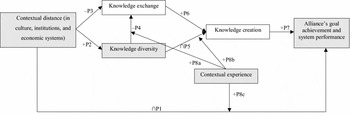
Viewing contextual distance as a double-edged sword may help clarify how contextual distance influences learning and the performance of international alliances. According to the organizational learning perspective, learning involves knowledge identification, exchange, integration/creation, and application (Huber, Reference Huber1991; Pawlowsky, Reference Pawlowsky, Dierkes, Berthoin-Antal, Child and Nonaka2001). Differences in national cultures, norms, regulatory institutions, and levels of economic development would be expected to influence knowledge stocks and their diversity, but also knowledge exchange and creation. The partners’ contextual experience should also influence learning, perhaps enhancing the benefits of contextual distance or mitigating its drawbacks. Using a sample of 46 studies involving ISAs in China, we tested the direct link between contextual distance and ISA performance and moderation by contextual experience in a meta-analysis. Finally, we suggested areas for future research based on the proposed framework. Figure 1 presents this conceptual framework.
A conceptual model: Contextual distance and learning in alliances
Note: Relationships linked by the constructs in the shaded boxes were verified by meta-analysis.

CONCEPTUAL FRAMEWORK AND PROPOSITIONS
In recent years, management scholars have paid increasing attention to knowledge exchange and creation involving domestic and foreign firms in emerging markets such as China (Cantwell & Zhang, Reference Cantwell and Zhang2013; Li, Chen, & Shapiro, Reference Li, Chen and Shapiro2013; Li, Zhang, & Lyles, Reference Li, Zhang and Lyles2013). Firms establish international alliances to seek knowledge (Kogut, Reference Kogut1988; Teece, Reference Teece1986), but alliance building and operation is itself a learning process (Child & Yan, Reference Child and Yan2003). The findings of prior research confirm the common assumption that as differences in national cultures, regulatory regimes, political systems, and levels of economic development between alliance partners increase, mutual understanding, communication, and knowledge integration become more difficult (Johanson & Vahlne, Reference Johanson and Vahlne1977; Salomon & Martin, Reference Salomon and Martin2008). Still, contextual distance can sometimes facilitate learning in mergers and acquisitions (Reus & Lamont, Reference Reus and Lamont2009; Stahl & Voigt, Reference Stahl and Voigt2008) as well as in alliances (Phan & Peridis, Reference Phan and Peridis2000). Through our conceptual analysis, we attempt to reconcile or integrate these inconsistent findings.
Three constructs are at the core of the learning processes: knowledge diversity, knowledge exchange, and knowledge creation. Knowledge diversity is defined as the extent to which alliance partners’ organizational codes and routines, such as different rules, procedures, and mental models, differ from each other (Argyris & Schön, Reference Argyris and Schön1996). Knowledge exchange in an alliance context refers primarily to the exchange of operational methods, know-how, and feedback regarding products and procedures between partners (Cummings, Reference Cummings2003). Knowledge creation occurs when alliance partners integrate each other's knowledge with their own to create new ideas, routines, and codes (Alavi & Tiwana, Reference Alavi and Tiwana2002; Fang, Reference Fang2011; Phan & Peridis, Reference Phan and Peridis2000).
By definition, contextual distance can bring diverse knowledge repertoires, heterogeneous mindsets, different viewpoints, and alternative business models into an alliance. At the same time, it seems intuitive that distance will create communication barriers and tend to inhibit the exchange of knowledge. So the relationship between knowledge diversity and knowledge creation might well be curvilinear: some diversity may facilitate knowledge creation, but either too little or too much diversity might inhibit it. In the former case, there is too much knowledge overlap, while in the latter case, there is so little as to provide no basis for communication.
Contextual Distance and Alliance Performance
Cultural distance and other forms of contextual distance would certainly be expected to dampen an alliance's performance through creating misunderstandings and conflicts (Barkema & Vermeulen, Reference Barkema and Vermeulen1997; Hennart & Zeng, Reference Hennart and Zeng2002, Parkhe, Reference Parkhe1991). A meta-analysis by Reus and Rottig has shown that this is so (Reus & Rottig, Reference Reus and Rottig2009). Contextual distance may also impair alliance performance by setting up barriers to the knowledge exchange (De Long & Fahey, Reference De Long and Fahey2000; Fang & Zou, Reference Fang and Zou2010) that is necessary for organizational learning (Aguilera, Reference Aguilera2007; Argote & Ingram, Reference Argote and Ingram2000) and knowledge creation (Nahapiet & Ghoshal, Reference Nahapiet and Ghoshal1998). So that, too, should dampen alliance performance. In addition, diversity in terms of culture, institutions, and economic system may lead to partners having diverse knowledge bases (Hambrick, Li, Xin, & Tsui, Reference Hambrick, Li, Xin and Tsui2001; Shin, Kim, Lee, & Bian, Reference Shin, Kim, Lee and Bian2012), and this can have an inverted U-shaped relationship with knowledge creation and, thus, alliance performance (Dahlin, Weingart, & Hinds, Reference Dahlin, Weingart and Hinds2005; Katila, Reference Katila2002). In sum, combining these three possible mechanisms, we propose:
Proposition 1: Contextual distance between the partners (in culture, institutions, and economic systems) has an inverted U-shaped relationship with an alliance's performance.
Contextual Distance and Knowledge Diversity
Contextual distance comprises cultural, institutional, and economic elements, where the cultural distance between countries refers to differences in management practices, values, mindsets, and norms of behavior (Hofstede, Reference Hofstede1984, Reference Hofstede2001; Kogut & Singh, Reference Kogut and Singh1988). Any or all of these distance dimensions might potentially generate learning opportunities (Park & Ungson, Reference Park and Ungson1997; Parkhe, Reference Parkhe1991). Nationality has a particular influence on values, mental models, demeanor, language, and so on (Hambrick, Davison, Snell, & Snow, Reference Hambrick, Davison, Snell and Snow1998; Roberts & Boyacigiller, Reference Roberts, Boyacigiller, Cummings and Staw1984), so the nationalities of an alliance's managers could be an important source of cognitive diversity (Hambrick et al., Reference Hambrick, Li, Xin and Tsui2001), ‘. . .[providing] team members with a wide range of ideas, perspectives, knowledge, and values’ (Shin et al., Reference Shin, Kim, Lee and Bian2012: 199). Empirical work has confirmed that variety in national culture increases knowledge and skill diversity (Shachaf, Reference Shachaf2008).
Institutional distance describes the extent of dissimilarity in the regulatory, cognitive, and normative institutions of alliance partners’ home countries (Kostova, Reference Kostova1996; Xu & Shenkar, Reference Xu and Shenkar2002). When such institutional distance is great, as between China and western countries, for example (Ahlstrom, Young, Nair, & Law, Reference Ahlstrom, Young, Nair. and Law2003), the partners in an alliance must deal with different regulations and norms of business practice (Eden & Miller, Reference Eden and Miller2004) beyond the ‘. . .different cognitive structures and social knowledge shared by the people in a given country’ (Kostova, Reference Kostova1997: 180). If they can do so, institutional distance could bring diverse knowledge to an alliance.
Economic distance describes differences in the level of economic development between the partners’ home countries. It involves differences in factor costs (such as natural resources, financial resources, and human resources), in infrastructure development, and in technological capabilities (Ghemawat, Reference Ghemawat2001; Tsang & Yip, Reference Tsang and Yip2007). Firms from developed and less developed countries normally rely on different information sources and have different ways of doing business. Thus, the greater the economic distance between alliance partners, the more diverse the alliance's knowledge base will tend to be. Taken together, we propose:
Proposition 2: Contextual distance relates positively to knowledge diversity in an alliance.
Contextual Distance and Knowledge Exchange
Knowledge exchange in an alliance context refers primarily to the exchange of operational methods, know-how, and feedback regarding products and procedures between the partners (Cummings, Reference Cummings2003). Cultural distance usually impedes such exchanges because of different norms of behavior (Lin & Germain, Reference Lin and Germain1998; Luo & Park, Reference Luo and Park2004). Specifically, in a survey conducted by De Long and Fahey (Reference De Long and Fahey2000), managers in multicultural joint ventures (actually, equity-based international alliances) frequently mentioned problems arising from poor communication owing to cultural barriers. Poor communication impedes knowledge sharing and exchange (Fang & Zou, Reference Fang and Zou2010) and can also limit intercultural understanding and lead to misunderstandings about assignments (Heiman & Nickerson, Reference Heiman and Nickerson2004; Heiman, Li, Chan, & Aceves, Reference Heiman, Li, Chan and Aceves2008; Oxley, Reference Oxley1997). In the worst case scenario, managers from one partner firm may incorrectly interpret certain actions or statements of managers from the other. Cultural distance, thus, can impede knowledge exchange.
Similarly, knowledge exchange tends to be more difficult when the institutional distance between the partners’ home markets is great. In an emerging economy such as China’s, the legal framework, particularly property rights law, contract law, corporate law, and arbitration, is relatively weak compared with the more established institutional environment in developed economies (Ahlstrom et al., Reference Ahlstrom, Young, Nair. and Law2003; Studwell, Reference Studwell2003). With concerns about intellectual property rights protection, foreign partners might be unwilling to share advanced knowledge with a local partner. In addition, local managers may have a limited understanding of global business (Braun & Warner, Reference Braun and Warner2002; Goodall, Warner, & Lang, Reference Goodall, Warner and Lang2004) and foreign managers may not be familiar with the local institutional environment and ways of doing business there (Ahlstrom et al., Reference Ahlstrom, Young, Nair. and Law2003). As a result, partners may develop different perceptions about normative obligations, expectations, goals, and appropriate means of attaining them. Such discrepancies make it difficult to communicate ideas and to cooperate.
Firms from emerging economies usually lag in their technological, management, and marketing expertise, even though they enjoy lower factor costs, particularly in wages and rent (Tsang & Yip, Reference Tsang and Yip2007). Their different expertise and knowledge, even if perceived as lower level, should be helpful to an alliance, but the knowledge gap might impede the exchange of information required to exploit the diversity. In addition, economic distance may lead to different opinions about employee compensation, which might nurture perceptions of unfairness or even conflict. This suggests a third proposition:
Proposition 3: Contextual distance relates negatively to knowledge exchange between alliance partners.
Knowledge Diversity and Knowledge Exchange
Individuals often tend to apply social categories to themselves and others (Tajfel & Turner, Reference Tajfel, Turner, Worchel and Austin1985). They do so based primarily on demographic characteristics, including information dimensions such as education level and expertise (Shin et al., Reference Shin, Kim, Lee and Bian2012; Wiersema & Bantel, Reference Wiersema and Bantel1993). In a strategic alliance, expertise is a primary basis of knowledge diversity, and different specializations may split alliance members into different expert camps. Members will tend to perceive those from a different expert camp as less trustworthy, less capable, and less cooperative (Brewer, Reference Brewer1979; Tajfel, Reference Tajfel1982). This perception would impede interpersonal or intergroup relations and promote communication breakdowns in the alliance (Hambrick et al., Reference Hambrick, Li, Xin and Tsui2001; Li & Hambrick, Reference Li and Hambrick2005). Knowledge exchange between the partners would be impaired.
When seeking or applying new knowledge, it helps to have a knowledge base in the same or a similar area, as similarity will facilitate understanding the intricacies of the new knowledge and how it can be best applied to the firm's unique circumstances. An alliance partner may have difficulty absorbing knowledge that is very different from what it currently knows (Cohen & Levinthal, Reference Cohen and Levinthal1990). A study by Lane and Lubatkin (Reference Lane and Lubatkin1998) found that the ability of firms to learn from one another in an alliance depends on the similarity between the partner firms’ knowledge bases, organizational structures, and dominant logics. Therefore,
Proposition 4: Knowledge diversity among the partners in an alliance will relate negatively to knowledge exchange between them.
Knowledge Diversity and Knowledge Creation
Knowledge is created when alliance partners integrate each other's knowledge to create new ideas, routines, and codes (Alavi & Tiwana, Reference Alavi and Tiwana2002; Fang, Reference Fang2011; Phan & Peridis, Reference Phan and Peridis2000). In this process, diversity can have contrasting effects. A moderate level of diversity should reveal opportunities for learning that will tend to emerge from the diverse perspectives, mindsets, business models, and knowledge bases newly available through the alliance. Cohen and Levinthal (Reference Cohen and Levinthal1990) have observed that ‘In addition to strengthening assimilative powers, knowledge diversity also facilitates the innovative process by enabling the individual to make novel associations and linkages’ (Cohen & Levinthal, Reference Cohen and Levinthal1990: 131). If knowledge diversity is too great, however, the partners’ different perspectives, mindsets, and business models may be so divergent that it may become impossible for the partners to maintain consensus and effectively absorb knowledge from each other (Hambrick et al., Reference Hambrick, Li, Xin and Tsui2001; Li & Hambrick, Reference Li and Hambrick2005). Prior research has confirmed that knowledge diversity can create barriers to knowledge integration (Ahuja, Reference Ahuja2000; Hinsz, Reference Hinsz1990; Johnsson, Reference Johnsson, Birkinshaw and Hagstrom2000; Walsh, Reference Walsh1995). Chi, Huang, and Lin (Reference Chi, Huang and Lin2009) found that differences in organizational tenure have an inverted U-shaped relationship with team innovation. Dahlin et al. (Reference Dahlin, Weingart and Hinds2005) found that diversity in educational background had an inverted U-shaped relationship with the range and depth of information co-workers use and that national diversity had an inverted U-shaped relationship with the depth of information they use and its integration. Katila (Reference Katila2002) found that the age variance of the external knowledge searched by a firm had an inverted U-shaped relationship with the number of new products the firm introduced. We propose:
Proposition 5: Knowledge diversity in an alliance will have an inverted U-shaped relationship with knowledge creation.
Knowledge Exchange and Knowledge Creation
Creating new knowledge in an alliance often involves integrating different types of specific knowledge brought to it by the partners (Dussauge, Garrette, & Mitchell, Reference Dussauge, Garrette and Mitchell2000; Nahapiet & Ghoshal, Reference Nahapiet and Ghoshal1998; Rothaermel, Reference Rothaermel2001). This works best if partners are familiar with each other's knowledge base as a result of knowledge exchange and interaction. Some scholars even argue that interaction and individuals’ exposure to partner knowledge is a necessary condition for organizational learning (Aguilera, Reference Aguilera2007; Argote & Ingram, Reference Argote and Ingram2000), assuming, as some do, that knowledge creation depends on the collective ability of employees to exchange and combine knowledge (Nahapiet & Ghoshal, Reference Nahapiet and Ghoshal1998).
Proposition 6: Knowledge exchange between alliance partners will relate positively to knowledge creation in the alliance.
Knowledge Creation and Performance
Following Child and Yan (Reference Child and Yan2003), we will focus on two types of alliance performance – goal achievement and system performance. Goal achievement describes the extent to which each parent company's objectives in forming the alliance are realized. System performance is the extent to which the alliance itself performs well. Knowledge creation should promote good performance in both goal and system terms.
Learning in an alliance is valuable to the parent firms, because often they can apply it to other geographic markets, products, and businesses, as well as in other alliances (Lyles, Reference Lyles1988). On occasion, it can even enhance operations at headquarters (Inkpen, Reference Inkpen2000). In any case, any new knowledge created facilitates the alliance's own operations and helps improve its performance (Luo, Reference Luo2002d). New products, market entry (Fang, Reference Fang2011), stability, and other operational improvements are typical outcomes (Das & Teng, Reference Das and Teng2000; Fang & Zou, Reference Fang and Zou2010).
Proposition 7: Knowledge creation in an alliance will relate positively to the alliance's goal achievement and system performance.
The Moderating Role of Contextual Experience
We define contextual experience as the extent to which an ISA partner has been exposed to the host country contexts, consistent with the organizational learning literature, which emphasizes learning from past experience (Cohen & Levinthal, Reference Cohen and Levinthal1990; Cyert & March, Reference Cyert and March1963). In an international alliance, prior experiences related to the partner's national context should facilitate learning and system performance (Barkema, Shenkar, Vermeulen, & Bell, Reference Barkema, Shenkar, Vermeulen and Bell1997). Although knowledge diversity may hamper knowledge exchange due to differences between the two contexts, contextual experience should tend to reduce the difficulties (Inkpen, Reference Inkpen1998). The knowledge overlap between the partners is likely to increase with experience, and as a result, the absorptive capacity of the alliance should be enhanced (Cohen & Levinthal, Reference Cohen and Levinthal1990). Specifically, when an alliance partner has prior experience working with partners from a foreign country, its ability to communicate effectively with other foreign partners should improve (Zeira & Shenkar, Reference Zeira and Shenkar1990). At the same time, its absorptive capacity is normally enhanced, and this helps it assimilate new knowledge from foreign partners in later alliances.
Trust between partners is also likely to increase with experience (Gulati, Reference Gulati1995; Larson, Reference Larson1992). Parkhe (Reference Parkhe1993) observed that prior cooperation reduces expectations of opportunistic behavior in new international joint ventures. Luo (Reference Luo2006) found that previous experience of collaboration with a foreign partner promotes fairness in interactions, more effective decision-making, greater interpersonal trust among managers, and even interorganizational attachment. Experienced partners are more willing to share information, promoting knowledge exchange despite substantial knowledge diversity. As contextual experience increases each party's absorptive capacity along with communication and trust, it is easier for the partners to learn by integrating their different ideas and perspectives. This enhances the positive influence of knowledge diversity while minimizing its negative side.
Proposition 8a: Contextual experience weakens the negative relationship between knowledge diversity and knowledge exchange (P4), such that the negative relationship is weaker at a high than at a low level of contextual experience.
Proposition 8b: Contextual experience moderates the inverted U-shaped relationship between knowledge diversity and knowledge creation (P5), such that a high level of contextual experience enhances the positive influence of knowledge diversity on knowledge creation when knowledge diversity is low to moderate, while weakening the negative influence of knowledge diversity on knowledge creation when knowledge diversity is high.
Proposition 8c: Contextual experience moderates the inverted U-shaped relationship between contextual distance and alliance performance (P1), such that a high level of contextual experience enhances the positive influence of contextual distance on alliance performance when contextual distance is low to moderate, while weakening the negative influence of contextual distance on alliance performance when contextual distance is high.
A PARTIAL TEST THROUGH A META-ANALYSIS
These propositions together constitute a model describing learning in international alliances. Prior scholarly work in this area has mainly focused on demonstrating direct links between contextual distance and alliance performance. The mediation of knowledge diversity, exchange, and creation is assumed in these empirical studies. In this study, we will use a meta-analysis to examine the relationship between contextual distance and alliance performance (P1), the mediation path (P2, P5, and P7: contextual distance, knowledge diversity, and alliance performance), and the moderating role of contextual experience in the relationships (P8c).
Identification of Studies
The meta-analysis covered peer-reviewed articles published between 1990 and July 2013 on the performance of international alliances in China. Chinese alliances were selected because alliances in China grew into a central focus of academic interest during this period (Yang, Tipton, & Li, Reference Yang, Tipton and Li2010). Articles were identified for analysis through searches of the Proquest databases and a manual search of individual journals to ensure the representativeness and completeness of the sample. The Proquest databases were searched first using the following keywords: alliance, joint venture, performance, China, and Chinese. Then seven premier management journals, which often publish empirical research, were searched manually: Academy of Management Journal, Administrative Science Quarterly, Management Science, Journal of Management, Journal of Management Studies, Organization Science, and Strategic Management Journal; along with three major international business journals: Journal of International Business Studies, (Columbia) Journal of World Business, and Management International Review; and the two main journals devoted to management issues in Asia and China: Asia Pacific Journal of Management and Management and Organization Review.
The third round of searching covered those of the 45 business and management journals used by the Financial Times for ranking business school research not included in the first two rounds: Entrepreneurship Theory and Practice, Human Resource Management, Journal of Applied Psychology, Journal of Business Ethics, Journal of Business Venturing, Organization Studies, and Organizational Behaviour and Human Decision Processes.
Finally, the reference lists of the articles identified as relevant were reviewed to identify any additional studies that might have been overlooked in the previous stages (Nippa, Beechler, & Klossek, Reference Nippa, Beechler and Klossek2007; Ren, Gray, & Kim, Reference Ren, Gray and Kim2009; Reus & Rottig, Reference Reus and Rottig2009; Yang et al., Reference Yang, Tipton and Li2010). However, books and articles that had not been peer reviewed were excluded.
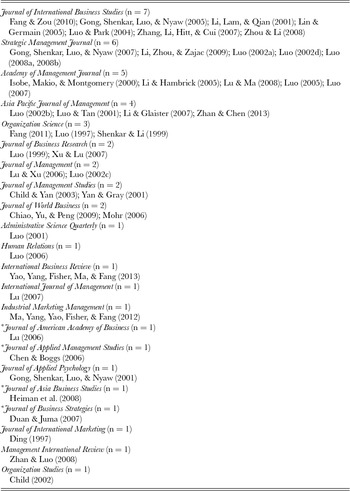
This process identified 53 empirical studies of alliance performance in China. Of these, 7 were excluded using three criteria. First, the reported sample size and statistics had to allow applying the formulas of Hunter and Schmidt (Reference Hunter and Schmidt1990: 272) to compute a correlation coefficient. Second, only studies studying ‘clean’ samples of international alliances were included. For example, a study by Puck, Holtbrügge, and Mohr (Reference Puck, Holtbrügge and Mohr2009), which examined the conversion of joint ventures into wholly owned subsidiaries in China, was excluded. Then only studies that examined at least two of the variables of interest were included. In the end, 46 studies reporting on 49 independent samples and 204 independent correlations were considered, giving a total sample size of 28,265 alliances. Table 1 lists the articles included in the meta-analysis, and they are identified by an asterisk in the list of references.
Studies included in the meta-analysis

Note: *Indicates a journal not indexed by the Social Sciences Citation Index
Measures
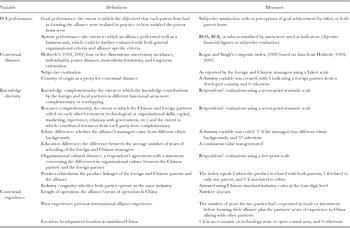
Dependent variable. Alliances often have hybrid structures and sometimes are rather transitory, so there is no scholarly consensus about how to describe and measure alliance performance (Buckley, Glaister, & Husan, Reference Buckley, Glaister and Husan2002; Chowdhury, Reference Chowdhury1992; Ren, Gray, & Kim, Reference Ren, Gray and Kim2009). In this study, Child and Yan's approach was used and alliance performance was decomposed into goal performance, referring to the partnering firms’ satisfaction with the alliance's accomplishments, and system performance, referring to the financial performance of the alliance itself (Child & Yan, Reference Child and Yan2003).
Independent variables. In the articles analyzed, contextual distance was usually measured in one of three ways. Some studies used a Euclidian distance measure based on an index developed by Kogut and Singh (Reference Kogut and Singh1988) and Hofstede's four or five cultural dimensions (Hofstede, Reference Hofstede2001). Others used differences along contextual dimensions as perceived by the foreign and Chinese partnering firms. A few studies used a dummy variable to indicate differences between countries. Typically ‘1’ indicated that the foreign partner was from a developed economy so contextual distance was presumably large. An alliance with a foreign partner from another less developed country was typically indicated by a ‘0’ and contextual distance was presumed to be small. In this meta-analysis, the sample was split into low contextual distance and high contextual distance groups based on the different methods used in measuring contextual distance. For studies measuring contextual distance with Kogut and Singh's index, those with a contextual distance equal to or above the median value were treated as high contextual distance and the others as low. For studies measuring contextual distance using some subjective measure (e.g., ratings on a Likert-type scale), those with contextual distance at or above the midpoint were considered as high contextual distance cases. A few studies used country of origin as a proxy. There were several studies that included samples of Sino-foreign alliances from different MNC home countries. In these studies, if half or more of the foreign parents in the sample were from developed countries, the case was included in the high contextual distance group.
Moderators. We use three measures, including the length of operation, prior experience, and regional development of an alliance's location in China, to quantify contextual experience. All increase one party's exposure to the other's national context. For example, a Chinese partner will be exposed to more foreign institutional norms as cooperation proceeds. Twenty-nine of the studies reported alliance duration. The median alliance duration was used to split the sample into old and young subgroups with 15 and 14 studies respectively.
The alliance partners’ prior experience was quantified in terms of the number of years the two parties had cooperated through trade or investment before forming the alliance, and also the Chinese partner's previous alliance experience with other foreign partners and the foreign partner's previous alliance experience with other Chinese partners. The three descriptors for each alliance were summed, and the sample was again split using the mean length of prior experience to form a more experienced group and a less experienced group.
The regional development of an alliance's location was indicated using a dummy variable coded ‘1’ if the alliance was located in one of China's special economic or technology zones or in a coastal area, and ‘0’ otherwise. China's economic reform started from the nation's eastern and coastal regions before expanding to other regions. The eastern and coastal regions were better developed and attracted more alliances from other ISAs about the contextual experiences. In the developed regions, it is easier for the alliance to accumulate contextual experiences by learning from other alliances.
The measures included in the meta-analysis are summarized in Table 2.
Variables and measures included in the meta-analysis

Analyses
As in other meta-analytic reviews (e.g., Horwitz & Horwitz, Reference Horwitz and Horwitz2007) the correlation coefficient (r) was used as the primary index of effect size. The statistical results reported from each study were first transformed into an index of effect size by employing Fisher's r to z transformation to minimize any underestimation bias (Fisher, Reference Fisher1970; Johnson & Eagly, Reference Johnson, Eagly, Reis and Judd2000). Each study's effect size was also weighted by the sample size to capitalize on the most reliably estimated study outcomes, generally those with larger samples (Hedges & Olkin, Reference Hedges and Olkin1985; Snedecor & Cochran, Reference Snedecor and Cochran1980). Subgroup analyses with a categorical model were used to test for any moderating effects following Hedges and Olkin's approach (Reference Hong, Liao, Hu and Jiang1985), which was used in some recent studies (e.g., Hong, Liao, Hu, & Jiang, Reference Hong, Liao, Hu and Jiang2013; Kirca et al., 2011). Categorical models can provide a between-subgroup effect, Qb, which is analogous to an interaction effect in analysis of variance, and a test of the significance of observed differences in effect sizes between subgroups.
RESULTS
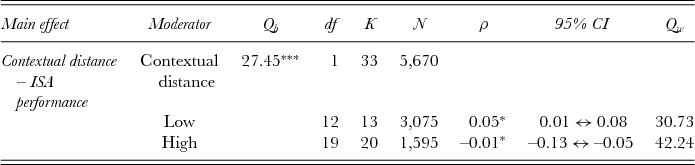
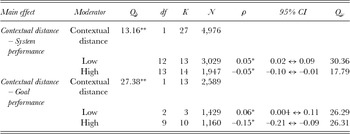
Tables 3 and 4 present the results relating contextual distance with alliance performance (P1). In the low contextual distance group, the relationship between contextual distance and performance was positive (ρ = 0.05, p ≤ 0.05), while in the high contextual distance group, it was negative (ρ = –0.01, p ≤ 0.05). This suggests an inverted U-shaped relationship between contextual distance and alliance performance. When performance was decomposed into goal performance and system performance, the results were similar. Contextual distance was positively related to system performance in the low contextual distance group (ρ = 0.05, p ≤ 0.05), but the relationship was negative when the contextual distance was large (ρ = –0.05, p ≤ 0.05). The same pattern was observed in the contextual distance and goal performance relationship, suggesting a robust inverted U-shaped relationship. Proposition 1 was therefore strongly supported.
Contextual distance and ISA performance (P1)

Note: K = number of correlations, N = total sample size, ρ = estimated population parameter (weighted mean effect size), 95% CI = the upper and lower bound of the 95% confidence interval, Qw = homogeneity statistic, and df = degrees of freedom.
*p ≤ 0.05 and ***p ≤ 0.001.
Contextual distance and the two types of ISA performance (P1)

Note: K = number of correlations, N = total sample size, ρ = estimated population parameter (weighted mean effect size), 95% CI = the upper and lower bound of the 95% confidence interval, Qw = homogeneity statistic, and df = degrees of freedom.
*p ≤ 0.05 and **p ≤ 0.01.
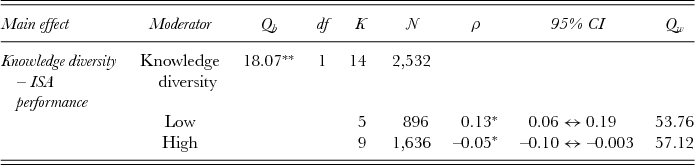
Due to the limited number of empirical studies on alliance learning in the Chinese context, we were only able to partially test the mediating processes in the model. First, as shown in Table 5, contextual distance increased knowledge diversity (ρ = 0.08, p ≤ 0.05), thereby supporting Proposition 2. Table 6 shows an inverted U relationship between knowledge diversity and ISA performance, consistent with P5 and P7 (even though we do not have data on knowledge creation, which mediates knowledge diversity and ISA performance). More specifically, knowledge diversity is positively related to ISA performance when knowledge diversity is low (ρ = 0.13, p ≤ 0.05), and the relationship turns negative when knowledge diversity is high (ρ = –0.05, p ≤ 0.05). In sum, a key mediation path between contextual distance and ISA performance was generally supported.
Contextual distance and knowledge diversity (P2)

Note: K = number of correlations, N = total sample size, ρ = estimated population parameter (weighted mean effect size), 95% CI = the upper and lower bound of the 95% confidence interval, Qw = homogeneity statistic, and df = degrees of freedom.
*p ≤ 0.05.
Knowledge diversity and performance (P5 and P7)

Note: K = number of correlations, N = total sample size, ρ = estimated population parameter (weighted mean effect size), 95% CI = the upper and lower bound of the 95% confidence interval, Qw = homogeneity statistic, and df = degrees of freedom.
*p ≤ 0.05 and **p ≤ 0.01.
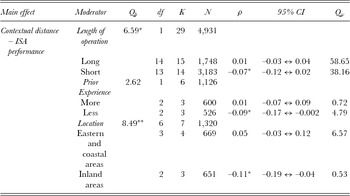
Due to data availability, the data on the two types of performance were pooled when studying moderating effects. As Table 7 shows, Qb for contextual distance, as indicated by the length of alliance operation, was significant (p ≤ 0.05), which means the relationship between contextual distance and performance weakens as the length of alliance operation increases.
Moderation of contextual experience on the relationship between contextual distance and ISA performance (P8c)

Note: K = number of correlations, N = total sample size, ρ = estimated population parameter (weighted mean effect size), 95% CI = the upper and lower bound of the 95% confidence interval, Qw = homogeneity statistic, and df = degrees of freedom.
*p ≤ 0.05 and **p ≤ 0.01.
Moreover, as Table 7 shows, a between-group analysis confirms that prior experience with an alliance partner can minimize the negative effect of contextual distance – the more prior experience, the lower the negative effect of contextual distance on performance.
For alliances based in more developed areas in China, contextual distance did not show any significant relationship with performance. In the less-developed inland areas, however, contextual distance did show a significant and negative relationship with performance (ρ = –0.05, p ≤ 0.05). The between-group difference was also significant (p ≤ 0.01). The results are in support of Proposition 8c.
DISCUSSION
We argue that the contextual distance between the partners (as in culture, institutions, and economic systems) increases knowledge diversity but decreases knowledge exchange between the alliance partners, which has implications for the alliance's knowledge creation and performance. A partial meta-analysis of existing empirical studies of international alliances in China shows that contextual distance has an inverted U-shaped relationship with performance. It is also positively related to knowledge diversity, while knowledge diversity itself has an inverted U-shaped relationship with performance. So the curvilinear relationship between contextual distance and performance may come from the curvilinear relationship between knowledge diversity and performance. While we are not able to test directly the mediation effect of knowledge creation in this article, prior research from the learning perspective has suggested that knowledge creation is critical for alliance performance (Huber, Reference Huber1991; Pawlowsky, Reference Pawlowsky, Dierkes, Berthoin-Antal, Child and Nonaka2001). Moreover, contextual experience may mitigate effects of the negative relationship between contextual distance and performance.
These results make several contributions to our understanding of the determinants of international alliance performance, at least in China. First, scholars have often taken a primarily negative view of contextual distance, yet their theories have received only mixed empirical support (Gupta & Govindarajan, Reference Gupta and Govindarajan2000; Luo & Park, Reference Luo and Park2004; Lyles & Salk, Reference Lyles and Salk1996). Consistent with Phan and Peridis's (Reference Phan and Peridis2000) suggestion that contextual distance and differences are necessary for knowledge creation and with the results of some studies of cultural distance effects in mergers and acquisitions (Reus & Lamont, Reference Reus and Lamont2009; Stahl & Voigt, Reference Stahl and Voigt2008), this meta-analysis found evidence of competing roles for contextual distance in influencing alliance performance.
Second, the conceptual framework used here may help explain how learning works in strategic alliances (Fang, Reference Fang2011; Fang & Zou, Reference Fang and Zou2010; Grant, Reference Grant1996; Kogut & Zander, Reference Kogut and Zander1992) by elucidating how contextual distance can facilitate joint learning. In emerging economies with complex and fast-changing markets and strong government regulation as in China, joint learning among alliance partners can be critical in developing new knowledge to respond to the dynamic environment (Fang & Zou, Reference Fang and Zou2010). The results of this study echoed Nippa's review that ‘. . .applying this [organizational learning] perspective to the Chinese context seems to be a promising approach for future research’ (Nippa et al., Reference Nippa, Beechler and Klossek2007: 10).
Third, in an emerging economy such as China, the problems created by contextual distance may not be addressed easily through formal institutions such as the legal system. Contextual distance might then be a major issue. Thus, it is more challenging to manage contextual distance in an emerging market. However, the results of this study show that contextual experience can help enhance the benefits of contextual distance and mitigate its negative influence.
Limitations and Future Research Directions
The conceptual framework underlying this work was only partially tested through meta-analysis, because relevant empirical studies in the Chinese context were limited. Even beyond the Chinese context, several of the propositions presented in this article remain underexplored in the literature. For example, Lyles and Salk (Reference Lyles and Salk1996) did not find any significant relationship between cultural distance and knowledge acquisition in a study of international joint ventures in Hungary. However, in a follow-up study, also with a Hungarian sample, they found that cultural compatibility among a venture's parent firms facilitated learning from the foreign parent and that knowledge acquisition predicted better performance (Lane, Salk, & Lyles, Reference Lane, Salk and Lyles2001). Fang (Reference Fang2011) found that different knowledge bases led to new product innovations for a sample of Sino-foreign alliances. Also, the relationship between institutional distance and knowledge exchange and knowledge creation and the relationships among knowledge diversity, knowledge exchange, and knowledge creation have been underexplored empirically in the Chinese context.
Due to the limited number of empirical studies published in this area, the meta-analysis was able to apply only analysis of variance to analyze each of the proposed relationships. Beyond verifying each path, future studies might fruitfully test the overall model. As additional studies emerge, scholars can consider applying more advanced techniques such as meta-regression models. Many constructs, such as knowledge diversity, have been operationalized in different ways in prior studies. This has made replications rare. Thus, future studies should pay more attention to the validity of the measures of each construct.
To maintain coherence and clarity, this work focused on the macrolevel organizational learning processes in Chinese alliances. The microlevel foundations of the process remain an important topic for future examination. Future studies should examine the learning processes in greater detail. For example, with the exception of several studies by Hambrick and his colleagues (Hambrick et al., Reference Hambrick, Li, Xin and Tsui2001; Li & Hambrick, Reference Li and Hambrick2005; Li, Xin, & Pillutla, Reference Li, Xin and Pillutla2002; Li, Xin, Tsui, & Hambrick, Reference Li, Xin, Tsui and Hambrick1999), the role of an alliance's senior managers has received inadequate scholarly attention. Even less attention has been paid to how contextual distance influences learning through top managers. For example, knowledge diversity might stimulate the emergence of contending subgroups within an alliance's top management team (Li & Hambrick, Reference Li and Hambrick2005). This presumably would impair knowledge exchange between the partners. Future studies could examine such groups and their relationship with knowledge diversity and knowledge exchange. At the same time, leadership might be one important countervailing factor (Dowell, Shackell, & Stuart, Reference Dowell, Shackell and Stuart2011; Finkelstein, Reference Finkelstein1992; Fischer & Pollock, Reference Fischer and Pollock2004). Equally powerful subgroups tend to lead to fierce fighting (Lau & Murnighan, Reference Lau and Murnighan1998), but a powerful CEO could integrate such factional groups and motivate cooperation between them.
Finally, the meta-analysis in this study included one Chinese contextual variable – regional development. Future studies should operationalize and analyze more contextual factors through deeper contextualization (Tsui, Reference Tsui2007). Such context-specific variables might include the political connections of the alliance's leaders (Fan, Wong, & Zhang, Reference Fan, Wong and Zhang2007; Wang & Qian, Reference Wang and Qian2011), guanxi (Chen, Chen, & Huang, Reference Chen, Chen and Huang2013; Luo, Huang, & Wang, Reference Luo, Huang and Wang2012), or dialectical thinking (Peng & Nisbett, Reference Peng and Nisbett1999). Chinese people tend to apply dialectical methods more readily than people from other cultures (Peng & Nisbett, Reference Peng and Nisbett1999; Spencer-Rodgers, Williams, & Peng, Reference Spencer-Rodgers, Williams and Peng2010). If the foreign partner is also from a culture that readily applies dialectics, for example, South America, the negative effects of contextual distance could be mitigated and the positive effects of knowledge diversity may be amplified because the partners may prove more adept at dealing with contradictions and compromising.
CONCLUSION
These results have delineated the learning process triggered by contextual distance in an alliance. The most intriguing finding is that contextual distance leads to knowledge diversity, which can either facilitate or impede knowledge creation. In addition, contextual experience can strengthen the benefits of knowledge diversity. Therefore, rather than taking a negative view of contextual distance in alliances, the nuanced learning processes it can trigger deserve greater scholarly attention.
SUPPLEMENTARY MATERIAL
To view supplementary material for this article, please visit http://dx.doi.org/10.1017/mor.2015.15