

INTRODUCTION
The answer to the question, how much regional missile defense is enough? has immense significance to the future of US–China security relations. It is often the most prominent issue of contention in the pursuit of nuclear arms control and strategic stability between the US and China.Footnote 1 In the minds of many Chinese strategists, the current deployment of American and allied regional ballistic missile defenses (BMD) in the Asia-Pacific exceeds the need to protect against North Korean ballistic missile threats. They often tend to argue that “North Korean [conventional] missile forces are not now, and will not become significant, and that North Korea and other rogue nations have been and will continue to be deterred by the overwhelming US conventional and nuclear capabilities” (McVadon Reference McVadon, Scobell and Wortzel2002, 172; Saalman Reference Saalman, Arbatov and Dvorkin2013a, 229 and 230).
Beijing argues that, apart from PATRIOT missile defenses, all regional BMD affect its strategic deterrent. For instance, when the United States and South Korea made an alliance decision to deploy the Terminal High Altitude Area Defense (THAAD) to the region, Chinese Foreign Minister Wang Yi argued in an interview that “the coverage of the THAAD missile defense system, especially the monitoring scope of its X-Band radar, goes far beyond the defense needs of the Korean peninsula. It will reach deep into the hinterland of Asia” and “directly damage China's strategic security” (Consulate-General of the People's Republic of China in Los Angeles 2016). Similarly, many Chinese analysts believe that “the substantial presence” of BMD-capable Aegis ships deployed to defend against North Korean missiles “reflect an American determination to establish an offensive ‘anti-ballistic missile net’ across the Pacific” to envelop China (Yoshihara Reference Yoshihara, Erickson and Goldstein2011, 344 and 348; Jize and Xiaokun Reference Jize and Xiaokun2010).
Chinese scholars and officials complain that these US regional missile defenses offset the bilateral strategic nuclear balance and give America the potential to execute a first strike in a crisis. For example, The Science of Military Strategy, published by the Chinese Academy of Military Science, declares that “the United States sees China as its primary strategic adversary and is stepping up the building of a missile defense system for the East Asia region” to contain and dilute China's nuclear deterrent capabilities (Chase Reference Chase2015, 5; Zhao Reference Zhao2017, 30, 31, 36, and 37). Therefore, the Chinese argue, they have no other option but to increase the number of strategic missiles and nuclear weapons and, if necessary, place them on higher alert status (Kulacki Reference Kulacki2016; Cunningham and Fravel Reference Cunningham and Taylor Fravel2015, 7 and 8).
American policymakers, however, insist that missile defense deployments in the Asia-Pacific region are defensive by design and do not have the ability to dilute China's nuclear deterrent. The 2019 Missile Defense Review (MDR) released by the Trump administration reaffirms that US missile defense capabilities are designed to provide defense only “against rogue states’ offensive missile threats” (US Department of Defense 2019, 31). The document reiterates that the US “relies on deterrence to protect against large and technically sophisticated Russian and Chinese intercontinental ballistic missile threats” (US Department of Defense 2019, 31). Similarly, the Trump administration's National Security Strategy released in December 2017 said that “enhanced missile defense is not intended to undermine strategic stability or disrupt longstanding strategic relationships with Russia or China” (The White House 2017, 8). Past administrations have offered similar reassurances.Footnote 2
Many American policymakers assert that the regional missile defense deployments in place now are motivated by genuine concerns about a large and proliferating North Korean ballistic missile arsenal. US policymakers argue that North Korea has accumulated a large variety of ballistic missiles capable of ranging all Asia-Pacific, including Guam. US policymakers also claim that North Korea has continuously enhanced the capabilities of its missile force with various technological and operational innovations. For example, in 2014 North Korea test-launched a missile “at a steeper (i.e., lofted) angle” raising its maximum altitude and terminal impact velocity (Sankaran and Fearey Reference Sankaran and Fearey2017, 8). A South Korea military source suggested that “by carrying out such a test, North Korea appears to have come up with a way not to be caught by either the South Korean or American” PATRIOT missiles defense emplaced in South Korea (Yonhap News 2014). The US–South Korean THAAD deployment decision was partly motivated as a response to retain a capacity to defend against missile “launched at high trajectories” (Grisafi Reference Grisafi2015).
American policymakers claim that other missile defense deployments in the Asia-Pacific region are reasonable and limited, and arguably even insufficient to mitigate the North Korean threat in a war. For instance, Admiral Jonathan Greenert, Chief of Naval Operations and General Raymond Odierno, Army Chief of Staff argued in 2014 that “ballistic missile threats are increasingly capable” and “continue to outpace our active missile defenses” (“Document: Army–Navy Memo on Need for Ballistic Missile Defense Strategy,” 2015). Admiral Bill Gortney, a former commander of the US fleet, has pointed out that US BMD-capable ships are trying “to meet demand at an unacceptable personnel tempo” compromising on essential maintenance and upgrades (Associated Press 2013).
In other words, the US believes its regional missile defenses are very limited and have no potential for offense. Yet, Chinese analysts claim that there are now too many missile defenses in their neighborhood with a clear offensive mission. Who is correct? What explains the differing assessments? Are the differences objectively valid, or are they framed and interpreted with certain biases?
These questions have not been explored in an empirically rigorous fashion in the existing literature. Most insights are interpretations derived from statements made by policymakers and analysts. In this article, I employ physics-based modeling and simulations to offer more accurate answers to these questions. The simulations are used to assess the amount of missile defense deployment that is adequate for a robust defense. The simulations are also used to determine whether current deployments have intercept capabilities against Chinese strategic missiles.
The first section of the article outlines the size of the North Korean missile arsenal and the threat it poses to the US and its allies. The second section examines the contours of North Korean doctrine on missile warfare. The third section details the various regional missile defense assets deployed by the United States in the Asia-Pacific region. The fourth section of the article details the two simulation experiments performed to investigate the capabilities of the missile defense systems deployed in the Asia-Pacific region to protect US and allied forces. The two experiments show that PATRIOT missile defenses are ineffective against lofted trajectories and that THAAD is needed to handle these threats. Similarly, the empirical work demonstrates the need for Aegis BMD-capable ships to defend US and allied forces against North Korean missile salvos. The two experiments demonstrably argue that current deployments cannot be considered excessive.
The article's fifth section details the third simulation experiment and argues that existing forward-deployed regional missile defense radars and interceptors do not pose a significant threat to Chinese nuclear deterrence. The results of the third simulation experiment indicate that the United States continues to rely on mutual deterrence against China. Finally, the sixth section concludes with a discussion of the impact of biases and worst-case assumptions that influence Chinese national security threat estimation. The conclusion will then proceed to discuss ways to reassure China and preserve strategic stability.
NORTH KOREAN REGIONAL MISSILE THREAT
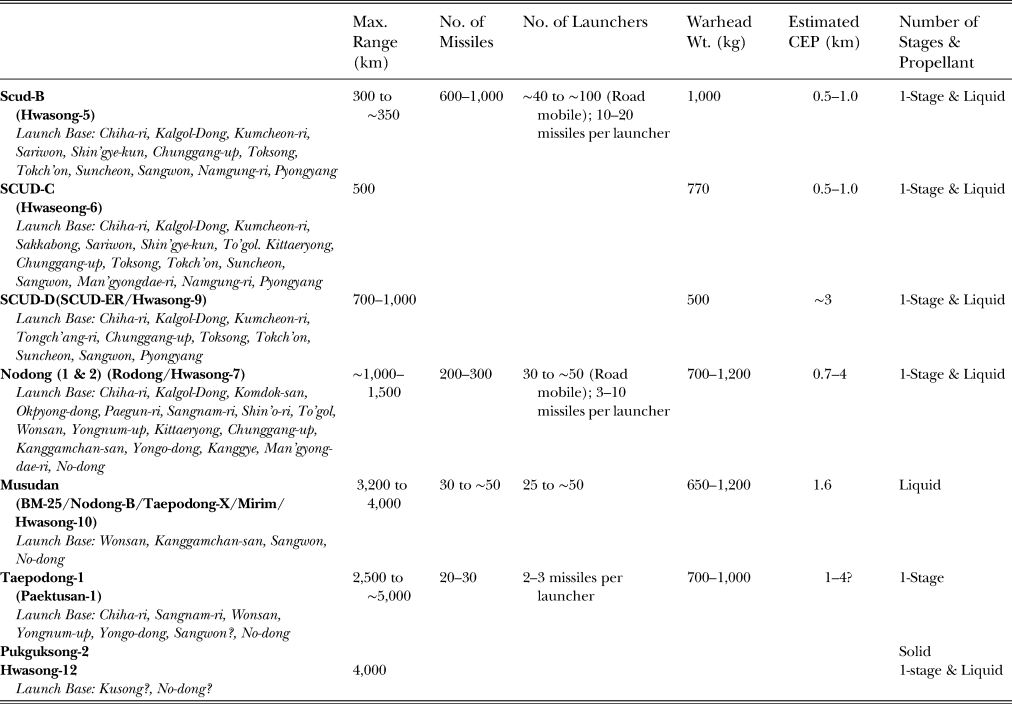
North Korea has diligently amassed a very large arsenal of short-, medium-, and intermediate-range ballistic missiles that can reach all parts of the Asia-Pacific region. The bulk of its arsenal consists of short-range Scud-type missiles (see Table 1), which are deployed throughout the country (Sankaran and Fearey Reference Sankaran and Fearey2017, 5–6). North Korea also has a substantial number of Nodong missiles with an approximate range of 1,300 kilometers and a limited number of intermediate-range ballistic missiles (see Table 1).
North Korean Short-, Medium-, and Intermediate- Range Missile Specifications

Data from: Bennett Reference Bennett, Crawford and Moon2000, 185; Bermudez Reference Bermudez2001 276 and 289; Cepek Reference Cepek2005, 23; Elleman Reference Elleman2017. “Musudan (BM-25),” Missile Threat, CSIS Missile Defense Project. https://missilethreat.csis.org/missile/musudan/; “Hwasong-7 (Scud ER Variant),” Missile Threat, CSIS Missile Defense Project, https://missilethreat.csis.org/missile/hwasong-7/; Missile Defense Advocacy Agency 2017; National Air and Space Intelligence Center (NASIC) 2017; Nuclear Threat Initiative 2013; Japan, Ministry of Defense 2017; Pinkston Reference Pinkston2008, 30, 50, and 51; Federation of American Scientists 2000; Bermudez Reference Bermudez2011; Nuclear Threat Initiative 2014;
All these missiles are capable of reaching the US and allied targets throughout the Asia-Pacific region. North Korean missiles, when armed with conventional, chemical, or biological warheads, could pose a military threat to major cities, military targets, and forward-deployed US forces and assets.Footnote 3 Biologically armed missiles, for instance, could “rival small nuclear weapons in their ability to kill people” (Fetter Reference Fetter1991, 26).Footnote 4 Similarly, North Korean missiles armed with chemical warheads could pose a particularly effective threat to military forces. The impact of a chemical weapon on a military base “is likely to send everyone into protective gear and seriously impair operations” and delay deployments of troops and equipment to the combat zone (Rubenson and Slomovic Reference Rubenson and Slomovic1990, 22 and 23). The same missile impacting a city could cause “40 to 700 times as many deaths, and 20 to 300 times as many injuries, as would result from the same missile armed with a conventional warhead” depending on the prevailing weather and other conditions (Fetter Reference Fetter1991, 21 and 22). Finally, conventionally armed missiles can delay military deployments if they destroy runways or naval berths. Repairing runways, aircraft shelters, naval berths, and other related equipment can take many days.
The United States and its allies consider these potential North Korean missile threats a very potent and immediate concern. Daniel R. Coats, the Director of National Intelligence, said at a Senate testimony in May 2017 that
North Korea has long posed a credible and evolving military threat to South Korea, and to a lesser extent, Japan. North Korea possesses a substantial number of proven mobile ballistic missiles, capable of striking a variety of targets in both countries … Kim has further expanded the regime's conventional strike options in recent years, with more realistic training … that enable precision fire at ranges that can reach more US and allied targets in South Korea (Coats Reference Coats2017; Bray Reference Bray2017, 8–9).
South Korean and Japanese officials also echo similar concerns.Footnote 5
IMAGINING THE NATURE OF A NORTH KOREAN MISSILE CAMPAIGN
North Korean leaders seem to believe that they can coerce South Korean, Japanese, and American decision-makers in a regional contingency using missiles.Footnote 6 Since the 1990s, North Korean defectors have warned about the missile threat suggesting that “Pyongyang will try to neutralize the bulk of friendly combat forces positioned near the Demilitarized Zone, derail the South's mobilization and American augmentation efforts” to force a negotiation quickly (US Defense Intelligence Agency 1991, 4–5).
In a 1997 congressional testimony, North Korean Col. Ju-Hal Choi said that
if a war breaks out in the Korean Peninsula, the North's main target will be US forces based in the South and Japan. That is the reason why the North has been working furiously on its missile programs. Kim Jong-il believes that if North Korea creates more than 20,000 American casualties in the region, the US will roll back, and North Korea will win the war (Choi and Ko Reference Choi and Ko1997).
These tactical preferences have persisted to this day.Footnote 7 In 2017, the former deputy chief of mission at the North Korean embassy in London informed in a US congressional hearing that if North Korea perceives an imminent attack it “would trigger automatic retaliation, with the North unleashing artillery and short-range missile fire” on South Korean and US forces (Pennington Reference Pennington2017; see also Fisher Reference Fisher2013).
There are currently close to 30,000 US servicemen stationed in South Korea as part of the US Force in Korea (USFK). In a conflict, these front-line troops may need to be augmented with as much as “690,000 ground, naval, and air force troops, 160 vessels, and 2,000 aircraft” (Ministry of National Defense 2016, 53).Footnote 8 Rather than waiting for such a massive force to be assembled and a Desert Storm-style operation “suddenly unleashed in high tempo” against it, North Korea seems to be willing to pre-empt if its survival is at stake (Swicker Reference Swicker1998, 10).
In trying to disrupt or delay the arrival of US troops, North Korea may use its ballistic missiles at the early stages of conflict to target major ports and air bases. In South Korea, Pusan and Chinhae naval bases and Osan and Kunsan air bases will be vital bases out of which the United States and allied Navy and Air Force will operate and within the range of North Korean missiles. In Japan, Yokosuka and Sasebo naval bases are viable targets within the range of North Korean missiles. A missile campaign aimed at these targets would derail or delay the arrival of these augmentation forces and significantly alter the course of a conflict.
A North Korean Foreign Ministry spokesman has also suggested that North Korea will consider attacking major cities in addition to military bases in Japan if it is “hostile towards the DPRK following the US” (Watanabe and Koike Reference Watanabe and Koike2018, 81). The North Koreans could also fire a few missiles at major commercial ports to intimidate the political leadership in Japan to stay out of a conflict. Given that Japan “relies on imports for 94 percent of its primary energy supply and 61 percent of its calorie intake,” any disruption in the inflow of goods would cause substantial domestic political turmoil (Schoff Reference Schoff2009, 7).
However, it is important to note that these ballistic missiles tactics are an ambitious agenda, even for an advanced military power. It will certainly not be easy for North Korea to execute an effective missile campaign. Also, US and allied retribution for such actions may weigh heavily against such a missile campaign. However, as Cha writes: “it is possible to be both rational and belligerent … North Korean brinkmanship may be dangerous and escalatory, but from their perspective, it makes sense”(Cha Reference Cha2010). It is conceivable that North Korea might employ its ballistic missile if its vital interests are perceived to be challenged.
MISSILE DEFENSE ASSETS IN THE ASIA-PACIFIC
Regional missile defenses are essential to providing limited protection to US forward-deployed forces, allied forces, and other military and civilian targets in the Asia-Pacific region against the potential North Korean missile campaigns discussed in the previous section. The United States operates most of the missile defense systems in the region. Japan retains a limited ability to perform missile defense operations (Sankaran Reference Sankaran and Kelleher2016, 31–43). The United States, Japan, and South Korea also deploy PATRIOT terminal missile defense system in the region.
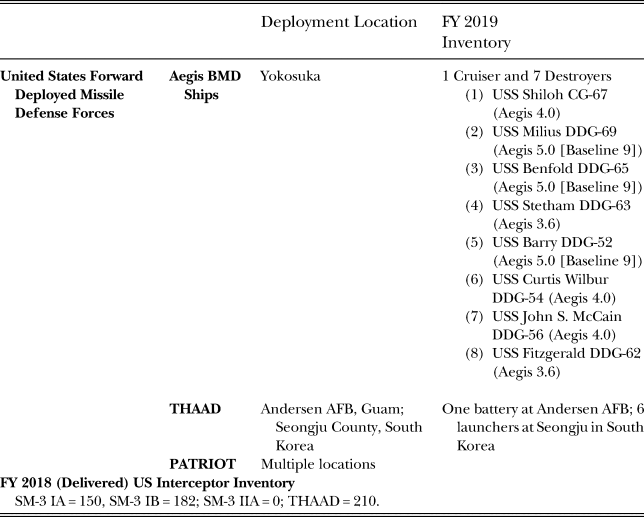
The United States deploys two types of missile defense systems in the region, THAAD and BMD-capable Aegis ships equipped SM-3 IA/B missile defense interceptors. The US Army has two THAAD batteries in the region (see Table 2). One THAAD battery is forward-deployed to Andersen Air Force Base (AFB) in Guam to protect vital military assets. A second THAAD battery was recently deployed to South Korea (Shim Reference Shim2017).
US Missile Defense Systems in the Asia-Pacific

Data from: Syring Reference Syring2016, 53 and 65; Doyle Reference Doyle2017, 14; McKeon Reference McKeon2016, 14; Missile Defense Advocacy Agency 2018; Werner Reference Werner2018; Syring Reference Syring2017, 46; Graves Reference Greaves2019, 27 and 34.
The US Navy has forward-deployed eight BMD-capable Aegis ships (1 Ticonderoga Class Guided Missile Cruisers (CGs) and 7 Arleigh Burke Class Guided Missile Destroyers (DDGs)) to the region (see Table 2). However, two of these eight forward-deployed ships are not on active duty. The USS John S. McCain (DDG-56) and USS Fitzgerald (DDG-62), were damaged in accidents in 2017 (Navy Office of Information 2017). Both these ships are still undergoing repairs, sea trials, and testing (LaGrone Reference LaGrone2019a, Reference LaGrone2019b). Consequently, only six of the eight BMD-capable Aegis ships are now available for combat operations. Additionally, in a contingency, Aegis ships are often needed for other priority missions. Assuming two of the six Aegis ships currently available need to be dedicated to other missions, four ships will be available for missile defense patrols if a situation arose shortly.
While eventually Aegis ships stationed in other parts of the world might be surged to provide reinforcements, it will take anywhere from 10 to 30 days to route other ships to the Asia-Pacific region (Cole Reference Cole, Swaine, Yang, Medeiros and Mastro2007, 197). Additionally, the actual missile defense capabilities of a ship not only depend on the number of available ships, but also on the number of interceptors loaded into the ships.Footnote 9 Depending on mission parameters, between 16 and 35 SM-3 IA/B interceptors are usually loaded onto a BMD-capable Aegis ship (Clark Reference Clark2014, 19; Swicker Reference Swicker1998, 36 and 43; Gunzinger and Clark Reference Gunzinger and Clark2016, 6).
PERFORMANCE OF MISSILE DEFENSES AGAINST NORTH KOREAN REGIONAL MISSILES
Two sets of simulation experiments were conducted to determine the defensive capabilities of US forward-deployed and allied missile defense assets. The mechanics of the simulation experiments are based on a combination of mixed-integer linear optimization and missile aerodynamics (Brown et al. Reference Brown, Carlyle, Diehl, Kline and Wood2005).Footnote 10 These simulations are often used by the military operations research community to study combat tactics. However, I have repurposed them to explore the impact of missile defenses on strategic stability. These simulations are designed to test the proposition that missiles currently deployed by the US, and its allies are reasonable and necessary to defend against North Korea. The evidence obtained using the simulations will fill a critical gap by linking empirical estimation of the adequacy of the defense to the debate on missiles defenses and strategic stability.
In the simulations, sixteen different launch sites spread across North Korea are modeled to ensure geographical dispersion. Each launch site has a limited inventory of various North Korean missiles (see Table 1). Further details on the launch and target sites are included in the online appendix. The performance parameters of the various North Korean missile can be found in Table 1, and the performance parameters of the various missile defense interceptors are included in the online appendix.
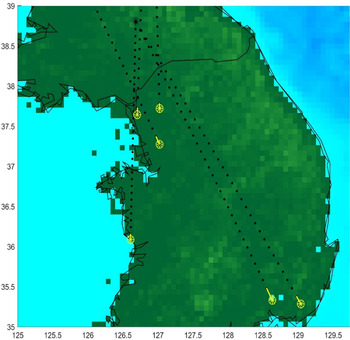
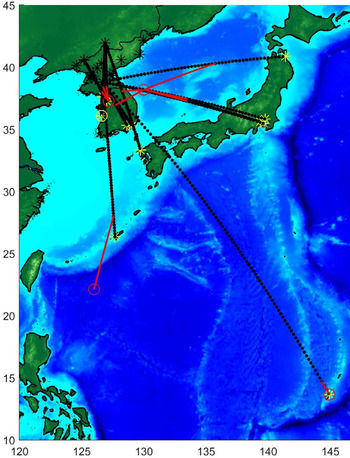
In the first simulation experiment, a simplistic threat is modeled to determine the ability of PATRIOT batteries to provide a defense to South Korea. Some Chinese officials and analysts have suggested that certain “US tactical BMD systems are not destabilizing” as long as there is a clear distinction between those tactical systems and strategic BMD systems (Riqiang Reference Riqiang2013, 45). These individuals note that they neither oppose “genuine TMD [Theater Missile Defenses]” nor “deny any country the right of self-defense” (Diamond Reference Diamond1999, 27; Lars Reference Lars2007, 169; Medeiros Reference Medeiros2001, 11). In most cases, it seems that the tactical system they have in mind is the PATRIOT terminal missile defense system. Therefore, the first simulation tests the ability of PATRIOT batteries to provide an effective defense to South Korea. A single missile is fired at six sites in South Korea (see Table 4 in the online appendix for a list of target sites). PATRIOT batteries are emplaced at each of the six targeted sites. As Figure 1 shows, PATRIOT missile defense batteries can kinematically intercept North Korean ballistic missiles targeting each of the six sites, if the missiles fly on a minimum energy trajectory.Footnote 11
Performance of South Korean PATRIOT missile defense batteries (against minimum energy trajectories)

However, if the missiles are launched in a lofted trajectory, PATRIOT missile defenses become ineffective. For illustration, Figure A in the online appendix shows the lofted trajectory of a North Korean missile launched from Chiha-ri, North Korea to Pusan Naval Base in South Korea. The lofted missile flies approximately 70 kilometers higher in altitude and takes 90 seconds of additional flight time. As Figure B in the online appendix demonstrates, the lofted trajectory increases the minimum required burn-out velocity to intercept the incoming missile from approximately 1.2 km/s to above 1.5 km/s. PATRIOT interceptors, however, have a maximum burn-out velocity of 1.5 km/s (see Table 5 in the online appendix). PATRIOT interceptors are unable to destroy the lofted missile heading towards Pusan Naval Base.
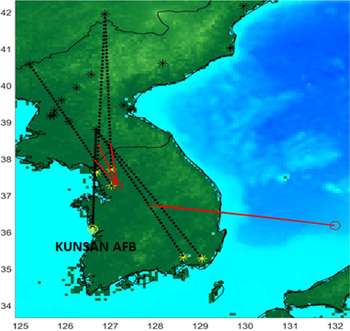
Similar degradation in the performance of PATRIOT interceptors is observed in five of the six modeled targets when the incoming North Korean missiles are launched on a lofted trajectory.Footnote 12 THAAD and BMD-capable Aegis ships are necessary to provide defense against these lofted trajectories. THAAD is necessary to intercept three of the five lofted North Korean missile targeting sites in the northern and mid-latitudes of South Korea. BMD-capable Aegis ships equipped with SM-3 IB interceptors are needed to intercept the two remaining lofted missile trajectories targeting southern locations in South Korea (see Figure 2). The first experiment described above indicates the limitations of the PATRIOT terminal missile defense systems and the genuine need for other advanced missile defense assets in the region.
Performance of South Korean PATRIOT, THAAD, and Aegis BMD (against lofted trajectories)

In the second experiment, the list of targets is expanded to include sites in Japan and Guam (see Table 4 in the online appendix). One missile is fired at each of the thirteen targets in the region.Footnote 13 The target sites were chosen to encompass the most relevant military bases and command and control targets in the region. In the second experiment, it becomes clear that PATRIOT terminal missile defenses are insufficient. None of the targets in Japan can be defended using PATRIOT interceptors even when North Korean missiles travel on a minimum energy trajectory. Two BMD-capable Aegis ships are needed for regional defense (see Figure 3). The first Aegis ship expends seven interceptors and provides a defense to locations in mainland Japan (Tokyo, Yokosuka, Sasebo, Misawa, and Atsugi) and South Korea (Pusan and Chinhae Naval Bases). The second ship expends one interceptor and provides a defense to Okinawa.
Performance of BMD against North Korean missiles targeting South Korea, Japan, and Guam

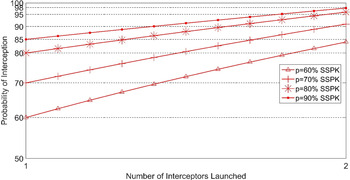
Until this point in the experiments, it was implicitly assumed that each interceptor had a 100 percent Single Shot Kill Probability (SSKP)—that is, each interceptor will always kinematically hit its target. In most circumstances, however, the SSKP of a missile defense interceptor is less than perfect. As of April 2019, the SM-3 IA/B interceptor had registered 33 successful intercepts in 42 attempts against ballistic missile targets, approximately a 79 percent SSPK (Missile Defense Agency 2019). The THAAD missile defense system had registered 15 successful intercepts in 15 attempts, a 100 percent SSPK (Missile Defense Agency 2019). These test records, however, may not reflect actual battlefield conditions. For the analysis in this article, an SSPK of 80 percent is assumed for both the SM-3 IA/B and THAAD interceptors. Assuming that the requirement is to obtain a probability of interception of 95 percent or above for each incoming missile, Figure 4 demonstrates it would require at least two interceptors to be fired simultaneously (i.e., a barrage firing doctrine) at each of the incoming missiles.Footnote 14 Even with the doubling of the interceptors, the missile defense assets already in play can, in principle, still provide a robust defense.
Impact of Interceptor SSPK on Probability of Interception

In a much larger missile salvo, however, current forward-deployed missile defenses could become very stressed. For instance, in the second experiment, if instead of five targets North Korea manages to simultaneously target twelve sites in Japan with three missiles aimed at each site, it would require 72 SM-3 IA/B to defend mainland Japan.Footnote 15 Three BMD-capable Aegis ships will need to be deployed to provide the 72 interceptors needed while the fourth ship will be needed to defend Okinawa.Footnote 16 In essence, the entire available inventory of four Aegis ships will need to be used. Given that Aegis ships cannot be reloaded at sea, using all four Aegis ships during the first missile salvo could leave the US and allied troops extremely vulnerable to follow-on attacks. In the event of a follow-on second missile salvo, Japan's missile defense ships might be able to provide some defensive cover.Footnote 17
It is worthwhile to note that it is unclear if North Korea can sustain such large missile campaigns, especially against the United States, which may mount an aggressive counter-missile operation.Footnote 18 However, if North Korea does manage to do so, the present assets might be overwhelmed. As the number of available missile defense assets eventually increases, some of these difficulties can be eased. By FY2023, the number of total BMD-capable ships are projected to be 57.Footnote 19 Assuming the same ratio of ship distribution between the Pacific and Atlantic Command as presently in play, by FY2023, approximately 30 BMD-capable ships could be assigned to the Pacific Command. Such an increased inventory might be sufficient to handle any future North Korean and other regional missile threats.Footnote 20
The second experiment described above shows the limitations of current missile defense deployments. It indicates how these limitations may be driving the need for a larger regional missile defense architecture in the future. The next section of the article examines the ability of various current and future missile defense deployments to dilute the Chinese strategic deterrent.
PERFORMANCE OF MISSILE DEFENSES AGAINST CHINESE STRATEGIC MISSILES
While the simulation experiments discussed earlier demonstrate the need for regional missile defenses, they still do not shed light on the accuracy of Chinese claims about the strategic impact of these defenses. A third simulation was designed to test the proposition that currently deployed US and allied missiles do not significantly alter the US–China bilateral strategic nuclear stability. The simulation results lend credence to the American argument that the US relies only on mutual deterrence against China.
China fervently objected to the US and South Korean decision to deploy THAAD. The Chinese government “demarched the US and South Korean ambassadors” and lodged formal protests against the deployment of THAAD (Meick and Salidjanova Reference Meick and Salidjanova2017, 5). A commentary in the People's Daily threatened that “if the United States and South Korea harm the strategic security interests” of China, then they will “receive a proper counter-attack” (CNBC 2016).Footnote 21 China also used substantial “economic coercion” to compel South Korea to reconsiders its decision (Meick and Salidjanova Reference Meick and Salidjanova2017, 3 and 7).
Chinese analysts argued that the deployment of the THAAD system and its associated AN/TPY-2 radar would enable the US to observe and track Chinese warheads and decoys, over “the entire Chinese mainland” and beyond, thereby compromising a “core national interest” (Zhun Reference Zhun2015).Footnote 22 A third simulation experiment was performed to evaluate this claim. Covering the entire Chinese mainland would require radar ranges over 4,000 kilometers. THAAD, however, is not capable of such long-range accurate tracking and discrimination. US defense officials argued that the AN/TPY-2 radar deployed in South Korea “will be configured in ‘terminal mode’ (or ‘engagement mode’) to optimize its ability to identify ballistic missile launches in North Korea and intercept them” and would not have much coverage over China (Rinehart, Hildreth, and Lawrence Reference Rinehart, Hildreth and Lawrence2015, 11 and 12). Independent studies have put the range of the THAAD radar deployed in South Korea at approximately 800 or less (Sankaran and Fearey Reference Sankaran and Fearey2017, 21–25; Lewis and Postol Reference Lewis and Postol2012).Footnote 23 At these ranges, the THAAD radar would, in most instances, be insufficient to track Chinese strategic warheads and decoys.
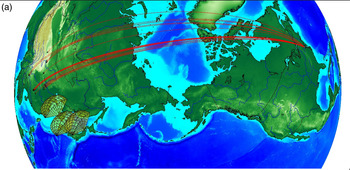
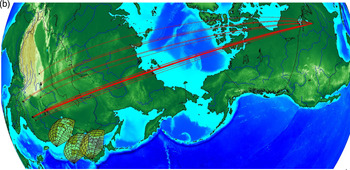
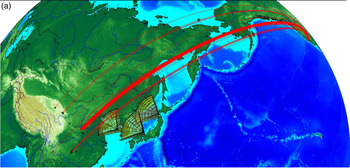
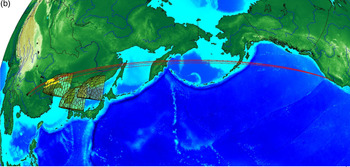
As Figures 5a and 5b show, China's strategic missiles targeting the East Coast and Midwest of the United States cannot be tracked by the THAAD radar in South Korea.Footnote 24 A small subset of strategic missiles targeting the West Coast of the United States is, in theory, visible to the forward-deployed AN/TPY-2 THAAD X-Band radar (see Figures 6a and 6b). China could loft these missiles over the radar or cross-target these missiles away from West Coast targets to evade detection. Additionally, current SM-3 interceptors on Aegis ships are not fast enough to engage these missiles heading towards the United States.Footnote 25
Chinese ICBM Flightpaths to the East Coast (Washington DC) of the United States

Chinese ICBM Flightpaths to the Midwest (Chicago) of the United States

Chinese ICBM Flightpaths to the West Coast (San Francisco) of the United States

Close-up View: Chinese ICBM Flightpaths to the West Coast (San Francisco) of the United States

Chinese critics also posit the possibility that the increasingly larger inventory of ships could be quickly repositioned to the continental United States and might, in principle, provide a much tighter terminal defense against Chinese strategic missiles. This complaint is not without merit. The 2019 Missile Defense Review states that the SM-3 Blk IIA interceptor under development while “intended as part of the regional missile defense architecture” will also have the potential to support “existing GBIs for added protection against [rogue states’] ICBM threats to the U.S homeland.” The document further notes that “Aegis BMD-capable ships armed with the SM-3 Blk IIA interceptor will be moved into position quickly in a crisis to strengthen the defense of the homeland against rogue state missile threats” (Missile Defense Review 2019).
However, these statements in the MDR may reflect an ambitious agenda. The redeployments mentioned in the document are very difficult to successfully perform, particularly in an emergency. Gen. Vladimir Dvorkin, a frequent participant in US–Russian strategic stability talks, writes:
periodically, the hypothetical scenario is raised under which the United States would relocate its mobile sea-based and land-based BMD systems to the United States to form a relatively tight defense of its territory against a Russian retaliatory strike. However, such a scenario is not realistic, for many reasons. One of the main problems with it is that the process of BMD relocation would be prolonged and could not be accomplished clandestinely. The goal of such relocation would unambiguously be seen as preparation for a disarmament strike by the United States. In the case, even during a large-scale nonnuclear war, a preemptive Russian nuclear strike would become highly probable. For such reasons, this scenario appears absolutely unrealistic (Dvorkin Reference Dvorkin, Catherine M. and Dombrowski2015, 126).
Additionally, assuming North Korea would possess only a small arsenal of intercontinental ballistic missile inventory in the future, it may not require repositioning a large number of ships. However, the Chinese are justified in being skeptical. In a crisis involving the US and North Korea, China would have a lot at stake and would probably find itself aligned with the North Koreans. Any substantial redeployment, even if designed exclusively with North Korea mind, may appear to China as directed towards it and forcing it to adopt escalatory postures. This indicates that as the North Korean threat evolves, it may provoke a growing tension between deploying and sustaining a strong missile defense while reassuring China on the viability of its deterrent. As discussed below, the pursuit of a combination of a reasonable increase in Chinese nuclear arsenal and negotiated reduction in the North Korean threat may be the best approach to mitigate this tension.
CONCLUSION
The results of the simulation experiments provide important insights. In the first experiment, initially it appeared that PATRIOT terminal missile defenses are sufficient for a robust defense against North Korean missiles. However, if North Korea launches its missiles at lofted angles, PATRIOT becomes ineffective. THAAD and BMD-capable Aegis ships equipped with SM-3 interceptors are needed to intercept these lofted missiles. The first experiment validates the need for THAAD and Aegis ships. The second experiment evaluates the missile defense assets needed to defend against a larger salvo of North Korean missiles. The experiment indicates that while current assets may be stressed, as US and allied missile defense procurement proceed apace, the defense will become relatively more robust against North Korea. However, it may be never to obtain an airtight defense against a larger North Korean missile salvo. Both experiments demonstrate that current deployments are not excessive, and they weaken the Chinese claim that there is excessive missile defense.
Finally, a third simulation argued that currently forward-deployed radars and interceptors do not have any significant ability to degrade China's strategic deterrent. Chinese leaders and analysts, however, remain unconvinced. Many tend to overestimate the impact current regional missile defense systems can have on their strategic nuclear deterrence. Such overestimations occur because national security is often assessed with a bias that tends to cast the adversary as stronger and the self as weaker, even if the reality suggests otherwise. Likewise, future threats are determined on a similar worst-case basis. Lora Saalman, for instance, notes “that old assumptions about U.S. intent and the potential for nuclear coercion continue to play a profound role in the Chinese strategic psyche” (Saalman Reference Saalman, Colby and Gerson2013b, 348).
Defense realists argue that military net assessments and threat evaluation are often misperceived and exaggerated by analysts and decision-makers, particularly in a competitive relationship (Taliaferro Reference Taliaferro2000, 141 and 155; Glaser Reference Glaser1997, 182). China is no exception. Possessing a smaller nuclear deterrent and engaged in a nascent geopolitical competition with the US, China increasingly tends to view any US missile defense deployments suspiciously. As Van Evera suggests “if states think the offense is strong, they will act as if it were” (Van Evera Reference Van Evera1998, 6). If true, China may decide to modernize its nuclear arsenal at a faster pace and in ways that may compromise bilateral strategic stability.
Reassuring China that US missile defenses are not intended to affect the bilateral nuclear balance will require concerted effort. Chinese leaders maintain a wariness towards bilateral engagement on these issues. When then US Deputy Secretary of State, Anthony Blinken, offered to brief senior Chinese on “what the [THAAD] technology does and what it doesn't do,” Chinese foreign ministry spokesman, Hong Lei replied that China did not view the matter “as simply a technical one” but a much larger issue (Wroughton Reference Wroughton2016).
Edelstein theorizes two conditions under which bilateral cooperation can emerge despite uncertainty about mutual intentions: “(1) if a state's intentions are perceived as malleable through cooperation; and (2) when strong short-term domestic or international pressure to cooperate are present” (Edelstein Reference Edelstein2002, 12). Both conditions are arguably present in US–China relations. As a first step gesture, American policymakers should consider communicating to the Chinese leadership, both publicly and privately, that they understand and accept China's motives for modernizing its nuclear arsenal consistent with its security requirements and broader strategic stability considerations. The United States could also offer serious limits on current and future missile deployments if China helps in dissuading North Korea from acquiring certain missile capabilities. Secretary of State, John Kerry, spoke about such limits in 2013 (Gordon Reference Gordon2013). Finally, given Chinese reticence about engaging in formal talks, an unofficial expert level “joint threat analysis of the North Korean missile threat” may provide much clarification on intentions and may serve as a platform for debate on other matters that help enhance US–China strategic stability (Brooks and Rapp-Hooper Reference Brooks, Rapp-Hooper, Tellis, Denmark and Tanner2013, 292).
CONFLICTS OF INTEREST
The author reports none.
SUPPLEMENTARY MATERIAL
The supplementary material for this article can be found at https://doi.org/10.1017/jea.2020.10.