Introduction
Long-term psychiatric sequelae following traumatic brain injury (TBI) have drawn the attention of researchers in the past few decades (Davidson & Bagley, Reference Davidson, Bagley and Herrington1969). Indeed, functional disabilities following TBI involve more neuropsychiatric (e.g. personality change and cognitive impairment) than neurophysical consequences (Fleminger, Reference Fleminger2008). Schizophrenia is not uncommonly reported, although causality is difficult to confirm. Various studies have attempted to evaluate the association between TBI and schizophrenia.
A systematic review of case studies of ‘psychotic disorder due to TBI’ covering the period from 1971 to 1994 found an average duration between TBI and appearance of a subsequent psychotic disorder of 4.1 years (Fujii & Ahmed, Reference Fujii and Ahmed2002). Subsequent investigations of TBI and schizophrenia have generated conflicting findings. One population-based large-scale cross-sectional survey found that approximately 3.4% of individuals with a history of TBI were later diagnosed with schizophrenia, compared with 1.9% of those without head injury, although the difference did not attain statistical significance (Silver et al. Reference Silver, Kramer, Greenwald and Weissman2001). Several long-term follow-up studies have suggested a higher risk of schizophrenia-like psychoses among individuals with a history of TBI (Achté et al. Reference Achté, Hillbom and Aalberg1969, Deb et al. Reference Deb, Lyons, Koutzoukis, Ali and McCarthy1999). In case-control studies, Wilcox & Nasrallah found a 16-fold increased risk of a history of TBI among patients with schizophrenia (Wilcox & Nasrallah, Reference Wilcox and Nasrallah1987). AbdelMalik et al. (Reference AbdelMalik, Husted, Chow and Bassett2003) further proposed that mild childhood head injury might influence the development of schizophrenia in familial schizophrenia. Nevertheless, a nested case-control study with time-matched incidence density sampling reported no association between either concussion or serious head injury and schizophrenia (Nielsen et al. Reference Nielsen, Mortensen, O'Callaghan, Mors and Ewald2002). With improved controls for socio-economic and other confounding factors, Harrison et al. (Reference Harrison, Whitley, Rasmussen, Lewis, Dalman and Gunnell2006) identified a small increase in the risk of non-schizophrenic, non-affective psychoses, instead of schizophrenic disorder.
Conflicting findings from previous studies may be due to differences in design, methodology, small sample, or use of case reports (O'Callaghan et al. Reference O'Callaghan, Larkin, Redmond, Stack, Ennis and Waddington1988), recall bias (Wilcox & Nasrallah, Reference Wilcox and Nasrallah1987), imprecise diagnostic criteria (Achté et al. Reference Achté, Hillbom and Aalberg1969), focus on special populations (AbdelMalik et al. Reference AbdelMalik, Husted, Chow and Bassett2003), or lack of control for certain confounders (Nielsen et al. Reference Nielsen, Mortensen, O'Callaghan, Mors and Ewald2002). Moreover, these studies were conducted in Western countries. No evidence to date has been reported from Asia, where historic, sociocultural, philosophical, and religious circumstances faced by patients with schizophrenia are substantially different from those in Western countries. For example, in Asia, more profound stigma associated with schizophrenia may constitute a significant barrier to access to mental healthcare (Yang, Reference Yang2007).
This study aimed to estimate the risk of schizophrenia during a 5-year period following hospital admission for TBI, as compared with non-TBI patients during the same period. The study also evaluates the effects of specific clinical characteristics of TBI on subsequent schizophrenia.
Method
Database
Three datasets were linked, the Traumatic Brain Injury Registry (released by the Head & Spinal Cord Injury Research Group of the Taiwan Neurosurgical Society), the National Health Insurance Research Claims Database, and the Cause of Death data file. The Traumatic Brain Injury Registry includes data from patient records of 56 major hospitals comprising 80% of hospitals that have referral hospital status to treat TBI in Taiwan. In this dataset, TBI includes brain concussion, skull fracture, brain damage with clinically demonstrated neurological deficits and cognitive deficits, post-traumatic amnesia, neurological sequelae during the hospitalization, or evidence of intracerebral haemorrhage. Patients who died prior to or during transportation to the hospital are not included in TBI registry. The registry includes data on medical history, sex, age, head trauma condition and severity (Glasgow Coma Scale), as well as the date of hospital admission, presence or absence of intracranial haemorrhage and the anatomical location of haemorrhage, injury type, whether or not a helmet was worn, treatment status, and outcome (Glasgow Outcome Scale). Many studies have been published based on this dataset.
The Taiwan National Health Insurance Research Claim Database is provided to scientists in Taiwan for research purposes. The dataset contains details of in-patient and ambulatory care claims as well as registries for contracted medical facilities, board-certified specialists and beneficiaries. As of 2005, the dataset included all medical claims data of about 25.68 million enrollees in the National Health Insurance (NHI) programme, representing more than 98% of Taiwan's population. The Taiwan National Health Insurance Research Claim Database allows researchers to track all medical services used by enrollees since the initiation of the NHI programme. Therefore, this nationwide population-based dataset provides a unique opportunity to estimate the risk of schizophrenia following TBI.
The Taiwan National Health Insurance Research Claim Database and the Traumatic Brain Injury Registry were linked by the Head & Spinal Cord Injury Research Group of the Taiwan Neurosurgical Society. Confidentiality protections were addressed by complying with the data regulations of the Bureau of NHI and the Institutional Review Board (IRB) of Taipei Medical University. The Taiwan Neurosurgical Society encrypted all personal identifiers. Since the dataset consists of de-identified secondary data released for research purposes, this study was exempt from full review by the IRB.
Study sample
We identified 6379 patients who were hospitalized with a diagnosis of TBI between 1 January 2001 and 31 December 2002. To ensure a clinically homogeneous sample, we limited our sample to adults aged >18 years. As patients developing schizophrenia over the age of 50 years are highly atypical, we excluded patients aged >50 years (total exclusions due to age=2834). We assigned study patients' hospitalization as their index medical service use. We also excluded those with a diagnosis of schizophrenia or TBI prior to their index medical service use (n=50). However, since the NHI programme in Taiwan began in 1995, we were able to track prior diagnoses since 1995. We could not exclude patients with a schizophrenia diagnosis before 1995. Ultimately, 3495 were included in the study group.
The comparison group for this study was extracted from a subset of Taiwan National Health Insurance Research claim dataset (Longitudinal Health Insurance Database; LHID) of the National Health Insurance Research Database (NHIRD). The LHID was created in 2000 by randomly selecting 1 000 000 subjects from the registry of NHI beneficiaries, which is similar on sex, age and average payroll-related insurance payments to the population of beneficiaries in the Taiwan National Health Insurance Research claim dataset. We excluded patients aged either <18 or >50 years. For the comparison group, we randomly selected 17 475 patients (five per TBI patient) matched with the study group on sex, age (<30, 30–39, 40–49 years) and year of medical services. We assigned their first medical service use occurring in the index year, regardless of whether it was hospitalization or an ambulatory care visit, as the index medical utilization. We verified that these patients had no history of TBI or schizophrenia prior to their index medical utilization since 1995.
The follow-up period of each individual patient (n=20 970) for 5 years was established from their index medical utilization date, and all patients with a diagnosis of schizophrenia were identified [any International Classification of Disease (ICD)-9-CM 295 code other than 295.7 – schizo-affective disorder]. Patients whose psychosis was due to a general medical condition, or termed as an organic illness, were further excluded from analysis. As schizophrenia is considered a severe disability under the NHI guidelines, a severe disability card would be issued for these patients for them to access any medical service without co-payments at any medical institution. This concession may increase patients' financial access to medical services when needed (Tzeng et al. Reference Tzeng, Lian, Chang, Yang, Lee, Pan and Lung2007). It should be noted that to minimize abuse, the appropriateness of the schizophrenia diagnosis is carefully monitored and audited as needed by Taiwan's Bureau of National Health Insurance. Thus, the diagnostic validity of schizophrenia in the NHI claims dataset is considered robust to clinical error or diagnostic upcoding. We also linked our data to ‘cause of death’ data obtained from the Department of Health, Taiwan to calculate the schizophrenia-free survival time over the 5-year period, with cases censored if individuals died during that time (313 patients died, 245 from the study group and 68 from the comparison group).
Statistical analysis
All statistical analyses in this study were performed with the sas statistical package (SAS Institute Inc., USA). We used Pearson χ2 tests to compare the differences between study patients and the comparison group on monthly income and the urbanization level of the patients' place of residence [ranging from ‘most urbanized’ (level 1) to ‘least urbanized’ (level 5)]. Survival curves were estimated by the Kaplan–Meier method. The log-rank test was conducted to compare the 5-year schizophrenia-free survival rates for the two groups. Stratified Cox proportional hazard regression (stratified by sex, age, and year of index medical utilization) was used to evaluate the association between TBI and subsequent schizophrenia during the 5-year follow-up. Hazard ratios (HR) and 95% confidence intervals (CI) were computed, using a significance level of 0.05.
Results
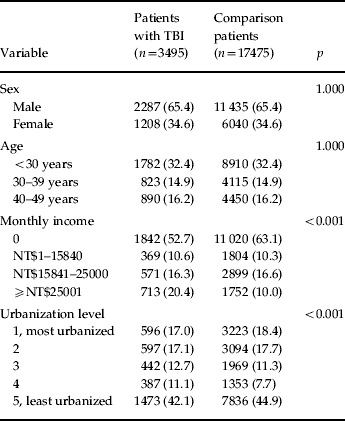
The mean age for the 20970 sample patients was 31.3 years (s.d.=9.4 years), and about two-thirds were male (65.4%). The main causes of TBI were traffic injury (52.7%), falls (13.7%), sports injury (13.5%), assaults (0.9%), and other causes (19.2%). Patients with TBI were more likely to have a monthly income of ⩾NT$25001 (p<0.001) and to reside in less urbanized communities (p<0.001) than comparison-group patients (Table 1).
Demographic characteristics and co-morbid medical disorders at baseline for the sampled patients in Taiwan, stratified by the presence or absence of TBI, 2001–2002 (n=20 966)

TBI, Traumatic brain injury.
Values are given as number of patients (column percentage).
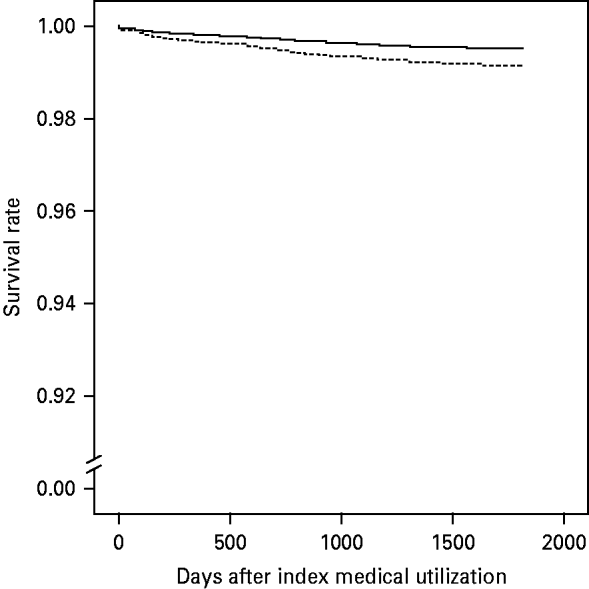
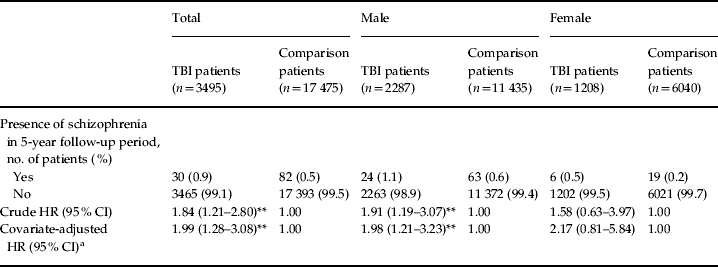
Table 2 shows the distribution of schizophrenia during the 5-year follow-up for the sample patients according to the presence or absence of TBI. A total of 112 patients (0.5%) received a diagnosis of schizophrenia, 30 patients from the study group (0.9% of the patients with TBI) and 82 patients from the comparison group (0.5% of patients without TBI). Fig. 1 presents the schizophrenia-free survival curves using the Kaplan–Meier method. Patients with TBI had significantly lower 5-year schizophrenia-free survival rates than patients without TBI (log-rank test: 8.263, p=0.004).
Schizophrenia-free survival rates for patients with traumatic brain injury (- - -) and the comparison group (––) in Taiwan, 2001–2002.

Crude and covariate-adjusted HRs for schizophrenia among the sampled patients during the 5-year follow-up, starting from index medical utilization

HR, Hazard ratio; TBI, traumatic brain injury; CI, confidence interval.
a Adjustments are made for patients' monthly income and geographical location.
** p<0.01.
Table 2 also shows the crude and adjusted HRs using stratified Cox proportional hazard regressions (stratified by sex, age group and year of index medical utilization). Compared with comparison-group patients, study-group patients were more likely to have schizophrenia during the 5-year follow-up (HR 1.84, 95% CI 1.21–2.80). After adjusting for monthly income and level of urbanization, the HR of schizophrenia for patients with TBI was 1.99 (95% CI 1.28–3.08) relative to those without TBI.
The crude and adjusted HRs for schizophrenia among subgroups stratified by sex are also presented in Table 2. Among males, the adjusted hazard of schizophrenia for the study group was 1.98 times (95% CI 1.21–3.23) that of the comparison group. No increased hazard of schizophrenia was observed among female TBI patients.
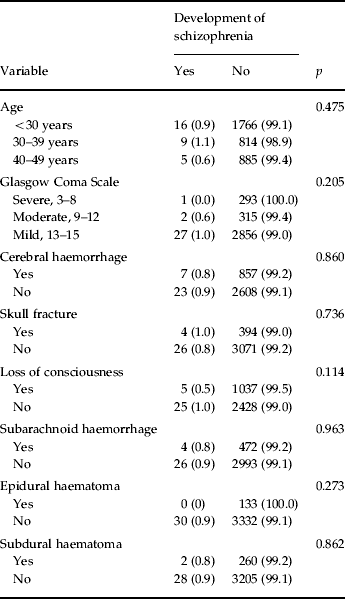
Table 3 presents the clinical characteristics of the sample patients with TBI at arrival in the hospital by development of schizophrenia during the 5-year follow-up. There was no significant difference in schizophrenia rates among patients classified by severity of TBI, cerebral haemorrhage, skull fracture, loss of consciousness, subarachnoid haemorrhage, epidural haematoma and subdural haematoma.
Clinical characteristics at baseline for the sampled patients with traumatic brain injury in Taiwan, 2001–2002 (n=3495)

Values are given as number of patients (row percentage).
Discussion
This is the first large-scale study in Asia suggesting TBI as a potential independent risk factor for developing schizophrenia. During the 5-year follow-up, TBI was independently associated with almost twice the risk of subsequent schizophrenia, after adjusting for monthly incomes and geographical location. No difference was found among TBI patient groups classified by severity and type of TBI.
Our results are consistent with several long-term follow-up and case-control studies (Achté et al. Reference Achté, Hillbom and Aalberg1969; Wilcox & Nasrallah, Reference Wilcox and Nasrallah1987; Gualtieri & Cox, Reference Gualtieri and Cox1991; Deb et al. Reference Deb, Lyons, Koutzoukis, Ali and McCarthy1999; Malaspina et al. Reference Malaspina, Goetz, Friedman, Kaufmann, Faraone, Tsuang, Cloninger, Nurnberger and Blehar2001; AbdelMalik et al. Reference AbdelMalik, Husted, Chow and Bassett2003). Some of these studies have found a higher schizophrenia risk, especially among those with a genetic predisposition. Indeed, the cumulative incidence of schizophrenia among individuals with TBI significantly exceeded chance. Yet the strength of estimates of associations was varied. However, other studies concluded that it is unlikely that TBI causes schizophrenia, including two large-scale nested case-control studies (Silver et al. Reference Silver, Kramer, Greenwald and Weissman2001; Nielsen et al. Reference Nielsen, Mortensen, O'Callaghan, Mors and Ewald2002; Harrison et al. Reference Harrison, Whitley, Rasmussen, Lewis, Dalman and Gunnell2006). Contradictory findings in these studies may reflect differences in study design and methodological limitations. It should also be noted that as a disease with aetiological heterogeneity, schizophrenia may be affected by complex patterns of gene–gene and gene–environment interaction (Keshavan et al. Reference Keshavan, Tandon, Boutros and Nasrallah2008; Tandon et al. Reference Tandon, Keshavan and Nasrallah2008). It has been suggested that if TBI contributes to schizophrenia aetiologically, the effects would probably be modest (Nielsen et al. Reference Nielsen, Mortensen, O'Callaghan, Mors and Ewald2002).
The association between TBI and schizophrenia might be explained by psychosocial factors, or the immediate or delayed psychological reactions to the traumatic experience of head injury (Harrison et al. Reference Harrison, Whitley, Rasmussen, Lewis, Dalman and Gunnell2006). An increased risk of schizophrenia in genetically vulnerable people may also result from certain psychosocial risk factors for psychosis (e.g. maladaptive family dynamics) that may be specifically activated by the fallout from a traumatic event (Tienari et al. Reference Tienari, Wynne, Sorri, Lahti, Laksy, Moring, Naarala, Nieminen and Wahlberg2004).
Despite our verification of a lack of schizophrenia diagnosis for a 6-year period prior to the TBI, we cannot rule out the possibility that the observed association between TBI and schizophrenia could result from reverse causality. Specifically, accident-proneness, especially to head injury, may be increased among schizophrenia patients due to cognitive deficits or prodromal symptoms known to occur in schizophrenia before the first occurrence of psychotic symptoms (David & Prince, Reference David and Prince2005). Evidence found by Fann et al. (Reference Fann, Burington, Leonetti, Jaffe, Katon and Thompson2004) also supports the notion that pre-existing psychosis predisposes such individuals to TBI.
Our observed sex difference of the association between TBI and schizophrenia is notable and consistent with other studies. In a nested case-control study, it was found that for males, both concussion and severe head injury were associated with increased schizophrenia risk (both OR 1.5, p<0.001), while for females the association was not significant, after adjusting for other fractures (Nielsen et al. Reference Nielsen, Mortensen, O'Callaghan, Mors and Ewald2002). Our study also found a significant association among males but not among females. While the smaller numbers of schizophrenia among TBI female patients (n=8) may have limited statistical power, it is likely not to be an artifact because males tend to have a longer prodromal period and longer history of untreated psychosis than females (Haas & Sweeney, Reference Haas and Sweeney1992, Larsen et al. Reference Larsen, McGlashan, Johannessen and Vibe-Hansen1996, Yung & McGorry, Reference Yung and McGorry1996). Differences in the occurrence of the prodromal symptoms may explain the sex differences in predisposition to accidents that lead to TBI. The influences of accident-proneness, or prodromal phase, should be carefully evaluated in interpreting the consequences of TBI (Nielsen et al. Reference Nielsen, Mortensen, O'Callaghan, Mors and Ewald2002).
Previous studies have suggested that certain characteristics of the injury [e.g. left hemispheric lesions (Buckley et al. Reference Buckley, Stack, Madigan, O'Callaghan, Larkin, Redmond, Ennis and Waddington1993), closed rather than penetrating brain injury (Lishman, Reference Lishman1968)] and age of the patient with TBI [e.g. early age of injury (Wilcox & Nasrallah, Reference Wilcox and Nasrallah1987)] affect subsequent disabilities. Consistent with Malaspina et al. (2000), we found no differences between groups classified by clinical characteristics of the TBI (e.g. severity and types of haemorrhage or haematoma), although the study was hampered by limited statistical power due to small numbers of subjects. Specifically, a higher proportion of TBI patients without loss of consciousness developed schizophrenia, compared with those who lost consciousness following the TBI. Because the duration of loss of consciousness is identified as a predictor of schizophrenia-like psychosis (Sachdev et al. Reference Sachdev, Smith and Cathcart2001), more studies are needed to clarify this issue.
The strengths of this study include its prospective design, a methodology that circumvents recall bias, and the use of ICD-9-CM diagnostic criteria in clinical settings. In most studies data on socio-economic status are lacking even in well-designed nested case-control studies (Nielsen et al. Reference Nielsen, Mortensen, O'Callaghan, Mors and Ewald2002). However, our study adjusted for monthly family income.
Our findings should be interpreted in the context of some limitations. First, our data covered only injuries severe enough to lead to admission to referral hospitals for TBI in Taiwan. A potential association between less severe TBI and schizophrenia could not be examined. It should also be noted that the total number of hospitalized TBI cases is quite small relative to the population, and therefore schizophrenia arising among them accounts for a small minority of all cases of schizophrenia. Second, the social stigma associated with mental illness may limit the number of patients who subsequently developed schizophrenia who sought appropriate diagnoses and mental healthcare, resulting in possible misclassification bias. Stigma is documented to be more prominent in Asian countries compared with Western cultures (Yang, Reference Yang2007). Moreover, it is also possible that families may be more likely to take an ailing relative with prior brain injury to the hospital for the treatment of schizophrenia with less stigma than for a spontaneous schizophrenia condition. This may cause a spurious association between brain injury and schizophrenia. On the other hand, stigma is more unlikely to influence TBI, a more neutral physical illness. Similar patterns of healthcare utilization would be expected in TBI severe enough to lead to hospital admission (Nielsen et al. Reference Nielsen, Mortensen, O'Callaghan, Mors and Ewald2002), as was analysed in our study.
Third, we could not exclude patients who may have been diagnosed with schizophrenia before 1995, prior to the NHI programme. Misclassification of cases with a prior history of schizophrenia before 1995 may reduce the strength of the association. However, it should be expected that most patients with schizophrenia would have recurring symptoms and obtain a psychiatric consultation. Keith et al. (Reference Keith, Regier, Rae, Robins and Regier1991) reported that for patients with a lifetime diagnosis of schizophrenia, 63% of females and 76% of males would report symptoms within the past year. As we ascertained that all patients had no psychiatric visit for schizophrenia in the past 6 or 7 years (i.e. from 1995 to 2001 or 2002), the potential for misclassification may be attenuated in our study. Finally, some important variables such as family history of schizophrenia and duration of loss of consciousness (Sachdev et al. Reference Sachdev, Smith and Cathcart2001) were not available in our study. Information regarding pre-injury dependence on drugs and alcohol, likely predictors of post TBI problems, was also lacking. In addition, patients' predisposition to schizophrenia and the early risk factors for psychosis (e.g. social functioning, neurologic soft signs, cannabis or amphetamine use, etc) were inaccessible in our registry data. We are therefore unable to exclude the possibility that patients with prodromal schizophrenic symptoms or early risk factors of psychosis had an increased propensity to suffer from TBI.
Our study suggests a need for better monitoring of TBI patients for long-term neuropsychiatric sequelae in both clinical and community settings. Psychotic symptoms following TBI should be investigated for potential secondary complications (e.g. subdural haemorrhage). Families of TBI patients should then be alerted to possible personality changes and cognitive and behavioural deficits. Timely access to psychiatric care improves the treatment and prognosis.
In conclusion, our findings suggest a potential link between TBI and schizophrenia and add important evidence from an Asian population to an array of investigations in this area. Our results justify additional research on this topic to explore a range of possible intermediary pathways and gene–environment interactions involved in the development of schizophrenia following TBI. Such research may benefit from considerations of genetic markers, genetic predisposition to specific sequelae, and potential pathways related to TBI-related characteristics (e.g. duration of loss of consciousness, injury type/region).
Declaration of Interest
None.