Introduction
Perchlorate (ClO
 $${_{4}}\!$$
-) is found to be widespread in the environment (Parker Reference Parker2009, Jackson et al. Reference Jackson, Bohlke, Andraski, Fahlquist, Bexfield, Eckardt, Gates, Davila, McKay, Rao, Sevanthi, Rajagopalan, Estrada, Sturchio, Hatzinger, Anderson, Orris, Betancourt, Stonestrom, Latorre, Li and Harvey2015b). Human exposure to environmental perchlorate is of concern because perchlorate may cause serious health problems by inhibiting iodine uptake in the thyroid (Kirk Reference Kirk2006, Leung et al. Reference Leung, Pearce and Braverman2010). Prolonged iodine inhibition may cause metabolic problems in adults and can seriously affect brain development of infants and children (Buffler et al. Reference Buffler, Kelsh, Lau, Edinboro, Barnard, Rutherford, Daaboul, Palmer and Lorey2006). Recent research efforts have focused on determining the magnitude of environmental perchlorate (Dasgupta et al. Reference Dasgupta, Dyke, Kirk and Jackson2006, Rajagopalan et al. Reference Rajagopalan, Anderson, Fahlquist, Rainwater, Ridley and Jackson2006, Jackson et al. Reference Jackson, Davila, Böhlke, Sturchio, Sevanthi, Estrada, Brundrett, Lacelle, McKay, Poghosyan, Pollard and Zacny2016) and the extent of human exposure (Buffler et al. Reference Buffler, Kelsh, Lau, Edinboro, Barnard, Rutherford, Daaboul, Palmer and Lorey2006, Mervish et al. Reference Mervish, Blount, Valentin-Blasini, Brenner, Galvez, Wolff and Teitelbaum2012).
Perchlorate in the current environment is believed to originate from both natural and anthropogenic sources. Previous research (Dasgupta et al. Reference Dasgupta, Martinelango, Jackson, Anderson, Tian, Tock and Rajagopalan2005, Sturchio et al. Reference Sturchio, Caffee, Beloso, Heraty, Hatzinger, Jackson, Gu, Heikoop and Dale2009, Jackson et al. Reference Jackson, Bohlke, Gu, Hatzinger and Sturchio2010, Reference Jackson, Davila, Böhlke, Sturchio, Sevanthi, Estrada, Brundrett, Lacelle, McKay, Poghosyan, Pollard and Zacny2016) has suggested that a significant fraction of the total perchlorate is of natural origin, probably produced in the atmosphere involving photolysis and/or oxidation of common chlorine species, which is supported by recently published work (Peterson et al. Reference Peterson, Cole-Dai, Brandis and Manandhar2015a, Reference Peterson, Cole-Dai, Brandis, Cox and Splett2015b). Both laboratory measurement (Kang et al. Reference Kang, Jackson, Dasgupta and Anderson2008, Rao et al. Reference Rao, Anderson, Redder and Jackson2010) and analysis of trends of perchlorate in the environment (Furdui & Tomassini Reference Furdui and Tomassini2010, Jackson et al. Reference Jackson, Davila, Sears, Coates, McKay, Brundrett, Estrada and Bohlke2015a) demonstrate that ozone is involved in atmospheric perchlorate production by oxidation. In addition to formation in the stratosphere (Jackson et al. Reference Jackson, Davila, Sears, Coates, McKay, Brundrett, Estrada and Bohlke2015a, Reference Jackson, Davila, Böhlke, Sturchio, Sevanthi, Estrada, Brundrett, Lacelle, McKay, Poghosyan, Pollard and Zacny2016), perchlorate may also be produced in the troposphere through photolysis and heterogeneous reactions (Dasgupta et al. Reference Dasgupta, Martinelango, Jackson, Anderson, Tian, Tock and Rajagopalan2005, Kounaves et al. Reference Kounaves, Stroble, Anderson, Moore, Catling, Douglas, McKay, Ming, Smith, Tamppari and Zent2010) and lightning (Furdui & Tomassini Reference Furdui and Tomassini2010, Rao et al. Reference Rao, Mohan, Neuber and Jackson2012).
In the polar regions, perchlorate, along with other atmospheric chemical substances, is deposited and preserved in continuous snow accumulation. Therefore, records of perchlorate in the environment can be reconstructed from analysis of polar snow and ice core samples. In this work, perchlorate concentrations in snowpit samples from a West Antarctica location were used to examine inter- and intraannual patterns of deposition and to investigate the role of stratospheric ozone in perchlorate production. Specifically, the hypothesis that perchlorate production in the troposphere is enhanced during the annual stratospheric ozone hole over Antarctica, as a result of increased tropospheric oxidant levels due to penetration of UV radiation into the troposphere is tested. Increased perchlorate concentrations during the months of the stratospheric ozone hole would support this hypothesis and may indicate that, in the polar regions, perchlorate forms primarily in the troposphere rather than the stratosphere.
Methods
Snowpit samples and chemical analysis
In January 2013, a 2.6 m deep snowpit was dug by hand near West Antarctic Ice Sheet (WAIS) Divide (112.085°W, 79.467°S). A total of 88 snow samples were taken at 0.03 m depth increments along a wall of the snowpit. The sampling was carried out with strict contamination control procedures: only pre-cleaned spatulas and gloves were allowed contact with the snow samples, which were collected in clean plastic specimen cups. The snow samples were kept frozen until laboratory analysis. Samples were allowed to melt at room temperature and the meltwater was then analysed for concentrations of chemical species.
A ThermoFisher (formerly Dionex) DX600 ion chromatography (IC) system, with a GP50 gradient pump, an ED50 electrochemical/conductivity detector in conductivity mode, a Dionex AS11 (2×250 mm) column and an ASRS300 (2 mm) suppressor were used to measure major anion concentrations, including chloride (Cl-), nitrate (NO
 $${_{3}\!$$
-) and sulphate (SO4
2-). The uncertainty of ion concentrations measured with this method, as described in previous work (Cole-Dai et al. Reference Cole-Dai, Mosley-Thompson and Thompson1997), is <10% relative standard deviation (RSD) of the measured concentrations. The recently developed method (Peterson et al. Reference Peterson, Cole-Dai, Brandis, Cox and Splett2015b) to determine perchlorate concentrations at the low and sub-ng l-1 level was used in this study. In this method, a Dionex DX600 IC instrument is interfaced with an AB SCIEX QTRAP electrospray-ionization tandem mass spectrometer. A 60 mM NaOH eluent was used with an IonPac AS16 (2×250 mm) column for ion chromatographic separation. External standards prepared in deionized water were used for calibration. The method provides a perchlorate detection limit of 0.1 ng l-1 (part-per-trillion or ppt). The precision of perchlorate concentration measurement is no more than 10% RSD (Peterson et al. Reference Peterson, Cole-Dai, Brandis, Cox and Splett2015b).
Dating snowpit samples
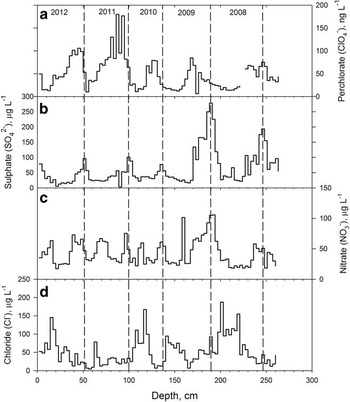
Concentrations of several chemical species in central West Antarctica snow are known to exhibit regular seasonal or annual cycles (Banta et al. Reference Banta, McConnell, Frey, Bales and Taylor2008, Sigl et al. Reference Sigl, Fudge, Winstrup, Cole-Dai, Ferris, McConnell, Taylor, Welten, Woodruff, Adolphi, Bisiaux, Brook, Buizert, Caffee, Dunbar, Edwards, Geng, Iverson, Koffman, Layman, Maselli, McGwire, Muscheler, Nishiizumi, Pasteris, Rhodes and Sowers2015). For example, the highest SO4 2- concentrations are reached during the summer (December to February) and the lowest concentrations are generally found in the winter (June to August). Several concentration maxima are seen in the SO4 2- concentration profile (Fig. 1b) in the WAIS Divide snowpit. When each maximum, beginning at the top of the snowpit, is marked as the beginning of a year (nominally January), 5.2 years are counted in the 2.6 m snowpit. The average annual layer thickness (0.5 m) is consistent with the typical snow accumulation rate (c. 0.6 m yr-1) at this location (Banta et al. Reference Banta, McConnell, Frey, Bales and Taylor2008, Sigl et al. Reference Sigl, Fudge, Winstrup, Cole-Dai, Ferris, McConnell, Taylor, Welten, Woodruff, Adolphi, Bisiaux, Brook, Buizert, Caffee, Dunbar, Edwards, Geng, Iverson, Koffman, Layman, Maselli, McGwire, Muscheler, Nishiizumi, Pasteris, Rhodes and Sowers2015). Therefore, the snow samples cover the time period between late 2007 and the end of 2012.
Concentrations of a. perchlorate, b. sulphate, c. nitrate and d. chloride in the WAIS Divide snowpit samples. Vertical dashed lines indicate the beginning (nominally 1 January) of calendar years, marked by annual maxima in sulphate concentration.

To determine the timing of snowfall during a year, a sub-annual timescale is needed. The depth of the sample with the SO4 2- maximum is designated 1 January of a calendar year. The depth interval between that sample and the next sample with a SO4 2- maximum at shallower depth corresponds to the length of that year. The date of a sample in the year is calculated according to its position (depth) within that annual depth interval, assuming that snow accumulation is linear throughout the year. This procedure has been used in previous work (e.g. Cole-Dai et al. Reference Cole-Dai, Ferris, Lanciki, Savarino, Baroni and Thiemens2009, Geng et al. Reference Geng, Cole-Dai, Alexander, Erbland, Savarino, Schauer, Steig, Lin, Fu and Zatko2014) to develop sub-annual timescales for ice cores. The assignment of specific months to snow depth and concentration carries uncertainty, owing to the fact that snow accumulation rate varies during the year. The largest uncertainty at South Pole was estimated to be ±4.5 months (Cole-Dai et al. Reference Cole-Dai, Ferris, Lanciki, Savarino, Baroni and Thiemens2009). The uncertainty at WAIS Divide is expected to be smaller than at South Pole due to the higher annual snow accumulation rate (0.20 m water equivalent per year) at WAIS Divide than at South Pole (0.08 m water equivalent) (Mosley-Thompson et al. Reference Mosley-Thompson, Paskievitch, Gow and Thompson1999). Assuming uncertainty is inversely proportional to accumulation rate, the uncertainty is estimated to be ±1.9 months.
Results
Perchlorate concentration varied between 6–180 ppt (Fig. 1a), with an average of 48 ppt for 87 samples (lack of sufficient meltwater prevented perchlorate measurement for one sample at 2.24 m). According to the dating with SO4 2--marked annual layers, the highest perchlorate concentrations during the five year period were found in 2011. It appears that perchlorate concentration follows a seasonal or annual cycle pattern. However, the timing of high and low concentrations during a year is different from SO4 2- (Fig. 1).
Discussion
An apparent annual cycle can be seen in the perchlorate concentration profile in Fig. 1. In each year, the highest perchlorate concentrations appear following in time (shallower depth) the SO4 2- maximum. Because the SO4 2- maximum is normally reached in January, the timing of perchlorate maximum appears to be around March. Nitrate concentrations in WAIS Divide snow (Fig. 1c) are generally high during summer, although multiple maxima in one year are not unusual, which has also been observed in other Antarctic locations (Savarino et al. Reference Savarino, Kaiser, Morin, Sigman and Thiemens2007). Previous research (McCabe et al. Reference McCabe, Thiemens and Savarino2007) has shown that a majority of nitrate in Antarctic snow is formed in the troposphere via NOx chemistry. The poor correlation between nitrate and perchlorate (Fig. 1) suggests that perchlorate formation is not directly related to NOx chemistry. Similarly, no significant correlation appears between chloride (Fig. 1d) and perchlorate in WAIS Divide snow.
To determine the precise time of maximum deposition, the perchlorate profile would need to be viewed on a sub-annual timescale. After the depth of each sample has been converted to days in a calendar year using the sub-annual timescale (described in Methods), perchlorate concentrations of samples in the same month are averaged to represent perchlorate deposition for that month.
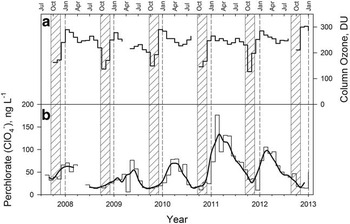
The monthly perchlorate concentrations for the five year period (2008–12) are shown in Fig. 2. According to the sub-annual timescale, perchlorate concentration reaches the annual maximum in the autumn, around March. The lowest concentrations generally appear in the winter and spring (July to October). With the estimated uncertainty of ±1.9 months, the annual maximum is between January and May, not during spring. In addition, the consistent appearance of the annual maximum in March suggests that the uncertainty of the sub-annual dating is probably smaller than ±1.9 months.
Monthly average total column ozone in Dobson units (DU) measured at South Pole and b. monthly average perchlorate concentration in WAIS Divide snow; spline fit indicated by heavy line. Hatched areas correspond to the periods of the annual stratospheric ozone hole. The timing of perchlorate data is converted from sample depth assuming linear snow accumulation during a year (see text for details). Vertical dashed lines indicate the beginning of calendar years (January).

Since the 1980s, significant depletion of stratospheric ozone over Antarctica has been observed during each spring (Farman et al. Reference Farman, Gardiner and Shanklin1985, Newman et al. Reference Newman, Nash, Strahan, Kramarova, Long, Pitts, Johnson, Santee, Petropavlovskikh and Braathen2015). Extensive research on the stratospheric ozone hole (e.g. Solomon Reference Solomon1999) demonstrates that the ozone depletion is the result of catalytic loss in reactions involving chlorine free radicals activated on polar stratospheric cloud ice crystals during the early spring days of polar sunrise. The ozone hole allows short wavelength (UV) solar radiation, which is normally filtered out by the ozone layer, to penetrate into the troposphere where it may enhance the production of oxidants, such as the OH free radical and ozone (Spiro et al. Reference Spiro, Purvis-Roberts and Stigliani2012). Based on this scenario, we hypothesized that the tropospheric oxidant levels elevated by the UV radiation during the appearance of the stratospheric ozone hole would lead to higher perchlorate production rate in the troposphere. According to the hypothesis, perchlorate concentration would be higher during the spring than other seasons.
The data shown in Fig. 2 indicate that perchlorate levels are at or near the annual minimum during the spring. Also plotted in Fig. 2 is the monthly average column ozone at South Pole (WMO/GAW Ozone Monitoring Community 2015), which clearly shows the appearance of the stratospheric ozone hole in early spring (September and October) of each year. The low perchlorate concentrations during the spring, within the estimated dating uncertainty, which occur annually during 2008–12, do not support our hypothesis of enhanced tropospheric perchlorate production on the stratospheric ozone depletion.
On the contrary, the consistency of seasonal variation in perchlorate concentration and, in particular, the annual minimum during the spring, suggests a relationship between perchlorate levels and ozone concentration opposite of what was initially hypothesized. The data show that perchlorate production is reduced when stratospheric ozone concentrations are low. Ozone concentrations can impact perchlorate production because ozone can be a key reactant in the perchlorate formation reactions (Rao et al. Reference Rao, Anderson, Redder and Jackson2010). If the atmospheric production of perchlorate over Antarctica, and in general in the polar regions, occurs primarily in the stratosphere, rather than the troposphere (Sturchio et al. Reference Sturchio, Caffee, Beloso, Heraty, Hatzinger, Jackson, Gu, Heikoop and Dale2009, Furdui & Tomassini Reference Furdui and Tomassini2010, Jackson et al. Reference Jackson, Bohlke, Gu, Hatzinger and Sturchio2010), the lowered stratospheric ozone concentrations would result in reduced perchlorate concentration in spring snow. A detailed examination of the impact of stratospheric ozone on perchlorate production and deposition in polar snow, which is beyond the scope of this work, will be needed in future research.
Conclusion
Perchlorate concentrations in WAIS Divide, West Antarctica snow range from a few to c. 200 ppt. The data show that perchlorate concentrations vary seasonally, generally reaching a maximum during the autumn, rather than in the spring, when the total column ozone over Antarctica reaches an annual minimum. Therefore, the appearance of the stratospheric ozone hole does not lead to enhanced perchlorate production in the atmosphere. The data suggests that, in the Antarctic, perchlorate production occurs primarily in the stratosphere and that loss of stratospheric ozone results in reduced perchlorate production.
Acknowledgements
Collection of WAIS Divide snow samples was accomplished during an ice core research project supported by the US National Science Foundation (NSF Award #1043508). Field work at WAIS Divide was co-ordinated by the Science Coordination Office of WAIS Divide project at University of New Hampshire and Desert Research Institute in Reno, NV, supported by NSF (Award #0944348 and 0944266). JC-D acknowledges NSF support (Awards #0922816 and #1203533) for the AB SCIEX ESI-MS/MS instrumentation and for chemical analysis of polar ice cores. The authors wish to thank two anonymous reviewers whose comments helped to improve the manuscript. This work was part of coursework of TZC and ADK at South Dakota State University and the SDSU Van D. and Barbara B. Fishback Honors College. The authors declare no competing interests.
Author contributions
JC-D conceived the hypothesis and the projects. KMP and JC-D collected snow samples. TZC, ADK and JC-D designed the experiments. TZC, ADK and TSC performed lab measurements. TZC and ADK initiated the manuscript. All contributed to the revision and completion of the manuscript.