

The worldwide incidence of work-related stress among teachers is a cause for serious concern (Chan, Chen, & Chong, Reference Chan, Chen and Chong2010). Within Australia, there are increasing reports of teacher stress, although state and territory education departments are reluctant to release details about this issue (Howard & Johnson, Reference Howard and Johnson2004). There has been an increasing rise in reports of teacher stress in Australian media (Munt, Reference Munt2004), and teacher union leaders have also reported a rise in stress-related workers’ compensation cases during the past few years (Hiatt, Reference Hiatt2010). However, no recently published studies have attempted to identify the prevalence and severity of psychological injury in Australian teachers, or the roles of relevant organisational factors in such injury.
Work-Related Stress in Teachers
While most teachers find their work highly satisfying, teaching is a recognised high-stress occupation, and international studies have found that teachers report higher levels of burnout and a stronger effort-reward imbalance than many other working populations (Timms, Graham, & Cottrell, Reference Timms, Graham and Cottrell2007; Unterbrink et al., Reference Unterbrink, Hack, Pfeifer, Buhl-Griesshaber, Muller, Wesche and Bauer2007). While there is a dearth of research focusing on Australian teachers’ experiences of stress (Independent Education Union, 1996; Timms et al., Reference Timms, Graham and Cottrell2007), results appear to mirror those found in international studies (Al-Fudail & Mellar, Reference Al-Fudail and Mellar2008; Bakker et al., Reference Bakker, Schaufeli, Demerouti, Janssen, Van Der Hulst and Brouwer2000; Howard & Johnson, Reference Howard and Johnson2004; Rudow, Reference Rudow, Vandenberghe and Huberman1999). Some of the reasons for increasing work-related stress in the Australian teaching population in more recent times include rapid curriculum change, extra tension caused by national literacy and numeracy testing, and deteriorating student behaviour, including physical attacks on teachers (Hiatt, Reference Hiatt2010). Furthermore, a large percentage of Australian teachers who suffer from burnout remain in their positions because of a lack of suitable alternative employment, thereby operating in a chronic state of stress (Timms, Graham, & Caltabiano, Reference Timms, Graham and Caltabiano2006).
Numerous types of costs are associated with elevated stress in the teaching workforce, affecting individuals, schools, and government departments. Economic costs are related to absenteeism (Stansfeld et al., Reference Stansfeld, Feeney, Head, Canner, North and Marmot1995), impaired work performance (Dewa & Lin, Reference Dewa and Lin2000), and the subsequent costs of mental health care. Figures obtained through freedom-of-information laws indicate high rates of teacher stress-related leave across Australia: between 2002 and 2005, the Victorian public education system received 429 stress-related claims, costing approximately 20,000 days of lost teaching time and $5 million in compensation (Tomazin, Reference Tomazin2005). In Western Australia in 2009, nearly $25 million was spent on teachers’ and other education department staff members’ compensation for work-related injuries, illnesses and stress, with $7.3 million specifically for mental stress-related injury (Hiatt, Reference Hiatt2010).
Teacher stress can have serious implications for the healthy functioning of the individual and the school, such as producing unproductive staff behaviours, including alienation, apathy and absenteeism (Tsai, Fung, & Chow, Reference Tsai, Fung and Chow2006). With the number of teachers applying for stress leave in Australia increasing in recent years (ABCNews, 2010), there are likely to be further educational costs by causing disruption for students (Woods & Montagno, Reference Woods and Montagno1997) and added financial costs associated with finding replacement teachers. The potential for widespread psychological injury due to stress in the teaching workforce is particularly alarming, considering the findings that teachers who continue working while suffering high levels of stress can have a negative effect on their students (Lamude, Scudder, & Furno-Lamude, Reference Lamude, Scudder and Furno-Lamude1992). For example, students who perceive their teachers to be unsupportive may be more likely to engage in health risk behaviours (McLellan, Rissel, Donnelly, & Bauman, Reference McLellan, Rissel, Donnelly and Bauman1999). Hence, there are clear benefits for some kind of monitoring of individual teacher psychological health, so that support can be given to at-risk workers before their situation has deteriorated to an unendurable level. In order to provide the most appropriate response, it would be important to identify not only the presence of psychological injury, but also its degree.
Identifying Workers at Risk: The Psychological Injury Risk Indicator
Recent literature investigating teacher retention in Australia, the United States, and the United Kingdom has identified teaching as having a relatively high turnover rate compared with other employee groups, which has been linked to the high strain associated with the role (Mayer, Reference Mayer2006; 2004). Hence, research investigating how to identify teachers who are approaching high levels of risk for psychological injury before they begin to experience significant suffering or loss of effectiveness is relevant and timely. According to Campbell and Knowles (Reference Campbell and Knowles2007), a common approach to identifying psychological injury involves directly questioning one's current psychological state (e.g., the General Health Questionnaire; Willmott, Boardman, Henshaw, & Jones, Reference Willmott, Boardman, Henshaw and Jones2008). However, such instruments can often be inaccurate, due to measuring transient states that may not necessarily be related to work stress or a work culture of emotional suppression (Winwood, Tuckey, Peters, & Dollard, Reference Winwood, Tuckey, Peters and Dollard2009).
The Psychological Injury Risk Indicator (PIRI) is a recently developed scale that attempts to measure the level of risk for psychological injury a worker is currently experiencing (Winwood, Peters, & Dollard, Reference Winwood, Peters and Dollard2010). Psychological injury risk is determined by measuring five behavioural and experiential indicators consistently seen in severe stress/psychological injury states, and which are associated with underlying neurophysiological changes brought about by prolonged exposure to excess stress (Winwood et al., Reference Winwood, Tuckey, Peters and Dollard2009). The five indicators measured include quality of sleep, recovery, chronic fatigue, alcohol use, and posttraumatic stress disorder (PTSD) symptoms.
Quality of sleep is a strong predictor of many work-related stress recovery and fatigue outcomes (Rook & Zijlstra, Reference Rook and Zijlstra2006; Sonnentag, Reference Sonnentag2003). Sleep plays a key role in maintaining a good mood and cognitive acuity, as well as in promoting physiological balance and resilience (McEwen, Reference McEwen2006). Research in the United States has found the existence of sleep deprivation among public school personnel, which can have serious health consequences, including raised blood pressure and increased body mass (Amschler & McKenzie, Reference Amschler and McKenzie2010; McEwen, Reference McEwen2006).
The conceptualisation of recovery and chronic fatigue in the PIRI is based on findings suggesting that chronic fatigue results from insufficient recovery between repeated instances of acute fatigue (Winwood, Lushington, & Winefield, Reference Winwood, Lushington and Winefield2006). For a worker to meet job-related challenges or stressors, a process termed the ‘stress response’ facilitates the concentration of available physical and mental resources, and is mediated by a heightened state of alertness in the central nervous system until the challenge has terminated (Kajantie, Reference Kajantie2008; McEwen, Reference McEwen1997; Pfaff, Martin, & Ribeiro, Reference Pfaff, Martin and Ribeiro2007a, Reference Pfaff, Martin and Ribeiro2007b). However, many neurotransmitters involved in the stress response are catabolic; they tend to damage the cells they act upon (Ganzel, Morris, & Wethington, Reference Ganzel, Morris and Wethington2010). Recovery is the return to prestressor levels of relevant functional systems, and the repair of stress-related cellular level damage (Demerouti, Bakker, Geurts, & Taris, Reference Demerouti, Bakker, Geurts and Taris2009). It is a process that requires further job-related demands to be absent; hence, school teachers might be particularly vulnerable to suffering inadequate recovery between shifts, as they are often required to take work home to complete (Fritz & Sonnentag, Reference Fritz and Sonnentag2005; Kozlovsky et al., Reference Kozlovsky, Kaplan, Zohar, Matar, Shimon and Cohen2008; Sonnentag & Fritz, Reference Sonnentag and Fritz2007). A high-pressure occupation such as teaching is likely to activate the stress response frequently and for substantial parts of the day, preventing adequate recovery from daily acute fatigue, leading to chronic neuro-cognitive/emotional fatigue (Bergendahl, Vance, Iranmanesh, Thorner, & Veldhuis, Reference Bergendahl, Vance, Iranmanesh, Thorner and Veldhuis1996; Lekishvili, Hesketh, Brazier, & Brown, Reference Lekishvili, Hesketh, Brazier and Brown2006; McEwen, Reference McEwen2006; Winwood et al., Reference Winwood, Lushington and Winefield2006). Typical costs to the individual associated with chronic fatigue include progressive decrements in motivation, and disengagement from activities formerly found to be rewarding, including work participation itself, with accompanying loss of productive capacity (McEwen, Reference McEwen2003).
Alcohol consumption can represent a palliative technique for coping with stress that is a technique that does not attempt to deal with the source of stress, but reduces the impact of the stressor (Kyriacou, Reference Kyriacou2001). However, this behaviour can become dysfunctional over a long period of time if alcohol consumption is excessive (Sinclair, Reference Sinclair, Turney, Hatton, Laws, Sinclair and Smith1992). Excessive drinking damages the liver and is associated with long-term exacerbation of emotional hyper-reactivity, threat perception and stress increase (Bengtsson et al., Reference Bengtsson, Allebeck, Lissner, Bjorkelund, Hallstrom and Sigurdsson1998; Lundberg, Reference Lundberg1999). When palliative techniques fail, teachers often take frequent leave or seek medical advice, which may lead to a regime of taking medication (Dinham, Reference Dinham1993).
The fifth indicator of psychological injury is PTSD symptoms. Although most PTSD research has been done with workers in high-risk occupations, such as war veterans or police officers, research shows that traumatic events resulting in PTSD symptoms are also prevalent among other populations who are not typically exposed to such acute stressors (Lauterbach & Vrana, Reference Lauterbach and Vrana1991; Livneh, Martz, & Bodner, Reference Livneh, Martz and Bodner2006). Teaching may involve various traumatic experiences, including hostile (and sometimes violent) incidents with students or parents, and the long-term symptoms associated with such experiences (Howard & Johnson, Reference Howard and Johnson2004; Vernberg & Medway, Reference Vernberg and Medway1981). Workplace bullying among school staff is a common experience, with 99.6% of respondents in an Australian national school teachers survey indicating that they had experienced some form of bullying during their employment (Riley, Duncan, & Edwards, Reference Riley, Duncan and Edwards2011). The impacts of bullying include poor performance, a desire to leave the job, and damaged psychological health that meet diagnostic criteria for PTSD (Matthiesen & Einarsen, Reference Matthiesen and Einarsen2004; Tehrani, Reference Tehrani2004).
The development of the PIRI has indicated its suitability as a clinical tool for identifying workers in need of professional intervention due to work-related psychological injury. Major strengths of the PIRI include a strong correspondence to clinical assessment of psychological injury as performed by an experienced clinician (Winwood et al., Reference Winwood, Tuckey, Peters and Dollard2009) and its ability to measure not only the risk of psychological injury, but also the extent. Research with police respondents has compared PIRI scores with assessments from a clinical psychologist and led to the development of suggested conservative guidelines for ‘cut off points’ identifying the relative risk of psychological injury for an individual (Winwood, Peters, & Dollard, Reference Winwood, Peters and Dollard2010; Winwood et al., Reference Winwood, Tuckey, Peters and Dollard2009). The experiences of individuals working as teachers may lead to serious negative psychological impacts, and the PIRI offers an accurate self-report method for assessing this across a large sample (Winwood et al., Reference Winwood, Peters and Dollard2010; Winwood et al., Reference Winwood, Tuckey, Peters and Dollard2009). In addition to informing the current state of psychological health across the Australian teacher population, the PIRI could also be used in investigations into organisational factors — in this case, school-related factors — in such injury. Detailed information about the contents of the PIRI scales can be found in the later section on measures.
Regional and Socioeconomic Index Differences of Schools
Two demographic variables that may influence teacher psychological injury are the region in which the school is located (i.e., metropolitan or rural), and the socioeconomic index (SEI) of the school area. Geographical isolation of a school is a potential stressor for teachers (Howard & Johnson, Reference Howard and Johnson2004). As a large percentage of Australian schools is located in rural areas, it is important to consider the impact that region has on teacher stress experiences (Clarke & Stevens, Reference Clarke and Stevens2009). Being rurally located has an indirect impact on staff via the challenges of relatively small student and staff populations, which commonly leads to members of school leadership teams having to carry a larger than normal teaching burden in addition to their administrative duties (Clarke & Stevens, Reference Clarke and Stevens2009). Previous research in Australia has hence found that leadership teams in rural schools can face even stronger challenges than those in metropolitan schools, particularly in terms of sustainable leadership that supports staff emotionally and psychologically over longer time periods (Clarke & Stevens, Reference Clarke and Stevens2009).
Hypothesis 1. Teachers working in rural schools will report higher levels of psychological injury than those working in metropolitan schools.
Schools in low SEI areas have previously been correlated with health-risk behaviours in teachers (e.g., increased alcohol consumption), with a possible explanation that teachers working in low SEI areas have less access to resources that can assist in dealing with personal challenges (Virtanen et al., Reference Virtanen, Kivimaki, Elovainio, Linna, Pentti and Vahtera2007). Hence, schools located in areas with lower socioeconomic advantage may be a potential risk factor for teachers developing greater psychological injury. To date, there have been no studies investigating the relationships between teacher psychological injury, school region and school SEI.
Hypothesis 2. Teachers working in schools of lower socioeconomic advantage will report higher levels of psychological injury.
Psychosocial Safety Climate in Schools
The level of psychological support offered by an organisation's management could be expected to play an important role in determining the level of psychological injury risk for workers. Difficult working circumstances may not necessarily lead to an insupportable stress experience if there is a supportive atmosphere provided by a facilitative administration (Howard & Johnson, Reference Howard and Johnson2004). When administration is not supportive, or worse still, abusive, workers’ resilience to stress is likely to be exceeded consistently, inducing a downward loss spiral leading inevitably to psychological distress and eventual injury (Blase & Blase, Reference Blase and Blase2003). The construct of psychosocial safety climate (PSC) measures the climate of an organisation specifically relating to the protection of the psychological wellbeing of its employees. It can be defined as: ‘policies, practices, and procedures for the protection of worker psychological health and safety’ (Idris & Dollard, Reference Idris and Dollard2011, p. 325). It is concerned with both the prevention (primary intervention) and management (secondary intervention) of psychological injury at work. It is characterised by a climate of trust and caring respect, wherein employees believe (based on their own, and observation of colleagues’ experiences) that management truly makes their psychological wellbeing a priority (Dollard & Bakker, Reference Dollard and Bakker2008). It is thus a reflection of management actions as perceived by individual employees.
PSC has been found to act as a precursor to both job demands and resources (Idris & Dollard, Reference Idris and Dollard2011). Organisations with high PSC have lower levels of job demands, since they create manageable challenges and put in place communication systems to monitor and manage risks (Dollard & Bakker, Reference Dollard and Bakker2010). In addition, adequate resourcing is given to allow workers to successfully meet goals and derive meaning from their work (Schaufeli, Bakker, & Van Rhenen, Reference Schaufeli, Bakker and Van Rhenen2009). Demands are not excessive or allowed to become excessive, and resources are promoted, encouraging employee engagement, and hence performance (Dollard & Bakker, Reference Dollard and Bakker2010). By comparison, low PSC organisations overlook high/excessive demand conditions and do little to build resources. Consequently, staff in low PSC organisations report high/excessive levels of work demands and associated work (Idris & Dollard, Reference Idris and Dollard2011), with the potential for work-related psychological injury.
Teaching is an emotionally demanding job, and so the psychological support of supervisors and school management is very important for staff wellbeing (Hargreaves, Reference Hargreaves1998). As PSC has received support as a ‘cause of the causes’ in work systems regarding demands/resources and subsequent outcomes, it should be considered a priority for school management that will benefit staff and students (Idris & Dollard, Reference Idris and Dollard2011). However, to date there has been no published research measuring the relationship between PSC and psychological injury in workers.
Hypothesis 3. Teachers reporting lower levels of school PSC will report higher levels of psychological injury.
The Present Study
Based on the above discussion, we conducted a cross-sectional online survey to explore current teacher psychological health across Australia, including differences between Australian states. This is the first large-scale study to utilise the PIRI with school teachers, and the first study to measure psychological injury across a large sample of Australian teachers. The present study addresses gaps in the literature by providing estimates of the prevalence and severity of psychological injury among Australian teachers, as well as the relative impacts of school SEI, region and PSC level on the extent of teachers’ psychological injury. This can provide insight into the level of support Australian teachers currently require, and identify particularly vulnerable sectors of the teaching population who are in need of more urgent intervention.
Method
Procedure
School teacher participants completed an online survey. Background variables included age and gender. Independent variables were school PSC, school region (metropolitan or rural) and school area SEI. The dependent variable was risk for psychological injury. We performed the study with relevant university ethics approval. We requested permission to advertise the survey through teacher union newsletters and websites with the teachers unions of South Australia, Tasmania, Western Australia and the Australian Capital Territory. The advertisements directed participants to a website created by the researchers that featured an information page and link to the survey questions. All responses were anonymous, and participants were informed that the study was investigating teacher work stress and PSC, and were assured of confidentiality. All data were entered into a PASW Statistics v18 database for analysis.
Participants
The online survey was attempted by a total of 1,136 participants. After removing incomplete submissions, the final number of participants was reduced to 960. This sample included 237 (25%) males and 707 (74%) females, of mean age 46.0 years (SD = 11.0). A representative, large-scale national survey (N = 2,335) of Australian school teachers conducted in 2002 found a mean age of 43.1, with 30% of respondents being male and 70% female (MCEETYA, 2004). Hence, our sample appears relatively representative of the national teaching workforce.
Participants in our sample were located in five different states/territories within Australia: 131 from the Australian Capital Territory (ACT); 119 from New South Wales (NSW); 79 from South Australia (SA); 29 from Tasmania (Tas); and 594 from Western Australia (WA). The majority of participants worked in government schools (97%), with 57% working in metropolitan schools and 43% working in schools from rural areas. In relation to job description, 76% classified themselves as Teachers, 20% as Coordinators/Executive Teachers, 3% as Principals/Assistant Principals, and 1% as Other. In relation to employment status, 87% were permanent, 12% were contract, and 1% were relief. Concerning work hours, 81% worked full-time, 16% worked at least half-time but not full-time, and 3% worked less than half-time. Mean length of employment at the participant's current school was 7.0 years (SD = 6.4).
Measures
Control and independent variables
Control variables included age and gender. Independent variables included school region, SEI, and PSC. We collected the postcodes of participants’ current school address to determine the school's region as either metropolitan or rural. Information about the postcodes’ associated SEI was collected from the Australian Bureau of Statistics (potential and actual scores ranged from 0–100; Australian Bureau of Statistics, 2008). All SEIs were based on a percentage score, with higher scores indicating relatively greater socio-economic advantage.
Psychosocial safety climate was measured using the PSC-12 (Hall, Dollard, & Coward, Reference Hall, Dollard and Coward2010). This is a 12-item measure, reworded to apply to school employees. An example item is ‘Psychological well-being of staff is a priority for this school’. The PSC-12 uses a 5-point scale (0 = strongly disagree, 4 = strongly agree). The scores were summed (actual scores ranged from 0–48), with higher values representing higher levels of PSC. In the present study, internal consistency reliability for the PSC-12 was high (Cronbach's alpha = .97).
Dependent variable: Psychological injury risk
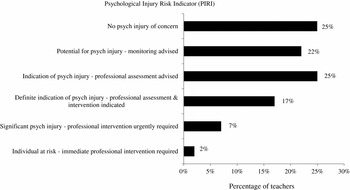
The PIRI consists of five subscales (sleep quality, recovery, chronic fatigue, alcohol use, and PTSD symptoms), which were combined to produce a score out of 100 (actual scores ranged from 0.52–85.94), with higher values representing higher levels of psychological injury. Cut-off scores from the PIRI can be used to categorise respondent scores into six different categories of risk for psychological injury, ranging from ‘No psychological injury of concern present’ to ‘Individual is at risk: immediate professional intervention required’ (see Figure 1).
Levels of psychological injuries in Australian school teachers according to PIRI level of risk.

PIRI subscale: Sleep Quality
Sleep quality was measured using six items selected from the Pittsburgh Sleep Quality Inventory (PSQI), an example being ‘I woke up in the morning feeling exhausted’ (Buysse, Reynolds, Monk, Berman, & Kupfer, Reference Buysse, Reynolds, Monk, Berman and Kupfer1989). Items were measured on a 5-point scale (0 = strongly disagree, 4 = strongly agree), which are summed to produce a score out of 24 (actual scores ranged from 0–24). Higher scores represent better sleep quality. Internal consistency reliability was high (Cronbach's alpha = .81).
PIRI subscales: Recovery and Chronic Fatigue
The PIRI employs two subscales (Recovery and Chronic Fatigue) selected from another instrument, the Occupational Fatigue Exhaustion Recovery (OFER) scale (Winwood et al., Reference Winwood, Lushington and Winefield2006). The subscale of Recovery contains five items, and measures recovery from acute fatigue between work periods. An example item is ‘Even if I’m tired from one work period, I’m usually refreshed by the start of the next work period’. The subscale of Chronic Fatigue contains five items, and measures levels of maladaptive fatigue that are persistent and consistently fail to resolve by simple rest or task moderation (Winwood, Bakker, & Winefield, Reference Winwood, Bakker and Winefield2007). This subscale correlates highly (.84) with the Exhaustion subscale of the Maslach Burnout Inventory (Winwood, Winefield, Dawson, & Lushington, Reference Winwood, Winefield, Dawson and Lushington2005). An example item is ‘I often wonder how I can keep going at my work’. We instructed participants to indicate to what degree each statement has applied to them over the last few months. The OFER uses a 5-point scale (0 = strongly disagree, 4 = strongly agree), with higher scores representing greater levels of each construct. For each subscale, the scores were summed to produce a value out of 20 (actual scores for both subscales ranged from 0–20). Internal consistency reliability was high for both the Chronic Fatigue (Cronbach's alpha = .85) and Recovery subscales (Cronbach's alpha = .85).
PIRI subscale: Alcohol Use
Maladaptive use of alcohol was measured with the RAPS4 alcohol measure, which consists of four dichotomous yes/no items (Cherpitel, Reference Cherpitel2000). An example item is ‘I sometimes need an “eye-opener” in the morning to get myself going’. Yes responses were coded as 1, and no responses coded as 0, which were summed to produce a score out of 4 (actual scores ranged from 0–4). Higher scores indicate more severe problematic alcohol consumption.
PIRI subscale: PTSD Symptoms
Symptoms of PTSD were measured using the Purdue Posttraumatic Stress Disorder (PTSD) scale (Lauterbach & Vrana, Reference Lauterbach and Vrana1996). Participants were asked to complete 10 items as they applied over the last month, with regards to the most upsetting work-related experience(s) encountered so far during one's career as a teacher. An example item is ‘You react physically to things that remind you of the event (e.g., heart racing, breaking out in a sweat)’. Items were measured on a 5-point Likert scale (0 = not at all, 4 = often), which were summed to produce a score out of 40 (actual scores ranged from 0–40). Higher scores represented greater symptomology. Internal consistency reliability was high (Cronbach's alpha = .94).
Results
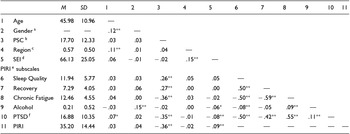
All variables were normally distributed and linear, except for alcohol use and PTSD symptoms, which had significant positive skews. Because the assumption of normality was not met for all variables, we used Spearman's correlation coefficient to measure bivariate correlations (Field, Reference Field2009, p. 179). Table 1 displays the means, standard deviations, and correlations between the study variables. Results showed that age was positively correlated with PTSD symptoms, and that males reported higher levels of problematic alcohol use. Psychosocial Safety Climate had positive relationships with sleep quality and recovery, and negative relationships with chronic fatigue, PTSD symptoms, and the overall PIRI score. The SEI was positively related to metropolitan schools, and negatively related to alcohol use, PTSD symptoms and PIRI score. Sleep quality was positively related to recovery, and negatively related to chronic fatigue, alcohol use, and PTSD symptoms. Recovery was negatively related to chronic fatigue and PTSD symptoms. Chronic fatigue was positively related to alcohol use and PTSD symptoms. Alcohol use was positively related to PTSD symptoms.
Means, Standard Deviations and Bivariate Correlations of Study Variables (N = 960)

Note: a1 = Male; bPSC = Psychosocial Safety Climate; c0 = Rural, 1 = Metropolitan; dSEI = Socioeconomic Index; ePIRI = Psychological Injury Risk Index; fPTSD = Post-traumatic Stress Disorder symptoms
*p < .05, **p < .01.
Incidence of Psychological Injury
Figure 1 presents a graph of the percentages of participants according to level of psychological injury based on overall PIRI scores. Approximately one quarter of teachers fell into the first category of ‘No psychological injury of concern present’. The next two categories (‘Potential for psychological injury’ and ‘Indication of psychological injury’) both contained relatively large percentages of participants, at 22% and 25%, respectively. The final three categories indicated more severe levels of psychological injury, with 17% in the category of ‘Definite indication of psychological injury’, 7% in the category of ‘Significant psychological injury’, and 2% in the final category of ‘Individual at risk’.
State/Territory PIRI and PSC Scores
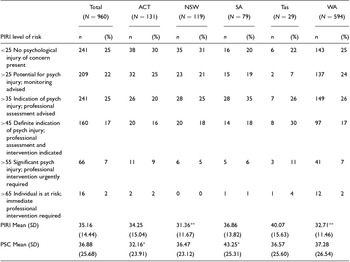
Table 2 presents the frequencies of participant PIRI scores divided between the six ‘cut-off’ levels of risk, as an entire sample as well as divided between states/territories. Owing to the small samples in some states/territories, with many of the expected frequencies being lower than the value of 5, a chi-square test for goodness of fit could not be performed. However, the proportions of participants in each level of risk appear relatively homogenous between the states. New South Wales and the ACT both contain a higher percentage of teachers whose PIRI scores indicate no psychological injury of concern present, compared to the other states, and NSW is the only state represented that did not have any teachers who fell into the most extreme category of ‘individual at risk; immediate professional intervention required’. Tasmania had a higher percentage of teachers who scored within the three highest categories of psychological injury.
Frequencies of PIRI Categories, Means and Standard Deviations of PIRI and PSC Scores

Note: *p < .05. **p < .01.
Table 2 also displays the means and standard deviations of PIRI and PSC scores for the overall sample, as well as for individual states/territories. Independent samples t-tests showed that the PIRI scores from teachers in NSW and WA were significantly lower than the national average of 35.16: NSW 3.80 points lower, 95% CI [−5.96, −1.65], t(114) = −3.49, p = .001, d = 0.33; WA 2.45 points lower, 95% CI [−3.39, −1.52], t(578) = −5.15, p < .001, d = 0.21. Both effect sizes were small.
Of the PSC scores, independent samples t-tests showed that teachers from the ACT scored lower than the national average of 36.88, 4.72 points lower: 95% CI[−8.86, −0.59], t(130) = −2.26, p = .025, d = 0.20, while teachers from SA scored higher than the national average, 6.37 points higher, 95% CI[0.70, 12.04], t(78) = 2.24, p = .028, d = 0.25. Both effect sizes were small.
Predictors of PIRI
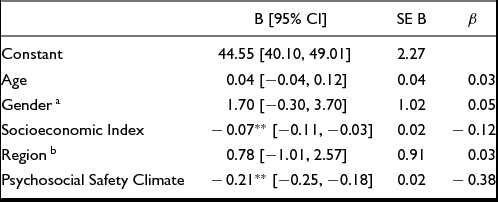
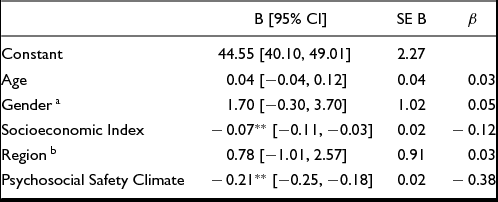
To estimate the proportions of variance in PIRI scores that can be accounted for by school region, SEI and PSC, we conducted a multiple regression analysis, with age and gender included as control variables (Table 3). Assumptions of normality, linearity and homoscedacity were all met, and Mahalanobis distance did not exceed the critical χ2 for df = 5 (at α = .001) of 20.52 for any cases in the data file, indicating that multivariate outliers were not of concern.
Multiple Regression Model Predicting Psychological Injury Risk
Note: a 1 = Male; b 0 = Rural, 1 = Metropolitan.
* p < .05, **p < .01.
The regression model accounted for 15% of the variability in psychological injury, R 2 = .15, adjusted R 2 = .15, F(5, 905) = 32.90, p ≤ .001. Results indicated no significant relationship between school region and psychological injury. However, PSC was significantly related to psychological injury, with a medium effect size. Additionally, SEI was significantly related to psychological injury, with a small effect size. That is, teachers working at schools with higher SEI and PSC reported lower levels of psychological injury.
Discussion
We used an online survey to explore the levels of psychological injury within the Australian teaching population. We also used multiple regression to examine how school region, SEI and PSC relate to psychological injury. We found a high percentage of Australian teachers reporting indications of psychological injury. We proposed that teachers working at schools located in metropolitan regions, in higher SEI areas, and with higher levels of PSC would report lower psychological injury. Hypothesis 1 was not supported, as there was no significant relationship found between school region and psychological injury. Hypotheses 2 and 3 were supported, as results showed significant effects of PSC and SEI in predicting psychological injury. This is the only published research to have performed a large-scale, multiple-state assessment of risk for psychological injury in Australian teachers, and the findings raise urgent concern for the psychological wellbeing of our teaching workforce.
Levels of Psychological Injury
One valuable use suggested for the PIRI is as an online screening tool for routine psychological health and welfare checks, with scores above certain cut-off points used as red-flags to identify workers who require some form of assessment and support (Winwood et al., Reference Winwood, Tuckey, Peters and Dollard2009). Results from this survey demonstrate that there is a potentially large number of working teachers across Australia who are suffering ‘red-flag’ levels of psychological injury from exposure to highly stressful situations, and that professional assessment or intervention is strongly needed.
However, Australian teachers do not currently have easy access to such services. For example, Easthope and Easthope (Reference Easthope and Easthope2007) report that despite the rise in stress claims from school teachers in Tasmania, there remain many obstacles for those seeking help. Most teachers making stress claims are required to see a departmental psychiatrist, but prior to receiving their results are likely to be told that their claim will be disputed before the Commissioner for Workers’ Compensation; this may produce added distress to already stressed teachers. Although this process does reduce stress claims (as teachers often choose to use regular sick days to cope with stress rather than apply for workers’ compensation), it simply diverts rather than solves problems (Easthope & Easthope, Reference Easthope and Easthope2007). The levels of psychological injury found are relatively homogenous across all states sampled, and so this would appear to be a nationwide trend of school teachers who are approaching, or have already reached, levels of work-related psychological distress that require intervention.
The PIRI may offer an opportunity to facilitate the responses necessary to help manage teachers’ psychological injury levels. Being able to measure such injury in a simple and accurate way is an advantage for education departments if it enables workers who are manifesting the typical ‘loss spiral’ associated with psychological injury to be identified at an earlier point on the injury trajectory (Winwood et al., Reference Winwood, Tuckey, Peters and Dollard2009). For teachers identified as being ‘at risk’, several options are open for appropriate management of the worker condition, including reassignment to a less stressful area or workload, provision of appropriate professional care, and/or taking steps to boost work engagement (Bakker & Bal, Reference Bakker and Bal2010; Bakker, Hakanen, Demerouti, & Xanthopoulou, Reference Bakker, Hakanen, Demerouti and Xanthopoulou2007; Hakanen, Bakker, & Schaufeli, Reference Hakanen, Bakker and Schaufeli2006). Such a response may mitigate further deterioration of injury levels, which may be difficult to reverse if the employee is left unsupported, and where premature career termination becomes more likely, with all its attendant costs and difficulties to the worker and the school. Regular assessment of teachers can be argued to constitute a clear and important part of employer duty-of-care, and with distinct advantages. One example is the avoidable loss of expensively trained employees to work-related stress, which is significant not only in terms of financial cost (including possible compensation), but also in reduced educational opportunities for students. A concerted effort is clearly needed from state and federal education departments to address this alarming trend in their workforces.
Psychosocial Safety Climate
We predicted that teachers working in schools with higher PSC would report fewer symptoms of psychological injury, and our results supported this. These findings contribute to the knowledge of PSC, identifying it as an important organisational variable in the level of worker psychological injury development. Psychosocial safety climate was the strongest predictor of reduced psychological injury levels in our analyses, suggesting that PSC offers a strong opportunity for school administrations and education departments to make changes that can help teachers’ psychological health. This highlights the importance of school management supporting teachers psychologically, not only to maintain teacher wellbeing, but also to maintain their work performance. In order to achieve this, school management must implement real changes within the workplace culture, as a key component of PSC is that school policies and administration actions reflect a prioritising of teacher mental health.
This can include a range of different actions taken by administration units, such as ensuring clear communication channels between management and staff. A study by Dorman (Reference Dorman2003) found that teachers who feel strong affiliation with fellow staff, and who believe that their school has a set of unified goals, experienced lower levels of burnout and emotional exhaustion. Another aspect relates to workload, that is, not placing an unreasonable amount of work demands on teachers, and providing the necessary resources required for staff to effectively complete their tasks. Such efforts will reduce risk for psychological injury in staff, and likely in turn create greater positive learning outcomes for students and minimise loss of productivity due to lower teacher performance or staff turnover. Measures taken by schools that increase the quantity but not quality of teacher work will likely erode an individual's sense of mastery, increase tension within the workplace, and increase exhaustion (Timms et al., Reference Timms, Graham and Cottrell2007).
School Regions and Socioeconomic Index
Our results did not find any significant differences between the levels of psychological injury in teachers at metropolitan compared to rural schools. However, we did find that working in a school from a low-SEI area predicted higher levels of psychological injury in staff. This is in accordance with previous research, as schools in low SEI areas have previously been correlated with health-risk behaviours in teachers (Virtanen et al., Reference Virtanen, Kivimaki, Elovainio, Linna, Pentti and Vahtera2007). Working in low SEI areas may also mean that teachers are exposed to more traumatic experiences and/or have less access to resources that can assist in dealing with such experiences (Virtanen et al., Reference Virtanen, Kivimaki, Elovainio, Linna, Pentti and Vahtera2007). Interestingly, school SEI did not show a significant correlation with PSC, suggesting that the socioeconomic environment of a school does not prevent school management from providing genuine and effective psychological care to its employees. It is important for public policy to focus interventions not only on individuals or schools, but also on the environment where people live and work (Virtanen et al., Reference Virtanen, Kivimaki, Elovainio, Linna, Pentti and Vahtera2007). Our results suggest that particular focus needs to be paid to school staff working in low-SEI areas, as they are the most vulnerable to suffering elevated levels of psychological injury.
Present Limitations and Future Research
Not all Australian states/territories were represented in our sample and there were uneven numbers of participants from the various states/territories, limiting our ability to make comparisons of state-level policies relating to teacher psychological health. Owing to the method of advertisement used for the online survey, the majority of participants worked in government schools, and hence no meaningful comparisons can be drawn between the working environments of government and private schools. Our sample did provide a large cross-section of teachers across Australia and so was useful in obtaining a profile of this occupational group as a whole. However, further research sampling teachers from all Australian states and territories, including government and private schools, would be helpful in identifying differences in education policy that may be contributing to psychological injury among staff.
Our research used a cross-sectional, self-report design, meaning that no causal conclusions can be made and the data may be affected by self-report biases. Future research into psychological injury utilising a longitudinal research design with behavioural outcome measures, such as performance or rates of sick leave, would provide useful data about the predictive validity of a measure such as the PIRI in identifying workers in various stages of need for psychological intervention. Furthermore, we did not measure certain individual variables that may have influenced work-related stress, such as locus of control or positive/negative affect (Naswall, Sverke, & Hellgren, Reference Naswall, Sverke and Hellgren2005). Future studies incorporating such variables, as well as sampling from other high-stress occupational groups, will likely provide further insight into the processes of psychological injury build-up, and highlight further potential avenues for its prevention within organisations.
Conclusion
Results from this cross-sectional survey of Australian school teachers reveal that a large percentage of school teachers in Australia are experiencing dangerously high levels of psychological injury. This must be promptly addressed by education departments, not only through conducting appropriate assessments of at-risk teachers, but also through policy changes that can reduce employee stress levels. The finding of PSC as a key predictor of reduced psychological injury highlights the importance of fostering good leadership among school-level management, ensuring that teachers feel that their psychological health is a priority for administrations and is reflected in the policies and practices of the school. Teachers working in schools from low-SEI areas are particularly vulnerable to psychological injury. These factors are likely to be shared to an extent among global school teacher populations, as teachers’ roles are comparable across schools internationally and similar stressors have been identified in teacher populations across Australia, New Zealand, Canada, the Netherlands, the United Kingdom and the United States (Coulter & Abney, Reference Coulter and Abney2009; Klusmann, Kunter, Trautwein, Ludtke, & Baumert, Reference Klusmann, Kunter, Trautwein, Ludtke and Baumert2008). This report provides evidence that in Australian schools, current conditions are leading to significant psychological injury within the teaching population. This must be urgently addressed by federal and state education departments, to enact policies that can reduce stress levels among staff as well as undertake psychological assessments and (if necessary) make intervention readily available for the large numbers of teachers who are currently suffering.