Atrial septal defect, which represents 8–10% of CHD and was first surgically closed by Gibbon in 1953, is one of the most common congenital pathologies. Reference Helgason and Jonsdottir1,Reference Gibbon6 Generally, defects smaller than 6 mm in diameter are not symptomatic in newborns or during the childhood, and usually close spontaneously before the age of 1 year. Surgical indications for defects larger than 6 mm in diameter or those that do not close spontaneously are the presence of right ventricular volume overload or the identification of pulmonary-to-systemic flow rate (Qp:Qs) of >1.5. In recent years, it has become very popular to close secundum ASDs via catheterisation, given the presence of a suitable rim. However, in the majority of cases, such catheter closure is either failed, or patients have secundum defects without suitable rim or primum ASDs in the left atrioventricular valve accompanied by mitral cuff and valvular insufficiency or sinus venosus type defects accompanied by partial pulmonary venous return anomaly. In these patients, surgery remains as the foremost treatment option.
Diagnosis and treatment may be delayed in ASD, in relation to its asymptomatic nature. Consequently, pulmonary hypertension may develop. Reference Hanslik, Pospisil and Salzer-Muhar2 Pulmonary hypertension is defined as the measurement of mean pulmonary artery pressure of ≥25 mmHg, and the presence of resting end-expiratory pulmonary capillary wedge pressure of ≥15 mmHg with a right heart catheterisation. According to the European Heart Survey Data, the incidence of pulmonary hypertension is 12% in adult patients with closed defects, while this frequency is 33% in those who are not treated. ASD patients with moderate-to-severe pulmonary arterial hypertension pose a clinical dilemma in terms of treatment approach, because the application of shunt closure amongst patients with irreversible PAH and non-closure amongst those with reversible PAH are both demonstrated to result in reduced quality of life and survival.
Pulmonary hypertension (PAP ≥ 25 mmHg) usually develops due to increased pulmonary blood flow as a result of left–right shunt in patients with ASD. It is extremely important to differentiate this from primary hypertension, because in primary PHT, the hypertension occurs due to increased pulmonary vascular resistance and increased pulmonary capillary wedge pressure. Thus, the closure process for ASD does not provide the desired outcome. Reference Hoeper, Bogaard and Condliffe3 Performing defect closure in patients with irreversible PAH and refraining from closure in patients with reversible PAH will cause serious problems in terms of both quality of life and survival. Reference Yong, Khairy and De Guise4,Reference Hirabayashi, Miyaji and Akagi5
In this retrospective study, we aimed to present our results with the fenestrated patch technique in ASD patients with high PAP and positive acute vasoreactivity test response.
Material and methods
A total of 906 patients who underwent ASD closure surgery in our clinic between January 2011 and November 2020 were included in the study. Fenestrated patch was used in 7 of these patients. 67 patients who underwent Transcatheter ASD closure were excluded from the study (Fig 1).
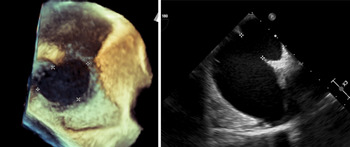
3D and 2D echo images of the patient with preoperative ASD.

The demographic information, operation information, and follow-up of the patients were scanned retrospectively from archive files.
Routine pre-op and post-op echocardiography investigations were performed in all patients. Pre-op pulmonary pressures of the patients were measured via catheter angiography. Response to the AVT test was taken into account when making the decision for the utilisation of fenestrated patch closure in patients with high pulmonary pressures who were not suitable for complete closure. A fenestrated patch procedure was planned in patients whose pulmonary pressure and PVR demonstrated regression with AVT.
Operations of the patients were performed under cardiopulmonary bypass with selective bicaval cannulation, and mini sternotomy was used mainly as incision. In patients who underwent patch closure, the patient’s own pericardium was prepared and used as a patch. Amongst patients who were planned to be left with residual ASD, the ASD was opened in a 2-mm circular shape with the use of a punch device.
Descriptive statistical methods (mean, standard deviation, median, frequency, ratio, minimum, maximum) were used while evaluating the study data.
Results
Between January, 2011 and November, 2020, the ASD of 906 patients was repaired with a pericardial patch in our clinic. Of these, 398 patients were male and 508 were female.
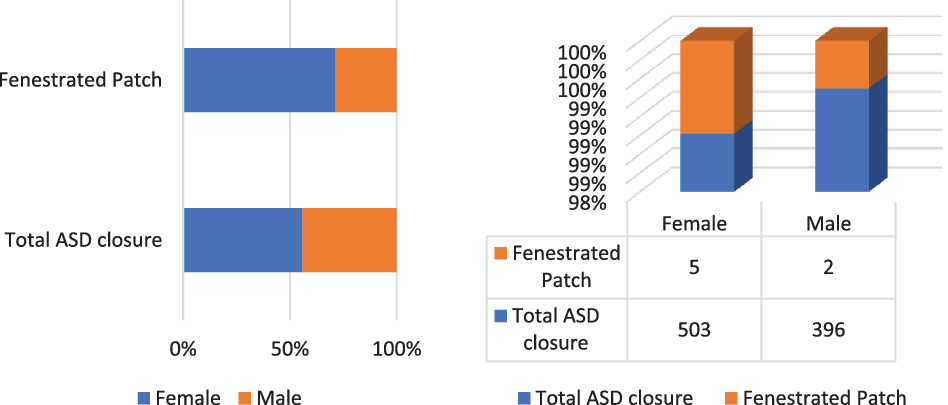
Fenestrated patches were used in 7 patients, 2 of whom were male and 5 of whom were female. Thus, conventional closure was performed in 899 of the patients (Fig 2).
Gender distribution of patients who underwent ASD closure and ASD closure with fenestrated patch.

Mean age in the conventional ASD closure group was 6.25 years, with the youngest patient being 6 months old and the oldest being 66 years old. In the fenestrated patch group, mean age was 36.14 years, with the youngest patient being 21 years old and the oldest being 52 years old.
The average length of stay in the ICU of the patients was 1.2 (min: 1, max: 5) days, and the average length of stay in the ward after discharge from the ICU was 5.3 (min: 2, max: 12) days.
The mean duration of cardiopulmonary bypass in the study group was 52 (min: 35, max: 87) minutes, and cross-clamp time was 21 (min: 18, max: 46) minutes (Table 1).
Demographic, pre-op, post-op datas.

Patients with fenestrated patches had an average total bypass time of 66.6 (min:44, max: 88) minutes and a mean cross-clamp time of 30.8 (min: 22, max: 38) minutes. None of the patients developed complications. Patients experienced a decrease in pulmonary pressures, improvement in symptoms, and regression in NYHA.
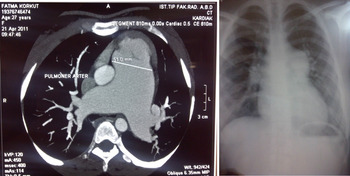
A 27-year-old female patient was admitted with dyspnoea. The pre-op pulmonary artery pressure was 62 mmHg and the PVR was 4.3 WU while the patient was at rest. In the echocardiography of the patient, we identified a 14-mm diameter ASD, and the PA diameter was measured as 51 mm in the preoperative CT scan. Acute vasoreactivity test was applied to the patient who had a positive response demonstrating regression in pulmonary pressures and PVR (Fig 3). The ASD closure operation was performed with a fenestrated patch. In the post-operative period, a significant regression was observed in the patient’s complaints and NYHA classification, additionally, it was observed that PAP decreased in the early period.
CT and tele image of a patient with preoperative pulmonary hypertensive ASD.

Discussion
Although ASD closure operation is routinely performed in patients with left–right shunt, the approach should be different in patients with no ASD shunt or with a right–left ASD shunt. In the patient group without left–right shunt in ASD, after catheterisation, if the pulmonary vascular resistance is below 6–8 wood units, they benefit from complete ASD closure. Response to the acute vasoreactivity test is important in the patient group with PVR above 6–8 WU. While non-responders are considered inoperable, fenestrated patch may be an option for patients with AVT response. Reference Hansmann, Koestenberger and Alastalo23 In the patient group in which we performed ASD closure with fenestrated patch, we selected those with a PVR between 6 and 8 WU who demonstrated AVT response.
In ASD patients with pulmonary hypertension, initiating medical treatment in the preoperative period and delaying the operation after medical treatment is a widely accepted approach. Reference Khan, McElhinney, Reddy and Hanley7–Reference Barbero-Marcial, Tanamati, Jatene, Atik and Jantene9 Although phosphodiesterase 5 inhibitors, prostanoids, and endothelin receptor antagonists are frequently used in the treatment of PHT, the response of each patient to treatment is not the same, and pulmonary vascular resistance may remain high in some patients despite treatment. The strategy of treatment for ASD in these patients still maintains its importance. Reference Arvind, Relan and Kothari19 Our objective was to enable atrial and pulmonary remodelling by using the fenestrated patch technique, thereby reducing pulmonary blood flow in ASD patients in which PHT regression could not be obtained with medical treatment.
ASD closure techniques are developing day by day, and minimally invasive and transcatheter closure methods are preferred at a relatively higher frequency than conventional surgery. Although complete anatomical repair is almost always achieved in ASD closure operations, which have low mortality and morbidity with current surgical developments, complete recovery may not be achieved in patients with PHT. Reference Grinda, Folliguet, Dervanian, Mace, Legault and Neveux10–Reference Mavroudis12 In these patients, complete closure of ASD may cause an increase in post-operative mortality and morbidity due to PHT that may develop after an increase in post-operative pulmonary vascular resistance. In patients with PHT who are resistant to medical therapy, as a result of the closure of ASD with fenestrated patch, pulmonary blood flow decreases, while the residual ASD left in the patch provides controlled residual shunt that enables sufficient cardiac output for decompression in case of critical increase in PVR until physiological adaptation to the new anatomy. In our patients, after fenestrated patch, NYHA classification grade, symptoms, and pulmonary artery pressure decreased.
Although it is stated in the literature that fenestration in patients with PHT and LVDD should only be considered when there is a pressure increase of 3–10 mmHg in the atrial septum after balloon inflation via transcatheter approach, there is no guideline stating definite values for the size of ASD that should remain in such patients. Therefore, the decisions are generally based on the experience of the surgeon performing the operation. Reference Hopkins, Bert, Buchholz, Guarino and Meyers13,Reference Holzer, Cao and Hijazi14 In our case series, we fenestrated the ASD patch with a 2 mm punch.
Although residual ASD accelerates adaptation to the new cardiac anatomy in the early and mid-post-operative period and reduces mortality and morbidity, it is known that atrial and ventricular remodelling after ASD closure results in decreased right ventricular and pulmonary pressures; thus, the long-term prognosis of patients is usually unassociated with residual ASD. However, since it allows patients to have a more comfortable early post-operative period with fewer complications, despite a theoretical increase in the risk of paradox embolism in the long term, it is often utilised in these surgeries. Reference Sezer, Özyurt and Narin16–Reference Peters, Ewert and Schubert18 In our series of patients, no paradoxical embolism or other complications developed in the early period. The NYHA class and symptoms of the patients were found to have decreased in the early period.
In the study conducted by Lowe et al., It was reported that PHT due to ASD generally develops over the age of 60 and the frequency of PHT increases with advancing age. Reference Lowe, Therrien and Ionescu-Ittu20 However, the age distribution of the patients in whom we performed ASD closure with fenestrated patch reveals that PHT had developed earlier in our study group – a finding that may have important implications for patient management.
In the previous series, the frequency of ASD and the development of PHT due to ASD was higher in female patients, which was associated with hormonal and genetic factors. Reference Warnes21 It is thought that the most important factor in the formation of this difference is related to the levels of sex hormones, progesterone, testosterone, and oestrogen, and their influence on the pulmonary circulation. Reference Martin and Pabelick22 In our study, the percentage of females was higher in the patient group, similar to the results put forth in the literature.
In conclusion, we think that the fenestrated patch technique is a safe approach in the management of PHT in pulmonary hypertensive ASD patients in the early and mid-post-operative period.
The limiting factor in our study is that, although the clinical protocol was decided upon with respect to the reduction of PVR after medical treatment and AVT response, the decision for the operation and the residual ASD size are entirely based on the surgeon’s own experience. This may cause unavoidable variations in the findings of different studies. In addition, studies with larger populations and long-term follow-up are needed to obtain accurate and reliable information concerning this topic.
Financial Support
This research received no specific grant from any funding agency, commercial, or not-for-profit sectors.
Conflicts of Interest
None.
Ethical Standards
The ethics committee approved the study protocol and all steps of the study were conducted in accordance with the principles of the Declaration of Helsinki. (2021/1/432).