In the spring of 1892, several prominent range cattle businessmen, all members of the Wyoming Stock Growers' Association (WSGA), organized a small armed militia. The purpose of the militia, as the organizers later claimed, was to clear northern Wyoming of rustlers—it was simply to protect the private property of the range cattle firms. It was on this basis that the WSGA recruited gunmen throughout the U.S. West and mobilized in Cheyenne. However, the organizers had broader goals than simply to impose vigilante justice on rustlers. They wanted to overthrow the newly emerging political structure in the county, take charge of the courthouse, and, as such, the legal process. With the rise in homesteader settlement and subsequent decrease in political influence of the cattle industry, especially with the financial downturn of the industry in the late 1880s, these businessmen felt that their rights were inadequately protected. They had all but given up trying to convict individuals of stealing their property, usually cattle, and decided instead to reestablish their influence via armed conflict.
On 6 April 1892 the militia began its 120-mile march to Buffalo, the seat of Johnson County. While in route, the militia came across some alleged rustlers at a ranch 50 miles south of Buffalo. After a heated debate, the militia decided to deal with the “rustlers” before continuing on to their intended destination. Expected to last but a few hours, it evolved into a disastrous daylong ordeal. This delay cost the militia the advantage of surprise as the news of the “invading” militia along with its intent reached Buffalo.1
While the operation was kept secret to gain the advantage of surprise, the leaders did not intend to remain anonymous. Reporters were included in the militia entourage (Larson, History, p. 274).
The local ranch was the TA ranch located 13 miles southwest of Fort McKinney. The initial counter force arrived at the ranch on 11 April, and government troops arrived on the morning of 13 April. A total of two days transpired between the arrival of the counter force and the arrival of government troops.
Larson, History, p. 279
Known today as the Johnson County War of 1892, these events form the historic basis for many of the popular film depictions of the U.S. West, starting with the original Virginian (1914) to Shane (1953) to Heaven's Gate (1980). Furthermore, historians argue that they were important because they altered the political structure in Wyoming, influencing the fall elections.4
Ibid., pp. 284–92. The war prompted the merging of the Democratic and Populists parties in Wyoming. After the election, Democrats carried all but Laramie County.
Baber, Longest Rope, preface.
Essentially, the war was a dispute over land, and it is common to depict all such land disputes in the west as resolved violently rather than peacefully through negotiation. On the other hand, recent work by economists has shown that the West may not have been as violent as popularly believed.6
Anderson and Hill, Not So Wild, Wild West.
Anderson and McChesney, “Raid.”
The fundamental conflict was control of the public domain. Over several decades, ranchers had developed use rights to the range. However, in the late 1880s, homesteaders began to migrate onto the public domain claiming portions of the range under various federal land acts, the most notable being the Homestead Act of 1862. However, this migration rarely lead to the type of organized violence seen in the Johnson County War. To identify the key parameters affecting whether the conflict ends in violence, the article uses a variation of a model developed to analyze land conflicts in the Brazilian Amazon.8
Alston, Libecap, and Mueller, “Land Reform Policies.”
CATTLE, LAND, AND PROPERTY RIGHTS
The range cattle industry dominated business in Wyoming during the 1880s. For the time, cattle concerns were large enterprises often financed by foreign capital. Production methods were land intensive based upon usufruct rights in land and fee simple title to cattle. Invested capital consisted almost entirely of cattle with only a small proportion of land held in fee simple. Moreover, the practice of grazing cattle on the range until ready for market exhibits substantial economies of scale.9
See Eaton, “Wyoming Stock Growers Association,” p. 136.
Market imperfections such as minimum price floors and acreage constraints along with bureaucratic impediments prevented market transactions from solving the land ownership issue. However, in the early development of the industry these were not binding constraints given the initial nonscarcity of land. Range use allocations occurred by the common law doctrine of prior appropriation whereby individuals set up operations by claiming a range and publicly stating their intent. Once such proclamation read
I, the undersigned, do hereby notify the public that I claim the valley, branching off the Glendive Creek, four miles east of Allard, and extending to its source on the South side of the Northern Pacific Railroad as a stock range. – Chas. S. Johnson.10
Osgood, Day, p. 183.
See Anderson and Hill, “Evolution”; and Ellickson, Order, for a discussion of informal networks. In Wyoming, a set of rights sold for “something over $200,000,” and one cattle company reported a value of $85,000 for range rights: Dennen, From Common to Private Property, p. 110. Fred Hesse obtained the use of 50,000 acres in exchange for debts from Morton Frewen: Sandoz, Cattlemen, p. 333. This suggests that early arrangements were effective in protecting range rights.
By the mid-1880s, conditions changed such that informal arrangements became less effective in protecting rights. Homesteaders, with the promise of legal title to land, came into this existing system of use rights and began establishing claims on ranges already extensively used by cattlemen. As competition increased, cattlemen found it economically viable to devote additional resources to alter the existing institutional framework governing range use. Early on, cattlemen lobbied Congress to alter federal land laws to align better with the conditions of the arid west where a cow required from 20 to 40 acres. If successful, this would allow market transactions to prevent this type of competition. Yet, their efforts failed in persuading Congress. Gary Libecap argues that Congress and the General Land Office intentionally obstructed western cattlemen's efforts to gain legal recognition of their established use rights or to alter existing land policies.12
Libecap, Locking Up the Range.
Clawson, Uncle Sam's Acres, p. 62. Libecap argues that the primary reason for the obstruction was that the Land Office's budget depended on case loads processed. To increase their budget, the Land Office had to increase workload. This favored the small land claimant over the land-intensive rancher.
This is not unlike the situation in much of South America as noted by Desoto, Mystery.
Compounding this was the passage of a congressional resolution in 1868 that represented a shift in federal land policy from one of revenue generation to territorial settlement. This effectively ended cash sales and prohibited cattlemen from securing private title to enough land through this avenue.15
Hibbard, History, p. 111. Gates, “Homestead Law,” argues that cash sale of land continued after 1868 using commutation of homestead entries under preemption, state land grants, Indian lands, and other Federal lands. However, this does not appear to have been a viable option in Wyoming. Only small fraction of the public domain was transferable under these entries.
Dennen estimates the open market value of land at less than ten cents per acre. Dennen, From Common to Private Property, p. 9.
Yet the inability to secure legal title did not prevent cattlemen from amending their informal institutions in response to increased competition.17
See Anderson and Hill, “Evolution” and “Race”; and Anderson and Grewell, “Property Rights Solutions,” for a complete discussion of the evolution of institutions on the western range.
Eaton, “Wyoming Stock Growers Association,” p. 133. These issues are the result of the communal grazing on public land. In particular, the issue of open access and the tragedy of the commons that could result from a failure to control range use.
See Jackson, “Wyoming Stock Growers' Association,” for a full discussion of the political activities of the WSGA.
The WSGA, through legislative acts and internal activities, created an institutional framework to govern the Wyoming range. Acts between 1869 and 1884 vested control over registering of brands with the WSGA, and the Maverick Law addressed ownership of unbranded range cattle (mavericks) and the negative externalities associated with individual roundups.20
See Wyoming Stock Growers Association. By-Laws, for a complete discussion of Wyoming Stock Laws. Communal roundups avoid excessive trampling of grass and overstressing cattle associated with individual roundups. However, communal grazing creates an incentive to brand cattle first. Once branded, a maverick becomes the property of the owner of the brand. Initially, the doctrine of presumptive ownership addressed this incentive by allocating mavericks under various rules such as proportional allotment. This agreement began to break down as the ranges became crowded. The maverick law attempted to overcame this by vesting the power to brand with the WSGA.
2005 dollars. See Table 3.
By controlling participation in the annual roundup, the association controlled access to the range. Membership required the sponsorship of a current WSGA member and approval of the membership committee. The association was not shy about blacklisting or denying membership to individuals it considered of “bad character.” This all but ensured that the individual could not participate in the roundup. All mavericks gathered during the roundup essentially became the property of the WSGA and any nonmember's cattle gathered were confiscated and sold at auction.22
Owners of confiscated cattle could petition the WSGA for the remittance of the funds generated from their confiscated cattle. However, the WSGA controlled what evidence would be considered proof of ownership.
By 1884 the WSGA controlled access to the open range through membership and the Maverick Law. However, during the later part of the decade, the principle competition for range use was small stock ranchers, sheepherders, and farmers known as “grangers.” The largest granger community developed in Sheridan, Johnson, and Crook counties were due to geographical conditions.23
Viable farming in the arid West required steady water flows for irrigation along with low construction costs of irrigation canals. Northeast Wyoming provided adequate summer water flow and the cost of constructing canals was lower than in the rest of Wyoming: U.S. Census Bureau. Report on Agriculture, pp. 248–54.
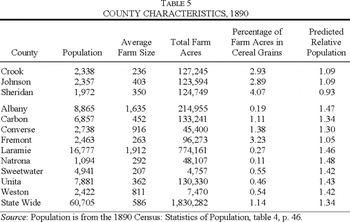
This is evident in Table 5.
Quoted in Larson, History, p. 188. Frank Canton was at one time a detective for the WSGA.
Beginning in the mid 1880s, several changes occurred that began to unravel the institutional arrangement. The election of President Cleveland in 1884 and appointment of William Sparks as Commissioner of the General Land Office represented a shift in the federal government's support of homesteaders against ranchers.26
Libecap, Locking Up the Range, p. 32.
Larson, History, p. 269.
With respect to the illegal fencing question, the Justice Department handled early cases, but with limited success.28
Ibid., p. 179. Cattlemen began to construct fences in an effort to exclude grangers from their ranges. In the process, cattlemen inclosed substantial portions of the public domain as well. See Larson, History, p. 32, for a full discussion of illegal fencing.
48th Cong. Ch. 149; 23 Stat. 321.
8 Utah 173, 30 P 433.
By the end of the 1880s, the WSGA had lost substantial control over access to the range and protection of cattle from theft began to breakdown at an increasing pace.31
Larson, History, p. 271. Smith, War, pp. 116–17.
A MODEL FOR ANALYZING CONFLICT
Not all competition over land use ends in violent confrontation. Indeed, the history of Wyoming is a case in point. Except for isolated incidences of lynching and vigilantism, the vast majority of Wyoming and the U.S. West peacefully transferred from the public domain into private ownership.32
See Anderson and Hill, Not So Wild, Wild West.
Alston, Libecap, Mueller, “Land Reform Policies.” In Brazil, land reforms set up the potential for conflict between individuals who held legal title to the land and landless peasants. Many times this conflict resulted in violence; their model lays out the necessary conditions for an increase in the probability of violence. However, the Homestead Act encouraged occupation of land held by the Federal government that was largely unoccupied. In Brazil, the level of violent confrontation was much greater than in the American West. The level of confrontation resulting from the Homestead Act would not reach the level in Brazil until the migration of farmers encountered a system developed for the arid conditions of the West. However, we believe it appropriate to use a model developed to analyze a situation where violence was more common to analyze a situation where violence was less common as in the American West.
In contrast to Brazil, Wyoming ranchers occupied large tracts of public land and homesteaders engaged in efforts to invade and occupy this land. To simplify the analysis, we assume the antagonists attempt to maximize land value and only two outcomes are possible. Either a rancher maintains the use of the land and the homesteader loses the use of the land or homesteaders invade and successfully resist eviction, in which case the rancher loses the use of the land.34
These assumptions are equivalent to the Alston et al. model derived in their appendix. However, the homesteader has legal title to the land rather than the rancher as in the Alston model.
This specification of v is more general than Alston's specification in that efforts to protect cattlemen's use rights to land include resisting homesteader's efforts to occupy the range and evicting homesteaders once actual occupation occurred rather than simple eviction efforts.
The probability that ranchers maintain the use of disputed land depends on the level of v supplied, the level of support from state and local government (both legislative and judicial) k, and the relative population (ranchers to homesteaders), n. We write this probability as:

Support from state and local government augments a rancher's ability to resist invasion and to evict homesteaders.
36In our model k is an exogenous parameter that either enhances or diminishes the efforts of ranchers in protecting their legal rights to property such as cattle. In the Brazilian context, the role of the courts is the protection of the owners' legal rights to the land itself.
The distribution of n affects the expected outcome of a violent confrontation. At the two extremes of the distribution, the outcome is certain. If n is sufficiently high, then homesteaders are not likely to waste resources fighting eviction given that the expected outcome favors ranchers. On the other hand, at sufficiently low n ranchers would not waste resources resisting and evicting homesteaders given that the expected outcome favors homesteaders. Between these two points, however, the outcome of a dispute is uncertain and the expected outcome favors neither ranchers nor homesteaders. It is in this range that violent confrontation is likely.37
This analysis is similar to that of Allen (“Homesteading”) where he argued that relative population is a critical component of disputes between whites and Indians in settling the West. He argued that the U.S. government used the Homestead Act as a method of rushing settlers into a territory, increasing the relative population to a point where the federal government could bypass the zone of violence. In our context, we argue that this zone of violence existed to the greatest extent in the northeast portion of the state in 1892.
What is more, the probability that the federal government through either the Department of the Interior, the Justice Department, or the military will intervene on behalf of homesteaders also affects the ability of ranchers to maintain the use of disputed land. This is a function of three variables; the level of s supplied by homesteaders; the level of security of a rancher's property rights, p; and the political support for the principles behind the Homestead Act itself, g.
38In Brazilian context, g represents the attitude of the Land Authority towards land reform in supporting the efforts of squatters in their attempt to expropriate privately owned land. In our case, it is the attitude of the Department of the Interior towards the settler's efforts in invading and resisting eviction from land to which they may hold legal rights. In our model, p has a different interpretation. It is the strength of extralegal institutions that arose on the plains in protecting a rancher's use rights. The most notable institution for our study was The Wyoming Stock Growers Association.

Combining equations 1 and 2, one can write the ranchers' expected value function from maintaining the use of the range as

The first term represents the expected returns from a successful eviction, and the second term is the expected loss if eviction efforts fail. L is the value of land and C(v) is the cost function for supplying units of v, which is increasing in v with Cvv > 0. The goal of the rancher is to choose the level of v that maximizes equation 3. Differentiating the objective function with respect to v yields the rancher's first order condition given by equation 4.

Equation 4 represents the marginal benefit and cost of supplying units of v. θ(s,p,g)]L is the expected loss avoided by the rancher, and βv is the marginal increase in the probability of evicting the homesteader with respect to increases in effort. The rancher balances this gain against the marginal cost, Cv.
Simultaneously the homesteader will choose the level of effort, s that maximizes the following expected value function

The first term in the equation represents the probability of a successfully occupying the range, and the second term is the probability of intervention by the federal government. Together with the value of the land L, this term represents the expected payoff to the homesteader from occupying the range and resisting eviction by ranchers. The last term is the cost function from the perspective of the homesteader. This function is increasing in s. The goal of the homesteader is to choose the optimal level of s that maximizes equation 5. Differentiating this objective function with respect to s yields equation 6, which is the first order condition for the homesteader.

A marginal increase in the probability of the federal government intervening, θs, times the value of the land gives the marginal benefit of another unit of s. Cs is the marginal cost of another unit of homesteader effort. The homesteader balances the gain from the use of the land against the cost of invading and resisting eviction efforts.
As in the Alston et al. model, the joint solution of the individual maximization problems produce a Nash equilibrium where the level of efforts v* and s* are such that both equation 4 and equation 6 hold simultaneously. Differentiating the first order conditions with respect to each parameter of the model and solving for the underlying derivatives yields the reaction function for each player in the land dispute. Establishing their slope is critical in understanding how each player responds to changes in the other's level of effort, holding the exogenous parameters constant. It is straightforward to demonstrate that the slope of the homesteader's reaction function is negative with respect to changes in v whereas the rancher's is positive with respect to changes in s for any given set of exogenous parameters.39
For a derivation of the slopes of each reaction function, see Alston et al., “Land Reform Policies.”
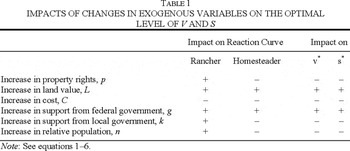
Critical for analyzing the Johnson County War is how the optimal levels of s and v responds to changes in the parameters n, k, p, g, L, and C. To ascertain these effects, we conducted a comparative static analysis of each of the exogenous parameters. Table 1 contains the results from this analysis.40
These results are identical to the results of the Alston model except that we deviate from the Alston model by explicitly modeling the probability of an eviction as a function of the proportion of ranchers to homesteaders. For a derivation of the results with respect to n, see the Appendix. For the other parameters, see Alston et al., “Land Reform Policies.”
This result of a direct and indirect effect is identical to direct and strategic effects in the Alston model.


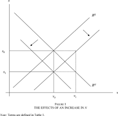
FIGURE 1 THE EFFECTS OF AN INCREASE IN N
To make definitive statements on the optimal level of v* and s*, the relative elasticity of the reaction curves with respect to changes in each exogenous variable must be known. Clearly, the determination of which party is more responsive is an empirical issue. In the absence of data and in order to determine unambiguous effects from changes in parameters we assume that homesteaders are always more sensitive to changes in parameters than ranchers. In other words, homesteader reaction curves are always more elastic than those for ranchers.42
This assumption plays the same role as the Alston et al. assumption that the direct effect is always greater than the strategic effect.
Table 1 lays out the necessary conditions for an increase in the probability that individuals will resort to violence in resolving land disputes. For this to occur, the supply of v and s must increase simultaneously. Both ranchers and homesteaders will increase their supply of v and s if the value of land or the support from the federal government increases. Furthermore, they will increase their supply of v and s if property rights protection, cost of supplying effort, support from local government, or relative population decrease. We will argue that all six parameters changed in a manner that increased the probability that ranchers and homesteaders would resort to violence in settling their dispute over land in Johnson County.
EVIDENCE
In the following section, we lay out the shifts for each exogenous variable in the model and their implication for the Johnson County war of 1892.
L, Land Values
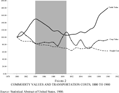
The value of land for agricultural purposes is a function of three variables: the value of the output produced, cost of transportation to markets, and the marginal productivity of land. In this context, output values increased, transportation costs fell, and the marginal productivity of Wyoming land increased relative to surrounding territories. We constructed three indexes to demonstrate the increase in the value of land with 1880 the base year. The first is a weighted average of the value of the yield per acre for primary cereal crops, and the second and third measure changes in cattle values and transportation costs respectively.43
Acreages of corn, oats, and wheat accounted for 97 percent of the cereal grains harvested in Wyoming in 1890. Oats accounted for 67 percent of the total cereal grains harvested. Transportation costs are average freight charges per ton-mile.

FIGURE 2 COMMODITY VALUES AND TRANSPORTATION COSTS, 1880 TO 1900
With respect to the marginal productivity of land in Wyoming, the important factor was the marginal productivity of lands in Nebraska and Kansas. By 1892, the combined population of Kansas and Nebraska approached 2.5 million with some 20 million acres contained in homesteads. As population increased, the marginal productivity of land in these states decreased. In turn, the marginal productivity of land in Wyoming increased relative to lands in Kansas and Nebraska. This change in relative marginal productivity increased the value of land in Wyoming.
Increasing land values shifted the reaction functions for both ranchers and homesteaders to the right. The impact on the optimal level of v is unambiguously positive. Ranchers respond to these changes by increasing their efforts at resisting and evicting homesteaders given the payoff to such activities increased. On the other hand, the impact on s is ambiguous. The payoff to homesteaders increased, but the optimal level of v also increased. As long as the shift of the homesteader's function dominates the rancher's shift, then the impact on the optimal levels of v and s will be positive increasing the probability of violence.
C, Per Unit Cost of Supplying Effort
One obstacle facing both homesteaders and ranchers in maintaining the use of land was the cost of fencing western plains. Traditional materials such as stone and wood were scarce, raising their cost substantially. The invention of a low cost method of producing barbed wire in 1874 significantly lowered the cost of constructing fences on the plains. In turn, this lowered the cost for both ranchers and homesteaders in asserting and defending their claims to disputed land. Without this invention, the rate of return to farming in the West was much lower due to a farmer's inability to protect his crops from damage due to trespassing cattle, given that Wyoming was a fence-out state. Simultaneously, ranchers could protect their existing ranges from intruding homesteaders.
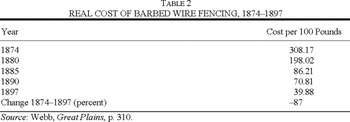
Table 2 presents the trend in the cost of barbed wire fencing from 1874 to 1897. The real cost of barbed wire fencing decreased 87 percent over this period. This shifted homesteaders' reaction curve to the right increasing the optimal level of s. They could now move onto the arid plains of Wyoming, stake a homestead claim, and protect their investment from damage caused by range cattle at a reasonably low cost, thereby increasing the rate of return to a Wyoming farm. Ranchers respond to increases in s by sliding up their reaction curve given its positive slope. The drop in fence costs increased the optimal supply of s and v leading to an increase in the probability of violence.

p, Property Rights
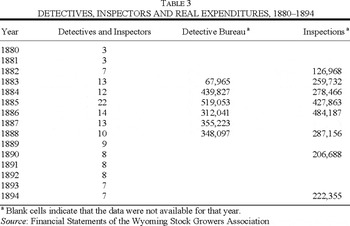
The primary institution through which open range ranchers protected their investment in cattle and range rights was the WSGA that provided essential inspection and detective services. Table 3 provides data on the number of inspectors and detectives and real expenditures for these services. Data are most complete for the number employed with a high of 22 in 1885 followed by a 68 percent decline by 1894. Expenditures for detective services pertain to the years 1883 to 1888. Real expenditures for detective services peaked in 1885 and declined by 32 percent by 1888 when the WSGA disbanded the bureau. Furthermore, between 1882 and 1894 real expenditures for inspection services declined 54 percent.

As is evident in Table 3, expenditures for enforcement activities steadily increased until 1886. In the aftermath of the winter storm of 1886, most large cattle outfits were bankrupt. The WSGA found itself in similar financial shape and by 1887 could no longer finance the detective bureau due to declining membership and revenues. While expenditures for inspection services continued, they never approached their high of 1886. These changes represent a decrease in the parameter P causing an outward shift of both the homesteader's and rancher's reaction functions. As a result, the optimal levels of both v and s increased leading to an increase in the probability of using violence to resolve land disputes.
g, Federal Government Support
The primary change in the probability of federal government intervention in the dispute between homesteaders and ranchers was the passage of the 1885 Illegal Inclosure Act. This act was the primary legal vehicle used by the federal government to prevent cattlemen from inclosing the public domain. Further supporting the homesteaders were the election of President Cleveland and the appointment of Secretary Sparks. After this point, the federal government became more actively involved in the dispute between homesteaders and ranchers, and the 1885 act gave the federal government a legal method to intervene. This shifted the reaction functions of both ranchers and homesteaders to the right. Again, as long as the shift of the homesteader's function dominates the ranchers, the optimal level of both s and v will increase. As a result, the probability that homesteaders and ranchers resort to violence will increase.
k, Local Government Support
With respect to protection from the courts, the ability of cattlemen to obtain convictions in local courts for theft of cattle was important. Evidence from Johnson County court records indicates that in 1885, of the nine cases of theft brought to trial, five resulted in convictions. However, in 1889, of the 14 cases brought to trial, none led to a conviction, and thereafter no cases of theft appear in the court records.44
Smith, War, pp. 116–17.
With declining conviction rates and legislative changes such as the repeal of the Maverick Law and creation of the Board of Livestock Commissioners, support of local government k, fell. As a result, the reaction curve for homesteaders shifted out while the function for ranchers shifted in. Unambiguously, the optimal amount of s supplied by homesteaders increased, but the effect on ranchers is ambiguous. With less support, the probability that homesteaders will resist eviction efforts increases. Ranchers initially respond to the fall in k by reducing v, but the increase in s induces them to supply more efforts at eviction. As long as the reaction curve of the homesteaders dominates the shift of the rancher's curve, the optimal value of v will increase as well. As a result, both s and v increased leading to an increase in the probability of violence in settling land disputes.
n, Relative Population
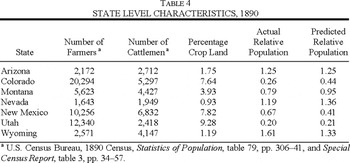
To construct a measure of relative populations by county, one would like to have data on individuals engaged in ranching and farming, however, these data exists only at the state level for Wyoming in 1890. To overcome this limitation, we constructed a prediction equation based upon state-level data using the percentage of farmland devoted to cereal crops such as corn, wheat, and oats for seven western states as the predictor. The presence of cereal crops is a strong indicator of a lower relative population. During this period, farmers grew cereal crops primarily for market sale and not as feed for cattle. We use the equation to predict a county's relative population.45
The 1890 Census classified cattlemen as individuals engaged as stock raisers, herders, and drovers while farmers are individuals who are farmers, planters, and overseers. The correlation coefficient between percentage crops and relative population is -0.927 and the coefficient of correlation is −0.7944, indicating a strong negative linear dependence between the two. The prediction equation is Y = 1.493 – 0.13802(X) with an adjusted R2 of 0.861.

With respect to the model, the implications for violence in Wyoming are clear. Larger relative populations led to the expected outcome of violence favoring ranchers in the southern portion of the state, and lower relative populations led to an uncertain expected outcome in the northeast. In the south, the reaction function for cattlemen shifted outwards, but inwards for homesteaders. In the northeast, lower relative populations shifted the reaction function for homesteaders outward and that of ranchers inwards. As long as the homesteaders' shift dominates the ranchers' shift, both s and v will increase with lower relative populations leading to a higher probability of violence, whereas the opposite is true with higher levels of n.
As seen from Table 5, Crook, Johnson, and Sheridan counties, comprising the northeast portion of the state, had relative populations around one indicating a relatively equal distribution of cattlemen and homesteaders. This is consistent with Frank Canton's assessment that grangers comprised a majority of Johnson County.46
Quoted in Larson, History, p. 188.

CONCLUSION
For decades, historians and popular culture depicted the development of the American West as one of almost continual violence, a lawless domain where guns and lynching solved disputes. Recent literature has challenged this characterization arguing that the region was neither “lawless” nor as violent as depicted. What is more, the violence that did occur was relatively rare and predictable. This article supports this view by arguing that the Johnson County War, the seminal event between whites, that Baber describes as a transition point between the old and new West was not the outcome of irrational vigilantism as popularly portrayed. Rather it was the direct result of decisions made by rational utility maximizing individuals under conditions of uncertainty.
The “war,” such as it was, was ultimately the result of incompatible property rights systems competing for the same land. Ranchers established an economic system based upon usufruct rights to land and private rights to cattle complete with an institutional structure for the protection of these rights. However, the federal government never recognized ranchers' claims on the public domain. Moreover, the federal government actively encouraged small-scale settlement of the West through various land policies that were well suited for the humid regions of America, but not the arid regions of the west. This conflict between two property rights systems culminated in the Johnson County War in Wyoming during the late nineteenth century. Using a model that specifies the conditions for violence, we demonstrate that every parameter affecting the probability of a dispute resulting in violence shifted in a manner that increased that probability of violence. As such, this article supports the argument that the level of organized violence reached in the Johnson County War was predictable and, furthermore, why this level of organized violence in the West was a relatively rare choice for resolving disputes.
Appendix
To determine the slopes of the reaction functions, we differentiated the first order conditions with respect each variable of the model and solved for the respective partial derivatives. Equations 7 and 8 represent the reaction functions.


The slope of the homesteader's reaction function with respect to changes in v is negative while the slope of the rancher's function with respect to s is positive. The numerator of the homesteader's function is positive while the denominator is negative due to the second order condition for maximization. Using the same logic, the slope of the rancher's function is positive. In other words, homesteader's respond negatively to any increase in efforts by ranchers while ranchers respond positively to increases in effort by homesteaders for any given set of exogenous variables.
To analyze the impact of each exogenous variable on the optimal level of s and v, we differentiated the reaction functions with respect to each exogenous variable. What differentiates our application from that of Alston et al. is the modeling of the probability of an eviction as a function of the relative population n. Equation 9 represents the derivative of the rancher's reaction function, and equation 10 that of the homesteader's with respect to n.


One can demonstrate that the sign of equation 9 is positive while that of equation 10 is negative. Increases in the relative population shifts rancher's reaction function to the right, but simultaneously shifts the homesteader's function to the left.
Without additional structure imposed upon the model, the impact on the optimal level of v is indeterminant. To demonstrate this ambiguity, refer to Figure 1. Initially, the model is in equilibrium with rancher's supply v0 and homesteader's supplying s0 given a fixed level of n. Suppose that n increases. The reaction function of ranchers shifts to the right, holding s constant. Ranchers respond by supplying v1. Homesteaders respond to the increase in v by moving down their reaction function and supply less s. However, an increase in n shifts homesteaders reaction function to the left. The result is an unambiguous decline in the optimal supply of s, but an ambiguous change in the optimal supply of v. If one assumes, which we do, that the shift of the homesteader's reaction function dominates that of the rancher's, then the result will be a decline in both s and v.