Implications
Canola co-products are often included in pig diets to supply protein. Results from this study show that canola co-products contribute dietary energy to pig via hindgut fermentation; hence, they can serve as a source of both protein and energy in swine diets. However, this amount of energy varies as function of the species of canola from which co-products are derived and oil content in the co-products.
Introduction
Canola co-products can be included in pig diets instead of soybean meal (SBM) to reduce feed cost (Woyengo et al., Reference Woyengo, Beltranena and Zijlstra2014). However, canola co-products have lower digestibility in the small intestine of pigs due to their greater fibre content: <15% NDF for SBM v. >20% NDF for canola co-products (National Research Council (NRC), 2012). Consequently, apparent ileal digestibility (AID) of gross energy (GE) for expeller-pressed canola meal (50%; Grageola et al., Reference Grageola, Landero, Beltranena, Cervantes, Araiza and Zijlstra2013) is lower than that for SBM (80%; Woyengo et al., Reference Woyengo, Moehn, Beltranena and Zijlstra2013).
Feed components that escape digestion in the small intestine might be fermented in the hindgut of pigs and thereby contribute to production efficiency and health. Microbial fermentation of undigested feed produces gases and volatile fatty acids (VFA) that contribute up to 25% of the energy need of pigs (Yen et al., Reference Yen, Nienaber, Hill and Pond1991). Production of butyric acid has been associated with improved gut health (Macfarlane and Macfarlane, Reference Macfarlane and Macfarlane2012). Specifically, butyrate is the most interesting of the VFA, because butyrate is an important energy source for the colonic epithelium and regulates cell growth and differentiation (Calabrò et al., Reference Calabrò, Carciofi, Musco, Tudisco, Gomes and Cutrignelli2013). Fermentation characteristics in the pig intestine vary widely among feedstuffs (Jha et al., Reference Jha, Bindelle, Rossnagel, Pieper, Van Kessel and Leterme2010; Jha and Leterme, Reference Jha, Rossnagel, Pieper, Van Kessel and Leterme2012) and it is important to understand their contribution toward energy needs and gut health of pigs. However, information about fermentation characteristics of canola co-products in the pig intestine is minimal.
Oil is removed from canola seed by pressing or solvent extraction (Spragg and Mailer, Reference Spragg and Mailer2007). In Canada, canola co-products are mostly derived from two species of canola; Brassica napus and Brassica juncea that differ in fibre profile. We hypothesise that canola co-products contribute dietary energy for pigs via hindgut fermentation and that these fermentation characteristics vary between species and among oil extraction methods. The objective of the present study was to determine porcine in vitro digestion and fermentation characteristics of SBM, Juncea solvent-extracted canola meal (JSECM), Napus solvent-extracted canola meal (NSECM), Napus expeller-pressed canola meal (NEPCM) and Napus cold-pressed canola cake (NCPCC). In addition, the correlations among chemical and fermentation characteristics of canola co-products were studied.
Material and methods
Sample collection
The conventional dehulled solvent-extracted SBM was obtained from a local supplier and was included as reference in the study. The JSECM was obtained from Bunge Canada (Altona, MB, Canada). The NSECM was obtained from Bunge Canada (Fort Saskatchewan, AB, Canada). The NEPCM was obtained from Heartland Colony (Bashaw, AB, Canada). The NCPCC was obtained from Cansource Biofuels (Mayerthorpe, AB, Canada). The feedstuff samples were ground in a centrifugal mill (model ZMI; Retch GmbH, Haan, Germany) to pass through a 1-mm screen before analyses: chemical composition, in vitro fermentation and digestion.
Feedstuff sample analyses
The ground feedstuff samples were analysed for dry matter (DM; method 930.15), CP (method 984.13 A-D), ether extract (EE; method 920.39 A), ADF (method 973.18) and ash (method 942.05) as per the Association of Official Analytical Chemists (2006), NDF (Holst, Reference Holst1973) and starch (assay kit STA-20; Sigma-Aldrich Corp., St. Louis, MO, USA). The GE of feedstuffs was analysed using an adiabatic bomb calorimeter (model 5003; IKAWerke GmbH & Co. KG, Staufen, Germany); benzoic acid was used as a standard.
In vitro digestion
The ground feedstuff samples were subjected to in vitro digestion as described by Jha et al. (Reference Jha and Leterme2011) with some modifications. Briefly, 4 g samples were weighed in conical flasks. A phosphate buffer solution (200 ml, 0.1 M, pH 6.0) and an HCl solution (80 ml, 0.2 M) was poured into the flasks. Two millilitres of a chloramphenicol solution (0.5 g/100 ml ethanol) was added to prevent bacterial growth during hydrolysis. Fresh pepsin solution (8 ml, 20 g/l porcine pepsin) was added and the flasks were placed in a water bath at 39°C for 2 h under gentle agitation (50 revolutions/min). Afterwards, 80 ml phosphate buffer (0.2 M, pH 6.8) and 20 ml of 0.6 M NaOH were added into the solution. Fresh pancreatin solution (8 ml, 100 g/l pancreatin; P-1750, Sigma-Aldrich Corp.) was added and digestion was continued for 4 h under the same conditions. The residues were then collected by filtration on a nylon cloth (42 µm), washed with ethanol (2×25 ml 95% ethanol) and acetone (2×25 ml 99.5% acetone), dried for 12 h at 60°C and weighed. The experiment was conducted as a randomized block design with batch as the block; four replicates for SBM and two replicates for JSECM, NSECM, NEPCM or NCPCC per batch in each of four batches. The SBM had a greater DM digestibility than canola co-products. Thus, to obtain enough undigested SBM residue for in vitro fermentation, the number of replicates for SBM was twice that for canola co-products. The undigested residues from the different batches were pooled for each feedstuff to use in the fermentation trial.
In vitro fermentation
The rate of fermentation of the undigested residues of the five samples was assessed in vitro using a cumulative gas-production technique adapted to the pig by Bindelle et al. (Reference Bindelle, Buldgen, Boudry and Leterme2007) and Jha et al. (Reference Jha and Leterme2011). Two hundred milligram samples of undigested residues for the five feedstuffs were incubated at 39°C (in a shaking water bath with 50 revolutions/min) in a 125 ml-glass bottle with 30 ml buffer solution containing macro- and micro-minerals (Menke and Steingass, Reference Menke and Steingass1988) and a faecal inoculum.
Three growing pigs were raised at the Swine Research and Technology Centre of the University of Alberta (Edmonton, AB, Canada) and fed a standard commercial diet devoid of antibiotics and served as donors for faecal inocula. Faeces were collected directly from the rectum and immediately placed in air-tight plastic syringes and kept in a water bath at 39°C until used, but no >1 h. The inoculum prepared from faeces was diluted 20 times in the buffer solution, filtered through a 250 µm screen and transferred into the bottle with fermentation substrates. Bottles were sealed with a rubber stopper and placed for incubation in a water bath. An anaerobic environment was maintained throughout the experiment, from the inoculum preparation until the incubation step by flushing with CO2 gas. The gas generated by fermentation and CO2 released by buffering of VFA produced during the fermentation were measured at 0, 2, 5, 8, 12, 18, 24, 36, 48 and 72 h by means of a pressure transducer (SIN-54978; GP:50, Grand Island, NY, USA) (Mauricio et al., Reference Mauricio, Moulda, Dhanoab, Owena, Channaa and Theodorou1999), fitted with digital data tracker (Tracker 211; Intertechnology Inc., Toronto, ON, Canada). Bottles were vented after each measurement. Fermentation was stopped at 72 h of incubation by quenching the bottles in iced water. The contents were then collected from the bottles and stored frozen at −20°C until analyses. The feedstuff samples were subjected to microbial fermentation as follows: ((5 feedstuffs×8 replicates)+4 blanks)×3 batches.
Experimental animal procedures were reviewed as part of the general herd protocol and were approved by the University of Alberta Animal Care and Use Committee for Livestock. Pigs that served as donors for faecal inocula were handled in accordance with the guidelines described by the Canadian Council on Animal Care (CCAC, 2009).
VFA analysis
Samples collected from the bottles at the end of fermentation and samples of inoculum before fermentation were centrifuged at 2500×g for 10 min at 4°C. The liquid phase of the centrifuged samples was collected quantitatively for VFA analysis, whereas the solid residue was freeze-dried and weighed. The concentration of VFA in the liquid phase of the fermented samples was determined using gas chromatography using a method adapted from Erwin et al. (Reference Erwin, Marco and Emery1961). Briefly, 0.8 ml of sample was added in a tube with 0.2 ml of 25% phosphoric acid and 0.2 ml of internal standard solution (150 mg of 4-methyl-valeric acid, S381810; Sigma-Aldrich Corp.) and vortexed for 1 min. The sample was analysed for VFA (i.e. acetic, propionic, butyric, isobutyric, valeric, isovaleric and caproic acids) using a gas chromatograph (Model 3400; Varian, Walnut Creek, CA, USA) with a Stabilwax-DA column (30 m×0.25 mm i.d.; Restek, Bellefonte, PA, USA). A flame-ionization detector was used with an injector temperature of 170°C and a detector temperature of 190°C. Branched-chain VFA content was calculated as the sum of the isobutyric and isovaleric acids.
Calculations
In vitro digestibility of DM (IVDDM; %) after pepsin and pancreatin hydrolysis was calculated as follows:
 $${\rm IVDDM}\,{=}\,\left( {{{\displaystyle {\rm dry}\;{\rm weight}\;{\rm of}\;{\rm intact}\;{\rm sample}\,{\minus}\atop \displaystyle{\rm dry}\;{\rm weight}\;{\rm of}\;{\rm hydrolysed}\;{\rm residue}} \over {{\rm dry}\;{\rm weight}\;{\rm of}\;{\rm intact}\;{\rm sample}}}} \right){\times}100$$
In vitro fermentability of DM (IVFDM; %) after in vitro fermentation was calculated as follows:
 $$\!\!\!{\rm IVFDM}\,{=}\,\left( {{{\displaystyle{\rm dry}\;{\rm weight}\;{\rm of}\;{\rm hydrolysed}\;{\rm residue}\,{\minus}\atop \displaystyle{\rm dry}\;{\rm weight}\;{\rm of}\;{\rm fermented}\;{\rm residue}} \over {{\rm dry}\;{\rm weight}\;{\rm of}\;{\rm hydrolysed}\;{\rm residue}}}} \right){\times}100$$
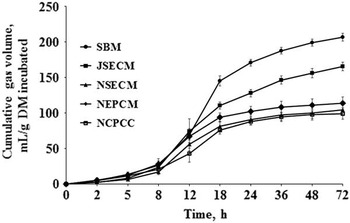
Gas pressure measurements were converted into gas volume (G, per gram DM) using the ideal gas law, assuming an atmospheric pressure of 101 325 Pa and a temperature of 312.15 K. Gas accumulation curves recorded during the 72 h of fermentation were modelled according to France et al. (Reference France, Dhanoa, Theodorou, Lister, Davies and Isac1993):
 $$G\,({\rm ml/g}\,{\rm DM})\,{=}\,0,\,{\rm if}\,{\rm 0\,\lt\,}t{\rm \,\lt\,}L$$
 $$\eqalignno{G({\rm ml/g}\;{\rm DM})\,&{=}\,G_{f} \left( {1{\minus}\exp \left\{ \!{{\minus}\left\langle {b\left[ {t\,{\minus}\,L} \right]{\plus}c\left[ {\sqrt t \,{\minus}\,\sqrt L } \right]} \!\right\rangle }\! \right\}} \!\right),\cr &\ \ \ \ \ {\rm if}\;t\geq L$$
where G denotes the gas accumulation to time, G f (ml/g DM) the maximum gas volume for t=∞ and L (h) the lag time before the fermentation starts. The model is illustrated in Figure 1. The constants b (h −1) and c (h −1/2) determine the fractional rate of degradation of the substrate µ (h −1), which is postulated to vary with time as follows:
 $$\mu \,{=}\,b{\plus}{c \over {2\sqrt t }},\ \ \ \ \ \ \ \ \ \ \ {\rm if}\;t\geq L$$
Kinetics parameters (G
f
, L, µ
t=T/2 and T/2) were compared in the statistical analysis. The T/2 is the time to half-asymptote when
 $G\,{=}\,G_{f} /2$
.
Gas production kinetics (mean±SD) of the undigested residue of soybean meal and canola co-products during a 72 h incubation with faecal inoculum. SBM=soybean meal; JSECM=Juncea solvent-extracted canola meal; NSECM=Napus solvent-extracted canola meal; NEPCM=Napus expeller-pressed canola meal; NCPCC=Napus cold-pressed canola cake; DM=dry matter.

In addition to the in vitro digestion and fermentation data, porcine in vivo (hindgut) fermentability data for the same test feedstuffs were calculated from in vivo AID and apparent total tract digestibility (ATTD) of GE values to establish whether or not the in vitro digestion and fermentation of the test feedstuffs reflect their digestion in the pig intestine. The in vivo AID and ATTD of GE values for SBM was obtained from our study (Woyengo et al., Reference Woyengo, Moehn, Beltranena and Zijlstra2013) in which the same SBM sample was fed. The in vivo AID and ATTD of GE values for JSECM and NSECM were obtained from the study of Beltranena and Zijlstra (Reference Beltranena and Zijlstra2011) in which the same JSECM and NSECM samples were fed. The AID and ATTD of GE values for NEPCM and NCPCC were obtained from the study of Grageola et al. (Reference Grageola, Landero, Beltranena, Cervantes, Araiza and Zijlstra2013) in which the same NEPCM and NCPCC samples were fed.
Statistical analyses
The IVDDM, IVFDM, total gas production, fermentation kinetics parameters and fermentation metabolites production were subjected to ANOVA as completely randomised block design with sample replicate as experimental unit and batch as block using the MIXED procedure of SAS (ver. 9.3; SAS Institute Inc., Cary, NC, USA). The model included treatment (feedstuff) as the fixed factor and batch as the random factor. Feedstuff means were separated by the LSD. To test the hypotheses, P<0.05 was considered significant.
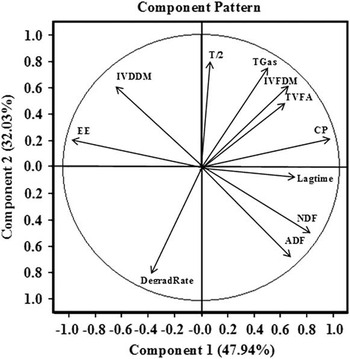
Principal component (PC) analysis was also conducted using SAS to establish relationships among chemical composition and fermentation characteristics of canola co-products. The chemical characteristics of canola co-product samples and fermentation kinetics and VFA profile defined in the present study were used as variables for PC analysis. The loading plots of PC 1 and PC 2, the first 2 eigenvalues, were used to determine the correlation among canola co-product characteristics, fermentation kinetics and VFA profile. The angle between arrows was used to describe the interrelationship. In PC analysis, the length, direction and angle between arrows indicates the correlation between variables or between variables and PC axes (e.g. α=0° and r=1; α=90° and r=0; and α=180° and r=−1). Percentages on x and y axes indicate proportions of variability of data that are described with the corresponding PC in the model.
Results
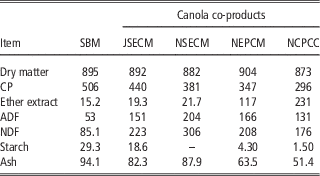
The NSECM, NEPCM, NCPCC or JSECM contained less CP, but more NDF than SBM (Table 1). The JSECM contained more CP and less NDF than NSECM. The NSECM contained more CP and NDF and less EE than NEPCM or NCPCC. The NEPCM contained more CP and NDF and less EE than NCPCC.
Analysed nutrient content (g/kg dry matter) of soybean meal and canola co-products

SBM=soybean meal; JSECM=Juncea solvent-extracted canola meal; NSECM=Napus solvent-extracted canola meal; NEPCM=Napus expeller-pressed canola meal; NCPCC=Napus cold-pressed canola cake.
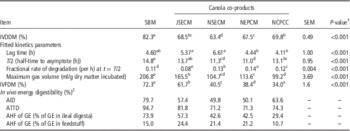
The NSECM had lower (P<0.05; Table 2) IVDDM than SBM. The JSECM had greater (P<0.05) IVDDM than NSECM. The IVDDM for NSECM was lower (P<0.05) than that for NEPCM or NCPCC. The JSECM had greater (P<0.05) IVFDM than NSECM. The NSECM had greater (P<0.05) IVFDM than NCPCC or NEPCM, whereas NEPCM had greater (P<0.05) IVFDM than NCPCC. Similar to IVFDM, the apparent hindgut fermentation (AHF) of GE, as % of GE in ileal digesta, for NSECM was lower (Table 2) than that of SBM. In addition, JSECM had greater AHF of GE, as % of GE in ileal digesta, than NSECM. The AHF of GE, as % of GE in feedstuff, for JSECM was greater than that of NSECM. The AHF of GE for NSECM and NEPCM did not differ and both doubled that for NCPCC.
In vitro digestibility of dry matter (IVDDM) and in vitro fermentability of dry matter (IVFDM), fitted kinetics parameters (means) of gas accumulation and in vivo gross energy (GE) digestibility for soybean meal and canola co-products

SBM=soybean meal; JSECM=Juncea solvent-extracted canola meal; NSECM=Napus solvent-extracted canola meal; NEPCM=Napus expeller-pressed canola meal; NCPCC=Napus cold-pressed canola cake; AHF of GE (% of GE in feedstuff)=in vivo GE digestibility in the hindgut as % of GE of feedstuff, calculated as apparent total tract digestibility of GE minus apparent ileal digestibility of GE; AHF of G (% of GE in ileal digesta)=in vivo (hindgut) GE digestibility as % of GE in ileal digesta; AID=apparent ileal digestibility; ATTD=apparent total tract digestibility; AHF=apparent hindgut fermentation.
1 P values for feedstuff effect.
2 The AID and ATTD of GE values for SBM, JSECM and NSECM were obtained from studies in our laboratory in which the same five feedstuffs were fed to ileal-cannulated grower-finisher pigs (Beltranena and Zijlstra, Reference Beltranena and Zijlstra2011; Grageola et al., Reference Grageola, Landero, Beltranena, Cervantes, Araiza and Zijlstra2013; Woyengo et al., Reference Woyengo, Moehn, Beltranena and Zijlstra2013).
a,b,c,d,eValues within a row without a common superscript differ (P<0.05).
The lag time for JSECM did not differ from that for NSECM (Table 2 and Figure 1). The lag time for NSECM was greater (P<0.05) than that for NEPCM or NCPCC, which did not differ in lag time. The JSECM had lower (P<0.05) fractional rate of degradation than NSECM. Fractional rate of degradation for NSECM was greater (P<0.05) than that for NCPCC, but lower (P<0.05) than that for NEPCM. The NSECM had lower (P<0.05) total gas production than SBM. The JSECM had greater (P<0.05) total gas production than NSECM. Total gas production for NEPCM was greater (P<0.05) than that for NCPCC.
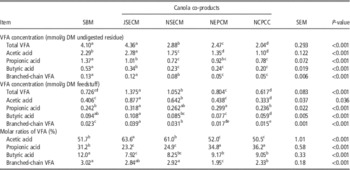
Per gram of DM of undigested residue, NSECM had lower (P<0.05; Table 3) total VFA production than SBM. The JSECM had greater (P<0.05) total VFA and butyric acid production than NSECM. The NSECM had greater (P<0.05) total VFA production than NEPCM or NCPCC whereas NEPCM had greater (P<0.05) total VFA production than NCPCC.
Concentration and molar ratios of volatile fatty acids (VFA) in the solution after fermentation of undigested residue of soybean meal and canola co-products in a faecal inoculum

SBM=soybean meal; JSECM=Juncea solvent-extracted canola meal; NSECM=Napus solvent-extracted canola meal; NEPCM=Napus expeller-pressed canola meal; NCPCC=Napus cold-pressed canola cake; DM=dry matter.
a,b,c,d,eValues within a row without a common superscript differ (P<0.05).
Per gram of feedstuff DM, total VFA production for NSECM was greater (P<0.05; Table 3) than that of SBM. Total VFA production for JSECM was greater (P<0.05) than that of NSECM. Total VFA production for NSECM was greater (P<0.05) than that of NEPCM or NCPCC. Total VFA production for NEPCM was greater (P<0.05) than that of NCPCC.
The PC analysis of chemical characteristics of fermentation kinetics and metabolites production of canola meals and cake studied in vitro is shown as a loading plot (Figure 2). The IVDDM were closely associated with EE, which in turn, were negatively correlated with ADF and NDF content and lag time. Total gas production, half time of total gas production, IVFDM and total VFA production were closely associated, which in turn, were negatively related with the fractional rate of degradation.
Loading plot from principle component analysis of canola meal and cake showing interrelationships among their nutrients and in vitro fermentation variables. EE=ether extract; IVDDM=in vitro digestibility of dry matter; T/2=half-time to asymptote; TGas=maximum gas volume; IVFDM=in vitro fermentability of dry matter; TVFA=total volatile fatty acids; lag time=lag time; DegradRate=fractional rate of degradation.

Discussion
Juncea canola meal
The CP and NDF content of JSECM were similar to those reported by Landero et al. (Reference Landero, Beltranena and Zijlstra2013). The JSECM contained less fibre than NSECM because Juncea canola seed has a thinner seed coat than Napus canola seed (Slominski et al., Reference Slominski, Jia, Rogiewicz, Nyachoti and Hickling2012). The greater IVDDM for JSECM than NSECM was likely due to the lower fibre content of JSECM than NSECM. The IVDDM of a feedstuff can influence subsequent fermentation because the composition of the undigested residue that is subjected to in vitro fermentation is dependent on the extent of previous in vitro digestion of the feedstuff (Jha et al., Reference Jha and Leterme2011). The fractional rate of degradation for JSECM was slower than that for NSECM for reasons unclear. Likely, readily fermentable nutrients were present in the undigested residue of NSECM that could not be digested in vitro by pepsin and pancreatic enzymes. Such substrate can be entrapped in fibre and other components of NSECM making them inaccessible to enzymes (Van Soest, Reference Van Soest1994).
The undigested residue of JSECM had greater total gas production and IVFDM than those of NSECM. In addition, total VFA production and propionic and butyric acid production per unit weight of undigested residue or feedstuff and AHF of GE (as % of GE in ileal digesta or feedstuff) were greater for JSECM than for NSECM. These results indicated that the undigested residue of JECM was fermented more extensively than that of NSECM. Fibre is indigestible by pepsin and pancreatic enzymes; hence, the undigested residues of feedstuffs after in vitro digestion are rich in fibre (Jha et al., Reference Jha and Leterme2011). The JSECM and NSECM are similar in non-starch polysaccharide content (Slominski et al., Reference Slominski, Jia, Rogiewicz, Nyachoti and Hickling2012). However, NSECM contains more lignin and associated polyphenols than JSECM (7.1% and 3.9%, respectively; Slominski et al., Reference Slominski, Jia, Rogiewicz, Nyachoti and Hickling2012), leading to more total fibre in NSECM than JSECM. Fibre fermentation is reduced with increased fibre lignification (Van Soest, Reference Van Soest1994). Thus, the greater fermentability of the undigested residue of JSECM than that of NSECM could be attributed to the less lignified fibre in JSECM than in NSECM. The greater propionic acid production for JSECM than for NSECM could be attributed to the greater starch content in JSECM than in NSECM.
Napus canola meals and cake
The CP, EE and NDF content of NSECM and NEPCM were similar to those reported by others (Seneviratne et al., Reference Seneviratne, Young, Beltranena, Goonewardene, Newkirk and Zijlstra2010; Woyengo et al., Reference Woyengo, Kiarie and Nyachoti2010). The less efficient oil extraction for the NCPCC, followed by NEPCM and then NSECM (Spragg and Mailer, Reference Spragg and Mailer2007) caused the greatest EE and lowest CP and NDF content for NCPCC, followed by NEPCM and last by NSECM. The IVDDM for NSECM was lower than those of NEPCM or NCPCC, respectively, likely due to the greater fibre content for NSECM than for NEPCM or NCPCC. More importantly, the lower IVDDM for NSECM than for NEPCM or NCPCC may also be due to the lower fat content of NSECM than NEPCM or NCPCC. Fat is highly digested by pigs (Seneviratne et al., Reference Seneviratne, Beltranena, Newkirk, Goonewardene and Zijlstra2011); therefore, high-fat feedstuffs generally have greater digestibility.
The undigested residue of NEPCM was fermented more rapidly and extensively than that of NCPCC as evidenced by greater fractional rate of degradation, greater total gas and VFA production and IVFDM for NEPCM than for NCPCC. The more rapid and extensive fermentation for NEPCM than for NCPCC could be due to the presence of readily fermentable components in the undigested residue of NEPCM that escaped pepsin and pancreatin digestion. Similarly, in vitro fermentation of rapeseed meal residue was decreased when less DM remained in the residue after in vitro digestion (Pustjens et al., Reference Pustjens, de Vries, Gerrits, Kabel, Schols and Gruppen2012). The lower fermentability for NCPCC than for NEPCM could also be due to nearly double the fat content in the NCPCC than in NEPCM likely resulting in more fat in the residue of NCPCC than in that of NEPCM. Unsaturated fatty acids that constitute a high proportion of canola oil reduce organic matter fermentability (Pantoja et al., Reference Pantoja, Firkins, Eastridge and Hull1994). Similar to total gas and VFA production per unit weight of undigested residue or of feedstuff, the AHF of GE (as % of GE in ileal digesta or feedstuff) of NEPCM were greater than that of NCPCC, indicating that the in vitro fermentation of NEPCM and NCPCC reflected the in vivo fermentation of these two feedstuffs. Similarly in the present study, the IVFDM and total VFA production per unit weight of feedstuff or undigested residue of the feedstuff were greater for NSECM than for NEPCM or NCPCC likely due to the lower IVDDM or fat content for NSECM than for NEPCM or NCPCC.
The NSECM contained more fibre than SBM, a difference partly due to SBM being dehulled whereas the NSECM was not. The NSECM had less IVDDM than SBM likely due to the greater fibre content in NSECM than in SBM. The undigested residue of NSECM was fermented less extensively than the undigested residue of SBM as evidenced by less total gas and VFA production and IVFDM for the NSECM compared with SBM. Fibre present in cotyledons of canola and soybean seeds is rich in non-cellulosic non-starch polysaccharides such as pectin, whereas fibre present in the hulls of canola and soybean seeds is rich in cellulose that is more lignified than fibre present in the cotyledons (Bell, Reference Bell1993; Karr-Lilienthal et al., Reference Karr-Lilienthal, Kadzere, Grieshop and Fahey2005). Thus, fibre of dehulled SBM contains less cellulose and is less lignified than that of the canola co-products, because canola co-products are not dehulled. For example, NEPCM contains 10.3% cellulose (NRC, 2012) and 9.5% lignin (NRC, 2001), whereas dehulled SBM contains 4.2% cellulose (NRC, 2012) and 0.5% lignin (NRC, 2001). Gastrointestinal microbes ferment cellulose poorer than non-cellulosic polysaccharides (van Laar et al., Reference van Laar, Tamminga, Williams, Verstegen and Engels1999) and fibre fermentation is reduced with increased lignification. Thus, these two differences in fibre composition explain the lower fermentability of NSECM compared with SBM. However, total VFA production per unit weight of feedstuff was greater for NSECM than SBM due to the greater IVDDM (and hence reduced substrate availability for fermentation) of SBM than NSECM.
Correlations among variables
The content of EE in canola meal and cake samples was correlated negatively with CP and NDF content in these samples. Extraction of oil from canola seed produces co-products that are rich in CP and fibre. The IVDDM was correlated positively with EE that could be attributed to EE being highly digestible in the small intestine of pigs (Seneviratne et al., Reference Seneviratne, Beltranena, Newkirk, Goonewardene and Zijlstra2011). The IVDDM was correlated negatively with NDF content because fibre is indigestible by gastric and pancreatic enzymes (Bedford and Schulze, Reference Bedford and Schulze1998). Fibre can also physically limit the availability of other nutrients for digestion (Bedford and Schulze, Reference Bedford and Schulze1998). Fractional rate of degradation was correlated negatively with IVFDM and VFA and total gas production. Notably, the fractional rate of degradation was greater for NSECM, NEPCM or NCPCC than for JSECM likely due to more readily fermentable nutrients in B. napus than in B. juncea co-products that did escape in vitro digestion due to the greater content of tannins in B. napus than in B. juncea co-products. The B. napus co-products contain more polyphenols including tannins than B. juncea co-products (Slominski et al., Reference Slominski, Jia, Rogiewicz, Nyachoti and Hickling2012). In addition, fibre in B. napus co-products such as NSECM, NEPCM and NCPCC is more lignified and hence less fermented than fibre in B. juncea co-products such as JSECM (Slominski et al., Reference Slominski, Jia, Rogiewicz, Nyachoti and Hickling2012). Thus, the negative correlation between rate of degradation and fermentation could be attributed to a greater fractional rate of degradation for feedstuffs that contained more lignified fibre.
In conclusion, the IVFDM mimicked AHF of GE (as % of GE in ileal digesta) for the tested feedstuff, indicating that fermentation characteristics of SBM and canola co-products simulated their digestion in the pig intestine. The VFA production per unit weight of feedstuff indicated that Juncea canola meal can contribute more dietary energy to the pig via hindgut fermentation than Napus canola meal due to higher CP and lower lignified fibre of JSECM. Differences in fermentability among Napus canola co-products indicate that fat in canola co-products may limit their fermentability in the hindgut of pigs. Hence, fermentation characteristics of canola co-products can vary depending on the efficiency of oil extraction from canola seed.
Acknowledgements
The project was funded by the Canadian Swine Research and Development Cluster (Quebec City, QC, Canada), Danisco Animal Nutrition (Marlborough, UK) and Agriculture and Agri-Food Canada within the Canadian Agri-Science Cluster Initiative.