BACKGROUND
L2 Acquisition of Prosody: An Underresearched Area
Although the body of research on second language (L2) acquisition in the areas of phonetics and phonology has grown steadily in recent decades, its focus has been on the acquisition of speech segments (i.e., phonemes), whereas prosody has been largely neglected. A survey of research on the phonological and phonetic properties of nonnative speech by Gut (Reference Gut2009) revealed that, of the 172 empirical studies published in international journals between 1969 and September 2008, aspects of L2 intonation featured in only nine studies, and speech rhythm was investigated in only four (e.g., Mennen, Reference Mennen2004, for intonation; Altmann, Reference Altmann2006, and Kijak, Reference Kijak2009, for stress; Rasier & Hiligsmann, Reference Rasier and Hiligsmann2007, for accentuation; Lin & Wang, 2008, for rhythm). This is surprising because nontargetlike prosody is notoriously persistent even in advanced learners (e.g., Grosser, Reference Grosser, Kettemann and Wieden1993; Rasier, Reference Rasier, Mettouchi and Ferré2003), and it is often considered to be one of the main stumbling blocks for L2 learners (e.g., “rhythm presents the greatest difficulties” [Barry, Reference Barry, Trouvain and Gut2007, p. 98]).
Perhaps unsurprisingly, the existing theoretical models of L2 phonological acquisition Footnote 1 have neglected to account for L2 prosodic acquisition, or they are poorly equipped to deal with different prosodic domains (e.g., rhythm and intonation). For instance, the speech learning model (Flege, Reference Flege and Strange1995) and the perceptual assimilation model (Best, Reference Best and Strange1995) focus on sound segments, whereas the Universal Grammar-based model of stress acquisition (Archibald, Reference Archibald1994) accounts for word stress parameters only. Because these models address very specific phenomena, they cannot straightforwardly be applied to other aspects of L2 speech. Moreover, in the absence of a unified theoretical framework for L2 phonology, it is difficult to relate the models to one another, unless they were developed to deal with the same phenomenon (see Gut, Reference Gut2009, for an overview of existing models).
The objective of this article is to contribute to the development of a unified model of L2 acquisition by investigating prosodic development in learners of typologically different first languages (L1s) at different levels of proficiency; the focus is on rhythm. We vary the L1 (Mandarin and German) to examine the possibility of prosodic transfer in the learner’s L2 language system (i.e., their interlanguage; the target here is L2 English), and we vary the proficiency level of the learner groups (B1 and C1 in the Common European Framework of Reference for Languages [CEFR]; Council of Europe, 2001) to evaluate commonalities and differences in the prosodic development between different L1 groups at different levels. We argue that the various prosodic properties involved in speech rhythm do not develop in a uniform manner because learners’ L2 performance for some properties is influenced by their L1, whereas other properties follow similar developmental paths despite differences in L1s. Existing SLA theories do not predict this. Whereas these theories make different claims about how factors such as L1 and universals influence L2 acquisition, they all appear to assume that the linguistic properties within their scopes would be influenced by such factors in the same manner (e.g., Larsen-Freeman & Long, Reference Larsen-Freeman and Long1991). As we will show, we instead have to assume that rhythm development is multisystemic (Post, Payne, Astruc, Prieto, & Vanrell, Reference Post, Payne, Astruc, Prieto and Vanrell2013, for L1 prosody).
In the following sections, we first review the different approaches to speech rhythm that are relevant to the present study. These include the earliest isochrony view of rhythm, the phonological account of rhythm, and the prosody-based view of rhythm. The prosody-based view of rhythm reevaluates the relative importance of different linguistic properties in speech rhythm and motivates the proposal of a multisystemic model of rhythm development; it forms the starting point of the current study. Then the various methods for quantifying rhythm will be introduced, including those that were applied in the current research. A review of previous work on L2 prosody and L2 rhythm will conclude the Background section.
Approaches to Rhythm
Early Isochrony View of Rhythm
In the traditional view of linguistic rhythm, all languages can be divided into two rhythm classes, a syllable-timed and a stress-timed class (Abercrombie, Reference Abercrombie1967; Pike, Reference Pike1945). In Abercrombie’s view, rhythm has a physiological basis: “speech rhythm is essentially a muscular rhythm, and the muscles concerned are the breathing muscles”; in syllable-timed languages, “the chest-pulses, and hence the syllables, recur at equal intervals of time—they are isochronous,” whereas in stress-timed languages, “the stress-pulses, and hence the stressed syllables, are isochronous” (pp. 96–97). This view of rhythm has been called the isochrony view, and it has a purely impressionistic basis.
However, many instrumental studies subsequently sought and failed to find evidence for constant or systematic durations in syllables or interstress intervals for either rhythm class. For example, Bolinger (Reference Bolinger, Abe and Kanekiyo1965) recorded six native English speakers reading two English sentences and measured the intervals between accented syllables (i.e., syllables that carry sentence-level stress). The results gave little support to the idea of isochrony in speech rhythm. Instead, the study showed that factors such as specific syllable types as well as the position of the interval within the utterance have an effect on the duration of interstress intervals (see also Roach, Reference Roach and Crystal1982). Nevertheless, the percept of a rhythmic distinction between languages in terms of these two very broadly defined categories is empirically supported; for instance, Ramus, Dupoux, and Mehler (Reference Ramus, Dupoux, Mehler, Solé, Recasens and Romero2003) showed that adults have the ability to discriminate between languages that have been classified to different rhythm categories.
Phonological View of Rhythm
The lack of clear acoustic evidence for distinct isochronous units led to the development of an alternative approach commonly referred to as the phonological view of rhythm, first proposed by Dasher and Bolinger (Reference Dasher and Bolinger1982). Under this view, the perceived rhythmic differences found across languages are the result or product of language-specific phonological properties, which are each reflected in durational variation in the speech stream and combine into different rhythmic patterns with different percepts. The phonological property they analyzed was vowel quality, which is “not a product of stressing rules or rhythm rules” (Dasher & Bolinger, Reference Dasher and Bolinger1982, p. 60) but a given with a fundamental effect in conditioning the rhythmic pattern of a language. Dauer (Reference Dauer1983) observed that stress-timed and syllable-timed languages have a number of different distinctive phonetic and phonological properties, of which the two most important are syllable structure and vowel reduction. The so-called stress-timed languages, like English and German, have a greater range of syllable structures and permit complex consonant clusters; they also tend to reduce unstressed vowels both durationally and qualitatively (Delattre, Reference Delattre1966). By contrast, in so-called syllable-timed languages like Mandarin, open syllables are far more common, and vowel reduction is much less evident. As Dauer (Reference Dauer1983) put it, “rhythmic differences . . . across languages . . . are more a result of phonological, phonetic, lexical, and syntactic facts about the language than any attempt on the part of the speaker to equalize inter-stress or inter-syllable intervals” (p. 55).
Dauer (Reference Dauer1987) also suggested that these properties could be independent and cumulative: A language should not be thought to be either stress timed or syllable timed with the corresponding properties; rather, the more properties typical of stress-timed languages a language presents, the more it is stress timed and the less it is syllable timed. She thus advocated a continuous model of rhythm, rather than just two categorical classes of speech rhythm.
Prosody-Based View and the Prosodic Properties of Rhythm
In addition to the phonological phenomena mentioned previously, the role of prosodic properties has been explored in recent studies of speech rhythm (Prieto, Vanrell, Astruc, Payne, & Post, Reference Prieto, Vanrell, Astruc, Payne and Post2012; White, Mattys, & Wiget, Reference White, Mattys and Wiget2012). These prosodic timing phenomena include durational marking of prosodic heads (i.e., accentual lengthening) as well as durational marking of prosodic edges, such as phrase-final lengthening.
Stressed and accented syllables are produced with additional lengthening compared to unstressed syllables in supposed stress-timed languages (e.g., Delattre, Reference Delattre1966, and Turk & White, Reference Turk and White1999, for English; Barry, Andreeva, & Steiner, Reference Barry, Andreeva and Steiner2007, and Delattre, Reference Delattre1966, for German). Under a phonological view, crosslinguistic prosodic differences could be expected to contribute to rhythmic differences in the same manner as previously highlighted factors, such as syllable structure and vowel reduction (qualitative but also quantitative vowel reduction; e.g., Prieto et al., Reference Prieto, Vanrell, Astruc, Payne and Post2012).
Another prosodic durational phenomenon that contributes to speech rhythm is final lengthening or preboundary lengthening (Prieto et al., Reference Prieto, Vanrell, Astruc, Payne and Post2012; White et al., Reference White, Mattys and Wiget2012). This describes the tendency for syllables in intonational phrase-final and utterance-final positions to be longer than when the same syllable is uttered in nonfinal or phrase-medial position. Final lengthening has been claimed to be universal (e.g., Delattre, Reference Delattre1966); nevertheless, as White and Mattys (Reference White and Mattys2007) point out, “the locus and extent of final lengthening and other prosodic lengthening processes, such as accentual lengthening, may be language specific, and may contribute to the overall perception of cross-linguistic differences in rhythmicity” (p. 507).
Prieto et al. (Reference Prieto, Vanrell, Astruc, Payne and Post2012) tested the hypothesis that phonological and prosodic properties contribute to the characteristic rhythm of a language by examining the role of syllable structure as well as the prosodic timing processes previously mentioned in the instantiation of durational and rhythmic differences across three languages—namely, English (a prototypical stress-timed language), Spanish (a prototypical syllable-timed language), and Catalan (claimed to be a mixed or intermediate language in the rhythm scale). This crosslinguistic study showed that important differences in durational patterns exist between these languages that cannot simply be attributed to differences in phonotactic properties and that the rhythmic class distinctions under consideration finely correlate with differences in the way these languages instantiate the prosodic timing properties of accentual lengthening and final lengthening. The results support the view that language-specific implementation of prosodic timing phenomena is an integral part of the rhythmic differences across languages (Beckman, Reference Beckman, Tohkura, Vatikiotis-Bateson and Sagisaka1992; Fant, Kruckenberg, & Nord, Reference Fant, Kruckenberg and Nord1991).
In line with this research, we consider rhythm as the result or product of a combination of a number of phonological and prosodic properties of a language, including, at least, syllable structure, vowel reduction, accentual lengthening, and final lengthening; all of these properties are reflected in acoustic regularities in temporal variation (as well as other acoustic parameters that are not being studied here), thus giving rise to a percept of rhythm class (which is scalar rather than categorical). Some of these properties are linguistic-systemic in nature (i.e., part of the linguistic system of the language). For instance, syllable structure is determined by the inventory of possible speech segments and the phonotactic constraints in the phonological component of the language’s linguistic system. Other properties reflect the interaction between different components of the system, like final lengthening, which depends on the morphosyntactic component for phrasal structure, on the phonological component for segmental and syllabic structure, and on the language-specific constraints that govern the mapping between phonology and morphosyntax; language-specific systematicities in the phonetic implementation of prosodic boundary marking will affect surface durations. Rhythm is also affected by factors that are outside the linguistic system, such as speaking rate and style, and these may further contribute to the rhythm percept.
If rhythm is indeed determined in this way, the acquisition of rhythm must be closely intertwined with the acquisition of the individual properties that contribute to it. This prediction is tested by Post et al. (Reference Post, Payne, Astruc, Prieto and Vanrell2013) for the acquisition of prosody in child speech in a cross-sectional study of 2-, 4-, and 6-year-old English-, Catalan-, and Spanish-speaking children. On the basis of their findings, Post and colleagues argue for a multisystemic model of rhythm development in which rhythm emerges gradually as the relevant language-specific properties are acquired. The rate of acquisition of individual properties will differ between languages, as will the trajectories of the developmental paths for those properties, because they depend on the development of different components in the system (e.g., morphosyntax and phonology in the case of final lengthening). Additionally, the acquisition of one property can have a knock-on effect on the development of another (i.e., the development of one property could interact with the development of another; for example, the mastery of one property could facilitate the development of another, or the nonmastery of one property could prevent the development of another property). This could accelerate or delay prosodic development in one language compared to another.
The question arises as to how crosslinguistic differences in the systemic properties may affect the acquisition of rhythm in a L2. Specifically, we ask whether the L2 learners’ acquisition of these properties is reflected in their L2 rhythm and what this can tell us about the nature of their L2 acquisition processes. To answer these questions, we applied a number of metrics that have been developed to allow for the quantification of temporal variability in studying speech rhythm.
Quantifying Speech Rhythm: Rhythm Metrics
Since the introduction of the continuous model of rhythm (Dauer, Reference Dauer1987), much work has attempted to capture systematic rhythmic differences across languages in a quantitative way, and, at the turn of the century, a number of metrics were introduced that quantified variability in durational variation on a phrase-by-phrase or utterance-by-utterance basis (for a recent review of rhythm metrics, see Gut, Reference Gut, Gibbon, Hirst and Campbell2012, or White & Mattys, Reference White and Mattys2007). Ramus, Nespor, and Mehler (Reference Ramus, Nespor and Mehler1999) proposed several utterance-global measures that involve dividing speech into vocalic and consonantal parts and computing (a) the proportion of the vocalic to the consonantal material (expressed as a percentage: %V), (b) the standard deviation of vocalic intervals (∆V), and (c) the standard deviation of consonantal intervals (∆C). However, because ∆C and ∆V have been repeatedly shown to be inversely related to speech rate (Barry, Andreeva, Russo, Dimitrova, & Kostadinova, Reference Barry, Andreeva, Russo, Dimitrova, Kostadinova, Solé, Recasens and Romero2003; Frota & Vigário, Reference Frota and Vigário2001; White & Mattys, Reference White and Mattys2007), Frota and Vigário (Reference Frota and Vigário2001) introduced ∆%C and ∆%V, which measure the variability of interval duration relative to sentence duration (i.e., the standard deviations of the space occupied by consonantal or vocalic intervals, whereby the space occupied by each interval was calculated by dividing the interval duration by the sentence duration and multiplying by 100). Similarly, Dellwo (Reference Dellwo, Karnowski and Szigeti2006) developed the rate-normalized metric VarcoC (the standard deviation of consonantal interval duration divided by the mean consonantal duration and multiplied by 100) and its vocalic counterpart VarcoV.
Other rhythm metrics do not measure rhythm exponents globally across the utterance but rather attempt to capture rhythm more locally by focusing on the degree of durational difference between neighboring intervals. The rationale for measures that take into account local variation is that utterance-global measures are blind to the sequencing of units, whereas rhythm “requires temporal sequencing of units with different properties” (Nolan & Asu, Reference Nolan and Asu2009, p. 65). The pairwise variability index (PVI) metric calculates the mean of the durational differences between adjacent temporal intervals in an intonation phrase (first applied in Low, Reference Low1998). The temporal intervals are usually vocalic or consonantal intervals, but they can be calculated over any interval that defines a specific stretch of speech material (e.g., syllables or feet). This raw PVI (i.e., rPVI-C for consonantal intervals and rPVI-V for vocalic intervals) contrasts with its normalized counterpart that controls for the effect of speech rate (i.e., nPVI; Grabe & Low, Reference Grabe and Low2002; Low, Reference Low1998; Low, Grabe, & Nolan, Reference Low, Grabe and Nolan2000), which is the mean of the durational differences (d) between successive vocalic or consonantal intervals (k) summed over the total number of intervals in the utterance (m), divided by the sum of the same intervals, and then multiplied by 100. This is represented in the following equation:
 $$nPVI = 100 \times {{\left( {\sum\limits_{k = 1}^{m - 1} {\left| {{{\left( {{d_k} - {d_{k + 1}}} \right)} \mathord{\left/ {\vphantom {{\left( {{d_k} - {d_{k + 1}}} \right)} {\left( {{{\left( {{d_k} + {d_{k + 1}}} \right)} \mathord{\left/ {\vphantom {{\left( {{d_k} + {d_{k + 1}}} \right)} 2}} \right. \kern-\nulldelimiterspace} 2}} \right)}}} \right. \kern-\nulldelimiterspace} {\left( {{{\left( {{d_k} + {d_{k + 1}}} \right)} \mathord{\left/ {\vphantom {{\left( {{d_k} + {d_{k + 1}}} \right)} 2}} \right. \kern-\nulldelimiterspace} 2}} \right)}}} \right|} } \right)} \mathord{\left/ {\vphantom {{\left( {\sum\limits_{k = 1}^{m - 1} {\left| {{{\left( {{d_k} - {d_{k + 1}}} \right)} \mathord{\left/ {\vphantom {{\left( {{d_k} - {d_{k + 1}}} \right)} {\left( {{{\left( {{d_k} + {d_{k + 1}}} \right)} \mathord{\left/ {\vphantom {{\left( {{d_k} + {d_{k + 1}}} \right)} 2}} \right. \kern-\nulldelimiterspace} 2}} \right)}}} \right. \kern-\nulldelimiterspace} {\left( {{{\left( {{d_k} + {d_{k + 1}}} \right)} \mathord{\left/ {\vphantom {{\left( {{d_k} + {d_{k + 1}}} \right)} 2}} \right. \kern-\nulldelimiterspace} 2}} \right)}}} \right|} } \right)} {\left( {m - 1} \right)}}} \right. \kern-\nulldelimiterspace} {\left( {m - 1} \right)}}.$$
With the development and increasing application of the various rhythm metrics, studies have been conducted to investigate their robustness and ability to discriminate between languages and speaker groups (e.g., Arvaniti, Reference Arvaniti2012b; White & Mattys, Reference White and Mattys2007). Several factors have been found to affect the rhythm values. As mentioned, these include speech rate, and rate-normalized metrics like Varco and nPVI have been claimed to be more reliable for that reason. However, the normalization for consonantal metrics has been argued to be undesirable because it is likely to eliminate linguistically interesting variation (e.g., languages that allow more complex consonant clusters may be associated with a greater consonantal variability; Grabe & Low, Reference Grabe and Low2002), a view supported by the results of White and Mattys (Reference White and Mattys2007). Additionally, consonantal variability metrics are sensitive to the nature of the materials used (White & Mattys, Reference White and Mattys2007); for instance, the syllable structures of the sentences that are being produced strongly affect consonantal metric scores (Arvaniti, Reference Arvaniti2012b; Prieto et al., Reference Prieto, Vanrell, Astruc, Payne and Post2012). Other factors include segmentation procedure, such as whether glides or syllabic consonants are treated as part of vocalic intervals or consonantal intervals, as well as speaking style (see Gut, Reference Gut, Gibbon, Hirst and Campbell2012).
Among the various metrics that have been proposed, %V and VarcoV and rPVI-C have been found to be the most robust and best able to reflect crosslinguistic differences in rhythm as well as rhythmic differences between native and nonnative speech (e.g., Grenon & White, Reference Grenon, White, Chan, Jacob and Kapia2008; Payne, Post, Prieto, Vanrell, & Astruc, Reference Payne, Post, Prieto, Vanrell and Astruc2012; White & Mattys, Reference White and Mattys2007). However, the usefulness of the metrics in rhythm classification has been called into question (Arvaniti, Reference Arvaniti2009, Reference Arvaniti2012b; Barry, Andreeva, & Koreman, Reference Barry, Andreeva and Koreman2009). For example, Arvaniti (Reference Arvaniti2009) argued that “the metrics are unreliable predictors of rhythm which provide no more than a crude measure of timing” (p. 46). By extension, the idea of rhythm classes has also been questioned (Arvaniti, Reference Arvaniti2009, Reference Arvaniti and Niebuhr2012a, Reference Arvaniti2012b). We agree that rhythm metrics provide only a very crude approximation of the perceptual differences that theorists have attempted to account for under the heading of rhythm class and that using metrics to assign individual languages to a rhythm class is not very fruitful. The categoricity implied by the term is at variance with the gradiency of the evidence that has been brought to bear as well as with the inherently multidimensional nature of the exponents of speech rhythm, which involves a wide range of parameters of which timing is only one (e.g., Cumming, Reference Cumming2010; Grabe & Low, Reference Grabe and Low2002; Nolan & Asu, Reference Nolan and Asu2009). Additionally, it is debatable that acoustically defined parameters like durational metrics truly represent the percept of speech rhythm.
Although the timing differences that are quantified in rhythm metrics are only crudely related to crosslinguistic differences in speech rhythm, and they do not allow us to predict or characterize the nature of the rhythm of speech samples, they have nevertheless been fruitfully applied to quantify differences in timing patterns produced by speakers with different language backgrounds at different stages of development (e.g., Grabe, Gut, Post, & Watson, Reference Grabe, Gut, Post, Watson, Barrière, Morgan, Chiat and Woll2001; Grabe, Watson, & Post, Reference Grabe, Watson, Post, Ohala, Hasegawa, Ohala, Granville and Bailey1999; Grenon & White, Reference Grenon, White, Chan, Jacob and Kapia2008; Payne et al., Reference Payne, Post, Prieto, Vanrell and Astruc2012; Prieto et al., Reference Prieto, Vanrell, Astruc, Payne and Post2012; White & Mattys, Reference White and Mattys2007). Because the objective in this study is to reliably distinguish between speaker groups rather than characterize or predict the nature of their rhythmic behavior, the metrics are a good tool to detect any systematic differences that may exist between them.
L2 Prosody and the Acquisition of Rhythm
Research in L2 prosody has tended to focus on the influence of the native language on the L2 (e.g., 58.7% of 172 studies on L2 phonology, according to Gut, Reference Gut2009, p. 42). Previous findings suggest that learners commonly transfer prosodic features from their L1 to the L2 (e.g., Backman, Reference Backman1979; Lepetit, Reference Lepetit1989), including pitch accent distribution and realization (e.g., Benet, Gabriel, Kireva, & Pešková, Reference Benet, Gabriel, Kireva, Pešková, Ma, Ding and Hirst2012; Lepetit, Reference Lepetit1989; Rasier & Hiligsmann, Reference Rasier and Hiligsmann2007), but universal development patterns also play a role in L2 prosodic acquisition (e.g., parallels in reduced pitch range and incorrect pitch accent assignment, Gut, Reference Gut, Trouvain and Gut2007; lexical stress, Archibald, Reference Archibald1994). However, crosslinguistic parallelism in L2 production does not necessarily imply that the observed patterns derive from a universal constraint that operates in the acquisition process. In many cases, the parallel patterns can in fact be attributed to L1 strategies that happen to be shared by different L2 learner groups, instead of a linguistic prosodic property that does not manifest itself in the L2 learner’s speech, even when it is present in the L1 (see Mennen, Reference Mennen2006, for the difficulty of isolating universal development from L1 transfer). Important variables in such studies are the presence versus absence of the key property under investigation in the different L1s in the study (e.g., as in Archibald, Reference Archibald1994) and the inclusion of different proficiency levels to shed light on the development of the property relative to the L1 source and the L2 target in the interlanguage (i.e., the language system that is developing in the learner and that is, to some extent, independent of source and target; it should not be considered as a defective or deviant form of either). Because only very few studies have addressed this issue in prosodic acquisition, the relation between L1 transfer and universals remains largely uncharted territory, and it has not been investigated for L2 speech rhythm at all.
Although various quantification methods have been used to capture differences between L1 and L2 rhythm, not much research has shown evidence for rhythmic differences between L2 learners of different proficiency levels or with different native language backgrounds. Guilbault (Reference Guilbault2002) compared the rhythmic properties of the spontaneous speech of more and less experienced learners of French with Canadian English as the L1, using the variability index (VI) metric, which calculates the mean durational differences between successive syllables. He found that the less experienced learners’ VI tended to be lower than that of the more experienced learners, but the difference between the two groups was not significant. Neither the L2 proficiency nor the time spent in the target language environment seemed to have any significant effect on the L2 rhythm of learners’ speech. Similar results were obtained by Gut (Reference Gut2009), who compared the rhythm of learners before and after a 9-month stay abroad in the target language country or a 6-month training course in pronunciation. She found no effect of either the stay abroad or the training on the learners in terms of rhythmic properties as measured by the syllable ratio (SR), the average ratio of adjacent stressed to unstressed syllables (i.e., the ratio of the syllable with a full vowel to the syllable with a reduced vowel, in this study). Sarmah, Gogio, and Wiltshire (Reference Sarmah, Gogio and Wiltshire2009) used %V and nPVI-V to evaluate rhythm in L1 Thai learners of American English. They found that learners who had spent less than 6 months in the United States exhibited a higher nPVI-V and a lower %V than learners who had spent more than 18 months in the United States. Surprisingly, the group that had spent more time in the United States showed values that were more distant from native English values. Stockmal, Markus, and Bond (Reference Stockmal, Markus and Bond2005) studied L1 Russian learners of Latvian using similar metrics, including variability in consonantal durations (∆C and rPVI-C). They found significant differences between the less proficient and the more proficient learners (proficiency based on learners’ self-reports) in consonantal variability but no differences in %V and nPVI-V.
Taken together, these studies give inconsistent evidence for rhythmic differences in L2 speech depending on level of proficiency or source language. One potential explanation is that the differences in experience or length of stay between the participant groups in these studies were not, in fact, reflected in a (sufficiently large) difference in L2 pronunciation proficiency. Because none of the studies directly compared learners with different L1s, the inconsistencies could also be due to L1 effects. Another possibility is that the quantification methods that were used are not a reliable or robust tool to capture rhythmic differences in L2 speech. Therefore, we ask the following questions:
-
1. Does the acquisition of speech rhythm (as measured by rhythm metrics) in a L2 reflect different levels of proficiency, and does this differ among typologically different L1s?
-
2. Does the L2 acquisition of two prosodic properties that contribute to speech rhythm (i.e., accentual lengthening and final lengthening) reflect different levels of proficiency, and does this differ among typologically different L1s?
-
3. Is the acquisition of speech rhythm related to the acquisition of the prosodic properties?
-
4. Can the findings be accounted for under a L1 transfer hypothesis, or do they point toward a universal developmental path independent of the properties of the L1? Footnote 2
METHODS
Participants
Four groups of L2 learners of English were recruited in this research: two groups of L1 Beijing Mandarin speakers and two groups of L1 German speakers, each with two different L2 English proficiency levels (B1 and C1 of the CEFR, which are roughly equal to the class division of lower intermediate and advanced levels, respectively; Council of Europe, 2001). The L1 Mandarin learners were recruited from the Communication University of China in Beijing, China. The lower level L1 Mandarin learners of English (CN1) were first-year undergraduate students who studied English as their major, whereas the learners at the higher English proficiency level (CN2) were chosen from third-year English majors. The students were asked to fill in a language background questionnaire and to take the standardized Oxford Online Placement Test (Oxford University Press, 2011), which tests listening proficiency as well as what it refers to as use of English (i.e., knowledge of grammatical forms and vocabulary size as well as how learners use that knowledge to understand and communicate meanings in reading and writing). The Oxford Online Placement Test is automatically scored; the results are reported on a scale of 0–120, with increments of 20 points corresponding to different CEFR levels (Purpura, n.d., p. 22). On the basis of the language background questionnaires and the results of the placement tests, 10 students were recruited and divided into two L2 English levels (5 participants each). The lower level group had an average score of 54.8 (SD = 5.17, SE = 2.31) on the placement tests, which falls into the B1 level (lower intermediate) of the CEFR; the higher level group achieved an average score of 88.6 (SD = 1.14, SE = 0.51), falling in the C1 level (advanced). An independent-samples t test confirmed that there was a significant difference in proficiency between the two L1 Mandarin groups (t = −14.283, p < .001). All participants were female and aged between 18 and 25; they had spent most of their lives in Beijing and had never lived in an English-speaking country. None of the participants in the lower level group spoke any other languages. The higher level group had just started to learn Japanese approximately 6 months prior to the experiment (2 hr/week of instruction).
The L1 German learners of English were chosen to match the L2 English proficiency levels of the L1 Mandarin learners. The lower level L1 German learners (DE1) were eighth- or ninth-grade students in a grammar school in Krefeld, Germany. The five subjects achieved an average score of 54.2 (SD = 4.09, SE = 1.83) on the Oxford Online Placement tests. The German lower level learners were all female and were 14 or 15 years old at the time of experiment; they had spent most of their lives in Krefeld and had never lived in an English-speaking country. None of them reported speaking other languages. The higher level L1 German learners of English (DE2) were recruited in Cambridge, United Kingdom. They had passed a Cambridge English test (C1 level) to enter the University of Cambridge as Erasmus students. They were also all female, aged between 18 and 25, and they had been in the United Kingdom for less than a month at the time of experiment. They reported speaking basic or intermediate French in addition to English and their native German.
An ANOVA of the Oxford Placement Test results showed a significant difference between the lower level L1 German learners and the higher level L1 Mandarin learners, F(2, 12) = 130.10, p < .001, and no difference between the two lower level learner groups of the two L1s. The test results of the higher level groups could not be compared, as DE2 did not take the Oxford Placement Test.
Additionally, five female native speakers of general American English (L1EN) were chosen to form the L1 English control group. They were age matched with the learner groups and were recruited in Cambridge, United Kingdom. All of them had lived in Arizona, United States, for most of their lives and had arrived in the United Kingdom less than 2 weeks prior to the experiment. They reported speaking basic Spanish. The reason for choosing native speakers of general American English is that different varieties of English have different prosodic and rhythmic properties (e.g., Low, Reference Low1998, for speech rhythm), and the L1 Mandarin learners had explicitly indicated that their target was American English; the L1 German learners had been exposed to American and British English and did not consciously choose one of them as their target.
Finally, Beijing Mandarin and German native speakers speaking their respective native languages participated as control groups, with five female participants each. The native Beijing Mandarin speakers (L1CN) were 18-year-olds who were recruited in the Communication University of China in Beijing, China. They had been born and educated in Beijing and had lived there all of their lives, had never attended bilingual schools or stayed in another city for more than a month, and did not have more than 3 hr per week of contact with English. The lower level L1 German learners were also used as the native German control group (L1DE), even though the Mandarin controls had much lower proficiency in English. Because German speakers tend to be more proficient in English than Mandarin speakers at a younger age (possibly due to the historical and typological closeness between German and English; our two L1 groups did not differ in the onset time of English education or hours of instruction per week, according to the language background questionnaires), matching all groups on all key criteria (proficiency, age, exposure) would have been impossible, so we decided to prioritize matching between control and learner groups over matching L2 English proficiency between the two control groups. None of the participants reported any hearing or speech impairment.
Sentence Materials
Twenty English sentences were used in this research; these matched materials for the control data in Mandarin and German in terms of the syllable structure types as well as the number of syllables. The syllable types were systematically varied in four conditions to control for and investigate the effect of syllable structure, as exemplified in (1)–(4). The first type contained predominantly utterances of the consonant-vowel (CV) type in which the syllable structure is the most basic type and is allowed in English, Mandarin, and German (the English utterances were adapted from the APriL project; Prieto et al., Reference Prieto, Vanrell, Astruc, Payne and Post2012). The second type contained five predominantly CVN-type utterances (N is for nasal). This type of syllable structure is slightly more complex than the basic CV type and is the maximal syllable structure allowed in Mandarin (e.g., Duanmu, Reference Duanmu2007). The third type contained five predominantly complex-syllable-type sentences. The majority of the syllables in these sentences have complex syllable structures (i.e., onset and/or coda clusters; also adapted from Prieto et al., Reference Prieto, Vanrell, Astruc, Payne and Post2012). The fourth and final type consisted of the mixed-syllable-type structures of the English materials of Ramus et al. (Reference Ramus, Nespor and Mehler1999), with matching materials for Mandarin and German.
-
(1) The mother of Susana is in Badalona. (CV type)
-
(2) Tan and Wang from Hong Kong are playing Ping-Pong in Beijing. (CVN type)
-
(3) Doctor Frankenstein was a big scary but exceptional monster. (Complex type)
-
(4) A hurricane was announced this afternoon on TV. (Mixed type)
There were 15 Mandarin matching sentences, of which five were predominantly CV-type sentences, five contained syllables of predominantly CVN structure, and five were mixed-type utterances, as in (5)–(7); they are near translations of (1), (2), and (4), respectively. Twenty German sentences were created to match the four sets of five English sentences, as in (8)–(11), which are near translations of (1)–(4).
-
(5) 苏珊娜的妈妈是从巴达洛纳来。(CV type)
/su.ʂan.na.tɤ.ma.ma.ʂɹ̝.tsʰuŋ.pa.ta.lwo.na.lai/
-
(6) 香港的小谭和小王正在北京打乒乓。(CVN type)
/ɕjɑŋ.kɑŋ.tɤ.ɕjau.than.kən.ɕjau.wɑŋ.tʂəŋ.tsai.pei.tɕjəŋ.ta.phjəŋ.phɑŋ/
-
(7) 今天下午电视播报了一则飓风警报。(Mixed type)
/tɕin.thjɛn.ɕja.wu.tjɛn.ʂɹ̝.pwo.pau.lɤ.ji.tsɤ.tɕy.fəŋ.tɕjəŋ.pau/
-
(8) Die Mutter von Susana ist in Badalona. (CV type)
/dɪ.mʊ.tɐ.fɔn.zʊ.za.nɐ.ɪst.ɪn.ba.da.lɔ:.nɐ/
-
(9) Tan und Wang aus Hongkong spielen Pingpong in Peking. (CVN type)
/tan.unt.waŋ.aus.hɔŋ.kɔŋ.ʃpi:.lən.piŋ.pɔŋ.ɪn.pe.kɪŋ/
-
(10) Doktor Frankenstein war ein großes und unheimliches Monster. (Complex type)
/dɔk.tɔɐ.fraŋ.kən.ʃtaɪn.va.aɪn.gro:.səs.unt.un.haɪm.lɪ.çəs.mɔn.stɐ/
-
(11) Heute wurde ein Hurrikan im Fernsehen angekündigt. (Mixed type)
/hɔy.tə.wʊə.də.aɪn.ha.rɪ.keɪn.ɪm.fɛɐn.ze:n.an.gə.kʏn.dɪkt/
Recording Procedure
The recordings of all Mandarin participants were made in a quiet room at the Communication University of China in Beijing; subjects produced the 20 English sentences prior to producing the 15 Mandarin sentences, whenever they were asked to produce both, with a 5-min break in between. The lower level German learners of English were recorded in a quiet room in the Gymnasium am Stadtpark in Krefeld, Germany, again with the English materials preceding the German materials with a 5-min interval between them.
The native speakers of American English and the higher level L1 German learners of English were recorded in the sound-treated booth of the phonetics laboratory of the University of Cambridge, United Kingdom. The higher level L1 German learners of English were asked to read the English sentences and then the German sentences, with a 5-min break in between, as before.
All recordings were made using a Nagra ARES-M II recorder at a sampling rate of 48 kHz and a Nagra mono microphone. For each subject, the sentences were randomized before the recording session and were shown on PowerPoint slides on a computer screen. All subjects were given time prior to the recordings to read the sentences at their own pace. They were asked to read the sentences at a normal speed that was comfortable for them. If they stumbled, they were asked to read the sentence(s) again at the end of the recording session. The L1 English controls were instructed in English; the L1 Mandarin learners of English and all the L1 German participants were instructed in two languages: English and the L1 of the subject. The native Mandarin control group was instructed in Mandarin only. The first author, a native speaker of Mandarin who speaks fluent English, was the experimenter.
Segmentation and Analysis
Vocalic and consonantal intervals were labeled for the calculation of rhythm metrics (%V, VarcoV, VarcoC, rPVI-C, rPVI-V, nPVI-C, and nPVI-V) in Praat (Version 5.2; Boersma & Weenink, Reference Boersma and Weenink2010). Vowel-consonant and consonant-vowel boundaries were identified and labeled primarily by visual inspection of speech waveforms and wideband spectrograms following standard criteria (see Peterson & Lehiste, Reference Peterson and Lehiste1960; White & Mattys, Reference White and Mattys2007): Vowel-consonant boundaries were primarily determined by the end of the pitch period preceding a break in formant structure when this was associated with a sudden, significant drop in waveform amplitude; consonant-vowel boundaries were placed at the beginning of the pitch period at the onset of vocalic formant structure, particularly the second formant. Syllabic consonants and prevocalic glides were included in consonantal intervals, and postvocalic glides were included in vocalic intervals.
Additionally, each syllable was marked as (a) unaccented and nonfinal, (b) unaccented and final, (c) accented and nonfinal, or (d) accented and final; note that only unaccented and final (type b) syllables were marked in the Mandarin L1 data, as Mandarin is not a stress-accent language. The key segmentation criterion for syllabification was the maximal onset principle (see Gussenhoven & Jacobs, Reference Gussenhoven and Jacobs2005, p. 137), which bars violations of language-specific phonotactic rules in the three languages of the study; that is, segments were placed in onsets in preference to codas.
Predictions
Among the three languages in the study reported here, English and German have traditionally been classified as stress-timed languages (Abercrombie, Reference Abercrombie1967, for English; Kohler, Reference Kohler1982, for German), whereas Mandarin is often considered to be syllable timed (e.g., Lin & Wang, Reference Lin and Wang2007; Mok, Reference Mok2009) but is sometimes unclassified (e.g., Grabe & Low, Reference Grabe and Low2002). With respect to the prosodic property of accentual lengthening, Delattre (1966, p. 189) showed that the ratio of stressed to unstressed syllable duration is 1.60 in English and 1.44 in German, indicating that English has a slightly stronger accentual lengthening effect than German. Because Mandarin is not a stress-accent language (i.e., it is not a language with lexical stress that can function as the docking place for a pitch accent), accentual lengthening does not apply (although a lengthening effect under corrective focus was found in Mandarin by Chen, Reference Chen2006). Final lengthening has been found in all three languages (e.g., Delattre, Reference Delattre1966, and Wightman, Shattuck-Hufnagel, Ostendorf, & Price, Reference Wightman, Shattuck-Hufnagel, Ostendorf and Price1992, for English; Delattre, Reference Delattre1966, and Kohler, Reference Kohler1983, for German; and van Santen & Shih, Reference van Santen and Shih2000, for Mandarin). The ratio of final syllable duration to nonfinal syllable duration is 1.53 in English and 1.50 in German (Delattre, Reference Delattre1966, p.190), which shows that the effect is more or less the same in these two languages. We are not aware of any studies that compare the final lengthening in Mandarin with that in English or German.
On the basis of these studies, we predict for our L1 data that German will show slightly less accentual lengthening than English, but the two languages should be comparable for final lengthening. Mandarin may also show less final lengthening, due to its simpler syllable structure. As a stress-timed language, German rhythm metrics should be comparable to English but with slightly less variability in vocalic/consonantal interval durations and a slightly lower %V than English. Mandarin should show much less variability but a higher %V than English if it is indeed a syllable-timed language.
How these features develop in L2 English is an open question. Under a total transfer hypothesis, German learners would be expected to show more accentual lengthening, more consonantal and vocalic variability, and a lower %V than Mandarin learners, and both groups would progress toward the target as their proficiency increases between B1 and C1. For German learners, this would result in a slightly upward trajectory for accentual lengthening, variability, and %V, but they would be on target for final lengthening. For Mandarin learners, we would expect to see upward trajectories for final lengthening and variability but a downward trajectory for %V; we cannot make any predictions for accentual lengthening under this hypothesis.
If, by contrast, the learners follow universal developmental paths for all properties investigated here, the prosodic lengthening and rhythm metric scores for learners with different L1s but the same proficiency levels would be similar, and their developmental trajectories would be the same. If English is marked for the properties investigated here, learners of both L1s would start out with relatively little lengthening and low variability but high %V compared to native English.
RESULTS
The prosodic lengthening effects and rhythm metrics scores for the L1 data of the present study are examined first to provide the basis for comparison with the L2 production data. In addition to the combined data set, analyses of the subset of the data containing CV-type sentences only were carried out to disentangle the effects of prosodically conditioned lengthening and syllable structure type.
Prosodic Lengthening and Speech Rhythm in L1 English, Mandarin, and German
In the combined data set, English showed significantly more lengthening than German, but this was due to the effect of accentual lengthening. Taking the unaccented syllables in nonfinal position as the baseline for comparison, accented nonfinal syllables were 55.5% longer in English but only 43.4% in German (independent-samples two-tailed t = 4.2, p = .003). Moreover, in English, accented syllables in phrase-final position were 133.7% longer than unaccented nonfinal syllables, whereas they were only 103.0% longer in German (independent-samples two-tailed t = 3.13, p = .014). However, there was no difference in phrase-final lengthening between the two languages (62.8% and 66.6%, respectively, compared to the duration of unaccented nonfinal syllables in each language), but both English and German showed significantly more final lengthening than Mandarin (35.4%), F(2, 12) = 11.61, p = .002, according to Bonferroni post hoc comparisons of English versus Mandarin, p = .007, and German versus Mandarin, p = .003.
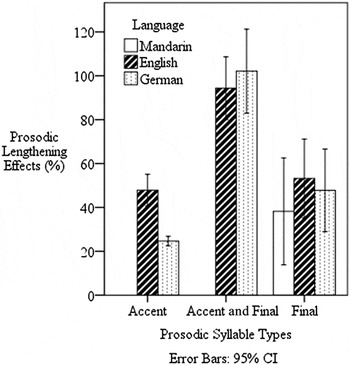
It is interesting to note that all prosodic lengthening effects disappeared in the analyses of the CV-type data set in which syllable structure was controlled for, except for accented nonfinal lengthening (English = 47.9% vs. German = 24.7%; independent-samples two-tailed t = 8.57, p < .001), as illustrated in Figure 1 (see the bars labeled “Accent”).
Prosodic lengthening in L1 Mandarin, English, and German (note that Mandarin does not have stress/accent).

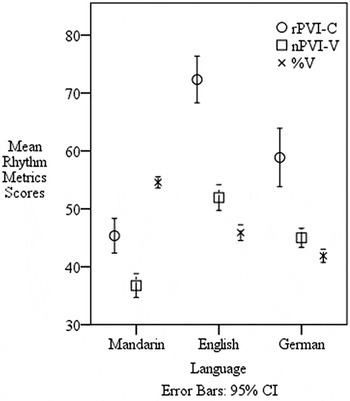
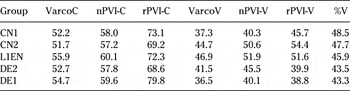
An analysis of the metric scores in a multivariate ANOVA showed a significant effect of language on all rhythm metrics: VarcoC, nPVI-C, rPVI-C, VarcoV, nPVI-V, rPVI-V, and %V, F(2, 272) = 30.83, 33.45, 36.37, 44.65, 53.82, 36.64, and 104.62, respectively; all p < .001 (see Appendix Table A1 for mean metric scores). Bonferroni post hoc comparisons revealed that the three languages all differed significantly from one another for all rhythm metrics at p < .05, except for the comparison for nPVI-C between Mandarin and German. Figure 2 illustrates these effects by presenting a plot of three metrics that discriminated well between the languages: %V, nPVI-V, and rPVI-C. English and German had relatively high vocalic and consonantal variability (as shown by nPVI-V and rPVI-C, respectively) and a low proportion of vocalic material (as shown by %V) compared to Mandarin, which showed the reverse pattern of relatively low vocalic and consonantal variability and a high proportion of vocalic material. This pattern of results is in line with the traditional rhythm classification of English and German as stress timed and Mandarin as syllable timed. Moreover, the effects are stronger in English than in German, which mirrors the prosodic lengthening effects observed previously.
Mean metric scores in native EN, CN, and DE (including all syllable types)

Mean %V, nPVI-V, and rPVI-C scores in L1 Mandarin, English, and German (including all syllable types).

Controlling for syllable structure differences between the languages in an analysis of the CV-type subset diminished the effect size, but it was still significant for all metrics (VarcoC, nPVI-C, rPVI-C, VarcoV, nPVI-V, rPVI-V, and %V, F(2, 72) = 13.63, 17.11, 10.00, 16.19, 12.61, 13.03, and 38.49, respectively; all p < .001; see Appendix Table A2 for mean values). The differences in vocalic variability and the overall proportion of vocalic material were still different among all three languages, except for nPVI-V for Mandarin as compared to German (p = .06) and rPVI-V for English as compared to Mandarin (English vs. German VarcoV: p < .001, nPVI-V: p = .029; English vs. Mandarin VarcoV: p < .001, nPVI-V: p < .001). Consonantal variability between English on the one hand and German or Mandarin on the other was also still significant, but consonantal variability in the CV-type materials was comparable in German and Mandarin.
Mean metric scores in native EN, CN, and DE (CV-type sentences only)

These findings confirm our predictions for the L1 data: English and German are more comparable than Mandarin in terms of their speech rhythm and in terms of the durational variation associated with accented syllables and phrase boundaries. However, the findings also revealed that consonantal variability and final lengthening in particular are sensitive to syllable structure, with equal values in German and Mandarin. This implies that, although German and English are prosodically very similar in certain respects, German learners of English need to acquire knowledge of how duration varies as a function of syllable structure and phrasing, just as their Mandarin counterparts do.
L2 Acquisition of English Prosodic Lengthening Properties
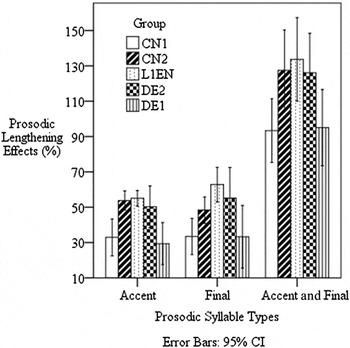
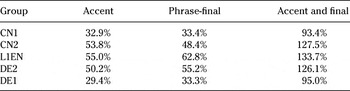
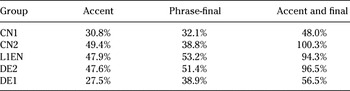
ANOVAs of prosodic lengthening in the L1 and L2 English data showed a significant effect of group, (a) for accented syllables: F(4, 20) = 12.92, p < .001; (b) for phrase-final syllables: F(4, 20) = 7.63, p = .001; and (c) for accented phrase-final syllables: F(4, 20) = 6.10, p = .002, as shown in Figure 3 (see also Appendix Table A3).
Prosodic lengthening in L1 (L1EN) and L2 English (CN1, CN2, DE1, DE2; including all syllable types).

Prosodic lengthening in L1 and L2 English (including all syllable types)

Post hoc Bonferroni-corrected tests revealed that both lower level learner groups produced significantly less prosodic lengthening in their L2 English than native English speakers, for accented syllables (CN1 vs. L1EN: p = .002; DE1 vs. L1EN: p < .001); for phrase-final syllables (both p = .003); and for accented final syllables (CN1 vs. L1EN: p = .016; DE1 vs. L1EN: p = .023). For accentual and final lengthening, the lower level groups also differed significantly from the higher level learner groups, for accented syllables (CN1 vs. CN2: p = .003; CN1 vs. DE2: p = .017; DE1 vs. DE2: p = .003; DE1 vs. CN2: p = .001) and for final syllables (CN1 vs. DE2: p = .041; DE1 vs. DE2: p = .039), but the higher level groups were similar to native speakers for all three prosodic lengthening measures, and, within each proficiency level, the learner groups were indistinguishable despite the difference in source language.
When we controlled for the effect of syllable structure by analyzing the effects in the CV-type subset, as illustrated in Figure 4 (see also Appendix Table A4), the significant effect of group was again observed, for accented syllables: F(4, 20) = 6.86, p = .001; for phrase-final syllables: F(4, 20) = 2.96, p = .045; and for accented phrase-final syllables: F(4, 20) = 2.92, p = .052.
Prosodic lengthening in L1 (L1EN) and L2 English (CN1, CN2, DE1, DE2; CV-type sentences only).

Prosodic lengthening in L1 and L2 English (CV-type sentences only)

However, the only significant differences between individual groups as revealed by post hoc Bonferroni comparisons were those between lower level and higher level learners of both L1s for accented syllables (CN1 vs. CN2: p = .040; DE1 vs. DE2: p = .021). This should perhaps not be surprising because we observed no significant differences between native English, Mandarin, and German when syllable structure was controlled for, except for syllables in accented nonfinal position.
L2 Acquisition of English Speech Rhythm
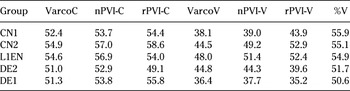
A multivariate ANOVA showed an effect of group (five levels) on all of the rhythm metrics investigated here except nPVI-C: VarcoC: F(4, 495) = 3.31, p = .011; rPVI-C: F(4, 495) = 3.92, p = .004; VarcoV: F(4, 495) = 24.13, p < .001; nPVI-V: F(4, 495) = 29.58, p < .001; rPVI-V: F(4, 495) = 30.13, p < .001; %V: F(4, 495) = 14.44, p < .001 (see Appendix Table A5 for means). However, Bonferroni post hoc tests showed that consonantal metrics did not reflect the different levels of L2 proficiency well, as the only significant difference between the L1 English controls with any learner group was between the higher level L1 Mandarin group and the native English controls for VarcoC (p = .025), and the only other significant difference was between the higher level Mandarin learners and the lower level German learners for rPVI-C (at p = .010).
Mean metric scores in L1 and L2 English (including all syllable types)

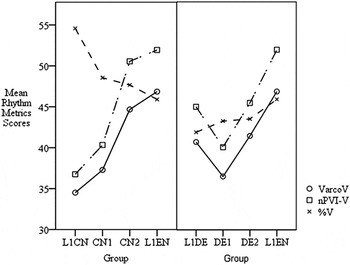
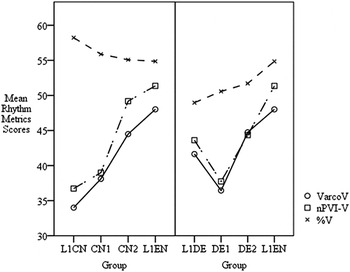
On the contrary, vocalic metrics discriminated well between proficiency levels, as is illustrated in Figure 5. VarcoV and nPVI-V scores both indicated significantly lower vocalic variability for both lower level learner groups than for higher level learners and native English controls; the two lower level groups did not differ from each other. The two higher level groups did differ, but only in nPVI-V scores, indicating higher vocalic variability for L1 Mandarin than German higher level learners (p = .005). German higher level learners also had significantly lower vocalic variability than the native English controls (VarcoV and nPVI-V, both p < .001). Furthermore, %V scores revealed that the proportion of vocalic material for lower level Mandarin learners was significantly higher than for native English speakers (p = .031), whereas, conversely, it was significantly lower for the lower level L1 German group compared to the English controls (p = .030).
Mean metric scores in L1 Mandarin (L1CN), L1 English (L1EN), and L2 English (CN1, CN2, DE1, DE2; including all syllable types).

As before, we carried out a second set of ANOVAs on the CV-type subset to control for the effect of syllable structure (see Appendix Table A6 for means). The consonantal metrics no longer exhibited any significant differences between any of the groups at all, which confirms that consonantal metrics are indeed sensitive to the syllable structure of the sentence materials. The vocalic metrics all still showed a significant effect for group—VarcoV: F(4, 120) = 12.74, p < .001; nPVI-V: F(4, 120) = 13.10, p < .001; rPVI-V: F(4, 120) = 14.35, p < .001; %V: F(4, 120) = 12.81, p < .001—indicating that the lower level learner groups of both L1s had significantly lower vocalic variability than the higher level learners and the native English control groups. Additionally, the higher level L1 German group had significantly lower vocalic variability than the native English controls (Bonferroni post hoc for nPVI-V, p = .035).
Mean metric scores in L1 and L2 English (CV-type sentences only)

Using VarcoV, nPVI-V, and %V, Figure 6 illustrates that, although the metric values depend on syllable structure, the learners’ developmental paths are very similar to those of Figure 5.
Mean metric scores in L1 Mandarin (L1CN), L1 English (L1EN), and L2 English (CN1, CN2, DE1, DE2; CV-type sentences only).

DISCUSSION AND CONCLUSIONS
This study set out to examine rhythmic development at different proficiency levels in two typologically different languages to examine (a) the development of L2 speech rhythm as measured by various rhythm metrics, (b) the acquisition of two prosodic properties that contribute to speech rhythm (i.e., accentual lengthening and final lengthening), (c) whether the two are related, and (d) whether the findings can be accounted for under a L1 transfer hypothesis or whether they point toward a universal developmental path independent of the properties of the L1.
We found that the vocalic rhythm metrics (VarcoV, nPVI-V, and %V) discriminated well between L2 proficiency levels for learners of both L1s, and this was independent of differences in syllable structure. For vocalic variability, the learners started with comparably low values, regardless of L1 values, and progressed toward high L1 English target values as their proficiency level increased. This is in line with predictions under a hypothesis of universal developmental paths in which learners with typologically different language backgrounds should show shared patterns in their acquisition of L2 properties. By contrast, the development of the proportion of vocalic material in the utterances followed opposite trajectories, converging on native English values: The L1 Mandarin learners gradually reduced their vocalic proportions along a downward trajectory between source and target values; conversely, the Germans were on an upward trajectory between source and target. This is consistent with predictions under a transfer hypothesis. Consonantal variability showed significant main effects, but no consistent differences were observed between groups by L1 or proficiency level, and the effects disappeared when the materials were controlled for syllable structure. This could be interpreted to suggest that any differences that were observed were related to pronunciation difficulties that affected the durational realization of consonants in more complex syllables.
With respect to accentual and final lengthening, learners of both L1s progressed from lower values toward the values measured for the L1 English target, differentiating increasingly among the durations of unaccented, accented, and final syllables; these patterns, again, are in line with a prediction under the hypothesis of universal developmental paths. It is interesting to note that, even though the lower level L1 German learners showed as much final lengthening in their native speech as the English native controls, they did not do so in their L2 English. This pattern of results closely mirrors the development of vocalic variability in the two languages, confirming that the development of L2 prosodic properties is indeed reflected in L2 speech rhythm.
L1 Transfer and Universals
The strong phrase-final lengthening effect that we observed in the native speaker data for English and German as opposed to Mandarin was not reflected in the L2 English data. The lack of lengthening in the lower level German group could be argued to indicate that a universal mechanism is at play by which lower level learners make prosodic boundaries less prominent (at least in durational terms), regardless of their L1 background. However, when syllable structure was controlled for, the crosslinguistic differences disappeared, in both the L1 and the L2 data. This suggests that the discrepancy is related to a difficulty with pronouncing English consonants in complex syllables rather than syllable complexity or boundary marking per se. This explanation would agree with the findings for consonantal variability, which, as we previously indicated, could also be accounted for in this way, but there is no evidence that L1 transfer or universal constraints on the acquisition of these properties played a role.
The accentual lengthening data shed more light on the question, showing values for lower level German speakers that are similar to their native values, whereas higher level learners are indistinguishable from native English speakers in this respect. This indicates that the lower level L1 German learners may be transferring their L1 settings for accentual lengthening into their L2 (either at the abstract phonological level or at the level of phonetic implementation during pronunciation). However, because the Mandarin learners, who do not have accent or accentual lengthening in their source language, exhibit the exact same lengthening effects in their L2 English as the Germans, an alternative explanation is possible: The L2 development of the accentual lengthening could be an instantiation of a universal process, with L2 learners making use of a default or unmarked value of the relevant phonological properties at the early stages of acquisition. This interpretation would also fit with the pattern of results in the vocalic variability data, in which all learners who were acquiring a L2 with high vocalic variability defaulted to relatively low vocalic variability in their interlanguage, regardless of L1, and progressed in the direction of the L2 as their proficiency increased.
Results of other studies support this interpretation. For example, Barry (Reference Barry, Trouvain and Gut2007) analyzed L2 German productions by learners whose L1s are English or Russian (both stressed timed) or Korean (assumed to be syllable timed) and found that “all tend to deviate from the average native-speaker pattern in a way which reflects too little differentiation of accented syllables and unstressed syllables” (p. 112). There is also evidence that the acquisition of lexical stress, which is a prerequisite for acquiring appropriate L2 accentual lengthening, has universal aspects (e.g., Archibald, Reference Archibald1994; Pater, Reference Pater, Hannahs and Young-Scholten1997). Additionally, Rasier and Hiligsmann (Reference Rasier and Hiligsmann2007) found that universal markedness is an important factor in predicting and explaining L2 accentual patterns for learners with different L1 strategies for marking information structure (i.e., plastic vs. nonplastic languages). The process of the L2 acquisition of lexical stress and accent distribution appears to follow a universal developmental path, with learners reverting to default (or unmarked) values at low proficiency levels and proceeding to L2 values at a later stage when necessary (e.g., Van der Pas, Wissing, & Zonneveld, Reference Van der Pas, Wissing and Zonneveld2000, for lexical stress). The hypothesis that a universal mechanism is at play here therefore seems warranted, but further research on L2 English learners with other typologically different L1 backgrounds will have to confirm that the shared pattern observed here is indeed truly universal in nature.
By contrast, the distribution of the vocalic proportions (%V) in the utterances across the different L1 and L2 speaker groups provides clear evidence of a straightforward transfer effect. Native Mandarin and German are both different from English, with much lower and much higher vocalic proportions, respectively. Second language learners show intermediate values on opposite trajectories toward the L2 target that mirror each other quite closely in terms of the rate of progression. For L2 prosody, evidence for a L1 influence on L2 production has also been observed for intonation patterns (Backman, Reference Backman1979; Mennen, Reference Mennen2004).
We conclude that the development of the various properties that are involved in speech rhythm is not affected in a uniform manner by the properties of the L1 or by universal constraints on acquisition. This implies that our findings cannot be successfully accommodated within existing models of L2 phonology.
Toward a Multisystemic Model of L2 Rhythm Acquisition
The results of our study support the view that L2 rhythm development is fundamentally multisystemic in nature. If the characteristic rhythm of a language is the product of a number of systemic properties like syllable structure, vowel reduction, and the marking of heads and edges (i.e., accentual and final lengthening in this study), the acquisition of rhythm must, of necessity, be closely intertwined with the acquisition of the individual systemic properties that contribute to it. Because these properties are acquired at different stages in the L2 developmental process and are variably subject to L1 transfer effects or follow more universal developmental paths, the acquisition of rhythm should emerge gradually as the learner acquires the relevant language-specific systemic properties as well as the language-specific regularities in phonetic implementation that differ between the L1 and L2. The acquisition of one systemic property could also have a knock-on effect on the development of other prosodic properties, accelerating or delaying prosodic development overall in specific L1 learner groups (just like nonprosodic or nonphonological systemic properties in the language, such as structural differences in syntactic phrasing between the L1 and L2).
Our results fit with a multisystemic model of prosodic acquisition. First, we have shown that the L2 learners’ development of some key prosodic properties (i.e., accentual lengthening and phrase-final lengthening) is reflected in L2 rhythm acquisition, whether or not the syllable structure of the sentence materials is controlled for. Second, we have found that the learners of typologically different L1s have a similar developmental path for L2 English vocalic variability, but they follow different acquisition paths in terms of the L2 English vocalic proportion. This difference is reflected in the L2 learners’ development of different systemic prosodic properties, which are influenced by various factors such as L1 properties and universal properties, as we have discussed in the previous section. Third, we have shown that learners perform better in terms of L2 prosodic lengthening when the syllable structure of the utterances they produce is of the CV type and that they are more off target when they produce more complex structures. This indicates that there is an interaction between the acquisition of the systemic property of syllable structure and the acquisition of the systemic properties that underlie prosodic lengthening.
Such a model could be couched within a dynamic systems approach to language development (de Bot & Larsen-Freeman, Reference de Bot, Larsen-Freeman, Verspoor, de Bot and Lowie2011; de Bot, Lowie, & Verspoor, Reference de Bot, Lowie and Verspoor2007). Dynamic systems are characterized by what is called complete interconnectedness: Subsystems or variables are nested and interrelated, and change in one subsystem will lead to changes in another as well as in the system as a whole. Speech rhythm could be seen as a dynamic system that consists of various subsystems, such as syllable structure and prosodic lengthening, and L2 acquisition of rhythm would also be dynamic in the sense that it involves the development of the subsystems and the connections between them, with change in one subsystem potentially triggering change in another. The interrelatedness of the development of the systemic properties of syllable structure and prosodic lengthening with rhythm in our study could be an example of such a connection.
Further research will have to explore to what extent prosodic development does indeed show the interconnectedness between subsystems in the L1 and L2 predicted by dynamic systems theory. Also, the multisystemic model referred to here has nothing to say about the role of variability as a source of development, which is a key aspect of dynamic systems theory. In dynamic systems theory, individual variation (even within a group) is accounted for from an emergentist point of view; that is, various internal and external factors interact in a complex manner, which can lead to unpredictable results. However, we controlled for the factors that might cause intragroup variation in our study because we are interested in what commonalities the members of a whole group share in terms of rhythmic and prosodic properties, rather than in intragroup variation.
We conclude that the various systemic properties that contribute to speech rhythm interact with one another in prosodic development and that their development in the interlanguage is directly reflected in the L2 rhythm acquisition process. In this process, different prosodic properties are acquired in a nonuniform manner across typologically different languages. Second language phonological theories, and SLA theories more generally, will need to be able to accommodate the multisystemic nature of L2 prosodic acquisition while taking into account the nonuniform manner in which the prosody of the interlanguage reflects L1 transfer effects as well as universal constraints on acquisition.