

1. Introduction
Dadanitic is the name of the script used to carve inscriptions attested in and around the ancient oasis of Dadān, modern-day al-ʿUlā, in the north-west of the Arabian Peninsula.Footnote 1 Just under 2,000 Dadanitic inscriptions are known so far, about 1,500 of which are informal graffiti.Footnote 2 It is generally assumed that these inscriptions were carved between the sixth and first centuries bce. The exact dating of the inscriptions is problematic, however, and mostly based on outside references to Dadān (see Rohmer and Charloux Reference Rohmer and Charloux2015 for the most recent overview and discussion of the evidence for dating the inscriptions). The dating of the inscriptions is particularly problematic due to their lack of references to known historical dates and events. Some do carry dates, but these refer only to the regnal years of the local kings. These dates can be further specified with a term rʾy, which is generally interpreted as a reference to a local political official.
This paper will discuss this dating formula used in the Dadanitic inscriptions. After a section in which the form and occurrence of the formula is introduced, the current interpretation will be outlined together with some fundamental questions concerning different aspects of this reading. In section 3, the formula will be discussed in relation to similar formulae in Minaic and Sabaic inscriptions. In section 4, a new interpretation of the formula as a local calendar will be proposed. At the end of the article an appendix will present a more detailed discussion of each of the lexical items following the phrase b-rʾy.
1.1. The formula
Several of the Dadanitic inscriptions are dated to a specific year. In these cases the year is mentioned, followed by a number and the name of the king whose regnal years are being counted:
s1nt X Personal Name (PN) bn PN mlk lḥyn
“year X PN son of PN king of Liḥyān”(e.g. AH 064)
A more elaborate dating formula is also attested:
s1nt X b-rʾy Y PN bn PN mlk lḥyn
“year X during the rʾy of Y; PN son of PN king of Liḥyān” (e.g. AH 239)
The formula can be further specified by adding a number of days and the preposition qbl, which replace the preposition b- “at”:Footnote 3
s1nt X Y ʾym qbl rʾy Z PN bn PN mlk lḥyn
“year X; Y days before the rʾy of Z; PN son of PN king of Liḥyān” (JSLih 068 and AH 244)
Variations of the b-rʾy formula are found in AH 197 and in JSLih 070.Footnote 4 In both these inscriptions we find another preposition: ḫlf “after”. In AH 197 this preposition is followed not by rʾy, but by the form ṭʿn. The word following ṭʿn is broken off, but since the rest of the phrase follows the rʾy formula closely, it is fairly certain this is a variation of the same phrase. It is interesting to note that the preposition ḫlf is never attested in combination with the word rʾy; instead we find it once before ṭʿn and once in what seems to be a shortened, or shorter, dating formula.
AH 197
s¹nt/ʿs2r/w ṯlṯ/13/ymn/ḫlf/ṭʿn/ḏ----l{ʿ}{b}
“year thirteen 13 two days following ṭʿn ḏ…”.
JSLih 070 seems to contain a shortened form of the formula, in which rʾy/ṭʿn and the name of the king are omitted. The form fḍg is not attested following rʾy or ṭʿn so far, although it seems to occur once as a patronymic in AH 251. This may indicate that this is not a direct equivalent to the rʾy and ṭʿn formula.
JSLih 070
s1nt/ʿs2r//n/wts1ʿ/ ʿs2rʾym//ḫlf/fḍg
“year twenty nine; ten days following fḍg”
1.2. The function of dating
In total there are 43 inscriptions that are dated either to the year of inscribing, or to the year and rʾy. Almost half of them (20) contain the b-rʾy elaboration. Most of the inscriptions containing a date are more elaborate, with a formal purpose that distinguishes them from graffiti based on their content. Only six of the 43 dated inscriptions can be identified as graffiti (see Table 1).
Number of attestations of each dating formula per genre
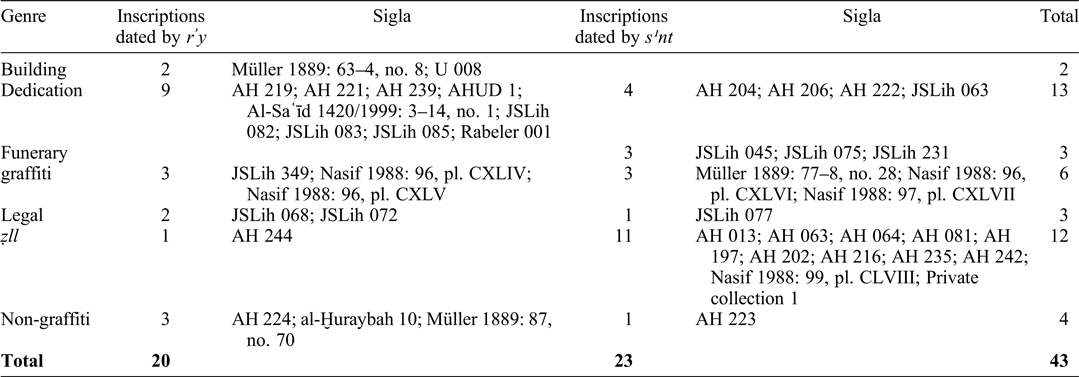
It is not surprising that formal inscriptions are more likely to contain a date, to support their legal or commemorative function. While some genres of inscription seem to have preferred a specific dating formula, the dating by year and dating by rʾy and year are relatively evenly distributed across the different genres. The most striking difference seems to be that between dedicatory inscriptions and ẓll inscriptions. The ẓll inscriptions commemorate a local ritual (h-ẓll) performed for the local deity of the oasis, ḏġbt. In terms of formula, they are similar to the dedicatory inscriptions. Currently no convincing interpretation of what the ritual entails is available.Footnote 5 While in dedicatory inscriptions, the preferred dating formula was the elaborate formula containing the specification by rʾy, the preferred form for the ẓll inscriptions seems to have been the shorter date by the year of the king. This may indicate that while specific dedications were tied to specific moments in the year, or their value was dependent on when the ritual was performed exactly,Footnote 6 the ẓll inscriptions were more independent of the specific moment of their performance. This is further supported by the mentioning of certain seasonal crops in some ẓll inscriptions (e.g. U 058 and U 079bis mention dṯʾ “crops of the season of the later rains”Footnote 7). While some inscriptions mention specific seasonal crops, there are also attestations of seasonal crops from different seasons mentioned in one inscription (AH 18 mentions both dṯʾ “crops of the season of the later rains” and ḫrf “crops of the season of the first rains”Footnote 8). Therefore, it seems that the writing of the ẓll inscriptions did not always occur at the same time as the harvests referred to. The lack of more specific time references could also mean that the ẓll ritual was always performed at the same time of the year, making additional specification superfluous.Footnote 9 Note that both ẓll and dedicatory inscriptions are attested with both formulae.
1.3. Current interpretation
The dating formula containing b-rʾy is generally translated as “in year X during the reign/government of PN; of PN son of PN king of Dadān” (e.g. Caskel Reference Caskel1954: 88–9; Farès-Drappeau Reference Farès-Drappeau2005: 122). The phrase b-rʾy is taken to refer to the reign of a political official (Farès-Drappeau Reference Farès-Drappeau2005: 122) or to that of the king, with the term directly following b-rʾy as an epithet of the king (Caskel Reference Caskel1954: 89).
1.3.1. b-s1mwy as epiphaneia
Winnett even suggest that b-s1mwy in JSLih 054 and JSLih 077 is a variation of the same phrase. He argues that b-s1mwy is used in an attempt to express the Hellenistic conception epiphaneia: “The word used, for instance, of the accession of the divine Caligula (37–41 ad)”. He concludes that “the s1mwy of the king must mean something like his ‘elevation to heavenly status’” i.e. “his deification at his accession’”. He saw b-rʾy as a parallel construction, but translated rʾy simply as “oversight, reign” (Winnett and Reed Reference Winnett and Reed1970: 126). It is difficult to connect the two expressions, however; bs1mwy occurs in JSLih 054, following the blessing formula and just before the name of the king, but in damaged context.
JSLih 054 (lines 4–5)
f rḍ-hm/w ----
bs¹mwy/tlmy/bn ----
“and may he please them and --- bs¹mwy tlmy son of”
It is difficult to tell how much is missing between the blessing formula and bs¹mwy. Since ḏʾbs¹mwy occurs in two other inscriptions, following b-rʾy, bs¹mwy is probably merely the end of this phrase. The other occurrence of b-s¹mwy that Winnett refers to (JSLih 077) is also heavily damaged. It cannot be found on the photograph available of the inscription today and is not part of the most recent readings of the inscription (OCIANA and Farès-Drappeau Reference Farès-Drappeau2005: 169). Therefore, a connection between the two, and certainly an interpretation of b-s¹mwy as epiphaneia seems unlikely.
1.4. A Minaic parallel?
Besides the Dadanitic inscriptions that were found at the oasis of ancient Dadān, a corpus of about 60 monumental Minaic inscriptions have been found there as well. These were probably inscribed there when the Minaeans, whose homeland was in the south of the Arabian Peninsula, established a trading outpost at the oasis. This trading post is considered contemporary with the Lihyanite kingdom referred to in the Dadanitic inscriptions (Winnett and Reed Reference Winnett and Reed1970: 117–8).Footnote 10 There are several inscriptions that attest to the participation of Minaeans in Dadanitic local rituals (JSLih 049 and AHUD 1) and to the presence of people with some knowledge of both scripts (e.g. JSLih 220). There is even a Minaic legal inscription at Dadān that, despite being heavily damaged, clearly discusses the status of children from a union between a Minaean woman and a Dadānite man.Footnote 11 These inscriptions show that the two groups interacted with each other at the oasis.
Several of the Minaic inscriptions contain a dating formula in which the year is given both in reference to the king, and to a kabīr who was probably a local ruler or official. If the phrase b-rʾy should indeed be interpreted as a reference to a political official, this phrase could be interpreted as a parallel to the Minaic dating formula. Examples of this dating formula can be found in the DASI corpus 5;Footnote 12 it goes roughly:
b-ywmh PN PN mlk mʿnm b-kbr PN (PN)
“during the days of PN PN king of Maʿīn during the kabirate of PN (PN)”
The formula can be elaborated by adding a specific month before the mention of the kabirate. Whenever this is the case, the phrase ḏ-kbrh is used rather than b-kbr (see M 358 = RES 3697 and M316 = RES 3341). This seems to confirm that kbr is a further specification of the year and not a reference to a specific part of the year.
These Minaic inscriptions at Dadān show us that dating by both a king and another political official is not impossible despite the seeming redundancy, and that this practice was likely known in Dadanitic society. It has to be borne in mind, however, that the political situation of the Liḥyanite kingdom at the oasis of Dadān was very different from that of the Minaic outpost there. For the Minaeans in Dadān, it would presumably make more sense to date by both the king and the kbr, as they were outside the Minaic kingdom proper. This would probably give the kbr more prominence in their day-to-day lives than the remote king and seems to be reflected in the different dating practices in Central Minaic as opposed to the inscriptions at Dadān. While the Central Minaic inscriptions from inside the Minaic kingdom are also dated by kabīrs, these formulae are different. They often concern the kabirate of the inscriber, who erected the inscription during his own kabirate (e.g. al-Ḥarāshif 3; al-Jawf 04.28; M11). The inscriptions that are dated by the kabirate of someone other than the inscriber never seem to refer to the king in the same dating formula (e.g. M 179; M 28).
2. rʾy as a political office
2.1. The etymology of rʾy
Besides the possible Minaic parallel, the translation “during the reign of” seems to be further motivated by linking the root rʾy, which has as its basic meaning “to see”, to the notion of ruling, probably inspired by the use of “to oversee” in English and German. There are several issues surrounding this interpretation, however, which merit discussion. Even though “oversee” and “ruling” seem to be closely connected in most European languages (e.g. German sehen and übersehen; English “to see” and “to oversee”),Footnote 13 this construction is not productive in Semitic languages. The meaning of rʾy in Semitic languages is related to “seeing” or “having an opinion” (ultimately also related to seeing). Although its usage with the meaning “opinion, judgement” could have been extended to have something to do with ruling or judging, it is not primarily used to express such concepts.
In Sabaic, the root can be used to mean “oracular vision” (Beeston et al. Reference Beeston, Ghul, Müller and Ryckmans1982: 113) and by extension also the person who does the “seeing”, like a priest or a soothsayer.Footnote 14 In this sense it could be argued that rʾy refers not to a political, but to a religious, official. In Sabaic and Qatabanic there are inscriptions that contain the phrase “ywm rs2w theonym (DN)”.Footnote 15 While a rs2w is a type of priest, these phrases indicate a period mostly relevant to the inscriber's name instead of an abstract year and they are translated as “the days in which he was priest of DN” (CSAI). There are several terms for priests or religious officials attested in the Dadanitic context ʾfkl (e.g. JSLih 055; JaL 010 a); s1lḥ (e.g. U 059; U 044), but there are no attestations of rʾy in a context where it clearly refers to a person or profession.
2.2. Personal names
A further issue that has been recognized,Footnote 16 but never sufficiently explored, is the obscurity of the etymologies of the forms following b-rʾy. None of these are attested as personal names in the Dadanitic corpus, and none of them have clear etymologies allowing them to be interpreted as epithets.Footnote 17
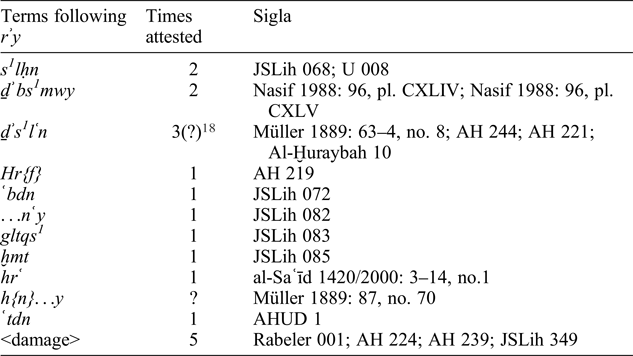
So even though the Minaic dating by a local kbr shows that it is not impossible to have a seemingly redundant specification of the year by both a king and a local official, there is no clear reason, based on the etymology of b-rʾy, to translate this phrase as “during the government of …”. On top of this, none of the forms following b-rʾy can be readily interpreted as either personal names or epithets, further complicating the interpretation that rʾy referred to the office of a person (see Table 2).
Schematic overview of the formula “s1nt X b-rʾy Y name-of-a-king mlk lḥyn” and its attestations
3. The formula revisited
3.1. Syntax and form
Previous investigations into the formula have focused mostly on the lexical items it contains and their cultural significance, however, the grammatical structure seems slightly awkward as well, and forms a good starting point for a comparison to other dating formulae in the Arabian inscriptions. In Dadanitic, s1nt is always followed by a cardinal number “in year 2/3/etc. (of) king X”, even though one might expect an ordinal one: *“in the 2nd/3rd etc. year of the reign of king X”. It is not uncommon to count the units of a dating formula with cardinal numbers, however: compare, for example, Sabaic b-ywm ṯmnym (C 601/18) or Syriac yawmo da-ṯloṯo (John 11.1) (Beeston Reference Beeston1956: 4). However, both these constructions differ from the Dadanitic form. In the Sabaic formula ywm stands in construct with the numeral, while in Syriac the numeral is introduced with a relative pronoun. In Sabaic it is formally apparent that the form ywm is in construct state from the lack of mimation (Stein Reference Stein and Weninger2011: 1051). In Dadanitic, we would expect the numeral to have a definite article if the two were in construct. Moreover, if s1nt indicates the year of the king, one would expect the year to stand in construct with the king, whereas in the Dadanitic inscriptions, “b-rʾy X” can appear in between. The key to interpreting both these issues seems to be interpreting the phrase as a formula “year/specific part of the year/era”. Note that the Dadanitic formula is also different from the Sabaic system which is “day/month/year”.Footnote 19
Neither is the form of the formula the same as Minaic, in which the year seems to stand in construct with the king, followed by the specification of the month and the kbr. Further comparison of the two formulae seems to confirm that Dadanitic rʾy is not the equivalent of Minaic kbr. As mentioned above, there are etymological problems in interpreting b-rʾy as “during the reign” as a parallel to Minaic b-kbr “during the kabirate”, and while the dating by a kbr can be specified by adding a month, the only attested specification of the Dadanitic rʾy formula is by a few days before or after rʾy or ṭʿn X. This suggests that while Minaic kbr refers to a longer period of time (probably a year), Dadanitic rʾy and ṭʿn refer to a specific moment instead.
3.2. rʾy and ṭʿn in other corpora
Even though it is difficult to connect any of the forms following rʾy to other known calendar systems, both rʾy and ṭʿn are attested in Safaitic inscriptions. Al-Jallad (Reference Al-Jallad2014: 217) demonstrated that rʾy refers to the heliacal or acronical risingFootnote 20 of the constellations of the zodiac. He recognized the use of the signs of the zodiac in the Safaitic inscriptions after linking two inscriptions that included an identical list of three unknown elements that were read as place names (C 4985; KRS 169), to an inscription that listed the three seasons “winter” s2ty, “the season of the later rains” dṯʾ, and the “dry season” qyẓ (SIJ 1008) (Al-Jallad Reference Al-Jallad2014: 214–6), suggesting that the terms were better understood as some indication of the seasons, rather than place names. He then identified the same three elements independently in inscriptions, sometimes together with the phrases b-rʾy or b-ks1ʾ, which led to the identification of nine other forms that were used in similar formulae.
C 1338
l ḥml b{n} [n] s2bt bn ktm w r [ʿ] y h- ʾbl b- rʾy ḏkr bq{l}
“By ḥml {son of} {ns2bt} son of ktm and he [pastured] the camels during the rising of Aquarius on fresh {herbage}.”Footnote 21
C 523
l ʾlh bn bʾẖh bn trb w wrd h- nmrt b-ks¹ʾ mlḥ
“By ʾlh son of bʾẖh son of trb and he went to water at Namārah during the cosmical setting/full moon of Aquarius.”Footnote 22
Al-Jallad managed to link all twelve attested forms to the different signs of the zodiac, based on both their etymology and the activities and seasonal circumstances described in the inscriptions, which all correspond to the moment of the rising of the signs mentioned (Al-Jallad Reference Al-Jallad2014: 228). In part II of this article (Al-Jallad Reference Al-Jallad2016), he examines the cultural context of the dating formula in more depth. In this article Al-Jallad adds that the Safaitic system was most likely a mixed system, in which the constellations of the zodiac were integrated into a local practical star calendar or parapegma Footnote 23 (Al-Jallad Reference Al-Jallad2016: 89–90), similar to the anwāʾ system discussed by Varisco (Reference Varisco1991: 23).
Al-Jallad proposes connecting rʾy to a term used by Babylonian astronomers igi = ittanmar “to rise heliacally”, from amārum “to see”. This forms a nice parallel to rʾy in Safaitic, which simply came to mean “the rising (of an asterism)” (Al-Jallad Reference Al-Jallad2014: 217). In Part I of his article Al-Jallad interpreted the form ks1ʾ as a reference “to the full moon when it occupies the constellation/sign with which it is in construct”, which can be linked to Hebrew kīsê and Syriac kesā both meaning “full moon” (HALOT #4329) (Al-Jallad Reference Al-Jallad2014: 217). After pointing to the likely relation between the “Arabian zodiac” and an older system of local marker stars, however, he also discusses the possibility of regarding ks1ʾ as a reference to the setting of an asterism. Unfortunately there is no direct evidence in the Safaitic inscriptions to decide what ks1ʾ referred to exactly.Footnote 24 Making a distinction between the two is especially complicated as the setting of an asterism coincides with the period in which the full moon occupies that constellation (Al-Jallad Reference Al-Jallad2016: 94). There is one attestation of a Safaitic inscription in which ks1ʾ seems to be substituted with ṭʿn.Footnote 25
The form ṭʿn also occurs once in Minaic in a dating formula:
M 293A (lines 7–8)
b-ṣltn bn bṯ l-gzz ḏn ftḥn ywmnt ftḥn w-mṯbtn s¹dṯ ṭʿn ḏ-ʾṯrt ḏ-kbrh hwfʾl ḏ-wkl qdmn kbr-s¹
“In the legal appeal within what has been proclaimed for the enforcement of this judicial decision: date of the judicial decision and promulgation is on the sixth of the last decade of ḏ-ʾṯrt during the kabirate of hwfʾl ḏ-wkl his first kabirate.”Footnote 26
The interpretation of ṭʿn as “last decade of the month” in reference to the last ten days of the month was first proposed by Beeston (Reference Beeston1956: 7). He connects ṭʿn to CAr. ṭaʿana fī s-sinn “he was advanced in age”. The basic meaning of the root is “to pierce, enter or penetrate”, however, which is not directly related to the end of something. If we try to relate this form to the phases of the moon or the stars, on the other hand, whether something “enters” or “exits” all depends on perspective: does the moon or an asterism exit the phase in which we can see it, or does it enter the phase of its cycle in which it is obscured from us? In this way the etymology of ṭʿn cannot solve the issue. The strongest argument for interpreting ṭʿn as the name of a decade or phase of the month is its position in the dating formula. Compare for example, the Sabaic formula in which the days of the month were divided into three “decades” (Beeston Reference Beeston1956: 4–8; Stein Reference Stein2005).
Ja 653 (lines 9–10)
ywm ʾrbʿm ḏ-fqhy wrḫ ḏ-mlyt
“The fourth day of the second decade of the month ḏ-mlyt.” Footnote 27
It should be noted, however, that Beeston (Reference Beeston1956) does not mention any other Minaic terms for the decades of the month, and that the terms used in Sabaic to indicate them (frʿ, fqhy, and ʾgby) are not attested in ManaicFootnote 28 in the environment of a dating formula (DASI). Given the isolated attestation of ṭʿn in Minaic, it is difficult to be certain of its exact meaning.
To sum up, b-rʾy does not seem to be a reference to a local official. The etymology of the term and its usage, which is restricted to dating formulae, do not support such an interpretation. Moreover, none of the forms following the phrase b-rʾy are elsewhere attested as personal names or epithets in the Dadanitic corpus. Based on the occurrence of the term rʾy in Safaitic and ṭʿn in Safaitic and Minaic, it seems plausible that the Dadanitic dating formula was based on a system using the observable rising and setting of celestial bodies to keep track of time.
4. A Dadanitic calendar
The fact that years are counted suggests that there was a definite and known beginning and ending of the year, which probably means that a relatively accurate system of keeping time was in place. Other cultures that do not keep time by a calendar usually date to local events. For example the Safaitic inscriptions use dating formulae such as the following to refer to a specific year.Footnote 29
ZeWa 1
… s¹nt ṭrq mk mlk nbṭ ṯlṯn mʾt qtl ʾl rm …
“The year mk king of the Nabataeans smote thirty cavalry units, warriors of the Romans.”
WH3792.1
… s¹nt ḥrb g{s2}m ʾl ṯmd
“The year {gs2m} and the people of Ṯamūd made war.”Footnote 30
In addition to that, the inscriptions that mention “X days before rʾy Y” (JSLih 068 and possibly AH 244) suggest that the occurrence of rʾy (and possibly ṭʿn) were predictable. Despite the apparent predictability of rʾy, there are no attestations of days counted within rʾy or ṭʿn. This suggests that b-rʾy refers to a specific moment or day, instead of a longer period of time, such as a month.Footnote 31 If we are looking at an actual calendar, which would have kept track of all the days of the year, one would expect to find at least occasional references to specific days of the month (as in Sabaic for example (Beeston Reference Beeston1956; Stein Reference Stein2005)). Alternatively this could mean that there was a system of counting days in place, which may be compared to the lunar interpretationFootnote 32 of the Roman ides Footnote 33 for example. This theory proposes that the days of the month were counted as the number of days before the nona (the ninth day before the ides), the ides (the full moon), and the next kalenda (the first day of the next month).Footnote 34 In this way all the days of the month could be accounted for while using a specific moment as an anchor from which to count the days.
Taken together, this suggests that the time reckoning system attested in the Dadanitic inscriptions was a systemized (hence predictable) mode of time reckoning, probably based on the movement of celestial bodies. This could mean that it was a ritual calendar for which not all days of the year would have been relevant, which would explain why most inscriptions only refer to the moment of rʾy or ṭʿn. Unfortunately, there are several obstacles that prevent an exact identification of the system. As discussed above, the etymologies of the terms following b-rʾy and b-ṭʾn are unclear. This means they cannot be directly linked to any known system of time reckoning, like the anwāʿ system, or the constellations of the zodiac.
On top of this, there are no Dadanitic inscriptions in which reference to seasonal conditions or activities is made, making it difficult to test any proposed correlation between any of the “dates” and actual periods of the year. As mentioned above, some ẓll inscriptions mention seasonal crops (e.g. U 058 and U 079bis mention dṯʾ “crops of the season of the later rains”), but there are also attestations of seasonal crops from different seasons mentioned within the same inscription (AH 018 mentions both dṯʾ “crops of the season of the later rains” and ḫrf “crops of the season of the first rains”). Therefore, it is impossible to link the moment of the writing of an inscription directly to the crops or season mentioned in it. Moreover, there is only one inscription which mentions a ẓll and has a relevant dating formula, but it does not mention any specific crops (AH 244).
Since the etymologies of the forms in the dating formula have not proven to be useful in determining what kind of calendar is attested in the Dadanitic inscriptions, the following section will focus on different modes of timekeeping in the region, to help shed some light on the possible system behind the Dadanitic formula.
4.1. Lunar calendar
Most societies in the ancient Near East had a luni-solar calendar. They kept track of the months by watching the phases of the moon, but used intercalation to keep the year in sync with the seasons. The Babylonian calendars were already luni-solar (Stern Reference Stern2012: 71). Later we find similar systems in ancient Greece (Stern Reference Stern2012: 25)Footnote 35 and the Levant (Stern Reference Stern2012: 71). If the Dadanitic were a lunar calendar as well,Footnote 36 it would seem likely that one of the two attested terms referred to the new moon, and one to the full moon, as they are the most recognizable phases of the lunar cycle. On top of this, the full moon had special significance in many religious activities in the region. Several Jewish festivals, such as Passover (van der Toorn, Becking, and van der Hors Reference Toorn, Becking and van der Hors1999: 590) and Sukkoth are celebrated during the full moon (Ulfgard Reference Ulfgard1998: 194); the Phoenicians celebrated new and full moon festivals (Wright Reference Wright and Johnston2007: 177);Footnote 37 similar festivals were also customary in Ptolemaic Egypt (Stern Reference Stern2012: 144) and generally across Mesopotamia. This would make a practical or cultic calendar, indicating two moments of a cycle, with no reference to the full moon unlikely.
In this case rʾy could refer to the appearance of the new moon, in parallel to its usage in Safaitic (the rising or appearance of an asterism) (Al-Jallad Reference Al-Jallad2014, Reference Al-Jallad2016) and its etymology (“to appear” from “to see”). Based on its etymology, ṭʿn could then be argued to work with a meaning “end of the month/lunar cycle” or “last decade of the month” as proposed by Beeston (Reference Beeston1956: 7), based on its meaning “to enter (the phase in which it is invisible)”. This meaning is a little awkward however. If ṭʿn indicated the new moon, the etymology would work better as the period in which the visible moon will start to enter the sky again, but in that case it would no longer align with its proposed Minaic usage indicating the last decade of the month.
Based on its occurrence in Safaitic, ṭʿn seems to be used as an alternative form of more common ks1ʾ, which can either be connected to the full moon, or the setting of an asterism (Al-Jallad Reference Al-Jallad2016: 94). It is unclear how the root ṭʿn would be related to the full moon etymologically. In Aramaic, ṭʿn can mean “to lift up and carry a burden, to become pregnant; to put a burden on something/someone”.Footnote 38 Such a meaning would go well with an interpretation of ṭʿn as referring to the full moon. However, Aramaic ṭʿn comes from *ẓʿn (compare e.g. CAr. ẓaʿūn “a camel used for work and for bearing burdens” (Lane: 1911c)).
In Dadanitic *ẓ is quite often written with ṭ, however, suggesting that the two merged in (some forms of the) spoken language (see Kootstra Reference Kootstra, al-Jallad and Nehmé2018b for a full discussion).Footnote 39 While this could explain how *ẓʿn ended up in Dadanitic as ṭʿn, this sound change does not seem to have operated in Safaitic and Minaic. However, if ṭʿn originally referred to the cosmical or acronical setting of a constellation this would have coincided with its full moon. The fact that these two events occur at the same time, could explain how a possible original meaning of “to set”, referring to an asterism, came to refer to the full moon being in a certain asterism, either through development of the system itself or when it was adopted from neighbouring societies.
Combining the attested days before rʾy and following ṭʿn into a lunar cycle with the full and new moon indicated is somewhat problematic, however, as the days mentioned in the inscriptions overlap in the different phases they are supposed to indicate. In other words, 13 days following ṭʿn would, in such a system, be the same as one day before rʾy (see Table 3). So unless there were different terms to refer to the same period of the month, this system does not work with the attested forms.
Phases of the moon and the attested days in the inscriptions with rʾy (light grey) and ṭʿn (dark grey) indicating the new and full moon
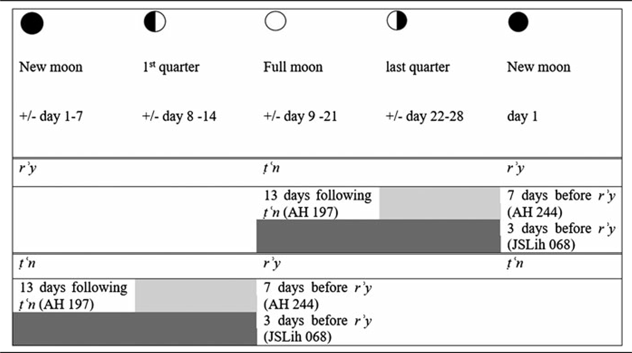
For a lunar system to work with the days specified in the inscriptions, we need one of the two terms to refer to the first or last quarter. Even though this would create a system that does not overlap and could potentially name all days of the month, it is unclear why a system would develop that referred to the days of the lunar cycle only through either the full or the new moon and one of the two quarters (see Table 4).
Phases of the moon and the attested days in the inscriptions with rʾy (light grey) and ṭʿn (dark grey) indicating the new or full moon and one of the quarters
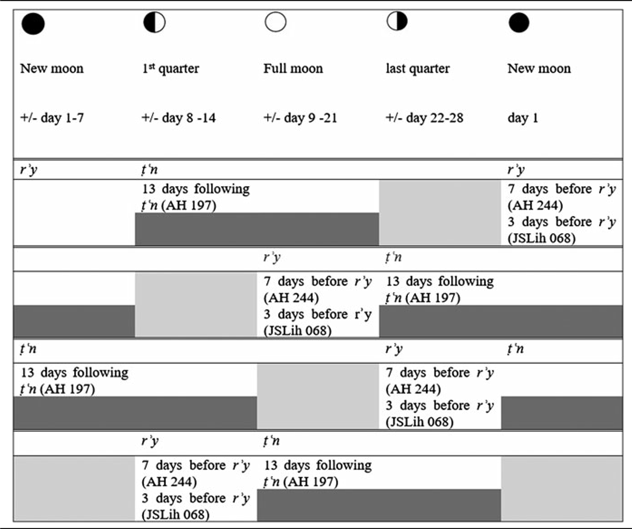
If the Dadanitic system was indeed a lunar calendar, possibly solely noting certain phases of the moon that were of cultic significance, the forms following b-rʾy and b-ṭʿn should be interpreted as local month names. Possibly similar to the month names in Sabaic, which derive from different sources: some are connected to festivals or deities, such as ḏ-nswr and ḏ-ṣrr (after the ritual indicated by the verb hṣr), while others relate to seasonal or agricultural activities ḏ-dṯʾ “the month of spring”, and several of which the origin remains obscure (Beeston Reference Beeston1956: 15–7).Footnote 40 This could explain why not all the terms following rʾy are readily interpretable in Dadanitic either. It is clear, however, that trying to fit the Dadanitic dating formula to a lunar system requires some special pleading.
4.2. Zodiac
Since the basic terms of the Dadanitic formula, rʾy and ṭʿn also occur in the Safaitic zodiac, one might expect to find the underlying system to be similar as well. However, as Al-Jallad (Reference Al-Jallad2014) demonstrated, each of the Safaitic forms can confidently be connected to one of the well-known constellations of the zodiac.Footnote 41 The Dadanitic forms, on the other hand, cannot be fitted into this system. Even though one might argue for a connection between some of the Dadanitic forms and the signs of the zodiac,Footnote 42 it seems impossible to connect all of the attested forms to the zodiac systematically.
In the second part of his article, Al-Jallad argues that the Safaitic zodiac is probably a hybrid system, using newly adopted zodiac signs in the framework of an older practical star calendar (Al-Jallad Reference Al-Jallad2016: 88). Practical star calendars in which a certain seasonal or agricultural event would be connected to the rising or setting of a star or asterism were widely used from Mesopotamia to the south of the Arabian Peninsula. Varisco (Reference Varisco1993) found several of these ancient local star calendars which have later been moulded into the lunar mansions system (Varisco Reference Varisco1993: 121–3) and a 365-day solar calendar (Varisco Reference Varisco1993: 126) by later Islamic scholars. Similar parapegmata are known, for example, from ancient Greece, in which astronomical events would be listed in connection to certain meteorological events (Stern Reference Stern2012: 57–8). These types of star calendars were a practical tool for people who were dependent on the weather and the seasons, without requiring a complex understanding of the movement of the celestial bodies, since simple repeated observation would be enough to be able to link the movement of the stars to local seasonal weather patterns (Varisco Reference Varisco1993: 121).
Given the attestation of both rʾy and ṭʿn in the Safaitic inscriptions, and even the attestation of ṭʿn in Minaic, these probably all stem from one system of time reckoning. Given their usage in Safaitic, the origin of this system was most likely a practical star calendar. Assuming a practical calendar to be at the base of this is further supported by the widespread usage of such systems in the ancient Near East. The reason we probably only see remnants of this system, sometimes adapted to other systems as in Yemen (Varisco Reference Varisco1993) and the Safaitic inscriptions (Al-Jallad Reference Al-Jallad2016), is probably due to the fact that they are not very practical for administrative purposes, due to their lack of specificity and uniformity. The fact that there seems to have been a close connection between the agricultural cycle and religious practice at Dadān may have contributed to the adoption of this, in essence, practical calendar for religious purposes, which led to it being written down – contrary to the fate of most similar calendars.Footnote 43
If the Dadanitic dating formula represented a star calendar, rʾy probably referred to the rising of a star or asterism, while ṭʿn referred to its setting. Assuming that the Dadanitic system reflects a local parapegma could also explain why the forms following rʾy and ṭʿn do not seem to correspond to any of the known time-keeping systems in the region, as they would represent the local names of locally relevant stars or asterisms. Moreover, assuming a practical calendar could help explain why we do not encounter a “full” calendar at Dadān, counting all the days of the year, since a practical calendar would only need to indicate the start of a general period of agricultural significance, or in a cultic guise it would only need to indicate the specific festival days of the year.
5. Conclusion
Based on the incompatibility of the forms following rʾy with personal names, the difficult connection between the root rʾy and the meaning “ruling”, and the occurrence of an alternative form of the formula including ṭʿn, it seems clear that the Dadanitic dating formula did not refer to a local ruler. The recent recognition that rʾy and ṭʿn in Safaitic refer to a calendar based on the movement of the stars (Al-Jallad Reference Al-Jallad2014; Reference Al-Jallad2016) and the use of ṭʿn in Minaic in similar time reckoning context seems to suggest that we are looking at an ancient dating system that lies at the basis of all three. After comparing the Dadanitic inscriptions to comparable dating systems in the ancient Near East, it seems that the Dadanitic inscriptions most likely reflect either a lunar calendar or a local star calendar. Given the strong parallels between the terms used in the Safaitic inscriptions and the Dadanitic ones, and the fact that until now only two phases of the moon would be accounted for in the Dadanitic inscriptions, there seem to be fewer problems with identifying the Dadanitic dating formula as a calendar based on the rising and setting of locally relevant asterisms. The fact that an identification of the terms following rʾy and ṭʿn with known month or star names remains problematic may be understood if we consider the Dadanitic dating system as a practical star calendar based on the local names of locally relevant stars.
Appendix 1: The terms following rʾy
In this section the terms following rʾy and ṭʿn will be discussed individually in order to explore if and how their etymology may contribute to our understanding of their function. Both their occurrence as personal names and possible connections to asterisms will be discussed. Note that while some of the terms may be connected to certain asterisms, in order to argue conclusively that these terms were part of any of the ancient star calendars known to us, all terms should fit within that system, which currently seems impossible. Connecting just a few of them is not enough to make such analogies. The following should therefore be understood as an initial exploration that might be helpful to put the terms in perspective.
s1lḥn
The form s1lḥn does not occur as a personal name in the Dadanitic corpus, but it does in ḤaḍramiticFootnote 44 and in Qatabanic,Footnote 45 in the latter mostly as the name or patronymic of a king (e.g. CIAS F 58/s4/49.10 no. 3 and CIAS F 58/s 4/49. 10 no. 2). In Sabaic it occurs 38 times, mostly in variations of the phrase bytn s1lḥn, which is translated as “the palace s1lḥn” (CSAI). Even though this phrase seems to refer to an actual building in some cases, e.g. …l-wfy bytn s1lḥn w-hgrn m [r] yb (CIH 373) “for the safety of the palace s1lḥn and the village mryb” (CSAI), in other inscriptions an interpretation “house, or family” seems to be more appropriate (Beeston et al. Reference Beeston, Ghul, Müller and Ryckmans1982: 34); e.g. l-s1lmm wʾḫnm w-l-ḥs2k bytnhn s1lḥn w-rydn “to seek peace and fraternity and to join the two families Salḥīn and Raydān”.Footnote 46
This is the only term that can be connected directly to an asterism. Lane reports ḏū as-silāḥ as an alternative name for Arcturus in Arabic (Lane: 1402c), which is the brightest star in the constellation of Boötus. The suffix -n may represent the ASA definite article,Footnote 47 in which case it was probably borrowed as a whole. Alternatively a connection may be sought between the meaning “weapon” (CAr. Sulḥān (Lane: 1402c)) and the constellation Aries. In this sense it may be compared to Safaitic ṯbr “soldier” or Babylonian Nedu (Al-Jallad Reference Al-Jallad2014: 227).Footnote 48
ḏʾbs1mwy
This form is not attested as a PN in Dadanitic or in ASA (DASI, accessed 3/10/2018). It seems to be a compound name, which could possibly be parsed ḏ ʾb s1mwy “of the sky father” or ḏʾb s1mwy “sky wolf”.
The Wolf (UR.BAR.RA (Hunger and Pingree Reference Hunger and Pingree1989: 18)) is one of the stars mentioned in the Babylonian star catalogue MUL.APIN. It refers to the star Alpha Trianguli, which was part of the constellation called the Plough (MUL.APIN (Hunger and Pingree Reference Hunger and Pingree1989: 18)). The rising of this constellation marked the starting of the spring ploughing in February in Mesopotamia (Rogers Reference Rogers1998: 16).
ʾs1lʿn
ʾs1lʿn is attested once as a personal name in Safaitic (WH 1018) (Harding Reference Harding1971: 324). It is not attested in ASA (DASI, accessed 3/10/2018) or in the Dadanitic corpus as a personal name.
The etymology of this form is rather unclear. In Sabaic ʾs1lʿ is found with the meaning “coins” (Beeston et al. Reference Beeston, Ghul, Müller and Ryckmans1982: 125). In this case the suffix -n could be interpreted as the Sabaic definite article.
Another explanation could possibly be found in the “plant or tree” named salaʿ (CAr.) (Lane: 1406c). Lane reports “a practice which was observed in the Time of Ignorance, when the people were afflicted with drought, or barrenness of the earth; which was the hanging the [kind of tree, or plant called] salaʿ with the [spices of swallow-worth called] ‘ušar to wild bull and then sending them down from the mountains, having kindled fire in the salaʿ and ʿušar, seeking thereby to obtain rain by the flame of fire, which was linked to the gleaming of lightning” (Lane: 1406c). Even though Lane reports a stem-II salla‘a for the verb signifying this custom, the Dadanitic form could be understood as the nominal form of a causative verb. In this case, however, it would be problematic to explain the suffix -n as the ASA definite article, since none of the ASA languages employed an ʾafʿal form of the causative verb.Footnote 49 While such a ritual may be connected to a certain part of the year and from there to a calendar, there is no other mention in the Dadanitic inscriptions of such a ritual.
hrm
The form hrm is attested three times as a tribal name in (central) MinaicFootnote 50 and four times in Sabaic;Footnote 51 as a personal name in QatabanicFootnote 52 and SabaicFootnote 53 and it occurs once as a toponym in SabaicFootnote 54 (Haram 49)(DASI, accessed, 3/10/2018).
It may be possible to connect this form to the root √RMY and interpret this form as /ha-ramī/ “the lancer/archer”.Footnote 55 This would form a nice parallel with rmy, which was identified as Sagittarius by Al-Jallad (Reference Al-Jallad2014: 227). Note that the only other form that could possibly be connected to the zodiac so far is s1lḥn, which would have to be linked to Sagittarius as well.
In addition to this it would structurally set this form apart from most of the others, since it would mean interpreting h- as a definite article in this form. Note that the only other form which may contain a definite article can also be interpreted as an occupational noun (see hrʿ).
ʿbdn
ʿbdn occurs as a personal name in QatabanicFootnote 56 and Sabaic;Footnote 57 it is attested as a lineage name in QatabanicFootnote 58 and as a tribal name in Sabaic.Footnote 59 It occurs in two Sabaic textsFootnote 60 as a toponym. The name also occurs in Safaitic.Footnote 61
In the inscription ʿbdn is directly followed by hnʾs1. While it may look like the two are in construct and hnʾs1 is part of the “month/period name” in the dating formula, it is probably a short hand to refer to a specific king. The name hnʾs1only occurs once as a personal name in a lineage given at the beginning of an inscription (U 090). In all other cases it is either found as a personal name or patronymic specified as mlk lḥyn “king of Liḥyān” as part of a dating formula, or (in some broken inscriptions) near the end of the inscription where one would expect to find a dating formula.Footnote 62 There are three inscriptions in which the name directly follows a dating formula including the one in which it follows ʿbdn (AH 224; JSLih 072 and D 159). Given the other occurrences of the name hnʾs1 it seems safe to suggest that here it was also added to indicate the era (see section 3.1 Syntax and form) and not as part of the “month/period name”.
ʿbdn could be ʿubdān (broken plural form), or have a suffixed plural or dual. It could be interpreted as “followers” in an attempt to connect it to the star al-dabarān “the Follower” of the Pleiades (Allen Reference Allen1963: 383) which later became identified with the lunar station dabarān (Varisco Reference Varisco1993: 123).Footnote 63 However, as with the few forms that may be connected to the zodiac, there does not seem to be a systematic way to connect all forms to such marker stars or lunar stations.
…nʿy
This form was restored as [m] nʿy in OCIANA. However, the first letter following the word divider is open at the bottom, while the m in the previous line is closed, making this an unlikely reading. mnʿy only occurs as a lineage nameFootnote 64 in Sabaic.
Since the word is broken it becomes impossible to speculate about its possible etymology.
gltqs1
gltqs1 does not occur in ASA (DASI).
The form looks like it might be a compound form with the deity qaws1, as was proposed by Caskel (Reference Caskel1954: 91). If we interpret qs1 as “bow” it could also be taken as a reference to the bow of Sagittarius. The image of a man with a bow is very old, it has been recorded on a boundary stone as early as the second millennium bce (Rogers Reference Rogers1998: 27).Footnote 65 Or even to BAN “the bow”, identified as the asterism S.CMa (and part of Puppis) from the Babylonian star list MUL.APIN (Rogers Reference Rogers1998: 19).
The first part of the form glt may then be related to CAr. jalal “a great or formidable thing” jillah “great” or (Lane: 437bc). In construct with the name of the deity this could give a meaning “greatness of Qaws”. Note, however, that there is no evidence in the inscriptions that Qaws1 was worshipped in Dadān.
ḫmt
ḫmt does not occur in ASA (DASI). ḫmt does not seem to appear in ANA as a PN either (Harding Reference Harding1971: 228).
The form ḫmt may be connected to ḫaymat “tent” and the constellation al-ʾaḫbiyah “the tents” (Gpze and Aquarii together). It is unclear, however, why this name would be calqued and not taken over with the same root.
hrʿ
This form is attested as C-stem verb of rʿy in Sabaic,Footnote 66 translated as “he let them pasture” (CSAI). rʿ does not occur in ASA (DASI). There does not seem to be a PN hrʿ in ANA either (Harding Reference Harding1971: 613).
This form may be interpreted as coming from the root √RʿY, which could render an interpretation “the shepherd”, with a definite article similar to hrm if that is from √RMY. This could be compared to the Babylonian name for Orion “the loyal shepherd of heaven” (SIBA.ZI.AN.NA Shitaddalu) (Rogers Reference Rogers1998: 16).
Acknowledgements
I would like to thank Professor Al-Jallad and Dr Macdonald for extensively discussing this idea with me when it was still in its initial stages. My gratitude goes to Professor de Blois for corresponding with me on the elusive “month names” in the Dadanitic inscriptions. Finally I would like to thank everyone who has commented on this paper in various stages of its writing, most notably: Dr Edward Hayes, Dr Benjamin Suchard, Dr Simone Mauri, Professor Maarten Kossmann and Professor Petra Sijpesteijn. All errors are of course my own. The research for this article was funded by the NWO grants in the humanities, Grant/Award no. PGW 14–43.
Sigla and abbreviations
- AH
Dadanitic inscriptions in Abū l-Ḥasan (Reference Abū l-Ḥasan1997)
- AHUD
Dadanitic inscription in Minaic script published in Abū l-Ḥasan (Reference Abū l-Ḥasan2005)
- ATM
Deposit number in the ʿAtaq Museum, available on DASI
- al-ʿUḏayb
Dadanitic inscriptions published in OCIANA
- al-Ḫuraybah
Dadanitic inscriptions published in al-Theeb (Reference Al-Theeb2013)
- al-Ḥarāshif
Inscriptions from al-Ḥarāshif, published in Robin (Reference Robin1992)
- al-Jawf
Ancient South Arabian inscriptions published in Arbach and Schiettecatte (Reference Arbach and Schiettecatte2006)
- Al-Saʿīd 1420/1999
Dadanitic inscriptions published in al-Saʿīd (Reference Al-Saʿīd1420/1999)
- ʿAbadān
South Arabian inscriptions published in Robin and Gajda (Reference Robin and Gajda1994)
- BM
Qatabanic inscriptions published in Bron (Reference Bron2006)
- C
Inscriptions published in Ryckmans (Reference Ryckmans1950)
- CIAS
Ancient South Arabian inscriptions published in Beeston, Pirenne and Robin (Reference Beeston, Pirenne and Robin1977)
- CIH
Corpus inscriptionum semiticarum pars quarta inscriptions Ḥimyariticas et Sabaeas continenst. I–III, Paris 1889–1929
- CSAI
Corpus of South Arabian Inscriptions, part of DASI
- DASI
Digital Archive for the Study of pre-Islamic Arabian Inscriptions. Available at http://dasi.cnr.it/
- Ghul-YU
South Arabian inscriptions published in Hayajneh (Reference Hayajneh2000)
- Gr
Ancient South Arabian inscriptions published in Grjaznevič (Reference Grjaznevič1978)
- Haram
Ancient South Arabian inscriptions published in Robin (Reference Robin1992)
- Ist
Deposit number in the Ancient Orient Museum in Istanbul, available on DASI
- Ja
Ancient South Arabian inscriptions published in Jamme (Reference Jamme1963)
- JaL
Inscriptions published in Jamme (Reference Jamme1968)
- JSLih
Inscriptions called Liḥyanite published in Jaussen and Savignac (Reference Jaussen and Savignac1909–12)
- KAI
Canaanite and Aramaic Inscriptions published in Donner and Röllig (Reference Donner and Röllig1968)
- KR
Ancient South Arabian inscriptions published in Avanzini (Reference Avanzini2008).
- KRS
Inscriptions recorded by Geraldine King on the Basalt Desert Rescue Survey in north-eastern Jordan in 1989 and published in OCIANA
- Lane
Arabic–English dictionary by Lane (Reference Lane1863)
- M
Minaic inscriptions in Garbini and Capuzzi (Reference Garbini and Capuzzi1974) and available in DASI
- MuB
Qatabanic inscriptions published in Avanzini et al. (Reference Avanzini, Bāfaqīḥ, Bāṭāyiʿ and Robin1994)
- Müller 1889
Inscriptions published in Müller (Reference Müller1889)
- Nasif 1988
Dadanitic inscriptions published in Nasif (Reference Nasif1988)
- OCIANA
Online Corpus of the Inscriptions of Ancient North Arabia. Available at: http://krcfm.orient.ox.ac.uk/fmi/webd/ociana
- Private collection
Dadanitic inscriptions from a private collection published in OCIANA
- Rabeler
Dadanitic inscription published in Scagliarini (Reference Scagliarini2002)
- RES
Répertoire d’épigraphie sémitique. (8 volumes). Paris: Imprimerie nationale, 1900–1968
- SIJ
Safaitic inscriptions in Winnett (Reference Winnett1957)
- U
Dadanitic inscriptions from al-ʿUḏayb published in Sima (Reference Sima1999)
- WH
Safaitic inscriptions published in Winnett and Harding (Reference Winnett and Lankester Harding1978)
- ZeWa
Zeinaddin, F. 2002. Unpublished Safaitic inscriptions on fax in Al-Jallad Reference Al-Jallad2015


 Open access

