Just as radio and television revolutionized the presidential election process in earlier decades, today the “new media” are making a significant imprint on how campaigns are conducted by candidates, covered by journalists, and evaluated by the voters. While the same basic goals for campaigns apply, the tools to accomplish these goals have expanded.
THE NEW MEDIA, THE PUBLIC, AND CAMPAIGN 2.0
New media is a general term covering nontraditional ways of delivering information. Traditional media would encompass broadcast and cable television, radio, newspapers, magazines, etc. New media refers specifically to things such as streaming video and audio, weblogs (hereby referred to as blogs), social networking sites, and user-generated content.
Hyperlinks and search engines link everything together and provide many choices to explore and share. Because most of the new media are utilized primarily through the Internet, it is here that we go next. The potential for new media to have an impact on the campaign rests on the premise that the content can reach the publics that the campaigns are attempting to capture. Indications are that new media have become highly accessible to the general public, but that there are still some who are less likely to access political information through this medium.
A recent Harris Poll survey, which polled 2,062 adults in July and October of 2007, found that 79% of adults—about 178 million—go online, spending an average 11 hours a week on the Internet. Internet users are seeking more than just bargains on eBay: 73% of the general public went online to access general news; 55% went online to get political news or information about candidates or upcoming campaigns (from the May 2008 Pew Internet & American Life Project Tracking surveys).Footnote 1 The profile of the news/information consumer on the Internet is now roughly even between male and female. However, it is still more Caucasian, relatively young, and highly educated (from the May 2008, Pew Internet & American Life Project, Tracking Survey).Footnote 2 There has been movement in terms of the racial makeup of Internet-news information seekers. The latest data from Pew suggests a significant increase in the number of African Americans and Hispanics utilizing the Internet for news.Footnote 3
While television still dominates, the number of individuals who use the Internet as the primary source for news information has been increasing steadily. According to Pew's survey, a majority of those who went online for political news used this information to help them decide how to vote. Indeed, about one-third of them suggested that information they received online was the determining factor in voting for or against an individual. The typical individual who uses the Internet for campaign information is generally using this platform to find out where candidates stand on issues and to research their voting records.
THAT WAS THE GOOD ONLINE NEWS; THIS IS THE BAD ONLINE NEWS …
One of the more interesting findings in recent studies of Internet use is also one that has implications for the population's exposure to political news and information The Project for Excellence in Journalism study, The Latest News Headlines—Your Vote Counts (September 12, 2007),Footnote 4 suggests that citizen-generated news is more diverse and more transitory in nature. Unlike the relative homogeneity of news found in the mainstream media, they found that Internet users were more likely to view and e-mail each other a very eclectic batch of news, very often more practical in nature or entertaining. This fits in with established uses and gratification theory with regard to information consumption.
Markus Prior's work (Reference Prior2005) and those of others suggests that such an outcome might occur. Prior argues that greater media choice allows people to find their preferred content. Those who like political information will have greater ease in finding it, while those who prefer entertainment and the like will as well. And thus, according to Prior, the increased media choice actually widens the gap in political knowledge and political action rather than as others have suggested, getting many more involved in politics. However, this research may not have factored in the ability of savvy candidates to utilize the Internet and its many tools to attract potential voters through vehicles that are more entertainment oriented.
SOURCES OF INTERNET NEWS: NOT WHAT YOU WOULD EXPECT
According to Johnson et al. (Reference Johnson, Kaye, Bichard and Wong2007) politically interested Internet users relied more on blogs than any other news source for news and information. Moreover, these blogs were judged as more credible than online newspaper sites, online cable television sites, and online broadcast news sites. If one utilized Technorati (a Web site that tracks who says what on the Web: http://www.technorati.com) to assess blog ranks, you would find that the Huffington Post and the Daily Kos are the most highly ranked political blogs. Most of the others with the highest authority rankings are more technology oriented. There is not a conservative blog that rates in the top 20. However, blogs played a role in the 2008 presidential nomination campaign. They were the first to break a number of stories about the candidates.Footnote 5
So did the candidates in 2008 utilize these new tools? It is clear that the electorate was online, getting information and in some cases producing that information, so how did the candidates respond? Did they harness the power of the Web effectively?
NEW MEDIA AND THE CANDIDATES: WHO WON THE INTERNET PRIMARY? THE HIRED GUNS
In 2004, online political operatives (or OPOs) were just beginning to create non-static, interactive Web sites (Williams and Tedesco Reference Williams and Tedesco2006). In fact, e-campaigning got its name when Joe Trippi, campaign manager for Howard Dean, was the first to integrate an Internet team with the more traditional campaign structure. Dean's team is credited with starting the first presidential campaign weblog, pioneering Internet-organized meet-ups of supporters, and utilizing the Web to raise almost $8 million dollars in the second quarter of 2003. Some campaigns looked askew at these changes as nothing more than bells and whistles, not effective tools for generating and organizing support, but campaigns quickly moved to replicate and enhance the innovations that existed when they saw that they could and did have an impact.
In 2008, every candidate had at least one online strategist or Web consultant. The Democratic candidates had more and better support in the e-campaign area (both of the frontrunners—Barack Obama and Hillary Clinton had teams that included many of Dean's original Internet operatives) and that is primarily due to the source pool for such talent. At this juncture, the political geek squad tends to be more left-leaning than right-leaning. Young Republican OPOs are working to change that and during the next national campaign cycle we will probably see more talent emerging for the Republicans.
CANDIDATE WEB SITES: THE FRONTLINES OF CAMPAIGN 2.0
Given the resources spent on developing an e-campaign, do we see individuals, particularly in the states that candidates care about, utilizing the Web as part of their information-gathering, decision-making routines? Research suggests that Web sites matter, particularly as a means to learn about the candidate (Trammell et al. Reference Trammell, Williams, Postelnicu and Landreville2006).
A survey conducted by Pew on December 7, 2007, examined the use of new media techniques in Iowa and New Hampshire, looking at whether or not the Web sites of the candidates were being utilized by potential voters in these states. They found that 30% of likely voters in Iowa and 29% in New Hampshire said they have visited candidate Web sites. Roughly the same percentages have viewed candidate videos online as well. In states that are inundated with candidates, their need for alternative contact may be lessened. However, we do not know whether or not the level of campaign activity in a state is related to the level of political Internet use by the voting public in a state.
All of the candidates competing for their party's nomination had a Web site. Yet how does one assess whether or not the candidates utilized their Web pages well? What type of traffic were they generating? Who visited, and who did so regularly? Since so much of the Internet is business oriented, the tools to evaluate the effectiveness of Web sites are quite accessible.
One such tool is Alexa (http://www.alexa.com), which measures the approximate traffic for millions of Web sites on the Internet. Alexa analyzes global Web traffic and currently has over 16 million users. Another site that provides this information is Compete (http://www.compete.com). Compete utilizes multiple data sources, including ISP, Panel, and Toolbar to estimate U.S. traffic. It currently has over two million toolbar users.Footnote 6 Another interesting source of Web site information is found at Quantcast's Web site (http://www.quantcast.com). Not only does its profile provide data on a Web site's reach and rank, it breaks down the site visitors by demographic and usage data.
In Figure 1, we utilize Alexa's ability to generate graphic representations of a Web site's rank over time. Rank is the combination of reach, the percent of global Internet users who visit this site, and page views—the number of unique pages viewed per user per day for the site. During the course of the primary nomination campaign, Obama's Web site was dominant, although Clinton's was not far behind particularly at a number of points during the campaign. Other than John Edwards, most of the other Democratic candidates had very little traffic on their Web sites—so little, in fact, that they do not even show up on the graph as other than a flat line at the bottom. The Republican candidates, however, who were getting much less traffic generally, did have more parity in terms of their Web site traffic. They, too, evince a number of simultaneous spikes, and some that were unique to particular candidates. One thing to note is that similarities exist in terms of peaks and valleys in rank across the Democratic and the Republican candidates. This may suggest that visitors are responding to similar external catalysts that may direct them to candidate Web sites. This is a question for future analysis. What motivates the public to go to particular candidates' Web sites? Will the same types of theories that explain general information seeking also explain purposeful politically oriented web surfing? Do the traditional media, particularly television and radio create the “push” to go to candidate Web sites, or do candidates themselves and the process create a “pull” to their Web sites? Some work has been done that compares the relative impact of traditional media versus the Internet (Kaid Reference Kaid2003), but there is a great deal we do not know as of yet.
Comparison of Rank for the Leading Democratic and Republican Candidates

When we examined the rankings for the candidates' Web sites overall as generated by Hubspot's Website Grader (http://www.websitegrader.com) for the nomination period of the campaign, the candidates who led in the polls and/or led in terms of their campaign resources were able to generate fairly strong Web sites. The winners on the Web site report card for the nomination phase were Barack Obama and Ron Paul. Hillary Clinton, John McCain, and Rudy Giuliani came in second place. One note on the nature of candidate Web sites: Paul's was different from most of the other candidates' sites. His approach was novel. Instead of building an infrastructure on his own campaign Web site like most candidates have done, Paul had created a portal to his presences on various third-party Web sites. According to BBC journalist Todd Zeigler (Reference Zeigler2007), Paul's Web site was a very limited enterprise, but it did encourage visitors to discuss and interact with the blog content on social sites like Digg, Del.icio.us, StumbleUpon, and Facebook.
RAISING MONEY
The Internet allows individuals to quickly and easily go to a candidate's Web site and contribute electronically. This has put credit card use in play, something that traditional campaigns of the past rarely accepted. Once the contribution is made, that candidate gains substantial data for subsequent solicitations. According to the New York Times, within the first six months of 2007, the top-three Democratic presidential candidates, Clinton, Edwards, and Obama, raised more than $28 million dollars in online donations (Luo Reference Luo2007). Republicans were behind somewhat with their top-three candidates at that time, Giuliani, McCain, and Mitt Romney, raising more than $14 million. These donations have all the appearances of grassroots activity for many of the candidates, not only for Obama. The Internet allows candidates to reach the usually hard to reach small givers, and it allows interest groups to bundle in new ways. In fact, 90% of Obama's millions came in contributions of $100 or less. These donations were responsible for the continued existence of some candidates who were generally outside of the traditional party/campaign organizations. Ron Paul's campaign had sustained his candidacy and grew his organization with his Internet donations. During the fourth quarter of 2007 alone, Ron Paul raised over $18 million dollars. Money cannot substitute for message, but it is a critical component of a campaign. The Internet's use as a tool to raise “fast” and “big” money may have implications for the process, particularly in areas of momentum and viability.Footnote 7
WHAT'S THE BUZZ? WEREN'T BLOGS SUPPOSED TO BE DIFFERENT?
Blogs have been the story of the new millennium. They are probably the most researched area of new media (Drezner and Farrell Reference Drezner and Farrell2004; McKenna and Pole Reference McKenna and Pole2004; Bloom Reference Bloom2003). Candidates have utilized blogs on their own pages, and most will link any blog that talks about their campaigns positively to their Web sites. One of the new ways to see which candidates are generating attention from cyberspace is through tools such as Technorati, which tracks the blog buzz. Even traditional search engines such as LexisNexis now search within blogs in addition to all of the other sources they utilize. Much has been made of the differences in how blogs cover events and campaigns compared to the traditional media. Do blogs diverge in the manner in which they cover the campaign? Are they less likely to fall prey to the traditional media's bias toward top-tier candidates?
In Table 1 we present the distribution of candidate coverage via the traditional and nontraditional mediums as represented by network news stories versus blog entries generated from LexisNexis searches for the time periods November 26 and ending December 26, 2007 (a period prior to the first contest), and from January 1 to 5, 2008 (the time period surrounding the Iowa caucuses). This is only a snapshot of the news coverage and blog conversations generated, but it does allow for some comparisons. First, with only two exceptions, the new media and the old media dedicated the most attention to the same candidates. The one exception was Rudy Giuliani during the pre-primary period. The traditional media gave him more coverage, including him in the top-three candidates covered. The new media had their own exception, and that was coverage of Ron Paul during this pre-primary period as well. The dominant candidates during this time point were Clinton, Obama, Edwards, Huckabee, and Romney. Clinton's coverage dominated the Democratic candidates, while Huckabee and Romney led for the Republicans. During the week surrounding the Iowa Caucuses, we see a shift. Clinton's coverage decreases and Obama and Edwards (who came in first and second, respectively, in Iowa) saw their share of coverage reach more parity with Clinton. For the Republicans, Iowa moved McCain to the top tier in both new and traditional media coverage. Thus, we do not see stark differences in terms of who is getting coverage. The new media, represented by blogs, seem to focus their attention very much like the traditional media, belying the notion that lower-tier candidates may do better at generating buzz on the Web.
Candidates and Blog Buzz versus Traditional News Media Buzz*

* Traditional News media includes CBS, CNN, FOX, ABC, NPR, NEWSHOUR, and NBC; all blogs accessible through LexisNexis were utilized for this data collection.
VIRTUAL FRIENDSHIPS AND VIRAL VIDEOS
Finally, we turn to the buzz trendsetters—YouTube and MySpace. These are probably the most discussed new media features of the 2008 elections. YouTube has been used by candidates for hosting campaign videos. Indeed, in 2008 Clinton, Edwards, Obama, and Sam Brownback all used Web videos to announce their candidacies, but it has also been used by individuals to post commentary about candidates, original supportive and opposition videos, questions to candidates, music videos about candidates, or make their own ads in addition to those of the campaign. In general, Web video ads are very cheap to create, take little production time, and allow the candidate to respond quickly to issues, events, and opponent speeches or attacks. These types of ads can be longer than the typical 30 seconds for television, giving candidates more time to make their points. Often they are humorous and entertaining. Mike Huckabee's ad that utilized the talents of Chuck Norris has had over two million views. Millions of people have participated in the nomination campaign process through YouTube. Given these high levels of activity, YouTube created its own Election '08 hub.
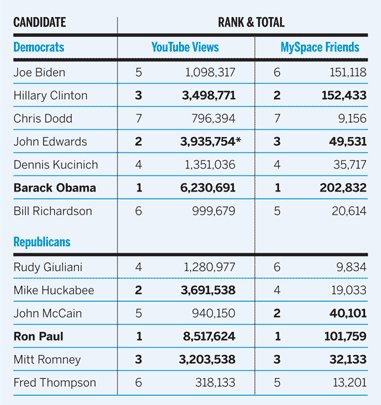
Which candidate saw more YouTube activity during the time period prior to the first primary event? Table 2 breaks reports the number of views of videos related to the candidate and the candidate's overall rank within the field prior to the start of the primaries.
Rank by Total Number of Individual Views of Candidate Video on YouTube and Friends on MySpace Prior to First Nomination Event

* Edwards's YouTube numbers were likely inflated due to the fact that he ran his videos housed on his Web site through YouTube, thus generating more hits. Obama and Clinton used their own video streaming software rather than YouTube.
Barack Obama and Ron Paul were the clear winners in the YouTube viewing category, followed far behind by the other candidates. Other than Paul, this activity prior to the first caucuses or primaries was a decent predictor of the eventual top tier. Clinton, Obama, and Edwards emerged after Iowa as the top three. YouTube did less well on the Republican side given Ron Paul's activity, but they did generate strong numbers for Huckabee and Romney, both competitive candidates. McCain was ranked fifth in terms of views. Generally, McCain did not utilize a great deal of new media in his campaign. While his Web page was quite strong, it was not as innovative and used less streaming video or social networking tools as some of the others. Moreover, the typical McCain supporter may have been less likely to visit YouTube and generate those views. But most likely of all was that McCain was also not being covered by the traditional news media or generating much conversation on the Web in general. As he became a more viable candidate, he also generated more buzz and more “friends.” Who had the most friends on MySpace prior to the nomination contests' start? Again, there are no surprises in Table 2. Obama and Paul dominated their competition. Both of them had created very strong networks of supporters on MySpace, and both had used this community in their fundraising efforts. What stands out here is that McCain actually had more MySpace friends than his peers (other than Paul), however, as of this summer, he had only generated about 100,000 friends total, whereas Obama had generated over half a million.Footnote 8
One thing we have noticed in our brief examination of new media and the campaign in 2008 is that the Internet campaign is just as dynamic as the traditional campaign, if not more so. We know immediately if a candidate's blog buzz drops. We can analyze these within moments with very little difficulty, if we are paying attention and capturing the data. The blogosphere appears to be very sensitive to changes in the dynamics of the race, just as quick to judge as the traditional media, and just as likely to make mistakes or set expectations and then be critical once they are not met, and so forth. While we may benefit from a more varied chorus of voices, bloggers, particularly those who become notables, are likely to fall into the same types of behaviors as traditional journalists. As advertisers move onto the Web even more, bloggers may become more concerned with audience numbers and this may affect the nature of their “reporting.” We may see more manipulation of information—more astro-turfing of the blogosphere where campaigns and their supporters attempt to create buzz that feels like grassroots support but is in reality simply manufactured. We have already seen a bit of this on YouTube and MySpace as campaigns planted material that had the appearance of coming from an individual but was really associated with the campaign. Social networking sites as campaign tools are really only beneficial when there is real support for a candidate. A campaign cannot manufacture friends. These are individuals who connect to the candidate in both worlds—the real and virtual.
Thus, in terms of winning the Internet primary, it would appear by all the evidence that both Senators Clinton and Obama did very well utilizing the Internet in ways that were creative and effective. Ron Paul also demonstrated that a band of loyal supporters and a dedicated staff can raise money and attention, but not necessarily the broad support that candidates need to win primaries. Senator McCain had a very mixed Internet report card, yet he won his party's nomination. In the end, it requires a confluence of factors to win the nomination campaign, but the candidates of the next cycle will likely not ignore the Internet. If there is one lesson to be learned, it is that the Internet can generate a significant amount of money for candidates—very quickly, and very efficiently. It can also be used to organize volunteers and spread information in a very effective manner.
SO WHAT DOES THIS ALL MEAN?
In the early days of our republic, politics was distant, carried out by elites who barely interacted with the masses. They didn't really need to given limited suffrage. As the vote expanded, so did the manner in which campaigns were conducted. William Henry Harrison was the first candidate to give a public campaign speech. That was the beginning of persuading the electorate on a more personal basis. Then came television, suburbs, and cars. Politics became more distant in nature and the public harder to reach. Moreover, the country was so large that candidates made television ads that they could cast over the vast landscape of electoral politics, and thus they were often quite generic, for various reasons, including cost and production time.
While people still watch television, many spend as much time watching YouTube. They own PDAs that are connected to the Internet and download their news. But as individuals have personalized their information consumption, so too have they made it possible for candidates to reach them at a more personal level. Just think about that e-mail someone received from a campaign. It is highly likely that it was sent using the receiver's first name. The campaign may have mentioned that the individual hadn't visited the candidate's Web site lately. Perhaps the campaign sent a new video or endorsement that was narrowcast to the receiver's preferences. Candidates may be able to better connect with their supporters and they may allow those supporters to have greater access to them. Perhaps once in office the newly elected “tech president” will e-mail his public letting them know what his first official act as president will be. Perhaps he will set up a wiki that allows members of the public to contribute ideas for cutting waste or conserving energy. Social capital may rise as relationships that are built on political campaigns, both for offices and for causes, will grow (Lawson-Borders and Kirk Reference Lawson-Borders and Kirk2005).
Campaigns are using technology to lower the costs and increase the benefits of participating. Campaigns know that indirect mobilization through their supporters' social networks is cheaper and more effective than direct mobilization. Campaigns have responded by creating messages (e.g., e-mails, videos) intended to spread virally and by creating widgets that allow supporters to show their support in blogs and social network sites. Campaigns will, to use Joe Trippi's phrase, “open source” their operations to give supporters a feeling of influence, at least over parts of the campaign. This may be the manner in which individuals become more closely attached to candidates.
There is no doubt that viable candidates can effectively use these tools to generate interest, mobilize support, raise money, introduce new issues, and so on. There is no doubt that the Internet will continue to expand its reach and that more and more people will utilize it for learning, entertainment, and politicking. So far the candidates who have the resources and the interest have shown that they can harness the potential of the Internet, and the contributions. There are those who will be slow to adapt, but like everything in politics, there is no doubt that they will once they are convinced that it may matter to their campaign's success. ■