

Introduction
Research largely conducted in Westernized countries has found that spousal support is predictive of smoking cessation (Homish & Leonard, Reference Homish and Leonard2005). Support involving cooperative behaviours (e.g., expressing pleasure regarding cessation efforts) predict cessation (Park, Tudiver, Schultz, & Campbell, Reference Park, Tudiver, Schultz and Campbell2004). Negative behaviours (e.g., nagging and complaining) predict relapse (Cohen & Lichtenstein, Reference Cohen and Lichtenstein1990; Roski, Schmid, & Lando, Reference Roski, Schmid and Lando1996). China is the world's largest producer and consumer of tobacco, with a smoking prevalence of 52.9% among men and 2.4% among women (Giovino et al., Reference Giovino, Mirza, Samet, Gupta, Jarvis and Bhala2012). Research regarding marital interactions around smoking may have implications for cultures with similarly large gender disparities in smoking.
Aims
We examined interactions among family members regarding the father's smoking and cessation in homes with small children in Shanghai, China.
Methods
Participants and Procedures
The Institutional Review Boards of Emory University and Fudan University approved this study. In Spring 2013, we conducted 30 in-person semi-structured interviews among participants from an urban and a suburban community in Shanghai, which were recruited using fliers in kindergartens and primary and secondary schools. Eligibility criteria included that one smoker, one nonsmoker, and one child resided in the home and that the spouse was not participating in this study (to prevent duplication of information). Participants included male current smokers and female nonsmokers with representation of each who either allowed or did not allow smoking in the home. Interested individuals called the research team at Fudan University, were screened for eligibility, and were scheduled for an in-person interview. Participants were compensated 100 RMB.
Interviews were conducted by the second author and two trained masters of public health level staff according to standard principles (Harrell & Bradley, Reference Harrell and Bradley2009; Krueger & Casey, Reference Krueger and Casey2000) in conference rooms on campus or in participants’ home. Once saturation was reached within a category, recruiting participants for that category was discontinued.
Measures
The semi-structured interview guide was translated from English to Chinese and then back-translated by bilingual, a MPH student at Emory and Fudan to ensure that meaning was consistent across languages. The guide included a brief structured section assessing sociodemographic, smoking-related history, and household composition and an open-ended guide that explored personal smoking history among the male current smokers and, among both males and females, communication regarding smoking and cessation and husbands’ responses to suggestions to quit.
Data Analysis
Descriptive statistics were computed using SPSS 21.0 (IBM Corporation, Armonk, NY). All sessions were audio-taped and transcribed. Chinese transcripts were translated into English by two bilingual MPH students at Fudan. The English and Chinese transcripts were compared by two bilingual MPH students at Emory. Then, three coders generated preliminary codes using an inductive and deductive process and developed a master coding structure (Miles & Huberman, Reference Miles and Huberman1994; Patton, Reference Patton2002). Thematic content analysis was conducted to identify themes, and matrices were constructed to help identify patterns and themes by gender. Qualitative data was coded and organized using NVivo 10.0 (QSR International, Cambridge, MA). Intra-class correlations for context exceeded 0.96. Themes were identified and agreed upon among the coders, and representative quotes were selected.
Results/Findings
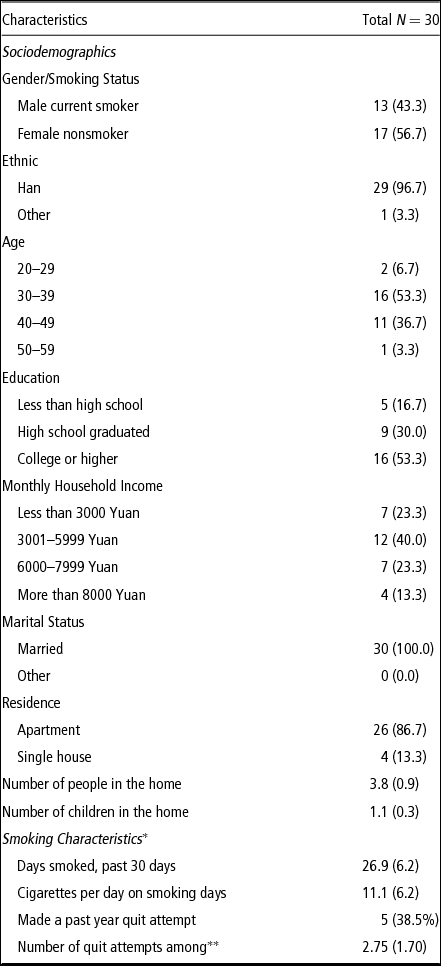
Of the 30 participants, 43.3% (n = 13) were male smokers, and 56.7% (n = 17) were female nonsmokers (Table 1). Smokers smoked an average of 26.9 (SD = 6.2) days in the past 30 days.
Sociodemographics and smoking characteristics of study participants

*Among current smokers (n = 13).
**Among current smokers who made a quit attempt in the past year (n = 5).
Messages Encouraging Smoking Cessation
Women used a range of strategies to encourage their husbands’ cessation or reduction. There were also instances of hesitation to having such conversations.
Wives’ direct persuasion
Roughly half of the women interviewed reported trying to persuade their husbands to quit or reduce, suggesting that smoking is bad for the smoker and for the family, particularly children. Men similarly reported these strategies being used.
‘I told him that smoking is bad for his health, and it will affect our child and me. Besides, the house environment will be polluted, and smoking blackens the walls and makes everything yellow. ’
‘She said she wants me to be responsible for our daughter, for her and for family's health. And she wants me to quit smoking. ’
‘My wife always complains about it. She says that (smoke) is dirty. The smoke residue and dust makes the environment of the house bad, and make the smell of cigarette smoke stay in clothes. Also it is definitely bad for health. ’
Wives’ indirectly persuasion and communication through children
Roughly a quarter of women reported that children delivered the message.
‘I will say to my child, ‘Go tell Daddy that smoking is bad. I hope that Daddy will be healthy.’ I hope that by going through my child, he will keep in mind a few things.’
A couple of women also reported indirect communication about cessation.
‘If I see others on Weibo talking about smoking or discussing news related to how bad smoking is, I will forward them to him quietly. Hopefully when he sees them, he will be afraid or aware, knowing that one day he can quit smoking.’
Conflict
Approximately, a third of women reported conflict or concern about conflict as reasons for not engaging in conversations about cessation or reduction.
‘It would cause conflicts when I told him not to smoke.. . . After that, he might not smoke at home for a period of time, but a few days later he would smoke again. So that's why there are often some conflicts and fights.’
Tolerance, resignation
Roughly a quarter of women reported tolerance and/or resignation.
‘When I first discovered that he smoked, I tried to help him quit. Strict and less strict methods were tried. Eventually, I found them to be useless and gave up.’
Husband's Reactions to Suggestions to Quit
Both men and women reported a range of negative responses to anti-smoking messages from family members.
Saying he can quit at a later time
Nearly half of the women indicated that their husbands would promise to quit in the future.
‘He says ‘I can quit, I can take my time and we can talk about it later.’ He uses delaying tactics.’
Work and work interactions
About half women and men talked about the role of work in promoting smoking, particularly in workplaces dominated by men.
‘He thinks his job constrains him, turning smoking into a communication tool. He says, ‘When men meet, they all smoke. When I sit down, if I don't pass a cigarette to someone, it is like I am missing a communication tool.’ So he says that for now, he can only cut down.’
‘All of the auto mechanics I work with are men. We all smoke. No one cares about it.’
‘If there are female colleagues around, I will definitely not smoke. . . If there are male colleagues, we smoke together.’
Smoking is their only hobby or addiction
Both men and women reported that husbands excused smoking because it was their only addiction or hobby.
‘He always says that smoking is his only hobby, so I shouldn't take it away from him. Then I will compromise with him and ask him to smoke less.’
‘I will tell her that I don't have other interests except for playing cards and smoking. I am not like other people who go out drinking and gambling.’
Discussed addiction or disadvantages of quitting
There were other disadvantages also stated by men to excuse their smoking.
‘He has tried to quit smoking for once or twice, but he says he will get sick if he quit, so he starts to smoke again.’
‘It is hard for me not to smoke if I have an urge to smoke. Once my smoking addiction comes, I must smoke.’
Argue against science
Finally, about a quarter of women and men reported arguing against the research documenting the negative health consequences of smoking as a strategy for men to continue smoking.
‘Actually, till now, there's no obvious scientific evidence to prove that smoking can cause health problems. Some doctors frighten me with damaged lungs, but there's no direct connection (between smoking and diseases). Even for lung cancer, many people who got lung cancer have never smoked for a lifetime. How do you explain that?’
Conclusions
This study provides unique data in relation to family interactions regarding men's smoking in Shanghai. Women tried several strategies, including both directly communicating with their husbands and indirectly communicating either through hints or through children, which coincides with prior research (Wang et al., Reference Wang, Li, Jia, Liu, Liu and Yan2014). Some women avoided the conversation due to fear of conflict. Some men said they would quit in the future or that work promoted smoking, while some discounted the negative health consequences of smoking, consistent with prior research (Ma et al., Reference Ma, Hoang, Samet, Wang, Mei and Xu2008).
Future research should refine measures regarding interpersonal interactions facilitating or impeding cessation. Interventions targeting motivators for cessation among Chinese men and to support women encouraging their husbands’ cessation should be developed and tested. Clinicians should promote cessation, highlighting the health consequences of smoking. Policies that denormalize smoking (e.g., public smoke-free policies) are needed.
Limitations
Limitations include small sample size and lack of generalizability due to a focus on male smokers and female nonsmokers with young children in Shanghai. Also, the interviews may not have yielded exhaustive information regarding the constructs and processes investigated.
Acknowledgements
This publication was supported by (removed for blinded review). We would like to thank our colleagues at Fudan University for their efforts in completing data collection.
Financial Support
This research was supported by Grant Number U01CA154282 from the National Cancer Institute.
Conflict of Interest
None.
Ethical Standards
The Institutional Review Boards of Emory University and Fudan University approved this study.