INTRODUCTION
Publications of pottery from various excavations in the Mediterranean area and the Black Sea have defined several categories of glazed pottery (based primarily on their decoration techniques), which co-existed or followed each other during the twelfth and the thirteenth century. Much of the terminology used for this group of wares (Slip-Painted, Green and Brown Painted, Fine Sgraffito, Painted Sgraffito, Incised Sgraffito, Champlevé, Plain Glazed) still relies on C. Morgan's pioneer publication of the Byzantine pottery of Corinth in the 1940s (Morgan Reference Morgan1942; see also Vroom Reference Vroom2003; Waksman and Wartburg Reference Waksman and Wartburg2006). Part of Morgan's Incised Ware falls in the group later distinguished by A.H.S Megaw as ‘Aegean Ware’ (suggesting an Aegean provenance), which he dated in the early thirteenth century (Megaw Reference Megaw, Robertson and Henderson1975). The chronology of these different types of pottery was revised by G.D.R. Sanders, who provided a new typo-chronology of reference for them from the beginning of the twelfth until the mid-thirteenth century (Sanders Reference Sanders1995; Reference Sanders and Papanikola-Bakirtzis1999; Reference Sanders, Belke and Hild2000; Reference Sanders, Williams and Bookidis2003).Footnote 1 Closed deposits from other excavations, such as the Saraçhane excavation in Istanbul (Hayes Reference Hayes1992) and the Palaion Demarcheion site in Cyprus (Violaris Reference Violaris2004; Wartburg and Violaris Reference Wartburg and Violaris2009) support Sanders' chronology. The later periods are less well documented, but we now know that some of the types may be found until the beginning of the fourteenth century, as shown at Kinet Höyük (Blackman and Redford Reference Blackman and Redford2005, 88, 96).
The importance of these categories of mainly twelfth–thirteenth century glazed pottery is accentuated by their wide diffusion, which includes major sites, especially harbours, from southern France to Israel and from Chersonesos to Paphos (Vallauri and Démians d'Archimbaud Reference Vallauri, Démians d'Archimbaud and Bakirtzis2003; Boas Reference Boas1994; Romancuk Reference Romancuk2003; Megaw Reference Megaw, Robertson and Henderson1975; François Reference François and Démians d'Archimbaud1997, 233–4). However, the quantities found at all these sites may not have been substantial,Footnote 2 with larger concentrations appearing in the Aegean, for instance at Corinth (Sanders Reference Sanders1995) or Kadıkalesi/Anaia (Mercangöz Reference Mercangöz and Mercangöz2013b, 38–54). Such pottery has also been located in rural sites of Central Greece (Armstrong Reference Armstrong1989; Vroom Reference Vroom2003, 145–64) and the Frankish Levant (Stern and Tatcher Reference Stern, Tatcher, Getzov, Avshalom-Gorni, Gorin-Rosen and Stern2009). But the most striking point is its presence in shipwrecks. In the Aegean, Eastern Mediterranean and the Black Sea, we are currently aware of a handful of shipwrecks dated back to the twelfth–thirteenth century which carried significant quantities of table wares. Most of them were located in the Aegean and off the coast of Lycia (in Pelagonnisos-Alonnisos, Kastellorizo, Skopelos and Adrasan, plus a recently discovered one in Kavalliani)Footnote 3 and, significantly, the cargoes of all except only the Black Sea shipwreck (Novy Svet) may have consisted mainly of these twelfth–thirteenth century categories (Kritzas Reference Kritzas1971; Michaïlidou and Philotheou Reference Michaïlidou, Philotheou, Spieser and Déroche1989; Armstrong Reference Armstrong1991; Zelenko Reference Zelenko1999; Papanikola-Bakirtzis Reference Papanikola-Bakirtzis1999; Doğer Reference Doğer2000; Koutsouflakis et al. Reference Koutsouflakis, Argiri, Papadopoulou and Sapountzis2012; Doğer and Özdaş forthcoming).Footnote 4
In recent years, the origin of these ceramics has been a major issue for laboratory investigations. As already suggested by previous studies (e.g. Armstrong Reference Armstrong1989; Boas Reference Boas1994; Sanders Reference Sanders1995; Blackman and Redford Reference Blackman and Redford2005), the results of chemical analysis based on samples of twelfth–thirteenth century Glazed Wares from various sites – including Kouklia and Paphos in Cyprus, Chersonesos in the Crimea, Tell Arqa in Lebanon and Pergamon in Turkey – definitively proved that samples of all these widely distributed pottery types belonged to a single chemical group and should be seen as a single, varied and long-lasting production.Footnote 5 This indicated a common origin and pointed to the existence of a workshop, or group of workshops, located in the same geological region, which distributed its products around the Mediterranean and the Black Sea (Waksman and Wartburg Reference Waksman and Wartburg2006). Research into the area of manufacture of this main ‘Middle Byzantine production’, tentatively abbreviated here as MBP, was directed towards a number of sites.Footnote 6
Cyprus was either proposed (Lapithos, see Boas Reference Boas1994) or suggested (Famagusta, see Blackman and Redford Reference Blackman and Redford2005) as a potential origin, but further research either rejected or could not substantiate these hypotheses (Waksman and Wartburg Reference Waksman and Wartburg2006). Another major result was to rule out Corinth, well known both as a production site and as a place where MBP was found in large quantities (Megaw and Jones Reference Megaw and Jones1983; White, Jackson and Sanders Reference White, Jackson and Sanders2006). Less well known, the castle of Kadıkalesi/Anaia in Western Turkey was also recently considered as a potential manufacturing place, but the case was similarly dismissed (Waksman Reference Waksman and Mercangöz2013, 110). These results left open the question of MBP origin in other possible production areas that have been proposed, especially the Aegean (Megaw Reference Megaw, Robertson and Henderson1975) and Central Greece (Waksman and Wartburg Reference Waksman and Wartburg2006, 382; White Reference White2009, 157–8). More than its presence in cities of Central Greece (for Thebes, see Armstrong Reference Armstrong1993; Vroom Reference Vroom2006; for Chalcis, see Georgopoulou-Meladini Reference Georgopoulou-Meladini1973–4, 503–4; Papadakis Reference Papadakis1975, 294–304, figs. 4–13), it is the abundance of MBP in rural sites as shown by surveys (Armstrong Reference Armstrong1989; Vroom Reference Vroom2003; Papanikola-Bakirtzis Reference Papanikola-Bakirtzis1999, 32, 42 nos. 11, 26) which attracted our attention to the region of Thebes. All types mentioned above were represented in survey material, a clue which may indicate the proximity of workshops. Thebes, being the regional capital, could have functioned, in relation to the port of Chalcis, as the main centre for both ceramic production and distribution.
The opportunity to investigate our hypothesis came from rescue excavations in Thebes and Chalcis. More specifically, the research focused on chemical analysis of c.80 samples, which derive from documented stratigraphic contexts in both cities. In this sense, they can be considered as reliable archaeological data. The selected contexts included evidence for pottery manufacture, consisting of kiln furniture (tripod stilts) and pottery wasters. Although the latter were typologically unrelated to MBP, they enabled us to constitute chemical reference groups for Thebes and Chalcis and to test, through the comparison with MBP examples, the hypothesis of MBP manufacture in one of these cities. In general, the study was expected to extend our knowledge of the local pottery repertoire of Thebes and Chalcis in the Medieval and post-Medieval periods.
THEBES AND CHALCIS IN THE TWELFTH AND THE THIRTEENTH–FOURTEENTH CENTURIES
The attempt to recreate a picture for the cities of Thebes and Chalcis during the Byzantine and Frankish periods has already been made by recent research (Louvi-Kizi Reference Louvi-Ziki and Laiou2002; Koilakou Reference Koilakou, Albani and Chalkia2013; Kontogiannis Reference Kontogiannis2012a). This was based on combining the meagre written and archival records with the material evidence coming mainly from rescue excavations from the second half of the twentieth century onwards.
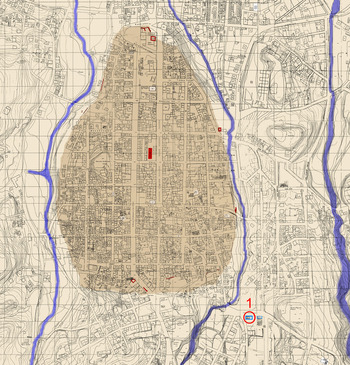
The twelfth century emerges as a period of relative stability and prosperity for eastern Central Greece, despite the Norman raids of 1147/8. Thebes, being the administrative and military capital of the Theme of Hellas from the ninth century onwards, was clearly the largest population centre of the province. The city lay on the land road that connected Corinth and Athens to the south with Thessaloniki and Constantinople to the north. The original nucleus situated on the Kadmeia hill was surrounded by a constantly repaired enclosure, which followed the trace of earlier fortifications going back to Mycenaean times (Fig. 1). The city had clearly expanded from the early eleventh century with unprotected suburbs developing on the foothills around Kadmeia, each with its own grid of streets, religious epicentre and graveyard. The population comprised a variety of craftsmen and merchants, among whom one could count those dealing with the production of silk fabrics and architectural sculpture (Jacoby Reference Jacoby1991/2, 466–8; Koilakou Reference Koilakou2004; Koilakou Reference Koilakou, Albani and Chalkia2013, 183–6), the members of the local landed aristocracy of the province (a situation presented in the slightly earlier – end of eleventh century – cadaster of Thebes), military personnel and administrators, both ecclesiastics and civilians (such as vasilikos kandidatos Vasileios and bishop Ioannes Kaloktenis), and a considerable Jewish community (Koilakou Reference Koilakou2011). The city served as the financial, commercial and crafts centre of a rich agricultural countryside, an image further accentuated by the rising numismatic circulation as documented from the early tenth century onwards (Harvey Reference Harvey1982/3, 21–8; Gerolymatou Reference Gerolymatou1987, 102–5; Galani-Krikou Reference Galani-Krikou1998, 158–161).
Plan of Thebes with the Kadmeia hill, indicating the position of Panagiotara Plot in 13 Pouliopoulou Street (1).

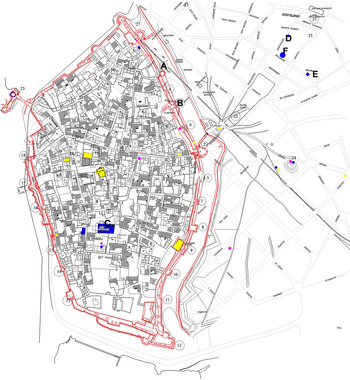
Chalcis (known as Euripos, Fig. 2), on the other hand, is much less documented and its role within the Byzantine administrative system is little known. It is usually accepted that the city served as the station for the Theme's flotilla and its port authorities, being the physical port of call in the Aegean for nearby Thebes (Koder and Hild Reference Koder and Hild1976, 156; Triantafyllopoulos Reference Triantafyllopoulos1990, 170; Georgopoulou Reference Georgopoulou2001, 73). This is a settlement that was founded anew during the Middle Byzantine period, transferred here from its ancient location for reasons related to the control of naval circulation. The overall image is that of a provincial town, a dense fortified settlement with houses, streets and churches composing a typical Medieval pattern whose earlier structures were dated to the ninth–eleventh centuries. Isolated installations and cemeteries were located beyond the walls. The amount and quality of material evidence show that this was a provincial centre of a certain standing in the commercial and cultural life of Byzantine Greece.
Plan of Chalcis indicating the Medieval city and the monuments mentioned in the text. A: Epimelitirio Plot at Eleutheriou Venizelou Street; B: IKA plot at Agia Varvara Square; C: Agia Paraskevi, Erotokritou, Olynthou and Skalkota plot; D: 9 Mitropoleos Street plot; E: Seirina Tower; F: 33 Balalaion Street plot.

The thirteenth and fourteenth centuries are seen as periods of fragmentation, disruption and constant upheaval, following the dismantlement of the empire, the settlement of a variety of rulers and the constant conflicts that erupted between them. However in Central Greece, both the historic and archaeological record show a relatively unopposed transition of power from the Byzantine administration to the feudal government, including the brief Sgouros regime interlude which usually goes unnoticed.
Thebes retained its role of provincial administrative centre, becoming capital of the Duchy of Athens and seat of a Latin archbishop. The end of the thirteenth century represents an apogee of prosperity reflected in the texts relating the construction of the Saint Omer castle within Kadmeia, apparently the largest alteration to the civic fabric (The Chronicle of Morea, vv. 8080–92; Koilakou Reference Koilakou, Albani and Chalkia2013, 187; Fig. 1). Its supposed remnant, the tower in the courtyard of the modern Museum, clearly reflects the aspirations and potential of those who commissioned the project. The fourteenth century saw the establishment of Catalan rule in Boeotia. Thebes became the seat both of a new administration and of an incoming population that settled within the walls and soon entangled itself in domestic struggles. However, this new social reality, though perhaps identifiable in the defensive patterns that developed in the countryside of Boeotia (Kontogiannis Reference Kontogiannis2012b, 80–90), has not yet been discerned in the archaeological record of the city itself. A continuity in both the size and the character of the settlement seems to occur from the Burgundian rule to the Catalans and the Florentines who succeeded them at the end of the fourteenth century, with some of the suburbs being abandoned in one period or another. The city retained its famous manufacture of silk products, which were now shipped to distant markets from ports such as Livadostra in the Corinthian Gulf (Dunn Reference Dunn and Jeffreys2006, 58–9).
Lombard and Venetian Chalcis (then known as Negroponte), on the other hand, was gradually turned into an international outpost that played a key role in the Aegean politics of the time. Despite the fact that the previous fortification was retained, there was a dynamic change both within and outside the walls (Fig. 2). Within the walls there is evidence of an intense building activity, both of civic structures, such as the surviving Agia Paraskevi Basilica (Fig. 2.C), and of military ones, i.e. the curtain wall dividing the Venetian from the Lombard quarters. Outside the walls, a series of suburbs were developed, which served a variety of settlers and purposes: the arsenal, the Jewish population, the artisans with their workshops, and, in times of danger, the refugees from the countryside seeking safety. The Venetian element that gradually expanded within the city, achieving control of the whole island of Euboea by the late fourteenth century, created a material culture of large aspirations, evident from the ceramics to the weapons, from the wall-paintings to the Gothic and Late Byzantine sculpture (Kontogiannis Reference Kontogiannis2012a).
EXCAVATION CONTEXTS
This study considered a selection of excavation contexts where samples indicative of pottery production were found. These correspond to rescue excavations located in areas outside the urban enclosures, both of Thebes and of Chalcis. In the latter case, a few more items were selected from excavations within the walls, as additional evidence.
Thebes, 13 Pouliopoulou Street (Koilakou Reference Koilakou2001–4, 35–6, figs. 12–13; Fig. 1.1)
Panagiotara plot in Pouliopoulou Street is located south-east of Kadmeia hill, its excavation comprising a large Middle Byzantine complex partly uncovered in 2003. During the Frankish period further sections were added to the east, south and north of the original core. At the south-west corner of the Middle Byzantine building a rubbish pit was excavated containing large quantities of tripod stilts (c.50) and unfinished pots, obviously rejected after initial firing. Although the kiln itself was not located within the plot limits, the contents of the pits are strong indications of a local production site.
Chalcis, extra muros
Two excavated plots (9 Mitropoleos Street and 33 Balalaion Street: Bedermacher-Geroussi Reference Bedermacher-Geroussi and Andreadaki-Vlazaki2012, 74–5) were located in neighbouring positions of a residential quarter. They are situated to the north-east of the Medieval city walls, an area corresponding to the suburbs of the Frankish/Venetian and the later Ottoman city, known in the sources as Borgo. It lay close to the port of Panagitsa (modern Souvala). The tower of Seirina, an Ottoman clock tower, is located c.50 m from the plots, indicating the limit of the city's market place during the Early Modern period (Fig. 2.E).
In 9 Mitropoleos Street (Fig. 2.D) the built structures were of poor quality, mainly dating from Late Ottoman times. However, six circular or oval rubbish pits carved into bedrock contained, among other things, large quantities of pottery, including a few tripod stilts. The bulk of the pottery belonged to the thirteenth and fourteenth centuries, with some random finds of the twelfth and the fifteenth centuries. Three of the rubbish pits also contained coins mainly dating from the thirteenth and the fourteenth centuries, confirming the main period of use.
In 33 Balalaion Street (Fig. 2.F) the excavated trenches revealed two main occupation layers: the earliest produced pottery that ranged from the late twelfth to the fourteenth century, and preserved few if any built structures apart from pipes carved in bedrock. The later layer included a part of a building complex, the pottery of which is dated to the Ottoman period. This is also the layer that produced a number of tripod stilts, and some fragments of over-fired pottery which could potentially correspond to wasters. Although it may not necessarily be the case (e.g. firing contexts), their association with tripod stilts supports this identification.
Chalcis, intra muros
In addition to the above contexts, and in the attempt to gain a more thorough picture for investigating potential pottery production in Chalcis, a small number of sherds was selected from five locations within the walls. These excavations produced twelfth–fourteenth century pottery, coming from types which are well represented in all excavations throughout the city.
The Epimelitirio plot, on the Eleutheriou Venizelou Avenue, revealed a stretch of the city's Medieval walls, excavated in 1964–5 (Lazaridis Reference Lazaridis1965, 294–6; Fig. 2.A) The most controversial point was the existence and dating of two parallel walls, built one next to the other. The first wall was initially dated either to the time of Justinian or to the time before the Frankish conquest, with the second wall attributed to the second half of the seventeenth century. We currently believe that both walls were integral parts of an urban enclosure that was continually reinforced and built upon in order to meet the challenges of military technology. The initial construction could be attributed to the early or mid-ninth century, when the city itself was erected. Phases of extensive repairs in the twelfth and the thirteenth centuries were documented, based on the bulk of pottery finds from all plots where parts of these walls were excavated. (Lazaridis Reference Lazaridis1965, 294–6; Reference Lazaridis1966, 236; Georgopoulou-Meladini Reference Georgopoulou-Meladini1973–4, 508; Papadakis Reference Papadakis1975).
The excavation of Agia Varvara Square (IKA plot, Georgopoulou-Meladini Reference Georgopoulou-Meladini1973–4, 500–4; Fig. 2.B) produced building remains and finds belonging to four different chronological phases, indicating the continuous use of civic space throughout the ages. The earliest belonged to the ninth–tenth century, with a few coins going back to the seventh century. The second represents a long occupation period, from the eleventh-twelfth to the fourteenth-fifteenth centuries, with no visible interruption or destruction layer between them. The third phase was attributed to the Ottoman period, with the last one reaching Early Modern times.
The excavation at the junction of Erotokritou, Olynthou and Skalkota Streets (Toulitsi– Loumou-Loumaki plot, Bedermacher-Geroussi Reference Bedermacher-Geroussi and Andreadaki-Vlazaki2012, 74; Fig. 2.C), is situated next to the large Agia Paraskevi Basilica, and was excavated in 2009. It represents a well-documented case of the dating sequences observed in the city. The earliest phase, including part of a building complex and storage pits, is attributed to the Middle Byzantine period ranging from the tenth/eleventh to the twelfth century. The second one, being of Frankish/Venetian date, revealed various structures, a number of which may have functioned as burial areas probably linked to the nearby church. Others were identified as parts of the area's water supply/sewage system. The last phase was represented by an Ottoman house complex.
Finally, two tripod stilts were collected from trenches excavated in the course of public works for the installation of a modern sewage system along Vaki and Charonda Streets in 1996. Even though these streets probably coincided with the grid of the Medieval and Ottoman city, the finds were sporadic, since the trenches could not be extended beyond the limits of the works. Only a number of graves were recorded, along with ceramics and isolated architectural sculptures. Therefore, their context and the buildings they are related to were not investigated (Sapouna-Sakellaraki Reference Sapouna-Sakellaraki1996, 287).
SAMPLING
Sampling selection
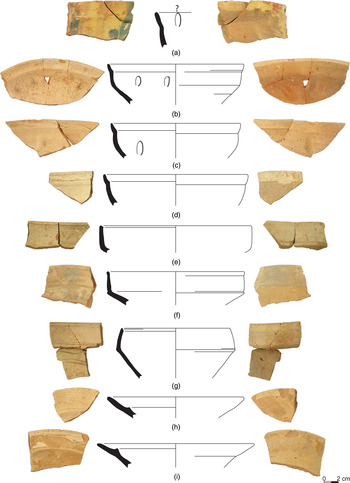
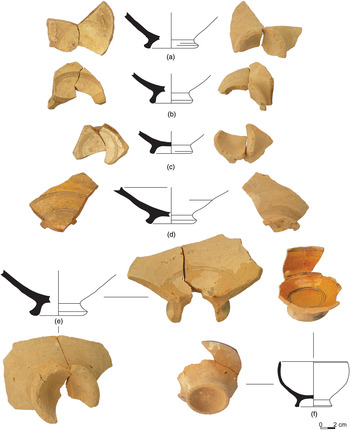
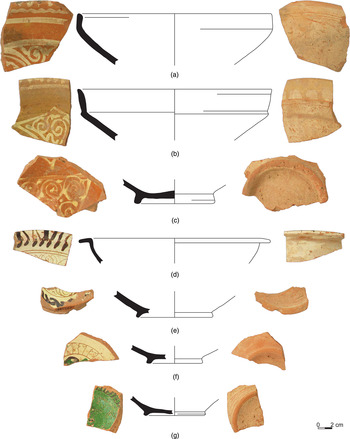
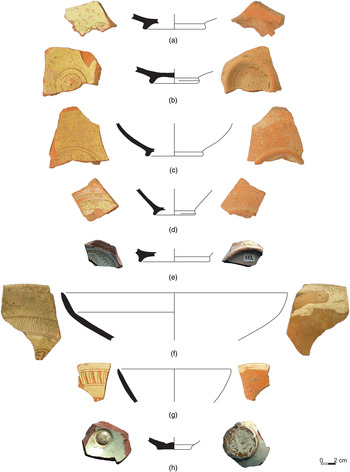
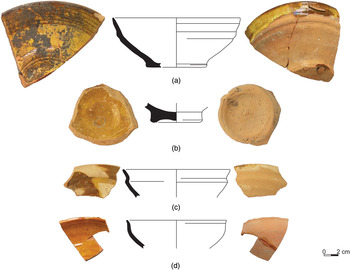
The samples fall into three main categories. The first one consists of sherds selected in order to define pottery production itself in Thebes and Chalcis, relying on undoubtedly local material. In Thebes, reference samples included both tripod stilts, used as separators between glazed ceramics during firing (catalogue nos. 1–2 BZY536–537), and unfinished, biscuit-fired, wares (catalogue nos. 3–6, 10–11, 13–15, 17 BZY492–496, 505–507, 509–510, Figs. 3b–h , 4a–c ). The latter were chosen in order to represent a large variety of forms, especially of rims (Fig. 3). Another sherd, presenting a coloured surface but no glaze,Footnote 7 was also considered a waster (catalogue no. 16 BZY499, Fig. 3a ).
Ceramics belonging to chemical group ‘Thebes production’: unfinished, biscuit-fired samples, taken as local references, and finished products. (a) Cat. no. 16 (BZY499); (b) Cat. no. 17 (BZY505); (c) Cat. no. 15 (BZY492); (d) Cat. no. 5 (BZY495); (e) Cat. no. 3 (BZY493); (f) Cat. no. 6 (BZY496); (g) Cat. no. 10 (BZY506); (h) Cat. no. 4 (BZY494); (i) Cat. no. 7 (BZY497).

Ceramics belonging to chemical group ‘Thebes production’: unfinished, biscuit-fired samples, taken as local references, and finished products. (a) Cat. no. 13 (BZY509); (b) Cat. no. 11 (BZY507); (c) Cat. no. 14 (BZY510); (d) Cat. no. 8 (BZY498); (e) Cat. no. 12 (BZY508); (f) Cat. no. 9 (BZY504).

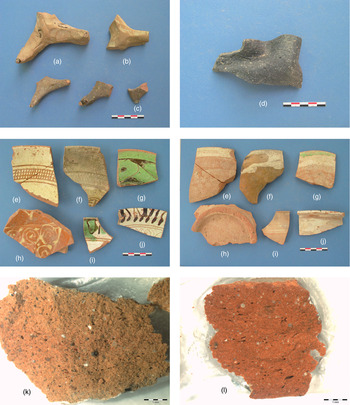
Unfinished wares were not found in Chalcis, so in this case reference samples mainly consist of tripod stilts (catalogue nos. 46–47, 59–62, 71–73 BZY550–554, 563, 749–751, Fig. 5a–c ). Several of them have fairly large dimensions, a feature usually related to the post-Byzantine period. One misshapen over-fired sherd, possibly a rim of an unglazed closed form (jug?) (catalogue no. 63 BZY555, Fig. 5d ), was also included as reference material for Chalcis.
Examples of samples analysed. Top: reference samples for Chalcis: tripod stilts: (a) Cat. no. 59 (BZY552); (b) Cat. no. 60 (BZY553); (c) Cat. no. 61 (BZY554); over-fired unglazed ware: (d) Cat. no. 63 (BZY555). Middle: examples of MBP, showing typical types and techniques of decoration and surface aspects of the reverse: (e) Cat. no. 38 (BZY530); (f) Cat. no. 39 (BZY534); (g) Cat. no. 41 (BZY526); (h) Cat. no. 19 (BZY520); (i) Cat. no. 21 (BZY511); (j) Cat. no. 30 (BZY533). Bottom: examples of fabrics under the binocular microscope (photos C. Brun), production of Thebes: (k) Cat. no. 5 (BZY495), and of Chalcis: (l) Cat. no. 31 (BZY512).

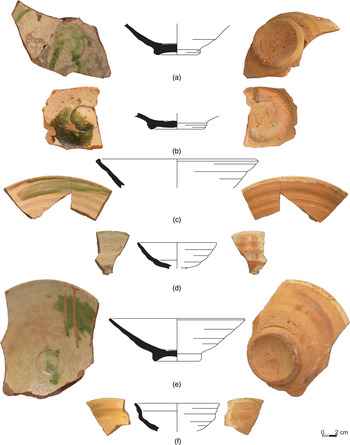
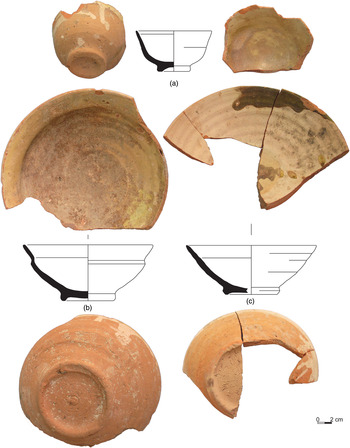
The status of other sherds was more ambiguous. In Chalcis, partially glazed ceramics are common (catalogue nos. 56–8, 67–8 BZY543, 547–548, 556–557, Figs. 6a–d , 7c ), some very similar to fully glazed ones (e.g. compare catalogue no. 57 BZY547, Fig. 6a with catalogue no. 54 BZY539, Fig. 6e ). The former were, however, not considered unfinished. On the one hand, several whole pots with similar decoration were uncovered in the Mitropoleos plot, and, on the other hand, a similar feature is observed, for instance, for Byzantine Glazed White Ware II (Hayes Reference Hayes1992; Waksman and Girgin Reference Waksman and Girgin2008).
Next to local references and Partially Glazed Wares, we also included finished wares which either were similar in form and fabric to wasters (Thebes: catalogue nos. 7–8, 12 BZY497–498, 508, Figs. 3i , 4d–e ),Footnote 8 or were commonly found at the site and could possibly be local (Thebes: catalogue no. 42 BZY500; Chalcis: catalogue nos. 53–55 BZY538–539, 541, Figs. 6e , 7a–b ). These include Sgraffito with Concentric Circles, Monochrome Sgraffito, and Plain and Painted Glazed Wares, which date from the thirteenth and fourteenth centuries.
Ceramics belonging to chemical group ‘Chalcis production’: Plain Glazed, Partially Glazed and Painted Wares. (a) Cat. no. 57 (BZY547); (b) Cat. no. 67 (BZY556); (c) Cat. no. 58 (BZY548); (d) Cat. no. 68 (BZY557); (e) Cat. no. 54 (BZY539); (f) Cat. no. 44 (BZY501).

Ceramics belonging to chemical group ‘Chalcis production’: Plain Glazed and Partially Glazed Wares. (a) Cat. no. 55 (BZY541); (b) Cat. no. 53 (BZY538); (c) Cat. no. 56 (BZY543).

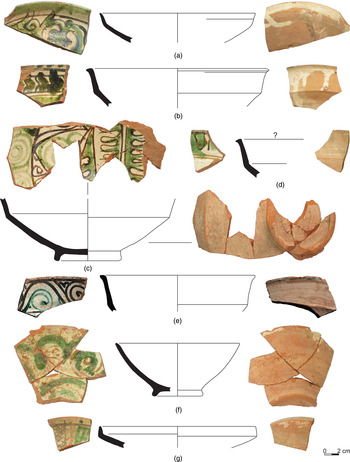
Ceramics belonging to chemical group ‘Chalcis production’: MBP: Green and Brown Painted Wares. (a) Cat. no. 64 (BZY560); (b) Cat. no. 48 (BZY544); (c) Cat. no. 65 (BZY561); (d) Cat. no. 21 (BZY511); (e) Cat. no. 74 (BZY754); (f) Cat. no. 22 (BZY514); (g) Cat. no. 23 (BZY528).

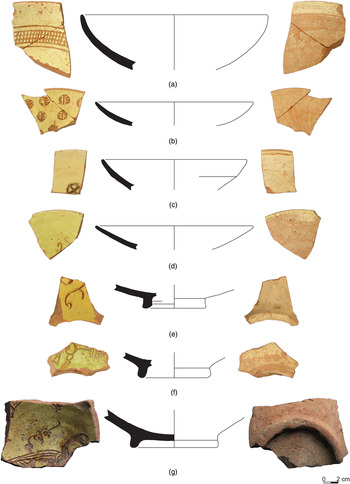
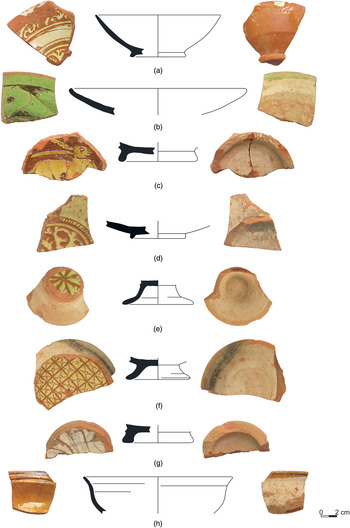
The second category of samples consisted of examples of MBP, with a selection covering a large part of its repertoire (Figs. 5e–j , 8, 9, 10, 11, 12a–e ). MBP is present in impressive quantities in the contexts considered, in both Thebes and Chalcis.Footnote 9 The following types are represented in the sampling: Slip-Painted, Green and Brown Painted, Fine Sgraffito, Painted Sgraffito, Incised Sgraffito, Champlevé. Some of the types, especially Fine Sgraffito and Green and Brown Painted, show several variants. Others, like Champlevé, were present in lesser quantities. The dating of these sherds spreads from around the beginning of the twelfth to the mid-thirteenth century, according to Sanders' typo-chronology. Fig. 5 (middle right) shows typical aspects of reverses of MBP sherds: a thin wash usually covering most of the reverse, lime spalling being frequently observed. A variant with glaze covering the whole reverse is also represented in the sampling (catalogue no. 49 BYZ540, Fig. 12a ).
Ceramics belonging to chemical group ‘Chalcis production’: MBP: Slip-Painted, Painted Sgraffito, Incised Sgraffito Wares. (a) Cat. no. 18 (BZY515); (b) Cat. no. 20 (BZY532); (c) Cat. no. 19 (BZY520); (d) Cat. no. 30 (BZY533); (e) Cat. no. 28 (BZY503); (f) Cat. no. 29 (BZY513); (g) Cat. no. 35 (BZY523).

Ceramics belonging to chemical group ‘Chalcis production’: MBP: Fine Sgraffito and Incised Sgraffito Wares. (a) Cat. no. 24 (BZY502); (b) Cat. no. 26 (BZY524); (c) Cat. no. 27 (BZY531); (d) Cat. no. 25 (BZY517); (e) Cat. no. 75 (BZY753); (f) Cat. no. 39 (BZY534); (g) Cat. no. 31 (BZY512); (h) Cat. no. 77 (BZY752).

Ceramics belonging to chemical group ‘Chalcis production’: MBP: Incised Sgraffito Wares. (a) Cat. no. 38 (BZY530); (b) Cat. no. 37 (BZY529); (c) Cat. no. 32 (BZY516); (d) Cat. no. 33 (BZY521); (e) Cat. no. 36 (BZY525); (f) Cat. no. 34 (BZY522); (g) Cat. no. 76 (BZY755).

Ceramics belonging to chemical group ‘Chalcis production’: MBP: Champlevé, and various other Wares. (a) Cat. no. 49 (BZY540); (b) Cat. no. 41 (BZY526); (c) Cat. no. 66 (BZY562); (d) Cat. no. 50 (BZY545); (e) Cat. no. 40 (BZY518); (f) Cat. no. 43 (BZY535); (g) Cat. no. 70 (BZY558); (h) Cat. no. 51 (BZY546).

A third group of samples, containing few additional sherds, does not enter the categories mentioned above, and is slightly later in date. Some were selected because they looked similar to wares previously studied in Lyon, for instance examples (catalogue no. 9 BZY504, Fig. 4f from Thebes; catalogue nos. 51–2, BZY546, 549 Figs. 12h , 13d from Chalcis) which recall the ‘Novy Svet Ware’ (Waksman and François Reference Waksman and François2004–5; Waksman and Teslenko Reference Waksman and Teslenko2010). This category also includes an example of Ottoman Sgraffito dating from the fifteenth–sixteenth century (catalogue no. 70 BZY558, Fig. 12g ).
Chemical outliers, not included in previously defined chemical groups, except for BZY549 which is part of the ‘Novy Svet Ware’. (a) Cat. no. 69 (BZY559); (b) Cat. no. 42 (BZY500); (c) Cat. no. 45 (BZY527); (d) Cat. no. 52 (BZY549).

SAMPLES CATALOGUE
The catalogue presents all ceramics included in the sampling. It is organised by excavation site, chronology and type, but with the local reference material (tripod stilts, unfinished vessels) and similar finished examples presented first under each excavation site. Ceramics coming from the intra muros area of Chalcis, because of their small number, were catalogued as a whole according to their type, regardless of their find spot. The ceramics are numbered consecutively, while their number in the laboratory in Lyon is given in square brackets. The description of each ceramic is followed by a reference to its find-group in the excavation, and the dating of the find-group. The chronology given next to the heading of each type has been based on the excavation context (find-group), taking into account the chronology of Corinth (Sanders Reference Sanders1995; Reference Sanders and Papanikola-Bakirtzis1999; Reference Sanders, Belke and Hild2000; Reference Sanders, Williams and Bookidis2003).
Fabric colour is described according to the Munsell Soil Color Charts (1998 edition), used in natural light. The quantity and size of inclusions and voids (pores) is described as follows: occasional to rare = 1% or less, few to some = 2–5%, many = 5–10%; small = less than 1 mm, medium = 1–2 mm, large = 2–5 mm.
A. Thebes – extra muros, 3 Pouliopoulou Street
The samples taken from this excavation come from various find-groups, which contained: (a) pottery dating from the mid-twelfth to the mid-thirteenth century (coming from lower layers in trenches 1 and 2, find-groups 10–15), (b) mainly pottery dating from around the mid-thirteenth to the early fourteenth century – characterised by the significant presence of unfinished and finished Sgraffito with Concentric Circles – and occasional earlier pieces (coming from upper layers in trenches 1 and 2, find-groups 5–9), and (c) pottery dating from around the mid-twelfth to the early fourteenth century (from trial trenches, find-groups 2, 3, 4 and 27).
Tripod stilts (thirteenth – early fourteenth century)Footnote 10
-
1. [BZY536] Tripod stilt. Length: 0.06 m. Width: 0.019 m. Small part missing. Fabric: fine, clean, 5YR 7/4 to 7/6 (pink to reddish yellow). Traces of glaze. Found in: area to the north-east of trench 1, find-group 27.
-
2. [BZY537] Tripod stilt. Length: 0.058 m. Width: 0.018 m. About half preserved. Fabric: fine, clean, 5/YR 7/6 (reddish yellow). Traces of glaze. Found in: area to the north-east of trench 1, find-group 27.
Sgraffito with Concentric Circles (second half of thirteenth century – early fourteenth century), including unfinished wares
-
3. [BZY493] Bowl, rim fragment. Estimated rim diameter: 0.20 m. Preserved height: 0.03 m. Small part of vertical rim with rounded lip preserved. Fabric: 5YR 7/4 (pink), with rare small white inclusions and rare small voids. White slip inside and around rim outside. Inside, two groups of incised horizontal lines on rim and on lip. No glaze (unfinished). Exterior bare. Found in: trench 2, find-group 8. Fig. 3e
-
4. [BZY494] Bowl, rim fragment. Estimated rim diameter: 0.20 m. Preserved height: 0.027 m. Small part of out-turned rim with rounded lip and very small part of upper body. Fabric: 5YR 7/4 (pink), with few small white inclusions and some small-to-medium voids. Whitish slip inside and around rim outside. Inside, a horizontal and a wavy line on rim. No glaze (unfinished). Exterior bare. Found in: trench 2, find-group 8. Fig. 3h
-
5. [BZY495] Bowl, rim and body fragment. Estimated rim diameter: 0.19 m. Preserved height: 0.033 m. Small part of rounded upper body and upturned rim with rounded lip. Fabric: 5YR 7/4 (pink), with rare small white inclusions and rare small-to-medium voids. White slip inside and around rim outside. Inside a horizontal and a wavy line on rim. No glaze (unfinished). Exterior bare. Found in: trench 2, find-group 8. Figs. 5k , 3d
-
6. [BZY496] Bowl, rim and body fragment. Estimated rim diameter: 0.20 m. Preserved height: 0.04 m. Small part of flaring upper body and vertical rim with rounded lip. Fabric: 5YR 7/4 (pink), with rare small white inclusions and few small-to-medium voids. Inside, whitish slip. Two groups of horizontal lines on rim, a wavy line on upper body. No glaze (unfinished). Exterior bare. Found in: trench 2, find-group 8. Fig. 3f
-
7. [BZY497] Bowl, rim and body fragment. Estimated rim diameter: 0.22 m. Preserved height: 0.035 m. Part of hemispherical upper body and out-turned rim with slightly pointed lip. Fabric: 2.5YR 7/6 (light red), with rare small white inclusions and few small-to-large voids. Inside, traces of white slip and glaze. Two pairs of horizontal and a wavy line on rim, a pair of horizontal lines on upper body. Exterior bare. Found in: trench 2, find-group 8. Fig. 3i
-
8. [BZY498] Bowl, base and body fragment. Estimated base diameter: 0.07 m. Preserved height: 0.045 m. Two joining fragments preserve about half of ring-base and part of hemispherical body. Fabric: 5YR 6/6 (reddish yellow), with rare small white and brown inclusions and some small-to-medium voids. Inside, white slip and yellow glaze. Two groups of concentric circles on body. Wash outside. Found in: trench 2, find-group 8. Fig. 4d
-
9. [BZY504] Bowl. Estimated rim diameter: 0.12 m. Estimated base diameter: 0.051 m. Preserved height: 0.064 m. Two mended pieces and four non-joining fragments preserve entire low ring-foot and large part of hemispherical body ending in slightly pointed lip (complete profile). Fabric: 2.5YR 6/4 (light reddish brown), with few small white inclusions and rare small voids. White slip and yellow glaze inside and around rim outside, dripping downwards. Inside, three groups of incised concentric circles on body and rim. Exterior bare. Found in: trench 2, find-group 8. Fig. 4f
-
10. [BZY506] Bowl, rim and body fragment. Estimated rim diameter: 0.18 m. Preserved height: 0.065 m. Three mended pieces preserve part of flaring upper body and vertical inwardly thickened rim. Fabric: 7.5YR 7/4 (pink), with few small white inclusions and few small voids. Thin whitish slip inside and around rim outside. Inside, a wavy and three double incised horizontal circles on rim and body. No glaze (unfinished). Exterior bare. Found in: trench 2, find-group 8. Fig. 3g
-
11. [BZY507] Bowl, base and body fragment. Estimated base diameter: 0.07 m. Preserved height: 0.038 m. Two mended pieces preserve part of high ring-foot and rounded lower body. Fabric: 7.5YR 7/4 (pink), with rare small white and brown inclusions, rare small voids. Inside, white slip. A group of incised concentric circles on lower body. No glaze (unfinished). Exterior bare. Found in: trench 2, find-group 8. Fig. 4b
-
12. [BZY508] Bowl, base and body fragment. Estimated base diameter: 0.076 m. Preserved height: 0.064 m. Two mended pieces preserve large part of high ring-foot and hemispherical body. Fabric: 7.5YR 7/6 (reddish yellow), with rare small white inclusions and rare medium-to-large voids. Inside, white slip (partly peeled). A group of incised concentric circles on lower body. No glaze (unfinished). Exterior bare. Found in: trench 2, find-group 8. Fig. 4e
-
13. [BZY509] Bowl, base and body fragment. Estimated base diameter: 0.08 m. Preserved height: 0.046 m. Two joining fragments preserve part of low ring-foot and part of hemispherical body. Fabric: 10YR 7/3 (very pale brown), with few small-to-medium white and brown inclusions and few small-to-medium voids. Inside, white slip. A group of incised concentric circles on lower body. No glaze (unfinished). Exterior bare. Found in: cleaning of wall 3, find-group 3. Fig. 4a
-
14. [BZY510] Bowl, base and body fragment. Estimated base diameter: 0.06 m. Preserved height: 0.024 m. Two joining fragments preserve part of low ring-foot and very small part of lower body. Fabric: 7.5YR 7/4 (pink), with rare small white inclusions and some small voids. Inside, white slip. A group of incised concentric circles on lower body surrounded by a series of little spiral motifs. No glaze (unfinished). Exterior bare. Found in: cleaning of wall 3, find-group 3. Fig. 4c
Unfinished wares with impressed decoration (second half of thirteenth – early fourteenth century)
-
15. [BZY492] Bowl, rim and body fragment. Estimated rim diameter: 0.18 m. Preserved height: 0.05 m. Part of rounded upper body and vertical rim with ‘notches’, ending in rounded lip. Fabric: 7.5YR 7/4 (pink), with rare small white inclusions and some small-to-medium voids. Pinkish slip inside and around rim outside. Inside, incised horizontal lines on upper body and rim, a wavy line on rim. No glaze (unfinished). Exterior bare. Found in: trench 2, find-group 8. Fig. 3c
-
16. [BZY499] Open form, rim and body fragment. Estimated rim diameter: 0.20 m. Preserved height: 0.055 m. Part of rounded upper body and vertical rim with flat lip. Fabric: 2.5YR 6/6 (light red), with few small white inclusions and some small-to-medium voids. Yellow slip inside and around rim outside. Traces of green paint. No glaze (unfinished). Exterior bare. Found in: trench 2, find-group 8. Fig. 3a
-
17. [BZY505] Bowl, rim and body fragment. Estimated rim diameter: 0.18 m. Preserved height: 0.056 m. Four mended pieces preserve part of rounded body and upturned rim with rounded lip. ‘Notches’ at junction of rim with body outside. Fabric: 7.5YR 7/4 (pink), with rare small white inclusions and few small voids. Pale-pink slip inside and around rim outside. No glaze (unfinished). Exterior bare. Found in: trench 2, find-group 8. Fig. 3b
Slip-Painted Ware (second half of twelfth – early thirteenth century)
-
18. [BZY515] Bowl, rim and body fragment. Estimated rim diameter: 0.19 m. Preserved height: 0.062 m. Part of flaring upper body and vertical rim with rounded lip. Fabric: 5YR 6/6 (reddish yellow), with few small white inclusions and some small-to-medium voids. Inside, colourless glaze. Slip-painted decoration with geometric curvilinear designs on body, a horizontal and a wavy line on rim. Slip-painted dots on lip. White wash outside. (Light on Dark Slip-Painted II.) Found in: trench 1, find-group 14. Fig. 9a
-
19. [BZY520] Bowl, base and body fragment. Estimated base diameter: 0.12 m. Preserved height: 0.035 m. About half of ring-base and very small part of rounded lower body preserved. Fabric: 5YR 6/6 (reddish yellow), with few small-to-medium white inclusions and few small-to-medium voids. Inside, colourless glaze and slip-painted decoration with spirals within triangles. Wash outside. (Light on Dark Slip-Painted II.) Found in: trench 1, find-group 12. Figs. 5h , 9c
-
20. [BZY532] Bowl, rim and body fragment. Estimated rim diameter: 0.24 m. Preserved height: 0.075 m. Part of flaring upper body and vertical rim with rounded lip. Fabric: c.2.5YR 6/4 (light reddish brown), with few small-to-medium white inclusions and few small voids. Pale-yellowish glaze inside and around rim outside dripping downwards. Inside, slip-painted decoration with geometric and curvilinear motifs on body, a horizontal line on rim and a series of dots on lip. White wash outside. (Light on Dark Slip-Painted II.) Found in: trial trench east of wall 1, find-group 4. Fig. 9b
Green and Brown Painted Ware (c.mid-twelfth – mid-thirteenth century)
-
21. [BZY511] Open form, rim and body fragment. Preserved dimensions: 0.057 × 0.031 m. Small part of vertical rim ending in outwardly thickened lip and very small part of upper body preserved. Fabric: 2.5YR 6/6 (light red), with rare small white inclusions and rare small voids. Inside, white slip and colourless glaze. Painted decoration with brown outlines and green colour, two brown concentric circles below rim. White wash outside. (Green and Brown Painted Ware III.) Found in: cleaning of wall 3, find-group 3. Figs. 5i , 8d
-
22. [BZY514] Part of a bowl. Estimated rim diameter: 0.20 m. Estimated base diameter: 0.07 m. Height: 0.075 m. Four mended pieces preserve about half of ring-base and part of hemispherical body ending in slightly pointed lip (complete profile). Fabric: 2.5YR 6/6 (light red), with few small white and rare small brown inclusions, some small voids. White slip and colourless glaze inside and around rim outside. Inside, painted decoration with spirals and other circular motifs outlined in brown and filled in with green paint. White wash outside. (Green and Brown Painted Ware III: similar to Sanders Reference Sanders and Papanikola-Bakirtzis1999, fig. 8; the same in Sanders Reference Sanders, Williams and Bookidis2003, fig. 23.2 no. 14.) Found in: trench 1, find-group 13. Fig. 8f
-
23. [BZY528] Bowl, rim and body fragment. Estimated rim diameter: 0.26 m. Preserved height: 0.026 m. Small part of flaring upper body with vertical rim ending in slightly pointed lip. Fabric: 2.5YR 6/6 (light red), with few small-to-medium white inclusions and few small-to-medium voids. White slip and thin colourless glaze inside and around rim outside. Inside, geometric decoration in alternating green and dark-brown paint. Wash outside. (Green and Brown Painted Ware II.) Found in: trench 2, find-group 9. Fig. 8g
Fine Sgraffito Ware (c.mid-twelfth – early thirteenth century)
-
24. [BZY502] Open form, base and body fragment. Estimated base diameter: 0.09 m. Preserved height: 0.022 m. Small part of ring-base and flaring lower body preserved. Fabric: 2.5YR 7/4 (light reddish brown), with few small white inclusions and rare small-to-medium voids. Inside, white slip and pale-yellowish glaze. Part of incised decoration with curvilinear motifs (and a bird?). Exterior bare. (Developed style? see Sanders Reference Sanders, Williams and Bookidis2003, fig. 23.3 no.16). Found in: trench 2, find-group: 8. Fig. 10a
-
25. [BZY517] Bowl, base and body fragment. Estimated base diameter: 0.09 m. Preserved height: 0.04 m. Small part of ring-base and rounded lower body preserved. Fabric: 5YR 6/6 (reddish yellow), with rare small white inclusions and rare small voids. Inside, white slip and pale-yellow glaze. Incised concentric circles enclosing curvilinear designs. Exterior bare. Found in: trench 1, find-group 14. Fig. 10d
-
26. [BZY524] Bowl, base and body fragment. Estimated base diameter: 0.07 m. Preserved height: 0.021 m. About half of ring-base and small part of rounded lower body preserved. Fabric: 2.5YR 6/6 (light red), with rare small white inclusions and some small-to-large voids. Inside, white slip and pale-yellow glaze. Incised medallion defined by two concentric circles and enclosing linked spirals. Compass mark. Exterior bare. Found in: trench 1, find-group 5. Fig. 10b
-
27. [BZY531] Bowl, base and body fragment. Estimated base diameter: 0.08 m. Preserved height: 0.043 m. Small part of ring-base and hemispherical body preserved. Fabric: 2.5YR 6/6 (light red), with rare small white inclusions and some small-to-large voids. Inside, white slip and pale-yellow glaze. Incised medallion defined by two concentric circles and enclosing interlace design and scale pattern. Traces of yellow glaze on upper body outside. (Similar to: Hayes Reference Hayes1992, 139, pl. 10d, from a closed deposit of the second half of the twelfth century.) Found in: trial trench, find-group 2. Fig. 10c
Painted Sgraffito (c.mid-twelfth to end of twelfth century)
-
28. [BZY503] Open form, base fragment. Estimated base diameter: 0.11 m. Preserved height: 0.016 m. Part of ring-base preserved. Fabric: 2.5YR 6/6 (light red), with rare small white inclusions and rare small voids. Inside, white slip and pale-yellowish glaze. Part of incised central medallion containing curvilinear motifs and surrounded by a series of small brown painted S motifs. White wash outside. Found in: trench 2, find-group 8. Fig. 9e
-
29. [BZY513] Open form, base and body fragment. Estimated base diameter: 0.14 m. Preserved height: 0.02 m. Small part of ring-base and rounded lower body preserved. Fabric: 2.5YR 6/8 (light red), with rare small white inclusions and few small voids. Inside, white slip and colourless glaze. Uncertain central motif painted in green and dark brown, surrounded by a band defined by two incised concentric circles and enclosing a series of a repeating kufic motif. Exterior bare. Found in: trench 1, find-group 13. Fig. 9f
-
30. [BZY533] Bowl, rim and body fragment. Estimated rim diameter: 0.26 m. Preserved height: 0.038 m. Small part of rounded upper body and horizontal rim with rounded lip. Fabric: 2.5YR 6/6 (light red), with rare small-to-medium white inclusions and rare small voids. White slip and colourless glaze inside and around rim outside. Inside, a group of two incised concentric circles on upper body surrounding curvilinear motifs. A series of brown painted vertical stripes on and below rim. Thin white slip outside (decoration similar to Morgan Reference Morgan1942, pl. XLVIIh). Found in: trial trench east of wall 1, find-group 4. Figs. 5j , 9d
Incised Sgraffito (c.second half of twelfth – mid-thirteenth century)
-
31. [BZY512] Bowl, rim and body fragment. Estimated rim diameter: 0.16 m. Preserved height: 0.038 m. Very small part of flaring upper body ending in slightly pointed lip. Fabric: 5YR 5/6 (yellowish red), with few small-to-medium white inclusions and few small voids. White slip inside and around rim outside. Colourless glaze on both sides. Inside, incised band around rim defined by double concentric circles and containing repeating linear motif. Traces of another band of vertical slashes on wall (‘Medallion’ Style). Found in: trench 1, find-group 13. Figs. 5l , 10g
-
32. [BZY516] Bowl, rim and body fragment. Estimated rim diameter: 0.19 m. Preserved height: 0.046 m. Small part of flaring upper body ending in rounded lip. Fabric: 5YR 6/4 to 6/6 (light reddish brown to reddish yellow), with few small white inclusions and rare small voids. White slip on both sides. Pale-yellow glaze inside and around rim outside. Inside, small circle enclosing an ‘X’. Found in: trench 1, find-group 14. Fig. 11c
-
33. [BZY521] Bowl, rim and body fragment. Estimated rim diameter: 0.24 m. Preserved height: 0.03 m. Small part of hemispherical body ending in rounded lip. Fabric: 2.5YR 6/8 to 7/8 (light red), with rare small-to-medium white and rare brown inclusions, rare small voids. White slip and pale yellow-green glaze inside and around rim outside. Inside, traces of incised curvilinear designs. White wash outside. Found in: trench 1, find-group 12. Fig. 11d
-
34. [BZY522] Open form, base and body fragment. Estimated base diameter: 0.08 m. Preserved height: 0.037 m. Small part of ring-base and flaring lower body. Fabric: 2.5YR 6/6 (light red), with few small white inclusions and some small-to-medium voids. White slip on both sides. Inside, green glaze and part of undiagnostic incised decoration freely applied on the field (Free Style). Found in: trench 2, find-group 7. Fig. 11f
-
35. [BZY523] Bowl, base and body fragment. Estimated base diameter: 0.09 m. Preserved height: 0.025 m. Small part of ring-base and very small part of rounded lower body preserved. Fabric: 5YR 7/6 (reddish yellow), with few small white inclusions and few small-to-medium voids. Inside, white slip and green glaze. A band of small vertical incised lines enclosing a bird and V-shaped motifs. White wash outside. (Intermediate Style: e.g. Sanders Reference Sanders and Papanikola-Bakirtzis1999, 162, 175 no. 202) Found in: trench 2, find-group 11. Fig. 9g
-
36. [BZY525] Bowl, base and body fragment. Estimated base diameter: 0.11 m. Preserved height: 0.032 m. Small part of ring-base and wide flaring lower body. Fabric: 5YR 6/6 to 6/8 (reddish yellow), with rare small white inclusions and rare small voids. Inside, white slip and shiny yellow glaze. Parts of undiagnostic incised curvilinear designs. Whitish slip outside, including the underside of base (Free Style). Found in: trench 2, find-group 10. Fig. 11e
-
37. [BZY529] Bowl, rim and body fragment. Estimated rim diameter: 0.21 m. Preserved height: 0.04 m. Two mended pieces preserve part of flaring body ending in rounded lip. Fabric: 2.5YR 7/6 (light red), with rare small white inclusions and few small-to-medium voids. Inside, white slip and yellowish glaze. Repeating small incised circular motif filled in with little horizontal and a vertical line. White wash outside. Found in: trench 1, find-group 12. Fig. 11b
-
38. [BZY530] Bowl, rim and body fragment. Estimated rim diameter: 0.24 m. Preserved height: 0.065 m. Two mended pieces preserve part of hemispherical body ending in rounded lip. Fabric: 5YR 7/6 (reddish yellow), with few small white inclusions and some small voids. White slip and pale-yellowish glaze inside and around rim outside. On upper wall inside, incised band defined by two concentric circles and enclosing a group of horizontal lines cut by small vertical lines. Wash outside. Found in: trial trench, find-group 2. Figs. 5e , 11a
-
39. [BZY534] Bowl, rim and body fragment. Estimated rim diameter: 0.34 m. Preserved height: 0.046 m. Part of flaring upper body and vertical rim with slightly pointed lip. Fabric: 2.5YR 6/4 (light reddish brown), with some small white inclusions and rare small voids. White slip inside and around rim outside dripping downwards. Pale-green glaze on both sides. Inside, incised band on upper body defined by two horizontal lines and containing a series of a repeating linear motif. Part of a circular motif with vertical and horizontal lines on lower body (‘Medallion’ Style). Found in: trial trench east of wall 1, find-group 4. Figs. 5f , 10f
Champlevé Ware (c.late twelfth – early thirteenth century)
-
40. [BZY518] Bowl, base fragment. Estimated base diameter: 0.09 m. Preserved height: 0.033 m. Large part of high foot preserved. Fabric: 5YR 6/6 (reddish yellow), with rare small-to-medium white inclusions and rare small voids. Inside, white slip and light-green glaze. Part of vegetal(?) champlevé decoration preserved. White wash outside, including the underside of base (similar to Morgan Reference Morgan1942, pl. LIIIo). Found in: trench 1, find-group 14. Fig. 12e
-
41. [BZY526] Bowl, rim and body fragment. Estimated rim diameter: 0.20 m. Preserved height: 0.038 m. Small part of flaring upper body ending in inturned rim with rounded lip. Fabric: 5YR 6/6 (reddish yellow), with rare small white inclusions and rare small voids. White slip and green glaze inside and around rim outside. Part of undiagnostic champlevé decoration inside. Exterior bare. Found in: trench 2, find-group 10. Figs. 5g , 12b
Monochrome Sgraffito Ware (second half of thirteenth – early fourteenth century)
-
42. [BZY500] Bowl, base fragment. Estimated base diameter: 0.075 m. Preserved height: 0.024 m. Part of low ring-base and very small part of lower body. Fabric: 5YR 7/4 (pink), with few small-to-medium white inclusions and few small-to-medium voids. Inside, white slip and yellowish-brown glaze. Careless incised sgraffito at the centre. Exterior bare. (Similarities in shape and decoration to Sanders Reference Sanders1987, 163–6: ‘Late Sgraffito Ware’; Gregory Reference Gregory and Gelichi1993, 284–8, pls. 1–2: ‘Local Ware A’, dated to the second half of the thirteenth and into the fourteenth century; Vroom Reference Vroom2003, fig. 6.26 w17.5: ‘Monochrome Sgraffito Ware from Corinth?’.) Found in: trench 2, find-group 8. Fig. 13b
-
43. [BZY535] Bowl, base fragment. Estimated base diameter: 0.12 m. Preserved height: 0.027 m. Part of low ring-foot and very small part of lower body. Fabric: 2.5YR 6/6 (light red), with few small-to-medium white inclusions and few small-to medium voids. Whitish slip on both sides including the underside of base. Inside yellow glaze. Part of central medallion with grid pattern, bearing an ‘X’ motif in each square. Compass point. Found in: trial trench east of wall 1, find-group 4. Fig. 12f
Plain Glazed and Partially Glazed Wares (thirteenth – early fourteenth century)
-
44. [BZY501] Bowl, rim and body fragment. Estimated rim diameter: 0.145 m. Preserved height: 0.04 m. Small part of flaring upper body and vertical rim with rounded lip. Fabric: 2.5YR 6/8 (light red), with few small white inclusions and few small voids. White slip and pale-greenish glaze inside and around rim outside, dripping downwards. Exterior bare. Found in: trench 2, find-group 8. Fig. 6f
-
45. [BZY527] Bowl, rim and body fragment. Estimated rim diameter: 0.14 m. Preserved height: 0.037 m. Small part of flaring upper body and out-turned rim with rounded lip. Fabric: 5YR 7/4 (pink), with rare small-to-medium white inclusions and rare small voids. Whitish slip inside and around rim outside, partially covered by yellow and brown glaze inside. Exterior bare. Found in: trench 1, find-group 15. Fig. 13c
B. Chalcis – extra muros
B.1. 9 Mitropoleos Street
Except for the two tripod stilts, which come from the upper layers of rubbish pit 2 (BZY550: find-group 26, fourteenth–fifteenth century) and the upper layers of the excavation (BZY551: trench Γ, find-group 11: thirteenth–fourteenth century), all samples were taken from pit 6, which represents a homogeneous thirteenth century context, based on numismatic evidence.Footnote 11
Tripod stilts (thirteenth– fifteenth centuries)
-
46. [BZY550] Tripod stilt. Preserved dimensions: 0.052 × 0.04 m. Width: 0.015 m. Small part from the centre preserved. Fabric: 5YR 5/3 to 5/4 (reddish brown), with few small white inclusions and some small voids. Traces of glaze. Found in: pit 2, find-group 26.
-
47. [BZY551] Tripod stilt. Length: 0.08 m. Width: 0.03 m. Small part missing. Fabric: 2.5YR 6/4 to 7/4 (light reddish brown), with rare small white inclusions and many small-to-large voids. Traces of glaze. Found in: trench Γ, find-group 11.
Green and Brown Painted Ware (early thirteenth century)
-
48. [BZY544] Bowl, rim fragment. Preserved dimensions: 0.066 × 0.056 m. Small part of vertical rim and very small part of upper body preserved. Fabric: 2.5YR 6/6 (light red), with few small white inclusions and some small voids. White slip and colourless glaze inside and around rim outside. Inside, a band defined by pairs of brown lines and containing a series of vertical brown curved lines filled in with green stripes. Traces of green paint on upper wall. Brown dots on lip. (Green and Brown Painted Ware III.) Found in: pit 6. Fig. 8b
Champlevé Ware (early thirteenth century)
-
49. [BZY540] Bowl. Estimated rim diameter: 0.14 m. Estimated base diameter: 0.08 m. Height: 0.055 m. Small part of ring-base and flaring body ending in slightly pointed lip (complete profile). Fabric: 2.5YR 5/6 (red), with some small-to-medium white inclusions and rare small voids. White slip inside. Colourless glaze on both sides. Inside, medallion at the centre and a band on rim both containing champlevé vegetal motifs (partly peeled). Found in: pit 6. Fig. 12a
-
50. [BZY545] Open form, base and body fragment. Estimated base diameter: c.0.07 m. Preserved height: 0.03 m. Part of ring-base and small part of flaring lower body preserved. Fabric: 2.5YR 7/4 to 6/4 (light reddish brown), with some small white inclusions and few small-to-large voids. White slip on both sides. Inside, colourless glaze. A medallion at the centre containing champlevé vegetal(?) motifs. Found in: pit 6. Fig. 12d
Sgraffito with Concentric Circles (second half of thirteenth century)
-
51. [BZY546] Bowl, rim and body fragment. Estimated rim diameter: 0.22 m. Preserved height: 0.04 m. Small part of rounded upper body and out-turned rim with rounded lip. Fabric: 2.5YR 6/6 (light red), with rare small-to-medium white inclusions and rare small voids. White slip and shiny yellow-brown glaze inside and around rim outside. Two incised concentric circles on rim inside. Found in: pit 6. Fig. 12h
-
52. [BZY549] Bowl, rim and body fragment. Estimated rim diameter: 0.13 m. Preserved height: c.0.06 m. Two mended pieces preserve part of hemispherical upper body and vertical rim with slightly pointed lip. Fabric: 5YR 6/6 (reddish yellow), with rare small white inclusions and rare small voids. Inside, white slip and shiny brown glaze. Exterior bare. Found in: pit 6. Fig. 13d
Plain Glazed and Painted Wares, including Partially Glazed Wares (thirteenth century)Footnote 12
-
53. [BZY538] Bowl. Estimated rim diameter: 0.19 m. Base diameter: c.0.08 m. Height: 0.078 m. Entire ring-base, large part of hemispherical body and slightly out-turned rim ending in rounded lip (complete profile). Fabric: 5YR 6/6 to 2.5YR 6/6 (reddish yellow to light red), with many small-to-large white inclusions and many small-to-large voids. Pinkish slip on parts of the interior and on lip, dripping downwards outside. Pale-green glaze inside and on lip. Found in: pit 6. Fig. 7b
-
54. [BZY539] Part of a bowl. Entire ring-base and large part of flaring body ending in squared lip (complete profile). Estimated rim diameter: 0.195 m. Base diameter: 0.07 m. Height: 0.058 m. Fabric: 2.5YR 6/4 (light reddish brown), with many small-to-large white inclusions and many small-to-medium voids. White slip inside and around rim outside. Interior covered by thin colourless glaze and ‘decorated’ with green glazed splashes at the centre and on body. (Similar to catalogue nos. 56–8 [BZY543, 547, 548] but fully glazed inside.) Found in: pit 6. Fig. 6e
-
55. [BZY541] Part of a bowl. Estimated rim diameter: c.0.11 m. Base diameter: c.0.048 m. Height: 0.056 m. Entire ring-base, large part of hemispherical body and small part of slightly out-turned rim ending in slightly pointed rim (complete profile). Fabric: 5YR 6/6 to 2.5YR 6/6 (reddish yellow to light red), with rare small-to-medium white inclusions and some small-to-large voids. Thin white slip inside and around rim outside dripping downwards. Pale-green glaze inside and around rim outside. Found in: pit 6. Fig. 7a
-
56. [BZY543] Part of a bowl. Three mended pieces preserve part of ring-base and large part of hemispherical body ending in rounded lip (complete profile). Estimated rim diameter: 0.19 m. Estimated base diameter: 0.09 m. Height: 0.078 m. Fabric: 2.5YR 6/6 (light red), with many small white and rare brown inclusions, many small-to-large voids. Pinkish slip inside and around rim outside dripping downwards. Inside, green glazed splashes on body and rim. Found in: pit 6. Fig. 7c
-
57. [BZY547] Bowl, base and body fragment. Base diameter: 0.067 m. Preserved height: 0.04 m. Two mended pieces preserve entire ring-base and small part of flaring body (profile from base to below rim). Fabric: 2.5YR 6/8 to 7/8 (light red), with few small-to-medium white inclusions and many small-to-medium voids. Pale-yellowish slip inside and around rim outside. Green glazed splashes inside. Found in: pit 6. Fig. 6a
-
58. [BZY548] Bowl, rim and body fragment. Estimated rim diameter: 0.24 m. Preserved height: 0.037 m. Two mended pieces preserve part of flaring upper body ending in thickened squared rim. Fabric: 2.5YR 5/8 (red), with rare small white inclusions and rare small voids. Thin pinkish slip inside and on lip. Careless green glazed stripe on rim inside. Found in: pit 6. Fig. 6c
B.2. 33 Balaleon Street
The samples taken from this excavation come from various find-groups, which contained: (a) pottery dating from the mid-twelfth to around the mid-thirteenth century (find-groups 18, 29, 30), (b) pottery dating from around the mid-thirteenth to the fifteenth/sixteenth century (find-groups 13, 19, 21, 22, 32, 33).
Tripod stilts (mid-thirteenth to fifteenth century)
-
59. [BZY552] Tripod stilt. Length: 0.115 m. Width: 0.025 m. Small part missing. Fabric: fine, clean, 2.5YR 6/4 to 6/6 (light reddish brown to light red). Traces of dark-brown glaze. Found in: trench A, find-group 21 Fig. 5a
-
60. [BZY553] Tripod stilt. Preserved dimensions: 0.06 × 0.054 m. Width: 0.022 m. Large part missing. Fabric: fine, clean, 5YR 6/4 to 2.5 YR 6/4 (light reddish brown). Found in: trench A, find-group 22. Fig. 5b
-
61. [BZY554] Tripod stilt. Preserved length: 0.049 m. Width: 0.025 m. Large part missing. Fabric: fine, 5YR 5/4 to 6/6 (reddish brown), with few small white inclusions and rare small voids. Traces of dark-brown glaze. Found in: trench A, find-group 19. Fig. 5c
-
62. [BZY563] Tripod stilt. Length: 0.07 m. Width: 0.025 m. Large part missing. Fabric: fine, c.2.5YR 5/4 (reddish brown), with few small white inclusions and rare small voids. Traces of dark-brown glaze. Found in: trench A, find-group 19.
Over-fired Unglazed Ware (mid-twelfth to around the mid-thirteenth century)
-
63. [BZY555] Closed form, rim fragment. Preserved dimensions: 0.09 × 0.06 m. Part of trefoil mouth. Over-fired, waster? Found in: trench A, find-group 30. Fig. 5d
Green and Brown Painted Ware (c.late twelfth – mid-thirteenth century)
-
64. [BZY560] Bowl, rim and body fragment. Estimated rim diameter: 0.21 m. Preserved height: 0.04 m. Part of flaring upper body and vertical rim with slightly pointed lip. Fabric: 2.5YR 6/4 (light reddish brown), with few small-to-medium white inclusions and few small voids. White slip inside and over rim outside, dripping downwards. Colourless glaze inside. Vegetal decoration outlined in dark brown and filled in with green paint. Horizontal green stripe on rim. Exterior bare. (Green and Brown Painted Ware, group III.) Found in: trench A, find-group 30. Fig. 8a
-
65. [BZY561] Part of bowl. Estimated base diameter: 0.093 m. Preserved height: 0.08 m. Six mended pieces preserve large part of ring-base, and small part of flaring body with nearly vertical rim. Fabric: 2.5YR 6/6 (light red), with few small-to-medium white inclusions and few small voids. White slip and colourless glaze inside. Vegetal and geometrical decoration on body outlined in dark green and filled in with green paint, green spirals on rim. Wash outside. (Green and Brown Painted Ware, group III.) Found in: trench A, find-group 29. Fig. 8c
Champlevé Ware (late twelfth – early thirteenth century)
-
66. [BZY562] Bowl, base and fragment. Estimated base diameter: 0.115 m. Preserved height: 0.025 m. Almost half ring-base preserved. Fabric: 5YR 5/6 to 6/6 (reddish yellow to yellowish red), with few small white inclusions and some small voids. Pale-yellowish slip on both sides. Inside, yellow glaze and part of champlevé rabbit. Found in: trench A, find-group 18. Fig. 12c
Partially Glazed Ware (thirteenth century)Footnote 13
-
67. [BZY556] Bowl, base fragment. Base diameter: 0.08 m. Preserved height: 0.025 m. Part of ring-base and small part of rounded lower body preserved. Fabric: 2.5YR 5/6 to 6/8 (light red to red), with some small-to-medium white inclusions and some small-to-medium voids. Inside, pinkish slip and green glazed blob. Wash outside. Found in: trench A, find-group 22. Fig. 6b
-
68. [BZY557] Bowl, rim and body fragment. Estimated rim diameter: 0.12 m. Preserved height: c.0.04 m. Small fragment of slightly flaring upper body with grooved rim ending in slightly pointed lip. Fabric: 2.5YR 5/6 to 6/6 (light red to red), with few small white inclusions and few small voids. Inside, pale-yellowish slip and trace of green glazed decoration. Mark of tripod stilt. Slip dripping down outside. Found in: trench A, find-group 33. Fig. 6d
Sgraffito with Concentric Circles (second half of thirteenth – early fourteenth century)
-
69. [BZY559] Part of bowl. Estimated rim diameter: 0.17 m. Estimated base diameter: 0.07 m. Height: 0.068 m. Two mended pieces preserve part of flat base, flaring body and carinated rim (complete profile). Fabric: 2.5YR 6/4 (light reddish brown), with many small-to-large white and brown inclusions and many small-to-large voids. White slip and yellow-green shiny glaze inside and over rim outside. Inside, incised concentric circles on rim and lower body. Exterior bare. Found in: trench A, find-group 32. Fig. 13a
Ottoman Sgraffito Ware (fifteenth – sixteenth century)
-
70. [BZY558] Bowl, base fragment. Estimated base diameter: 0.09 m. Preserved height: 0.022 m. About half of low squared ring-foot preserved. Fabric: 2.5YR 6/8 (light red), with few small-to-medium white inclusions and some small-to-medium voids. Inside, white slip and incised decoration with radiating and curved lines. Traces of glaze preserved in the incision. Wash outside. Found in: trench A, find-group 13. Fig. 12g
C. Chalcis – intra muros
Tripod stilts
-
71. [BZY749] Vaki Street. Tripod stilt. Length: 0.084 m. Width: 0.027 m. Small part missing. Fabric: fine, clean, 2.5YR 6/6 (light red), with rare small voids. Traces of dark-brown glaze.
-
72. [BZY750] Erotokritou, Olynthou and Skalkota Streets. Tripod stilt. Length: 0.073 m. Width: 0.025 m. Small part missing. Fabric: fine, clean, 5YR 7/4 (pink), with rare small voids. Traces of dark-brown glaze. Found in: trench 1, find-group 121, 13th–14th century.
-
73. [BZY751] Charonda Street. Tripod stilt. Length: 0.086 m. Width: 0.015 m. Small part missing. Fabric: c.7.5YR 5.2 (brown). Over-fired.
Green and Brown Painted Ware (c.mid-twelfth century – 1200)
-
74. [BZY754] Agia Varvara Square. Bowl, rim and body fragment. Estimated rim diameter: 0.22 m. Preserved height: 0.055 m. Small part of vertical upper body and outwardly thickened rim with flat lip. Fabric: 2.5YR 5/6 to 6/6 (red to light red), with rare small white inclusions and rare small voids. White slip and colourless glaze inside and on lip. Spirals in dark brown and green on rim inside. Wash outside. (Green and Brown Painted Ware II.) Fig. 8e
Fine Sgraffito Ware (c.mid-twelfth – early thirteenth century)
-
75. [BZY753] Agia Varvara Square. Bowl, base fragment. Estimated base diameter: 0.10 m. Preserved height: 0.02 m. Part of disc base preserved. Fabric: 2.5 YR 5/6 to 6/6 (red to light red), with some small white inclusions and some small voids. White slip on both sides, including the underside of base. Inside, colourless glaze and incised vegetal decoration (decoration similar to Hayes Reference Hayes1992, pl. 11a). Fig. 10e
Incised Sgraffito (c.second half of twelfth – mid-thirteenth century)
-
76. [BZY755] Agia Varvara Square. Bowl, base and body fragment. Estimated base diameter: 0.12 m. Preserved height: 0.053 m. Almost half ring-base and small part of rounded lower body preserved. Fabric: 2.5YR 6/6 to 7/4 (light red to light reddish brown), with rare small white inclusions and some small-to-medium voids. Inside, pale-yellowish slip and pale-yellow shiny glaze. Part of an incised bird surrounded by linear designs. Exterior bare. (Free Style.) Fig. 11g
-
77. [BZY752] Epimelitirio Plot. Bowl, base and body fragment. Base diameter: 0.048 m. Preserved height: 0.018 m. Entire disc base and small part of rounded lower wall preserved. Fabric: 5YR 6/6 (reddish yellow), with rare small white inclusions and rare small voids. White slip and pale-yellowish glaze on both sides, including the underside of base. Inside, little cone at the centre with an incised figural representation.Footnote 14 Fig. 10h
CHEMICAL ANALYSIS AND CLASSIFICATION OF SAMPLES ACCORDING TO CHEMICAL COMPOSITION
Chemical analysis of the samples was carried out by Wavelength Dispersive – X Ray Fluorescence (WD-XRF) at the ‘Laboratoire de Céramologie’ in Lyon (e.g. Waksman Reference Waksman2011); 24 elements are quantified, 17 of which are usually taken as active variables in multivariate statistical treatments used to classify ceramics into groups of similar chemical composition. These include eight major and minor elements in ceramics (MgO, Al2O3, SiO2, K2O, CaO, TiO2, MnO, Fe2O3) and nine trace elements (V, Cr, Ni, Zn, Rb, Sr, Zr, Ba, Ce).
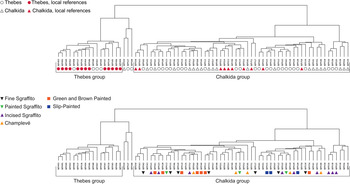
Classification of samples was obtained by hierarchical clustering analysis applied to standardised data, using Euclidean distance and average linkage (e.g. Picon Reference Picon1984). The corresponding diagram, called a dendrogram, initially represents each sample as a vertical bar at the bottom of the figure (Fig. 14, Fig. 15). The two samples the most alike in elemental composition are connected by a horizontal link, which lies all the lower as the samples are chemically similar. The two samples are then fused into a ‘pseudo sample’ of average composition. The same process is repeated, with the linkage being formed at growing heights, until all the samples are connected. The resulting diagram constitutes the dendrogram. It shows clusters of samples of similar composition linked at a lower level, all the clusters being ultimately linked together at the top of the diagram. This representation is, however, not sufficient in itself to define compositional groups, as it cannot give expression to the significance of elemental differences between clusters. Further examination of the raw data is still needed in order to be able to interpret classifications in terms of pottery productions and workshops (Picon Reference Picon and Santoro1993).
Classification according to chemical compositions of ceramics from Thebes and Chalcis (Chalkida). Samples are identified by their laboratory number. Symbols indicate: (top) the city where samples come from, reference samples (tripod stilts and pottery wasters) being pointed out; (bottom) the type of samples, for those belonging to the main ‘Middle Byzantine Production’ (MBP). The main compositional groups are underlined.

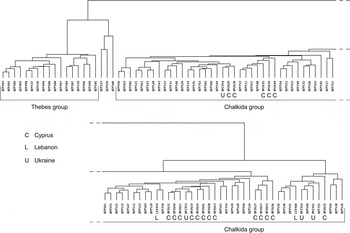
Classification according to chemical compositions of ceramics from Thebes and Chalcis (Chalkida), together with comparative material for the main ‘Middle Byzantine Production’ (Waksman and Wartburg Reference Waksman and Wartburg2006). Samples are identified by their laboratory number, and by letters for samples coming from Paphos and Kouklia (Cyprus), Chersonesos (Ukraine) and Tell Arqa (Lebanon). The main compositional groups are underlined.

RESULTS AND DISCUSSION
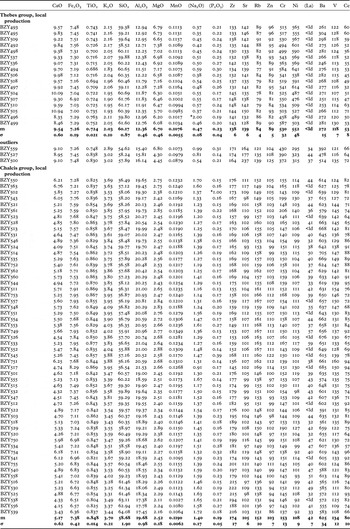
The classification of our samples from Thebes and Chalcis according to their chemical compositions is shown in Fig. 14 (see also Table 1). Two main groups may be distinguished, one of them having a possible substructure. Three samples, two from Thebes (catalogue nos. 42, 45 BZY500, 527, Fig. 13b –c) and one from Chalcis (catalogue no. 69 BZY559, Fig. 13a ) are not part of any of the two groups. Another sherd from Chalcis is a chemical outlier to the whole sampling, and is not shown in the classification (catalogue no. 52 BZY549, Fig. 13d , Table 2, see below ‘Novy Svet Ware’). The location of the reference samples in the dendrogram (solid [red] symbols in Fig. 14, top) indicates that the two main groups correspond to the pottery production of Thebes and Chalcis, respectively. In the framework of analytical studies of ceramics of various periods from Chalcis and especially from Thebes (e.g. Catling and Millet Reference Catling and Millet1965; Asaro and Perlman Reference Asaro and Perlman1973; Catling and Jones Reference Catling and Jones1977; Popham, Hatcher and Pollard Reference Popham, Hatcher and Pollard1980; Reference Popham, Hatcher and Pollard1983; Jones Reference Jones1986; Tomlinson Reference Tomlinson and Aravantinos2000; Mommsen et al. Reference Mommsen, Andrikou, Aravantinos, Maran, Jerem and Biro2002; Schwedt et al. Reference Schwedt, Aravantinos, Harami, Kilikoglou, Kylafi, Mommsen and Zacharias2006), these two groups constitute, as far as we know, the first chemical reference groups for the two cities based on kiln furniture and pottery wasters.
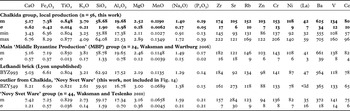
Chemical compositions of samples from Thebes and Chalcis; samples ranked as in the classification (Fig. 14). Major and minor elements are given in oxides weight %, trace elements in parts per million (ppm); m: mean, σ: standard deviation, ld: detection limit. Elements between brackets are indicative; data with an asterisk were not taken into account in the calculation of m and σ.

Comparative chemical data for MBP, Lefkandi brick and ‘Novy Svet Ware’. Major and minor elements are given in oxides weight %, trace elements in parts per million (ppm); m: mean, σ: standard deviation, n: number of samples, ld: detection limit. Elements between brackets are indicative.

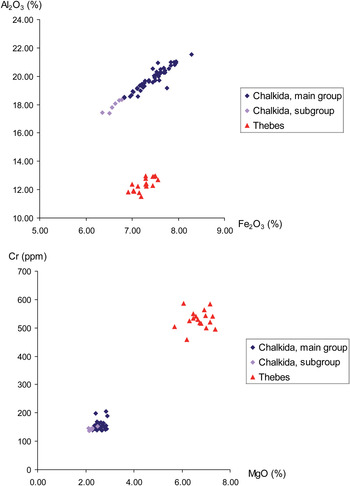
They are very different from one another from a chemical viewpoint (Table 1, Fig. 16). Unlike the Chalcis group, the group of Thebes has clear ultrabasic features, with high percentages of magnesium, chromium and nickel (Fig. 16, bottom). It also has lower contents of aluminium (Fig. 16, top), potassium and rubidium, zirconium, barium, rare earth elements, etc. The binary plot aluminium–iron (Fig. 16, top) indicates that the substructure within Chalcis group, which appears on the right-hand side of the dendrogram (Fig. 14: BZY516, 530, 525, 538, 556, 539; see also Table 1), is probably not significant. It corresponds to samples showing the same geochemical behaviour, illustrated in Fig. 16 (top) by a continuous correlation between aluminium and iron in the main group and in the subgroup.
Binary plots aluminium–iron and magnesium–chromium. Thebes and Chalcis (Chalkida) groups are clearly differentiated. Chalcis group, including its subgroup in the classification (Fig. 14), shows a variability which corresponds to co-variations of elements; its samples belong to the same geochemical ensemble. The high concentrations of magnesium and chromium in Thebes group may be related to ultrabasic formations.

Samples included in the Thebes and Chalcis chemical groups (Fig. 14) enable us to identify the corresponding local repertoire, or at least its representatives within our sampling. The group of Thebes (Figs. 3–4) consists of tripods, unfinished wares (‘Sgraffito with Concentric Circles’, wares with impressed decoration) and a few finished products, which again consist of ‘Sgraffito with Concentric Circles’ (examples typologically similar to biscuit-fired wasters, catalogue nos. 7–8, 12). They all belong to the thirteenth and fourteenth centuries with no earlier specimens. One of the finished samples, whose thin walls, shiny brown glaze and external tongues of slip remind one of the so-called ‘Novy Svet Ware’ (Waksman and François Reference Waksman and François2004–5; Waksman and Teslenko Reference Waksman and Teslenko2010), is in fact part of the Thebes chemical group (catalogue no. 9 BZY504, Fig. 4f ). ‘Novy Svet Ware’ itself also occurs in the same contexts, as one example is present in our samples found in Chalcis (catalogue no. 52 BZY549, Fig. 13d ). But its chemical features may easily be differentiated from those of Thebes and Chalcis products (Table 2).
The chemical group of Chalcis (Figs. 6–12) includes, on the one hand, all samples of various dating (from Middle Byzantine to Ottoman, including all the MBP) taken from Chalcis, except for a single Sgraffito with Concentric Circles (catalogue no. 69 BZY559, Fig. 13a ), which does not belong to any of the two groups, and for the sherd of ‘Novy Svet Ware’ (catalogue no. 52 BZY549, Fig. 13d ). On the other hand, all MBP samples taken from Thebes, along with a plain glazed (catalogue no. 44 BZY501, Fig. 6f ) and a monochrome sgraffito (catalogue no. 43 BZY535, Fig. 12f ), form part of this chemical group. Examples of fabric of each group are shown in Fig. 5 (bottom), MBP fabric being described in detail in Sanders Reference Sanders1995.
Following the discussion from previous studies of MBP (Blackman and Redford Reference Blackman and Redford2005; Waksman and Wartburg Reference Waksman and Wartburg2006), we conclude also in this case that the Chalcis chemical group mixes all the different types which constitute MBP (Fine Sgraffito Ware, Painted Fine Sgraffito Ware, Incised/Aegean Ware, Slip-Painted Ware, Green and Brown Painted Ware …, Fig. 14 [bottom], Fig. 5e –j, Figs. 8–11, Fig. 12a –d). This is a long-term production (at least from the beginning/mid-twelfth to the mid-thirteenth century, and possibly until the beginning of the fourteenth century) in various decoration techniques. Provided that the chemical composition of this group is specific to Chalcis, a point we will come back to, the classification shows that MBP was produced locally.
Although this result does not exclude the possibility that other workshops – such as Corinth – may have manufactured similar wares as well, the next classification (Fig. 15) supports the role of Chalcis as the provider of MBP all around the Mediterranean and beyond. Samples of MBP from Cyprus, Lebanon and the Crimea (Waksman and Wartburg Reference Waksman and Wartburg2006)Footnote 15 are matched to the Chalcis chemical group, including its subgroup, irrespective of their type and of the site where they were found. Samples of MBP coming from western Anatolian sites (Pergamon, Ephesos, Kadıkalesi/Anaia: Waksman and Spieser Reference Waksman, Spieser and Maguire1997; Waksman Reference Waksman and Mercangöz2013; Waksman forthcoming), not shown in Fig. 15, also correspond to the same chemical group. Chemical compositions of examples found in Corinth (White, Jackson and Sanders Reference White, Jackson and Sanders2006: Phyllite group D) and in Kinet Höyük (Blackman and Redford Reference Blackman and Redford2005: group 1) analysed in other laboratories are in reasonably good agreement (see also Waksman and Wartburg Reference Waksman and Wartburg2006 for a discussion of previous MBP data). The results clearly show that it is Chalcis' products which correspond to the main widespread and long-lasting production that we defined as MBP.
Furthermore, our material indicates that Chalcis also manufactured a series of types that appear there for the first time in the thirteenth century along with the use of tripod stilts (Papanikola-Bakirtzis Reference Papanikola-Bakirtzis1986), such as the Plain, Painted or Partially Glazed Wares (catalogue nos. 53–58, 67–68 BZY538–539, 541, 543, 547–548, 556–557, Figs. 6a–e , 7) and the Sgraffito with Concentric Circles Wares (catalogue no. 51 BZY546, Fig. 12h ). This seems to have continued in later centuries, though evidence from a single sample (catalogue no. 70 BZY558, Fig. 12g ) is hardly adequate to substantiate this hypothesis.
The close vicinity of the city itself is not a likely origin for the clay used to manufacture the MBP, as Medieval (and modern) Chalcis at least partly sits on ultrabasic rocks (Geological Map of Greece, Halkida sheet). Such geological formations would show high contents of magnesium, chromium and nickel, features we do not observe in the Chalcis group. It is more likely that the clay came from the nearby Lelantine plain, exploited until recently by the potters of modern Chalcis (Jones Reference Jones1986, 144–6, 867–8), and where extensive clay quarrying took place, especially in the Vasiliko area (Geological map of Greece, Halkida sheet). Exploitation of clays of the Lelantine plain may have gone back as far as the Bronze Age, as it was already used at the site of Lefkandi (Jones Reference Jones1986, 144). Both bricks and pottery were manufactured from these clays without further treatment (Jones Reference Jones1986, 144–5, 867–8). The ‘Lefkandi brick’, proposed by R. Jones as a standard for pottery analysis, provides good comparanda for the Chalcis chemical group. The chemical composition of ‘Lefkandi brick’ as analysed in Lyon fits samples of the Chalcis chemical group with the lowest contents of aluminium, iron and potassium (Table 2).
Petrographic data would also support our results, as the petrographic features of MBP examples from Corinth (fitting chemically our Chalcis group; White, Jackson and Sanders Reference White, Jackson and Sanders2006: group D, ‘Phyllite fabric’) seem compatible with those of the Vasiliko clays (Matson Reference Matson, Borza and Carrubba1972, quoted in Jones Reference Jones1986, 144).Footnote 16 These clays may be homogeneous within the Lelantine plain, but it is not expected that the associated ‘uncertainty zone’ (Picon Reference Picon and Santoro1993) extends much further (Jones Reference Jones1986, 149–50). We thus consider the Chalcis group to be specific enough for us to conclude that MBP was manufactured in Chalcis or its surroundings, with clay most probably coming from the Lelantine plain.
The study also brings information about the production of Thebes, and about the continuation of ceramic manufacture (made in the same or similar decorative techniques as the MBP) under Frankish rule, i.e. after 1204 (see especially Stillwell-MacKay Reference Stillwell-MacKay, Williams and Bookidis2003), alongside the appearance of new decorative types. A distinctive type of the second half of the thirteenth and the fourteenth century, which was also widely diffused in the Mediterranean area and the Black Sea, comprises the ‘Sgraffito with Concentric Circles’, identified in previous publications variously as ‘Zeuxippus ware family, imitations, derivatives or subtypes’ (Megaw Reference Megaw, Spieser and Déroche1989; François Reference François1995; Vroom Reference Vroom2003; Waksman et al. Reference Waksman, Stern, Segal, Porat and Yellin2008; for this large and controversial group of pottery, see especially Waksman and François Reference Waksman and François2004–5). Various places of manufacture for productions related to this type have been located on the basis of wasters and chemical analyses, such as Thessaloniki, Mikro Pisto, Paphos, Pergamon, Nicaea, Kadıkalesi/Anaia and Constantinople (Megaw and Jones Reference Megaw and Jones1983; Waksman and Spieser Reference Waksman, Spieser and Maguire1997; Papanikola-Bakirtzis Reference Papanikola-Bakirtzis1999; Reference Papanikola-Bakirtzis and Morrisson2012, 211; Waksman and François Reference Waksman and François2004–5; Waksman and Girgin Reference Waksman and Girgin2008; İnanan Reference İnanan and Mercangöz2013, 59–74) and some others have been proposed, such as Sparta and North Italy (Armstrong Reference Armstrong and Sanders1992; Berti and Gelichi Reference Berti, Gelichi and Maguire1997).
Other related wares, whose production sites are still unlocated, were also defined both typologically and chemically, as for instance the ‘Novy Svet Ware’ named after the Novy Svet shipwreck (Zelenko Reference Zelenko1999; Waksman and Teslenko Reference Waksman and Teslenko2010). A large part of Thebes' pottery repertoire that we present here may be related to the ‘Sgraffito with Concentric Circles’ as well. Further work could investigate the regional characteristics of these wares in Boeotia and Euboea, in a similar way to the north-western Anatolian area for instance. In the latter region, a large number of productions of ‘Sgraffito with Concentric Circles’ has been identified. They are sometimes manufactured in the same workshops as wares more clearly related on stylistical grounds to the Zeuxippus Ware stricto sensu, as is the case in Pergamon (Spieser Reference Spieser1996; Patitucci Uggeri Reference Patitucci Uggeri2003; İnanan Reference İnanan, Doksanalt? and Aslan2010; see especially Böhlendorf-Arslan Reference Böhlendorf Arslan2004 for an update of Spieser's publication and for a more general view).Footnote 17
The results of the present research may contribute to the discussion of a number of historic, economic and cultural issues. Previous archaeological research concerning twelfth-century Central Greece presented a picture in which Thebes was the primary centre (Koder and Hild Reference Koder and Hild1976, 104; Gerolymatou Reference Gerolymatou1987, 97–112; Louvi-Kizi Reference Louvi-Ziki and Laiou2002, 631–2; Koilakou Reference Koilakou, Albani and Chalkia2013, 183–5) with Chalcis holding a secondary role. The latter was restricted to its function as a trade and naval station for goods produced in or destined for Thebes, such as the purple dye used in the silk industry (Koder Reference Koder1973, 40–1; Koder and Hild Reference Koder and Hild1976, 102–4; Gerolymatou Reference Gerolymatou1987, 109; Harvey Reference Harvey1989, 219–20). Our ceramic evidence points to the existence of a more complex picture and stronger links between a main consumption centre (Thebes) and its principal manufacturing workshop (Chalcis). Furthermore, the primary role of Thebes as provincial capital may have instigated the circulation of its commodities, i.e. the ceramics produced in Chalcis, around the Aegean, the Black Sea and the Eastern Mediterranean. The location of the known shipwrecks carrying as their cargo thousands of MBP ceramics (such as Kastellorizo, Alonissos and Kavalliani) could act as indicators of the naval routes followed by the ships departing from Chalcis towards the open Aegean Sea. This is especially evident in the case of the Kavalliani shipwreck, located in the southern Euboean Gulf. It is reasonable to assume that the ship had probably loaded its cargo in the nearby city before heading towards the southern Aegean. Within this picture, Chalcis emerges as a focal point of an organised maritime network within the Byzantine empire and beyond, centred around the capital Constantinople. The unified economic space of the twelfth-century Byzantine Aegean provided the conditions for the emergence of a limited number of production centres whose commodities were easily distributed on a large scale through naval routes.
It is often accepted that the dismemberment of the Byzantine empire after 1204 brought about major socio-economic changes, witnessed in political and monetary fragmentation, the establishment of feudal rule and estate farming and the active integration of the Aegean into the European trade system (Lock Reference Lock1995, 240–65; Jacoby Reference Jacoby, Laiou and Mottahedeh2001, 197–233, esp. 233; Matschke Reference Matschke and Laiou2002, 763–4, 781, 797–8; Morrisson Reference Morrisson and Laiou2005, 221–32). Nevertheless, our evidence points to the continuity of the MBP production and distribution well into the thirteenth century, despite the new conditions. This may indicate that the transition to the new political reality did not result in radical alterations, at least in everyday life, and that these alterations may have occurred for pottery later in the thirteenth century than has been previously considered (Laiou and Morrisson Reference Laiou and Morrisson2007, 166, 184–8; Papanikola-Bakirtzis Reference Papanikola-Bakirtzis and Morrisson2012). It is noticeable that the production and diffusion of the MBP continued on a large scale in Chalcis: the types of MBP found as cargo in shipwrecks both pre- and post-date the beginning of the thirteenth century, and some still exist at the beginning of the fourteenth century according to Kinet's contexts (Blackman and Redford Reference Blackman and Redford2005, 88, 96). The history of Chalcis in these periods was defined by the increasing involvement of Venice in both its political and economic evolution, being located ideally for the Serenissima's maritime and commercial interests. The suggested continuity in MBP forms and fabrics may imply a scheme of ‘Byzantine craftsmen – Latin patrons’, i.e. local craftsmen responding to the demands of Venetian traders who now controlled the distribution network, a case proposed by Mercangöz in a recent publication for the western Anatolian site of Kadıkalesi/Anaia (Mercangöz Reference Mercangöz and Mercangöz2013c, 170–4). Our evidence, though relatively meagre for the later periods, indicates the continuation of local ceramic production in the following centuries, under both Venetian and Ottoman rule, though perhaps on a more regional level and next to a multitude of imports from various other Mediterranean centres.
In the meantime, the political fragmentation of feudal Greece after 1204 eventually brought about the decentralisation of ceramic production, with local provincial workshops springing up and starting large-scale production of wares with new distinctive characteristics (François and Spieser Reference François, Spieser and Laiou2002, 603–6; Papanikola-Bakirtzis Reference Papanikola-Bakirtzis and Bakirtzis2003, 64; Reference Papanikola-Bakirtzis and Morrisson2012; Laiou and Morrisson Reference Laiou and Morrisson2007, 184–8). We may suggest, based on our evidence, that during the second half of the thirteenth century Thebes either initiated or carried on with the manufacture of ceramics decorated with the then commonly applied patterns, such as the Sgraffito with Concentric Circles. This can be related to its new position as the capital of the Duchy of Athens as opposed to nearby Chalcis, which became the centre of a lesser feudal lordship. The production of these wares in Thebes continued at least until the early fourteenth century. We can further suppose that a potential discontinuance, suggested by the evidence at hand, could be connected with the arrival of the Catalan mercenary troops in 1311, which might have temporarily affected ceramic manufacture. In any case, Thebes' workshops are again attested in the following centuries during Ottoman rule (Vroom Reference Vroom2006, 187).
CONCLUSION
The main Middle Byzantine Production (MBP) currently appears as a single, but multiform and long-lasting ceramic production including several types (Fine Sgraffito, Painted Sgraffito, Incised Sgraffito or Aegean, Champlevé, Slip-Painted, Green and Brown Painted Ware).Footnote 18 Although these types are significant on chronological grounds, they share a common origin. MBP had a wide diffusion in the twelfth and thirteenth centuries in the Mediterranean and beyond (from Marseille to the Levantine coast, from the Crimea to Cyprus), and its economic importance is supported by its predominance in the few identified Medieval shipwrecks containing significant quantities of glazed pottery.
Evidence of pottery production, in the form of kiln furniture and pottery wasters, found in documented stratigraphic contexts in Thebes and Chalcis gave us the opportunity to test the hypothesis of Central Greece being a potential manufacturing place for MBP. Chemical analysis of reference samples for local production in Thebes and Chalcis, and of examples of MBP from the same and other sites, showed that Chalcis should be considered as the place of origin of the MBP. It probably functioned alongside other regional workshops (for example, Corinth), whose range of production and distribution, however, remains a goal for future research (for Corinthian production see especially White Reference White2009). Chalcis served at the time as the harbour of wealthy Thebes, and occupied a strategic location on the maritime trade routes. Its role is further enhanced by our results. The latter also provide new chemical reference groups stricto sensu, which may be used in the future to investigate the role of these important cities in previous periods as well.
Furthermore, the study gives information about the evolution of pottery production in Thebes and Chalcis. The political fragmentation of the thirteenth century gradually changed the conditions that facilitated the predominance of MBP and led to the establishment of a number of regional workshops whose ceramics were mainly destined to cover local markets. While continuing earlier techniques, they introduced new types, prominent among which was the ‘Sgraffito with Concentric Circles’ (previously related to ‘Zeuxippus Ware’). Thebes was one of these workshops functioning in or by the mid-thirteenth century and continuing at least to the early fourteenth century and beyond. Chalcis eventually followed the same course, its production probably carrying on well into the Ottoman period.
The data presented in this paper leave several questions for future research. The precise location of the MBP and later workshop(s) still has to be identified. As far as MBP is concerned, although kiln furniture from both inside and outside Medieval Chalcis was examined, none was found associated with wasters of MBP. The origin of the clay material itself is to be looked for in the nearby Lelantine plain, where a long tradition of clay quarrying persists to the present day. But the workshops are still awaiting discovery, and questions regarding their location in relation to the city's topography and the size of their installations are opened. Further work could also help in tracing the trade routes followed by the MBP, and its associations with other products along these routes. The abundance of MBP in western and southern Anatolian sites such as Anaia and Myra (Fındık Reference Fındık2010) suggests that part of it could have been directed to the Levantine area.
The same questions also stand concerning the later ceramic production, both in Thebes and Chalcis. Establishing the chemical identity of both workshops leads the way to identifying the extent of their respective market potential as influenced by their respective historical conditions. In any case the effort to develop a more direct and truthful picture of the complex production and distribution patterns in the Middle and Late Byzantine Aegean, as affected by the diverse political and economic conditions, still remains a primary goal for future investigations.
Another point which would deserve further study concerns the evolution of food and foodways between the Byzantine and the Frankish periods, as these may be approached through pottery studies (Vroom Reference Vroom2003, 329–31; Williams Reference Williams, Williams and Bookidis2003, 431–3; Joyner Reference Joyner2007). The production of MBP clearly continues after the end of the Byzantine rule in Chalcis, possibly for as long as a century, with the same forms and sizes and presumably the same uses. What does it imply in terms of dining habits? Was it still used by the same populations? Was it adopted by the newcomers? Or did it become mainly a commodity for export, as suggested by the emergence of new pottery productions in both Thebes and Chalcis, and the continuation of MBP in distant contexts (e.g. Kinet) rather than in closer regions where it was initially widespread (e.g. Corinth)? Some of these questions may hopefully be addressed by future research.Footnote 19
In any case, the present endeavour could be envisaged as an initial effort to reconstitute the ceramic production of Medieval Greece, so that complex political, financial and social aspects may be appreciated and evaluated within the wider historical conditions that affected Byzantium.
ACKNOWLEDGEMENTS
This study was made possible thanks to a Fitch Laboratory Senior Visiting Fellowship to S.Y. Waksman, who is grateful to the Fitch Laboratory and the British School at Athens, and especially to E. Kiriatzi and A. Pentedeka, for providing such a nice research environment. It was partly funded by the French National Research Agency (ANR) through the POMEDOR project, and we acknowledge the support of the ANR under reference ANR-12-CULT-0008. The kind collaboration of the 23rd Ephorate of Byzantine Antiquities, and especially of the director, Dr Pari Kalamara, along with all the employees in Thebes and Chalcis is gratefully acknowledged. Our thanks also go to several colleagues for their help at various stages of this study: G. Sanders, J. Vroom, S. Redford, A. Peignard-Giros, J. Tomlinson, H. Hatcher; to Y. Montmessin, J. Burlot and especially to C. Brun for help with the figures (all pottery drawings and photos by S.Y. Waksman except for BZY752–755); to the staff of the ‘Laboratoire de Céramologie’ in Lyon. Finally, we are grateful to A. Dunn for reviewing the article and making valuable suggestions.