During the 1130s, at the Benedictine monastery of St Albans in Hertfordshire, the Life of a local holy woman named Christina of Markyate (c. 1096–after 1155) was composed.Footnote 1 This Life, like many earlier and contemporary hagiographical accounts, begins with a miraculous sign witnessed by the saint's mother while she was pregnant, portending the spiritual graces that her daughter would receive. It then traces Christina's spiritual advancement from childhood through adolescence, highlighting her private vow of virginity made in about 1106, and her resolute determination to preserve this vow, despite repeated and often violent attempts made by family members, friends and ecclesiastical officials to ensnare her to marriage.Footnote 2 The second third of the Life recounts her flight to and secret reclusion in two separate hermitages, first at Flamstead and then at Markyate, and her eventual establishment and leadership of a community of women religious at the latter location.Footnote 3 The concluding third follows the progress of her friendship with the reigning abbot of St Albans, Geoffrey de Gorron (1119–46), detailing, with remarkable familiarity, conversations and counsels shared, material and spiritual benefits bestowed, visions and premonitions received, and rumours and defamations suffered due to their deepening intimacy and dependency.Footnote 4 The familiarity that the writer enjoyed with his narrative's subjects has long begged the question: Who was he? Final answers to this question have been frustrated, mainly because the writer never once positively identifies himself in the extant versions of his text. Yet, as this article will show, the Life, especially when it is read alongside related sources from St Albans and Markyate, contains many clues, hitherto overlooked by scholars, that suggest that the likeliest candidate for the writer was Robert de Gorron (d. 1166), Geoffrey's nephew, appointed sacristan and later abbatial successor.
To assess Robert's eligibility as the Life’s writer, this article will first review the scholarship on the text's authorship and the challenges posed by the surviving historical evidence to make any definitive identification of Christina's biographer. Robert's vita in the Gesta abbatum monasterii Sancti Albani will then be assessed in order to establish his close relationship with his uncle Geoffrey and his credentials as the abbey's most celebrated twelfth-century reformer. Robert's love of learning and efforts to ensure that St Albans’ library possessed correct copies of books invite a reappraisal of the manuscripts and documents produced during his career. The contributions of one scribal hand to the composition of several of these books and charters especially merit attention. The nature of his involvement distinguishes him as an intimate associate of both Geoffrey and Christina, yet his identity, much like that of the writer of the Life, has eluded positive identification. I raise the likelihood of Robert's handiwork by viewing this scribe's productions through the Gesta’s account of the abbot's life. Finally, Robert's vita is set in parallel with Christina's Life in order to detect resonances between features of the abbot's biography and distinctive narrative choices made by the writer. This close textual analysis reveals that Robert uniquely matches the writer's profile.
An anonymous biographer
Nicholas Roscarrock (1547 × 1549–1633/4), an English Catholic hagiographer, ventured the first identification of the writer of Christina's Life. In his digest of the text, found in his catalogue of British and Irish saints, Roscarrock surmised: ‘a Monck of St Albons wrote it’.Footnote 5 His identification was no doubt encouraged by the writer's evident knowledge of the names and offices of monks at St Albans and his frequent references to the abbey as ‘our monastery [nostrum monasterium]’,Footnote 6 to St Alban as ‘our most benevolent patron [benignissimus patronus noster]’,Footnote 7 and to Roger, the St Albans monk-turned-hermit, who offered Christina sanctuary at his hermitage and later placed it under her care, as ‘our old man [nostro sene]’.Footnote 8 C. H. Talbot, who published the first edition and translation of the Life in 1959, concurred with Roscarrock's identification, but insisted that any attempt to specify the writer's identity further remained ‘a matter of pure guesswork’.Footnote 9 Instead, Talbot analysed the writer's relationships with Christina and his narrative's other subjects. So close did Talbot perceive these associations to have been that he concluded that ‘the whole tone of the story is autobiographical rather than historical’.Footnote 10 The writer often includes himself among the eyewitnesses of events,Footnote 11 and even recounts one of his dining experiences at Markyate.Footnote 12 Many of the characters whom he featured, including Christina's mother Beatrix and sister Matilda, relayed valuable information about her life directly to him.Footnote 13 Christina herself also recalled or confirmed some occurrences ‘in [his] hearing [me audiente]’,Footnote 14 but she could, on occasion, prove to be an incompliant source. Concerning the particulars of one of her visions, the writer remembers: ‘How she saw this vision, although she herself knows well, in no way have we been able to coax it from her up to the present.’Footnote 15 On such occasions, the writer likely had to consult another member of her community at Markyate, perhaps her sister Margaret, to glean the details that the holy woman withheld from him. The writer refers to Margaret as ‘the keeper of [Christina's] secrets [secretorum suorum consciam]’,Footnote 16 highlights her privy knowledge of her sister's visionsFootnote 17 and cites the remark that she made immediately after hearing about one vision: ‘I answered that it was not something small, but wonderful and memorable for posterity.’Footnote 18 In her analysis of the Life, Kathryn Kerby-Fulton has excavated a ‘submerged textual layer’, and speculated that this layer's author was ‘a woman, an intimate of Christina's house at Markyate’.Footnote 19 Kerby-Fulton does not name names, but the focus of her analysis betrays a clear interest in Margaret, thus tacitly nominating this woman as the first chronicler of Christina's deeds.
Talbot's characterisation of the Life as ‘autobiographical’ has been endorsed and elaborated upon by subsequent scholars. Christopher Brooke inferred that ‘a good deal of [the Life] was evidently dictated by Christina herself’, even if she ‘romanced more than a little’.Footnote 20 Christopher Holdsworth also read the Life as a transparent record of what the holy woman had related, ‘perhaps many times’, to her biographer about her past thoughts, words and deeds, though ‘doubtless somewhat embroidering the original events with each repetition’.Footnote 21 Robert Hanning even claimed that the Life mimetically ‘reproduces Christina's personal sensory responses to her environment’, giving readers access to her very ‘individuality’.Footnote 22 Similarly, Sharon Elkins maintained that ‘Even though [the writer's] interpretation cannot be distinguished from Christina's narration, this vita reports enough of Christina's private thoughts and personal opinions to give an unparalleled view of the inner life of a hermitess.’Footnote 23 More remarkably, Elizabeth Petroff included the Life in her anthology of medieval women's writing, alongside texts composed by two other twelfth-century visionaries, Hildegard of Bingen (1098–1179) and Elisabeth of Schönau (c. 1129–64). Petroff hailed Christina's Life as a prime example of what she termed ‘autobiography-biography’, as it often ‘reads like a first-person narrative’.Footnote 24 And, most recently, Joanna Royle has highlighted Christina's complicity in her own textualisation, concluding that she ‘auto-hagiographically staged her own past as she related it to the Writer’.Footnote 25
Such ‘autobiographical’ characterisations of Christina's Life have not gone uncriticised. Neil Cartlidge has sympathised with readers’ attraction to ‘the seeming immediacy of [Christina's] presence and personality’ in the Life, but has none the less argued for a more thoroughgoing analysis of how the writer ‘constantly shapes the events of her life by reference to imaginative models drawn from other texts’.Footnote 26 Samuel Fanous has also questioned ‘the text's highly autobiographical flavour’, by focusing instead on its ‘patently hagiographic qualities’.Footnote 27 Relatedly, Robert Stanton has advocated reading the Life ‘as a work rather than an account, a play of ideas and ideologies’.Footnote 28
To safeguard against the ‘autobiographical’ fallacy to which many of the Life’s readers fall prey, Ruth Karras and Thomas Head have independently insisted that a distinction must be made between ‘Christina as a subject of the vita’ and ‘Christina the historical individual’.Footnote 29 And Rachel Koopmans has advised reading the writer less as ‘an amanuensis, a transparent transmitter of Christina's thoughts and actions’, and more as ‘a portrait painter’.Footnote 30 Thea Todd has enriched Koopmans's analogy by ‘bring[ing] Anonymous into the light, to show as far as possible the conditions that produced him, the problems that interested him, and his authorial abilities’.Footnote 31 By shifting attention away from Christina to the writer, Todd has shown that ‘the portrait of Christina is a complex creation, the raw material coming from many sources, and then at some point given form by the biographer’.Footnote 32 The analogy of ‘a portrait painter’ certainly captures better the heavily mediated nature of the Life’s construction, yet its suitability is still predicated on the writer's having gained intimate access to his subjects and, thus, continues to raise the spectre of his identity.
None of the scholars surveyed thus far has ever done any guesswork on the writer's identity, arguably with good reason, for not only does the writer's anonymity thwart definite ascriptions, but the absence of a twelfth-century manuscript witness to his efforts further complicates attempts to uncover his identity. Two fourteenth-century manuscripts – John of Tynemouth's Sanctilogium Angliae, Walliae, Scotiae, et Hiberniae, now BL, ms Cotton Tiberius E.i, and Thomas Walsingham's continuation of Matthew Paris's Gesta abbatum monasterii Sancti Albani, now BL, ms Cotton Claudius E.iv – preserve the closest versions, but neither provides a perfect attestation to the twelfth-century original.Footnote 33 The Tiberius version offers the fullest account, but it ends abruptly around 1139, well before Christina's death sometime after 1155, and even before the founding of Markyate as an independent priory in 1145. Koopmans, on the basis of her study of both versions of the Life, as well as other mid twelfth-century sources from St Albans and Markyate, has concluded that this abrupt ending was not peculiar to the Tiberius version, but already present in the original Life. A clear explanation for the writer's abrupt ending is wanting if the Life’s composition is situated within the abbacy of Robert de Gorron (1151–66), as Talbot posited.Footnote 34 However, if the Life was written at his uncle Geoffrey's behest, then the reasons behind the writer's abrupt ending become more apparent. Both the Life and the account of Geoffrey's deeds in St Albans’ Gesta abbatum allude to the mounting opposition that his friendship with Christina faced from his confrères.Footnote 35 His generous financial support of her community was viewed less as a meritorious act of charity and more as a profligate expenditure of the abbey's resources. Paulette L'Hermite-Leclercq has added that the tide of the monks’ opinion especially turned against Geoffrey and Christina when the abbey paid to have Markyate rebuilt a second time after a fire had destroyed it.Footnote 36 Faced with rising hostilities, the hagiographical enterprise that the abbot had initiated in his friend's honour had to be abandoned, probably at the beginning of 1140, and was never to be completed.
Revisions to the dating of the Life’s composition and explanations for its unfinished state by Koopmans and L'Hermite-Leclercq inspired Diane Watt to reconsider the question of the writer's identity. She was particularly struck by the writer's greater knowledge of Geoffrey's secrets than Christina's. Indeed, the writer seems to address Geoffrey directly in the Life when he lists the reasons why Christina preferred St Albans over other monastic communities: ‘as you proved through continual experience, she loved you most steadfastly, above all pastors under Christ on earth’.Footnote 37 The writer's intimate ties to Geoffrey led Watt to conclude that ‘he was Geoffrey's own spiritual confidant, his secretary’.Footnote 38 She did not name this confidant, but the likeliest candidate for the writer – Robert de Gorron – was indeed Geoffrey's secretarius.
A loyal nephew
The fullest account of Robert's career is found in Matthew Paris's mid thirteenth-century domestic history of the abbey, the Gesta abbatum monasterii Sancti Albani, whose vitae of the first eighteen abbots depended on ‘an ancient roll’ kept by a clerk named Bartholomew, probably under the auspices of Adam, the cellarer of the monks’ kitchen (fl. c. 1140–1167 × 76).Footnote 39 Mark Hagger has argued that this rotulus was composed during or shortly after Robert's abbacy in response to the legal disputes in which St Albans was engaged in the 1160s and 1170s.Footnote 40 It is probably telling that, with respect to both length and depth, the account of Robert's abbacy is ‘very much the odd man out among the early vitae’, as Rebecca Reading has noted.Footnote 41 In H. T. Riley's edition of the Gesta, Robert's abbacy, which lasted for fifteen years, takes up roughly seventy-four pages, and his successor Simon's, which lasted for sixteen, occupies only twelve.Footnote 42 Richard Vaughan observed that ‘the long description of Abbot Robert's rule is almost entirely devoted to detailed, and often, it seems, eyewitness, accounts of lawsuits concerning land, in which Adam the Cellarer is a central figure’.Footnote 43 Robert's comparatively lengthy and detailed vita in the Gesta suggests that the rotulus that Matthew Paris consulted was expansive in its account of this abbot's deeds, and that Paris was able to borrow, even copy, more than he had to embellish. The apparent proximity of the rotulus to Robert's abbacy imbues his vita with a vivid sense of immediacy that boosts readers’ confidence in Paris's claims to historical reliability. This confidence should be tempered with due caution for the rhetorical amplification of Robert's character and achievements by both Bartholomew (or Adam) and Paris. As Hagger has shown, St Albans was wont to forge its own domestic history in order to strengthen its claims to various properties and privileges.Footnote 44 However, Robert's vita should not be dismissed as merely an idealised portrait, bearing little or no resemblance to its historical subject. It still provides the most comprehensive record of his deeds – both good and bad – and, thus, merits scrutiny.
According to the Gesta, Robert, like his uncle Geoffrey, was foreign born, a native of the county of Maine, and claimed noble descent. He made his original profession as a monk at an unspecified monastery on the Continent, but when his uncle was made abbot of St Albans, he visited the monastery and was so impressed by its conventual discipline and rigour that he wrote to his abbot to request a transfer.Footnote 45 Sometime after his official reception as a monk at St Albans, Geoffrey appointed him sacristan (secretarius),Footnote 46 charging him ‘with all things pertaining to the ornamentation of St Albans, and restoring what had been destroyed’.Footnote 47 To this end, every year, on the anniversary of Geoffrey's ordination, which fell on the feast of St Katherine of Alexandria (25 November), Robert had to plan a feast for the community and to report publicly on what he had done or still needed to do.Footnote 48 He held the office of sacristan until he was appointed prior in 1149, the penultimate year of the abbacy of Geoffrey's successor, Ralph Gubion.Footnote 49 Upon Ralph's death in 1151, and at his strong recommendation, Robert was unanimously elected abbot by his confrères.Footnote 50
Most notable among Robert's achievements as abbot were his successful campaigns for St Albans’ full exemption from its diocesan, the bishop of Lincoln, before Adrian iv, the only English pope (1154–9).Footnote 51 The first and most significant of the bulls issued by Adrian was Incomprehensibilis (1156), which made St Albans
free from all episcopal subjection, both those living in the body of the monastery and those dwelling in cells or in the care of vills, so that hereafter it has no bishop, except the Roman pontiff, and beyond this, many other noble privileges, so that no other monastery compared in privileges to that of the church of St Albans.Footnote 52
The following year Adrian issued Religiosam vitam (1157), which not only made the abbot of St Albans first in dignity among all the abbots of England, but also granted him permission to wear all the pontifical insignia, including the mitre.Footnote 53 So successful were Robert's campaigns to secure the monastery's full exemption that he is hailed as ‘the reformer of the liberties of the church of St Albans [reformator libertatum Ecclesiae Sancti Albani]’ at the opening of his vita.Footnote 54
Robert's zeal for reform was evidently inspired by his efforts to renew St Albans’s liturgical practice and physical structure during Geoffrey's reign and his lifelong passion for learning and the law. The Gesta reports that, while he was sacristan, ‘He covered the greater part [of the church] with lead, properly cleaned it both inside and out, and repaired certain things that had been consumed with age.’Footnote 55 The Gesta also praises his love of learning – ‘he readily applied his mind to the study of the liberal arts’Footnote 56 – as well as his eloquence and knowledge of human and divine laws.Footnote 57 Throughout his abbacy, Robert proved to be very skilful in his use of St Albans’ ancient muniments and recent papal privileges to claim and maintain its exempt status and rights to certain lands in disputes with the bishop of Lincoln and various noblemen.Footnote 58 The Gesta even cites Robert's concern over the abbey's possession of correct copies of books. Upon returning to St Albans from a general synod in Tours in 1163, ‘he made many books to be written that had long been in error’.Footnote 59 The Gesta’s passive construction of the book-making initiated during Robert's abbacy suggests that his hand was not directly involved in this activity. Yet study of the manuscripts and documents produced at and associated with St Albans from the 1120s to the 1160s, especially the contributions and interventions of one scribe, increase the likelihood of Robert's labours, both as copyist and author, throughout his career at the abbey.
A familiar scribe
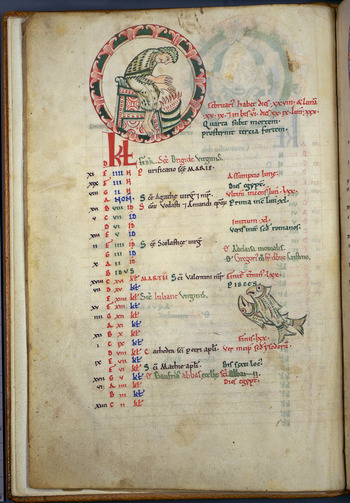
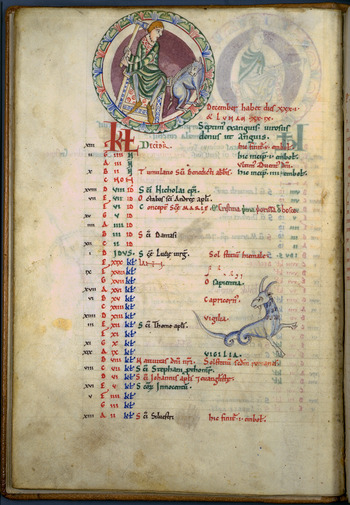
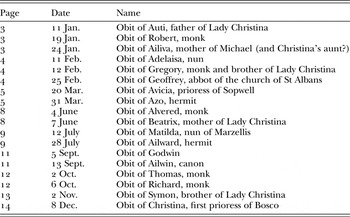
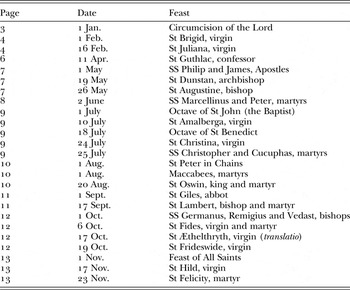
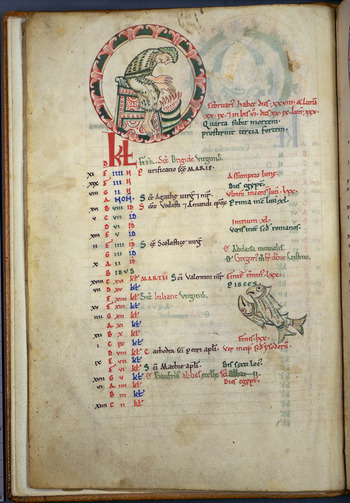
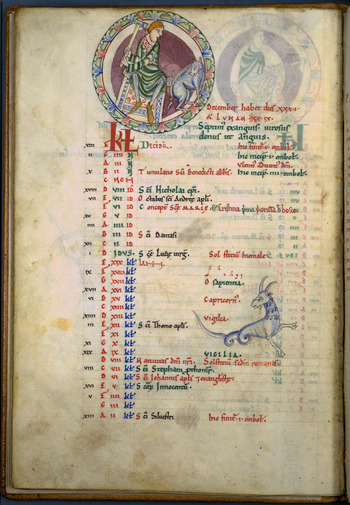
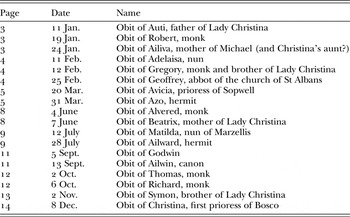
Although there are no contemporary manuscript witnesses to the Life that the writer fashioned in honour of Christina, additional scriptorial efforts made by the St Albans monks on her community's and her own behalf are still extant. Arguably, the most iconic of these efforts is the St Albans Psalter, a deluxe codex whose constitutive components were produced in various stages at the monastery over the second quarter of the twelfth century, ultimately for the use of Christina and her consorors. Footnote 60 Notable among the scribal hands that appear in this manuscript is one scholar frequently referred to as ‘Scribe 4’. To the liturgical calendar that opens the psalter, Scribe 4 made additions of neumes above the incipit to the Advent antiphon ‘O sapientia’, numerous saints’ feast days and obits of Christina's relatives and familiars, including Abbot Geoffrey's on 25 February and the holy woman's own on 8 December (see tables 1, 2 and figs 1, 2). Peter Kidd has commented on Scribe 4's use of different coloured inks to make these entries, and the varying aspect of his script. Both features suggest that Scribe 4 did not make all of these entries at the same time, but rather added them in a couple stints of writing that ranged over several years, probably beginning sometime after 1146 and ending before 1173.Footnote 61 Other surviving evidence from Markyate may indicate that Scribe 4's affiliation with the community began at least by the time that its church was dedicated in 1145 by Alexander, bishop of Lincoln (1123–48), given that his hand and the one that copied the charter marking this event are almost identical.Footnote 62
The St Albans Psalter Calendar, ms St Godehard 1, p. 4 © Dombibliothek, Hildesheim: February
The St Albans Psalter Calendar, ms St Godehard 1, p. 14 © Dombibliothek, Hildesheim: December
Scribe 4's additions of obits to the St Albans Psalter Calendar
Scribe 4's additions of feast days to the St Albans Psalter Calendar
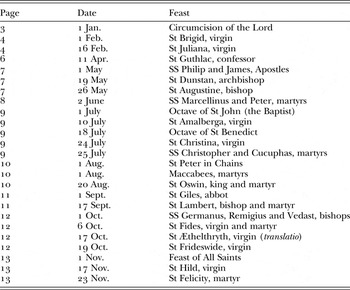
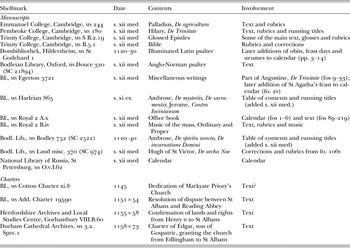
Kidd has made a persuasive case for Scribe 4's identification with another St Albans scribe, whose numerous and varied activities in the abbey's scriptorium were first observed by Rodney Thomson, who dubbed him ‘Scribe B’.Footnote 63 Palaeographical studies of this hand undertaken by Thomson, Michael Gullick and Matthew Ward have detected his activity in many charters and liturgical, scriptural and theological manuscripts, not only in serving as the main copyist, but also in supplying rubrications, corrections, running titles, tables of contents and neumation (see table 3).Footnote 64 Characteristic features that Kidd identifies for Scribe 4, which correspond with those Thomson attributes to Scribe B, include ‘descenders that trail off to the left, especially on the second i of ii; a g whose lower bowl has a sharp serif, like a fishing hook; a large s at the ends of words; a capital A with a very low cross-stroke; and the use of a wavy abbreviation-mark, somewhat similar in shape to an s’.Footnote 65 The dates of the charters and manuscripts linked to Scribe 4/B indicate that his activity roughly spanned the period from 1140 to 1170, across the abbacies of Geoffrey, Ralph (1146–51) and Robert. Closer examination of the liturgical manuscripts exhibiting this scribe's handiwork, as K. D. Hartzell has shown, reveals that he implemented the reforms initiated by Abbot Geoffrey, especially the promotion of the relatively new and controversial feast of the Conception of Mary on 8 December.Footnote 66
Scribe 4/B's involvement in the manuscripts and charters of St Albans
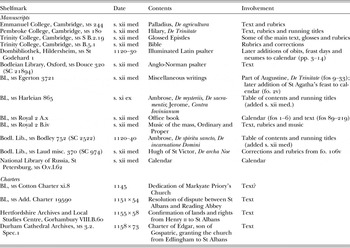
Scribe 4/B also produced an Anglo-Norman French translation of the Latin psalter, now Bodleian Library, Oxford, ms Douce 320 (SC 21894), fos 37r–75v.Footnote 67 Ian Short, Maria Careri and Christine Ruby have traced the origin of the Oxford Psalter to St Albans and identified Scribe 4/B as its scribe-translator.Footnote 68 The large number of corrections and erasures made by Scribe 4/B indicate that ‘he translated his text as he went along, editing and revising it as the need arose’.Footnote 69 Many of these alterations, as well as the extensive addition of diacritics, clear word-divisions, well-spaced lines, use of interrogation marks and absence of abbreviations, suggest that Scribe 4/B tailored this psalter ‘to aid persons reading aloud from the manuscript in a situation of collective aural communication’.Footnote 70 Short, Careri and Ruby have also established the likeliest base text for Scribe 4/B's translation: the Gallican psalter found in the St Albans Psalter.Footnote 71 Scribe 4/B was remarkably faithful, even ‘a willing slave’, to his source text; he ‘opt[ed] for a word-for-word literal translation’, often ‘distort[ing] the grammar, particularly the syntax and the lexis, of his target language – his own vernacular … providing what amounts to a running gloss on his Latin source’.Footnote 72 His fidelity to his Latin source surely contributed to the staggering success of his translation. Not only was it copied ‘countless’ times, but ‘for decades and centuries to come, his text was to be the standard vernacular French translation of the psalter’ in England and on the Continent.Footnote 73
Scribe 4/B's translation may also have guided Christina and her consorors’ reading of the psalter. Short, Careri and Ruby have made a convincing case for the Oxford Psalter's intended recipient: Markyate Priory, perhaps on the occasion of its foundation on 27 May 1145.Footnote 74 The inclusion of the Chanson d'Alexis in the St Albans Psalter suggests that Christina or other members of her community possessed some facility in Anglo-Norman. Sometime after receiving this Latin psalter as a gift from St Albans, the Markyate women may have asked the abbey to make a vernacular translation of it in order to facilitate their comprehension of the text during public recitation at collatio or small-group devotional reading, and Scribe 4/B, possibly at Abbot Geoffrey's directive, heeded their request. The Oxford Psalter may offer another important witness, beyond the obits added to the St Albans Psalter and Markyate Priory's dedication charter, to Scribe 4/B's close affiliation with Christina and her community, but even if Markyate was not the psalter's intended recipient, it still helps further to define Scribe 4/B's identity. The language of his translation reveals him to be ‘a learned Francophone with native mastery of a coherent, expressive and fluent variety of 12th-century French’, probably a Norman transplant, just like Abbot Geoffrey.Footnote 75
Consideration of the sheer range of Scribe 4/B's textual contributions led Rodney Thomson to speculate that this scribe was the head of St Albans’ scriptorium.Footnote 76 Advancing Thomson's speculation, through insights gained from Margot Fassler's study of the liturgical, scribal and custodial roles of the medieval cantor,Footnote 77 Matthew Ward has made a case for this scribe's cantorial status.Footnote 78 Judged against the duties incumbent on the office of the cantor outlined in the Constitutions of Lanfranc, archbishop of Canterbury (1070–89),Footnote 79 which exerted considerable influence on St Albans’ praxis,Footnote 80 Scribe 4/B does seem to have embodied the quintessential form of a monastic cantor. But Teresa Webber has recently cautioned against neatly categorising certain scribal activities according to specific monastic offices on the basis of the ideal forms that they assumed in customaries, since, in actual practice, the roles filled by various officers could be quite fluid, depending on the size and wealth of a monastic house and the talents of its members. As Webber's research on monastic scribal activities in Anglo-Norman England attests, there are a number of historical examples of priors and sacristans performing very cantor-like roles.Footnote 81
Scribe 4/B may be an excellent case in point. In light of other evidence from St Albans, primarily gleaned from its Gesta abbatum, it is more likely that this scribe was not a cantor, but a sacristan, which office was filled by Robert during the abbacies of Geoffrey and Ralph. Several features of Robert's biography recommend him as the most likely candidate for Scribe 4/B. He held the offices of sacristan, prior and abbot for the entire period when this scribe was active. During his tenure in all three offices he displayed remarkable zeal for St Albans’ liturgical renewal and learning, even updating its library with correct copies of books. He also enjoyed a close relationship with his uncle Geoffrey. The bonds of kinship likely served as the primary motive force behind both his transfer to St Albans and his subsequent appointment to the office of sacristan, and they may have encouraged Geoffrey to entrust the execution of his plans for reform at the abbey and the safe keeping of other confidences, like the details of his friendship with Christina, to Robert's care.
Two additions made by Scribe 4/B to the St Albans Psalter calendar especially, communicate such close ties to Geoffrey, his liturgical reforms and Christina. The scribe's entry of Geoffrey's obit on 25 February stands out among his additions of obits.Footnote 82 Customarily Scribe 4/B entered obits as close to the right side of the ruled writing space as possible, unless previously written text or a drawing obstructed him, as the obits of the nun Adelaisa (11 February) and Christina's brother Gregory (12 February) demonstrate (see fig. 1).Footnote 83 But Scribe 4/B entered Geoffrey's obit on the left side of the ruled writing space, in line with the entries of liturgical feasts in the temporal and sanctoral cycles. So aligned, the memorial of the abbot's death appears to be weighted with special significance, even promoted to the same degree of solemnity as the feasts of the Church's more well-established saints. Though Christina or another woman at Markyate may have dictated the placing of Geoffrey's obit, the scribe too may have taken a hand in its alignment for his own, very personal reasons.
The obit of Christina, the ostensible raison d’être of the psalter, received rather different, though no less remarkable treatment from Scribe 4/B. It concurs with another important feast day: the Conception of Mary (see fig. 2). The concurrence of these memorials was likely not coincidental, as Henrietta Leyser first suspected.Footnote 84 Though Christina may have died on 8 December, it seems more likely that the scribe added her obit next to the entry for Mary's feast in order to promote Christina's sanctity and to seal her virginity against threats of defamation by placing her under Mary's aegis and, conversely, to legitimate the Marian feast newly instituted at St Albans by pairing it with a local saint's dies natalis. Or, as Paulette L'Hermite-Leclercq has suggested, Christina herself may have insisted that her obit be paired with the feast that her beloved Geoffrey had patronised so that they could be united forever, even in death.Footnote 85
A textual correspondent
Certain features of Robert's vita in St Albans’ Gesta abbatum also resonate with unique narratorial choices made by the writer of Christina's Life. These correspondences disclose a St Albans monk with an attraction to dramatic yet sincere conversions, a respect for rigorous conventual discipline, intimate knowledge of and concern for the community's finances, a flair for liturgical commemoration, a vested interest in securing the abbey's exemption from episcopal control and personal acquaintance with the office of sacristan. Robert and the writer do not merely share superficial similarities, but deeper connections rooted in their particular vision and practice of the monastic vocation.
In the writer's account of Christina's first visit to St Albans in about 1106, he makes clear his association with the monastery and emphasises her immediate feelings of kinship with the members of the community:
Meanwhile, with divine providence arranging, it happened that Autti and Beatrix, taking their dearest daughter Christina with them, came to our monastery of the blessed martyr Alban, whose holy bones are venerated there, to ask for protection for themselves and for their child. The girl, looking the place over diligently, and considering the venerable maturity of the monks who lived there, declared them fortunate and desired to become a sharer in their fellowship. Then, when her parents were leaving the monastery, after they had completed what they had come to do, Christina inscribed the sign of the cross with one of her nails on the door, surely because she had specially concealed her affection in that monastery.Footnote 86
The writer's account may faithfully echo Christina's report of her initial visit to St Albans, but given the number of intervening years between her visit and its textual inscription, it is more likely that the writer had to remedy the deficiencies in her memory by drawing on another's, even his own, experience of monastic conversatio. Indeed, the writer's account bears a striking resemblance to the Gesta’s recollection of Robert's first visit to St Albans and his impression of the community's way of life:
He was received by Abbot Geoffrey and his [confrères] with every reverence, and after he saw in the house of St Albans commendable conventual discipline in all things – rigour of order, observance of behaviour, liberty of possessions – it pleased him completely to remain in the same house, received as a brother and added to the convent.Footnote 87
According to their biographers, Christina's and Robert's connections to St Albans were instantly and deeply felt, inspiring similar encomia and pledges to dedicate their lives to this community. And though, on account of her sex, Christina would not have been able to make the same formal vows of profession before the abbot of St Albans that Robert ultimately did,Footnote 88 her cruciform etching on the abbey church's door imitated the very ‘sign of the cross [signum crucis]’ that Lanfranc's Constitutions advised illiterate novices to make at the end of their written professions.Footnote 89 The writer reinforces the reading of Christina's cruciform etching as a sign of monastic profession by aligning the date of her visit to St Albans with her birthday (6 November): ‘And it should be noted that it was then the natalicium of St Leonard, just as when she was first rising into the light of this world.’Footnote 90 So told, Christina's act of commitment to St Albans is staged as a spiritual rebirth, akin to the ‘second baptism’ that monks and nuns underwent by taking vows.Footnote 91 The writer's meticulous staging of this event as a conversion to the religious life is paradigmatic of the concern that he shows elsewhere in the Life for ‘the sincerity of vocation and the conversatio morum of the numerous clergy’, as Thea Todd has observed.Footnote 92 He is clearly determined to figure Christina as a faithful member of St Albans, one perhaps made in his own image, if he and Robert were really the same person.
Many of the features of St Albans’ ‘conventual discipline’ that the Gesta credits to Robert's observation are the very features that the writer of Christina's Life highlights in his description of Geoffrey's abbacy: ‘in the beginning of his prelacy he strenuously governed the house committed to him in the rigour of order and the growth of possessions’.Footnote 93 The writer's admiration for Geoffrey's enlargement of St Albans’ possessions is especially noteworthy, because it suggests familiarity with and care for the abbey's financial administration. In fact the writer goes on to recount how the support that Geoffrey received from ‘noble relatives [parentum nobilium]’ swelled his ego, tempting him to make a decision that would impact the community's welfare without first seeking the chapter's counsel, trusting his own judgement more than his monks’.Footnote 94 Not until Geoffrey was verbally and physically chastised in a series of visions, which were, in part, instigated by Christina's prayers, did he finally ‘call together his more intimate associates in the church, make known the matter in order to them and promise to abandon the plan’.Footnote 95 The writer's knowledge of Geoffrey's lapse in judgement and the events that inspired the change in his course of action must result from the writer's privileged position among the abbot's familiars, but his interest in communicating the details of this knowledge in Christina's Life may betray the preoccupations of a monastic officer, like a sacristan, who had been charged with overseeing ‘all things pertaining to the ornamentation of St Albans’.Footnote 96 Such an officer certainly would have been distressed to see his superior imperil the monastery's possessions in any way.
An equally remarkable narratorial choice made by the writer of the Life was his decision to feature only one of the healing miracles performed by Christina, though he insists that ‘she procured healing for others from heaven’.Footnote 97 The sole miracle that he recounts involves her healing of a woman from Canterbury who suffered from epilepsy. Most revealing among the details that the writer supplies is his reference to the vision that the woman had received, in which she was instructed by St Margaret of Antioch to journey to Markyate to seek healing from Christina.Footnote 98 This vision is St Margaret's only dramatic role in the Life, but her significance is heightened by the fact that she appears in the sole healing miracle that the writer chose to include.
Robert was renowned for his devotion to St Margaret, just as his uncle Geoffrey was remembered for his patronage of St Katherine of Alexandria.Footnote 99 The Gesta recalls that, when Robert was crossing the Channel en route to Benevento in 1155, a violent storm threatened to capsize his ship. Fearing for his life, ‘the abbot specially called upon the help of blessed Margaret, virgin and martyr, and immediately and contrary to the belief of all, he felt aid against shipwreck. Whence he vowed that her name would be placed in the litany of the church, to be honoured more readily’.Footnote 100 So told, this miraculous episode reveals not only Robert's primary, even instinctual devotion to Margaret – he prayed to her during his time of greatest need – but also his impulse toward ritualisation, likely cultivated during his tenure as sacristan – he honoured Margaret by adding her name to the litany. A similar impulse may lie behind the decision made by the writer of Christina's Life to include just the healing miracle that starred the saint whom he specially patronised. Although it could be argued that the Life contains only one healing miracle because Christina's sister Margaret decided to record the one that showcased her namesake, it must be remembered that the St Albans writer in the end decided to include it, rather than omit or more generally recount it.
The third significant narratorial choice made by the writer appears in his account of Christina's miraculous appearance to Simon, the sacristan of the Cluniac priory of Bermondsey in London, who had increasingly come to doubt the integrity of her virginity. Here again the writer claims that many individuals were recalled from their doubt ‘by manifest signs [manifestis indiciis]’, but the only proof of such signs that he chose to offer was the example of Simon.Footnote 101 Notably, Simon is the only vowed religious identified by his office in the Life, beyond the heads of certain religious houses, like Abbot Geoffrey. This identification may admit the personal bias of the writer who wished to give added recognition to a fellow sacristan. If this was the case, and if the Life was indeed written at Geoffrey's behest during the 1130s, then the writer was Robert, the sacristan of St Albans.
Identifying Robert as the writer is encouraged further by the fact that he had close ties with the monks of Bermondsey. According to the Gesta’s accounting of the few negligences that Robert committed during his abbacy, he gave, without the chapter's consent or notice, the tithes and all the parish rights of Bridesthorne into the perpetual possession of the monks of Bermondsey, under the condition that they solemnly celebrate his anniversary annually.Footnote 102 This alienation of jurisdiction is significant among Robert's alleged negligences, because it was his only indiscretion that directly benefited another monastic house. Moreover, the compensation that he stipulated in return conveys his concern for liturgical commemoration, as well as his esteem for Bermondsey's rigour of order, because, more than repayment in kind – money, land or another material good – he wanted this community to memorialise his death every year with a spiritual offering, probably a mass.
Elsewhere in the Life the writer evinces a similar aptitude for liturgical commemoration. Scholars have commented on his evident knowledge of and occupation in the liturgy.Footnote 103 His conception of time itself is indebted to the temporal and sanctoral cycles. He rarely mentions the year in which certain events took place; instead, he marks time by noting the feast day or the hour of the Divine Office.Footnote 104 Thomas Head detected a clear Norman bias in the writer's references. For example, he highlighted the coincidence of Christina's birthday with the imported feast of St Leonard de Noblat, rather than with the widely celebrated Anglo-Saxon feast of St Winnoc.Footnote 105 Such bias bespeaks the habits of a monastic officer entrusted with the maintenance of his community's liturgical practice, like a cantor or sacristan, who understood time not as simply linear, but as recursive: past sacred events were never forgotten, but recollected at precisely the moment in the cycle of feasts when their significance would most fully illuminate the present.
The final narrative detail suggestive of Robert's handiwork appears in the writer's description of a vision that Christina had a month prior to her official consecration as a virgin by Bishop Alexander of Lincoln in about 1131. On the seventh day after the feast of the Assumption, shortly after the hour of Matins, three heavenly visitors are said to have bestowed on her a crown of resplendent beauty that had two white fillets hanging from its back, making it appear ‘like a bishop's mitre [instar episcopalis mitre]’.Footnote 106 Prompted by the writer's unusual description of Christina's crown, I have argued elsewhere that Abbot Geoffrey commissioned the Life to feature the holy woman as the abbey's new, mitred, patron saint in order to bolster his own campaign for St Albans’ exemption from episcopal control.Footnote 107 But for reasons likely owing to some monks’ outspoken resentment of his close friendship with Christina and his financial support of her community, the Life was ultimately abandoned.
Geoffrey never fully succeeded in securing the papal privileges that he and his community desired. It was not until Robert's abbacy that a successful campaign for exemption was waged. His strategy seems to have been inspired, at least in part, by his uncle's, perhaps because Robert's hand was responsible for its textual realisation in Christina's Life. According to the Gesta’s account of his embassy to Benevento in 1155–6, ‘[Robert] offered to the Lord Pope gold and silver of no little weight and other precious gifts, as well as three mitres and sandals of wondrous craft, which Lady Christina, prioress of Markyate, had most carefully made.’Footnote 108 Apparently, Adrian iv approved of all the gifts that were presented to him, but only accepted the mitres and sandals, ‘because they were of remarkable craft [quia admirabilis operis]’.Footnote 109 Robert's gifts of Christina's embroidery work to Adrian reveal that Robert had cultivated his own friendship with Christina, one that likely began during Geoffrey's abbacy, but continued after his death. Like Geoffrey, Robert seems to have recognised the power of Christina's spiritual charisma, but decided to channel it through a different material medium, probably knowing that her textile production, not her textual refashioning, would be more acceptable to his monks and more effective in the abbey's campaign for exemption. Robert's strategy proved successful in both securing the pope's protection of the abbey's rights and bolstering his confrères’ confidence in his leadership. He became the first abbot of St Albans to celebrate mass arrayed in all seven episcopal insignia – staff, ring, gloves, tunic, dalmatic, sandals and mitre – at Easter 1163.Footnote 110 For this occasion, Robert may have commissioned the production of the gradual now found in Bodleian Library, Oxford, ms Laud. misc. 358 (SC 948), which, on fos 50v–51v, prescribes the hymn Inventor rutili for the procession of candles on Holy Saturday – the very liturgical occasion when Robert would have worn the episcopal pontificalia for the first time.Footnote 111 In Rodney Thomson's analysis of the gradual's prescription of this hymn, he has stressed that ‘Lanfranc had ordered this for use in a cathedral only. Thus, the abbot of St Albans had taken over what had been an episcopal prerogative according to earlier Canterbury tradition.’Footnote 112 Given Robert's bent to ritualise, he could very well have chosen to set his crowning moment to this episcopal hymn in order to display his privileged status visibly and audibly.
Ensuring that his actions bolstered his confrères’ support of his abbacy would have been of paramount importance to Robert given the years of rebellion that troubled the monastery's unity immediately after his uncle's unexpected death in 1146. According to Rachel Koopmans's reconstruction of these years, St Albans was deeply divided between those who objected to the former abbot's use of the monastery's resources to support neighbouring religious communities, anchorites and the poor, and those who endorsed these ventures.Footnote 113 Geoffrey's objectors were led by his prior, Alchinus, who had designs on the abbacy, whereas his supporters rallied around Robert, even though Ralph was Geoffrey's elected successor. Recurring bouts of illness may have effectively incapacitated Ralph, forcing him to deputise Robert, his prior, with much, if not all, of the daily administration of the abbey. So deputised, Robert would have sought to restore peace to the community by whatever means necessary, including abandoning the very text that sanctioned Geoffrey's charitable profligacy, Christina's Life. If Robert was its writer, he was all the more motivated to distance himself from it, because the ties of kinship that linked him to Geoffrey already raised suspicions in the eyes of his uncle's objectors. Koopmans observes Robert pursuing a more ‘prudent course’ in his dealings with Christina and her community during his abbacy than had Geoffrey. Though Robert brought her gifts to Adrian iv, he did not continue St Albans’ financial aid to Markyate. And though he did not destroy what had been written of her Life – a copy of it could still be found at Markyate in the mid-fourteenth centuryFootnote 114 – he did not continue the campaign to promote Christina's sanctity in any permanent way, certainly not through a textual record that could be traced back to him.
In 1163 Robert sought from Pope Alexander iii the privilege to bless virgins, both those belonging to St Albans’ dependency, Sopwell Priory, and others under the abbey's rule.Footnote 115 With this privilege, the abbot no longer had to enlist a bishop's services to bless virgins. Unlike Geoffrey, who had to invite Bishop Alexander of Lincoln to St Albans to consecrate Christina, Robert and his successors could perform this rite themselves, thus safeguarding the abbey's liberties against episcopal encroachment and extending its jurisdiction over neighbouring women religious, possibly even those at Markyate, as Sally Thompson has speculated.Footnote 116 Robert's acquisition of this privilege would have been appreciated by the St Albans monks who still worried that any material or spiritual support of local religious communities threatened the abbey's exempt status. As ‘the reformer of the liberties of the church of St Albans’, Robert is remembered for going to extraordinary lengths to fight for the abbey's privileges, ultimately incurring more than 600 marks in debt by the time of his death in 1166 due to expenditures on litigation.Footnote 117 He would not have risked compromising his achievements for anyone, including Christina.
Though incontrovertible evidence explicitly naming Robert de Gorron as the writer of Christina's Life and as the scribe who added her obit to the St Albans Psalter is wanting or no longer extant, the foregoing palaeographical, codicological and textual analyses have sought to raise the distinct possibility that it is his handiwork. As the sacristan of St Albans and the nephew of the reigning abbot, Robert was uniquely positioned to become closely acquainted with the people, places and events featured in the Life, especially with its leading characters, Christina and Geoffrey. According to St Albans’ Gesta abbatum, Robert was so impressed with the abbey's way of life that he requested a formal transfer into the community. His recognition of and dedication to St Albans’ conversatio, as well as the benefits that recourse to nepotism promised, surely encouraged Geoffrey to promote his nephew to an office where his family loyalty could be unconditionally relied upon, particularly to carry out new liturgical initiatives at the abbey, like the feast of the Conception of Mary, and to support controversial relationships with neighbouring religious, like Christina and her consorors at Markyate. Textual clues gleaned from the Life indicate that the writer shared a similarly intimate bond with Geoffrey. C. H. Talbot was the first to note that ‘[o]ne of [the writer's] most prolific sources must have been Abbot Geoffrey himself … he seems to know Geoffrey's side of the story with uncanny precision, what he said and did, his perplexity over the sources of Christina's spiritual knowledge, and his reaction to her teachings’.Footnote 118 Moreover, the writer conveys detailed knowledge of St Albans’ possessions and the financial consequences of Geoffrey's administration, which knowledge could only have been acquired by someone with access to the abbey's records and to conversations about the management of the community's resources. The writer's ‘uncanny precision’ in his accounts of both private and institutional matters strongly suggests that he was not only a high-ranking officer at St Albans, but also one of Geoffrey's closest confidants. During the period when the Life was composed, Robert alone fits this profile.
Study of the Gesta’s portrait of Robert's career at St Albans also illuminates significant correspondences with the glimpses that the writer offers of his persona in Christina's Life. Both were captivated by dramatic conversions set at St Albans. Both claimed special devotion to St Margaret, but, more significantly, both exhibited a real penchant for liturgical commemoration. Both also exhibited an admiration for and personal connection to the Cluniac monks of Bermondsey in the written records that they left behind. And, most important, both, albeit in dramatically different ways, featured Christina in St Albans’ bids for episcopal exemption. But only Robert's strategy achieved its desired end.
During Robert's tenure as St Albans’ sacristan, prior and abbot, he proved time and again that he possessed the requisite learning, eloquence, administrative skill and political savvy to manage the abbey's spiritual and temporal possessions expertly. His achievements as abbot were gained through his uncompromising prioritisation of his community's goods above all else. Unlike his uncle, he would not risk jeopardising the abbey's privileged position, alienating his confrères or undermining his own authority in order to pursue a personal friendship, especially one resented by his fellow monks. Robert must have learned many lessons in effective monastic leadership by observing his uncle's rule. The great costs that Geoffrey's abbacy suffered as a direct consequence of his relationship with Christina would have been apparent to his fellow officers. Robert was undoubtedly determined not to repeat his uncle's mistakes. He would chart a more ‘prudent course’, even if it meant forsaking the textual relic of the saint's cult that Geoffrey was so invested in promoting around his dearest friend, Christina.