INTRODUCTION
This study is part of the overarching PVIS (Palliative Care in Nursing Homes) project, aimed at building competence in palliative care for nursing home staff within the greater Stockholm area. According to the World Health Organization (WHO) (Davies & Higginson, Reference Davies and Higginson2004), the greatest increase in palliative care needs will be among the elderly population, with complex and multifaceted care requirements resulting in strained welfare systems. In Sweden, projections suggest a 50% increase of people above the age of 65 until 2060 (Statistics Sweden, 2015), which will lead to increased numbers of dying individuals in nursing homes. In 2011, 89,000 older people in Sweden (mostly above 80 years of age) resided in nursing homes (Beck et al., Reference Beck, Jakobsson and Edberg2014a ; Socialstyrelsen, 2012). In order to qualify for nursing home care in Sweden, an individual's care needs have to be substantial, and in many cases including palliative care (Österlind et al., Reference Österlind, Hansebo and Lindqvist2009). Therefore, staff working in nursing homes need to enhance their knowledge of palliative care (see p. 15–16, www.founu.se, www.palliativ.se). The purpose of palliative care is to embrace individualized and evidence-based care with attention to WHO's definition to offer symptom relief and support to patients and relatives at a time of physical, psychological, social, and existential distress close to death (Ahmedzai, Reference Ahmedzai, Costa and Blengini2004; Davies & Higginson, Reference Davies and Higginson2004; Davies et al., Reference Davies, Goodman and Bunn2011). People in old age may be affected by several diseases simultaneously, leading to substantial impairment and a need for advanced care and symptom relief, emphasizing the staff's need for a deeper and more profound knowledge of the palliative care principles (Beck et al., Reference Beck, Jakobsson and Edberg2014a ; Davies & Higginson, Reference Davies and Higginson2004; Davies et al., Reference Davies, Goodman and Bunn2011; Dwyer et al., Reference Dwyer, Hansebo and Andershed2011; Hall, Reference Hall, Petkova and Agis2011; Socialstyrelsen, 2006; Österlind, Reference Österlind, Hansebo and Andersson2011). In order to support educational strategies in palliative care at nursing homes, the Swedish government has devoted financial means to all county councils and local municipalities. Collaborations between specialized palliative care units engaged by the county councils and nursing homes of local municipalities were encouraged to implement local competence-building programs (CBPs).
Organization of Nursing Homes in Sweden
Each local municipality is assigned to and responsible for its nursing home care, while the county council is in charge of all specialist and medical healthcare (Socialstyrelsen, 2006). Consequently, older people living at nursing homes receive their medical consultations and/or treatment from staff employed by the county councils, while the actual day-to-day nursing care is managed by staff—registered nurses (RNs), enrolled nurses (ENs), and care assistants (CAs)—employed by the municipalities themselves or contracted private entrepreneurs. The collaboration between the county councils and the local municipalities is fundamental to deliver good nursing care quality. To ensure older people continuity of medical treatment and care at nursing homes, a medically responsible RN paying special attention to routines concerning contacts at different levels within the healthcare system is assigned by each municipality (Socialstyrelsen, 2011). This means that all nursing home care in Sweden comes under two different jurisdictions—the health and medical jurisdiction (Mellström, Reference Mellström2006) and the Swedish Social Policy Act (Swedish Social Policy Acts, 2001).
Building Competence
According to the National Board of Health and Welfare in Sweden (Socialstyrelsen, 2006), staff working with dying people need continuous support, mentorship, and education. The report emphasizes the need to adjust utilization of palliative care principles related to different care environments. Previous studies concerning competence-building programs (CBPs) indicated both positive (Raunkiaer & Timm, Reference Raunkiaer and Timm2013) and restricted outcomes regarding perception of knowledge in palliative care, emphasizing the difficulties of translating and adjusting educational knowledge to the right care level (Davies et al., Reference Davies, Goodman and Bunn2011; Raunkiaer & Timm, Reference Raunkiaer and Timm2010, Reference Raunkiaer and Timm2013; Seymour et al., Reference Seymour, Almack and Kennedy2010). This is consistent with other studies that emphasized the importance of translating scientific and experiential knowledge (Hall, Reference Hall, Petkova and Agis2011; James et al., Reference James, Andershed and Gustavsson2010a ; Reference James, Andershed and Gustavsson2010b ) into practical work in order to bridge the gap between what is known and what is actually done. Much of the care provided in nursing homes is still based on experiential knowledge, rather than scientific or evidence-based knowledge. These two categories of knowledge may be compared in terms of how the palliative care principles may be applied in practical work, as previously described in the literature by Beck and colleagues (Reference Beck, Jakobsson and Edberg2014a ; Socialstyrelsen, 2006). Another important aspect is the need for nursing home leaders to participate in CBPs (Kuhn & Forrest, Reference Kuhn and Forrest2012; Scott-Cawiezell et al., Reference Scott-Cawiezell, Schenkman and Moore2004). Beck and colleagues (Reference Beck, Tornquist and Brostrom2012; Reference Beck, Tornquist and Edberg2014b ) suggest that leaders play a crucial role in initiating discussions and reflections on topics associated with staff situations and palliative care in nursing homes. The staff experienced lack of support from colleagues, their organizations, and recognition of their own knowledge in palliative care (Augustsson et al., Reference Augustsson, Tornquist and Hasson2013; Beck et al., Reference Beck, Tornquist and Brostrom2012; Reference Beck, Tornquist and Edberg2014b ). It is suggested that the suboptimal learning climate within the organizations contributed to a lack of necessary knowledge. The purpose of our study was therefore to describe attitudes toward competence-building programs in palliative care among nursing home staff.
Competence Building Programs (CBPs)
Within our study, three CBPs were developed by specialist staff from three local specialized palliative care teams. The following CBPs were introduced to 852 staff at 37 nursing homes in the greater Stockholm area:
-
1. Education of 1–2 key persons per ward (RN, EN, and CA), including three seminars lasting about two hours, introducing the principles of palliative care. This program introduced role-play as a pedagogical means for learning. In total, 118 staff from 20 nursing homes participated.
-
2. Separate seminars for staff (5 × 2 hours for ENs and CAs, and 4 × 2 hours for RNs), with a focus on the principles of palliative care and the palliative team, followed by consultation and support visits once a month for a year. In all, 363 staff participated from 11 nursing homes.
-
3. Three shared seminars (about 1.5 hours) introducing the Liverpool Care Pathway (LCP) (Ellershaw, Reference Ellershaw2002), a strategic care plan for the very last days in life. Introduction of a seven-step model with focus on medical treatment and symptom relief, with 371 staff participating from 6 nursing homes.
It was also mandatory for all nursing homes to sign up with the Swedish Palliative Register (2015), reporting all deaths as well as systematically evaluating the dying process (www.svenskpalliativregister.se).
METHODS
Focus Group Discussions (FGDs)
The choice of focus-group discussions was made in order to gain access to people's everyday communication in addition to collecting data from a number of people (McLafferty, Reference McLafferty2004). The main advantages of FGDs have been described as the process of interactions facilitating sharing and comparing among participants. Sharing means allowing each participant to grow through her or his involvement in the discussions (Morgan, Reference Morgan2010; Morgan & Bottorff, Reference Morgan and Bottorff2010). The purpose of our FGDs was specifically to view participants' similarities and differences relating to the aim of our study. The authors acted as facilitators and moderators during the FGDs, helping along the process of discussion.
The FGD Procedure and Participants
Initially, staff (RN, EN, and CA) were invited to one designated room outside the ward where the FGDs took place. The moderator and facilitator introduced themselves and discussed the purpose of the discussion, the ethical aspects involved in participating, and the key areas of interest for the group. This was followed by the participants introducing themselves by name and describing their previous care experiences (during the process of transcription, their names were coded to P1/participant 1, etc.). The moderator guided the participants by questions concerning each program, for example, “What did you specifically learn about palliative care from the program?” and “Please, tell me about your own working experiences in palliative care.” The FGDs lasted from 60 to 90 minutes, and they were audiotaped and transcribed verbatim.
Data Analysis
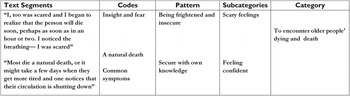
The FGDs were analyzed with descriptive qualitative content analysis (inspired by Patton, Reference Patton2002). During analysis, the following steps were employed: (1) the authors read the transcribed FGDs to obtain a first impression of the whole content, writing code words or notes in the margin; (2) they then read the text again to identify significant text segments; (3) the authors compared and discussed the text segments and started to identify patterns, for example, feeling insecure and feeling frightened; (4) the patterns were then compared and grouped based on their similarities into (5) subcategories (e.g., “scary feelings”); (6) the subcategories were also compared and grouped based on their similarities into three categories. This procedure is depicted in Figure 1.
Example of the analysis.

Ethics
Both written and oral information were given, and informed consent was obtained in connection with the interviews, according to the protocol for FGDs, emphasizing that participation was voluntary and that they could withdraw at any time, without stating a reason. This study was approved by the human ethics committee in Stockholm (no. 2009/5:9).
RESULTS
The results showed that the attitude toward the competence-building programs was positive independent of their design or content. The findings also showed that a lack of a common language between different professionals can cause tension in a setting involving death and dying, issues that are notoriously difficult to deal with and talk about. The results are presented in categories and subcategories as follows:
-
Category 1. Experiences of CBPs and palliative care in nursing homes
-
Category 2. Tension between different professions
-
Category 3. Encounter older people's dying and death
Experiences of Competence Building Programs and Palliative Care in Nursing Homes
This category emphasizes staff satisfaction when gaining new knowledge and insight into palliative care following participation in the CBP. The overall attitude toward the CBP was positive: “I was positive straight away, as I will get direct answers to what I need to know. I work with old people. That's why I need to know.” Still, their own experientially based knowledge was often rated higher than the theoretical one: “Not all [patients] can express themselves and say, ‘I am in pain' or ‘I don't feel so good.’ It's their expressions, how their eyes look and the look on their faces— how they move. Well, you have to take it all in, the whole picture. It's nothing you can learn by reading. No, it's something you just have to learn.” This illustrates that knowledge about palliative care was seen as complex. It was described by some as hard to fully comprehend when in their practical daily work they combined experiential and scientific knowledge. A major opinion concerning the CBPs was that they demonstrated a lack of specialized knowledge about older people's needs rather than specialized palliative care with experience from cancer care.
During the FGDs, it became apparent that most staff perceived participation in the CBPs as an opportunity to learn more about the dying process. They regarded the new knowledge as facilitating their understanding and assisting them to verbalize arguments concerning difficult care situations or in meetings with relatives. Still, staff reflected on their own knowledge. This was most apparent among the RNs, as they compared their own knowledge to that of the specialists in the CBPs. They discussed the differences between “the specialists, responsible for the CBPs” and themselves as disadvantageous. Specifically, RNs described the specialists as having work experience and advanced knowledge of oncological palliative care and not nursing home care: “It was obvious that they work with dying cancer patients— and that experience is nothing we really have.” This exemplifies that the RNs experienced a clinical distance from the specialist team conducting the CBP. Still, they also described what possibilities the CBP offered as they had realized the need to evaluate each person's pain and to discuss and initiate individual treatment strategies with the physician. Even if the RNs described CBPs as primarily repetitious of already-known facts, they had extended their practical and theoretical knowledge about pain relief. Prior to the CBPs, all staff described that they were unfamiliar with the guidelines for palliative care. Still, following the CBP, they described how they planned to implement their new knowledge and understanding of the guidelines when caring for older people. In the FGDs, tangible examples were given of how they had improved their knowledge as they described new routines concerning palliative care and information to colleagues and relatives through manuals and information folders, accessible at each ward. An example of how they comprehended their knowledge was the implementation of necessary appliances following the death of an older person, such as a manual/checklist on what to do and whom to contact, a tablecloth, Bible, book of hymns, candle, candlestick, and vase.
Tension Between Different Professions
This category is about collaboration or lack thereof based on different profession-related experiences of caring, and they fall into two subcategories: (1) power struggle and (2) lack of a common language.
Power Struggle
The tension between staff was described as involving structures of power and directives, sometimes emphasizing their professional differences. The following quote illustrates this: “They [the RNs] might say that I don't have the right education and that I don't know the way the medicine works. I realize that to be true, but I can see when someone is in pain. That's enough for me, I don't have to be a physician to realize the old person's needs. It hurts.” The overall attitude, however, was that the RNs were appreciated but that their presence was sparse: “Sometimes I miss the nurse [RN]. It would be nice to have her here, but when we phone her it feels as we are intruding.”
The ENs and CAs described that they sometimes neither had the competence nor the authority to carry out more advanced care at the end of older people's lives and to offer support to their relatives, but still they did. They reported how they alone had to make difficult decisions when contacting the physician if the older person's health had deteriorated outside office hours. A significant aspect was their concern for the older person suffering from various symptoms, especially physical pain: “How can it be that if a patient is in terrible pain he has to wait, and then when it's just hours left to live, get pain relief.” In this case, no RN and/or physician was available to consult with. This situation exemplifies the uncertainty, especially concerning the directives.
Registered nurses described that working office hours was complex and tough, obstructing the possibility of teamwork. During the workday, they had to deal with the medication on each ward even if they themselves did not administer it to the older people. They also described how filling out documentation sheets and other charts took a great deal of their time. This meant that they did not participate in actual care situations unless it was specifically needed—for example, administrating pain medication. Their responsibility was described as a “solitaire at work” (RN), exemplifying their experiential knowledge, their unique role, and specific responsibility: “We know what to do. We have long working experience. It is in our spinal cord, so to speak. We don't even have to think. We can remind each other or tell each other how to carry out certain things just like that.”
Lack of a Common Language
Caring situations were sometimes described as difficult due to a lack of proper communication and planning between staff. Obstacles to collaboration resulted in tension between different professionals, questioning each other's level of competence and knowledge concerning palliative care. Feelings of frustration when communicating with other professionals were described by the staff and mainly by the ENs and CAs. Most of them reported that they were not allowed to contact the physician without contacting the RN first. Still, if an older person's health deteriorated during the evening, at night, or on the weekend, they were expected to provide full information to the physician, even if they themselves did not fully comprehend it. They found this difficult and stressful, and described that they lacked both competence and the language to properly express their assessments.
RNs also described dilemmas and frustrations in communicating when discussing critical cases with physicians. They felt this was mainly due to the physicians' inexperience in dealing with transportation of an elderly person to the hospital, as described in the following:
He [the older person] had pneumonia and got worse and worse, and we thought that we could treat him here. But no way— The physician said, “Oh no, this doesn't look good. Call an ambulance.” The older man was isolated due to a serious infection at the main hospital for one week, ten days, and died all alone— So he died all alone in the middle of the night. Why not let him die here? We would have treated the pneumonia here to the best of our knowledge. (RN)
The lack of communication and common language was described as a problem, as well as a feeling of being left out. This quote illustrates a frustrating case that may have been prevented if the physician had been experienced in palliative care and shared a language with the RNs. It also exemplifies the gap between the ability to understand and to communicate among the different professionals responsible for the care of severely ill and dying elderly people.
Some staff experienced adequate communication, leading to a better understanding of each other during challenging and complicated situations, for example, with symptoms previously unknown to them. They were able to consult with each other to find guidance and support to collaborate: “It was interesting to talk all together and to gain an understanding for each other—To get information straightforward is easier to deal with,” and “I think that it would be great to have joint meetings sometimes to be able to discuss more directly, maybe ask each other.” The importance of how communication was perceived is further described in the last category.
To Encounter Older People's Dying and Death
Two subcategories illustrate the nursing staff attitudes and feelings toward caring for the dying elderly. It was described as frightening and at the same time a natural and accepted part of life. Following their participation in CBPs, staff had increased their knowledge about the dying process, making them more confident.
Scary Feelings
To some staff, dying and death in an older person was a terrifying experience, portrayed by one thus: “I don't want to see—I want to see people alive. I don't want to see them dead. They look different then—I am frightened to see them different.” The fear of dying and death as described here represented both the death of a person who might have been well known to the staff and facing the dead body without being prepared, often a traumatic experience.
Staff described how they recognized the different symptoms, making them more attentive and sometimes frightened, as illustrated in this statement: “I was scared—The person will die soon, perhaps as soon as in an hour or two. I noticed the breathing. I was scared—And the nurse I worked with, she forced me to go and have a look. I had nightmares all night.” To some staff it was overwhelming, resulting in successive sick leaves.
Feeling Confident
Some staff vividly described how dying, death, and colleagues' support over time generated experiential knowledge that helped them to understand:
I can tell you that when I used to work in nursing homes as a young person I had never seen a dead person. Then the RN asked me if I could come, as she was preparing a dead person. At that point, I learned that it was nothing to be afraid of.
Some acknowledged death as a natural part of life and described that most older people died in that way, that is, had a dignified death without too much suffering: “Most die a natural death. It might take a few days when they get more tired and one notices that their circulation is shutting down.”
The staff's knowledge of dying as an individual process was also evident and is described in the following:
We had a lady here, she was having breakfast in the morning and then suddenly she was unconscious. We called her relatives, and after two hours you could tell that her circulation was slowing down. But still her daughter-in-law was talking to her all the time, and suddenly she asked if the lady wanted a cup of coffee because that was something she really liked, and the lady replied, “Yes, please.” It was like a ghost talking. She got her coffee and piece of chocolate, and after that the lady wanted to be left alone for a while, and the relatives left the room, and she took her last breath.
This was perceived as an example of a natural, good, and dignified death that also included the presence of relatives.
An additional aspect of the CBPs was to initiate implementation of the Swedish Palliative Register at each nursing home. This was not successfully accomplished, however, mainly due to the lack of time and commitment from the physician in charge (general practitioner) at each nursing home.
DISCUSSION
The purpose of our study was to investigate nursing home staff attitudes to and experiences of CBPs in palliative care. Our findings indicate that staff tended to be positive about the CBP but needed further knowledge about palliative care and support in their practical work. Mentorship or support groups would be a possible additional help. The FGDs have served that purpose, as the sharing of experiences has been appreciated. Among other issues of concern was staff's difficulties in talking about and dealing with death. This is in line with results from others (Beck et al., Reference Beck, Jakobsson and Edberg2014a ; Dwyer et al., Reference Dwyer, Hansebo and Andershed2011; Österlind, Reference Österlind, Hansebo and Andersson2011), who interpreted the perception of dying and death as being “unnatural” occasions in nursing homes, making the staff uncertain about these issues. These results may also be related to different taboos in society, as moral standards in nursing care also reflect a society's standards (Ternestedt, Reference Ternestedt and Nordenfelt2009). The findings in our study suggest that staff to a certain extent fear dying and death and that such fear may interfere with the care of a dying person. It may also restrict the staff's possibility to have conversations concerning existential issues with older people.
The staff at nursing homes have different principal organizations (county and municipality). The jurisdiction reflects this in two different laws (Swedish Social Policy Acts, 2001; Mellström, Reference Mellström2006). There may be cause for concern if these two groups do not communicate and cooperate, as it might affect work-related relationships and the use of language. The findings of our study suggest that there were tensions between the different professions mainly because the areas of responsibility were unclear and that the care was not coordinated, leading to unnecessary misunderstandings.
Previous studies of CBPs have suggested limited positive outcomes regarding increasing staff competence in palliative care (Davies et al., Reference Davies, Goodman and Bunn2011; Raunkiaer & Timm, Reference Raunkiaer and Timm2010; Reference Raunkiaer and Timm2013; Seymour et al., Reference Seymour, Almack and Kennedy2010). Our study proposes the need for extended knowledge in palliative care when caring for dying older people. This is partly due to the Swedish organization of nursing home care, with the main providers of daily care being ENs and CAs. In Sweden, ENs have a three-year high school degree, while CAs often only have local workplace-related courses in nursing care corresponding to the Swedish Social Policy Act (Swedish Social Policy Acts, 2001). While RNs have a three-year college education, conforming to the requirements of the health and medical jurisdiction (Mellström, Reference Mellström2006). This indicates diverse levels of experience and knowledge among staff. In our study, varied competence was regarded as problematic mainly due to the lack of a common language.
The competence-building program was evaluated positively and useful but also as repetitious of known facts by different staff. This is partly consistent with Augustsson and colleagues (2013), who showed that workplace-related education in palliative care resulted in a modest impact on both the individual and organizational levels. The main obstacles to having a significant impact are a poor learning climate, managers' (including RNs') ambiguity about their own professional role, a lack of structure, a lack of clear definitions of ownership, and confusion about responsibility among all professions (Augustsson et al., Reference Augustsson, Tornquist and Hasson2013). According to Neergaard et al. (Reference Neergaard, Olesen and Jensen2010a ), greater respect for each other's competencies is needed, including upgraded knowledge and competence in general when dealing with under- and postgraduate education. They (Reference Neergaard, Vedsted and Olesen2010b ) suggest that trust and respect are of great importance both at the personal and professional levels, and may be the key requirement for successful cooperation. This is in line with our findings, as we suggest there is a need to collaborate between different professions to build competence and to facilitate learning about palliative care in nursing homes. This is in accordance with Raunkiaer and Timm (Reference Raunkiaer and Timm2013), who suggested that segregation between different professionals may not improve shared learning and shared care. The staff in our study showed initiative and a willingness to implement their new knowledge in practice. Still, the RNs offered negative remarks about the CBP focusing on known facts and patients with cancer, and they showed poor or insufficient understanding of the nursing home context. This is also in line with Raunkiaer and Timm (Reference Raunkiaer and Timm2013), who suggested that a lack of a workplace-oriented CBP in palliative care for nursing home staff is a key problem. This may be an explanation of why some staff in our study experienced that the specialist palliative care team had limited knowledge about nursing home care. Yet, they were responsible for the CBP. Even so, the CBP did initiate various strategies to facilitate learning in line with suggestions from previous studies by Beck and colleagues (Reference Beck, Jakobsson and Edberg2014b ), Kuhn and Forrest (Reference Kuhn and Forrest2012), and Raunkiaer and Timm (Reference Raunkiaer and Timm2013). Should future studies use the same design (i.e., investigate different approaches to facilitate learning), it will be necessary to evaluate and compare the CBPs to identify suitable and applicable models for nursing homes.
One crucial aspect of achieving success is that managers encourage staff to continuously participate in competence-building activities (Augustsson et al., Reference Augustsson, Tornquist and Hasson2013; Kuhn & Forrest, Reference Kuhn and Forrest2012). As shown by Kuhn and Forrest (Reference Kuhn and Forrest2012), mutual goals and commitments are essential to develop and improve the care of older people. In our study, it became apparent that the hierarchy among staff made it difficult to communicate and to develop unified care and support strategies. Still, following the CBPs, there were attempts to implement new care strategies and information with colleagues and relatives about palliative care. According to Cullen and Adams (Reference Cullen and Adams2012), a sustainable change is challenging and difficult and requires determination as well as persistence (Cullen & Adams, Reference Cullen and Adams2012; Cullen et al., Reference Cullen, Smelser and Wagner2012).
Our findings show that staff to a large extent were guided by their own and colleagues' experiences. A cause for concern is whether nursing home staff had insufficient time to discuss, evaluate, and consider their own and/or colleagues' experiential knowledge due to reduced working hours. This may affect the staff's opportunity to share each other's knowledge to gain both approval and support in demanding caring situations. We know that there will be a great need for palliative care among older people in the future, so that there will be extensive requirements concerning the nursing staff's motivation to discuss and develop their knowledge in this area.
In our study, it became evident that, even though staff found the CBP interesting and that it generated new knowledge, some felt restricted to use their new knowledge due to poor support from colleagues.
Methodological Considerations
Our study is part of a larger interventional investigation. A limited number of staff participated in the FGDs. Our findings must therefore be evaluated in that light. Previous studies (Beck et al., Reference Beck, Tornquist and Edberg2014b ; Dwyer et al., Reference Dwyer, Hansebo and Andershed2011; Österlind et al., Reference Österlind, Hansebo and Lindqvist2009; Raunkiaer & Timm, Reference Raunkiaer and Timm2010; Reference Raunkiaer and Timm2012) indicate the complexity of introducing palliative care, as CBPs include long-term implementation strategies and organizational commitment. We introduced three different programs, but we did not compare nor evaluate them against each other. Consequently, we are not able to conclude that one program was more successful than the others. This needs to be addressed in future studies with a similar design, evaluating each program for cost-effectiveness and sustainable implementation.
CONCLUSION
The staff at nursing homes evaluated CBPs in palliative care for older people as useful, even though some described it as repetitious of already-known facts. It also became clear that staff experienced death and dying as hard to deal with due to a lack of support from other professionals. This study also revealed that ENs and CAs experienced that they carried out advanced care of dying without the necessary theoretical and practical knowledge. Our findings also suggest that some staff perceived dying and death as unnatural occurrences for nursing home care. Further studies need to consider implementation strategies as well as evaluate each program for cost-effectiveness, that is, if introducing key persons to palliative care is the most beneficial way to facilitate learning about palliative care in nursing homes rather than including all staff.
ACKNOWLEDGMENTS
We wish to thank FOU nu, Stockholm County Council, Sweden, for financial support and Ms. Lisen Tang, m.p.h., for administrative support.