INTRODUCTION
The evolution of non-reproductive and reproductive castes, primarily known from social insects (e.g. Wilson, Reference Wilson1971; Crespi & Yanega, Reference Crespi and Yanega1995), has been a vigorous research area since Darwin's time, because natural selection is a process based on reproductive success. It is, therefore, difficult to explain how altruistic non-reproductive individuals can evolve (see e.g. Nowak et al., Reference Nowak, Tarnita and Wilson2010; Abbot et al., 2011). So far the most successful and recognized theory explaining the evolution of non-reproductive castes is Hamilton's kin selection theory based on the concept of inclusive fitness (Bourke, Reference Bourke2011), though there have been challenges to this theory recently (e.g. Nowak et al., Reference Nowak, Tarnita and Wilson2010). It states that there can be selection for altruistic behaviour if such behaviour results in a higher inclusive fitness than direct fitness for the altruistic individual (Hamilton, Reference Hamilton1964). To make this possible, relatedness between individuals is required, but high relatedness cannot drive the evolution of altruism by itself (Hughes et al., Reference Hughes, Oldroyd, Beekman and Ratnieks2008). Certain ecological factors, such as presence of a spatially well-defined and delimited food resource to defend, and strong inter- or intraspecific competition over that resource (selection for defence), also appear necessary for the evolution of altruism (Crespi, Reference Crespi1994). However, it can be difficult to determine which ecological factors are important since the relatedness between individuals is not the same within all taxa where non-reproductive and reproductive castes have evolved.
The influence of ecological factors can be evaluated by contrasting colonies of different social species with similar degree of relatedness between individuals, as any differences in the social structure can therefore be ascribed to present or past ecological conditions, all else being equal. Parasitic trematodes could be such a study system, as evidences for formation of non-reproductive and reproductive castes were recently found in the larval stages of a marine echinostome trematode species (Himasthla sp. B) infecting the California horn snail, Cerithidea californica (Haldeman, 1840) (Hechinger et al., Reference Hechinger, Wood and Kuris2011), as well as in other trematode species (Miura, Reference Miura2012; Leung & Poulin, Reference Leung and Poulin2012). The two identified castes differ both morphologically and behaviourally in that one caste is specialized in defending the colony against other competing parasites that might invade the host organism, whereas the other caste is engaged predominantly in reproduction by producing dispersal stages that leave the host to find the next host in the parasite's life cycle.
Echinostome trematodes (Echinostomatidae) often have a three-host life cycle involving a gastropod first intermediate host, a bivalve second intermediate host and a water bird as definitive host (Lauckner, Reference Lauckner and Kinne1980, Reference Lauckner and Kinne1983; Galaktionov & Dobrovolskij, Reference Galaktionov and Dobrovolskij2003; Esteban & Muñoz-Antoli, Reference Esteban, Fried and Toledo2009). The parasites reproduce sexually in the intestine of the bird from which eggs are expelled to the surrounding environment via the host's faeces. The trematode egg then hatches into a miracidium larva that seeks out and penetrates the first intermediate host, in which it reproduces asexually into a colony of rediae that eventually infest most of the visceral mass of the host. The echinostome redia is equipped with a mouth, a pharynx and a gut, and it literally eats its way through the host tissues. Upon maturity, the redia produces either a new redial generation or the parasite's dispersal stage (cercariae); the latter leave the snail host in order to invade the next host in the life cycle. Here, the cercariae encyst as dormant metacercariae and await trophic transmission to the definitive avian host preying on the second intermediate host.
The intra-molluscan trematode larvae are particularly useful for the study of social organization in an ecological context because they form clonal colonies without genetic conflicts between individuals: the relatedness is the same in all colonies. In this respect trematodes resemble, for instance, the eusocial gall-forming aphids (Aoki, Reference Aoki1977). Furthermore, the redial stages are equipped with a feeding apparatus that allows for antagonistic behaviour and thus retain the ability to compete over the common limited resource (the host). Finally, the larvae of different species of trematodes live under different ecological conditions, such as resource availability in terms of size, abundance and longevity of their molluscan host, and/or the level of inter- and intraspecific competition, which differs according to host species and shows great spatio-temporal variation (Sousa, Reference Sousa1983; Kuris & Lafferty, 1994; Poulin & Mouritsen, Reference Poulin and Mouritsen2003).
Hechinger et al. (Reference Hechinger, Wood and Kuris2011) suggest three ecological factors that will make the evolution of a specialized soldier caste in trematode species more likely. First, the trematode species has to be dominant in the interspecific hierarchy since this indicates the ability to effectively defend itself. Second, the infection incidence in the host population has to be high, as this increases the probability of multiple infections and hence inter- or intraspecific competition. Third, the host has to have a long lifespan, since this will increase the probability of interactions between different species within the host and make the possible returns from future reproduction higher. These ecological factors differ between trematode species, and we therefore investigated the social structure of the marine trematode Himasthla elongata (Mehlis, 1831) that infects the common periwinkle Littorina littorea (L.). Compared to the congeneric Himasthla sp. B studied by Hechinger et al. (Reference Hechinger, Wood and Kuris2011), H. elongata may be less dominant in the interspecific hierarchy (see Werding, Reference Werding1969; Lauckner, Reference Lauckner and Kinne1980). Moreover, the overall infection incidence by trematodes is lower in L. littorea populations (less competitive pressure) than in Cerithidea californica populations hosting Himasthla sp. B (Poulin & Mouritsen, Reference Poulin and Mouritsen2003). We therefore hypothesized the redial stage of H. elongata to be less specialized for defence of the colony than Himasthla sp. B. Based on the findings by Hechinger et al. (Reference Hechinger, Wood and Kuris2011) we conducted a series of studies on H. elongata rediae in order to examine three questions:
• Do the non-reproductive and reproductive rediae differ in size and morphology?
• Is the distribution of non-reproductive and reproductive rediae the same in different parts of the host snail?
• Do the non-reproductive and reproductive rediae differ in their willingness to attack other trematode species?
MATERIALS AND METHODS
Collections of animals
Periwinkles, Littorina littorea, were collected from two sites: (1) on a pier at the northern part of Aarhus harbour, Denmark, in April 2011; and (2) in Knebel vig, a small bay 8 km north-east of Aarhus harbour, in October 2013. Here, the periwinkles are known to host colonies of Himasthla elongata rediae as well as other trematode species—particularly Renicola roscovita, but also Cryptocotyle lingua. The snails were maintained in the laboratory in seawater at 5°C for maximum 2 wk prior to dissection.
Dimensions, morphology and within-host distribution of rediae
The shell height of each snail was measured (apex to aperture), after which the shell was cracked with pliers and the snails' soft tissue carefully removed. The anterior visceral mass of each snail was removed by cutting through the albumen gland, and the retained softer mainly gonad/digestive gland complex was divided in two evenly-sized parts by cutting just posterior to the kidney. These two body parts (hereafter denoted the front and hind part) were moved to separate Petri dishes and further dissected for presence of H. elongata rediae. The mantle of snails collected at the second site (Knebel vig) was also inspected under a light microscope for enumeration of present rediae. Dissecting the different body parts separately was done because Hechinger et al. (Reference Hechinger, Wood and Kuris2011) found reproductive and non-reproductive rediae of Himasthla sp. B to be unevenly distributed within the host body. If present, rediae from the front and hind part were isolated by removing as much snail tissue as possible followed by rinsing in filtered (10 μm) seawater. To avoid severe contraction of larvae often seen during chemical preservation, the parasites were killed by letting them dry out in the dish and then rehydrated to their original size. With a pipette we isolated a subsample of larval parasites both from the front and the hind part of each Himasthla-infected snail by sucking them up haphazardly according to type and size and shape. Under a stereomicroscope equipped with an ocular micrometer, we measured the length and width of each redia at 40× magnification. The redial width was measured at two different sites on the animal: one measure was taken ~1/4 body length posterior to the front, the other was taken ~1/4 body length anterior to the hind part. These two measures were then averaged to obtain a single width value for further analysis. The volume of the redia was calculated by approximating the shape of the redia to a cylinder. Each redia was classified as reproductive or non-reproductive based on the occurrence/absence of germinal masses or cercariae at different developmental stages within their body. In case of doubt, rediae were examined under a light microscope at 100× magnification. Also, it was noted whether the rediae possessed collars and posterior locomotor appendages often characterizing rediae of the genus Himasthla (e.g. Stunkard, Reference Stunkard1938, Reference Stunkard1966). In this way we processed in total 2922 rediae; 1304 from the front part and 1618 from the hind part of ten infected snails (five from each site) measuring between 21.1 and 26.9 mm in shell height. The 412 rediae found in the snails mantles were not measured and solely inspected under the light microscope. If not otherwise stated, these individuals are, therefore, excluded in given numbers of processed rediae.
Attack frequencies of reproductive and non-reproductive rediae
In a controlled experiment we tested whether reproductive and non-reproductive H. elongata rediae originating from the same colony attack sporocysts of the heterospecific trematode Renicola roscovita (Stunkard, 1932) with similar frequency. Renicola sporocysts were obtained from the same population of periwinkles as the applied H. elongata rediae (Aarhus harbour), and they were isolated in the same way as H. elongata. We made two treatments with different combinations of H. elongata and R. roscovita and one control treatment. In the first treatment, we combined 20 non-reproductive H. elongata rediae with 20 R. roscovita sporocysts (N = 10). In a second treatment, we combined 20 reproductive H. elongata rediae with 20 R. roscovita sporocysts (N = 10). In the control treatment we combined 20 reproductive and 20 non-reproductive H. elongata rediae from the same colony (N = 9). The replicates in each of these treatments included H. elongata rediae from separate colonies/snails, whereas rediae across treatments within given replicates originated from the same colony (paired design). The experiment was performed at room temperature (22.5–25°C) in concave glass wells with 0.75 ml filtered (10 μm) seawater. To avoid a possible higher activity of non-reproductive rediae affecting observed attack rates (see Hechinger et al., Reference Hechinger, Wood and Kuris2011), we ensured that all parasite larvae were in close proximity to each other at onset of the experiment. During the experiment, we recorded the number of attacks by respectively reproductive and non-reproductive H. elongata rediae under a stereomicroscope for 1 min after 10, 30, 60, 90 and 120 min from the beginning of the experiment. The maximum number of attacks observed in each replicate during the 2 h experimental period was used for further analyses. An attack was defined as when a redia had its mouthparts latched onto another trematode larva.
RESULTS
Dimensions, morphology and within-host distribution of rediae
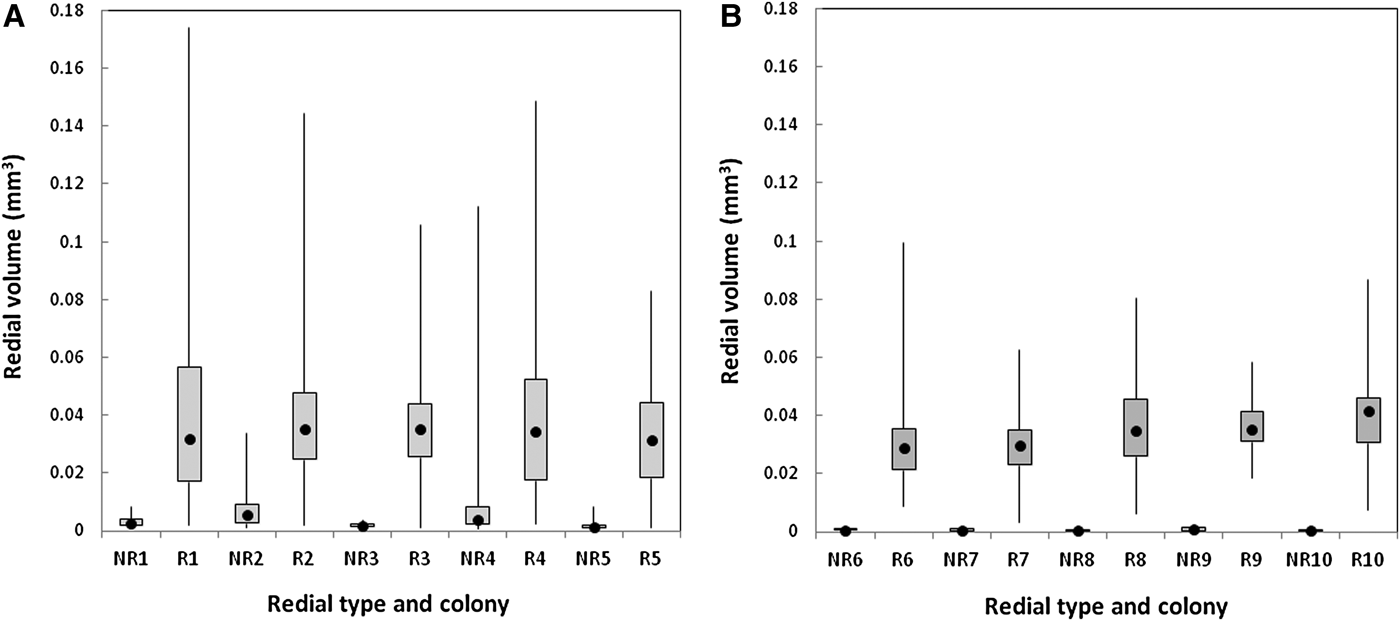
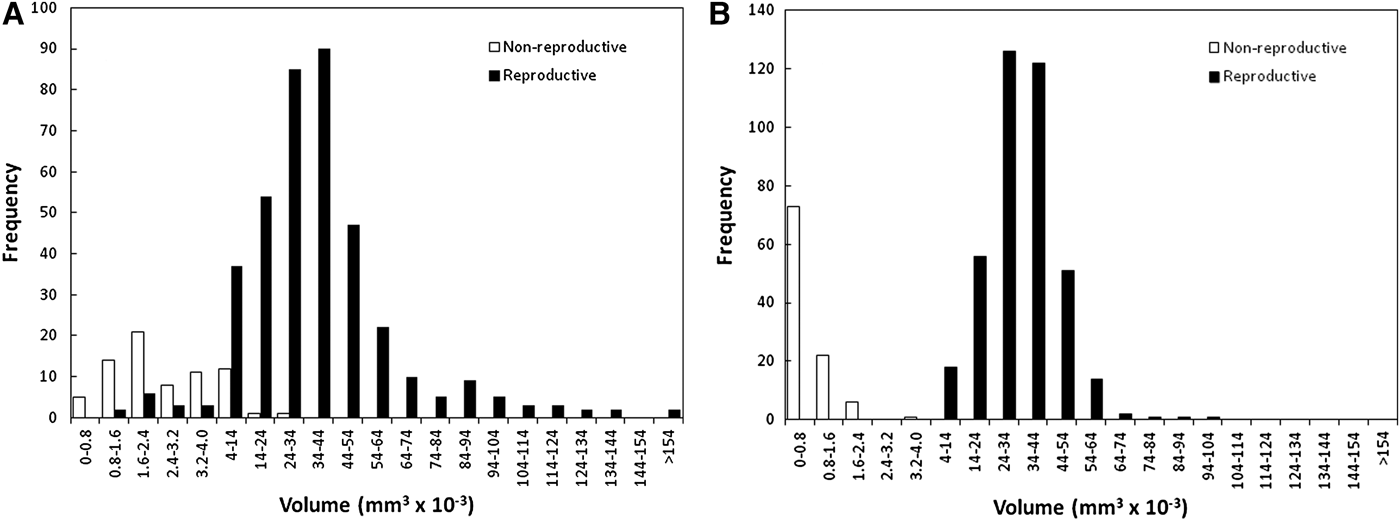
Of the 732 Himasthla elongata rediae processed from the first site (Aarhus harbour), 158 were non-reproductive and 574 were reproductive. Of the 2190 rediae processed from the second site (Knebel vig), 304 were non-reproductive and 1886 were reproductive. Non-reproductive rediae were generally smaller and had a relatively narrower body than reproductive rediae and, hence, had a markedly smaller volume (Figures 1–3). The mean length-to-width ratio across the five studied colonies from Aarhus harbour was 4.9 for non-reproductive rediae and 3.4 for reproductive rediae. There was, however, a considerable overlap in individual dimensions between the two redial types within all five colonies (Figures 2A and 3A). This was particularly pronounced in colony 4, and to some extent also in colony 2, which contained some very large non-reproductive rediae (Figure 2A). The mean length-to-width ratio of rediae from Knebel vig was 6.1 for non-reproductive rediae and 4.0 for reproductive rediae, and no overlap in individual dimensions between the two redial types was seen at this site (Figures 2B and 3B).
Reproductive Himasthla elongata redia containing developing cercariae. Insert: non-reproductive H. elongata redia next to a section of the distinctively larger reproductive rediae. Arrows denote mouth (M), pharynx (P), collar (Co), gut (G), maturing cercariae contained within the redial body (Ce), posterior locomotor appendage (A). Note that collar is not visible on the partly contracted reproductive redia, but is so on more elongated individuals. Light microscopy using differential interference contrast.

Volume box-plot (maximum, minimum, 25% and 75% quartile, and median [•]) of Himasthla elongata rediae from (A) the five colonies from Aarhus harbour; (1–5: separate colonies (snails); redial sample sizes from left to right are: 14, 83, 11, 66, 16, 71, 87, 248, 30 and 105) and (B) the five colonies from Knebel (6–10: separate colonies; redial sample sizes from left to right: 21, 80, 23, 73, 17, 70, 20, 82, 20 and 86) . NR, non-reproductive rediae; R, reproductive rediae.
Frequency distribution of redial volume of Himasthla elongata for (A) all Aarhus colonies combined and (B) all Knebel colonies combined. Note that frequencies of non-reproductive and reproductive rediae do not reflect actual relative proportion of the two redial morphs in the colonies. The included numbers of respectively non-reproductive and reproductive were standardized across colonies in order to obtain approximately similar weight by colony (Aarhus: 11–16 non-reproductive and 66–84 reproductive rediae per colony; Knebel: 17–23 non-reproductive and 70–86 reproductive rediae per colony). Also note that size-classes differ.
Aside from the non-reproductive's larger sucker, pharynx and stomach relative to body size, there were no clear differences in the morphological structures between non-reproductive and reproductive rediae from either site. Both redial types possessed well-defined collar and posterior locomotor appendages, albeit these structures were less pronounced in the often swollen reproductive morphs (Figure 1).
Average redial width and length was unaffected by the position of the rediae in the gonad/digestive gland complex (front versus hind part), irrespective of whether they were non-reproductive (paired samples t-test, t 4 ≤ 0.651, P ≥ 0.550) or reproductive (paired samples t-test, t 4 ≤ 1.943, P ≥ 0.124). This allowed us to combine size data from the hind and front part of the five snails from each site in two separate analysis, which showed a statistically significant difference between reproductive and non-reproductive rediae at either sites both regarding mean body width (t 4 ≥ 10.440, P < 0.0005), mean body length (t 4 ≥ 3.552, P = 0.007) and therefore also mean body volume (t 4 ≥ 13.835, P < 0.0005) (Figures 2 and 3). Across site, there was no significant difference in average volume of reproductive rediae (Student's t-test, t 8 = 0.226, P = 0.827), whereas non-reproductive rediae were significantly larger at the Aarhus site than at Knebel vig (t 8 = 3.129, P = 0.014) (Figures 2 and 3). Also, the variation in volume was somewhat larger for both non-reproductive and reproductive rediae at Aarhus than at Knebel.
At the Aarhus site, the reproductive rediae occurred approximately four times more frequently than non-reproductive (74.1–85.7% reproductive across colonies; one-sample t-test, t 4 = 13.433, P < 0.0005), and the relative proportion of non-reproductive rediae did not differ between the front part (mean percentage ± standard error: 19.6 ± 2.7) and the hind part (18.8 ± 3.8) of the hosts gonad/digestive gland (paired samples t-test, t 4 = 0.338, P = 0.753). At Knebel vig, reproductive rediae were also more frequent (~six-fold) than non-reproductive (76.7–91.1%; one-sample t-test, t 4 = 14.260, P < 0.0005), and neither was there any difference in the relative proportion of redial types between the front (15.9 ± 3.9% non-reproductive) and the hind part (11.4 ± 1.8% non-reproductive) of the snail hosts (paired samples t-test, t 4 = 1.661, P = 0.172). The relative proportion of redial types did not differ significantly between sites (Student's t-test, t 8 = 1.689, P = 0.130). The mantles of snails from Knebel vig were also screened for rediae, and in this part of the host, the proportion of non-reproductive rediae was considerably higher (57.8 ± 4.8%) than in the other two parts combined (13.2 ± 2.6%; paired samples t-test, t 4 = 9.192, P = 0.001). A one-way ANOVA contrasting all three body parts in one analysis, but not correcting for inter-colony variation, reached similar conclusions (F2,12 = 48.504, P < 0.0005; Bonferroni post hoc tests, front vs hind part: P = 1.000, front and hind part vs mantle: P < 0.0005). Although we did not record presence of dead or dying rediae systematically, it was noted that quite a lot of reproductive specimens in the mantle region appeared to be dead (these were excluded in the analyses).
Attack frequencies of reproductive and non-reproductive rediae
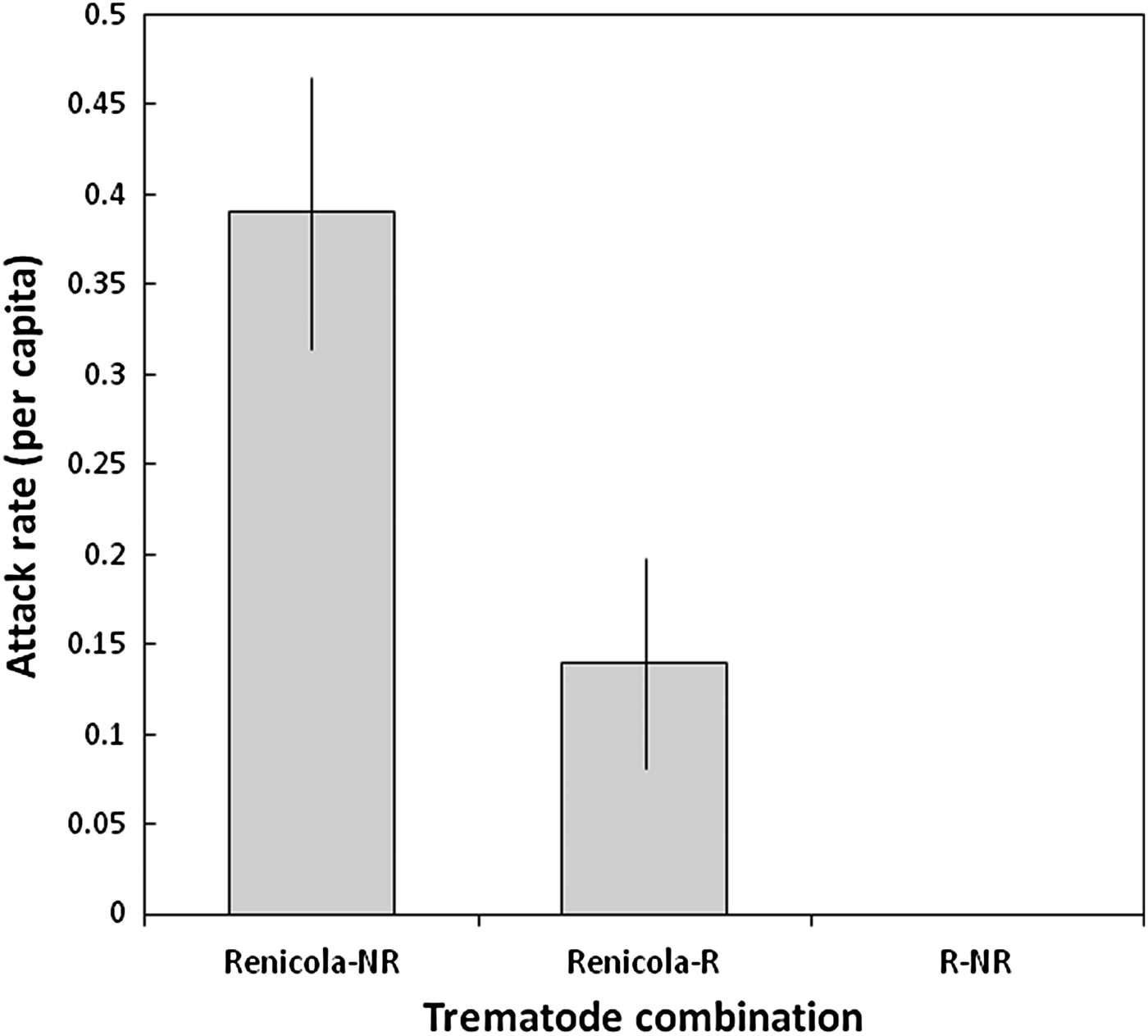
Himasthla elongata rediae readily attacked heterospecific trematode larvae (here R. roscovita sporocysts) (Figures 4 and 5). A paired samples t-test, which took possible differences between individual colonies into account, showed that the non-reproductive H. elongata rediae attacked R. roscovita sporocysts 2–3 times more frequently than the reproductive rediae did (t 9 = 3.478, P = 0.007; Figure 5). Furthermore, both non-reproductive rediae (paired samples t-test, t 8 = 4.800, P = 0.001) and reproductive rediae (paired samples t-test, t 8 = 2.485, P = 0.038) attacked R. roscovita sporocysts significantly more often than conspecifics from their own colony that were never attacked (Figure 5).
Non-reproductive Himasthla elongata rediae attacking Renicola roscovita sporocysts (stereomicroscopy).
Attack rates (mean number of attacks per capita ± standard error, N = 10) of non-reproductive (NR) and reproductive (R) Himasthla elongata rediae on Renicola roscovita sporocysts (Renicola) and conspecifics (reproductive rediae from same colony).
DISCUSSION
Present results demonstrate that the clonal redial stages of Himasthla elongata form two relatively distinct groups: one comprised small and narrow non-reproductive rediae possessing relatively greater willingness to attack heterospecific trematodes, and another comprised relatively large and broad reproductive rediae less willing to engage in heterospecific attacks. This suggests that division of labour under its widest definition (see e.g. Wilson, Reference Wilson1971; Crespi & Yanga, Reference Crespi and Yanega1995) has evolved in H. elongata or its ancestor, in which the clonal colony of rediae is divided into two main castes, a ‘soldier’ caste specialized for defence and a caste specialized for reproduction. Hence, our investigation is in accordance with Hechinger et al. (Reference Hechinger, Wood and Kuris2011), Leung & Poulin (Reference Leung and Poulin2012) and Miura (Reference Miura2012), who found comparable evidence also in the trematodes Himasthla sp. B, Philopthalmus sp., and Philophthalmid sp. I, Philophthalmid sp. II and Acanthoparyhium sp. I, respectively. Our study represents the first demonstration of division of labour in a species of trematode from the European continent, and the first social trematode whose entire life cycle has previously been thoroughly described.
Contrasting our work and Hechinger et al. (Reference Hechinger, Wood and Kuris2011) is particularly interesting because the involved trematodes belong to the same genus, and there are notable differences. First, there was considerable overlap in dimensions between the two redial types in Himasthla elongata from Aarhus, which was unparalleled by Himasthla sp. B. Second, in contrast to the larger reproductive morphs, defending rediae of Himasthla sp. B possessed collar and posterior locomotor appendages. In H. elongata both redial types expressed these morphological structures, albeit they are less visible on the cercariae-filled and hence swollen reproductive morph. Third, Himasthla sp. B rediae specialized for defence were disproportionately represented in the front part of the host, i.e. where new competing trematode infections are most likely to emerge (mantle, middle and hind-part: ~99, 55 and 35%). Such a within-host spatial pattern was less pronounced in H. elongata (mantle, front and hind part: ~99, 16 and 11%; Knebel data). Fourth, the mean proportion of defending Himasthla sp. B rediae across colonies was 44%, whereas this figure was well below 20% in H. elongata. Based upon 95% confidence limits calculated for both Himasthla sp. B and H. elongata (data not shown), this difference between species is statistically significant. Finally, defending Himasthla sp. B rediae attack heterospecifics more than 20 times more often than reproductive rediae, while in H. elongata the non-reproductive rediae attack only 2–3 times more frequently than their reproductive counterparts. The magnitude of some of the discrepancies between Himasthla sp. B and H. elongata can be ascribed to the two studies' different methodology. In particular, Hechinger et al. (Reference Hechinger, Wood and Kuris2011) separated the two redial types according to their dimensions, whereas we did so according to their reproductive state. Thus, the two trematode species may not differ as much as the two studies seem to indicate regarding overall relative abundance of the two identified redial morphs. Nevertheless, the reproductive morph of H. elongata possesses collar and well-defined posterior appendages, which appear to be absent in reproductive Himasthla sp. B. Further, in the directly comparable experiments on antagonistic behaviour, the defending redial morph of Himasthla sp. B was considerably more aggressive towards heterospecifics than defending H. elongata. Hence, under the assumption of adaptive division of labour in both parasite species, the Himasthla sp. B castes appear more specialized than those of H. elongata.
This scenario supports the expectations outlined in the introduction that H. elongata should be less specialized for defence of the colony because the ecological factors necessary for the evolution of castes in trematode parasites suggested by Hechinger et al. (Reference Hechinger, Wood and Kuris2011) differ between the two species. First, the average prevalence of trematode infections in Littorina littorea across 35 studies worldwide is 9.7% and the trematode communities of L. littorea are on average composed of 3.3 species (six in total) whereas, in comparison, the average infection prevalence of C. californica is 27.3% (seven studies) and the trematode communities comprise 12.7 species on average (17 in total) (Werding, Reference Werding1969; Sousa Reference Sousa1993; Kuris Reference Kuris, Esch, Bush and Aho1990; Poulin & Mouritsen, Reference Poulin and Mouritsen2003). This suggests that interspecific competition is considerably stronger in trematode communities of C. californica than in L. littorea. Second, L. littorea has a life expectancy of 4–10 yr, while C. californica has a life expectancy of 8–10 yr (Hyman, Reference Hyman1967; Sousa, Reference Sousa1983). The somewhat greater longevity of C. californica increases the possibility of interactions between infecting parasite species and makes the possible returns from future reproduction by the trematode higher.
Adopting a more narrow definition of division of labour, in which the two redial types need to be irreversibly distinct behavioural/morphological groups (e.g. Crespi & Yanega, Reference Crespi and Yanega1995), it is questionable whether a division of labour scenario can be retained in the case of H. elongata, as this aspect has not yet been investigated. In fact, the defending non-reproductive rediae could simply be fast-growing juveniles with a higher demand for nutrition during their development into reproductive rediae. Hechinger et al. (Reference Hechinger, Wood and Kuris2011), Leung & Poulin (2011) and Miura (Reference Miura2012) provide some lines of evidence suggesting that the main defending caste in these systems are indeed temporally stable (see also Lloyd & Poulin, Reference Lloyd and Poulin2012). However, we find that this issue deserves additional attention across the so-far studied trematode-systems because unequivocal evidence of irreversible caste formation will be the undisputable proof of evolution of division of labour in trematoda. Although a direct comparison of our two samples (Aarhus and Knebel) is unwise, as they differ both spatially and temporally, the much smaller and entirely non-reproducing rediae found in the autumn sample (Knebel, Figure 3B) could be interpreted as a new redial generation that during the winter grows into a significantly larger and partly reproducing group of rediae in spring (Aarhus sample, Figure 3A). The observation of dead rediae in the mantle region supports this view as it suggests a certain level of turn-over among reproductive specimens. Moreover, a pilot study has shown that non-reproductive rediae of H. elongata do not attack and eat heterospecific Renicola roscovita sporocysts more willingly than they eat visceral tissue from their own snail host when given a choice (K.N. Mouritsen, unpublished data). This is not to be expected if non-reproductive rediae were adapted for the single purpose of defending the colony against invaders. Perhaps the role of small non-reproductive rediae in defending the colony is merely a matter of probability of meeting an invading competitor by virtue of their smaller size and therefore greater activity and mobility. The experimental demonstration by Lloyd & Poulin (Reference Lloyd and Poulin2012) that the in vitro cercarial production of reproductive Philopthalmus sp. rediae is elevated in the presence of non-reproducing morphs, and in the absence of heterospecific competitors, suggest that the role of the small non-reproducing colony members is not yet fully understood.
ACKNOWLEDGEMENTS
We wish to thank Morten Rud, Susanne Pedersen, Susanne Vase Petersen and Frej Juhl Halvorsen for work and assistance in the laboratory during the investigation.