Introduction
Alcohol use is one of the top three behavioral health-risk factors responsible for global burden of disease and injury (GBD 2015 Risk Factors Collaborators, 2016). Alcohol use and impaired mental well-being often co-occur (Jane-Llopis and Matytsina, Reference Jane-Llopis and Matytsina2006; Rehm et al., Reference Rehm, Baliunas, Borges, Graham, Irving, Kehoe, Parry, Patra, Popova, Poznyak, Roerecke, Room, Samokhvalov and Taylor2010; Boden and Fergusson, Reference Boden and Fergusson2011). For example, 17% and 18% of at-risk drinking adults in the German general population have co-occurring affective and/or anxiety disorders, respectively (Bott et al., Reference Bott, Meyer, Rumpf, Hapke and John2005). Alcohol is often used to alter affective states and to receive desired outcomes in social situations (Cooper et al., Reference Cooper, Kuntsche, Levitt, Barber, Wolf and Sher2015). However, using alcohol to cope with difficult affective states and social situations makes long-term drinking reductions particularly difficult to achieve (Anker et al., Reference Anker, Kushner, Thuras, Menk and Unruh2016).
To reduce the global burden of disease attributable to alcohol, the World Health Organization recommends alcohol screening and brief intervention in medical care (World Health Organization, 2014). A previous study showed that at-risk drinking medical care inpatients with impaired mental health responded particularly well to brief alcohol interventions (BAIs) concerning reduced drinking (Baumann et al., Reference Baumann, Gaertner, Haberecht, Meyer, Rumpf, John and Freyer-Adam2017). However, also due to low expectations concerning long-term impact and impact on health, the usefulness of BAI is currently questioned in primary care, while stand-alone or facilitated web-based applications, that typically involve computer-generated feedback, are pointed out as possible alternatives (McCambridge and Saitz, Reference McCambridge and Saitz2017).
Despite its primary purpose to increase health, positive evidence on BAI efficacy and effectiveness in health-care settings has been derived almost exclusively from self-report alcohol use data (Bertholet et al., Reference Bertholet, Daeppen, Wietlisbach, Fleming and Burnand2005; Kaner et al., Reference Kaner, Dickinson, Beyer, Pienaar, Schlesinger, Campbell, Saunders, Burnand and Heather2009; McQueen et al., Reference McQueen, Howe, Allan, Mains and Hardy2011; Mdege et al., Reference Mdege, Fayter, Watson, Stirk, Sowden and Godfrey2013; Alvarez-Bueno et al., Reference Alvarez-Bueno, Rodriguez-Martin, Garcia-Ortiz, Gomez-Marcos and Martinez-Vizcaino2015). Measures that could grasp the impact of BAI on aspects of health beyond alcohol use have not been in the focus of the investigation of efficacy and/or effectiveness. Although there is evidence that significant drinking reductions are accompanied by improvements of health-related quality of life, physical and mental health (Kraemer et al., Reference Kraemer, Maisto, Conigliaro, Mcneil, Gordon and Kelley2002; Donovan et al., Reference Donovan, Mattson, Cisler, Longabaugh and Zweben2005), evidence of BAI efficacy, and effectiveness on health-related quality of life measures, morbidity, and mortality is still scarce (Bertholet et al., Reference Bertholet, Daeppen, Wietlisbach, Fleming and Burnand2005; Jonas et al., Reference Jonas, Garbutt, Amick, Brown, Brownley, Council, Viera, Wilkins, Schwartz, Richmond, Yeatts, Evans, Wood and Harris2012). Systematic reviews on BAI efficacy and effectiveness reported no effect on mental health, health-care utilization, and other substance use (McCambridge and Jenkins, Reference McCambridge and Jenkins2008; Bray et al., Reference Bray, Cowell and Hinde2011; Hunt et al., Reference Hunt, Siegfried, Morley, Sitharthan and Cleary2013), one reported reduced mortality among general hospital inpatients (McQueen et al., Reference McQueen, Howe, Allan, Mains and Hardy2011), and one showed that six of 69 studies in primary and emergency care settings investigated health-related outcomes, with two studies reporting positive effects (Kaner et al., Reference Kaner, Beyer, Muirhead, Campbell, Pienaar, Bertholet, Daeppen, Saunders and Burnand2018). Among older primary care clinic patients, a single trial reported small improvements in health and health-related quality of life after BAI up to 1 year (Barnes et al., Reference Barnes, Xu, Tseng, Ang, Tallen, Moore, Marshall, Mirkin, Ransohoff, Duru and Ettner2016).
Previous studies have not sufficiently considered that behavior change counseling may require time for BAI effects to be visible on the behavioral level, let alone on the level of mental and general health. Specifically in the large group of health-care patients currently not intending to change drinking, it may take a while for the patient to move on to behavior change (Prochaska and Velicer, Reference Prochaska and Velicer1997), and it may take longer to experience improvements concerning mental or general health that could result from e.g. reduced alcohol use and/or from more general lifestyle changes in response to BAI.
Outcomes concerning BAI efficacy on measures of mental and general health beyond year 1 are needed. This study's aim was to analyze whether BAI could improve self-reported mental and general health among at-risk drinking general hospital inpatients 2 years after hospitalization, and whether intervention effects are dependent on how BAI is delivered: in-person (PE) or through facilitated computer-generated feedback letters (CO).
Methods
Study design
Secondary outcome data from the three-arm randomized controlled trial ‘Testing delivery channels of individualized motivationally tailored alcohol interventions among general hospital inpatients: in-person v. computer-based, PECO’ (ClinicalTrials.gov: NCT01291693) described in more detail elsewhere (Freyer-Adam et al., Reference Freyer-Adam, Baumann, Haberecht, Tobschall, Schnuerer, Bruss, Bandelin, John and Gaertner2016, Reference Freyer-Adam, Baumann, Haberecht, Tobschall, Bischof, John and Gaertner2018) were analyzed. Primary alcohol use outcome data revealed that PE as well as CO, both psychological interventions, resulted in changes concerning alcohol use among at-risk drinking medical care inpatients at some point over 2 years. Namely, computer-generated feedback reduced the primary outcome (g alcohol per week) up to month 24, and PE reduced the proportion of at-risk drinkers by one-half at month 6 (Freyer-Adam et al., Reference Freyer-Adam, Baumann, Haberecht, Tobschall, Bischof, John and Gaertner2018). Thus, both psychological interventions were expected to result in improved self-reported mental and general health. The ethics committee of the University Medicine Greifswald approved the study prior to data collection (BB07/10 and BB105/13). All trial participants provided informed written consent.
Sampling frame and participants
In 2011–2012, participants were recruited from four departments (internal medicine, surgical medicine, trauma surgery, and ear-nose-throat) of the University Medicine Hospital Greifswald, Germany. These departments were chosen as large proportions of the inpatients drink at-risk (Coder et al., Reference Coder, Freyer-Adam, Bischof, Pockrandt, Hartmann, Rumpf, John and Hapke2008). All 13 non-psychiatric wards (except intensive care) were asked and agreed to participate.
All consecutively admitted inpatients between 18 and 64 years of age were approached by a research assistant and asked to fill in a self-administrative questionnaire on health behaviors provided by an electronic-handheld device. Inpatients cognitively or physically incapable or terminally ill (determined in consultation with treatment staff), with highly infectious diseases, discharged or transferred outside the study area within the first 24 h, already recruited for the study during an earlier hospital stay, with insufficient German language skills, or employed at the conducting research institute were excluded. Those inpatients who screened positive for at-risk alcohol use according to national guidelines (German Centre for Addiction Issues, 2008b; National Institute on Alcohol Abuse and Alcoholism, 2012) were eligible for trial inclusion. Among these, the trial excluded inpatients with (a) more severe alcohol problems due to insufficient BAI effects among these (Moyer et al., Reference Moyer, Finney, Swearingen and Vergun2002), and (b) no telephone as phone interviews were part of subsequent intervention steps.
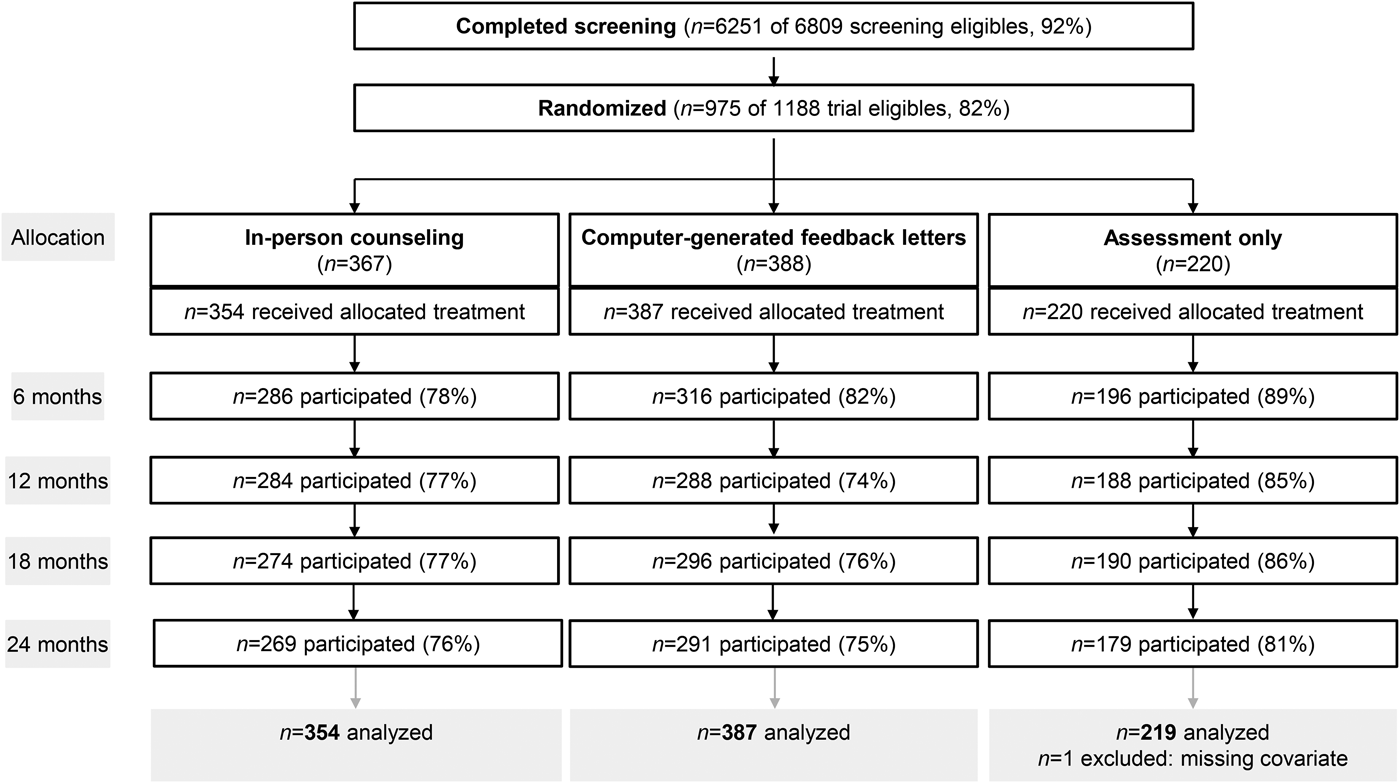
Expecting small intervention effects concerning the primary outcome reduced alcohol use after 24 months, 975 inpatients with an allocation ratio of 2PE:2CO:1AO were needed (Freyer-Adam et al., Reference Freyer-Adam, Baumann, Haberecht, Tobschall, Bischof, John and Gaertner2018). In total, n = 6251 (92% of those eligible) completed the screening. Of these, n = 1327 were screened positive for at-risk alcohol use. Among them, n = 124 were excluded from the trial due to alcohol use disorder identification test-consumption (AUDIT) score ⩾20 and n = 15 due to having no telephone, leaving n = 1188 eligible for trial inclusion. Of these, n = 975 agreed to participate, and n = 961 (81% of those eligible) received their allocated intervention (Fig. 1). Participants were younger, better educated, and did not differ in other socio-demographic or alcohol-related aspects from non-participants (Freyer-Adam et al., Reference Freyer-Adam, Baumann, Haberecht, Tobschall, Schnuerer, Bruss, Bandelin, John and Gaertner2016).
Participant flow by the study group. Note: Flow according to the CONSORT statement is provided in more detail elsewhere (Freyer-Adam et al., Reference Freyer-Adam, Baumann, Haberecht, Tobschall, Bischof, John and Gaertner2018).

Interventions
As described in more detail elsewhere (Freyer-Adam et al., Reference Freyer-Adam, Baumann, Haberecht, Tobschall, Schnuerer, Bruss, Bandelin, John and Gaertner2016, Reference Freyer-Adam, Baumann, Haberecht, Tobschall, Bischof, John and Gaertner2018), PE and CO, both psychological interventions, were comparable in content. They primarily differed in how the content was delivered.
Content of PE and CO: Both PE and CO were designed to include three intervention contacts: at baseline, and 1 and 3 months later. PE and CO were based on the trans-theoretical model of intentional behavior change (TTM, Prochaska and DiClemente, Reference Prochaska and Diclemente1984; Prochaska and Velicer, Reference Prochaska and Velicer1997). According to the TTM, persons proceed through stages of change from not intending to change (precontemplation) up to manifesting change (maintenance); and interventions are expected to be most effective when tailored to the person's current stage. In the past, stage of change measures have been criticized for being based on arbitrary time periods (Sutton, Reference Sutton2001), and TTM-based interventions often failed to show convincing effects as they did not include the model's multiple dimensions (Bridle et al., Reference Bridle, Riemsma, Pattenden, Sowden, Mather, Watt and Walker2005). In this trial, a staging measure rather independent of time periods was used (Lippke et al., Reference Lippke, Ziegelmann, Schwarzer and Velicer2009; Freyer-Adam et al., Reference Freyer-Adam, Baumann, Haberecht, Tobschall, Schnuerer, Bruss, Bandelin, John and Gaertner2016), and both interventions were matched with the current stage using all dimensions of the model which has been shown to increase intervention effects (Noar et al., Reference Noar, Benac and Harris2007; Webb et al., Reference Webb, Joseph, Yardley and Michie2010). As part of each of the three intervention contacts, the participants were required to first respond to self-report measures on alcohol use and on the four TTM dimensions (stage of change, processes of change, decisional balance, and self-efficacy). These measures were either provided by electronic-handheld devices (month 0) or as part of computer-assisted telephone interviews (CATIs, months 1 and 3). Based on these responses, PE and CO provided feedback. Feedback was stage-matched and addressed all TTM dimensions. For example, while participants in the precontemplation stage received feedback on cognitive–affective processes of change and self-perceived pros/cons of drinking; participants planning to reduce or quit drinking (preparation stage) received feedback on behavioral processes, self-efficacy, and self-perceived pros/cons of drinking. Normative feedback was provided, i.e. feedback on TTM dimensions was given in comparison with persons in the same motivational stage concerning reduction/quitting of drinking; and feedback on drinking was given in comparison with persons of the same gender. In addition, at months 1 and 3, participants received feedback on own behavioral and motivational changes over time. PE and CO included information on low-risk drinking limits.
PE was delivered by research staff (three psychologists, one study nurse) with an average of 42 h of training in motivational interviewing (Miller and Rollnick, Reference Miller and Rollnick2002)-based techniques plus weekly group supervisions. Baseline counseling was conducted face-to-face on the ward or if discharged by phone. After 1 and 3 months, the same counselor when possible conducted CATIs and provided feedback on the phone. In total, each participant received 35 minutes (median) of counseling with medians of 20, 11, and 11 minutes at months 0, 1, and 3, respectively. Of all participants, 17% received one, 29% two, and 54% all three possible consultations. To ensure comparability of intervention content with CO and to leave enough margin to counselors to practice motivational interviewing, the counselors were asked to provide feedback on at least three TTM constructs (precontemplation stage: two). Information on individual TTM scores and alcohol use were provided to counselors on a one-page output, created automatically by expert system software after completion of CATI. PE was delivered with acceptable adherence to motivational interviewing; and its content was comparable with CO content (Freyer-Adam et al., Reference Freyer-Adam, Baumann, Haberecht, Tobschall, Bischof, John and Gaertner2018).
CO was delivered by three to four page computer-generated individualized feedback letters and TTM stage-matched manuals (German Centre for Addiction Issues, 2008a). The letters were created automatically by expert system software as used similarly in previous studies (e.g. Velicer et al., Reference Velicer, Prochaska, Bellis, Diclemente, Rossi, Fava and Steiger1993; Freyer-Adam et al., Reference Freyer-Adam, Baumann, Schnuerer, Haberecht, Bischof, John and Gaertner2014). For each intervention time point, the software consisted of primarily TTM-derived selection rules, and a pool of up to 276 text modules and graphics written in a patient-accepting, supportive, and non-confrontational style. Using these, the software created individually tailored letters depending on alcohol use and TTM assessment data (see Freyer-Adam et al., Reference Freyer-Adam, Bischof, Goeze, Gaertner, Baumann, Schnuerer, Gross, Meyer and John2011). The letters were automatically created, printed, and referred to certain pages of the stage-matched manual for more information. After baseline, both were handed out on the following day or sent by mail in case of discharge. After 1 and 3 months, research assistants conducted CATIs. Based on these, a new letter and stage-matched manual were sent by mail. Of all participants, 11% received one, 17% two, and 72% all three possible feedback letters.
Assessment only (AO) included care as usual, and participants received minimal assessment at baseline only, i.e. measures of alcohol use and stage of change.
Randomization
To prevent participants allocated to different study groups from exchanging intervention information, participants were randomized in small clusters. On each ward, allocation to study groups rotated by week. For this purpose, the wards were collapsed to two groups of closely located wards. Five weeks intervals with 1 week for AO and two weeks for PE and CO were used. In weeks 1/2/3/4/5 ward group 1 participants were allocated to AO/PE/PE/CO/CO, respectively, and ward group 2 participants were allocated to CO/CO/AO/PE/PE, respectively. This sequence was run 14 times, resulting in 140 clusters. As part of the screening software, the handheld device conducted group allocation after the research assistant entered ward group before the screening started. Only in case patients consented to participate in the trial, allocation was recorded. Participants were not explicitly informed about study group allocation.
Follow-ups
The 6-/12-/18- and 24-month follow-ups were conducted in 2011–2014 with an average participation of 80% (Fig. 1). If contact attempts by phone (88% CATIs) failed, participants were asked by mail/email to either fill in self-administered questionnaires or to participate in computer-assisted face-to-face interviews. Incentives included promised self-selected 10/15/20€ vouchers for the 6-/18-/24-month follow-up participants; and a prepaid 5€ voucher along with the 12-month follow-up announcement for all trial participants.
All follow-up interviewers were blinded to group allocation, i.e. they were not informed about group allocation. Sixty four percent of the CATIs were conducted by student interviewers (97/47/49/60% at months 6/12/18/24) and 36% by research assistants that may have been involved in sample recruitment 1 or 2 years before follow-ups.
Measurements and outcomes
To screen for at-risk alcohol use, the AUDIT-C (Bush et al., Reference Bush, Kivlahan, Mcdonell, Fihn and Bradley1998) was used. Three items assess frequency/quantity of drinking and heavy drinking (score range: 0–12). Women with ⩾4 and men with ⩾5 points were considered at-risk drinkers. These cut-points are related to a good balance of sensitivity and specificity concerning the detection of at-risk alcohol use (Reinert and Allen, Reference Reinert and Allen2007). To exclude persons with severe alcohol problems, the total AUDIT (Saunders et al., Reference Saunders, Aasland, Babor, De La Fuente and Grant1993) score including the AUDIT-C and seven items on symptoms of alcohol use disorders (score range: 0–40) was used. A cut-point of ⩾20 was applied as persons with scores above 19 are likely to be dependent on alcohol (Donovan et al., Reference Donovan, Kivlahan, Doyle, Longabaugh and Greenfield2006).
Self-reported mental and general health were assessed at baseline, after 6, 12, 18, and 24 months (primary time-point). To enhance participation in follow-ups over 2 years by conducting rapid follow-up interviews, particularly short measures that perform well in large population samples were applied.
Mental health was assessed using the five-item mental health inventory (Berwick et al., Reference Berwick, Murphy, Goldman, Ware, Barsky and Weinstein1991; Rumpf et al., Reference Rumpf, Meyer, Hapke and John2001). It asks ‘How often in the past month e.g. were you nervous/did you feel calm?’ on a five-point rating scale from ‘never’ to ‘always’. The score range was transformed to 0–100, with higher scores indicating better mental health. The five-item mental health inventory is commonly used as a screening measure for the most common mental health disorders in population studies. In a large German general population study, the five-item mental health inventory with a cut-off point of 65 performed well in detecting current mood and anxiety disorders (Rumpf et al., Reference Rumpf, Meyer, Hapke and John2001). In a large Danish population study, it was found to be a better predictor of long-term sickness absence than the well-established major depression inventory (Thorsen et al., Reference Thorsen, Rugulies, Hjarsbech and Bjorner2013).
General health was assessed using one item and five response categories ‘Would you say your health in general is poor (0)/fair (1)/good (2)/very good (3)/excellent (4)?’ (McHorney et al., Reference McHorney, Ware and Raczek1993). This measure of self-rated health is a reliable and independent predictor of mortality, also when adjusted for numerous indicators of health status and mortality (Idler and Benyamini, Reference Idler and Benyamini1997).
Baseline covariates: Socio-demographic variables included gender, age (years), living in a partnership (yes/no), school education (<10/10–11/>11 years of school), and employment status (employed/unemployed/other). Alcohol problem severity was captured by the number of alcohol use disorder symptoms derived from the AUDIT items four to 10. Each item was coded 1 if participants had experienced the respective symptom in the past 12 months, resulting in a total maximum score of 7. Initial TTM motivational stage, i.e. motivation to reduce or quit drinking (precontemplation, contemplation, preparation, and action) was assessed using a four -item staging algorithm (described in Freyer-Adam et al., Reference Freyer-Adam, Baumann, Haberecht, Tobschall, Schnuerer, Bruss, Bandelin, John and Gaertner2016), an adaptation of measures previously used (DiClemente et al., Reference DiClemente, Prochaska, Fairhurst, Velicer, Velasquez and Rossi1991; Lippke et al., Reference Lippke, Ziegelmann, Schwarzer and Velicer2009). Further health variables included the medical department (internal medicine/surgical medicine/trauma surgery/ear-nose-throat) and current cigarettes per day.
Statistical analyses
Using Mplus 7.31 (Muthén and Muthén, Reference Muthén and Muthén2011), two latent growth models (Wang and Wang, Reference Wang and Wang2012) were applied to investigate the effects of CO and PE on the development of self-reported general and mental health over 24 months. To decide on form and variance of growth curves, rescaled likelihood ratio tests were used. To provide a detailed picture on trajectories of change over time, differences of means in change from baseline to follow-up and 95% confidence intervals for each follow-up were calculated. At month 24 (primary time point), statistical significance was tested with p < 0.008 considered statistically significant after Bonferroni correction for six comparisons. Effect sizes Cohen's d are given.
A maximum likelihood estimator with robust standard errors was chosen, i.e. models were estimated under a missing at random assumption (Little and Rubin, Reference Little and Rubin2002) using all available data. To make the missing at random assumption more plausible, the models were adjusted for all variables that predicted follow-up participation in multivariable models at p ⩽ 0.1: age, school education, alcohol use disorder symptoms, motivation, medical department, and depending on model: mental or general health. To allow for chance imbalances between study groups and to account for the potential relevance of co-substance use, models were also adjusted for gender, employment status (p ⩽ 0.1), and current cigarettes per day, respectively. One participant with missing baseline stage of change was excluded, resulting in n = 960 participants for both analyses.
Results
Sample characteristics
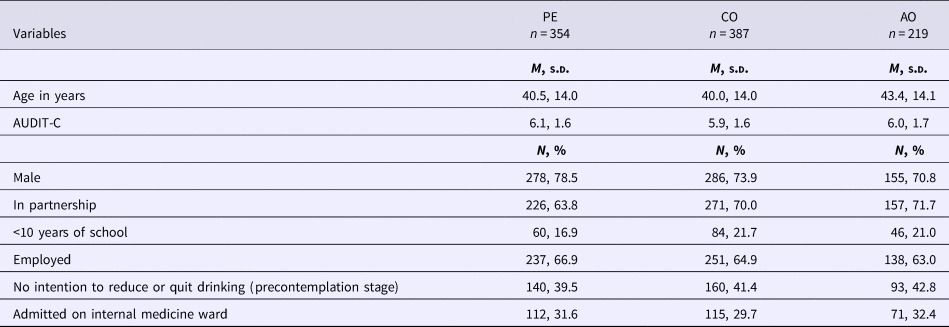
At baseline, the mean age of the total sample was 40.9 years (s.d. = 14.1) and 74.9% were male. The mean five-item mental health score was 68.7 (s.d. = 17.0) and the mean general health score was 2.0 (s.d. = 0.8). A small Pearson's correlation of r = 0.27 was obtained for both measures of health. The study groups did not significantly differ in terms of both health outcomes and all alcohol- and socio-demographic variables except age (Table 1, Freyer-Adam et al., Reference Freyer-Adam, Baumann, Haberecht, Tobschall, Bischof, John and Gaertner2018).
Socio-demographic and alcohol-related sample characteristics at baseline stratified by study group (n = 960)
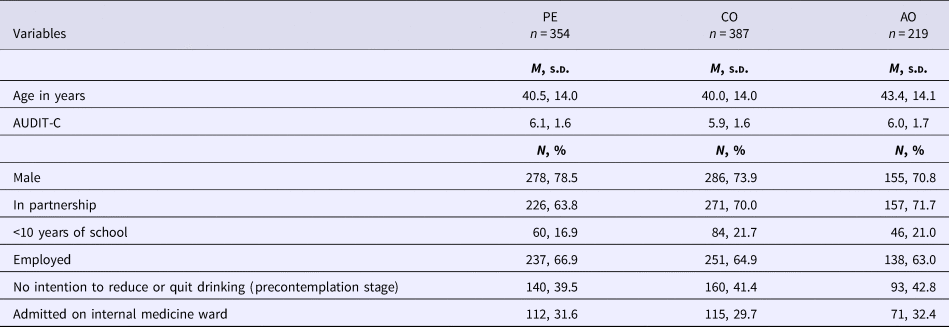
PE, in-person counseling; CO, computer-generated feedback letters; AO, assessment only; M, mean; s.d., standard deviation; N, number of cases; AUDIT-C, alcohol use disorder identification test-consumption.
Health measures over time
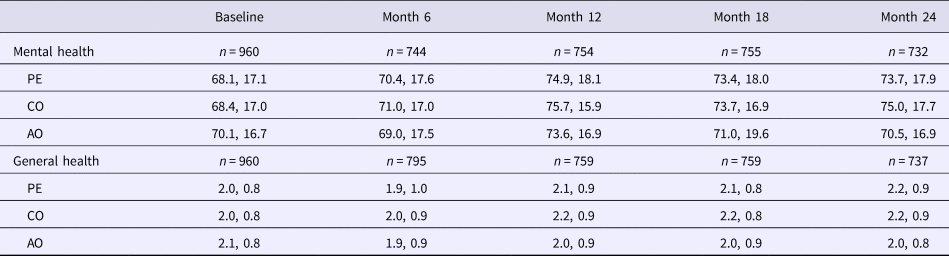
Unadjusted means and standard deviations on both health measures by study group for each time point are given in Table 2.
Unadjusted means and standard deviations on self-reported mental and general health by study group at all time-points
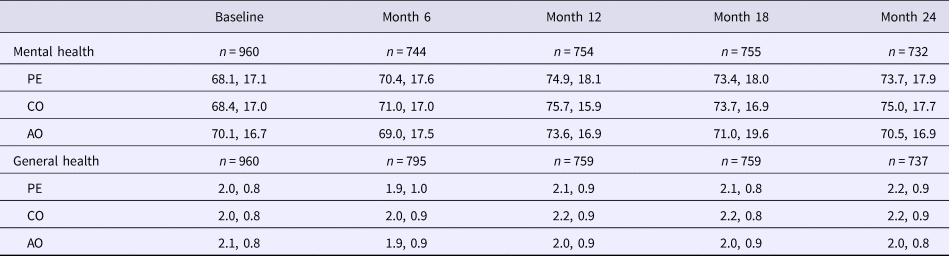
PE, in-person counseling; CO, computer-generated feedback letters; AO, assessment only.
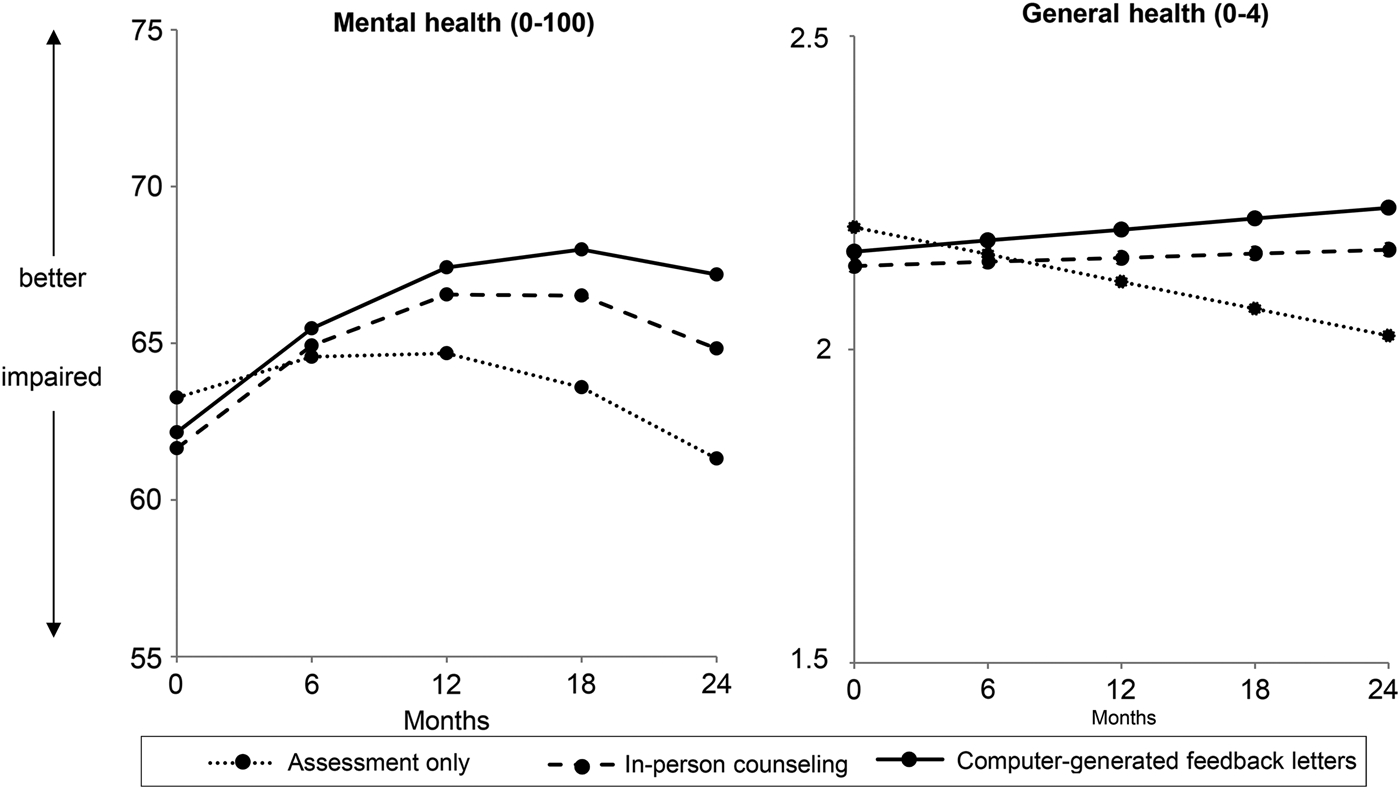
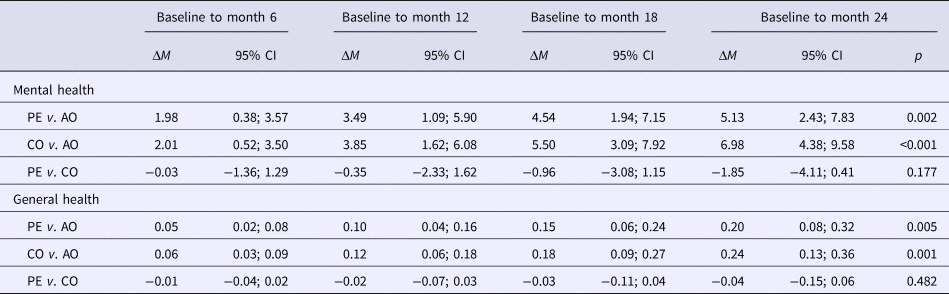
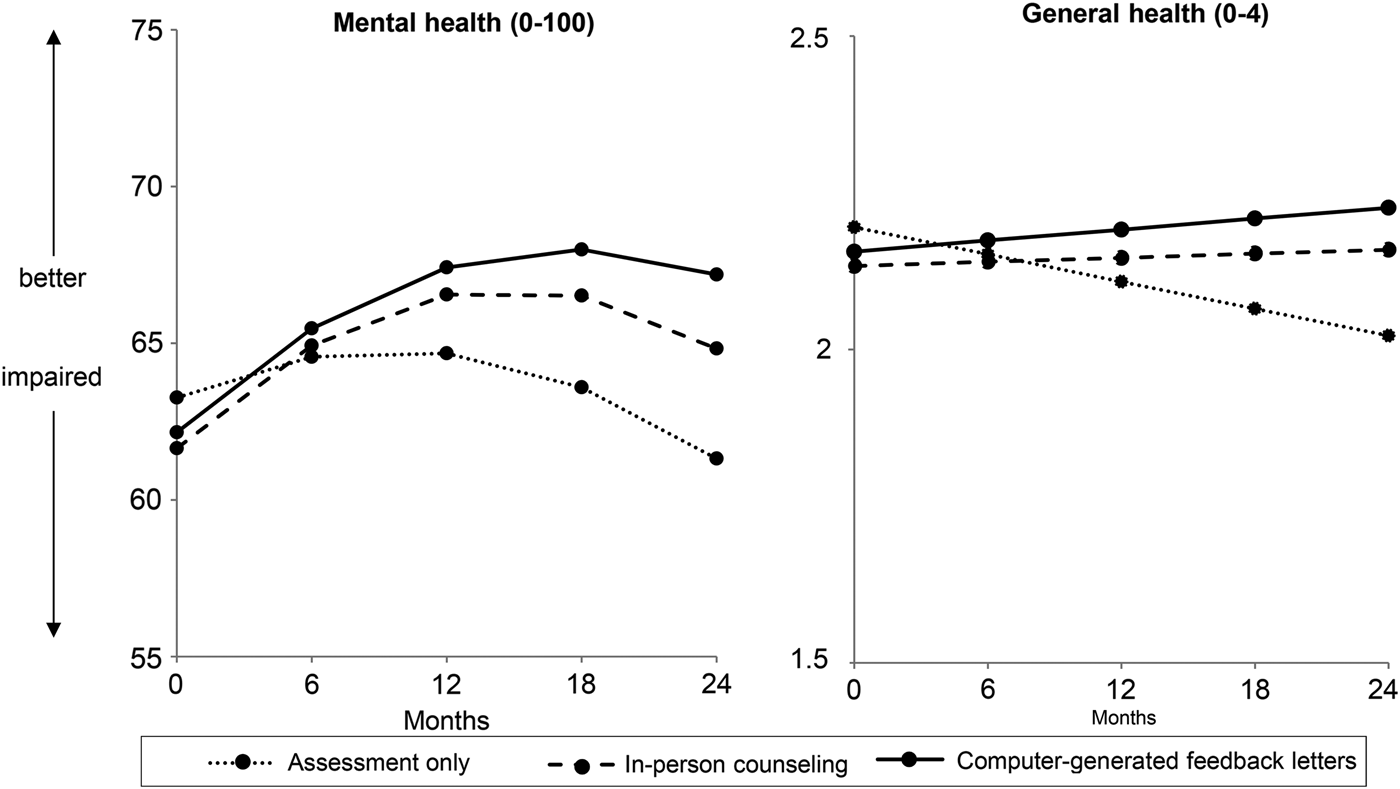
Adjusted models revealed that mental health developed curvilinearly over time (Fig. 2). In comparison with AO, PE (ΔM = 5.13, p = 0.002, d = 0.51; unadjusted: ΔM = 4.39, p = 0.005) and CO (ΔM = 6.98, p < 0.001, d = 0.69; unadjusted: ΔM = 6.06, p < 0.001) resulted in significantly better mental health at month 24 (Table 3). Intervention effects did not differ significantly by whether the intervention was delivered in-person or through CO (ΔM = −1.85, p = 0.177, d = 0.18; unadjusted: ΔM = −1.67, p = 0.227).
Self-reported mental and general health over 24 months by the study group. Note: N = 960, adjusted model-implied mean values.
Between group differences concerning self-reported mental and general health at all four follow-ups in comparison with baseline (n = 960)
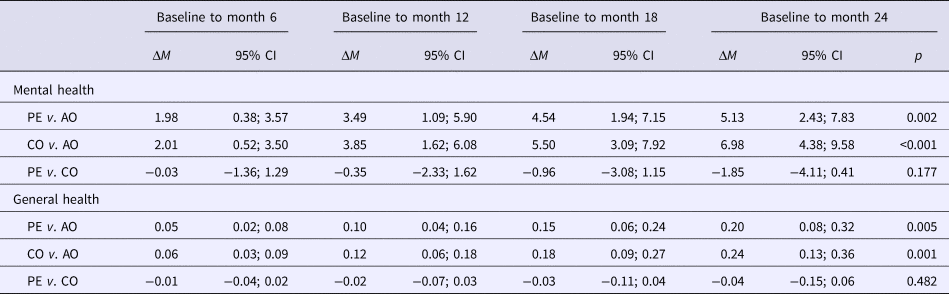
ΔM, difference of means; CI, confidence interval; PE, in-person counseling; AO, assessment only; CO, computer-generated feedback letters.
Adjusted latent growth models.
Self-reported general health developed linearly over time (Fig. 2). That is, with every 6 months, the mean difference between AO and PE increased significantly by 0.05 (unadjusted: ΔM = 0.05), and between AO and CO significantly by 0.06 (unadjusted: ΔM = 0.06). As depicted in Table 3, by month 24 general health was improved by 0.20 in PE v. AO (p = 0.005, d = 0.71; unadjusted: ΔM = 0.20, p = 0.005) and by 0.24 in CO v. AO (p = 0.001, d = 0.86; unadjusted: ΔM = 0.22, p = 0.002). Again PE v. CO difference was not significant (ΔM = −0.04, p = 0.482, d = 0.16, unadjusted: ΔM = −0.02, p = 0.721).
Discussion
BAIs aiming to reduce alcohol use in at-risk drinking general hospital inpatients can improve mental and general health. In this study, independent from method of delivery, in-person delivered and computer-generated feedback resulted in significantly improved self-reported mental and general health over 24 months in contrast to AO. Furthermore, for both channels of delivery, increasing intervention effects over time concerning self-reported general health were observed.
Until now, evidence on BAI efficacy in health-care settings has been derived primarily from decreased alcohol use, and little has been known about BAI effects on mental and general health. Within this randomized controlled trial, the findings concerning measures of health support BAI efficacy consistently: for both health measures, for all follow-ups, and with a similar direction of increasing intervention effects for both methods of delivery. The positive effects on both health measures are valuable as with higher values on the general health item, the likelihood of premature death should decrease (Idler and Benyamini, Reference Idler and Benyamini1997). Self-reported general health is considered ‘an irreplaceable dimension of health status’ as it provides a more holistic picture of the health status than ‘nothing else could’ (Idler and Benyamini, Reference Idler and Benyamini1997, p. 34). It may be expected that this measure would also capture existing physical or mental health comorbidities well. In this regard, medical records are likely to be limited as routine care physicians tend to underestimate the true occurrence of particularly common mental disorders (Olariu et al., Reference Olariu, Forero, Castro-Rodriguez, Rodrigo-Calvo, Alvarez, Martin-Lopez, Sanchez-Toto, Adroher, Blasco-Cubedo, Vilagut, Fullana and Alonso2015). Concerning the improved mental health inventory scores in both BAI groups, long-term sickness absence among employees should decrease (Thorsen et al., Reference Thorsen, Rugulies, Hjarsbech and Bjorner2013). Besides the clinical significance for each person among this population of risky although not yet extremely heavy drinkers, these findings also need to be viewed in terms of potential impact on the population level given the interventions are implemented widely (Heather, Reference Heather2012). According to the prevention paradox, most alcohol-related problems, including alcohol-related hospitalization and deaths occur among the lesser-drinking majority of the population and not among the small proportion of extremely heavy drinkers (Rose, Reference Rose1985; Poikolainen et al., Reference Poikolainen, Paljarvi and Makela2007). While, despite medium to large effect sizes, score differences of 7.0 in mental health and 0.24 in general health may appear small and may not necessarily be involved with immediate benefit for each single person, these small changes in many, i.e. in most risk-bearers may have a substantial impact on the population level (Rose, Reference Rose1985). Our findings indicate that the interventions may prevent a worsening of mental and general health after discharge from hospital. As these medium to large effects on health were produced in persons of whom an initial 41% were not yet contemplating to change their drinking and who would very unlikely have sought any alcohol-related advice without this facilitated approach, and as these intervention effects increased over time and may even further increase beyond year 2, this study supports that systematic screening and BAI in the general hospital setting, when implemented widely, has the potential to improve population health in the long-term.
In contrast to these consistent positive results on both health measures, the primary outcome findings concerning alcohol use measures were less consistent: while CO (not PE) resulted in significantly reduced self-reported g alcohol per week up to month 24, PE (not CO) reduced the probability of at-risk drinking by one-half at month 6 (Freyer-Adam et al., Reference Freyer-Adam, Baumann, Haberecht, Tobschall, Bischof, John and Gaertner2018). This current study's findings may provide support for the assumption that short-term intervention effects on health-risk behaviors vanishing over time may still be of long-term value due to reducing or removing the health-risk behavior earlier in time. However, whether BAI effects on health measures are mediated by reduced alcohol use or caused through effects on other relevant health domains or whether effects are moderated by the initial reason of admission or by whether or not the reason for admission was attributable to alcohol, should be investigated in the future.
Strengths and limitations
There are notable strengths of this study. First, four follow-ups up to month 24 provided the opportunity to investigate the long-term efficacy of BAIs concerning health measures, and the trajectories of change in self-reported general and mental health over time. Second, findings were derived from a systematically drawn sample. Due to proactive recruitment (Prochaska, Reference Prochaska2008) more than 80% of all eligible inpatients were reached, providing an almost representative sample of inpatients on wards with a high load of at-risk drinking inpatients. Reach is a core dimension of public health impact of interventions (Glasgow et al., Reference Glasgow, Vogt and Boles1999; Glasgow and Estabrooks, Reference Glasgow and Estabrooks2018). In this study also persons with low alcohol use problem severity and low motivation to change, an underserved and main target population for public health approaches, were reached and had the chance to benefit from these interventions concerning their own mental and general health. Third, latent growth analyses were used. These analyses handle missing values by using maximum likelihood estimation based on all data available, allowing to include all study participants irrespective of missing data at a specific follow-up.
Several limitations should be noted. First, self-report was used. Outcome measures were not drawn from patients’ medical records. In Germany, national register-based medical records are unavailable, and health insurance data are difficult to obtain due to the large number of health insurance companies, i.e. 156 compulsory plus private companies at study start. Concerning the hospital's medical records, we would expect that only a small and selective part of our sample would be readmitted to the same hospital within the 2 years, and that for most participants no comparable outcome data would be available. No such losses are expected from self-report. While self-reported alcohol use may be distorted by social desirability in randomized controlled trials on BAIs, particularly in intervention groups (Saitz, Reference Saitz2014), we assume that these self-reported health outcomes bear lower risks of being biased by social desirability or task demand effects in the intervention groups as improving mental and general health was not the explicit target of the interventions in this study. Second, given the population-based nature of the study, little is known about the clinical relevance of the observed changes in mental and general health. However, the selected self-report health measures, although simple, are characterized by good predictive validity of clinically relevant outcomes; and the public (mental) health relevance appears to be high. Third, strictly speaking, besides controlling for medical department, we did not take into account that participants were randomized in small clusters. However, different from common cluster-randomized trials, we expect no severe loss of power. Through the ward and week dependent allocation sequence, all wards provided participants for each study group. And, with the large number of 140 clusters and the small average number of seven participants per cluster, only a small design effect (if at all) may be expected (Killip et al., Reference Killip, Mahfoud and Pearce2004). Fourth, although follow-up interviewers did not obtain information on group allocation, we cannot completely rule out memory effects as three of 16 follow-up interviewers, particularly at months 12, 18, and 24, may have been involved in sample recruitment 1–2 years before the follow-ups. Memorizing group allocation was expected to be highly unlikely due to the time passed since recruitment, the high patient and participant flow (>10 000 inpatients assessed for eligibility), and the large study sample (n = 961). And finally, generalizability of the findings to non-theory driven or non-motivational interviewing based or non-facilitated interventions may be limited. These psychological interventions were designed to reach out to patients, rather than to wait for patients to contact the interventionists. Interventions might work differently when provided without facilitation, and/or without according psycho-theoretical and motivation enhancing background.
Conclusions
This study provides first insight into the positive effects of facilitated in-person alcohol counseling and computer-generated feedback on mental and general health in medical care patients with at-risk alcohol use; and that effects can be sustained and even increase over 2 years. These findings provide new support for Screening, Brief Intervention and Referral to Treatment programs (e.g. Babor et al., Reference Babor, Del Boca and Bray2017), and are of considerable public (mental) health relevance. Future research has to confirm this. Replication is needed concerning the general findings as well as interventions in other medical care settings, and concerning clinical parameters. Furthermore, the investigation of BAI effects on measures of mental and general health in the long-term, beyond year 2, is warranted. However, at this stage, our findings highlight the potential of BAIs to increase mental and general health over time.
Acknowledgements
The authors appreciate Elke Bandelin, Kornelia Sadewasser, Stefanie Tobschall, Inga Schnuerer, and Angelika Beyer for conducting field work, and Christian Goeze for programming the intervention and participant management software. The authors are grateful for the support provided by the heads and staff of the participating departments at the University Medicine Hospital Greifswald. The authors are much obliged to the participants and their efforts for their long-lasting participation.
Financial support
The study was funded by grants from the German Cancer Aid to JFA, BG, and UJ (108376, 109737, 110676, 110543, and 111346). SB was supported by the Alfried Krupp von Bohlen and Halbach Foundation; KH by the Mecklenburg-Vorpommern State Graduate Funding; and GB, CM, HJR, and UJ by the German Federal Ministry of Education and Research (research consortium on addiction ARIAL, 01EE1406F, and 01EE1406H). The funders had no role in study design, data collection and analysis, decision to publish, or preparation of the manuscript.
Conflict of interest
JFA, GB, and HJR are members of the Motivational Interviewing Network of Trainers. No financial conflict of interest exists.
Ethical standards
The authors assert that all procedures contributing to this work comply with the ethical standards of the relevant national and institutional committees on human experimentation and with the Helsinki Declaration of 1975, as revised in 2008. The authors assert that all procedures contributing to this work comply with the ethical standards of the relevant national and institutional guides on the care and use of laboratory animals.