Humanitarian actors are better at responding to crises than at preventing or preparing for them. Preparing for the crises of the future means not only developing more efficient relief delivery mechanisms and protection strategies, but also analysing the political and economic context that will shape the nature of future challenges. Over the past twenty-five years, the international humanitarian system has gone through major changes as a result of crises such as the Kobe earthquake, conflicts in Bosnia, Rwanda, and Somalia, the 11 September 2001 terrorist attacks on the United States, the war in Afghanistan, the Indian Ocean tsunami, the famine and conflict in Darfur, the earthquake in Haiti, and hundreds of smaller emergencies. Indeed, the system has dramatically improved in responding to crises quickly, effectively, and professionally. Humanitarians have become much better at responding to emergencies and lives have been saved because of those changes.
Nonetheless, in the past few years, the humanitarian system has come under enormous stress in responding to new mega-crises, which have occurred on top of a growing number of protracted crises. For example, international organizations have found it easier to raise funds for a high-visibility emergency, such as the Haitian earthquake, than for refugees streaming out of Côte d'Ivoire, or internally displaced persons (IDPs) living for years in Iraqi cities or for decades in Colombian ones. The system is already stretched, but it is likely to experience additional stress in the coming decades.
This article reviews six megatrends likely to shape the future context of humanitarian response over the next twenty-five years and draws out their implications for future humanitarian work. These are not new trends. Indeed, with the exception of technology and science, all of them were highlighted twenty-five years ago by the United Nation's Report of the World Commission on Environment and Development, Our Common Future. Footnote 1 Even today's prediction of the increase in sudden-onset natural disasters was foreshadowed in this 1987 report, although the links with climate change were not at that time so definitively drawn. In the past couple of years, there has been growing interest in looking at the implications of global trends on future humanitarian action,Footnote 2 which is itself a recognition that the humanitarian system must change to meet future challenges.
Predicting the future is particularly difficult in an era of rapid technological development. Who could have imagined twenty-five years ago the role of social media in the popular uprisings known as the Arab Spring? Or the collaborative mapping of earthquake damage in Haiti, carried out not by professional humanitarians but by individuals sitting at computers far from the earthquake's epicentre? It is also difficult to predict a truly catastrophic event, such as a global pandemic, a nuclear war, or even collision with an asteroid. Few in the humanitarian community are considering such possibilities but, as the concluding section of this article suggests, it behoves them to do so.
The six megatrends analysed here are:
• demographic trends: more people, older people, more urbanization;
• technology and science: rapid change;
• economic trends: uneven growth, increasing inequality;
• political power: changing global patterns, changing domestic determinants;
• climate change: more disasters; and
• conflict: prolonged, simmering, and increasingly urban.
Demographic trends: more people, older people, more urbanization
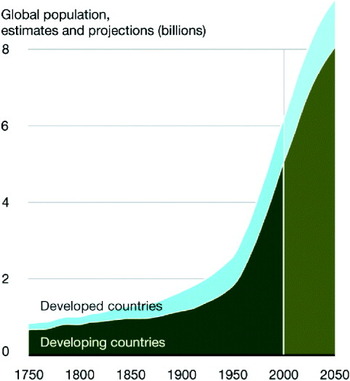
The UN predicts that the world's population will continue to grow, reaching the level of 10.1 billion by 2100; this is an increase over earlier projections that the population would level off by the middle of this century.Footnote 3 The expansion of the population to 8 billion by 2025, coupled with changing consumption patterns, is expected to lead to a 50% increase in global food production.Footnote 4 Most of this growth will take place in developing countries and will result in a different balance in the relative populations of developed and developing countries. In 2003, the population of Canada, the US, and Europe made up 17% of the world's population; by 2050, that figure will shrink to 12%.Footnote 5 Whereas today Europe and Africa are each home to about one-eighth of the world's population, by 2050 Europe's share will shrink to about 6.8%, while Africa's share will grow to 21.8%.Footnote 6
Global population, 1750–2050. From United Nations Environment Programme, http://maps.grida.no/go/graphic/trends-in-population-developed-and-developing-countries-1750-2050-estimates-and-projections.

The demography within countries will also change, with increasing percentages of elderly people. Indeed, the UN projects that 58% of the world's population growth will come from increases in the number of people over 60, whereas only 6% will come from people under 30.Footnote 7 This trend is already evident in developed countries, particularly Europe, Japan, and Korea, where the decline in the labour force and corresponding increase in retirement expenditures is taxing economies. Predictions are that aging populations will constrain economic growth in these countries, increase the demand for migrant labour, and affect the ability of these governments to be active participants in the international arena.Footnote 8
This aging of the world's population will be uneven. Longman notes, for example, that it is already apparent in the world's middle-level powers, where countries such as Iran and Mexico will have a larger percentage of their populations over the age of 60 than France does today.Footnote 9 The consequences of these demographic developments will be manifold. For example, demographic pressures leading to Mexican migration to the US will fall off (and, indeed, such migration is already decreasing), even as the demand for foreign labour will increase in the US and other developed countries.
Most of the world's expected population growth will be concentrated in countries that are already poor and young, particularly in Africa and in countries with substantial Muslim populations. Fertility continues to be very high in some countries, especially sub-Saharan Africa, and is the reason why the UN Population Division revised its prediction to forecast much higher global population growth rates. Thus Malawi, a country of 15 million today, could grow to 129 million by 2100. Yemen, whose population has increased from 5 million to 25 million between 1950 and 2010, is expected to quadruple its population again, to 100 million, by the end of the century.Footnote 10 Today Afghanistan has 28 million people; by 2025, there will be 45 million and by 2050 there will be close to 75 million.Footnote 11 This growth in population in developing countries will outpace educational and especially job opportunities. Governments and economies of developing countries will be unable to produce the jobs needed by a growing population, which will have political consequences as well as increasing pressures for migration. This so-called ‘youth bulge’ will put increased stress on the governments of fast-growing developing countries. In an extreme case, the Palestinian territories are likely to see an 84% increase in youth population between 2005 and 2025.Footnote 12 Pressure to create jobs for these young people will intensify.
In sum, rich countries will have a proportionately smaller percentage of the world's population, both rich and middle-income countries will have older populations, and the demographic pressure on presently poor countries will continue. These trends have global political and economic consequences. Politically, countries of the global south will become more powerful in multilateral fora as a result of their burgeoning populations. Meanwhile, developed countries will spend increasing percentages of their domestic budgets on pensions and medical costs of caring for an aging population.
Another major trend will be the continuing urbanization of the world's population, particularly in the developing world. As agriculture becomes more mechanized, there will be a continued shift from rural areas to cities – a shift accelerated by the powerful expansion of media messages touting the modernity of urban life. Intra-urban migration will also increase. Megacities – those with populations of more than 10 million – will get larger, and the number of moderate-sized cities of 1 million will skyrocket.Footnote 13 This will lead to more pressure on urban land and will have political consequences as urban residents everywhere demand more from their governments than people living in rural areas. In the longer term, urbanization is leading to a slower rate of population growth, as it seems that the high cost of raising children in megacities is a main reason for falling global birth rates.Footnote 14 Urban residents not only demand more from their governments, but they earn and consume more. For example, people spend an average of 30% more on food in urban than in rural areas.Footnote 15 Most urban growth is occurring in slums and shantytowns, which increases vulnerability of populations to disasters and disease. UN-Habitat reports that 43% of urban residents in developing countries and 78% of those in the least-developed countries live in slums with lodgings of impermanent materialsFootnote 16 – a factor that increases their vulnerability to disasters of all types. As Ronak Patel concludes, ‘[u]rbanization, in fact, is a health hazard for certain vulnerable populations’.Footnote 17 Given the rising density of populations, the potential for the spread of disease increases, and the increasing international travel associated with globalization, the threat of pandemics is very real.Footnote 18
Finally, 3 billion more people on the planet, particularly if they are living in urban areas, will produce significantly more greenhouse gas emissions, increasing global warming.
What does this mean for humanitarian action in the future ?
So what do all of the above trends mean for future humanitarian action? First, increased population and increased concentration of populations in urban areas mean that more people are likely to be affected by conflict and natural hazards in the future. Second, there are also likely to be increasing numbers of conflicts over resources, as more people compete for finite quantities of arable land, water, and other resources. Third, a larger proportion of older people in the population means that humanitarian actors will need to be able to respond to the particular needs of the elderly in conflicts and natural disasters. This involves not only taking into consideration specific medical needs of older populations (e.g. more medicines for hypertension, fewer for infant diarrhoea) but also factoring this into planning for long-term solutions for those displaced by conflict or disasters. As the 2011 Japanese earthquake demonstrated, the elderly were not only disproportionately affected by the earthquake but are also finding it more difficult to restart their lives.Footnote 19
Technology and science: rapid, rapid change
It is hard to overstate the impact of technological and scientific innovation over the past twenty-five years. The world's population growth is at least partly the result of higher crop yields resulting from improved agricultural technologies. Similarly, both the world's improving health and the aging of the population are due in large measure to developments in medical research and consequent improvements in both the quality and the availability of health care. Increasing access to birth control has contributed to declines in fertility rates, even as medical research has made it possible to select the gender of children. Robots are reducing the possibility of errors in surgery, while mobile technologies, as well as low-tech solutions, can enable remote communities to access sophisticated medical attention.Footnote 20 Medical research will find new (and often more expensive) ways of keeping people healthy for longer, and life expectancy is likely to increase in all regions. At the same time, access to medical technology will be uneven, with a significant gap between rich and poor within countries.Footnote 21
The pace of technological and scientific innovation will increase. Computers will become smaller, faster, and cheaper, which means that more people, in both developed and developing countries, will be connected via the Internet. Mobile phone technology, now the dominant tool of communication in many regions, will reach close to global coverage in the coming generation.Footnote 22 Technologies will become more than repositories of knowledge: they will be increasingly smarter, more autonomous, and more anthropomorphic, with voice- and gesture-based commands. On the economic level, more work will be automated, particularly in developed countries, resulting in fewer jobs in the service sector. For example, even in the food service industry – a bastion of entry-level jobs for unskilled workers – increased automation is occurring. Automated sushi bars serve customers in Japan, while the possibility of touch-screen orders at McDonald's is actively discussed.Footnote 23 Technologies such as mobile banking will increase, with a corresponding decrease in the use of cash.Footnote 24 This has implications for humanitarian assistance, as evidenced by the practice of aid distribution through prepaid bank cards as used in response to the 2010 floods in Pakistan, as well as for mobilizing charitable contributions, such as those witnessed in response to the 2010 earthquake in Haiti, the 2010 floods in Pakistan, the 2011 tsunami and earthquake crisis in Japan, and ongoing drought in East Africa.Footnote 25
Global connectivity will continue to increase; social media such as Twitter and Facebook (and new ones that have yet to emerge) will continue to expand. There will be a fusion of mainstream and social media, now evident in CNN's regular reporting on Twitter, but mainstream media will decrease in power as social media grow. This change is driving a transformation not only in the nature of news but in the possibilities of popular response. News is now defined less by experts sitting in headquarters offices than by people reporting their direct experiences in their communities. People everywhere will read less and depend more on visual sources for information. And information will lead to increased popular action, as demonstrated in the Arab Spring.Footnote 26
The robotics revolution in military technology has been apparent in developed countries for some time, but it is rapidly spreading to developing countries, to non-state actors, and even to individuals.Footnote 27 The US now carries out military offensives in Pakistan with drones and has used robots to disarm roadside bombs in Iraq. Robots will move into ever more sophisticated realms of artificial intelligence.Footnote 28 This likelihood challenges the very notion of responsibility. Who is responsible when a drone kills civilians? The battlefield commander? The software programmer working from a distance of thousands of miles away? The situation is further complicated by the fact that more actors will have access to these high-tech military weapons. As Krepinevich warns, non-state actors will be able to use much more dangerous weapons, which will make roadside bomb threats in Afghanistan and Iraq seem ‘trivial by comparison’.Footnote 29
Perhaps the most exciting – and sometimes frightening – technological innovation has come at the intersection of different fields, such as mobile phones and banking, nanotechnology and genetics, traffic and robots, viruses and military equipment. The development of technology will become even more democratic. While much of the technological growth of recent decades has been dominated by developed countries, this is changing as more developing countries are investing in research capacities and as innovation by individuals (wherever they live) is rewarded.
There is, of course, a downside to all of this technological development. The increasing dependence on high-tech tools for survival means increased dependence on energy. If the electricity fails or the ‘computers are down’, the economy comes to a standstill. And the potential damage of cyber attacks grows by the day. The experience of the Stuxnet attack on Iran, coupled with the escalation in the sheer quantity of malware – an average of 73,000 new samples a day in the first quarter of 2011, 26% more than during the same period in 2010 – means that technological advancement is accompanied by increased vulnerability.Footnote 30 When advances in biology and biotechnology are coupled with military intent – such as the possibility of designing not only new and deadly pathogens but also delivery systems, there are new and frightening possibilities for terrorist actions, particularly with the growing proportion of people living in cities.Footnote 31
What does this mean for humanitarian action in the future?
Based on the above discussed trends, one can predict that, first, humanitarian actors will increasingly employ technologies in new and creative ways. This includes using mobile telephones to monitor the security of returning refugees; using mobile banking technology to distribute assistance; using GPS technology to map both conflict-affected and disaster-affected populations; using new developments in medical and nutrition research to develop more efficient ways of delivering both medical assistance and high-protein food for populations in need; and using social media as an early warning system, a means of more effectively targeting humanitarian relief and raising funds.Footnote 32 Second, new threats will emerge in the form of cyber attacks, insurgent/terrorist groups using increasingly sophisticated weaponry with consequent effects on civilian populations, and the possibility of a catastrophic event, which will overwhelm both national capacity and the international humanitarian system.
Economic trends: uneven growth, increasing inequality
Over the past twenty years, the world as a whole has become much richer. Gross domestic products have risen in all countries, with corresponding increases in education, life expectancy, and access to public services. In the last two decades, income per capita increased by 47%, education by 20%, and life expectancy by 7%.Footnote 33 At the same time, inequality has increased. Rich countries have become wealthier in comparison with developing countries, and inequality within countries has risen. In 1970 the richest 25% of countries in the world had an average per-capita income 23 times greater than that of the poorest 25%. By 2010 the gap had widened to 29 times, owing to the fact that rich countries on average experienced faster growth than poorer ones. But for several of the poorest countries real average income has fallen over the past forty years. For thirteen countries in the bottom 25% of the world income distribution, the real average income is lower today than in 1970.Footnote 34 Approximately half the world's population lives on less than 1% of its wealthFootnote 35 and over 1 billion people worldwide – one-sixth of the population – suffers from hunger.Footnote 36 African states, in particular, seem particularly at risk of falling behind other developing countries in terms of economic progress.
With population growth and technological development, global wealth is likely to increase in the future, but patterns of economic power will probably change. In 2010 China surpassed Japan as the world's second-largest economy, even though its population is expected to fall, after peaking at 1.4 billion in the next two decades, to 941 million by 2100.Footnote 37 Malaise in the US economy, serious problems in European Union economies, and the projected costs of caring for aging populations seem to portend relative stagnation of those currently at the top of the pile, while the potential for growth in some developing countries will become much stronger. Less burdened by the need to care for aging populations or to maintain large military arsenals, they have access to young, cheap labour and either have or are likely to develop a large consumer base to drive economic growth. Of course, there will be as many differences as similarities in the economic prognosis for developing countries, with some countries, such as Brazil, Indonesia, Turkey, Poland, and South Africa, becoming economic powerhouses, while those that are presently considered failed states – for instance, Haiti, the Democratic Republic of the Congo, and Somalia – will remain at the bottom.
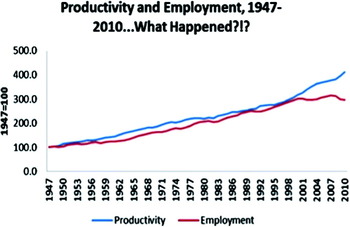
Technological development seems to portend a fundamental change in the relationship between productivity and employment, as shown in Figure 2. This means that the economy can grow without producing many jobs, a trend with particular import in those countries that still have a growing youth population – countries that tend to be at the bottom of the global power scale.
Productivity and Employment, 1947–2010. From Econfuture, http://econfuture.wordpress.com/.

In spite of the democratization of at least some forms of technology, there is little reason to expect decreasing inequality. Rather, trends of increasing economic inequality – particularly the growth of the very rich – are likely to continue. Economic growth will be driven by technology that has the potential to increase the power of large corporations. There will be more consolidation of large businesses: a trend well underway, as a quick glance at the airline or any other major industry will show. In wealthy countries, labour-intensive work will increasingly be outsourced to Asia and there will be more automation/robots in sectors where unskilled workers have traditionally found jobs, giving rise to a permanent underclass of unemployment.
The big wild card in predicting economic growth is energy. The trends are all in the direction of increased energy consumption, driven by both the developed world's continuing addiction and industrializing countries’ desire for economic growth. The world's energy consumption is likely to double by 2030, with China accounting for half of that growth.Footnote 38 While it seems likely that there will be a steady increase in renewable energy sources and increasing use of technology to create fuel efficiencies, coal and oil are likely to continue to be the dominant sources of energy for the foreseeable future. In the post-Fukushima world, the possibilities of dramatically increasing reliance on nuclear energy seem less likely. Energy is fundamentally tied to economic power, which is fundamentally tied to political power. And the results of increased consumption of fossil fuels are increasing greenhouse gases, the main factor driving climate change.
New governance structures will emerge to account for the new economic powers,Footnote 39 but those at the bottom will become even more marginalized, as countries that once advocated for them (e.g. South Africa, Brazil) gain a seat at the table of the powerful. Transnational corporations have long operated with little regard for state borders and it is possible that future economic drivers, coupled with developments in technology, could create a growing global technocratic class less bound by traditional state borders.
Global economic trends will have an impact on the way in which the international humanitarian system is financed. Until now, developed countries have been the backbone of the international humanitarian system. Of the total international humanitarian contribution in 2010 of US$16.7 billion, governments contributed US$12.4 billion while US$4.3 billion came from private voluntary sources. Of the amount governments contributed, US$11.8 billion, approximately 95%, came from members of the Organisation for Economic Co-operation and Development (OECD) Development Assistance Committee (DAC). Non-DAC countries contributed US$623 million, approximately 5% of the total contributed by governments.Footnote 40 The question is whether developed countries will continue their commitment to international humanitarian assistance – particularly given current trends of economic malaise and aging populations, and the likelihood that more assistance will be required in the future. A further question is whether emerging economies will display greater commitment to providing humanitarian assistance in the future, and whether this support will be channelled to multilateral organizations or will be directed bilaterally, including through international non-governmental organizations (NGOs), in support of foreign policy goals.
Presently about 25% of donations come from private contributions. Individual donations to humanitarian response are likely to increase as a result of increasing social media and possibilities of organizing citizen response.
The possibility of more private financing of humanitarian action – by individual philanthropists and companies – cannot be overlooked. This is likely to happen in developing as well as developed countries, is likely to be facilitated by social media, and is likely to be directed at high-profile emergencies. However, corporate support for humanitarian action is likely to be directed at ‘less-political’ natural disasters rather than long-term simmering conflicts. If this trend develops, the result could be that international multilateral organizations could be left with the challenge of supporting the poor intransigent conflicts.
In this respect it is interesting to look at China's record. In 2010 China contributed US$37.6 million in humanitarian aid, ranking it as the year's fifth largest non-DAC donor.Footnote 41 This was its second largest contribution in ten years and was significantly larger than most of its previous annual contributions.Footnote 42 The majority of China's 2010 contribution, US$28.5 million (approximately 75%) was given bilaterally to affected governments,Footnote 43 with only 10.9% going to multilateral organizations.Footnote 44 To put this in perspective, in 2010 China contributed less humanitarian aid than Luxembourg, a country of 500,000,Footnote 45 which gave US$52 million.Footnote 46 China's contribution to multilateral organizations, such as the World Food Programme, is significantly less than the amount contributed by Algeria, which gave US$8.1 million to the World Food Programme in 2010.Footnote 47
What does this mean for humanitarian action in the future ?
In all likelihood, Africa will continue to be the region most in need of international humanitarian assistance, although there could well be new needs and new possibilities in the Middle East. The countries presently seen as failed states will continue to need massive injections of international support just to keep their populations alive, but there are questions about the willingness of developed countries, themselves facing increasing pressure on their economic models, to provide such support indefinitely. In the worst-case scenario, this could mean that developed countries respond to immediate security threats posed by failed states (e.g. Somali piracy) but leave suffering civilians to an uncertain fate.
Second, humanitarian actors need to have much greater engagement with emerging powers to broaden the base of support beyond the traditional, largely Western powers that created the humanitarian system and continue to provide over 95% of its funding. This is probably not just a question of encouraging developing countries to support the present system, but also of offering them a role in reshaping it for the future. This is a somewhat risky endeavour for those humanitarian actors committed both to humanitarian principles and to values such as gender equality. At the same time, some countries that have been recipients of large-scale international aid, such as Indonesia, will have an increasing capacity to respond to domestic disasters. And some, such as the Philippines, are ready and willing to provide increased technical assistance to other countries on the basis of their experience.
Political power: changing global patterns, changing domestic determinants
At the international level, the relative power of Western liberal democracies will decline as they struggle to deal with both demographic and economic shifts, even as the power of other countries increases. While the trends seem clear that China's power is rising while the US is declining as a hegemonic power, these are likely to develop over several generations. Power is slowly but clearly slipping from the Atlantic alliance to the Pacific region (although the differences within Asia are probably greater than those within the Atlantic region). Power dynamics are likely to become more complex as more middle-income powers acquire military and economic power that translates into political power. While it seems likely that regional organizations and initiatives will increase in importance, developments in the European Union in recent years seem to indicate that advances in such regional initiatives will be uneven at best. At the international level, exercise of power will become more complicated, as global consensus will need to be exercised between a larger number of actors. As the West's influence diminishes and powers ebb and flow, the possibility of military confrontations cannot be ruled out. Robert Kaplan, for example, argues that China's naval expansion gives rise to possible conflicts in the South China Sea – conflicts that could stand in contrast to the land-based wars of recent decades, with fewer civilian casualties and fewer ethical dilemmas.Footnote 48
While economic and technological developments seem to be moving in the direction of a weakening role of the state, it is unlikely that issues of sovereignty and nationalism will diminish in importance. For one thing, Asian countries – now ascendant – have been in the forefront of efforts to defend national sovereignty. On the other, continuing concerns with military interventions by the US and NATO stoke nationalist tendencies. If Western powers, particularly the United States, retreat from their role as global policemen, several scenarios are possible: an invigorated multilateral system of response, new leadership patterns as emerging powers step up to the plate or (in the worst case) anarchy.
As demonstrated most recently by the Arab Spring, however, the possibility of widespread changes in the relationship between the governing and the governed is likely. The era of dictators seems to be coming to an end – at least, of dictatorships as we know them – although it is still too early to tell. The power of social media, rising standards of living, increasing access to education, and urbanization will all drive citizens to demand more of their governments. On the one hand, this means more democratic forms of government. On the other hand, it means more populism, including nationalistic and religious/sectarian-inspired calls to action, on the part of political leaders who must depend on popular support for continued rule. In Western countries, there will be a tendency to blame China and other Asian countries for the West's relative economic decline. It is likely that people and political leaders in these countries will insist on more attention being paid to domestic issues, resulting in both more isolationism and more right-wing politicians playing on fear. In developing countries, politicians will need to make promises – particularly for jobs – that they cannot keep, in order to get elected. When popular discontent increases, governments are likely to be replaced by political leaders making even more promises. While governments are likely to rise and fall bloodlessly (without armed revolutions), political instability and new forms of ‘democratic authoritarianism’ are likely to emerge. Social media will be key – maybe as important as formal elections – in the rise and fall of political leaders, and they offer hope for new accountability.Footnote 49
Another likely political development is that there will be both more emphasis and more pressure on municipal authorities: the growth of urban areas, the failure of centralized bureaucracies to deal with the range of problems experienced on the local level, and increasing citizen activism are all likely to mean an increased focus on mayors. In fact, a major political issue of the future in countries as diverse as Turkey, Colombia, and Zimbabwe is the relationship between central and municipal authorities. Recent decades have witnessed a spate of measures to decentralize political authority, but this decentralization is often not accompanied by devolution of authority and finances.
What does this mean for humanitarian action in the future?
The way in which a government responds to a disaster has always had political consequences but, in the future, there will be more media coverage of such response. There will be more pressure to respond to urban disasters. There will also be increased risk that international humanitarian response will be used by national politicians in support of their political objectives.
On the positive side, democracies tend to respond better to the needs of their populations than dictatorships.Footnote 50 The development of global communications and social media will lead to more citizen involvement in response – more grassroots groups will become more engaged in more humanitarian activities – but this will pose challenges to traditional humanitarian actors and to the already weak system of humanitarian co-ordination.
As for humanitarian actors themselves, they will have to engage much more with municipal authorities. States, at least in some countries, will become much more assertive in dealing with international humanitarian actors. The days of international bodies running autonomous ‘fiefdoms’ (such as in refugee camps) are probably limited. The challenge of building local capacity will become an imperative, not just because it is good humanitarian practice but also because it will be politically necessary.
Finally, changing shifts in power should mean that rising countries, such as Brazil, Turkey, and South Africa, will play a much more important role not only in financing international humanitarian work but also in shaping and supporting the future work of multilateral agencies. However, as these institutions are typically associated with presently developed countries, it may be that new forms of global governance will emerge. It is also likely that the BRIC countries (Brazil, Russia, India, and China) could devote more energy and effort to building up regional mechanisms designed to respond to regional humanitarian emergencies.
Climate change: more natural disasters
The likely trends over the next thirty years are for increases in the severity and intensity of sudden onset natural disasters, particularly those related to weather (storms, hurricanes, cyclones, flooding). These will increasingly affect urban populations, in part because there will simply be more people living in cities and in part because more people will be living on more marginal land. Climate change will also drive rural to urban migration. As droughts, dry conditions, and unpredictability in rainfall patterns increase, pressure will grow on rural communities, whose inhabitants will move to towns and then cities. Pastoralist and indigenous groups will be particularly affected. Climate change is also expected to reduce potential agricultural output by up to 30% in Africa and up to 21% in AsiaFootnote 51 – further adding to the pressure on already high food prices. Food prices are presently 41% higher than their 2002–2004 levels;Footnote 52 predictions of increased drought, coupled with a growing population, suggest that food insecurity will increase, particularly in countries already experiencing difficulties.
Rising sea levels will particularly affect the mega-deltas of Asia, but the impact of sea-level rise will be felt in a variety of ways, from increased salinization of water on Pacific islands to new maritime routes opening up in the Arctic.Footnote 53 At present, nearly 634 million people – one-tenth of the world's population – live in at-risk coastal areas just a few metres above existing sea levels.Footnote 54 And rising temperatures will mean a rise in the prevalence and geographical scope of dengue fever, malaria, and waterborne illnesses.
Natural disasters will affect rich as well as developing countries. Loss of life will be greater in developing countries, while the economic costs of disasters will be far higher in developed countries. Moreover, with increased urbanization and increased wealth, the economic costs of disasters will grow. As John Seo wrote:
This year's earthquake in Japan, which caused more than $300 billion in economic damage, was just a preview; a decade and a half from now, a single hurricane or earthquake will come with a potential price tag of $1 trillion or more.Footnote 55
Disasters have always affected economic growth and development, but in a world where more people and more assets are concentrated in cities and where the number and intensity of disasters increases, this effect will be even more dramatic. There will be more cases where response to natural disasters is shaped by conflict and more cases where natural disasters will be associated with industrial, technological, or nuclear disasters.
Social media will provide immediate coverage of major disasters and of the response (which will almost always be much slower than people expect). There will be increased political pressures to respond quickly; governments that are perceived as responding slowly will suffer politically. In democracies, governments will want to send the signal that they are taking disasters seriously, as evidenced by the comprehensive response in the US by both the Obama administration and local governments in responding to Hurricane Irene in August 2011 and by recent efforts in the European Union to develop more effective (and co-ordinated) civil defence mechanisms.
What does this mean for humanitarian action in the future ?
First of all, if, as expected, sudden-onset natural disasters increase in severity and frequency, there will be a corresponding increase in pressure on humanitarian actors. Presently, the international system is hard-pressed to respond to more than one major natural disaster a year, as demonstrated in 2010.Footnote 56 Response to more sudden-onset natural disasters is likely to divert resources away from protracted conflict situations. If the system is not able to respond quickly and effectively to a particular disaster it could fuel resentment, particularly if the connections are drawn to climate change caused by developed countries.
Second, natural disasters in developed countries, because they are so economically costly, could limit the ability and willingness of developed countries to support relief efforts in other parts of the world, particularly in areas of limited strategic importance.
Third, much more expertise is needed within the humanitarian community to think through and plan for response to the deadly combination of natural hazards, simmering conflict, and industrial/technological accidents all occurring in urban areas. For example, the destruction of a chemical plant by an earthquake in an urban area of a developing country is likely to pose enormous challenges to humanitarian response.
Finally, while there is a possibility that the world will respond in ways to prevent the most egregious consequences of long-term climate change through enhanced mitigation and adaptation measures, the signs are not positive. Rather, the trends are that the frightening scenarios presented by the Intergovernmental Panel on Climate Change (IPCC) back in 1990 will play out at the high end of the spectrum, such as a 4° Celsius rise in temperature by the end of the century rather than the 1.5° at the low end. If this does occur, then the consequences for humanitarian actors (as well as governments, NGOs, and development agencies) will be enormous. For example, a rise in sea levels of only a metre would have devastating humanitarian consequences for which the humanitarian community is not prepared.
Conflict: prolonged, simmering, and increasingly urban
The first point to make about future trends in conflict is that it is likely that many of today's simmering conflicts will continue to do so in the coming decades. The Palestinian–Israeli conflict is now in its seventh decade, and there is little indication that a resolution will be found soon. Countries such as the Democratic Republic of the Congo and Somalia are likely to continue to need international assistance for the foreseeable future. However, there are situations where political change may offer prospects of an end to oppressive regimes, which in turn could result in less conflict, more stability, and less need for humanitarian response – for instance, in Egypt, Zimbabwe, Venezuela, Libya, and Yemen. But, given the historical record, it is unlikely that all such political changes will result in peace and stability. Long-standing disputes, such as China–Taiwan, India–Pakistan, and South Korea–North Korea are likely to continue, with possibilities for sudden escalation.
Future civil conflicts will probably occur in developing countries over ethnic and religious issues, which in themselves usually overlap with economic and social fault-lines; perhaps, in reaction to the inexorable creep of Western culture, there will be efforts to resist homogenization by asserting particular identities.Footnote 57 Conflicts over land and access to resources are expected to intensify. However, it is likely that a smaller percentage of the world's population will die in civil conflicts than in previous eras as a result of the combination of global population growth,Footnote 58 decreasing civilian casualties in conflict, and the continued presence of UN peacekeeping operations. The conflicts that do take place will receive more media coverage and will demand an increasingly visible humanitarian response. Terrorism is likely to continue and to be manifest in both low- and high-tech forms.
Most conflict in the future is likely to be protracted, to be fought by armed groups for personal gain, and to be to be fought in cities. The lines are becoming more blurred between gangs, warlords, insurgents, child soldiers, paramilitary forces, and drug traffickers, all of whom will increasingly operate in urban environments. Of course, non-state actors have engaged in criminal activities to finance their struggles for years. What is new today is the growth in the number and capabilities of exclusively criminal gangs and the blurring of lines between street gangs and other non-state actors. In countries without a strong public security sector, the rich will hire private security firms to protect themselves, as witnessed over the past few years in Mexico – forces that may themselves become parties to the conflict (as occurred in Colombia in the 1980s).Footnote 59 In another part of the world, the South African vigilante group ‘People against Gangsterism and Drugs’ began as an organization protecting Capetown neighbourhoods against local criminals, but evolved into a criminal entity.Footnote 60
More and more areas of conflict – and areas of acute humanitarian need – will become no-go areas. According to Peter Singer, ‘[t]he CIA today counts some fifty countries that have “stateless zones”, where the local government has lost all effectiveness or simply given up’.Footnote 61 And when conflicts are protracted, a particular dynamic of violence is created that is difficult to overcome, even when peace agreements are signed. The breakdown of social values and the loss of authority of the state and of civic institutions can lead to the emergence of criminal gangs that take advantage of the resulting lawlessness to threaten, rob, rape, and kill civilians. This constellation of factors will make it difficult for humanitarians to respond either to conflicts or to natural disasters occurring in cities.
While some have seen Iraq and Afghanistan as the wars of the future, it is unlikely that the United States will engage in many more such long-term costly ventures. Domestic pressures against foreign entanglements, the realization that terrorism is not linked to a particular geographic territory, and the difficulty in actually winning such wars, as well as growing economic pressures in developed countries, mean that it is unlikely that there will be many wars of this kind in the future.Footnote 62 Rather, the US and other military powers will increasingly pursue their security interests in strategically important countries by means other than outright military invasion: for example, through increased reliance on multilateral military and police initiatives, as well as through deployment of Special Forces, use of proxy states, and increased use of high-tech weaponry.
However, in areas where the US military is directly involved in conflict, stabilization measures will be the key to the conduct of the war, and they will present humanitarian actors with tough choices in working with the military. Technological developments in military weapons systems will have far-reaching consequences for the future of warfare – and for civilians. The increasing use of robotic technologies in warfare will have implications for future conflicts, the military as an institution, and the laws of war. Wars in which the US or other developed countries are involved will increasingly be fought by unmanned drones and robots, controlled by computer technicians a safe distance away. Moreover, as Singer explains, robots can be programmed to make decisions without later human involvement,Footnote 63 giving rise to possibilities of wars carried out between machines, and of wars where the only casualties will be civilians. The jury is still out on whether such technologies will reduce future atrocities by taking some of the passion and personal angst out of warfare.
Finally, there is terrorism. As high-tech weapons become smaller, cheaper, and more widely available, they will be used by an even wider variety of groups than they are now. And there are possibilities for more deadly attacks – such as bioterrorist and cyber attacks – in the future. It cannot be ruled out that, sometime in the next twenty-five years, there will be an attack on civilian populations with incredibly far-reaching consequences.Footnote 64 And in the future, as in the present, governmental efforts to protect their populations from terrorism will put limits on humanitarian action.Footnote 65
What does this mean for humanitarian action in the future ?
While there will be considerable attention focused on the new mega-disasters and pressure to divert resources away from protracted conflicts, it is likely that the majority of funding, staffing, and energy of humanitarian action will continue to be directed to long-standing conflict situations. At present, probably two-thirds of humanitarian funding is directed towards humanitarian situations that have lasted at least five years; in some cases, to situations that have gone on for decades. While humanitarian action, by definition, consists of immediate life-saving assistance and a premium is placed on rapid response, the reality is that much humanitarian assistance is simply care and maintenance – keeping people alive, sometimes for years, in the absence of a political solution. However, if the scale and intensity of natural disasters does increase significantly as a predicted result of climate change, pressure on humanitarian actors will increase.
Working in urban environments will become more dangerous, given the concentration of criminal gangs, drug traffickers, and private security forces in cities. In spite of the efforts of some governments to regain control of urban areas through military force, it is likely that parts of major cities will remain beyond the reach of law enforcement agencies.Footnote 66 Even responding to a natural disaster, such as an earthquake, may put humanitarian actors at risk of being attacked by armed groups. Municipal authorities will therefore become more important actors in their own right.
Finally, the rise of high-tech weaponry raises fundamental challenges about the applicability of international humanitarian law, challenges that the international community is not yet grappling with. The use of high-tech weaponry should allow for more precision in targeting, with decreased civilian casualties, but errors do occur, as shown in US use of drones in Pakistan and Afghanistan. What does it mean for responsibility when military decisions resulting in civilian casualties are made by computer programmers far from the battlefield?Footnote 67
The present international humanitarian system is unable to keep up with the challenges of today and indeed seems incapable of responding to more than one mega-disaster at a time. What will things look like for the future?
Further implications for future humanitarian action
The present international assistance architecture is based on a belief that those displaced by violence are particularly vulnerable and particularly in need of assistance. This is evidenced by the progressive development of the international refugee regime over the course of the last century and by the expansion of concern to internally displaced persons. Many of today's major international NGOs, for example, were established to respond to the needs of refugees. While the displaced have particular needs – for protection (particularly refugees, who by definition do not enjoy the protection of their governments), shelter, and documentation – this paradigm needs to be refined. Sometimes the most vulnerable people are those who are not displaced – people who could not escape the violence or the effects of a natural hazard. Particularly as humanitarian work is increasingly carried out in urban areas, it is likely that distinctions between the displaced and the urban poor will become more difficult to sustain, as presently demonstrated in Haiti. This should give rise to further efforts to reassess the relationship between humanitarian and development actors. While this has been a theme in the humanitarian community for at least the past twenty-five years, with little signs of significant improvement, it will become more serious in the future. There are possibilities of increased synergy between emergency preparedness, disaster risk reduction, community protection techniques, and climate change mitigation/adaptation measures, but bringing together different institutional interests, approaches, and responses will require far-sighted global leadership.Footnote 68
The proliferation of actors in humanitarian action, particularly in high-profile emergencies, will make issues of co-ordination more difficult and complex, and will raise fundamental issues about the balance between inclusivity and effectiveness in response. The experience with clusters in Haiti illustrates this dilemma: the health cluster, for example, had over 500 participants in its regular co-ordination meetings.Footnote 69 When there are so many actors, effective co-ordination is impossible, which means that the large, established, experienced actors simply find other fora to provide the needed co-ordination. The growth in the number of NGOs seeking to respond to large-scale disasters is likely to lead to a certification process, creating a publicly recognized tier system of responders. And yet, while high-profile emergencies will be characterized by the involvement of a plethora of actors, smaller and lower-profile emergencies will suffer from a lack of humanitarian attention. For example, the International Federation of Red Cross and Red Crescent Societies (IFRC) estimates that 90% of natural disasters have fewer than fifty casualties and that response to these small-scale disasters tends to be poorly funded.Footnote 70
The issue of military involvement in humanitarian response will become both more central and more difficult in coming years. For example, in large-scale natural disasters, military assets will be needed. For military forces, increasing involvement in these disasters can be justified on national security grounds but also by the argument that responding to natural disasters is applicable to military roles elsewhere (for buying goodwill, for training, or for testing equipment). If military and civilian actors can enhance their understanding of how to work together, new possibilities for humanitarian action may emerge. For example, military technology may be helpful in changing the way that internationals respond to sexual and gender-based violence, as personal protection devices (such as taser guns) and other technologies become more sophisticated. Rather than giving women in Haitian IDP camps whistles to call for help when they are assaulted, in the future there may be ways of using GPS technology and cell phones to trigger an immediate response by police.
The military is also involved in national preparedness efforts and in contingency planning for worst-case scenarios. For example, an area where the international humanitarian community has not (at least publicly) been engaged is planning for the possibility of a major terrorist attack or a major natural disaster coupled with a nuclear or major industrial accident. In the past two decades, there has been growing concern about the security of humanitarian workers working in conflict situations, who have been attacked, killed, and kidnapped in greater numbers than ever before. However, these security concerns are dwarfed by the possibility of a nuclear accident or even a large-scale industrial accident involving the release of deadly chemicals. Such a situation could be a by-product of a natural hazard (such as the Japanese earthquake) or a terrorist incident (such as the release of deadly chemicals by the attacks of 9/11, which had long-term health consequences for those responding). Or it could be the result of a deliberate terrorist attack: the Sarin gas attack on a Tokyo subway in 1995 killed thirteen people but raises the possibility of much more deadly attacks in the future.
The capacity of humanitarian actors to respond to these kinds of threats is limited. If there were, for example, a terrorist attack involving biological, chemical, or nuclear agents – such as an attack on a large city's public transportation sector – the international humanitarian community would be poorly placed to respond. The 2011 Great East Japan earthquake and tsunami was the first case where a natural hazard created a major nuclear accident, raising a new set of security concerns for humanitarian workers. Given the patterns of urban and industrial growth, it is not unlikely that a future natural hazard – a hurricane or cyclone, an earthquake or a tsunami – would cause damage to a nuclear reactor, resulting in the release of radioactive material. Few humanitarian actors would have the capacity or would have done the planning necessary to respond to such a situation. Rather, response would fall under the state's disaster plans or military contingency planning. In some highly developed countries plans have been developed to respond to such catastrophic situations; they may or may not be sufficient. In other countries, the planning for response has been much lower and it seems unlikely that their systems would be able to cope. In all of these situations, it is uncertain how and where either national or international humanitarian actors would be asked to or could respond.
The theme of accountability has become central on many levels. The International Criminal Court, for example, has made it difficult for dictators to get away with atrocities. Social media are increasing the visibility of actions – by dictators and humanitarian NGOs alike – that previously operated far off the radar screen. Questions of accountability to beneficiaries have long been discussed by humanitarians, but there are new possibilities for this to be translated into reality. For example, participatory needs assessment is moving into the mainstream of humanitarian operating procedures, and numerous accountability initiatives are seeking to increase accountability to beneficiaries.Footnote 71 With increasing access to communication, beneficiaries are also challenging humanitarian actors in new ways. To cite a personal experience, when visiting an IDP camp in Haiti with an NGO representative, the author was surprised to hear an IDP leader challenge the NGO by saying: ‘We saw on your website that you've raised an additional million dollars for Haiti, but where are you spending the money? We don't see it here.’Footnote 72
Most fundamentally, the coming changes signal a need to re-think our basic humanitarian model, which has been based on the practice of parachuting expatriates into a disaster situation. But we have not yet got it right in terms of building up local capacity. The ability of the affected state and of local organizations to respond to humanitarian crises must be increased. The emerging powers must play a more active role, not only in financially providing for the victims of wars and natural disasters but in shaping the existing system to better meet the needs of the future.
The complex array of actors who make up the international humanitarian system have become increasingly professional and effective over the past few years. Overall, the system has got better at responding quickly, at saving lives, at preventing death. Shocking reports of tens of thousands of Somali children dying of malnutrition in 2011 underscore how rare this has become in the last twenty years. But the humanitarian system has not been able to prevent the conflicts that produce humanitarian emergencies. Even when the warning signs are clear – as in Somalia, Côte d'Ivoire, Burundi, Yemen, and a dozen other places – humanitarian actors have not been able to stop the escalation of hostilities or prevent human rights abuses. And, in fact, it is not their responsibility to do so. Rather, it is the responsibility of political leaders and institutions to ensure peace and security (and to take actions to mitigate the effects of climate change for that matter), while the humanitarians are expected to respond to the human need that results from the failure of effective political action. And yet, the interface between prevention and response is not so clear-cut, as evidenced by the growing advocacy role of many humanitarian NGOs and the increasing engagement of the UN Security Council with humanitarian issues. Exploring and expanding the linkages between prevention and response will surely be one of the major challenges for future humanitarian action.
Responding to the challenges posed by the six megatrends explored in this article will require more – and more creative – thinking and visionary leadership. It will also require humanitarian actors to take time to step back from their day-to-day operations and think about the big-picture issues that will affect their work. Understanding future trends is a first step in preparing for them.