INTRODUCTION
Family law refers to the state regulation of marriage, parenthood, dissolution of marriage, custody of children, and transmission of goods across generations. As John R. Bowen (Reference Bowen2003, 18) states, family law encompasses the basic practices that constitute, divide, and reproduce family relations. The binding legal authority of the state distinguishes statutory family law from more fluid and long-standing community, social, or religious practices, and as such, defines in large measure a society's accepted norms of family formation and attendant economic obligations (Naim Reference Naim2002, 2). Many family law systems codify differential treatment of women and men, and in the majority of the cases where differential treatment of men and women in the application of family law exists, it is women who have lesser rights. Specifically, the main differences center around whether women are considered full and autonomous persons in the legal sense, with the right to consent to marriage, to inherit equally, and to contract a divorce with rights equal to those of a man.
The 1993 United Nations General Assembly Declaration on the Elimination of Violence Against WomenFootnote 1 was significant in its effort to define violence against women as including not only physical harm but also sexual and psychological harm.Footnote 2 This is an interesting and important development, as heretofore violence had been defined almost solely in terms of physical harm, such as murder, rape, and assault, with “discrimination” being the preferred term for nonphysical harm. As can be imagined, there has been greater, though not universal, societal consensus that physical harm against women cannot be justified under the international system's human rights framework. The issue of whether inequity in family law is violence against women along the lines of the 1993 Declaration, however, is quite contentious. Many nations have filed reservations to the Convention on the Elimination of All Forms of Discrimination Against Women (CEDAW) specifically on the basis that religiously or culturally sanctioned practices of inequity in family law within their societies do not constitute discrimination, much less violence, against women. What has never been empirically investigated is whether there is, in fact, a relationship between inequity in family law, which would include issues such as consent in marriage, inheritance rights, divorce and custody rights, legality of polygyny, and so on, and more traditionally defined aspects of physical violence against women, such as domestic violence, rape, and murder. This article seeks to address that lacuna.
Furthermore, since calls for the establishment of legal enclaves, which generally invoke family law that is arguably inequitable toward women, have increased in recent years, we also seek to inform that debate through our empirical findings. If there proves to be a relationship between inequity in family law and levels of violence against women, then the enclaves discussion must be expanded beyond issues of religious and cultural liberty alone.
I. THE COMPLEX NATURE OF THE FAMILY LAW DISCUSSION
Controversies over inequity in family law concerning women abound in the twenty-first century. A case in point is the contentious issue of age of marriage, as well as a woman's right to consent to marriage. For example, more than 25% of Yemeni girls are given in marriage before age 15, and it is disputed whether there is even a legal minimum age of marriage in the country. While the average age at first marriage for Yemeni women is over 22, cases of girls married at 12, or even at 8 years, have received international media attention (Emory Law, Yemen n.d., WomanStats n.d., AOM-Practice-1). Respected Muslim leaders issued a religious decree calling on the state to make it illegal for girls to marry before 17, and the legislature passed a law in 2009 to do just that, only to have the law canceled the very next day on procedural grounds. Indeed, reconsideration of legislative action in 2010 led to a situation where “members of parliament from different political parties jumped at each other with sticks and shoes during a heated debate on the minimum age of marriage” (Linsley Reference Linsley2010). To add to the tumult, a cleric closely associated with Al Qaeda,Sheikh al-Zindani, has sworn to collect a million signatures and contest any proposed change in marriage age (Al-Haj Reference Al-Haj2010).
In addition to the contentious nature of these issues, practice may differ from law. Indeed, in most states where family law practice diverges from state family law, we typically find that the state stands mute and does not intervene. This may even be codified; in certain African states, for example, Zambia and Botswana, laws may even contain a clause at the end explicitly stating that where tribal and customary practice clash with state law, practice will supersede law. In Ethiopia, the legal marriage age is 18, but it is not uncommon for parents to contract marriages for their much younger daughters, including girls as young as 7; and there is little or no interference by the state (Council of Europe 2005, 22). In Utah, Texas, and Arizona, as well as in British Columbia in Canada, break-out polygynous religious factions marry girls at young ages. In response, Utah and Arizona set the legal marriage age at 18 and require parental consent for girls ages 16–17. In Utah, girls of 15 need not only parental consent but also consent from the Juvenile Court, which must rule whether such marriages are voluntary and in the girls' best interest. Arizona requires a court order as well as parental consent for girls 15 or younger (Stritof and Stritof n.d.). Despite these laws, many girls are married in private religious ceremonies at ages as young as 12 (Adams Reference Adams2006). Polygyny is illegal in the United States and Canada, but nonetheless is practiced widely enough in some states that observers would be forced to conclude that these states do not consider enforcement of laws against polygamy a priority.
The relationship between law and practice is complex. While law cannot dictate practice and often stands impotent before it, law is nevertheless generally regarded as a strong normative factor capable of modifying practice over time, and importantly, of establishing state and community ideals. In this sense, despite the ingrained nature of practice, contestation over law is often a critical first step in changing practice. This process is long and complicated in most states. In Uganda, under the Divorce Act, grounds for seeking divorce differ for men and women. For example, a man may obtain a divorce by proving his wife guilty of adultery. A woman seeking to divorce an adulterous husband must not only prove adultery but also show that the husband committed, rape, bigamy, desertion, or sodomy. A 2004 court case ruled that grounds for divorce should apply equally to men and women. While it will take time for the court judgment to be accepted, judges have held that the roles of men and women had changed significantly during the past century and that law should reflect this reality (Center for Reproductive Rights 2005).
The case of “borrowed law” adds an additional layer of complexity in the legal arena. For example, at independence, the North African countries of Morocco (1956), Algeria (1962), and Tunisia (1956) had the option to follow the French model of codified law or to return to the traditional system of Muslim religious courts. Each country saw a necessity for reform and sought political consensus allowing them to codify family law with some reforms (specific to each country) while still reflecting their Muslim heritage. At the same time, France, their colonial power, had yet to reform the Napoleonic Code of 1804, which had established a civil law based on male-dominated families. The North African countries eliminated some of the worst abuses of traditional Islamic law in their codes at that point. But many other problems, due in part to the French legacy, remained, and progressive reforms were sought to rectify them over the coming decades (Mayer Reference Mayer1995). Both India and Turkey instituted reforms that were influential as other Muslim countries were beginning to search for models. Indian Muslim reformers tried to reform Muslim law to be in accord with some British standards of human rights, resulting in the Muslim Marriage Act of 1939, which regulated family law for India's Muslim population.Footnote 3 Turkey, the former seat of the Muslim caliphate, discarded traditional Islamic law and enacted the 1926 Civil Code, modeled after the 1912 Swiss personal status code. Thus, there be several historical layers of accretion in the law codes of former colonies and still other regimes striving to break with the past, which may make reform that much more difficult (Weyland Reference Weyland2006).
In many countries, family law has changed substantially over time. In most cases, the direction is toward greater equity and safeguards for women in marriage and family matters. For example, over the course of the twentieth century, many Muslim countries steadily incorporated reforms of family law into legal codes. The two most critical issues during this time period were minimum marriage age and protection of women seeking divorce. In the Koran, Islam grants the right of talaq, or repudiation, to the husband. This is an irrevocable act and needs no judicial intervention. Wives have no similar rights. Schools of Shariah jurisprudence (fiqh) have extended the possibility of seeking divorce to the wife as well, but under highly regulated conditions that remain unequal to rights accorded to men. The Dissolution of Muslim Marriages Act of 1939 in India attempted to mitigate the restrictive religious laws on court-regulated divorce for women by stating nine grounds under which a woman is entitled to obtain a decree of dissolution of her marriage, such as the husband's imprisonment, impotence, insanity, cruelty, or unequal treatment of co-wives (Naim Reference Naim2002, 223).
In the 1920s, the Egyptian legislature enacted a codified family law, and in 1929 enacted legislation that gave limited grounds—based on traditional Islamic fiqh—on which women could seek divorce. Demands for additional reforms took place throughout the 1960s and 1970s. Finally, faced with deadlock over family law reform, President Anwar Sadat bypassed the legislature and unilaterally issued an emergency decree in 1979 popularly called Jihan's Law, named for Sadat's wife's insistence on divorce reform. Furious conservative legislatures struck this law down on technical grounds, but legislation was passed in 1985 to restore two disputed provisions. The first provision entitled a wife who was unilaterally divorced by a traditional talaq divorce to at least two years' financial compensation. The second provision, which was highly controversial in crowded Egypt, decreed that the divorcing husband must provide independent housing for a divorced wife with custody of minor children (Emory Law, Egypt n.d.). But two provisions in the 1979 legislation that had produced the greatest uproar were never reinstated. These related to polygyny, for example, giving the wife the right to an automatic divorce if the husband took an additional wife (Naim Reference Naim2002).
There was further reform of divorce law in 2000. One provision allowed women to pursue a khlu῾ divorce (in which the wife may return the dower and obtain a divorce without going to court and proving harm on her husband's part) without her husband's permission (Human Rights Watch 2004, Sach Reference Sach2000) . The second reform allowed a woman married under customary law, not state or Islamic law, to obtain a divorce, which is generally accomplished after first registering the marriage under state auspices. Customary marriages have become popular as they can be contracted between the two individuals with only two witnesses, and thereby avoid the high costs of a formal marriage and dower. These marriages were acceptable in some circles, but previously had not been recognized by the Egyptian state (Fluehr-Lobban Reference Fluehr-Lobban and Moore2002).
Reform in Muslim family law codes has been complicated by the fact that the Koran requires men to provide material support for their wives and female relatives. Traditionally, this has been interpreted as according additional rights to men in all areas of family law because of their greater responsibilities. The male right to repudiate his wife while the wife has no defined rights in the Koran to divorce her spouse is one example.
We see, then, that while some sectors of the state may push legislation to reform family law in the direction of greater equity, changes often incur popular and political resistance that may set back these legislative efforts, at least temporarily. The path of family law reform is filled with zigs and zags, even in the twenty-first century, as may be expected when an issue of identity is involved (Abdelal et al. Reference Abdelal, Herrera, Johnston and McDermott2006). For example, change may not always mean greater equity or safeguards for women, but the opposite. Following the demise of the Soviet Union, the bias of judges against female claimants when adjudicating divorce cases in Central Asian republics has become more pronounced (Wilson Reference Wilson2010). Some of these republics have even attempted to reintroduce legalized polygyny.Footnote 4
The tension between individual rights, as recognized under CEDAW and international human rights law, and rights of the family and the community is most powerful in issues concerning women and decision-making power within the family unit. It is not only men who may oppose such reforms; women may oppose them as well. For example, the heralded reforms to the Moroccan mudawana, or family law code, were facilitated by organized political action on the part of tens of thousands of Moroccan women and their male allies, resulting in substantive change. Changes included increased autonomy for women, maintenance of the family now considered the equal responsibility of both men and women, and an increase in women's rights (such as to contract their own marriages, to ensure that all divorces are to be placed before a judge, etc.). Equally notable was the opposition to the reforms, even among some women. Quite a few middle- and lower-class women were reluctant to endorse the reforms: Many feared change, and some resented them as an unknown quantity pushed by the West and possibly prejudicial to women's well-being.Footnote 5 Despite increasing international pressure to end legal discrimination against women, the demands to be governed by religious or traditional systems of family law have instead increased in recent years. In several Western nations, religious minorities have maintained that equal representation under the law is only possible if their family law systems are recognized as part of the legal fabric of the country. These proposed enclaves would allow religious courts to rule on issues of family law and would also grant exceptions to rights recognized under each country's legal system.
Historically, the concept of a legal enclave permitting diverse family law systems to coexist with a unified criminal law is not new. Far-flung empires, even more recent ones such as the Ottoman and British Empires, permitted localized family law systems based on religion and ethnicity. Several countries today, such as India and Bangladesh, maintain such a legal pluralism with regard to family law, with several family law systems being accommodated within the context of a common criminal code. The advantages asserted for legal pluralism include respect for cultural and religious integrity, traditions, and practice, but also the diminishing of conflict among groups by segregating practice along community lines.Footnote 6
In sum, as we survey the issues of family law, we cannot help but notice that the complexity and contention surrounding such issues is increasing over time, suggesting that the matter has deep import, not only for individuals and families, but also for states and societies.
II. THE CULTURAL JUSTIFICATIONS FOR INEQUITABLE FAMILY LAW
In this article, we make a distinction between equitable and inequitable family law using international conventions, in particular CEDAW. But we must note at the outset of our exploration that there are many who hold that the judgment of “inequitable” is, in fact, erroneous.
While some groups, such as the FLDS (Fundamentalist Latter-day Saints groups) in the United States and Canada that maintain de facto legal enclaves within those states, have not justified their inequitable family practices using terms that describe them as a protection to women, in other cases, a rationale of protection is expressly offered. When speaking of cultural justifications for inequitable family law, it is important to keep a broad historical perspective. That is, what we now might consider inequitable was once considered revolutionary and progressive reform in its time. For example, Islam under the Prophet Muhammad was, itself, a reform movement that worked to the benefit and protection of women, outlawing female infanticide and guaranteeing women an inheritance and complete control over their own property.Footnote 7 While marriage and divorce remained the province of men, in the days before Islam the situation for women was far worse.
Nevertheless, in the current day, traditional law that appears inequitable to modern sensibilities may be defended by reference to the theme of protection. When discussing Shariah law as an example, it is important to understand that there is no one formulation of Shariah law, and that schools of Islamic jurisprudence (fiqh) have arisen to provide what each believes is an authoritative interpretation of the intent of the original texts (such as the Koran). So when we use the term Shariah law, we are following conventional Western usage, which does not normally make distinctions among these very diverse interpretations. Because family law is codified or justified on a state level—that is, state policy is the mechanism of implementation of a particular interpretation—it is this state-level interpretation that can be classified on our scale of relative inequity between men and women. But it is not possible to say that Shariah law, using that broad term, is by necessity inequitable between men and women. Individual believers may differ in interpretation not only from the state's application but also from the interpretations of any particular school of fiqh.
Turning to family law in Islam, it is not uncommon for Muslim religious leaders to suggest that women are afforded greater protection under family law codes that restrict their rights (for example, see Elfiki Reference Elfiki2008). In tribal society, such as Arabia in pre-Islamic times, the ability to protect women and children defined the honor of the male family members. In more stark terms, men want to protect women from other men, and especially from sexual contact with them. The definition of “protection,” however, may become enlarged over time. For example, in countries without substantive reforms, women, having restricted rights to consent to marry, to divorce, to child custody, and to inheritance, are set under the protection of an extended male kin network of husbands, sons, grandsons, uncles, brothers, and so on. In a way, then, when family law offers men greater rights than women, this inequity is often justified by suggesting that men are thereby obligated to protect women because women are handicapped by this inequity. For example, in explaining its reservations to CEDAW, the state of Bahrain stated, “The Islamic Shariah, which is an integral system, achieves true equality between women and men based on justice that transcends the demand for formal or numerical equality.”Footnote 8 It is not surprising that the protection provided often involves a very high degree of control over women (Peterson Reference Peterson and Peterson1992).
In Islamic societies, the tradition of male management of women, coupled with the sense of men as women's protectors, stems from one and a half millennia of commentaries on two verses of the Koran:
Women shall with justice have rights similar to those exercised against them, although men have a status above women. Allah is mighty and wise. (2:228)
Men have authority over women because Allah has made the one superior to the other, and because they spend their wealth to maintain them. Good women are obedient. They guard their unseen parts because Allah has guarded them. As for those from whom you fear disobedience, admonish them and send them to beds apart and beat them. Then if they obey you, take no further action against them. Allah is high, supreme. (4:34)
The interpretation that these verses indicate that men are superior to women and grant men the right of management over women's affairs is accepted both by the majority of authors of commentaries on the Koran and by many Muslims themselves, and is reflected in most versions of Muslim family law. It should be noted, however, that a handful of twentieth-century scholars (Fazlur Rahman and Sayyid Qutb, among others), plus an increasing number of feminist Islamic scholars, have challenged the sense of male supremacy by noting that the first verse, including the statement that men's status is above that of women, occurs in a context that refers solely to the arena of divorce, which is set out in the Koran as a male prerogative. The second statement, which notes that men have authority over, are in charge of, have control over, or are to manage women, is asserted by these scholars to refer to men's economic responsibilities for women and children. Thus, they “manage” women as a side product of providing for them. Nowhere, these contemporary commentators assert, do these verses negate the numerous statements that affirm women's worth and equality to men.
Notwithstanding these more recent interpretations, the sense that men are to protect women as part of their duty to provide for and maintain women is legislated into many family law codes in Islamic societies in the form of differential rights within families for men and women. Under the rationale of safeguard, though women are under tighter control as a result of inequitable family law, they should therefore enjoy greater security, especially physical security, since families are assumed to be working to protect their women. Are levels of, for example, domestic violence, rape, and murder of women lower in systems where they are “protected” by inequitable family law? What has never yet been empirically investigated is whether, in fact, that is the case.
III. FAMILY LAW: AN EVOLUTIONARY PERSPECTIVE
Why are issues of family law at once so contested and so important? In this article, we adopt a feminist evolutionary analytic (FEA) approach, which situates current human social organization along a trajectory that includes the ancient evolutionary landscape.
When using evolutionary theory for an account of ultimate cause in human affairs, it is important to remember, as Gat suggests, that “evolutionary theory does not compete in explaining motivation with scholarly constructs such as psychoanalytic theories or the realist approach in IR; rather, evolutionary theory may encompass some of their main insights within a comprehensive interpretative framework” (Gat Reference Gat2006, Reference Gat2009, 583). It is also important to keep in mind that 1) evolutionary forces are not deterministic; rather, they are significantly influential but can be mitigated; and 2) evolutionary theory does not posit an essentialist account of male–female differences, but rather suggests that evolutionary forces may predispose men and women toward particular behaviors in the absence of countervailing forces. Evolutionary forces may make certain behaviors more likely, but unless these are maintained through the processes of social learning and social diffusion, they may not persist.Footnote 9 And any equation of evolutionary theory with simplistic essentialist accounts of male–female behavior, such as presuming that women are pacifist angels, is completely unwarranted.
Still, some may ask whether feminist research can possibly be performed from the theoretical standpoint of evolutionary biology and psychology. There is, in fact, a robust school of feminist evolutionary thought (in addition to the many works cited in this section, a nice overview volume is Gowaty Reference Gowaty1997; see also Hannagan Reference Hannagan2008 for an example of an application within the field of political science). One of the most important contributions of FEA is an explication of patriarchy and its prevalence in human societies in terms of ultimate causes. Such an explication is not a rival to other types of explanations, such as sociological, psychological, political, or historical; these explanations are not mutually exclusive. Nevertheless, an FEA approach to patriarchy supplements theories of more proximate causes with a theory of ultimate cause. While some have argued that “terminology, politics, and ignorance are, in retrospect, major barriers to the dialectic of feminism and evolutionary biology” (Waage and Gowaty Reference Waage, Gowaty and Gowaty1997, 585), we agree with Hannagan (Reference Hannagan2008, 467) that “a Darwinian feminist approach can serve as a kind of meta-feminism because it provides footing for explanations involving the ultimate causes of power relations.” We also concur with Tang-Martinez (Reference Tang-Martinez and Gowaty1997, 118), who argues that, by “understanding the evolutionary origins of male dominance, we will be able to formulate more effective responses to counteract female oppression.”
With these caveats and cautions in mind, an evolutionary explanation for persistent patterns of patriarchy throughout human history may be sought, which does not take away one whit from the many fine works in political theory that seek to explain the patriarchal organization of our world at various levels of analysis. (See, for example, Agacinski Reference Agacinski2001; Gilligan and Richards Reference Gilligan and Richards2008; Harding Reference Harding1988; Lerner Reference Lerner1987; MacKinnon Reference MacKinnon1991; Mies Reference Mies1999; Okin Reference Okin1979, Reference Okin1991; Pateman Reference Pateman1988, Reference Pateman1990; in international relations more specifically, see, for example, Enloe [Reference Enloe1989] 2001; Peterson Reference Peterson and Peterson1992; Sylvester Reference Sylvester1994, Reference Sylvester2001; Tickner Reference Tickner1992, Reference Tickner2001.) There is always more than one path to a destination, and this consilience allows scholars to choose the direction of their theoretical journey to a common point.
In this section, we highlight the work of anthropologist Barbara Smuts (1992, 1995) on the evolutionary origins of patriarchy. Smuts (Reference Smuts1995, 1) asserts that “humans exhibit more extensive male dominance and male control of female sexuality than is shown by most other primates.” Furthermore, she (somewhat controversially) believes that patriarchy's beginnings are to be found long before the development of agriculture.Footnote 10
Male reproductive success centers on control of female sexuality; without the intensive labor provided by women in gestation, lactation, and nurture of the young, men cannot reproduce. Trivers's (Reference Trivers and Campbell1972) theory argues that the more competitive (or in Darwin's language, the more “eager”) sex is usually the sex who invests less in reproduction, in terms of both gamete production and parental investment in offspring survival. As Archer (Reference Archer2009, 250) explains, “the sex showing higher parental investment becomes a limiting resource [for] the other sex competing for reproductive access.” Thus, control of female sexuality becomes an important goal of male reproductive behavior.
While there is a wide variety of male–female interactions that result in reproduction, one of the most common in nonhuman primates is sexual coercion by the male of the female, according to Smuts. Such coercion lowers the costs to males of reproduction, compared to strategies such as assisting females in the care of the young. Such sexually coercive strategies involve not only forced copulation (usually on pain of physical violence) but also infanticide by males of nonrelated offspring of the female with whom he seeks copulation.
In an FEA approach, then, the first conflict among humans was the clash of reproductive interests between men and women. This leads Rosser (Reference Rosser and Gowaty1977, 32) to assert that “[w]omen's oppression is the first, most widespread, and deepest oppression,” and Gowaty (Reference Gowaty1992, 219) to opine that “sexist oppression is fundamental to—is “the root” of—all other systems of oppression.” This is why Smuts believes that patriarchy predates agriculture. Smuts (Reference Smuts1992, 30) concludes that “men use aggression to try to control women, and particularly to try to control female sexuality, not because men are inherently aggressive and women inherently submissive, but because men find aggression to be a useful political tool in their struggle to dominate and control women and thereby enhance their reproductive opportunities.” She adds that “male use of aggression as a tool is not inevitable but conditional; that is, under some circumstances coercive control of women pays off, whereas under other circumstances it does not.”
Why is human male dominance so much more pervasive and elaborate than male dominance in other primate species, then? Smuts theorizes that the differences have to do with how effective or ineffective female resistance to control by men is within a given collective. The less effective that resistance, the deeper and wider will be male dominance—and social structures and processes that systematically decrease the effectiveness of female resistance will, in general, be chosen by men for just such purposes.
Smuts hypothesizes that several near-universal social structures and processes in traditional human societies preclude effective female resistance: patrilocality (female movement from their natal group to another group when sexually mature; also present in chimpanzees) is first and foremost, a practice that deprives a woman of female kin networks that could potentially prohibit sexual coercion by men. This is the first example Smuts (Reference Smuts1992, 8) offers of how “male aggression has influenced not only female behavior but also the form of the social system itself.”Footnote 11
The second strategic development is the formation of male-male alliances, which aid men in the primary conflict with women. Because of patrilocality, most men in a particular area are kin, which forms a natural foundation for alliances. Smuts (Reference Smuts1995, 13) notes: “Male reproductive strategies came to rely increasingly upon alliances with other males. . . . Male reliance on alliances with other males in competition for status, resources, and females is a universal feature of human societies.”
As such fraternal alliances developed, the male-dominance hierarchy structure was increasingly selected as a way to dampen male-male competition within the group. Indeed, pair bonding in human societies may have developed as a social structure to that very end, that is, to produce “male respect of the mating privileges of their allies” (Smuts Reference Smuts1992, 11). With amelioration of in-group conflict among men, such male coalitions were more effective in coercing women, as well as in facing threats from out-group male coalitions. Such male coalitions also formed the foundation for male control of economic resources important for female reproduction. Male hunting parties would control division of game; male raiding parties would control division of spoils: “Men may use their alliances with other men to prevent actions that may benefit the women, but at a cost to the men” (Smuts Reference Smuts1992, 19).
Male-dominance hierarchies can, however, become extremely hierarchical, with some men controlling a vastly disproportionate share of the resources and power. Smuts hypothesizes that in such inegalitarian contexts, women will be subject to the most extreme forms of coercion, as the fear of powerful men over “the problem of imperfect monopolization of the mate” increases (Wilson, Daly, and Scheib Reference Wilson, Daly, Scheib and Gowaty1997, 457). Powerful men with greater resources have much more to lose than poor men if their control over women is ineffective: they will use their resources and power to ensure they will not be losers. Smuts (Reference Smuts1995, 18) suggests, “The degree to which men dominate women and control their sexuality is inextricably intertwined with the degree to which some men dominate others.” Indeed, in an intriguing empirical study of 186 societies, Betzig (Reference Betzig1986) finds the correlation between despotism and polygyny to be 0.72, significant at the 0.01 level.
This increasing male monopoly over the economic resources needed by women for reproduction is not mirrored in nonhuman primates, where females collect their own food. It is in human societies, especially after the development of agriculture and animal husbandry in which land and animals belonged exclusively to men, that the complete economic dependence of the woman could be effected. This is pertinent, because as Smuts (Reference Smuts1995) notes in a survey of empirical results from a variety of studies, the lower the share of female contribution to subsistence, the higher the level of wife beating and rape within the society. Cultures in which women are profoundly dependent upon men in an economic sense are cultures in which the structural control of women can be extended beyond purely economic spheres.
In such a state of relative prostration of human women, more effective and less costly means of sexual coercion were developed that did not require one-on-one violence. Indeed, Smuts (Reference Smuts1992) argues that “gender ideology” was the first product of human speech (see also Gowaty Reference Gowaty2003). Men created codes of conduct for women, including marriage patterns and systems of family law that would favor male control interests over female autonomy interests. Furthermore, they could easily coerce women to adopt and enforce such codes: “Women's adoption of cultural values that appear to go against their own interests may in fact be necessary for survival” (Smuts Reference Smuts1992, 26).Footnote 12
This is not to say that all men are aggressive, or that all men coerce women, or that such oppressive social systems are inevitable or biologically determined. Far from it. While selected, these phenomena are not genetically determined: “[C]ulture affects phenotype, and the phenotypes of individuals in any one generation can, in turn, affect the culture encountered by the subsequent generation. Thus, an individual's phenotype is the result of dynamic interactions among an individual's genotype (genetic makeup) and the biotic, abiotic, social, and historical environment in which the individual develops and lives” (Gowaty Reference Gowaty1997, 12). Instead, what we are seeing is a complex and varying interplay among genetic, epigenetic, and extragenic influences, and the result thereof is subject to change by, among other things, altered cultural values. Nevertheless, we would be remiss if we did not notice that FEA tells us that there is a strong evolutionary component to violence, and that its origin is male–female conflict over reproduction, and that these influences will be mirrored in human systems of family law.
According to evolutionary theory, higher-ranked men made family law in the image of their own reproductive interests. Consider the remarkable convergence of family law throughout both time and space in human history: adultery as a much greater crime for women than for men; female infanticide as a historically sanctioned practice in virtually all human cultures; polygyny legal but polyandry proscribed; divorce easy for men and almost impossible for women; male-on-female domestic violence and marital rape not recognized as crimes; a common legal sequel to rape being the marriage of the victim to the rapist; the legal age of consent and of marriage years younger for women than for men; and inheritance of resources preferentially allocated to men. Still other practices that are an expression of physical and sexual dominance of men over women, such as infibulation, chastity belts, droit de seigneur, and gender-based dress codes that inhibit the mobility of women, are also understandable in this light. The convergence in family law systems, expansively defined, through time and space leads us to conclude that the formation of family law is at least in part due to higher-ranked men in all cultures having originally created such law through their political power, and having created it in the image of male reproductive interests as shaped by our evolutionary heritage. Control over women by men, baldly put, is at the foundation of historical family law because of our common evolutionary legacy.Footnote 13 Thus, where family law is highly inequitable toward women, we would expect much lower barriers to male coercion of women. Violence against women should arguably be more prevalent in societies that structure family law to maximize men's rights in reproduction.
While it is possible to find full “male-dominant family law,” as described here, still prevalent in many areas of the world, in other regions there have been sustained and consistent departures from this template. In many areas, there is no longer any significant level of female infanticide, or of polygyny. In many societies, it is as straightforward for a woman to obtain a divorce or to inherit from her parents as it is for a man. What we find, then, in the early twenty-first century of recorded human history is a broad spectrum of family law along a putative continuum, between family law that fully encodes male dominance over women and relatively equitable family law that encodes a meaningful degree of parity between men and women. If we were to examine the resulting range of law (and practice) across the globe, then some societies would appear much closer to our evolutionary heritage than others in the area of family law, while other societies would be seen as successfully and proactively having mitigated the bias of male-dominant family law. Our thesis leads us to expect that levels of coercion against women, including levels of violence against women, should be lower where evolutionary templates of inequitable family law have been significantly mitigated.Footnote 14
IV. HYPOTHESIS ON FAMILY LAW AND VIOLENCE AGAINST WOMEN
Family law, as we have seen in the preceding theoretical discussion, may be a useful marker of how tied to our evolutionary heritage a particular society remains. Societies that persist in safeguarding inequitable family law are societies built upon evolutionary male reproductive strategies of structural control and higher levels of coercion of women by men. We would expect inequitable family laws, then, to be strongly associated with higher levels of violence against women. Recall that we define violence against women in this article in terms of domestic violence, rape, and murder; and we classify inequity in family law on the basis of legal age of and consent in marriage, legality and incidence of polygyny, rights to divorce and custody, abortion rights, and inheritance rights.
In analyzing the relationship between inequity in family law and level of violence against women, we will also examine several possible variables that might represent alternative explanations concerning what best predicts levels of violence against women in society. Because we are working within the field of international relations, we have chosen for this initial analysis variables of the greatest theoretical interest to scholars in that field: level of democracy, level of wealth, and prevalence of Islamic civilization (indicating Muslim-majority societies). Each of these state-level variables defines a broad societal context in which violence against women might receive positive or negative sanction. In democracies, the greater voice given women as voters might be hypothesized to lessen the legitimacy of violence. Weldon (Reference Weldon2002), among others, has investigated whether levels of violence against women are lower in democratic countries and has found some, though not overwhelming, evidence that they are. With regard to wealth, it might be hypothesized that in poorer countries, levels of violence against women might be woven into a larger background context of extreme poverty, ill health, and struggle for survival for all. Shrader (Reference Shrader2000), for example, has found conflicting evidence about the relationship between economic development and violence against women. Lastly, in recent years the work of Huntington (1998) has been used as a springboard to investigate civilization as an indicator of several differences of note to IR scholars, including authoritarianism, stability, and peacefulness. Fish (Reference Fish2002), for one, has used such civilizational markers to examine whether Islamic countries differ in their propensity to adopt democratic rule (see also Donno and Russett Reference Donno and Russett2004).
Our empirical hypothesis, then, is that states with greater inequity in family law are associated with higher levels of violence against women after controlling for the effects of level of democracy, level of wealth, and prevalence of Islamic civilization.
V. VARIABLES AND METHODS
Dependent Variable: Physical Security of Women Index (PSOW)
This five-point ordinal scale, created by Mary Caprioli, attempts to capture the degree of physical threat experienced by women generally within the society. The scale focuses, in particular, on the level of violence against women, including the prevalence of domestic violence, rape, and murder of women in the nation. Because incidence data may be unreliable due to reporting problems or problems concerning the normalization of violence against women, we triangulate as many sources and types of data on these phenomena as possible, including crime reports, survey data, practice reports, and so forth. Each of the three phenomena are examined in terms of custom, practice, law, and statistics related to these forms of violence against women.Footnote 15
Independent Variable: Inequity in Family Law Index (IFL)
This scale was developed by Rose McDermott (Reference McDermott2007). The index utilizes the information provided by the WomanStats Database, the largest and most comprehensive database concerning the status of women in the world, coding for more than 294 variables for 174 countries (available at: http://womanstats.org). McDermott chose to examine law and practice concerning age of marriage, polygyny, consent in marriage, abortion, divorce, whether marital rape is recognized as a crime, and inheritance law and practices.Footnote 16 She scales these variables along a five-point ordinal scale, ranging from 0 to 4, with the 0 scale point representing equitable family law/practice and 4 representing highly inequitable family law/practice.
Control Variables
As stated in our empirical hypothesis, our control variables are level of democracy, level of wealth, and the prevalence of Islamic civilization (indicating Muslim-majority societies).Footnote 17 Prevalence of Islamic civilization might be considered endogenous if all Muslim-majority societies practice Shariah law, which will surely result in a worse score on the IFL scale. Muslim-majority nations, however, are not monolithic in their practice: Polygyny, for example, is against the law in certain Islamic nations, such as Tunisia. Furthermore, other family law systems in the world are inequitable to women besides those found in certain Islamic societies. So while the question of endogeneity may be raised for this variable, we would be premature to conclude that an assumption of endogeneity is warranted.
Methods
Since all of our scales are ordinal in nature, we use a polytomous logistic regression model to assess the nature of the relationship among our explanatory, dependent, and control variables. Our method cannot prove causality or reveal its direction. But, if we confirm the hypotheses, and given that the direction of causality is specified by the feminist evolutionary framework adumbrated in this article and others, then causality could, at minimum, be imputed pending further empirical investigation (Hudson et al. Reference Hudson, Caprioli, Ballif-Spanvill, McDermott and Emmett2008/9).
VI. RESULTS
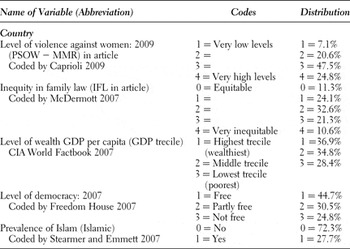
We include 141 countries in our analysis; selection of country was determined by data availability. Table 1 summarizes the description and distribution of our key variables. Approximately 37% of the countries in the study are in the wealthiest category (the United States and Canada among them) and 28% are in the poorest (mostly African nations). Seventy-two percent are not Muslim-majority nations, and 45% of the countries are classified as free, 30% as partly free (such as Afghanistan and Bangladesh), and 25% as not free (such as Belarus and Brunei). It is interesting to note that only 7% of all countries in this sample are classified as having very low levels of violence against women (the United States is not in this group, probably because of our relatively high degree of domestic violence). Only 11% of the countries in the study are classified as having equitable family laws (Scandinavian countries, Australia, and Canada, for example). In other words, both violence and inequity in family law broadly characterize most of the nations of the world, in keeping with our evolutionary theoretical framework.
Description and distribution of the variables used in the study of 141 countries

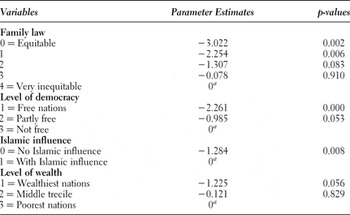
Table 2 presents the results of the polytomous ordinal regression analysis to test our central hypothesis. Table 2 shows that family law, level of democracy, and Islamic influence are the factors most strongly predictive of level of violence against women (PSOW-MMR). The effect of level of wealth is diminished when the effects of the other control variables are taken into account. The negative estimated coefficients tell us that countries with relatively inequitable family laws are less likely to be ranked as more free on the Freedom House scale and are generally Muslim-majority nations. These countries are also more likely to have high levels of violence against women.
The effects of family law, level of democracy, level of wealth, and Islamic influence on predicting level of violence against women (ordinal regression coefficients and p-values for n = 141 with pseudo-R 2=.558)

a = this parameter is set to zero because it is redundant.
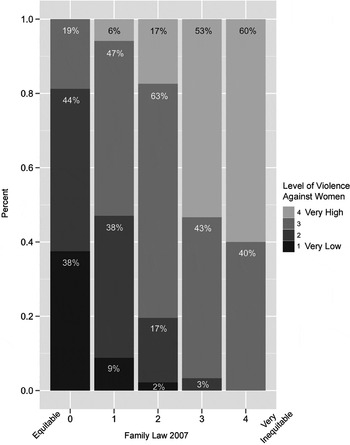
That the results in Table 2 are statistically significant is heartening; if they were not, then serious doubt concerning the hypothesis linking inequity in family law to violence against women would prevail. Cross-tabulation results, not presented here, show a monotonical and increasing relationship between the two variables. This relationship can be seen in Figure 1. Nations with relatively equitable family law (with no enclaves of inequitable family law) make no appearance at the highest level of the PSOW scale, and only 19% appear in the second-highest scale point. Unsurprisingly, 98% of the nations with inequitable family law systems have high levels of societal violence against women. It is noteworthy that scale point 3 indicates nations with legally recognized enclaves of inequitable family law, and all of these nations have relatively high levels of violence against women.
Distribution of level of violence against women by inequitable family law. Source: McDermott Reference McDermott2007.

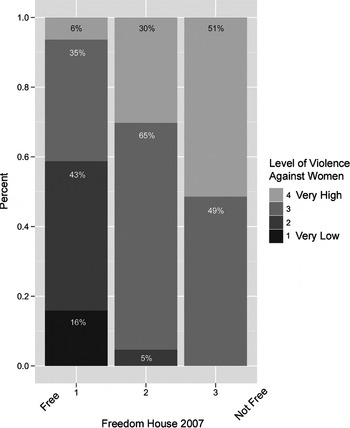
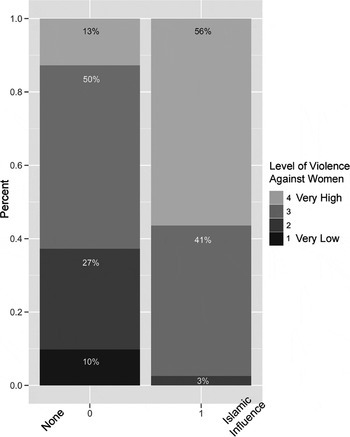
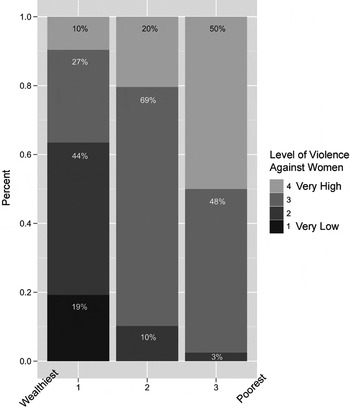
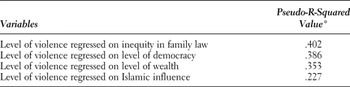
Notwithstanding these results, we must delve deeper to see how other variables fare in comparison to inequity in family law (IFL) in explaining the dependent variable. The bivariate results presented in Table 3 indicate that IFL outperforms the other control variables in explaining the variance in level of violence against women. (An alternative way to visualize these multivariate results is through the graphs in Figures 1 through 4.) The multivariate results confirm this, even after the effects of the other variables are taken into account; that is, the best overall predictor of level of violence against women is the degree of inequity in family law. Democracies (“free” societies) do, in general, have lower levels of violence against women, but explain a lower proportion of the total variance; we do have “free” countries that have very high levels of violence against women, such as India.
Distribution of level of violence against women by level of democracy.

Distribution of level of violence against women by Islamic influence. Source: Stearmer and Emmett Reference Stearmer and Emmett2007.

Distribution of level of violence against women by level of wealth (GDP trecile). Source: CIA World Factbook 2007.

Bivariate Cox and Snell pseudo-R-squared values for level of violence against women (PSOW minus marital rape), IFL, level of democracy, level of wealth, presence of Islamic civilization (n = 141).

*All model-fitting measures are significant at the .05 level.
At first glance, the bivariate results indicate relatively desultory outcomes for the prevalence of the Islamic civilization variable in predicting levels of violence against women. This would indicate, apparently, that there are several legal systems encoding inequitable evolutionary family law other than that found in Islam, and scholars would be remiss to focus their attention solely on the inequities manifest in law codes in Muslim-majority nations. Furthermore, Muslim-majority nations are not uniform, introducing a real spectrum of IFL scores within that group of nations.
The multivariate results, however, show that in the presence of the other variables, the influence of Muslim majorities becomes stronger, significantly diminishing the effect of level of wealth in determining the level of violence against women. This may be because several of the wealthiest nations in the world are the oil-rich Gulf nations, where religious law is more enshrined in state legal codes. We believe that this is an area of important further investigation.Footnote 18
We see these results as a vindication of the redefinitional move made by the 1993 Declaration, which, as discussed previously, called for an inclusion of variables related to what we call inequity in family law in a more expansive definition of violence against women. On the basis of our empirical results, we can say that the 1993 Declaration is not simply a polemical statement: There is real evidence that inequity in family law for women is strongly related to violence against women. Indeed, it is more strongly related than other, alternative hypotheses, including those making reference to democracy, wealth, and prevalence of Islam within a society. These results call us to see inequity in family law as an important component of the problem of, and perhaps also of solutions to, the issue of violence against women.Footnote 19
VII. FAMILY LAW AND VIOLENCE AGAINST WOMEN: IMPLICATIONS FOR THE ESTABLISHMENT OF LEGAL ENCLAVES
Family law is a contentious issue in many countries, and as calls increase for legal enclaves of ethno-religious family law in states currently without such enclaves, the potential for contention also increases. In all of this debate and discussion, however, the question of whether certain types of family law—that is, male-dominant family law encoding structural control of females by males—affect the security of women has not been asked. Our cross-national empirical analysis shows that nations with inequitable family law have significantly higher rates of violence against women compared to nations wherein no women are subject to male-dominant family law. Even a “small” breach against women, as represented by minority legal enclaves (IFL scale point 3), is significantly associated with negative results for women in those states, according to our analysis. None of this is by chance: According to the theoretical framework discussed here, states more closely tied to the human evolutionary legacy of male-dominance hierarchies and structural control of women by men are also states in which templates of violence and domination continue to be perceived as being “functional.”
We argue, then, that states should be wary of calls to permit cultural and religious affiliation to trump the human rights of women. As feminist philosopher Susan Moller Okin (Reference Okin, Cohen, Howard and Nussbaum1999, 19–22) notes, “[B]y failing to protect women and sometimes children of minority cultures from male and sometimes maternal violence, cultural defenses violate women and children's rights to equal protection of the laws. . . . Those who defend group rights on liberal grounds need to address these very private, culturally reinforced kinds of discrimination.”
Calls for legal enclaves have been increasing in recent years, and some de facto enclaves have even emerged. For example, the government of Ontario Province in Canada recognizes polygynous marriages—at least among Muslims, if not apostate Mormons (FLDS)—though the nation of Canada currently does not (WLUML 2008a). Indeed, a case has just been heard by the Supreme Court concerning whether Canada should continue such a ban, and the British Columbia Civil Liberties Association has called for an overturn of the ban, stating that it should be “relegated to the scrap heap of history” (Globe and Mail 2011; a ruling issued November 22, 2011 affirmed the ban on polygamy). With regard to issues in Canada other than polygyny, however, despite calls from a former attorney general to allow Islamic law tribunals to settle family law issues, the government of Ontario, facing street protests against the recommendation (not only in Ontario, but also in European capitals), adamantly refused (BBC 2005). Indeed, Ontario went even further in 2006, rendering the rulings of any religious tribunal without legal validity or enforceability (Sciolino Reference Sciolino2008).
In February 2008, the United Kingdom granted welfare benefits to all spouses in a polygamous marriage if the marriage took place in a country that recognizes polygamy; this situation also pertains to the Netherlands. That same year, the archbishop of the Episcopal Church, Rowan Williams of the United Kingdom, argued that immigrants from Muslim countries will be less alienated if allowed to have Shariah religious courts to decide family law matters, and that this step was “unavoidable” (CNN 2008). At the same time, the UK has set up a “Forced Marriages Unit” to deal primarily, perhaps specifically, with human rights abuses against Islamic women living in that country.
In Australia, two senior Islamic community leaders called upon the government to recognize polygamy, and Australia's attorney general responded, “There is absolutely no way that the government will be recognising polygamist relationships. They are unlawful and they will remain as such. Under Australian law, marriage is defined as the union of a man and a woman to the exclusion of all others. Polygamous marriage necessarily offends this definition” (Bhandari Reference Bhandari2008). In the United States, the FLDS church is preparing a lawsuit it believes will ultimately reach the Supreme Court, in the hopes of having the high court decriminalize polygamy in that country (Winslow Reference Winslow2008).
Legal Pluralism?
As we noted previously, there have been numerous historical attempts to create multiple systems of family law within the same national entity. The Dutch “pillared” system of religious multicultural identities emerged in 1870 to bridge religious and linguistic cleavages by setting up parallel social institutions. The program ultimately broke down as Dutch society became more mobile and integrated. Even while in operation, however, it was criticized as setting up pillars of different groups that were separate but never equal. In 1980, concern for Muslim immigrants suggested a revival of the “pillared” system, but it received little support (Klausen Reference Klausen2005, 198–99).
Legal systems that differentiate by community (known as legal pluralism and cultural federalism) set up separate legal courts for minority communities to deal with issues where community practice diverges from the majority community (Fournier Reference Fournier2004; Rudolph and Rudolph Reference Rudolph and Rudolph2000). The millet system used by the Ottoman Empire from the sixteenth through nineteenth centuries recognized and protected the religious diversity of its subjects by mandating that family law be adjudicated by each community's own court system. Thus, Jews and Christian denominations were each subject to their own religious authorities in this sphere. Even in the case of tribal groups that may have been nominally Muslim, customary law was recognized as binding for each separate group. This system was common throughout the Ottoman Empire as well as Iran, and survives to some extent in former Ottoman countries, such as Iraq, Jordan, Lebanon, Israel, the Palestinian Authority, and Egypt, where family law is governed by each community's own religious courts.
British rule in India also established a system of legal pluralism that recognized and legitimized the personal law of India's separate religious communities. The Indian state, from the early 1800s on, continues to reflect traditional separation of religious and cultural groups (Hindus, Muslims, Christians, Sikhs, Jains, Buddhists, and Parsis, as well as smaller sects and religious communities) by allowing self-governance for religious and personal status issues (Rudolph and Rudolph Reference Rudolph and Rudolph2000). Pakistan and Bangladesh, in keeping with this British colonial legacy, also follow legal pluralism. Indeed, much of the support for legal enclaves or legal pluralism is found in commonwealth countries where Muslims of South Asian origins are a significant group.
The advantages of legal pluralism include respect for cultural and religious integrity, traditions, and practice, but also the diminishing of conflict among groups by segregating practice along community lines.Footnote 20 Religious law arbitration tribunals that would allow members of a faith to settle family law disputes, such as divorce or inheritance questions along religious law outlines have, however, also proved controversial. In the UK, a seeming compromise between the law of the state and family law codes—arbitration tribunals (beth din)—have been established for obtaining a divorce under halacha law for Orthodox Jewish couples, without which neither can remarry. Muslim proponents of using Shariah legal principles to settle civil matters in Western countries have called for the establishment of extrastate arbitration councils. For example, a council could issue a divorce in accordance with Shariah law, freeing both parties to marry again.
There are two problems that arise with this proposed compromise. First, as emphasized previously, there is no one accepted version of Shariah law. Rather, different schools of law have established different standards and practices. Any “Islamic” or “Shariah” law declared for a group in a given state or area is, in reality, an interpretation by that group or leaders of the group working from traditional understandings, often unique to a geographical locality or a certain conception, of what Islamic practice should be. No one version is more accepted by the global community of Muslims than another. Holding a Moroccan or Indonesian woman to standards set by a Hanbali Wahabi arbitration council (one school of fiqh) would be unacceptable according to understandings that recognize the diversity of schools.
Second, the same danger of jeopardizing the rights of women exists as in the religious enclaves. To adhere to the standard of equality and human rights of CEDAW, religious arbitration should be nonbinding, giving individuals the possibility of opting out of decisions that contradict rights stipulated under state law. Simply put, religious arbitration has no way of guaranteeing an equitable outcome for a woman. Since family pressure can push a woman into abandoning her brideprice and not receiving alimony, or religious courts may disregard Western standards of domestic abuse, women's groups firmly oppose Muslim arbitration councils and have led the fight against them in Canada and Britain (Bakht Reference Bakht2004).
Religious Freedom and Women's Rights
It is no wonder that nations are, at times, confused in how to respond to calls for male-dominant family law enclaves to be established. Allowing cultural and religious identity to be preserved is a recognized human right: The United Nations in 1992 issued the “Declaration on the Rights of Persons Belonging to National or Ethnic, Religious, and Linguistic Minorities” (A/RES/47/135), which, in turn, cited article 27 of the International Covenant on Civil and Political Rights, declaring that “States shall take measures to create favourable conditions to enable persons belonging to minorities to express their characteristics and to develop their culture, language, religion, traditions and customs,” but in the same breath continues, “except where specific practices are in violation of national law and contrary to international standards” (UN 1992). Minority communities, notably Muslims in Western countries, argue that secular countries are negating their religious and cultural traditions by rejecting the practice of their family law systems (Pearl Reference Pearl2000).
The question of the universality of women's human rights cannot be avoided, however. For example, a 2009 UN ECOSOC report notes:
Compatibility between certain individual rights, including freedom to practise a religion or faith or to observe rites, and women's fundamental rights as universal rights poses a major problem. The problem stems from the fact that the right to engage in certain practices injurious to women's health or their position before the law or their status in general is claimed by persons, communities or States pursuing those practices or perceiving them as a component of freedom of religion and as a religious duty by which they and their ancestors have been bound from time immemorial and which in their eyes appear unrelated to issues concerned with the universal protection of women's rights. Universality of the rights of women as individuals thus draws us into a classic yet still topical debate, that of the universality of human rights, and women's rights in particular, in the face of cultural diversity. The issue is a sensitive one since practices or norms that impair the status of women originate, from the standpoint of the discriminator, in what are regarded as deeply held beliefs and, on a practical level, in rules, regulations or values based on or imputed to religion. (point 3: 5)
This legitimate concern for cultural and religious integrity poses a dilemma. In the West, universal application of law recognizes individuals as the fundamental unit of society with uniform legal rights and obligations. Other cultural and religious traditions, however, may recognize collectives as the basic unit, and these collectives generally privilege senior male members and create mechanisms of structural control of women by men (Rudolph and Rudolph Reference Rudolph and Rudolph2000). It is difficult to mesh these two very different legal traditions.
Interestingly evidence shows that Muslim women living outside of Muslim-majority countries may not, in fact, support such enclaves (Fournier Reference Fournier2004). Klausen (Reference Klausen2005, 194), author of a study that documented support for application of Islamic law in European countries, states that women “were notably less supportive of legal pluralism and multicultural devolution of authority to Islamic scholars and imams than were the male leaders.” This did not mean that the women were not observant Muslims. While the women overwhelmingly sought freedom to practice their religion, they opposed being governed by religious personal-status law. Three-quarters of the women in Klausen's study rejected the proposition that secular law should be changed to devolve authority to religious leaders in matters of personal law, as did half of the men. Klausen emphasizes that this rejection does not reflect levels of religiosity or women's positions on other issues.Footnote 21
Klausen relates an interview with a young British lawyer who stated emphatically her allegiance to Shariah law. When told that even very religious Muslim women did not want imams and Shariah councils to issue binding decisions on family law matters, the woman exclaimed, “But oh no. . . they are right. You cannot trust these matters to imams. That would be terrible for women. We must have professionals make those decisions” (Klausen Reference Klausen2005, 194–95). The question of whether women from cultures with relatively inequitable family law systems would prefer to be governed by secular family law is an important and underdeveloped area of research, deserving of greater attention by scholars in several social science fields.
There have been some interesting attempts to separate the baby from the bathwater, so to speak, in the area of disparate family law systems. For example, Muslim groups in the United Kingdom have attempted to issue guidelines concerning, among other things, marriage contracts; these contracts would explicitly give women the right to divorce and prohibit polygyny, while still maintaining Islamic traditions, such as a dower (WLUML 2008b). Indeed, Islamic law courts have coexisted with Church of England and Jewish ecclesiastical courts for more than 20 years in the UK, primarily handling appeals from women wanting a religiously sanctioned divorce from a husband who does not agree to one. But all of these courts and tribunals must subordinate themselves to British law under the Arbitration Act of 1996. Jack Straw, justice minister in 2008, stated the principle in these terms: “There is nothing whatsoever in English law that prevents people abiding by Shariah principles if they wish to, provided they do not come into conflict with English law,” adding that British law “would always remain supreme” and that “regardless of religious belief, we are all equal before the law” (Sciolino Reference Sciolino2008).
Legal scholar Robin Fretwell Wilson has offered the formula that parallel systems could be countenanced if and only if government courts are legally obligated to refuse the ruling of religious courts in the event that women, specifically, would be worse off under the religious judgment than a government judgment, saying, “Society has a stake in the outcome” (Liptak Reference Liptak2008).Footnote 22
We believe that Fretwell is right: Society does have a stake in the outcome. If society countenances inequitable family law that discriminates against women in the name of religion or belief, then society is grabbing not just that one end of the stick but the other end as well—higher levels of violence against women.Footnote 23 The international system, as represented by the United Nations, and the states of the world cannot avoid deciding between the concept that women's rights are universal and the concept that individuals should be free to practice their deepest-held beliefs. As the UN ECOSOC report puts it:
Freedom of religion or belief, which entails the legitimate assertion of a right to be different and to respect cultural diversity, is to some extent incompatible with the universality of women's rights, whether in society or specifically within the family. That paradox—which may at first sight be surprising or even shocking—shows the difficulty of coexistence between certain rights when exercised by a specific community and the fundamental rights of each of the members of that community, especially women. This is particularly the case since it is in general women who are often the first and main victims of the exercise of conflicting asserted rights and of the adverse consequences arising from a certain view of freedom of religion, notably in situations of conflict or ethnic or cultural identity crisis. (point 4: 5)
Our own research leads us to believe that there can be no compromise on the universality of the human rights of women, including, and perhaps even most consequentially, within family law; when the human rights of women are compromised, the inviolability of the human rights of every human being is also compromised. If a society mitigates the harmful evolutionary legacy of male dominance in family law, then it chooses to act so as to reduce societal levels of violence against women. If a society is indifferent concerning the establishment of inequitable family law, including enclaves, it then also demonstrates its open indifference concerning societal levels of violence against women. The point simply cannot be finessed; a choice must be made.
No wonder, then, that the newly created UN Women organization has set one of its first priorities to be “to close the gaps between women's rights in the law, and their enjoyment in practice” (UN General Assembly 2010). The battle for equitable family law should engage all those concerned with violence against women. National governments are taking action as well. For example, one of the most ambitious and far-reaching recent legislative initiatives is the Philippines' Magna Carta of Women, signed into law in 2009 (PhilGAD 2009). This Magna Carta is the instrument by which the Philippine government will bring its affairs fully into compliance with CEDAW. Along with such top-down efforts, we see some impressive bottom-up movements as well, such as the Equality Without Reservation Movement, the Million Signature Campaign, and the WISE Compact.Footnote 24 As anthropologist and Islamic feminist Ziba Mir-Hosseini has recently commented: “[T]he issue of gender relations within the family—which is what personal laws are all about—actually relates to the core of power in society at a broader level. Since the family is the basic unit of society, only if there is justice and democracy within the family can you possibly have justice and democracy in the wider society. In other words, the key to democratizing the whole society is to democratize its basic unit, the family, and for this legal reform is crucial” (Madrasa Reforms in India 2010).Footnote 25
It is possible that the real battle for security within human collectives, as Mir-Hosseini implies, is fought at the level of family law and violence against women. International leaders have recognized this linkage. For example, then–UN Secretary General Kofi Annan stated: “It is within the family that the notion of human rights becomes a reality lived on a daily basis. If tolerance, respect and equity permeate family life, they will translate into values that shape societies, nations and the world” (Annan Reference Annan1998). As feminist scholar Michaele Ferguson (Reference Ferguson2004) has put it: “A policy of homeland security should equally be concerned with the security of women at home.” It is time for states, especially those confronted with calls to establish enclaves of inequitable family law, to act as if the human rights and the security of the broader society were inextricably linked to the rights and security of women within their own families—because they are.