

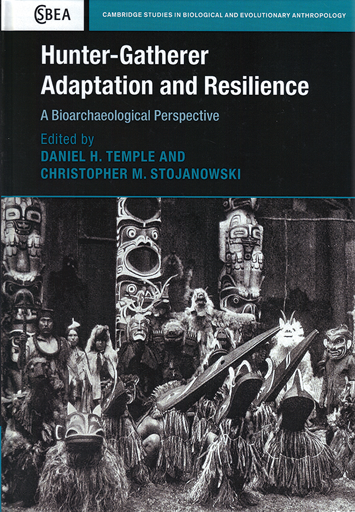
As in many other subjects, the investigation of resilience is becoming prevalent in archaeological science. At the same time, however, debate about the benefits of resilience theory, as something more than an attractive narrative, is also growing. The 13 case studies that comprise Hunter-gatherer adaptation and resilience consider a diverse set of hunter-gatherer societies, focusing methodologically on the bioarchaeological investigations of human remains and their archaeological context. This focus is fruitful in several ways: the data concerning diet, mobility, stress, diseases and mortuary practices is of particular interest in this research area, with studies of the resilience of hunter-gatherer societies highly underrepresented until now. In addition, the book addresses the key question of how archaeological data can be used within resilience theory.
Beginning with a good introduction that defines the key terms and some history of the research, the first case studies are focused on the socioeconomic resilience of hunter-gatherers from the South African Late Stone Age (Pfeiffer & Harrington) and Late Pleistocene–Early Holocene societies in Patagonia (Bernal et al.). Both chapters provide a characteristic blueprint for a highly resilient society, with interesting insights into specific physical characteristics, but also unexpected and more complex behaviours, such as territoriality. Schulting observes a similar high socioeconomic resilience to the climate trigger event 8.2 thousand years ago that reduced global temperatures. This is primarily based on a comprehensive set of stable isotope data from southern Wales for broad-spectrum hunter-gatherers. In contrast, his dataset from the Neolithic–Mesolithic transition in Denmark and Britain describes a scenario in which the introduction of Neolithic technology, and behaviour, led to a changing way of life. It resulted in widespread reorganisation of societies into agricultural farming communities.
The second set of case studies focus on aspects of cultural resilience, beginning with Temple's chapter on the Late–Final Jomon period. By using a wide range of bioarchaeological methods to investigate stress, diet, mortality and cultural practices, he proposes a link between resilience and culture. Using the adaptive cycle model as the basis of their chapter, Cameron and Stock interpret observed biomechanical properties related to hunting, gathering and herding within the human fossils of Late Stone Age groups in southern Africa. In doing so, they interpret the introduction of herding as a release phase (or breakdown of the system), while during reorganisation, both lifeways merged into something new but not radically different.
Stojanowski's analysis also focuses on the resilience of hunter-gatherers and pastoralism during climatic shifts, this time considering the Gobero region in Niger, and emphasising the high resilience of the groups analysed in the study. The beginnings of social hierarchy are evident in the chapter by Da-Gloria and Bueno who present a study encompassing a settlement spanning 7000 years at Lagoa Santa, Brazil. Their evidence shows that the increasing complexity of the settlement system corresponds with decreasing territory sizes, reduced mobility of peoples and increasing negative effects on human health. Da-Gloria and Bueno suggest that the next phase of reorganisation of social groups into more mobile and less territorial groups did not represent a collapse in social order, but an adaptation designed to preserve broader settlement continuity. This may have been a response to a shift towards less stable climatic conditions.
Bornemann and Gamble's chapter describes the resilience of the Chumash society under the growing influence of the Europeans. They identify continuity in rituals that reflect social hierarchy, such as mortuary practices, as possible explanations for the persistence of many aspects of Chumash society. Letham and Coupland describe a comparable situation in their chapter, which considers hunter-fisher-gatherers from the Northwest Coast of North America. Here the existence of specific lavish burial practices are supposed to support the resilience of the societies when dealing with both internal and external agents of change. A further example of cultural resilience and persistence of tradition is presented by Justice and Temple in their case study focusing on the Tiagra Culture, and its two constituent cultures, at Point Hope, Alaska. By emphasising the pre-adult skeletal remains and mortuary practices, they identified the dynamics of persistence and change in cultural packages, providing insights into the social development of cultural resilience.
The painful effects of a loss of resilience are investigated by Bartelink et al. in their chapter on the Bay of San Francisco in the Late Holocene. Although faced with challenging environmental changes, it appears to have been violence and warfare associated with the introduction of new cultural traditions and migrations that caused a failure of resilience in this population. With the lack of detailed studies about the collapse of hunter-gatherer societies in the wider literature, the final chapters of the volume provide rare new insights. Merbs considers the case of the Sadlermiut, a highly complex hunter-gatherer society of the Thule Culture, which remained isolated and had no contact with Europeans until the nineteenth century. While bioarchaeological data support the Sadlermiut's resilience to harsh environmental conditions, immunity to disease was a weakness, and an epidemic of infectious disease killed the entire population. In a further example of collapse in highly adapted society, Littleton focuses on the Indigenous Australian peoples. In this case, the health of individuals or groups was not weakened by disease, but the society went into decline as a result of the general loss of resilience caused by landscape reorganisation, increased grazing or a steady influx of Europeans.
The volume closes with a comprehensive synthesis by Buikstra, suggesting distinct strategies for future bioarchaeological studies within resilience theory, and concepts for the integration of other datasets, such as ethnohistory and ethnoarchaeology.
To conclude, it is fair to say that some contributors could have defined their terms more explicitly, and in terms of comparability, it would have been fruitful to apply the adaptive cycle model in more of the case studies. Overall, however, this volume provides not only a comprehensive insight into state-of-the-art bioarchaeology research and engaging case studies on hunter-gatherer societies, but also demonstrates the efficacy of resilience research in archaeological science.


