In the last three decades, intimate relationships have become an increasing focus of interest for social scientists. Since the early 80s, a wide range of issues have been addressed concerning the variables that predict relationship stability and divorce (for a review, see Gottman & Silver, Reference Gottman and Silver1999), as well as the factors that influence relationship quality, adjustment and satisfaction (Adler-Baeder, Higginbotham, & Lamke, Reference Adler-Baeder, Higginbotham and Lamke2004; Bradbury & Karney, Reference Bradbury and Karney2004; Graham, Liu, & Jeziorski, Reference Graham, Liu and Jeziorski2006; Graham, Diebels, & Barnow, Reference Graham, Diebels and Barnow2011). Furthermore, recently researchers from different disciplines are paying special attention to the nature of romantic love in long-term relationships (Hatfield, Pillemer, O’Brien, & Le, Reference Hatfield, Pillemer, O’Brien and Le2008; O’Leary, Acevedo, Aron, Huddy, & Mashek, Reference O’Leary, Acevedo, Aron, Huddy and Mashek2012).
In the contemporary Western society, the link between the concepts of romantic love, marriage and sexuality has consolidated so that romantic love is considered an important basis not only for establishing an intimate relationship and maintaining it, but also for marital stability (Barrón, Martínez-Iñigo, De Paul, & Yela, Reference Barrón López de Rueda, Martínez-Íñigo, de Paúl and Yela1999; Ferrer, Bosh, Navarro, Ramis, & García, Reference Ferrer, Bosh, Navarro, Ramis and García2008). The importance of love and stable intimate relationships lies in the fact that they have been associated with various factors, such as personal well-being (Riehl-Emde, Thomas, & Willi, Reference Riehl-Emde, Thomas and Willi2003), mental health (Cohen, Klein, & O’Leary, Reference Cohen, Klein and O'Leary2007), and satisfaction (Masuda, Reference Masuda2003).
Several studies argue that love is an important predictor of happiness, positive emotions and general life satisfaction (Acevedo & Aron, Reference Acevedo and Aron2009; Diener & Lucas, Reference Diener and Lucas2000; Kim & Hatfield, Reference Kim and Hatfield2004). Researchers in this area often use the term “subjective feeling of well-being” as a synonym for general happiness when referring to people’s emotional and cognitive evaluation of their lives (Diener, Oishi, & Lucas, Reference Diener, Oishi and Lucas2003; Kim & Hatfield, Reference Kim and Hatfield2004). In this regard, on a sample of college students, Kim and Hatfield (Reference Kim and Hatfield2004) considered Hatfield and Rapson’s (Reference Hatfield and Rapson1993) love types to analyze the relationship between passionate love, companionate love and the subjective feeling of well-being or happiness. The results of the study showed that companionate love was the strongest predictor of life satisfaction, while passionate love was the strongest predictor of positive emotions. In addition, the most relevant finding of the study was the multidimensional consideration of the relationship between love and happiness.
Some studies argue that romantic or passionate love, or “Eros” (Lee, Reference Lee1977), diminishes over time and generally becomes companionate love, a less intense, more stable, friendship-type love, devoid of sexual desire and interest, combining attachment, intimacy, and commitment (Acevedo, Reference Acevedo2008). In contrast, other studies argue that romantic love with intensity, sexual interest and commitment (without the obsessive component of early stage romantic love) is a phenomenon that does not necessarily transform into companionate love over time, according to the results observed in diverse studies that have examined this phenomenon (Acevedo & Aron, Reference Acevedo and Aron2009; Buss, Reference Buss, Sternberg and Weis2006; Fisher, Reference Fisher, Sternberg and Weis2006; Hatfield et al., Reference Hatfield, Pillemer, O’Brien and Le2008; O’Leary et al., Reference O’Leary, Acevedo, Aron, Huddy and Mashek2012).
In Spain, research on love is scarce, although several studies have analyzed different aspects of love. In a sample of undergraduate students in intimate relationships, Yela (Reference Yela1997) analyzed the temporal course of the components of love (erotic passion, romantic passion, intimacy, and commitment), finding some empirical support for the model proposed by Sternberg (Reference Sternberg1986), which attempts to explain the structure (basic dimensions) and dynamics (temporal evolution) of the phenomenon. Moreover, global analysis of the components suggests the existence of three main stages in the evolution of love: “infatuation,” “passionate love,” and “companionate love”. Barrón et al. (Reference Barrón López de Rueda, Martínez-Íñigo, de Paúl and Yela1999) examined the belief in the main romantic myths and the link between sex, love, and marriage, especially in the case of women, older people, and people with a lower educational level. Ferrer et al. (Reference Ferrer, Bosh, Navarro, Ramis and García2008) delved into the concept of love that prevails in the Spanish population and found evidence that the Eros style or romantic love generated higher acceptance of this form of loving than any other love concept, such as Agape, Ludos, and Mania in men and women of all ages. Other studies have examined the predictive factors of love and sexual satisfaction for men and women (Yela, Reference Yela2000); the myths and beliefs about romantic love (Yela, Reference Yela2003); romantic love and the process of differential socialization (Esteban & Távora, Reference Esteban Galarza and Távora Rivero2008), and the romantic myths and their possible relation to gender violence (Ferrer, Bosch, & Navarro, Reference Ferrer Pérez, Bosch and Navarro Guzmán2010).
Romantic love is a multidimensional construct, difficult to conceptualize and, consequently, difficult to measure (for a review of the main instruments, see Myers & Shurts, Reference Myers and Shurts2002). The studies that have examined the association of intensity of romantic love and age or length of relationship have focused on determining its development over time, the variables that predict it and potential gender differences (Acevedo & Aron, Reference Acevedo and Aron2009; Hatfield et al., Reference Hatfield, Pillemer, O’Brien and Le2008; O’Leary et al., Reference O’Leary, Acevedo, Aron, Huddy and Mashek2012). In this regard, Acevedo and Aron (Reference Acevedo and Aron2009) analyzed the variations of romantic love on the basis of relationship length with the Passionate Love Scale (PLS; Hatfield & Sprecher, Reference Hatfield and Sprecher1986), one of the most widely used instruments to measure romantic love. The results of the study showed that 13% of the participants who had been married an average of 8.39 years obtained high scores on the non-obsessive items of the scale. The results from the meta-analysis showed a significant correlation between romantic love in intimate relationships and relationship satisfaction in the short and long-term, whereas the obsessive component correlated negatively in long-term relationships and positively in short-term relationships. In a recent study, O’Leary et al. (Reference O’Leary, Acevedo, Aron, Huddy and Mashek2012) considered the findings observed by Acevedo and Aron (Reference Acevedo and Aron2009) in order to analyze the variables that theory associates with the intensity of romantic love. To the surprise of the investigators, the results of a randomly selected U.S. sample showed that, 40% of women and 35% of men who had been married for more than 30 years reported being “very intensely in love” and no significant gender differences were observed. In a random selected New York sample of men and women married 30 years or more, 19% of wives and 29% of husbands reported being very intensely in love. Furthermore, in the U.S., higher levels of the variables: thinking positively about the partner, thinking about the partner when apart, affection, frequency of sexual intercourse, participation in novel and challenging activities, and general life satisfaction were associated with higher levels of intensity of long-term romantic love. In contrast, higher levels of the variable wanting to know where the partner is were associated with higher levels of intensity of romantic love for men, but not for women.
The investigation carried out suggests that couples who have been in their relationship for a longer time may feel romantic love, but it is not known whether this is a rare phenomenon. As noted by O´Leary et al. (Reference O’Leary, Acevedo, Aron, Huddy and Mashek2012), we know very little about love and gender differences in couples who have been together for a long time. Thus, the present study assessed the prevalence of the variables that theory associates with intensity of romantic love such as: affective behaviors, sexual intercourse, thinking positively about the partner, thinking about the partner when apart, wanting to know where the partner is, participation in novel and challenging activities, difficulty concentrating and general life happiness. As noted earlier, several relationship researchers and scholars have posited that intensity of love of a romantic nature is uncommon in marriage (e.g., Sternberg, Reference Sternberg1986) and generally fades across time (Fisher, Reference Fisher, Sternberg and Weis2006). Yet, as Hatfield et al. (Reference Hatfield, Pillemer, O’Brien and Le2008) noted, we have little empirical data regarding love in long-term marriage. O’Leary et al.’s (Reference O’Leary, Acevedo, Aron, Huddy and Mashek2012) research is the first to empirically address this issue in randomly selected samples in New York and the U.S. The data supported the notion that intensity of romantic love does fade but largely in the first 10 years, with relatively little change thereafter.
In long-term relationships, affection and physical desire have been found to be associated with being in love with a partner, but the association of these variables has had little attention in representative samples. In a U.S. sample, affection and sexual intercourse had significant associations with reports of intensity of romantic love but affection had stronger associations with intensity of romantic love than sexual intercourse for both men and women (O’Leary et al., Reference O’Leary, Acevedo, Aron, Huddy and Mashek2012). When general relationship satisfaction was controlled, the association of affection and intensity of romantic love remained significant whereas sexual intercourse did not. Furthermore, not a single individual reported being intensely in love if there was not physical affection, though that was the case for absence of sexual intercourse.
Positive cognitive variables like sentiment override have been posited as a reason why an individual will recall more positive things than actually happened (Weiss, Reference Weiss and Vincent1980). In fact, individuals in satisfactory dating relationships recalled more positive descriptors of their partners than had actually been presented to them in comparison to those in less satisfactory relationships (Jose, Rajaram, O’Leary, & Williams, Reference Jose, Rajaram, O'Leary and Williams2010). Moreover, unsatisfied married partners were more likely to recall negative things about their partners than those who were satisfied (Whisman & Delinsky, Reference Whisman and Delinsky2002).
Hypotheses
-
a. Given the similarity of US and Spanish cultures in terms of literacy rates, life expectancy, and educational attainment (Jose, O’Leary, Gomez, & Foran, Reference Jose, O’Leary, Gomez and Foran2014) and the percentages of men and women in New York (29%) who reported that they were intensely in love, it was predicted that approximately 30% of men and women who were married over 10 years would report that they were intensely in love.
-
b. Given that thinking positively about one’s partner, thinking about one’s partner when apart, affection and general life happiness were associated in a randomly selected New York sample and randomly selected US sample, we predicted that these variables would be positively associated with reports of intensity of romantic love in our Spanish sample.
-
c. We predicted that intensity of romantic love would decline with age with the highest reports of intensity of romantic love occurring in those individuals in relationship less than ten years and that the decline after 10 years would be very small.
Method
Ethics Statement
The study was approved by the Bioethics Committee of the Faculty of Psychology of the Universidad Complutense de madrid. The purpose of this research was explained to the participants and the goal was to analyze different aspects regarding the quality of couple’s intimate relationships concerning how much in love they were and their level of satisfaction with the relationship. As the questionnaire was anonymous, the consent form was introduced in the first part of the protocol and participants were told that they could give their consent by completing the questionnaire and sending it anonymously and independently of their couple to a PO Box.
Participants
The participants of the study consisted of 2,988 adult heterosexual couples, aged between 18 and 80 years, from the Region of Madrid. All participants provided the following sociodemographic data: age, sex, civil status, nationality, partner's sex.
As a function of the goals of the study, the inclusion criteria were being over 18 years of age and being in a heterosexual relationship either currently or in the past 12 months.
The majority (61.7%) of the participants were married; 29.5% were single and living with a partner, 7.0% were common-law couples and 1.8% were widowed, separated, or divorced and living with a partner. Men’s mean age was 40.44 years (SD = 14.00) and women’s mean age was 39.73 (SD = 13.93). Of the sample, 97% were Spanish and 3% were of other nationalities. Concerning occupation, 43.1% were employees, 13.5% were civil servants, 11.4% were self-employed or autonomous workers, 8% were businessmen, 21.7% were unemployed and 2.3% were students.
Instruments and Variables
Sociodemographic Questionnaire
Diverse items were included to assess the participants’ characteristics in the following sociodemographic and personal variables: age, sex, civil status, nationality, professional activity and current partner’s sex and age.
The survey consisted of 19 questions involving relationship information (O´Leary et al., Reference O’Leary, Acevedo, Aron, Huddy and Mashek2012). The questions were read to the respondents and they were to answer after all the options to each question were given. The questions usually had a number of options to which the respondent indicated the extent of agreement or disagreement, or the intensity of sentiment about something. For example, the question on general life happiness was rated on a 4-point Likert-type scale as follows: “I am happy with my life in general.” Do you (1 = agree strongly; 2 = somewhat agree; 3 = somewhat disagree; 4 = disagree strongly). The question about intensity of romantic love was rated on a 7-point Likert-type scale as follows: How much in love are you with your partner? (1 = very intensely in love; 2 = intensely in love; 3 = very in love; 4 = in love; 5 = somewhat in love; 6 = a little in love; 7 = not at all in love).
We employed a global item for intensity of romantic love for two reasons. First, and most importantly, the existing, most widely used measures of romantic love (e.g., PLS, Love Attitudes Scale) are based on theoretical conceptualizations of newly in-love individuals. Secondly, it was specifically the subjective sense of being intensely in love that was our focus, not the prevalence or correlates of a set of hypothetically underlying variables that might or might not correspond to what people experience as intensity of romantic love and that might or might not overlap with other related constructs.
Procedure
The study used a quota sampling method to recruit a community sample of married or cohabitating couples from the Region of Madrid. In order to obtain the most representative sample possible of the active population of the diverse urban areas, the research assistants (RAs) were selected from 300 candidates from the Department of Clinical Psychology of the Universidad Complutense de Madrid, who wished to obtain research credits. We took, as reference for the distribution of the RAs, the population as a function of census of the Region of Madrid (Table 1).
Distribution of the Research Assistants (RAs) Based on Information from the Population Census of the Region of Madrid

Source: Population Census. Provisional data. National Institute of Statistics. Review of population projections for the Region of Madrid 1996–2011.
The RAs were informed of the general characteristics of the study and that the general goal was to analyze different aspects regarding the quality of couple’s intimate relationship concerning how much in love they were and their level of satisfaction with the relationship.
The purpose of this research was explained to the participants and, as the questionnaire was anonymous, the consent form was introduced in the first part of the protocol. Participants were told that they could give their consent by completing the questionnaire and sending it anonymously and independently of their partner to a PO Box.
The procedure was as follows: (a) each RA had to collect a quota of 8 couples from the assigned census area, 1/3 of whom could be acquaintances and the rest unknown; (b) the couples were selected taking into account the following age range: 18–29; 30–50; 50+; (c) after obtaining the study quota, the RA had to give the code of each couple member to the director of the project (e.g., 1-a and 1-b up to 8-a and 8-b) and the phone number or email address of each couple; and (d) in order to confirm the veracity of the data, a random control of 10% of the participants of the study was performed.
Table 2 shows the sample selection procedure and includes the number of RAs and the initial protocols by year. Likewise, the rate of return of the protocols, the rejection rate (the protocols were rejected because they had faulty data, had been completed randomly, or had low response consistency) and the total number of participants for each year.
Sample Selection Procedure

The missing data were replaced through Expectation–Maximization (EM) procedure (SPSS version 19.0). The prevalence statistics reported in the present study are based on valid cases (i.e., missing data were not replaced prior to computing this statistic, and as no differences were obtained then, they were replaced with imputed values).
Data Analysis
Analyses were performed using SPSS version 19.0. Firstly, in order to estimate gender differences in the intensity of romantic love, a Student's t-test was used. Secondly, a one-way independent-measures ANOVA was performed to compare the effect of the variable length of relationship on the intensity of romantic love. Thirdly, in order to check for predictor variables that theory associates with intensity of romantic love, a linear logistic regression analysis (Enter method) was performed.
Results
Gender Differences in Intensity of Romantic Love
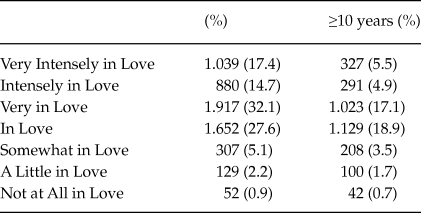
Of special interest herein, 17% of men and 18% of women reported being “very intensely in love” and it can observed that the most frequent response for men and women was “very in love” (M = 5.02, SD = 1.28). The results revealed no significant differences between men and women in the intensity of romantic love, t(2987) = 1.41, p = 0.16, percentages are combined in Table 3. Even for the longest marriages (≥ 30 years), 12% of women and 9% of men reported being “very intensely in love”.
Weighted Percentage of Responses to “How in Love are You with Your Partner?”

Note: Mean of Madrid Sample = 5.02; SD = 1.28; N = 5.976.
Mean of Madrid Sample married more than or equal to 10 years = 4.66; SD = 1.24; N = 3.120.
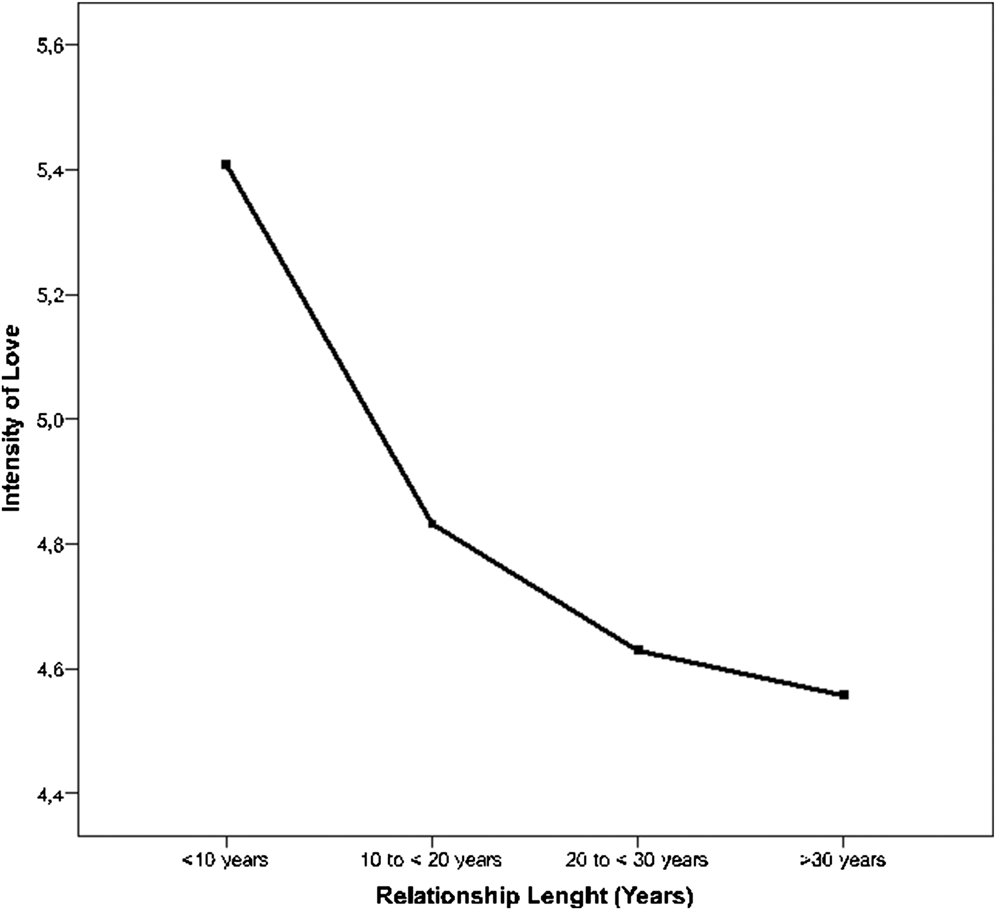
Intensity of romantic love is adjusted with relationship length (years) to a negative exponential function, so that the degree of love is higher in participants in a shorter relationship (<10 years), even though the decrease is much higher for couples in a relationship of 10 to 19 years than for couples in longer relationships (see Figure 1). Also, there is little variation for couples in relationships of 20 to 30 years and of more than 30 years.
Intensity of being in love. Based on a scale of 1 (Not at all in love) to 7 (Very intensely in love) with one’s spouse by relationship length.

When relationship length was divided into four groups (<10 years, 10–20, 20–30 years and >30 years), there were significant differences between the four groups regarding the response “very intensely in love”, F(3, 5.972) = 191.32, p < .001, ηp2 = 0.08, 95%. The comparisons using the Bonferonni method showed that couples in relationships of less than 10 years had significantly higher levels of intensity of romantic love than the three other groups (10–20 years, 20–30 years, and >30 years). Couples in relationships of 10 and 20 years had a significantly lower level of infatuation than the group of less than 10 years and significantly higher than the group of more than 30 years; however, there were no significant differences between the age groups of 20–30 years and >30 years.
Zero Order General Correlations
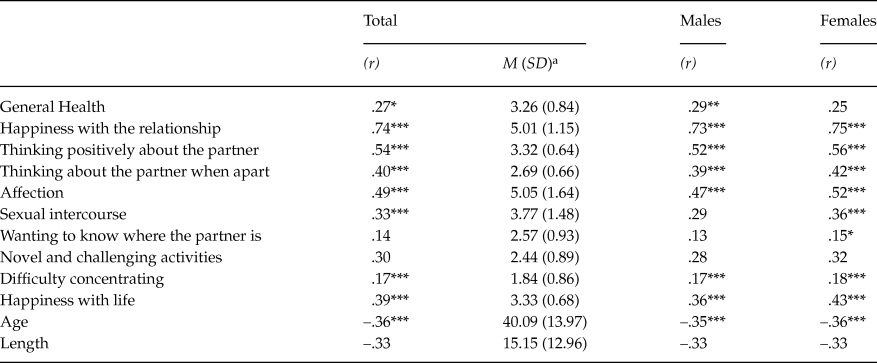
The degree of general happiness with life, happiness with the relationship, thinking positively about the partner, affectionate behaviors (hugging, kissing), thinking about the partner when apart and difficulty concentrating, were associated with higher levels of intensity of romantic love for both men and women (see Table 4). Wanting to know where the partner is and frequency of sexual intercourse were associated with higher levels of intensity of romantic love for women, but not for men. General health was associated with higher levels of intensity of romantic love for men but not for women. Age was associated with lower levels of intensity of romantic love for both men (–.35) and women (–.36).
Correlations with the Variable Intensity of Love for Males, Females and Total Sample

Mean and standard deviation of variables associated with intensity of love in Madrid Sample (N = 5976). *p < .05. **p < .01. ***p < .001.
The relationship between intensity of romantic love and happiness with the relationship obtained the strongest correlation for men and women (r = .75 for women; r = .73 in men), although no significant differences were found, t(5974) = 0.63; p > .05.
Partial Correlations
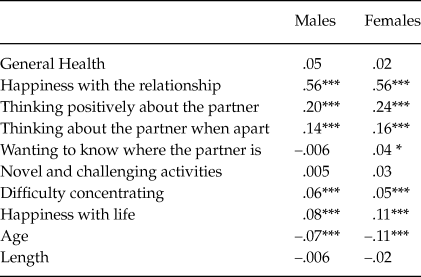
After controlling for affection and frequency of sexual intercourse, the happiness with the relationship had the strongest correlation with intensity of romantic love. Thinking positively about the partner, thinking about the partner when apart, difficulty concentrating, happiness with life and age were significant predictors for both men and women, although the strength of the correlation between the variables was low. As can be observed in Table 5, there were fewer related variables in the case of women than for men. The variables general health, engage in novel and challenging activities and length of the relationship were not significant predictors for either men or women. The variable wanting to know where the partner is was a significant predictor for women, but not for men although the strength of the correlation between the variables was low.
Predictors of Intensity of Romantic Love (N = 2,988)

Note: *p < .05. **p < .01. ***p < .001.
Discussion
The results obtained allowed us to conclude that a small but significant percentage of men and women, (17% and 18%, respectively) reported being “very intensely in love” with their partners, with no significant gender differences being observed. These results can be interpreted from a socio-structural perspective. From this perspective, Ubillos et al. (Reference Ubillos, Zubieta, Páez, Deschamps, Ezeiza and Vera2001) argue that the social and economic development of a country, linked to a smaller difference of status and power in gender roles, is consistent with the fact that there are strong similarities in the responses of men and women about love.
These results support the evidence observed by Ferrer et al. (Reference Ferrer, Bosh, Navarro, Ramis and García2008) in Spain on the high valuing and social acceptance of the Eros style Eros, or passionate or romantic love, by men and women of all ages. They are also consistent with the studies performed in a Latin environment (Ubillos et al., Reference Ubillos, Zubieta, Páez, Deschamps, Ezeiza and Vera2001). Our rates of intensity of romantic love are significantly lower than those reported by O’Leary et al. (Reference O’Leary, Acevedo, Aron, Huddy and Mashek2012) in a similar study for both their national and their New York sample. The format in the national (US) and New York study was a phone interview to randomly selected respondents, whereas the format in the current study in Spain was a questionnaire that was returned to the researchers. Based on assessments of drug and alcohol use (Aquilino, Reference Aquilino1994; Currivan, Nyman, Turner, & Biener, Reference Currivan, Nyman, Turner and Biener2004), we believe that it is possible that the interview format was more subject to positive response bias than the questionnaires format. More specifically, in the interview, respondents may have responded in a positive fashion because they may have had the belief that they should feel intensely in love with their partner.
As predicted, regarding relationship length, the total percentage of men and women in a relationship of more than 10 years who reported being “very intensely in love” was lower (5.5%) than the percentages reported by O´Leary et al. (Reference O’Leary, Acevedo, Aron, Huddy and Mashek2012), and 10.6% of the respondents who were married 30 years or more reported being “very intensely in love”.
Happiness with the relationship showed the strongest correlation with intensity of romantic love for both men and women. In addition, the mean scores obtained on the item concerning happiness with the relationship in an average scale of 1–7 was 5.02 for men (SD = 1.13) and 5.00 for women (SD = 1.16). These scores are similar to those reported those reported by O’Leary et al. (Reference O’Leary, Acevedo, Aron, Huddy and Mashek2012) and Donnelly (Reference Donnelly1993) in the United States. In this regard, intensity of romantic love may be a reflection of relationship satisfaction, although one must consider, when interpreting these results, that people involved in dyadic relationships influence each other regarding thoughts, emotions and behaviors (Kelley & Thibaut, Reference Kelley and Thibaut1978).
The rates observed concerning the intensity of romantic love predict thoughts and behaviors in men and women and we can observe a pattern related to the fact that thinking positively about the partner, thinking about the partner when apart and affective behaviors showed a stronger significant association than difficulty concentrating and age. Also, the frequency of sexual intercourse and wanting to know where the partner is were significantly associated with the intensity of romantic love for women but not for men, although the strength of the correlation between the variables was low. These results are consistent with those previously reported by Yela (Reference Yela2000) in the sense that, concerning relationships, women place more importance on romantic and erotic passion, open communication, general satisfaction and emotional jealousy.
Finally, joint participation in novel and challenging activities and relationship length had no effect on the intensity of romantic love for either men or women. On the other hand, O’Leary et al. (Reference O’Leary, Acevedo, Aron, Huddy and Mashek2012) found that a small percentage of older people may feel intensity in love without having sexual intercourse, although a necessary condition to feel intensity in love is having affective behaviors. In this regard, we found that 4.3% of people over 50 years of age reported being very intensity in love without having had sexual intercourse in the previous month, whereas out of the participants who reported having no affective behaviors, almost none of them reported being very intensity in love (1,5%).
In conclusion, this study addresses an issue of great importance in people’s lives and is one of the first studies in Spain to empirically explore intensity of romantic love in men and women in intimate relationships. The results highlight the role that certain cultural factors, such as beliefs about love, socio-structural influences and the process of differential socialization, play on the intensity of romantic love and, ultimately, on various aspects of affective relationships and happiness for men and women.
This study has some limitations that should be considered. The respondents all provided information about themselves and we do not know how well the self-reports of love would relate to clinicians or independent observer ratings of intensity love. However, unless the subjects are deceiving themselves that they are in love, their own self report of the intensity of romantic love seems to have some face validity. Intensity of romantic love has been hypothesized to decline across time and while that was true for the initial ten year period, intensity of romantic love did not decline much after ten years. The meaning of intensity of romantic love may also be different for individuals in early marriage versus in a marriage of 30 or 40 years and in-depth interviews regarding the meaning of intensity of romantic love in different age groups would seem useful. It is unclear what percent of the 10.6 percent of individuals who rated themselves as being intensity in love in marriages over 30 years would perceive their relationship as characterized EROS or by irresistible passion, intense feelings, intimacy, strong physical attraction and sexual activity or could their sense of very intensity love come from other standards or frames of reference. Finally, given that the study consists of couples and not individuals, the answer to the question about the intensity of romantic love may be influenced by the partner’s answer or by what the partner expects to hear due to factors such as social desirability, which is an important response bias. We consider that, in this context, it is not easy to guarantee independent measures in spite of the fact that the questionnaires were handed out and delivered to a P.O. Box anonymously and independently of the partner.
This research was supported by Spanish Ministry of Science and Innovation (Plan Nacional I+D+I; N° Referencia: PSI2008–02215).