Introduction
Psychiatric co-morbidity is extensive in the general population (Kessler et al. Reference Kessler, McGonagle, Zhao, Nelson, Hughes, Eshleman, Wittchen and Kendler1994, Reference Kessler, Chiu, Demler and Walters2005), and in clinical samples poly-diagnosis is the rule rather than the exception (Zimmerman & Mattia, Reference Zimmerman and Mattia1999). This complicates clinical communication, treatment selection, and frustrates efforts to uncover the pathophysiology, etiology and maintenance mechanisms of mental illness (Hyman, Reference Hyman2010). One promising approach for resolving these issues involves using formal statistical modeling to clarify the natural structure of mental disorders (Krueger & Markon, Reference Krueger and Markon2006; Wright & Zimmermann, Reference Wright, Zimmermann and Huprich2015). This approach has been profitably applied to both child (Achenbach, Reference Achenbach1966; Lahey et al. Reference Lahey, Rathouz, van Hulle, Urbano, Krueger, Applegate, Garriock, Chapman and Waldman2008) and adult (Krueger, Reference Krueger1999; Markon & Krueger, 2006; Kotov et al. Reference Kotov, Ruggero, Krueger, Watson, Yuan and Zimmerman2011) disorders. In adult psychopathology, a well-replicated structure has emerged based on the clustering of disorders and their symptoms into internalizing (e.g. unipolar mood disorders, anxiety disorders), externalizing (e.g. substance use, antisocial behavior) and thought disorder/psychosis (e.g. psychotic disorders, schizotypal personality disorder) spectra (Wolf et al. Reference Wolf, Schubert, Patterson, Grande, Brocco and Pendleton1988; Kotov et al. Reference Kotov, Chang, Fochtmann, Mojtabai, Carlson, Sedler and Bromet2010a , Reference Kotov, Gamez, Schmidt and Watson b ; Markon, Reference Markon2010; Wright et al. Reference Wright, Krueger, Hobbs, Markon, Eaton and Slade2013). This structure has demonstrated strong empirical and statistical evidence for its validity; importantly, the resulting spectra or domains appear to predict treatment response and match genetic models of these disorders (Kendler et al. Reference Kendler, Prescott, Myers and Neale2003, Reference Kendler, Aggen, Knudsen, Røysamb, Neale and Reichborn-Kjeennerud2011).
Recently developed quantitative models of psychopathology have expanded the basic internalizing, externalizing and thought disorder/psychosis structure by incorporating additional diagnoses, most notably personality disorders (PDs), and have begun to uncover additional spectra. To date only four published studies have explored the structure of psychopathology using a broad suite of clinical syndromes and PDs (Markon, Reference Markon2010; Kotov et al. Reference Kotov, Ruggero, Krueger, Watson, Yuan and Zimmerman2011; Røysamb et al. Reference Røysamb, Kendler, Tambs, Ørstavik, Neale, Aggen, Torgersen and Reichborn-Kjennerud2011; Blanco et al. Reference Blanco, Krueger, Hasin, Liu, Wang, Kerridge, Saha and Olfson2013)Footnote 1 Footnote †. Although each resultant model is necessarily unique given differences in the precise admixture of disorders (e.g. some do not include indicators of psychosis), sampling strategy (e.g. clinical versus epidemiological), and other features (e.g. disorder-level versus symptom-level analyses), two additional domains appear reasonably replicable across studies. First, Markon (Reference Markon2010) and Røysamb et al. (Reference Røysamb, Kendler, Tambs, Ørstavik, Neale, Aggen, Torgersen and Reichborn-Kjennerud2011) each identified a new spectrum they respectively termed pathological or anhedonic introversion. In both cases, avoidant and dependent PDs were strong markers of the factor, although Røysamb et al. (Reference Røysamb, Kendler, Tambs, Ørstavik, Neale, Aggen, Torgersen and Reichborn-Kjennerud2011) also found that schizoid and depressive PDs loaded strongly on the factor, which accounts for the slight difference in conceptualization. Blanco et al. (Reference Blanco, Krueger, Hasin, Liu, Wang, Kerridge, Saha and Olfson2013) also found evidence for a factor with the strongest loadings from avoidant and dependent PDs and social phobia.
Second, in three studies (Kotov et al. Reference Kotov, Ruggero, Krueger, Watson, Yuan and Zimmerman2011; Røysamb et al. Reference Røysamb, Kendler, Tambs, Ørstavik, Neale, Aggen, Torgersen and Reichborn-Kjennerud2011; Blanco et al. Reference Blanco, Krueger, Hasin, Liu, Wang, Kerridge, Saha and Olfson2013), a domain related to antagonism, as labeled by Kotov and colleagues, has emerged. Again, slight differences emerge in the makeup of this domain across studies, although narcissistic and histrionic PDs consistently exhibit the strongest loadings. Additional markers for this domain, but varying slightly across studies, include obsessive–compulsive, borderline, paranoid and (to a lesser extent) antisocial PDs. What these disorders share to varying degrees is an antagonistic interpersonal style that puts afflicted individuals at odds with others. Notably, introversion and antagonism, which emerge with the addition of PDs, each deal with maladaptive social/interpersonal functioning, consistent with the view that the PDs reflect the interpersonal disorders (Benjamin, Reference Benjamin1996; Meyer & Pilkonis, Reference Meyer, Pilkonis, Lenzenweger and Clarkin2005; Pincus, Reference Pincus, Lenzenweger and Clarkin2005; Hill et al. Reference Hill, Pilkonis, Bear, Horowitz and Strack2010; Hopwood et al. Reference Hopwood, Wright, Ansell and Pincus2013). Therefore, based on this initial accumulation of studies that have included PDs in structural models of psychopathology and a strong theoretical rationale, the domains of introversion and antagonism appear to be good candidates to include alongside internalizing, externalizing and thought disorder/psychosis as broad, replicable domains of psychopathology.
Taken together, these domains bear a remarkable conceptual resemblance to the pathological personality trait domains included in the Diagnostic and Statistical Manual of Mental Disorders, fifth edition (DSM-5) section III system of PDs (American Psychiatric Association, 2013). The five domains outlined in this system include negative affectivity, antagonism, detachment, disinhibition and psychoticism, and were empirically derived from quantitative modeling of more specific PD features (i.e. clinical specifiers) outlined by the DSM-5 Personality and PD workgroup (Krueger et al. Reference Krueger, Eaton, Clark, Watson, Markon, Derringer, Skodol and Livesley2011, Reference Krueger, Derringer, Markon, Watson and Skodol2012). Compared with this PD trait framework, the psychopathology spectra of internalizing, antagonism, anhedonic/pathological introversion, externalizing and thought disorder, respectively, reflect strong conceptual matches. However, although intuitively compelling, these putative matches between psychopathology spectra and personality domains have not been empirically demonstrated.
Notably, an empirical demonstration that the major spectra underlying psychiatric co-morbidity in common clinical syndromes and PDs align with the domains of pathological personality trait models would represent a major advance in clarifying the phenotypic structure of psychopathology. A model such as this would provide the foundation for a comprehensive bridge between mental disorders and elementary domains of individual differences in basic functioning. For example, the DSM-5 pathological trait model has been linked empirically to a large scientific literature on structural models of normal personality and temperament (Wright et al. Reference Wright, Thomas, Hopwood, Markon, Pincus and Krueger2012; De Fruyt et al. Reference De Fruyt, De Clercq, De Bolle, Wille, Markon and Krueger2013; Gore & Widiger, Reference Gore and Widiger2013; Thomas et al. Reference Thomas, Yalch, Krueger, Wright, Markon and Hopwood2013; Watson et al. Reference Watson, Stasik, Ro and Clark2013; Wright & Simms, Reference Wright and Simms2014), which builds on a larger literature linking pathological and basic personality traits (e.g. Markon et al. Reference Markon, Krueger and Watson2005). Adding to the strength of our proposal, that the structures underlying traits and much of psychopathology align, basic trait domains demonstrate strong associations with clinical syndromes (Kotov et al. Reference Kotov, Chang, Fochtmann, Mojtabai, Carlson, Sedler and Bromet2010a , Reference Kotov, Gamez, Schmidt and Watson b ) and PDs (Saulsman & Page, Reference Saulsman and Page2004; Samuel & Widiger, Reference Samuel and Widiger2008) in meta-analyses. Based on these accumulated findings, some have suggested that there is potential to organize both basic domains of individual differences and psychopathology using a finite number of functional domains or spectra rooted in basic psychological and physiological systems (e.g. Siever & Davis, Reference Siever and Davis1991; Harkness et al. Reference Harkness, Reynolds and Lilienfeld2014). This parallels efforts in the broader DSM-5 development process aimed at developing crosscutting dimensions of pathology (Narrow et al. Reference Narrow, Clarke, Kuramoto, Kraemer, Kupfer, Greiner and Regier2013) and in the National Institute of Mental Health's research domain criteria (RDoC; Insel et al. Reference Insel, Cuthbert, Garvey, Heinssen, Pine, Quinn, Sanislow and Wang2010; Sanislow et al. Reference Sanislow, Pine, Quinn, Kozak, Garvey, Heinssen, Wang and Cuthbert2010). Further, an empirically based dimensional structure increases the potential to link with biological correlates and genetic liabilities, and leads to more replicable and accurate etiological research (Plomin et al. Reference Plomin, Haworth and Davis2009; Ofrat & Krueger, Reference Ofrat and Krueger2012).
The potential for an organizing metastructure that encompasses basic and pathological functioning would go a long way towards linking disparate scientific literatures and in so doing provide an organizing scheme for refining the study of psychopathology. In the current study, we tested whether such a model was viable by examining the joint structure of mental disorders and the DSM-5 pathological personality traits. We hypothesized that a factor analysis of interview-diagnosed major clinical syndromes and PDs and patient-reported pathological trait scales in a large general psychiatric out-patient sample would result in five easily interpretable dimensions that closely resemble the aforementioned internalizing, externalizing/disinhibition, thought disorder, antagonism and introversion/detachment domains. Specifically, we use exploratory structural equation modeling (ESEM; Asparouhov & Muthén, Reference Asparouhov and Muthén2009; for an applied example, see also Marsh et al. Reference Marsh, Lüdtke, Muthén, Asparouhov, Morin, Trautwein and Nagengast2010) to examine the joint structure of DSM-5 pathological personality traits, clinical syndromes and PDs, while accounting for method variance across instruments. We hypothesize that disorders that mark the internalizing spectrum (e.g. mood, anxiety disorders) will load on the same factor as traits that indicate negative affectivity (e.g. emotional lability, separation insecurity), and that markers of externalizing (e.g. alcohol use, antisocial PD) and disinhibition (e.g. risk taking, impulsivity), antagonism (e.g. narcissistic PD and histrionic PD) and trait antagonism (e.g. callousness, manipulativeness), pathological introversion (e.g. avoidant PD, schizoid PD) and detachment (e.g. withdrawal, restricted affectivity), and thought disorder (e.g. psychotic symptoms, schizotypal PD) and psychoticism (e.g. unusual beliefs, perceptual dysregulation) will load together on the same factors, respectively.
Method
Sample and procedure
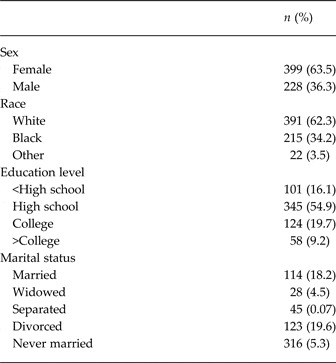
Participants for the present study were recruited by distributing flyers at mental health clinics across Western New York and were eligible to participate if they reported psychiatric treatment within the past 2 years. Exclusionary criteria were age under 18 years and evidence that the data collected were untrustworthyFootnote 2 . The final sample included 628 participants with a mean age of 43.2 years (s.d. = 12.5) and was mainly female but was diverse in terms of racial, educational and marital features (Table 1). The majority of the sample was currently in treatment (80%) or had been within the last 1 (10%) to 2 (5%) years.
Sample demographic features (n = 628) a

a One participant did not provide their sex and two did not provide their marital status.
Measures
Current criteria for clinical syndromes were assessed using the sixth edition of the Mini International Neuropsychiatric Inventory (MINI; Sheehan et al. Reference Sheehan, Lecrubier, Harnett-Sheehan, Amorim, Janavs, Weiller, Hergueta, Baker and Dunbar1998; Sheehan & LeCrubier, Reference Sheehan and Lecrubier2010), which was adapted (with permission) to (a) assess the DSM-5 criteria for the sampled disorders, and (b) relax certain skip-out rules so that all relevant symptoms were assessed (e.g. all symptoms of depression were assessed regardless of whether participants initially endorsed depressed mood or anhedonia). Criteria for the DSM-5 section II PDs were assessed using a modified protocol for the Structured Clinical Interview for DSM-IV-TR Personality Disorders (SCID-II; First et al. Reference First, Spitzer, Gibbon and Williams2002). Participants initially completed the SCID-II personality questionnaire, and interviewers followed up on all items for potential diagnoses to ascertain their presence and that they caused the individual dysfunction. Both assessments were conducted by highly trained interviewers (including the first author; A.G.C.W.), who typically were clinical psychology doctoral students. Interviewers received extensive initial training and ongoing supervision by the second author (L.J.S.), which included weekly case conferences and tape review throughout the course of the study. Independent reviewers recoded a total of 120 cases with excellent reliability. Disorder-level κ's were high (median = 0.96; range = 0.66–1.00).
The MINI covers mood, anxiety, substance use and psychotic disorders. All disorders assessed by the MINI were assessed dimensionally to allow for gradations in disorder severity, with the exception of psychotic delusions, hallucinations and negative symptoms, which were treated as binary (i.e. absent or present), and panic attacks, which were treated as ordinal (i.e. absent, present, present with persistent fear of recurrence). The three psychotic disorder symptom sets (delusions, hallucinations and negative symptoms) were combined to form an ordinal indicator of psychosis severity. Alcohol and drug abuse and dependence symptoms were collapsed to form single severity dimensions for each, consistent with DSM-5 formulations. Current manic episodes were excluded due to low rates of endorsement, which affected the reliability of estimated associations with other disorders and caused problems with model estimation. All SCID-II-assessed PDs were treated as dimensional criterion counts.
The DSM-5 section III pathological personality traits were assessed using the Personality Inventory for the DSM-5 (PID-5; Krueger et al. Reference Krueger, Derringer, Markon, Watson and Skodol2012). The PID-5 is a patient-report instrument that includes 220 questions measuring 25 PD traits, organized based on factor analytic evidence into five broad domains: negative affectivity, detachment, antagonism, disinhibition and psychoticism. Each trait facet is measured by four to 14 questions. PID-5 items are rated on a four-point scale ranging from 0 (very false or often false) to 3 (very true or often true). Higher scale scores are indicative of greater personality pathology. Adequate to good internal consistencies were achieved in the current sample (median α = 0.86; range = 0.77 to 0.96).
Data analysis
We used ESEM (Asparouhov & Muthén, Reference Asparouhov and Muthén2009) to examine the joint structure of the clinician-assessed mental disorders and the patient-reported pathological personality traits. ESEM is a recently developed technique that permits models to include both exploratory (i.e. data-driven) and confirmatory (i.e. investigator-defined) factors. For the current study, ESEM offers the advantage of being able to estimate an exploratory model of the joint structure of mental disorders and pathological personality traits, while including ‘measurement factors’ that account for the difference between assessment methods (i.e. clinician-assigned symptoms versus patient-reported traits). Therefore, we ran a final ESEM model with three factors for measurement, one each with the interview-based variables loading on it, and one with all of the PID-5 scales loading on it. Additionally, the ESEM models included an exploratory portion of the structure that allowed all variables to freely load on each estimated factor to allow the data to determine the optimal pattern of loadings. We estimated models with zero to seven exploratory factors. Measurement factors were estimated as orthogonal to each other and the exploratory factors. For the exploratory portion of the model we used an oblique Geomin rotation due to the expectation that factors would be correlated, and Geomin's balance of factor and variable complexity in its rotational criterion (Sass & Schmitt, Reference Sass and Schmitt2010)Footnote 3 .
All models were estimated in Mplus 7.11 (Muthén & Muthén, Reference Muthén and Muthén2012). Due to the ordinal nature of two variables (all other variables were measured continuously), we used a robust maximum likelihood estimator (MLR in Mplus), which provides fit statistics and standard error estimates adjusted for non-normality in the data. Additionally, although missing data in the interviews were negligible, not all participants completed the PID-5 (about 74%) because it was presented later in the assessment protocol. It was found that the missingness on the PID-5 was associated with severity of interview-assessed psychopathology, and therefore it was treated as missing at random, and handled via full-information maximum likelihood in our models.
Adjudication between ESEM models was based on multiple fit indices in addition to interpretability. Because a non-significant χ2 statistic is rarely obtained in real-world clinical data (Brown, Reference Brown2006), we relied on the root mean square error of approximation (RMSEA) and the associated 90% confidence interval, with values lower than 0.05 indicating excellent fit and values lower than 0.08 indicating good fit, the comparative fit index, with values approaching or greater than 0.95 indicative of excellent fit, and values of 0.90 or greater indicative of acceptable fit, and the standardized root mean square residual (SRMR), with values lower than 0.05 indicative of excellent fit (Hu & Bentler, Reference Hu and Bentler1999).
Ethical Standards
All procedures contributing to this work comply with the ethical standards of the relevant national and institutional committees on human experimentation and with the Helsinki Declaration of 1975, as revised in 2008.
Results
Exploratory structural equation model of mental disorders and pathological personality traits
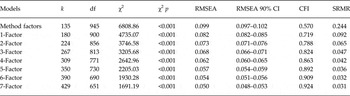
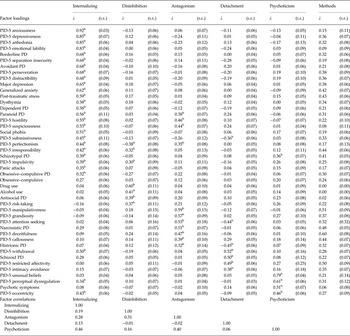
Model fit results for ESEMs ranging from zero to seven substantive factors (i.e. not counting method factors) are listed in Table 2. Fit improved appreciably up to seven factors, although it was acceptable according to two indices (RMSEA, SRMR) starting with a three-factor model. We therefore gave close scrutiny to results from the three- to seven-factor models. Full results for each model can be found in the online Supplementary Tables. For the three-factor model we interpreted the factors as reflecting internalizing (strong loadings from, e.g. PID-5 anxiousness, borderline PD, major depression), externalizing (strong loadings from, e.g. PID-5 risk-taking, narcissistic PD, and loadings from alcohol and drug use) and detachment (strongest loadings from PID-5 withdrawal, PID-5 restricted affectivity and schizoid PD). In the four-factor model, internalizing, disinhibition and detachment factors remained, but now a clear psychoticism factor emerged. The five-factor conformed to the hypothesized structure, in that there were clear factors that could be labeled internalizing (e.g. strong loadings from PID-5 anxiousness, generalized anxiety, major depression, borderline PD), disinhibition (drug use, alcohol use, antisocial PD, PID-5 risk-taking), psychoticism (psychotic symptoms, PID-5 unusual beliefs), antagonism (narcissistic, histrionic, paranoid PD symptoms, PID-5 manipulativeness) and detachment (schizoid PD symptoms, negative histrionic PD symptoms, PID-5 withdrawal, PID-5 restricted affect).
Model details and fit indices for exploratory factor analyses of mental disorder symptom counts and Personality Inventory for DSM-5 scales (n = 628) a

DSM-5, Diagnostic and Statistical Manual of Mental Disorders, fifth edition; k, number of estimated parameters; df, model degrees of freedom; RMSEA, root mean square error of approximation; CI, confidence interval; CFI, comparative fit index; SRMR, standardized root mean square residual.
a Model estimated using robust maximum likelihood.
In the six-factor model the solution retained its structure with the exception that a small histrionism factor (marked mostly by histrionic PD and PID-5 attention seeking) split off from the antagonism spectrum. Similarly, in the seven-factor model, the primary structure was retained, excepting that a small factor we labeled suspiciousness emerged, with only PID-5 suspiciousness having its primary loading on the factor. Thus, although the best model fit was obtained for a seven-factor solution, factors that emerged after the five-factor solution were either highly specific or suggestive of over-factoring. As such, based on theoretical and quantitative grounds, we chose to retain the five-factor model consistent with hypotheses (see Table 3)Footnote 4 .
Exploratory structural equation model of mental disorder symptom counts and pathological personality traits a

λ, Factor loading; s.e., standard error; PID-5, Personality Inventory for the Diagnostic and Statistical Manual of Mental Disorders, fifth edition; PD, personality disorder.
a A Geomin oblique factor rotation was used. Methods factor loadings, although based on three factors, are presented in the same column for space considerations.
b Factor loadings >|0.30|.
Discussion
Based on an emerging body of research suggesting that five replicable domains of psychopathology account for the structure of common clinical syndromes, psychosis and PDs, and that these domains bear close conceptual resemblance to the major domains of personality traits, we estimated a joint structural model to test whether the same dimensions could account for patterns of covariation across these traditionally disparate systems. Our results demonstrate that an underlying metastructure explains the shared features of personality and psychopathology and may help uncover the basic structure for much of human psychological maladaptation. Many other clinical theorists and researchers have hypothesized this relationship, going back as far as antiquity, with Hippocrates and Galen, and continuing through to more contemporary thought as well (e.g. Eysenck, Reference Eysenck1967; Siever & Davis, Reference Siever and Davis1991; Clark, Reference Clark2005; Harkness et al. Reference Harkness, Reynolds and Lilienfeld2014). Yet this is the first study to demonstrate this fact using a reasonably comprehensive grouping of psychiatric disorders and suite of personality traits. Ultimately, these results move us towards greater theoretical integration across psychiatric and behavioral sciences, and have important implications for refining the classification of mental disorders and refocusing the targets of mechanistic research.
Our findings suggest that the combination of mental disorders and pathological personality traits can be combined within the same structural framework. Moreover, the alignment of the disorder spectra with the trait domains closely follows our predictions based on the disorder-specific impairments and the trait scale content. As noted in the Introduction, three of the spectra found here, internalizing, externalizing and thought disorder/psychosis, have been well replicated in a number of samples (Kotov et al. Reference Kotov, Chang, Fochtmann, Mojtabai, Carlson, Sedler and Bromet2010a , Reference Kotov, Gamez, Schmidt and Watson b , Reference Kotov, Ruggero, Krueger, Watson, Yuan and Zimmerman2011; Markon, Reference Markon2010; Wright et al. Reference Wright, Krueger, Hobbs, Markon, Eaton and Slade2013). As it pertains to these dimensions, our results accord well with prior findings, such that in our model the pattern of PID-5 scale loadings on these three domains were mostly as expected. Traits tapping negative affectivity loaded on the same factor as disorders that mark internalizing, disinhibition scales loaded on the same factor as disorders considered part of the externalizing spectrum, and the PID-5 psychoticism scales loaded on the same factor as psychotic symptoms and schizotypal PD criteria.
A comprehensive inclusion of all of the PDs sets this structural model apart from the majority of prior work. Although some PDs loaded most strongly on the internalizing, disinhibition and thought disorder spectra, expanding the model to include these disorders also requires an expansion to include the primarily interpersonal domains of antagonism and detachment. These spectra are an important addition to the structure of psychopathology, in so far as they reflect maladaptive variants of core domains of human social functioning (Bakan, Reference Bakan1966; Wiggins, Reference Wiggins, Cicchetti and Grove1991). The emergence of these additional domains further emphasizes that personality pathology is intimately linked with interpersonal dysfunction, which is a view reflected in the alternative DSM-5 section III model and by many theorists. However, PDs are not exclusively related to the primarily interpersonal factors of antagonism and detachment, but rather are infused throughout the structure of mental disorders. For example, borderline PD has its strongest loading on the internalizing factor, reflecting the affective dysregulation associated with the construct, and schizotypal PD falls along the psychoticism spectrum. What is probably the case is that much of the characteristic interpersonal dysfunction that is the shared hallmark of the PDs (Benjamin, Reference Benjamin1996; Meyer & Pilkonis, Reference Meyer, Pilkonis, Lenzenweger and Clarkin2005; Pincus, Reference Pincus, Lenzenweger and Clarkin2005; Hopwood et al. Reference Hopwood, Wright, Ansell and Pincus2013) exists outside of this structural hierarchy, and rather is reflected in social–cognitive processes related to self- and other-perception.
Nevertheless, the domains of antagonism and detachment reflect important new additions to the quantitatively derived structure of psychopathology. In our model the antagonism factor, defined most strongly by narcissistic and histrionic features and antagonistic traits, is consonant with prior results (Kotov et al. Reference Kotov, Ruggero, Krueger, Watson, Yuan and Zimmerman2011). In contrast, the domain of detachment observed here related more focally to low positive emotionality and withdrawal as opposed to social avoidance and interpersonal submissiveness. Thus, our results align more closely with Røysamb et al. (Reference Røysamb, Kendler, Tambs, Ørstavik, Neale, Aggen, Torgersen and Reichborn-Kjennerud2011) as opposed to Markon (Reference Markon2010). In the final model, social avoidance (e.g. avoidant PD, social phobia) emerged more strongly as a fear domain within the internalizing spectrum. Taken together, these results suggest the need for refinement of content related to impoverished social relating in psychopathology. Specifically, there probably are distinct underlying processes driving failures to socially engage (i.e. fear versus lack of social reward).
Despite the pattern of loadings that were generally highly consistent with expectations, several deviations and cross-loadings are notable. For instance, it was not uncommon for the PID-5 scales from disinhibition and psychoticism to have a ‘split’ loading between their predicted location and the internalizing domain. As it pertains to the PID-5 psychoticism scales, this may reflect distress captured in responses to patient-report scales of this nature. Prior work has shown high correlation between internalizing and thought disorder spectra (e.g. Kotov et al. Reference Kotov, Chang, Fochtmann, Mojtabai, Carlson, Sedler and Bromet2010a , Reference Kotov, Gamez, Schmidt and Watson b , Reference Kotov, Ruggero, Krueger, Watson, Yuan and Zimmerman2011; Wright et al. Reference Wright, Krueger, Hobbs, Markon, Eaton and Slade2013). For the PID-5 scales of irresponsibility and impulsivity, it may be that cross-loadings arise because internalizing impairs task accomplishment, and past research has demonstrated that impulsivity can be driven by negative affect (Whiteside & Lynam, Reference Whiteside and Lynam2001), respectively. Therefore, these cross-loadings are generally understandable based on past findings. Unexpected but theoretically consistent cross-loadings include the negative loadings of obsessive–compulsive PD and PID-5 perfectionism on our disinhibition factor. However, obsessive–compulsive disorder and obsessive–compulsive PD generally had modest loadings, suggesting an area in need of continued inquiry.
This points to a general need for a detailed refining of these domains. Deriving domains from current psychiatric constructs is an exercise in rough estimation at best. It is akin to using a hacksaw to carve nature at her joints, when what are needed are refined tools that serve like scalpels. This is the view espoused in the RDoC effort, where the goal is to refine the measurement of core domains, which can then be used as a framework to bootstrap a new nosology that would rest on a firm scientific foundation (Insel et al. Reference Insel, Cuthbert, Garvey, Heinssen, Pine, Quinn, Sanislow and Wang2010). The results here would suggest that this approach may be viable, and the patterns of covariation among mental disorders along with their integration with basic domains of functioning could serve to expedite this process. Indeed, one the major limitations of the current psychiatric nosology is that it was created without consideration for normative functioning, and, as a result, the extant structure of disorders remains divorced from the basic mental, behavioral and physiological processes that necessarily give rise to mental disorder when they go awry. The initial description of putatively discrete syndromes based on clinical observation was an essential initial step in outlining important clinical constructs. However, the patterns of observed covariation among disorders, shared treatment responses, and widespread failure to find specific biomarkers suggest that the current parsing of disorders lacks validity and may have run its course in terms of scientific yield (Hyman, Reference Hyman2010).
Moving forward, what is needed is a revised research agenda based on refining the definition and measurement of a finite set of general domains rooted in biopsychosocial processes and mechanisms. In turn, this would lay the foundation for studies that selected individuals along these spectra for intensive study in order to maximize precision of measurement and statistical power, as opposed to case–control designs with noted limitations in interpretability and potential for linking to biology (Plomin et al. Reference Plomin, Haworth and Davis2009; Hyman, Reference Hyman2010). Furthermore, this probably would result in a model of psychopathology that more closely approximates the gradations observed in clinical practice, allowing for fine-grained assessment of individual differences in functioning, ranging from the healthy to the pathological (Harkness et al. Reference Harkness, Reynolds and Lilienfeld2014). The linking of personality trait domains and disorder spectra provides an important demonstration of the viability of this proposal, serving as a much-needed bridge between basic processes and maladaptivity.
Any study of this type is necessarily limited by the nature of the data on which the model was estimated. A strength of this study was the large clinical sample with rich levels of psychopathology of various types, assessed by structured clinical interviews. However, not all expressions of psychopathology were assessed or included. Notable exclusions included mania, somatic disorders, eating disorders, the autism spectrum and tic disorders. Also, because the DSM-5 traits were assessed via self-report only, an open question remains regarding whether an identical structure would emerge if clinician ratings were included. Emerging results suggest that structural analyses of these traits as rated by clinicians result in a very similar structure, providing confidence in the results (Morey et al. Reference Morey, Krueger and Skodol2013). Patient reports of traits hypothesized to indicate the disinhibition and psychoticism domains might be influenced in large part by levels of distress as opposed to purely problems in cognition, and clinician ratings might be able to more cleanly assess these domains.
Several other considerations arise from our study. First, the structural model we arrived at here has emerged from exploratory analyses, and therefore the results should be considered an initial demonstration of a viable ‘metastructure’ that necessitates replication and confirmation in other samples of a diverse nature. We hope that other investigators will be motivated by our findings to pursue refined models in a confirmatory framework. Second, we note that our sample size, although large, is modest when considering model complexity, which further indicates the need for replication in larger samples. Finally, some may wonder to what degree the model we have estimated here truly integrates traditionally diverse domains (i.e. psychopathology and traits) as opposed to merely demonstrating that the trait scales used here share the same item content as the criteria for mental disorders. Although the DSM-5 traits were designed to capture the important features of PD, and it is clearly the case that some trait scales (e.g. PID-5 depressivity, anxiousness) overlap with clinical syndromes, others do not have such explicit representation (e.g. PID-5 hostility, submissiveness). In many respects, the observed item similarities across domains are consistent with our view that these domains share items because they are not wholly distinct domains. Strictly differentiating personality from psychopathology probably is an overstatement of true differences between them given that all of these features are phenotypes with roots in what are necessarily the same biological and social substrates.
Conclusion
In conclusion, the results of the models estimated here suggest that large proportions of the recognized mental disorders can be organized within a framework shared by personality trait domains. These spectra that cut across personality and psychopathology provide fundamental orienting dimensions for organizing classification and guiding research in the service of identifying core mechanisms. Although further refinement of the precise structure of these dimensions is warranted, the outlines of the picture appear clear. A comprehensive framework of individual differences in normative and maladaptive functioning provides much needed integration of psychiatric nosology with the basic sciences that should be its foundation.
Supplementary material
For supplementary material accompanying this paper visit http://dx.doi.org/10.1017/S0033291715000252
Acknowledgements
This work was supported by the National Institute of Mental Health (L.J.S., R01MH80086; A.G.C.W., F32MH097325). We thank William Calabrese, Julie Gass, Jane Rotterman, Wern How Yam and Kerry Zelazny for their help in data collection and preparation.
Declaration of Interest
None.