Introduction
In most pig-producing countries in the EU, male piglets are castrated at a young age to prevent boar taint in meat. The surgical castration is commonly performed without the use of anaesthesia or analgesia.
However, it has been abundantly substantiated that piglets experience pain during castration (Wemelsfelder and van Putten, 1985; McGlone and Hellman, Reference McGlone and Hellman1988; McGlone et al., Reference McGlone, Nicholson, Hellman and Herzog1993; Weary et al., Reference Weary, Braithwaite and Fraser1998; Taylor and Weary, Reference Taylor and Weary2000; Taylor et al., Reference Taylor, Weary, Lessard and Braithwaite2001). Castration induces acute activation of the hypothalamic–pituitary–adrenal axis (HPA) and of the sympathetic nervous system (SNS) (Prunier et al., Reference Prunier, Mounier and Hay2005). Based on this information, there is growing criticism from consumers, opposition groups and politicians concerning the unanaesthetised castration. Therefore, a lot of attention and effort is being given in different EU countries for the development of acceptable anaesthesia methods for piglets (Kohler et al., Reference Kohler, Moens, Busato, Blum and Schatzman1998; Jäggin et al., Reference Jäggin, Kohler, Blum and Schatzmann2001; Walker et al., Reference Walker, Jäggin, Doherr and Schatsmann2004; Svendsen, Reference Svendsen2006).
Anaesthesia is generally applied to prevent pain sensation during surgery. Pain is an aversive sensory and emotional experience representing awareness by the animal, of damage or threat to the integrity of its tissues. It changes the animal’s physiology and behaviour to reduce or avoid damage (Molony and Kent, Reference Molony and Kent1997). Anaesthesia or reduction of pain during surgery can be performed by local anaesthesia, induced by injection, or by general anaesthesia, induced by injection or inhalation. Anaesthetic gasses can be inhaled, because they evaporate at room temperature. Examples of anaesthetic gasses include ether, chloroform, halothane and methoxy-flurane. Anaesthetic gasses cause depression of the central neural system with induction of unconsciousness and muscle flaccidity. An overdose leads to paralysis of the breathing muscles and the animal is killed by apnea. Induction by an anaesthetic gas can result in excitation, depending on the gas used.
Under practical circumstances, the problem with most anaesthetic gasses is that their usage is restricted to veterinarians. Furthermore, the use of most of these anaesthetic gasses is subject to strict safety regulations and registration. Applying CO2 as anaesthetic agents could presumably be a useful alternative. It is well recognised that CO2 is an anaesthetic gas that produces rapid unconsciousness when inhaled at high concentrations (Martoft, 2001). However, increasing stress hormone levels (Kohler et al., Reference Kohler, Moens, Busato, Blum and Schatzman1998), signs of asphyxia and behavioural excitation (Iwarsson and Rehbinder, Reference Iwarsson and Rehbinder1993; Raj and Gregory, Reference Raj and Gregory1995; Kohler et al., Reference Kohler, Moens, Busato, Blum and Schatzman1998; Leach et al., Reference Leach, Bowell, Allan and Morton2002), were observed due to the occurrence of both hypercapnia and hypoxia. Moreover, CO2 is an acidic gas and has been found to be painful, causing unpleasant sensations to the nasal mucosa, lips and forehead in humans, when administered as gas-puffed stimuli in concentrations above 65% (Danneman et al., Reference Danneman, Stein and Walshaw1997; Hari et al., Reference Hari, Portin, Kettenmann, Jousmäki and Kobal1997). The right hemisphere of the human SII cortex is predominantly involved in this response, which may suggest emotional/motivational aspects of trigeminal pain, and is in agreement with the role of the trigeminal pathways as a general warning system. It has been shown that broilers can detect CO2 in air at concentrations below 10% (Gerritzen et al., Reference Gerritzen, Lambooij, Reimert, Stegeman and Spruijt2007). Increases in head shaking and the elicitation of withdrawal from feeding at 55% CO2 and above suggest that such concentrations of CO2 in air may be aversive. In rats, a low concentration of CO2 and addition of O2 and humidification of the gasses could ameliorate these negative effects (Coenen et al., Reference Coenen, Drinkenburg, Hoenderken and van Luijtelaar1995). In the latter case, almost no signs of asphyxia and excitation were observed. The main affect of CO2 is not suffocation, but an anaesthetic activity. A problem with O2-replacing gasses is their lower efficacy in very young animals (AVMA, 2004).
An electroencephalogram (EEG) is widely used to record brain activity under different circumstances to determine the state of consciousness and brain disorders in humans and animals. The electrical activity recorded on the EEG can be classified into delta (<4 Hz), theta (4 to 8 Hz), alpha (8 to 13 Hz) and beta (>13 Hz) frequency bands. In alpha and beta rhythms, the animal is conscious (Kooi et al., Reference Kooi, Tucker and Marshall1978). Increased dosage of most anaesthetic agents results in spontaneous progressive EEG responses with higher amplitude and lower frequencies (theta and delta waves) (Woodburry and Karler, Reference Woodburry and Karler1960; Mattson et al., Reference Mattson, Stinson and Clark1972). It is also known that a quiescent or near-iso-electric EEG occurs in deep anaesthesia as well as brain death (Eger, Reference Eger1981). The electrocardiogram (ECG) is used to determine heart function. Changes in frequency (beats/min) and other characteristics of the ECG such as amplitude, wave form and frequency patterns indicate the efficacy of heart function.
The objectives of these experiments were to determine, which concentrations of gasses in a mixture of CO2 and O2 are suitable to anaesthetise very young piglets to enable insensible castration. Behavioural, neural and physiological measurements were used to assess animal welfare aspects.
Material and methods
The study presented here was executed in three successive phases. The first phase – identification of concentrations – was conducted to determine the most promising CO2/O2 mixture to induce an adequate state of anaesthesia and analgesia. In the second phase – castration experiment – piglets were exposed to the most promising mixture from the first phase to provide insensible castration under full anaesthesia. During the final phase – limiting circumstances – an assessment was made as to whether piglets could remain in this mixture for a longer period without dying and whether a lower concentration of CO2 would induce a sufficient anaesthetic effect. Ethical aspects of the experiment were judged and approved by the Animal Ethical Committees of the Animal Sciences Group and of the University of Utrecht.
Animals and experimental design
Piglets used during this experiment were from the herd at the experimental pig farm ‘De Tolakker’, Veterinary Faculty, University of Utrecht. All piglets were commercial cross-breeds (‘Topigs’) intended for fattening. After the experiment, piglets returned to their farrowing pen and were reared under standard commercial conditions.
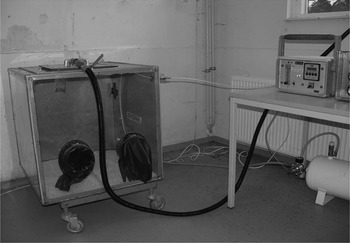
Anaesthesia experiments were carried out with individual animals in a Perspex box i.d. 0.8 × 0.8 × 0.8 m (see Figure 1). The test box was fitted with a 1-cm Ø CO2 inlet located 5 cm above the base of the box and an overflow valve situated at the top of the box. The different CO2/O2 mixtures were injected from a pre-filled compression tank after mixing with a three-phase gas mixer. A gas-measuring tube was placed in the centre of the box at approximately head height (when piglets were standing), and CO2 and O2 concentrations were measured continuously using an electronic gas analyserFootnote 1. Piglets were placed in the test box after the required concentration had been established.
Induction test box, recording monitor and gas tank.

Identify concentrations
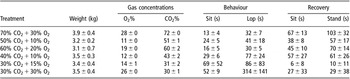
In order to identify the most promising CO2/O2 mixture for a painless castration under complete anaesthesia, piglets were exposed to six different gas mixtures (Table 1). Behavioural aspects were judged with five piglets per gas mixture to assess whether they lost posture (indicative for loss of consciousness). After loss of posture, the piglets remained for a further 1 min in the gas mixture before removal from the box and were placed in a recovery crate under normal room conditions. Anaesthetic state was judged based on behavioural aspects, i.e. loss of posture, tonic and clonic seizures, and on clinical reflexes of cornea and to pain stimuli provided by ear and interdigital pinching. The piglets were allowed to recover without assistance. Recovery time was judged to be the moment animals could remain standing without support.
Experimental conditions (BW and gas concentrations) and behavioural events indicating loss of consciousness and recovery

All values are mean ± s.e.d. of five piglets.
Sit = time taken to sit down (behaviour) or to sit up (recovery); Lop = time taken to loss of posture; Stand = time taken to recover posture (stand up unaided).
Castration experiment
Based on the results of the previous identification phase, 25 piglets were exposed to the most promising gas combination (i.e. 70% CO2 with 30% O2). In order to facilitate identification of loss of consciousness and to control physiological conditions during anaesthesia, animals were equipped with electrodes to measure brain and heart activity. For the registration of the EEG, two needle electrodesFootnote 2 (55% silver, 21% copper, 24% zinc) of 10 mm length and 1 mm diameter were positioned subcutaneous on the skull on the line ear to ear, 0.5 cm left and right of the sagital line. The electrodes were fixated with leucoplast tape. To register heartbeat and rhythmic disorders, two needle electrodes of 30 mm in length were placed subcutaneously at the left and right side of the chest approximately 1 cm behind the front legs. In order to minimise signal distortion, an earth-connecting electrode was placed subcutaneously at the back of the piglets. The electrodes were connected to a registration and recording device using isolated and coaxial shielded wires. The micro-voltage signals of the brain and heart were amplified using a biomedical-amplifierFootnote 3 and continuously recorded using Windaq computer softwareFootnote 4. Two blood samples were taken from the jugular vein of each animal shortly before introducing the piglets into the gas mixture and directly after castration. One of the blood samples was analysed for pH, pCO2, pO2, acid–base equilibrium (ABE) and O2 saturation using a mobile acid–base laboratoryFootnote 5; the second sample was analysed for glucose and lactate (LX20 analyzerFootnote 6). After measuring EEG and ECG for 30 s, piglets were individually placed into the pre-filled gas box. Behaviour of the animals was observed and analysed for gasping, head shaking, sitting, loss of posture (falling on its side) and convulsions. At 30 s after loss of posture, animals were taken out of the gas mixture and immediately castrated. Castration was performed by a single incision of approximately 2 cm from the left to the right through the scrotum. Both testicles were taken out and removed by cutting both funiculi. Immediately after castration, the second blood samples were taken from the jugular vein as mentioned previously. Both EEG and ECG measurements were continued for 3 min after removal from the gas mixture.
Blood values as well as EEG and ECG recordings were analysed afterwards to assess whether animals were unconscious at the time of castration and to classify the impact of the anaesthesia and castration on the piglets’ welfare. EEG signals were analysed for changes in frequency and amplitude, more specifically, for the suppression of alpha (8 to 13 Hz) and beta (>13 Hz) waves and the occurrence of theta (4 to 8 Hz) and delta (<4 Hz) waves. The ECG signals were analysed for heart rate at the start of the gas flow, at loss of posture and during the last minute of the monitoring period.
Limiting circumstances
In order to evaluate the reliability of the method, it is essential to determine the limitations of the method. Decreasing CO2 and O2 concentrations are assumed to impact the anaesthetic properties of the gas mixture. On the other hand, increasing the duration that animals remain in the gas mixture will increase the duration of anaesthesia, and also the risk of mortality.
To gain an impression of the effect of decreasing CO2 levels in practice, 25 piglets were exposed to a gas mixture of 60% CO2 + 20% O2 in nitrogen. Judgement of anaesthetic as well as of animal welfare aspects was based on the same parameters as described in the castration experiment. Furthermore, all piglets were treated similarly and measurements were taken as described in the castration experiment.
To assess maximal exposure time, five piglets were exposed to the gas mixture 3 min after loss of posture and four piglets were exposed for 2 min after loss of posture. Physiological and animal welfare aspects were assessed comparable to those described for the previous groups.
Statistics
For assessment of an adequate anaesthesia, each piglet represents an experimental unit for n piglets, which are treated independently, the number x, which remain conscious, follows a binomial distribution with total n and probability P. A confidence interval can be calculated for probability P based on a relationship between the binomial and beta distribution. The number of animals that are effectively anaesthetised follows a binomial distribution. A 95% confidence limit on the probability for an effective stun can be obtained by means of a well-known relationship with the beta distribution (Johnson and Kotz, Reference Johnson and Kotz1969).
Differences in blood values before exposure and directly after castration were analysed as a two-sided paired t-test (GenStat Committee, 2000).
Results
Pilot experiment
Based on behavioural observations, the different gas mixtures were examined on their capability to induce acceptable anaesthesia in young piglets. The results are presented in Table 1. It was observed that all piglets showed intensified breathing during induction with the different gas mixtures. Gasping was observed at a low CO2 concentration. All animals showed some weak or heavy convulsions after loss of posture. The higher the O2 concentration, the weaker the convulsions. The intensity of convulsions was not affected by the CO2 concentration but the duration till onset of convulsion was delayed by lower CO2 concentrations The time taken to induce loss of posture was lengthened by a lower CO2 concentration. More important was the dramatic decrease in duration till recovery after lowering the CO2 concentration. At an O2 concentration lower than 14%, all piglets appeared blue (hypoxic). Based on behavioural parameters (loss of posture), it remained doubtful whether piglets became unconscious during immersion in CO2 concentrations below 31%.
Based on these results, castration experiments were performed using a mixture of 70% CO2 + 30% O2.
Castration experiment
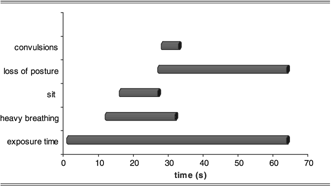
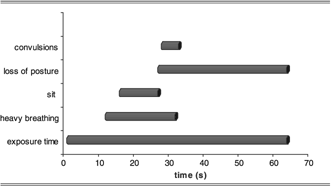
A typical behaviour (Table 2) during induction with the gas mixture 70% CO2 + 30% O2 was heavy breathing, which started 11 ± 1 s after immersion. Heavy breathing was observed until 6 s after loss of posture. At 16 ± 0.8 s after immersion in the gas mixture the animals sat down until eventual loss of posture at approximately 24 ± 1 s. Immediately after loss of posture all piglets showed a few mild to strong convulsions (at 26 ± 1.7 s).
Average (n = 25) start and duration (s) of behavioural events during exposure to a gas mixture of 70% CO2 + 30% O2
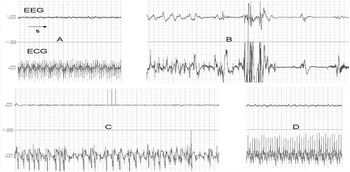
A change to lower EEG frequencies was observed after approximately 19 ± 1.1 s. Minimal brain activity was observed 33 ± 2 s after immersion. The castration took place on average 19 ± 5 s after the animals were removed from the gas mixture. None of the piglets displayed a behavioural, EEG or ECG response to castration (Figure 2). Recovery started 56 ± 11 s after removal from the gas box.
Characteristic examples of the electroencephalogram (EEG) and electrocardiogram (ECG) readings: A = prior to anaesthesia, B = loss of consciousness (displaying strong signal disturbance at loss of posture), C = deep anaesthesia (three vertical lines above EEG signal trace indicate the moment of castration), D = recovery of consciousness after anaesthesia.

Based on these observations it was calculated that within a confidence limit of 95% and taking into account the number of animals with a reliable EEG (n = 25), the chance that piglets aged 3 to 5 days are effectively anaesthetised is greater than 0.89.
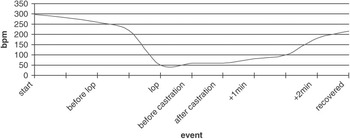
During induction with the gas mixture, the heart rate decreased slowly. After loss of posture the heart rate dropped dramatically to almost zero (Figure 3). Heart activity increased approximately 1 min after the piglets were removed from the gas box. Heart rate returned to the same rhythm as prior to exposure to the gas mixture in approximately 120 s.
Graphical example of the development of the heartbeat during exposure to the 70% CO2 + 30% O2 gas mixture and the recovery period.

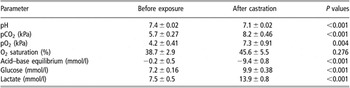
Blood pH decreased from 7.4 to 7.1, the pCO2 increased from 6 to 9.7 kPa and the pO2 from 3.8 to 4.5 kPa (Table 3). The O2 saturation increased from 38% to 42%. Due to the increase of pCO2 and decrease of pH, the ABE shifted from 0 to −10.
Average blood gas values (jugular vein) before exposure to 70% CO2 + 30% O2 and directly after castration

Values are mean ± s.e. of the mean based on n = 25. Differences between pairs are significant when P < 0.005 based on two-sample two-sided t-test.
Both glucose and lactate levels increased from 7.2 to 9.4 mmol/l and from 7.6 to 13.8 mmol/l, respectively.
Limits in gas concentration and duration
After immersion in a gas mixture of 60% CO2 + 20% O2, 16 of 24 piglets displayed behavioural and EEG responses during castration. When immersed in a gas mixture of 70% CO2 + 30% O2 for 3 min after loss of posture, two of five piglets died. When they remained in this mixture for 2 min, one of four piglets died. Due to this longer immersion period the pH decreased from 7.4 to 7.0, the pCO2 increased from 6.5 to 15.6 kPa and the pO2 increased from 2.6 to 9.2 kPa. The O2 saturation increased from 27% to 73% and the ABE shifted from 0 to −10. The glucose and lactate values increased from 6.5 to 10.3 mmol/l and from 7.2 to 12.5 mmol/l, respectively. No differences were found in the values of these parameters between animals that survived or died. It was observed that the animals that died did so approximately 3 to 4 min after they were removed from the gas box. Conspicuously, the animals apparently regained consciousness (based on behaviour and EEG) but their heart rhythm did not recover to pre-anaesthesia levels. Moreover, heart rhythm remained irregular in these animals, possibly resulting in death.
Discussion
Castration of male piglets without the use of any anaesthesia is meeting with increasing resistance from society and from the pig-producing sector itself. Aim of this research was to examine the suitability of CO2 anaesthesia for castration under practical on-farm conditions. Main reason to focus on CO2 was because this could be a method that can be used by farmers without intervention of a veterinarian. Moreover, the use of anaesthetic gasses as halothane and isoflurane is in many countries strictly prohibited to veterinarians.
Exposure to CO2 induces depression of brain activity, which extends progressively from the telencephalon to the diencephalon and then to the mesencephalon. It is well recognised that CO2 is an anaesthetic gas, which produces rapid unconsciousness and complete analgesia when inhaled at different concentrations (Lauer, 1994; Kohler et al., Reference Kohler, Moens, Busato, Blum and Schatzman1998; Martoft, 2001). However, side-effects like signs of breathlessness and behavioural excitation are observed (van den Bogaard et al., Reference van den Bogaard, van Dam and Weekers1985; Raj et al., Reference Raj, Wotton and Gregory1992; Kohler et al., Reference Kohler, Moens, Busato, Blum and Schatzman1998). In rats, a low concentration of CO2 and the addition of O2 and humidification of the gasses could help ameliorate the negative effects. In which case almost no signs of asphyxia and excitation were observed (Coenen et al., Reference Coenen, Drinkenburg, Hoenderken and van Luijtelaar1995). The main action of CO2 is not to suffocate but to anaesthetise (Coenen et al., Reference Coenen, Drinkenburg, Hoenderken and van Luijtelaar1995). In the present experiment, O2 saturation did not change during exposure to the gas mixture, which could be the reason for the relative mild induction of anaesthesia. However, it must be mentioned that O2 saturation was low, which is presumed to be due to the stress of handling. After exposure of fattening pigs to high concentrations (80% to 90%) of CO2, the pigs remained quiet for the first 10 to 20 s and displayed movement during the subsequent 10 s (Forslid, Reference Forslid1987). It is difficult to perceive what pigs experience during this induction period. At best, it may be mildly unpleasant. At worst, it could be very unpleasant. Following immersion in high CO2 concentrations, pigs are well stunned and remain so provided they are bled within 1 min of stunning. For stunning of slaughter pigs, a concentration of 80 to 90% CO2 is recommended for a rapid induction of anaesthesia (Lambooij, 1990). Activity, i.e. wing flapping in broilers, and the number of birds displaying this behaviour were low using the gas mixture 40% CO2/30% O2/30% N2, suggesting a positive effect of O2 (Lambooij et al., Reference Lambooij, Gerritzen, Engel, Hillebrand, Lankhaar and Pieterse1999; McKeegan and Smith, Reference McKeegan and Smith2005). When young piglets were placed in the gas mixture, they usually remained calm, breathing increased and then lost their posture. Most animals showed a few convulsions after they were considered to be unconscious according to the EEG. This observation is supported by results in ducks and turkeys, where these birds showed low levels of consciousness (according to theta and delta waves on the EEG) during loss of posture (Gerritzen et al., Reference Gerritzen, Lambooij, Reimert, Spruijt and Stegeman2006). The piglets recovered on average within 1 min after removal from the mixture, which is rather fast. To be able to guarantee that no piglets are castrated while regaining consciousness and allowing for the biological variation between animals, it is recommended to castrate within 30 s.
Breathing is regulated in the brain by the medulla oblongata. This area of the brain has sensors that regulate the pH (acidity) of the blood. Blood pH is determined by the concentration of CO2 and O2 in the blood. When blood pCO2 increases and subsequently pH decreases, the brain regulates an increase of the ventilation of the lung. Therefore, the animal in the gas box increases its rate of breathing, which under these circumstances results in the inhalation of an increased amount of CO2. It appeared that when blood pH decreases, the pH of the cerebrospinal fluid follows (Martoft et al., Reference Martoft, Jørgenson, Foslid, Pedersen and Jørgenson2003), resulting in neuronal inhibition and anaesthesia (Woodburry and Karler, Reference Woodburry and Karler1960). The normal pH of brain fluid is 7.4 and induction of unconsciousness occurs at a pH of 7.1 (Eisele et al., Reference Eisele, Eger and Muallem1967). During our experiment, the blood pH of the piglets decreased to the same value, caused by a shift in the ABE. According to the EEG, the piglets were unconscious in the 70% CO2 + 30% O2 mixture as with the 60% CO2 + 20% O2 one. However, piglets placed in the 60% CO2 + 20% O2 mixture were not anaesthetised long enough and displayed a behavioural and EEG response upon incision and cutting of the funiculus cords during castration, while the decrease in blood pH was the same as for those piglets placed in 70% CO2 + 30% O2. In experiments with fattening pigs (Martoft, 2001) it appeared that pigs have been shown to recover rapidly even when they were exposed to concentrations of 80% CO2. It is questionable whether 60% CO2 in the gas mixture is too low for the anaesthetised castration of young piglets. However, it is possible that a longer exposure time of piglets to this concentration can induce an anaesthetic state that is of sufficient duration to perform a painless castration.
An extraordinary increase of the pCO2 in the blood causes initially a stimulation and later a depression of the breathing rate, which ends in death (Guyton and Hall, Reference Guyton and Hall2000). At slaughter, when the pH in the blood in pigs decreases to a value of 6.6, death is a possibility (Martoft, 2001). The same phenomenon was observed in ducks and turkeys (Gerritzen et al., Reference Gerritzen, Lambooij, Reimert, Stegeman and Spruijt2007). Changes in blood pH affect enzyme reactions related to energy production, causing changes in membrane permeability and management of electrolytes. It is hypothesised that this pH point is already too low for the regeneration of the physiological balance. There is an increased risk of death in piglets if they remain in 70% CO2 + 30% O2 for longer than 4 min (Svendsen, Reference Svendsen2006). During our research, piglets died when they remained in this gas mixture for a period longer than 2 min. These differences between the results of this study and Svendson’s study cannot be easily explained. Differences can be introduced due to many factors like stability of the gas concentration in the test box, gas-measuring location, the size of the test box and the breed. The similarities and differences between different studies indicate the variation that can be expected under practical use.
Since blood pH did not decrease below 7.0, recovery should have been possible. However, restoration of the heart rate did not occur. It can thus be concluded that CO2 concentration in the gas mixture and exposure time to the gas mixture are critical factors for the successful induction of unconsciousness on the one hand or the risk of death in young piglets on the other hand.
Conclusions
Induction and maintenance of insensibility and unconsciousness during castration of young piglets is possible using 70% CO2 and 30% O2. However, it cannot be neglected that the inhalation and induction of anaesthesia with CO2 is causing discomfort or stress. However, un-anaesthetised castration or local inter-testicular anaesthesia was assumed to cause more stress and pain than the induction of general CO2 anaesthesia. It is clear that CO2 anaesthesia induces an analgetic state for only a short period and therefore the use of additional analgetic drugs is recommended.
For use in practice, the conditions under which insensibility and unconsciousness are induced and the prevention of death are critical. The limits of these conditions should be further assessed before the method can be applied under commercial practice. Moreover, close co-operation with farmers, designers and manufacturers is essential for the development of a practical system for on-farm usage.
Acknowledgement
The authors gratefully acknowledge the funding of the present study by the Dutch ministry of Agriculture, Nature Management and Food.