


Introduction
Cognitive behavioural therapy for insomnia (CBT-i) has been shown to be efficacious for the treatment of adolescent insomnia (Blake et al., Reference Blake, Sheeber, Youssef, Raniti and Allen2017). Although preliminary empirical research suggests that augmenting CBT-i programs with emotion regulation strategies enhances the effectiveness of insomnia interventions for adults (Cerolini et al., Reference Cerolini, Ballesio and Lombardo2015), research is lacking in adolescent populations. The aim of the current study was to conduct a feasibility and preliminary case series evaluation of a CBT-i treatment protocol for insomnia in early adolescence augmented with emotion regulations strategies. The intervention was intended for younger adolescents (11–14 years) as (a) existing research has shown that the median age of onset for adolescent insomnia is 11 years (Johnson et al., Reference Johnson, Roth, Schultz and Breslau2006) and (b) this age group demonstrates less developed emotion regulation strategies and therefore may particularly benefit from the addition of emotion regulation techniques (McRae et al., Reference McRae, Gross, Weber, Robertson, Sokol-Hessner, Ray and Ochsner2012). It was hypothesized that treatment would lead to clinically significant improvements in insomnia disorder, emotion regulation and quality of life ratings at post-intervention and 6-week follow-up.
Method
Detailed information about this trial can be found in the full version of this paper online.
Participants
Three female youth, aged 11 to 13 years (mean 11.67 years), participated in the pilot program. ‘Alice’ was a 13-year-old female presenting with difficulties initiating sleep every night and experiencing daytime sleepiness almost every day, for approximately 2 years prior to treatment. She met diagnostic criteria for insomnia disorder, did not meet clinical diagnostic criteria for any anxiety or other psychological disorder, and fell within the normal range on the anxiety (t = 39) and depression (t = 48) subscales of the Revised Child Anxiety Depression Scale (RCADS).
‘Candice’ was an 11-year-old female presenting with difficulty initiating sleep approximately five nights per week, the onset of which was 6 months prior to participating in the study. She reported unhelpful beliefs about sleep that also affected her during the day, such as predicting a bad night’s sleep and having a ‘funny feeling’ that she would not be able to sleep. She met diagnostic criteria for insomnia disorder and her scores fell within the normal range on the anxiety (t = 57) and depression (t = 43) subscales of the RCADS.
‘Sally’ was an 11-year-old female presenting with difficulty initiating sleep that was occurring nightly for approximately 3 years prior to participating in the study. Sally reported that she was unable to fall asleep because she was thinking about many different things. Sally often woke up feeling tired and reported feeling tired throughout the day. Sally’s parents were concerned that she was sleeping less hours than recommended for her age. Sally met diagnostic criteria for insomnia and her scores fell within the normal range on the anxiety (t = 44) and depression (t = 50) subscales of the RCADS.
Measures
Diagnosis of insomnia was assessed at pre-treatment, post-treatment and 6-week follow-up using a semi-structured clinical interview devised by the authors in line with DSM-5 criteria for insomnia disorder and was completed by provisionally registered clinical psychology students. Participants were screened at pre-treatment for other psychological problems using the Anxiety Disorders Interview Schedule: Child and Parent Versions interview, which was administered to the adolescent and their parent separately following the insomnia diagnostic clinical interview. At pre-treatment, post-treatment and 6-week follow up, participants also completed: (1) the RCADS (assessing anxiety and depression) (2) the Insomnia Severity Index (ISI) (3) the Emotion Regulation Questionnaire for Children and Adolescents (Cognitive Reappraisal and Expressive Suppression subscales) and (4) the Pediatric Quality of Life Inventory (PedsQL; physical, emotional, social and school subscales). Participants also completed a daily sleep diary for the baseline period and duration of the intervention to assess sleep onset latency (the time it takes to fall asleep; SOL) and total sleep time (TST). Finally, participants and their parents completed a program satisfaction measure at post-intervention.
Intervention
Recharge is a 7-session treatment program designed specifically for young adolescents with insomnia disorder. The weekly sessions are completed individually with a therapist. Each session includes a 60-minute adolescent session followed by a 30-minute parent session. Two of the seven parent sessions are also attended by the adolescent to facilitate collaboration and agreement regarding new bedtime routines.
Recharge follows a primarily CBT-i framework, consisting of sleep hygiene, stimulus control, sleep restriction, and relaxation strategies, with the addition of a Pennebaker-like writing task and mindfulness strategies incorporated as part of the bedtime routines from session 2 onwards. It also uses the cognitive strategies of thought monitoring, cognitive restructuring, coping cards and worry time, and draws on recent research regarding emotion regulation. Treatment was conducted by a provisionally registered clinical psychology student who was supervised by a clinical psychologist.
Results
Insomnia diagnostic status
At post-treatment, none of the participants met criteria for insomnia disorder according to the diagnostic interview. Treatment gains persisted at 6-week follow-up for both Alice and Candice, with neither participant meeting DSM-5 diagnostic criteria for insomnia disorder. However, Sally met criteria for insomnia disorder at follow-up, with the exception of the 3-month time qualifier.
Insomnia symptom severity
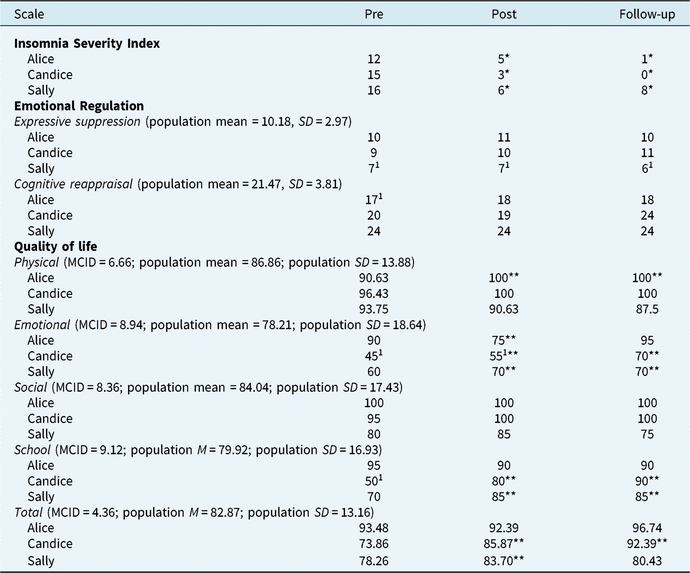
Clinically significant change was demonstrated on the ISI for all three participants following treatment. Reliable change indices (RCI) were calculated for the participants’ outcome data on the ISI. Reliable reductions in insomnia symptoms were found for Alice, Candice and Sally at post-assessment (RCI = 2.35, 4.02 and 3.35, respectively) and 6-week follow-up (RCI = 3.69, 5.03 and 2.68, respectively). See Table 1 for all outcome measure scores.
Outcome data for Insomnia Severity Index, Emotion Regulation Subscales and Quality of Life Subscales and Total Scale

1 Score fell below one standard deviation of the population mean on Emotional Regulation and QOL scales; *RCI > 1.96, indicating reliable change occurred at 95% confidence; **clinically meaningful change occurred from pre- to post-, or pre- to follow-up, according to minimal clinically important difference.
Sleep diary data
Sally did not complete the sleep diary measure and therefore those data are missing. None of the participants were was required to complete sleep diaries at follow-up.
Sleep onset latency
Both Alice and Candice experienced a clinically significant reduction in sleep onset latency (SOL) at post-intervention. Furthermore, Alice’s SOL remained below the 30-minute threshold for problematic sleep from session 4 onwards. However, Candice reported SOLs above the clinical threshold for the majority of the intervention.
Total sleep time
There were minor increases in TST for both Alice (16 minutes) and Candice (42 minutes) at post-assessment.
Emotion regulation
As indicated in Table 1, none of the participants reported large changes in either expressive suppression or cognitive reappraisal at either post-intervention or at follow-up.
Quality of life
As is evident from Table 1, risk of impaired quality of life (QOL; scores one standard deviation or more below the mean), were only evident for Candice on the emotional subscale at pre- and post-assessment, and the school subscale at pre-assessment. All other scores for all other participants and subscales at all time points were within the normal range.
Minimal clinically important differences (MCID) for the total score and subscale scores of the PedsQL were used to evaluate change due to treatment and are given in Table 1. As is evident from Table 1, clinically important differences occurred on the emotional subscale, which decreased at post-assessment for Alice (although this had improved again by follow-up), and improved for Candice and Sally. Clinically important improvements were also found on the physical subscale for Alice, and the school subscale and total score for Candice and Sally.
Treatment satisfaction
Both adolescents and parents were satisfied with the Recharge program (adolescent average = 4.66, parent average = 4.33) and agreed that the program had improved adolescent sleep (adolescent average = 4.33, parent average = 4).
Discussion
As expected, all three participants lost their insomnia diagnosis at post-assessment and showed clinically significant and reliable change in insomnia severity following treatment. Two of the three participants continued to be diagnosis free at 6-week follow-up, with one returning to subthreshold levels at this time point. SOL also reduced following treatment, and there was also a small improvement in TST. Finally, improvements in various QOL domains were evident for all three participants, although there was little improvement in emotion regulation.
Overall, the program was effective in treating insomnia disorder with these young adolescents, although at 6-week follow-up, one participant reported subclinical insomnia symptoms, potentially highlighting the need for booster sessions. The demonstrated improvements in sleep did not appear to be due to improvements in emotion regulation, as emotion regulation did not significantly improve at post- or follow-up. Although it may be the case that the emotion regulation strategies included in the program were ineffective, participant emotion regulation was within the normal range at pre-assessment, making it difficult to demonstrate meaningful improvement. Future research should consider replicating this study with young adolescents who have emotion regulation problems, to better assess the usefulness of including emotion regulation strategies in adolescent CBT-i programs.
There were clinically important improvements in emotional functioning according to the QOL measure for two participants. The results also showed clinically meaningful improvement on physical functioning for one participant, and school functioning for two participants. This suggests that CBT-i interventions for insomnia disorder may contribute to improvements in other important areas of daily functioning, and that improving sleep using CBT-i is of benefit to broader areas of adolescents’ lives.
Study limitations include a case series design, which, whilst useful, is not considered the gold standard in terms of treatment evaluation. Future studies should conduct RCTs to assess the relative efficacy of CBT-i and CBT-i augmented with emotion regulation strategies in the treatment of adolescent insomnia, moderated by emotion regulation level at pre-treatment. Second, the use of paper sleep diaries proved an onerous task for the adolescents. Future studies should include only a period of monitoring at each time point including follow-up, perhaps using a mobile application. Finally, the omission of objective actigraphy data is a limitation that should be amended in future research.
This study has demonstrated the effectiveness of CBT-i for adolescent insomnia, but was unable to demonstrate that including emotion regulation strategies within treatment led to improvements in emotion regulation that may have contributed to treatment efficacy. Given that participants had good emotion regulation strategies prior to treatment, and because the adolescents anecdotally reported the usefulness of the emotion regulation strategies, further research is required to assess the potential usefulness of including emotion regulation strategies within a CBT-i treatment protocol.
Acknowledgements
None.
Ethical statements
The authors have abided by the Ethical Principles of Psychologists and Code of Conduct as set out by the APA. Ethics approval was required from the Griffith University Human Research Ethics Committee. Griffith University reference number: 2016/719.
Conflicts of interest
Luka Byrne, Caroline Donovan and Amy Shiels have no conflicts of interest with respect to this publication.
Financial support
Caroline Donovan received seed funding from the School of Applied Psychology, Griffith University.
Supplementary Material
To view supplementary material for this article, please visit https://doi.org/10.1017/S1352465819000481




Comments
No Comments have been published for this article.