1. Introduction
This paper investigates the emergence of the category humanness in the 3rd person singular personal pronoun of Alemannic dialects. Alemannic dialects are German dialects spoken in southwestern Germany, in Alsace (France), in the German-speaking part of Switzerland, in Vorarlberg (Austria), and in some villages in the Aosta Valley (Italy). Alemannic dialects were also spoken in some villages in Romania and Hungary, as well as by the Black Sea and in Georgia. In some of these dialects, the neuter personal pronoun is used to refer to a female person. These dialects developed a new form for the accusative human neuter, which differs from the accusative nonhuman neuter. Thus, a human and a nonhuman paradigm are distinguished in the neuter: Subject and direct object forms differ from each other in the human paradigm but not in the nonhuman paradigm. This phenomenon has mainly been described from a sociolinguistic perspective (Christen Reference Christen, Schnyder and Fleith1998, Fleischer Reference Fleischer2012, Nübling et al. Reference Nübling, Simone and Juliane2013, Birkenes et al. Reference Birkenes, Kleopatra and Jürg2014), but it has never been analyzed from a systemic point of view (that is, what that signifies for the language system), as is done in the first part of this paper (sections 1–4). The second part (sections 5–9) presents a pilot study of Sense Alemannic, where a human and a nonhuman paradigm are distinguished not only in the neuter, but also in the masculine and feminine of the 3rd person singular personal pronoun.
The first part investigates the 3rd person singular neuter personal pronoun in 17 Alemannic dialects based on already existing language descriptions. These dialects are situated in the different parts of the Alemannic speaking area. It is shown that the neuter gender is used with nouns that refer to female persons, which is already described in other papers (section 2). Section 3 gives a detailed description of how the category humanness is encoded in the Alemannic dialects based on my own analysis of these dialects: the paradigms, the origin of the new accusative neuter form, the areal distribution, and some deviations from the general pattern. Section 4 proposes an explanation for the paradigms of the Alemannic dialects, namely, the differential object marking hypothesis (DOM; Keenan Reference Keenan and Li1976, Silverstein Reference Silverstein and Dixon1976, Bossong Reference Bossong and Feuillet1998, Aissen Reference Aissen2003).
What is presented in the second part should be considered to be a pilot study. For one Alemannic dialect, Sense Alemannic, the available descriptions are not exhaustive. It is for this reason that I collected new data from two native speakers of this dialect (section 5). Section 6 presents evidence that gender assignment to nouns that denote females does not only depend on the sociopragmatic context, but also on the morphology of the proper noun. Section 7 provides a detailed analysis of how humanness is encoded, showing that a human and a nonhuman paradigm are distinguished not only in the neuter, but also in the masculine and feminine. Section 8 presents instances found in Sense Alemannic contradicting DOM. However, other paradigms are in accordance with DOM. Based on the latter two sections, it becomes clear that there are two principles (humanness marking and DOM) leading to conflicting results. It is shown that the humanness marking principle is never violated at the expense of the DOM principle (section 9). The paper concludes with a summary and an outlook (section 10).
2. Female Proper Names and Neuter Gender
Most varieties of German have a three-gender system: masculine, feminine, and neuter. Gender assignment is lexically conditioned. However, as a general rule, if a noun or a pronoun refers to a male person or animal, it bears the masculine gender, and if a noun or a pronoun refers to a female person or animal, it bears the feminine gender. There are some exceptions: Some female persons are referred to by nouns with neuter gender, for example, Weib ‘woman’ (archaic, now with a pejorative meaning), Mädchen ‘girl’. The neuter gender of Weib is lexically conditioned; the neuter gender of Mädchen is morphologically conditioned because -chen is a diminutive suffix that determines neuter gender.
However, neuter gender is assigned to female proper names in some German dialects (with no lexical or morphological conditioning). Consider the example in 1.
(1)


Interestingly, these dialects are located between the Benrather isogloss (though the neuter gender for nouns referring to females can also be found in some Low German dialects) and the Swiss Alps, mainly on the western bank of the Rhine (Nübling et al. Reference Nübling, Simone and Juliane2013:152–153). Thus, this is the area where Alemannic dialects, amongst others, are spoken.Footnote 1 In most of these dialects, the feminine and neuter gender (marked on the article and personal pronoun) may be used to refer to a woman, depending on the sociopragmatic context: If the speaker knows the woman concerned well (family, friend) and likes her, the neuter gender is used, whereas if there is a certain social distance between the speaker and the woman, or if the speaker does not like the woman in question (pejorative), the feminine gender is used (Christen Reference Christen, Schnyder and Fleith1998:275, Nübling et al. Reference Nübling, Simone and Juliane2013:154, 189, 192–193).
The two widespread hypotheses regarding the origin of the neuter gender referring to females are the following: i) often a diminutive is derived from female proper names, thus the female proper name becomes neuter in gender and, by analogy, the neuter gender expands to all female proper names; ii) some denotations for females (for example, Weib ‘woman’ (archaic), Mädchen ‘girl’) are neuter in gender (lexically or morphologically conditioned), so the neuter expands analogically to female proper names (Nübling et al. Reference Nübling, Simone and Juliane2013:161–164).
This is a very short summary regarding the origins and the sociopragmatic factors that determine the distribution of gender when used to refer to women. More detailed descriptions and analyses (including questions regarding semantically and formally conditioned agreement) can be found in the following papers: Christen Reference Christen, Schnyder and Fleith1998, Fleischer Reference Fleischer2012, Nübling et al. Reference Nübling, Simone and Juliane2013, Birkenes et al. Reference Birkenes, Kleopatra and Jürg2014. In this paper, I exclusively focus on the systems of morphological exponence of gender and humanness in the 3rd person singular neuter personal pronoun of Alemannic dialects, thus on the paradigms.
3. Humanness in the 3rd Person Singular Neuter Personal Pronoun
3.1. The Paradigms
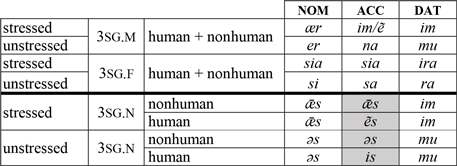
Several Alemannic dialects have grammaticalized two paradigms in the 3rd person singular neuter of the personal pronoun: one for human beings and one for nonhuman entities. Table 1 displays the paradigm in Jaun Alemannic, which is representative of the Alemannic dialects investigated here in having both human and nonhuman paradigms. Note that all Alemannic dialects distinguish full (stressed) and reduced (unstressed) forms, as well as nominative, accusative, and dative in the 3rd person singular personal pronoun.Footnote 2
3rd person singular personal pronoun in Jaun Alemannic (Stucki Reference Stucki1917:280–282).

The neuter human and the nonhuman paradigms differ only in the accusative. The nonhuman paradigm shows the usual, diachronically inherited forms distinguishing the dative from the nominative and accusative, which are syncretized. In contrast, the human paradigm has a new form in the accusative: ẽs/is in Jaun Alemannic, in(ə)s in all other Alemannic dialects under investigation here. As a consequence, in the human paradigm, the nominative and accusative are distinguished in the neuter.Footnote 3 That the nominative neuter form differs from the accusative neuter form is typologically uncommon, especially in Indo-European languages. The neuters referring to humans, however, can be considered as a special class of neuters (higher ranked in the animacy scale, Silverstein Reference Silverstein and Dixon1976), as Indo-European neuters usually refer to nonhumans/inanimates.
Three deviations from the general pattern displayed in table 1 are found in the Alemannic dialects under investigation here (regarding the syncretism patterns, as well as the use of forms of the demonstrative pronouns instead of the personal pronouns). Those deviations concern not only the neuter, but also the masculine and the feminine of the 3rd person singular personal pronoun. There is very little and only vague information about these deviations, so clearly more investigation is needed. Again, one should also bear in mind that the grammatical descriptions used in this study do not specifically address the subject of humanness in the personal pronouns, but report the forms of the paradigm and their origins. Thus, the deviations (especially if information is lacking) may also be due to the fact that the authors of the grammars were not interested in the specific subject of humanness differentiations (absence of evidence is not evidence of absence).
First, in some dialects, the demonstrative pronouns are used instead of personal pronouns. In Issime Alemannic, the personal pronoun is used when referring to human entities, and the demonstrative pronoun when referring to nonhuman entities (Zürrer Reference Zürrer1999:244–245, 257). The same applies to Zurich Alemannic, but nouns referring to human beings may be pronominalized by personal pronouns as well as by demonstrative pronouns (Weber Reference Weber1987:159). In Elisabethtal Alemannic, the demon-strative pronoun is frequently used, whereas the personal pronoun is rarely used (Žirmunskij Reference Žirmunskij1928/1929:52). In Petrifeld Alemannic, the demon-strative pronoun is preferred when strongly stressed (Moser Reference Moser1937:65). Finally, in Stuttgart Alemannic, the demonstrative pronoun is frequently used, especially in the preverbal position in main clauses (Frey Reference Frey1975:160–161).
Second, information is lacking for some dialects regarding the paradigm of the 3rd person singular neuter. In Alsace Alemannic, the personal pronoun can only pronominalize nouns referring to human entities, but nothing is said about the pronominalization of nouns with nonhuman referents (Beyer Reference Beyer1963:155). The same counts for Vorarlberg and Petrifeld Alemannic (Jutz Reference Jutz1925:274, Moser Reference Moser1937:65), but only in the nominative and accusative, as well as for Visperterminen (Wipf Reference Wipf1910:141) and Sense Alemannic (Henzen Reference Henzen1927:197), but only in the accusative.
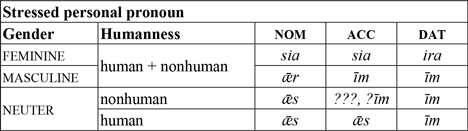
Third, a very interesting phenomenon may be found in 3rd person singular neuter nominative and accusative personal pronouns in Bern Alemannic (table 2). This dialect displays a systematic distinction between the human and nonhuman paradigms not only in the accusative (inəs versus es), but also in the nominative (ǣs versus es). This distinction is made by the stressed (ǣs) and the slightly reduced (es) personal pronouns.
Stressed 3rd person singular neuter personal pronoun in Bern Alemannic (Hodler Reference Hodler1969:189–190, Marti Reference Marti1985:92–97).

A very similar case is described in section 5, which deals with Sense Alemannic. Note that Bern Alemannic and Sense Alemannic are geographically adjacent dialects.
3.2. The Origin of the Accusative Neuter Human and Areal Distribution
The only hypothesis regarding the origin of the new accusative neuter human form can be found in the Swiss idioticon (Staub & Tobler Reference Staub and Ludwig1881). This hypothesis is adopted by Stucki (Reference Stucki1917). According to this hypothesis, ins (and its variants, see table 1) is composed of in and s. In is the accusative form of the 3rd person singular masculine personal pronoun and s one of the numerous variants of the 3rd person singular neuter personal pronoun (Staub & Tobler Reference Staub and Ludwig1881:512).Footnote 4 Additionally—and this is not mentioned by Staub & Tobler (Reference Staub and Ludwig1881)—the s may also be considered as a kind of default neuter marker in varieties of German because it is commonly used, for example, in the neuter of the possessive pronoun inflection (as in Jaun Alemannic mī-s ‘my-nom.sg.n’, Stucki Reference Stucki1917:284) and in the adjective inflection (as in Jaun Alemannic warm-s ‘warm-nom.sg.n’, Stucki Reference Stucki1917:273).
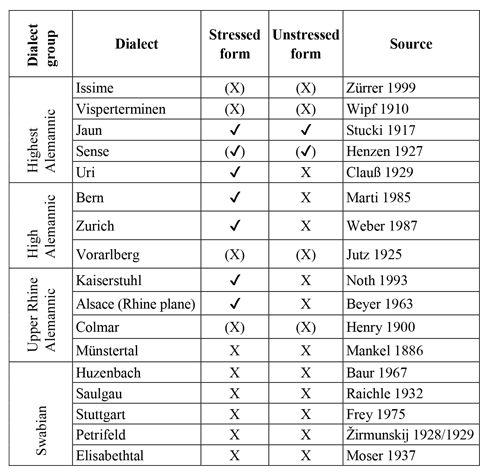
As for the areal distribution, the stressed form of the new accusative of the 3rd person singular neuter personal pronoun is found in only 6 of the 17 Alemannic dialects investigated here (with check mark in table 3); the unstressed form is found only in Jaun Alemannic.
New accusative form in 3rd person singular neuter personal pronoun.

Sense Alemannic is a special case to which the second part of this paper is dedicated (section 5–9). In these six Alemannic dialects (with the new form in the accusative) and in Sense Alemannic, the neuter (article or personal pronoun) is used to refer to a female. The same counts for Vorarlberg and Colmar Alemannic, but they do not show any special paradigms or forms for human entities, and, more precisely, the grammatical descriptions do not mention any special forms (Henry Reference Henry1900, Jutz Reference Jutz1925). In Issime and Visperterminen Alemannic (both Walser dialects), the neuter is used to refer not only to females but also to males. However, those dialects did not develop any special forms in the neuter either (Wipf Reference Wipf1910, Zürrer Reference Zürrer1999; see also Christen Reference Christen, Schnyder and Fleith1998 for new data concerning the canton of Valais where Visperterminen is situated). This may be explained by the general observation that the Walser dialects show many archaic features (Baechler Reference Baechler2017). In the grammatical descriptions of Münstertal Alemannic and of all Swabian dialects, there is no mention of a possible use of the neuter for female proper names and their pronominalization. Thus, it can be concluded that the neuter referring to females is mainly a feature of Highest Alemannic (Walser dialects as a special case), High Alemannic, and Upper Rhine Alemannic dialects, but not of Swabian dialects. This conclusion is consistent with the observations made in the AdA (Atlas der deutschen Alltagssprache ‘Atlas of the German everyday language’, Elspass & Möller Reference Elspass and Robert2003). One should not, however, entirely exclude the possibility that this phenomenon may have also existed in the Swabian dialects.
It was observed that some grammatical descriptions are not very precise or that they lack information about the personal pronouns and the encoding of humanness. This leads to the question of why these grammatical descriptions can be used for this survey. The grammatical descriptions do not aim to answer the questions addressed in this paper, but rather to report the forms of a paradigm and to explain their origins. Furthermore, one cannot entirely exclude the possibility that the grammars are, at least partially, based on the author’s intuitions. However, introductions to several of the grammars report that the data are based on interviews.Footnote 5 One also needs to bear in mind that there is still no corpus for Alemannic dialects that would cover the entire Alemannic-speaking area. Alemannic data are only available in grammars, dictionaries, and atlases.Footnote 6 Thus, if one aims to undertake a comparative investigation of dialects from very different Alemannic-speaking areas, the grammars used in this paper have proven to report valid data, as they provide fairly detailed and systematic descriptions.
4. Explanation for the Nominative/Accusative Distinction
The previous section showed that nominative and accusative are distinguished in the neuter human (new form in the accusative) and syncretized in the neuter nonhuman. This pattern can be explained by the so-called DOM hypothesis. Bossong (Reference Bossong and Feuillet1998:201) assumes that in a transitive context, the prototypical subject is animate because it performs the action, whereas the prototypical object is inanimate because it undergoes the action. Hence, an animate object represents a potential subject and, thus, must be marked in order to be clearly distinguished from the subject (Bossong Reference Bossong and Feuillet1998:202). According to Aissen (Reference Aissen2003:437), proposing a slightly weaker version, “it is those direct objects which most resemble typical subjects that get overtly case-marked.” Typical—and thus unmarked—properties for subjects and marked properties for objects are agenthood, topicality, animacy, and definiteness (Aissen Reference Aissen2003:438, based on Keenan Reference Keenan and Li1976). Therefore, it is not surprising that the Alemannic dialects, distinguishing a human and a nonhuman paradigm in the neuter, developed a new form in the accusative human, used for animates.
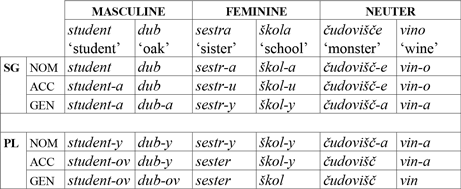
The same explanation applies to those Scandinavian languages with a two-gender system and humanness distinction in the personal pronoun. Only in the 3rd person singular human (masculine and feminine) do the subject and object forms differ from one other, whereas subject and object forms are syncretized in the nonhuman paradigm. A very similar case can be found in the inflection of nouns in Russian. Russian has a three-gender system (masculine, feminine, neuter; lexically distributed) and distinguishes animacy. Again, it is the accusative, which varies according to animacy: The accusative of a noun with an animate referent is inflected like the genitive, whereas the accusative of a noun with an inanimate referent is inflected like the nominative, as shown in table 4. As a consequence, the animate accusative always differs from the nominative (except in the neuter singular). Note that animacy is not morphologically distinguished in the feminine and neuter singular. However, the feminine conforms to DOM because the accusative always differs from the nominative. In the neuter singular, nominative and accusative are never distinguished, but very few neuter nouns are animate.
Inflection of Russian nouns, animate and inanimate (shortened paradigm, Corbett Reference Corbett1991:166).

Thus, DOM seems to explain this phenomenon in many languages. However, the second part of the paper (sections 5–9) presents a system that in part contradicts this hypothesis.
5. Incomplete Data in Henzen Reference Henzen1927 and New Data
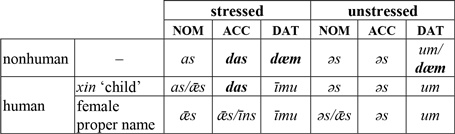
Table 5 shows the paradigm of the 3rd person singular personal pronoun (stressed) in Sense Alemannic based on Henzen Reference Henzen1927. Concerning the 3rd person singular neuter, Henzen (Reference Henzen1927:197) gives the following information in addition to the table showing the paradigm: “Der freie Akkusativ Neutrum Singular ǣs kommt nur selten in Anwendung, so für Frauen” [The free accusative neuter singular ǣs is used only rarely, for example, for women].Footnote 7 Thus, the neuter human paradigm has the inherited forms of the neuter (nominative=accusative versus dative). However, nothing is said about the accusative neuter nonhuman form. One hypothesis may be that the accusative neuter nonhuman form is replaced by the dative form as happened in the 3rd person singular masculine personal pronoun, as well as in the 1st and 2nd person singular personal pronoun (Henzen Reference Henzen1927:196–197).Footnote 8 Thus, it is not clear with which form the 3rd person singular neuter nonhuman accusative is expressed. Furthermore, new data were collected in the Projekt Dialektsyntax des Schweizerdeutschen ‘Project on Swiss German dialect syntax’, but not for the entire paradigm of the personal pronoun. These new data show that the dative masculine/neuter form īm is not only used as an accusative masculine, but also as an accusative neuter human (Bucheli Berger Reference Bucheli Berger and Christen2010:77). In this case, the neuter paradigm would work like the Russian noun inflection, but the other way around (and thus, contradicting the DOM hypothesis): The dative form is used in the accusative nonhuman (nominative ≠ accusative), and the nominative form in the accusative human.
3rd person singular neuter in Sense Alemannic (Henzen Reference Henzen1927:197–198).

As it is not possible to build up a paradigm with these data, I collected new data from two native speakers of the Sense dialect: Informant 1, female, 54 years old, and informant 2, male, 62 years old. The data were collected between January and April 2016. It was crucial to collect all the forms of the 3rd person singular personal pronoun, that is, three genders (masculine, feminine, neuter), human and nonhuman (of all three genders), three cases (nominative, accusative, dative), and full as well as reduced forms of all the corresponding forms. This is why I created sentences covering all these morphosyntactic properties and instructed the informants to fill in the blank spaces with a suitable personal pronoun (and, if a proper noun is concerned, the definite article). The informants were encouraged to discuss their results together while filling in the gaps. Each three to four sentences were arranged into a short story. Example 2 contains the sentences for the neuter human unstressed paradigm including nominative, accusative, and dative.
(2)

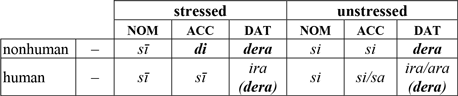
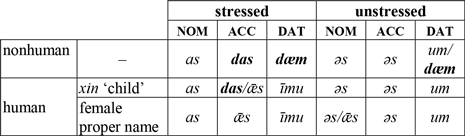
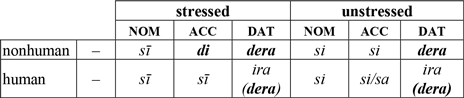
The personal pronoun paradigms gathered of informant 1 are reported in tables 6–8, and the ones of informant 2 in tables 9–11.
3rd person singular neuter personal pronoun (informant 1).

3rd person singular masculine personal pronoun (informant 1).

3rd person singular feminine personal pronoun (informant 1).

3rd person singular neuter personal pronoun (informant 2).

3rd person singular masculine personal pronoun (informant 2).

3rd person singular feminine personal pronoun (informant 2).

This is only a pilot study and is not representative of the dialect. The results, however, are valid in the following respects: i) the answers of the informants differ only very slightly from one another, ii) the results represent the coherent systems of two native speakers of Sense Alemannic, and iii) all morphosyntactic properties are covered so all the cells of the paradigm are filled.
6. The Grammatical Gender of Nouns with Female Referents
In section 2, it was explained that the feminine and neuter gender may be assigned to the same noun referring to a female person. Which gender is chosen depends on the relation between the speaker and the woman concerned. Thus, gender is sociopragmatically determined: closeness and appreciation (neuter) versus distance or antipathy (feminine).
Sense Alemannic has a slightly more complex system, and one needs to differentiate between the definite article preceding the proper name and the pronominalization of the proper name. Which article (feminine or neuter) is used depends on the morphology of the proper name and, additionally, in some cases, on the sociopragmatic context: If a female proper name ends in -i or in a consonant, the neuter or feminine gender is assigned to that proper name following the sociopragmatic considerations described above.Footnote 9 However, an ongoing change can be observed, as informant 2 uses both the feminine as well as the neuter; the choice can reflect this sociopragmatic difference, but does not do so obligatorily. An ongoing change from the neuter to the feminine for female proper names was observed in Christen Reference Christen, Schnyder and Fleith1998:280 and Nübling et al. Reference Nübling, Simone and Juliane2013:162, 194, too.
Furthermore, there are female proper names in Sense Alemannic ending in -a. These proper names can never occur with the neuter definite article, only with the feminine one.Footnote 10 This may be because all nouns ending in -a in the singular are feminine (Henzen Reference Henzen1927:180–190) and because the majority of the feminine nouns in this dialect end in -a (=weak feminine nouns; Henzen Reference Henzen1927:188). Moreover, this class of weak feminine nouns is growing: Strong feminines as well as strong and weak masculines change to weak feminines. For example: īx > īxa ‘oak’ (strong feminine), tsēıjə > tsēıja ‘toe’ (weak masculine), doərn > doərna ‘thorn’ (strong masculine; Henzen Reference Henzen1927:189). Finally, -a is suffixed to French feminine loan words (Henzen Reference Henzen1927:189).
Thus, in addition to the sociopragmatic criteria, there is a morphological criterion, which is ranked higher. First, the speaker has to differentiate between those female proper names ending in -a (feminine gender) and those ending in -i or in a consonant (neuter or feminine gender). Second, regarding names ending in -i or in a consonant, the speaker has to differentiate between the two sociopragmatic contexts.
Regarding the pronominalization of proper nouns, the results are very clear: Personal pronouns always agree with the definite article in gender. This can be explained by the short distance between the definite article and the personal pronoun in the questionnaire: According to Birkenes et al. Reference Birkenes, Kleopatra and Jürg2014, the shorter the distance between the controller and the target, the more likely it is to find formal agreement, and the larger the distance, the more likely it is to find semantic agreement. In the questionnaire used for this study, the personal pronoun is always very close to the definite article and proper noun (see example 2 in section 5). Thus, it is possible that the personal pronoun may change in gender (for example, depending on the sociopragmatic context) if the distance to the controller is larger. Note, however, that this would not affect the paradigms that are at the center of my interest for the purposes of this paper.
7. The Marking of Humanness
7.1. Demonstrative Pronouns
Several cells of the personal pronoun paradigms show demonstrative pronouns (bold in tables 6–11). Their distribution is not random, but follows a clear pattern. In the stressed paradigm, the demonstrative pronoun fills the cells of the accusative and dative nonhuman; in the unstressed paradigm, the demonstrative fills the cells of the dative nonhuman. However, in the neuter and masculine, the demonstrative pronoun is in variation with the personal pronoun (um/dæm). Thus, human and nonhuman forms are distinguished by personal and demonstrative pronouns in the object cases only. The neuter noun xin ‘child’ is a special case, which is discussed in more detail in section 7.3. The dative feminine human forms ira and dera are not in free variation because dera for females is used only with a pejorative meaning. It is not very surprising that the demonstrative pronoun is used in these contexts: If a +/–pejorative meaning is distinguished and if a human and a nonhuman forms are available, it is more likely that the nonhuman form will be used in pejorative contexts.
Thus, Sense Alemannic distinguishes between a human and a nonhuman category not only in the neuter (like other Alemannic dialects), but also in the masculine and feminine, therefore independently of gender. At least to my knowledge, this phenomenon has never been systematically investigated and described, although there are some indications in the grammatical descriptions that the demonstrative pronoun is used instead of the personal pronoun (see section 3.2). Furthermore, in those grammatical descriptions a rather wide range of variation is assumed. Interestingly, the demonstrative pronouns are also used to refer to nonhuman entities in some Scandinavian languages (Danish, Norwegian, and Swedish), while personal pronouns are used to refer to human (feminine and masculine) entities.Footnote 11 Old Norse (with a three-gender system), unlike the other Old Germanic languages, expresses the 3rd person singular neuter personal pronoun by the demonstrative pronoun þat, and the masculine and feminine by the personal pronoun hann, hon (Krahe & Meid Reference Krahe and Wolfgang1969:55–58; for a detailed discussion see Howe Reference Howe1996).
That the demonstrative pronoun is in free variation with the personal pronoun in the dative masculine and neuter of the unstressed paradigm, and is, contrary to the stressed paradigm, not used in the accusative, needs an explanation. One hypothesis may be that this variation pattern represents a diachronic change toward using the demonstrative pronoun instead of the personal pronoun: This change took its starting point in the stressed personal pronoun and expanded only later to the unstressed personal pronoun. Another possible explanation is that demonstrative pronouns are better suited to function as stressed than as unstressed personal pronouns because when they are used as demonstrative pronouns they bear deictic semantics.
In summary, demonstrative pronouns replace personal pronouns, which leads to the human versus nonhuman distinction in all genders. Moreover, the stressed and unstressed paradigms differ in the use of the demonstrative pronoun (stressed: accusative and dative, unstressed: dative). In contrast, no differences are observed between the three genders: The demonstrative pronoun is used in exactly the same cases in all three genders within both (stressed and unstressed) paradigms. This uniform use of the demonstrative pronoun signifies that humanness is not connected to a specific gender but is distinguished in all genders.
7.2. Nominative and Accusative Neuter, and the Paradigm for Child
First, I consider nominative neuter stressed forms. Informant 1 makes a clear distinction when referring to human and nonhuman entities in the nominative neuter: as for nonhuman entities and ǣs for human entities (for the paradigm of xin ‘child’, see below).Footnote 12 Unlike informant 1, informant 2 uses the same exponence (as) for human and nonhuman entities (as in the masculine and feminine). An explanation for the different paradigms used by informant 1 and informant 2 may be found in the diachrony. The form ǣs is taken as a starting point because the 3rd person singular neuter personal pronoun in Old High German (OHG) is is (nominative/ accusative; Braune Reference Braune2004:243), and Henzen (Reference Henzen1927:197) reports only ǣs. Consequently, as is a new form. Informant 2 uses the new form as throughout the nominative neuter stressed, whereas informant 1 uses ǣs and as depending on human/nonhuman semantics. Thus, I propose that informant 2 represents a newer stage of the language than informant 1: The former distinction (=informant 1) between human and nonhuman in the nominative neuter is leveled (=informant 2), in analogy to the feminine and masculine, which do not differentiate between human and nonhuman in the nominative.
Regarding the new form as, note that the stressed personal pronouns are always sentence initial in this investigation. Therefore, from a synchronic point of view, as and das are not phonologically conditioned allomorphs. However, I hypothesize that diachronically as may be traced back to the demonstrative pronoun das: Informant 1 uses as (nominative) exclusively for nonhuman entities where one would expect a demon-strative pronoun (as in the accusative and dative). As for nominative neuter unstressed forms, in this paradigm human and nonhuman entities are pronominalized with əs. If the pronoun refers to a female person, ǣs may also be used.
With respect to accusative neuter, informant 2 clearly distinguishes the accusative neuter human (ǣs) from the nominative neuter human (as) as well as from the accusative neuter nonhuman (das). Informant 2 has, thus, no form for the accusative neuter human of the type īns observed in other Alemannic dialects, where the neuter form is used to refer to females (section 3.1). In contrast, informant 1 uses the form īns as well as ǣs for the accusative neuter human. As a consequence, the human versus nonhuman contrast emerges in the accusative neuter (īns/ǣs versus das); but now, if ǣs is chosen as the accusative human form, the accusative human ǣs syncretizes with the nominative human ǣs. Thus, this paradigm violates the DOM principle (see section 8).
Finally, there is a special paradigm for the neuter noun xin ‘child’. The question raised here is whether the noun xin is considered grammatically as human or nonhuman.Footnote 13 The paradigms produced by both informants show a mix of human and nonhuman forms. The nominative in the paradigm of informant 2 tells one nothing because no distinction is made between human and nonhuman. In the accusative, both human and nonhuman forms are used to refer to a child, but in the dative only the human form. Informant 1 uses the human and nonhuman form in the nominative, the nonhuman form in the accusative, and the human form in the dative. Thus, the noun xin is grammatically considered neither exclusively human nor exclusively nonhuman. This may be because neuter nouns can have both human and nonhuman referents, with the former always being females. Of course, the noun xin has a human referent, but that referent may be either male or female, and it is clearly less concrete than a specific female person addressed by a proper name. It would be interesting to check with which pronouns the nouns Weib ‘woman’ (archaic) and Mädchen ‘girl’ are pronominalized: whether they behave like the noun xin, the neuter human, or the feminine human.
8. The Nominative/Accusative Distinction
In OHG, the 3rd person singular masculine nominative and accusative are distinguished by the forms er (nominative) and inan (accusative; Braune Reference Braune2004:243). Thus, ǣr/ər and īn/nə in Sense Alemannic are inherited distinctions. However, the question is whether or not the n in ne is part of the personal pronoun or if it is inserted to prevent hiatus. Both analyses are possible in principle because n is used in the Alemannic dialects by default to avoid a hiatus between words, as in 3.
(3)

To rule out the use of the hiatus-preventing n, I ensured that the word preceding the personal pronoun in the questionnaire always ended in a consonant. The responses clearly show that the n forms part of the accusative masculine personal pronoun: Informant 2 noted nə, informant 1 nə and ənə as possible forms for the 3rd person singular accusative masculine personal pronoun.
Regarding the nonhuman stressed paradigm, it is important to note that the demonstrative pronoun only replaced the personal pronoun in the accusative and in the dative. Had the demonstrative pronoun been used in the nominative as well, the nominative and accusative forms would have been identical, due to syncretism, dæ/dǣr (Henzen Reference Henzen1927:200).Footnote 14 Thus, nominative and accusative are always distinguished morphologically, either by inherited forms (ǣr/ər and īn/nə) or by the personal and demonstrative pronoun (ǣr and dæ).
OHG has one form, is, for the nominative and accusative of the 3rd person singular neuter personal pronoun (human and nonhuman) (Braune Reference Braune2004:243). This form is maintained in the unstressed paradigm in Sense Alemannic (əs) with a minor exception: Females may be referred to by the form əs as well as by ǣs. The latter corresponds to the human form in the stressed paradigm. Contrary to the unstressed paradigm, the stressed nominative and accusative forms differ from each other. In the nonhuman paradigm, these cases are distinguished, as the demonstrative pronoun replaces the personal pronoun only in the accusative and dative, but not in the nominative (the demonstrative pronoun—for example, masculine—has the syncretic form das/dās in the nominative and accusative; Henzen Reference Henzen1927:200).Footnote 15
In the stressed human paradigm provided by informant 2, the nominative (as) and the accusative (ǣs) are distinguished. This is due to the expansion of the nonhuman nominative form as, which is replacing the former human nominative form ǣs. As discussed in section 7.2, this expansion may be caused by a leveling of the human/nonhuman distinction in analogy to the masculine and feminine nominative. The stressed human paradigm of informant 1 shows either the inherited syncretic form ǣs or the new accusative form īns—the pattern observed in many other Alemannic dialects. Thus, the distinction/nondistinction between the nominative and the accusative is in free variation. To summarize, nominative and accusative are distinguished in the stressed neuter by different parts of speech or by changes in the personal pronoun (the new forms as and īns), but are not distinguished in the unstressed neuter (with a minor exception in both the stressed and unstressed paradigms).
In OHG, the nominative of the 3rd person singular feminine personal pronoun is siu, the accusative is sia (Braune Reference Braune2004:243). Henzen (Reference Henzen1927:197) reports sia for nominative and accusative. In present-day Sense Alemannic, the syncretism is preserved: si (unstressed human and nonhuman), sī (stressed human). In the unstressed human paradigm, nominative and accusative are distinguished, if sa (in free variation with the syncretic form si) is used in the accusative (informant 1). In the stressed nonhuman paradigm, nominative and accusative differ from each other because the demonstrative pronoun is used in the accusative and dative, but not in the nominative. Again, the feminine demonstrative pronoun has a syncretic form for nominative and accusative, namely, dia/di (Henzen Reference Henzen1927:200), as was already observed with neuter and masculine.Footnote 16 In summary, nominative and accusative are distinguished only in the stressed nonhuman paradigm due to the use of the demonstrative pronoun in the accusative.
At first glance, it seems rather surprising that the nominative and accusative nonhuman (stressed) differ from one another because there is a general tendency to syncretize these two forms: They are never distinguished morphologically in the entire nominal inflection, except in the aforementioned 3rd person personal pronoun (as well as in the 1st and 2nd person singular and plural personal pronoun). Additionally, it is striking that not all personal pronouns of the nonhuman paradigm are replaced by the forms of the demonstrative pronouns. However, the same DOM hypothesis may explain why the nonhuman paradigms show demonstrative pronouns in the accusative and dative, but not in the nominative. Given that the prototypical subject is animate (see Aissen Reference Aissen2003:437–438), an inanimate subject must be marked. Thus, the personal pronoun in the nominative of the stressed nonhuman paradigm may be considered a marked form, whereas the demonstrative pronoun in the accusative and dative is the default, or unmarked form.
9. The DOM Principle and the Encoding of the Category Humanness
It was shown in section 4 that marking of the accusative human follows a well-known typological pattern captured by the DOM hypothesis (Bossong Reference Bossong and Feuillet1998). This hypothesis can explain why the direct object is marked and thus distinguished from the subject when it refers to a human being, but not marked when it refers to a nonhuman entity. Under this hypothesis, one may expect that the changes in the 3rd person singular personal pronoun in Sense Alemannic would lead to a marking of the accusative in the human paradigm. However, this change applies only to the neuter (mainly in the stressed paradigm), and there are even instances undermining the DOM hypothesis.
One such instance involves the neuter gender. Although in IE languages, the neuter gender is typically reserved for nonhuman entities, I have shown that in some Alemannic dialects, neuter nouns may refer to humans, and more specifically, to females. Therefore, the DOM hypothesis predicts different marking for the nominative and accusative forms of neuter nouns referring to humans. This prediction is borne out in most cases, but not in all. In the stressed neuter human accusative, informant 1 uses ǣs (in free variation with īns), which is the same form as in the nominative. Paradoxically, nominative and accusative are distinguished at the same time in the stressed neuter nonhuman paradigm. This distribution clearly contradicts the DOM hypothesis. There is also variation in the unstressed human neuter paradigm in the data from both informants: They both use two distinct forms—that is, the nominative ǣs and the accusative əs—as well as the syncretic form əs.
Other examples that undermine the DOM hypothesis come from the feminine paradigms. The feminine gender also developed a human/nonhuman distinction. Thus, one may expect that the feminine accusative human would be marked. This expectation is partially fulfilled in the unstressed paradigm, where one finds the accusative sa. This exponence, however, is in free variation with the exponence si, which corresponds to the nominative form. This distribution contradicts the DOM hypothesis at least partially, depending on which form is chosen in the accusative human. The strongest deviation from the DOM principle can be found in the stressed feminine paradigm. Nominative and accusative are distinguished in the nonhuman paradigm (the demonstrative pronoun is used in the accusative and the personal pronoun in the nominative), but not in the human paradigm. Thus, the paradigms of the feminine do not generally fit the DOM hypothesis.
To summarize, the DOM principle applies throughout the masculine paradigm without exception (inherited form; see section 8). In the stressed neuter, DOM applies for the most part, as new forms have emerged to disambiguate syncretism. Furthermore, there are exceptions to the DOM principle in the unstressed neuter paradigm, due to inherited OHG syncretism, as well as in the unstressed feminine paradigm. Finally, the DOM principle clearly does not apply in the stressed feminine paradigm, due to new syncretism (see OHG). Thus, contrary to what one might expect under the DOM hypothesis, this principle does not apply uniformly, across the board.
With respect to encoding the category humanness, Sense Alemannic has developed a human/nonhuman distinction in the accusative and dative of the stressed paradigm for all genders, as well as in the dative of the unstressed paradigm (for all genders). Although there are syncretic forms that do not convey the human/nonhuman distinction, every nonhuman paradigm has at least one demonstrative pronoun form used exclusively for nonhumans. Thus, effectively, there is a human and a nonhuman paradigm for each gender.
Two marking principles are at play, whose application may lead to contradicting results. For example, the feminine paradigm did not have the human/nonhuman distinction and no nominative/accusative distinction, due to syncretism. Then the demonstrative pronoun started being used to refer to nonhumans. Since demonstratives replace the stressed nonhuman personal pronouns only in the accusative and dative, their use led to i) the human/nonhuman distinction in the feminine, and ii) the nominative versus accusative distinction in the feminine nonhuman. At the same time, the feminine human maintained the nominative/accusative syncretism.
So the question is how the encoding of the category humanness and DOM interact. I suggest that the interaction between these two principles may be captured within the framework of Optimality Theory, similar to what Aissen (Reference Aissen2003) proposes regarding the DOM principle. Based on a crosslinguistic comparison, Aissen identifies two conflicting principles: iconicity and economy. According to the iconicity principle, “the more marked a direct object qua object, the more likely it is to be overtly case marked” (Aissen Reference Aissen2003: 435), whereas the economy principle requires that case marking be avoided. In Sense Alemannic, every gender has a human as well as a nonhuman paradigm without any exception (thus, no violation of the human/nonhuman constraint). In contrast, nominative and accusative differ from one another in the stressed nonhuman, but not necessarily in the stressed human paradigm and, thus, contradict the DOM principle in some cases. Thus, it can be deduced that the encoding of the human/nonhuman distinction is ranked higher than the marking of the accusative human (and, as a consequence, the distinction between nominative and accusative human). Assuming a higher ranking for humanness also explains why the demonstrative pronouns did not enter the human paradigm (thus, not replacing all the personal pronouns but only some specific ones): If they did so, no distinction would be made between human and nonhuman.
10. Conclusion
In the first part of the paper (sections 1–4), it was shown that Alemannic dialects distinguish between a human and a nonhuman paradigm in the 3rd person singular neuter personal pronoun, using a new form in the accusative human. As a consequence, the accusative human differs from the nominative human, while the inherited syncretism between nominative and accusative is conserved in the nonhuman paradigm. Some Scandinavian languages (with a two-gender system and humanness distinction in the personal pronouns) display a very similar system. The morphologically encoded (non)distinction between subject and object depending on humanness can be explained by the DOM hypothesis (Bossong Reference Bossong and Feuillet1998).
The second part (sections 5–9) was dedicated to the 3rd person singular personal pronoun of Sense Alemannic, where a human and a nonhuman paradigm developed in all three genders. The new forms referring to nonhuman entities correspond to those of the demonstrative pronoun; however, those forms are used only in the accusative and dative (stressed) or only in the dative (unstressed). Note that the Scandinavian languages use demonstrative pronouns as personal pronouns to refer to nonhuman entities, too. Additionally, there are two new forms in the neuter of Sense Alemannic: īns and as. These two changes—that is, the development of the human versus nonhuman distinction and the emergence of two new forms—led to a nominative versus accusative distinction in the stressed nonhuman paradigm in all genders and in the stressed human paradigm in the neuter gender. The DOM principle, however, is violated in the unstressed neuter paradigm (inherited syncretism retained, see OHG) as well as in the stressed and unstressed feminine paradigm (new syncretism, see OHG). Thus, two principles operate in the system: Mark humanness and distinguish nominative and accusative in the human paradigm. The application of these principles may produce contradicting outputs. It was shown that the encoding of the category humanness is higher ranked in Sense Alemannic than the encoding of the nominative versus accusative distinction.
A third principle may be added, namely, syncretize nominative and accusative (see the feminine personal pronoun). Interestingly, the whole nominal inflection—except the instances in the personal pronoun presented in this article—displays a syncretism between nominative and accusative. This is not only true for Sense Alemannic but also for all the other Alemannic dialects, including the highly inflecting Alpine Alemannic dialects showing a very rich noun inflection with up to 18 inflection classes (Baechler Reference Baechler2017). As discussed in section 9, OT could capture the interaction between the three principles.
Furthermore, these three principles and the interaction between them raise further questions. Do other dialects (or languages) also use demonstrative pronouns or do they apply other strategies to encode nonhuman entities and, if so, how do those strategies affect the case marking system? Are there systematic relations between the changes in the nominative/accusative system and the category gender? How does the encoding of nominative and accusative (and other cases) change on the level of single parts of speech as well as on the level of noun phrases? Is the lack of morphological distinction between subject and direct object always compensated for elsewhere in the system (for example, by word order)? These questions arise especially with regard to the highly inflecting German Alpine dialects because the standard model of phonologically driven case loss and compensation by case marking on the article or by a fixed word order does not apply to these dialects: Alpine dialects show full vowels in nonstressed syllables, reduction of inflectional case marking (reduced noun inflection is not systematically compensated for by case marking on the articles), and only partially fixed word order. Thus, further research (perhaps including other highly inflecting Germanic languages) is needed to explore how exactly these principles interact with one another in the inflectional system of the personal pronouns as well as throughout the nominal inflection system.