Introduction
A component of Aboriginal and Torres Strait Islander children overcoming the negative factors associated with colonisation and its by-products is receiving a culturally appropriate and quality education. If the Aboriginal children of today are to become our future leaders across a range of areas and disciplines and continue to decolonise Australia, a quality education is essential. For Aboriginal children to grow up strong, there is a range of holistic variables to consider (Walter et al., Reference Walter, Dodson, Barnes, Walter, Martin and Bodkin-Andrews2017a, Reference Walter, Martin and Bodkin-Andrews2017Reference Walter, Martin and Bodkin-Andrewsb, p. 3). In an Aboriginal lifeworld, growing up strong in culture is an important component (Martin, Reference Martin, Walter, Martin and Bodkin-Andrews2017, p. 94–95). Having a strong connection to culture is shown to act as a protective factor against risks and an increased sense of identity (Colquhoun and Dockery, Reference Colquhoun and Dockery2012, p. 19; Lovett, Reference Lovett, Walter, Martin and Bodkin-Andrews2017, pp. 302, 305; Martin, Reference Martin, Walter, Martin and Bodkin-Andrews2017). Decolonising the school environment, educational system and Western pedagogy is important for Aboriginal children to receive a holistic education and grow up strong (Smith, Reference Smith1999; McCarty and Lee, Reference McCarty and Lee2014; Hynds et al., Reference Hynds, Hindle, Savage, Meyer, Penetito and Sleeter2016, p. 101; Ragoonaden and Mueller, Reference Ragoonaden and Mueller2017, p. 22). Privileging Indigenous perspectives, strength-based approaches and cultural competency have all been cited as factors to help Indigenous children to grow up strong in education (Stone et al., Reference Stone, Walter and Peacock2017, p. 94–97). One valuable strategy schools can utilise is through employing an Aboriginal Education Worker (AEW).
AEWs have been utilised in Australia since the 1950s throughout each state and territory and are classified nationally as educational aides undertaking non-teaching duties and providing assistance to Aboriginal students (Australian Bureau of Statistics, 2013, p. 1; Price et al., Reference Price, Jackson-Barrett, Gower and Herrington2017, p. 3–4). Their title, role and duties undertaken vary between each state and territory. The Australian Bureau of Statistics classifies the occupation as ‘Assists Aboriginal and Torres Strait Islander students in their education, provides feedback to parents or guardians and teachers about students’ progress, and liaises with educational bodies, government agencies and committees’ (Australian Bureau of Statistics, 2013, p. 1). They have two specialisations; these are Aboriginal Education Worker Coordinator and Aboriginal Home-School Liaison Officer. Despite this definition, AEWs and teachers have reported being unclear of their roles and expectations. Identifying how using an AEW impacts on cultural measures is important to help clarify their role and expectations within schools.
The theoretical frame used in this paper is decolonisation with a focus on the Australian education system (Smith, Reference Smith1999; Zuberi and Bonilla-Silva, Reference Zuberi and Bonilla-Silva2008; Bodkin-Andrews et al., Reference Bodkin-Andrews, Whittaker, Cooper, Parada, Denson, Bansel, Walter, Martin and Bodkin-Andrews2017, p. 154; McFarlane et al., Reference McFarlane and Schabus2017). The need to decolonise the Western education system to incorporate Aboriginal worldviews is a component of Aboriginal student success and overcoming statistical discourses measured from a Western standpoint (Walter and Andersen, Reference Walter and Andersen2013, p. 7–20; Trudgett et al., Reference Trudgett, Page, Bodkin-Andrews, Franklin, Whittaker, Walter, Martin and Bodkin-Andrews2017, p. 233–234). A critical race theory lens is used to challenge the Western education system that de-values and overlooks the strengths Aboriginal and Torres Strait Islander knowledge and culture (Ladson-Billings, Reference Ladson-Billings1998, p. 9–11; Langton and Ma Rhea, Reference Langton, Ma Rhea and Sykes2009, p. 107; Delgado and Stefancic, Reference Delgado and Stefancic2017, p. 7). This paper uses the concept ‘growing up strong’ to guide the research process (Walter et al., Reference Walter, Martin and Bodkin-Andrews2017b, p. 1–4). Growing up strong for Aboriginal children is holistic, this includes not only a Western education to navigate the Western world, but Aboriginal knowledge and cultural values. Using these theoretical concepts as a framework, this paper aims to answer the following question:
From the LSIC data, what impact do AEWs have on Aboriginal and Torres Strait Islander culture within schools?
Literature review
The literature review undertaken for this paper primarily focused on Aboriginal and Torres Strait Islander Education Workers, the importance of culture and Aboriginal children growing up strong. The apparatuses used to conduct the literature review were Google Search Services and EBSCO Discovery Service. The terms used were combinations of Aboriginal, Torres Strait Islander, Indigenous, Koori, Australia, Education Worker, Education Officer, Teacher Aides, Teacher Assistants, Longitudinal Study of Indigenous Children (LSIC), education, success, growing up strong, school, primary and secondary, culture, Country, decolonisation and critical theory. There is minimal literature regarding quantitative and qualitative analysis of AEWs (Gower et al., Reference Gower, Partington, Byrne, Galloway, Weissofner, Ferguson and Kirov2011, p. 13–23; MacGill, 2017, p. 57; Price et al., Reference Price, Jackson-Barrett, Gower and Herrington2017, p. 10).
History of AEWs
The first remunerated Aboriginal Teacher Aides (ATA) was employed during the 1950s in the Northern Territory (Price et al., Reference Price, Jackson-Barrett, Gower and Herrington2017, p. 3). Yet it was not until the 1970s where AEWs gained traction within Australian schools. During the 1970s in New South Wales, the Aboriginal Education Council initially funded a small number of ATAs to work at schools with high enrolments of Aboriginal and Torres Strait Islander students (Price, Reference Price and Price2012). These ATAs became known as Aboriginal Education Workers (AEWs), Indigenous Education Workers, Koori Education Workers or other similar terms depending on geographical location (Same Kids Same Goals, 2007, p. 1; Price, Reference Price and Price2012, p. 8; Rose, Reference Rose and Price2012, p. 76; Price et al., Reference Price, Jackson-Barrett, Gower and Herrington2017, p. 3–4). Today AEWs assist teachers and schools with a range of tasks regarding Aboriginal and Torres Strait Islander students. However, in the early days some AEWs and their important role were misunderstood, being considered ‘another pair of hands’ to help with unskilled tasks (Price, Reference Price and Price2012, p. 8).
In 1975, the Aboriginal Consultative Group recommended the Aboriginal Liaison Officers be introduced to support Indigenous projects being implemented from the Australian Schools Commission (Price et al., Reference Price, Jackson-Barrett, Gower and Herrington2017, p. 4). Recommendations were also made to the roles of ATAs; these included permanent employment, ATAs being paraprofessional, the ability for ATAs to become qualified teachers and improvement to employment remuneration (Aboriginal Consultative Group, 1975). The important role played by ATAs was identified by the Australian Government House of Representatives Select Committee on Aboriginal Education however, calls for improved remuneration and training were not met (Australian Parliament House of Representatives, 1985; Price et al., Reference Price, Jackson-Barrett, Gower and Herrington2017, p. 4). In 1993, there were approximately 1500 AEWs across Australia. Since the turn of century and beyond, there is limited data available on the total number of AEWs employed across Australia. This may be because of different profession titles and education being a state or territory responsibility. One source listed over 2500 AEWs across Australia however, this figure is not referenced (Same Kids Same Goals, 2007, p. 1). In 2009, there were approximately 790 AEWs in Western Australia's public schools (Zubrick et al., Reference Zubrick, Silburn, De Mario, Shepared and Griffin2006; Gower et al., Reference Gower, Partington, Byrne, Galloway, Weissofner, Ferguson and Kirov2011, p. 4) although actual figures vary because some schools could not make appointments and others paid for AEWs from discretionary funds. Improving data collection methods to identify the number of AEWs is important if enhancements regarding aspects of their work are to be appropriately undertaken.
AEWs today
Today, the importance of AEWs is more clearly understood and their skills are utilised across a range of activities and tasks regarding Indigenous children (Harrison, Reference Harrison2011, p. 65; Andersen et al., Reference Andersen, O'Dowd and Gower2015, p. 10–11; Department of Education, 2016, p. 2; Price et al., Reference Price, Jackson-Barrett, Gower and Herrington2017, p. 5–9). Their job description is determined by the states or territories they are located, there are many similarities but also differences (MacGill, 2008, p. 10). For example, in Western Australia the AEW job description can include over 30 tasks, some of which differ from Tasmania (Department of Education and Training, 2003; Department of Education, 2016, p. 3; Price et al., Reference Price, Jackson-Barrett, Gower and Herrington2017, p. 5). Tasmanian AEWs are not required to bath, shower, toilet and dress children or clean soiled clothing, unlike their Western Australian counterparts. Other roles undertaken by AEWs include social and emotional support, improving attendance, behaviour and achievement, providing classroom support, Aboriginal cultural knowledge, Indigenous language and role modelling (Gower et al., Reference Gower, Partington, Byrne, Galloway, Weissofner, Ferguson and Kirov2011, p. 36–37; Department of Education, 2016, p. 3; Price et al., Reference Price, Jackson-Barrett, Gower and Herrington2017, p. 5–6).
The roles undertaken by AEWs are more clearly examined within the Western Australian Aboriginal Child Health survey. AEWs (n = 152) were asked to qualitatively identify tasks which they spend the most time undertaking, compared to those they considered important (Gower et al., Reference Gower, Partington, Byrne, Galloway, Weissofner, Ferguson and Kirov2011, pp. 41, 52). Tasks they spent most of their time on included direct involvement (such as literacy and numeracy) (60%), behaviour and attendance (13%), liaison contact (7%) and cultural support (4.5%). While AEWs perceptions of their most important tasks included 39% working with students, 27% liaison with parents/teachers and 11% cultural support. Providing student support was identified as the task needing the most time and perceived as the most important. AEWs believe they should undertake less behaviour and attendance work and more parent/teacher liaison and cultural support (Gower et al., Reference Gower, Partington, Byrne, Galloway, Weissofner, Ferguson and Kirov2011, p. 39). Other changes to the role AEWs would like are greater focus on cultural awareness and community liaison, more community involvement, more time overall, improved communication between teachers and AEWs and a clearer upstanding and use of the AEWs (Gower et al., Reference Gower, Partington, Byrne, Galloway, Weissofner, Ferguson and Kirov2011, pp. ii–iii, 41–43, 122).
Benefits of AEWs
A key role undertaken by AEWs is bringing Aboriginal culture into schools and classroom (MacGill, 2008, pp. 134, 165). This process includes bringing the local culture into the school in the form of storytelling, yarning, cultural items, recognising days of significance, fieldtrips and learning about Aboriginal history (Gower et al., Reference Gower, Partington, Byrne, Galloway, Weissofner, Ferguson and Kirov2011, pp. 32, 38). This can extend to training teachers about Aboriginal culture and cultural awareness.
I have worked as an AIEO for 14 years and have worked with people who have little or no cultural experience, they do their 2 years country and come back as they are experts on Aboriginal culture. Our teachers need to be educated before they pass their teaching degree so it is also not a culture shock for them (Gower et al., Reference Gower, Partington, Byrne, Galloway, Weissofner, Ferguson and Kirov2011, p. 56).
This role of cultural expert is being performed because of short-comings by the Western education system (Pearce, Reference Pearce2011, p. 123; Rose, Reference Rose and Price2012, p. 75–76). Teachers are not being taught enough about Aboriginal culture during their training, there is a lack of cultural awareness training once qualified and schools are not prioritising Aboriginal culture within schools (Nakata, Reference Nakata2010, p. 53; Gower et al., Reference Gower, Partington, Byrne, Galloway, Weissofner, Ferguson and Kirov2011, p. 113–145; Price et al., Reference Price, Jackson-Barrett, Gower and Herrington2017, pp. 3, 6). Until this colonial pedagogy is changed, Indigenous culture and knowledge will continue to be marginalised and Aboriginal people will need to fill this gap. Further, this extra and often unrecognised work can negatively impact on the health and well-being of the Aboriginal workforce.
One of the key roles performed by AEWs is filling the gap between schools and Aboriginal communities. This role of mediator working at the cultural interface can be difficult perform and poorly understood by non-Indigenous people (Nakata, Reference Nakata2007, p. 8–10; Price et al., Reference Price, Jackson-Barrett, Gower and Herrington2017, p. 8–9). ‘Principals and teachers identify cultural and community liaison skills as the most important contributions made by AIEOs to program effectiveness’ (Gower et al., Reference Gower, Partington, Byrne, Galloway, Weissofner, Ferguson and Kirov2011, p. ii). Qualitative interviews with three Aboriginal Teaching Assistants (ATAs) from Catholic schools in the Kimberly, sought to understand their perception on improving numeracy for Indigenous students (Gervasoni et al., Reference Gervasoni, Hart, Croswell, Hodges, Parish, Clark, Kissane and Mousley2011, p. 306). These ATAs play a crucial role in bridging the gap between schools and Aboriginal communities and improving relationships between teachers and families.
There are other benefits identified in the published literature regarding having AEWs within schools, these include, bridging the gap between schools, teachers and students whose primary language is not English is important (Price et al., Reference Price, Jackson-Barrett, Gower and Herrington2017, p. 8). Having an Indigenous role model within the school environment is important to assist Aboriginal children grow up strong (Price et al., Reference Price, Jackson-Barrett, Gower and Herrington2017, p. 8; Walter et al., Reference Walter, Martin and Bodkin-Andrews2017b, p. 1–4). Role models with an understanding of culture are important and identified by parents as being key (Martin, Reference Martin, Walter, Martin and Bodkin-Andrews2017, p. 90–92; Creative Spirits, 2018, p. 1). Previous research has found approximately 60% of principals and 75% of teachers thought AEW programmes are effective, while 60% of principals and teachers believed the AEW programme was vital for improving educational outcomes for Aboriginal children (Gower et al., Reference Gower, Partington, Byrne, Galloway, Weissofner, Ferguson and Kirov2011, p. iii).
Issues experienced by AEWs
The notion that any Aboriginal issue within schools should become the responsibility of Indigenous staff or AEWs has become known as the silent apartheid (Rose, Reference Rose and Price2012, p. 68–79). AEWs can be one of the lowest paid employees within a school, yet the position can require them to make high-level management type decisions regarding anything Indigenous such as complex student behaviour (MacGill, 2008, pp. 132, 139; Price et al., Reference Price, Jackson-Barrett, Gower and Herrington2017, p. 9–10). This over-reliance of Aboriginal and Torres Strait Islander staff to complete tasks outside their position description can cause reduced Indigenous capacity building amongst other staff. They evidently see these practices as exploitation (Rose, Reference Rose and Price2012, p. 75–76). The role of AEWs has been reported as not understood by teachers and principals (Gower et al., Reference Gower, Partington, Byrne, Galloway, Weissofner, Ferguson and Kirov2011, p. v):
AIEOs report good relationships with school staff and community members, but are concerned that many teachers are unaware of their skills and do not make effective use of them. Induction processes for teachers (either pre-service or early in their careers) to assist them to understand the roles of AIEOs are identified as a need (Gower et al., Reference Gower, Partington, Byrne, Galloway, Weissofner, Ferguson and Kirov2011, p. iii).
The lack of career pathways for AEWs is an issue for those undertaking the role however, means of progressing from an AEW to qualified teacher have been identified (Andersen et al., Reference Andersen, O'Dowd and Gower2015, p. 14–16). Having career pathways available may help retain AEW by providing career aspirations to work towards. This may also help address the reduced number of Aboriginal and Torres Strait Islander teachers compared to students (Price, Reference Price and Price2012, p. 8). The issues faced by AEWs and the AEW programme more broadly are worthwhile addressing. The benefits of having AEWs within schools are important to decolonise the school environment by bringing Aboriginal culture into the classroom.
Despite the positive cultural elements that AEWs bring to the school environment, their effectiveness in students' attendance and academic results is under-researched. Quantitative research from Western Australia has shown AEWs are associated with poorer student attendance and do not improve academic achievement (Zubrick et al., Reference Zubrick, Silburn, De Mario, Shepared and Griffin2006, p. 113). Reasons contributing to lowered attendance and academic ability are complex (Biddle, Reference Biddle2014, p. 7–8; Ladwig and Luke, Reference Ladwig and Luke2014, pp. 171, 173; Department of the Prime Minister and Cabinet, 2015, p. 1–3; Prout Quicke and Biddle, Reference Prout Quicke and Biddle2017, p. 57). Some reasons for these results may be delegating problems experienced by Aboriginal students to AEWs which are outside their skillset and expecting an AEW to be the sole support when a holistic team approach is needed (Zubrick et al., Reference Zubrick, Silburn, De Mario, Shepared and Griffin2006, p. 146–147; Rose, Reference Rose and Price2012, p. 75–76; Price et al., Reference Price, Jackson-Barrett, Gower and Herrington2017, p. 9–10). Having an AEW does not imply inclusive culture; they should be accompanied by structural school wide changes regarding the needs of Aboriginal students (Zubrick et al., Reference Zubrick, Silburn, De Mario, Shepared and Griffin2006, p. 146–147).
Acknowledging the important work undertaken by AEWs within schools has been identified as contributing to their success (Price et al., Reference Price, Jackson-Barrett, Gower and Herrington2017, p. 9–10). The value AEWs contribute to decolonising the school environment, building relationships between schools and Aboriginal communities and acting as role models can be misunderstood. The report reviewing Aboriginal and Islander Education Officers (AIEO's) by Gower et al. (Reference Gower, Partington, Byrne, Galloway, Weissofner, Ferguson and Kirov2011) found ‘that the work of AIEOs was enhanced in schools where there was a positive attitude to tasks by both teachers and AIEOs, where teachers were patient in developing relationships with AIEOs, and where AIEOs have strong relationships with community and students’ (Price et al., Reference Price, Jackson-Barrett, Gower and Herrington2017, p. 10).
Method
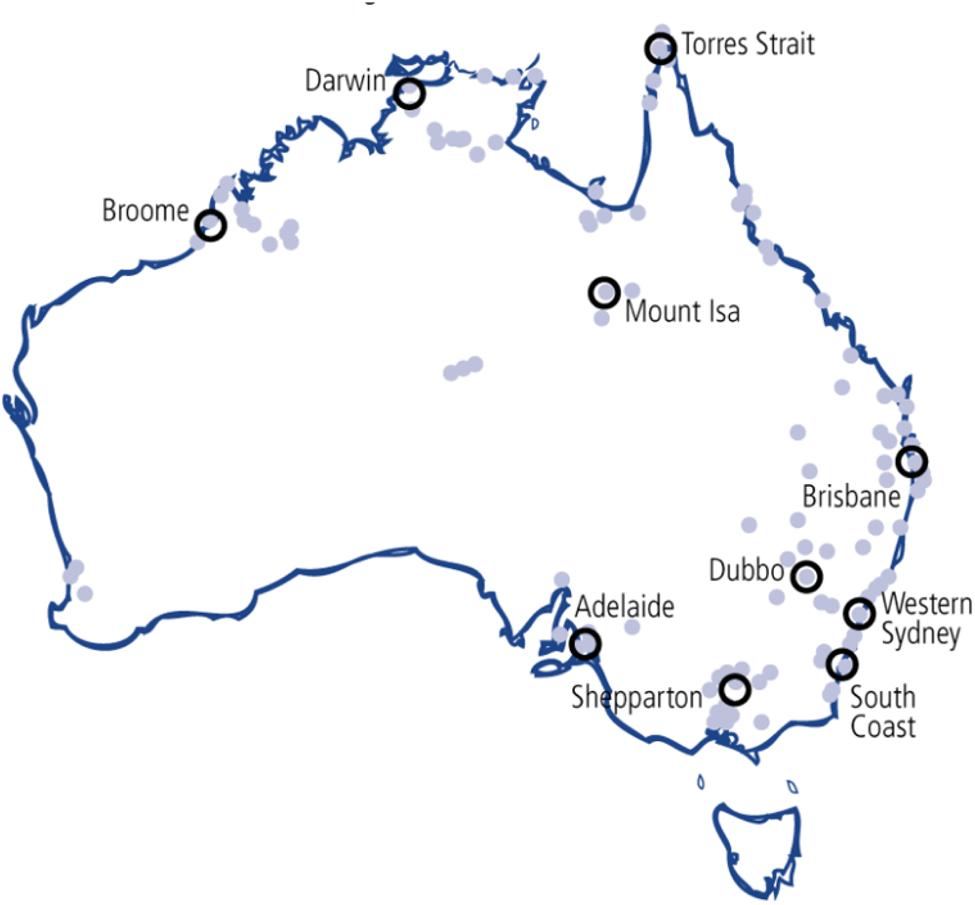
The sample for this study is taken from the LSIC. LSIC comprises participant families from 11 sites around Australia (see figure 1) (Department of Social Services, 2016, p. 1). LSIC is a study conducted by the Australian Federal Government's Department of Social Services with guidance from the Footprints in Time Steering Committee, primarily made up of Indigenous researchers. The study comprises two cohorts, those aged 6–18 months (B cohort) and 3.5–5 years (K cohort) at the commencement of the study in 2008. The study is currently collecting data for Wave 11 and the most recently published dataset is Wave 9. For this study, the kid cohort (K cohort) Wave 7 data are utilised, participants are aged 9.5–11 years.
Footprints in time interviewing locations (Kneebone et al., Reference Kneebone, Christelow, Neuendorf and Skelton2012, p. 64).

The study collects data on a range of factors including, children's physical and mental health, social and cognitive development, family background, household composition, and education, cultural and attitudinal values, among a range of other factors. Interviews are primarily conducted by Aboriginal Research Officers from the communities in the study. These data are providing unequalled opportunities for current Indigenous and non-Indigenous researchers to contribute to improving outcomes for Aboriginal children and families (Department of Social Services, 2016, p. 1; Walter, Dodson, et al., Reference Walter, Dodson, Barnes, Walter, Martin and Bodkin-Andrews2017a, p. 21–22). Yet it is not a perfect dataset, population statistics are often imbued with meaning derived from the dominant social norms, values and racial hierarchies of colonising nation-states (Walter, Reference Walter, Kukutai and Taylor2016, p. 79).
Statistical procedures
Analysis is undertaken regarding the presence of an AEW in the Study Child's (SC's) school as of Wave 7K Cohort (aged 9.5–11) of the LSIC study. This involves descriptive and bivariate analysis of the variable: Does an Aboriginal Education Worker work at SC's school? There are five options that the Primary Care Giver (P1s) could choose from when answering this question. [1] All of the time, [2] some of the time, [3] rarely, [4] never and [-2] don't know. This variable was recoded into a dichotomous variable where [0] rarely/never/don't know and [1] all/some of the time where the options.
To operationalise the research question (What impact do AEWs have on Aboriginal and Torres Strait Islander culture within schools?), the variable (Does an Aboriginal Education Worker work at SC's school?) is measured against a range of cultural questions. These questions including Does school get involved with Indigenous communities, does school recognise days of cultural significance, does the school teach about Indigenous culture, and is there an Indigenous language programme at the school. These questions were originally coded in the same way as the dependant variable, and were also recoded in to a dichotomous variable [0] rarely/never/don't know and [1] always/sometime. These variables were also asked of primary caregiver (P1's). These were run at a bivariate level with the AEW variable using cross-tab analysis as well as point-biserial correlation analysis.
Results
Univariate descriptive analysis

Key finding

Question 1

χ 2 p ≤ 0.001, Pearson's point biserial correlation = 0.28.

χ 2 p ≤ 0.001, Pearson's point biserial correlation = 0.22.

χ 2 p ≤ 0.001, Pearson's point biserial correlation = 0.19.

χ 2 p ≤ 0.001, Pearson's point biserial correlation = 0.12.
Key finding

Discussion
The analysis produced important but unsurprising results. If an AEW is present within a child's school all or some of the time (n = 318), then 92.5% of these schools recognised days of cultural significance. For schools with AEWs rarely, never or don't know (n = 190), schools recognised days of cultural significance 72.1% of the time. About 71.7% of schools get involved with Indigenous community if an AEW is present all or some of the time, while 50% of schools do if an AEW is employed rarely, never or don't know. 67.3% of schools teach about Indigenous culture if there is an AEW all or some of the time, this is compared to 47.9% if present rarely, never or don't know. Schools have Indigenous language programmes 35.3% of the time if an AEW is present all or some of the time, while 18.9% do if an AEW is there rarely, never or don't know. This bivariate analysis shows that having an AEW present all or some of the time is associated with increased Aboriginal and Torres Strait Islander cultural practices within schools.
Having a strong Aboriginal cultural presence is important to decolonise the school environment. An inclusive space where Aboriginal and Torres Strait Islander children feel culturally safe is important for them to succeed (MacGill, 2008, p. 227–228; Gower et al., Reference Gower, Partington, Byrne, Galloway, Weissofner, Ferguson and Kirov2011, pp. 30, 32, 38; Martin, Reference Martin, Walter, Martin and Bodkin-Andrews2017, pp. 91, 93–95). From an Indigenous perspective, parents have identified family, culture, identity, heritage and land/country as being important for their children to grow up strong (Martin, Reference Martin, Walter, Martin and Bodkin-Andrews2017, p. 93–95). This holistic and decolonised approach identified by parents is more likely to occur if AEWs are present. Further, decolonising the school environment is important for Aboriginal parents, families and communities to feel included, welcome and comfortable to visit. Making schools more inviting for Aboriginal parents may increase Indigenous student attendance, however, the attendance debate is complex (Biddle, Reference Biddle2014, p. 7–8; Ladwig and Luke, Reference Ladwig and Luke2014, pp. 171, 173; Department of the Prime Minister and Cabinet, 2015, p. 1–3; Prout Quicke and Biddle, Reference Prout Quicke and Biddle2017, p. 57). Until the Western education system and Australian society has been decolonised enough that Aboriginal people feel culturally safe, an AEW is important for schools to employ.
Additionally, to decolonise the school environment and create culturally appropriate spaces, AEWs perform a number of additional roles. Two common duties of an AEW are to assist Aboriginal students with academic achievement and attendance (Price et al., Reference Price, Jackson-Barrett, Gower and Herrington2017, p. 6). Although, there are reports of anything Aboriginal being referred to AEWs including tasks outside their skillset and responsibility (Zubrick et al., Reference Zubrick, Silburn, De Mario, Shepared and Griffin2006, p. 146–147; Rose, Reference Rose and Price2012, p. 75–76; Price et al., Reference Price, Jackson-Barrett, Gower and Herrington2017, p. 9–10). Thinking critically about AEWs and their roles within schools is important to ensure they are correctly utilised. Expecting AEWs to fix Indigenous student attendance by themselves is unreasonable, absenteeism can be multifaceted (Biddle, Reference Biddle2014, p. 7–8; Ladwig and Luke, Reference Ladwig and Luke2014, pp. 171, 173; Department of the Prime Minister and Cabinet, 2015, p. 1–3; Prout Quicke and Biddle, Reference Prout Quicke and Biddle2017, p. 57). Overcoming these issues can benefit from a team approach, including AEWs, teachers, principals, social workers, Elders, Aboriginal Health Workers and other required professionals. If teachers, principals and schools do not clearly understand the role of an AEW, their skills can be used incorrectly. Education departments providing appropriate information to schools regarding how to best utilise AEWs is important.
A major study into other strengths of AEWs is need across different Aboriginal communities and states and territories to help Indigenous children grow up strong. The exact role and duties of AEWs varies between jurisdictions and may also vary between school types (Price et al., Reference Price, Jackson-Barrett, Gower and Herrington2017, p. 1). This means research from Tasmania (Andersen et al., Reference Andersen, O'Dowd and Gower2015) may not be appropriate for Western Australia (Zubrick et al., Reference Zubrick, Silburn, De Mario, Shepared and Griffin2006). This research could then help improve Aboriginal attendance (Purdie and Buckley, Reference Purdie and Buckley2010; Ladwig and Luke, Reference Ladwig and Luke2014; Department of the Prime Minister and Cabinet, 2015; Baxter and Meyers, Reference Baxter and Meyers2016), academic achievement (Green et al., Reference Green, Nelson, Martin and Marsh2006; Trudgett et al., Reference Trudgett, Page, Bodkin-Andrews, Franklin, Whittaker, Walter, Martin and Bodkin-Andrews2017, p. 236–237) and other areas.
Limitations
This study has some limitations which stem from the LSIC dataset. Limited analysis can be undertaken regarding the influence AEWs have on the lives of Indigenous children. It would be beneficial if there were more questions asked about AEWs, as there is a lack of quantitative research on their effect within Australian schools. Questions about the relationships AEWs have with students and the Aboriginal community would be beneficial to get a better understanding of the positive impacts they have. Questions regarding AEWs were only asked in Wave 7 of LSIC. This means the impacts AEWs have over the course of children's lives cannot be analysed longitudinally.
Another limitation of the LSIC study is generalisability to the broader Aboriginal and Torres Strait Islander population. There is no sample collected from Tasmania (Walter et al., Reference Walter, Dodson, Barnes, Walter, Martin and Bodkin-Andrews2017a, Reference Walter, Martin and Bodkin-Andrews2017b, p. 25). Although LSIC is not strictly a random sample, the study does reflect the wider Australian Indigenous population. This means the data and analysis are relevant and valuable for improving the lives of Aboriginal and Torres Strait Islander children, their families and communities.
Conclusion
This paper has analysed the impact that AEWs have regarding cultural competency within primary schools with Aboriginal and Torres Strait Islander children from the LSIC. Results show that cultural practices are significantly more likely to occur if an AEW is present at the school all or some of the time. This process of decolonising the school environment and creating a culturally safe space for Indigenous children is important to help them achieve success. Schools need to understand the role of an AEW and utilise their skills accordingly. A variety of issues regarding Indigenous children can be referred to AEWs despite being outside their role and skillset. While the decolonisation of schools and the presence of Aboriginal culture are important, more research is needed into AEWs across the states and territories to understand how they can be best utilised to assist Aboriginal children. The continued employment of AEWs is important to decolonise school environments, helping Indigenous children feel culturally safe and achieve success holistically.
Acknowledgements
We would like to thank Taimeka Mazur.
Financial support
This work is funded by the Australian Research Council through the ARC Discovery Indigenous Program: Project Number IN 160100024.
Conflict of interest
There are no financial interests or benefits that have arisen from the direct applications of this research.
Huw Peacock is a proud palawa (Tasmanian Aboriginal). He currently works for the Pro Vice-Chancellor of Aboriginal Research and Leadership at the University of Tasmania. He is involved in research projects regarding Aboriginal and Torres Strait Islander education and health. Huw is also undertaking a Higher Degree by Research looking into the factors influencing Aboriginal and Torres Strait Islander children's educational success.
Jacob Prehn is a proud Worimi (Australian Aboriginal). Jacob works for the Office of the Pro Vice-Chancellor Aboriginal Research and Leadership at the University of Tasmania. He is undertaking a Higher Degree by Research on wellbeing of Aboriginal men. Jacob is the deputy-chair of the National Aboriginal and Torres Strait Islander Health Worker Association (NATSHIWA). He is also a qualified Social Worker and Aboriginal Health Worker.