Introduction
The Antarctic continent covers an area of 14,062,500 km2, of which only 0.32% of its total area is free of ice. Vegetation grows on a constrained basis in coastal sectors free from ice and snow during the summer and in some rock outcrops located inland.
Despite its remote situation and extreme conditions, human presence has existed in Antarctica for more than 200 years associated with whaling activity (Tin et al. Reference Tin, Fleming, Huges, Ainley, Convey and Moreno2009) and for more than 70 years associated with science and tourism. Today, the human presence is represented by 112 research bases throughout the continent, which accommodate over 5000 people during the summer. In winter, 40 stations are in operation, which can accommodate 3916 people who require water, fossil fuel consumption and management of waste. Moreover, tourism has been continuously increasing; this caused the visitation of > 50,000 people during the 2017–2018 season, with obvious environmental implications.
King George Island, Antarctic Peninsula, Maritime Antarctic, stands out as a ‘hotspot’ receiving increasing pressure from human activities. Fildes Peninsula, with ~29 km2 surface area, has high biodiversity and is a major logistical centre for the northern Antarctic Peninsula; it supports the largest number of scientific bases (five permanent bases of Chile, China, Russia and Uruguay) and shelters and an airfield for aircraft arriving from the city of Punta Arenas, Chile.
There is no monitoring of air quality and certainly no inventory of sources of particulate matter that are responsible for the degradation of air quality in the Fildes Peninsula (Tin et al. Reference Tin, Fleming, Huges, Ainley, Convey and Moreno2009). Studies by Mishra et al. (Reference Mishra, Kim, Hong and Lee2004) on total atmospheric aerosols (total suspended particles (TSPs), suspended particles < 45–50 μm) from King Sejong base (Barton Peninsula) indicate that the presence of the elements Bi, Cd, Co, Cr, Cu, Ni, V and Zn is caused by anthropogenic activities associated with local sources. For Fildes Peninsula, information is available on fractionated aerosols < 3 μm. The elements Na, Mg, Sr, Mn, Fe, Cr, Co and Ca have a natural origin, while Pb, Ni, Zn, Cu and Cd, on the contrary, have an anthropogenic origin. The elements Pb, Cr, Sb, Cu and Mn are partially of extra-continental origin. Ca, Ba, Ni and partially Zn and Cu are generated by the human activities in the island (Carrasco & Préndez Reference Carrasco and Préndez1991, Préndez et al. Reference Préndez, Wachter, Vega, Flochini, Wakayabashi and Morales2009).
Mosses and lichens constitute the main biotic components of the terrestrial ecosystems in Antarctica. Exposed biological surfaces (e.g. lichens, mosses and leaves) accumulate atmospheric particles and are able to provide a record of location-specific and time-integrated information on local air quality (Bajpai et al. Reference Bajpai, Semwal and Singh2018). The relatively high humidity and mild temperatures found in the Maritime Antarctic, together with the absence of competition from higher plants, create the perfect place for stress-tolerant organisms such as lichens (Sancho & Pintado Reference Sancho and Pintado2011). Lichens are good bioaccumulators of chemical elements transported by air (Préndez et al. Reference Préndez, Peralta, Palma and Lancho2006, Sancho et al. Reference Sancho, Green and Pintado2007) and can be used as biomonitors of the atmospheric deposition of inorganic pollutants, even in Antarctica (Poblet et al. Reference Poblet, Andrade, Scagliola, Vodopivez, Curtosi, Pucci and Marcovecchio1997). Nutrients and/or material derived from the humid and dry atmospheric precipitation deposit can accumulate on or around the thallus. The incorporation of elements through the thallus surface depends on many factors, such as the nature of the element, the morphological characteristics of the surface and environmental parameters (Wolterbeek Reference Wolterbeek2002). When using lichens as bioindicators, it is necessary also to evaluate the contribution of the substrate in which they grow in order to determine only the atmospheric contribution to the nutrition and accumulation of contaminants in the thallus. Poblet et al. (Reference Poblet, Andrade, Scagliola, Vodopivez, Curtosi, Pucci and Marcovecchio1997) have shown that Usnea aurantiaco-atra (Jacq.) Bory (currently Neuropogon aurantiaco-ater) is a convenient organism for developing the biomonitoring of metals in atmospheric aerosols in the area of the South Shetland Islands.
The United States Forest Service (http://gis.nacse.org/lichenair/index.php?page=cleansite) provides an extensive database of air quality in relation to biomonitoring through lichens, with tables including threshold levels of chemical elements present in Oregon, Washington and in Alaska's national forests. To our knowledge, there is no similar database for Antarctica.
Atmospheric pollution, in particular urban particulate matter (PM), often contains levels of magnetic minerals, such as iron oxides like magnetite, hematite and maghemite (e.g. Matzka & Maher, Reference Matzka and Maher1999), which are easily measurable magnetically. This PM can accumulate on exposed biological surfaces and deliver accumulated information on local air quality. A group of trace metals, such as Zn, Cd, Pb, Ni, Cu and Cr, are often directly associated with magnetic PM due to their incorporation in the mineral structure during combustion processes (Cao et al. Reference Cao, Appel, Hu, Yin, Lin and Rösler2015). Therefore, the magnetic signal may not only act as a PM proxy, but also be of direct, often health-related, interest in itself.
Only a few magnetic measurements have been carried out on lichens, in situ or as transplants (see Hofman et al. Reference Hofman, Maher, Muxworthy, Wuyts, Castanheiro and Samson2017 for a review). These studies show that magnetic properties are good proxies for anthropogenic atmospheric pollution, although they are species dependent.
The aim of this study was to evaluate the use of the lichen U. aurantiaco-atra as a bioindicator of air quality in the Fildes Peninsula over a period of 13 years (1997–2010) using magnetic and elemental techniques.
Sampling
Substrates and lichens
Five-gram samples of U. aurantiaco-atra were carefully collected in some summer/autumn seasons between 1997 and 2010. Samples were taken from 1 × 1 m2 demarcated and protected sites (Table I), then air-dried in Antarctica, stored in clean paper bags, transported to the laboratory for analyses and kept isolated from external influences. Lichen thalli, when dried, do not decompose. In the laboratory, duplicates of all lichen samples were sorted, using only the thinnest thalli, and dead and senescent tissue, superficial dust, soil particles and small stones were manually removed using a Teflon clamp. Samples were dried at 90°C for 24 h, mashed in an agate mortar and stored in sterile Petri dishes to provide samples for the different analyses.
Coordinates of the sampling sites of the lichen Usnea aurantiaco-atra (Jacq.) Bory and the corresponding substrate.

In parallel, two or three samples of the substrate (the first 5 cm of the substrate) were taken together with the lichens. Composite substrate samples were assembled and were air dried in Antarctica, packed in paper bags and further stored in plastic containers at -18°C.
We lack samples of substrate or lichens for some years and/or sites not because the samples were not taken but because they were used in other analyses over the years and there was no more material left.
Sampling sites
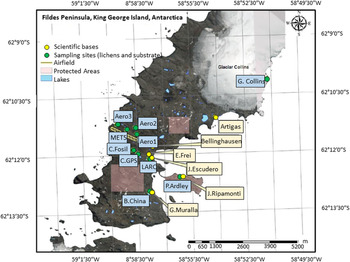
King George Island is located between 61°50' and 62°15'S and between 57°30' and 59°01'W; it is a part of the South Shetlands Islands and is located near the northern part of the Antarctic Peninsula (Fig. 1). Collins Glacier covers practically the entire island. The rest of the surface, mostly along the coast, is composed of volcanic rocks (basalts and/or andesites) that form cliffs ~100 m high. The substrate is composed of material with coarse granulometry.
Sample sites in Fildes Peninsula, King George Island, of the lichen Usnea aurantiaco-atra (Jacq.) Bory.

The sampling points are localized in sites close to potential human emission sources, such as the aerodrome and scientific bases, as well as in more isolated sites where there should be less human influence, such as the Ardley peninsula and Collins Glacier (Fig. 1).
The sites that are close to emission sources are: Site Aerodromo, located near the Aerodrome Teniente Rodolfo Marsh, which is used by many of the scientific bases on the island; Site LARC, located next to the Antarctic Laboratory of Cosmic Radiation, University of Chile, which is installed on top of a hill of ~40 m above sea level (a.s.l.), close to two Chilean bases; Site Base China, which is located ~100 m south-east of the Great Wall Chinese base station and was under construction/extension during the sampling period; and Site Aerodromo MET, located in the vicinity of the east side of the Aerodrome T.R. Marsh.
The sites chosen far away from possible anthropogenic emissions are: Site Ardley, located on a small peninsula located south-east of Fildes and connected by a sand dam, which is a nesting site for a wide variety of birds and one of the most important habitats of penguins, with a rich and extensive vegetation cover; and Site Collins, located at the foot of Collins Glacier in an ice-free area ~10–15 m from the sea.
Two more sites were chosen as intermediates: Sites Cerro Fosil and Cerro GPS, located on top of a small hill of ~25 m a.s.l., in the area west of the Aerodrome T.R. Marsh, separated from it by no more than 100 m.
Analytical techniques and methods
Magnetic techniques
Magnetic measurements were carried out with two objectives: to quantify the magnetic minerals through measurements of magnetic susceptibility and remanent magnetization (Mr) and to obtain magnetic parameters that might give information regarding the nature of the magnetic minerals and their magnetic grain size.
In order to perform magnetic measurements, each sample of lichen and substrate was crushed into a powder and tightly packed into a gelcap. A lichen gelcap contains 150–200 mg of material, while a substrate gelcap contains between 300 and 400 mg of material. Then, the gelcaps were used for measurement with two different pieces of equipment. Firstly, the magnetic susceptibility, which is the ability of a sample to be magnetized in a weak field, was measured using an AGICO Kappabridge KLY-3 at the Institut de Physique du Globe de Paris (IPGP). The same samples were then used for the measurement of hysteresis parameters and first-order reversal curve (FORC) diagrams with a vibrating sample magnetometer (VSM) from Lakeshore, which is part of the Mineral Magnetism Analysis Platform situated at IPGP-Institut de Minéralogie, de Physique des Matériaux et de Cosmochimie (IMPMC). More details on the measurement of these properties can be found in the Supplemental Information.
Scanning electron microscopy with X-ray energy-dispersive spectrometry
Scanning electron microscopy (SEM) with X-ray energy-dispersive spectrometry (EDS) allows visualization of the external morphology of the sample. In order to obtain the image of the analysed surface, the sample is swept with an electron beam in a raster pattern. In the case of SEM-EDS, the backscattered electrons are used to generate the image. An X-ray detector is coupled to this system in order to perform a qualitative and quantitative elemental analysis of the sample.
The analysis was carried out in the microscopy laboratory of the Escuela Nacional de Estudios Superiores (ENES) Morelia unit of the Universidad Nacional Autónoma de México (UNAM). Substrate and stem fragments from lichen samples were analysed using a JSM IT300 scanning electron microscope, JEOL brand with EDS X-Max detector with a 20 mm2 window. The substrate samples were metallized with a gold coating. The analysis was conducted under low vacuum conditions (50 Pa) for the lichen samples and high vacuum conditions (10-4 Pa) for the substrate samples. Elemental analysis using X-ray fluorescence (EDS) was performed on some individual particles.
Instrumental neutron activation analysis
Instrumental neutron activation analysis (INAA) is a multi-elemental and non-destructive technique that uses characteristic nuclear reactions. The neutron flux interacts with the sample, producing a nuclear reaction, mainly of the type (n, γ). The characteristic γ-rays emitted by each radionuclide are captured by a high-resolution detector.
The INAA technique has been used widely to study the elemental composition of samples from Antarctica (e.g. Mróz et al. Reference Mróz, Szufa, Frontasyeva, Tselmovich, Ostrovnaya and Kornaś2018), whether they are sediments, lichens or mosses.
In this work, we used the INAA technique to measure the concentrations of the elements Na, Sc, Cr, Fe, Co, As, La, Ce, Sm, Eu, Yb and Hf in the substrates of the sites LARC, Aerodromo and Ardley peninsula sampled at the same time as the lichens in the years 1997 and 2006. Experimental details can be found in the Supplemental Information.
Elemental quantification by inductive coupled plasma-optical emission spectrometry
We selected the elements to be quantified by inductive coupled plasma-optical emission spectrometry (ICP-OES) according to the following four criteria: 1) potentially toxic chemical elements, 2) probability of finding them in the study area in concentrations quantifiable by the technique used based on previous research, 3) bioaccumulative chemical elements, and 4) elements of known anthropogenic origin. Therefore, the quantified elements, both for lichens and for the substrates, were Ag, Al, As, B, Ba, Be, Cd, Co, Cr, Cu, Fe, Mn, Mo, Ni, Pb, Se, V and Zn. However, many of these elements were found to be below the detection limits of the technique. The experimental procedure is detailed in the Supplemental Information.
Results
Magnetic measurements
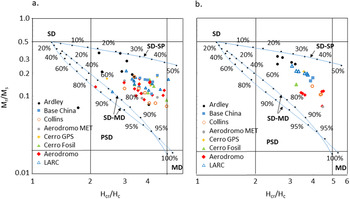
According to the Day diagrams (Day et al., Reference Day, Fuller and Schmidt1977), the hysteresis parameters for the lichen samples (1997–2010) all plot in the pseudo-single-domain (PSD) region, between the single-domain (SD)-multidomain (MD) (MD percentage > 60%) and the SD-superparamagnetic (SP) mixing lines (SP percentage > 30%) (Fig. 2a).
Day plots showing the hysteresis parameters with the mixing lines of Dunlop (Reference Dunlop2002) for a. lichen Usnea aurantiaco-atra (Jacq.) Bory samples and b. substrate samples. Hc; coercivity field; Hcr = coercivity of remanence; MD = multidomain; Mr = remanent magnetization; Ms = saturation magnetization; PSD = pseudo-single-domain; SD = single-domain; SP = superparamagnetic.

More than three-quarters of the Mr/saturation magnetization (Ms) ratios are between 0.1 and 0.2, and 85% of the ratios of coercivity of remanence (Hcr) to coercivity field (Hc) are between 3.0 and 5.0. Most of the points that are not in this region are from the Ardley site, and they are characterized by a smaller magnetic grain size, with points closer to the SD-SP mixing line, with a higher SP percentage. This tends to show that magnetic particles present on all the sites, except Ardley, have a similar origin. By contrast, the hysteresis parameters from the substrate samples plot slightly closer to the SD-SP mixing line than the lichen samples, but they are still in the PSD region (Fig. 2b). Samples from Ardley demonstrate behaviour that is different from the rest of the samples, being identical to what we observed in the lichens, and they plot closer to the SP region.
These results are further confirmed by the strong correlation between magnetic susceptibility and Mr in the case of the lichen samples (Fig. 3a), where the determination coefficient R 2 = 0.889 (95% significance level), but for the substrate samples there is only weak correlation between magnetic susceptibility and Mr (R 2 = 0.378), demonstrating that the magnetic sources in these samples are diverse (Fig. 3b). The magnetic signal in the substrate is probably caused not only by the anthropogenic signal, but also takes into account geological sources.
Susceptibility vs remanent magnetization (Mr) for: a. lichen Usnea aurantiaco-atra (Jacq.) Bory samples and b. substrate samples.

The variation of Mr with time shows an increase in Mr values in 1997 (when there are available data) and another one in 2006–2007 (Fig. 4a). Susceptibility values show large variation, from almost zero to 2.5 × 10⁻⁶ m3/kg. The variation in magnetic susceptibility is similar, again with peaks in 1997 and 2006–2007 (Fig. 4b).
Variation in a. remanent magnetization (Mr) and b. magnetic susceptibility (MS) of lichen Usnea aurantiaco-atra (Jacq.) Bory samples with time (1997–2010).

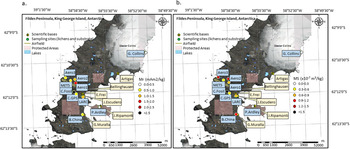
In order to study the spatial variation of magnetic parameters, we plotted the Mr values and the susceptibility values for lichen samples from 2010 on a cartographic representation of the sites (Fig. 5). That year corresponds to a sampling of all of the sites, and the results do not seem to be affected by the external causes that increased the magnetization and susceptibilities everywhere. The lowest values correspond to samples from the Collins ice sheet and Ardley peninsula, where there is little human activity. By contrast, the sites with the highest magnetic susceptibility are the sites close to the airport and the site of Cerro Fosil in particular.
Cartography of a. remanent magnetization (Mr) and b. magnetic susceptibility for lichen Usnea aurantiaco-atra (Jacq.) Bory samples sampled in 2010.

Unfortunately, the only sampling years for which we have substrate samples available for this study are 1997, 1998 and 2006, which are the years corresponding to the possible occurrences of external sources of magnetic input. It is therefore difficult to make any interpretations regarding the variations in magnetic parameters with time (Fig. SI-2).
FORC diagrams: comparison of lichen/substrate magnetic signals
Because they are calculated with a second derivative of magnetization, FORC diagrams are extremely sensitive to noise, and therefore can only be used for the magnetically strongest samples. We produced FORC diagrams for the strongest lichen samples (most of them from the 1997 sampling) and for corresponding lichen and substrate samples whenever available.
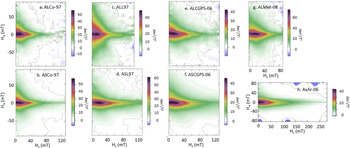
Figure 6 shows some of the FORC diagrams produced over three different sampling years. The images in Fig. 6a, c, e & g are FORC diagrams produced for lichens and the images in Fig. 6b, d, f & h show FORC diagrams produced for the substrate samples. The first three pairs were produced for corresponding lichen and substrate samples. Firstly, patterns characteristic of a SD-PSD magnetic grain size are visible on all FORC diagrams. The SD contribution is identified with the high coercivity tail and the PSD contribution is identified by the peak of the FORC distribution close to the origin of the diagram and the fact that most contours are not closed but instead intersect the vertical axis. The spread along the vertical axis is quite limited, except for sample ALL97 (Lichen-LARC 1997), which demonstrates that the magnetic interactions are moderate.
First-order reversal curve (FORC) diagrams. a., c., e. & g. Usnea aurantiaco-atra (Jacq.) Bory samples. b., d., f. & h. Substrate samples. Horizontal and vertical scales are the same for all samples except AsAr-06. Hc; coercivity field; Hu = interaction field.

Elemental concentrations in the substrates determined by INAA and ICP-OES
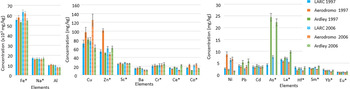
Figure 7 shows the elemental concentrations determined by INAA and ICP-OES of substrates from three of the sites sampled in the years 1997 and 2006.
Elemental concentrations determined by instrumental neutron activation analysis (Fe, Na, Zn, Sc, Cr, Ce, Co, As, La, Hf, Sm, Yb and Eu, labelled with asterisks) and inductive coupled plasma-optical emission spectrometry (Al, Cu, Ba, Ni, Pb and Cd) of substrates from three of the sites sampled in the years 1997 and 2006.

These results are somewhat surprising as the continental terrestrial crust normally presents higher concentrations of Al than Fe. The higher concentrations of Na than Al agree with the marine aerosol contribution on King George Island.
Sc, Yb and Eu are natural elements, which could explain the low variability of these elements at the different sites. In contrast, Cu, Zn, Co, Ni, Pb and As are anthropogenic elements, and therefore they show great variability depending on the sites and years.
Elemental concentrations determined by SEM-EDS
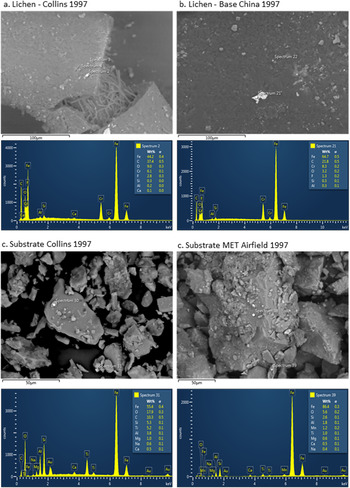
Figure 8 shows examples of SEM images and semi-quantitative EDS analysis corresponding to individual particles that contain heavy elements and therefore could carry a magnetic signal as well as heavy metals, both in lichens and the substrates. The SEM images of lichens (Fig. 8a & b) show the presence of particles of a wide range of sizes (from sub-micrometres to several tens of micrometres) dispersed in the sample. The EDS analyses in lichens all show the presence of natural elements such as Si, Al and Mg. Among the possible anthropogenic elements, Cr is present on two sites sampled in 1997 (Collins and Base China). Small amounts of K, P and V are also measured in various sites and sampling years. Calcium is also present in small amounts but widely throughout the different sites.
Examples of representative micrographs and energy-dispersive spectrometry semi-quantitative analysis for a. lichens sampled at the Collins site in 1997, b. lichens sampled at the Base China site in 1997, c. substrates sampled at the Collins site in 1997 and d. substrates sampled at the Aerodromo MET site in 1997.

Angular particles between 1 and 20 μm can be seen on the SEM images of substrate samples (year 1997) (Fig. 8c & d). The EDS measurements also show the presence of the same natural elements (Si, Al and Mg) that were identified in the lichen samples. Titanium is also present in the soil; the origin of this is probably natural. Other elements present in small amounts are Ca, V and K. These elements were also present in small amounts in the lichens.
Elemental concentrations in lichens determined by ICP-OES
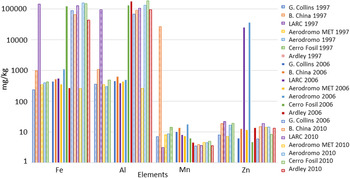
Figure 9 shows the elements Fe, Al, Mn and Zn that are present at significant concentrations (10–200,000 mg/kg), but at different concentrations in the different sites. The concentrations of Zn in the LARC site and the Aerodromo site in 2006 are particularly high. The Fe and Al concentrations are similar and have the highest values in 2010 and the lowest in 2006, while the Mn and Zn concentrations do not show such large variations.
Concentrations of major elements determined by inductive coupled plasma-optical emission spectrometry of Usnea aurantiaco-atra (Jacq.) Bory from the seven sites sampled in the years 1997, 2006 and 2010.

The Fe concentrations measured here are above the United States Department of Agriculture (USDA) recommended maximum limits for Usnea spp. (272 mg/kg) for all of the years and sites except Collins and Ardley in 1997 and Ardley 2006. Aluminium exceeds the recommended value (499 mg/kg) at LARC and Base China in 1997, Base China, Cerro Fosil and Ardley in 2006 and everywhere except Aerodromo MET in 2010.
Figure 10 shows the presence of 13 elements at concentrations between 0.01 to 5.00 mg/kg in lichens of different sites in 1997. The highest concentrations of Cu and Pb are measured at the sites closer to the airfield and bases (Cerro Fosil, Aerodromo, Base China), while the Ardley and Collins sites have much lower values.
Concentrations of 13 minor elements determined by inductive coupled plasma-optical emission spectrometry of Usnea aurantiaco-atra (Jacq.) Bory from the seven sites sampled in the year 1997.

The same information for the years 2006 and 2010 is presented in the Supplemental Information (Fig. SI-3 & SI-4). Overall, the concentrations of Cr, Cd and Pb have a tendency to decrease over the years, but the concentration of Cu at the airfield shows a strong increase in 2006. The lowest values are found at the Ardley and Collins sites, the two sites most isolated from human activities.
The V concentration is above the USDA recommended limit (1.5 mg/kg) at Base China, Aerodromo, Aerodromo MET and Cerro Fosil in 1997 and all sites except Ardley in 2006. Regarding Mo, the maximum recommended concentration is 0.40 mg/kg, and this value is exceeded at LARC, Aerodromo and Aerodromo MET in 1997, at LARC in 2006 and everywhere except Aerodromo and Ardley in 2010. The Be concentration is ≤ 0.06 mg/kg.
Discussion
Magnetic measurements
The average magnetic susceptibility in lichen samples for the year 2010 is 7.5 × 10⁻⁸ m3/kg, and the average Mr for that same year is ~1–10 mAm2/kg. These values are one to two orders of magnitude lower than the values measured for lichens from Argentinian cities by Chaparro et al. (Reference Chaparro, Lavornia, Chaparro and Sinito2013) and about the same order of magnitude as values measured for lichens sampled close to a cement factory in Slovakia (Paoli et al. Reference Paoli, Guttová, Sorbo, Grassi, Lackovičová and Basile2016). For the years 1997 and 2006–2007, when both susceptibilities and Mr values are the highest, the Mr values are comparable to the lowest values measured by Chaparro et al. (Reference Chaparro, Lavornia, Chaparro and Sinito2013) and Paoli et al. (Reference Paoli, Guttová, Sorbo, Grassi, Lackovičová and Basile2016), and the susceptibilities are comparable to the highest values. However, it should be kept in mind that the lichen species are all different in all of these studies, so direct comparison with these previous results is difficult.
The cartography of the magnetic parameters enables us to identify the sites that receive the most magnetic particles. Regardless of the sampling year, the highest values are measured for the sites that are close to the airstrip: either of the Aerodromo sites (the sites closest to the airstrip) or one of the two sites slightly farther from the airstrip (Cerro Fosil and Cerro GPS). These two farther sites are higher in altitude and therefore could be impacted by the emissions from planes during take-off and landing.
At the other end of the spectrum, the lichen samples from the Collins ice sheet and Ardley peninsula have very low magnetic signals. They are almost entirely non-impacted by direct human activities because they are far from all of the scientific bases. Furthermore, the hysteresis parameters for the samples from the Ardley peninsula are different from those of other samples: on the Day plot, they all plot closer to the SP mixing line and SD region. The peninsula hosts a penguin colony, and this difference in hysteresis parameters could be linked to an incipient formation process of soil by organic matter accumulation and associated phosphatization (Machado et al. Reference Machado, Reynaud Schaefer, Dias, Bello Simas, De Melo Benites and De Sá Mendonça2006). In fact, high levels of SP grains in soils are often due to magnetic enhancement by secondary magnetite/maghemite produced by paedogenic processes (Dearing et al. Reference Dearing, Bird, Dann and Benjamin1997).
The FORC diagrams measured in this study can be compared with those measured by Salo et al. (Reference Salo, Bućko, Vaahtovuo, Limo, Mäkinen and Pesonen2012) for lichens from urban and industrial sites. Despite the low resolution of their measurements, it is easy to see that their FORC diagrams are much more characteristic of MD magnetic grains than ours are. The FORC diagrams measured by Sagnotti & Winkler (Reference Sagnotti and Winkler2012) on tree leaves from Rome are also MD-like and therefore quite different from the diagrams we measured.
The only published palaeomagnetic study from the Antarctic Peninsula also includes FORC diagrams (Gao et al. Reference Gao, Zhao, Yang, Liu, Liu, Zhang and Pei2018). Measurements on basalt samples from three different formations show patterns that are MD-like, with no high-coercivity component and a large vertical spread. On the other hand, a FORC diagram produced for volcanoclastic rocks from Fildes Peninsula is SD-like. In any case, our FORC diagrams show patterns that are very different from those measured on rocks from the Antarctic Peninsula, which tends to indicate that the magnetic signal we have measured is not caused mostly by geological input.
Comparison of the magnetic results between corresponding lichen and substrate samples shows a few differences. The substrate samples from sites close to the airstrip still have higher values than the samples from the other sites, but unlike for lichen samples, substrate samples from LARC and Collins have high Mr and susceptibility values. The FORC diagrams for lichen and substrate samples also bear some differences. Even though they bear similar SD-PSD patterns, there are two significant differences: the SD tail is more prominent and longer and the spread along the vertical axis is more limited for the substrate than for the lichen samples. This shows that the magnetic particles deposited on the substrate are different from those on the lichen. It is probable that the magnetic signal in the substrate samples contains a geological part as well as an anthropogenic part. Another explanation could also be that coarser-grained particles of anthropogenic origin are more efficiently fixed on the lichens than in the substrates. It also seems that magnetic particles are more dispersed in substrates than in lichens, perhaps because they become more strongly fixed when deposited on lichens than on substrates. These observations are further confirmed by the fact that there is no correlation between Mr or magnetic susceptibility for sister substrate/lichen samples (Fig. 11). This shows that the signal from the lichen U. aurantiaco-atra is likely to be more representative of the anthropogenic contribution than the signal from the substrate.
a. Remanent magnetization (Mr) of substrate samples vs Mr of the corresponding Usnea aurantiaco-atra (Jacq.) Bory samples (taken at the same location on the same year). b. Magnetic susceptibility of substrate samples vs magnetic susceptibility of the corresponding lichen samples.

Comparison of magnetic and elemental concentration measurements
The concentrations of Fe determined by INAA in the substrate samples of 1997 from the Aerodromo, LARC and Ardley sites are consistent with the Ms measurements: for both datasets, the highest values are observed for the Aerodromo site, then an intermediate value is observed for LARC and a lower value is observed for Ardley. Similarly, the increase in the Fe concentration from 1997 to 2006 also corresponds to an increase in Ms. However, when looking at the concentrations of the other elements, only the Ni concentrations for the year 1997 show similar variations of concentrations among sites.
In the lichen samples, the concentrations of the various elements measured by ICP-OES can be compared with the magnetic proxies (Ms and magnetic susceptibility). The element that shows the highest correlation with magnetic parameters is Ni (R 2 = 0.832 for Mr and 0.6173 for magnetic susceptibility).
Some elements show a weak correlation: Cr (R 2 = 0.334 for Mr and 0.349 for magnetic susceptibility), Co (R 2 = 0.420 for Mr and 0.243 for magnetic susceptibility), V (R 2 = 0.342 for Mr and 0.154 for magnetic susceptibility) and Ag (R 2 = 0.088 for Mr and 0.254 for magnetic susceptibility). The correlation for Cu is even weaker (R 2 = 0.069 for Mr and 0.136 for magnetic susceptibility). Ni and Cr are elements for which an association with magnetic parameters has been described (e.g. Cao et al. Reference Cao, Appel, Hu, Yin, Lin and Rösler2015, Salo et al. Reference Salo, Paturi and Mäkinen2016); however, it is somewhat surprising that no stronger correlation is observed for the other elements, such as Cu, Pb, Cd, Ba and Mo.
Possible sources of the various elements
Possible explanations for the presence of the various elements in sometimes fairly high concentrations, both in the lichens and the substrates, are presented in Table II.
Possible origins of the elements detected in the lichen Usnea aurantiaco-atra (Jacq.) Bory and the corresponding substrate samples.

a The Earth's crust and rocks contain ~100 mg/kg of Cr. Soils contain normally on average ~40 ppm of Cr, sometimes up to some hundreds of milligrams per kilogram (Merian Reference Merian1984). In this work, we find ~20 mg/kg of Cr in the substrate. Some plants can take up higher Cr amounts, such as lichens, mosses, ferns, grasses and others. We find lower concentrations of Cr in the lichens. On the other hand, practically all Cr compounds used by humans originate from chromite, of which the largest sources are located in South Africa, Zimbabwe and Russia.
Conclusion
We carried out for the first time magnetic and elemental analyses on the lichen U. aurantiaco-atra and its substrates from various sites on the Antarctic Peninsula with various levels of influence from human activities. The main results are the following:
• Several anthropogenic elements have been identified on sites close to human activities: Ni, Pb, Mo, Cd and Zn are the most prevalent. Some of the elements were found at sites that should have very little human influence, which shows that elements coming from other continents can travel long distances and contribute to pollution in Antarctica.
• Magnetic proxies from lichens show a spatial correlation with human influence (scientific bases or airstrips). The temporal variation shows that, on average, magnetic parameters started with high values in 1997, then decreased with time until 2007, but increased again in 2006–2007. The most recent measurements nonetheless indicated a general decreasing trend.
• It seems that the magnetic signal from the lichens is likely to be more representative of the anthropogenic contribution than that from the substrates.
• We observed a correlation between magnetic parameters and Ni and to a lesser extent with Cr, Co, V and Ag.
• All of these results suggest that by using magnetic and elemental techniques it is possible to implement monitoring with the lichen U. aurantiaco-atra as a bioindicator for anthropogenic pollution.
Acknowledgements
The authors thank the editor and two anonymous reviewers for their constructive comments.
Financial support
The authors acknowledge the projects URedes Consolidación-URC-026/17, VID, Universidad de Chile, Conicyt-Inach 0897, 04/03 and T-02/07 for financial support.
Author contributions
MP performed the fieldwork and supervised the entire work. RF, CE, NG and CC performed the different analyses of the samples. CC, MP, BA and NG interpreted the obtained results. CC and MP prepared the manuscript and created the figures with input from BA and NG.
Details of data deposit
The article will be deposited with free access in the libraries of the Universidad de Chile, the Sorbonne Université and the Universidad Nacional Autónoma de México.
Supplemental material
Supplemental experimental details and a supplemental figure will be found at https://doi.org/10.1017/S0954102021000419.