In 1820, the Church Missionary Society (CMS), the evangelical missionary society of the Church of England, entered North America, intent on disseminating Christianity throughout present-day northern and western Canada. By the end of the century, the organization had spread throughout the north-west, establishing missions and winning converts. However, the propagation of Christianity was not the only goal and preaching the word was not the only way in which the CMS achieved its mandate, which also included support of, and participation in, the expansion of the British empire, particularly through the promotion of British cultural and social norms. Although forwarding this agenda in a variety of ways, including the transmission of religious beliefs and encouragement of British moral and domestic ideals, this article shows how the CMS used the built environment, the buildings and stations it erected throughout the Canadian north, as a central and integral aspect of its strategy. These structures were employed both practically and symbolically to convert indigenous people to Christianity and to assist in bestowing upon them one of the perceived great benefits of a benevolent and providential empire: civilization. Through both their usage and their visual appearance, the buildings erected by the CMS in northern Canada played a clear and acknowledged role in the organization's mission to convert and civilize non-Christian people and their landscape as part of the wider expansion of British culture, with the CMS acting as a de facto agent of empire through its building programme.
The CMS, its mission and its building programme cannot be understood outside the geographical context, which both affected its approach to evangelism and placed limitations on what missionaries were able to achieve, particularly with regard to building. In the nineteenth century, the Arctic, as both place and idea, was well ingrained in the British imagination and deeply romanticized.Footnote 1 An ill-defined geographic area, including both the Arctic and sub-Arctic, the north was a region characterized by its inhospitable environment and sheer vastness, stretching from the Arctic Ocean across the present-day Canadian territories and along Hudson's Bay.Footnote 2 With the exception of indigenous people, whose importance as occupiers was generally disregarded, the land was also unsettled. Initially viewed as the potential route to riches in the Orient, by the nineteenth century it had become an area where British exploration increased scientific and geographic understanding.Footnote 3 Here, British naval explorers took on the most challenging forces of nature at the very edge of the earth. Their successes demonstrated the sheer power of the British world by showing it could claim territory in any conditions through exploratory prowess, with the Arctic territories becoming a source of pride in national and imperial discourse.
The narrative of British Arctic exploration and its reception is well established in contemporary scholarship.Footnote 4 However, what is less clearly explored are its overtly Christian overtones. Arctic exploration was not explicitly directed to the conversion of indigenous people, although some explorers, including John Franklin, approached the CMS to this effect.Footnote 5 Nonetheless, Arctic exploration was subsumed within the mission of a Christian empire, indeed, of one that was often seen as providentially expanded through God's will, and the imbedded Christian discourse in some of the expeditions is hard to ignore. For example, the integration of Christianity into Franklin's expeditions is very clear. Deeply religious, Franklin ensured that Christian texts were carried on both his overland expeditions and promoted prayer and worship throughout; his crew was portrayed as devout and pious in the British press.Footnote 6 Both Franklin and surgeon John Richardson emphasized the importance of personal and collective faith in overcoming the difficulties of the Arctic in the pursuit of British imperial expansion.Footnote 7
This Christian Arctic narrative fitted well with notions of a providentially expanded British empire where God saw fit to allow Britain to gain territory; possession of the Arctic, in particular, demonstrated Britain's exploratory prowess, spreading its sphere of influence under an explicitly Christian banner.Footnote 8 Explorers were presented as godly, pious men, exemplars of the notion of Christian manliness, expanding the bounds of empire through unimaginable suffering.Footnote 9 The idea that explorers survived and succeeded primarily through God's mercy further created an Arctic narrative intimately tied to a God-given empire. Even through disaster and failure, the Christian narrative continued, as the faithful hero faced a noble end in pursuit of a greater cause.
However, the CMS did not enter the Arctic through exploration. It was invited into the territory by the Hudson's Bay Company (HBC), the chartered company that controlled the North American fur trade until the late nineteenth century. From its inception at the end of the seventeenth century, the HBC held a monopoly over western North America and acted as the imperial agent there.Footnote 10 The company officially established a British presence in the region, but its rule was based on economic self-interest, not on larger imperial initiatives. The HBC was not interested in providential expansion, nor in the growing humanitarian concern for imperial populations during the early nineteenth century; it was often criticized for its lukewarm attachment to imperial ideals and poor treatment of indigenous people.Footnote 11 The HBC faced particularly harsh criticism for its role in Arctic exploration. The company had undertaken massive exploratory endeavours throughout northern Canada but made a great effort to keep its findings secret, afraid that its commercial interests could be compromised.Footnote 12 The HBC had also publicly refused to assist various Arctic expeditions in their missions, citing its lack of suitable resources.Footnote 13
There were also concerns over the HBC's humanitarian record; the Christian public saw the company as having a duty to spread the blessings and benefits of Christianity and British civilization to local indigenous people and it was perceived, correctly, as not doing so.Footnote 14 Concerned over the backlash aimed at the East India Company during the renewal of its charter in 1813, and pressured by a number of prominent evangelicals on its board, the HBC administration responded in 1820 by inviting the CMS to establish a mission at Red River.Footnote 15 Ostensibly, this was intended as a mission for indigenous people, but in reality the HBC wanted the CMS to serve the retired HBC employees and their families living there, as a token Christian presence.Footnote 16 At the same time, the HBC allowed Roman Catholic priests from Quebec at Red River under the same assumption; these priests were subsequently replaced by a French religious order, the Oblates of Mary Immaculate (OMI), in 1845.Footnote 17
Whatever the HBC's intention, the evangelism of indigenous people was the primary goal of both the CMS and the OMI.Footnote 18 Both had expanded beyond Red River by mid-century and continued to extend their operations, establishing missions throughout western and northern Canada. However, while all areas were seen as being worthy of evangelism, the north was the real prize and, by 1850, both organizations were poised to establish themselves in the Athabasca-Mackenzie and Yukon River watersheds and on the Hudson Bay coast.
The Arctic had been at the forefront of the missionary imagination since the early 1820s.Footnote 19 The successful evangelism of the north was consistently presented as the primary goal of both the CMS and the OMI. As a remote and inaccessible region, viewed by many as the very edge of empire, evangelism in that area was given clear mandate through Christ's commandment to spread the gospel to ‘the uttermost parts of the earth’ (Acts 1: 8 KJV). Designated ‘the Ultima Thule . . . of Missionary Enterprise’Footnote 20 by William Carpenter Bompas, then Anglican bishop of Athabasca, who had been a CMS missionary since 1865, success there represented, for missionaries, the great triumph of the Christian gospel in the furthest reaches of the globe.Footnote 21
Both organizations entered the Athabasca-Mackenzie watershed in the 1850s and from there began what has been characterized by historian John Webster Grant as ‘the race for the northern sea’.Footnote 22 Their initial period of expansion throughout the 1850s and 1860s resulted in the CMS and OMI competing for an audience amongst Canada's northern indigenous people.Footnote 23 It also resulted in the establishment and construction of mission stations as bases from which to work and to assert a presence in the region. Although these generally began as single structures from which all mission activities were performed, they gradually expanded to multi-building complexes containing houses, schools, churches and auxiliary buildings.Footnote 24
For the CMS, the expansion of its northern operations was closely linked to the expansion and consolidation of Britain's sphere of influence in the far north. Christianity was often regarded as the forerunner of empire and, although explorers had already claimed the region, missionaries could establish themselves permanently and extend the benefits of empire to its inhabitants through programmes of conversion and civilization, making local people Christian citizens.Footnote 25 Furthermore, the CMS had developed an often fraught relationship with colonial authorities elsewhere due to their perceived bias against Christianity and humanitarian concerns.Footnote 26 But in the far north, while the CMS was at odds with the HBC, the company was consistently viewed as a poor imperial agent which failed to extend imperial benefits to non-Europeans; as a result, the CMS took on that role itself.Footnote 27 Unlike its commercial counterpart, the CMS provided a tangible representation of British morality and ideology that coalesced with wider humanitarian concerns and supported the belief that the extension of Christianity was a vital aspect of the providential expansion of empire and a duty of its agents.Footnote 28
Conflict between the agendas of the CMS and imperial expansion often arose, due to concerns over settlement and its impact on indigenous people, but this was not the case in the Arctic, where it was clear that settlement of the region was not a priority. The 1858 Select Committee Report on the HBC's position in the territory firmly established that settlement was neither expected nor encouraged.Footnote 29 When unexpected settlement did arise, in the 1886 Fortymile gold rush and the following Klondike strike, the CMS turned to governmental authorities, in this case the Canadian government, as natural allies in its aim of consolidating British influence and values in the face of commercial activity, demonstrating a belief in close ties between the missions of the Church and the colonial authorities of the wider British world.Footnote 30
The imbedded Christian narrative of Arctic exploration also strengthened the CMS's commitment to its northern missions; David Anderson, the first bishop of Rupert's Land, was adamant as to the connections between the two endeavours and pushed for the CMS to enter the region, citing the need to bring the gospel to the edges of Britain's sphere of influence.Footnote 31 Anderson, while not a member of the CMS, shared the society's views on mission and its role in the expansion of empire. Members of the CMS, including secretary Henry Venn, also frequently discussed mission and exploration as interconnected aspects of the providential expansion of the British empire throughout the nineteenth century, including when they discussed the Arctic.Footnote 32 While God was seen as allowing Britain's sphere of influence to expand through the efforts of godly explorers, such as Franklin, it was the duty of missionaries to extend the benefits of Christianity to the inhabitants of newly opened territories. For missionaries, however, mission was the more important endeavour. For example, the Revd Arthur Lewis remarked: ‘Arctic exploration seeks always to claim Christian sympathy . . . . The very heart of the nation becomes stirred with the exploits of Franklin, McClintock or Nansen. But these things . . . leave out of sight the greatest of all human projects, the evangelization of the heathen.’Footnote 33
The CMS also saw itself as a representative of Britain in opposition to the French Catholic OMI, which was viewed as essentially foreign and exceedingly hostile, an opinion shared by some in the HBC.Footnote 34 The competition between these two organizations, although superficially denominational, ran deeper, reflecting the larger metanarrative of British and French hostility, where Catholic priests represented French republican values; the OMI's ultramontane outlook placed them under increased suspicion due to their allegiance to papal authority which they clearly felt overrode national considerations.Footnote 35 Practice showed that the OMI were not hostile to British interests, but their identity as a French Catholic organization placed them firmly in opposition to the CMS, which believed itself to be the defender of British Protestant values and interests in the Arctic.
Missionary expansion ultimately resulted in the growth of mission stations throughout the north. These provided both practical and symbolic spaces for the CMS, playing a vital role in the dissemination of Christianity and the consolidation of British influence over the region. Buildings, for the CMS, fulfilled multiple roles in the missions, replicating British forms in a foreign landscape and, by extension, the religious and cultural ideology of the wider imperial project. At their most basic, these spaces provided necessary infrastructure for doing mission work.Footnote 36 Most evidently, churches were constructed for worship space, introducing people to the liturgical and theological norms of the Church of England. However, mission stations also contained other vital structures, including schools for education and catechism, basic medical facilities, a house for the missionary and agricultural buildings for subsistence. The mission was also a permanent Christian centre where indigenous people could gather to meet the missionary and be instructed in the CMS's message.Footnote 37 In remote missions with little contact and support from the outside world, these spaces were vital in ensuring the missionary's success and even survival.
However, these structures also served other purposes. Beyond their practical uses, they served to mark space, to inculcate British values and to differentiate the CMS from the HBC and the OMI, all of which served to strengthen Britain's claim to the land and its inhabitants. Most obviously, these structures demonstrated the CMS's presence, serving as a ‘landmark of Christianity in a vast field of heathenism’.Footnote 38 The mission buildings, particularly churches, which were often stylistically distinctive and larger than many of the other buildings throughout northern Canada, were a clear indication that Christianity had arrived in the land, a function of architecture which missionaries consistently and explicitly recognized in a territory with limited permanent physical infrastructure. Bompas, for example, as bishop of Athabasca, was very clear that
. . . the house of God is the chief visible sign which we are still allowed to retain God's presence among us and I take it to be of great importance that the heathen should be reminded by this constant memorial before their eyes that the introduction of Christianity into their country is a reality and more than a mere tale.Footnote 39
Bompas regarded architecture as a very tangible representations of the Church's evangelistic mission and encouraged his clergy to erect new buildings to assist in the permanent establishment of the CMS in the north and to solidify its presence there. The emphasis Bompas placed on marking the landscape through building was consistently reiterated, particularly by his fellow bishop, Anderson, who drew clear connections between buildings and Christianity's recognized presence.Footnote 40
The presence of Christianity correlated directly to the presence of empire and, as a result, buildings were also able to demonstrate imperial influence in the region. Anderson was very explicit in this recognition. In 1857, he addressed a meeting of the CMS in London:
Ours is a country which has been opened so far that although we are not able to penetrate into the thousands and thousands of miles that are opened to our view, . . . it is well for us to guard the lines . . . . That line being strengthened, not with bulwarks of earth, but with church after church, so as to mark the British boundary from the Red River to Lake Winnipeg, stretching westwards as far as we are permitted to go.Footnote 41
For Anderson, architecture played a definitive role in the demarcation of British territory and, in North America, it was the Church whose architecture answered that need. It was particularly important when placed in contrast with the buildings of the HBC.
Since its inception at the end of the seventeenth century, the HBC had developed a wide network of posts beginning on the Hudson Bay coast and eventually extending into the interior.Footnote 42 These posts contained vital buildings for the fur trade, including housing for employees, storage areas and work spaces. For the CMS, these buildings also represented the commercial proto-empire of the HBC and its poor moral influence on the country. As a result, the CMS attempted to separate itself from the HBC through its use of space. Although many CMS buildings were stylistically very similar to those of the company, the use of the Gothic Revival style, particularly in church building, denoted a clear material separation. This style, which was used in Britain and throughout its empire to communicate the presence of Britishness and of Christianity, reinforced the separateness of the CMS from its commercial counterparts and set it as an alternative, more benign British representative, one which it believed more fully represented the empire's greater purpose.Footnote 43
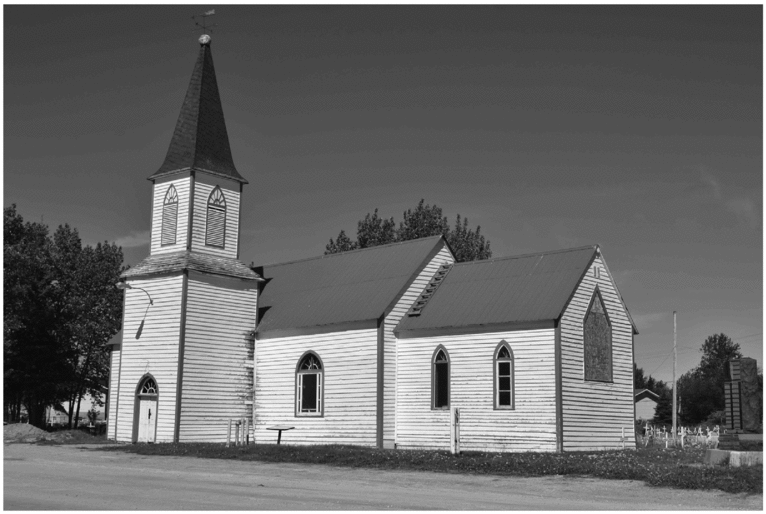
In particular, the style of church buildings was connected to the CMS's role as a missionary arm of the established Church.Footnote 44 In the northern mission field where the only missionary organizations were the English CMS and the French OMI, the Gothic style was seen by the CMS as reflecting the heritage of the Church of England and as enabling its liturgical traditions, allowing architecture to represent through style, historical association and ritual the established Church and its connection to the state. Part of the reason for this was that the Oblates often built in a Classical style which reflected church construction practice in French Canada; denominational differences in architectural style, therefore, were seen to reflect national differences, even though the Gothic style was pervasive across denominational boundaries and the CMS did not adhere to the style as dogmatically as, for example, its high Anglican counterparts elsewhere. It was also seen as particularly suited to worship because Gothic buildings were regarded as looking Christian and as reflecting the beliefs proclaimed within them. The CMS often expressed concern over the ability of northern architecture to fulfil the role of worship space in the local context, especially when faced with less than ideal circumstances for the erection of what it deemed to be English buildings. For example, when John Horden arrived at Moose Factory in 1851, there was already a church in place from an earlier, defunct Methodist mission; he was concerned that it did not allow for Anglican liturgy, nor did it reflect how a building of the established Church should look, noting that it was ‘not much like that of a place of worship associated with the Church of England’.Footnote 45 His concerns were both liturgical and national, reflecting a need to articulate the CMS's wider mission through architectural forms. The Wesleyan church was replaced with a new Gothic building, completed in 1864 (Fig. 1).
St. Thomas's Church, Moose Factory, 1856–64, completed 1884. Author's photograph.

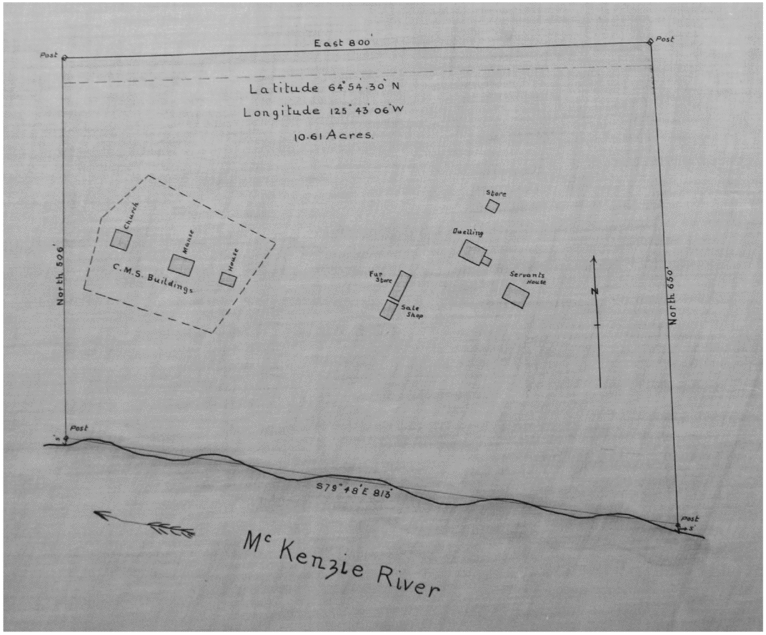
To reinforce the dichotomy between them, the CMS also desired to distance itself physically from the HBC. The vast majority of CMS missions were constructed adjacent to HBC posts, where indigenous people gathered to trade; this made them easy to access.Footnote 46 However, the ultimate goal of the CMS was for a complete separation, to disentangle itself from the perceived moral corruptness of the post.Footnote 47 It found quickly that this was not realistic, owing to the difficulties in supplying the missions and the CMS's need for assistance from HBC personnel. The Revd Robert Hunt remarked: ‘they [the HBC] could probably disable you simply by letting you alone’.Footnote 48 His assessment was accurate; the CMS was unable to dissociate its missions from HBC posts, with the exception of Metlakatla in British Columbia and, to a lesser extent, Stanley Mission at Lac la Ronge.Footnote 49 Instead, the CMS attempted to create a physical separation through grouping its buildings as a distinctive unit away from the main HBC complexes (Fig. 2). Although a minor separation, it reinforced the differences between the two agencies through physical distance and created clear Christian spaces, where indigenous people could gather free of the influence of the HBC.Footnote 50
Plan of Fort Norman, Mackenzie River, Northwest Territories, [1898]. Winnipeg, Hudson's Bay Company Archives, G.1/315.

Architecture also served to inculcate Christian values and, by extension, the perceived benefits of Christianity, to which many believed residents of British holdings had a right and that Britain's agents had a duty to extend. Mission stations, therefore, were areas where the theoretical benefits of the Christian world could be bestowed upon indigenous people. These included the direct benefit of Christian belief, taught through church and school. However, auxiliary to this were moral values and codes of behaviour and conduct known as ‘civilization’, which, in the words of Dandeson Coates (CMS secretary 1830–46), was ‘intended to mean the moral and social improvement of a people’.Footnote 51 In a practical sense, ‘civilization’ involved the introduction of a sedentary, agricultural lifestyle to a non-sedentary culture and the creation of settlements where God could be worshipped and work could be done.Footnote 52
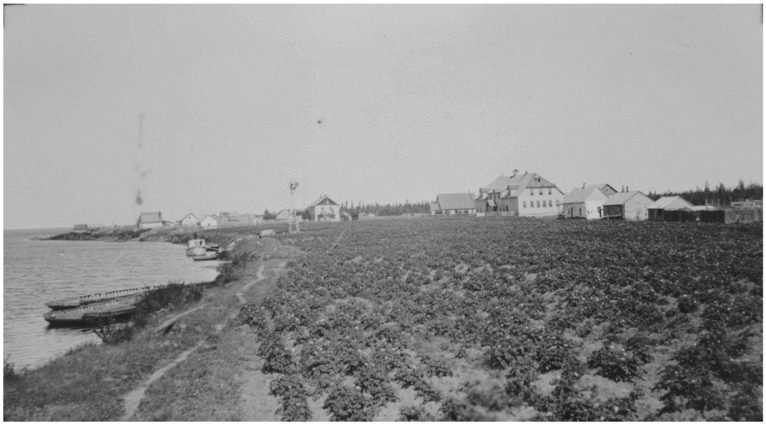
These ideas could be implemented through the creation of a sedentary Christian population engaged in farming, which was seen as a manifestation of the need to engage in toil in order to satisfy God and demonstrate commitment to Christianity, in opposition to traditional indigenous life.Footnote 53 Architecturally, this translated into the construction of permanent houses, schools, worship spaces and agricultural establishments. In the southern part of the CMS mission in North America, model mission farms were set up in order to demonstrate to indigenous people the benefits of agriculture and Christianity and to assist in the transformation of their lifestyle to an idealized pastoral one, consistent with the CMS's general belief that it should bring the temporal benefits of empire to indigenous people alongside the spiritual ones.Footnote 54 Large-scale agriculture was not realistic for some northern missions where climate made it unfeasible, but in areas such as Hay River (Fig. 3), where the soil and climate could support limited crop development, these strategies were enacted quickly in order to promote the adoption of what was presented as the Christian world and its way of life. Erected as the initial aspect of agricultural settlements, missionaries thus saw buildings as directly bringing the benefits of Christian empire to their indigenous flock. William Mason at York Factory wrote in 1857: ‘I trust when we get up our Church and School, the Station will be made a more extensive blessing to the heathen around us’,Footnote 55 a very explicit recognition of the perceived role of buildings in the extension of the providential empire and of its provision for its inhabitants, enacted through missionary agents.
Hay River, late nineteenth century. Toronto, Anglican Church of Canada General Synod Archives, P7559–73.

Buildings not only demonstrated how Christians could and should live, but were understood as a tool of communication, both in their replication of British architectural forms and through their function. Edmund Peck at Little Whale River saw his new church, erected in 1879, in much this way. He wrote: ‘You know how necessary it is to have a proper place wherein to worship God . . . . As the church will be visible to all, it will be a silent witness to God. The Eskimos will understand our desires for their welfare far better than if mere words were used.’Footnote 56
Here too, the desires of which he spoke were for the transmission of Christianity itself and for civilization: effectively the complete reordering of indigenous life such that ‘the Eskimos’ might reap the benefits of belonging to a benevolent empire. Buildings inherently redefined space, reordering architectural norms towards European ones as opposed to indigenous ones. By extension, these buildings attempted to replace the temporal and spiritual world of northern communities through the activities that took place in them and the cultural associations of the structures themselves.
The CMS did not believe that these values could be transmitted or bestowed through HBC buildings, largely because the company's infrastructure encouraged an economic and social system oriented towards a more traditional trapping lifestyle with aims incompatible with those of the CMS.Footnote 57 The CMS and its buildings, therefore, were the ‘civilized’ counterparts of the ‘uncivilized’ HBC, representing a progressive and positive Christian empire. HBC buildings would simply not suffice as the infrastructure of empire because they were not ‘civilized’. At Churchill, the Revd William West Kirkby explained that a church was:
. . . much needed for the Indians and Esquimaux used to have to meet in one of the houses or fur stores, and my four months experience of this showed me how very undesirable it was. Fancy a little church at this, the last place in the world, for there is not another civilized dwelling between this and the North Pole.Footnote 58
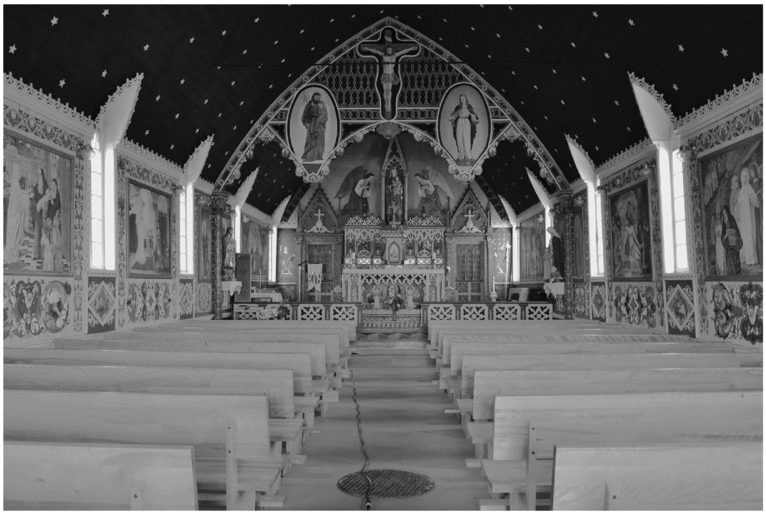
However, the CMS did not only aim to separate itself from the HBC, but also from the OMI, thus reinforcing the British religion over that of France. It is telling that Protestantism and Catholicism were referred to respectively as the English and French religions, and the two organizations saw themselves in conflict across national as well as religious lines.Footnote 59 By building structures, the CMS claimed the land for Protestant Britain; concerned about Catholic construction projects, the CMS often felt compelled to build missions and expand existing ones specifically to counteract the OMI.Footnote 60 It also aimed to reinforce difference through style and detail, in the belief that architecture could influence character as well as liturgical and theological identity.Footnote 61 While both used the Gothic style, particularly for churches, they employed it differently. Whilst usually employing Classical forms, the OMI often used elaborate Gothic-style decoration consistent with contemporary Catholic visual culture, notably in the Church of Our Lady of Good Hope (Fig. 4). The CMS saw the OMI as demonstrating the excesses of popery; in contrast, its structures used Gothic detail in a simpler and more subdued manner, which it saw as representing a strong and stoic Protestantism, consistent with British worship and character.Footnote 62
Church of Our Lady of Good Hope, Fort Good Hope, 1865–85. Author's photograph.

The CMS did not aim only to transform the north's indigenous people, but also its landscape. The north was seen in popular imagination as the ultimate wilderness, representing sin, danger and the unbridled forces of nature, reflected in the architecture of indigenous people.Footnote 63 In line with nineteenth-century assumptions that architecture was reflective of the people and society that built it, mission architecture represented the order of the wider British world, brought about through a positive administration, ‘civilized’ habits and Christianity, as opposed to ‘wild’ and ‘heathen’ indigenous buildings.Footnote 64 Therefore, the erection of buildings and, where possible, the ploughing of fields could transform a landscape from one that was controlled by, and belonged to, the indigenous world to one administered and ordered by the British one. The transformation of the landscape through infrastructure development demarcated the land as British-controlled territory through the changing of its natural state and the kinds of infrastructure it supported.
The erection of buildings to serve this purpose was also undertaken in Arctic exploratory missions. Such buildings can be traced back as early as Martin Frobisher, the English Arctic explorer whose erection of a stone cottage on Kodlurnarn Island in 1578 was praised as a glowing reproduction of Elizabethan life.Footnote 65 Nineteenth-century expeditions over-wintering in the Arctic regularly erected buildings on the ice in an attempt to recreate Victorian life, including one during Edward Belcher's 1853–4 expedition named ‘the Crystal Palace’ after the London landmark.Footnote 66 Explorers also expressed a desire to transform the landscape into something more closely related to those of Britain, or at least to find connections between them, such as in the direct comparison made by members of Franklin's 1819–22 Coppermine expedition between the Barren Lands north of Great Slave Lake and the English Lake District.Footnote 67 Despite their interest, however, exploratory missions did not have the permanence or the mandate to enact this transformation from the wild and indigenous world to the ordered and British one, but missionaries did, and they took control of the northern environment for God and empire through the erection of buildings and the ploughing of fields, which they believed would be both long-lasting and transformative.
Certainly this ideal was impossible to enact everywhere, especially in the High Arctic, where the landscape and environment effectively prevented large-scale building projects. Missionaries who worked there nevertheless looked to the ordered agricultural mission station as the ultimate goal, and constructed as much as was possible.Footnote 68 These actions were certainly impractical, but architecture was not simply about creating a space for mission work. In the Canadian north, it was embedded within a larger set of cultural values and the assumption that the erection of Christian structures could consolidate British imperial influence in the far north. Building on a constructed Christian narrative that painted the far north as a place where the heroic Christian, be he missionary or explorer, could claim the region for God and empire, mission stations could, in the words of Anderson, ‘mark the British boundary’ and lay claim to a land where settlers and larger administrative structures could not be transplanted. Blessed by a providential empire, it was the duty of Britain to bring the benefits of imperial rule to its citizens and, in the north, the CMS acted as its agent, using architecture to mark the land, to inculcate values and ideals and to transform the environment from a hostile, unknown territory into a firmly held British possession.