Introduction
One in five Americans will die in or shortly after being discharged from an intensive care unit (ICU) (Angus, Reference Angus2005), stressing the importance of providing quality end of life care for the critically ill. Although patients look to clinical care teams for physical healing, they also desire emotional and spiritual healing as well (Steinhauser et al., Reference Steinhauser, Christakis and Clipp2000). This has led both the Joint Commission and national palliative consensus groups to publish guidelines that emphasize the duty healthcare providers have to address the spiritual needs of patients and families at the end of life (Angus, Reference Angus2005; Sulmasy, Reference Sulmasy2009). Additionally, the American Thoracic Society and the Society of Critical Care Medicine include spiritual care as a key element of high quality ICU care (Clarke et al., Reference Clarke, Curtis and Luce2003; Lanken et al., Reference Lanken, Terry and Delisser2008). Addressing the spiritual needs of patients has been shown to have various effects on health outcomes. A study in cancer outpatients showed that patients with positive religious coping tend to have higher rates of ICU death and more aggressive care at the end of life, signifying that a patient's religion may play an important role in healthcare decision-making particularly at the end of life (Maciejewski et al., Reference Maciejewski, Phelps and Kacel2012; Phelps et al., Reference Phelps, Maciejewski and Nilsson2009). However, when spiritual needs are met by a member of the healthcare team, patients have higher levels of hospice utilization, lower rates of ICU death, and lower healthcare costs at the end of life (Balboni et al., Reference Balboni, Balboni and Paulk2011; Balboni et al., Reference Balboni, Paulk and Balboni2010). In addition to these objective measures, addressing the spiritual needs of patients has implications for patient satisfaction. When spiritual needs are not met by the healthcare team, patients tend to rate care more poorly (Astrow et al., Reference Astrow, Wexler and Texeira2007; Williams et al., Reference Williams, Meltzer and Arora2011).
Despite the importance of addressing spiritual needs, clinicians still fail to make this a regular part of patient care (Balboni et al., Reference Balboni, Vanderwerker and Block2007; Wall et al., Reference Wall, Engelberg and Gries2007). Physicians have reported that they often, in particular, feel unprepared to not only to elicit spiritual beliefs, but also to address spiritual needs that may be identified (Ford et al., Reference Ford, Downey and Engelberg2012; Sloan et al., Reference Sloan, Bagiella and Powell1999). A recent study from ICU family meetings showed that, although families often bring up religious or spiritual topics, physicians usually respond by changing the subject and focusing mainly on medical facts (Ernecoff et al., Reference Ernecoff, Curlin and Buddadhumaruk2015). Recently, we found that chaplains were called on behalf of ICU patients predominantly in the last 24–48 hours of life, suggesting that religious or spiritual issues are generally thought to be synonymous with end of life by many clinicians (Choi et al., Reference Choi, Curlin and Cox2015). Although there may be other explanations for clinicians' attitudes and beliefs about their roles in addressing spiritual needs, little research has been done to elucidate clinicians' perspectives on their role in addressing spiritual needs of patients and family members.
To further investigate the ways in which religious and spiritual needs of patients and families are addressed, we surveyed ICU clinicians (physicians, nurses, and advanced practice providers [APPs]) to understand their views on religion and spirituality in the ICU. We hypothesized that ICU clinicians would not see it as their clinical responsibility to inquire about religious or spiritual needs. We also aimed to explore how comfortable different providers felt addressing spiritual needs, hypothesizing that fellows would be the least comfortable, whereas nurses, the clinicians with the greatest amount of patient contact, would more regularly ask about religious and spiritual needs.
Methods
Design
We performed a cross-sectional survey study of ICU physicians, nurses, and APPs to understand their attitudes and beliefs about addressing the religious and spiritual needs of ICU patients and their family members. The survey included questions with Likert-scaled responses. Survey items were designed to explore clinicians' attitudes regarding their roles in assessing and addressing spiritual needs. Additional items captured clinician characteristics including primary ICU, clinical status, level of religiosity and spirituality, religious service attendance, and religious affiliation.
Surveys were distributed to physicians, nurses, and APPs in the five adult ICUs at Duke University Hospital between September 1, 2014, and December 31, 2014. The medical ICU (MICU), cardiac care unit (CCU), neuro ICU, surgical ICU (SICU), and the cardiothoracic ICU (CTICU) were included in the study. All clinicians whose primary work was in the ICU were eligible. Clinicians were individually approached by study personnel or surveys were distributed during ICU staff meetings. A total of 300 surveys were distributed and 219 were completed, with a response rate of 73%. The Duke Institutional Review Board (Pro00054818) approved all study procedures. All participants provided written informed consent.
Statistical analyses
Summary data are displayed as counts (frequency). For each survey item, responses were dichotomized by collapsing “strongly disagree” and “disagree” as well as “agree” and “strongly agree.” For 5-response items, “never,” “rarely,” and “sometimes” were grouped with the negative dichotomous response, whereas “often” and “always” were grouped with the positive dichotomous response. We tested for differences in responses by clinician group using Pearson chi-square testing. We also used logistic regression models to determine which clinician characteristics were associated with responses to various questions.
Results
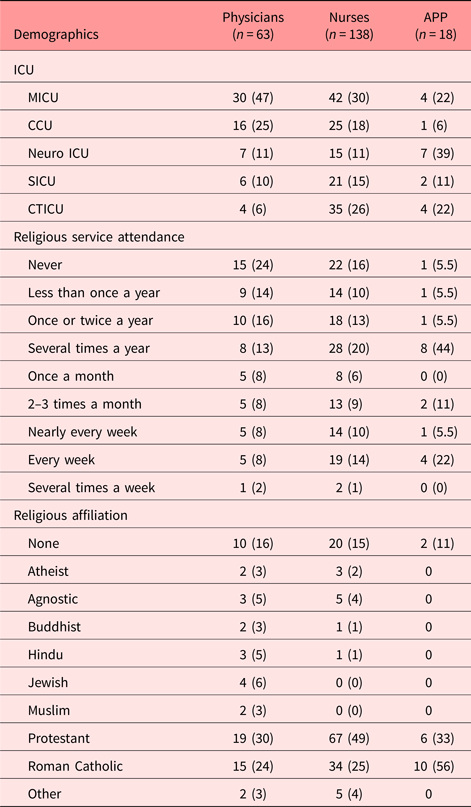
A total of 219 clinicians completed the survey (63 physicians, 138 nurses, and 18 APPs). The MICU was most represented (n = 76, 43%). Most clinicians were either Protestant or Roman Catholic (n = 93, 69%). A minority of clinicians (n = 84, 38%) attend religious services at least once a month (Table 1).
Demographics of survey participants

CCU, critical care unit; CTICU, cardiothoracic intensive care unit; ICU, intensive care unit; MICU, medical intensive care unit; SICU, surgical intensive care unit.
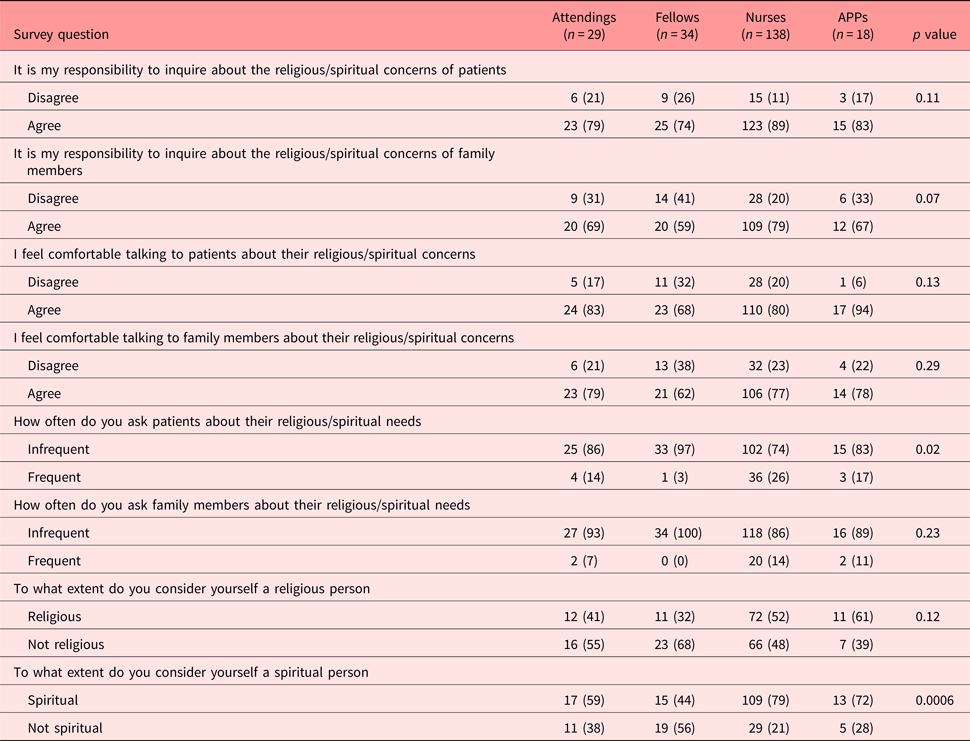
A majority of ICU clinicians generally agreed that it was their responsibility to inquire about the religious and spiritual needs of patients. Twenty-three attendings (79%), 25 fellows (74%), 123 nurses (89%), and 15 APPs (83%) agreed or strongly agreed with this statement. Nurses were more likely than physicians to agree with this statement (p = 0.02). Although the majority of respondents agreed that it was their responsibility to inquire about the religious or spiritual needs of family members, this response was more frequent among nurses (p = 0.02). Clinicians reported generally feeling comfortable talking to both patients and families about their religious or spiritual concerns, with no significant differences by group. Despite this sense of general comfort, few clinicians reported that such inquiry was part of their regular practice. In fact, only four attendings (14%), one fellow (3%), 36 nurses (26%), and 3 APPs (17%) reported say that they asked patients about their religious or spiritual concerns either often or always. The difference between physicians and nurses was statistically significant (p = 0.002). Clinicians less frequently ask family members about their religious or spiritual concerns (Table 2).
Responses to questions divided by clinical status, n (%)

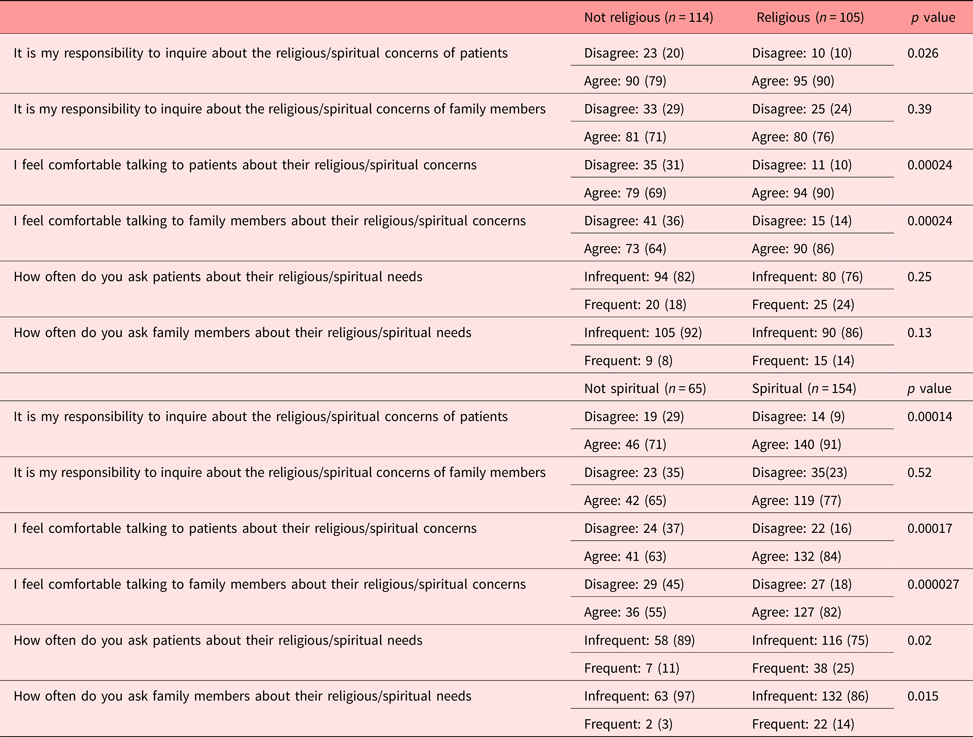
We found that both level of religiosity and spirituality correlated with how clinicians view their responsibility in addressing religious and spiritual concerns of patients. And these factors also affect how comfortable clinicians feel addressing these issues. However, only level of spirituality as opposed to religiosity correlates with how often clinicians ask patients and family members about their religious and spiritual concerns (Table 3).
Responses to questions based on level of religiosity and spirituality n(%)

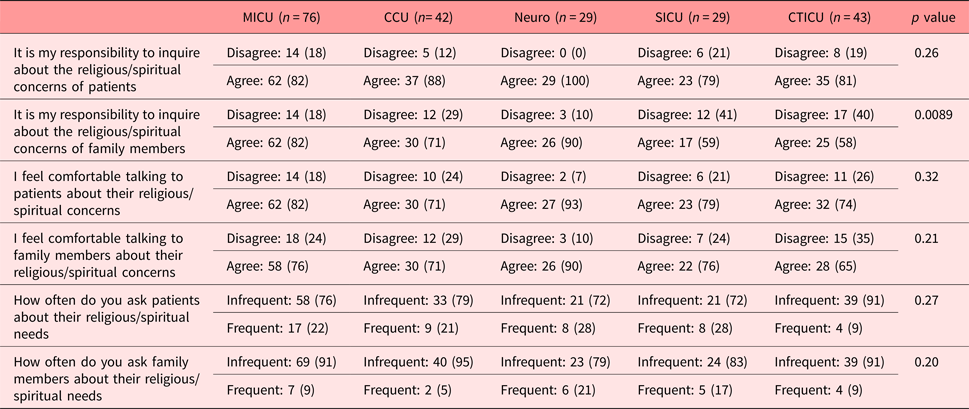
When looking at the various ICUs, we did not see any statistically significant differences in most of the responses across different ICUs. A total of 82% of MICU, 88% of CCU, 100% of neuro ICU, 79% of SICU, and 81% of CTICU clinicians believe that it is their responsibility to inquire about the religious and spiritual needs of patients. Interestingly, when asked about the responsibility to inquire about the religious and spiritual needs of family members, there was a statistically significance across ICUs (p = 0.0089). When grouping the more medical-based ICUs (MICU, CCU, neuro) versus the surgical ICUs (SICU, CTICU), this accounted for this difference, with 80% of the MICU clinicians versus 59% of the SICU clinicians agreeing that it was their responsibility to inquire about the religious and spiritual needs of family members (p = 0.00085) (Table 4).
Responses to questions based on ICU location, n(%)

CCU, critical care unit; CTICU, cardiothoracic intensive care unit; ICU, intensive care unit; MICU, medical intensive care unit; SICU, surgical intensive care unit.
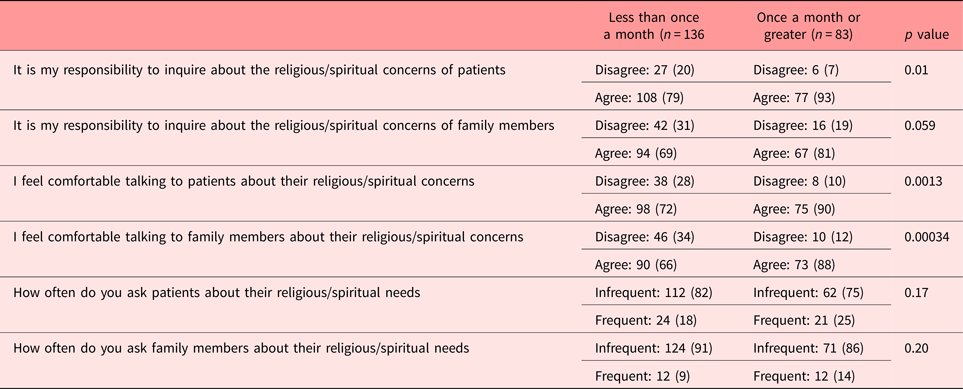
We looked at frequency of religious service attendance and responses to these questions. We found that more frequent religious service attendance (once a month or greater), was associated with clinicians viewing it as their responsibility and feeling comfortable about asking patients and families about their religious and spiritual concerns. However, despite this, they still infrequently ask about religious and spiritual needs. Eighteen percent of clinicians who attend religious service less than once a month and 25% of clinicians who attend religious service once a month or greater say they often or always inquire about the religious and spiritual needs of patients (p = 0.17) (Table 5).
Responses to questions based on frequency of religious service attendance

High clinician-reported personal spirituality was strongly associated with a belief that it was their responsibility to inquire about religious/spiritual concerns, (odds ratio = 4.13, CI 95% = 1.9, 8.89). In comparison to physicians and APPs, nurses were more likely to report that asking patients about their religious/spiritual concerns was a regular part of their practice (odds ratio = 3.34, CI 95% = 1.47, 7.60).
Discussion
This study of ICU clinician attitudes about spiritual care highlights novel findings in the context of critical care provision. Given the findings in our previous study that showed the infrequency of chaplain visits, we inferred that unmet religious and spiritual needs may not be routinely considered by ICU clinicians. Contrary to these data and our expectations, we found that ICU clinicians overwhelmingly believed that inquiring about the religious and spiritual concerns of patients is their responsibility. Further, they reported feeling comfortable talking about religious or spiritual topics with patients and families. Given that ICU clinicians see it as both their responsibility to inquire about religion and spirituality and feel comfortable broaching those subjects, one would believe that this would be a regular part of clinical practice. However, despite feeling comfortable with these topics, ICU clinicians do not regularly make this part of clinical practice.
We found that nurses reported more comfort and engagement addressing spiritual needs than physicians. However, only a minority of nurses said they frequently make it a regular part of clinical practice even though a templated question on preference for a chaplain visit is included in our medical center's new patient intake. This may mean that although efforts are taken within the healthcare system to try to ensure that ICU practices meet the best practice guidelines set by the Joint Commission, in the minds of clinicians, simply asking a routine question does not necessarily equate with truly inquiring about religious or spiritual concerns.
We observed a difference in responses by level of training among physicians, with fellows consistently reporting less comfort addressing spiritual needs. This finding is similar to past work that showed that more junior medical trainees find discussing religious and spiritual topics more complex than simply discussing do not resuscitate topics (Ford et al., Reference Ford, Downey and Engelberg2012). Despite efforts to include this type of training into medical school curricula, it seems that some of the comfort level may come from clinical experience as opposed to simply from classroom teaching. We did not gather information regarding years of clinical experience, but it could be hypothesized that more experienced physicians would feel more comfortable asking patients about their religious and spiritual needs. We also found that fellows are less likely to ask about patients’ religious and spiritual needs. Only one of 34 fellows surveyed (3%) reported that they often ask about religious or spiritual needs of patients and none reported asking similar needs among patients' family members. There may be several factors involved, including lack of training or the busy nature of clinical responsibilities; however, given that house staff are the physicians on the front lines of clinical service, it is important that these trainees become more comfortable with making this a part of regular clinical practice. As shown by Dzeng and colleagues, a house staff's approach to conversations such as do not resuscitate are often influenced by hospital culture and policy (Dzeng et al., Reference Dzeng, Colaianni and Roland2015). Therefore, identifying opportunities to change hospital culture and policy around spiritual care may ultimately affect how house staff engage with these issues.
Further exploring the reasons behind this apparent disconnect between ICU clinicians perceptions of their roles and their actual practices will be vital to develop a hospital culture in which the religious and spiritual needs of patients are being met. Our study shows that in these ICUs, addressing the religious and spiritual needs of patients and families is not necessarily limited by comfort level or perceived roles of the clinicians. One potential reason could be that with all the acute medical needs of patients in the ICU, religious and spiritual needs of patients simply take secondary priority to any acute biomedical needs of patients. Although clinicians believe it is their responsibility to inquire about religious and spiritual needs, it may be that they do not believe that these needs are as important as medical or even psychological needs.
Through this study, we found that many personal characteristics are associated clinicians’ views on addressing religion and spirituality and also on comfort level in addressing these issues. Higher levels of reported spirituality, religiosity, and more frequent religious service attendance were all associated with clinicians believing it was their responsibility to address religious and spiritual concerns of both patients and family members. However, only level of spirituality was associated with more frequently asking patients and families about their religious or spiritual concerns. Although spirituality may mean something different to different clinicians, this may point toward the ways that connecting to something deeper than ourselves may help us more deeply connect to some patients. It may also potentially signify ways that clinicians may want to separate their own personal organized religious beliefs from patient care.
Our findings help to define a research agenda that could improve the frequency of unmet spiritual needs of ICU patients and their family members. First, further inquiry is required to explain the apparent disconnect between perceived responsibilities and actual practice and therefore inform a targeted solution. At the very least, an intervention that extends the single spirituality question asked during nursing intake may be necessary to create the space for these issues to be addressed. This may require formal, short spiritual assessments to be used on rounds, or possibly more interdisciplinary work with chaplains.
Second, more work is required to prepare house staff to more confidently and effectively engage in religious and spiritual discussions. Although we focused on fellow level physicians in our study, even those at the resident level in past work have reported that spirituality has already been “trained out” of them (Swinton et al., Reference Swinton, Giacomini and Toledo2016). That said, Ernecoff and colleagues (Reference Ernecoff, Curlin and Buddadhumaruk2015) have shown that clinicians at all levels have difficulty addressing the religious and spiritual needs of patients and families, even when they are explicitly brought up by family members. Tools such as 3 Wishes (Cook et al., Reference Cook, Swinton and Toledo2015) or Clinical Pastoral Education for Healthcare Providers (Zollfrank et al., Reference Zollfrank, Trevino and Cadge2015) are potential resources that clinicians may use to help elicit religious or spiritual concerns of family members.
There are several limitations to this study. First, there are limitations to Likert-scale surveys. We can attempt to make inferences based on the answers provided, but they do not explain any reasoning behind the answers. Understanding the deeper meaning behind each answer would require more in-depth interviews and qualitative work. Second, this study was done at only one large academic center in the southeastern United States. Both staff and patients are likely to be more religious than in other parts of the country. Additionally, clinical practice at smaller community hospitals may differ. Third, in this study, clinicians are reporting what they think they do, instead of what they actually do in practice. However, we might expect that despite the confidential nature of the study, clinicians may be more inclined to overestimate how frequently they address religion and spirituality. Fourth, although we had a response rate of 73%, this was only of the total surveys that were distributed. There are more than 300 clinicians working in these ICUs. However, because many of the clinicians are part of float pools and may only work occasional shifts, it was difficult to determine a true total number of clinicians. Although we distributed 300 surveys expecting that this would provide an adequate representation, there is still the possibility of sampling bias.
In summary, addressing religious and spiritual needs is important to both patients and families, particularly at the end of life, although we found evidence that suggests there is discordance between clinicians' beliefs and their actual practice. This study highlights continued gaps in the provision of regular spiritual care for ICU patients. Further work should be aimed at bridging the gap between clinicians’ self-perceived role and actual clinical practices so that high-quality spiritual care can be provided to all ICU patients.
Conflicts of interest
None.