Introduction
Archaeobotanical studies in the Andes have produced significant advances in our understanding of pre-Hispanic human subsistence, including on topics such as forager plant consumption, the transition in early food production, the spread of agriculture, and post-harvest processing activities (e.g. Babot Reference Babot2011; Planella et al. Reference Planella, Scherson and McRostie2011; Capparelli & Prates Reference Capparelli and Prates2015). In particular, the domestication and consumption of maize (Zea mays) have played a dominant role in archaeobotanical discussion, especially in relation to the questions such as whether maize spread alongside new populations or was adopted by pre-existing hunter-gatherers, and whether maize was locally produced or imported (e.g. Gil et al. Reference Gil, Tykot, Neme and Shelnut2006; Babot et al. Reference Babot, Hocsman, Piccón Figueroa and Haros2012; Oliszewsky Reference Oliszewsky2012; Lantos et al. Reference Lantos, Spangenber, Givannetti, Ratto and Maier2015). In this context, the spread of agriculture has formed a central focus of several recent investigations in the Central Mountains of Argentina (e.g. Pastor & López Reference Pastor and López2011; López & Recalde Reference López and Recalde2016). This small-scale process took place no later than 1100 years BP (Medina et al. Reference Medina, Pastor and Recalde2016); evidence for sustained intensification in domestic resource production appears in the archaeological record towards the end of the pre-Hispanic period (c. 300 years BP). Such domestic resources would have complemented the diet of hunter-gatherers. Pastor and López (Reference Pastor and López2011) propose that the gradual adoption of agricultural innovations, such as crop production, was an intentional strategy to conserve and continue the hunter-gatherer way of life.
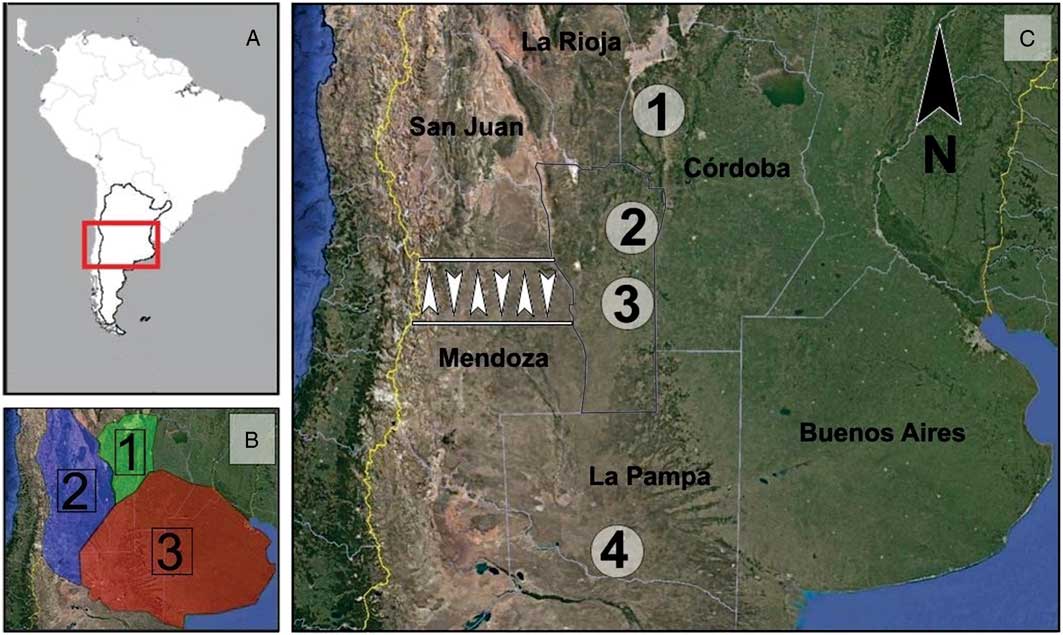
Here, we present new archaeobotanical evidence for the presence of maize in the form of phytoliths and starch grains from 19 archaeological hunter-gatherer sites located in the San Luis and Córdoba provinces of Argentina. Importantly, however, only two of these sites, El Durazno and La Alborada, have yielded evidence of maize cobs in the form of microscopic remains (Figure 1: C3; Heider & López Reference Heider and López2016). Our results therefore provide important evidence for reassessment of the adoption of maize as part of subsistence strategies and the spread of small-scale farming across Central Argentina, a region in which macro-botanical remains are poorly preserved (López Reference López2015). These data are particularly significant to South American archaeological discourse, in which the consumption of maize and its spread are major topics of debate. The north of Mendoza and the centre of Córdoba (Figure 1) are currently understood as the ecological and cultural limits for the pre-Hispanic production of maize. We provide new evidence for the presence of maize in a region with no previous record of cereals (see Pastor & Gil Reference Pastor and Gil2014). These important data could be incorporated in future discussions about the limits for maize production.
A) Central Argentina. B) Regions of major archaeological interest in central Argentina: 1) Central Mountains; 2) Central-west; 3) Pampas region. C) Currently proposed limit for agricultural development in the Mendoza province (white arrows); 1) archaeological sites with evidence of maize in the province of Córdoba; 2) sector of the province of San Luis investigated by Gambier (Reference Gambier1998); 3) location of the sites El Durazno and La Alborada; 4) location of sites with evidence of maize in the south of the Central Pampa. The continuous black line highlights the province of San Luis. Figure created by the authors using Google Earth.

San Luis province in the macro-regional context
The Central Mountains, the Central-West and the Central Pampas are three areas of major archaeological interest in Argentina (see Figure 1: B1–3). Research in the Central Pampas has varied in terms of the quantity of work carried out, research objectives and theoretical frameworks and methodologies used (Politis & Madrid Reference Politis and Madrid2001). Most archaeological studies in the Pampas have been carried out in the southern area (La Pampa province) (e.g. Berón Reference Berón2013; Musaubach Reference Musaubach2014), while research in the North Pampas (San Luis province) is still in its infancy (Heider Reference Heider2015). Given its intermediate location between these areas, San Luis province presents both environmental and cultural variability, as well as an archaeological record influenced by different border areas (Heider Reference Heider2016).
The palaeoclimate of San Luis province is well studied. This area occupies part of the South American Arid Diagonal and is subject to two distinct climatic influences: the Pampean and Patagonic (Piovano et al. Reference Piovano, Ariztegui, Córdoba, Cioccale and Sylvestre2009). Palaeoenvironmental reconstruction of Laguna Nassau (2km east of El Durazno) covering the last millennium (Vilanova et al. Reference Vilanova, Karsten, Geilenkirchen, Schäbitz and Schulz2015) and local pollen and sediment data from the last 12 600 years BP (Rojo et al. Reference Rojo, Paez, Chiesa, Strasser and Shäbitz2012) suggest a progressive lowering of the lake level, culminating around 3600 years BP, when it reached its current state. The modern plant communities of the study area would have been established by approximately 3500 years BP (Rojo et al. Reference Rojo, Paez, Chiesa, Strasser and Shäbitz2012).
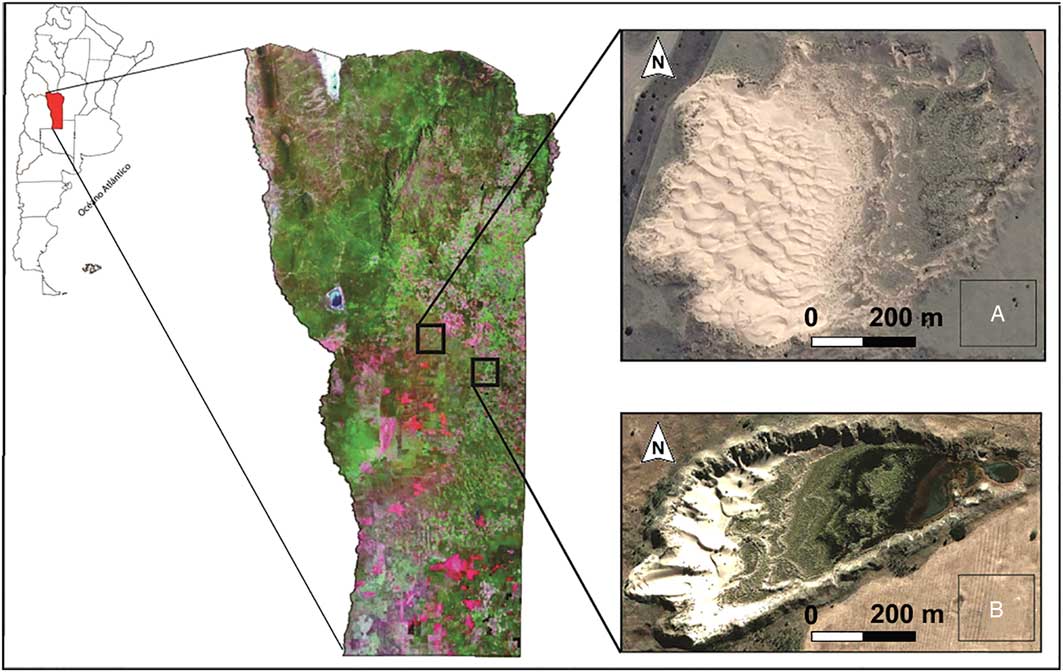
El Durazno (S 33°58′11″ W 65°24′53″, 460m asl) and La Alborada (S 33°51′2″ W 65°29′5″, 456m asl) are small open-air sites located in San Luis province, approximately 25km south of the Quinto River. Both sites are located on parabolic dunes, which are partially stabilised by vegetation (Figure 2). The dunes are part of an extensive aeolian system known as the ‘Pampean Sand Sea’, which has covered most of Central Argentina since the Late Holocene (Iriondo Reference Iriondo1999). Soils prone to wind erosion favoured the formation of distinct superimposed layers of occupation (Bailey Reference Bailey2007). Characteristic artefacts, such as potsherds, lithic grinding tools, anthropomorphic statuettes and small triangular points (Heider Reference Heider2015) suggest a Late Holocene date for the use of the two sites. Recently acquired palaeoecological data have shown the emergence of local lagoons between c. 1200 and 700 BP (Vilanova et al. Reference Vilanova, Tripaldi, Piovano, Forman, Chiesa, Jobbagy, Rojo, Heider and Schittek2017). This reflects suitable conditions for long-term occupation of these spaces, which is also evidenced by the presence of frequently re-occupied base camps.
A) La Alborada dune; B) El Durazno dune. Figure created by the authors using Google Earth.

Petrographic studies of the lithic grinding tools indicate the Central Mountains as the source of raw lithic materials (Heider Reference Heider2015). We define local resources as those available within 40km of a site (after Meltzer Reference Meltzer1989), and hence, the possible source for the lithics is non-local (Heider Reference Heider2015, Reference Heider2016). Maize or other cereals may have been part of this non-local procurement, although current evidence suggests the transport of lithic artefacts and, more rarely, pottery, rather than foodstuffs. In this sense, it was suggested that the transport of grinding tools (some of them weighing more than 8kg) involved the planning of future activity with periodic returns to the site (Heider Reference Heider2015, Reference Heider2016).
Such evidence suggests that the El Durazno and La Alborada dunes were used as base-camps, the main activities within which were the production of stone tools and the consumption of faunal resources, mainly ungulates such as guanaco (Lama guanicoe) (Heider Reference Heider2015; Heider & López Reference Heider and López2016). In this context of mobility and the circulation of lithic resources, maize could be grown, consumed and transported from production areas. The Argentinian Central-western region (32–35° south latitude) together with central Chile are considered to form the southern boundary of Andean agricultural production during the last 2000 years, with archaeological evidence for spatial and temporal variability in maize consumption from north to south (Gil et al. Reference Gil, Giardina, Neme and Ugan2014, Reference Gil, Menéndez, Atencio, Peralta, Neme and Ugan2017). The environmental and climatic conditions in these areas allowed for the cultivation of several crops, such as maize, beans (Phaseolus vulgaris and Phaseolus lunatus), pumpkin (Cucurbita sp.) and quinoa (Chenopodium quinoa). But beyond this agricultural frontier, in regions where hostile climatic conditions precluded cultivation (e.g. Pampas and Patagonia), human subsistence relied on hunting and gathering. This did not, however, prevent the spread of maize from neighbouring production areas to regions such as the Pampas, where individuals could learn to process (i.e. grinding) and cook it for subsequent consumption.
Studies of ancient subsistence practices in San Luis have traditionally focused on human groups that inhabited the Central Mountains, where, it has been proposed, subsistence was based on hunting and gathering (Heider Reference Heider2015). Farming took place close to water sources, and was restricted in scale due to low population densities. Gambier (Reference Gambier1998) suggested that general farming in San Luis emerged around 2000 years BP, although this was based on indirect ceramic evidence. He also claimed that the 531 potsherds found at the Tilisarao site in San Luis were indicative of agricultural production (Gambier Reference Gambier1998: 46). Ethnographic records document the eighteenth-century consumption of maize by the Rankülches tribe in the south of San Luis (Heider & López Reference Heider and López2016). Mansilla (Reference Mansilla1938: 110, translated by the authors) mentioned that, for the Rankülches, the algarrobo or tortuous mesquite (Prosopis flexuosa) ‘‘serves to elaborate the sparkling and drowsy chicha and patay by trampling it alone or with roasted maize to make a pleasant and nutritious meal’’. The data presented and discussed below provide the first archaeological evidence for the presence of domesticated plants in the San Luis province and in a large region of Central Argentina.
Materials and methods
The sample of grinding tools collected by the authors includes hand-stones and conana (plural: conanas) fragments (passive grinding stones). All the lithic artefacts had adhering sediments and were bagged unwashed. Each artefact was measured and weighed in the laboratory.
Research focused on the analysis of microfossils from 73 grinding tools recovered from 19 archaeological sites. Information on grain or fruit processing was obtained from 18 tools from the eight sites listed in Table 1. The study followed Piperno’s (Reference Piperno2006) methodology for sampling phytoliths and starch residues from artefacts, and a dedicated sampling area was set up in the laboratory. Organic residues accumulated in cracks, fissures, holes and crevices of unwashed grinding surfaces were removed using the point of a fine needle. To facilitate equal analysis of all artefacts, sampling was limited to an 8cm2 area of the grinding surfaces of the hand-stones and conanas. The residue samples were mounted onto glass slides using immersion oil, and protected with a cover slip. The work area and all the equipment were washed with distilled water after each extraction to avoid contamination. When possible, sediments adhering to passive areas or unused facets of artefacts were also sampled as a control to distinguish between accidentally and intentionally incorporated starch grains and phytoliths. Moreover, sediment samples from cultural strata were analysed to document the presence of microfossils adjacent to archaeological artefacts. Prepared slides were scanned using an optical microscope at 400–1000× magnification, under transmitted and polarised light.
Results of archaeobotanical analysis from the north Pampas, Argentina. Highlighted sites and their results are discussed in this paper.

Phytoliths and starch grains from each sample were observed, photographed, described and compared with reference collections for taxonomic identification. Phytolith shape, texture and ornamentation, morphometric data and anatomical terms were described following the international code for phytolith nomenclature (Madella et al. Reference Madella, Alexandre and Ball2005). Phytoliths were classified following Twiss et al. (Reference Twiss, Suess and Smith1969) and Zucol (Reference Zucol1996, Reference Zucol2001). Starch-grain attributes described were the three-dimensional morphology, grain size, contour and surface strait, hilum shape and size, lamellae visibility, fissures, birefringence properties, extinction cross features, grain visibility by normal and polarised light, and packing of compounded grains (Loy Reference Loy1994; Perry Reference Perry2004; Piperno Reference Piperno2006). The reference collections for domesticated and wild plants vary by their origin; some specimens were collected during fieldwork, some were recovered from archaeological sites, and others were from publications (Winton & Winton Reference Winton and Winton1932; Piperno Reference Piperno2006; Korstanje & Babot Reference Korstanje and Babot2007).
Results
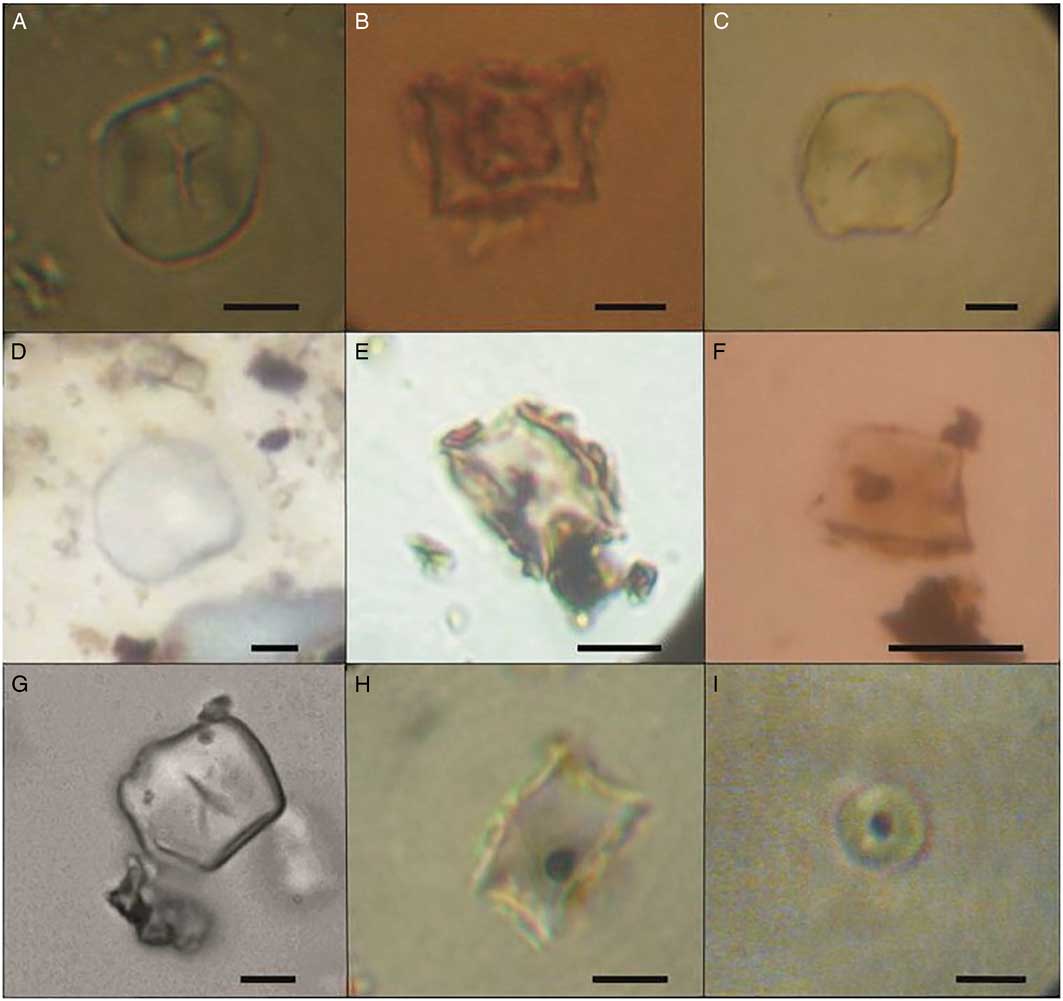
Silica phytoliths and starch grains were isolated from artefacts from eight sites (Table 1), and belonged mainly to wild regional species (Prosopis sp., Acacia sp., among others). Nevertheless, the El Durazno and La Alborada sites also yielded evidence of domesticated species. Identified taxa from grinding tools at both sites included maize, based on the presence of wavy top-rondel phytoliths (characterised by a circular-oval flat base with a wavy upper portion, and measuring around 20µm in length). Maize kernel starch grains were also recorded. These correspond to spherical single grains with irregular pressure facets, a distinct centric hilum line or dot and a variable size from 12–20µm. The centric polarisation cross has four visible arms.
The use of maize in El Durazno is demonstrated by starch and phytolith assemblages, together with Poaceae leaves (cf. Geoffroea decorticans (chañar) fruits and cf. Oxalis sp. tuber (see Heider & López Reference Heider and López2016)). The presence of starch grains at La Alborada allowed us to propose maize-processing activities (Figure 3).
Micro-remains from the La Alborada and El Durazno sites (A) starch grain of Zea mays; B) silica phytolith of Zea mays; C) starch grain of cf. Prosopis sp.; F) silica phytolith of Poaceae; I) starch grain unidentified); archaeological comparative sample of Zea mays starch grains from: D) Ojo del Agua archaeological site, Catamarca (see fig. 10-I in Lantos et al. Reference Lantos, Spangenber, Givannetti, Ratto and Maier2015) and G) Tapera Moreira archaeological area, La Pampa (see fig. 2-A in Musaubach et al. Reference Musaubach, Plos and Babot2013); E) silica phytolith of Zea mays from the Arroyo Tala Cañada site, Córdoba (Pastor & López Reference Pastor and López2011: fig. 4); H) silica phytolith of modern Zea mays cob. Scale bar = 10µm. Figure created by the authors.

Discussion
Evidence for maize in San Luis
Maize phytoliths and starch grains identified on grinding tools from El Durazno and La Alborada provide the first direct evidence of a domesticated plant in the San Luis province in the Central Pampas of Argentina. Taxonomic identification contributes important information to the discussion around the production, consumption and geographic dispersion of maize in San Luis, and in a regional context—including the Central Mountains, the Central-western region and the Central Pampas of Argentina. Prior to this study, data on the production and consumption of plants in San Luis were scarce and indirect. As discussed above, the occurrence of agricultural products was proposed on the basis of the presence of pottery, rather than botanical remains. More recent investigations in regions adjacent to the study area (e.g. the Central Mountains in the Córdoba province, southern San Juan and Mendoza provinces in the Central-west, and the La Pampa province in Central Pampas) have provided archaeobotanical and isotope data that have spurred new discussions concerning the presence of maize and its propagation.
The ecological limits of maize production
The earliest evidence for the processing and consumption of maize in the Central Mountains of the Córdoba province dates to the Final Holocene approximately 2500 years BP (Pastor et al. Reference Pastor, López and Rivero2012). It is remarkable that no specific indicators of agricultural production (e.g. seeds and agricultural tools and structures) or significant socio-economic transformations were recorded in association with the presence of this cultigen (Pastor et al. Reference Pastor, López and Rivero2012). Archaeological evidence for cultivated plants, including maize, pumpkin, beans and quinoa increase in abundance only after 1100 years BP, although maize—and crops generally—were not a main subsistence resource (Pastor & López Reference Pastor and López2011). Recent research shows a high incidence of wild plants in Late Holocene subsistence, with cultigens occupying a secondary role in the diet (e.g. Medina et al. Reference Medina, Pastor and Apolinaire2011; López Reference López2015).
Central-west Argentina is considered the southern boundary of pre-Hispanic Andean agriculture. This region can be divided in two areas of similar size, but with significant archaeological differences in the extent to which archaeological research has been carried out: the north (San Juan province) and the south (Mendoza province). The economic strategies of the farmers and hunter-gatherers form a dichotomy that is currently being discussed throughout the region (e.g. Novellino et al. Reference Novellino, Gil, Neme and Durán2004; Gil Reference Gil2006; Pastor & Gil Reference Pastor and Gil2014). Although the presence of maize in these areas has been discussed since 1980s, its antiquity is not yet established (Bárcena Reference Bárcena2001; Lagiglia Reference Lagiglia2001). Agriculture began to develop in the north around 3800 years BP (Bárcena Reference Bárcena2001). The incorporation of maize would have followed the cultivation of cucurbits (Cucurbita maxima and C. pepo), beans and quinoa. Some researchers, however, propose that the arrival of maize occurred in the context of emerging agriculture (Lagiglia Reference Lagiglia2001).
In the south, the production and consumption of maize is linked strongly to latitude and altitude, with isotope studies showing high dietary variability in different sectors. Some groups, for example, would have incorporated maize into the diet alongside other crops, thus changing their subsistence practice, as reflected in the isotopes (Bárcena Reference Bárcena2001). The archaeological record of the southern Central-west, however, shows the persistence of hunter-gatherer groups. These societies could have consumed more maize from 2000 years BP onwards, but in the context of intensified consumption of wild resources. In the south, the different ways of incorporating maize into the diet resulted from a diversified subsistence strategy, influenced by Late Holocene climate changes, group mobility patterns and demographic growth (Bárcena Reference Bárcena2001; Novellino et al. Reference Novellino, Gil, Neme and Durán2004; Gil et al. Reference Gil, Tykot, Neme and Shelnut2006, Reference Gil, Giardina, Neme and Ugan2014; Ugan et al. Reference Ugan, Neme, Gil, Coltrain, Tykot and Novellino2012).
Archaeological research in the Central Pampas region—more specifically in La Pampa province—has indicated the importance of plant foods to the hunter-gatherer diet (Berón Reference Berón2013). Recently, Musaubach and Berón (Reference Musaubach and Berón2012) presented the first evidence for the consumption of domesticated vegetables in a local hunter-gatherer context, at the archaeological site Tapera Moreira (La Pampa province). Here, maize starch adhering to ‘Challa’ potsherds was also identified. Evidence for the use of maize is therefore increasing, as are data on its Final Holocene chronology (Musaubach et al. Reference Musaubach, Plos and Babot2013; Musaubach Reference Musaubach2014).
Maize within exchange networks
Maize in the Central Argentinian archaeological record is suggested to represent part of a macro-regional intensification process (Medina et al. Reference Medina, Pastor and Apolinaire2011; Musaubach et al. Reference Musaubach, Plos and Babot2013; Gil et al. Reference Gil, Giardina, Neme and Ugan2014). Intensification is an adaptive process by which people obtain more energy per unit of area (Richerson et al. Reference Richerson, Boyd and Bettinger2001; Freeman Reference Freeman2007). This process in the Final Holocene, however, has different expressions in the archaeological record. In the Central Mountains, human societies were mobile and could change settlement location or group size according to the circumstances. Ethnographic research shows that, during the growing season (September to April), a few extended families settled in semi-permanent villages to grow maize, among other domestic resources (Medina et al. Reference Medina, Pastor and Recalde2016). The archaeological record in the Central-west (at about 35° south) suggests that the maize-dispersal process began approximately 2000 years ago, and that maize formed a significant part of the diet mainly after 1000 years BP (Bárcena Reference Bárcena2001; Gil et al. Reference Gil, Tykot, Neme and Shelnut2006). Models for this region assume that the archaeological record does not necessarily support farming practices farther to the south (Gil Reference Gil2006). Musaubach (Reference Musaubach2014) proposes a similar argument for the Pampas Region. The evidence for maize presented in the current study cannot be understood outside of the macro-regional process of intensification that began in the Final Holocene. The current archaeological evidence does not support the practice of farming in the north Pampas (Heider & López Reference Heider and López2016), although more research is needed. The climate over the past 2000 years is critical in rejecting the hypothesis of local maize cultivation. Maize is a very resistant grass, but local sandy soils and unpredictable precipitation would have hampered its production. Furthermore, new palaeoclimatic studies show that over the last 300 years, some variations in pollen types seem to coincide with anthropogenic disturbances, the increase of the levels of the lakes and the stabilisation of sand dunes (Vilanova et al. Reference Vilanova, Tripaldi, Piovano, Forman, Chiesa, Jobbagy, Rojo, Heider and Schittek2017). These data agree with ethnographic reports of the Rankülche groups, who practised small-scale agriculture (Heider Reference Heider2017). The sites analysed in this paper, however, pre-date this period.
As there is currently no evidence to suggest that maize was locally produced in the north of the Central Pampas in antiquity, we believe that data on maize consumption in the study area should be addressed in the context of the movement of resources and people. Heider’s (Reference Heider2016) study of lithic raw materials, for example, indicates the possibility of high levels of mobility or resource exchange. For highly mobile hunter-gatherer groups, however, the discussion cannot be restricted to these two alternatives alone. These societies had an ‘open social formation’ (Borrero et al. Reference Borrero, Martin and Barberena2011), and this aspect influenced the distribution and exchange of different goods, including plants. Pallo and Borrero (Reference Pallo and Borrero2016) recognise a different type of archaeological mobility that involved a ‘visiting system’ for hunter-gatherers. Some non-local rocks (e.g. obsidian) have a characteristic frequency that can be assigned to such visits (Heider Reference Heider2016; Pallo & Borrero Reference Pallo and Borrero2016). Such archaeological evidence shows interaction and movement between El Durazno and La Alborada and the Central Mountains: at both sites, Heider (Reference Heider2015) identified lithic raw material for grinding tools, ceramic styles, ceramic raw materials and ceramic cooking techniques characteristic of the Central Mountains.
Palaeoclimatic data from Central-west Argentina show that environmental conditions were unsuitable for local crop production. The presence of maize, therefore, was mostly the result of macro-regional interactions (Neme et al. Reference Neme, Gil, Otaola and Giardina2013; Gil et al. Reference Gil, Giardina, Neme and Ugan2014). Similar resource-circulation networks were developed in the north of the Dry Pampas. Alternative explanations for the presence of maize, such as different mobility mechanisms or small-scale horticultural production, however, cannot be dismissed. Finally, other possibilities should be considered. In many contexts, for example, maize was a symbolic, exotic resource (Gil Reference Gil2006; Staller Reference Staller2007; Nuñez et al. Reference Núñez, McRostie and Cartajena2009; Babot Reference Babot2011). It was a rare commodity, which had to be acquired from other regions through exchange. Maize therefore could be consumed on special socio-political occasions, when it was considered a prestige resource, rather than as a part of daily diet.
Conclusion
In this study, microbotanical remains of maize have been recovered from grinding tools from both the El Duranzo and La Alborada sites in the San Luis province. Past environmental conditions, however, were unsuitable for the local production of this species. Our analyses suggest that this maize crop could have come from nearby regions. In this context, the presence of maize in the north Central Pampas relates to group mobility (Heider Reference Heider2015) as part of an intensification process (as in the increase of energy produced per land unit) that made it possible to obtain resources from adjacent regions. Thus, the absence of maize production did not negate the local processing and consumption of this resource. The role of maize in the diet is hard to evaluate, due to its scarcity, although its presence invites discussion about the adoption of this crop by groups that mainly processed wild fruits and seeds.
Research in the study area indicates that hunter-gatherer groups had high mobility patterns, wide circles of interaction and a subsistence system that included the use of wild camelids and plants (Heider Reference Heider2015; Heider & López Reference Heider and López2016). In this context, maize was also consumed as part of an intensification strategy to cope with unpredictable resource availability. The evidence for maize in the San Luis province offers a new contribution to discussions concerning the southern agricultural frontier of South America. More research, however, is needed to further our understanding of this and other aspects of local pre-Hispanic people.
Acknowledgements
We thank our colleagues for their constant support and for discussion of the ideas presented in this article. Our thanks also go to the landowners and workers where the fieldwork was carried out; to members of the different Programmes of the Ministry of Tourism and Cultures of the province of San Luis for their support; to the Rankülche people; and to María Clara Álvarez for help with this article. This research was developed as part of a Doctoral fellowship from CONICET and the project ‘Plant resources and intensification practices during the Holocene along the Arid Diagonal Argentina. An approach through macro analysis and plant micro-resources’ was conducted by A. Capparelli, and funded by CONICET (PIP 2014–2016 GI).