Implications
This paper suggests new ways of understanding the reproductive performance of dairy cattle herds. Reproductive performance has recently been a growing concern in cattle dairy systems, which compromises both the replacement of the herds and the economic operation of the farms. Broadening the way of perceiving and analysing reproductive problems, as suggested in our paper, makes it possible to gain a better understanding of such problems, which can be regarded as a first step towards their solving. The proposed approach may also be relevant for any biotechnical problem encountered in a livestock farming system.
Introduction
Reproductive performance of dairy cattle herds continues to decline worldwide (Butler, Reference Butler2003). Many factors can contribute to explaining this trend. All the negative consequences of increased milk production due to a continuing selection for milk yield are often mentioned, as well as other various explanations such as increasing herd size, reduced heat detection, declining body condition score at calving, or increased body condition score loss post partum (McDougall, Reference McDougall2006). A poor reproductive performance at the farm scale would therefore gain to be addressed as a complex problem. Mixing systemic and analytical approaches at the farm scale can be seen as a way to address complex problems encountered on farms. By analytical approaches of reproductive problems, we mean research based on quantitative and animal-related data, mainly using statistics. Such approaches aim at understanding the biological phenomena that underpin impaired performance. By systemic approaches at the farm scale, we mean paying particular attention to interactions between the different subsystems that constitute the whole livestock farming system. In particular, researchers in livestock farming systems (LFS) are used to considering the livestock farming system as a system subdivided into a decisional subsystem and a biotechnical subsystem (Gibon et al., Reference Gibon, Sibbald, Flamant, Lhoste, Revilla, Rubino and Sorensen1999), which suggests not to ignore the farmer, his objectives and his rearing practices. It is also suggested to consider three different poles in a livestock farming system: the farmer, the animals and the resources (Landais, Reference Landais1992).
Mixing systemic and analytical approaches requires successive downscaling and upscaling movements. Such successive movements are preconised in the ‘H-R-H approach: from holism via reductionism and back to holism’ (Van Der Zijpp, Reference Van Der Zijpp2008). The H-R-H approach is part and parcel of a research stream aiming at favoring sustainable development and system innovation. This approach makes it possible to formalise methodologies to describe, analyse and design socio-economic systems at local, regional or global scales. Such methodologies are taught to students who are able ‘to explore sustainable development options for a variety of animal production systems worldwide’ (Eilers, Reference Eilers2008). But this approach was not specifically conceived to address biotechnical problems encountered at the farm scale.
Modelling LFS requires to carry out processes of downscaling and upscaling too. To give an example, the whole-farm model MELODIE upscales models developed at the field or animal scale and on short-term periods by considering the management of the whole farming system (Chardon et al., Reference Chardon, Rigolot, Baratte, Le Gall, Espagnol, Martin-Clouaire, Rellier, Raison, Poupa and Faverdin2007). But the aim of modelling LFS is generally not to address biotechnical problems encountered in a particular farm. So as to serve such a purpose, methodologies that aim at gaining a good overview of the operation of a particular farming system by questioning its managers are more appropriate. But such methodologies are scarce: only two methods addressing the farming system in its globality were found out of a literature review (Abt et al., Reference Abt, Pierreval, Lardon and Steffe2006): the AGEA method (Bonneviale et al., Reference Bonneviale, Jussiau, Marshall, Bonneau and Capillon1989) and the GEEA method (Capillon and Manichon, Reference Capillon and Manichon1988). Neither the AGEA method nor the GEEA method were conceived so as to facilitate further analytical study in case of the highlighting of a biotechnical problem. The aim of both methods is to build a shared representation of the system, so as to understand its operation and propose a diagnosis. But both methods are based on a quick survey, which does not give the opportunity to gain an in-depth understanding.
The aim of this paper is to formalise and test a methodology to be applied to a livestock farming system research addressing biotechnical problems. It is based on a case study dealing with reproductive problems encountered in a system experiment, and it focuses on the links between reproduction and feeding management.
After a preliminary literature review on the topic that focuses on the possible use of lactation curves to better understand reproductive performance, we illustrate the interest of mixing both systemic and analytical approaches by describing the methodology we used and the results we obtained from our case study. Finally, we discuss the interests and transposability of our proposed methodology.
Resarch approaches on the links between reproduction and nutrition in dairy cattle
Focusing on feeding management
While dealing with impaired reproductive performance of dairy cows, genetic factors (Mackey et al., Reference Mackey, Gordon, McCoy, Verner and Mayne2007), nutrition (Robinson et al., Reference Robinson, Ashworth, Rooke, Mitchell and McEvoy2006), health of the cow (Collard et al., Reference Collard, Boettcher, Dekkers, Petitclerc and Schaeffer2000) and work organisation (Zaaijer and Noordhuizen, Reference Zaaijer and Noordhuizen2003) are very often referred to. These four fields are closely connected together. For example, a high feeding level can result in higher milk production, which may lead to lowered heat expression (Cutullic et al., Reference Cutullic, Delaby, Causeur, Michel and Disenhaus2009) and therefore to difficulties in organising heat detection (Zaaijer and Noordhuizen, 2003).
When a very low input dairy system is to be designed, as such is the case in the system experiment we use as a case study in this paper (Coquil et al., Reference Coquil, Fiorelli, Mignolet, Blouet, Foissy, Trommenschlager, Bazard, Gaujour, Gouttenoire and Schrack2009), investigating about the consequences of reducing energy supply becomes of crucial importance. We therefore decided to focus on nutritional factors and especially on energy balance.
Literature schematically offers three main kinds of research contributions concerning the relationships between energy balance and reproductive performance: (i) some approaches aim at gaining a better understanding of the physiological processes which link the energy balance of the cow to the reproductive performance (Butler, Reference Butler2003), (ii) some statistical studies, designed at the cow scale or the herd scale, offer analytical information about the relationships between reproduction and nutrition (Dohoo et al., Reference Dohoo, Tillard, Stryhn and Faye2001; Buckley et al., Reference Buckley, O’Sullivan, Mee, Evans and Dillon2003). Farming practices or types of livestock systems are not always taken into consideration, and they never play a greater part than adjustment variables, (iii) some papers do deal with herd management practices and their relationships to reproductive performance. The approach is more systemic. But these studies are necessarily linked to a given context and so cannot directly be applied to any particular situation. Besides, there is no guarantee that the farmers will accept the recommendations if there has not been any interest in their particular projects and objectives. For example, nutritional management can be questioned, with practical suggestions (Overton and Waldron, Reference Overton and Waldron2004), but adding more input to the cows’ diets may be refused by some farmers, for example if they do not want to compromise their objectives of self-sufficiency.
Shapes of lactation curves to better understand reproductive performance?
By showing that the shapes of lactation curves can be linked to feeding management and that reproductive performance can be analysed in light of milk production, we suggest to use shapes of lactation curves as a possible tool to better understand reproductive performance when nutritional factors are to be considered.
From feeding management to the shapes of lactation curves. In this sub-section, we decribe some research studies that emphasise the sensitivity of lactation curves to feeding conditions.
The first example is based on the validation procedure of an empirical model to simulate lactation curves (Coulon and Pérochon, Reference Coulon and Pérochon2000). The model to be validated took into account some characteristics of the cows (age, potential production, breed) and integrated all factors known to have an effect on milk production (season, period of lactation, period of gestation), except feeding and health conditions. The validation procedure consisted in comparing predicted data with real data obtained in experimental farms that were not used for the calibration procedure. Predictive errors were not independent of calving season, although the model already integrated a cyclic seasonal effect for variations in day length within the year. It was then decided to add another cyclic function in the model for seasonal variations that are not directly linked to day length. Results were improved by this change but remained calving season-dependent. The authors explained this result by noting that although all considered cows were fed according to INRA feeding recommendations, feeding conditions were different from one farm to another, and presumably also variable in each farm within the year. As a conclusion, this paper suggested that ‘seasonal effect’ may not only be linked to day length variations, but also that feeding management is worth taking into account when a lactation curve is to be modelled.
Brunschwig et al. (Reference Brunschwig, Veron, Perrot, Faverdin, Delaby and Seegers2001) obtained the same kind of conclusion while studying lactation curves in grassland dairy systems in Pays-de-la-Loire (France). They distinguished four different families of curves, based on the different shapes. Then they noted that these families were not independent of the calving season. They finally concluded that in these grassland systems, a wide diversity of lactation curves’ shapes is observed and that it can be linked to the variability of feeding supply within the year. Moreover, it was seen that the greater the feeding restriction in winter, the higher the increase in milk production at turnout.
This adaptive ability of milk production was observed in New Zealand too (Garcia and Holmes, Reference Garcia and Holmes2001). During the first 4 months of lactation, milk production was found to be higher for cows which calved in spring than for cows which calved in autumn. During months 5 to 9, this result was inversed. The authors connected this phenomenon to the variability of grass quality within the year, with a better quality in spring.
All these papers suggest the relevance of taking feeding into account in order to model lactation curves. Effectively, when Roguet and Faverdin (Reference Roguet and Faverdin1999) modelled milk production along lactation by using a mechanistic approach based on the use of ingested energy, they managed to simulate even complex curves with a good quality. When carrying out a 5-year trial to study the direct and indirect effects of four feeding strategies on the lactation and reproduction performances, Delaby et al. (Reference Delaby, Faverdin, Michel, Disenhaus and Peyraud2009) observed different shapes of lactation curves corresponding to the four different feeding strategies.
From milk production to reproductive performance. In literature, relationships between milk production and reproductive performance are heterogeneous.
It is often admitted that high production increases risk of poor reproductive performance. For example, in a multi-year trial carried out in France in a low-cost grazing context, it was shown that a production higher than 37 kg/day at lactation peak was a risk factor for multiparous cows of not having a successful first artificial insemination (Jegou et al., Reference Jegou, Bareille and Brocard2004). In a statistical study involving 44 dairy herds of the west-central region of France, the incidence of late embryonic/foetal mortality was found to be increased by highest milk production superior to 39 kg/day (Grimard et al., Reference Grimard, Freret, Chevallier, Pinto, Ponsart and Humblot2006). But the relationship is not so easy to generalise. For instance, McDougall (Reference McDougall2006) noted that although the most commonly observed relationship in international literature is effectively a negative correlation between production and reproduction, reproduction is positively correlated to production in Ireland and in New Zealand. The author proposed three different hypotheses to explain this heterogeneity of results: (i) absolute levels of milk production can explain the observed difference. In New Zealand and Ireland, cows generally produce less milk than in many industrialised countries. This fact suggests a curvilinear relationship between reproduction and production. Up to a certain level of production, reproduction could be improved by higher production, whereas reproductive performance would decrease with production for upper levels of milk production, (ii) differences in reproductive performance can also be explained by differences in production systems, (iii) lastly, contradictions can be linked to the chosen object: cows in a given herd, or comparisons of reproductive performance between different herds. For example, a given high-production herd can be well managed so that its reproductive performance is better than in many other less productive herds. But within this same herd, the most productive cows may have such a high genetic merit for milk yield that their reproductive performance can be diminished compared with less productive cows in the same herd.
Another approach dealing with genetic merit for milk yield can be proposed to explain the contradictions found in literature about relationships between reproduction and production (Buckley et al., Reference Buckley, O’Sullivan, Mee, Evans and Dillon2003). These authors showed with a statistical study involving 74 Irish commercial herds that reproductive performance is positively correlated to milk production, when it is adjusted with genetic merit for milk yield. Buckley et al. (2003) explained that when there is no adjustment for genetic merit, the genetic negative correlation between production and reproduction makes it difficult to distinguish genetic and phenotypic effects in the relationship between reproduction and production. But when there is an adjustment for genetic merit, an increase in milk production means that milk production becomes closer to milk potential, which can be linked to better herd management, feeding management in particular, better health, and hence better reproductive performance. Eventually, a positive phenotypic correlation between production and reproduction can be expressed in production systems for which feeding management does not allow milk production to meet its potential. This phenomenon can only be shown when there is an adjustment for genetic merit.
Material and methods
A Grazing System (GS)
This study was based on a system experiment run in North-Eastern France, in the INRA Research Unit of Mirecourt (Coquil et al., Reference Coquil, Fiorelli, Mignolet, Blouet, Foissy, Trommenschlager, Bazard, Gaujour, Gouttenoire and Schrack2009). A system experiment is an experiment which is run at the production system scale, sometimes with livestock, and which is guided in its operation by a specific corpus of general objectives (Chabosseau and Dedieu, Reference Chabosseau and Dedieu1994).
Two systems have been tested in Mirecourt since late 2004: an organic GS and an organic Mixed-Crop Dairy System. The general objectives which guide the operation of each system (Sebillotte and Soler, Reference Sebillotte and Soler1990) are inspired by environmental sustainability. The study presented in this paper is based on the operation of the GS. The GS is based on 78 ha of permanent grassland, initially grazed by 37 dairy cows and the replacement heifers. Two breeds are represented in this system: Holstein and Montbéliarde. Impaired reproductive performance was observed during the first 2 years of running. In 2006, only 27% of the GS cows submitted for breeding were pregnant at the end of their breeding season.
Available data: numerous and heterogeneous registrations
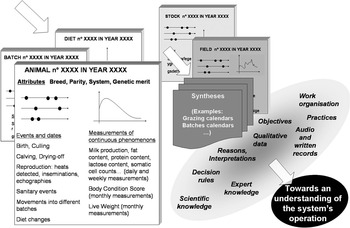
For both systems, some quantitative data are routinely registered. For example, as far as the animal is concerned, milk production and classic parameters linked to milk quality are registered on a daily or a weekly basis. Body Condition Score and Live Weight are measured once a month for each cow. Apart from these quantitative measurements, all important dates in the animal’s career are registered, such as birth and culling, calvings and drying-offs, reproduction- and health-related events, or even management decisions such as batch or diet changes. Batches and diets are precisely referenced in the animal data bases. Agronomic information is also available, using the same type of data bases as the animal data bases, the elementary object being the field instead of the animal. At an upper level, these data are synthesised into intermediary documents such as, for example, grazing calendars which allow us to gain a synthetic view of a particular point of the system’s operation.
In order to gain a better understanding of the whole system’s operation, some extra data are needed and available in the system experiment, although their registrations are not as systematic as previously described and more subjective. In Figure 1, these extra data are represented in the grey elliptic area. The mentioned expressions embody all elements which can help us to understand the operation of the system but are not easily accessible or upgradeable through a systematic methodology.
Available data in the system experiment.

Methodology
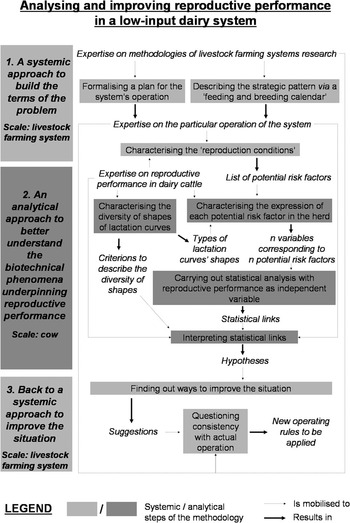
Our methodology is summarised in Figure 2. It consisted in three main phases: a systemic approach followed by an analytical study, and back to a systemic approach.
Methodological approach.

A systemic approach to build the terms of the problem
The first step of this first phase was to formalise the general objectives for the operation of the GS. This step aimed at gaining a good overview of the system’s operation, making it easier to find out the relevant phenomena to explain the poor reproductive performance. As we wanted to take the long term into account to formalise the decision makers’ objectives, as suggested by Lev and Campbell (Reference Lev and Campbell1987), we used some of Mintzberg’s concepts (Reference Mintzberg1987), referred to by Girard and Hubert (Reference Girard and Hubert1999): the plan and the strategic pattern. The plan represents what is decided for a system to function. It formalises the intention of the decision makers and it anticipates what is to happen. The pattern represents the dynamics of what really occurs. It is the plan’s translation to reality, and it differs from the plan because some elements of the plan are never transferred into reality, whereas new elements that were not in the plan emerge when the system is operating. We decided to formalise the plan retained for the GS in September 2004. September 2004 is the date of the beginning of the operation of the GS, which before September 2004, was managed in a different way and as a single system together with the mixed-crop dairy system. The formalisation of this dated plan aimed at giving access to the general objectives for the operation of the GS. A first representation of this plan was built on the basis of the different project documents that had been written in 2004. It was then enriched and validated by the decision-makers who managed the project in 2004. For such a purpose, they were told to concentrate on what had been decided in September 2004 and to ignore what had emerged during the operation of the GS since that date.
After that, the second step consisted in building a graphical representation of the strategic pattern during the first 2 years of running of the GS. Given the considered problem, i.e. reproductive performance of dairy cows in a low-input strategy with very few concentrate, the choice was made to focus this representation on the herd’s feeding and breeding strategy. The principle was to represent all the successive memberships of each animal in ‘feeding groups’. A feeding group was defined as a homogeneous group of animals having, in the same time, the same physiological status (e.g.: lactating or dry cows, pregnant or non-pregnant heifers) and exposed to the same kind of feeding conditions (e.g.: winter diet or grazing). Information needed to build this ‘feeding and breeding calendar’ was to be extracted from the data bases of the system experiment. This calendar made it possible to describe some rearing practices that are potentially linked to reproductive performance. Rearing practices are a key aspect of research in LFS, as they are considered to be at the interface between the decisional subsystem and the biotechnical subsystem (Landais, Reference Landais1992).
Finally, in a third step, the plan and the strategic pattern (represented by the feeding and breeding calendar) were confronted so as to characterise the diversity of ‘reproduction conditions’ stemming from the rearing practices. Reproduction conditions consisted in all the conditions that we considered to potentially have an impact on reproductive performance, for example feeding conditions, possibly characterised by temporal successions of feeding groups. Apart from reproduction conditions stemming from the rearing practices, conditions stemming from the herd’s environment, the productive history of the cows and individual characteristics that could be linked to reproductive performance were also listed. This step was both based on expertise on the particular operation of the GS, acquired thanks to the two precedent steps (formalising the plan and the strategic pattern) and on expertise on reproductive performance in dairy cattle in general. This double expertise finally made it possible to list all the relevant ‘reproduction conditions’ to be analysed as potential risk factors in the case of the GS.
An analytical approach to better understand the biotechnical phenomena underpinning reproductive performance
As the literature review presented above invited us to consider lactation curves as a possible tool to better understand reproductive performance, the first step of the analytical phase consisted in characterising the diversity of shapes of all lactation curves of the GS cows submitted for breeding in 2005 and 2006. Two methods were combined to serve that purpose. Direct observation of the curves was the first one. The second one was based on the use of principal components analysis (PCA) using the Statistical Analysis Systems Institute (SAS) software package (1999) running on the UNIX system. Such analysis was carried out for each studied year (2005 and 2006). The individuals were the cows submitted for breeding (36 cows in 2005; 30 cows in 2006) and the 20 active variables corresponded to the 20 first weekly values of raw milk production. Such analyses made it possible to formalise both criterions to describe the diversity of the shapes and a set of different types of curves’ shapes.
Then, the aim of the second step was to construct a variable for each identified potential risk factor, so as to carry out statistical analysis with those variables as dependent variables explaining reproductive performance. Results of the previously described study on lactation curves’ shapes were mobilised to analyse the reproduction conditions connected to feeding. The other variables were constructed on the basis of descriptive statistics.
Once dependent variables had been constructed, statistical procedures were carried out with two variables describing reproductive performance as independent variables. The first one was SUC and corresponded to the final result of the breeding season: SUC was equal to 1 if last practiced ultrasound scan was positive; else it was equal to 0. The second one was AI1 and corresponded to the result of the first artificial insemination: AI1 was equal to 1 if the first insemination was successful; else it was equal to 0. As many cows submitted for breeding in 2006 had already been submitted for breeding in 2005, data stemming from the 36 submissions for breeding in 2005 and the 30 submissions for breeding in 2006 were not independent. We therefore decided to work on two separate data bases: the first one for 2005 and the second one for 2006, and to carry out logistic regression procedures (Kleinbaum, Reference Kleinbaum1994) using the SAS software (id.). The effect of the year was evaluated by a χ 2 test. Our aim was not to design a unique predictive model of reproductive performance based on several dependent variables. We rather wanted to analyse the impacts of the different potential risk factors separately. Every analysis we carried out with a logistic regression procedure was therefore structured the following way: we analysed the risk associated to exposure E on performance P while taking into account j (0 to several) confusing factors Ci. P was the independent variable, E the dependent variable and Ci the adjustment variables. The adjustment variable Ci was added in the logistic regression between the independent variable P and the dependent variable E if and only if Ci was linked to both P and E, and was neither a consequence of P nor a consequence of E. Ci was considered to be linked to P (or E) if the P-value of the χ 2 test was lower than 0.20.
Finally, the statistical links obtained were interpreted in light of both the shapes of the lactation curves and the expertise on the operation of the GS acquired thanks to the previous systemic approach. This analysis led us to formulate hypotheses on the biotechnical phenomena underpinning reproductive performance.
Back to a systemic approach to improve the situation
For this third phase of our methodology, we used the hypotheses previously formulated to suggest some ways of improving the reproductive performance of the GS. These suggestions were then confronted to the overall objectives for the GS in order to see if they were consistent with its strategy. The relevant ones were translated into new rules to be applied for the following years.
Results
Results of the first systemic approach: building the terms of the problem
In this section, we first describe the main points we gained access to by formalising the plan retained for the GS by its decision makers in September 2004. GS management is inspired from the Irish system; the calving period takes place in late winter and in early spring (between 15 February and 15 May), so as to make the start of lactation and high feed requirements correspond with the most intense period of grass growth. Keeping such a concentrated calving pattern is seen as a major objective because the resulting calendar makes it possible to feed the herd in a thrifty way. So as to keep this concentrated pattern, the breeding period must occur between 15 May and 15 August, which means that there is no artificial insemination after 15 August even if some cows are not pregnant at that date. Time spent outside the shed at the year scale is maximised for every type of animal (calves, heifers and dairy cows) to achieve both economy and self-sufficiency. Three main points are related to this general rule of grazing maximisation: (i) turnout occurs every year as soon as weather conditions allow cows to graze without any risk of soil compaction. Grass availability is not taken into consideration when the turnout date needs to be chosen, (ii) cows have to stay outside the shed throughout the summer even in the case of drought, (iii) cows are overwintered in cubicle buildings for as short a period as possible, defined on the basis of animal welfare and considerations on soil preservation. The feeding strategy is mainly based on grazed grass and hay. Winter diet for the cows is exclusively based on hay. When cows are outside, they eat grass and can be complemented with hay during the breeding season. Concentrates are distributed in very low quantities: maximum 3 kg dry matter/cow per day in early lactation, only for the cows that calve before the grazing season. Straw and concentrates are imported from the complementary mixed-crop dairy system of the system experiment. Therefore, in order to improve the self-sufficiency of the GS, the use of straw and concentrates must be minimised. Finally, this pattern offers the opportunity to close the milking parlour 1 month in the year, just before 15 February. The decision was therefore taken to dry off every cow every year before 15 January.
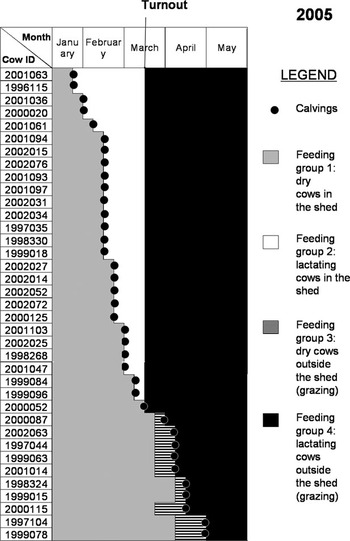
With such a plan, on the one hand, cows calve every year between 15 February and 15 May. On the other hand, turnout occurs when the weather is dry enough, approximately in late March or early April. These two objectives, respectively, related to herd management and to land use lead to a situation in which some cows calve before turnout date, whereas others calve during the grazing season, as we can see it on the ‘grazing and feeding calendar’ (see Figure 3 for an extract related to spring 2005). In such a context, the moment of calving results in differences in the successive membership in ‘feeding groups’. As feeding practices vary from one group to another, the differences in the successive membership of feeding groups may lead to different evolutions of energy balance, which might have an impact on reproductive performance. This phenomenon invited us to consider the calving date with regard to the turnout date as a relevant factor to explain the variability of reproductive performance within the herd. Another potential risk factor stemming from the particular rearing practices of the GS can be pointed out. As we have seen it while exposing the plan for the GS, closing the milking parlour 1 month in the year makes it compulsory to dry off every cow before 15 January even if some cows still have a significant milk production at that date. This decision rule results in potential heterogeneity in the length of dry periods within the herd. As dry period length can be linked to reproductive performance (Watters et al., Reference Watters, Guenther, Brickner, Rastani, Crump, Clark and Grummer2008), it can be considered as a relevant potential risk factor to be taken into account in the case of the GS. Independently from the particular operation of the GS, some potential risk factors have to be taken into account when studying reproductive performance in dairy cattle: breed, parity, urogenital health disorder at calving and interval between calving and first artificial insemination (that must not be too short) (Tillard et al., Reference Tillard, Humblot, Faye, Lecomte, Dohoo and Bocquier2008).
Extract of the feeding and breeding calendar concerning the dairy cows in Spring 2005.

To sum up, this first systemic phase of our methodological approach (Figure 2) finally led us to identify six different potential risk factors to be taken into account when analysing the reproductive performance for each year of running of the GS: interval between calving and turnout, dry period length, interval between calving and first artificial insemination, breed, parity and urogenital health disorders. The effect of the year was also to be analysed, in so far as climatic variations between years may result in differences in grass quality and quantity, which, in that kind of thrifty systems based on grazing, may appear crucial for reproductive performance.
Results of the analytical analysis: better understanding the biotechnical phenomena underpinning reproductive performance
Characterising the diversity of shapes of lactation curves
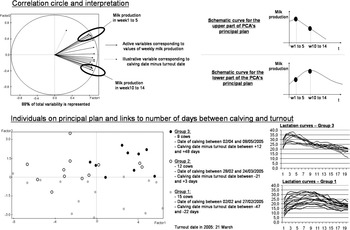
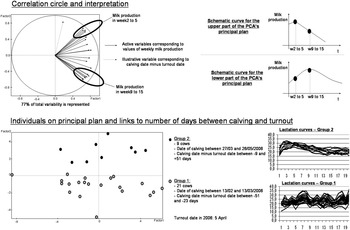
Our study on the shapes of lactation curves is presented in Figure 4 for 2005 and in Figure 5 for 2006. In 2005, two schematic types of lactation curves’ shapes can be observed. The first type corresponds to the upper part of the PCA’s principal plan and is associated with early beginnings of declining phases of lactation, around weeks 1 to 5. The second type corresponds to the lower part of the PCA’s principal plan and is associated to later beginnings of declining phases, around weeks 10 to 14. These types of curves are not independent from calving date with regard to turnout date: on the correlation circle, we can see that the illustrative variable corresponding to calving date minus turnout date is well associated with the vertical axis of the principal plan. Effectively, cows that calved long before turnout are all represented on the lower part of the PCA (see group 1 on Figure 4), whereas cows that calved after turnout are all represented on the upper part (see group 3). Cows that calved at intermediate dates are represented at intermediate positions (see group 2) and the shapes of their lactation curves are also intermediate (not shown). We formulated the hypothesis that after turnout, ingested grass was able to very quickly stimulate the beginnings of lactations in group 3, which was not the case with hay feeding for the beginnings of lactations in group 1. Consequently, cows in group 3 may have had a greater metabolic load in early lactation, which resulted in poorer persistency and which can be regarded as a potential risk factor for reproductive performance. Metabolic load is defined as ‘the burden imposed by the synthesis and secretion of milk’ (Knight et al., Reference Knight, Beever and Sorensen1999). The analysis of lactation curves in 2006 (see Figure 5) shows similar results: same interpretation of the correlation circle, and same positive correlation between calving date minus turnout date and the vertical axis of the principal plan. Cows which calved around or after turnout (see group 2 on Figure 5) had very similar lactation curves to the ones of cows in group 3 in 2005 (Figure 4). This observation reinforced our hypothesis about a greater metabolic load for the cows that calved around or after turnout.
Analysis of the shapes of lactation curves in 2005.

Analysis of the shapes of lactation curves in 2006.

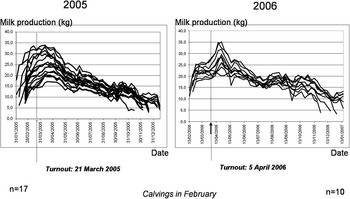
One particular phenomenon was observed in 2006 that did not appear in 2005: lactation curves of cows which calved before turnout date (see group 1 in Figure 4 and group 1 in Figure 5) were not as smooth in 2006 as in 2005. In 2006 lactation curves showed numerous sharp variations, which, in first approximation, suggested lower stability of feed quality in 2006 than in 2005. So as to enquire with more precision about this phenomenon, we compared entire lactation curves (i.e. not only the 20 first weekly values of raw milk production), placed on a calendar basis (i.e. the x-axis representing the calendar dates and not the numbers of weeks after calving) and with fewer curves for 2006 in order to gain a less confusing image of lactation curves in group 1 than the one presented in Figure 5. One of the results is shown in Figure 6. The comparison 2005/2006 of lactation curves of cows which calved in February showed that it was possible to determine when turnout occurred on every lactation curve in 2006, whereas it was not the case in 2005. In 2006, turnout was associated with a very quick and intense increase in milk production, which resulted in a particular ‘peak’ observable on the lactation curve (up to 10 kg increase). This observation led us to formulate the following hypothesis: winter feeding quality and grass quality were different in a way that enabled enhanced milk production at turnout, which may result in great body fat mobilisation and difficulties as far as reproductive performance is concerned.
Comparison of the shapes of the individual lactation curves between 2005 and 2006; Illustration with the cows which calved in February.

Characterising the expression of each potential risk factor in the herd
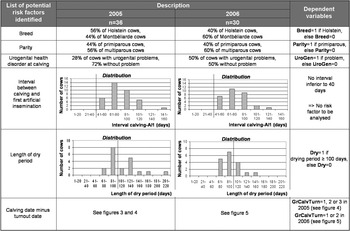
The potential risk factors listed thanks to our previous systemic approach were analysed so as to build discrete variables that could be used as dependent variables in logistic regression procedures (Figure 7). During this step, one of the six potential risk factors listed for each year was not translated into any dependent variable: as interval between calving and first artificial insemination was never inferior to 40 days, we considered that this interval was not the basis of any major risk of poor reproductive performance in the case of the GS. Breed, parity and urogenital health disorders were easily translated into binary variables. The length of the dry period was effectively quite variable within the herd (see Figure 7) and this variable was binarized using the median for 2005: 100 days. Calving date minus turnout date was translated into discrete variables by using the three groups presented in Figure 4 for 2005 and the two groups presented in Figure 5 for 2006.
From a list of potential risk factors to discrete dependent variables.

Carrying out statistical analysis with reproductive performance as independent variable
In 2005, 61% of the GS cows submitted for breeding were pregnant at the end of the breeding period (SUC = 1), whereas this success rate was only 27% in 2006. This difference was significant (P = 0.005). Success rate at the first insemination (AI1 = 1) was 44% in 2005 and 13% in 2006. This difference was also significant (P = 0.006).
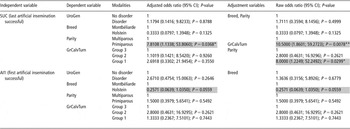
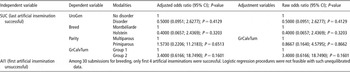
Results of the logistic regression procedures carried out to analyse different risk factors for each year are presented in Table 1 for 2005 and in Table 2 for 2006. Four main results were obtained in 2005: (i) primiparous cows presented a higher probability of reproductive success (SUC) than multiparous cows (P = 0.008). This result remained significant when adjusted with the date of calving with regard to the date of turnout. But there was no significant association between the parity and the success to the first insemination (AI1), (ii) the earlier the cows calved (GrCalvTurn, first group), the higher the probability of success to the last artificial insemination (SUC) (P = 0.003). But this result lost its significance when adjusted with the parity (P = 0.355). The calving date with regard to the turnout date was not associated with the success to the first insemination (AI1), (iii) breed was associated with success to the first insemination, in favour of the Montbéliarde cows (AI1) (P = 0.056), but breed was not found to be linked to the final result of the breeding period (SUC) (P = 0.133), (iv) urogenital health disorders at calving were not found to be associated with reproductive performance.
Results of the logistic regression procedures carried out for 2005

In grey: results for which P < 0.10.
*P < 0.05; **P < 0.01.
Results of the logistic regression procedures carried out for 2006

In 2006, no potential risk factor was found to be linked to the final reproductive success (SUC). It was impossible to carry out analyses with AI1 as independent variable, as data were too unequilibrated (see Table 2).
The effect of the length of the dry period was analysed for the multiparous cows in 2005 and for the multiparous cows in 2006. No association was found to be significant (not shown).
Interpreting statistical links
The result obtained in 2005 concerning the link between calving date minus turnout date and final reproductive success can be analysed in light of the previous study on the shapes of lactation curves. Cows in group 1 were those which calved long before turnout, did not have early beginnings of the declining phase of their lactation curves (Figure 4), and had a higher probability of final reproductive success (Table 1). Such observations put together tend to reinforce our hypothesis about a greater metabolic load for cows that calve after turnout, and subsequent difficulties with regard to reproduction. But this result was no longer significant when parity was taken into account. As a matter of fact, primiparous cows were more represented in group 1 than in group 3 (66% of primiparous cows in group 1; 0% in group 3). As parity was found to be linked to the final reproductive success (Table 1), even when adjusted with calving date with regard to turnout date, there may have been at least two different mixed effects explaining the better performance in group 1 than in group 3: a higher proportion of primiparous cows and a lower metabolic load at the beginning of the lactation. Last, a third potential explaining factor should be taken into consideration: as the breeding period is strictly delimitated in the GS operation, the earlier the cow calves, the more time it gains before the end of the breeding period to be inseminated, several times if necessary, and successfully fertilised. The latter explanation could help to interprate the contrast between the significant results obtained for the final reproductive success (concerning calving date with regard to turnout date) and the non-significant results for the success to the first insemination. Even if the cows which calved long before turnout had not been advantaged by a lower metabolic load at the beginning of their lactations, a better final reproductive performance could have been explained by the higher amount of time they had to be fertilised before the end of the breeding season. On the basis of Table 1, we finally formulated three different hypotheses corresponding to three types of biotechnical phenomena that could have confusing effects together: (i) primiparous cows have better reproductive performance than multiparous cows, (ii) cows which calve at the beginning of the calving season are advantaged by lower metabolic load at calving, (iii) cows which calve at the beginning of the calving season are advantaged by a higher amount of time to be fertilised. With such a dispositive with low effectives, it was not possible to better distinguish those three mixed effects. The result about the breed (better performance of the Montbéliarde cows at the first insemination) was less ambiguous, in so far as we did not identify any confusing factor to be taken into account as an adjustment variable.
Reproductive performance in 2006 was very poor, and no association was found to be significant with any of the factors that were considered to have significant influence on reproductive performance in 2005. As we have seen it previously, the study of lactation curves’ shapes (Figure 6) led us to formulate the following hypothesis: in 2006 winter feeding quality and grass quality were different in a way that enabled enhanced milk production at turnout, which may have caused metabolic disorder at turnout that could lead to impaired reproductive performance. Such hypothesis seems to be reinforced by the effective poor reproductive performance in 2006, whatever the breed, the parity and the date of calving.
Results of the second systemic approach: improving the situation
On the basis of the hypotheses formulated thanks to our analytical approach, some suggestions could be made in order to improve the reproductive performance of the GS. For example, as Montbéliarde cows seemed to have better performance than Hostein cows, it could have been suggested to progressively abandon the Holstein breed, for example by stopping inseminating with Holstein sires. But this idea was not consistent with some overall objectives of the GS: its decision makers had decided in 2004 to maintain two breeds for scientific reasons.
Another suggestion relied on the hypothesis that calving long before turnout could advantage the cows thanks to lower metabolic load at calving. It was suggested that the breeding season could take place earlier in the year so as to maximise the number of cows that would calve before turnout. This suggestion was not contradictory with the overall objectives of the GS. The dates of the breeding season (between 15 May and 15 August) had been decided so as to serve thrift purposes by making the start of lactation and high feed requirements correspond with the period of grass growth. But the optimal breeding period was probably misestimated for the GS case for which the use of concentrate is prohibited during the grazing period. There are tradeoffs to be observed between thrifty feeding, milk production and cow’s health. Changing the dates of the breeding period was considered as a way to better take these tradeoffs into consideration. It was then decided in 2007 that the breeding season would take place 1 month earlier in the year (between 15 April and 15 July). Results of this new strategy remain to be assessed.
Discussion
About the relevance of the methodological approach
The methodology we proposed in Figure 2 and applied in this paper enabled us to formulate new decision rules (changes in the dates of the breeding period) to improve the reproductive performance of the GS. The final aim of this methodology is to design preventive measures to make the system operate according to its overall objectives while minimising the risk of poor reproductive performance. Preventive approach is preferred to corrective approach, as the latter may compromise some of the system’s objectives because of the usual emergency of the situations that compel to corrective measures. For example, deciding to practice veterinary treatments or diet changes in the course of the breeding period may be entirely contradictory with the decision makers’ plan, for example in the case of organic systems or if the feeding strategy is at the core of the system’s operation. On the contrary, one particularity of our approach is that it explicitly takes the farmer’s plan into account and confronts it to all suggestions stemming from analytical analysis. Acceptability of such ‘external suggestions’ may be improved by this way (McCown, Reference McCown2002).
As it is the case with any approach based on rearing practices, our results are necessarily linked to the particular situation of the GS. Our objective is neither to directly transfer our final suggestions to any livestock farming system encountering reproductive problems nor to generalise the results of our statistical analyses. The relevance of our approach does not rely on explaining the biological phenomena underpinning impaired performance but on analysing some risk factors so as to be able to suggest new practices to improve a particular situation. In such a way, what is to be directly generalised is not our analytical results but the methodology. Nevertheless, the original risk factors we identified for that study (interval between calving and turnout, breed, parity, year) can form a set of potential risk factors to be examined in any other situation that would require reproductive performance to be analysed.
Transposability into commercial farms?
Our methodology was built from and applied to a system experiment. We have to discuss its transposability into commercial farms. Applying it to an experimental situation presents some obvious advantages compared with commercial situations. The first one is that many biotechnical data are routinely registered, which makes it possible to carry out precise analytical studies on their basis. In the case of the GS, it was also quite natural to formalise a plan, and data were easily accessible to build a precise ‘feeding and breeding calendar’ so as to represent the strategic pattern. In the case of a commercial farm, it would probably be more difficult to formalise a plan and a representation of the strategic pattern. But some methodologies of LFS research do exist which either help to understand the objectives of a commercial farm or to formalise its operation, although none of them was specifically conceived to understand and improve a given biotechnical problem encountered in the farm. To access to the system’s general objectives, the AGEA method or the GEEA method (Capillon and Manichon, Reference Capillon and Manichon1988; Bonneviale et al., Reference Bonneviale, Jussiau, Marshall, Bonneau and Capillon1989) cited in the introduction of this paper may be useful. To access to the strategic pattern with a focus on the feeding strategy, a development methodology, based on the rearing practices, has been formalised (Moulin et al., Reference Moulin, Girard and Dedieu2001).
From reproductive problems to any biotechnical problem encountered on farm?
The methodology presented in this paper aims at addressing reproductive problems in dairy herds. But further developments could be made so as to transpose it to any biotechnical problem encountered on farm. The general structure of the methodology would probably be kept: a systemic approach to build the terms of the problem, an analytical approach to better understand the biotechnical phenomena underpinning the problem encountered, and back to a systemic approach to suggest new practices to improve the situation. Methods to address specifically the problem encountered would have to be developed, such as the analysis of the lactation curves’ shapes to better understand reproductive performance.
Conclusion
Combining both analytical and systemic approaches appeared to be efficient to understand and improve reproductive performance in a dairy system. The systemic investigation aimed at considering reproductive performance as the result of the consistencies of a whole system. It made it possible to formalise a list of potential risk factors that were relevant for the particular case of the GS operation. The analytical approach (analysis of the shapes of the lactation curves and analysis of the links between the potential risk factors and reproductive performance) enabled us to formulate some hypotheses concerning the biotechnical phenomena underpinning impaired performance. Such hypotheses involved the breed, the parity, the year and the date of calving with regard to the date of turnout. They made it possible to suggest some strategic changes in herd management so as to improve reproductive performance.
Analytical methods (analysis of the shapes of the lactation curves and logistic regression procedures) helped to analyse the questions raised by the systemic building of the problem. In such a way, both approaches were necessary to carry out an effective problem-oriented research.
The methodology proposed in this paper, mixing both systemic and analytical approaches, is quite difficult to generalise because understanding the consistencies of a whole system is time-costly. Moreover, as far as we know, no systematic methodologies are available to gain an in-depth understanding of the system, which enables us to find out the relevant phenomena related to a given problem in a given livestock farming system. Nevertheless, in the current context of agriculture made of change and uncertainty, it is of crucial importance to build some innovative research methodologies that make production of scientific knowledge meet practical action at farm level. The study presented in this paper can be regarded as an attempt to consider this option.
Acknowledgements
The authors wish to thank all the staff from the INRA experimental research centre of Mirecourt for data collecting, Pr Stéphane Robin for helping with the statistical analysis, Pr Daniel Sauvant for suggesting the use of PCA to study the shapes of the lactation curves, and anonymous reviewers for helpful suggestions. This review is based on an invited presentation at the 59th Annual Meeting of the European Association for Animal Production held in Vilnius, Lithuania during August 2008.