Implications
The present work shows a detrimental effect of controlled atmosphere stunning (CAS) on the quality of fatty liver in both ducks and geese. In the actual state of knowledge and in the technical conditions described in this work, we should not recommend the use of CAS under commercial conditions, even though we showed in the same work that CAS had positive effects on the appearance defects and quality of carcass and meat (see associated paper).
Introduction
During the past decade, the French production of ‘foie gras’ has strongly increased from about 15 000 in 2000 to 20 000t nowadays. Most of this production is represented by duck liver, geese liver accounting for only 500 t. France is the top producer and consumer of ‘foie gras’ in the world. French ‘foie gras’ is a high-quality standard product with strong added value. The commercial value of ‘foie gras’ as a raw material is dependent upon two main quality traits: the overall aspect (absence of appearance defects leading to downgrading) and the ability to retain fat during the cooking process.
In poultry species, it has long been reported that the stunning operation is one of the main factors of variations in the incidence of carcass and meat appearance defects (see, for instance, the review by Raj (Reference Raj1995)). Specific works on force-fed ducks and geese are scarce. Hungarian scientists have compared electrical v. controlled atmosphere stunning (CAS) for their effects on the incidence of haemorrhages in meat and fatty liver of geese (Turcsán et al., Reference Turcsán, Szigeti, Varga, Farkas, Birkás and Turcsán2001). They confirmed previous data obtained in other poultry species and showed a beneficial effect of CAS on the incidence of appearance defects in meat (haemorrhages), but they failed to show any effect of the techniques on the visual quality of goose liver. The same team compared various combinations of voltage and frequency during electrical water-bath stunning in geese. They demonstrated an increase in the visual quality of the liver with the use of current frequency above the standard 50 Hz AC (350 Hz) (Turcsán et al., Reference Turcsán, Varga, Szigeti, Turcsán, Csurák and Szalai2003). However, these data were obtained with individual currents ranging from 65 to 90 mA, which are far below the European recommendation of 130 mA per bird for an efficient stun of geese and ducks in a water bath. In our laboratory, we have studied the effect of current intensity, stunning duration and current frequency during the water-bath stunning of overfed geese, on blood loss and fatty liver downgrading (Fernandez et al., Reference Fernandez, Leprettre, Dubois, Auvergne and Babilé2003). We showed an overall detrimental effect of electrical stunning in a water bath on the quality of the liver but this effect was slightly attenuated with high frequency AC current (1200 Hz). Here again, the currents used did not reach the recommended values since previous works had shown detrimental effects of high currents (>100 mA) on the quality of goose liver (S. Leprettre, unpublished observations).
The available data on the impact of stunning methods on the quality of liver from force-fed animals concern only geese and most of these works use electrical stunning in a water bath with currents lower than the recommended value. There is, therefore, a strong need for reference data on the effects of the stunning methods on the quality of carcass and liver on ducks, the latter being the main source of ‘foie gras’ in France, and geese, and using stunning methods commonly recognized as humane methods.
The present study compared electrical (water-bath or head-only) stunning, CAS and mechanical stunning for their effects on the quality of carcass, meat and fatty liver in ducks and geese. This paper reports the results obtained for the quality of fatty liver (or ‘foie gras’).
Material and methods
Animals, breeding and overfeeding
The male mule ducks (Cairina moschata × Anas platyrhynchos) used in this study (n = 150) were reared collectively in a poultry house under natural conditions of light and temperature, under the facilities of the Agricultural College of Périgueux (LEGTA, 24, France). They were reared, until the age of 12 weeks according to standardized practices (Molee et al., Reference Molee, Bouillier-Oudot, Auvergne and Babilé2005). They were then overfed in collective cages (four animals/cage) during 12 days, by the distribution of a soaked-corn mixture (grain-flour; 42% to 58%) twice daily.
Male geese (n = 160) from the French Landes grey breed were used in this experiment. The animals were raised at the Station of Goose Breeding (Coulaures, 24, France) until the age of 13 weeks, following standardized practices (Leprettre et al., Reference Leprettre, Babilé, Auvergne, Dubois, Manse and Verdier1997). They were then overfed in collective pens (eight animals per pen; pen size 3 × 1 m) during 18 days. Overfeeding was achieved by the distribution of a soaked-corn mixture (grain-flour; 42% to 58%) in four meals per day, using a hydraulic machine, as previously described (Fernandez et al., Reference Fernandez, Leprettre, Dubois, Auvergne and Babilé2003).
Stunning and slaughter
Ducks and geese were slaughtered in the experimental slaughterhouse of the Agricultural College of Périgueux on two different days (one day – one species). Since the ducks were reared and force-fed on the same site, they were slaughtered from 8 h after the last meal but without being road-transported, whereas the geese were transported for approximately 30 min between the experimental farm and the slaughterhouse, and were slaughtered from 10 h after the last meal. The rate of slaughtering was 30 birds/h and the overall process lasted for about 5 h. Slaughter rank was recorded but the stunning treatments were alternated in order to avoid confusion between stunning treatment and slaughter rank.
The following stunning techniques were applied after the birds have been weighed:
• Water-bath: The animals were suspended individually from a shackle with their head downwards and the contact between the shackle and the legs was wetted. The head and upper neck were plunged into a water bath and an isolated constant current (AC, 130 mA; 50 Hz) was applied for 4 s between the water and the shackle. For this purpose a constant current generator designed by the Silsoe Research Institute (Silsoe, UK) was used.
• Head-only: The animals were suspended individually from a shackle with their head downwards. The feathers on the head were wetted to improve the current flow through the skull. A 600 mA, 50 Hz AC was applied during 4 s via two 2-cm diameter spiked electrodes fixed on a scissors-type tong. The generator was designed and constructed by DLC Instrumentation (Naintré, 86, France). Earlier work in our laboratory, based on electroencephalogram analysis, has shown that this intensity of 600 mA is required to ensure a satisfactory stun, on welfare grounds, in force-fed mule ducks (Beyssen et al., Reference Beyssen, Babilé and Fernandez2004). In geese, however, we have been unable to achieve an acceptable stun with current intensities reaching up to 1 A (X. Fernandez, unpublished results). Therefore, in the present study, this technique was used only for ducks.
• CAS: Controlled atmosphere stunning was carried out on individual birds using a two-phase system. They were first plunged for 2 min in a mixture of CO2 (40%)–O2 (30%)–N2 (30%) and then immediately exposed to an atmosphere containing more than 85% CO2 in air (less than 2% O2) for 2 min. In previous works, we have demonstrated that this technique was suitable for the stunning of force-fed ducks and geese from the point of view of bird welfare (Fernandez et al., Reference Fernandez, Auvergne, Santacruz, Seidlinger, Leprettre, Dubois and Babilé2006). The CAS experimental equipment was designed and constructed in our laboratory.
• Mechanical: The animals were suspended individually from a shackle with their head downwards. They were stunned using a spring-handled penetrative bolt (6 mm diameter). The bolt was placed on the medium line of the skull, 1 cm back from the line joining the eyes (this position corresponds to the top of the skull). The shot profoundly damages the brain and creates an immediate and irreversible state of unconsciousness (Lambooij and Pieterse, Reference Lambooij and Pieterse1997).
All birds were slaughtered by a ventral cut of neck blood vessels within 10 s after the end of the stun.
Fatty liver sampling and measurements
At approximately 20 min post mortem, the carcasses were eviscerated and the liver was removed, weighed, placed in a chilling room and stored until early afternoon (on average 5 to 6 h after slaughter). At this time, the core temperature in the liver was below 7°C.
Colour was measured along the ventral face of the big lobe of the liver using the trichromatic CIE Lab coordinates system (L*, a*, b*), thanks to a CR 300 Minolta chromameter. The average of three measures done at different sites (top, middle and bottom of the large lobe) was computed on each liver.
Liver appearance defects were then subjectively scored by a trained research staff (12 persons) on a 4-point scale: 1 (absence of the defect), 2 (slight presence), 3 (moderate presence) and 4 (severe presence). The following defects were scored: overall red colour of the liver, engorged veins, red colour of the big lobe tip, superficial haemorrhages (can be easily scraped off with a knife), deep haemorrhages (require a significant trimming) and petechial haemorrhages.
At the same time, a commercial grading was carried out by a person coming from the industry and trained to classify the raw fatty liver according to their potential commercial use. The livers were graded on a 4-point scale: from 1 (best commercial class corresponding to livers with no defects, appropriate texture, usually dedicated to the processing as entire-canned livers) to 4 (the levels 2, 3 and 4 corresponding to increasing levels of defects, regarding either visual aspect or texture, and correspondingly, to decreasing commercial value, since they are dedicated to processed products with much less added-value than entire fatty livers).
Canned liver processing and cooking loss measurements
After the different scorings, the livers were prepared for processing. The main blood vessels were carefully removed. A slice of approximately 200 g was excised perpendicularly to the long axis of the liver and across the big and the little lobe. This 200 g sample was put in a glass can. Salt (12 g/kg) and pepper (2 g/kg) were added and the cans were closed and cooked for 1 h in water at 85°C, under a pressure of 0.8 bar. After 30 min chilling, the cans were removed from the autoclave and stored at +4°C.
After 2-month storage, the cans were opened and the cooked liver was carefully dissected from all visible fat. The amount of fat loss during the cooking was expressed as percentage of initial liver weight.
Sensory analysis
A second can was processed as described above and subjected to the sensory analysis that was carried out by the ADIV (63, Clermont-Ferrand, France) after 2-month storage at +4°C. Livers from ducks and geese were analysed separately. The analyses were made on 12 livers per treatment, randomly chosen among the ∼30 animals. The livers were evaluated individually by a trained panel of 12 members, at room temperature. The order of presentation followed a factorial design in order to take into account the effect of rank. The sensory attributes (listed in Figure 2) were scored on a 7-point discrete scale from 1 = very low to 7 = very high intensity.
Statistical analysis
Analyses of variance were performed using the GLM procedure of SAS (SAS, 1989). The model included the main effect of stunning technique. Slaughter rank was used as a covariate. Where appropriated, differences between means were tested using Duncan’s multiple range test. The test of χ 2 was used to analyse the effect of stunning treatment on the distribution of scores for appearance defects.
Data from sensory analyses were treated through the SAS system, using non-parametric methods of variance analysis and mean comparisons (Kruskall Wallis and Wilcoxon tests).
Results and discussion
Liver weight, colour and cooking loss
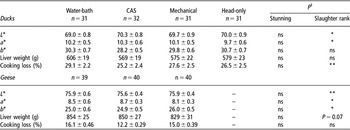
Liver weights at slaughter were in the usual range for this type of production and were not affected by the stunning treatment (Table 1). Liver weight depends mainly on long-term production factors (Leprettre et al., Reference Leprettre, Babilé, Auvergne, Dubois, Manse and Verdier1997) and on the duration of feed withdrawal before slaughter (Leprettre et al., Reference Leprettre, Auvergne, Manse, Babilé, Dubois and Candau1998), but not on acute pre-mortem factors such as stunning treatment.
Trichromatic coordinates, weight and cooking loss of fatty livers from ducks and geese according to the stunning method and slaughter rank (data are shown as mean ± s.e.)

CAS = controlled atmosphere stunning.
1Level of significance of the effects of stunning method or slaughter rank: **P < 0.01; *P < 0.05; ns, P > 0.10.
In ducks and geese, neither the trichromatic coordinates were affected by the stunning treatment, nor were the fat loss. Differences in the bleeding rate between the present stunning treatments were reported for both species (see the associated manuscript, Fernandez et al. (in press)). Variations in bleeding rate are expected to be associated with differences in residual blood in the carcass, and more specifically in the liver since in poultry species, vital organs, such as the liver, appear to retain the largest amount of residual blood (Kotula and Helbacka, Reference Kotula and Helbacka1966). The present results do not support this hypothesis since differences in bleeding rate were not associated with differences in liver colour, and more specifically with the red index a*. Furthermore, our results support previous findings showing no difference in liver colour between geese stunned by the CAS or the water bath (50 Hz, 50 V, 75 mA, 8 s) technique (Turcsán et al., Reference Turcsán, Szigeti, Varga, Farkas, Birkás and Turcsán2001).
Several items were however significantly affected by slaughter rank (Table 1). The corresponding Pearson correlations are showed in Table 2. The ducks slaughtered later (with a greater last meal-to-slaughter delay) had fatty livers that were darker (decrease in L*), redder (increase in a*) and lost more fat during heating. The geese that have been waiting longer before slaughter tended to lose liver weight (Table 2). The response in liver colour was inverted compared to the data obtained in ducks: the livers were lighter and less red when the slaughter rank increased (Table 2). The loss of liver weight with increasing slaughter rank observed in geese is consistent with concomitant increase in the last meal-to-slaughter delay. The effect of this delay was not observed in ducks. It should be stated however, that overall, the effect of slaughter rank is of low magnitude since it explains 2% to 7% of the variability in the different items.
Pearson correlations between fatty liver traits and slaughter rank in ducks and geese

Level of significance of Pearson correlations: **P < 0.01; *P < 0.05.
Bouillier-Oudot et al. (Reference Bouillier-Oudot, Laurent, Leprettre, Auvergne, Dubois and Babilé2004) have studied the effect of the last meal-to-slaughter delay on several characteristics of geese livers. They showed that the increase in this delay induced a decrease in liver lightness (L*, we observed the reverse), redness (a*, as in the present case) and weight (as in the present case). Overall, the effects of slaughter rank observed in the present study do not strictly reflect the type of responses expected from variations in the last meal-to-slaughter delay. Other factors linked to the slaughter rank probably affected the characteristics of livers.
Appearance defects and commercial grading
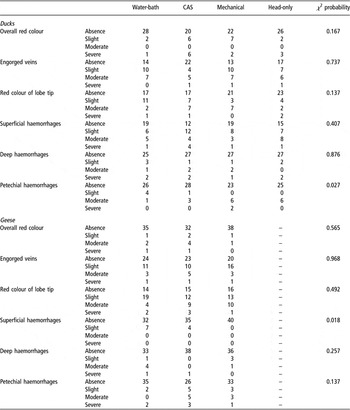
The distribution of the scale values for liver appearance defects are shown in Table 3. In ducks, the incidence and the severity of petechial haemorrhages were significantly affected by the stunning treatment. The mechanical and head-only stunning techniques were associated with the highest incidence of livers showing moderate and severe petechial haemorrhages, compared to water-bath and CAS. None of the other appearance defects was significantly affected by the stunning treatment (Table 3). As already stated in the associated manuscript (Fernandez et al., in press), mechanical and head-only stunning were associated with the highest incidence and severity of convulsions and wing flapping during bleeding. It is likely that these behavioural and associated physiological responses are the cause of the higher incidence of petechial haemorrhages in the liver because they induce an increase in blood pressure. However, it is of interest to note that the incidences of other appearance defects such as superficial and deep haemorrhages in ducks livers were not significantly increased after mechanical and/or head-only stunning. The mechanical effects of these stunning techniques on the liver, during the convulsions and the wing flapping, were apparently not strong enough to induce a significantly higher incidence of haemorrhages compared to water-bath stunning or CAS. As already shown by Turcsán et al. (Reference Turcsán, Szigeti, Varga, Farkas, Birkás and Turcsán2001), and taken each appearance defect individually, there was no difference in duck liver downgrading between the CAS and the water-bath stunning methods. According to these authors, the position of the liver in the body makes it less susceptible to the effects of electrical and gas stunning than breast and thigh muscles that were shown to be affected by the stunning technique.
Distribution of scale values for appearance defects of fatty livers in ducks and geese, according to the stunning method

CAS = controlled atmosphere stunning.
Data are reported as number of animals not showing (absence) or showing the defect at a slight, moderate or severe level.
The effect of the stunning technique on petechial haemorrhages in duck livers was not found in geese (Table 3). In this species however, the mechanical stunning prevented the apparition of superficial haemorrhages (Table 3), whereas this defect was observed after water-bath stunning and CAS but with a low severity (no livers showed this defect at a moderate or severe level).
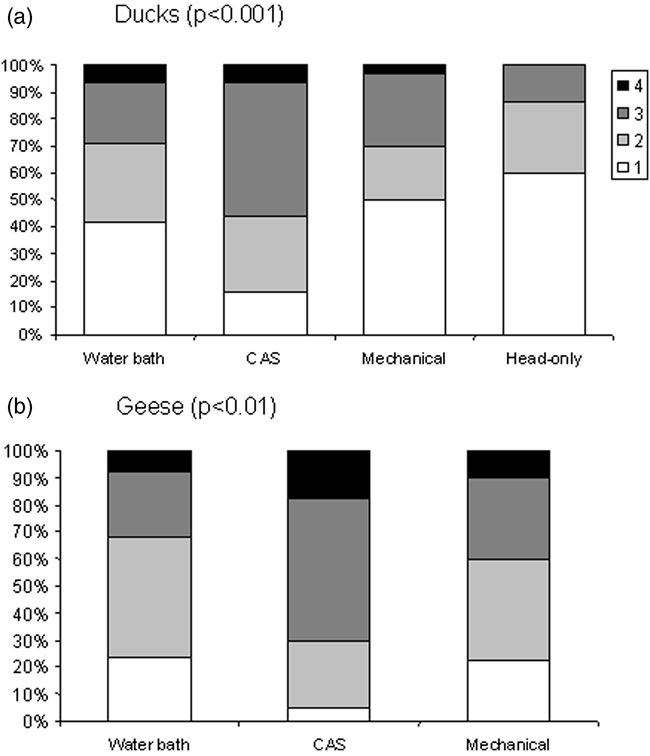
As shown in Figure 1, the commercial grading of ducks and geese livers was significantly affected by the stunning method. In both species, the CAS technique was associated with the lowest scores. In ducks for instance, the proportion of livers graded in the first class – corresponding to livers that offer the best added value – ranged from 40% to 60% after water-bath, mechanical and head-only stunning, whereas only 15% of the livers from the ducks stunned with the CAS technique were in the best commercial grading class. A similar effect was observed in geese even if the average commercial quality of the experimental population was lower than for the ducks (the proportion of liver in the first class ranged from 5% to 25%) (Figure 1).
Distribution of commercial grading scores of fatty livers from ducks (a) and geese (b), according to the stunning method (commercial grading scores rank from 1 to 4 corresponding to the best and worst commercial value, respectively).
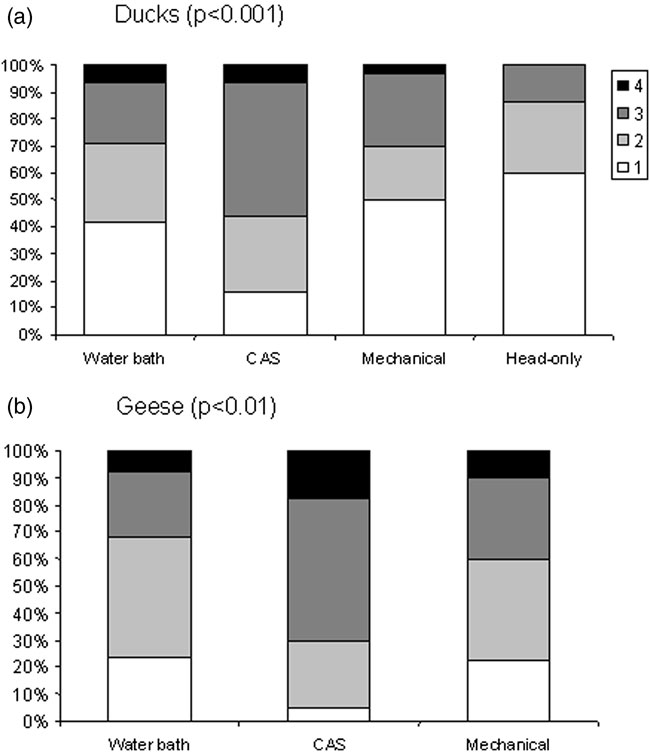
It may seem surprising that there is no clear correspondence between the commercial grading of fatty livers – showing the detrimental effects of CAS stunning – and the scale values for appearance defects. Indeed, stunning techniques had little influence on appearance defects and when significant, they were not to the detriment of CAS stunning. The scale value of appearance defects may be considered as a subjective evaluation of each parameter, independently one of each others, carried out by a trained research staff. The commercial grading, though carried out by a trained person from the industry, is the subjective combination of various characteristics of the liver such as weight, overall colour, appearance defects and texture.
In an attempt to quantify the overall quality of the livers with regards to the appearance defects, we calculated an overall defect score as follows:

where,
• i = the ith appearance defect that has been scored on the 4-point scale (six defects in total, as shown in Table 3);
• ni /1…4 = the number of livers in the 1, …, 4 scale value, corresponding to absence (value 1) to severe (value 4), and for the ith defect;
• each ni is multiplied by a weight factor arbitrarily chosen as 1 to 4, for absence of the defect to presence of severe defect, respectively;
• nt is the number of livers scored in the corresponding stunning treatment.
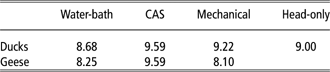
Results of this calculation are presented in Table 4. The livers from ducks and geese stunned with the CAS technique clearly showed the highest overall score for appearance defects. This is in agreement with the results from the commercial grading showing the lowest commercial value after CAS (Figure 1). This further shows that, taken individually, the appearance defects evaluated as described in the present study, cannot predict the commercial grading of the liver. Taken together, the overall score and the commercial grading clearly show the detrimental effect of CAS on liver quality, thus contradicting the previous findings of Turcsán et al. (Reference Turcsán, Szigeti, Varga, Farkas, Birkás and Turcsán2001).
Average score for livers’ appearance defects according to stunning technique
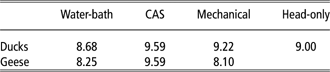
CAS = controlled atmosphere stunning.
Calculation of the average score is described in the ‘Results and discussion’ section.
Sensory characteristics
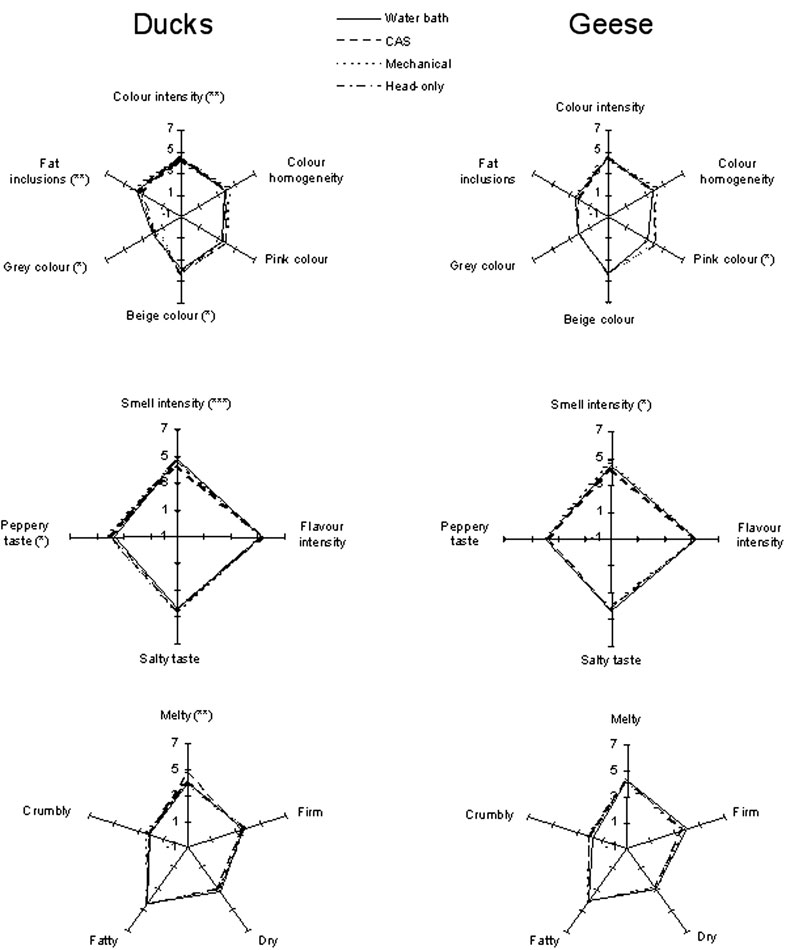
The distribution of sensory scores is shown in Figure 2 for ducks and geese. Though significant effects were recorded for several parameters, an overall view of the sensory profiles indicated that there were no clear-cut differences between the stunning techniques.
Distribution of scores for various sensory properties of fatty livers according to stunning technique in ducks and geese. The effect of the stunning technique is reported as *P < 0.05; **P < 0.01; ***P < 0.001.
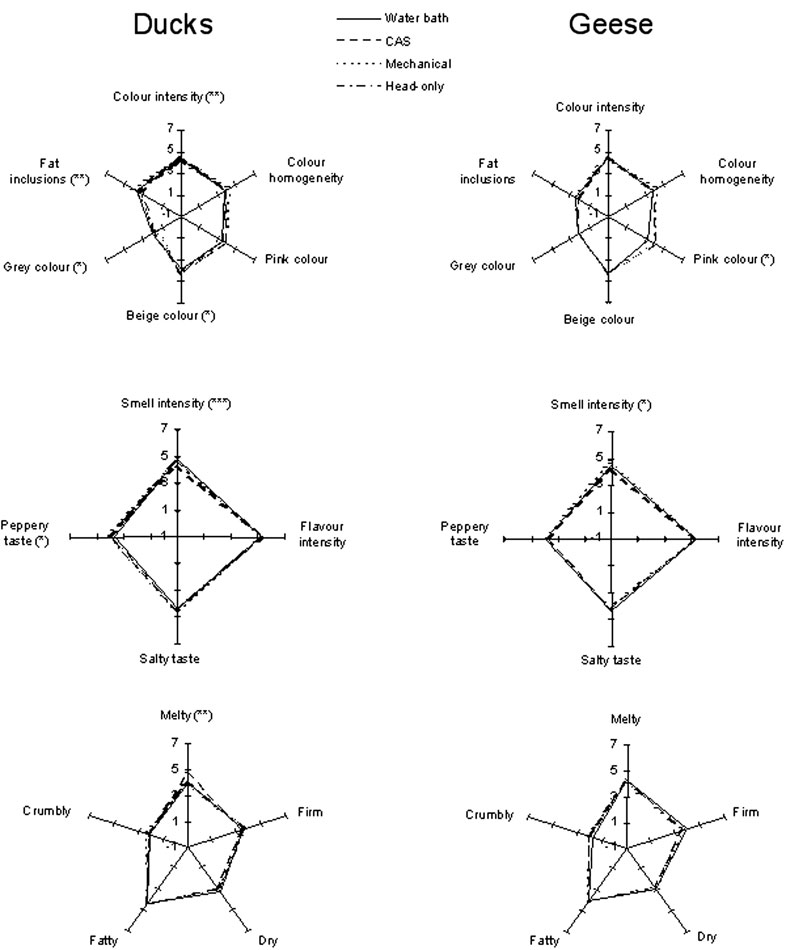
In ducks, colour intensity was significantly lower after electrical stunning (water-bath and head-only; score 4.6) than after CAS or mechanical stunning (score 4.3) (P = 0.008). The livers from ducks slaughtered after CAS showed the lowest score for smell intensity (4.3 v. 4.9 for the highest, i.e. water-bath) (P = 0.0007) whereas they had the best evaluation for the melty texture (4.7 v. 3.9 for the lowest, i.e. mechanical stunning) (P = 0.006). The CAS and mechanical stunning treatments showed the highest scores for peppery taste (4.3 v. 3.7 for the lowest, i.e. water-bath) (P = 0.032).
Most of the sensory traits of geese liver were unaffected by the stunning treatment (Figure 2). Smell intensity showed the same pattern of differences between the stunning techniques as in ducks: the lowest score (4.2) was recorded after CAS, v. 4.5 and 4.8 for water-bath and mechanical stunning, respectively (P = 0.028). In addition, the score for pink colour was significantly lower after water-bath stunning (3.2) than after mechanical stunning (3.8) or CAS (4.0) (P = 0.043).
Overall, the effects of the stunning treatments on the sensory traits of fatty livers were of low magnitude and the observed differences are difficult to explain on the basis of the differential responses to the various stunning treatments under study.
Conclusions
The main finding of the present work is that CAS has detrimental effects on the commercial grading of fatty livers in ducks and geese. This effect is most likely due to an overall higher incidence of appearance defects after CAS. The physiological mechanisms underlying the effect of CAS on fatty liver qualities deserve further investigations.
Acknowledgements
The authors wish to thank Mrs H. Manse for the practical organization of the experiment and Mr S. Seidlinger for expert assistance with the handling of the CAS equipment. Ducks and geese were slaughtered and processed under the facilities of the Lycée Agricole de Périgueux (LEGTA, 24, France). The authors are indebted to François Hérault (LEGTA) for technical supervision of the slaughter process. The sensory analysis was carried out at the ADIV, Clermont-Ferrand (63, France). We thank Mrs Sylvie Gilbert (ADIV) for expert assistance in this field. The financial supports of INRA, CIFOG, Office de l’Elevage and French Ministry of Agriculture enabled the implementation of this programme.