1. Introduction
Political parties play a key role in a modern representative democracy by providing structure to political competition in elections and legislatures, facilitating voter representation and accountability, and mobilizing voters. Parties' ability to fulfill their functions depends crucially on their stability and unity. Research has therefore analyzed extensively the causes and consequences of parties' disunity, especially in the context of legislative voting.
Occasionally, however, party unity breaks to such an extent that the party splits permanently: some of its members establish a new splinter party that competes with the rump party in the next electoral cycle.Footnote 1 The outcomes of this post-fission competition vary greatly. For example, the Popular Unity party in Greece, established by the MPs of the Syriza party who disagreed with the terms of the EU Greek bailout, gained less than 3 percent of the vote in the September 2015 election, while Syriza lost less than 1 percentage point of its vote in comparison to the previous election. In contrast, the Social Democratic Party in the UK (established in 1981 by a group of deputies from the Labor party) won a respectable 11.6 percent of the vote in the 1983 general election. As a result of this split, the rump Labor party obtained only 27.6 percent of the vote, thus losing more than 9 percentage points of its support relative to the 1979 election. In other cases the splinter party performs even better than the rump party. This was the case in the 1998 election in Denmark, when the Progress Party received 2.4 percent of the vote, while its splinter, the Danish People's Party, gained 7.4 percent.
What factors determine this substantial variation in parties' aggregate electoral support after splits? Currently, the scholarship lacks a satisfactory answer to this question. Neither the descriptive patterns of parties' electoral support after splits nor the factors explaining these patterns have been examined in a systematic comparative study.Footnote 2 The present research addresses this gap by elaborating an argument that the vote shares of rump and splinter parties in the first election after fission depend on the strength of their membership organizations and the appeal and name recognition of their candidates. The empirical test based on a new dataset covering 25 EU member states in the post-war period supports these hypotheses.
Understanding the variation in parties' electoral support after fission is important because splits are a frequent phenomenon in many countries. As discussed below, more than one third of electoral periods included in the sample analyzed in this study witnessed the emergence of a splinter party. Voter response to splits determines their impact on party system stabilization and change regarding the number and identity of relevant parties and the patterns of cooperation and competition among them. Splits can change the legislative strength of parties and their bargaining power in a single legislative period (Laver and Benoit Reference Laver and Benoit2003). Party fission can be even more consequential if/when splits are followed by a substantial electoral change. The first election after the schism is particularly crucial, as it shows whether the splinter party has the potential to become a viable player on the long term, and whether the rump party is likely to remain relevant after its split. In established party systems, the electoral change related to fission may be significant enough to change radically the patterns of party competition and cooperation, as for example in Ireland after the emergence of the Progressive Democrats (PD) as a splinter party of Fianna Fail in the late 1980s. In young party systems, frequent splits that lead to the redistribution of parties' support could impede the emergence of a stable set of parties and structured patterns of cooperation among them. This usually translates into low levels of citizens' trust in political parties and poor quality of representation and electoral accountability.
This study improves our understanding of these key processes of party system change and stabilization by uncovering conditions under which splits are likely to have important electoral consequences. Specifically, the findings indicate that the most established explanations of the initial electoral performance of new parties (institutional thresholds, party competition and electoral demand) are less relevant than “internal supply” factors (party membership organization and candidate quality) for understanding the electoral support of the splinter type of new parties.
This research also attends to the question of whether broad theories of the electoral success of established parties are applicable to the contexts where these parties experience organizational secessions. Recent individual-level analyses suggest that under conditions of party instability voters are more likely to be swayed by their feelings towards party leaders and are less likely to vote based on the perceptions of economic performance (Marinova Reference Marinova2016). The present research supports the former finding but qualifies the latter by showing that at aggregate level economic factors have a strong effect on the support of incumbent parties that split. Also, some scholars demonstrate that splits lead to the substantial electoral losses or even electoral marginalization (Bakke and Sitter Reference Bakke and Sitter2013; Beyens et al. Reference Beyens, Lucardie and Deschouwer2016). However, not all splits have the same effect on party electoral support and persistence as illustrated by the examples discussed above. The present study uncovers the conditions under which splits have stronger effects on the support of established parties.
2. Explaining party success after splits: electoral demand and political opportunity structure
The strength of partisan attachments, well-developed and stable cleavages and economic conditions are key demand-side explanations for the stability in the electoral support of established parties and the electoral success of new parties. Established parties are less likely to lose support and new parties are less likely to gain it when the electorate has strong partisan attachments to established parties, when the latter are embedded in well-developed and stable cleavages and when economic conditions are good.
However, the specific context characterizing the emergence of splinter parties potentially makes these factors less appropriate for understanding electoral competition after party splits. Specifically, the research on new party success rarely theorizes the organizational and programmatic links between the splinter and the parent party that makes the former less “new” in comparison to a genuinely new party (Barnea and Rahat Reference Barnea and Rahat2011). In the same vein, broad theories of the electoral support and stability of established parties do not consider the implications of the context in which these parties have to compete with their own splinters.
Once this specific context is considered, it is likely for the splinter party to attract some partisan voters of its parent party by claiming to be a “true” representative of its identity. Similarly, both rump and splinter parties, as successors of the parent party, can credibly claim to be representatives of the same social groups associated with this party. Furthermore, while poor economic conditions could increase the support of new parties (Tavits Reference Tavits2008), splinter parties might not be able to benefit from voter frustration about the mismanagement of the economy if voters associate them with the unsuccessful policies of their parent parties in office. Splits may also weaken the effect of economic factors on the electoral performance of incumbent rump parties. Organizational change following splits may prevent voters from attributing to them the responsibility for economic outcomes (cf. Powell and Whitten Reference Powell and Whitten1993) or infer their competence in managing the economy in the future based on their record (Marinova Reference Marinova2016, 89).
Turning to political opportunity structures, new parties tend to be more successful (and established parties more vulnerable) under more proportional electoral institutions or party funding regimes that do not favor established parties (Hug Reference Hug2001). However, by attracting prominent elites from the parent party, splinter parties may find it easier (in comparison to genuinely new parties) to establish electoral or financial viability even in adverse institutional contexts. Also, spatial models of party competition suggest that the electoral success of both established and new parties depends on their distance to their competitors on key dimension(s) of competition. However, voters may not be able to differentiate or may discount the ideological differences between splinter and rump parties, at least in the first election after a split.
3. Party candidates and members
Apart from the aforementioned research, a smaller number of studies on new parties suggest that new party's resources matter for its initial success. For example, Bolin (Reference Bolin2010), Lucardie (Reference Lucardie2000) and Sikk (Reference Sikk2006) argue that the new party needs members, leadership, media access and money to become visible to the electorate as a credible contender. Without spending sufficient resources to promote its message, the new party is unlikely to attract many voters. Scholars of new radical right parties have also emphasized the importance of leadership and organization, although these effects are debated in the literature (see Mudde Reference Mudde2007 for a review of these arguments). This is mainly because systematic empirical tests of the effect of resources of new parties on their success remain an exception in the literature (Golder Reference Golder2016, 489). However, several case studies on splits suggest that the electoral success of rump and splinter parties depended on the personal popularity of their leaders and candidates (Aimer and Vowles Reference Aimer and Vowles1993; Crewe and King Reference Crewe and King1995; Rybár and Deegan-Krause Reference Rybár and Deegan-Krause2008) and the strength of party organization (Hanley Reference Hanley2008; Luther Reference Luther, Bischoff and Plasser2008).
These arguments are also in line with the criticisms of other explanations outlined above. Thus, in contexts where group loyalties, partisanship, economic performance, party programmes or electoral viability potentially provide only limited cues to voters when choosing between rump and splinter parties, such considerations as the personal appeal of parties' candidates and leaders and their membership strength are likely to have an important effect on vote choice. Specifically, the electoral performance of the splinter party may be improved if the elites of the parent party that join it have high name recognition, thus increasing the splinter party's visibility to the electorate. More importantly, the splinter party may benefit from the personal electoral appeal of the switcher elites. A number of studies in the voting behavior literature indicate that personal voting, due to the policy positions, the perceived competence and personalities of leaders and candidates, matters for voters' party choices (e.g., McAllister Reference McAllister2007; Rahat and Sheafer Reference Rahat and Sheafer2007).
Conversely, the rump party that loses leaders and candidates with high name recognition and/or personal appeal is unlikely to be able to replace them with the politicians of equal standing, at least not before the next parliamentary election. In line with this argument, I propose the following two hypotheses:
H1:
The electoral support of the rump party is lower if the candidates of the splinter party have high name recognition and personal appeal.
H2:
The electoral support of the splinter party is higher if its candidates have high name recognition and personal appeal.
Large membership is also important for the electoral success of both rump and splinter parties. Party members provide a pool of loyal voters, spread the party's message through their personal social networks, serve as a workforce that can effectively mobilize electoral support for the party during electoral campaigns, inform the party about the public opinion at grass-roots level, and signal the legitimacy of the party to the electorate (Tavits Reference Tavits2013; Scarrow Reference Scarrow2015).Footnote 3 Thus, large membership helps splinter parties to establish themselves as viable contenders, while for rump parties, it is a way to assure their continued relevance following a split. Based on this logic, I expect that:
H3:
A larger membership of the rump party increases its electoral support.
H4:
A larger membership of the splinter party increases its electoral support.
One potential concern with these hypotheses is that candidates and members may select between rump and splinter parties depending on their expected electoral support. However, as the previous section indicates, the uncertainty about electoral consequences of splits is expected to be high. Although no systematic public opinion polling data is available, anecdotal evidence suggests substantial changes in parties' standings in polls after splits. For example, immediately after its split from the Civic Democratic Party (ODS) in early 1998, the splinter Freedom Union in the Czech Republic had substantially higher support in polls than its parent party (Hanley Reference Hanley2008, 138) even if in the election six months later its vote share was only one third of that of the ODS. High uncertainty about the electoral support of rump and especially splinter parties reduces the attraction of these parties to potential members who seek to achieve certain policy outcomes or promote their political careers. The research on party organization also provides little support to the argument that changes in party membership are driven by expectations of their electoral support (Tavits Reference Tavits2013). Similarly, while systematic research on candidates' affiliation decisions after splits is limited, explanations of splits emphasize electoral institutions and policy and office motivations of party elites rather than their expectations about party's future electoral performance (Ceron Reference Ceron2015).
The literature also suggests important counter-arguments on why the hypotheses presented above should not hold. Specifically, some scholars have stressed that the effects of leader and candidate evaluations on vote choice are limited (King Reference King and King2002). Similarly, a number of studies question the impact of party organization on parties' electoral performance (Tavits Reference Tavits2013, 36–38). Furthermore, studies on radical right parties argue that party organization is important only for their electoral consolidation and persistence but not for an initial breakthrough (Carter Reference Carter2005; Mudde Reference Mudde2007; Art Reference Art2011). These counter-arguments suggest that there is a certain level of theoretical ambiguity/controversy in the scholarship over the effect of these two explanatory factors and provide further theoretical justification for testing the aforementioned hypotheses systematically in a large-n analysis.
4. Data and measurement
The theoretical expectations are tested using an original dataset on party splits that occurred in 25 member states of the European Union in the post-war period.Footnote 4 The analysis includes the splits of the parties that obtained at least 3 percent of seats in the lower house of the national legislature in the last election before a split (however, no threshold of electoral support was applied when measuring the vote share of rump and splinter parties after a split). This selection criterion allows considering almost all parties that are relevant for government formation and policymaking in the selected countries. In contrast, the splits of small and/or ephemeral parties are less likely to matter substantively because the parties that experience these splits have little influence, and such splits are unlikely to lead to the emergence of splinter parties that are sufficiently large to be relevant for government formation or policymaking. The findings of the study are therefore not generalizable to the latter set of splits. Moreover, from a more practical point of view, a threshold of relevance is required since the splits of very small parties are much harder to record and also raise difficulties with regard to the measurement of key predictor variables, such as membership strength or personal appeal of leaders and candidates.
The dataset distinguishes between individual parties and electoral coalitions present in both Western and Central and Eastern European (CEE) countries (Golder Reference Golder2006; Ibenskas Reference Ibenskas2016b; Greene and Haber Reference Greene and Haber2017). The break-ups of electoral coalitions are therefore not considered as party splits. The main criterion for identifying an organization as an individual party was whether it could recruit individual members without the latter automatically becoming the members of the broader alliance or coalition that this organization was a member of. Thus, highly factionalized parties, such as the Christian Democracy in Italy, were coded as parties given that they were characterized by the existence of a unified membership organization despite well-established factional affiliations of individual members.
4.1. Measurement of dependent variables
Party splits were identified based on the triangulation of information from a variety of academic, media and official sources.Footnote 5 As mentioned above, in order to reduce the chances of selecting only electorally successful splits, no minimum threshold of electoral success of splinter parties was used for coding party splits and substantial effort was made to identify the splinter parties with very limited electoral support. Furthermore, the analysis excludes the splits of the merged parties that were formed in the same period when the split occurred, and the cases of fission if the parent or splinter party merged with another party after the split.Footnote 6 These ‘split-mergers’ are more complex phenomena than simple splits, and therefore the theoretical expectations of this study may only partially apply to them.
The sample includes the total count of 228 splinter parties. They were formed as a result of splits in 136 parent parties.Footnote 7 These splits occurred in 120 electoral periods or 42 percent of the total number of periods included in the sample. Italy has had the highest number of splinter parties (25). Among older European democracies, France and the Netherlands experienced the formation of more than ten splinter parties. However, splits were on average more frequent in newer CEE democracies, with almost one half (110) splinter parties coming from this region, even if the length of democratic experience of these countries remains substantially shorter when compared to Western and Southern European countries.
The dependent variables in the cross-national analysis are the individual and combined vote shares of the rump and splinter parties.Footnote 8 While the theoretical hypotheses refer to the individual electoral success of rump and splinter parties, understanding the total support of successor parties is also of interest because it indirectly represents the vote share of the parties other than the rump and splinter parties. Thus, the analysis of this variable indicates when a split of a party benefits other parties in the system, either because they attract the supporters of the party that experienced a split or because these voters abstain.
Since some parties split more than once in a single electoral period, the unit of analysis in the model that explains the support of splinter parties is the dyad of the splinter party and electoral period. The models that explain the performance of rump parties and the combined support of rump and splinter parties use the dyads of rump parties and electoral periods as units of analysis.
4.2. Measurement of predictor variables
To test Hypotheses 1 and 2 on the effect of candidates' personal popularity and name recognition, the analysis uses the ratio between the number of lower chamber legislators of the parent party who joined the splinter party at the time of a split and the total number of MPs.Footnote 9 This measure is in line with the causal mechanisms of Hypotheses 1 and 2 as incumbent MPs have on average a stronger personal popularity and name recognition than other candidates. Moreover, given the focus of this study on party electoral success in parliamentary elections, it is important that incumbent legislators are more likely to participate in these elections in comparison to, for example, parliamentary candidates in the previous national election that did not win seats.
The main measure used to test Hypotheses 3 and 4 on the effect of party membership organization is the ratio between the number of members of the parent party and the size of the electorate.Footnote 10 The ratio between the size of party membership and the electorate is recognized in the literature as one of the most established measures of party membership strength (Katz and Mair Reference Katz and Mair1994; Tavits Reference Tavits2013). While the estimates or records of the size of party membership suffer from the problems related to their reliability and comparability, especially in a cross-national context, they still provide among the best available proxies and correlate highly with with the declared membership in mass surveys (Van Biezen et al. Reference Van Biezen, Mair and Poguntke2012).
Although separate measures of the membership strength of rump and splinter parties would provide a more direct test of Hypotheses 3 and 4, they are also characterized by missing data. Specifically, the information on party membership is not available for 57 percent of splinter parties and 9 percent of rump parties. For the observations that the data is available for, the membership of parent parties correlates highly with that of rump parties (the value of the correlation coefficient is 0.93) but not with the membership of splinter parties (the correlation coefficient equals 0.28). Thus, the membership of the parent party captures well the membership of the rump parties, but it is only a proxy measure of the membership of the splinter party. To improve the empirical test of Hypothesis 4, I also present the analyses that use the ratio between the number of members in splinter parties and the size of the electorate. These analyses thus cover 43 percent of the splinter parties in the sample.
The measures for electoral demands, institutional thresholds and party competition are the following. Voter partisanship is operationalized as the age of the parent party in the year of the split. The embedment of the parent party in a strong cleavage structure is captured by a dichotomous variable that takes a value of 1 for (1) communist and social democratic parties in (2) countries with high trade union density. Trade union membership of at least 30 percent (close to the median value observed in the sample) is required for a country's trade union density to be coded as high. Data on trade unions comes from Visser (Reference Visser2013). Such leftist parties that represent an organized working class should be less likely to lose votes after splits in line with the theoretical discussion above. The dichotomous variable for the presence of rump parties in government within one year before the election, interacted with the rate of economic growth, tests the argument of retrospective economic voting. The effective electoral threshold (cf. Lijphart Reference Lijphart1994) measures electoral system disproportionality (data collected by Carey and Hix (Reference Carey and Hix2011) is used). Higher thresholds for representation might increase voters' propensity to strategically desert splinter and/or rump parties. The access of new splinter parties to financial resources is captured by a dichotomous variable that indicates whether direct public funding provided by national government was available only to the parties with representation in the national legislature (coded based on information provided by Institute for Democracy and Electoral Assistance (2012) and Biezen (Reference Biezen2013)). A restrictive funding regime may limit the ability of new parties to achieve an electoral breakthrough (Hino Reference Hino2012; Potter and Tavits Reference Potter and Tavits2015).
The importance of party competition is examined using three variables. The first one indicates whether the ideological families of the rump and splinter parties are different. Main sources of information on this variable were Döring and Manow (Reference Döring and Manow2015) and Bugajski (Reference Bugajski2002). This variable is a proxy for the positional differences between the successor parties on key dimensions of party competition as well as the salience they attach to different issues. Online Appendix A provides more information on this measure. Higher number of issues that are not addressed by the main established parties in their programmes could also increase the support of the splinter party by providing it with more “political space” (Hug Reference Hug2001; Meguid Reference Meguid2005; Hino Reference Hino2012). Following Zons (Reference Zons2015), this measure was constructed based on information from the Manifesto Project Database as the number of coding categories that were not addressed in established parties' manifestoes at the time of the first election after fission. Additionally, higher party system fragmentation signals an open political market in which new parties may be serious contenders for legislative seats and government office (Mainwaring et al. Reference Mainwaring, Gervasoni and España-Najera2017). The effective number of parties (data provided by Gallagher Reference Gallagher2016) captures this variable.
Finally, the analyses also control for the presence of the splinter party in government within one year before the election, multiple splits of the same party in a single electoral period, and the vote share of the parent party in the last national parliamentary election before a split. The latter variable attenuates endogeneity concerns by controlling for the effect of past electoral results on membership size and share of splinter legislators.
5. Analysis and results
5.1. Electoral performance after splits: descriptive analysis
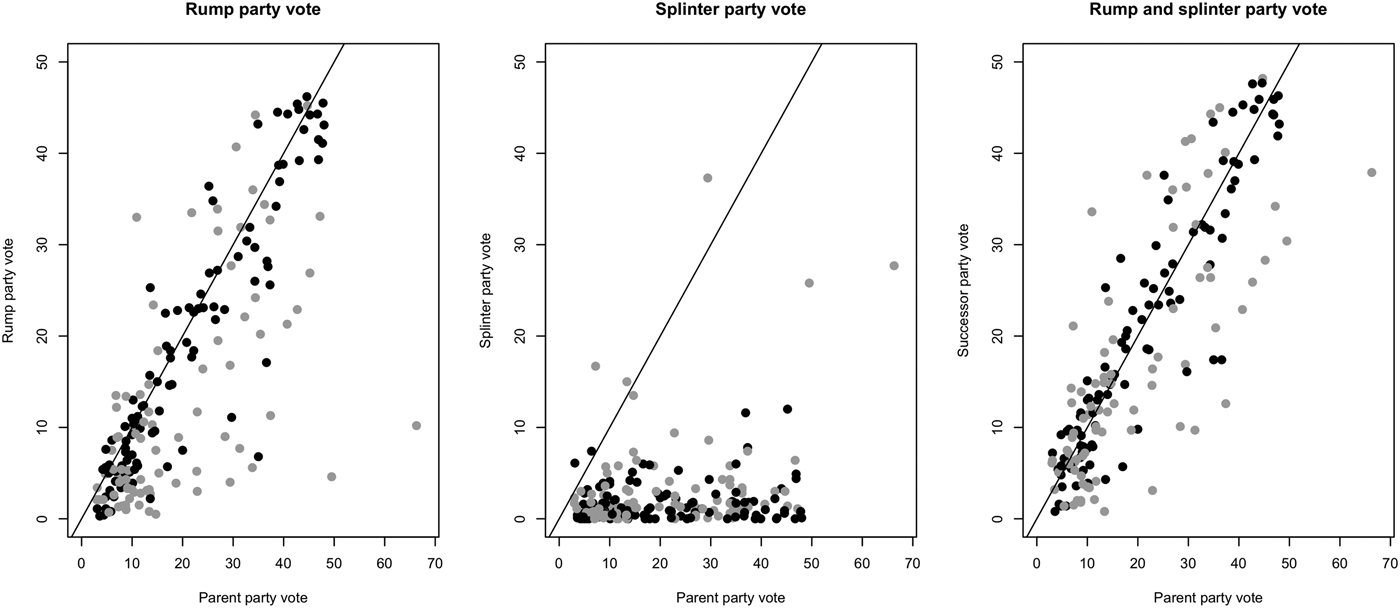
Figure 1 presents the electoral performance of rump and splinter parties in the first election after the split (plotted on Y-axis) in comparison to the vote share of the parent party in the last election before the split (plotted on X-axis). The figure also includes 45° lines to differentiate between cases where a successor party's (or parties') support was higher than that of its (their) parent party.
Party vote before and after fission. Note: Black points indicate observations from Western Europe. Gray points indicate CEE cases.
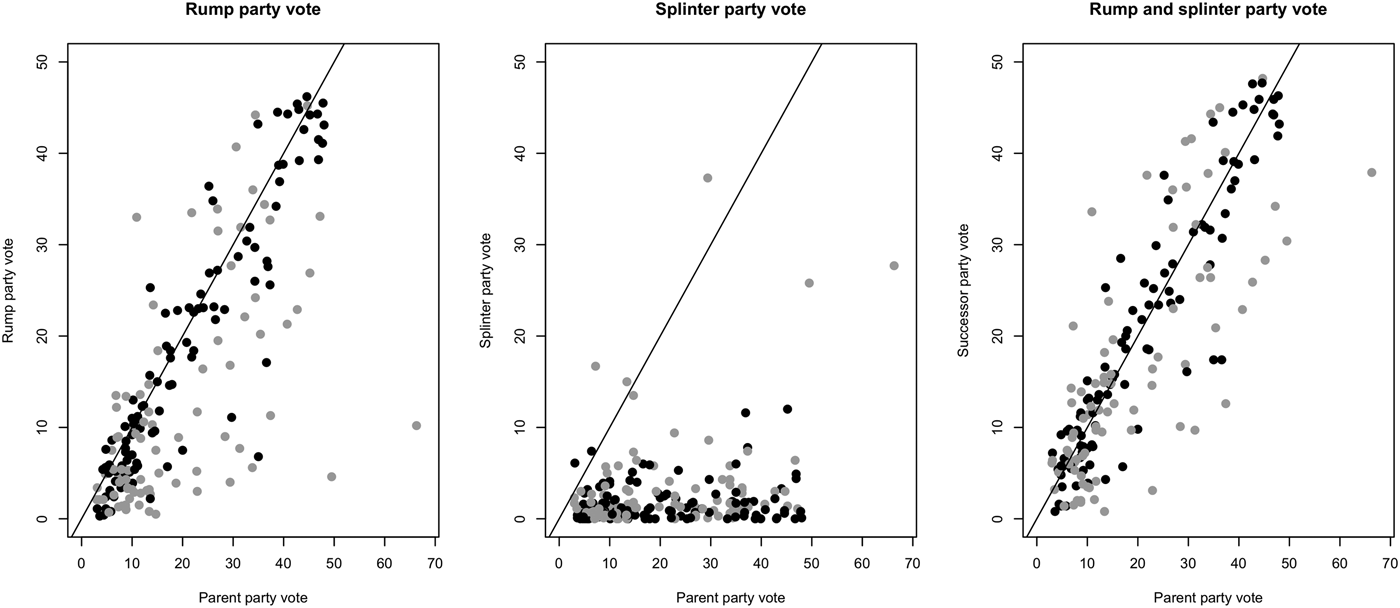
The figure demonstrates several interesting patterns describing the variation in the electoral performance of parties after splits. First, the scatterplot on the left indicatesa strong correlation (correlation coefficient is 0.79) between the support of rump and parent parties. On average, rump parties tend to lose only some support in comparison to their parent parties but there is a non-negligible group of rump parties, mostly in post-communist democracies, that perform substantially worse than their parent parties. Second, the middle scatterplot shows that the vote share of splinter parties tends to be much lower, than and correlates only weakly (at 0.24), with that of their parent parties. Third, the total support of successor parties tends to be close to that of their parent parties (correlation coefficient is 0.86), which suggests that the patterns of vote redistribution after splits occur first and foremost among successor parties as opposed to voter switching to other parties that are not related to the split.
5.2. Modeling strategy
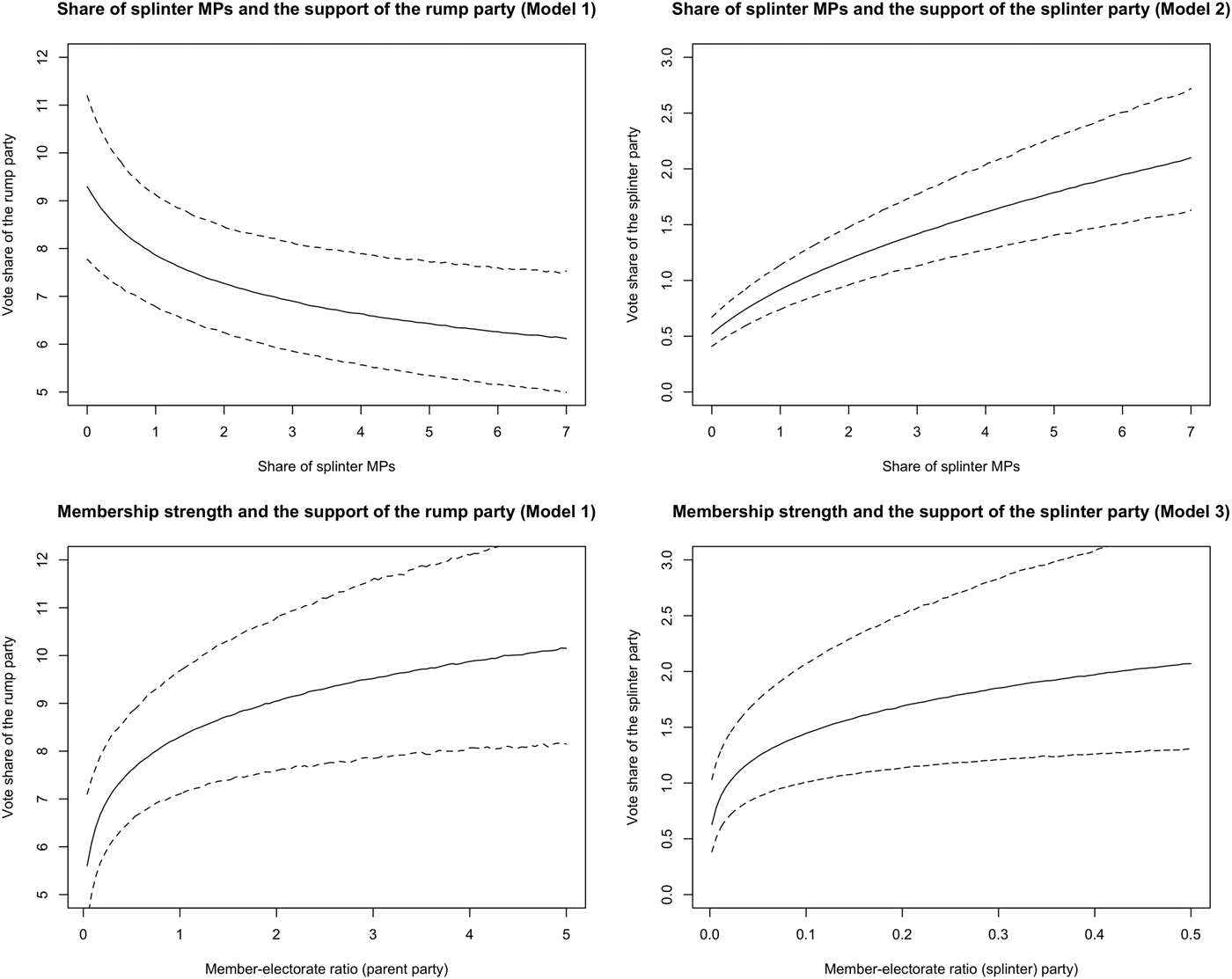
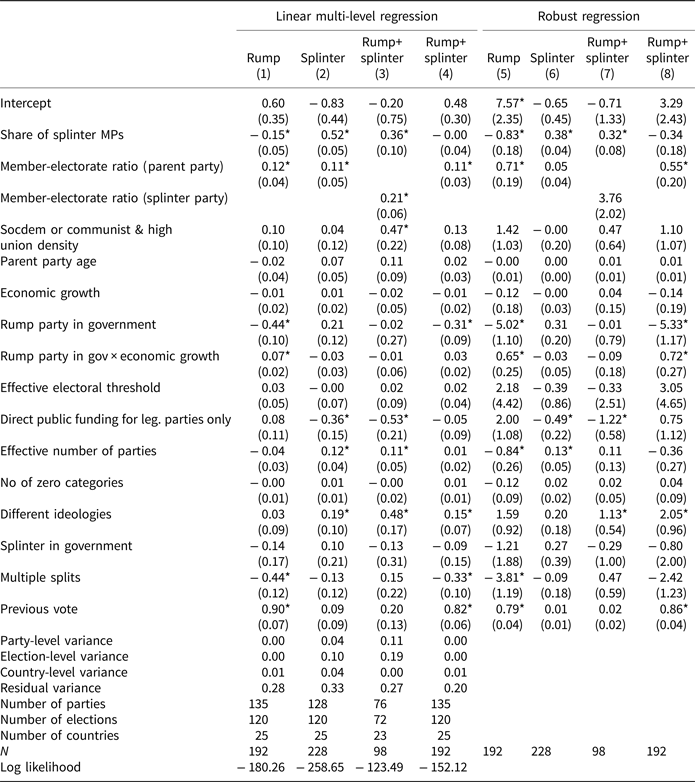
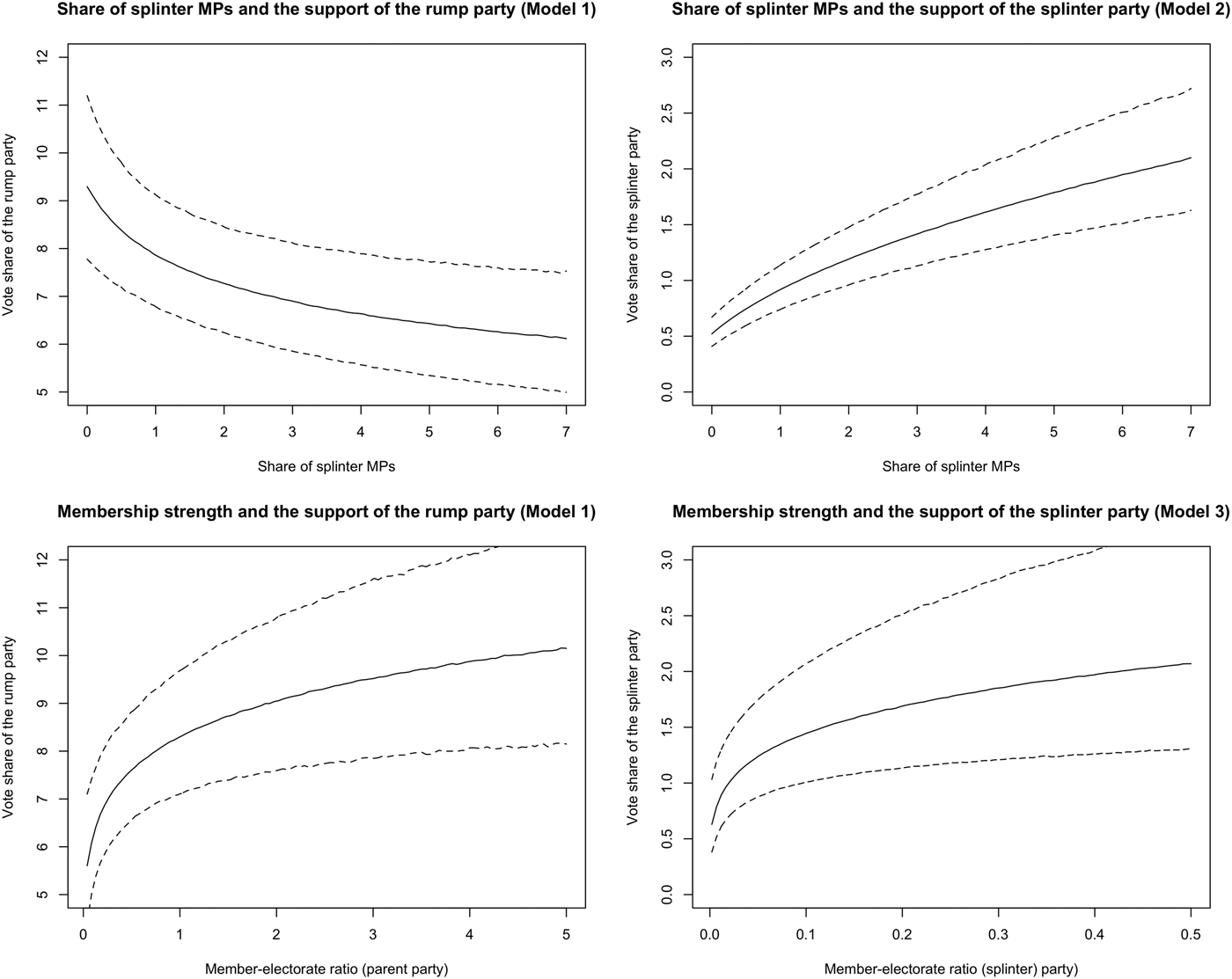
As Figure 1 shows, the distribution of parties' vote shares after splits is highly skewed to the right. Several predictor variables are also characterized by right-skewness. Two modeling strategies are adopted to deal with this challenge. First, Models 1–4 in Table 1 present linear multi-level models (with random intercept terms for countries, elections and parent parties) in which parties' vote shares and right-skewed predictor variables (the share of splinter MPs, membership and electorate ratio, party age, effective electoral threshold and the vote share of the parent party) are logged.Footnote 11 Due to logarithmic transformations, the regression coefficients do not represent the change in raw vote shares for one unit change in predictor variables. Thus, Figure 2 presents the substantive effects of the share of splinter MPs and party membership. Second, Models 5–8 are robust regression models with raw vote shares as dependent variables.Footnote 12
Expected vote shares of rump and splinter parties: cross-national analysis. Note: Simulations of expected vote shares with 95% confidence intervals. The values of other variables are held constant at their mean values.
Electoral competition after splits: full sample
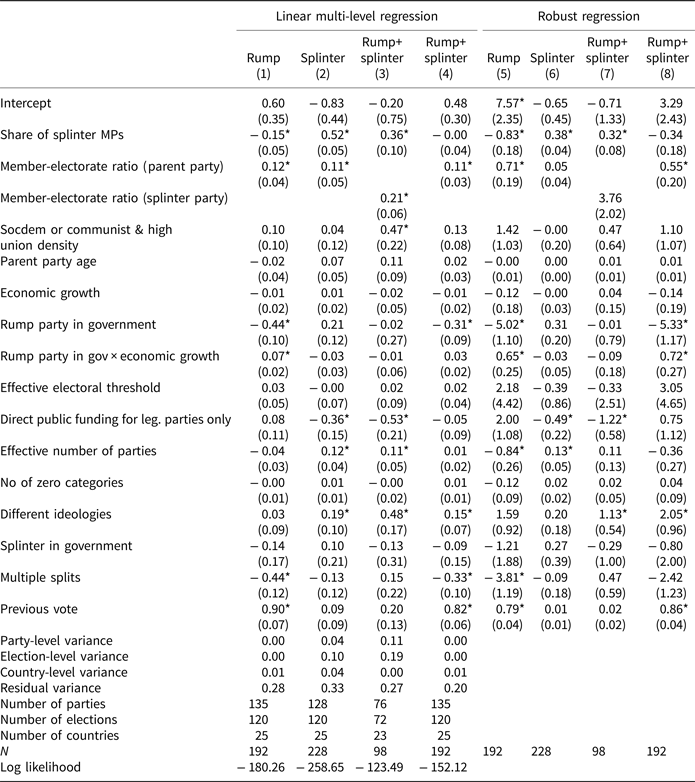
Note: dependent variables in Models 1-4 are logged vote shares of rump and splinter parties and the variables capturing the share of splinter MPs, membership-electorate ratio, party age and effective threshold are also logged in these models. MM-estimator used for robust regression models. *p < 0.05.
Since the literature on new parties emphasizes important differences between established and new democracies, both linear multi-level and robust regression models are estimated for Western European and younger CEE democracies. Online Appendix B presents the results of these analyses.
The literature also indicates that studies of new party electoral performance may be susceptible to selection bias because some of the factors that affect new party success could also impact their emergence (Hug Reference Hug2001; Golder Reference Golder2003). To account for this, Online Appendix B presents the results of Heckman's sample selection models, where the selection equation models party splits by using factors suggested in the existing studies on party splits and new party entry, while the outcome equation models the electoral support of rump and splinter parties. The substantive results do not change when sample selection models are used.
5.3. Candidates' appeal and party membership
The results support Hypotheses 1 and 2: a higher share of switcher legislators increases the electoral support of splinter parties and decreases the vote share of rump parties (Models 1–3 and 5–7). The magnitude of effects is substantial. According to Model 1, the increase in the share of splinter MPs from 0 to 7 percent (corresponding roughly to the 10th and 90th percentiles of the observed distribution of this variable) decreases the expected vote share of the rump party from 9 percent to 6 percent and increases the expected vote share of the splinter party from 0.5 percent to 2 percent. The robust regression estimates suggest stronger effects. According to Models 5 and 6, the increase in the share of splinter MPs by 1 percentage point leads to the loss of 0.83 percentage points of the vote for the rump party and the gain of 0.38 percentage points for the splinter party. Thus, the exit of 7 percent of national legislators translates into the loss of almost 6 percent of the vote for the rump party and the gain of almost 3 percent for the splinter party. The results largely hold for both Western European and CEE sub-samples (Online Appendix B), although the statistical and substantive significance of the effects of party membership is somewhat stronger in the former than in the latter.
However, the effect of the share of splinter MPs on the combined vote share of rump and splinter parties is significant (at 0.1 level) only in Model 8, but not in Model 4. Thus, there is only limited evidence that a greater extent of fission at the parliamentary elite level benefits other parties in the system, although multiple splits do so.Footnote 13
Hypothesis 3 is also substantiated. The estimates of Model 1 indicate that the increase in the member-electorate ratio of the parent party from 0.1 to 5 percent (these values roughly correspond to the 10th and 90th percentiles of the observed distribution) increases the expected vote share of the rump party from 6 to 10 percent. According to the estimates of Model 5, the increase in the membership-electorate ratio by 1 percentage point leads to the increase in the vote share of the rump party by 0.71 percentage point. Thus, the change in the size of relative size of party membership by 4.9 percentage points on average increases the vote share of the rump party by approximately 3.5 percentage points.
The evidence supporting Hypothesis 4 is also relatively strong. The membership of the parent party has a significant effect in Model 2 although not in Model 6; while the membership of the splinter party has a significant effect in Models 3 (at 0.01 level of significance) and 7 (at 0.1 level of significance). With regard to substantive effects, Figure 2 shows (based on the estimates of Model 3) that when the ratio between the membership size and the electorate increases from 0.01 percent (the 10th percentile of the observed distribution) to 0.3 percent (the 90th percentile of the distribution), the expected vote share of the splinter party increases by more than 1 percentage point. The substantive effect of this variable estimated in Model 7 is of similar magnitude. The membership variable remains a statistically significant predictor of the electoral success of rump and splinter parties in most regression models for the regional sub-samples (compare Models 11 and 15 with Models 19 and 23 in Tables 1 and 2 in Online Appendix B).
5.4. Electoral demands, institutions and party competition
The results show some support to the demand-side, institutional and party competition explanations. Specifically, incumbent rump parties perform better when economic conditions are good. Every additional point in economic growth increases their support by 0.65 percent (Model 5). This contradicts earlier findings that party instability reduces the effect of economic conditions on the vote share of government parties. However, low or negative economic growth does not increase the vote share of splinter parties (regardless of whether rump parties are in government or not). This finding stands in contrast to the studies that find the substantial effects of economic performance on the initial electoral success of new parties (Tavits Reference Tavits2008; Mainwaring et al. Reference Mainwaring, Gervasoni and España-Najera2017), thus suggesting that the latter relationship holds only for genuinely new parties. The significant and positive effect of economic growth on the combined vote share of successor parties when the rump party is in government (Model 8) provides further evidence that poor economic performance leads incumbent rump parties to lose votes not to their splinters, but to other parties in the system.
However, cleavage structures (captured by the variable indicating leftist parties competing in environments of relatively high trade union density) and the partisanship of the voters of the parent party (measured by its age at the time of split) provide limited leverage for understanding electoral competition after splits. These findings support the aforementioned argument that social groups or partisan base of the parent party might divide their support between rump and splinter parties after splits. For example, Aimer and Vowles (Reference Aimer and Vowles1993) show that in the 1990 parliamentary election in New Zealand, the splinter of the Labor party (called the New Labor Party) drew its support primarily from the traditional Labor electoral base, namely the working class voters.
Turning to institutional explanations, electoral system disproportionality has no effect on the vote share of rump or splinter parties, but the public funding regime that favors legislative parties reduces the support of splinter parties, especially in CEE countries. These findings indicate that the arguments about the effect of “funding parity” on new and small party success (Hino Reference Hino2012; Potter and Tavits Reference Potter and Tavits2015) are applicable to splinter parties.
Furthermore, Model 5 indicates that the electoral support of rump parties decreases by 0.84 percentage points for each additional “effective party”—or by 3.8 points when the effective number of parties increases from the 10th to the 90th percentile of the observed distribution (3.1 and 7.6 parties, respectively).Footnote 14 Party system fragmentation also increases the electoral performance of splinter parties (effect present in both regions), although the substantive size of the effect is rather modest (each additional effective party increases the support of splinter parties by 0.13 percentage points according to Model 6). However, the combined support of rump and splinter parties is not associated with the number of effective parties. These results suggest, in line with Mainwaring et al. (Reference Mainwaring, Gervasoni and España-Najera2017), that fragmented party systems signal supporters of the parent party that the splinter party might be electorally viable.
Another party competition variable, differences in ideological families of successor parties, is a statistically significant predictor of the total vote share of successor parties (although in the analyses for CEE countries only) and, in some models, of the support of splinter parties (Model 2). This provides some evidence that ideological differentiation is related to the vote share of successor parties. The stronger effect in post-communist countries may be a consequence of lower diversity in parties' positions in this region (Roberts Reference Roberts2010), which allows new splinter parties to attract more voters if they provide ideological innovations as compared to their parent parties. However, there was no evidence that the third variable of party competition, the diversity of established parties' programmes, is important for the outcomes of electoral competition after splits.
The vote share of parent parties has a strong effect on the support of rump parties and the combined support of successor parties but not on the vote share of splinter parties. These results support the descriptive patterns presented in Figure 1. In contrast, the presence of splinter parties in government does not affect electoral outcomes after party splits.
6. Conclusion
This study mapped the patterns of party electoral performance in the first election after party fission and explained the variation in them. This cross-national analysis of 25 countries in Europe suggests a number of new results and important implications. First, the findings suggest that splinter parties, on average, attract limited support. However, those parties that include a substantial number of legislators from the parent party and build at least some organization on the ground are more electorally successful. The electoral success of splinter parties also depends on political opportunity structures, such as party system fragmentation and favorable public party funding regimes, but no support was found for demand-side explanations. Given the substantial evidence in line with the electoral demand, institutional and party competition explanations of new party electoral performance, the findings of the present research suggest that the factors explaining the electoral support of genuinely new and splinter parties may differ.
Second, this study also shows that most parties withstand the electoral competition after party splits relatively unscathed. Nevertheless, a split may be highly damaging if the party loses a substantial share of its legislators to the splinter party and if it lacks a large strong membership. Splits also do not impact the well-established effect of economic indicators on the electoral support of government parties. However, apart from party system fragmentation, the relevance of institutional and party competition factors explaining the support of rump parties is limited. By addressing a previously under-researched but important question of how parties perform after splits, the present study makes an important contribution to the literature on party electoral persistence.
Third, the combined support of rump and splinter parties in the first election after the split is on average close to the electoral performance of the parent party in the previous electoral cycle. However, other parties in the system are more likely to benefit from splits of their competitors if the latter split multiple times in the same electoral term, lack large memberships and represent similar ideological positions. These findings shed light on the broader electoral consequences of fission and legislative party switching in the party system beyond the electoral fate of splinter parties or the parties that experience splits.
Finally, the present study shows that the patterns of electoral competition after splits in Western Europe and younger CEE democracies are quite similar. Membership organizations and the extent of legislative party switching are among the most important explanations of parties' electoral support after party splits.
Supplementary Materials
The supplementary material for this article can be found at https://doi.org/10.1017/psrm.2019.15
Acknowledgments
I would like to thank Adriana Bunea, Nicole Bolleyer, Evelyne Bytzek, Sona Golder, Karina Kosiara-Pedersen, Tom Mustillo, Jonathan Polk, and four anonymous reviewers and the editors of Political Science Research and Methods for their valuable comments. While doing this research, the author benefited from the funding from the Swedish Institute (Visby Programme, grant number 00445/2012) to conduct post-doctoral research at the Centre for European Studies at the University of Gothenburg, Sweden. The research has also received funding from the Marie Sklodowska-Curie Actions Programme (Intra-European Individual Fellowship Grant No 330446 PARTYINSTABILITY) to conduct post-doctoral research at the University of Exeter. This financial support is gratefully acknowledged.