Introduction
Henckelia Spreng. (Gesneriaceae) is by far the largest genus of understorey herbs in Peninsular Malaysian rain forest, with about a hundred species – many more than the other most speciose understorey herb genera Begonia L. (Begoniaceae) with 52 species (Kiew, Reference Kiew2005) and Argostemma Wall. (Rubiaceae) and Sonerila Roxb. (Melastomataceae), each with 45 species (Turner, Reference Turner1997). Not surprisingly considering its size, Henckelia shows a wide range of variation in habit, leaf and inflorescence form and in corolla size, shape and colour. The unifying characters are its capsular fruit that is held horizontally (plagiocarpic) and splits along the dorsal side and, distinguishing the genus from Ridleyandra A.Weber & B.L.Burtt that has a similar fruit, its two stamens (Ridleyandra has four). Several sections are recognised among the Peninsular Malaysian Henckelia species. Section Loxocarpus (R.Br.) A.Weber & B.L.Burtt is recognised principally by its short fruit up to 10 mm long, as compared with the other sections (in Peninsular Malaysian species fruit length varies in the range (13–)23–90(–120) mm). In addition, the fruit is conical with a broader base, often with a hump-like swelling on the upper side, and tapers to the style. When the fruit splits it forms a bowl-shaped splash cup. In contrast, in other species of Henckelia the fruit is narrowly cylindric and not thicker at the base and on splitting is long and gutter-shaped (see below). Both fruit shapes are presumed to be adapted to seed dispersal by the large water drops that drip through the canopy after rain. These are much larger than rain drops and fall with greater ballistic force (Savile & Hayhoe, Reference Savile and Hayhoe1978), and can bounce small seeds out of the splash cups or roll along the gutter-shaped capsules carrying off the seeds.
History
Loxocarpus was described as a new genus by Robert Brown (Reference Brown and Bennett1839) based on the short swollen fruit of L. incanus R.Br. Bentham (Reference Bentham, Bentham and Hooker1876) reduced Loxocarpus to sectional level within Didymocarpus Wall. In Didymocarpus sect. Loxocarpus, Clarke (Reference Clarke, de Candolle and de Candolle1883) described an additional species, D. semitortus C.B.Clarke. Ridley wrote extensively on the Gesneriaceae besides his Flora accounts. In 1896 he produced ‘Cyrtandraceae Malayenses’ and in 1905 ‘The Gesneraceae of the Malay Peninsula’. Both included descriptions of new species and in 1905 one new genus, Orchadocarpa Ridl. He described Didymocarpus caeruleus Ridl. in 1896. In 1905, he reinstated Loxocarpus as a genus considering it to be ‘sufficiently distinct in its short tubed and short stamened flowers and horn-like capsule’ and made new combinations for L. caeruleus (Ridl.) Ridl. and L. semitortus (C.B.Clarke) Ridl. Subsequently four new species were described for the Peninsula, L. angustifolius Ridl. (Ridley, Reference Ridley1908), L. minimus Ridl. (Ridley, Reference Ridley1922), L. papillosus M.R.Hend. (Henderson, Reference Henderson1927) and L. holttumii M.R.Hend. (Henderson, Reference Henderson1929).
Burtt (Reference Burtt1958) also considered that the differences in fruit were ‘sufficient to distinguish Loxocarpus from Didymocarpus sect. Orthoboea Benth.’ (= Henckelia Spreng.) and consequently transferred three Bornean Didymocarpus species to Loxocarpus, namely L. petiolaris (C.B.Clarke) B.L.Burtt, L. rufescens (C.B.Clarke) B.L.Burtt and L. verbeniflos (C.B.Clarke) B.L.Burtt, as well as describing a new species L. longipetiolatus B.L.Burtt. In 1962, he made further combinations for the Bornean Loxocarpus concapsularis (C.B.Clarke) B.L.Burtt and L. stapfii (Kraenzl.) B.L.Burtt and described two new Loxocarpus species from Sumatra, L. caulescens B.L.Burtt and L. meijeri B.L.Burtt (the latter described without fruits). He noted that these Sumatran species, Loxocarpus caulescens and L. meijeri, with stems 20–30 cm long, were different in not having the compact rosette habit of most other species, but were otherwise typical in their short corolla tubes and short ovaries; he also noted that L. caulescens had a short (1 cm long) fruit with its base enlarged above. In 1971, he described Loxocarpus argenteus B.L.Burtt and made a new combination for L. sericeus (Ridl.) B.L.Burtt from Lingga. In 1982, he described Loxocarpus repens B.L.Burtt from Sarawak. Kiew (Reference Kiew1987) described Loxocarpus tunkui Kiew, a new species from Johor, Peninsular Malaysia.
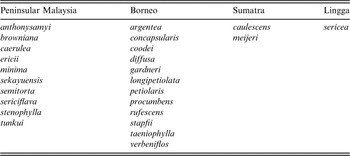
In 1997, Burtt described a further four species attributable to this group, Henckelia coodei B.L.Burtt, H. diffusa B.L.Burtt, H. gardneri B.L.Burtt and H. taeniophylla B.L.Burtt, all from Brunei. In 1998, Weber & Burtt reduced Loxocarpus to a section of Henckelia, the latter including most Malesian species previously known as Didymocarpus species. Besides making new combinations, this required the renaming of Loxocarpus angustifolius as Henckelia stenophylla A.Weber, L. incanus as H. browniana A.Weber, L. holttumii as H. ericii A.Weber and L. repens as H. procumbens B.L.Burtt. Our account includes descriptions of three new species, Henckelia anthonysamyi Banka, H. sekayuensis Banka & Kiew and H. sericiflava Kiew & Banka. Henckelia papillosa (M.R.Hend.) A.Weber is excluded from the section, bringing the total number of species for the section to 25 with 10 in Peninsular Malaysia (Table 1).
Species described in Henckelia sect. Loxocarpus

Weber & Burtt (Reference Weber and Burtt1998) considered that the ‘essential feature of Loxocarpus lies in the fruit’, which is a short capsule with an enlarged base that splits dorsally to form a bowl-shaped splash cup (their fig. 6c–h). This separates it from species in Henckelia sect. Boeopsis Ridl., which is similar in including small rosette plants with small campanulate flowers with a short tube, often without a nectary (Kiew, Reference Kiew1992). Contrary to Weber & Burtt's assertion that for fruit construction the ‘clear distinction becomes blurred’ between species of section Loxocarpus and other species in Henckelia, species in section Loxocarpus throughout its range (Sumatra, Peninsular Malaysia and Borneo) have short fruits up to 10 mm long that are enlarged at the base and open to form a bowl-shaped splash cup, whereas in the most similar section of Henckelia, section Boeopsis, fruits are clearly different, being narrowly cylindric, 13–17 mm long, not enlarged at the base and splitting dorsally to form a narrow gutter-like fruit. (All other sections within Henckelia have much longer narrowly cylindric fruits, the longest being found in section Heteroboea (Benth.) A.Weber & B.L.Burtt where fruit length ranges from 62 mm in H. curtisii (Ridl.) A.Weber to 120 mm in H. atrosanguinea (Ridl.) A.Weber.)
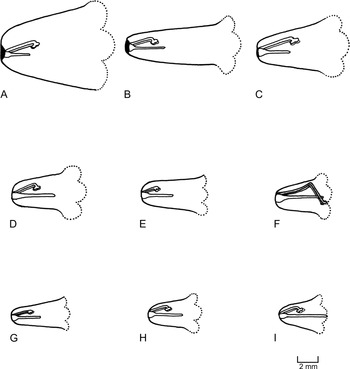
Ridley (Reference Ridley1905) also distinguished Loxocarpus from Didymocarpus by its short campanulate corolla tube. Unfortunately, nothing is known about pollination in these species, but it is clear that the trend from the nectar flower, as exemplified by Henckelia sect. Heteroboea, with the large, tubular flowers frequently with nectar guides and with a conspicuous nectary, to the pollen flower with a short campanulate corolla, without a nectary but with conspicuous, large anthers in the mouth of the corolla, has occurred several times within Henckelia, not only in section Loxocarpus but also in sections Boeopsis and Salicini. In Henckelia sect. Loxocarpus, H. ericii and H. semitorta exemplify nectar flowers with their larger tubular flowers with nectaries (Fig. 1); the corolla of H. semitorta also has nectar guides. Henckelia caerulea is unique in Henckelia in having geniculate stamens where the knee on the filament is bright yellow – the anther dummy – while the anthers are small, dark coloured and inconspicuous (Weber & Kiew, Reference Weber and Kiew1983). Weber (Reference Weber and Kubitzki2004) considers this to be a deceptive pollen flower. However, most species in Henckelia sect. Loxocarpus have short campanulate corollas 5–10 mm long and 3–6 mm wide and all lack a nectary (Fig. 1). They are therefore not nectar flowers. Nor are they typical pollen flowers because their anthers are minute, 1–2 mm long and 0.5–1.5 mm wide, and inconspicuous, being enclosed within the corolla tube. This suggests that these small flowers may be self-pollinated. Their flowers are plain coloured and the lower lobes are not well developed so do not offer a landing stage for the pollinator. However, they are not cleistogamous because the upper lobes reflex to expose the open mouth of the corolla. In most species, the stigma projects beyond the anthers so that pollen cannot drop passively onto the stigma. It is possible that self-pollination could be effected in these protandrous flowers if the stigma touched the anthers as the ovary and style elongated during development. Whatever the mode of pollination, it is effective because even in small populations individuals with many-seeded fruits can be found.
Position of the stamens, stigma and style within the corolla tube in Peninsular Malaysian species of Henckelia sect. Loxocarpus: A, Henckelia ericii; B, H. semitorta; C, H. anthonysamyi; D, H. stenophylla; E, H. browniana; F, H. caerulea; G, H. sekayuensis; H, H. sericiflava; I, H. tunkui.

Henckelia sect. Loxocarpus
In Peninsular Malaysia, species in Henckelia sect. Loxocarpus are small rosette plants. They have a woody rootstock which, in species that grow on vertical rock faces with a thin layer of moss or algae, is short. Two species, Henckelia ericii and H. semitorta, have larger rootstocks that are covered by persistent leaf bases. Henckelia semitorta, which grows on vertical earth banks as well as rocks, may also produce a vertically creeping stem.
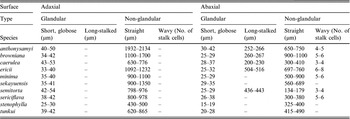
A characteristic feature of the Peninsular Malaysian species is the dense layer of long silvery hairs on the upper leaf surface. Four types of hair are found on the leaves (Table 2). The longest (just over 2 mm long) are straight, non-glandular, unbranched and multicellular. They are abundant on the upper lamina surface and are present, though often less densely, on the lower surface. The next most frequent hair type is the short-stalked, glandular hair that is found on both the upper and lower lamina surfaces. Long-stalked glandular hairs and non-glandular wavy hairs are found on the lower surface of about half the species. The silvery appearance of the indumentum is useful in distinguishing species in Henckelia sect. Loxocarpus from other Henckelia species. Long and short unbranched, multicellular and glandular hairs are also present in other species of Henckelia (Norana, Reference Norana1982). However, the special character of those in Henckelia sect. Loxocarpus is their orientation: they lie appressed to the lamina surface, their tips orientated towards the leaf apex. When the leaf is wet the surface appears green but when it is dry the reflective property of the many individual hairs causes it to appear silky white or silvery. The hairs themselves are not coloured.
Lamina trichome types and length in Peninsular Malaysian species of Henckelia sect. Loxocarpus

– = absent.
All species are petiolate. Most have slender petioles 1–1.5 mm thick, except for Henckelia caerulea, H. ericii and H. semitorta in which they are 2–3.5 mm thick. Usually the petiole is terete but in Henckelia caerulea and H. tunkui it is distinctly grooved above. The laminas of species in Henckelia sect. Loxocarpus are among the thickest in the genus, ranging from very thick (385 μm to more than 430 μm thick) in H. browniana and H. semitorta; to thick (230–380 μm) in H. caerulea, H. ericii, H. sekayuensis and H. sericiflava; to moderately thick (100–225 μm) in most species, to thin (70–80 μm) in H. stenophylla.
All species produce cymose inflorescences (none has solitary flowers), although in small plants (Henckelia minima and H. stenophylla) simple cymes may be reduced to two or even one flower(s); in the other species the cymes show various degrees of branching. Henckelia browniana and H. sekayuensis that begin to flower when still small at first produce simple cymes but as they grow larger produce branched inflorescences.
Another characteristic of Henckelia sect. Loxocarpus is the short campanulate corolla with a tube 4–15 mm long that is held horizontally. In most species the tube is as long as or twice as long as wide (Fig. 1). Only Henckelia semitorta, which has the largest flower in the section, has a narrowly campanulate corolla with the tube 14–15 mm long and three times longer than wide. All flowers in this section are basically pale to dark mauve or purple, although it should be noted that some collectors describe them as blue, a difference in colour perception not in actual flower colour. In most species the colouring is uniform. The exceptions are Henckelia semitorta where there are darker purple streaks on the lower lobes running into the throat of the corolla, and H. caerulea where the base of all the corolla lobes is deep violet.
The stamens are short with straight filaments about half the length of the corolla tube, except for Henckelia caerulea, which has geniculate filaments that project beyond the corolla tube. Anthers in all species are small, reniform and coherent. Only two species, Henckelia ericii and H. semitorta, have a narrow disc-like nectary. Stigmas are uniformly small and rounded (not capitate or peltate as is seen in some other Henckelia species; Kiew, Reference Kiew1992). Position of the stigma is variable. The style and stigma reach halfway up the corolla tube, apart from in Henckelia tunkui where the style and stigma project beyond the corolla mouth, and in H. caerulea, H. sericiflava and H. stenophylla where they reach to the corolla mouth (Fig. 1).
There is an apparent correlation between corolla tube length and the position of the stigma. Species with a corolla tube 5–8 mm long have the stigma positioned at the corolla mouth, and those with corollas longer than 8 mm have the stigma included within the corolla tube. Henckelia tunkui, which has the shortest corolla tube (c.5 mm long), is the only species where the style and stigma project beyond the corolla mouth.
Fruits of all species in this section are short, have a broad base and split dorsally to form a bowl-shaped splash cup. Most are straight, but those of Henckelia ericii, H. semitorta, H. stenophylla and H. tunkui are slightly curved and that of H. caerulea is strikingly corniculate.
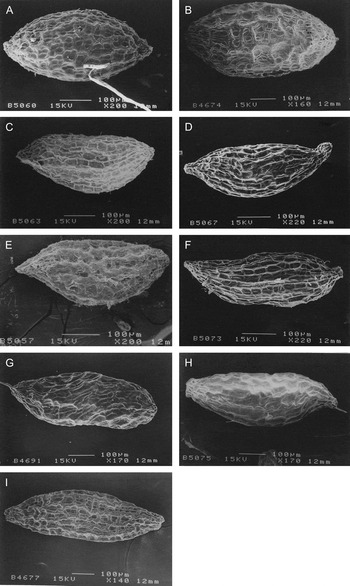
Seed morphology is uniform – seeds are small and ellipsoid (Fig. 2). The largest is seen in Henckelia caerulea (730 × 230 μm) and the smallest in H. sericiflava (400 × 160 μm). The narrowly ellipsoid ones measure c.460 × 150 μm and the broadly ellipsoid ones c.590 × 290 μm. The testa cells are longitudinally oblong, arranged in rows and have elevated cell walls, the depressed surface being faintly striate or colliculose.
Micrographs of seeds in Peninsular Malaysian species of Henckelia sect. Loxocarpus: A, Henckelia ericii; B, H. semitorta; C, H. browniana; D, H. minima; E, H. sericiflava; F, H. sekayuensis; G, H. anthonysamyi; H, H. tunkui; I, H. caerulea.

Habit, habitat and distribution
In Peninsular Malaysia, species in Henckelia sect. Loxocarpus fall into two groups. Species of the first group, which includes most species, grow on bare granite or sandstone (never limestone) rock faces or on large boulders by or in streams, mostly in lowland forest but with Henckelia browniana and H. caerulea in hill forest. This group has very short rootstocks (probably because the solid rock substrate does not allow the roots to penetrate), their petioles are as long as or shorter than the laminas and the leaf bases are not persistent. Their flowers are smaller and none has a nectary.
The second group includes Henckelia ericii and H. semitorta, which grow on steep earth banks or on sandstone rocks below the summit in lower montane forest. They are very distinctive in their long rootstocks covered by persistent leaf bases, woolly petioles that are longer than their thick laminas and in their relatively large flowers with nectaries.
As can be seen from Table 1, Henckelia sect. Loxocarpus is confined to Sundaland. Henckelia minima extends into Peninsular Thailand, which phytogeographically is continuous with the Malesian flora. Peninsular Malaysia and Borneo are centres of diversity and it is likely that when the Bornean flora is better known it will be far more species rich than Peninsular Malaysia. Species are endemic in either Borneo, Lingga, Peninsular Malaysia or Sumatra.
In Peninsular Malaysia, the greatest diversity for this group is found in the south and east, with only Henckelia browniana and H. caerulea growing on west coast mountains. Only Henckelia caerulea and H. minima are widespread and known from five or more localities. Most (six species) are presently known from a single locality and two species are known from two localities. Henckelia ericii and H. semitorta share a similar habit with H. longipetiolata from Gunung Pueh, Sarawak, and may be considered part of the Bornean element of the Malayan flora.
Systematic Treatment
Henckelia sect. Loxocarpus (R.Br.) A.Weber & B.L.Burtt, Beitr. Biol. Pflanzen. 70: 334 (1998 [‘1997’]). – Loxocarpus R.Br., Cyrtandreae 120 (1839); Ridley, J. Straits Branch Roy. Asiat. Soc. 44: 61 (1905); Ridley, J. Asiat. Soc. Bengal, Pt. 2, Nat. Hist. 74: 768 (1908); Ridley, Fl. Malay. Penin. 2: 526 (1923); Burtt, Notes Roy. Bot. Gard. Edinburgh 22: 308 (1958); Henderson, Malay. Wild Fls., Dicots. 352 (1959). – Didymocarpus Wall. sect. Loxocarpus (R.Br.) Benth. in Benth. & Hook.f., Gen. Pl. 2: 1022 (1876); C.B.Clarke in A.DC. & C.DC., Monogr. Phan. 5(1): 71, 98 (1883); C.B.Clarke, Fl. Brit. India 4: 352 (1884). – Type: Henckelia browniana A.Weber.
Rosette plants with reduced stems (rootstock), rarely creeping or caulescent; usually with a dense layer of long silky hairs, usually white or silvery, sometimes brown or yellowish, as dense or less so beneath. Leaves petiolate. Inflorescences cymose, pedunculate. Calyx lobes free to the base. Corolla short, relatively broad and campanulate, pale to mid-purple; lobes more or less isomorphic, lower three lobes slightly or considerably longer than the upper two. Nectary disc usually absent. Stamens adnate at the base of the corolla, usually short (except in H. caerulea) with reniform, coherent anthers included within the corolla tube (except in H. caerulea where anthers project beyond the tube). Ovary short and conical; stigma minute, rounded. Capsule plagiocarpic, short, conical (wide at the base and tapered to the style), often with a dorsal hump, straight or slightly curved to corniculate (in H. caerulea), splitting dorsally to form a bowl-shaped splash cup. Seeds broadly to narrowly elliptic, two to three times longer than wide, cells in longitudinal lines of oblong or square cells, lines sometimes twisted, cell edges elevate, fused or not, face depressed, sometimes finely striate or minutely colliculose.
Key to the species
1a. Petiole longer than the lamina 2
1b. Petiole shorter or equal in length to the lamina 4
2a. Lamina thin, 6.5–20 × 4.5–15 cm; corolla tube 6–6.5 mm long, stamens exserted with a conspicuous yellow knee; fruits strongly corniculate, 9–10 mm long 3. H. caerulea p.p.
2b. Lamina thick, 2–5 × 1–4 cm; corolla tube 12–15 mm long, stamens included within the corolla tube and without a conspicuous yellow knee; fruits straight or slightly curved, 6–8 mm long 3
3a. Lamina about twice as long as wide; inflorescence a simple cyme with 1–2 flowers, peduncle 4–5 cm long 7. H. semitorta
3b. Lamina almost as broad as long; inflorescence branched with 7–15 flowers, peduncle 12–20.5 cm long 4. H. ericii
4a. Leaf margin entire 5
4b. Leaf margin serrulate to serrate 6
5a. Lamina four times longer than wide; peduncle to 8 cm long; corolla tube c.8 mm long, style and stigma included within corolla tube 9. H. stenophylla
5b. Lamina up to three times longer than wide; peduncle 10–15 cm long; corolla tube c.5 mm long, style and stigma projecting beyond corolla tube 10. H. tunkui
6a. Lamina broadly ovate, base truncate, cordate or broadly rounded 7
6b. Lamina elliptic to lanceolate or oblanceolate, base rounded or cuneate and tapered into the petiole 8
7a. Lamina brownish beneath; petiole as long as or longer than the lamina, to 22 cm long; stamens exserted with a conspicuous yellow knee; fruits strongly corniculate, 9–10 mm long 3. H. caerulea p.p.
7b. Lamina greyish or silvery beneath; petiole shorter than the lamina, to 9 cm long; stamens included within the corolla tube and with a conspicuous yellow knee; fruits slightly curved, 3.5–7 mm long 2. H. browniana
8a. Lamina to 1.2–6 cm long, lateral veins 3–4 pairs 9
8b. Lamina more than 6–16 cm long, lateral veins (4–)6–9 pairs 10
9a. Lamina usually less than twice as long as wide, (1.2–)2.5–6.5 × (0.5–)2–4.5 cm, base usually rounded or cuneate; corolla tube 3–5 mm long; capsule 3.5–5.5 mm long 5. H. minima
9b. Lamina about twice as long as wide, 1.75–5.5 × 1–2.25 cm, base narrowed into the petiole; corolla tube c.6 mm long; capsule 5–6 mm long 6. H. sekayuensis
10a. Petiole 2–5.5 cm long, lamina brownish grey beneath; inflorescence two or three times branched with 12–13 flowers, peduncle 5.5–12.5 cm long 1. H. anthonysamyi
10b. Petiole (2.5–)5–7 cm long, lamina yellowish green beneath; inflorescence once branched with 4–7 flowers, peduncle (10–)15–17 cm long 8. H. sericiflava
1. Henckelia anthonysamyi Banka, sp. nov.
A Henckelia tunkui (Kiew) A.Weber foliis majoribus 6.5–9 × 2.5–3.5 cm (nec 3–7 × 1–2 cm), marginibus folii serrulatis (nec integris), inflorescentiis multifloris floribus 12–13 (nec paucifloris floribus 5–7) et capsulis longioribus 7–8 mm longis (nec 4–6 mm) differt. – Type: Johor, Kahang Timor, Sungai Yong, 28 v 1987, S. Anthonysamy SA 681 (holo KEP; iso E).
Rootstock short, woody, to 4 cm long, 0.75–1 cm thick, covered by wiry adventitious roots, leaf bases caducous. Petiole slender, 2–5.5 cm long, c.1.5 mm thick, slightly grooved above, with dense brown hairs; lamina elliptic to lanceolate, 6.5–9 × 2.5–4 cm, moderately thick, indumentum brownish, hairs dense above, beneath dense on midrib, veins and forming a band along the margin, base cuneate to slightly rounded, unequal, margin serrulate, apex acute; midrib and veins usually inconspicuous above, conspicuous beneath, lateral veins (4–)6–7 pairs. Inflorescence a two or three times branched cyme of 12–13 flowers, peduncle slender, 5.5–12.5 cm long, peduncle and bracts with sparse silky grey indumentum; bracts narrowly lanceolate, c.2 × 0.5 mm; pedicel c.2 mm long; calyx lobes acute, c.3.5 × 1 mm, with sparse glandular and unicellular hairs; corolla campanulate, plain violet or blue, or tube white with blue lobes, tube 9–10 mm long, c.6 mm wide, lobes c.3 × 2 mm, with a few sparse glandular and non-glandular hairs on outer surface; stamens with straight filaments c.5 mm long, anthers yellow, c.2 × 1 mm, positioned below the stigma; nectary absent; ovary c.2 mm long, base c.1 mm wide, style c.2 mm long, ovary and style with abundant glandular hairs; anthers and stigma included within the corolla tube. Capsule straight, 7(–8) mm long, base 1.2–2 mm wide. Seeds narrowly ellipsoid, c.540 × 200 μm.
Distribution. Endemic in Peninsular Malaysia: Johor, Kahang Timor, Sungai Yong.
Habitat. On rock faces near a waterfall.
Additional specimen examined. Johor: Sungai Yong, 23 v 1994, R.A. Banka RB10 (KEP).
Among the small-leaved species with cuneate leaf bases, Henckelia anthonysamyi resembles H. tunkui in leaf size but it is distinct in its serrulate margin, larger leaves, many-flowered inflorescences, and longer corolla and capsules. Its many-flowered inflorescences and brownish indumentum also distinguish it from the other three small-leaved species with serrulate margins, Henckelia minima, H. sekayuensis and H. sericiflava.
This species is named in honour of S. Anthonysamy, herbarium assistant in the Biology Department, Universiti Pertanian Malaysia for more than 25 years. He is an excellent field botanist who has made significant contributions to the study of Gesneriaceae in Peninsular Malaysia including the discovery of this species.
2. Henckelia browniana A.Weber, Beitr. Biol. Pflanzen. 70: 341 (1998 [‘1997’]). – Loxocarpus incana R.Br., Cyrtandreae 120 (1839); Ridley, J. Straits Branch Roy. Asiat. Soc. 44: 62 (1905); Ridley, J. Asiat. Soc. Bengal, Pt. 2, Nat. Hist. 74: 769 (1908); Ridley, J. Linn. Soc., Bot. 37: 319 (1908); Ridley, Fl. Malay. Penin. 2: 527 (1923); Henderson, Malay. Wild Fls., Dicots. 353, fig. 329A–C (1959); Kiew, Malay. Nat. J. 41: 223 (1987). – Loxocarpus alatus A.DC. in DC., Prodr. 9: 277 (1845), nom. illeg. for Loxocarpus incanus. – Didymocarpus incanus (R.Br.) C.B.Clarke in A.DC. & C.DC., Monogr. Phan. 5: 98 (1883); C.B.Clarke, Fl. Brit. India 4: 352 (1884); Ridley, J. Linn. Soc., Bot. 32: 512 (1896). – Type: Peninsular Malaysia, Penang, Wallich 809 (lecto BM, designated here; isolecto K).
Rosette plant, rootstock short, woody, to 1.5 cm long, c.0.75 cm diam., covered by wiry adventitious roots, leaf bases caducous. Petiole thick, (0.7–)5–9 cm long, 1.5–3 mm diam., terete, hairs dense, silvery; lamina ovate to broadly ovate, (2.5–)6.5–10 × (2.5–)6.5–9 cm, slightly succulent, very thick, dark green above, paler beneath, greyish or silvery when dry, hairs velvety above and dense beneath, base truncate to cordate, sometimes broadly rounded, usually unequal, margin serrulate, apex acute; midrib and veins inconspicuous above, slightly prominent beneath, lateral veins c.5 pairs. Inflorescences three or four times branched cymes with up to 29 flowers, to 23 cm long, peduncle 6–14.5 cm long, branches to 7 cm long, small plants sometimes producing a simple cyme with 1–2 flowers and peduncle c.4.5 cm; bracts lanceolate, 2–3 mm long; pedicel to 7 mm long; calyx lobes lanceolate, c.3 × 1 mm; corolla campanulate, plain pale purple to violet [or blue], tube 6–8 mm long, c.4.5 mm wide, lobes c.6 × 2.5 mm; stamens included within the corolla tube, filaments straight, 3.5–7 mm long, anthers c.2 × 1 mm; nectary absent; ovary c.2 mm long, base c.1 mm wide, style c.2.5 mm long, style and stigma white; anthers and style included within the corolla tube. Capsule straight, humped above, c.7 mm long, base c.3 mm thick. Seeds ellipsoid, c.555 × 220 μm.
Distribution. Endemic in Peninsular Malaysia: Penang and Perak.
Habitat. In hill forest to 650 m altitude, usually on damp granite rock faces and boulders in streams or in damp shady forest.
Additional specimens examined. Penang: Penang Hill, Banka RB8 (KEP), Burkill SFN 1241 (SING), Burkill SFN 2575 (BM, SING), Burkill SFN 2674 (SING), Curtis 297 (K, SING), Kiah SFN 35351 (SING), Kiew RK 1608 (SING), King's Collector 1757 (SING), Sinclair SFN 39109 (SING), Weber 840803-1/2 (KEP). Perak: Gunung Bubu [Hermitage Hill], Ridley s.n. 1892 (SING); Ulu Kenas, Rafidah FRI 52607 (KEP).
Clarke (Reference Clarke, de Candolle and de Candolle1883) listed Lobb's specimen (not seen by us) as from Singapore but Ridley (Reference Ridley1896) noted that this was an error and that ‘Lobb doubtless got the plant at Penang, where it is common’. Specimens recorded from Gunung Tahan in fact belong to Henckelia caerulea. Burtt (Reference Burtt2001: 94) reported this species from Thailand but the specimens belong to Henckelia minima.
The leaves, with dense, silvery indumentum and serrulate margin, are similar to those of Henckelia minima but H. browniana is a much larger plant with thicker leaves and much-branched, many-flowered inflorescences. Occasionally, it begins to flower when small with leaves just 2.5 × 2.5 cm, when it produces a simple cyme with 1–2 flowers on a peduncle 4.5 cm long. However, these small plants would not be confused with Henckelia minima that have thinner, elliptic leaves and fruits scarcely longer than the calyx lobes.
3. Henckelia caerulea (Ridl.) A.Weber, Beitr. Biol. Pflanzen. 70: 341 (1998 [‘1997’]). – Didymocarpus caerulea Ridl., J. Linn. Soc., Bot. 32: 513 (1896). – Loxocarpus caerulea (Ridl.) Ridl., J. Straits Branch Roy. Asiat. Soc. 44: 62 (1905); Ridley, J. Asiat. Soc. Bengal, Pt. 2, Nat. Hist. 74: 769 (1908); Ridley, Fl. Malay. Penin. 2: 527 (1923); Henderson, Malay. Wild Fls., Dicots 353, fig. 329D (1959); Weber & Kiew, Nat. Malaysiana 8(3): 24 (1983). – Type: Peninsular Malaysia, Perak, Bukit Larut, ix 1881, Ridley 2476 (lecto K, designated here).
Rootstock short, woody, 3–4 cm long, c.0.75 cm thick, covered by persistent leaf bases and wiry adventitious roots. Petiole slender to thick, 6–22 cm long, 1.5–3.5 mm diam., as long as or longer than the lamina, grooved above, hairs dense and brown; lamina thin, broadly ovate, 6.5–20 × 4.5–15 cm, thick, dark green above, when dry silvery grey, indumentum brown beneath, hairs dense above and beneath, especially thick on the lower surface of veins, base rounded to cordate, equal, margin serrate, apex acute; midrib and veins less conspicuous above, conspicuous beneath, lateral veins 6–7 pairs, ascending from the midrib with the lowermost 2–3 pairs arising from the lamina base. Inflorescences two or three times branched cymes of 4–13 flowers, peduncle slender, (9–)20–23 cm long; bracts narrowly lanceolate, c.2.2 × 0.6 mm; pedicel c.3.5 mm long; peduncle and bracts with greyish brown hairs; calyx lobes acute, c.5 × 0.6 mm; corolla campanulate, pale violet to white, deep violet [purple-blue or light blue] at the base of the lobes, tube 6–6.5 mm long, 3.4–4 mm wide, lobes rounded, 4–4.5 × 1.7–2 mm; stamens with geniculate filaments c.7 mm long, 0.5 mm thick, projecting beyond the corolla mouth above the lower lobe, pale white except for the bright golden yellow swollen ‘knee’ and distally for a few millimetres, anthers brown or deep violet, c.1 × 0.9 mm; nectary absent; ovary c.3 mm long, base c.0.7 mm wide, style c.3 mm long, pale yellowish white. Capsule strongly corniculate, 9–10 mm long, base c.2.5–3 mm wide. Seeds narrowly ellipsoid, c.725 × 230 μm.
Distribution. Endemic in Peninsular Malaysia: Perak (Taiping Hills, Gunung Bubu and Gunung Bujang Melaka), Pahang (Gunung Tahan) and Selangor (Bukit Hitam).
Habitat. Common on steep moist banks and granite rocks and boulders on hillsides, especially at higher altitudes up to c.1600 m, growing in moss.
Additional specimens examined. Pahang: Gunung Tahan, Haniff & Nur s.n. (SING), Holttum SFN 20944 (SING), Kiew 2433 (SING), Kloss 12188 (SING), Ng FRI 20965 (KEP), Ridley 16042 (BM, SING), Wray & Robinson 5430 (SING). Perak: Gunung Bubu, Chua FRI 39087 (KEP), Wray 3809 (SING); Gunung Bujang Melaka, S. Anthonysamy SA 832 (KEP), King's Collector 7192 (SING), Ridley 9782 (SING); Taiping Hills, Anderson 3 (SING), Banka RB7 (KEP), Burkill & Haniff SFN 12881 (SING), Henderson SFM 11812 (SING), King's Collector 2426 (K), King's Collector 6990 (SING), Mohd Shah MS 1085 (SING), Ridley s.n. 1891 (SING), Scortechini 466a (K), Scortechini s.n. 1884 (SING), Sinclair & Kiah SFN 38659 (SING), Stone 14374 (KLU), Stone 15505 (KLU), Strugnell SFN 14537 (SING), Weber s.n. (KEP). Selangor: Bukit Hitam, 1891, Kelsall s.n. (SING).
In Peninsular Malaysia, this is a remarkable species not only for the section but also for the genus. It has strongly corniculate fruits and its flowers have protruding stamens that are bent, the ‘knee’ being thickened and golden yellow. Weber (Reference Weber and Kubitzki2004) considered it to be a deceptive pollen flower, the yellow knee mimicking anthers while the true anthers are inconspicuously brown or deep violet against the deep violet base of the corolla lobes.
4. Henckelia ericii A.Weber, Beitr. Biol. Pflanzen. 70: 344 (1998 [‘1997’]). – Loxocarpus holttumii M.R.Hend., Gard. Bull. Straits Settlem. 4: 412 (1929); Henderson, Malay. Wild Fls., Dicots. 354 (1959). – Type: Peninsular Malaysia, Johor, Gunung Panti, 14 ii 1926, Holttum 18097 (holo SING).
Rootstock short, woody, to 4 cm long, 0.75 cm thick, covered by fleshy persistent leaf bases. Petiole thick, 4–9 cm long, 2–3.5 mm diam., slightly grooved above, hairs dense, rusty brown; lamina ovate, 2–5 × 2–4 cm, thick, light green or grey above, rusty brown beneath, hairs especially dense on midrib, veins and marginal vein, hairs sparse beneath, base rounded, equal, margin finely serrulate, apex acute or rounded; midrib and veins sunken above, prominent beneath, lateral veins 4–5 pairs. Inflorescences two or three times branched cymes with 7–15 flowers, peduncle slender, 12–20.5 cm long; bracts elliptic to lanceolate, c.1.5 mm long, weakly pointed; pedicel 5–10 mm long; calyx lobes acute, c.2.2 × 0.5 mm; corolla campanulate, plain pale or dark mauve-blue or violet, lobes sometimes darker, tube c.12–13 mm long, 9.5–10.5 mm wide, lobes c.3.5 × 3 mm; stamens included within the corolla tube, filaments straight, c.3.8 mm long, anthers c.1.5 × 0.5 mm, at about the same level as the stigma; nectary a narrow ring at the base of the ovary; ovary c.1.6 mm long, base c.1 mm wide, style c.1.6 mm long; anthers and stigma included within the corolla tube. Capsule slightly curved, 6–8 mm long, base c.2 mm wide. Seeds broadly ellipsoid, c.475 × 230 μm.
Distribution. Endemic in Peninsular Malaysia: known only from Gunung Panti, Johor.
Habitat. Locally common on shaded sandstone outcrops or cliff faces, below ridge top at 500–530 m altitude.
Additional specimens examined. Johor: Gunung Panti, Banka RB2 (KEP), Corner s.n. (SING), Holttum s.n. (SING), Holttum 19863 (SING), Kiew RK 2396 (KEP, SING), Maxwell 81-176 (KLU, SING), Ng FRI 1684 (KEP, SING), Sam FRI 50144 (KEP), Stone 14597 (KLU), Stone 145623 (KLU), Teruya 880 (SING), Weber 840723-2/1 (KEP).
This species belongs to the group in Henckelia sect. Loxocarpus characterised by long fleshy persistent petioles with relatively short, very thick laminas, larger more trumpet-shaped flowers and longer fruits (the group also includes H. semitorta from Gunung Ledang, Johor, and H. longipetiolata from Sarawak). With their larger flowers and silky leaves, these are very attractive herbs that are worthy of cultivation.
5. Henckelia minima (Ridl.) A.Weber, Beitr. Biol. Pflanzen. 70: 350 (1998 [‘1997’]). – Loxocarpus minima Ridl., J. Straits Branch Roy. Asiat. Soc. 86: 302 (1922); Ridley, Fl. Malay. Penin. 2: 527 (1923). – Type: Peninsular Malaysia, Negri Sembilan, Bukit Tangga, 22 xii 1920, Ridley s.n. (holo K).
Rootstock lacking, leaves tufted; leaves 2 or 3, densely silvery, silky. Petiole 0.5–2.5 cm long, 1–3 mm diam.; lamina broadly elliptic, sometimes oblanceolate, (1.2–)2.5–6 × (0.5–)2–4.5 cm, base usually rounded, sometimes cuneate, usually equal, margin serrulate, apex acute, sometimes slightly acuminate, lateral veins 3–4 pairs, prominent beneath. Inflorescence a simple cyme with 1–2 flowers, peduncle 1.5–5.5 cm (rarely [Ngadiman s.n.] branching with many flowers and peduncle to 12 cm long); bracts small, linear; pedicel 2–3 mm long; calyx lobes lanceolate, c.3 mm long; corolla campanulate, sub-regular, tube 3–5 mm long, c.2 mm wide, pale mauve or light purple [blue-violet], hairy outside; stamens with anthers c.0.8 × 0.5 mm; nectary absent; ovary c.1.2 mm long, style c.2.8 mm long, style and stigma white. Capsule ovoid, 3.5–5.5 mm long, hardly longer than the calyx. Seeds ellipsoid, c.500 × 180 μm.
Distribution. Endemic in Peninsular Malaysia and Peninsular Thailand (Satun and Narathiwat provinces). In Peninsular Malaysia: Kedah, Kelantan, Terengganu, Negri Sembilan and Johor.
Habitat. In lowland forest below 350 m, on large granite rocks or boulders in or beside streams.
Additional specimens examined. Kedah: Teloi, Sik, 1986, Weber s.n. (KEP). Kelantan: Jeram Pasu, Anthonysamy SA 681 (KEP), Stone 15220 (KLU), Weber 840805-1/1 (KEP). Terengganu: Sungai Kemia, Chua FRI 26696 (KEP). Negri Sembilan: Ulu Bendol, Holttum SFN 9819 (SING); Ulu Pedas, Anthonysamy SA 700 (KEP), Md Nur SFN 10726 (SING). Johor: Bukit Pengantin, Mohd Shah & Shukor MS 2270 (SING); Bukit Tinjau, Ngadiman s.n. 1939 (SING); Sungai Pelepah, Md Nur SFN 20000 (SING); Sungai Selai, B.H. Kiew SB 15 (KEP), Sam et al. FRI 47110 (KEP); Sungai Sempanang, Kiew RK 2111 (KEP, SING).
Henckelia minima resembles H. browniana in its white silky leaves but is distinct from the latter in its smaller size and elliptic leaves (plants of H. browniana that flower when small have broadly ovate leaves with laminas almost as broad as long), its veins that are prominent on the lower surface, and its fruits that are hardly longer than the calyx.
Ridley (Reference Ridley1905) misleadingly described the species as having exceptionally small leaves 13–19 × 5–6 mm, but re-examination of the type sheet with 13 plants shows that while the smallest plant has laminas 12 × 5 mm, the other plants on the sheet have leaves to 30 × 10 mm. Ridley recorded on the label of the type specimens that Henckelia minima was ‘very local on 2 rocks only’. However, it has proved to be the most widespread species in the section and the only one that occurs in Peninsular Thailand.
6. Henckelia sekayuensis Banka & Kiew, sp. nov.
A Henckelia tunkui (Kiew) A.Weber marginibus folii serrulatis (nec integris), pedunculis brevioribus 4.5–7.5 cm longis (nec 10–15 cm) et stylis non exsertis differt. – Type: Peninsular Malaysia, Terengganu, Sekayu Recreational Forest, 29 viii 1986, S. Anthonysamy SA 638 (holo KEP).
Rootstock lacking, leaves tufted. Petiole slender, 0.5–2.5(–3) cm long, c.1 mm diam., terete, hairs dense, silvery; lamina elliptic to broadly lanceolate, 1.75–5.5 × 1–2.25 cm, thick, green above, silvery when dry, beneath dull green, hairs white, dense above and beneath on midrib and veins but sparse on the lamina, base cuneate, narrowed into the petiole, equal, margin serrulate, apex acute; midrib and veins less conspicuous above, prominent beneath, lateral veins 3–4 pairs. Inflorescences of young plants a simple cyme or in larger plants a once-branched cyme with up to 7 flowers, peduncles slender, 4.5–7.5 cm long; bracts linear, c.1.8 × 0.2 mm; pedicel 2–3 mm long; calyx lobes acute, c.4 × 1 mm; corolla campanulate, plain pale mauve or light purple [violet-blue], lobes sometimes lighter, tube c.6 mm long, c.3.5 mm wide, lobes c.2 × 1 mm; stamens with straight filaments c.2 mm long, anthers c.1.3 × 0.8 mm; nectary absent; ovary c.1.5 mm long, base c.1 mm wide, with silky glandular hairs, style c.1.5 mm long, glabrous or nearly so; anthers and stigma included within the corolla tube. Capsule straight, humped above, c.5–6 mm long, base 2–2.5 mm wide. Seeds narrowly ellipsoid, c.460 × 150 μm.
Distribution. Endemic in Peninsular Malaysia: Terengganu (Sekayu Recreational Forest, Ulu Setui and Ulu Kemia, Besut).
Habitat. On granite rock faces near a stream.
Additional specimens examined. Terengganu: Sekayu Recreational Forest, Banka RB4 (KEP), B.H. Kiew s.n. 1986 (KEP), Kiew RK 2694 (KEP); Ulu Setui, Chua et al. FRI 41754 (KEP), Saw FRI 44393 (KEP); Ulu Kemia, Besut, Chua et al. FRI 40553 (KEP).
Henckelia sekayuensis is different from H. tunkui in its serrulate margin, its shorter peduncle, and the style that is included within the corolla tube. Among the small-leaved species with a serrulate leaf margin it is distinct from Henckelia anthonysamyi and H. sericiflava, that have leaves with 7–8 pairs of veins, in possessing only 3–4 pairs of veins. From Henckelia minima, that has 3–4 pairs of veins, it is distinct in its much narrower lamina (twice as long as wide) which is narrowed into the base compared with H. minima where the lamina is less than twice as long and the base is usually rounded.
7. Henckelia semitorta (C.B.Clarke) A.Weber, Beitr. Biol. Pflanzen. 70: 356 (1998 [‘1997’]). – Didymocarpus semitortus C.B.Clarke in A.DC. & C.DC., Monogr. Phan. 5(1): 99 (1883); C.B.Clarke, Fl. Brit. India 4: 352 (1884); Ridley, J. Linn. Soc., Bot. 32: 512 (1896). – Loxocarpus semitorta (C.B.Clarke) Ridl., J. Straits Branch Roy. Asiat. Soc. 44: 61 (1905); Ridley, J. Asiat. Soc. Bengal, Pt. 2, Nat. Hist. 74: 768 (1908); Ridley, Fl. Malay. Penin. 2: 526 (1923); Henderson, Malay. Wild Fls., Dicots 354 (1959). – Type: Peninsular Malaysia, Johor, Gunung Ledang [Mt. Ophir, Malacca], Griffith 3836 (lecto K, designated here; isolecto P).
Rootstock short, woody, 2–7 cm long or semi-erect to 13 cm long, c.0.5 cm thick, covered by fleshy persistent leaf bases. Petiole thick, c.6 cm long, 2–2.5 mm diam., grooved above, hairs brown and densely woolly; lamina ovate, 2–4 × 1–2.5 cm, very thick, green above, silvery grey when dry, beneath dull to pale green, hairs dense, woolly and brown on midrib, veins and marginal veins, base truncate to cordate, equal, margin slightly crenate, apex acute; midrib and veins inconspicuous above, prominent beneath, lateral veins 5–6 pairs. Inflorescence a simple cyme of 1–2 flowers, peduncle slender, 4–5 cm long; bracts lanceolate, c.1.5 × 0.5 mm; pedicel c.5 mm long; calyx lobes narrowly lanceolate, c.3–4 × 1 mm; corolla narrowly campanulate, pale ‘blue’ or mauve with violet streaks in the throat, tube c.14–15 mm long, 5–6 mm wide, lobes c.2 × 3 mm; stamens included within the corolla tube, filaments straight, c.3.5 mm long, anthers c.2 × 1.2 mm; nectary a narrow ring at the base of the ovary; ovary c.1 mm long, base c.1 mm wide, style c.4 mm long; anthers and stigma included within the corolla tube. Capsule straight to slightly curved, c.7–8 mm long, base c.2 mm wide, tapering to apex. Seeds broadly ellipsoid, c.590 × 290 μm.
Distribution. Endemic in Peninsular Malaysia: known only from Gunung Ledang, Johor.
Habitat. Locally abundant on steep shaded earth banks above streams and on dripping sandstone rock faces below summit at c.900 m altitude.
Additional specimens examined. Johor: Gunung Ledang, Banka RB1 (KEP), Derry 599 (BM, SING), Griffith 1220 (K), Hullett 800 (K, SING), Kiew RK 1687 (SING), Maingay 1220 (K, L), Maingay 2725 (K), Mohd Shah & A. Samsuri 3521 (KEP, SING), Mohd Shah & A. Samsuri 3596 (KEP, SING), Ridley 3184 (SING), Stone 7538 (KLU), van Balgooy 7099 (KEP), Weber 840716-2/1 (KEP), Whitmore FRI 12358 (KEP).
Of all the species in Peninsular Malaysia, this is the only one that grows semi-erect on damp earth banks. However, on rocks it has a short rootstock and the rosette habit typical of this section.
Ridley (Reference Ridley1905) coined the name ‘The Mount Ophir Violet’ for this species which Henderson (Reference Henderson1959) used in his popular account of Malayan wild flowers.
8. Henckelia sericiflava Kiew & Banka, sp. nov.
A Henckelia tunkui (Kiew) A.Weber marginibus folii serrulatis (nec integris), petiolis longioribus 5–7 cm longis (nec 1–5 cm), pedunculis longioribus 15–17 cm longis (nec 10–15 cm) differt. – Type: Peninsular Malaysia, Johor, Gunung Panti, 5 xii 1936, Corner SFN 32538 (holo SING).
Rootstock short and woody, c.1–1.3(–8) cm long, c.0.75 cm thick, with a mat of long wiry adventitious roots from the base, leaf bases caducous; indumentum of leaf bases, lower surface of midrib, veins and margin and of young leaves woolly, in life yellow-green or yellow, when dry silky pale straw-coloured. Petiole slender, (2.5–)5–7 cm long, 1–2 mm diam., grooved above; lamina elliptic, sometimes narrowly obovate and slightly asymmetric, (6–)13–16 × (2.5–)4–5 cm, moderately thick, in life uniformly green above and beneath, sparsely hairy (not silky) above, hairs c.1 mm long, base slightly rounded or cuneate, sometimes unequal, margin serrulate to shallowly crenate, apex acute; midrib and veins plane above, slightly prominent beneath, lateral veins (7–)8–9 pairs, tertiary veins reticulate and distinct. Inflorescence a twice-branched cyme of 4–7 flowers, peduncles slender, (10–)15–17 cm long; in life peduncles, bracts, pedicels, calyx and young fruit pale green with dense white silky hairs; bracts lanceolate, c.2 × 1 mm; pedicel 4–7 mm long; calyx lobes acute, c.3 × 1 mm; corolla campanulate, plain pale ‘lilac-blue’, tube 5.5–6 mm long, c.3 mm wide; stamens with straight, deep lilac filaments c.2 mm long, anthers cream, c.2 × 1 mm; nectary absent; ovary c.2 mm long, base c.1 mm wide, style c.3 mm long; anthers included within the corolla tube, stigma positioned at the mouth of the corolla tube. Capsule slightly curved, humped above, 5–6 mm long, base c.1.5 mm wide. Seeds ellipsoid, c.415 × 170 μm.
Distribution. Endemic in Peninsular Malaysia: known only from Johor (Gunung Belumut and Gunung Panti).
Habitat. On Gunung Panti, sandstone rocks in the spray zone of waterfall and streams at 270 m and on Gunung Belumut on forest floor in shade in ridge forest at c.900 m altitude.
Additional specimens examined. Johor: Gunung Belumut, Holttum SFN 10654 (SING); Gunung Panti, Corner SFN 75686 (SING).
Henderson annotated SFN 10654 as ‘Loxocarpus sericeoflava Hend. n. sp.’. However, this name was never published. In describing Loxocarpus tunkui as a new species, Kiew (Reference Kiew1987) compared it with specimens of Loxocarpus sericiflavus but without validating the latter name. We have retained the name because it describes the salient character of the species, namely its silky distinctly yellow indumentum. Henckelia sericiflava differs from H. tunkui in its larger leaves with a serrulate margin and its longer petioles and peduncles. In leaf shape and number of veins, Henckelia sericiflava is similar to H. anthonysamyi but is distinct from it in that the latter has smaller leaves with brown hairs and inflorescences with just 4–7 flowers.
Notes on the label of the specimen SFN 32538 from Gunung Panti state that in plants growing on vertical rock faces the lower leaves of the rosette are larger than the upper. Plants from Gunung Belumut have longer stems (to 8 cm long) and smaller leaves (lamina 6.5 × 3.2 cm and petiole 2.5–4 cm long) than the Gunung Panti plants. It is probable that this difference is due to differences in habitat – compact rosette plants on rock faces vs. longer stems on vertical earth banks, as is seen in Henckelia semitorta for example.
9. Henckelia stenophylla A.Weber, Beitr. Biol. Pflanzen. 70: 357 (1998 [‘1997’]). – Loxocarpus angustifolia Ridl., J. Linn. Soc., Bot. 38: 319 (1908); Ridley, J. Fed. Malay States Mus. 4: 168 (1915); Ridley, Fl. Malay. Penin. 2: 526 (1923). – Type: Peninsular Malaysia, Pahang, Kuala Teku, 9 vii 1905, Wray & Robinson 5504 (holo BM; iso SING).
Rootstalk short, to 1 cm long, c.0.5 cm diam., leaf bases caducous. Petiole slender, 3(–15) mm long, c.1 mm diam., terete, hairs dense, silvery; lamina narrowly lanceolate, 2–5 × 0.5–1.3 cm, thin, dense silky grey hairs above and beneath, base attenuate into the petiole, equal, margin entire, apex narrowly acute; midrib and veins plane above, slightly prominent beneath, lateral veins 3–5 pairs. Inflorescence usually a simple cyme of 2–3 flowers, in some larger plants once branched with up to 8 flowers, peduncles 3–8 cm long; bracts elliptic to lanceolate, c.3 × 0.7 mm; pedicel 2–3 mm long; calyx lobes linear, c.3 mm long; corolla campanulate, plain violet to pale purple, tube c.8 mm long, c.4.5 mm wide; stamens with straight filaments c.2.2 mm long, anthers c.1 × 0.8 mm, positioned below the stigma; nectary absent; ovary c.4 mm long, base c.0.9 mm wide, style c.2 mm long; anthers included within the corolla tube, stigma positioned within the mouth. Capsule slightly curved, 5–6 mm long, base c.1.7–2 mm wide. Seeds not known.
Distribution. Endemic in Peninsular Malaysia: known only from Gunung Tahan, Pahang (Kuala Teku and Kem Koh).
Habitat. On downstream side of granite boulders in torrential streams or in lower montane forest at 650 m on dripping rock faces above stream.
Additional specimens examined. Pahang: Gunung Tahan, Kuala Teku, Corner s.n. (SING), Haniff & Nur SFN 7957 (SING), Kiah SFN 31706 (SING), Kiew RK 2484 (KEP), Ridley 16039 (BM, K), Seimund 868 (SING); Kem Koh, Kiew RK 4011 (KEP), Kiew RK 4014 (KEP).
Ridley (Reference Ridley1923) recorded this species from Lingga, Indonesia. However, Burtt (Reference Burtt1971: 49) showed that the Lingga specimen belongs to Loxocarpus sericeus (Ridl.) B.L.Burtt, a Bornean species, now known as Henckelia sericea (Ridl.) A.Weber.
While the population at Kuala Teku is small and confined to a few large boulders at the confluence of the Sungai Tahan and Sungai Teku, at Kem Koh this species is found in abundance on a dripping rock face. At Kuala Teku it is a true rheophyte, withstanding the full force of periodic flash floods (Kiew, Reference Kiew1987).
10. Henckelia tunkui (Kiew) A.Weber, Beitr. Biol. Pflanzen. 70: 357 (1998 [‘1997’]). – Loxocarpus tunkui Kiew, Malay. Nat. J. 41: 221 (1987). – Type: Peninsular Malaysia, Pahang, Sungai Gerugal, 18 vi 1989, B.H. Kiew KBH 86-10 (holo KEP; iso SING).
Rootstock short, woody, 1.3–5 cm long, 0.75–1 cm thick, covered in wiry adventitious roots, leaf bases caducous. Petiole slender, 1–5 cm long, c.1.5 mm diam., grooved above, hairs dense; lamina lanceolate, 3–7 × 1–2 cm, moderately thick, hairs dense silvery on both surfaces, beneath thicker on midrib and veins, base cuneate and narrowed into the margin, equal, margin entire and slightly undulate, apex narrowly acute; midrib and veins inconspicuous above, plane but conspicuous beneath, lateral veins 3–4 pairs. Inflorescence a twice-branched cyme of 5–7 flowers, peduncles c.10 cm long (to 15 cm in infructescences), peduncles and bracts with dense silky grey hairs; bracts narrowly lanceolate, 4–5 mm long; pedicel c.5 mm long; calyx lobes acute, 2–3 × 1 mm, densely silky; corolla campanulate, plain purple or deep purple, tube c.5 mm long, 2.5–2.8 mm wide, lobes c.2.5 × 2.3 mm, with short unicellular hairs on outer surface; stamens with straight filaments c.3.5 mm long, anthers c.2 × 1.5 mm; nectary absent; ovary c.2 mm long, base c.0.75 mm wide, style c.6 mm long; anthers included within corolla tube, style and stigma projecting beyond the corolla mouth. Capsule strongly curved, 4–6 mm long, base c.2 mm wide. Seeds narrowly ellipsoid, c.570 × 200 μm.
Distribution. Endemic in Peninsular Malaysia: known only from the Endau-Rompin State Parks in Johor and Pahang.
Habitat. On the downstream side of sandstone boulders or on wet rock faces.
Additional specimens examined. Johor: Endau-Rompin National Park, Sam et al. FRI 44462 (KEP), Saw FRI 44950 (KEP). Pahang: Ulu Kinchin, Davison GD 1 (KEP), Saw FRI 36335 (KEP); Bukit Keriong, Saw FRI 37589 (KEP).
As with Henckelia stenophylla, this species in its original locality was a rare plant. However, in Pahang, where it grows on a wet rock face, the population numbers hundreds of plants.
Excluded Species
Henckelia papillosa (M.R.Hend.) A.Weber, Beitr. Biol. Pflanzen. 70: 351 (1998 [‘1997’]). – Loxocarpus papillosa M.R.Hend., Gard. Bull. Straits Settlem. 4: 53 (1927). – Type: Peninsular Malaysia, Negri Sembilan, Gunung Angsi, 22 xi 1923, Nur SFN 11632 (lecto SING, designated here; isolecto K).
Henckelia papillosa appears to belong to Henckelia sect. Boeopsis rather than Henckelia sect. Loxocarpus because it has very short petioles, thin oblanceolate leaves 6–11 × 2.5–4.2 cm with rounded base and apex, and the upper surfaces are glabrescent. In addition, the inflorescences are one-flowered. Henderson (Reference Henderson1927) reported that the corolla was pale blue, campanulate and 5 mm long and the capsule measured 7–9 mm long and was straight and narrowly conic and split along the upper edge. In fact the only other specimen, Holttum SFN 9923, also collected from Gunung Angsi, had been identified as ‘near heterophylla’, a species that belongs to Henckelia sect. Boeopsis. Until good material is available, it is excluded from Henckelia sect. Loxocarpus.
One specimen (Holttum SFN 9923) is unusual among Henckelia species in that the lamina apex in contact with the soil had begun to form a young plant.
Acknowledgements
We are grateful to Universiti Pertanian Malaysia for providing facilities for this study, to S. Anthonysamy for support in the field and to S. Madhavan for assistance with microtechnique. We are also grateful to the curators of BM, K, KEP, KLU, L, SING and UKMB for permission to examine specimens in their care, and to M. J. E. Coode for correcting the botanical Latin. The first author thanks the Japanese International Cooperation Agency for sponsoring his 15-month visit to Malaysia and the Papua New Guinea Forest Department for granting study leave.