“It would be impossible for me ever to adopt a political philosophy so narrow as to merit the label ‘liberal,’ or ‘conservative,’ or anything of the sort,” explained Dwight D. Eisenhower late in his eventful life. Instead, he “came to believe . . . that an individual can only examine and decide for himself each issue in a framework of philosophic conviction . . . and let the pundits hang the labels as they may.”Footnote 1 Indeed, scholars have tried to hang labels on Eisenhower almost from the moment he left office, particularly as a way to make sense of his “middle way” approach to domestic politics in the 1950s. Exactly how did he split the difference between the ideological impulses that dominated the postwar era?
By now, the historical assessment has become familiar to anyone interested in this period. In the decade after his presidency, scholars saw in Eisenhower a “Roosevelt in reverse,” a president who did little to resolve the political tensions of his time, instead letting “the tides of economic history have their way.”Footnote 2 After the United States suffered the twin traumas of Vietnam and Watergate—and as more archival material on Eisenhower’s presidency became available—a revisionist generation appreciated a president who showed restraint and a “hidden-hand” style of leadership.Footnote 3 These scholars revealed an Eisenhower who effectively promoted his own agenda while appearing “above” politics.Footnote 4
Yet we still have a poor sense of Eisenhower’s formula for balancing liberalism’s faith in the state and conservatism’s faith in the individual. This is surprising since he spent so much of his life searching for this formula. As he outlined the problem to friends, “the progress of the industrial revolution” had brought about dramatic changes in America, and these changes suggested that “government had to establish many rules and regulations in the human and industrial fields that would have been completely unjustified fifty years [earlier].”Footnote 5 In short, the line between state and individual needed to be redrawn. But where to draw it? “The problem of our day and time,” he lamented, “is how to distinguish between all those things that government must now do in order to perpetuate . . . freedom from economic as well as political slavery . . . while, on the other hand, we combat remorselessly all those paternalistic and collectivistic ideas which . . . will accomplish the gradual . . . collapse of self-government.”Footnote 6
Among scholars, Robert Griffith was one of the first to take seriously the import of this problem for Eisenhower. Griffith placed Eisenhower within the “organizational revolution”; he argued that Eisenhower (in concert with America’s managerial elites) hoped to build a “harmonious corporate society by limiting the New Deal state, forging cooperative relations between business and government [and] promoting social harmony and consensus.” Eisenhower’s “corporate liberalism” included both “a series of programmatic commitments and a style of leadership.” But, in the end, the latter determined the former. According to Griffith, Eisenhower believed that he could “carefully” limit state power, “prudently” manage federal budgets, and defuse social conflict “through skillful governance and public relations” (as opposed to institutional reforms or policy initiatives). Indeed, in Griffith’s view, Eisenhower believed that all these matters could be “resolved only through the leadership of public-spirited and professionally skilled managers such as himself.”Footnote 7 In short, Eisenhower had decided to answer the “how” of balancing state and individual with a “who”—himself.
But by placing Eisenhower within the organizational synthesis, Griffith forced the question of policy to the terrain of psychology where most scholars have remained. Over the subsequent decades, historians have made repeated appeals to the “essence” of Eisenhower’s character to explain his policies. For some, Eisenhower was “deeply conservative” or an “instinctive conservative.”Footnote 8 For others, he “instinctively sought the middle ground” and pursued “moderate” and “liberal Republican” policies.Footnote 9 Many have credited his military training or Midwestern upbringing for his politics, as if these experiences had clear and inherent political values.Footnote 10 Some have tried to have it both ways, arguing that Eisenhower’s first-term liberalism gave way to second-term conservatism.Footnote 11 By contrast, others suggest that exogenous factors created a false appearance of change where none in fact existed.Footnote 12 In any event, nearly every account suggests that Eisenhower was really either conservative or moderately liberal, and only gestured away from his nature for political reasons. Fred Greenstein’s take is typical: Eisenhower’s “assessment of what political realism required if the Republicans were to prosper led him deliberately to temper his private conservatism.”Footnote 13
The effort to shoehorn Eisenhower’s politics into preexisting categories has denied his political economy a place of its own. Moreover, it has obscured the difficult intellectual journey Eisenhower traveled in developing his own political program. In reality, his views changed significantly as he struggled to make sense of the times he lived through. His diaries, papers, and published works reveal a man deeply aware of and concerned with the nation’s political economy. By taking these sources seriously and allowing for change in Eisenhower’s views, three conclusions follow.
First, despite his protests later in life, Eisenhower avidly supported the early New Deal and held a lasting admiration for Bernard Baruch in particular.Footnote 14 Indeed, his early training in industrial policy fit comfortably within the aims of Franklin Roosevelt’s first administration. Like many in Roosevelt’s circle, Eisenhower saw the depression as the result of selfishness; recovery lay in the cooperation of business, labor, and government under Franklin Roosevelt’s benign supervision.
Second, and most important, Eisenhower’s contact with Germany and his tenure as Military Governor of the American Zone reconfigured these political views. Indeed, scholars have largely ignored the fact that becoming the president of the United States turned out to be Eisenhower’s second tenure as chief executive of a state. His tenure as Military Governor of Germany first forced him to confront the challenges that came from governing a nation. Germany just after the war represented extreme political and economic problems that, at least initially, seemed dissimilar to the American situation. But as the 1940s wore on, Eisenhower increasingly drew lessons from the German experience to understand the causes of America domestic challenges. By the early 1950s, he had concluded that unless policy in the United States changed, the nation risked following the same path of democratic collapse and despotism that Germany suffered through the 1930s.
Still (and this is the final point), Eisenhower might not have run for president had Harry Truman not made two choices at the end of 1950 that seemed to confirm Eisenhower’s worst fears about America’s political trajectory. First, Truman attempted to force the Federal Reserve to buy government debt below market value. Second, he adopted the unfunded military buildup proposed by NSC-68. Should Truman (and the Democrats) succeed, Eisenhower worried it would begin a spiral of higher deficits that would lead to rising inflation, government controls, corruption, and cronyism. Democracy might collapse. America would become like Germany of the 1930s. Of course, a Republican (such as Robert Taft) might win the election of 1952 and stop progress in this direction; but that might result in the United States abandoning its international commitments. Given the alternatives, Eisenhower felt compelled to run for president.
Eisenhower’s Early Economic Views (1929–1934)
In 1929, the army asked Eisenhower to prepare an industrial conversion plan in case of a future war. It seemed clear to several former members of the War Industries Board (the body tasked with conversion during World War I) that any future conflict would require a total mobilization of the economy.Footnote 15 Many Americans opposed this effort because they feared the “armaments industry” and worried that planning for a future conflict might just invite it.Footnote 16 Still, army officials concluded that they should at least consider the problems of mobilization, if only on a highly theoretical plane. Eisenhower had the task to draft the plan because of his prior work at the Army War College.Footnote 17 Industrial policy, Eisenhower explained, “was to me of especial importance because . . . large-scale motorization and mechanization and the development of air forces in unprecedented strength would characterize successful military forces of the future.”Footnote 18 Starting in 1920, he had taken the then-controversial position that “world-wide military matters” and “mobilization and composition of armies” showed “tendencies toward mechanization, and the acute dependence of all elements of military life upon the industrial capacity of the nation.”Footnote 19 In short, Eisenhower’s strategic focus led him to problems of political economy.
In working through the many issues involved in industrial conversion, Eisenhower decided upon an approach that became a hallmark of his education thereafter. Eschewing textbooks, he traveled the country, interviewing various industrial leaders about their experience in World War I. Most important, he discovered Bernard Baruch.Footnote 20 His interview with Baruch started a long mentorship: whenever Eisenhower had economic questions, he normally went to Baruch first. “He was ready to talk to me at any time,” Eisenhower noted.Footnote 21
By December 1930, Eisenhower had completed the Plan for Industrial Mobilization and forwarded it to President Hoover.Footnote 22 Several themes ran throughout. First, Eisenhower saw in the emergency of war the need to disregard economic orthodoxy. “The Government has wisely refrained, as far as practicable, from interfering with the operation within our own country of fundamental economic laws.” However, “in war all this changes.”Footnote 23 Second, Eisenhower suggested that the economy must become more “cooperative,” that competition between various sectors of the economy (and among departments within the government) “must not exist.” Instead, “the government must know the national needs—and by wise and conservative measures direct the efforts of the population toward meeting those needs.”Footnote 24 To do this, the plan encouraged the president to take advantage of the “unified and intensive public opinion” common at the outbreak of hostilities because this unity, “[if] properly directed and employed under a popular leader, will make effective any reasonable, practical and efficient plan that may be adopted.”Footnote 25
The third theme proved the most controversial: price controls during war.Footnote 26 Senior military officers hoped to control prices through carefully selected long-term procurement contracts.Footnote 27 By contrast, Bernard Baruch favored price controls and rationing across the entire economy. Long-term contracts could not anticipate all the military’s needs nor stem the rise in demand across the economy in time of war: “Inflation enormously increases the cost of war and multiplies burdens on the backs of generations yet to come,” Baruch argued.Footnote 28 This controversy made writing the Mobilization Plan “a long, irksome job,” Eisenhower lamented. “Many people in the War Department were flatly opposed to Br. Baruch’s ideas.”Footnote 29 Nevertheless, Eisenhower sided with Baruch in the plan and encouraged his superiors to embrace controls.
As the nation descended into a deep depression in the early 1930s, Eisenhower realized that his plan for industrial mobilization might apply to the economic emergency unfolding before him. While he had insisted in 1930 that only war justified state management of the economy, he changed his mind (by early 1931); indeed, his fellow officers began to call him “Dictator Ike” because he suggested that “a virtual dictatorship must be exercised by our President” to solve the economic malaise. By February 1933, he wrote that “things are not going to take an upturn until more power is centered in one man’s hands. Only in that way will confidence be inspired; will it be possible to do some of the obvious things for speeding recovery, and will we be freed from the pernicious influence of noisy and selfish minorities.”Footnote 30
Indeed, in his journal Eisenhower repeatedly confided support for the early New Deal. In March 1933 he noted that “Congress met and gave the Pres. extraordinary powers over banking. Now if they’ll just do the same with respect to law enforcement, federal expenditures, trans. systems, there will be such a revival of confidence that things will begin to move.”Footnote 31 Later he noted, “The purpose of the [National Recovery Administration] is to establish codes of business practice . . . with the idea of . . . raising prices . . . and wages for labor. As in all other ideas of the President’s that have been translated into actual national effort—the announced objective is a most desirable one.”Footnote 32 Indeed, Eisenhower felt that “individual right must be subordinated to public good”—that “we must conform to the President’s program . . . otherwise dissension, confusion and partisan politics will ruin us.”Footnote 33 In large measure, Eisenhower could embrace the early New Deal because he shared its intellectual genealogy—the War Industries Board. Indeed, Baruch, Hugh Johnson, and other members of that board (such as Gerard Swope) influenced the design of the NRA as much as they influenced Eisenhower’s industrial planning.Footnote 34
Eisenhower’s support of the New Deal eventually caught the eye of Harold Ickes. Ickes, the secretary of the interior, offered Eisenhower a job (in June 1933) as an executive manager of the Public Works Administration. Eisenhower wanted to take this “marvelous” opportunity, but General of the Army Douglas MacArthur refused. He might allow the army to run aspects of the New Deal, but he would not countenance New Dealers pillaging his personal staff.Footnote 35 In any event, by the time the Supreme Court began dismantling the early New Deal in the spring of 1935, Eisenhower’s thoughts had turned elsewhere. The Tydings-Duffy Act of 1934 had granted the Philippines independence by 1945. This gave the provisional government a decade to prepare for self-rule. It asked MacArthur for help in creating a credible defense against Japanese imperialism, and MacArthur turned to Eisenhower for support in the effort. Both moved their families to Manila in 1935.
For most of the next decade, Eisenhower remained outside the United States, either preparing for war or winning it. His success in these areas made him a household name. But it did not prepare him for the political and economic challenges that followed the war, or the increasing pressure he felt to take an active part in meeting those challenges.
Proconsul of Germany (May–December 1945)
By late 1944, the Allies recognized that the German war machine stood near collapse. At the Yalta Conference in February 1945, Roosevelt, Stalin, and Churchill agreed to divide Germany into zones where each of the Allies would take responsibility to govern one zone.Footnote 36 Nearly everyone within the U.S. government wanted Eisenhower to become the Military Governor of America’s zone in Germany. The only exception was Eisenhower himself, who consistently argued that civilians should control the occupational governments.Footnote 37 His protests went unheeded largely because no civilian authorities wanted the job. As a result, when Germany surrendered in May 1945, Eisenhower became military governor—a position he accepted with the proviso that the role would be temporary. Washington decided to send his friend Lucius Clay to function as his deputy governor and heir apparent.
Clay belonged to the Army Corps of Engineers, and he and Eisenhower had already grown close in the late 1930s when they surveyed the jungles surrounding the Agno, a river northwest of Manila. Hiking together, they burned off leaches and mapped most of the river-way, emerging from the jungle as lifelong friends.Footnote 38 In Germany, Eisenhower developed an additional appreciation for Clay’s political acumen.Footnote 39 As Clay noted years later, “When I was [Eisenhower’s] deputy for military government we were governing an entire country.” When Clay convinced Eisenhower to run for president in 1952, “this business of talking over a full range of governmental issues was something that had become rather a habit with us.”Footnote 40
In the months just after Germany’s surrender, the two faced one particular challenge that proved central to their subsequent political views: inflation. Monetary policy had concerned Washington officials soon after American armies began liberating enemy territory. They realized that “within a few days or weeks after invasion of any enemy occupied territory” occupation “authorities would have to administer . . . a sound monetary, banking and fiscal order” in that territory.Footnote 41 To facilitate a rapid return to normalcy in occupied areas, the State and Treasury Departments worked out a system for using military scrip at easily converted exchange rates for use in occupied territory.Footnote 42
The decision by the Allies to jointly govern postwar Germany required American officials to compromise their policies on monetary issues. While the British and French ultimately agreed to the American approach and even let the Americans print the scrip, the Soviets would only consent to the American plan if they had their own copy of the printing plates. Some American planners worried how the Soviets would use the plates, but most agreed that without the American plates the Soviets would simply “embark upon a currency of their own . . . and establish a rate of exchange of their own and also establish monetary and financial programs of their own.” The result would jeopardize “the likelihood of developing a uniform and coordinated Allied pattern of action towards Germany.” They felt that “it would have a very nice effect upon the German people if we all used the same type of currency” and give “evidence of cooperation between the three nations.”Footnote 43 Thus, on April 18, 1944, “the Soviet Ambassador was furnished with glass negatives and positives of plates for the use of the Soviet Government in the printing of Allied military marks.”Footnote 44
By the spring of 1945, American and Soviet troops began to bump into each other as they advanced from either side of the collapsing German Wehrmacht. The Soviet soldiers showed surprising generosity to their American allies. Eisenhower radioed Washington that the “Russians, using their printings of identical AM [American Military] marks, [are] giving same to United States troops . . . as gifts.” This generosity created a “new problem” for him. He planned to ascertain the “amounts involved,” but initial reports suggested that the Soviets had been “issuing AM marks to their troops in large quantities” since “they place little value on them.”Footnote 45 After lengthy discussions, the Treasury, State, and War departments agreed that the matter could become problematic. By design, the Treasury would have to match in dollars any scrip U.S. soldiers wanted to send home. In short, the American taxpayer might have to underwrite the scrip the Soviets had printed. Washington recommended that Eisenhower resolve the issue through the Allied Control Council (the official policymaking forum for the occupying powers).Footnote 46
Coordination between the various governments proved difficult, however. Indeed, the Soviets never told the Americans how many AM marks they had distributed or planned to distribute, and American officials suspected that the Soviets did not know themselves. In the meantime, throughout Germany—and especially in Berlin, where troops from each power had a garrison—mini bazaars sprang up. Russian soldiers flush with military scrip and short on goods arrived with “bags and suitcases [full of AM marks] to buy,” while American “GIs and Germans [did] the selling and trading.” The GIs reaped a “whirlwind profit, selling cigarettes for 1,500 marks, watches for 5,000 to 10,000 marks, and cameras at 2,500 to 5,000 marks.”Footnote 47
By August 1945, the bazaars had become newsworthy—as had the implications for the Treasury. Stars and Stripes ran an article noting that American troops in Berlin had sent home roughly $4 million during July despite the fact that “during the same period . . . the soldiers in the U.S. Berlin garrison were paid a total of only about $1 million in cash.”Footnote 48 Eisenhower’s Chief of Staff Walter Bedell Smith wrote alarmingly, “Obviously there is no real limit being placed on the exchange of these ‘Russian’ marks.” They appeared to be distributing the marks hot off the presses. “I really think we will have to [limit] it.”Footnote 49
“The story is exaggerated,” Eisenhower replied, “but is still bad enough” and he agreed something should be done.Footnote 50 In the absence of Soviet cooperation on monetary policy, however, Eisenhower had few options. After several attempts to limit what GIs sent home had failed, Eisenhower fell back on an appeal to the soldiers’ honor and patriotism. In September 1945, he ordered “all field grade officers and all civilians” hoping to exchange AM marks into dollars to take a written oath that stated: “I certify that these funds . . . were derived only from United States official sources.” He then ordered all enlisted men to submit similar certificates to their commanding officers, charging the commanding officer with verifying the truthfulness of the certificate.Footnote 51 This measure proved a stopgap at best and did not appreciably limit the makeshift bazaars or crimp the profits of the GIs participating.
By August 1946, Eisenhower (at this point back in Washington as Army Chief of Staff) officially disallowed the exchange, ending hopes of unified monetary policy in Germany. “Disbursing officers of the United States Army and their agents, wherever stationed, will no longer acquire indigenous currencies of the areas in which military payment certificates are in use.”Footnote 52 All military scrip issued henceforth would be unconvertible to either AM marks or German reichsmarks. In the meantime, American military personnel had, in a little over a year, sent home at least $250 million more in money orders than they had earned (adjusted for inflation, somewhere between $2.86 billion and $3.1 billion).Footnote 53
The episode proved a lesson in the challenges of building economic cooperation in the absence of a stable currency. It also brought to the fore the critical role currency played in stabilizing both the political and economic order in Germany. As Clay explained, “If [the Soviets] want to spend more money in Russia, they just issue more money.” The Soviet state printed “money as they want to, to meet their government aims.” By contrast, “we have to value money as the property of an individual. “ In short, “it’s an entirely different concept of money.”Footnote 54
Inflation in America (1946–1948)
Coordinating monetary policy with the Soviets proved to be only one of the many headaches Eisenhower suffered just after the war. He forwarded to his son a joke circulating within the Pentagon that, he explained, “probably gives you a better idea of what we are going through than could a volume of description.” To wit: “A Sergeant who had just recently returned from duty in Germany came to a recruiting office and wanted to re-enlist for overseas service. The recruiting officer inquired as to his reasons for wanting to go right back, stating that everything in Europe was in chaos. The Sergeant replied, “‘Yes, I know, but over there the chaos is better organized.’”Footnote 55 The joke captured the nostalgia Eisenhower felt for a clarity that had evaporated after the war. In particular, the pressure of war had given him an idealistic hope that once it ended he could retire to a stress-free, “normal” civilian life. Instead, he found a never-ending series of problems. “I have been back from Europe exactly a year,” he wrote in his journal, and “it has been a most difficult period for me, with far more frustrations than progress.”Footnote 56 Domestically, the transition out of war production brought inflation, shortages, and waves of labor conflict. “I am suspicious of anyone who believes he could take over the presidency successfully in these days and times,” he concluded.Footnote 57
But his own celebrity told him he might have to carry precisely that burden. He had become the man everyone turned to in order to solve the next “great problem.” Edward R. Murrow considered him the “only man” who could make the United Nations work. The labor leader Sidney Hillman saw him as the only person to safely guide Germany into democracy.Footnote 58 Truman himself broached the idea of the American presidency even before the war had ended.Footnote 59 When Truman appointed Eisenhower as Army Chief of Staff, the New York Times spoke for many in arguing that “the one regret of most Americans will be that General Eisenhower is not twins so that he might take this post and still remain our military representative in Germany during the difficult days ahead.”Footnote 60
As a result, Eisenhower decided to work out solutions for the problems facing the country on his own, just in case. “A commander in a theater of war has as his most difficult task the clarifying of his own convictions and conclusions,” he wrote. “Once he has [developed from] the conflicting promises and obstacles a simple line of action, he can devote himself and his organization to the one job of carrying on the execution of the decision.”Footnote 61 It helped that the position of Army Chief of Staff put him near the epicenter of the many postwar controversies (aided by the fact that the army had achieved a high level of prestige within the administration).Footnote 62
On economic matters, however, he found himself at a loss, in part because he had largely missed the “Keynesian revolution” that moved New Deal thinking toward “compensatory” spending and away from structural reforms central to the early New Deal.Footnote 63 New Deal Keynesians had come to accept that fiscal policy might manipulate “aggregate demand” in such a way as to guarantee consistently high levels of employment.Footnote 64 They codified much of this thinking in the Employment Act of 1946, which promised that the federal government would “promote maximum employment, production, and purchasing power” within the American economy.Footnote 65
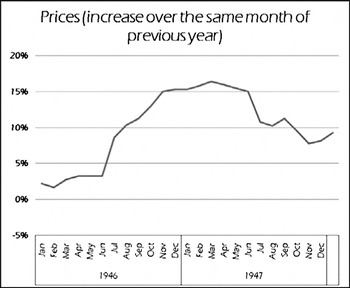
For all its sophistication, the entire Keynesian analysis faced a persistent problem in the postwar years. Its analysis rested on correcting capitalism’s tendency toward deflation and recession; it had very little to say about inflation, which, in the years just after the war, became Americans’ top domestic concern (Fig. 1). “In 1946 the high cost of living was the top worry of 28 percent” of Americans, George Gallup reported. “A year later of 47 percent.” By contrast, only 9 percent worried about jobs in 1946.Footnote 66 President Truman found himself forced to address the problem of inflation even as his advisers offered policies to cure a potential depression.Footnote 67
U.S. Inflation Rate (1946–1947).

If a simple reading of Keynes suggested that the cure to deflation lay in government spending to increase effective demand, then the cure for inflation should lie in government retrenchment as a way to decrease effective demand. But economists in and around the administration rejected this approach because, as Alvin Hansen explained, inflation was not “a problem that could be met solely by over-all control of aggregate demand.” Inflation came from structural factors and the selfishness of labor and business. Moreover, any “such relation as may exist between the quantity of money and prices,” Hansen wrote, “is indirect and tenuous.” The cause of inflation came from the increased demand on scarce products by the federal government in competition with the excess savings of consumers. Fortunately, America was “not an inflation-sensitive country”; once “we work our way through the current scarcities,” the price level would stabilize.Footnote 68 In short, when considering the narrow area of inflation, postwar New Dealers remained committed to the thinking of the early New Deal. Inflation stemmed from structural problems that could be stabilized through better cooperation among sectors of the economy.
While waiting for this stabilization, the Truman administration pursued two options for tackling inflation: price-wage controls and “exhortation.”Footnote 69 As one administration economist argued, it might be “necessary to retain, until the danger is past, some of the machinery that has assured economic stabilization during the war,” including price controls. But these measures, combined with “enlightened business practices,” would soon become unnecessary.Footnote 70 Thus, to the Labor-Management conference of November 1945, Truman said, “The time has come for labor and management to handle their own affairs in the traditional, American, democratic way.” They should show restraint in their wage and price demands. Indeed, “the whole system of private enterprise and individual opportunity” depended upon it.Footnote 71 The inaugural report from the newly created Council of Economic Advisors echoed Truman in arguing that “the outlook for production and jobs in 1947 lies primarily in whether the responsible persons in [different economic] groups will show a willingness to face the issues . . . and show intelligence and skill.”Footnote 72
In the years just after the war, Eisenhower followed Truman’s assessment of postwar inflation largely because it also matched his prewar assessment of the depression. “International [problems] are bad enough,” he wrote in his journal near the end of 1946, “but they are insignificant compared to domestic issues.” When it came to inflation, he noted: “Although everyone believes in cooperation (the single key) as a principle, no one is ready to abandon immediate advantage or position in practicing cooperation.”Footnote 73 Until then, the country would suffer “rising prices . . . labor troubles, housing shortages, and tax squabbles.” He worried that “unless we find a formula which will stabilize the price structure, we are due for most serious times.”Footnote 74
On occasion, Eisenhower expressed his views publicly. Near the end of 1947, at a dinner sponsored by a number of top industrialists as well as leading Republicans, Eisenhower again suggested that the solution to inflation required personal sacrifice. Senator Robert Taft, also attending, pressed him for specifics. So Eisenhower suggested that if some leading industrialist, maybe even “the president of United States Steel,” announced that “his company, regardless of profit or loss, would not raise prices for one year,” it might change the inflationary psychology within the country. Perhaps Eisenhower hoped one of the men in the room might follow his suggestion. But the opposite proved true. The story leaked, and radio personality Fulton Lewis Jr. made it the subject of a broadcast at the end of 1947, embellishing in the process. As Lewis told the story, Eisenhower had “called on top industrial leaders to reduce all prices” and “if the industrialists balked, the government should level a confiscatory tax on all corporate profits.”Footnote 75
The entire experience proved another headache for Eisenhower. As he explained to Arthur Krock, “I normally succeed in keeping my mouth closed about matters concerning which soldiers are not expected to have opinions.” Still, “something suddenly touched upon one of my deep-seated convictions and I was guilty of very warm advocacy of a particular idea.” This did not mean Eisenhower had misspoken: “I still believe that some really big man in the industrial world has an opportunity . . . by sincere, even dramatic action, to help halt the inflationary spiral.” But he concluded that he should have kept his thoughts to himself.Footnote 76
Inflation in Germany (1946–1948)
At almost the same time Eisenhower worried about the consequences of American inflation, Lucius Clay realized that he could not effectively revive Germany’s economy without halting inflation in that country as well. Moreover, Clay worried that he could not successfully democratize Germany without solving this problem. Clay realized that inflation carried important political as well as economic consequences.
Prior to the war’s end, Washington planners had focused on decentralizing Germany’s industrial order by breaking up cartels and other large combines.Footnote 77 They had ignored questions of finance and left instructions for Military Government to work within the existing German financial structure (after seizing Nazi bank accounts and dismissing Nazi bankers).Footnote 78 Soon after Clay arrived in Germany, he began to assemble his staff in anticipation of taking charge of Military Government (upon Eisenhower’s departure). In particular, he wanted his friend and former assistant Joseph Dodge to become the new finance director.Footnote 79 Dodge was a banker from Detroit who had served as a volunteer during the war effort, helping Clay with military procurement contracts.
Soon after becoming finance director in Military Government, Dodge identified inflation as the largest impediment to German economic recovery. Like many other governments, the Nazis had abandoned the gold standard in the early 1930s and used deficit spending to finance an array of state projects. The Nazi leadership had decided never to depend on public support for government debt. They feared that bond issues might amount to a referendum on their policies and turned instead to “silent financing”: that is, they required German banks to buy government bonds. When the banks could no longer absorb the debt, the Nazis placed the Führer at the head of Germany’s central bank. The central bank then purchased government debt with printed reichsmarks, inundating the country with currency.Footnote 80
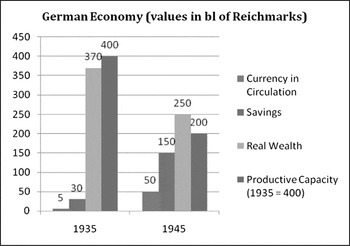
As inflationary pressures mounted throughout the 1930s, the Nazi government turned to price controls (much as the Allies did in the 1940s). In broad terms, currency in circulation rose by ten times, while that in savings multiplied five times. Because of the war, however, the country’s real wealth plummeted by nearly 70 percent, and its overall productive capacity fell in half. In short, the ratio of wealth to currency dropped from roughly ten to one in 1935 to just over one to one by 1945 (Fig. 2).Footnote 81
German Finances (1935; 1945).

When Dodge realized the extent of currency creation under the Nazis, he made monetary reform his top priority.Footnote 82 By early November 1945, as Eisenhower prepared to leave for the United States, Dodge informed Clay of his findings. Clay quickly realized the implications. Because “West Germany could not raise enough food to be self supporting . . . it had to import food,” but “the only place that it could get food was from the United States,” and the Germans only had “worthless currency” to buy it. Under normal circumstances, the Germans might trade their own manufactures for American agriculture. However, “in view of the fact that [we] were paying people to work in currency that was depreciating all the time, there was a very low incentive for people to work.”Footnote 83 As a result, German workers appeared each day at the factory, they received a paycheck each month, but they produced nothing and could buy nothing with their wages. The only short-term solution, price controls and rationing, simply spawned a massive black market. Clay asked Dodge to formulate a solution.Footnote 84
By the spring of 1946, Dodge (working with several economists from the Truman administration) developed a plan to resolve Germany’s inflation problem.Footnote 85 The plan called for a 90 percent reduction in the volume of German currency, the old reichsmarks being replaced by new deutschmarks. The plan also suggested ways to achieve currency stability thereafter.Footnote 86 Disagreements among the allies delayed the implementation of currency reform for another two years, however.Footnote 87 In the midst of the delay, Clay lamented the problem to Eisenhower. “After one year of occupation, zones represent airtight territories with almost no free exchange of commodities, persons and ideas,” he wrote. “Drastic . . . reforms to reduce currency and monetary claims and to deal with debt structure are essential at earliest possible date [but] these cannot be obtained by independent action of the several zones.” He feared that “runaway inflation accompanied by economic paralysis may develop at any moment.”Footnote 88 Eisenhower decided to return to Germany to review the situation personally.
The delay in implementation also led Clay to see inflation in political as much as economic terms. With inflation, he explained, “the lifetime savings of the little man disappear.” Equating a stable currency with “individual rights and human freedoms,” Clay noted that “currency reform affects the everyday life of the individual as no other measure.” He concluded that “there was no other way to democracy” than currency reform and an end to inflation.Footnote 89 By 1948, the British and French had concluded that a currency reform had indeed become imperative, accepting most of Dodge’s plan and Clay’s arguments. The Soviets ultimately agreed to the reform as well—provided they once again could have their own plates for printing currency. Given past experience, Clay, of course, refused.Footnote 90 When he pressed forward with currency reform in the American, British, and French zones in June 1948, the Soviets responded by issuing their own currency and ending any pretense of working with the other Allies.Footnote 91 The Soviets also chose to blockade Berlin, creating the first major Cold War crisis and completing the division of Germany.
Back in the States, Eisenhower observed the reform and its consequences. He also reformed his own economic views. While he never stated his precise reasons, he nevertheless ceased emphasizing altruism as the cure for inflation; in his speeches, his journal, and his private correspondence, he instead focused increasingly on currency creation, the banking structure, and the designs of politicians as inflation’s source.
Connecting German and American Inflation (1948–1949)
When West Germany’s currency reform spurred dramatic economic recovery, various reports filtered back to the United States explaining why.Footnote 92 One particular report that piqued Eisenhower’s interest came from Lewis Brown, the head of the Johns Manville Corporation.Footnote 93 Writing of the economy before the currency reform, Brown noted “the lack of incentives . . . to work and to enterprise in a country once famed for both.”Footnote 94 Indeed, “there are only two ways of making people work. One way is to drive them with a club. That requires a strong fist, the iron fist of the police-state.” By contrast, “The other way is to offer rewards in the form of high living standards, in other words, through an ample supply of consumer goods and services.” To accomplish this, the economy needed “strong money . . . that can be depended on in the present and in the future to buy the things that people need and want. For such money they will work hard.”Footnote 95
Brown juxtaposed “strong money” with “Schachtism,” a term he coined after the Nazi minister of economics and Reichsbank president Hjalmar Schacht. “Schachtism” consisted of “the reckless production of money” that caused “the inflation that is inherent to ‘Schachtism’” and necessitated “the system of price control, wage control, profit control, exchange control, foreign trade control, rationing, quotas, priorities, allocations, special licenses required for even the most minor transactions, red tape, and paper work barriers at a thousand points to that free flow of materials, men, and money which constitutes the very life of healthy trade and a vigorous economy.”Footnote 96 Brown concluded: “Inflation, obscured by the legally fixed low price level . . . [deprives] money of value, which in turn deprives the private enterprise economy and the political system of democracy of its one weapon to get people to work [and] produce.” In short, “without strong money, there is no alternative but the strong fist and that is what the apparatus of ‘Schachtism’ logically leads to.”Footnote 97 In a letter of thanks, Eisenhower called the report “illuminating.”Footnote 98 Soon the two men struck up a correspondence in which Brown continued to forward analysis and suggestions to Eisenhower, often in the form of economic reports or memoranda. Eisenhower often asked for clarification or further analysis.
If Eisenhower had not drawn the connection between “Schachtism” and the American scene, Brown made certain to do it for him. In January 1949, he forwarded a new memorandum that argued that Keynesianism aimed at a “profound modification [of capitalism] to assure the masses of the people permanent ‘full’ . . . employment and purchasing power.” Politicians, but especially Truman, could hardly reject Keynesian economics, since “as long as the Keynesians are successful in preventing drastic deflation and heavy unemployment, the political party in power is likely to stay in power.” Thus, “this basic Keynesian objective . . . coincides with the wishes of the politicians in power. There is a natural alliance between the latter and the Keynesians.”
In Brown’s view, Truman talked about inflation but worried more about his core constituencies, “labor and farmers.” These groups generally benefited from inflation. By contrast, “inflation harms chiefly the middle class who are not, by and large [Truman’s] supporters.” For “those of us who [are] neither farmers nor unionized workers but middle class people or upper-income people with savings,” Brown argued, “Keynesianism will permanently devalue [our savings] and influence.” Political power would continue “steadily passing to those who run Big Government rather than those who run Big Business or Finance.” An economy that lacked for investment capital would soon falter: “This is the beginning of stagnation,” it argued. And stagnation would lead voters to demand “the Security State,” which would lead “to the Welfare State,” and it was “only a step and from there to the Police State. . . . There is the danger.”Footnote 99
Eisenhower sent a note of thanks. “I was particularly interested in [the] theory of the Keynesian state,” he told Brown. As a follow-up, he wanted Brown to work through the implications of Keynesian economics for international trade. “What will be the effect of the changing situation in foreign markets on success in maintaining the Keynesian state?” he asked.Footnote 100 When Brown replied with another memo, Eisenhower concluded, “[Your] economic presentations continue to make much sense to me.”Footnote 101
As Eisenhower considered the implications of this new understanding of inflation, he wanted to check with his old mentor, Bernard Baruch. In June 1949, he wrote Baruch that, while he did “not venture definitely into the field of economics,” he nevertheless felt compelled to make sense of “this constant increase in political control of local and individual affairs.” Echoing Brown, he suggested that “this question is definitely and directly tied up with that of inflation.” He hoped to have some time in the near future to pursue the matter with Baruch in hopes of finding a way he could become “more emphatic and effective” in his understanding.Footnote 102 The two men did meet and discussed their views; but Eisenhower had already begun drifting from Baruch’s worldview and toward the policy insights coming from postwar Germany.
Eisenhower, Truman, the Fed, and the Treasury
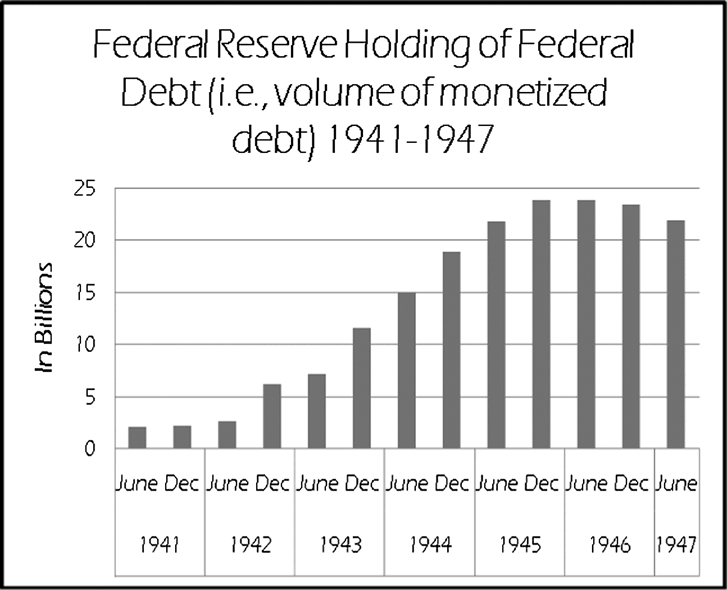
On December 16, 1950, Truman named Eisenhower the Supreme Allied Commander for the North Atlantic Treaty Organization (NATO). On January 1, 1951, Eisenhower left on a whirlwind tour of European capitals. In the meantime, back in the United States, Truman found himself embroiled in a growing rift between the Federal Reserve and the Treasury Department. The conflict grew out of a 1942 decision by the Federal Reserve to support the war budget by purchasing government bonds at a low, fixed rate (2½ percent for long-term bonds). In practice, this meant that whenever the Treasury could not find buyers for government debt, the Fed stepped in to sop it up. Essentially the Fed did this with printed money (Fig. 3).
U.S. Finances (1941–1947).
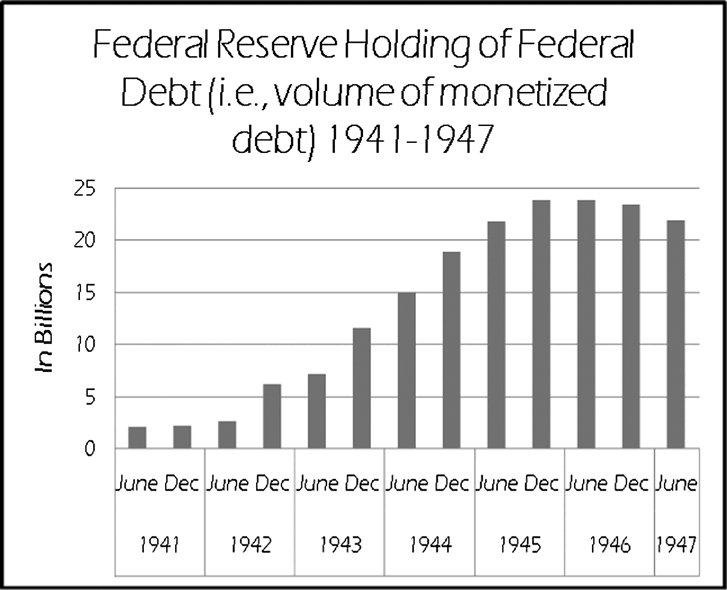
Not long into World War II, however, a number of officials within the Fed worried that the increase in the money supply might lead to runaway inflation. Specifically, Mariner Eccles, the Fed’s chairman (and a longtime New Dealer), warned his fellow New Dealers of the impending danger. But he was largely rebuffed.Footnote 103 When the Roosevelt administration ultimately implemented price controls, Eccles felt vindicated. “I have frequently sought to emphasize in the past,” he explained in January 1946, that “the primary source of the inflation . . . is the vast accumulation of currency and bank deposits.”Footnote 104 Price controls could only partially slow inflation. “In retrospect,” he told Congress, “we can see that we could have, and probably should have, taxed more and borrowed more from nonbank investors, and less from the banking system.”Footnote 105 But Eccles represented a minority view. Truman’s advisers followed Alvin Hansen and downplayed the significance of monetary factors in the price level.Footnote 106
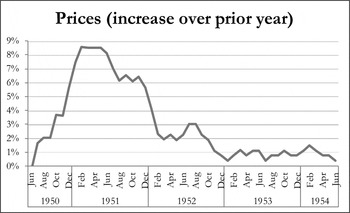
Thus in the summer of 1950, when the Korean War erupted, the Treasury assumed that the Reserve System would again buy its issue of debt at no more than 2½ percent. But by this time, many of the Reserve Board’s Governors had come to believe Eccles’s explanation of inflation and felt that supporting the bond market in the same way would have the same inflationary outcome (Fig. 4). When they informed John W. Snyder, Secretary of the Treasury, of their concerns, he only reiterated that the Fed had an obligation to finance the war as cheaply (for the government) as possible. The two sides eventually fell into a standoff; by January 1951, the conflict had gone public.Footnote 107
U.S. Inflation Rate (1950–1954).

To clear the air, both sides decided to meet late in the afternoon of January 31, 1951. They had to meet late because on that very day Eisenhower returned to Washington to meet with Truman and report on his first impressions of NATO. Truman met Eisenhower at noon on the tarmac of Washington’s National Airport. But as they traveled together in the president’s limousine, Truman largely ignored Eisenhower; instead, he and his aids prepared for the late-afternoon meeting with the Fed. As Eisenhower listened, he realized he did not fully understand why Truman felt so strongly about the issue and why it mattered to the nation.
Back at his hotel, Eisenhower raised the issue with his friend (and former Secretary of the Treasury) Fred Vinson. Vinson shared a few thoughts and then said, “If you want to know about that, why don’t you ask Bob Anderson?” Vinson considered Anderson, a Texas banker, to have a good understanding of monetary issues. Anderson arrived a little later and for several hours he tutored the men on the relationship between bonds, interest rates, inflation, and deficits.Footnote 108 While none of the participants took notes, Anderson most likely repeated in private his public statements on the feud between the Treasury and the Fed. “When Government bond prices were ‘pegged,’ [during the war]” he explained, the “Federal Reserve had to buy securities offered at a fixed price—and thus make credit easier to get.”Footnote 109 This made the Fed into nothing more than the Treasury’s surrogate, which supplied it with “artificially easy credit in a way that [led] to ruinous inflation.”Footnote 110 The conversation clearly made an impression on Eisenhower. The two men began a lifelong friendship that included two administration jobs for Anderson (first, as secretary of the navy and, in Eisenhower’s second term, treasury secretary).
At precisely the same moment that Anderson lectured Eisenhower on his views, Truman lectured the Federal Reserve Board on his own views. In dire terms, he suggested that “the present emergency is the greatest this country has ever faced, including the two World Wars and all the preceding wars.” The Fed had to support the 2½ percent rate; failure to do so could lose the Cold War. “If the people lose confidence in government securities,” he explained, “all we hope to gain from our military mobilization . . . might be jeopardized.”Footnote 111 Surprisingly, though, he never asked the bankers for a commitment. Unaware of the oversight, he announced the next morning that the Fed had agreed to continue buying bonds at 2½ percent; in response, Mariner Eccles leaked the minutes of the meeting to show that Truman had never asked for, nor received, such an agreement. Relations between Truman and the Fed deteriorated further until, by the end of February, the Fed announced that it would no longer support the 2½ percent policy. In early March, William McChesney Martin, then undersecretary at Treasury, managed to strike an “accord” with the Fed involving a complicated agreement on bond purchases over the short-term.Footnote 112
For Eisenhower, Truman’s behavior signaled that he had embraced a policy of inflation for his own political ends. After he returned to Europe, Eisenhower asked his friends to report on the fallout from the controversy. The entire affair “was very badly handled,” wrote one friend. “There was great confusion and uncertainty as to how permanent the truce between the Treasury and the Federal Reserve was.”Footnote 113 As for the policy questions at stake, Eisenhower’s friend Clifford Roberts provided the most detail.Footnote 114 “Purely for the purposes of saving interest on the public debt,” Roberts explained, “the Administration wanted to dictate the policy of the Federal Reserve System.” This violated the purpose of the Fed. “As you well know, [it] is supposed to be an independent body.” Worse, letting the Treasury dictate Fed policy disrupted the dynamic of the market. Because the Fed guaranteed a minimum price, the banks could always “sell Government bonds at a premium,” essentially guaranteeing them a profit. Roberts noted that bankers “were almost completely united in their desire to see higher interest rates used as one of the various measures which are needed to combat the inflationary trend.” Indeed, the bankers—not the administration—held the moral high ground. “Despite the fact that the banking system as a whole will suffer a sizable loss in their portfolios,” Roberts concluded, “they are happy to suffer these portfolio losses in the interest of sound banking.”Footnote 115
Eisenhower decided to distance himself from Truman. He wrote his friend William Robinson (a newspaper executive) that he wished to disabuse those who thought that “merely because I have responded to a simple call to military duty” as the head of NATO he had “embraced without reservation almost all of the foreign, domestic, and political policies of the Administration.” In reality, he “violently opposed [many] of the policies of the current Administration.” It left him “just a bit irritated when I find anyone interpreting my readiness to respond to military orders” as tacit support for Truman’s domestic policies.Footnote 116 Moreover, he began openly to compare postwar America with prewar Germany. “Because some stock a man owns may gain a few points,” he wrote a friend in late 1951, “or because he may be able to sell real estate for more dollars than he paid for it, he cannot be certain that he is prospering. He may be nothing but the victim of inflation.” In fact, “these things were true of Germany in the late 1920s and we know what happened; utter and complete collapse!”Footnote 117
NSC-68: The Final Straw
As Eisenhower drifted from Truman, Truman drifted toward his economic adviser Leon Keyserling.Footnote 118 Keyserling’s influence stemmed from his recognized loyalty to Truman but also his tendency to offer policy proscriptions that escaped many of the hard economic choices Truman had faced in his first term. As one of his fellow economists observed, “Keyserling seems to think that no matter how wide you open the throttle, ‘selective controls’ will prevent unfavorable consequences.”Footnote 119 Whether the country faced recession or inflation, Keyserling generally recommended more government borrowing and spending. “My basic position,” he explained, “is that you have got to measure your federal budget against your national budget.” So long as the economy expanded faster than the carrying charges of the debt, the debt “is easily absorbable.”Footnote 120
Keyserling’s thinking radiated into many administration policies, including the development of NSC-68, the influential Cold War study that recommended a dramatic expansion of America’s military capacity.Footnote 121 NSC-68 worried that the rapid military buildup in the communist world endangered the United States. Truman’s advisers estimated that (even in the absence of war in Korea) defense might require $40 billion annually to match the communist buildup, significantly greater than the $15 billion Eisenhower thought necessary and the $13 billion Truman had previously set as a ceiling on military spending. As Truman’s advisers contemplated these costs, they turned to Keyserling to justify the huge expense, which he did by arguing that the American economy had, essentially, no limits. “With a high level of economic activity, the United States could soon attain a gross national product of $300 billion per year,” the report concluded. “Progress in this direction would permit, and might itself be aided by, a buildup of the economic and military strength of the United States and the free world.”Footnote 122 When he first saw the report, Truman felt ambivalent. He remained wary of the price tag, especially given the energy he had exerted in balancing the budget in the past. But the eruption of the Korean War changed his mind and NSC-68 became policy.Footnote 123
Eisenhower remained outside the circle that drafted the document. But once it moved from recommendation to budgeting, he became aware of both. “This morning’s paper states that the president’s budget,” he confided to his journal, “amounts to something over $85 billion with a contemplated deficit for the year of $14 billion.” He felt betrayed. “Only two or three years ago the president told me very solemnly that an aggregate national budget of more than $42 billion would quickly spell unconscionable inflation in the United States.”Footnote 124 But mostly he felt incredulous: “I have not been a party to any of the military estimates included in the budget,” he noted. “But I know that those men have no better access to secret or otherwise valuable information than I have.” In short, there was “no greater probability of war today than there was two years ago; and no one can say for certain that there is any greater probability of deliberately provoked war at the end of this year or of next than there is now.”Footnote 125 It appeared, now, that Truman had embraced a program for “the annual expenditure of unconscionable sums on a program of indefinite duration, extending far into the future.”Footnote 126
Since the end of the war, Eisenhower had argued that “the purpose of [military defense] is to defend a way of life rather than merely to defend property, territory, homes, or lives.” Because of this purpose, “everything done to develop a defense against external threat, except under conditions readily recognizable as emergency, must be weighed and gauged in the light of probable long-term, internal, effect.” In short, he feared that “we will be so committed to a possibly unwise military program that either we will begin to go far more rapidly down the inflation road or we will again have to accomplish a sudden and expensive contraction in that program.” Sitting in Paris, surveying the Western European political scene, he could not help observing the parallels: “I am well acquainted with some of the countries in which the size of national budgets has stifled initiative and caused great difficulties otherwise.”Footnote 127
His thoughts led in a single, important direction. He had refused every attempt to convince him to run for president. But he feared that the Republicans could nominate the isolationist Robert Taft, who might withdraw American involvement from NATO.Footnote 128 Now he also feared the perpetual deficits contemplated by NSC-68; these had such “great political significance at home [that] if the Republicans decide to place a political mandate upon me, I would not attempt to evade it.”Footnote 129 As it turned out, at precisely that moment Lucius Clay decided to press the issue of the presidency once again, and this time Eisenhower ultimately agreed to run.
“It is needful,” Eisenhower explained of his decision, “to stand watch to see that new financial despotisms do not arise.” These could “scarcely come into existence except with the consent of, or because of the weakness of the over-all political organization.” Indeed, Truman’s plan to have “peace time . . . deficits,” “stifling Federal Taxes,” and “the piling up of governmental debt” pointed to the “danger [that] still exists” for American democracy. His administration seemed to say, “Let me, whether in peace or war, control prices of materials and of labor, let me control imports and exports, let me control production and sales, let me issue more money . . . and, I promise you . . . all will be well!” For Eisenhower, it seemed instead that Truman had placed the country on a path toward “regimented labor” and the “inescapable basis of the socialized or planned economy!”Footnote 130
The Campaign of 1952 and the Promise of a New Political Economy
In June 1952, Eisenhower held his first televised press conference as a presidential candidate. In talking of the price and wage controls that resulted from the Korean conflict, he explained that he had “far more faith in the interplay of . . . supply and demand” than in price controls and preferred “extending and reducing credits, and discount rates, and so on” for controlling inflation.Footnote 131 These words hit Bernard Baruch like a bombshell. He immediately called Eisenhower’s campaign and complained that Eisenhower’s words were “most disturbing.” Echoing his conversations with Eisenhower in past decades, he explained, “You cannot mobilize to the extent security requires without priorities over production.” Moreover, “you cannot have priorities without price and other controls.” To Baruch, “no other single problem save peace itself is more basic than this.” He felt Eisenhower needed to give the matter “more judicious thinking” because America could not “have peace without the controls necessary to mobilize the strength that is all that keeps the world free.”Footnote 132
Eisenhower soft-pedaled their disagreement. “I have sat at your feet for many years and listened to your ideas,” he explained, “and as you know I have, in the main, thoroughly agreed with them.” But times had changed. “Now we find ourselves in circumstances that are neither war nor peace.” Controls undercut the nation’s ideals and strengths. “I feel that we should figure out our strength objectives and push toward them steadily,” he explained, “but always having in mind that we must retain a strong and solvent economy.”Footnote 133 While the two remained cordial, their disagreement marked the end of the mentorship. Eisenhower could no longer embrace the price controls he had recommended twenty years earlier.
Throughout the campaign, Eisenhower placed the blame for inflation upon deficit spending and money creation. “With one hand the Administration has been turning up the water pressure at the hydrant, while with the other hand it has been trying to check the water’s flow.” As a result, “the Administration’s controls over prices are nothing but weak stop-gaps.” In veiled reference to the Treasury-Fed conflict, he explained, “The really effective controls—those over money and credit—were ignored by the Administration.” The reason? “Resort to those controls would have paralyzed their scheme to use ‘cheap money’ for their own ends.” Echoing Lewis Brown, he explained those ends as political rather than economic, as an effort “to fool the people with a deceptive prosperity . . . to give more people more money that is worth less.” Echoing Clay, he argued that inflation had more than an economic impact on the country: “It pervades every single aspect of our individual and national life.” In short: “I have spent a number of years in Western Europe . . . trying to help our friends there set their houses in order and in strength. I have seen these war-shaken countries grapple with terrible problems of shortages and prices.” He then connected economics with geopolitics and explained that he had warned Europe: “You must strengthen your currencies, beat back inflation, set your economic affairs straight—or you will lose the battle with Communism without a gun being fired.”Footnote 134
For specific economic policies, he told the American people that he planned to “provide a sound dollar.” Indeed, providing a stable currency amounted to “government’s primary economic responsibility”; the “first and vital step” toward a stable currency came from eliminating “the deficit from our national budget.” He also wanted lower taxes; but Eisenhower made clear that this required first a reduction in “government spending” that would “thereby permit lower taxation.” Tax relief remained secondary to keeping the budget balanced.Footnote 135
Still, the state had vital functions to perform in defense and protecting the “little man” from the vicissitudes of capitalism. But, on Eisenhower’s view, this made balancing the budget the crucial policy. “Of course, some of the huge spending is necessary,” he explained during the campaign trail. “But doesn’t that very fact make frugality in government more essential than ever?” Indeed, “isn’t it time we had in Washington an Administration which knows how to keep spending down; which will put an end to waste; which believes than an unbalanced budget is dangerous to every one of us—and moved to bring that budget into balance?”Footnote 136
As Election Day neared, Eisenhower turned to Clay for help in governing. They agreed immediately that they did not want “another military man in high position in [Eisenhower’s] government.” Clay would remain an informal adviser outside government.Footnote 137 In staffing the Cabinet, however, Eisenhower deferred almost entirely to Clay’s preferences. They looked to the Budget Bureau first because they agreed it was “the most influential” agency in government: it “define[d] financial policies to prevail” within the executive branch and provided the primary tool to “control the general program of each Department and Agency.”Footnote 138
Clay selected his friend and former Finance Director Joseph Dodge to become Director of the Budget Bureau. Eisenhower remembered Dodge from Germany and knew of his work on currency reform. Clay invited an unsuspecting Dodge to Eisenhower’s campaign headquarters at the Commodore Hotel for election night. Once Adlai Stevenson had conceded the election, Clay pulled Dodge to a separate room where Eisenhower waited. Would Dodge accept the nomination? Dodge “was as moved by the occasion as anyone.” He answered “in a choked voice [that] he would be glad to help the General out on any immediate problem.”Footnote 139 In subsequent discussions, Eisenhower told Dodge that he had the task of working out the details of a balanced budget. Soon, Dodge noted that he had “been included in more responsibilities and . . . engaged in more diversified activities than [all] former Directors.”Footnote 140
Conclusion
Thus, when he assumed the presidency Eisenhower had developed a coherent political philosophy based on a set of policy recommendations that came largely out of the military occupation of Germany. In his estimation, his political economy amounted “almost to a revolution in Federal Government as we have seen it operating in our generation.”Footnote 141 But here he spoke almost autobiographically; after all, his views of 1952 largely rejected his views of 1932. Between these two pivotal years, he traveled a long and winding intellectual path—largely outside the United States—to arrive at the policy prescriptions he ultimately made the centerpiece of his domestic policy. He never found a good way to characterize his views, though. At some points, he called his views “conservative dynamism” only to reverse that to “dynamic conservatism.”Footnote 142 Part of the problem came from the fact that he tried to translate policies born outside the United States into the political jargon familiar within it. In any event, what he called his political economy never mattered to him as much as the policies themselves.