

1. INTRODUCTION
One could ask two types of questions concerning preservation and non-preservation of dative case, namely, on the one hand, diachronic questions concerning the keeping or loss of dative case in a language or dialect through time, and, on the other hand, synchronic questions concerning the keeping or loss of the dative case of a DP under movement to certain syntactic positions. We assume that the two types of questions are connected in the sense that synchronic preservation or non-preservation of dative under movement can be used as an indication of the status of the general diachronic preservation or non-preservation of dative in a certain language or dialect. Focusing on the three languages mentioned in the title of this article, we hypothesize that these three languages can be said to represent three diachronic stages signalled synchronically by the degree of preservation or non-preservation of dative under movement. In this paper, we will seek to lay the groundwork for an investigation of this particular diachronic–synchronic connection in Norwegian, Icelandic and Faroese, primarily by exploring the synchronic status of dative under passive movement and topicalization in the three languages, but also simultaneously paying attention to the larger questions of diachronic preservation and non-preservation of dative.
The paper is organized as follows. In Section 2, we briefly describe the status of dative in the common historical antecedent of the three languages under discussion, namely Old Norse. In Section 3, we investigate the status of dative in contemporary Norwegian, where dative is already lost in many dialects, and where its loss seems to be imminent in others. Then, in Section 4, we discuss the situation in Icelandic, where dative is strong and even spreading, and in Faroese, where dative seems to be in an intermediate diachronic position between Icelandic and Norwegian. The robustness of dative in Icelandic and Faroese is measured by an investigation of the preservation or non-preservation of dative DPs under movement to the subject position in passives and to the topic position. In Section 5, a corresponding investigation of the robustness of dative in Norwegian dative dialects is carried out, again using the preservation or non-preservation of dative DPs under movement to the subject position in passives and to the topic position as a measure. Section 6 contains a preliminary theoretical discussion of the results that are found, and Section 7 summarizes and concludes the paper.
2. DATIVE IN OLD NORSE
Old Norse is a North Germanic language that was used in the Western part of Scandinavia (Norway, Iceland and the Faroe Islands, and in the Norse settlements in the British Isles and Greenland) from the early ninth century until the late fourteenth century. Old Norse, unlike Modern Norwegian, but like Modern Icelandic, is a highly inflected language. It has four grammatical cases: nominative, accusative, genitive, and dative. All relevant parts of speech (nouns, adjectives, pronouns, and determiners) are inflected for case. Nouns are inflected both in the singular and plural, and in the indefinite and definite form.
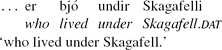
The Old Norse dative case can occur in a variety of contexts. For instance, it can serve as the direct object of certain verbs, as in (1), as an indirect object, as in (2), as the complement of certain prepositions, as in (3), or as the complement of an adjective, as in (4). Dative typically realizes semantic roles like beneficiary, instrumental, location, and origin.
(1)

(2)
(3)
(4)



In addition, note that Old Norse shows the dative – accusative alternation correlating with locative – directional spatial prepositions in PPs. This alternation is common in Germanic case languages (see Åfarli Reference Åfarli2011), and is also found today in the Norwegian dialects we are investigating in this paper; see Section 3.2 below.
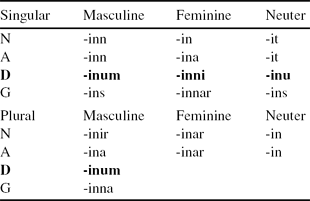
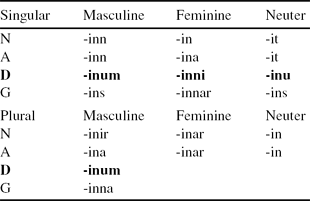
As an illustration of the case paradigms in Old Norse, consider the inflectional pattern of the definite article in Table 1.
The inflectional pattern of the Old Norse definite article (Torp Reference Torp1995). Bold highlights dative.
The loss of case inflection has often been related to the change from a ‘free’ to a ‘fixed’ word order. After the Black Death in c. 1350, during which almost half of the Norwegian population died, the language went through extensive changes. During this period, syntactic changes happened that reflect more general typological trends. One of these trends is the move from reliance on morphology to reliance on syntax, from a synthetic to a more analytic language type. One main consequence of this drift is a change in the marking of grammatical relations. Most of the morphological marking in Old Norse is replaced by fixed positions and the use of function words, such as prepositions (see Faarlund Reference Faarlund2004).
Faarlund (Reference Faarlund1990) argues that in most instances the preservation of the dative case, as opposed to the preservation of accusative and genitive, can be understood on a phonological basis: The dative case had the most distinct and marked form in Old Norse. In many declensional classes there was already much syncretism of nominative and accusative. Another explanation offered by Faarlund is that the dative case is maintained longer since it is used in a well-defined position, such as following a preposition or as an indirect object.
3. DATIVE IN CONTEMPORARY NORWEGIAN
In this section, we will present the dative situation in contemporary Modern Norwegian by considering data from four dialects that are usually assumed to have retained dative. However, before we look at the data from these four dialects, we first give a general overview of the dative situation in Norwegian (Section 3.1), followed by an outline of the syntactic and semantic criteria that trigger dative according to the literature (Section 3.2). Next, we show the geographical distribution of dative in Norway (Section 3.3), and we describe the Nordic Dialect Corpus, which is the main data source from which our material has been gathered (Section 3.4). Then, in Section 3.5, we provide material from the corpus, discussing data from the four dialects that we have selected for consideration. Lastly, in Section 3.6, we discuss the fragility of dative in the dialects that we have been discussing.
3.1 Dative has been dying for a long time
The loss of dative in Norwegian is assumed to have started around the year 1350 (Sandøy Reference Sandøy and Elmevik2000), when many other changes in the Norwegian language also started. When Ivar Aasen published the Nynorsk written norm (Aasen Reference Aasen1864), he chose not to include dative, since he believed dative was becoming obsolete in many dialects.
Previous studies of Norwegian have shown that young people in many regions of the country have lost dative, even in those regions where it was still believed to exist, thereby supporting Aasen's view. Young people born after 1970 in the districts of Romsdal (Sandøy Reference Sandøy1996, Reference Sandøy and Elmevik2000) and Toten do not use dative, except for a small area in the south-eastern part of Toten (Faarlund Reference Faarlund2000), and it is lost among people born after 1980 in the village of Os in Østerdalen, according to Moseng (Reference Moseng1996). In the valley of Hallingdal, the loss of dative started among people born after 1940 (Beito Reference Beito, Beito and Hoff1973 [1958]). Some places are still holding on to dative. Øygarden (Reference Øygarden1995) reports that even among those born around 1980 there is still a lot of datives in the municipality of Vågå, in the Gudbrandsdalen valley. Since, according to the literature, young people in many of these traditional dative areas no longer use dative, it might seem futile to look for dative among young speakers now, but our investigation of the NorDiaSyn material shows that there are still young dative users in certain areas, e.g. in Lom, the neighbouring municipality of Vågå.
Beito (Reference Beito, Beito and Hoff1973 [1958]) argues that there is a hierarchy of contexts for the loss of dative. He claims that dative is lost first in contexts where dative is governed by an adjective, then in direct object and indirect object positions, while it is kept the longest when governed by prepositions.
3.2 Syntactic and semantic criteria for the Norwegian dative
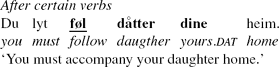
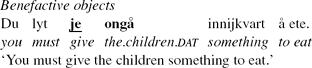
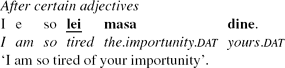
In this section, we give an overview based on the relevant literature, of what the dative contexts are in those dialects of contemporary Norwegian that still have dative. The syntactic criteria for dative are basically the same as in Old Norse, and we exemplify this with the Romsdal dialect (from Anderson Reference Anderson2010:26–28). The word triggering dative is underlined and bold, while the dative phrase is just bold.
(5)
(6)
(7)
(8)

The Norwegian dative also expresses the semantic distinction of location and direction. As in Old Norse, dative is used to express location while the standard case in Norwegian expresses direction.Footnote 1 The examples in (9) from the Toten dialect show the semantic distinction between dative and standard case:
(9)

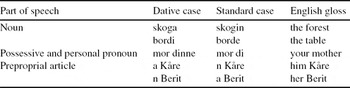
Unlike Old Norse, the Norwegian dative dialects show dative only on a restricted number of parts of speech: nouns, pronouns (including possessives), preproprial articles (i.e. the determiners obligatorily preceding names in many dialects), and demonstratives; see Table 2 for the first three classes. Also unlike Old Norse, the Norwegian dialects only have dative-marking on definite nominals (i.e. definite nouns, pronouns, demonstratives and articles). Indefinite nominals are never dative-marked.
Dative forms in different parts of speech (from Faarlund Reference Faarlund2000).
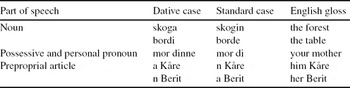
Note that for the preproprial articles there is an economy principle: the dative form is simply the masculine standard one for feminine nouns and the feminine standard one for masculine nouns. Note also that adjectives and psychologically distal demonstratives (Johannessen Reference Johannessen2008) do not have dative case marking.
3.3 The Norwegian dative area
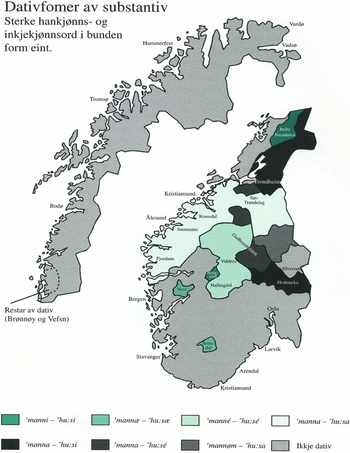
The traditional dative area stretches from East Norway, from Hedmark, the valleys of Gudbrandsdalen, Hallingdalen and Valdres, and over to the western coast of Norway from Sogn in the far west and to Trøndelag further north. Dative is found as far north as North Trøndelag. There are also two dative islands in Setesdalen and Voss (south and west, respectively, of the core dative area). The Norwegian dative area is shown in Figure 1 (from Skjekkeland Reference Skjekkeland1997). It comprises all the areas in the middle part of Norway that are not shaded in the same grey colour as the one that covers the northern and southern parts of Norway on the map.
The Norwegian dative area (Skjekkeland Reference Skjekkeland1997).

3.4 The ScanDiaSyn data collection
We have seen that dative seems to be dying, but that there are some areas where it still exists. In order to better diagnose the present dative situation, we wanted to find more recent data on which to base our investigation. Fortunately, the big project Scandinavian Dialect Syntax (ScanDiaSyn) could provide us with what we needed. The ScanDiaSyn project aims to systematically map and study syntactic variation across the Scandinavian dialect continuum. In order to do so, a comprehensive data collection has been carried out. In Norway there are 100 measure points, each with data collected from four informants. Informants are selected according to the following criteria: They must speak the local dialect, two must be under 30 years old (one female, one male), two must be over 50 years old (one female, one male). The informants are supposed not to have lived outside the municipality for more than seven years, and they should not have any higher education.
At each measure point three types of data have been collected: audio and video recordings of spontaneous speech, evaluations on syntactic constructions presented as questionnaires (speaker intuitions) and translations of certain constructions. In the present dative study we have used the audio and video recordings as they have been made available available in the Nordic Dialect Corpus (Johannessen et al. Reference Johannessen, Priestley, Hagen, Åfarli and Vangsnes2009) and the speaker intuition data that are available in the Nordic Syntax Database (Lindstad et al. Reference Lindstad, Nøklestad, Johannessen and Vangsnes2009). Speaker intuitions are measured by the informants’ evaluation of questionnaire sentences. In the ScanDiaSyn questionnaire there are seven sentences that test dative use.
The audio and video recordings are a valuable source of data for the present kind of investigation, since the informants speak freely and data are not elicited. Each of the four informants takes part in two different recording sessions. One is a semi-formal fifteen-minute interview in which the project assistant asks questions about such topics as the informant's general personal background, childhood, and their opinions about the location. In the other session, two informants talk to each other with no intervention of the assistant, who moves out of sight, for example, out of the room. They are given a list of topics from which they can choose what to talk about. This list, which varies somewhat depending on the nature of the location, contains such topics as cooking, television shows, sports, leisure activities, travels, and fishing. The informants are also told what they must not talk about; their illnesses, prison sentences, political opinions, other people, including friends and family. This is to comply with the Personal Data Act, which is necessary for the recordings to be used for research.
Since the informants speak freely, any grammatical constructions that they use occur spontaneously and without prior elicitation. Since the recordings will be used for any kind of linguistic investigation, the informants cannot know what might be interesting for researchers; the only thing they have been told is that their language is valuable for linguistic investigation, and that they are the experts. Whenever a dative form is spoken, therefore, we have reason to believe that it is part of the speaker's repertoire. Whenever a dative form is not used where it can be accepted, we can assume that dative is not part of that person's linguistic system. It is important that the informants are speaking to each other rather than to the assistant during this recording. It means that the risk of accommodation towards an outside dialect or speech variety is minimized.
In addition to the spontaneous recordings, the ScanDiaSyn project also has collected systematic data on various grammatical constructions, including the morphological dative. In this part of the investigation the same informants were presented with pre-recorded sentences presented in a dialect that resembled their own phonologically and lexically, but testing particular constructions. Approximately 150 sentences were presented to them, and they would evaluate each on a scale from 1 (unthinkable in the dialect) to 5 (perfect in the dialect). This syntactic judgement task was carried out with one or two informants at a time, depending on a variety of factors to do with time, and attitude to the task by the informants and the investigators. Some informants felt insecure about this part of the investigation; they felt it resembled a school situation, and wanted to be part of a team rather than on their own. The resulting Nordic Syntax Database is a valuable addition to the Nordic Dialect Corpus, especially for less frequent constructions. In this paper, we present data from both sources.
3.5 Four Norwegian dialects: Material from the Nordic Dialect Corpus
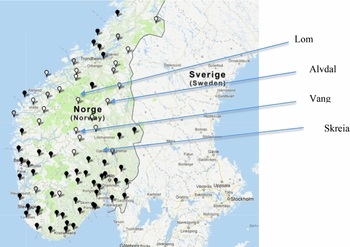
In our investigation of dative we have chosen four measure points found in the Nordic Dialect Corpus: Alvdal, Skreia, Lom, and Vang in Valdres. These four measure points, see Figure 2, are from three major dialect areas. Skreia belongs to opplandsk, Alvdal is in the østerdalsk area, while Vang and Lom are in the midlandsk area. All these dialect areas are in the traditional dative area in Norway.
Results from Nordic Syntax Database testing dative governed by a locative preposition. White markers indicate positive evaluation; grey medium, and black negative.

First we will present data from the recorded spontaneous speech. Our data show that dative is found most frequently with prepositions. However, there are some examples of dative with direct objects in Lom, and we found one example of dative with an adjective in Vang. The data from spontaneous speech are interesting since they are produced without prior prompting. We thus know that if they are used, they belong to the dialect of the people who have uttered them.
3.5.1 Alvdal
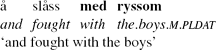
In Alvdal, we find dative only after prepositions:
(10)
(11)
(12)
(13)



3.5.2 Skreia
In Skreia, too, we find dative most frequently after prepositions:
(14)
(15)
(16)
(17)



3.5.3 Vang
In Vang, dative is mostly triggered by prepositions, apart from one occurrence with an adjective, shown in (18).
(18)
(19)
(20)
(21)




3.5.4 Lom
In Lom we find dative both after prepositions and after certain verbs. The first four examples below are with prepositions, and the last two with verbs. Both verbs are in fact mentioned by Dagsgard (Reference Dagsgard2006) as typical dative triggers. Dagsgard (Reference Dagsgard2006:107) says about the verb fylgje ‘follow’ that dative is used with complements of this verb, even by children of immigrants. About the verb tru ‘believe’ he says (page 109) that while this verb is used to trigger dative in the traditional dialect, it is nowadays mostly found with dative only in the expression e tru:r di ‘I think it’. i.e. ‘I think so’. The examples below show dative with prepositions in (22)–(25) and as direct objects in (26)–(27).
(22)
(23)
(24)
(25)
(26)
(27)






To conclude our data presentation of these four dialects, we have found that dative occurs there, but mostly with prepositions, and occasionally with direct objects of verbs (Lom) and with adjectives (Vang). We have found no example of indirect object datives. Recalling now what Beito (Reference Beito, Beito and Hoff1973 [1958]) said about a hierarchy of loss, we find that our data do not support his claim in every detail. His main claim is uncontroversial with respect to our data: Prepositions are definitely the most frequent dative trigger in all dialects. But he claims that dative is lost for adjectives first, and this does not hold for our data; while we have no examples of dative with indirect objects, we do have dative with an adjective. However, we should be careful in applying any generalizations of this kind on the basis of the small data sets we have used. There may simply not be any indirect objects on which dative could have been realized. Also, considering the northern dative dialects that we investigate in Section 5 below, dative seems, on the whole, to be more robust there. For instance, indirect object dative DPs are easily found in these northern dative dialects.
3.6 Dative DPs are disappearing now
There are several indications that dative is vulnerable and disappearing in the four dialects that we have been investigating. For instance, while dative has many uses in Old Norse, it is found mainly with prepositions in our material, although some uses with verbs and adjectives are still found. We recall from Section 2 on Old Norse that semantics plays a role in the assignment of dative case. In particular, spatial prepositions can typically be used with both location and direction. In such instances it is the semantics that decides whether it should be dative or standard case that is used. This is illustrated by the two examples in (9) in Section 3.2 above, from the contemporary Toten dialect. The data from our four places of investigation confirm that this pattern is still in use.
Another indication that dative is vulnerable and disappearing in the contemporary dative dialects is that only a restricted number of parts of speech – nouns, pronouns (including possessive pronouns, preproprial articles, and demonstratives – can be marked with dative case. This contrasts with the use of dative in Old Norse where more parts of speech had dative forms. In addition, dative can only be used with the definite form of the noun in the contemporary dialects. This again contrasts with the situation in Old Norse, where both definite and indefinite forms had dative morphology.
Moreover, the spontaneous speech in the Nordic Dialect Corpus shows that the dative system is unstable. Thus the same person uses dative case in one sentence and standard case in the other, even when the context is formally and semantically the same. Consider for example the following two sentences:
(28)
(29)
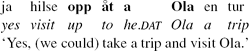

Investigating the dative noun phrases uttered by the various speakers, it is clear that the dative system is unstable. By studying the differences between the generations it is quite obvious that dative is in fact dying in contemporary Norwegian dialects.
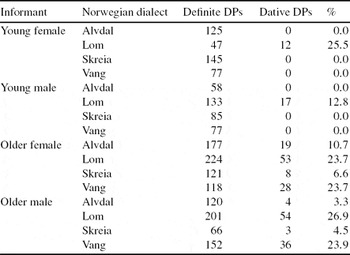
Consider Table 3. This table shows that while the older generation uses dative in all four areas, among the young people, only those from Lom have any datives at all.
Dative use in the four Norwegian dialects.

Figure 2 shows a map from the Nordic Syntax Database. The informants across South Norway have been asked to evaluate a sentence in which a dative follows a locative preposition. The figure shows the mean scores.
Our four locations are all amongst the white or grey markers on this map. The database also includes sentences with other types of dative triggers. The results do not always correlate with the data we found in the Nordic Dialect Corpus. Some informants rejected the dative sentences in their dialect, while they produced dative spontaneously, while others accepted the dative sentences from the questionnaire while not producing any themselves (we refer the reader to the Nordic Syntax Database, or to Garbacz (to appear). We take these results to indicate that speaker intuitions are weak, and that they support our findings; that while dative has been dying for a very long time, it is now really on its deathbed. However, note that Sandøy (Reference Sandøy, Reinhammar, Elmevik and Edlund2011) is slightly less pessimistic, a stance that is supported to some extent by our findings reported in Section 5 below, that dative seems to be more robust in the dative area north of the four southern dialects discussed in the present section.
4. SUBJECTS, TOPICS, AND DATIVE IN ICELANDIC AND FAROESE
The focus in Sections 2 and 3 above was on the diachronic loss of dative in Norwegian; now we will concentrate on Icelandic and Faroese, where dative is more robust, and more robust in Icelandic than in Faroese. We will test the diachronic robustness of dative by investigating the synchronic status of dative in different structural positions in the two languages. In Section 5, we will extend similar synchronic tests to Norwegian dative dialects. Thus, from this section on, we shift our focus from the diachronic (non-)preservation of dative to the synchronic (non-)preservation of dative in different syntactic positions as a diagnosis for the comparative diachronic (non-)preservation of dative in Icelandic, Faroese, and Norwegian.
4.1 Icelandic
Icelandic and Faroese have two types of canonical passive clauses which can be termed (i) ‘full passive’, in which the DP moves to the canonical subject position, and (ii) ‘expletive passive’, in which the DP either stays in situ or undergoes ‘short DP movement’ to the left of the past participle (for a detailed exposition of the facts, see Eythórsson Reference Eythórsson and Eythórsson2008; see also Thráinsson Reference Thráinsson2007). The full passive counterpart to the Icelandic active sentence in (30) is exemplified in (31).
(30)
(31)
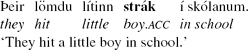

The corresponding expletive passive types are shown in (32a–b). As in other expletive constructions, the DP is subject to the Definiteness Effect (Safir Reference Safir, Reuland and Ter Meulen1987:71–97) and must be indefinite; in the full passive, on the other hand, there is no such restriction.
(32)

As seen in the examples in (31) and (32), accusative objects in active sentences show up as nominative subjects in passive.Footnote 2 The facts of Faroese are comparable, although passive is in general not as robust in that language as in Icelandic (see Section 4.2 below). Dative and genitive, on the other hand, are ‘preserved’ in passive; DPs in these cases pass the standard subject tests as well. The case preservation in passive is illustrated here by means of the monotransitive verb hjálpa ‘help’, which takes a dative object:
(33)
(34)
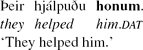

In expletive passives, dative is also preserved in Icelandic. As mentioned above, the DP must be indefinite and can occur either to the left or to the right of the past participle.
(35)
(36)
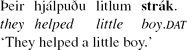

It should be mentioned that the postverbal DPs, i.e. those occurring to the right of the participle, appear to resist subject tests more than the ones occurring to the left of the participle. However, this has not been studied systematically.
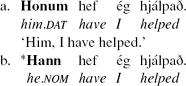
Finally, in topicalizations of dative (and genitive) objects in active sentences, no change of case occurs:
(37)
4.2 Faroese
In Faroese there is considerable variation in case marking in passive and both preservation and non-preservation of dative occurs. The variation is partly lexical, depending on a particular verb. There also appears to be a great deal of speaker variation in that some speakers prefer preservation of dative, whereas others do not. Again, this is illustrated with the verb for ‘help’, hjálpa, which takes dative in the active, just as in Icelandic, but occurs with either dative or nominative in passive. Both the nominative and the dative DPs pass the standard subject tests (see Barnes Reference Barnes1986).
(38)
(39)


An overview of the basic facts of case preservation in passive in Faroese is presented in Thráinsson et al. (Reference Höskuldur, Petersen, Lon Jacobsen and Hansen2012 [2004]). According to the description given in that work, dative is preserved with bíða ‘wait’, dugna ‘help’, takka ‘thank’, and trúgva ‘believe’. On the other hand, nominative rather than dative is said to occur in passive with bjarga ‘save’, bjóða ‘invite’, heilsa ‘greet’, hindra ‘hinder’, hjálpa ‘help’, mjólka ‘milk’, rósa ‘praise’, and steðga ‘stop’.
It should be noted that Thráinsson et al. (Reference Höskuldur, Petersen, Lon Jacobsen and Hansen2012) do not discuss the expletive passive in Faroese in any detail, nor do they provide any examples of case preservation in this type of structure. They do, however, present examples of expletive passives of the verb keypa ‘buy’, which takes accusative case (see Thráinsson et al. Reference Höskuldur, Petersen, Lon Jacobsen and Hansen2012:284–285). As in Icelandic, the accusative is replaced by nominative in passive and the DP must be indefinite, occurring either to the left or to the right of the past participle.
(40)

More detailed information on the case variation in passive was obtained in fieldwork surveys conducted in the Faroe Islands in 2008 and 2009 (Eythórsson Reference Eythórsson2012). During a field trip in August 2008, a written questionnaire containing judgement sentences was administered to 62 informants in six locations; the number of informants in each location is given in parentheses: Tórshavn (14), Fuglafjørður (6), Klaksvík (6), Tvøreyri (6), Sandur (5), and Miðvágur (25). The gender distribution was fairly even: 32 women and 30 men. The participants were divided into three age groups: 30 years and younger (21), 31–50 years (25) and 51 years and older (16). In the 2009 survey, a small number of informants were interviewed in three different locations in the Faroe Islands; the elicitation methods included rephrasing active sentences in order to obtain production data involving passive.
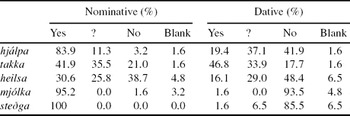
In the 2008 survey the verbs tested included heilsa ‘greet’, hjálpa ‘help’, mjólka ‘milk’, steðga ‘stop’, and takka ‘thank’; these verbs are also discussed in Thráinsson et al. (Reference Höskuldur, Petersen, Lon Jacobsen and Hansen2012). The participants were asked to evaluate two sentences for each verb, one containing a nominative and the other a dative; thus, the sentences formed minimal pairs; see Table 4. The possible answers were: ‘Yes’ (I can say this), ‘?’ (Doubtful sentence), and ‘No’ (I cannot say this). Some participants did not give any answer to some of the questions, and these are indicated by the figures in the ‘Blank’ column in Table 4.
Case in passive in Faroese: The 2008 survey (from Eythórsson Reference Eythórsson2012).

As this table shows, the informants judged passive sentences with a preserved dative case best with takka ‘thank’ (46.8% acceptance rate as against 41.9% acceptance rate with nominative).
(41)
(42)
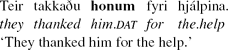

This is in accordance with the general findings in Thráinsson et al. (Reference Höskuldur, Petersen, Lon Jacobsen and Hansen2012), as are the results of the 2008 survey in general. However, the survey provides a more nuanced picture than that in Thráinsson et al. (Reference Höskuldur, Petersen, Lon Jacobsen and Hansen2012), where it is summarily stated that nominative occurs with hjálpa, heilsa, mjólka, and steðga, and dative with takka only, thus showing that there is more variation than suggested there.
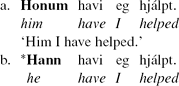
While there is variation in the preservation of dative case under movement in Faroese, no such variation is reported for topicalization of dative objects in active sentences. The findings of recent surveys on Faroese and interviews with speakers corroborate this result. For example, when the object DP of the verb hjálpa ‘help’ is topicalized, the dative case remains intact, just as in Icelandic.
(43)
In addition to passive structures involving movement, the 2008 survey tested case preservation in expletive passives in Faroese, which, as mentioned, is not discussed in Thráinsson et al. (Reference Höskuldur, Petersen, Lon Jacobsen and Hansen2012). It should be explained here that the focus of the investigation was primarily on the question if Faroese has structures corresponding to the so-called New Passive in Icelandic, i.e. if definite accusative and dative DPs can occur postverbally in passive (see e.g. Eythórsson Reference Eythórsson and Eythórsson2008). The results from this part of the survey will be presented in detail elsewhere, but for the present purposes it is sufficient to state that, in general, dative preservation occurs at a much higher rate in the expletive passive than in ‘long movement passive’ (i.e. subject-initial passive sentences). Again, the verb takka ‘thank’ had the highest acceptance rate, with 64.5% of the participants accepting the sentence in (44); it should be noted that the postverbal dative DP is definite.Footnote 3
(44)

As shown above, in Faroese, dative is preserved under movement in passive with certain verbs, in particular takka ‘thank’. The preservation of dative in passive is even stronger in the expletive passive (often in violation of the Definiteness Effect). Moreover, with double object verbs, dative seems to be generally preserved in passive. The case marking of the object, however, varies between nominative and accusative. Comparison with Old and Modern Icelandic shows that the nominative is the older pattern, but the accusative is an innovation. Thráinsson et al. (Reference Höskuldur, Petersen, Lon Jacobsen and Hansen2012 [2004]:270–272) claim that the accusative is uncommon/ungrammatical in passives involving double object verbs, marking the examples with a double question mark or a star (??/*). However, the 2008 survey shows that, with the verb giva ‘give’ and an indefinite DP object, more participants accept the accusative than the nominative:
(45)
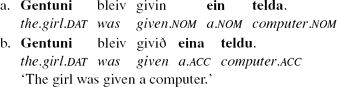
The figures are as follows: (45a) was accepted by 25.8% of the participants and rejected by 50.0%; (45b) was accepted by 17.7% of the participants and rejected by 61.3%. Remarkably, the percentage of participants who said they were unsure and provided the sentences with a question mark was the same in both cases (21.0%). By contrast, a sentence containing a definite DP in the nominative was overwhelmingly rejected (88.7%) or judged questionable (6.5%).
(46)

Finally, it is worth asking if there is any tendency for dative in passives of double object verbs to be replaced by nominative. Such a change has happened in English (Denison Reference Denison1993:103–104), where the following type of passive is found in some varieties:
(47) She was given them.
Thráinsson et al. (Reference Höskuldur, Petersen, Lon Jacobsen and Hansen2012 [2004]:272) state that the examples below are both equally unacceptable.
(48)

In the 2008 survey, speakers were asked to judge these passive sentences. The result was that the sentence containing nominative case with both the subject and the object was totally rejected, but the one containing accusative case with the object was judged slightly better (14.5% accepted it, 8.1% gave it a question mark). These results suggest that even in passives of double object verbs nominative is slowly being substituted for dative in accordance with the general development in Faroese.
4.3 Summing up
In the preceding discussion, the robustness of dative in Icelandic and Faroese was measured by studying the preservation or non-preservation of dative DPs under movement to the subject position in passives and to the topic position.
The general situation in Icelandic is that dative is preserved, both as a subject case and as a topic. However, case in Icelandic is not completely static, contrary to what one might be inclined to think given the usual view. In fact, Nominative Substitution is attested with theme subjects, mostly affecting accusative DPs, but also dative DPs. However, Nominative Substitution appears never to be found with dative subjects of passives. Moreover, there is no variation in the case of topicalized DPs; dative is always preserved under movement to the topic position.
In Faroese, dative seems always to be preserved under movement to topic position, like in Icelandic. However, dative in passives seems to be less robust in Faroese as compared to Icelandic, in that dative DPs in Faroese show both preservation and non-preservation under movement to the subject position in passives. We will now turn to the Norwegian dative dialects to investigate the fate of dative under passive movement and topicalization there.
5. SUBJECTS, TOPICS AND DATIVE IN NORWEGIAN
We will now carry the synchronic investigation into contemporary Norwegian dative dialects.
The first thing to note is that Norwegian dative dialects, unlike Icelandic and Faroese, do not have oblique subjects in any construction type (apart from typical relicts).Footnote 4 However, as we have already seen, some Norwegian dialects have retained dative case, at least to some extent, in much the same in situ positions that we find dative case in Icelandic and Faroese, i.e. following certain verbs, adjectives, and prepositions, and in the indirect object position. Thus, dative in these dialects is non-structural (lexical, inherent) case according to standard categorization, being lexically selected and/or semantically conditioned (Butt Reference Butt2006:67).
What happens in instances where an in situ dative DP is moved to an empty subject position in Norwegian dative dialects? In conformity with the observation that Norwegian does not have oblique subjects, such dative DPs do not retain their dative when they are made subject. For instance, dative object DPs in Norwegian do not preserve their dative case when they are made subject in passives. We will now investigate the relevant facts in some detail, using as our empirical basis data from the Oppdal dative dialect (OPP) in Sør Trøndelag, and from the Surnadal and Halsa dative dialects (SUR and HAL, respectively) in Nordmøre, Møre og Romsdal. These three dialects are all from the northern dative area in the middle part of Norway, i.e. north of the dative dialect area discussed in the beginning of this article. These dative dialects are probably among the most robust in the contemporary Norwegian dative area. For instance, among older speakers, dative is retained on indirect objects in these dialects, unlike what appears to be the case in the dative dialects discussed in Section 3 above, where dative on indirect objects seems to be lost.
5.1 Some basic facts
Consider first a set of examples from the Halsa dialect (HAL), showing the basic facts concerning the non-preservation of dative in passives, see Åfarli & Fjøsne (Reference Åfarli and Fjøsne2012:83–86).
(49)
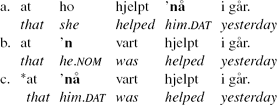
The verb hjelpe ‘help’ requires a dative object DP, as shown in (49a) where ’nå ‘him’ is the clitic dative form of the masculine singular 3rd person personal pronoun. However, as shown by the contrast between (49b) and (49c), the dative form must be substituted by the standard case form (i.e. neutralized non-dative form) when the pronoun is moved to the subject position.
Parallel examples with an indirect object dative DP and a dative DP following the preposition med ‘with’ are shown in (50) and (51), respectively. Notice that the relevant DP in these examples is the full non-clitic form of the masculine singular 3rd person personal pronoun.
(50)
(51)
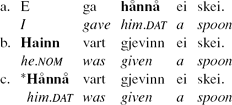

Again, the dative DP must be substituted by the standard case form when it is moved to the subject position.
Crucially, the passive data are different from corresponding data with topicalization in the Halsa dialect, see Åfarli & Fjøsne (Reference Åfarli and Fjøsne2012:83–86). Generally, dative is preserved under topicalization in this dialect, see (52) for topicalization counterparts to (50a) and (51a).
(52)
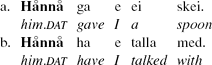
As can be seen here, dative can be preserved under topicalization even though it cannot be preserved under passivization in the Halsa dative dialect. Note, however, that Sandøy (Reference Sandøy and Elmevik2000:234) observes that a dative DP is turned into the standard case form when it is topicalized in his Romsdal dative dialect. Thus, dative appears to be preserved neither under passivization nor topicalization in his dialect. We will return to this difference between Norwegian dative dialects below.
5.2 Fieldwork data from Oppdal, Surnadal, and Halsa
In order to investigate more closely the fate of dative under passivization and topicalization in Norwegian dative dialects, fieldwork was carried out on the Oppdal dative dialect and the Surnadal dative dialect. The latter is very close geographically to the Halsa dative dialect. This fieldwork took place on 19–21 April 2010. Although the fieldwork as a whole investigated both older and younger informants, only older informants who have retained a robust in situ dative are taken into consideration here. The informants who still use dative in situ are of course the only ones of interest in an investigation of whether dative is preserved or not under movement. For additional information on dative in the Oppdal dialect, see Haugen (Reference Haugen1982) and Fjøsne (Reference Fjøsne2007), and in the Surnadal dialect, see Holten (Reference Holten1974).
The method used during the fieldwork was elicitation of acceptability judgements in elaborate face-to-face interviews and discussions with informants. Although elicitation of acceptability judgements is a method that has been criticized and certainly has its pitfalls (see Schütze Reference Schütze1996:132, 190–192; see also Newmeyer Reference Newmeyer1983), we found the method reliable and even very useful when carried out with care, especially given the fragile nature of the data. The informants were given test sentences in triples read by the fieldworker, who has a dative dialect similar to the dialect used by the informant. The first item given was a sentence with a dative DP in situ, the second item was a sentence where this DP has been topicalized, and the third item was a sentence where the DP has been moved to the subject position in a passive version. In what follows, we present and discuss the relevant results. First, judgements by one informant from Oppdal are discussed, followed by the judgements by three informants from Surnadal. Last, we discuss the judgements elicited in a similar fieldwork that was carried out in May 2010 using two informants from Halsa.
5.2.1 Oppdal
Consider first the judgements from an informant from Oppdal born in 1932. The set of examples in (53) below shows the judgements of test sentences with the preposition med ‘with’, the set in (54) shows the judgements of test sentences with an indirect object, and the set in (55) shows the judgements of test sentences with the verb hjelpe ‘help’. All three types involve, as we have seen, a dative DP in situ. The square brackets framing the judgement marks in the (b) sentences indicate that the informant was very unsure about the judgement.
(53)
(54)
(55)


These judgements show a quite clear pattern. The informant has dative DPs in all three in situ positions, as expected, compare the (a) versions. However, the dative case is considerably weakened when the DP is topicalized, as in the (b) versions, and it is absolutely impossible when the DP is made subject in a passive, as seen in the (c) versions. Thus, this pattern seems, at least to some extent, to be similar to the pattern mentioned earlier from Sandøy's Romsdal dialect in that neither topicalization nor passive allow preservation of dative, as opposed to the pattern reported from the Halsa dialect in (50)–(52).
Still, even in the Oppdal dialect there seems to be a weak, but systematic, pattern that preservation is not totally prohibited under topicalization, note the [??] marking, contra the pattern shown in passivization, where dative preservation is ungrammatical and hence confidently starred by the informant. This difference could be explained as follows. Dative is generally fragile in all Norwegian dative dialects, even in in situ positions. Therefore it could well be the case that movement of a dative DP from its in situ position would lead to a further weakening of the dative marking, even though dative would be the ‘correct’ form, strictly speaking. The situation in passives seems to be another matter. Here, dative is not only weakened, but actually prohibited altogether. Therefore, we would like to entertain the following hypothesis: From the point of view of the grammatical system, dative is essentially preserved under topicalization, although it may be weakened due to the ‘distance’ from its in situ case position. On the other hand, dative is not preserved under passivization, where its occurrence in the subject position is prohibited in principle, and not just due to the ‘distance’ from its in situ case position. With this hypothesis in mind, we will now consider the corresponding judgement patterns from the Surnadal dialect.
5.2.2 Surnadal
In the Surnadal dialect, we will show the judgements made by three informants, born in 1961, 1943, and 1950, respectively. Their judgements are given, separated by slashes, for each topicalization and passive sentence in the same order.
(56)
(57)
(58)


The interesting contrasts are between the (b) and (c) versions, i.e. between the topicalization and passive versions, respectively. As suggested by the many intermediate judgements, the informants often seems to be unsure about how to judge a given test sentence, a fact that may be attributed to the generally fragile status of the dative case in the dialect, but despite this, the passive versions in the (c) examples are generally judged to be worse than the topicalization versions in the (b) examples. Also, it is noticeable that there is considerable variation among the informants, but this variation must not distract from the overall judgement patterns, which are quite clear.
5.2.3 Halsa
To further illuminate the fate of dative case in topicalization contra passive structures, we carried out thorough interviews in May 2010 with two informants speaking the Halsa dialect, which is a closely related dative dialect bordering the Surnadal dialect to the north-west. One of the informants was born in 1966 and the other in 1927. The only example tested was an indirect object structure. The results are given in (59), with the judgements of the younger informant given to the left of the slash, and the judgements of the older informant given to the right.
(59)

The judgement patterns given here are interesting for several reasons. First, notice that the younger informant barely has dative at the outset, as witnessed by the judgement ‘?’ in (59a). Therefore, it is not unexpected that dative is lost for this informant both under topicalization and passivization, thus supporting our conjecture that a generally fragile dative is altogether lost under topicalization. The younger informant accepted the neutralized plural standard (non-dative) case form fåglainn ‘the birds’ in all the variants equivalent to (59a, b, c).
On the other hand, the older informant clearly is a dative user, as witnessed by the judgement ‘OK’ in (59a), and this informant also basically retains dative under topicalization, as witnessed by the judgement ‘?’ in (59b). His comment is that (59b) is ‘almost good; not so bad’. Crucially, however, the older informant rejects the passive version in (59c), saying it is ‘not so good’, and giving it a star. Thus, this speaker, who is a regular dative user, shows a clear contrast between topicalization and passivization as to the preservation of dative.
5.3 Intermediate conclusion
Summing up the results from Oppdal, Surnadal, and Halsa, we can state very broadly that there is a relatively clear and systematic difference in preservation/non-preservation of dative under topicalization (dative preserved) as compared to passives (dative not preserved). The Halsa data are particularly revealing, since they clearly indicate that if the speaker has a fragile in situ dative, then that speaker actually shows non-preservation of dative under topicalization (the younger informant), but if the speaker has a robust in situ dative, then dative is preserved under topicalization (the older informant), even though dative is not preserved under passivization.
Thus, these Norwegian dative dialects show some weakening of dative under topicalization, but still this weakening does not amount to systematic non-preservation. On the other hand, Icelandic seems always to preserve dative both under topicalization and passivization, and thus Icelandic can be said to be the opposite of the Norwegian dative dialects in this respect. Faroese occupies an intermediate position between Icelandic and Norwegian, in that Faroese may show both preservation and non-preservation of dative under movement to the subject position in passives, while still showing preservation of dative under topicalization.
We believe that it is reasonable to conclude from this that the syntactic system dictates dative preservation under topicalization in both Icelandic and Faroese, and also in Norwegian. The weak tendency towards non-preservation of dative under topicalization in Norwegian can be attributed to the general vulnerability of dative in Norwegian dative dialects (see Åfarli & Fjøsne Reference Åfarli and Fjøsne2012:87 for similar reasoning). On the other hand, the systematic and clear tendency that the subject position of passives does not show preservation of dative in the Norwegian dialects, even with speakers that otherwise have robust datives, implies that non-preservation in passives is a fact of the syntactic system of Norwegian dative dialects. Thus, it seems that the syntactic system itself dictates that dative is ‘overwritten’ by nominative in the subject position of passives in Norwegian, unlike in Icelandic and partly in Faroese.
6. SOME THEORETICAL RAMIFICATIONS
Theoretically, we want to interpret the preservation/non-preservation of dative under topicalization/passivization in the Norwegian dative dialects as follows. Like in Icelandic and Faroese, dative in the relevant Norwegian dialects is a non-structural (lexical, inherent) case that is assigned by certain lexical heads or in certain semantic configurations, e.g. as assumed in Woolford (Reference Woolford2006:113). The dative feature that is assigned in the in situ dative position is always preserved if the dative DP is moved to a non-case position. This explains the preservation of dative under topicalization in all languages under consideration (Icelandic, Faroese, and Norwegian).
However, if the dative DP is moved to another case position, notably to a nominative position, as in passivization, there are two possibilities. One possibility is that the nominative gives way to dative, leading to preservation of dative under passivization. This is what happens in Icelandic, and in part in Faroese. Alternatively, dative gives way to nominative. We assume that this latter alternative is what is exemplified in the Norwegian dative dialects, and also in some instances in Faroese. One could suggest various ways to implement this idea technically, e.g. by assuming that one case is ‘overwritten’ by another case, but we will not go into the various technical possibilities here. Instead, we want to point out that the nature of dative must be different in the two situations. In other words, we suggest that non-structural (lexical, inherent) case comes in two varieties which we will characterize as strong and weak, respectively. Strong dative case is preserved under passivization, whereas weak dative case is not (see also Åfarli & Fjøsne Reference Åfarli and Fjøsne2012).Footnote 5
What are the ramifications of this for case typology and standard case diagnostics in generative syntax? Consider the following widely accepted diagnostic for determining structural and non-structural case, taken from Woolford (Reference Woolford2006:117–118):
If the Case of an argument is preserved under A-movement, that argument has non-structural Case. In contrast, an argument with structural Case will change its Case after movement to whatever structural Case is licensed in the position to which that argument moves.
Given this diagnostic (see also e.g. Chomsky Reference Chomsky1986; Blake Reference Blake1994), the Norwegian dative data are quite puzzling. Dative in the Norwegian dialects is clearly lexical or inherent non-structural as judged by its in situ generation (dative is lexically selected and/or semantically conditioned), but according to the standard diagnostics it must be categorized as a structural case, like the ordinary structural accusative, since it is not preserved under passivization or other types of A-movement.
We take the in situ generation to determine the fundamental nature of the case. Then it follows that dative in Norwegian is non-structural, and according to Woolford's typology lexical or inherent, see the typological partition shown in (60), taken from Woolford (Reference Woolford2006:111).
(60)
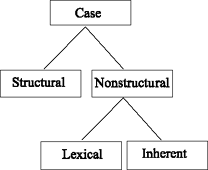
This also means that the diagnostic that says that lexical or inherent case (= non-structural case) must be preserved under A-movement cannot be the whole story. Given our assumption that non-structural dative case comes in two varieties, i.e. strong and weak, we only find weak non-structural dative in the Norwegian dative dialects, whereas Icelandic has strong non-structural dative, and Faroese has both weak and strong non-structural dative (i.e. dative is unstable in Faroese).
We would like to suggest that this reasoning brings us a long step towards a revised case typology and diagnostics. Dative (in Norwegian in particular) is now not different from accusative as to the usual structural/non-structural diagnostic. A similar playing down of the structural/non-structural distinction can be found in Barðdal (Reference Barðdal2008) and Manzini & Savoia (Reference Manzini, Savoia and Freidin2008). In both these works it is argued that there is no structural/non-structural distinction in complement positions.
This is our proposal: We suggest that all cases that are licensed inside vP by a lexical element (V, A, P) or are in an indirect object position, are non-structural (lexical or inherent) cases, whereas all cases licensed in the extended projection of the verb (above vP) are structural. Thus, nominative comes out as the only structural case. In fact, this is consistent with the traditional partition into nominative and non-nominative, which e.g. in Bittner & Hale (Reference Bittner and Hale1996) is rendered as a partition into marked case (= accusative, ergative, oblique) and unmarked case (= nominative), where nominative may also be analysed as caseless, see also Neeleman & Weerman (Reference Neeleman and Weerman1999).
In fact, our proposal may be seen as a sharpening of Woolford's (Reference Woolford2006:117) principles of non-structural case licensing, namely that lexical case is licensed only by lexical heads (e.g. V, P), which opens the possibility that lexical heads can also license non-lexical structural case (e.g. structural accusative). Furthermore, according to Woolford, inherent case is licensed only by little/light v heads, which again opens the possibility that little v can license non-inherent structural case. In our words, Woolford's principles may be rendered as follows: If a DP bears lexical case, then it is licensed by a lexical head; if a DP bears inherent case, then it is licensed by little/light v head.
We propose the following a bi-directional sharpening of Woolford's principles:
- (61)
a. If a DP bears lexical case, then it is licensed by a lexical head, and if a DP is licensed by a lexical head, then it bears lexical case.
b. If a DP bears inherent case, then it is licensed by a little/light v head, and if a DP is licensed by a little/light v head, then it bears inherent case.
According to (61), both accusative and dative (and all non-nominative cases) are either lexical or inherent cases, i.e. non-structural cases, which renders nominative the only structural case.
7. SUMMARY AND CONCLUSION
In the preceding discussion, the robustness of dative in Norwegian, Icelandic, and Faroese was measured by studying the preservation or non-preservation of dative DPs under movement to the subject position in passives and to the topic position.
The general situation in Icelandic is that dative is preserved both under topicalization and under movement to the subject position in passives. On the other hand, dative is never preserved under movement to the subject position in passives in the Norwegian dative dialects, and although dative has been argued to be preserved under topicalization in the Norwegian dialects, it is often weakened, as evidenced by the observation that informants are unsure about their judgements. Faroese is in an intermediate position between Icelandic and Norwegian, not only geographically but also linguistically. This is clearly true of dative in passives, which shows both preservation and non-preservation under movement to the subject position. In this respect, Faroese is partly similar to the Norwegian dialects. However, like Icelandic, but unlike the Norwegian varieties, dative seems to show no weakening under movement to topic position in Faroese.
Thus, in terms of the preservation and non-preservation of dative under movement there seems to be a dialect continuum, stretching from Icelandic in the west via Faroese to Norwegian in the east. From this point of view, Faroese can be described as the ‘Icelandic of the future’, and probably the Norwegian dative dialects can give a hint of what the ‘Faroese of the future’ will be like. The fuller diachronic ramifications of the mainly synchronic investigation carried out in this paper remain to be investigated in future work.
As for the theoretical ramifications, they too remain to be investigated more fully. Still, we have tentatively suggested that our findings motivate certain revisions to standard assumptions in generative Case Theory. First, we have suggested that non-structural (lexical/inherent) case comes in two varieties, strong and weak, where only the former behaves according to the standard diagnostic for determining non-structural case. Also, we have suggested that there is no distinction between structural and non-structural case in complement positions, but that all cases licensed inside vP should be categorized as non-structural cases. This amounts to a basic distinction between nominative and non-nominative cases. We want to emphasize again that these proposals are tentative and thus far based on quite sparse empirical evidence. Still, we hope that our investigation of the Icelandic – Faroese – Norwegian case continuum has convinced the reader that our theoretical hypotheses are worth pursuing.
ACKNOWLEDGEMENTS
We are very grateful to the two anonymous reviewers for their comments and to Ewa Jaworska from Cambridge University Press for excellent copy-editing. We are also grateful to Jeff Parrott for taking on the task of organising this special issue of the Nordic Journal of Linguistics. Finally, we would like to thank Høyskoleforlaget for giving us permission to use the map in Figure 1.
URLs
Nordic Dialect Corpus: http://www.tekstlab.uio.no/nota/scandiasyn/
Nordic Syntax Database: http://www.tekstlab.uio.no/nota/scandiasyn/