Introduction
With Internet's rapid advance and social penetration, its negative effects have emerged prominently. Pathological Internet use (PIU), also described as Internet addiction disorder (IAD) or problematic Internet use, is defined as an individual's inability to control his or her use of the Internet, which eventually causes psychological, social, school and work difficulties or dysfunction in a person's life (Reference Davis1,Reference Young and Rogers2). The description of PIU has been based on the definition for substance dependence or pathological gambling that belongs to a compulsive-impulsive spectrum disorder. Components of impulsivity include attention, suppressing responses, poor evaluation of consequences and/or an inability to forgo immediate small rewards in favour of greater delayed rewards. Impulsivity can be conceptualised more broadly as dysregulated behaviour. Dysregulated behaviour conveys the complex interplay of factors underlying the breakdown in behavioural regulation that the construct of impulsivity implies, such as poorly planned, unreflective, reckless, abrupt, undercontrolled or inappropriate behaviour that leads to negative outcomes Reference Finn, Justus, Mazas and Steinmetz(3). Studies reported that PIU consists of at least three subtypes: excessive gaming, sexual preoccupations and e-mail/text messaging. All of the subtypes share the common components, i.e. preoccupation, mood modification, excessive use, withdrawal, tolerance and functional impairment Reference Block(4). By using the Diagnostic and Statistical Manual of Mental Disorders Fourth Edition (DSM-IV) criteria, some authors suggest that PIU is an impulse disorder or at least related to impulse control disorder (Reference Brard and Wolf5,Reference Shaw and Black6).
Barratt impulsiveness scale 11 (BIS-11) has been used for measures of impulsivity and it is considered more of a trait measure of impulsivity Reference Patton, Stanford and Barratt(7). The go/no-go task is a kind of operational measures of impulsivity. In the go/no-go task, responding in the presence of a specific discriminative stimulus is reinforced. For example, human participants are shown repeated presentations of eight different numbers, four of which are designated ‘correct’ numbers and the other four are designated ‘incorrect’ numbers. They are required to respond to correct stimuli (go) and withhold responses to incorrect stimuli (no-go). Correct responses are reinforced with points, money or social reinforcers and incorrect responses are either unreinforced or penalised. In go/no-go tasks, errors of omission (withholding a response when a correct stimulus is presented) and errors of commission or ‘false alarms' (responding when an incorrect stimulus is presented) are the dependent measures. Impulsivity in this task is defined by the number of false alarms. Reaction time (RT) or the time it takes to make a response (response latency) can also be measured in this task, and that is another measure used to determine whether there are non-specific effects of a particular manipulation on the time needed to activate a response. The go/no-go task requires subjects to either execute (go) or inhibit (no-go) a response, and therefore, it has been used to measure inhibitory control.
The event-related potentials (ERPs) reflect the rapidly changing electrical activity associated with a cognitive event in relatively large synaptic fields containing tens of millions of neurons. ERPs using go/no-go tasks have been widely examined to interpret the possible neural correlates of response activation and inhibition in healthy individuals as well as in clinical groups. Studies on response production and inhibition in normals using go/no-go tasks with ERP showed that subjects with higher impulsiveness showed smaller amplitudes than subjects with lower impulsiveness for the N2 component and the P3 component, which suggested that ERP measures appear suitable for detailed analyses of impulsiveness in healthy participants (Reference Pfefferbaum, Ford, Weller and Kopell8,Reference Ruchsow, Spitzer, Gron, Grothe and Kiefer9). Other studies reported that in the no-go conditions, the ERP N2 and P3 components have been identified as the markers for response inhibition. For instance, a study displayed that psychopathy has been associated with atypical function of the anterior cingulate cortex (ACC) and adjacent brain regions and with abnormalities in performance monitoring, which is thought to rely on these structures. The ACC and adjacent regions are also involved in the generation of the frontal ERP N2 and P3 components. Both components are enhanced when a response is withheld (no-go trial) within a series of positive-responses (go trials) and are considered an index of response inhibition (Reference Bekker, Kenemans and Verbaten10–Reference Veen and Carter12). Studies on attention-deficit hyperactivity disorder (ADHD) indicated that in the go/no-go task, reduced ERP N2 and P3 amplitudes (no-go conditions) in ADHD group compared to controls (Reference Johnstone, Barry, Markovska, Dimoska and Clarke13–Reference Johstone and Clarke15). However, studies on movement-related potentials in the go/no-go task reported that only the P3 reflects both cognitive and motor inhibition (Reference Smith, Johnstone and Barry16–Reference Smith, Johnstone and Barry18). In addition, a study that compared the magnitude and spatial distribution of ERP components during response activation and inhibition in alcoholics and normal controls using a visual go/no-go task indicated that alcoholics manifest a decreased P3 amplitude during no-go conditions, and the no-go P3 can be an electrophysiological signature of response inhibition in alcoholism Reference Kamarejan, Porjesa and Jones(19).
On the other hand, many ERP studies have provided evidence that only N2 components present the deficiency of inhibitory control. A study that used a pair of go/no-go tasks, i.e. a go/no-go task (task 1) and a variation of the go/no-go task with reduced behavioural involvement during the impulse control process (task 2), investigated whether the N2 potential was associated with the successful suppression of behaviour responses in impulse control processes, and results indicated that N2 was a combination of behavioural suppression and cognitive control rather than a simple ERP component that marked the cognitive impulse control process Reference Dong, Yang, Hu and Jiang(20). Another study on impulsive-violent behaviour using a cued go/no-go task in impulsive-violent offenders showed that the amplitudes of the N2 component at Fz reflected different degrees of inhibition in impulsive-violent offenders compared with matched controls. The N2 amplitude was significantly lower in the impulsive-violent offenders than in matched controls. The amplitude of N2 increased when effort was required to withhold the ‘go’ intention. A smaller N2 amplitude was seen in offenders, suggesting difficulties with inhibition of prepotent behaviour Reference Chen, Tien, Juan, Tzeng and Hung(21). Studies on obsessive-compulsive disorder (OCD) displayed that ERP N2 amplitudes were related to response inhibition in go/no-go tasks (Reference Kim, Kim, Yoo and Kwon22,Reference Ruchsow, Reuter, Hermle, Ebert, Kiefer and Falkenstein23).
In summary, the N2 and P3 components during the no-go condition may represent different processing of response inhibition, and hence the dysfunction in either or both of these components in different mental disorders may suggest the deficiency of inhibitory control Reference Kaiser, Unger, Kiefer, Markela, Mundt and Weisbrod(24).
As PIU belongs to a compulsive-impulsive spectrum disorder, theoretically, it should present neuropsychological and ERPs characteristics of some disorders, such as pathological gambling, drug addiction, ADHD or alcohol abuse, testing with a go/no-go task. Up to now, no studies on impulsivity in PIU with ERP were reported. In this study, participants' behavioural responses and ERPs were recorded while they performed a go/no-go task. The ERP go/no-go paradigm was suitable to examine the neural processes involved with inhibiting and behavioural responses. The purpose of the present study was to examine whether PIU displays impulsivity and relation of ERP N2 component to response inhibition in a visual go/no-go task.
Materials and methods
Diagnostic approaches and subjects
The criteria of PIU group included subjects (a) who met the criteria of the modified Young's diagnostic questionnaire for Internet addiction (YDQ, Appendix 1)Reference Brard and Wolf(5), i.e. subjects who answered ‘yes’ to questions 1 through 5 and at least any one of the remaining three questions were classified as suffering from PIU; (b) whose age was more than 18 years old; (c) who did not meet criteria of any DSM-IV axis I disorder or personality disorders by administering a structured clinical interview (Chinese version); (d) who were not smokers and (e) who did not have a diagnosis of alcohol or substance dependence, neurological disorders, all kinds of head injury or systemic disease that might affect the central nervous system. We conducted this study from 1 May 2007 to 30 March 2008. Subjects were recruited from IAD Therapeutic Department of Wuxi Mental Health Center. Sixty patients were screened for the study according to the sequence of individuals with PIU admission. Sixteen subjects met criteria of DSM-IV axis I disorder (including 9 patients with depressive disorders and 7 patients with psychotic syndromes) and 5 patients with personality disorders by administering a structured clinical interview (Chinese version) were excluded from the study. In addition, six patients who were smokers and seven patients who had a diagnosis of alcohol or substance dependence were excluded from the study. At last, 26 subjects were recruited as PIU group. The controls were recruited from citizens of Wuxi city, Jiangsu Province, China through local advertisement. Controls were excluded from the study if they were smokers; or had a diagnosis of alcohol or substance dependence, neurological disorders, all kinds of head injury or systemic disease that might affect the central nervous system. Twenty-six healthy persons who matched age, gender and education were recruited as control group. All participants were Chinese. They all gave written informed consent to participate. The protocol for the research project was approved by the Ethics Committee of Nanjing Medical University, China.
Tools and measurements
All participants underwent a clinical assessment by a psychiatrist to collect information on medication, socio-demographic data and to confirm/exclude a PIU diagnosis. On the day of the ERP recording, impulsivity was rated in all participants with BIS-11. BIS-11 is a questionnaire on which participants rate their frequency of several common impulsive or non-impulsive behaviours/traits on a scale from 1 (rarely/never) to 4 (almost always/always). BIS-11 consists of 30 items and is divided into three subscales including attentional key, motor key and non-planning key, to determine overall impulsiveness scores, all items are summed, with higher scores indicating greater impulsivity. Handedness was assessed using the Annett Handedness Scale Reference Annett(25). Ratings on this scale were recoded into the following definitions of handedness: Annett score (1) = right, (2–7) = mixed, (8) = left.
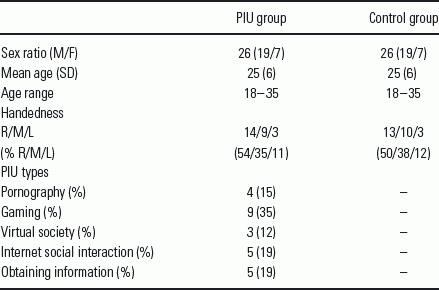
The demographic characteristics of the sample are detailed in Table 1.
Demographic characteristics of the sample
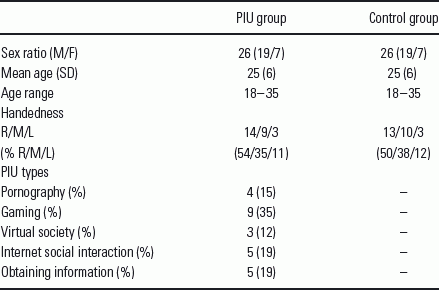
M, male; F, female; SD, standard deviation; R, right; M, mixed; L, left.
Experimental procedures
Go/no-go task
E-Prime software was used for the go/no-go task. The task, adapted from Peter et al. Reference Peter, Finn, Carlos and Joseph(26), involved the serial presentation on a computer screen of eight different two-digit numerical stimuli (four go and four no-go), displayed white on black background (1.5 × 1.5 cm in size). A total of 160 stimuli were presented in 20 blocks. Each block included eight trials, and pseudo-randomly presented with no more than three consecutive trials with either a go or no-go stimulus so that withholding a response involved overcoming an established response tendency. Specific numbers were chosen following Newman's Reference Newman(27) suggestion for balancing even/odd and above/below 50. The go stimuli in any blocks were ‘08’, ‘63’, ‘74’ and ‘25’; the no-go were ‘58’, ‘19’, ‘14’ and ‘79’. Subjects were told that the task involved learning when to go (bar press as quickly as possible) or not to go (withhold response) and that responses after some numbers would result in winning money ($0.15 per trial) but responses after others would result in losing money ($0.15 per response). The response window was 1000 ms and the inter-trial interval (ITI) was 1500 ms. Reward contingencies (green background with +$0.15 in white) or punishment contingencies (red background with −$0.15 in white) were presented on the computer screen for 1000 ms immediately after a response (within the 1500 ms ITI). The experiment consisted of a practice phase and a recording phase. The practice phase consisted of 16 go and no-go trials. The practice phase did not accrue any reward.
Behavioural measurements
The percentage of hits and RT to go stimuli and the percentage of false alarms to no-go stimuli were used for analysis. When the button was pressed within 200–1000 ms after the presentation of a go stimulus, the response was defined as correct. Lack of a response in this latency window was scored as a miss, whereas responses made within this window to no-go stimuli were scored as false alarms. False alarms were scored for each modality separately. The percentage of correct responses to go stimuli was defined as 100 ×N (target detections) divided by the total number of go stimuli. The percentage of false alarms to no-go stimuli was defined as 100 ×N divided by the sum of no-go stimuli presented. RT was measured from the onset of the go stimulus to the button press.
Electrophysiological recordings
Depending on the findings and reports of studies that fronto-central ERP components (no-go conditions) reflect general activation of the frontal and posterior brain networks in go/no-go studies, according to the 10/20 International System, electroencephalography (EEG) was recorded with the Stellate Harmonie EEG device (Physiotec Electronics Ltd, Canada) using electro-cap electrode system (ECI Electro-Caps, Electro-cap International, INL, USA) from Fp1, Fp2, Fpz, Fz, Cz, Pz, Oz, F3, F4, F7, F8, F9, F10, C3, C4, T7, T8, P3, P4, P7, P8, P9, P10, O1, O2, A1 and A2. Combined ear electrodes served as a reference and the ground electrode was attached to the forehead. Eye movement artefacts were monitored by recording vertical and horizontal electrooculogram (EOG) from electrodes placed above and below the right eye and at the left outer canthus. Electrode impedance was kept below 5 kΩ. System band pass was 0.1–30 Hz and digitalised continuously at a sampling rate of 250 Hz. Digital tags were obtained for all go/no-go condition stimuli. The EEG activity was recorded only during the recording phase and not during the practice phase.
ERP analysis
Brain electrical source analysis program (BESA, Version 5.2.0, software) was used to perform data analysis. After visual inspection, segments containing EOG or extensive muscle artefacts were removed and correct responses were averaged. Epochs were constructed that consisted of a 100 ms pre-stimulus baseline and a 1000 ms post-stimulus interval. All epochs with amplitudes exceeding ±75 µV at any electrode were excluded automatically. Epochs were averaged offline for each subject and stimulus type, and digitally filtered with a low-pass filter of 15 Hz (24 dB down). Measurement latency windows were determined based on visual inspection of the individual data and grand averaged data of all subjects. On the basis of the ERPs grand averaged map, the following 13 electrode points were chosen for statistical analysis: Fp1, Fp2, Fpz, Fz, F3, F4, F7, F8, F9, F10, C3, Cz and C4. The N2 amplitude has been analysed for the purpose of this report because previous studies have shown it to be highly relevant to inhibitory control (Reference Sasaki and Gemba28,Reference Kristina, Richard and Lynett29). Inspection of the grand-average waveforms indicated that N2 component, the peak negativity within a 130 to 470 ms latency window, was used for analysis.
Statistical analyses
Data were analysed using SPSS (version 10.0). Comparisons of BIS-11 scores as well as RTs, hit rate and false alarm rate between PIU group and control group were done using paired-sample t-tests. Separate repeated-measures analysis of variance (ANOVA) was performed for ERPs from frontal (Fp1, Fp2, Fpz, Fz, F3, F4, F7, F8, F9 and F10) and central (C3, Cz and C4) electrode sites for N2 amplitudes of no-go conditions. All F ratios associated with repeated-measures factors were assessed using degrees of freedom corrected with Greenhouse-Geisser procedure for controlling type I error. Least square difference (LSD) tests were performed as post hoc analyses if indicated. Correlation coefficients between N2 amplitudes of no-go conditions and BIS-11 scores were calculated by the Pearson test. Alpha values of 0.05 were considered significant throughout.
Results
Comparisons of BIS-11 scores between PIU group and control group
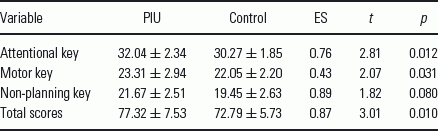
There were significant differences in BIS-11 total scores, attentional key scores and motor key scores between PIU group and control group; however, no differences in non-planning key scores were observed (Table 2).
BIS-11 scores (mean ± SD) in PIU group (n = 26) and control group (n = 26)
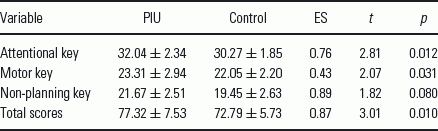
ES, Effect size
Comparisons of RTs, hit rate and false alarm rate between PIU group and control group
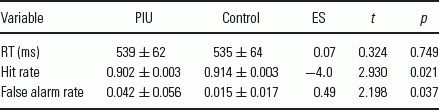
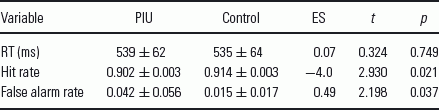
A paired-sample t-test was used to analyse the RTs, hit rate and false alarm rate. The results showed false alarm rate of PIU group was significantly higher, and hit rate was significantly lower than that of control group, while RTs were not significantly different between the two groups (Table 3).
RTs, hit rate and false alarm rate (mean ± SD) in PIU group and control group
Comparisons of N2 amplitudes of No-go conditions between PIU group and control group
N2 amplitudes of no-go conditions at frontal electrode sites
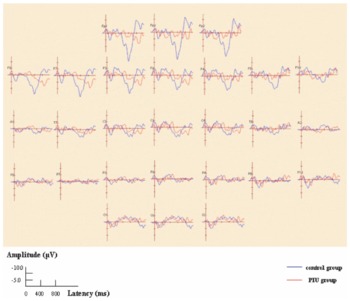
N2 amplitudes [mean (µV); control group vs. PIU group] of no-go conditions at frontal electrode sites, respectively, are as follows: Fp1 (1.49 vs. 0.45), Fp2 (0.76 vs. 0.65), Fpz (0.71 vs. 0.40), Fz (2.82 vs. 0.72), F3 (3.01 vs. 0.77), F4 (2.45 vs. 0.79), F7 (2.68 vs. 0.26), F8 (1.66 vs. 1.19), F9 (0.87 vs. 0.81) and F10 (3.33 vs. 1.69). A repeated measure ANOVA with frontal electrode sites and group (PIU vs. control) as within-subject factors revealed a significant group, frontal electrode sites and group × frontal electrode sites main effect for N2 amplitudes of no-go conditions (for group: F = 3953, df = 1, p = 0.000; for frontal electrode sites: F = 541,df = 9, p = 0.000; for group × frontal electrode sites: F = 306, df = 9, p = 0.000). LSD tests were performed as post hoc analyses and showed significant differences between N2 amplitudes of no-go conditions at frontal electrode sites of PIU group and those at control group (all p = 0.000). N2 amplitudes of no-go conditions were lower than those at control group (Fig. 1). There was no significant correlation between N2 amplitudes of no-go conditions at frontal electrode sites in PIU group or control group and BIS-11 total scores, attentional key, motor key and non-planning key scores (p > 0.05).
Grand averaged ERPs were elicited by the no-go condition of the go/no-go task for PIU group (blue lines) and control group (red lines). The prominent N2 components were presented within a 130 to 470 ms latency window at frontal and central scalp locations.

N2 amplitudes of no-go conditions at central electrode sites
N2 amplitudes [mean (µV); PIU group vs. control group] of no-go conditions at central electrode sites, respectively, are as follows: C3 (1.77 vs. 0.78), Cz (2.65 vs. 1.39) and C4 (3.03 vs. 1.39). A repeated measure ANOVA with central electrode sites and group (PIU vs. control) as within-subject factors revealed a significant group, central electrode sites and group × central electrode sites main effect for N2 amplitudes of no-go conditions (for group: F = 9074, df = 1, p = 0.000; for central electrode sites: F = 163, df = 2, p = 0.000; for group × central electrode sites: F = 73, df = 2, p = 0.000). LSD tests were performed as post hoc analyses and showed significant differences between N2 amplitudes of no-go conditions at central electrode sites of PIU group and those at control group (all p = 0.000). N2 amplitudes of no-go conditions were lower than those at control group (Fig. 1). There was no significant correlation between N2 amplitudes of no-go conditions at central electrode sites in PIU group or control group and BIS-11 total scores, attentional key, motor key and non-planning key scores (p > 0.05).
Discussion
This study is the first to use a go/no-go task to investigate impulsivity in PIU with ERP. Our trail results showed that BIS-11 total scores, attentional key scores and motor key in PIU group were higher than that of control group. In the go/no-go task, false alarm rate of PIU group was significantly higher and hit rate was significantly lower than that of control group. Consistent with a previous study Reference Cao and Su(30), individuals with PIU were more impulsive than controls. A pervious small sample size study on psychiatric features of individuals with problematic Internet use showed that all subjects' problematic Internet use met DSM-IV criteria for an impulse control disorder not otherwise specified, and concluded that problematic Internet use may be associated with subjective distress, functional impairment and axis I psychiatric disorders Reference Shapira, Goldsmith, Khosla and Mcelroy(31). Another study that used a questionnaire survey on Internet-addicted behaviour displayed a high prevalence of features of impulse control disorders: presented a great urge to be ‘online’ if they are disconnected; believed the world is an empty and dull space without Internet; had daytime fantasies about Internet use; became very nervous if the Internet connection was slow; displayed depressive mood and feeling of guilty after a longer use of the web; had aggressive behaviours if they were interrupted by others using the Internet Reference Treuer, Fabian and Furedi(32). The above-mentioned two studies suggested that PIU is a new subtype of impulse control disorder. As BIS-11 is considered more of a trait measure of impulsivity, and the go/no-go task is a kind of operational measures of impulsivity, i.e. a model for measurement of inhibitory control, our study supported the standpoint that impulsivity is a risk factor for the development of PIU, and PIU is an impulse disorder or at least related to impulse control disorder. Within neuropsychology and cognitive neuroscience, impulsivity is often equated with the term ‘disinhibition’, referring to the idea that top-down control mechanisms ordinarily suppress automatic or reward-driven responses that are not appropriate to the current demands Reference Aron(33). These inhibitory control mechanisms may be disrupted following pathological gambling, drug addiction, ADHD or alcohol abuse, resulting in a predisposition towards impulsive acts. Defined in this way, impulsivity has relevance to PIU.
Our study showed that ERP N2 components of no-go conditions distributed at frontal and central brain areas in PIU group as in control group, that is, the activation related to inhibitory control was recorded over these brain areas. The same patterns for ERPs to no-go conditions indicated that subjects with PIU and controls might use the same strategies to perform the task. Our study displayed that N2 amplitudes of no-go conditions at frontal and central electrode sites in PIU group were lower than those in control group. As previous studies have shown N2 amplitude to be highly relevant to inhibitory control (Reference Sasaki and Gemba28,Reference Kristina, Richard and Lynett29), this study's results suggested that individuals with PIU presented deficient inhibitory control.
Many studies have found that response inhibition requires the activation of the executive system of the frontal lobes (Reference Kaiser, Unger, Kiefer, Markela, Mundt and Weisbrod24,Reference Weisbrod, Kiefer, Marzinzik and Spitzer34). Additionally, the neural basis of this executive system is thought to be a distributed network involving the prefrontal areas and anterior cingulate gyrus Reference Smirth and Jonides(35). The prefrontal cortex (PFC) has been implicated in behavioural inhibition, based on animal, clinical and neuroimaging studies. For instance, studies in monkeys showed that lesions in the PFC resulted in difficulties in behavioural inhibition (Reference Butters, Butter, Rosen and Stein36–Reference Jaeggi, Seeweer, Nirkko, Eckstein, Schroth, Groner and Gutbrod38), as well as the studies of patients with lesions in the same region Reference Godefroy and Rousseaux(39). At the behavioural level, response inhibition is considered to be a behavioural measure (encompassing sensory, cognitive and motor components) sub-served by cortical inhibition and frontal executive processes. The dysfunction in response inhibition can also be evidenced by the finding that alcoholics committed more commission errors than controls during no-go conditions Reference Kamarejan, Porjesa and Jones(19). Our results showed that individuals with PIU had decreased no-go N2 amplitude in the frontal and central brain areas, implying that subjects have dysfunctions in both cortical inhibition and frontal inhibitory mechanisms. A study on assessment of the decision-making function mediated by the ventromedial PFC in pathological gambling using the gambling task, the Weigl's Sorting Test (WST) and the Wisconsin Card Sorting Test (WCST) showed a ventromedial PFC dysfunction in pathological gambling patients Reference Paolo, Giovanna, Roberto, Arcangela and Laura(40).
Several findings from go/no-go studies support the hypothesis that the no-go N2 is driven by inhibition of a planned response. There is some evidence that the no-go N2 is larger when no-go stimuli share features with target stimuli, and thus trigger preparation of an incorrect response that must be suppressed. For instance, a study of effects of response mode (finger movement or counting) and stimulus probability on inhibitory processes showed that even though larger N2s are elicited by no-go than go trials in silent counting tasks, it tends to be somewhat larger in tasks for which an overt response must be withheld Reference Bruin and Wijers(41). Another study on the relationship between N2 and response inhibition displayed that at least to some extent N2, which increased in amplitude when a greater effort was required to withhold the go response, reflects the activity of a response inhibition system of the brain Reference Jodo and Kayama(42). This sensitivity to speed instructions may bear on the difference between tasks with overt motor responses and covert responses such as silent counting as it is more difficult to mandate speed for a covert response. In addition, the no-go N2 is larger in participants with low than high false alarm rates, suggesting an association between amplitude and successful response inhibition Reference Falkenstein, Hoormann and Hohnsbein(43). A recent study on combined observation of false alarms and ERPs to distracter stimuli in a selective attention task indicated that a large negativity N2 at the prefrontal area (370–430 ms), following the motor preparation stage (275–315 ms) and preceding the RT stage (about 510 ms), was the best candidate for reflecting response inhibition and top-down cognitive control, namely, the N2 indexes cognitive control Reference Proverbio, Del, Crott and Zani(44).
In conclusion, the results of this study clearly show that individuals with PIU were more impulsive than controls and shared neuropsychological and ERPs characteristics of some disorders, such as pathological gambling, drug addiction, ADHD or alcohol abuse, testing with a go/no-go task, which supports that PIU is an impulse disorder or at least related to impulse control disorder.
A limitation of this study is that although deficits in the ability of inhibiting prepotent responses can be assessed by the go/no-go task, a well-designed inhibition task including Internet-related cues that might reflect deficient inhibitory control in PIU precisely should be used. In addition, because of the small sample our results have to be considered preliminary. Future studies may utilise other tools, such as functional magnetic resonance imaging (fMRI) and positron emission tomography (PET) to further assess the relationship between impulsivity and PIU.
Acknowledgements
This study was supported by the Nature Science Foundation of Jiangsu Province, China (No.BK2007024).
Appendix
Appendix 1: Young's Diagnostic questionnaire for Internet addiction (YDQ)
1 Do you feel preoccupied with the Internet (think about previous online activity or anticipate next online session)?
2 Do you feel the need to use the Internet with increasing amounts of time in order to achieve satisfaction?
3 Have you repeatedly made unsuccessful efforts to control, cut back or stop Internet use?
4 Do you feel restless, moody, depressed or irritable when attempting to cut down or stop Internet use?
5 Do you stay online longer than originally intended?
6 Have you jeopardised or risked the loss of significant relationship, job, educational or career opportunity because of the Internet?
7 Have you lied to family members, therapist or others to conceal the extent of involvement with the Internet?
8 Do you use the Internet as a way of escaping from problems or of relieving a dysphoric mood (e.g. feelings of helplessness, guilt, anxiety or depression)?