

INTRODUCTION
Robert Agnew’s general strain theory elaborates three levels of strain, accepting the explanations of Robert Merton’s cultural goals and means (strain theory) as the first one (Konstantinović-Vilić, Nikolić-Ristanović, and Kostić Reference Konstantinović-Vilić, Nikolić-Ristanović and Kostić2010; Merton Reference Merton1957; Stanojoska and Aslimoski Reference Stanojoska and Aslimoski2019), but also introducing the absence of positive stimulus and the appearance of the negative one (Agnew Reference Agnew1985). The first strain may arise insituations when an individual fails to achieve positively valued stimuli (stable income), the second when positively valued stimuli are removed (breaking up of a romantic relationship), and the last one which arises from the presence of noxious stimuli (abuse, discrimination) (Agnew Reference Agnew1992, Reference Agnew2006). These strains generate negative emotions (such as anger) among individuals. Individuals, who experience negative emotions and are unable to use positive copying mechanisms (cognitive, behavioural and emotional), have higher possibilities of engaging in criminal and delinquent activities (Agnew Reference Agnew2001).
When is a strain most likely to lead towards criminal or delinquent activities? As a response to criticism of general strain theory’s first concept being impossible to be proven false, Agnew added four characteristics of strain connected to its possibility to lead the individual towards crime and delinquency. Namely, a strain will lead an individual towards crime and delinquency when it is unjust, high in magnitude, associated with a low level of social control, and when it motivates and encourages committing crime (Agnew Reference Agnew1992, Reference Agnew1995c, Reference Agnew2001, Reference Agnew2006). Also, Agnew posited that all types of strain that can cause criminal and delinquent behaviour can be attributed to a one-time individual event or to several reoccurring, cumulative events (Agnew Reference Agnew2001, Reference Agnew2006; Sun et al. Reference Sun, Haishan, Wu and Wen-Hsu2016). Furthermore, Agnew proposed two main categories of strain: subjective and objective (Froggio Reference Froggio2007).
What is the purpose of our study? Being written on a social–psychological level (Agnew Reference Agnew1992, Reference Agnew and Sheley1995a), general strain theory has been tested among adolescent populations, connecting running away from home with prostitution (Nadon, Koverola, and Schludermann Reference Nadon, Koverola and Schludermann1998; Ruggiero, McLeer, and Dixon Reference Ruggiero, McLeer and Dixon2000; Seng Reference Seng1989; Silbert and Pines Reference Silbert and Pines1983; Simons and Whitbeck Reference Simons and Whitbeck1993; Simons et al. Reference Simons, Whitbeck, Conger and Conger1991) and drug use with prostitution (Cates and Markley Reference Cates and Markley1992; Nadon et al. Reference Nadon, Koverola and Schludermann1998; Pleak and Meyer-Bahlburg Reference Pleak and Meyer-Bahlburg1990; Simons and Whitbeck Reference Simons and Whitbeck1993). Also, depression and insecurity (Broidy Reference Broidy2001) have been associated with prostitution when individuals were sexually abused as youngsters (Bess and Janus Reference Bess, Janus, Sadock, Kaplan and Freedman1976; Brown Reference Brown1979; Bullough Reference Bullough1965; Jackman, O’Toole, and Geis, Reference Jackman, O’Toole and Geis1963; James Reference James and Crites1976; Maerov Reference Maerov1965). Furthermore, all these and other studies (Bao and Haas Reference Bao and Haas2009; Baron Reference Baron2004, Reference Baron2007; Hay Reference Hay2003; Hoffmann, Cerbone, and Su Reference Hoffmann, Cerbone and Su2000) have concluded that the criminal and delinquent activities of adolescents are response to a strain. However, what has been very rarely analysed is the response to strain of different types of offenders and diverse populations. Incarcerated women, being a group of serious offenders, are more likely to experience a connection between strain and crime, but also being females, they are generally less researched compared with male incarcerated offenders.
Also, this study is even more valuable if we mention that until the beginning of our research, to our knowledge, general strain theory or any other criminological theory has not been tested on any population in the Republic of North Macedonia. The incarcerated population in North Macedonia has neglected needs, inhumane living conditions and overcrowded penitentiary institutions. There is a high level of recidivism among those imprisoned and poor use of alternative measures. We have focused on incarcerated women as a research population, because their experience is generally less known compared with those of incarcerated men, they have a low level of participation in the total number of crimes in the country, and, of course, because of the lack of criminological research on female criminality in general.
We used a survey and collected data from 37 female inmates, focusing on the influence of strain and negative emotions on the level of female criminality. The results should answer the following research questions:
1. Does strain lead to negative emotions?
2. Does strain influence female criminality and its level?
3. Do negative emotions intermediate in between the strain and the level of criminality?
Globally, the study’s results and conclusions can help other researchers understand strain and female criminality in a Balkan (Southeastern) context, and judge whether the theoretical explanations of general strain theory can or cannot be used outside the context of Western countries.
Locally (in the North Macedonian context) the discussion and results can be used to improve the general situation of females in the Republic of North Macedonia, prevent gender-based, especially domestic, violence, and create more employment opportunities for women.
THE GENERAL STRAIN THEORY AND FEMALE CRIMINALITY
The classic strain theories (Cloward and Ohlin Reference Cloward and Ohlin1960; Cohen Reference Cohen1955; Merton Reference Merton1938) explain criminality through the prism of inability of the individual to fulfill positively valued goals (such as middle-class status or monetary successes) and their results were applicable in explaining why males commit more crimes than females, and why females commit crimes (Heidensohn Reference Heidensohn1991). But, later research has shown that their conclusions are not satisfactory (Agnew Reference Agnew and Barlow1995d; Agnew and Brezina Reference Agnew and Brezina1997; Agnew and White Reference Agnew and White1992; Chesney-Lind Reference Chesney-Lind1986; Chesney-Lind and Shelden Reference Chesney-Lind and Shelden1992; Naffine Reference Naffine1987), especially regarding the question of female criminality, where females were under-researched (Simpson Reference Simpson1989) and where the conclusions were in the direction of an explanation of rare female criminality as a consequence of less strain and social pressure.
According to Agnew the term strain refers to “relationships in which the individual is not treated as he or she wants to be treated” (Agnew Reference Agnew1992:48). In their explanation of criminal activities, Broidy and Agnew (Reference Broidy and Agnew1997) argue that general strain theory can explain gender differences in crime in three ways: (1) males and females are subjected to different kinds of strain, with male strains being more conducive to criminal activities (males and females have different stressors of their strain); (2) males and females have different emotional response to strain, with male emotional response (once again) more conducive to crime; and (3) males respond to strain and negative emotions using criminal strategies and activities (Broidy and Agnew Reference Broidy and Agnew1997; Sun et al. Reference Sun, Haishan, Wu and Wen-Hsu2016). Males are concerned with material success which leads to higher rates of property and violent crime; on the other hand, females are concerned with creating and maintaining close bonds and relationships with other people which results in lower rates of property and violent crimes. Also, males more often face conflicts with other individuals, making them more vulnerable to conflicts, with females facing negative social treatment, such as high demand from families, gender discrimination and restricted (according to their gender roles) behaviour. And last, males react with property and violent criminal activities in cases when they failed to achieve their goals while females in such situations react with self-destructive behaviour (Broidy and Agnew Reference Broidy and Agnew1997:278–81; Steffensmeier and Allan Reference Steffensmeier and Allan1996). Interpersonal strain is significantly related to criminal activity of females, but it is an important predictor among males (Agnew and Brezina Reference Agnew and Brezina1997).
The general strain theory used in a gender-based circumstance uses the two most common goals for women: interpersonal relationships and financial success and career (see Figure 1). Women expect more from interpersonal relationships, because of their place in the social structure and the level of socialization. But, today success in these goals is mostly bitter and even impossible, which is noticed through the high number of divorces and violence between intimate partners. On the other hand, the strain that emerges from financial failure is in most cases the reason for their criminal behaviour, especially in cases when women are unemployed and have lack of finances (Broidy and Agnew Reference Broidy and Agnew1997).
The Nexus Between Different Ideal Goals and Life Expectations Among Women.

When a woman does not gain or loses some of these positive stimuli, then she tries to fulfill her expectations by using illegal means. Every society builds models of behaviour that refer to both genders. Females are bounded in their everyday behaviour: the way they talk, the clothes they wear, their behaviour, body language, the way emotions are demonstrated, and their sexual behaviour is strictly set in a social and cultural framework. All of these barriers are and can be factors for women’s criminal activity. It is a result of their defiance and repulsiveness towards social roles which are given to women. Also, in some cases negative stimuli, such as domestic violence, can and in most cases trigger strains which end in criminal behaviour. Even at their workplace women get the lowest places in the hierarchy; they do not have autonomy and authority during work obligations which results in an atmosphere where it is impossible to present their knowledge and efficiency (Agnew Reference Agnew1985). Such female roles (in accordance with feminist explanations) and source of strain are the result of patriarchal (male-based) power relations which influence female victimization at home, by family and friends, outside of their homes or at work places (Brownmiller Reference Brownmiller1975; Dobash and Dobash Reference Dobash and Dobash1979; Griffin Reference Griffin1971; Smart Reference Smart1976, Reference Smart1979; Williams III and McShane Reference Williams and McShane2010), and sexism (Chesney-Lind Reference Chesney-Lind1989; Chesney-Lind and Shelden Reference Chesney-Lind and Shelden1992, Reference Chesney-Lind and Shelden2014). In line with feminist theories, general strain theory points out several sources of strain or stressors, such as financial stress, physical abuse and sexual discrimination (Agnew Reference Agnew2006; Hay and Evans Reference Hay and Evans2006; Sun et al. Reference Sun, Haishan, Wu and Wen-Hsu2016). Broidy and Agnew (Reference Broidy and Agnew1997) conclude that females are treated in an inequitable manner and all of it will “likely create a sense of injustice, particularly given the increased emphasis on justice norms that stress equal treatment for males and females” (Broidy and Agnew Reference Broidy and Agnew1997:291). Accordingly, this gender-based and non-gender-based discrimination (major discrimination) is a significant predictor of criminal and deviant activities, and also of substance abuse (Eitle Reference Eitle2002).
Males and females have different emotional responses to strain, with males more likely to respond with anger, which is followed by moral outrage (they blame others, and are less concerned about hurting people), resulting in property and violent crime. Females mostly respond with depression and anger, with the latter accompanied by fear, guilt and shame (they blame themselves, worry of the modus they use as an answer to their anger), resulting in self-destructive behaviour (Broidy and Agnew Reference Broidy and Agnew1997:281–3; Mazerolle Reference Mazerolle1998). Piquero and Sealock (Reference Piquero and Sealock2004) did not find significant differences in strain across different genders, but concluded that females show higher levels of anger than males. What are different are the conditioning effects across gender, such as homelessness, which is a stronger predictor of male property crime; however, monetary dissatisfaction and relative deprivation are future predictors for female violent behaviour (Baron Reference Baron2007).
There is difference in how males and females express emotions more than how they experience emotions (Brody and Hall Reference Brody, Hall, Lewis and Haviland2000; Simon and Nath Reference Simon and Nath2004), with this being a result of socially set expressions (Lewis and Saarni Reference Lewis and Saarni1985; Malatesta and Haviland Reference Malatesta and Haviland1982) and cultural norms and beliefs about gender roles and masculinity–femininity (Brody Reference Brody1997). Agnew (Reference Agnew2006) concluded that females have higher levels of emotional social support compared with males, not restricting their emotionality. Females are more likely to cry when they feel anger and will more likely report symptoms of anger and depression (Averill Reference Averill1983; De Coster and Zito Reference De Coster and Zito2010; Eagly and Steffen Reference Eagly and Steffen1986; Stapley and Haviland Reference Stapley and Haviland1989). When a female expresses anger outward, then her emotionality is perceived as the antithesis of femininity. Passivity and nurturance are expected reactions of anger among females, with aggressiveness being one associated with males (Brody and Hall Reference Brody, Hall, Lewis and Haviland2000; Campbell and Muncer Reference Campbell and Muncer2007; Heimer, De Coster, and Unal Reference Heimer, De Coster and Unal2006; Shields Reference Shields2002; Thorne Reference Thorne1993). Empirical examinations of general strain theory have shown that depression increases the level of possibility of delinquent and criminal activities (Jang Reference Jang2007; Piquero and Sealock Reference Piquero and Sealock2004). Depression is more acceptable among females, because their emotions are passive as a result of internalizing and maintaining of feelings in females (Horwitz and White Reference Horwitz and White1987; Schur Reference Schur1984). It is a result of the different nurturing of genders. Girls are educated to be calm and nice; on the contrary, boys should be strong. Many authors find those differences in the natural role of women to be pregnant. It is not only connected to their sexual nurturing and education, but also to the whole social codex (Sutherland and Cressey Reference Sutherland and Cressey1978).
In a direction of analysing the strain, negative emotions and level of criminality of incarcerated females, Sun et al. (Reference Sun, Haishan, Wu and Wen-Hsu2016) have concluded that incarcerated Chinese women, who had experienced physical abuse and gender discrimination, were more likely to involve themselves in criminal and deviant behaviour; also, different types of strain have varying effects on negative emotions and criminality among incarcerated females; and third, “although physical abuse and gender discrimination led to greater negative emotions, the direct effect those (negative emotions) have on criminality was weak” (Sun et al. Reference Sun, Haishan, Wu and Wen-Hsu2016:842).
As mentioned before in the text, in North Macedonia there are no studies regarding the general strain theory and its testing on any kind of samples. Also, what is important to bear in mind is that most worldwide studies have been directed toward juvenile samples and that those using adult females as their sample have been undertaken in Western countries. This situation might be a limitation to our study, especially as the extent of the connection between strain and crime and the mediating influence of negative emotions that can be applied to adult incarcerated females coming from a society of a Balkan country are unknown.
WOMEN’S SOCIAL POSITIONS AND FEMALE CRIMINALITY IN THE REPUBLIC OF NORTH MACEDONIA
Macedonian society, although proclaiming itself a modern one, is still struggling between patriarchal relations and gender equality. Females are still perceived as the less worthy, incapable of fulfilling different expectations, intellectually inferior, especially those living in rural areas.
In the Republic of North Macedonia, although fewer female children graduate from secondary schools (47%), data show that more women (54%) enrol in universities, and even a higher percentage graduate (57% are women); however, the employment rate among women (33.7%) is still lower than the one among men (50.5%). The differences between rural and urban areas represent a very difficult social situation for women that are not unknown to our territories and have roots inside socially divided relations in traditional families. The employment rate among women in rural areas is 29.6%; on the other hand, in urban areas it is 36.7% (Women and Men in the Republic of Macedonia; Republic of Macedonia State Statistical Office 2015). The situation in 2016 shows no difference, with an employment rate of women of 33.8% (37.65% for urban and 29% for rural areas) (Women and Men in the Republic of Macedonia; Republic of Macedonia State Statistical Office 2017).
Women are mostly clerical support workers, technicians and associate professionals, service workers, and shop and market sales workers. They occupy less than 20% of job positions such as legislators, senior officials and managers. In most of the cases, women are underpaid for the same job positions compared with men (Women and Men in the Republic of Macedonia; Republic of Macedonia State Statistical Office 2016). The gender pay gap between women and men is 12.5% lower payment for females and it is even higher for job positions where primary education or no education is needed (males have 28.4% higher payment than females). The unadjusted wage gap is 13.4% (Eurostat 2010) and the adjusted gap is 17.9% (Avlijas et al. Reference Avlijas, Ivanovic, Vladisavljevic and Vujic2013). Also, in the Republic of North Macedonia there is still a difference between male and female job positions.
Women are discriminated while being interviewed for job positions where they are always asked about their marriage and family plans (do they plan to have children in the near future?), and 68% of mobbing victims are women (most of them were sexually harassed). What is worrying are the data that 49% of Roma girls are married before they turn 18 years of age (around five times higher than other Macedonian girls). The number of Roma girls being married before they turn 15 years of age is 20 times higher than for Macedonian girls. This practice results in illiterate or Roma women with fourth-grade or primary education (Association for Emancipation, Solidarity and Equality of Women in the Republic of Macedonia, ESE, and Akcija Zdruzenska 2012).
Research of the situation of rural women shows that 23.9% of them did not have the right to choose their partner, and 49.4% of rural women accept the patriarchal relations in their families with their husband as the head of the family and the only person who can decide regarding the future of the family. Also, 44.5% of rural women should ask their husband for permission, before they go and see a doctor (Association for Emancipation, Solidarity and Equality of Women in the Republic of Macedonia, ESE, and Akcija Zdruzenska 2012).
The above-mentioned positions of women in their families, communities and society in general are reflected in their deviant, delinquent and criminal activities. In the next part of this section we will present statistical data about female criminality and incarcerated females in the Republic of North Macedonia.
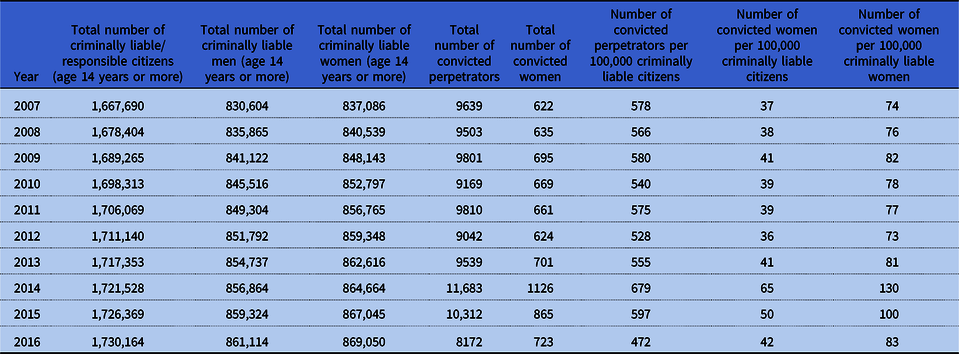
The Macedonian crime rate is around 540 convicted perpetrators per 100,000 criminally liable citizens, with around 40 convicted women per 100,000 criminally liable citizens and around 80 convicted women per 100,000 criminally liable women (see Table 1).
Convicted Offenders Rate and Convicted Women Rate Per 100,000 Criminally Liable Citizens, and Convicted Women Rate Per 100,000 Criminally Liable Women in the Republic of North Macedonia (Republic of Macedonia State Statistical Office: Perpetrators of Criminal Offences (2008–2017) and Population Estimates by Sex and Age, by Municipality and Statistical Regions (2007–2016))

The number of perpetrators convicted to imprisonment between 1995 and 2016 varies between 7168 perpetrators sentenced to imprisonment in 2005 and 1922 perpetrators sentenced to imprisonment in 2016 (Republic of Macedonia State Statistical Office 1995–2017).
The ratio between convicted women and convicted men between 1995 and 2016 oscillates between 5.27 in 2001 as the lowest and 10.66 in 2014 as the highest ratio. The average number of convicted women in the 22 years’ period is 562 women a year (around 5%), which is around 12 times lower than that of men.
The average Macedonian female criminal has primary or secondary education (there are cases of Roma women criminals with no education or who finished fourth grade), is between 25 and 35 years of age (group 1) or between 45 and 60 years of age (group 2), and has Macedonian, Albanian or Roma ethnic origin. Females in most cases commit four groups of crimes: property crimes (theft, aggravated theft and fraud), violent crimes (bodily harm and grievous bodily harm), traffic crimes (endangering traffic safety) and crimes against marriage, family and youth (abduction of a child; neglecting and mistreating of a child; and non-payment of maintenance). Average female criminals are either unemployed or have uncertain employment status (changing employment positions); in most cases they were abused by their intimate partners or other member of their family (especially in the cases of violent crimes committed by females) (Republic of Macedonia State Statistical Office 2007–2016; Stanojoska and Aslimoski Reference Stanojoska and Aslimoski2019).
Before being made a crime in 2004, domestic violence in the Republic of North Macedonia had been perceived as a family matter which left no space for action by police forces. Spouses and family members were left alone to solve their family problems due to respect for their privacy.
Research on domestic violence in the Republic of North Macedonia in 2012 has shown that males are dominantly the perpetrators of this crime, with 53% in cases of psychological (56% are spouses, 34% parents and 10% other family members), 76% in cases of physical (41% spouses, 31% parents and 18% other family members) and 100% in cases of sexual violence. The most important factors increasing the possibility and risk of victimization are women’s age, education, the number of children in the family, rural or urban area of habitation, and unemployment which increases economic dependence (unemployed women have higher prevalence of violence than the average ones) (Republic of Macedonia Ministry of Labor and Social Policy 2012).
Further research from 2014 has shown that in 19% of the cases a male was the victim of domestic violence (15% of which with a male and 4% with a female perpetrator). The other 81% were registered cases where females were victimized in 76% of the cases by a male and in 5% by a female. When males were registered as perpetrators, in 61% of the cases they were the spouses, 3% the children, 8% the parents and 9% other family members (Mirceva, Chacheva, and Kenig Reference Mirceva, Chacheva and Kenig2014).
There are significant differences between types of domestic violence in rural and urban areas. Namely, psychological domestic violence takes place more often in rural (78.5%) than in urban areas (59.6%); physical domestic violence has a prevalence of 34.8% in rural versus 25% in urban areas; and sexual domestic violence has a prevalence of 15.5% in rural and 13.2% in urban areas. Measures of protection are less known to rural women (Association for Emancipation, Solidarity and Equality of Women in the Republic of Macedonia, ESE, and Akcija Zdruzenska 2012).
In the period between 2012 and 2016, the social welfare system has given protection to 736 women victims of domestic violence (from a total number of 870 victims); in 2012, to 711 women victims (from 860); in 2013, to 858 women victims (from 944); in 2014, to 1047 women victims (from 1140); and to 994 women victims (from 1081) in 2016 (Women and Men in the Republic of Macedonia; Republic of Macedonia State Statistical Office 2012–2016).
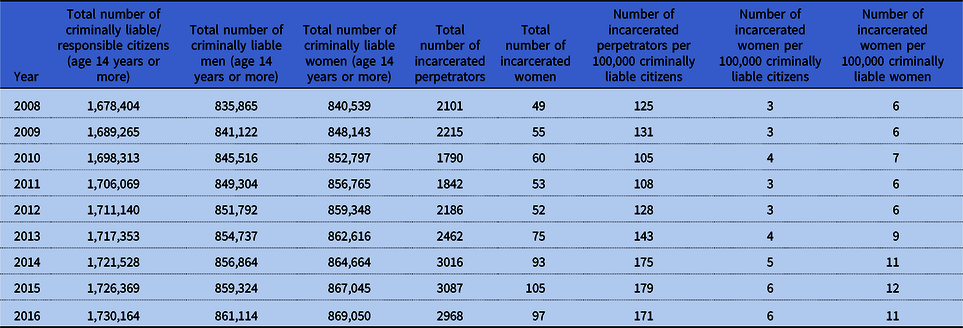
Using the data given by the State Statistical Office and the Directorate for Execution of Sanctions (Ministry of Justice) we could calculate the incarcerated offenders rate and incarcerated women rate per 100,000 criminally liable citizens and per 100,000 criminally liable women, concluding that the incarceration rate in the Republic of Macedonia since 2012 has had an increasing trend, especially in the period 2014–2016 (see Table 2). Correspondingly the incarceration rate of women has increased in the same period (incarceration rate of six incarcerated women per 100,000 criminally liable citizens and 11 incarcerated women per 100,000 criminally liable women). During this period the law on determining the type and assessing the severity of the punishment was effective, resulting in such an increasing trend in the incarcerated population.
Incarcerated Offenders Rate and Incarcerated Women Rate Per 100,000 Criminally Liable Citizens, and Incarcerated Women Rate Per 100,000 Criminally Liable Women in the Republic of North Macedonia (Perpetrators of Criminal Offences; Republic of Macedonia State Statistical Office 2009–2017; Directorate for Execution of Sanctions of the Republic of North Macedonia)

METHODOLOGY, DATA COLLECTION AND SAMPLE
The data used in this research have been gathered by using a survey questionnaire which had 34 questions, divided into four different groups:
1. Background characteristics;
2. Information regarding the crime the women were incarcerated for;
3. Questions regarding the creation of strain;
4. Questions regarding their emotional response (negative emotions).
The results should answer the following questions:
1. Does strain lead to negative emotions?
2. Does strain influence female criminality and its level?
3. Do negative emotions intermediate in between the strain and the level of criminality?
The research was conducted in KPD IdrizovoFootnote 1 (a facility at around 17 km from the capital Skopje). KPD Idrizovo was the chosen institution, because the penitentiary system in the Republic of North Macedonia provides only one prison for females sentenced to imprisonment. The survey took place in the dining room of the women’s section of KPD Idrizovo, on October 19, 2018, between 09.00 and 12.40 hours. At first, the staff from the Resocialization Section explained to the inmates the objectives of the research and also that their participation in the survey was strictly voluntary (by using an inmate), after which 37 of 65 female inmates agreed to participate in the survey (we should note that around 20% of the inmates were still sleeping).
The 37 inmates were divided into four groups (3 × 10, 1 × 7) and consecutively entered the dining room where the questionnaires were distributed by one inmate, while we were explaining to them the goals of the research, once again telling them that their participation was strictly voluntary and anonymous, and instructing them not to discuss their answers with each other in benefit of the clarity of the results. A separate questionnaire was distributed to each respondent along with a pencil, and enough time was given to answer the questionnaire (the approximate time an inmate needed to fill in the questionnaire was around 6–8 minutes). Also, there was enough space between inmates so they could not read the other inmates’ answers. Solely, in cases when the inmates were illiterate, a fellow inmate helped them by reading them the questions and filling in the answers they would give. During the survey process we were not actively taking part and we were not discussing the questions with the inmates. The security officers and other staff members were not present in the dining room.
Regarding their ethnicity, 56.8% of the inmates were Macedonian, 24.3% were from the Roma ethnic group, and 8.1% were Albanian or Turk; leaving 2.7% with other ethnic origin. Regarding educational attainment there are two extremes that are conspicuous, with 24.3% illiterate inmates and 27% inmates with a faculty diploma. Also, there were a large number of participants who had secondary education (24.3%) and primary education (10.8%). More than half of them (62.2%) were unemployed prior to their incarceration and most of the participants had been living in urban areas (83.8%). Around 51.4% were in the age group between 33 and 55 years of age and 45.9% of them were between 18 and 32 years of age at the time when the crime was committed. Regarding their sentence, close to a half (45.9%) were sentenced and serving a fixed term, but 54.1% were sentenced to prison with a possibility of parole. We have to notice that more than two-thirds of the participants (75.7%) were first-time offenders.
Following the research of Proctor (Reference Proctor2004) and Sun et al. (Reference Sun, Haishan, Wu and Wen-Hsu2016) who tested the general strain theory among female inmates, we used the level of criminality as a dependent variable (a higher score of the variable indicates a higher level of criminality), constructing it from three inmate characteristics: the offence they were incarcerated for (as per the Criminal Code of the Republic of Macedonia), the length of the sentence they were serving, and their deviant or delinquent behaviour prior to their criminal activity or incarceration. On the other hand, Proctor’s level of criminality was constructed by summing the criminality score based on the level of the most serious offence in the Penal Code of the state where the research was undertaken, the number of times the inmates had tried to escape from prison, and their involvement in prostitution, stealing and/or substance abuse (Proctor Reference Proctor2004).
The independent variables according to the concept of the general strain theory are the strain and the negative emotions. The strain has been analysed from two different aspects: the abuse and discrimination of women inmates (before incarceration) and the financial stress they had been feeling (before incarceration). This strain variable was measured using eight main and another seven additional (explaining) questions. The respondents were asked: 1 and 3: whether they had been victims of domestic violence or other type of crime before 18 years old; 2 and 4: whether they had been victims of domestic violence or other type of crime after 18 years of age; 5: did they have a stable financial income before incarceration; 6: what was the level of their financial situation; 7: whether they thought that Macedonian society discriminates against women; and 8: whether they had been discriminated during their life because they are females. The additional questions are used to accumulate data regarding the abuser before and after 18 years of age; the type of crime they have been victims of before and after 18 years of age; the value of their financial income before incarceration; the area where Macedonian society discriminates the most against women; and the area they had been discriminated against just because they are females. The strain variable was constructed as a cumulative measure of the abuse and discrimination, and of financial stress variables, in accordance with the conclusion “that stressful life events have a cumulative impact on the individual” (Agnew Reference Agnew1992:62) and “it is not so much the unique quality of any single event but the cumulation of several stressful events within a relatively short time span” (Linsky and Straus, Reference Linsky and Straus1986:17, as cited in Agnew Reference Agnew1992:62). “It is not the effect of one specific strain or stressor that is important; rather, it is the cumulative effect of all the strains experienced by the individual” (Agnew Reference Agnew2001:324). Combining individual strain measures into a single scale will eventually give a better estimate to their cumulative effect.
Researching females’ positions in Macedonian society, we chose abuse and discrimination and financial stress as the most common stressors among women in the Republic of North Macedonia.
On the other hand, negative emotions as a variable were measured using three main and one additional (explaining) question. The respondents were asked whether they often felt anger or were depressed because of the situation they were in (abused, victimized, lack of financial stability: which are the strain indicators), whether they were in a situation where they felt inferiority just because of being females (here the additional question was asked: which was the situation where they have felt inferiority), and the third main item: whether they felt anger, pain or were depressed because they were discriminated against for just being a female.
Control variables in the research were the age when the inmate had committed the current offence, their educational attainment, their employment/unemployment prior to incarceration, whether they were primary offenders or recidivists, and their household registration (whether they lived in an urban or rural area). The control variables were chosen on the basis of the current situation with females in the Republic of North Macedonia.
Analysing the correlation between all three categories of variables, results indicated significant correlations between negative emotions and abuse and discrimination (.671, P < .01), educational attainment and negative emotions (.359, P < .05), employment prior to incarceration and financial stress (–.349, P < .05), first-time offender and level of criminality (–.443, P < .01), household registration and financial stress (.397, P < .05) and household registration and employment prior to incarceration (–.343, P < .05).
RESULTS, DISCUSSION AND CONCLUSIONS
Because this study’s population is not conducive to quantitative analysis, the results will be exploratory (qualitative). Being a first attempt to test Agnew’s general strain theory on an incarcerated female population, but also a first attempt to test this theory in the Republic of North Macedonia, our goal was to conclude whether strain and negative emotions influence the level of criminality among Macedonian female inmates. The respondents were self-selected (on a voluntary basis) which eluded the possibility of selection bias. Also, the research findings are generalizable to the larger population of incarcerated women in the Republic of North Macedonia (37 out of 65 incarcerated women at the moment when the survey was given took part in the research process).
Broidy and Agnew (Reference Broidy and Agnew1997) in their studies of gender differences in the nexus of strain and delinquent and criminal behaviour analysed through the gender strain theory explanations have concluded that females are more likely to experience gender-based discrimination and abuse compared with males, but will less likely be subjected to financial stress as strain.
In the nexus level of criminality–strain (abuse, discrimination and financial stress) where strain references “create pressure for corrective action with delinquency being one possible response” (Agnew Reference Agnew, Adler and Laufer1995b:116; Brezina Reference Brezina1996, Proctor Reference Proctor2004), we have come to the conclusion that females in the Republic of North Macedonia who have experienced any kind of abuse (physical, psychological, sexual) or who were discriminated against on a gender basis in their life have a higher likelihood of engaging in criminal (or delinquent) activity. In this group, women who have committed violent crimes, especially murders, were abused by their family members (mostly husbands). The essential meaning of this nexus is that if people are badly treated, they might get mad and engage in delinquency (Agnew Reference Agnew, Adler and Laufer1995b:132, Reference Agnew and Barlow1995d:43). Studies on delinquent girls or incarcerated women result in conclusions that these categories report abuse victimization on higher rates than general populations (Belknap and Holsinger Reference Belknap and Holsinger2006; Chesney-Lind and Rodriguez Reference Chesney-Lind and Rodriguez1983; Gaarder and Belknap Reference Gaarder and Belknap2002; Gilfus Reference Gilfus1993). Females who were sexually abused as youngsters often ran away from home or committed other status offences (Dorne Reference Dorne2002). In an attempt to cope with abuse, girls often run away from home or engage in prostitution, selling drugs and drug abuse (Gilfus Reference Gilfus1993). Also, sexually victimized girls have a higher incidence of aggression, drug and alcohol problems (Roy and Janal Reference Roy and Janal2006). In a gender-stratified society, the risk of female victimization is higher, with women more likely to be abused by family members, for a long period (Browne and Finkelhor Reference Browne and Finkelhor1986). In accordance with patriarchal values victimizers have greater opportunity to victimize them, because females are expected to stay home (Chesney-Lind and Shelden Reference Chesney-Lind and Shelden2014). Around 85% of the incarcerated women studied by Lake (Reference Lake1993) had experienced at least some form of abuse by family members; 90% of women who were incarcerated had been abused as adults, with around 43% reporting sexual abuse (Girshick Reference Girshick1999), and 81% reported being sexually abused both as adult women and as young girls (Singer et al. Reference Singer, Anglin, Song and Lunghofer1995).
The results of this study show that 29.7% of the incarcerated females were abused as children and adolescents (8.1%) and as adults (21.6%), mostly by their father (24.3%), intimate partner (27%) and mother (18.9%). These women in their answers pointed out that they felt trapped by their parents or intimate partners, and physically and psychologically abused on a daily basis. These stressors created a strain which resulted in violent behaviour and crimes.
In the case of inmate A, who (at the time) was incarcerated for murdering her husband, we could conclude the she was a victim of domestic violence for more than 15 years. Before committing the crime, she lived in a rural area, was not employed and had finished primary education. As a victim of domestic violence she asked for help during 2011 and was accommodated in a safe house, but because of her financial position and her child, inmate A after a period of time went back to her husband’s house, where she continued to be abused and discriminated against. The morning of the murder, the victim was engaged with her everyday home activities, and was psychologically abused by her drunk husband. Around two hours later, she killed him in his sleep, using a metal pipe. “He called me whore, saying that I have sex with our son. He told me that he will kill me.”
Inmate B had been incarcerated for committing grievous bodily harm on a couple of occasions during domestic violence against her mother. Namely, from March 2010 until August 2010 she mistreated and physically attacked her mother. On several occasions she threatened her mother, saying “I will kill you or I will kill myself”. Inmate B, a mother of one, was not employed, was divorced, and had secondary education, and had no possibilities for a better future. Her only income was the money that she got from her mother, because she was living with her in her apartment, even though she received payment for her part of the apartment. They had arguments on a daily basis about the sale of the apartment, the price and the fact that they would be on the street if they sold the apartment. These conflicts had been a result of the ongoing strain that the inmate felt as result of the financial stress.
Regarding discrimination, in 28 of our cases they agreed that Macedonian society discriminates against women (75.7%) while in nine cases (24.3%) they replied in the negative. Incarcerated women reported personal discrimination in 21 cases (56.8%).
Inmate C, at the time of the research was incarcerated for murder. She is of Roma ethnic origin, illiterate, mother of two children, lived with her intimate partner, and both were accused of killing the little daughter of her neighbour. The child was beaten to death with a cable for urinating in the living room. Her intimate partner as a first accused and inmate C as a second accused were sentenced to 20 years of imprisonment each. Inmate C said that she did not beat the child, concluded that she was discriminated against just because she is a woman and was punished only because she was in an intimate relationship with the first accused. “I did not hit the child. He did it and I was punished for being a woman, his woman.”
The next level of the research was the nexus level of criminality–strain plus negative emotions. As we already mentioned above while elaborating on the essentials of the general strain theory, males and females have different emotional response to strain, with anger being the more frequent response for males and depression and anger (accompanied with fear, guilt and shame) for females which results in self-destructive behaviour (Broidy and Agnew Reference Broidy and Agnew1997). The expression of emotions is qualitatively different among males and females, with females being passive and males aggressive (Brody and Hall Reference Brody, Hall, Lewis and Haviland2000; Campbell and Muncer Reference Campbell and Muncer2007; Heimer et al. Reference Heimer, De Coster and Unal2006; Shields Reference Shields2002; Thorne Reference Thorne1993). Males and females in their social roles abide by gender “feeling rules” which direct the type, the extent and the duration of the emotion (in a given situation) (Ganem Reference Ganem2010; Hochschild Reference Hochschild1979). What are the “feeling rules”? In a society there are two different concepts of identity shapes: masculinity and femininity. Acting according to the “feeling rules” males and females maintain their statures of identity, with males “restricting” their emotionality (Ganem Reference Ganem2010; Jansz Reference Jansz and Fischer2000; Shields Reference Shields and Eisenberg1995). And most of the different forms of negative emotions are linked to different types of criminal activity (Piquero and Sealock Reference Piquero and Sealock2004). As Sun et al. (Reference Sun, Haishan, Wu and Wen-Hsu2016) concluded, the weak link between negative emotions and female criminality is a result of a measured sample composed of different forms and types of criminal activity. We may also use the same conclusion, mentioning that our sample included various types of crimes, ranging from violent to property crimes, even crimes of drug production and drug selling. Another thing we should also mention regarding negative emotions as a variable is the fact that in the study we only measured the trait-based negative emotions, such as anger, not considering situational-based negative emotions (Broidy Reference Broidy2001; Mazerolle, Piquero, and Capowich Reference Mazerolle, Piquero and Capowich2003; Moon et al. Reference Moon, Morash, McCluskey and Hwang2009). This should be perceived as a possible limitation of the study in relation to the negative emotions variable and its impact on the level of female criminality.
In this study, 23 inmates (62.2%) had a stable income before incarceration and 14 (37.8%) had not. Their income was less than 10,000 Macedonian denars (less than 165 euros) in 11 cases (29.7%), more than 10,000, but less than 15,000 Macedonian denars in three cases (8.1%), more than 15,000, but less than 20,000 in two cases (5.4%), more than 20,000, but less than 30,000 Macedonian denars in four cases (10.8%) and in three cases more than 30,000 denars. Of the female inmates, 13 could not buy the necessary goods for life (35.1%), they partly could not (seven cases; 18.9%), they could (eight cases; 21.6%), they partly could (eight; 21.6%) and fully could buy (one case; 2.7%).
With females being either unemployed or working underpaid jobs, criminal activity is used for satisfying simple, everyday necessities, in order to survive. Roma women mostly commit frauds as fortune tellers, they have low levels of education, are illiterate and unemployed.
Inmate D was a Roma woman, incarcerated for fraud. She was a mother of four at the time, her children lived with her mother, and she was not sure whether they went to school or not. Inmate D was illiterate at the time of the research. She said that she did not commit the crime. “I’m illiterate, I couldn’t have done such thing as he says (the victim). I did not take his money. I have four children, tried to give them bread, but I’m not a criminal.”
Inmate E was incarcerated for committing a robbery and a burglary, which were committed on several occasions. Being in an intimate relationship with the two males she committed the crimes with, unemployed and with finished primary education, she saw property crimes as the only way out from her powerless situation. In this way she could provide for her daily needs and that was a relief from the strain she was feeling which was related to her financial stress.
On the first of the three questions connected to negative emotions (anger or pain), 24 respondents (64.9%) answered that they often felt anger or depression because of their disadvantaged situation, saying they could not be employed just because they are women, or must work underpaid jobs, and these answers are connected to the feeling of inferiority for being a woman (23 cases; 62.2%) and feelings of pain or anger, as result of gender discrimination (27 cases; 73%).
Also, background characteristics of female criminals have an important role in the process of criminal behaviour and activity. Namely, household registration and age at the current offence have shown a correlation with the level of criminality, with women between 33 and 55 years of age and those living in urban areas engaging in higher levels of criminal activity.
This kind of analysis will undoubtedly be an important step towards considerable widening of the area of interest in criminological research in the Republic of North Macedonia. Regarding future research, the authors consider a possibility for a comparative gender study of the general strain theory in the Republic of North Macedonia, including a comparative group of incarcerated males to compare with the incarcerated females, or using interviews to expand the spectrum of interest to different types of strain among female criminals, or testing the general strain theory among incarcerated females for different types of crimes. Also, it would be an important contribution to criminological research, especially in North Macedonia, if there were a possibility of a comparative study testing the general strain theory between groups of incarcerated women from North Macedonia and incarcerated women from another country (maybe a Western society would be a good choice, because of social, financial and other differences between females’ positions in the respective societies).
What should be the implications of our findings on Macedonian criminal and social policy? Given the strong connection between abuse and discrimination and the level of criminality, in the first place we must position the protection of victims of abuse and discrimination by police officers and social workers, especially victims of domestic violence and we have to undertake measures of avoidance of their stigmatization in their communities.
The Macedonian government should take actions in the direction of strengthening the position of women in Macedonian society and change the previously set policies that are weakening women’s position, such as limiting birth rights and free will, the use of birth-rate politics which underestimate women and mark them as birth machines. As a society we should overcome the previously set traditional values and views which perceive women as the ones who are weaker, passive, incapable of working in high job positions and not equal to men, and work in the direction of equality in every aspect of social life, especially when it comes to equal pay for equal work and the availability of different job positions for women and men. These changes will allow women to pursue careers, to have equal opportunities as men and to be more valued in Macedonian society. Maybe then the level of strain that women feel will be reduced to a minimum and this in the end may have a relevant impact on the level of female criminality.
Acknowledgements
We would like to thank Professor Agnew for his comments on the early draft versions of this paper.
Angelina Stanojoska is an Associate Professor of Criminology at the Faculty of Law, University “St. Kliment Ohridski” – Bitola. She graduated at the Police Academy, Skopje (2008), received her MSc in Criminology and Criminalistics at the Faculty of Security, Skopje (2011) and her PhD in Security Sciences at the Faculty of Security (2014). During 2016, she visited, for teaching mobility, the Faculty of Law, Lund University, Kingdom of Sweden. In May 2018 she continued her postdoctoral research in the area of female criminality at the Max Planck Institute for Foreign and International Criminal Law, Department of Criminology in Freiburg, Germany. She was a fellowship recipient for EUROCRIM 2015, 2018 and 2019. She is the Head of the Centre for Scientific Research at the Faculty of Law. She has written a significant number of articles and has been a part of many scientific conferences and international schools and courses.
Julija Jurtoska is an MA in Law. She graduated at the Faculty of Law, University “St. Kliment Ohridski” – Bitola, North Macedonia (2015), received her MA in Law at the Faculty of Law, University “St. Kliment Ohridski” – Bitola (2017) and passed the State Law Examination in 2018. She has taken part in Moot Court competitions and simulations of the European Court of Human Rights, and has been a volunteer in the Basic Court in Prilep. She was a fellowship recipient for EUROCRIM 2018 and 2019, has written and co-authored a number of articles, and taken part in several scientific conferences.