1. Introduction
The present paper reports a comparative re-production (carried out in 2017) of a largely qualitative study I originally undertook in 2012, and published in East (Reference East2014). The original study sought to uncover beginning modern foreign language (MFL) teachers' developing understandings of TBLT during their initial teacher education (ITE) in New Zealand. The 2012 cohort was the very first to have experienced a course in language teaching methodology with a dedicated focus on TBLT. This focus had been precipitated by official government endorsements for teachers to consider a task-based approach to fulfil the learner-centred and experiential aims of a revised school curriculum.
The original study was initiated to provide ‘a preliminary evaluation of the effectiveness of the programme in developing participants’ understandings of TBLT’ (East, Reference East2014, p. 264). The findings revealed what I described at the time as ‘a genuine tension between encouraging TBLT as innovation (through teacher education) and moderating TBLT in practice in the light of genuine constraints’ (East, Reference East2014, p. 272). Building on Norris's argument (Reference Norris, Long and Doughty2009, p. 591) that TBLT ‘comes with a price’ because it ‘counters our traditions of practice, requires rethinking the outcomes of our programmes and implies an overhaul of the teaching and testing that is going on in many language classrooms,’ the following questions emerged from a consideration of the data:
If a price is to be paid, how high should that price be? Or what negotiations are required to reduce the price? Put another way, when is innovation to be embraced wholeheartedly, when is it to be eschewed and when is it to be moderated? (East, Reference East2014, p. 272)
I argued that these questions necessitated on-going investigation. Subsequent to the preliminary study, I made some adjustments to the course in order to help the teachers I was working with to explore the questions for themselves. In 2017, five years after I had undertaken the original exploration, I repeated the original study with a new cohort of students. This was framed as a ‘purposeful replication’ (Norris & Ortega, Reference Norris, Ortega, Norris and Ortega2006, p. 8) to reconsider what I had found in the original study in a new and more informed light (Porte, Reference Porte and Porte2012; Porte & McManus, Reference Porte and McManus2019).
Thus, the original exploratory study revealed tensions for teachers as they sought to implement TBLT. Its re-production emerged from my desire to understand the extent to which, in comparative terms, teachers’ understanding and implementation might differ as a consequence of more transparent exploration of the tensions. This paper presents the findings of the 2017 study in comparison with those of the original study.
It must be said at the outset, however, that re-productions such as the one presented here are problematic. Before going on to present the re-production in question, this paper situates the study within the broader context of challenges to the phenomenon of TBLT, and considers the thorny issue of the replication of qualitative studies.
2. Background to the two studies
TBLT's learner-centred and experiential approach to language pedagogy claims significant support from experimental research. However, my own work as a teacher educator has demonstrated that TBLT remains in practice a contested endeavour (East, Reference East2017). Favourable research findings are not necessarily finding their way into classrooms, and teachers often struggle with the concept of task and how to implement tasks. The clash between TBLT and the more established teacher-fronted approaches that teachers are more used to (and frequently hold onto) – such as the grammar-oriented Presentation-Practice-Production (PPP) sequence – has often created challenging environments in which to enact TBLT. As Long (Reference Long2016, p. 28) put it, TBLT is ‘still a relatively recent innovation – one whose adoption requires expertise.’
The original qualitative study (East, Reference East2014) and its re-production (reported here) complement a recent New Zealand based experimental study into the learning impact of input-based tasks, and its approximate replication (Erlam & Ellis, Reference Erlam and Ellis2018a, Reference Erlam and Ellisb). The latter two studies are important, in several respects. First, the New Zealand context for school-based MFL teaching is a particularly interesting one to investigate due to strong encouragement, at official levels, for teachers to experiment with tasks (see e.g. East, Reference East2012). Second, rather than taking place in an inauthentic setting, the studies occurred in an intact secondary school classroom with the full support of the class teacher. Third, a research question addressing teacher and student perspectives moved the study closer to considering the pedagogical implications of the intervention. Fourth, the focus was beginner learners of French (in contrast to English as an additional language). Thus, the two studies provided some insight into what worked in an authentic context that encourages task use among teachers and learners of an MFL – participant cohorts which Shehadeh (Reference Shehadeh, Ahmadian and del Pilar Garcia Mayo2018) suggested are at present under-researched.
However, despite positive findings regarding students' learning, and despite the fact that the teacher in question had taken part in a professional development programme that had introduced her to TBLT, Erlam and Ellis (Reference Erlam and Ellis2018a, p. 19) were ‘left with the impression that once the study was over the teacher would return to her usual way of teaching’ (my emphasis). This impression brings attention to a fundamental issue for the success of TBLT in real classrooms – how are teachers grappling with TBLT ideas?
My own parallel research into teacher reception of TBLT provides a complementary vantage point from which to view what is happening in New Zealand's secondary school MFL classrooms at the present time, and, more widely, to draw implications that are applicable across other contexts. As Norris (Reference Norris, Long and Doughty2009, p. 588) asserted, for TBLT to be supportable long term, research is required that augments the findings of experimental studies into task performance because it ‘seeks to illuminate organic questions of interest to those who are responsible for making language learning happen (teachers, administrators, curriculum developers).’ Practitioner-focused studies play a crucial role alongside experimental studies in adding to our knowledge of what works and what does not work. They are therefore, I believe, important candidates for re-production.
Nevertheless, the re-production of qualitative studies is fraught with challenges. Below I consider carefully the nature of these challenges.
3. On replication
The importance of replication studies to the field of applied linguistics has been underscored in Language Teaching since the initial call for replication papers made in 2007. For almost 15 years, therefore, this journal has sought submissions that replicate, or (more frequently) present cases to replicate, earlier studies. As Porte (Reference Porte and Porte2012) made clear, this call represented the first time that a journal had made the decision to dedicate a specific section exclusively to replication.
Since that initial call, and as Markee (Reference Markee2017) noted, the published replications and calls for replications have focused on largely quantitative experimental studies. This in itself replicates an argument from a hard sciences model whereby researchers are ‘encouraged or even required to see their work scrutinized, repeated, and verified in some way’ (Porte, Reference Porte and Porte2012, p. 2). That is, the purpose of replication within the positivist paradigm is to confirm (or disconfirm) findings of a previous study with a view to identifying (and eliminating) error (Mackey, Reference Mackey and Porte2012).
In the Social Sciences, however, where qualitative studies are more common, there is a dearth of replication with ‘little perceived need to integrate replication into the structure of scientific inquiry’ (Porte, Reference Porte and Porte2012, p. 3). In Education, a field to which language teaching clearly aligns, Makel and Plucker's (Reference Makel and Plucker2014) analysis of the publication histories of the top 100 education journals as determined by five-year impact factors revealed that only 0.13% of submissions were replications. This, they noted, was considerably lower than the replication rates of other (more positivist) domains they had previously analysed. Thus, in domains where qualitative inquiry is more normative, even quantitative studies are less frequently replicated.
Where does this leave qualitative educational research? According to Porte and Richards (Reference Porte and Richards2012, pp. 284, 287, 288), qualitative replication is seen as ‘inherently problematic,’ because qualitative studies sit within a paradigm where replication is seen as ‘antithetical’ and ‘incompatible.’ Markee (Reference Markee2017, p. 367) repeated these assumptions when he declared the ‘widely accepted orthodoxy’ that ‘it is impossible to do replication studies within qualitative research paradigms.’
The argument for impossibility arises from an understanding that qualitative research is based on context-specific interpretations of outcomes, that contexts change, and that participant variables cannot be controlled. If the main purpose of replication is to confirm or disconfirm previous findings, this is indeed antithetical to the main purpose of qualitative studies, which is not ‘truth seeking’ or ‘generalisability’ but, rather, the exploration and illumination of a particular case. However, if lessons learned from the particular case are to have greater value in informing other contexts, it may be that some kind of replication would be helpful. This being so, replication needs to be redefined for the qualitative paradigm (Porte, Reference Porte2013).
4. On comparative re-production
Markee (Reference Markee2017, p. 371) answered the objections to the replication of qualitative studies by calling for what he labelled comparative re-production research as a ‘qualitative alternative.’ Markee limited himself to a discussion of such re-production in the context of conversation analysis which, he argued, is a well-established practice. He went on to define comparative re-production research as ‘the empirical study of qualitative phenomena that occur in one context, which are then shown also to obtain in another’ (Markee, Reference Markee2017, p. 367).
Markee (Reference Markee2017, p. 380) hoped that his arguments may have ‘gone some way toward persuading qualitative colleagues’ who might be sceptical about replication. There is concern, however, that the argument for the comparative re-production of qualitative studies might go unheeded. Porte and Richards (Reference Porte and Richards2012, p. 287) posed the question, ‘what hope is there that qualitative researchers might be persuaded to take on the challenges of replication?’ as if to invite qualitative researchers to rise to the challenge.
The re-production presented here confronts the challenge. It is predicated on two assumptions. First, I see the purpose of re-production in constructivist/interpretive qualitative research as a means of helping us to gain cumulative and broader insight into the phenomenon of interest (see e.g. Porte & Richards, Reference Porte and Richards2012 in this regard). In this case it can be argued that ‘qualitative research projects can build on one another and contribute to a developing understanding,’ whereby we can make ‘incremental advances’ (Porte & Richards, Reference Porte and Richards2012, p. 284, 288).
Second, a qualitative re-production differs from a follow-up study. Markee (Reference Markee2017) aimed to differentiate between the two by arguing that replication is effectively constructed as essentially the same study (even if some variables are tweaked, as with approximate replications). In follow-up, by contrast, a study might take up, and pursue for investigation, the most important findings of the original study. It will also likely include several other elements that were not part of the original study. A follow-up might draw on a previous methodology in a new context or with new participants, but its aim is to report the findings of the new study without overt comparison with the original. In Porte's view (Reference Porte2013), an approximate replication would follow the original study closely in most respects, but would change one or two non-major variables so as to maintain comparability between the two studies, with findings reported in comparative terms.
Taking the above into account, I contend that, where comparison with the findings of a previous qualitative study is being made with a view to incremental advances in knowledge, the vocabulary of ‘re-production’ is appropriate. This is arguably not essentially different from a multiple case study (an accepted methodology in qualitative research) involving a two-stage replication that might predict (but does not necessarily have to demonstrate) similar results (Yin, Reference Yin2014).
In the above light, in what follows I present a comparative re-production of East (Reference East2014).
5. The original study
The original study posed three research questions (RQs) (East, Reference East2014, p. 264):
-
RQ1: What understandings about TBLT and tasks do beginning teachers have as they begin to engage with a dedicated MFL methodology course in an ITE programme?
-
RQ2: Do understandings about TBLT and tasks change and develop as beginning teachers complete the course and the programme?
-
RQ3: What possibilities and challenges for the implementation of TBLT in schools are highlighted by the data?
To address the RQs, the study followed a non-experimental before-and-after design. A reading log assignment required participants, at different points in the year, to read a chapter from East (Reference East2012) and to provide a reflection on the issues it raised in light of their developing experiences. When on practicum placements in schools, participants were required to plan and implement a task with a class of their choice, and then to reflect on its effectiveness. Data for the study were drawn from comparative questions in the ‘critical reflection’ sections of participants’ first reading log (start of course) and final reading log (end of course). The first log was completed three weeks into the course, after students had had opportunities to engage with some theoretical perspectives around TBLT, but before they had had any actual teaching experience in schools. The last log was completed just before the end of the course, and after students had completed two seven-week blocks of working in two different schools; its purpose was to enable students to reflect on theory in light of practice (with the expectation that students would have tried out some TBLT ideas with at least one intact class).
Following a thematic analysis approach (Braun & Clarke, Reference Braun and Clarke2006), discrete characteristics (perceived advantages and drawbacks of TBLT) were the primary units of analysis. Initial data coding (first logs) identified eight characteristics of TBLT of which six demonstrated substantial intra-coder consensus when compared to a second coding (Landis & Koch, Reference Landis and Koch1977):
1. Authenticity: promotes authentic ‘real-world’ communication
2. Motivation: is a motivating pedagogical approach
3. Learner-centredness: is a learner-centred pedagogical approach
4. Workload: increases teacher workload
5. Grammar: hinders the acquisition of grammatical proficiency
6. Manageability: can create manageability problems in the classroom. (East, Reference East2014, p. 267)
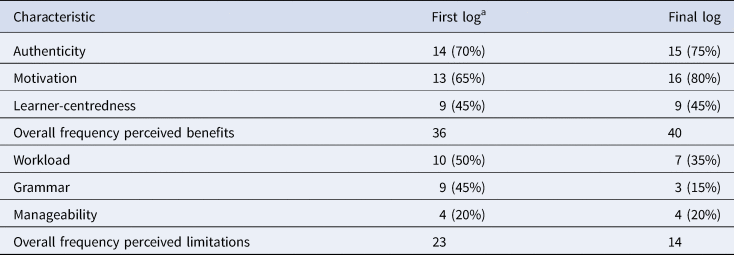
For comparative purposes, the themes that were reliably identified in the first logs became a taxonomy (three positives and three challenges) that was applied to coding the final logs. McNemar chi-square tests tested the null hypothesis of no significant difference between expected and observed frequencies (RQs1 and 2). Table 1 reproduces the frequencies of comments from both logs.
Frequency of comments – first and final reading logs (original study)

a Initial coding.
At the start of the course, perceived benefits were more frequently noted than perceived limitations, but this difference was not significant. Comparatively, end-of-course data indicated shifts in frequency of comment. Participants noted potential benefits of TBLT significantly more frequently than limitations (χ2 (1) = 12.52, p < .001).
In summary, authenticity ranked high as a positive characteristic of TBLT at both points in the course, and perceptions of student motivation were more in evidence at the end of the course. It was also evident that confronting and developing beginning teachers' thinking and understandings through inter-weaving theory with practice had had positive impact on several participants' perspectives on TBLT as innovation.
Comments in the final logs were also looked at to determine whether reflection on theory and practice appeared to influence participants' understandings of the potential and challenges of TBLT moving forward (RQ3). Evidence suggested that participants' beliefs and practices could change, demonstrating greater openness to, and enhanced understanding of, task-based principles by virtue of critical reflection on both theory and practice. One exception stood out. Chen, a first language (L1) speaker of Chinese and beginning teacher of Chinese and Japanese, acknowledged openness to consider task-based ideas on completion of the course. However, his view of the importance of explicit grammar instruction as expressed at the start remained intact at the end. His final log therefore provides evidence that, although enhanced understanding of the value of TBLT can be promoted via actual experience, prior beliefs can be hard to modify.
Experiences in schools also appeared to be pivotal, in two respects. First, witnessing tasks in practice (whether through observation or own use) enhanced perceptions of benefit. Second, participants' experiences, coupled with the attitudes and understandings they encountered among more senior colleagues (which might be antithetical to task use), led to a level of circumspection about future pedagogical choices.
6. The comparative re-production
As I reflected on the evidence presented from the original study, I made several adjustments to the course to encourage more informed standpoints from which participants might enter their practicum placements. These adjustments reflected my wish to help participants to think about the key questions emerging from the original data that I stated in the opening section of this paper. Essentially, and as previously stated, it seemed that TBLT was an attractive proposition, but that the price to implement TBLT was perceived to be quite high.
On the one hand, I enhanced activities that replicated the core characteristics of tasks, with the aim of helping course participants to embrace the innovation more wholeheartedly. On the other hand, I sought to pre-empt the challenges of the environments in which these teachers might be working, and to explore what these environments might mean for their own work with tasks, thereby helping these beginning teachers to think more clearly about whether, and in what circumstances, the innovation might need to be moderated.
Enhancing participants' awareness of the advantages of tasks included: presenting and discussing examples of tasks that the original 2012 cohort had come up with for use in real classrooms alongside the original cohort's reflections on how these tasks worked in actual practice (see East, Reference East, Samuda, Van den Branden and Bygate2018); a task where participants worked in small groups at six workstations, each representing one task type (Willis, Reference Willis1996). For a few minutes, participants discussed and wrote down a sample task that fitted a particular task type, before rotating to a new station and adding a further example to what became an expanding list. At the conclusion, they arrived back at their original station and reviewed the whole list that had been created. The completed lists were subsequently written up to become a participant-generated collection of suggestions for tasks which the participants could take with them into their first practicum placement.
Enhancing participants' awareness of where a task-based approach may need to be moderated included the following: I maintained a stance that, even in the face of collegial resistance or more traditional approaches, the students should still experiment with tasks and thereby see for themselves what happened. Nevertheless, I made it more apparent that participants would confront, and would need to think about how to navigate, not only a range of perspectives on TBLT among more senior colleagues in schools but also more traditional teacher-fronted elements in classrooms. I was also mindful that, as an increasing number of experienced teachers completed the professional development programme referred to by Erlam and Ellis (Reference Erlam and Ellis2018a, Reference Erlam and Ellisb), this potentially increased the likelihood of more receptive working environments for some course participants.
An issue of central importance to me was whether, and to what extent, the above subtle modifications to practice would influence students' perspectives about TBLT in comparison with the original cohort. The re-production was constructed in the same way as the original study, posed the same research questions, and utilised the same data collection instrument.
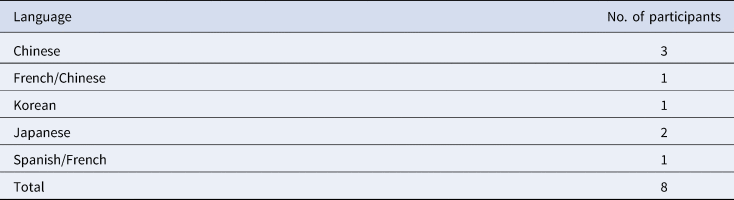
Of a ten-strong cohort in 2017, eight students who were studying to become teachers of an MFL gave their consent for aspects of their coursework to be used for research purposes.Footnote 1 Table 2 presents the chosen MFLs of these participants.
The participants

Most participants were first language speakers of the principal target language, and were effectively bilingual with English. Several had familiarity with the New Zealand education system through their own school experiences. Following the original study, participants' names have been replaced by pseudonyms that reflect the ethnicity and gender of the participant and the primary language taught (e.g. Janelle is a female teacher of Japanese who identifies as European), and minor spelling errors in the reading logs were corrected.
7. Findings
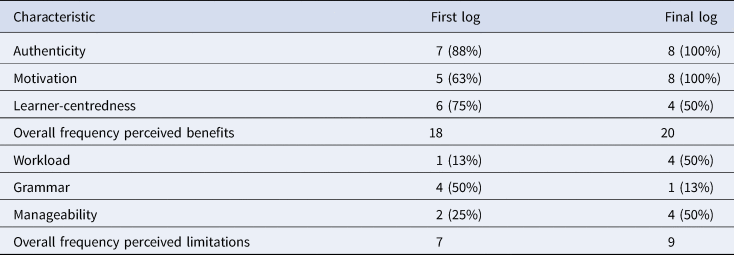
By way of initial comparative analysis, the taxonomy that had emerged from the first phase of the original study was applied to the newly available data. Table 3 reproduces the frequencies of comments from both logs after application of the taxonomy.
Frequency of comments – first and final reading logs (comparative study)

The frequency data revealed substantially similar perspectives in comparison with the original data. They indicated a very strong perception of authenticity as a positive characteristic of TBLT, with motivation and learner-centredness also perceived as important dimensions. At the start of the course, hindrance to acquisition of grammatical proficiency was the main perceived concern, whereas workload and manageability came more to the fore by the end. Overall, perceived benefits were mentioned more frequently than perceived limitations. Χ 2 tests on the comparative overall frequencies (positive and negative) between the original cohort and the new cohort indicated no significant differences, whether at the start or the end of the course.
Following East (Reference East2014), participants' log entries provided further data to address the three RQs.
7.1 Initial understandings
Data from the initial reading logs were used to answer RQ1 (What understandings about TBLT and tasks do beginning teachers have as they begin to engage with a dedicated MFL methodology course in an ITE programme?).
7.1.1 Positive characteristics
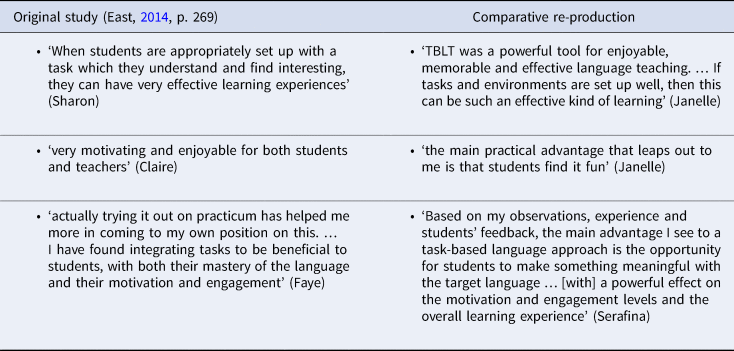
With regard to the positive characteristics of tasks, Feng, for example, argued initially that TBLT encourages ‘meaningful communication’ as an ‘authentic, engaging, outcome-oriented, and learner autonomous approach.’ She expressed the view that ‘a task designed with a genuine social context in mind is far more useful in the real world than a language lesson focused mainly on grammar.’ She went on to describe a task-based approach as ‘holistic and experiential.’ Compared to a more traditional approach, she argued that the ‘greater degree of learner responsibility’ offered through TBLT was ‘more likely to increase learner participation and satisfaction.’
Several other participants suggested similar inter-related advantages. TBLT: ‘enables students to engage extensively in authentic acts of communication’ – as students perform ‘meaningful tasks which intrinsically motivate them,’ this gives them ‘more power over their learning’ and they thereby gain ‘more confidence’ with language use (Kyung Mi); ‘focuses on using authentic language’ (Jae Hwa); ‘involves giving learners authentic tasks that encourage them to use the target language in a communicative and meaningful manner,’ making the approach ‘[s]tudent centred, communicative, interactive’ (Chin).
Janelle provided a useful illustrative example. TBLT, in her view, is ‘powerful’ because ‘we practise and become better at things by doing them.’ For example:
While learning the rules and talking about how to play basketball helps, the most effective way to get better is by playing basketball. The same is true for language, we get better at using a language by using a language. This is exactly what TBLT provides, the opportunity to use a language.
For Janelle, therefore, ‘the main point [of TBLT] is to use the target language to achieve that non-linguistic goal.’ Since ‘in reality we use language to achieve the things we need to do,’ TBLT ‘replicates and practises this.’
7.1.2 Negative characteristics
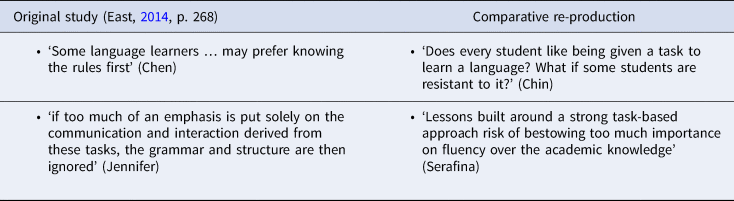
As stated earlier, hindrance to acquisition of grammatical proficiency was noted as an initial concern by half the participants. Perspectives suggest a belief that formal teacher-fronted grammar instruction is a necessary component of language learning that was perceived to be absent from TBLT.
Chin, for example, acknowledged that a potential benefit of TBLT was that ‘the grammar is not introduced in the beginning.’ Rather, ‘a language focus comes first.’ However, in light of his own prior experiences of language learning and teaching in China, Chin saw this as challenging. Although, in that context, tasks might have been ‘used occasionally,’ he asserted that his students were ‘first given explanations about the rules and use of grammar,’ and there was no requirement for them to ‘discover them independently.’ For him, the question became, ‘how is the mastery of fluency and accuracy to be balanced?’ Serafina was similarly concerned about ‘a decay in accuracy’ if the focus were placed too much on meaning. For Chyou, a TBLT approach might mean that ‘students cannot entirely master a language’ since ‘communication is its core, not [a] grammatical-oriented teaching method.’
Negative characteristics did not focus solely on the place of grammar. Feng succinctly articulated several additional disadvantages:
The amount of time taken to set up and complete tasks, potential loss of control in the classroom (especially in large classes), the pressure to complete the assigned textbook and meet the national assessment standards, teachers’ lack of TBLT knowledge and potential for excessive off-task use of first language.
7.2 Developing understandings
Data from the final reading logs were used to answer RQ2 (Do understandings about TBLT and tasks change and develop as beginning teachers complete the course and the programme?).
7.2.1 Positive characteristics
Several comments illustrate experiences of working with real students as catalysts for on-going positive reception of task-based ideas.
Kyung Mi (a part-time student who was unable to complete practicum placements but who drew on her experiences in a Korean community language class) noted, ‘at the beginning of the year I was quite hesitant to put task-based language teaching actively in practice, particularly in beginners’ level classrooms.’ She thought that ‘limited proficiency of beginning learners can greatly challenge the practice of teachers trying to maximise the target language input as well as the opportunities for output for genuine interaction.’ However, by the end of the course she had come to realise that ‘such limitations can easily be overcome.’ She explained:
Exposing them to those very simple everyday expressions that help learners to negotiate meaning effectively while completing tasks provides [the] chance for beginner learners not only to see examples of language as actually used but also enables them to begin interacting in the target language so that they can successfully complete the tasks.
Chin commented on ‘improvement in student behaviour and attitude when I set more authentic, meaningful tasks.’ In his experience, ‘students engaged proactively and they were enthusiastic and inspired to complete each activity. I felt these lessons were effective and the goals were achievable.’ Chun likewise observed that, having conducted a series of tasks regularly throughout her practicum, ‘students have responded that classes are a lot more interesting and they are excited [about] what tasks I would give to them.’ She went on to reflect that ‘while they have this excitement, chances are they are more focused and engaged in class when they get to utilise the language in tasks.’ Her report on increased motivation meant that, in her experience, ‘students start to look forward to what they would do in the next lessons.’ Chyou similarly noted that tasks helped the students she was working with to become ‘more motivated to use target language.’ TBLT, it seemed, ‘had built up their confidence when they spoke the language.’ Her students ‘actively interacted with others’ and ‘negotiated the meanings of the language without explanation of the form, which meant that they were starting to use the language and communicating.’
Serafina and Janelle commented directly on how their two practicum placements had reinforced the positive perspectives on TBLT that they had expressed at the start of the course. Serafina asserted, ‘now, six months later and after two practicum experiences I reaffirm the advantages that I had identified earlier on … the benefits are unquestionable.’ She reflected that ‘this freedom [for students] to try out their own hypothesis, along with the interactivity associated to task completion, has a powerful effect on the motivation and engagement levels and the overall learning experience.’ Janelle commented that her experiences during the two practicum placements had re-enforced her perception of TBLT as ‘a powerful tool in the language classroom.’ She had come to see in practice that TBLT ‘gives students the opportunity to get better at a language through its use.’ She could ‘now see TBLT as achievable for teachers and more importantly engaging, fun and beneficial for students.’
Several final log entries illustrated how reflection and experience were leading to modification of previously held beliefs about effective language teaching. Feng explained:
Before my engagement with TBLT … my understanding of a good teacher and a good teaching practice had been a traditional PPP model where the teacher has to know everything (almost everything) and be the authority of the knowledge delivered in the classroom.
Feng had come to see that TBLT, by contrast, created ‘a real-world scenario inside a classroom with a goal for the FL learners to interact with each other using the target language.’ Feng concluded that ‘such a pedagogy should be incorporated into all FL teaching.’
Chun explained, ‘it has been almost 20 years from the very last time I have learnt a foreign language in secondary school. My assumption was that we would still need to learn the basics i.e. vocabulary and grammar.’ She was ‘surprised to find out that … we are now promoting task-based language teaching – an innovative teaching method towards language teaching.’ She had found it ‘quite stressful at the beginning’ as she tried to ‘overwrite the system in my head.’ That is, ‘you want to cling onto something that you are comfortable and familiar with.’ She argued in her final log:
But the more I learn about TBLT, the more I try to implement it, the more I am fascinated by it. When I see students actively communicate with each other in class, I think – this is going to be the way. When I see students fighting hard to achieve their goals for the task using the target language, I think – this is the way. When students ask me ‘Miss, what are we going to do tomorrow? Can we do some more of those tasks?’ I think this has to be the way.
7.2.2 Negative characteristics
Despite evidence to suggest that on-going reflection and actual experiences were shaping perspectives in a positive way, several challenges for TBLT still persisted. As noted earlier, however, grammar instruction became less of an expressed concern.
With regard to grammar, Chin and Serafina provide interesting perspectives. Chin had originally been concerned about TBLT's perceived lack of attention to grammar instruction and noted, in his final log, that he was initially ‘not confident that TBLT was an effective way to approach teaching Chinese.’ However, his practicum experiences illustrated that students’ spoken proficiency appeared to become enhanced through task participation to the extent that ‘teachers felt the lessons were effective’ and ‘my initial worry was unnecessary.’ Serafina had worried initially about a‘decay in accuracy’. By the end of the course, she reflected, ‘I [now] honestly cannot say that those learners that have been the subject of extensive grammar drills and rote-learning are better equipped to translate that knowledge into communication.’ Nevertheless, for her a task-based approach did not have to preclude an overt grammar focus whereby students might ‘engage in more “traditional” grammar practice’ as ‘a stage of the learning process.’
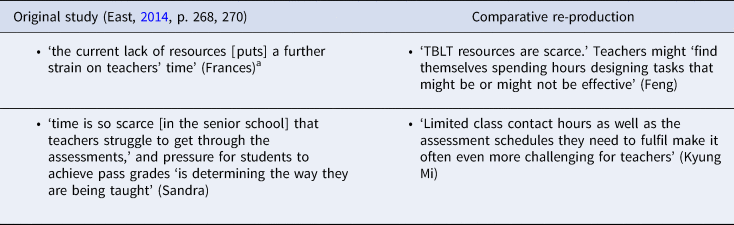
Whereas apprehensions about grammar appeared to have diminished by the end of the course, workload and manageability became more apparent as concerns. Feng commented that the scarcity of TBLT resources compared to what was available for the traditional PPP model negatively impacted on teachers’ time. She concluded, ‘I believe that the practicality issues could be the main reason that is holding FL teachers back from fully embracing and adopting TBLT into their language classrooms … regardless of how beneficial TBLT is to learners’ communicative skill.’ Perceived additional workload made it ‘harder for FL practitioners to move out of the PPP model.’ Kyung Mi similarly noted, ‘developing effective language tasks’ is ‘time-consuming.’ She commented that TBLT ‘often requires more class time and more teacher patience than other language teaching approaches … limited class contact hours … make it often even more challenging for teachers.’ Chun referred to teachers who ‘have confessed how they find it almost impossible to implement tasks into everyday teaching’ due to time constraints and lack of ready-made resources.
7.3 Issues for the successful implementation of TBLT as innovation
The data raise several implications in response to RQ3 (What possibilities and challenges for the implementation of TBLT in schools are highlighted by the data?).
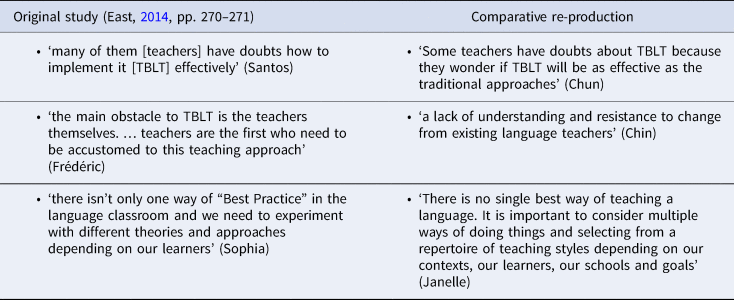
Practising teacher reticence was perceived as a considerable stumbling block to the implementation of task-based ideas. Jae Hwa observed on practicum that ‘current language teachers were still facing challenges in class,’ meaning that TBLT ‘wasn't always present in the classroom practice.’ When Chin questioned one more traditional teacher on her lack of using TBLT ideas, ‘she told me that she did not use it, and “what you learn at university has nothing to do with real teaching”.’ Chun argued that ‘if teachers work in more traditional schools which have huge focus on students’ academic achievement, they will face more stress when trying to innovate their teaching methods as higher management may have questions toward the effectiveness of the new methods.’ Furthermore, she admitted that she still felt ‘confused at times when trying to define tasks as [opposed] to communicative activities.’ She was therefore ‘not surprised how other professional teachers find it difficult to understand.’ As Janelle commented, ‘old habits do die hard.’ An issue therefore remains ‘of teachers not wanting to change the status quo, or not having the option to engage in PD [professional development] about TBLT in order to understand it.’
Eclecticism in practice appeared to be the likely consequence of on-going challenges. Serafina, for example, argued that, although TBLT represents ‘a solid platform’ for renewal of teaching approaches, ‘there is still much confusion as to what constitutes an approach based on tasks.’ She concluded, ‘at the end, it is the job of the teacher to find the right balance of approaches that fit their students’ abilities and learning styles.’ As Chun put it, ‘is TBLT our final answer for language teaching? The answer is probably no.’
8. Discussion
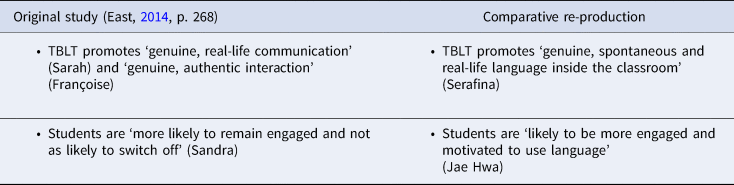
The above presentation of findings, and additionally the comparative extracts recorded in Tables 4–8, illustrate that, by and large, the findings of the comparative re-production corroborate those of the original study and provide further evidence of the benefits and challenges of introducing TBLT in school MFL classrooms in New Zealand.
Initial reflections (positive characteristics)

Initial reflections (negative characteristics)

Concluding reflections (positive characteristics)

Concluding reflections (negative characteristics)

a Recorded in Frances’ first reflective log.
Issues moving forward

With regard to the comparative thematic analysis, on both occasions the enhanced authenticity of a task-based approach was seen as a strongly compelling advantage over more traditional teacher-led approaches, with student motivation noted almost as strongly. In both studies, a perception that a task-based approach might hinder the acquisition of grammatical proficiency was considerably less in evidence at the end than at the start. East (Reference East2014, p. 273) argued that the findings of the original study ‘provide some preliminary evidence that critical reflection contributes to positive understandings of the potential of TBLT and the successful introduction of aspects of TBLT in school classrooms … the findings support the direction in which the programme is going.’ The comparison provides accumulative evidence that, at least between the two points of evaluation (2012 and 2017), the course was continuing to fulfil its primary function, and suggests on-going appreciation among participants of the principles and benefits of TBLT.
One interesting contrastive example relates to grammar instruction. Chin (Chinese as L1 teacher of Chinese in the comparative study) expressed a belief at the start of the course, based on prior experiences in China, that formal teacher-fronted grammar instruction is a necessary component of language learning that was potentially absent from TBLT. His practicum experiences appeared to demonstrate to him that effective learning could take place in the absence of attention to explicit grammar. He concluded that his initial worry was unfounded and his view of TBLT had changed.
Chen (Chinese as L1 teacher of Chinese and Japanese in the original study) had declared at the start that some students might prefer a teacher-led up-the-front grammar approach to a learner-centred post-task grammar approach. At the end, and unlike Chin, his beliefs had not shifted. As East (Reference East2014, p. 271) commented, ‘Chen provides an interesting example of someone whose beliefs regarding formal systematic grammar instruction appeared to remain static from beginning to end.’
Although actual classroom experiences could be positive in enhancing an appreciation of the use of tasks, perceived challenges across both studies were workload and manageability. Participants reported that task creation was time consuming and there was a lack of ready-made resources. Furthermore, doubts and hesitations about TBLT among more experienced colleagues continued to exert an influence. It appeared that the environments in which these beginning teachers were working had not necessarily become more receptive over five years, and the day-to-day realities of classroom life meant that eclecticism in practice continued to be normative.
It is important to point out that the findings of the original and comparative studies do not enable us to draw any conclusions about the success or otherwise of professional development initiatives. Porte and McManus (Reference Porte and McManus2019, p. 8) made clear that research in authentic settings cannot determine or control for a host of variables that might affect an outcome. This, in their view, leads to ‘tantalizingly incomplete results’ that invite some kind of replication. In both the original study and the re-production, it was not possible to control for whether participants would be working alongside more experienced teachers who had successfully completed TBLT oriented in-service professional development, or who, having undertaken such professional development, still questioned the viability of a task-based approach. (In this regard I look forward to the release of Erlam and Tolosa (Reference Erlam and Tolosaforthcoming) which will explore the pedagogical realities of the professional development programme referred to by Erlam and Ellis (Reference Erlam and Ellis2018a, Reference Erlam and Ellisb).)
Notwithstanding that the comparative re-production reported here did not directly research practising (i.e. experienced) teachers’ buy-in to TBLT ideas, it is feasible to conclude that the practising teacher variable is in need of attention moving forward. That is, it may be hypothesised that beginning teachers who enter the profession with a solid research- and practice-informed foundation in TBLT will likely be more empowered to see task-based principles more firmly embedded into practice when they can work alongside more experienced teachers who are also developing such a foundation. The question becomes how the in-service needs of practising teachers can be more adequately addressed than currently appears to be the case.Footnote 2 As Long (Reference Long2016, p. 28) argued, when teachers lack knowledge of or are apprehensive about an approach that seems unfamiliar and so different to what they have been used to, this becomes ‘a major factor mitigating against teacher buy-in and adoption of new ideas.’ This, in his view, highlights the need for adequate in-service teacher education and on-going teacher support that will develop ‘expertise on the part of … classroom teachers.’ Long conceded, however, that ‘a considerable investment of time and effort’ would be required to achieve these aims.
9. Conclusion
The comparative study presented here is limited in several respects. First, the sample size was very small, and the findings cannot be generalised beyond the immediate context. However, as I maintained earlier, generalisability is not the main purpose of qualitative research. The comparative re-production presented here does not seek to ‘make predictions about the likelihood of an observation or outcome occurring in the future,’ but rather to ‘obtain a gradually clearer and more detailed picture of the phenomenon itself’ (Porte, Reference Porte and Porte2012, p. 4).
Second, quantification is problematic in a study which is essentially qualitative (especially in light of the small sample size). As I argued with regard to the original study, frequency counts were derived from the number of occasions a particular quality was referred to in log entries, whether overtly (e.g., tasks are authentic) or by clear implication (e.g., tasks are real-life). The absence of reference to a characteristic does not necessarily mean that the characteristic was not known, recognised or otherwise acknowledged by a participant; it was simply that it was not mentioned or clearly implied. The frequency data have some value in helping to determine which characteristics were in the forefront of participants’ thinking, but must be treated with caution and as a guide only to perceived issues of importance. However, with regard to re-production, the thematic analysis leading to the identification of a taxonomy of advantages and disadvantages of TBLT arguably encourages ‘a level of detailed representation that – crucially – allows comparison across studies’ (Porte & Richards, Reference Porte and Richards2012, p. 289).
Third, I re-produced my own original study. Makel and Plucker (Reference Makel and Plucker2014) noted that just over 48% of the replications they identified were carried out by the same researchers who published the original research. They point to the danger of potential biases in this approach. However, Erlam and Ellis (Reference Erlam and Ellis2018a, p. 2) argued that the uniqueness of their replication lay in the fact that, as the researchers for both studies, they were ‘equally familiar with both studies and thus able to specify the similarities and differences between them’ and could ‘provide an informed account of the changes we made in the replication study.’ As Makel and Plucker (Reference Makel and Plucker2014, p. 308) put it, ‘same-author replications could … be benefiting from the wisdom/experience from having done the study previously.’
Last, and arguably most importantly, it has been argued that qualitative studies are simply not replicable due to their context-bound idiosyncratic nature (Porte, Reference Porte and Porte2012; Markee, Reference Markee2017). No two qualitative studies will ever be identical. As previously noted, qualitative re-production presents significant difficulties, leading Porte and Richards (Reference Porte and Richards2012), for example, to question whether qualitative researchers can be persuaded to take on the challenges. The alternative, however, is not to re-visit past work, leaving qualitative researchers open to the charge of not critically assessing or reviewing what has previously been presented. As I suggested earlier, a comparative qualitative study may be little different to a multiple case study (an accepted qualitative methodology) involving a two-stage replication (Yin, Reference Yin2014).
In concluding, I re-visit the argument for the importance of undertaking this comparative re-production. Studies into stakeholder reception of TBLT ideas are just as necessary as experimental studies that demonstrate task efficacy. The findings of experimental studies need to be laid alongside, and allowed to inform, TBLT from the teachers’ perspective, and both need to work in tandem to contribute to pedagogical developments. As Long (Reference Long2016, p. 29) argued, ‘researchers and practitioners [need] to move forward together systematically in what must be a collaborative endeavour’ (my emphases). The comparative re-production presented here has aimed to go some way towards addressing this need. In its immediate (New Zealand) context it provides a valuable complement to Erlam and Ellis's approximate replication (Reference Erlam and Ellis2018a). More broadly, it enables us, as Porte and Richards (Reference Porte and Richards2012) might put it, to make incremental advances in our understanding of the issues at stake for the profession and the variables that continue to require attention. The focus of future research from the practitioner perspective arguably needs to be on support for and uptake of TBLT ideas by existing teachers in existing programmes.
Martin East is Professor of Language Education in the School of Cultures, Languages and Linguistics, Faculty of Arts, at the University of Auckland, New Zealand. His research sits at the intersection between second language acquisition, language pedagogy and teacher education, and he publishes widely in areas related to stakeholders' reception of innovative practices. He is currently President of the International Association for Task-Based Language Teaching, a worldwide organisation of scholars interested in and active contributors to the field of TBLT.