

Introduction
The development of tools for recording and playback has had an enormous impact on musical language. The birth of musique concrète in the hands of Pierre Schaeffer indicated a possible path to be followed by all subsequent musics which use the recorded format as a medium to develop musical ideas. The vinyl record, and subsequently the CD, became not only a means to document the creative skill of a composer/group/songwriter but a work in its own right. It is like a painting, a unique object, not replicable, a fixing of a musical product (Chion Reference Chion1991), definitional of a period in the history of that group/songwriter/composer.
Thus 1948, the year in which Schaeffer composed and diffused the Concert de Bruits at French Radio, marks a major turning point in the history of musical language; prior to this, music was only transmitted in two ways, by oral or by written tradition. Consequently, the score and oral memory are prescriptions that require interpretation; they do not represent the ‘sonic matter’ of the piece. The sonic matter of the piece takes form only in the performance. Prior to the development of the documentation by recording media, this happened only ephemerally. The Concert de Bruits by Pierre Schaeffer consisted of five studies, ‘Cinq Etudes de Bruits’, each one focusing on certain kinds of sound material produced by non-musical instruments, or by musical instruments used in unconventional ways. Traditionally, a piece was conceived with particular instruments in mind and, whether conveyed orally or by writing, the instructions which define it have to conform to the limits, albeit sometimes stretched, of those instrument/s whose task was to give life to the sonic matter of the piece. Other sounds, such as those of the environment, could not be included in the musical discourse. The advent of recording and playback tools, used for creative purposes, dramatically changed this scenario. Schaeffer used train sounds for his first Etude; sounds of everyday life were used by the Beatles in Revolution Nine, nearly 20 years later. Neither of these two pieces could be performed ‘live’ except by means of reproduction equipment; recording tools change the ways in which musicians create and compose music.
The new musical medium to which this gives rise has its own features and peculiarities related to musical genre. Sound becomes the central parameter to develop. In more traditional genres, other parameters (pitch, rhythm, harmony, arrangements) are more important, even though they are organised in a structure in which sound and space acquire a relevant signification. Not only are sound and space used to transmit the traditional parameters, but they become organisational in their own right.
The recorded format fixes the sound image of the work. As Gracyk stated, borrowing the term from the philosopher Nelson Goodman (Goodman Reference Goodman1976; Gracyk Reference Gracyk1996), music in recorded format is autographic like paintings and sculptures, in the sense that there is no possibility that an exact replica could be produced. This is an important facet because the sonic image of a work in recorded format is perpetuated in the same form in listener memory. In this context, the interpretation lies not in the reproduction of the sonic artefact but in the very act of listening. The fixing of the sonic image in listener memory means that mixing or production imperfections also get fixed. For example, the sudden change from right to left of the ride cymbal rhythm at the beginning (00:05ʺ) of King Crimson's ‘Sailor's tale’ marks the sonic image of that piece as clearly as does the voice at the back of the mix of the first part of Caravan's ‘For Richard’ (00:00ʺ–02:36ʺ). Even the recording of the Soft Machine's Third, which has a very opaque and seemingly disorganised mix of instrumental sounds, represents a sonicprint of that record. Were we able to listen to a new version, with clearer equalisation and a new mix of the sound sources, it would not be the Third which exists in our sound memory.
In order to conclude these introductory remarks, I would like to note that this article is exemplified chiefly by pieces belonging to progressive rock and rock of the late 1960s and early 1970s. Aside from the musical values of the repertoire of that period, this is because the period represents a phase in which the recording studio begins to be used as a compositional tool. The consequences of this approach are seen in an attitude which explores the possibilities the studio offers, and which operates without a normative articulation of mix and montage processes. It is these considerations which make the music of that period an important corpus in which to investigate its use of recorded space. Access to the entire sound world, the possibility of composing not notes, but the ‘sound matter’ of the piece, like a sculptor carves the stone, requires a new awareness on behalf of composing musicians, as well as new analytical strategies from the music's critics, in order to take into account these new features of music in recorded format.
The recorded space
Music diffused by loudspeakers hides its sound sources. As Schaeffer (Reference Schaeffer1966) said, borrowing a term from writer Jerome Peignot, it is acousmatic (Bayle Reference Bayle1993). Music seems to originate from a ‘black box’ in which sounds are located in two spatial dimensions: near and far; left–centre–right. While the earlier mono format does not have the second dimension, it developed its own spatial organisation (Doyle Reference Doyle2005). It would seem to be true that spatial location is the most significant type of space to be articulated in the recording format (Smalley Reference Smalley2007), a point to which I will return.
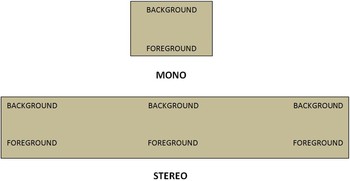
Mono and stereo spaces can be represented as two kinds of imaginary stage. In mono space, the difference between near and far can be articulated. This means that one can place sounds (instruments) into layers which, partly by means of their loudness, can be perceived as overlapped but at different distances. But, as the original mono version of the Beach Boys' ‘Wouldn't It Be Nice’ shows, the overlap between different sounds is not only due to their loudness. Here, at the beginning of the song, the sensation of an open and deep space is portrayed through sound instruments of differing frequency ranges and reverberation. In stereo space, in addition to the near–far dimension, a left–centre–right dimension is added. The stereo space acts as a sort of window through which the listener can ‘view’ the location of sounds, not only in an overlapping construction but in a complex and dispersed structure. We could be hearing a single sound on the left side, one in the centre and two on the right at different distances, far and near. This is hypothetical since the degree of fusion of the overall sound image would not allow such a precise distinction, at least on first hearing. Nevertheless, the overall sound image which the listener perceives is a result of the localisation of sounds and their relationships. In some pieces, the stereo localisation of the sound serves as a sort of mark to be assigned to a particular sound or thematic fragment. In ‘Cirkus’, the opening track from King Crimson's album Lizard, the three-note riff is located in the left channel throughout the song. But, as I have already noted, both in mono and (more particularly) in stereo, localisation is not the only parameter which shapes the overall sound image of the recorded piece and provides the relative listening sensations of depth, brightness, dullness, width and saturation (see Figure 1).
Mono and stereo windows.
In order to analyze these listening sensations, I used the term sonic space (Camilleri 2005) to indicate the space in which the piece unfolds in the recorded format. Other scholars have used different terms in order to define the space in which the sounds are articulated. Wishart (Reference Wishart2000) uses the term landscape, defining a parallelism between the objects located in a natural landscape and sound objects placed in the stereo window. Moore (Reference Moore1992) employs the term sound-box in order to stress the multi-dimensional space in which sounds are organised. I prefer a more neutral term in order to avoid confusion with the term soundscape (Schafer Reference Schafer1972) which is charged with more natural and environmental meanings.
According to my definition, sonic space is a three-dimensional space divided into:
• localised space;
• spectral space;
• morphological space.
Localised space is the space into which sounds are placed both in terms of stereo or mono windows. Obviously, the actual parameters change according to the differences in these two spaces. Depth is one of the principal facets of mono, at least in term of localisation, while position and motion are key aspects of stereo. The sensory experience of localisation does not only result from these parameters, because the spectral content (timbre) of sound plays a relevant role in the overall perception of space. This consideration introduces the notion of spectral space in an appropriate way. If localisation is, in a certain way, a real sensation, then spectral space is metaphorical since there is no such physical space, even though we can experience the sense of saturation or emptiness due to the spectral content of the sounds used. Moreover, the combination of the spectral content of sounds and their disposition can accentuate the various sensory experiences to be had from listening to the overall sound structure.
The different behaviour of the combination of spectral and localised spaces in mono and stereo formats can be observed in Caravan's ‘A Place of My Own’, a song from their first album. This is a typical early Caravan song, whose structure is formed by a quiet verse, a more articulated chorus and an organ solo toward the middle. If we listen to the mono recording, we do not appreciate the change of timbre of the drum kit introduction, from low to medium/high (00:00ʺ–00:14ʺ). In mono the kit is masked. Stereo displacement avoids the masking phenomenon, opens the space and places the subsequent drum roll in the right channel. In addition, the splash cymbals in the chorus (00:41ʺ), located in the right channel, become more evident and modify the spectral space. Similarly, the organ solo is located in the right channel in order to allow the rhythm guitar to be more perceptible even though it is rather back in the mix (01:36ʺ–02:41ʺ).
Temporal perception is an additional dimension we need to take into account in order to develop the shape of a sound structure more precisely. Sound unfolds temporally through its morphological shape, whose streaming gives fluidity to the sound components and their other space types. But sounds can evolve differently in time, providing different types of sensory perception, senses of direction, stasis, cyclicity or oscillation. These sensations can be expanded by placing the sound in a given space, or can create the feeling that a sound structure inhabits the particular kind of space evoked by its motion (Delalande 1998). Repetition of patterns, for example, can accentuate the sense of saturation in a sound structure in which the spectral space is packed, is made up of close frequency bands, and the instruments fill all the stereo space. The importance of the morphology of sounds lies in the sense of direction and motion. The idea that the form of a sound as it subtly changes in time can be placed in a space, means that the sense of stasis or motion is viewed like an articulation of the relationship between space and time, a metaphorical way to ‘measure’ the distances among sounds. We can imagine the overall form of a song or piece in recorded format as composed by space frames whose connections can be characterised by the morphology of one or more sounds which compose the overall sounding-structure of that particular temporal space frame.
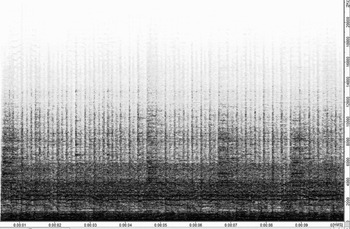
The overall impression of saturated space in King Crimson's ‘Great Deceiver’ derives from a combination of the three types of sonic space (as described in Figure 2). ‘Great Deceiver’ is the first track on the album Starless and the Bible Black, an album whose overall sound is marked by the used of distorted guitar: this song is a good example of the sonic approach of the album. The reiterated fast rhythmic morphological pattern at the beginning of the song is combined with distorted and multiplied guitar sounds and a grouped disposition in the stereo space, in order to convey a sensory perception of saturation, where all the sounds completely fill the space, giving a sort of ‘hard rock’ feeling. Were the rhythmic pattern slower, and the pulses therefore not so close to each other, the sensation of saturation, a completely filled space, would not be evident. This can be more clearly conveyed my means of a sonogram of the first ten seconds of the piece (Figure 3). The colours from white to black display the amplitude, while the vertical and the horizontal axes show, respectively, frequency and time. Saturation of the spectral space is quite evident, but the vertical line which marks rhythmic pulsations shows how the fast, close repetitions of the beat add value in order to convey the sensation of saturation.
The three space types.

The sonogram of the first 10 seconds of King Crimson's Great Deceiver.
The sense of direction, due to the morphology of sound which articulates the space/time relationship, is an additional feature of morphological space. In Pink Floyd's ‘Breathe’, for example, the sense of motion is due to the mellow sound of David Gilmour's guitar whose spectro-morphology moves and connects the distinct spatial frames at the beginning of the instrumental part of the song (01:24ʺ onwards). ‘Breathe’ is the first track on Dark Side of the Moon and presents two typical features of their songs – an introduction based on natural/recorded sounds and a verse/chorus structure based on a characteristic chord progression. The guitar sound morphology is in the foreground of this track and causes the sensation to drag the overall sound structure in the subsequent space/time frames.
At this point it should be clear that recorded and sonic spaces are themselves important parts of the compositional discourse, creating a space where all the meanings, musical and extra-musical, are organised. In King Crimson's ‘Ladies of the Road’, from the album Islands, it is evident that the organisation of sounds in sonic space plays a key structural role in the musical discourse. ‘Ladies of the Road’ is a song which uses features of the previous album Lizard, such as the guitar accompaniment located in a well defined channel, a chorus with Beatles-like reminiscences, with new sonic elements such as the voice of new singer Boz Burrell, a sparer instrumental palette and greater prominence in the bass drum beat. If we analyze the verse, where the voice has an important role, we find that it is split between the two stereo channels, though with different amplitude levels in each. Even though the content of the stereo channels varies during the unfolding of the piece, the verse maintains a pattern of lead voice split between channels and the accompanimental lead guitar in the left channel. The overall structure of localised space has two key characteristics. First, it presents the property of having some instruments split between the two channels (voice and sax) with an amplitude predominance on one channel creating a sort of sound shadow (Zak Reference Zak2001). Secondly, it localises one sound (the guitar), in a well defined channel so as to mark out its own space. It is interesting that in this piece, the only sound which seems to move from one channel to the other comes from a synthesiser (01:38ʺ–01:40ʺ): here, the movement of uncommon sounds within localised space becomes normative behaviour.
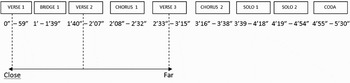
That said, the most important feature in this piece is the space of the voice, which is strictly connected to the structure of the verse (see Figure 4). The piece presents three verses, each utilising a different vocal space. In the first, the voice is very close, in the foreground and band-filtered as if it was uttered in a small space. The space occupied by the voice is highlighted by the fact that the spectral space is nearly empty due to the presence of just a few instruments located in distinct parts of the spectral space: guitar (medium), bass drum (low), tambourine (high). In the second verse, the spectral space is more dense while the voice is no longer filtered, is more distant and has a little reverberation. In the third and final verse, the voice is further distanced, a sensation caused by it being doubled with a little delay, removing it from any sense of direct perception.
The three verses of Ladies of the Road placed according to the spatial axis close–far.
It is clear that sonic space becomes a part of the musical discourse used to mark out the musical and, in certain cases, extra-musical features of the piece. In this case the progressive modification of the voice/space represents both a sonic distinction of each verse and a subtly progressive estrangement of Burrell's human presence. This intention is accentuated by the structure of the piece, whose second part is only instrumental, as if the voice (human presence) is absorbed by the instrumental sounds.
Features of sonic space
The triple-layer structure of sonic space affects sensory perception of not only the sounding context in which the musical discourse is carried out, but also its temporal unfolding. In a certain sense, it determines the sonic setting and sonic dramaturgy of the piece. The sonic setting can be viewed as the sound environment in which the piece unfolds, and the sonic dramaturgy the way it behaves as regards its temporal structure. By focusing on these two terms in order to make sense of the way sonic space works, it seems that sonic space setting and behaviour present some regularities due to the result of the relationships among these three layers: morphological, spectral and localised. It follows that there are some categories of sonic settings linked with some common spatial sensory perception, i.e. open and closed, produced by the way the three categories of space interact. For example, open and closed spaces are often used in the same piece in order to create opposing articulations and to accentuate the sense of tension and relaxation or to make a dramatic change in the song's narrative. These spaces also have extra-musical meaning: open space evokes freedom and vastness while close space calls to mind constriction but also intimacy.
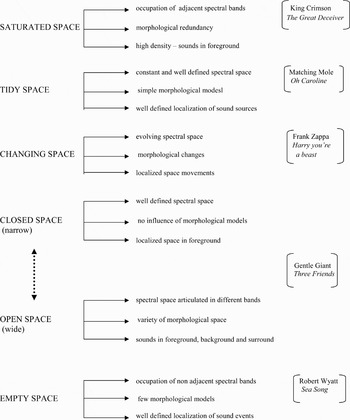
Through observation of several musical pieces, I have developed some categories that can be viewed as normative in the setting of sonic space. Figure 5 presents a classification of types of sonic space setting, with a short description of the features of the three spaces which comprise it. In this classification of the space setting types, open and closed spaces are connected, since passing from one to another is often a strategy aimed at altering listener perspective or giving a sensation of the broadening of the sound scene. Gentle Giant's ‘Three Friends’, the concluding song on their eponymous concept album, presents an example of the use of this kind of space setting. Gentle Giant mark the conclusion of the album by passing seamlessly from the previous song ‘Mr Class and Quality?’ to ‘Three Friends’; the last part of the album sounds as it would be performed in the wide space of a cathedral or similar environment. Thus the conclusion is marked by this specific space setting, underlining the importance of that part of the album. The wide space is strengthened by the choir of voices, typical of a cathedral, but it also conveys a feeling of nostalgia and dreaminess.
Sonic space settings.
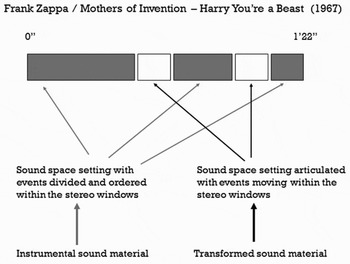
Use of change of space setting is usual when the sound world of a piece is composed of both instrumental and non-instrumental (unconventional) sound sources. A good example is the piece ‘Harry You're a Beast’ from Frank Zappa's Mothers of Inventions album, We're Only in it for the Money. The structure of this piece is based on musical sequences using instrumental sounds within a song structure, and others containing sound transformed from uncertain origins. The piece's vocal/instrumental parts are subdivided into a piano introduction and a verse/chorus structure whose melodic profile is non-linear. Without the transformed sound parts, the structure of the piece is symmetrical, divided into intro-verse-chorus–verse-chorus-intro, with the exception of the different character of the second chorus. The configuration of space, especially the localisation parameter, is very different in the sequences with transformed sounds. Here, sound sources are moved between stereo windows in order to support their morphological properties, an example of interaction between morphological and spectral space (see Figure 6). The sequences using instrumental sound have a more precise, tidier organisation of the space. This kind of sonic space setting can be found, in a more extended manner, in Zappa's Lumpy Gravy.
The changing space in the articulation of Zappa/Mothers of Inventions' piece.
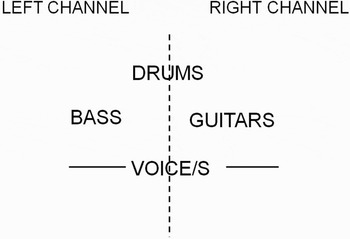
A piece from the same year, ‘Lovely Rita’ from the Beatles’ Sgt. Pepper (Martin 1994) is an appropriate example of a tidy, or orderly, space setting. ‘Lovely Rita’ is a straightforward song about a meter maid, marked by Paul McCartney's voice, a honky-tonk piano solo (01:12ʺ–01:23ʺ), and some strange sounds obtained by humming through comb and tissue paper. The vocal part is highlighted in the overall sonic structure of the song, particularly with respect to a normative stereo spatial subdivision, where a re-presenting of the live position of the players (as used in previous albums, e.g. Help!) is of interest (Figure 7).
Normal stereo disposition of the instruments in the Beatles' Help.
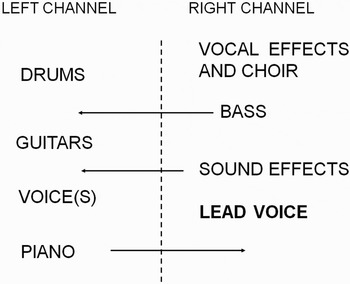
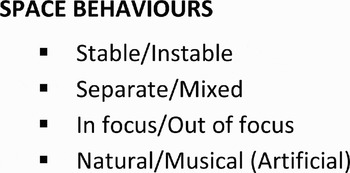
The localised space of ‘Lovely Rita’ divides the type of sounds/instruments within the stereo windows with a very precise and tidy separation between the voice and remaining instruments. The organisation of the sound space in terms of the localisation of the sound sources and their spectral content is exemplified by Figure 8. The arrow indicates sound shadows for the bass and the sound effects, while for the piano it shows that the honky-tonk-style solo is located in the left channel. The main feature is that the voice is located in the right channel, nearly alone. This placement reinforces and stresses the importance of the vocal part in this song and allows the listener to be attracted by the voice above all. The spectral space in the right channel is mainly occupied by the vocal spectrum and it enhances the sonic presence of the voice. As to the behaviour of sound space behaviour, my classification is based on the coupling of opposed behaviours: sometimes we find two opposing behaviours used in the same piece in order to articulate its structure (see Figure 9).
The stereo window setting of Lovely Rita.
Couples of sonic space behaviours.
An example of combining musical with artificial sonic behaviour can be found in Pink Floyd's ‘Alan's Psychedelic Breakfast’ from Atom Heart Mother. The piece uses recorded sounds taken from everyday life, further evidence that music in recorded format tends to employ any kind of sound in its musical discourse. However, in this piece these everyday life sounds are employed not as a decoration but as an integral part of the composition. Even though the piece, as marked in the album, is divided into three movements – (a) Rise and Shine, (b) Sunny Side Up, (c) Morning Glory – it can be subdivided into eight sections, as shown below. The segmentation is paradigmatic, in the sense that the letter A denotes the section composed mainly by everyday-life sounds while letter B denotes the others, mainly made up by instrumental sounds.

The first observation to make is that sections A and A4 are symmetrical: the piece starts and ends with the iteration of a water drop. But their behaviour in these sections, even in terms of space, is different. In section A, articulation of the space of the sounds of this imaginary breakfast tends to become more ‘musical’, more rhythmic, in order to arrive at the match/organ–upbeat/downbeat sequence which leads to section B, the first instrumental. In section A this takes place between 1′07ʺ and 1′25ʺ. The sound spatial behaviour changes from movement toward fixed localisations, from natural to artificial (musical) in order to reinforce the sense of musical organisation of the non-conventional sounds. In section A4, the sounds show a more ‘natural’, less ‘musical’ behaviour, leading to the iterative water drop which finishes the piece. Sections B4 and A4 mark the conclusive phase of the piece, after the climax reached in the section B3, composed only by instrumental sound, thereby articulating a more musical (artificial) behaviour.
The importance of the sonic space structure is well exemplified by another moment in the piece. In a part of section B2, ‘breakfast sounds’ (mainly the sounds of mastication) are located in the right channel, while two acoustic guitars are split across the two channels, rhythm guitar in the right, lead guitar in the left. At 5′35ʺ, the sound of mastication is emphasised by extending it to the left channel. This ‘artificial’ behaviour of the sound is connected to a harmonic change in the chord progression, from D to G/6. A ‘natural’ sound thereby becomes musical by means of its function, denoting a harmonic change.
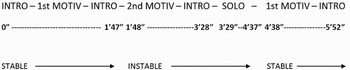
Stable/unstable behaviours are often connected with the characterisation of song structure. In ‘River’ by Gentle Giant, the closing song from the album Octopus, the first part of the piece is based on a regular riff with a nearly saturated setting and stable spatial behaviour (0′11ʺ–1′47ʺ). The next part (1′48ʺ–3′07ʺ), which leads to the guitar solo section, has a more open setting; reverberation gives the effect of greater depth, the sound sources seem to be floating in sonic space and in the stereo windows, causing the sensation of an unstable motion. Sonic space behaviours, stable/unstable, mark different parts of the song, underlining its overall form (Figure 10).
The overall form of River by Gentle Giant.
The mixed/separated behaviour could be represented by the way sound sources create a more ‘packed’ sonic image, or create the space in which single sources can be highlighted. This kind of behaviour can alter in a relevant way the overall sonic image and its consequent sensory perception. The re-edition of Henry Cow's ‘Nirvana for Mice’ provides a clear example. The original recording presents a more jumbled and packed sonic spatial behaviour, which is well adapted to the unstable motion of the melodic and rhythmic structures, in both expository and solo sections. The re-mix recording, released nearly 15 years later, adds more depth by means of reverberation and a greater sense of separation of the single instrumental lines. One can listen more clearly to these single instrumental lines; each one is more comprehensible, but one loses the sensation of chaotic motion characteristic of the original sonic image. This example also stresses the effect of the memory fixation related to music in recorded format. Exposure to repeated listening to a piece in recorded format forms a sonic image which is more fixed and rooted than one of a live performance. Greater disorientation therefore results when one listens to a differently mixed version of a well known song.
Conclusion
The sonic matter of a recording is one of its most important features. Akin to the very materiality of a sculpture or a painting, it brings about a sensory response in the listener connecting all the traditional musical parameters to its overall sonic structure, organised in sonic space. The acid, saturated and distorted sound of King Crimson's Lark's Tongues in Aspic album is a sonicprint which characterised the whole album. With regard to this notion, the sonicprint, we can speak of a global sonicprint, one which represents a persistent overall sonic image in a piece or a collection of pieces, an album. There are, however, local sonicprints, which are particular sounds, of an instrument or another sound source, which characterise that recording. The snare drum sound, dry, resonant and metallic, of drummer Bill Bruford in Yes's Fragile is a prime example. The recording studio, moreover, has become a compositional tool in which sounds can be organised and structured in the sonic space of the recorded format. There are many examples of this approach. A more traditional one is Yes's Close to the Edge, where the piece has been composed and recorded sequence by sequence, obliging Yes to learn to play it as the cover bands do. A more experimental approach is from the second side of the Henry Cow album Unrest. The band performed very rough improvisations in the studio, recording them in different ways, using panoramic or directional microphones. The material produced in these improvisations was spliced, cut, transformed and then organised as the sonic space of the piece, in a similar way to what an electroacoustic composer does with other kinds of sounds.
The possibility of operating in this manner opens access for the composer/group/songwriter to the totality of a sound world. Any sound can be used including, obviously, non-conventional sounds or sounds from everyday life, which can clearly affect the musical discourse. As Denis Smalley (Reference Smalley1997) points out, recorded sounds taken from natural or non-musical contexts have extrinsic links. This means that, although they may be used musically, some features of their original context remain. Smalley uses the term transcontextuality in order to explain the situation in which a non-musical sound is inserted into a musical discourse; such sounds inhabit two contexts, the musical and the original one. Whether one context becomes more important than the other depends on the approach of the composer. ‘Alan's Psychedelic Breakfast’ and ‘Revolution Nine’ are examples of this. Access to the totality of the sound world allows the composer/group/songwriter to organise the musical discourse at different levels: the musical level, the discourse based on the intrinsic feature of sounds and musical parameters, can be connected with a level in which elements of mimesis can play a certain role. The recorded space, the sonic space, permits this kind of possibility. Sonic matter becomes the only medium of musical communication, with no extra visual content, an added value in exploring new musical paths.



