














Introduction
The goal of this work, refining and extending our earlier paper [Reference FriedlanderFri15], is to present a context and a point of view for the study of representations of familiar linear algebraic groups  $\mathbb {G}$ on vector spaces
 $V$ over a field
 $k$. We work in the modular setting, fixing a field
 $k$ of prime characteristic
 $p > 0$; our linear algebraic groups are connected affine group schemes of finite type over
 $k$; the vector spaces are vector spaces over
 $k$, not necessarily finite dimensional. A typical example for
 $\mathbb {G}$ is the simple algebraic group
 $SL_n$. The representations we consider are ‘rational’, formally defined as comodules for the coordinate algebra
 $k[\mathbb {G}]$ with coproduct given by the group structure of
 $\mathbb {G}$.
We demonstrate how the theory of support varieties, first developed for finite groups and eventually extended to all finite group schemes, can be extended to a good theory of supports for  $\mathbb {G}$-modules. Our first formulation is an evident extension of the theory of
 $\pi$-points,
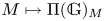
 $M \mapsto \Pi (G)_M$, for
 $\mathbb {G}$-modules
 $M$ with
 $G$ a finite group scheme as introduced by Pevtsova and the current author in [Reference Friedlander and PevtsovaFP07]. This theory,
 $M \mapsto \Pi (\mathbb {G})_M$, applies to any linear algebraic group
 $\mathbb {G}$ over an arbitrary field
 $k$ of positive characteristic and any (rational)
 $\mathbb {G}$-module
 $M$. However, it is difficult to make explicit because a point of
 $\Pi (G)$ is an equivalence class of maps to the group algebra of some Frobenius kernel
 $\mathbb {G}_{(r)} \subset \mathbb {G}$. Our second formulation
 $M \mapsto \mathbb {P} \mathfrak{C}(\mathbb {G})_M$, valid only if the algebraic group
 $\mathbb {G}$ is of exponential type, uses varieties of
 $1$-parameter subgroups
 $\mathbb {G}_a \to \mathbb {G}$ as introduced in our earlier paper [Reference FriedlanderFri15] following joint work with Suslin and Bendel in [Reference Suslin, Friedlander and BendelSFB97a, Reference Suslin, Friedlander and BendelSFB97b].
The underlying justification for a theory of supports is that it is sensitive to extensions of representations. Most support theories are based on cohomology, and support theory offers a geometric picture of cohomology following foundational work of Quillen [Reference QuillenQui71]. For example, the spectrum of the cohomology of the  $r$th Frobenius kernel
 $(SL_n)_{(r)}$ of
 $SL_n$ is homeomorphic to the variety of
 $r$-tuples of pairwise commuting,
 $p$-nilpotent
 $n\times n$ matrices of trace
 $0$ [Reference Suslin, Friedlander and BendelSFB97b]. Our theories are much influenced by Carlson's consideration of rank varieties for elementary abelian
 $p$-groups [Reference CarlsonCar81].
As motivation for considering support theories for linear algebraic groups, we remind the reader of a few consequences of support theory for finite groups and finite group schemes. An important role of support theories is that they offer a means of classifying categorical structures associated to representation theories of finite group schemes which are typically ‘wild’ (e.g. [Reference Benson, Carlson and RickardBCR97, Reference Benson, Iyengar, Krause and PevtsovaBIKP18]). Support theories have led to the identification and study of various interesting special classes of representations such as ‘modules of constant Jordan type’ [Reference Carlson, Friedlander and PevtsovaCFP08] and ‘mock injective’ modules [Reference FriedlanderFri18], provided new invariants for  $G$-modules [Reference Friedlander, Pevtsova and SuslinFPS07], and enabled the construction of algebraic vector bundles [Reference Friedlander and PevtsovaFP11, Reference Benson and PevtsovaBP12]. Another fruitful theme has been the application of support theories to investigate structural properties of the nilpotent cone and related algebro-geometric objects [Reference Nakano, Parshall and VellaNPV02].
There are obstructions to formulating a suitable support theory for  $\mathbb {G}$-modules. Not only is rational cohomology of
 $\mathbb {G}$ inadequate for this purpose, but also the abelian category
 $\mathit {Mod}(\mathbb {G})$ of
 $\mathbb {G}$-modules rarely has non-trivial projective objects (see [Reference DonkinDon96]) and its injective objects are almost always infinite dimensional. The latter obstruction persuades us to consider the bounded derived category
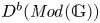
 $D^b(\mathit {Mod}(\mathbb {G}))$ of the abelian category
 $\mathit {Mod}(\mathbb {G})$ and to formulate associated stable categories. We verify that our constructions
 $C^\bullet \mapsto \Pi (\mathbb {G})_{C^\bullet }$ and
 $C^\bullet \mapsto \mathbb {P} \mathfrak{C}(\mathbb {G})_{C^\bullet }$ are well defined on objects of the stable category
 $\mathit {StMod}(\mathbb {G})$ and satisfy the standard properties expected of a good theory of supports. Although
 $C^\bullet \mapsto \Pi (\mathbb {G})_{C^\bullet }$ satisfies numerous good properties, we are far from recognizing which subspaces of
 $\Pi (\mathbb {G})$ are realizable as supports for a bounded complex of
 $\mathbb {G}$-modules. We lack the analogue for
 $\mathbb {G}$-modules of a central result of Carlson (easily extended from finite groups to arbitrary finite group scheme
 $G$) that any closed subvariety of
 $\Pi (G)$ can be realized as the support of some finite-dimensional
 $G$-module [Reference CarlsonCar84].
We highlight some of the contents of this paper. In § 1, we consider four variations of support theories for modules for a finite group scheme:
 \[ M \mapsto \mathbb{P} |G|_M; \quad M \mapsto \mathbb{P} V_r(G)_M; \quad M \mapsto \Pi(G)_M;\quad M \mapsto \mathbb{P} \mathfrak{C}_r(\mathbb{G}_{(r)})_M. \]
After briefly recalling the formulations of each, we verify in Theorems 1.4, 1.6, 1.7 and 1.13 that these theories are equivalent for those finite group schemes  $G$ and
 $G$-modules
 $M$ for which they are defined. The
 $\pi$-point theory
 $M \mapsto \Pi (G)_M$ applies to any finite group scheme; in Definition 2.2, we show that this theory naturally extends to a theory for linear algebraic groups
 $\mathbb {G}$ and their
 $\mathbb {G}$-modules,
 $M \mapsto \Pi (\mathbb {G})_M$.
In § 2, we verify for a Frobenius kernel  $\mathbb {G}_{(r)}$ of a linear algebraic group
 $\mathbb {G}$ of exponential type that the exponential support theory
 $M \mapsto \mathbb {P} \mathfrak{C}_r(\mathbb {G}_{(r)})_M$ also extends to a theory for
 $\mathbb {G}$-modules
 $M \mapsto \mathbb {P} \mathfrak{C}(\mathbb {G})_M$. In Theorem 2.6, we show that this exponential theory
 $M \mapsto \mathbb {P} \mathfrak{C}(\mathbb {G})_M$ is equivalent to the
 $\pi$-point theory
 $M \mapsto \Pi (\mathbb {G})_M$ for linear algebraic groups of exponential type and arbitrary
 $\mathbb {G}$-modules. Proposition 2.8 establishes further good properties of the theory
 $M \mapsto \mathbb {P} \mathfrak{C}(\mathbb {G})_M$. In Examples 3.1, 3.2, 3.3 and 3.4 of § 3, we investigate examples of
 $\mathit {Mod}(\mathbb {G})$-realizable subsets
 $\mathbb {P} \mathfrak{C}(\mathbb {G})_M \subset \mathbb {P} \mathfrak{C}(\mathbb {G})$.
For any finite group scheme  $G$ over
 $k$, Theorem 4.2 extends to arbitrary
 $G$-modules an important theorem of Rickard [Reference RickardRic89, Theorem 2.1] by giving an explicit equivalence of the stable module category
 $\mathit {StMod}(G)$ with the localization of the homotopy category
 $\mathcal {K}^b(\mathit {Mod}(G))$ of bounded complexes of
 $G$-modules by the thick subcategory of bounded complexes of injective
 $G$-modules. In Definition 4.7, we introduce the tensor triangulated category
 $\mathit {StMod}(\mathbb {G})$ which serves as a natural domain for our support theory for bounded complexes of arbitrary
 $\mathbb {G}$-modules. Motivated by Rickard's equivalence, we formulate our stable module category
 $\mathit {StMod}(\mathbb {G})$ as a localization of the bounded derived category
 $D^b(\mathit {Mod}(\mathbb {G}))$ by the thick subcategory of mock injective modules. Defined similarly, the stable module category
 $\mathit {stmod}(\mathbb {G})$ of Definition 4.7 is in almost all examples equal to
 $D^b(mod(\mathbb {G}))$, the bounded derived category of
 $mod(\mathbb {G})$.
We extend the support theories  $M \mapsto \Pi (\mathbb {G})_M$ and
 $M \mapsto \mathbb {P} \mathfrak{C}(\mathbb {G})_M$ to bounded complexes of
 $\mathbb {G}_{(r)}$-modules and then to bounded complexes of
 $\mathbb {G}$-modules in § 5. As shown in Proposition 5.2, our construction
 $C^\bullet \mapsto \Pi (\mathbb {G}_{(r)})_{C^\bullet }$ ‘agrees’ with the usual
 $\pi$-support theory
 $M \mapsto \Pi (\mathbb {G}_{(r)})_M$ for
 $\mathbb {G}_{(r)}$-modules. Theorem 5.4 shows that
 $C^\bullet \mapsto \Pi (\mathbb {G})_{C^\bullet }$ satisfies all of the standard properties of a theory of supports for
 $\mathit {StMod}(\mathbb {G})$. Among these properties, we mention the criterion for
 $\Pi (\mathbb {G})_{C^\bullet }$ to be empty (if and only if
 $C^\bullet$ is an object of
 $\mathit {Mock}^b(\mathbb {G})$), the more general fact that
 $\Pi (\mathbb {G})_{C^\bullet }$ depends only upon the isomorphism class of
 $C^\bullet$ in
 $\mathit {StMod}(\mathbb {G})$, and the tensor product property
 $\Pi (\mathbb {G})_{C^\bullet \otimes D^\bullet } = \Pi (\mathbb {G})_{C^\bullet } \cap \Pi (\mathbb {G})_{D^\bullet }$.
In § 6, we classify certain full subcategories of  $\mathit {stmod}(\mathbb {G})$ and
 $\mathit {StMod}(\mathbb {G})$ in terms of certain subsets of
 $\Pi (\mathbb {G})$. Namely, Theorem 6.5 establishes that
 $(r)$-complete, thick tensor ideals
 $\mathfrak{C} \subset \mathit {stmod}(\mathbb {G})$ are classified by locally
 $\mathit {stmod}(\mathbb {G})$-realizable subsets of
 $\Pi (\mathbb {G})$, and Theorem 6.11 demonstrates that
 $(r)$-complete, localizing subcategories
 $\tilde{\mathfrak{C}} \subset \mathit {StMod}(\mathbb {G})$ are classified by
 $\mathit {StMod}(\mathbb {G})$-realizable subsets of
 $\Pi (\mathbb {G})$ (as formulated in Terminology 5.6). The technique of proof of both these theorems is to pass from
 $\mathbb {G}$ to the family
 $\{ \mathbb {G}_{(r)}, r > 0 \}$ of Frobenius kernels of
 $\mathbb {G}$. For
 $\mathit {stmod}(\mathbb {G})$, we use the classification of thick tensor ideals of
 $\mathit {stmod}(\mathbb {G}_{(r)})$ given by Pevtsova and the author [Reference Friedlander and PevtsovaFP07, Theorem 6.3], which, in turn, utilizes Rickard's idempotents [Reference RickardRic97]. For
 $\mathit {StMod}(\mathbb {G})$, we use the classification of localizing subcategories of
 $\mathit {StMod}(\mathbb {G}_{(r)})$ proved by Benson, Iyengar, Krause and Pevtsova [Reference Benson, Iyengar, Krause and PevtsovaBIKP18, Theorem 10.1].
In § 7, we mention various questions and challenges concerning our support theory which would enhance our understanding of  $\mathbb {G}$-modules.
Throughout this paper,  $k$ denotes a field of characteristic
 $p > 0$ and all linear algebraic groups
 $\mathbb {G}$ are assumed to be connected; in other words
 $\mathbb {G}$ is assumed to be a reduced, connected affine group scheme of finite type over
 $k$.
1. Comparison of support theories for finite group schemes
We review a few salient features of four formulations of support theories for modules  $M$ for a finite group scheme
 $G$
 \[ M \mapsto \mathbb{P} |G|_M; \quad M \mapsto \mathbb{P} V_r(G)_M; \quad M \mapsto \Pi(G)_M; \quad M \mapsto \mathbb{P} \mathfrak{C}_r(\mathbb{G}_{(r)})_M \]
and establish their close relationships. In Theorem 1.4, we recall that the cohomological support theory  $M \mapsto \mathbb {P} |G|_M$ agrees with the infinitesimal
 $1$-parameter support theory
 $M \mapsto \mathbb {P} V_r(G)_M$ for an infinitesimal group scheme of height
 $\leq r$ provided that
 $M$ is finite dimensional. In Theorem 1.6, we recall that the cohomological support theory
 $M \mapsto \mathbb {P} |G|_M$ is equivalent to the
 $\pi$-point support theory
 $M \mapsto \Pi (G)_M$ for any finite group scheme provided
 $M$ is finite dimensional. In Theorem 1.7, we make explicit the equivalence between
 $M \mapsto \Pi (\mathbb {G}_{(r)})_M$ and
 $M \mapsto \mathbb {P} V_r(\mathbb {G}_{(r)})_M$.
This section concludes with the formulation of the exponential support theory  $M \mapsto \mathbb {P} \mathfrak{C}_r(\mathbb {G}_{(r)})_M$ for a Frobenius kernel of a linear algebraic group
 $\mathbb {G}$ of exponential type. Our definition of a linear algebraic group of exponential type in Definition 1.9 allows the exponential
 $\mathcal {E}: \mathcal {N}_p(\mathfrak{g}) \times \mathbb {G}_a \to \mathbb {G}$ to be a continuous algebraic map (a rational map with unique specialization at every geometric point). In Theorem 1.13, we demonstrate that the exponential support theory
 $M \mapsto \mathbb {P} \mathfrak{C}_r(\mathbb {G}_{(r)})_M$ agrees with the infinitesimal
 $1$-parameter support theory
 $M \mapsto \mathbb {P} V_r(\mathbb {G}_{(r)})_M$ for Frobenius kernels
 $\mathbb {G}_{(r)}$ of linear algebraic groups of exponential type. This exponential support theory is an extension of joint work with Suslin and Bendel for infinitesimal group schemes [Reference Suslin, Friedlander and BendelSFB97a, Reference Suslin, Friedlander and BendelSFB97b] which itself extends earlier joint work with Parshall [Reference Friedlander and ParshallFP86]. In some sense,
 $M \mapsto \mathbb {P} \mathfrak{C}(\mathbb {G})_M$ is the ‘rank variety’ formulation of
 $M \mapsto \Pi (\mathbb {G})_M$.
Terminology 1.1 We use the term ‘group algebra’ of a finite group scheme  $G$ over
 $k$ to refer to the
 $k$-linear dual
 $(k[G])^*$ of the coordinate algebra
 $k[G]$ of
 $G$ and denote this group algebra by
 $kG$. For a linear algebraic group
 $\mathbb {G}$ (assumed, as always, to be connected), we use the term ‘group algebra’ to refer to the hyperalgebra (also called the algebra of distributions at the identity) of
 $\mathbb {G}$, and we denote this group algebra by
 $k\mathbb {G}$.
Recollection 1.2 Let  $\mathbb {G}$ be a finite group scheme. We denote by
 $H^\bullet (G,k)$ the commutative, graded
 $k$-algebra equal to
 $H^*(G,k)$ if
 $p = 2$ and otherwise equal to the subalgebra of
 $H^*(G,k)$ generated by classes of even degree. We set
 $\mathbb {P} |G|$ equal to
 $\operatorname {Proj}\nolimits H^\bullet (G,k)$. For
 $M$ finite dimensional, we denote by
 $\mathbb {P} |G|_M \subset \mathbb {P} |G|$ the closed, reduced subscheme determined by (the radical of) the homogenous ideal
 $ker\{H^\bullet (G,k) \to Ext_G^*(M,M) \}$.
The additive group  $\mathbb {G}_a$ plays a central role in what follows. The coordinate algebra of
 $\mathbb {G}_a$ is the polynomial algebra
 $k[T]$ on one variable, whereas the group algebra
 $k\mathbb {G}_a$ is the truncated polynomial algebra
 $k[u_0,\ldots, u_n, \ldots ]/(u_i^p)$ on countably infinite generators each of whose
 $p$th powers is
 $0$. Here,
 $u_r: k[T] \to k$ is the functional sending a polynomial
 $p(T)$ to its coefficient of
 $T^{p^r}$. If we denote by
 $v_i$ the dual basis element to
 $T^i \in k[\mathbb {G}_a]$ so that
 $v_i(p(T))$ reads off the coefficient of
 $T^i$ in
 $p(T)$, then
 $u_r = v_{p^r}$. We denote by
 $\epsilon _r$ the map of
 $k$-algebras (but not Hopf algebras, unless
 $r = 1$)
 \begin{equation} \epsilon_r: k\mathbb{G}_{a(1)} \simeq k[t]/t^p \to k\mathbb{G}_a, \quad t \mapsto u_{r-1}. \end{equation}
We also use  $\epsilon _r$ to denote the factorization of (1.2.1) through
 $k\mathbb {G}_{a(r)} \hookrightarrow k\mathbb {G}_a$,
 $\epsilon _r: k\mathbb {G}_{a(1)} \to k\mathbb {G}_{a(r)}$.
The analysis of  $M \mapsto \mathbb {P}|G|_M$ was achieved for the very special case in which
 $G \simeq \mathbb {Z}/p^{\times r}$ by replacing cohomological support varieties for modules for these elementary abelian
 $p$-groups by more accessible rank varieties as conjectured by Carlson and proved by Avrunin and Scott [Reference Avrunin and ScottAS62]. This was first generalized to restricted Lie algebras, especially in joint work with Parshall (see [Reference Friedlander and ParshallFP86]).
A fundamental step in extending support varieties to finite group schemes was the extension to all infinitesimal group schemes in joint work with Suslin and Bendel in [Reference Suslin, Friedlander and BendelSFB97a, Reference Suslin, Friedlander and BendelSFB97b] as we next recall.
Recollection 1.3 Let  $G$ be an infinitesimal group scheme of height
 $\leq r$. The functor on commutative
 $k$-algebras sending
 $A$ to the set of maps of group schemes
 $\phi : \mathbb {G}_{a(r),A} \to G_A$ is representable by a graded affine
 $k$-scheme
 $V_r(G)$ whose projectivization we denote by
 $\mathbb {P} V_r(G)$. For each finite-dimensional
 $G$-module
 $M$, one considers the closed subscheme
 $\mathbb {P} V_r(G)_M \subset \mathbb {P} V_r(G)$ whose
 $K$-points for any field extension
 $K/k$ are represented by (infinitesimal)
 $1$-parameter subgroups
 $\phi : \mathbb {G}_{a(r),K} \to G_K$ such that
 $\phi _*(u_{r-1})$ does not act freely on
 $M_K$ (in the sense that
 $(\phi \circ \epsilon _r)*(M_K)$ is not a free
 $K\mathbb {G}_{a(1)} \simeq K\mathbb {Z}/p$-module).
Theorem 1.4 [Reference Suslin, Friedlander and BendelSFB97b, Theorem 5.2, Corollary 6.8]
Let  $G$ be an infinitesimal group scheme of height
 $\leq r$. There is a natural (in
 $G$) map
 $\psi : H^\bullet (G,k) \to k[V_r(G)]$ inducing a universal homeomorphism
 \begin{equation} \Psi: \mathbb{P} V_r(G) \to \mathbb{P} |G|, \quad \text{restricting to} \quad \Psi: \mathbb{P} V_r(G)_M \to \mathbb{P} |G|_M \end{equation}
(where  $\mathbb {P} V_r(G)$ denotes
 $\operatorname {Proj}\nolimits k[V_r(G)]$) for each finite-dimensional
 $G$-module
 $M$.
The most general construction of a support theory for finite group schemes is the  $\pi$-point theory
 $M \mapsto \Pi (G)_M$ introduced by Pevtsova and the current author [Reference Friedlander and PevtsovaFP07] which we next recall.
Recollection 1.5 Let  $G$ be a finite group scheme over
 $k$. Elements of
 $\Pi (G)$ are equivalence classes of flat maps of
 $K$-algebras for some field extension
 $K/k$,
 $\alpha _K: K[t]/t^p \to KG$, which factor through the group algebra of some unipotent abelian subgroup scheme
 $U_K \subset G_K$. Two such flat maps
 $\alpha _K:K[t]/t^p \to KG,\ \beta _L:L[t]/t^p \to LG$ are equivalent if there exists a common field extension
 $\Omega$ of
 $K, L$ such that
 $\alpha _\Omega ^*(M_\Omega )$ is free if and only if
 $\beta _\Omega ^*(M_\Omega )$ is free for any finite-dimensional
 $G$-module
 $M$.
We consider subsets of  $\Pi (G)$ of the form
 \[ \Pi(G)_M \equiv \{[\alpha_K]: \alpha_K^*(M_K) \text{ is not free as a } K[t]/t^p\text{-module}\} \]
for an arbitrary  $G$-module
 $M$, well defined by [Reference FriedlanderFri15, Theorem 6.6]. The closed subsets of
 $\Pi (G)$ are the subsets of this form with
 $M$ finite dimensional.
The following theorem tells us that  $M \mapsto \mathbb {P} |G|_M$ is equivalent to
 $M \mapsto \Pi (G)_M$ provided that
 $M$ is finite dimensional.
Theorem 1.6 [Reference Friedlander and PevtsovaFP07, Theorem 7.4]
There exists a natural scheme structure on  $\Pi |G|$ and a scheme-theoretic isomorphism
 \begin{equation} \Phi: \mathbb{P} |G| \stackrel{\sim}{\to} \Pi(G),\quad \text{restricting to} \quad \mathbb{P} |G|_M \stackrel{\sim}{\to} \Pi(G)_M \end{equation}
for any finite-dimensional  $G$-module
 $M$.
The isomorphisms  $\Psi$ of (1.4.1) and
 $\Phi$ of (1.6.1) are quite abstract. The natural map
 $\psi : H^\bullet (G,k) \to k[V_r(G)]$ of [Reference Suslin, Friedlander and BendelSFB97a, Theorem 1.14] determining
 $\Psi$ for an infinitesimal group scheme of height
 $\leq r$ uses the universal height
 $r$
 $1$-parameter subgroup for
 $G$. The isomorphism
 $\Phi$ of [Reference Friedlander and PevtsovaFP07, Theorem 7.5] entails consideration of a sheafified version of the endomorphisms of the stable module category of finite-dimensional
 $G$-modules.
The following proposition makes  $\Psi, \Phi$ more concrete.
Theorem 1.7 Let  $G$ be an infinitesimal group scheme over
 $k$ of height
 $\leq r$. Then the composition
 \[ \mathbb{P} V_r(G) \stackrel{\Psi}{\to} \mathbb{P} |G| \stackrel{\Phi}{\to} \Pi(G) \]
sends the  $K$-point represented by the
 $1$-parameter subgroup
 $\eta _K: \mathbb {G}_{a(r),K} \to G_K$ to the
 $K$-point represented by the
 $\pi$-point
 $\eta _{K*} \circ \epsilon _r: K[t]/t^p \to K\mathbb {G}_{a(r),K} \to KG_K$.
Moreover, if  $G$ is the Frobenius kernel of the linear algebraic group
 $\mathbb {G}$ and if
 $K/k$ is a field extension, then the maps induced by
 $\Psi$ and
 $\Phi$ are both
 $\mathbb {G}(K)$-equivariant with respect to the natural actions induced by conjugation of
 $\mathbb {G}$ on itself.
Proof. The map  $\Psi$ sends a
 $K$-point of
 $\mathbb {P} V_r(G)$ represented by
 $1$-parameter subgroup
 $\eta _K: \mathbb {G}_{a(r),K} \to G_K$ to
 \begin{equation} ker\{ eval_{\eta_K} \circ \psi: H^\bullet(G,k) \to k[V_r(G)] \to K \}, \end{equation}
where  $\psi$ is the map of [Reference Suslin, Friedlander and BendelSFB97a, Theorem 1.14] mentioned previously. By [Reference Friedlander and PevtsovaFP07, Theorem 3.6], the inverse of
 $\Phi$ (on
 $K$-points) sends a
 $\Pi$-point
 $\alpha _K: K[t]/t^p \to KG_K$ to
 \begin{equation} ker\{H^\bullet(G,k) \to H^\bullet(G_K,K) \stackrel{ \alpha_K^*}{\to} H^\bullet(K[t]/t^p,K) \}. \end{equation}
To identify  $\Psi$, we first consider the special case
 $G = GL_{N(r)}$. In this case, each
 $K$-point of
 $\Pi (G)$ is uniquely represented by the composition of
 $\epsilon _r: K[t]/t^p \to \mathbb {G}_{a(r)}$ and a
 $1$-parameter subgroup
 $\eta _K$ of the form
 $\mathcal {E}_{\underline B}: \mathbb {G}_{a(r),K} \to KG$ by [Reference Suslin, Friedlander and BendelSFB97a, Proposition 1.2] and [Reference Friedlander and PevtsovaFP05, Proposition 3.8]. (See also Definition 1.9(2).) Thus, for
 $G = GL_{N(r)}$, it suffices to show the equality of the radicals of the kernels of (1.7.1) and (1.7.2) with
 $\eta _K= \mathcal {E}_{\underline B}$ and
 $\alpha _K = \mathcal {E}_{\underline B} \circ \epsilon _r$. This follows from [Reference Suslin, Friedlander and BendelSFB97a, Theorem 5.2].
For a general infinitesimal group scheme  $G$, we embed
 $G$ in some
 $GL_N$ and use [Reference Suslin, Friedlander and BendelSFB97b, Theorem 5.2] which asserts that the map
 $\psi : H^\bullet (G,k) \to k[V_r(G)]$ has nilpotent kernel and [Reference Suslin, Friedlander and BendelSFB97b, Proposition 4.3] which implies that
 $H^\bullet (GL_N,k) \to H^\bullet (G,k)$ has image containing all
 $p^r$th powers so that
 $\mathbb {P} |G| \to \mathbb {P} |GL_{N(r)}|$ is injective. This injectivity together with the commutativity of the diagram (implied by the naturality of
 $\Psi$ and
 $\Phi )$

implies that the identification of  $\Phi \circ \Psi$ for
 $GL_N$ implies the ‘same’ identification for
 $G$.
For  $G = \mathbb {G}_{(r)}$, the
 $\mathbb {G}(K)$-equivariance of the maps on
 $K$-points determined by
 $\Psi$ and
 $\Phi$ follows directly from the explicit descriptions of these maps given previously.
The abstract formulation of  $M \mapsto \Pi (G)_M$ does not easily lead to computations. Following [Reference Suslin, Friedlander and BendelSFB97a], we consider the following affine
 $k$-varieties, worthy of study in their own right.
Definition 1.8 Let  $\mathbb {G}$ be a linear algebraic group with Lie algebra
 $\mathfrak{g}$. We denote by
 $\mathcal {N}_p(\mathfrak{g}) \subset \mathfrak{g}$ the
 $p$-nilpotent variety of
 $\mathfrak{g}$, the (reduced) closed subvariety of the affine space
 $\operatorname {Spec}\nolimits S(\mathfrak{g}^*) \simeq \mathbb {A}^d$ whose
 $K$-points are the elements
 $X \in \mathfrak{g}_K$ such that
 $X^{[p]} = 0$ for any field extension
 $K/k$. For any
 $r > 0$, we define
 \[ \mathfrak{C}_r(\mathbb{G}) \equiv \mathfrak{C}_r(\mathcal{N}_p(\mathfrak{g})) \subset \mathcal{N}_p(\mathfrak{g})^{\times r} \]
to be the (reduced) closed subvariety of  $\mathcal {N}_p(\mathfrak{g})^{\times r}$ whose
 $K$-points are
 $r$-tuples
 $\underline B = (B_0,\ldots,B_{r-1}) \in \mathcal {N}_p(\mathfrak{g}_K)^{\times r}$ satisfying the condition the
 $[B_i,B_j] = 0$ for all
 $i,j$ with
 $0 \leq i < j < r$.
The following definition of a linear algebraic group of exponential type is a slight modification of that of [Reference FriedlanderFri15] in that we allow  $\mathcal {E}$ to be a continuous algebraic map and we explicitly require
 $\mathcal {E}$ to be
 $\mathbb {G}$-equivariant with respect to the adjoint action of
 $\mathbb {G}$ on
 $\mathfrak{g}$ and the conjugation action of
 $\mathbb {G}$ on itself. Following [Reference FriedlanderFri11], we define a continuous algebraic map
 $f: X \dashrightarrow Y$ to be a ‘roof’
 $X \stackrel {p}{\leftarrow } \tilde X \stackrel {g}{\to } Y$ of
 $k$-schemes such that
 $p: \tilde X \to X$ is a universal homeomorphism (i.e. a finite, surjective map such that
 $k(\tilde x)$ is purely inseparable of
 $k(p(\tilde x))$ for all points
 $\tilde x \in \tilde X$). A typical example is a rational map from
 $X$ to
 $Y$ (i.e. a morphism with domain a dense open set) whose graph in
 $X\times Y$ projects to
 $X$ via a universal homeomorphism. A bicontinuous algebraic map of irreducible varieties
 $X, Y$,
 $f: X \stackrel {\sim }{\dashrightarrow } Y$, is given by a finite, purely separable extension
 $k(X)$ over
 $k(Y)$ inducing a bijection between the
 $K$-points of
 $X$ and the
 $K$-points of
 $Y$ for any algebraically closed extension
 $K$ of
 $k$. Examples include the Frobenius map
 $F: \mathbb {G} \to \mathbb {G}^{(1)}$ and the canonical map
 $\tilde N(sl_2) \to N(sl_2)$ from the normalization of the nilpotent cone of the Lie algebra
 $sl_2$ to the nilpotent cone itself.
As remarked in [Reference FriedlanderFri15, Remark 1.7], if the linear algebraic group  $\mathbb {G}$ admits the structure
 $(\mathbb {G},\mathcal {E})$ of an algebraic group of exponential type, two such structures are isomorphic via an automorphism of
 $\mathcal {N}_p(\mathfrak{g})$.
Definition 1.9 Let  $\mathbb {G}$ be a linear algebraic group over
 $k$ with Lie algebra
 $\mathfrak{g}$ equipped with a
 $\mathbb {G}$-equivariant, continuous algebraic map
 $\mathcal {E}: \mathcal {N}_p(\mathfrak{g}) \times \mathbb {G}_a \dashrightarrow \mathbb {G}$ sending a geometric point
 $(B,\alpha )$ of
 $\mathcal {N}_p(\mathfrak{g}) \times \mathbb {G}_a$ to
 $\mathcal {E}_B(\alpha )$. Then
 $(\mathbb {G}, \mathcal {E})$ is said to be an algebraic group of exponential type provided that the following hold.
(1) For each
 $K$-point $B$ of $\mathcal {N}_p(\mathfrak{g})$, $\mathcal {E}_B: \mathbb {G}_{a,K} \to \mathbb {G}_K$ is a $1$-parameter subgroup; furthermore $\mathcal E_B \circ \alpha = \mathcal E_{\alpha \cdot B}$ for any $\alpha \in K$.
(2) For any pair of commuting
$p$-nilpotent elements of $\mathfrak{g}_K$, the maps $\mathcal {E}_B, \mathcal {E}_{B^\prime }$ commute.(3) For each Frobenius kernel
$\mathbb {G}_{(r)} \subset \mathbb {G}$ and geometric point $\operatorname {Spec}\nolimits K \to V_r(\mathbb {G}_{(r)})$, the corresponding $1$-parameter subgroup $\mathbb {G}_{a(r),K} \to \mathbb {G}_{(r),K}$ admits a unique representation of the form
for some\[ \mathcal{E}_{\underline B} \equiv \large\prod_{s = 0}^{r-1} \mathcal{E}_{B_s} \circ F^s: \mathbb{G}_{a(r),K} \to \mathbb{G}_{(r),K}, \]
$K$-point $\underline B = (B_0,\ldots,B_{r-1}) \in \mathfrak{C}_r(\mathbb {G}).$ Here, $F: \mathbb {G}_a \to \mathbb {G}_a$ is the Frobenius map, and $\mathcal {E}_B: \mathbb {G}_{a,K} \to \mathbb {G}_K$ is the $1$-parameter subgroup associated to the map of $K$-points determined by $\mathcal {E}$ restricted to $\{ B \} \times \mathbb {G}_a$.(4) For each algebraically closed field extension
$K/k$, a $1$-parameter subgroup $\mathbb {G}_{a,K} \to \mathbb {G}_K$ has a unique representation of the form
for some\[ \mathcal{E}_{\underline B} \equiv \large\prod_{s\geq 0}\mathcal{E}_{B_s} \circ F^s: \mathbb{G}_{a,K} \to \mathbb{G}_{K}, \]
$K$-point $\underline B = (B_0,\ldots,B_n,\ldots )$ of $\mathfrak{C}(\mathbb {G}) \equiv \varinjlim _r \mathfrak{C}_r(\mathbb {G})$.


We are much indebted to P. Sobaje for guiding us to the following results in the literature.
Theorem 1.10 The following are examples of linear algebraic groups  $\mathbb {G}$ of exponential type.
(1) Simple algebraic groups
$\mathbb {G}$ of classical type, their standard parabolic subgroups, and the unipotent radicals of these standard parabolic subgroups. See [Reference Suslin, Friedlander and BendelSFB97a].(2) Connected, reductive groups
$\mathbb {G}$ over an algebraically closed field $k$ whose derived subgroup has no factor of exceptional type with Coxeter number $h$ with $p \leq 2h-2$. See [Reference McNinchMcN02, Theorem 9.5] for a somewhat sharper result, with an explicit list of problematic exceptional simple factors.(3) The group
$\mathbb {U}$ is the unipotent radical of a parabolic subgroup $\mathbb {P} \subset \mathbb {G}$ of a connected, reductive group over an algebraically closed field $k$ with the property that the nilpotent class of $\mathbb {U}$ is $< p$. See [Reference SeitzSei00, Proposition 5.3].


Proof. Examples of type (1) are given in [Reference Suslin, Friedlander and BendelSFB97a, Lemma 1.8], where  $\mathcal {E}: \mathcal {N}_p(\mathfrak{g}) \times \mathbb {G}_a \to \mathbb {G}$ is constructed as a scheme-theoretic morphism and no condition is placed on the field
 $k$.
In the context of part (2), McNinch establishes  $\mathcal {E}: \mathcal {N}_p(\mathfrak{g}) \times \mathbb {G}_a \to \mathbb {G}$ as an ‘isomorphism of varieties’ (but not of schemes). Moreover,
 $\mathcal {E}$ is given by the restriction of the exponential
 $exp: \mathcal {N}_p(gl_N) \times \mathbb {G}_a \to GL_N$ associated to some faithful representation
 $(\rho,V)$ of
 $\mathbb {G}$ of some dimension
 $N$. Although McNinch only considers infinitesimal
 $1$-parameter subgroups, his results also apply to establish condition (4) of Definition 1.9 when supplemented by the following observation. Given a
 $1$-parameter subgroup
 $\phi : \mathbb {G}_a \to \mathbb {G}$, condition (3) of Definition 1.9 tells us that
 $(\rho \circ \phi )_{|\mathbb {G}_{(r)}}$ is given uniquely by a product of exponentials; using the observation of [Reference Suslin, Friedlander and BendelSFB97a] that
 $1$-parameter subgroups
 $\mathbb {G}_a \to GL_N$ have a unique, finite product representation, we conclude that the product representations for
 $(\rho \circ \phi )_{|\mathbb {G}_{(r)}}$ agree for sufficiently large
 $r$ and, thus, that
 $\rho \circ \phi$ agrees with this ‘stable’ product representation of
 $(\rho \circ \phi )_{|\mathbb {G}_{(r)}}$.
In the context of part (3), Seitz proved in [Reference SeitzSei00, Proposition 5.3] that there is a unique  $\mathbb {P}$-equivariant isomorphism
 $\theta : \mathfrak{u} \stackrel {\sim }{\to } \mathbb {U}$ of algebraic groups, where
 $\mathfrak{u}$ is viewed as a vector group over
 $k$. Thus, any
 $1$-parameter subgroup
 $\mathbb {G}_a \to \mathbb {U}$ is given by composing an additive map
 $\mathbb {G}_a \to \mathfrak{u}$ with
 $\theta$.
In the following definition, we consider  $p$-nilpotent linear operators on
 $K[\mathbb {G}]$ of the form
 $\mathcal {E}_{B*}(u_r)$. We recall that
 $u_r:k[\mathbb {G}_a] \to k$ reads off the coefficient of
 $T^{p^r}$ of a polynomial in
 $k[T] = k[\mathbb {G}_a]$ and
 $\mathcal {E}_{B*}(u_r)$ is the composition
 $u_r \circ \mathcal {E}_B^*: K[\mathbb {G}] \to K[\mathbb {G}_a] \to K$.
Definition 1.11 Let  $(\mathbb {G},\mathcal {E})$ be a linear algebraic group of exponential type. For any
 $\mathbb {G}$-module
 $M$, we define the Jordan type of
 $M$ at a
 $K$-point
 $\mathcal {E}_{\underline B}$ of
 $\mathfrak{C}_r(\mathcal {N}_p(\mathfrak{g}))$ to be the block sum decomposition
 \[ JT(M)_{\mathcal{E}_{\underline B}} \equiv [1]^{\oplus m_1} \oplus \cdots \oplus [p]^{m_p},\quad 0 \leq m_i \leq \infty \]
for the action on  $M_K$ of the
 $p$-nilpotent element
 $\sum _{s \geq 0} (\mathcal {E}_{B_s})_*(u_s) \in K\mathbb {G};$ we further define the stable Jordan type of
 $M$ at
 $\mathcal {E}_{\underline B}$ to be
 \[ sJT(M)_{\mathcal{E}_{\underline B}} \equiv [1]^{\oplus m_1} \oplus \cdots \oplus [p-1]^{m_{p-1}},\quad 0 \leq m_i \leq \infty. \]
We define  $\mathfrak{C}_r(\mathcal {N}_p(\mathfrak{g}))_M \subset \mathfrak{C}_r(\mathcal {N}_p(\mathfrak{g}))$ to be the subspace whose set of
 $K$-points is the subset of those
 $K$-points
 $\underline B$ of
 $\mathfrak{C}_r(\mathcal {N}_p(\mathfrak{g}))$ with the property that the stable Jordan type
 $sJT(M)_{\mathcal {E}_{\underline B}}$ is not
 $0$.
The natural grading on the affine scheme  $V_r(\mathbb {G}_{(r)})$ for
 $(\mathbb {G},\mathcal {E})$ a linear algebraic group of exponential type corresponds to the monoid action
 \[ V_r(\mathbb{G}_{(r)}) \times \mathbb{A}^1 \to V_r(\mathbb{G}_{(r)}), \quad (\mathcal{E}_{\underline B}, a) \mapsto \mathcal{E}_{a \bullet \underline B}, \]
where  $\mathcal {E}_{a \bullet \underline B} = \mathcal {E}_{\underline B}(a \cdot t)$. As
 $(\mathcal {E}_B\circ F^s)(a\cdot t) =( \mathcal {E}_{a^{p^s} \cdot B} \circ F^s)(t)$, we conclude that
 $V_r(\mathbb {G}_{(r)}) \times \mathbb {A}^1 \to V_r(\mathbb {G}_{(r)})$ is given by
 \begin{equation} (\mathcal{E}_{\underline B},a) \mapsto \mathcal{E}_{(a\bullet \underline B)}, \quad a \bullet (B_0,\ldots B_{r-1}) \equiv (a\cdot B_0,\ldots,a^{p^{r-1}}\cdot B_{r-1}). \end{equation}
Then  $\mathbb {P} V_r(\mathbb {G}_{(r)})$, the projective variety associated to
 $V_r(\mathbb {G}_{(r)})$ with this grading, agrees with the more general notation
 $\mathbb {P} V_r(G)$ appearing in Theorem 1.4.
We denote by  $\Lambda _r: \mathfrak{C}_r(\mathbb {G}) \to \mathfrak{C}_r(\mathbb {G})$ the isomorphism sending
 $(B_0,\ldots,B_{r-1})$ to
 $(B_{r-1},\ldots,B_{0})$. We introduce a grading on
 $\mathfrak{C}_r(\mathbb {G})$ which enables bicontinuous algebraic maps
 $\rho _r \circ \Lambda _r: \mathbb {P} \mathfrak{C}_r(\mathbb {G}) \to \mathbb {P} V_r(\mathbb {G}_{(r)})$. Namely, we define the monoid action
 $\mathfrak{C}_r(\mathbb {G}) \times \mathbb {A}^1 \to \mathfrak{C}_r(\mathbb {G})$ as the restriction of the monoid action
 $\mathfrak{g}^{\times r} \times \mathbb {A}^1 \to \mathfrak{g}^{\times r}$ given by
 \begin{equation} (\underline B,a) \mapsto a * \underline B, \quad a* (B_0,\ldots B_{r-1}) \equiv (a^{p^{r-1}}\cdot B_0,\ldots,a \cdot B_{r-1}). \end{equation}
We denote by  $\mathbb {P} \mathfrak{C}_r(\mathbb {G})$ the associated projective variety. For any
 $\mathbb {G}$-module
 $M$ and any algebraically closed field extension
 $K/k$, we define the
 $K$-points of
 $\mathbb {P}\mathfrak{C}_r(\mathbb {G})_M$ to be the image
 $K$-points of
 $\mathfrak{C}_r(\mathbb {G})_M \backslash \{ 0 \}$.
Definition 1.12 Let  $(\mathbb {G},\mathcal {E})$ be a linear algebraic group of exponential type. We denote by
 \begin{equation} \rho_r: \mathfrak{C}_r(\mathbb{G}) \dashrightarrow V_r(\mathbb{G}_{(r)}). \end{equation}
the continuous algebraic map associating to a  $K$ point
 $\underline B$ of
 $\mathfrak{C}_r(\mathbb {G})$ the
 $K$-point
 $\mathcal {E}_{\underline B}: \mathbb {G}_{a(r),K} \to \mathbb {G}_{(r),K}$ of
 $V_r(\mathbb {G}_{(r)})$; so defined,
 $\rho _r$ is a bicontinuous algebraic map and, thus, a universal homeomorphism. Here, we have abused notation by using
 $\mathcal {E}_{\underline B}$ to denote both the
 $1$-parameter subgroup
 $\mathbb {G}_{a,K} \to \mathbb {G}_K$ and its restriction
 $(\mathcal {E}_{\underline B})_{(r)}: \mathbb {G}_{a(r),K} \to \mathbb {G}_{(r),K}$.
Thus (see [Reference FriedlanderFri15, Definition 4.4]), the  $K$-point
 $\underline B$ is a
 $K$-point of
 $\mathfrak{C}_r(\mathcal {N}_p(\mathfrak{g}))_M$ if and only if
 $(\mathcal {E}_{\Lambda _r(\underline B)}) \circ \epsilon _r)^*(M_K)$ is not free as a
 $K[t]/t^p$-module.
Theorem 1.13 Let  $(\mathbb {G}, \mathcal {E})$ be an algebraic group of exponential type and let
 $M$ be a
 $\mathbb {G}$-module. The bicontinuous algebraic map given as the composition
 \begin{equation} \rho_r \circ \Lambda_r:\mathfrak{C}_r(\mathbb{G}) \stackrel{\sim}{\to} \mathfrak{C}_r(\mathbb{G}) \stackrel{\sim}{\dashrightarrow} V_r(\mathbb{G}_{(r)}) \end{equation}
commutes with the gradings of  $\mathfrak{C}_r(\mathbb {G})$ given by (1.11.2) and of
 $V_r(\mathbb {G}_{(r)})$ given by (1.11.1).
Furthermore,  $\rho _r \circ \Lambda _r$ satisfies the following properties.
(1) For all
$\mathbb {G}$-modules $M$, $\rho _r \circ \Lambda _r$ determines a bicontinuous algebraic map
(1.13.2)where\begin{equation} \rho_r \circ \Lambda_r: \mathbb{P}\mathfrak{C}_r(\mathbb{G}) \stackrel{\sim}{\dashrightarrow} \mathbb{P} V_r(\mathbb{G}_{(r)}), \quad \text{restricting to}\ \ \mathbb{P}\mathfrak{C}_r(\mathbb{G})_M \stackrel{\sim}{\dashrightarrow} \mathbb{P} V_r(\mathbb{G}_{(r)})_{M_{|\mathbb{G}_{(r)}}} \end{equation}$M_{|\mathbb {G}_{(r)}}$ denotes the restriction of $M$ to $\mathbb {G}_{(r)}$.(2) If
$M$ is finite dimensional, then $\rho _r \circ \Lambda _r$ restricts to a universal homeomorphism from $\mathbb {P}\mathfrak{C}_r(\mathbb {G})_M \subset \mathbb {P}\mathfrak{C}_r(\mathbb {G})$ to $\mathbb {P} V_r(\mathbb {G}_{(r)})_{M_{|\mathbb {G}_{(r)}}} \subset \mathbb {P} V_r(\mathbb {G}_{(r)})$.(3) The adjoint action of
$\mathbb {G}$ on $\mathfrak{g}$ induces a $\mathbb {G}(K)$-action on the $K$-points of $\mathbb {P} \mathfrak{C}(\mathbb {G})$ for any field extension $K/k$. This action stabilizes the $K$-points of $\mathbb {P}\mathfrak{C}_r(\mathbb {G})_M$ for any $\mathbb {G}$-module $M$.(4) The composition
$\Psi \circ (\rho _r \circ \Lambda _r): \mathbb {P} \mathfrak{C}_r(\mathbb {G}) \simeq \mathbb {P} |\mathbb {G}_{(r)}|$ is $\mathbb {G}(K)$ equivariant when evaluated at $K$-points for any field extension $K/k$.


Proof. Comparing the actions of  $\mathbb {A}^1$ on
 $\mathfrak{C}_r(\mathbb {G})$ as in (1.11.2) and of
 $\mathbb {A}^1$ on
 $V_r(\mathbb {G})$ as in (1.11.1), we see that
 $\rho _r \circ \Lambda _r$ respects degrees of homogeneous elements.
By [Reference FriedlanderFri15, Proposition 4.3], the  $\pi$-point
 $K[u]/u^p \to K\mathbb {G}_{(r)}$ given by
 $u \mapsto \sum _{s=0}^{r-1} (\mathcal {E}_{B_s})_*(u_s)$ is equivalent to the
 $\pi$-point sending
 $u \mapsto (\mathcal {E}_{\Lambda _r(\underline B)})_*(u_{r-1})$ provided that
 $B_s = 0$ for
 $s \geq r$. Thus, the Jordan type of
 $M$ at the geometric point
 $\mathcal {E}_{\underline B}$ of
 $\mathfrak{C}_r(\mathcal {N}_p(\mathfrak{g}))$ as defined in Definition 1.11 has a block of size
 $< p$ if and only if the
 $1$-parameter subgroup
 $\mathcal {E}_{\Lambda _r(\underline B)}: \mathbb {G}_{a(r),K} \to \mathbb {G}_{(r),K}$ lies in
 $V_r(\mathbb {G}_{(r)})_M$. This implies that (1.13.2) induces a bijection on
 $K$ points for any
 $K/k$ and, thus, is a bicontinuous map.
To prove that  $\mathbb {P} \mathfrak{C}_r(\mathbb {G})_M \subset \mathbb {P}\mathfrak{C}_r(\mathbb {G})$ is closed if
 $M$ is finite dimensional, we observe that the condition on a
 $K$-point
 $\underline B$ of
 $\mathbb {P} \mathfrak{C}_r(\mathbb {G})$ to lie in
 $\mathbb {P} \mathfrak{C}_r(\mathbb {G})_M$ is the condition that the rank of
 $(\mathcal {E}_{\Lambda _r(\underline B)})_*(u_{r-1}) \in K\mathbb {G}$ acting on
 $M_K$ is strictly less than
 $ (({p-1})/{p}) \dim (M)$.
Observe that  $(M_K)^\tau$ (see [Reference JantzenJan03, I.2.25]) is isomorphic to
 $M_K$ as a
 $\mathbb {G}_K$-module for any
 $\mathbb {G}$-module
 $M$ and any
 $\tau \in \mathbb {G}(K)$. Moreover, for any
 $\tau \in \mathbb {G}(K)$, the uniqueness argument of [Reference FriedlanderFri15, Remark 1.7] implies that
 $(\mathcal {E}_{\underline B^\tau }) = \mathcal {E}_{\underline B^\tau }$. Thus,
 $((\mathcal {E}_{\underline B})^\tau )^*(M_K)$ is isomorphic to
 $(\mathcal {E}_{\underline B})^*(M_K)$, thereby proving property (3).
Finally,  $\Psi \circ (\rho _r \circ \Lambda _r)$ sends a
 $K$-point
 $\underline B$ of
 $\mathfrak{C}_r(\mathbb {G})$ to the intersection of
 $H^\bullet (G,k)$ with the kernel of
 $((\mathcal {E}_{\Lambda _r(\underline B)})_*\circ \epsilon _r)^*: H^\bullet (\mathbb {G}_{(r)},K) \to H^\bullet (K[t]/t^p,K)$. For any
 $\tau \in \mathbb {G}(K)$,
 $\tau \circ \mathcal {E}_{\underline B} = \mathcal {E}_{\underline B^\tau }$ by
 $\mathbb {G}$-equivariance for
 $\mathcal {E}$. Thus,
 $\tau$ applied to this kernel equals the intersection of
 $H^\bullet (G,k)$ with the kernel of
 $(\mathcal {E}_{\Lambda _r(\underline B^\tau )})_*\circ \epsilon _r)^*$.
2. Support theories $M \mapsto \Pi (\mathbb {G})_M, M \mapsto \mathfrak{C}(\mathbb {G})_M$

In this section, we consider support theories for  $\mathbb {G}$-modules for a linear algebraic group. Our first theory,
 $M \mapsto \Pi (\mathbb {G})_M$ is a natural extension of the
 $\pi$-point support theory for finite group schemes recalled in Recollection 1.5. Although simple to define and good for establishing general properties,
 $M \mapsto \Pi (\mathbb {G})_M$ does not lend itself to computation. With this in mind, we also consider the natural extension
 $M \mapsto \mathbb {P}\mathfrak{C}(\mathbb {G})_M$ of the exponential theory for Frobenius kernels of linear algebraic groups of exponential type formulated in Definition 1.8.
For notational convenience, we frequently denote the restriction  $M_{|\mathbb {G}_{(r)}}$ of a
 $\mathbb {G}$-module
 $M$ to some Frobenus kernel
 $\mathbb {G}_{(r)} \subset \mathbb {G}$ by
 $M$.
We utilize  $M \mapsto \mathbb {P}\mathfrak{C}(\mathbb {G})_M$ to verify various properties of
 $M \mapsto \Pi (\mathbb {G})_M$ for
 $\mathbb {G}$ a linear algebraic group of exponential type. We also use
 $M \mapsto \mathbb {P}\mathfrak{C}(\mathbb {G})_M$ in order to consider
 $\mathbb {G}$-modules of bounded exponential degree in Proposition 2.12.
We begin with an observation about closed embeddings of infinitesimal group schemes. This observation is contrary to the behavior of cohomological support varieties for finite groups. For example, if  $\tau$ is a finite group and
 $\kappa \subset \tau$ is a
 $p$-Sylow subgroup, then
 $|\kappa | \to |\tau |$ is rarely injective.
Proposition 2.1 Let  $i: H \hookrightarrow G$ be a closed embedding of infinitesimal group schemes of height
 $\leq r$. Then for any
 $G$-module
 $M$,
 $i$ induces an embedding
 $i_*: \Pi (H) \subset \Pi (G)$ which restricts to
 $\Pi (H)_{i^*M}\subset \Pi (G)_M$.
Proof. Clearly, composition with  $i$ induces an embedding
 $V_r(H) \to V_r(G)$ and thus by Theorem 1.6 an embedding
 $i: \Pi (H) \to \Pi (G)$ also given by composition with
 $i$. In other words, sending a
 $\pi$-point
 $\alpha _K: K[t]/t^p \to KH$ to
 $i_*\circ \alpha _K: K[t]/t^p \to KH \to KG$ is well defined and injective on equivalence classes of
 $\pi$-points. (Recall that
 $i_*: kH \to kG$ is flat whenever
 $i: H \to G$ is a closed embedding of finite group schemes, so that
 $i\circ \alpha _K$ is always a
 $\pi$-point whenever
 $\alpha _K$ is a
 $\pi$-point for any closed embedding of finite group schemes; see [Reference JantzenJan03, 8.16.2].)
Let  $M$ be a
 $G$-module and
 $\alpha _K$ be a
 $\pi$-point of
 $H$. Then
 $i\circ \alpha _K$ represents a point in
 $\Pi (G)_M$ if and only if
 $(i\circ \alpha _K)^* (M_K)$ is not free as a
 $K[t]/t^p$-module if and only if
 $\alpha _K^*(i^*M_K)$ is not free as a
 $K[t]/t^p$-module if and only if
 $\alpha _K$ represents a point of
 $\Pi (H)_{i^*M}$. Thus,
 $i_*: \Pi (H) \to \Pi (G)$ restricts to
 $\Pi (H)_{i^*M} \to \Pi (G)_M$ for any
 $G$-module
 $M$.
Proposition 2.1 justifies the constructions of the following definition of  $M \mapsto \Pi (\mathbb {G})_M$ as a colimit with respect to
 $r$ of
 $M \mapsto \Pi (\mathbb {G}_{(r)})_M$. One can view
 $M \mapsto \Pi (\mathbb {G})_M$ as a support theory for modules for the hyperalgebra
 \[ k\mathbb{G} \equiv \varinjlim_r k\mathbb{G}_{(r)}. \]
Definition 2.2 Let  $\mathbb {G}$ be a linear algebraic group over
 $k$. We define
 $\Pi (\mathbb {G})$ to be the topological space
 $\Pi (\mathbb {G}) \equiv \varinjlim _r \Pi (\mathbb {G}_{(r)})$, the colimit with the colimit topology whose connecting maps
 $\Pi (\mathbb {G}_{(r)}) \to \Pi (\mathbb {G}_{(r+1)})$ are given by sending a
 $\pi$-point
 $\alpha _K: K[t]/t^P \to K\mathbb {G}_{(r)}$ to its composition with the flat map
 $K\mathbb {G}_{(r)} \to K\mathbb {G}_{(r+1)}$ induced by the closed embedding
 $\mathbb {G}_{(r)} \hookrightarrow \mathbb {G}_{(r+1)}$.
For a  $\mathbb {G}$-module
 $M$, the
 $\Pi$-support space
 $\Pi (\mathbb {G})_M$ is defined to be
 \[ \Pi(\mathbb{G})_M \equiv \varinjlim_r \Pi(\mathbb{G}_{(r)})_M \subset \varinjlim_r \Pi(\mathbb{G}_{(r)}) \equiv (\mathbb{G}). \]
The fact that  $\Pi (\mathbb {G}_{(r)}) \hookrightarrow \Pi (\mathbb {G}_{(r+1)})$ restricts to
 $\Pi (\mathbb {G}_{(r)})_M \hookrightarrow \Pi (\mathbb {G}_{(r+1)})_M$ for
 $M$ a finite-dimensional
 $\mathbb {G}_{(r+1)}$-module is immediate from the definition of the equivalence relation on
 $\pi$-points. For arbitrary
 $\mathbb {G}_{(r+1)}$-modules
 $M$, one appeals to [Reference Friedlander and PevtsovaFP07, Theorem 4.6] which asserts that equivalence of
 $\pi$-points implies strong equivalence.
Remark 2.3 We compare our current construction of  $M \to \Pi (\mathbb {G})_M$ with the construction of
 $M \to V(\mathbb {G})_M$ considered in [Reference FriedlanderFri15, Definition 4.4]. First, [Reference FriedlanderFri15] requires that the linear algebraic group
 $\mathbb {G}$ be of exponential type. Second, in [Reference FriedlanderFri15],
 $k$ is required to be algebraically closed and the formulation of support varieties is as a topological space of closed points, whereas
 $\Pi (\mathbb {G})_M$ includes non-closed points. Finally,
 $\Pi (\mathbb {G})_M$ as defined in Definition 2.2 is a colimit with respect to
 $r$ of
 $\Pi (\mathbb {G}_{(r)})_M$, whereas limits were taken in [Reference FriedlanderFri15] rather than colimits.
We recall the definition of a mock injective module for a linear algebraic group  $\mathbb {G}$ introduced in [Reference FriedlanderFri15, Definition 4.3]. The subcategory of
 $\mathit {Mod}(\mathbb {G})$ consisting of mock injective modules plays a key role in our formulation of stable module categories in § 4. Interesting examples of such modules, even for
 $\mathbb {G}_a$, are constructed in [Reference FriedlanderFri15, Reference Hardesty, Nakano and SobajeHNS17].
Definition 2.4 Let  $\mathbb {G}$ be a linear algebraic group. A
 $\mathbb {G}$-module
 $J$ is said to be mock injective if the restriction of
 $J$ to each Frobenius kernel
 $\mathbb {G}_{(r)}$ of
 $\mathbb {G}$ is an injective
 $\mathbb {G}_{(r)}$-module.
The properties for our support theory  $M \mapsto \Pi (\mathbb {G})_M$ stated in the following theorem are the basic properties required of a theory of support. Perhaps it is worth mentioning that support theories do not determine functors from categories of
 $\mathbb {G}$-modules to subsets of some space. For example, one could consider a
 $\mathbb {G}$-module
 $M$ with non-trivial support and an embedding
 $M \hookrightarrow I$ of
 $M$ into an injective
 $\mathbb {G}$-module; in this case, there is no conceivable map from the support of
 $M$ to the empty set (which is the support of
 $I$).
As  $M \to \Pi (\mathbb {G})_M$ is the colimit of
 $M \to \Pi (\mathbb {G}_{(r)})_{M_{|Gr}}$, the properties of
 $M \mapsto \Pi (\mathbb {G})_M$ stated in Theorem 2.5 are immediate consequences of the corresponding properties for each Frobenius kernel
 $\mathbb {G}_{(r)}$ of
 $\mathbb {G}$ as established in [Reference Friedlander and PevtsovaFP07] together with the definition of mock injective modules.
Theorem 2.5 Let  $\mathbb {G}$ be a linear algebraic group and consider
 $\mathbb {G}$-modules
 $M, M_i, N$. Then sending a
 $\mathbb {G}$-module
 $M$ to the subspace
 $\Pi (\mathbb {G})_M \subset \Pi (\mathbb {G})$ satisfies the following properties.
(1) Isomorphism. If
$M$ and $N$ are isomorphic $\mathbb {G}$-modules, then (as subsets of $\Pi (\mathbb {G})$)
\[ \Pi(\mathbb{G})_M = \Pi(\mathbb{G})_N. \]
(2) Arbitrary direct sums. For any family
$\{ M_i,\ i \in I\}$ of $\mathbb {G}$-modules,
\[ \Pi(\mathbb{G})_{\oplus_I M_i} = \bigcup_{i\in I} \Pi(\mathbb{G})_{M_i}. \]
(3) Tensor products. For any pair of
$\mathbb {G}$-modules $M$ and $N$,
\[ \Pi(\mathbb{G})_{M\otimes N} = \Pi(\mathbb{G})_M \cap \Pi(\mathbb{G})_N. \]
(4) Two out of three. For any short exact sequence of
$\mathbb {G}$-modules $0 \to M_1 \to M_2 \to M_3 \to 0$ and any permutation $\sigma$ of $\{ 1, 2, 3 \}$,
\[ \Pi(\mathbb{G})_{M_{\sigma(2)}} \subset \Pi(\mathbb{G})_{M_{\sigma(1)}} \cup \Pi(\mathbb{G})_{M_{\sigma(3)}}. \]
(5) Trivial module. We have
$\Pi (\mathbb {G})_k = \Pi (\mathbb {G})$.(6) Closed. If
$M$ is finite dimensional, then $\Pi (\mathbb {G})_M\subset \Pi (\mathbb {G})$ is a closed subspace.(7) Detection. We have
$\Pi (\mathbb {G})_M = \emptyset \iff M$ is mock injective.(8) For any field extension
$K/k$, the $K$-points of $\Pi (\mathbb {G})_M \subset \Pi (\mathbb {G})$ are stable under the action of $\mathbb {G}(K)$ given by the conjugation action of $\mathbb {G}$ on itself.


To establish further properties and to compute examples, we consider the colimit of the exponential support theory  $M \mapsto \mathbb {P} \mathfrak{C}_r(\mathbb {G})_M$ of Definition 1.11. We observe that the natural embedding
 $\mathfrak{C}_r(\mathbb {G}) \hookrightarrow \mathfrak{C}_{r+1}(\mathbb {G})$ (determined by sending a
 $K$-point
 $\underline B = (B_0,\ldots,B_{r-1})$ to
 $(\underline B,0) \equiv (B_0,\ldots,B_{r-1},0)$ multiplies the degrees of homogeneous elements (specified by the
 $\mathbb {A}^1$-action given in (1.11.2)) by
 $p$ and, thus, induces
 $\mathbb {P} \mathfrak{C}_r(\mathbb {G}) \hookrightarrow \mathbb {P} \mathfrak{C}_{r+1}(\mathbb {G})$. Moreover, for
 $(\mathbb {G},\mathcal {E})$ an algebraic group of exponential type, one checks by inspection the equality for any
 $K$-point
 $\underline B$ of
 $\mathfrak{C}_r(\mathbb {G})$
 \begin{equation} \mathcal{E}_{\Lambda_r(\underline B)*} \circ \epsilon_r = \mathcal{E}_{\Lambda_{r+1}((\underline B,0))*} \circ \epsilon_{r+1}: K[t]/t^p \to K\mathbb{G}_K. \end{equation}
Theorem 2.6 Let  $(\mathbb {G}, \mathcal {E})$ be an algebraic group of exponential type and consider the bicontinuous algebraic map
 $\rho _r \circ \Lambda _r: \mathbb {P}\mathfrak{C}_r(\mathbb {G}) \stackrel {\sim }{\dashrightarrow } \mathbb {P} V_r(\mathbb {G}_{(r)})$ of Theorem 1.13 for each
 $r > 0$. Then the diagram

commutes, where the horizontal maps are bicontinuous algebraic maps and the vertical maps are the natural embeddings. For any field extension  $K/k$, (
) determines a  $G(K)$-equivariant commutative diagram of
 $K$-points.
Moreover, for every  $\mathbb {G}$-module
 $M$ and every
 $r > 0$, the composition
 $\Phi \circ \Psi \circ (\rho _r \circ \Lambda _r): \mathbb {P} \mathfrak{C}_r(\mathbb {G}) \to \Pi (\mathbb {G})$ restricts to a bijection
 \begin{equation} \Phi \circ \Psi\circ (\rho_r \circ \Lambda_r): \mathbb{P} \mathfrak{C}_r(\mathbb{G})_M \stackrel{\sim}{\to} \Pi(\mathbb{G}_{(r)})_M. \end{equation}
Taking colimits with respect to  $r$ determines a homeomorphism derived from bicontinuous algebraic maps
 \begin{equation} \Phi: \mathbb{P} \mathfrak{C}(\mathbb{G}) \stackrel{\sim}{\to} \Pi(\mathbb{G}), \quad \text{restricting to} \quad \mathbb{P} \mathfrak{C}(\mathbb{G})_M \stackrel{\sim}{\to} \Pi(\mathbb{G})_M \end{equation}
for any  $\mathbb {G}$-module
 $M$.
For each field extension  $K/k$, the adjoint action of
 $\mathbb {G}(K)$ on the
 $K$-points of each
 $\mathbb {P}\mathfrak{C}_r(\mathbb {G})$ determines an adjoint action of
 $\mathbb {G}(K)$ on the
 $K$-points of
 $\mathbb {P}\mathfrak{C}(\mathbb {G})$.
Proof. To verify the commutativity of (2.6.1), it suffices to check at geometric points. This follows from (2.5.1) supplemented by (1.11.1) and (1.11.2).
To verify that  $\Phi \circ \Psi \circ (\rho _r \circ \Lambda _r): \mathbb {P} \mathfrak{C}_r(\mathbb {G}) \to \Pi (\mathbb {G})$ restricts as in (2.6.2), we use the explicit definitions of
 $\mathbb {P} \mathfrak{C}(\mathbb {G})_M$ in Definition 1.11 and of
 $\Pi (G)_M$ in Recollection 1.3 in conjunction with Theorems 1.7 and 1.13(1).
Observe that this argument remains valid for any  $M$ even though we consider
 $\mathbb {P} |\mathbb {G}_{(r)}|_M$ only for finite-dimensional
 $\mathbb {G}_{(r)}$-modules.
The assertion about the  $\mathbb {G}(K)$-equivariance of the maps induced on
 $K$-points by the maps of (2.6.1) follows from the
 $\mathbb {G}(K)$-equivariant assertion of Theorems 1.7 and 1.13(4).
To formulate certain functoriality properties (with respect to  $\mathbb {G}$) of
 $M \mapsto \mathbb {P}\mathfrak{C}(\mathbb {G})_M$, we require the following definition.
Definition 2.7 Let  $(\mathbb {G}, \mathcal {E})$ and
 $(\mathbb {G}^\prime, \mathcal {E}^\prime )$ be linear algebraic groups of exponential type. A smooth closed embedding
 $f: \mathbb {G} \hookrightarrow \mathbb {G}^\prime$ is said to be an embedding of exponential type if
 $\mathcal {E}^\prime$ restricted along
 $df\times id$ to
 $\mathcal {N}_p(\mathfrak{g}) \times \mathbb {G}_a$ equals
 $\mathcal {E}: \mathcal {N}_p(\mathfrak{g}) \times \mathbb {G}_a \to \mathbb {G}$.
Proposition 2.8 Let  $f: (\mathbb {G},\mathcal {E}) \to (\mathbb {G}^\prime,\mathcal {E}^\prime )$ be an embedding of linear algebraic groups of exponential type.
(1) The embedding
$df: \mathfrak{g} \hookrightarrow \mathfrak{g}^\prime$ determines morphisms $\mathbb {P} \mathfrak{C}_r(\mathbb {G}) \to \mathbb {P} \mathfrak{C}_r(\mathbb {G}^\prime )$ sending $\underline B$ to $df_*(\underline B)$, with colimit sending $K$-points of $\mathbb {P} \mathfrak{C}(\mathbb {G})$ to $K$-points of $\mathbb {P} \mathfrak{C}(\mathbb {G}^\prime )$.(2) Composition with
$f$ determines $f_*: \Pi (\mathbb {G})_{f^*(N)} \to \Pi (\mathbb {G}^\prime )_N$ for any $\mathbb {G}^\prime$-module $N$.(3) Moreover,
$f_*(\Pi (\mathbb {G})_{f^*(N)}) = f_*(\Pi (\mathbb {G})) \cap \Pi (\mathbb {G}^\prime )_N$.(4) If
$J^\prime$ is a mock injective $\mathbb {G}^\prime$-module, then $f^*(J^\prime )$ is a mock injective $\mathbb {G}$-module.


Proof. The first statement is self-evident. As  $f _*\circ \mathcal {E}_{\underline B*} \circ \epsilon _r: K\mathbb {G}_{a(1)} \to K\mathbb {G}_a \to K\mathbb {G} \to K\mathbb {G}^\prime$ equals
 $\mathcal {E}^\prime _{df_*(\underline B)} \circ \epsilon _r: K\mathbb {G}_{a(1)} \to K\mathbb {G}_{a} \to K\mathbb {G}^\prime$, the action of
 $(\mathcal {E}_{\Lambda _r(\underline B)})_*(u_{r-1})$ on
 $f^*N$ equals the action on
 $N$ by the image of
 $(\mathcal {E}_{\Lambda _r(\underline B)})_*(u_{r-1})$ under
 $f_*: K\mathbb {G} \to K\mathbb {G}^\prime$. This immediately implies assertions (2) and (3). Assertion (4) following immediately from assertion (3) and the detection property of Theorem 2.5(7).
Definition 2.9 We recall that base change along the  $p^r$th power map
 $k \to k$ associates to a scheme
 $X$ over
 $k$ a map
 $F^r: X \to X^{(r)}$. For a group scheme
 $G$ and a
 $G$-module
 $M$ this leads to the definition of the Frobenius twist
 $M^{(r)}$ of
 $M$ given as the restriction along
 $F^r$ of the
 $G^{(r)}$-module
 $M^{(r)}$.
If the group scheme  $G$ is defined over
 $\mathbb {F}_{p^r}$, then we can identify
 $G^{(r)}$ with
 $G$ and we can associate to a
 $G$-module
 $M$ the external Frobenius twist
 $M^{[r]}$ defined by the restriction along
 $F^r$ of the
 $G$-module
 $M$. If the action of
 $G$ on
 $M$ is defined over
 $\mathbb {F}_{p^r}$, then
 $M^{(r)} \simeq M^{[r]}$ (see [Reference JantzenJan03, II.3.16]).
The following proposition is complementary to Proposition 2.8. One major difference is  $F^r: \mathbb {G} \to \mathbb {G}$ is far from smooth; in fact, its associated differential map on Lie algebras is the 0-map. Another difference is that Proposition 2.10 gives an explicit relationship between elements of the support varieties of
 $M^{[r]}$ and of
 $M$.
Proposition 2.10 Let  $(\mathbb {G},\mathcal {E}) \hookrightarrow (GL_N,exp)$ be an embedding of exponential type defined over some finite field
 $\mathbb {F}_{p^d}$. Then for any
 $\mathbb {G}$-module
 $M$, any
 $p$-nilpotent element
 $B$ of
 $\mathfrak{g}_K$ and any
 $r \geq d$, the action of
 $(\mathcal {E}_{B^{(r)}})_*(u_s)$ on
 $M_K$ equals the action
 $(\mathcal {E}_B)_*(u_{r+s})$ on
 $M_K^{[r]}$ and the action of
 $(\mathcal {E}_B)_*(u_{s})$ on
 $M_K^{[r]}$ is trivial for
 $s < r$.
Consequently, for any  $r \geq d$, the
 $K$-points of
 $\mathbb {P} \mathfrak{C}(\mathbb {G})_{M^{[r]}}$ are the
 $K$-points of
 $\operatorname {Proj}\nolimits (\delta _r^{-1}(\mathfrak{C}(\mathbb {G})_M))$, where
 $\delta _r: \mathfrak{C}(\mathbb {G}) \to \mathfrak{C}(\mathbb {G})$ sends a
 $K$-point
 $(A_0,\ldots,A_{r-1},B_0,\ldots,B_n,\ldots )$ to
 $(B_0,\ldots,B_n,\ldots )$.
Proof. The action  $(\mathcal {E}_B)_*(u_{r+s})$ on
 $M_K^{[r]}$ is given by the composition
 \[ M_K \to M_K \otimes K[\mathbb{G}] \stackrel{1\otimes F^r}{\to} M_K \otimes K[\mathbb{G}] \stackrel{(\mathcal{E}_B)^*}{\to} M_K \otimes K[t] \stackrel{1 \otimes u_s}{\to} M_K. \]
Our condition on  $(\mathbb {G},\mathcal {E})$ as the restriction (defined over
 $\mathbb {F}_{p^r}$) of the exponential structure on
 $GL_N$ implies that the composition
 $F^r \circ \mathcal {E}_B: \mathbb {G}_a \to \mathbb {G} \to \mathbb {G}$ equals
 $\mathcal {E}_{B^{(r)}} \circ F^r: \mathbb {G}_a \to \mathbb {G}_a \to \mathbb {G}$. (See [Reference FriedlanderFri15, Proposition 1.11].) Thus, the equality of the actions of
 $(\mathcal {E}_{B^{(r)}})_*(u_s)$ on
 $M_K$ and
 $(\mathcal {E}_B)_*(u_{r+s})$ on
 $M^{[r]}_K$ and the triviality of the actions of
 $(\mathcal {E}_B)_*(u_{s})$ on
 $M^{[r]}_K$ for
 $s < r$ both follow from the identification of
 $u_{s}$ with
 $F^r_*(u_{r+s})$.
This immediately implies the identification of  $K$-points of
 $\mathfrak{C}(\mathbb {G})_{M^{[r]}}$ with
 $\delta _r^{-1}(\mathfrak{C}(\mathbb {G})_M)$ and, thus, the asserted identification of
 $\mathbb {P} \mathfrak{C}(\mathbb {G})_{M^{[r]}}$.
The following is an immediate consequence of Proposition 2.10 and Theorem 2.5(3) and (7).
Corollary 2.11 Let  $(\mathbb {G},\mathcal {E}) \hookrightarrow (GL_N,exp)$ be an embedding of exponential type defined over some finite field
 $\mathbb {F}_{p^d}$, let
 $r \geq d$, and let
 $J$ be a mock injective
 $\mathbb {G}$-module:
(1)
$\mathbb {P} \mathfrak{C}(\mathbb {G})_{J^{[r]}} \hookrightarrow \mathbb {P} \mathfrak{C}(\mathbb {G})$ equals $\mathbb {P} \mathfrak{C}_r(\mathbb {G}) \hookrightarrow \mathbb {P} \mathfrak{C}(\mathbb {G})$;(2) if
$M$ is a $\mathbb {G}$-module, then $\mathbb {P}\mathfrak{C}(\mathbb {G})_{M\otimes J^{[r]}} \hookrightarrow \mathbb {P}\mathfrak{C}(\mathbb {G})$ equals $(\mathbb {P}\mathfrak{C}(\mathbb {G})_M \cap \mathbb {P}\mathfrak{C}(\mathbb {G}_{(r)})) \hookrightarrow \mathbb {P}\mathfrak{C}(\mathbb {G})$.


Let  $\mathbb {G}$ be a linear algebraic group of exponential type. A
 $\mathbb {G}$-module
 $M$ has exponential degree
 $< p^r$ if every
 $u_s \in K\mathbb {G}_a$ with
 $s \geq r$ acts trivially on
 $\mathcal {E}_B^*(M)$ for every
 $B$ a geometric point of
 $\mathcal {N}_p(\mathfrak{g})$ (see [Reference FriedlanderFri15, Definition 4.5]).
As we show in Proposition 2.12(1),  $\mathbb {G}$-modules of bounded exponential degree have a strong condition on their
 $\mathbb {P} \mathfrak{C}_r(\mathbb {G})$-support. Observe that other
 $\mathbb {G}$-modules also satisfy this condition. For example, if
 $M$ has exponential degree
 $< p^r$ and if
 $M \hookrightarrow J$ is an embedding of
 $M$ in a mock injective
 $\mathbb {G}$-module
 $J$, then
 $J/M$ has the same condition on its support as does
 $M$ by the ‘two out of three’ property of Theorem 2.5(4).
Proposition 2.12 Let  $(\mathbb {G}, \mathcal {E})$ be an algebraic group of exponential type and
 $M$ be a
 $\mathbb {G}$-module.
(1) If
$M$ has exponential degree $< p^r$, then $\mathbb {P}\mathfrak{C}(\mathbb {G})_M = \operatorname {Proj}\nolimits (\pi _r^{-1}(\mathfrak{C}_r(\mathbb {G})_M ))$, where $\pi _r: \mathfrak{C}(\mathbb {G}) \to \mathfrak{C}_r(\mathbb {G})$ sends the $K$-point $(B_0,\ldots,B_n,\ldots )$ to $(B_0,\ldots,B_{r-1})$.(2) Any finite-dimensional
$\mathbb {G}$-module has bounded exponential degree.(3) If
$M$ has exponential degree $< p^r$ and if $N$ has exponential degree $< p^s$, then $M \otimes N$ has exponential degree $< p^{r+s}$


Proof. Assume that  $M$ has exponential degree
 $< p^r$. Then assertion (1) follows immediately from the observation for any
 $t \geq r$ that the action of
 $\sum _{s=0}^{t-1} \mathcal {E}_{B_s*}(u_s)$ on
 $M_K$ equals that of
 $\sum _{s=0}^{r-1} \mathcal {E}_{B_s*}(u_s)$ on
 $M_K$.
Assertion (2) is proved in [Reference FriedlanderFri15, Proposition 2.6].
Assertion (3) is proved by reducing to the case of  $\mathbb {G} = \mathbb {G}_{a,K}$ and considering coactions
 $M_K \to M_K \otimes k[T]/T^{p^r}$ and
 $N_K \to N_K \otimes k[T]/T^{p^s}$.
3. Examples of $M \mapsto \mathbb {P} \mathfrak{C}(\mathbb {G})_M$

In the examples that follow, we frequently encounter projectivized versions of the projection  $\pi _r: \mathfrak{C}(\mathbb {G}) \to \mathfrak{C}_r(\mathbb {G})$ sending a
 $K$-point
 $(B_0,\ldots,B_n,\ldots )$ to
 $(B_0,\ldots,B_{r-1})$. Starting with a subspace
 $X \subset \mathbb {P}\mathfrak{C}_r(\mathbb {G})$, we abuse notation by writing
 $W = \pi _r^{-1}(X) \subset \mathbb {P}\mathfrak{C}(\mathbb {G})$ determined by the condition that a
 $K$-point
 $\underline B$ of
 $\mathfrak{C}(\mathbb {G})$ represents a
 $K$-point of
 $W$ if and only if
 $(B_0,\ldots,B_{r-1})$ represents a
 $K$-point of
 $X$. For examples, see Proposition 2.12(1).
Example 3.1 We consider the special case  $\mathbb {G} = \mathbb {G}_a$. The variety
 $\mathfrak{C}(\mathbb {G}_a)$ is identified with
 $\mathbb {A}^\infty$. The
 $1$-parameter subgroup
 $\mathcal {E}_{\underline b}: \mathbb {G}_{a,K} \to \mathbb {G}_{a,K}$ given by the
 $K$-point
 $\underline b = (b_0,b_1,\ldots b_n.\ldots )$ of
 $\mathbb {A}^\infty$ is defined by
 $(\mathcal {E}_{\underline b})^*: K[\mathbb {G}_a] \to K[\mathbb {G}_a]$ sending
 $T \in K[T] = K[\mathbb {G}_a]$ to
 $b_0T + b_1T^p \ldots b_nT^{p^n} + \cdots$; the
 $\mathbb {A}^1$-action is given by sending a
 $K$-point
 $(a,\underline b)$ to
 $(a\cdot b_0,a^p\cdot b_1,\ldots,a^{p^n}\cdot b_n\cdots )$. For any
 $\mathbb {G}_{a(r)}$-module
 $M$, the restriction along the quotient map of algebras (but not a map of Hopf algebras)
 $k\mathbb {G}_a \twoheadrightarrow k\mathbb {G}_{a(r)}$ provides
 $M$ with the structure of a
 $\mathbb {G}_a$-module such that
 $\mathfrak{C}(\mathbb {G}_a)_M = \pi _r^{-1}(\mathfrak{C}_r(\mathbb {G}_a)_M) \subset \mathfrak{C}(\mathbb {G}_a)$ (where
 $\pi _r: \mathfrak{C}(\mathbb {G}_a) \to \mathfrak{C}_r(\mathbb {G}_a)$ is the projection onto the first
 $r$ factors); see [Reference FriedlanderFri15, Proposition 3.2(3)]. If
 $W \subset \mathbb {P}^{r-1} = \mathbb {P} \mathfrak{C}_r(\mathbb {G}_a)$ is any closed subset, some tensor product of Carlson
 $L_\zeta$-modules for
 $\mathbb {G}_{a(r)}$,
 $M = \otimes _i L_{\zeta _i}$, has the property that
 $\Pi (\mathbb {G}_{(r)})_M = W$ and, thus,
 $\mathbb {P} \mathfrak{C}(\mathbb {G}_a)_M =pi_r^{-1}(W)$. Consequently, a closed subset
 $W\subset \mathbb {P}\mathfrak{C}(\mathbb {G}_a)$ is of the form
 $\mathbb {P}\mathfrak{C}(\mathbb {G}_a)_M$ for some finite-dimensional
 $\mathbb {G}$-module
 $M$ if and only if
 $W = \operatorname {Proj}\nolimits \pi _r^{-1}(\pi _r(W))$ for some
 $r>0$.
More generally, using Rickard idempotent modules, we may realize any subset  $X \subset \mathbb {P} \mathfrak{C}_r(\mathbb {G}_a)$ as
 $\Pi (\mathbb {G}_{a(r)})_M$ for some (not necessarily finite-dimensional)
 $\mathbb {G}_{a(r)}$-module
 $M$. Thus, given any subset
 $X \subset \mathbb {P} \mathfrak{C}_r(\mathbb {G}_a)$, we may find some
 $\mathbb {G}_a$-module
 $M$ with the property that
 $\mathbb {P} \mathfrak{C}(\mathbb {G}_a)_M = \pi _r^{-1}(X)$.
We explicitly construct infinite-dimensional  $\mathbb {G}_a$-modules
 $M$ with the property that
 $X = \mathbb {P} \mathfrak{C}(\mathbb {G}_a)_M$ does not satisfy
 $X = \pi _r^{-1}(W)$ for any
 $W \subset \mathbb {P}\mathfrak{C}_r(\mathbb {G}_a)$. Let
 $L$ denote the regular representation of
 $\mathbb {G}_a$ on
 $k[\mathbb {G}_a] \simeq k[T]$. Thus,
 $k\mathbb {G}_a = k[u_0,\ldots,u_n,\ldots ]/(u_i^p)$ acts on
 $k[T]$ with each
 $u_i$ a derivation and
 $u_i(T^{p^j}) = \delta _{i,j}$. For any subset
 $S \subset \mathbb {N}$, we define the
 $\mathbb {G}_a$-module
 $L_S$ by identifying
 $L_S$ with
 $k[T]$ as a
 $k$-vector space and defining
 $u_i$ on
 $L_S$ to be
 $0$ if
 $i \notin S$ and
 $u_i$ as the derivation
 $u_i(T^{p^j}) = \delta _{i,j}$ if
 $i \in S$. For any
 $\underline b \not = 0$,
 $\mathcal {E}_{\underline b}$ represents a
 $K$-point of
 $\mathbb {P} \mathfrak{C}(\mathbb {G}_a)_{L_S}$ if and only if
 $b_i = 0,\ \forall i \in S$. This is verified by observing that if
 $b_i = 0$ for all
 $i \in S$, then the Jordan type of
 $L_S$ at
 $\mathcal {E}_{\underline b}$ consists only of blocks of size 1, whereas if
 $b_i \not = 0$ for some
 $i \in S$, then
 $\mathcal {E}_{\underline b}$ determines a non-zero
 $\pi$-point of
 $\mathbb {P}\mathfrak{C}(\mathbb {G}_{a(i+1)})_{L_S}$.
The preceding analysis applies with little change if one replaces  $\mathbb {G} = \mathbb {G}_a$ by
 $\mathbb {G} = \mathbb {G}_a^{\times s}$ for any positive integer
 $s$.
Example 3.2 Let  $\mathbb {G}$ be a split, reductive algebraic group which admits an embedding
 $(\mathbb {G},\mathcal {E}) \hookrightarrow (GL_N,exp)$ of exponential type. Denote by
 $\mathbb {B} \hookrightarrow \mathbb {G}$ the closed subgroup given by the intersection of
 $\mathbb {G}$ with the Borel subgroup
 $B_N \subset GL_N$ of upper triangular matrices. For any
 $s > 0$, let
 $St_s$ be the
 $\mathbb {G}$-module given by
 \[ St_s \equiv L((p^s-1)\rho) = H^0(\mathbb{G}/\mathbb{B},(p^s-1)\rho)). \]
The restriction of  $St_s$ to
 $\mathbb {G}_{(s)}$ is both irreducible and injective. Consequently, the only
 $K$-point of
 $\mathfrak{C}_s(\mathbb {G})_{St_s}$ is
 $0$. As
 $St_s$ is a block of the
 $\mathbb {G}$-module
 $k\mathbb {G}_{(s)}$,
 $u_r$ acts trivially on
 $St_s$ for
 $r \geq s$. Thus,
 $\mathbb {P} \mathfrak{C}(\mathbb {G})_{St_s} = \pi _s^{-1}(\{ \emptyset \})$; in other words,
 $\mathbb {P} \mathfrak{C}(\mathbb {G})_{St_s}$ is the center of the projection
 $\pi _s: \mathbb {P}\mathfrak{C}(\mathbb {G}) \dashrightarrow \mathbb {P} \mathfrak{C}_s(\mathbb {G})$.
Following [Reference Suslin, Friedlander and BendelSFB97b, Proposition 7.8], we can use this computation to determine  $\mathbb {P}\mathfrak{C}(\mathbb {G})_{H^0(\lambda )}$ for any dominant weight
 $\lambda$ of the form
 $n\rho$.
Example 3.3 Let  $\mathbb {U}_3$ denote the Heisenberg group, the unipotent radical of a split Borel subgroup of
 $GL_3$. The computations in [Reference FriedlanderFri19] give the identification
 $\mathfrak{C}_r(\mathbb {U}_3) = Y_r \times \mathbb {A}^r \subset \mathbb {A}^{2r} \times \mathbb {A}^1,$ where
 $Y_r$ is the closed subvariety of
 $\mathbb {A}^{2r}$ with generators
 $x_{1,2}(\ell ),\ x_{2,3}(\ell ^\prime ),\ 0 \leq \ell,\ \ell ^\prime < r$ subject to the relations
 $x_{1,2}(\ell )\cdot x_{2,3}(\ell ^\prime ) = x_{2,3}(\ell )\cdot x_{1,2}(\ell ^\prime ), \ 0 \leq \ell < \ell ^\prime$. In fact,
 $Y_r$ is shown to be a rational variety of dimension
 $r+1$, smooth outside of the origin [Reference FriedlanderFri19, Proposition 5.2].
Thus,  $\mathbb {P} \mathfrak{C}_r(\mathbb {U}_3) = (\mathbb {P} Y_r) \# \mathbb {P}^{r-1} \subset \mathbb {P}^{3r-1}$. Here, the linear join
 $(\mathbb {P} Y_r) \# \mathbb {P}^{r-1}$ of the disjoint closed subvarieties
 $\mathbb {P} Y_r,\ \mathbb {P}^{r-1}$ of
 $\mathbb {P}^{3r-1}$ is the closed subvariety whose points are points in
 $\mathbb {P}^{3r-1}$ lying on some projective line from a point on
 $\mathbb {P} Y_r$ to a point on
 $\mathbb {P}^{r-1}$. Furthermore, the colimit
 $\mathbb {P} \mathfrak{C}(\mathbb {U}_3)$ is identified with
 $(\mathbb {P} Y_\infty ) \# \mathbb {P}^\infty$.
Observe that the restriction to  $\mathfrak{C}_r(\mathbb {U}_3)$ of the adjoint action of
 $\mathbb {U}_3$ on
 $\mathcal {N}_p(\mathfrak{u}_3)^{\times r}$ is non-trivial. As the adjoint action must stabilize subsets of the form
 $\mathbb {P}\mathfrak{C}(\mathbb {U}_3)_M$ for a
 $\mathbb {U}_3$-module
 $M$ by Theorem 1.13(3), this constrains which subspaces are of the form
 $\mathbb {P}\mathfrak{C}(\mathbb {U}_3)_M$.
One class of examples of  $\mathbb {U}_3$-modules is given by inflation
 $pr^*(N)$ of
 $\mathbb {G}_a^{\times 2}$-modules
 $N$ along the projection homomorphism
 $pr: \mathbb {U}_3 \to \mathbb {G}_a^{\times 2}$. This projection induces the projection map
 \[ p_r: \mathbb{P}\mathfrak{C}_r(\mathbb{U}_3) \simeq (\mathbb{P} Y_r) \# \mathbb{P}^{r-1} \dashrightarrow \mathbb{P} Y_r \hookrightarrow \mathbb{P}^{2r-1}. \]
Consequently, for any (Zariski) closed subspace  $W \subset \mathbb {P} Y_r$, we may realize
 $p_r^{-1}(W) \subset \mathbb {P}\mathfrak{C}_r(\mathbb {U}_3)$ as
 $\mathbb {P}\mathfrak{C}(\mathbb {U}_3)_{p_r^*(N)}$ for some finite-dimensional
 $\mathbb {U}_3/Z$-module
 $N$ by Example 3.1.
Interesting infinite-dimensional examples are given by induction from the central subgroup  $\mathbb {G}_a \simeq Z \subset \mathbb {U}_3$. For example, let
 $M = \operatorname{\textit{ind}}\nolimits _Z^{\mathbb {U}_3} k \simeq k[\mathbb {U}_3/Z]$. The action of
 $\mathbb {U}_3$ on
 $M$ is given by the projection to
 $\mathbb {U}_3/Z$ followed by the left regular representation of
 $\mathbb {U}_3/Z$. Thus, if
 $\mathcal {E}_{\underline B} \in \mathfrak{C}_r(\mathbb {U}_3)$ factors through
 $Z$, then the action of
 $(\mathcal {E}_{\underline B})_*(u_{r-1})$ on
 $M$ is trivial and, therefore,
 $\underline B \in \mathfrak{C}_r(\mathbb {U}_3)$ lies in
 $\mathfrak{C}_r(\mathbb {U}_3)_M$. Otherwise, the composition
 $pr \circ \mathcal {E}_{\underline B}: \mathbb {G}_a \to \mathbb {U}_3 \to \mathbb {U}_3/Z$ represents a non-zero point of
 $\mathfrak{C}_r(\mathbb {U}_3/Z)$; because
 $\mathfrak{C}(\mathbb {U}_3/Z)_{k[\mathbb {U}_3/Z]} = 0$, the action at the
 $1$-parameter subgroup
 $\mathcal {E}_{\underline B} \to \mathbb {U}_3$ on
 $M$ can be identified with the action at
 $p_r \circ \mathcal {E}_{\underline B} \to \mathbb {U}_3/Z$ for the regular representation of
 $\mathbb {U}_3/Z$ which is free. We conclude that
 $Z \hookrightarrow \mathbb {U}_3$ induces a homeomorphism
 $\mathbb {P}\mathfrak{C}(Z) \stackrel {\sim }{\to } \mathbb {P}\mathfrak{C}(\mathbb {U}_3)_M$.
Example 3.4 Let  $\mathbb {G}$ be a simple algebraic group over an algebraically closed field
 $k$ with Coxeter number
 $h< p$. Assuming the Lusztig character formula is valid for all restricted dominant weights
 $\lambda$, Drupieski, Nakano and Parshall showed in [Reference Drupieski, Nakano and ParshallDNP12, Theorem 3.3] for any restricted dominant weight
 $\lambda$ that
 \[ \mathfrak{C}_1(\mathbb{G})_{L(\lambda)} = \mathbb{G} \cdot \mathfrak{u}_{J(\lambda)}, \]
where  $\mathfrak{u}_{J(\lambda )}$ is the Lie algebra of the unipotent radical of a parabolic subgroup
 $\mathbb {P}_{J(\lambda )}$ explicitly determined by
 $\lambda$ and
 $L(\lambda )$ is the irreducible
 $\mathbb {G}$-module of high-weight
 $\lambda$.
For  $\mathbb {G}$ a classical simple algebraic group of rank
 $\ell$ satisfying
 $p > {\ell ^2}/{2} + 1$, Sobaje in [Reference SobajeSob13] explicitly computed
 $\mathfrak{C}_r(\mathbb {G})_{L(\lambda )}$ for any dominant weight
 $\lambda = \sum _{i \geq 0}p^i\lambda _i$ (with each
 $\lambda _i$ a restricted dominant weight). The form of Sobaje's determination is
 \[ \mathbb{P}\mathfrak{C}_r(\mathbb{G})_{L_\lambda} = \{ \underline B \in \mathbb{P}\mathfrak{C}_r(\mathbb{G}): B_i \in \mathbb{G}\cdot \mathfrak{u}_{J(\lambda_i)} \}. \]
Assume further that  $\lambda = \sum _{i=0}^m p^i\lambda _i$ satisfies the condition
 $2\sum _{j=1}^\ell \langle \lambda _i,\omega _j^\vee \rangle < p(p-1)$ for each
 $i$. Then, as argued in [Reference FriedlanderFri15, Proposition 5.1], we can identify the
 $K$-points of
 $\mathfrak{C}(\mathbb {G})_M$ for
 $M = H^0(\lambda _0) \otimes H^0(\lambda _1) \otimes \cdots \otimes H^0(\lambda _m)$ as those
 $K$-points
 $\mathcal {E}_{\underline B}$ of
 $\mathfrak{C}(\mathbb {G})$ such that
 $B_i$ is a
 $K$-point of
 $\mathbb {G}\cdot \mathfrak{u}_{J(\lambda _i)}$.
4. Stable module categories
For a finite group scheme  $G$, a natural domain for support theory is the stable module category
 $\mathit {StMod}(G)$, with triangulated category structure introduced by Happel [Reference HappelHap88]. This triangulated structure utilizes the fact that the group algebra
 $kG$ is self-injective, implying that projective objects are the same as injective objects in the abelian category
 $\mathit {Mod}(G)$. Our primary objective in this section is to introduce in Definition 4.7 the triangulated categories
 $\mathit {StMod}(\mathbb {G})$ and
 $\mathit {stmod}(\mathbb {G})$ associated to the triangulated structures of the homotopy categories of (cochain) complexes
 $\mathcal {K}^b(\mathit {Mod}(\mathbb {G}))$ and
 $\mathcal {K}^b(mod(\mathbb {G}))$.
We begin by recalling various constructions associated to the abelian category  $\mathit {Mod}(G)$ of
 $G$-modules and the full abelian subcategory
 $mod(G)$ of finite-dimensional
 $G$-modules for an affine group scheme
 $G$ over
 $k$. We denote by
 $CH(\mathit {Mod}(G))$ the abelian category of (cochain) complexes of
 $G$-modules and by
 $\mathcal {K}(\mathit {Mod}(G))$ the associated homotopy category with respect to cochain homotopy equivalence. The additive category
 $\mathcal {K}(\mathit {Mod}(G))$ has the natural structure of a triangulated category with basic exact triangles
 $C^\bullet \to D^\bullet \to E^\bullet \to C^\bullet [1]$ associated to short exact sequences
 $0 \to C^\bullet \to D^\bullet \to E^\bullet \to 0$ in
 $CH(\mathit {Mod}(G))$. We are primarily interested in the analogous structures
 $CH^b(\mathit {Mod}(G)),\ \mathcal {K}^b(\mathit {Mod}(G))$ whose objects are bounded complexes of
 $G$-modules and their full subcategories
 $CH^b(mod(G)),\ \mathcal {K}^b(mod(G))$ of bounded complexes of finite-dimensional
 $G$-modules,
We say that a bounded complex  $C^\bullet$ of
 $G$-modules in
 $CH^b(\mathit {Mod}(G))$ has length
 $\leq d$ if there exists some integer
 $m$ such that
 $C^i = 0$ for
 $i < m$ or
 $i > m+d$. In particular, complexes
 $M[n]$ which have the
 $G$-module
 $M$ in some degree
 $n$ and 0 in all other degrees have length 0.
We recall that the stable module category  $\mathit {StMod}(G)$ of a finite group scheme
 $G$ is the additive category whose objects are
 $G$-modules and whose abelian group of maps
 $\mathit {Hom}_{\mathit {StMod}(G)}(M,N)$ is the quotient of
 $\mathit {Hom}_{\mathit {Mod}(G)}(M,N)$ by the subgroup of maps
 $M \to N$ which factor through an injective
 $G$-module. One equips
 $\mathit {StMod}(G)$ with a triangulated structure in which short exact sequences in
 $\mathit {Mod}(G)$ determine exact triangles in
 $\mathit {StMod}(G)$. The +1 shift for this triangulated structure is given by sending
 $M$ to the cokernel
 $\Omega ^{-1}(M)$ of a minimal embedding
 $M \hookrightarrow I_M$ with
 $I_M$ an injective
 $G$-module, whereas the
 $-$1 shift is given by sending
 $M$ to the kernel
 $\Omega ^1(M)$ of a minimal surjection
 $P_M \twoheadrightarrow M$ with
 $P_M$ a projective
 $G$-module. We define
 $\mathit {stmod}(G) \subset \mathit {StMod}(G)$ to be the tensor triangulated subcategory whose objects are finite-dimensional
 $G$-modules.
If  $\mathfrak{C} \hookrightarrow \mathfrak{D}$ is an embedding of triangulated categories (which implies by definition that the image of
 $\mathfrak{C}$ is a full subcategory of
 $\mathfrak{D}$), then the Verdier quotient
 $\mathfrak{D} \to \mathfrak{D}/\mathfrak{C}$ is the universal triangulated map from
 $\mathfrak{D}$ to a triangulated category
 $\mathcal {E}$ with kernel containing
 $\mathfrak{C}$. If
 $\mathfrak{C}$ is a thick subcategory (i.e. containing any summand in
 $\mathfrak{D}$ of an object of
 $\mathfrak{C}$), then the kernel of
 $\mathfrak{D} \to \mathfrak{D}/\mathfrak{C}$ equals
 $\mathfrak{C}$. The Verdier quotient is constructed as the category whose objects are the same as objects of
 $\mathfrak{D}$ and whose maps
 $X \to Y$ in
 $\mathfrak{D}/\mathfrak{C}$ are equivalence classes of ‘roofs’: triples
 $X \leftarrow E \to Y$ in
 $\mathfrak{D}$ such that the cone of
 $E \to X$ is an object of
 $\mathfrak{C}$. We refer the reader to [Reference NeemanNee01] for a detailed discussion of Verdier quotients of triangulated categories.
Granted the construction of the Verdier quotient, we readily observe that  $\mathfrak{D} \to \mathfrak{D}/\mathfrak{C}$ is the localization
 $\mathfrak{D} \to \mathfrak{D}[mor_{\mathfrak{C}}^{-1}]$, where
 $mor_\mathfrak{C}$ is the class of maps
 $X \to Y$ in
 $\mathfrak{D}$ whose cone lies in
 $\mathfrak{C}$. Namely,
 $mor_\mathfrak{C}$ is a ‘multiplicative system’ as considered for example in [Reference WeibelWei94, 10.3.4]. As
 $\mathfrak{D} \to \mathfrak{D}/\mathfrak{C}$ sends each
 $X \to Y$ in
 $mor_\mathfrak{C}$ to an invertible map,
 $\mathfrak{D} \to \mathfrak{D}[mor_{\mathfrak{C}}^{-1}]$ is well defined and factors
 $\mathfrak{D} \to \mathfrak{D}/\mathfrak{C}$; on the other hand, granted the existence of
 $\mathfrak{D}[mor_{\mathfrak{C}}^{-1}]$, the fact that
 $\mathfrak{C}$ lies in the kernel of
 $\mathfrak{D} \to \mathfrak{D}[mor_{\mathfrak{C}}^{-1}]$ provides the inverse functor
 $\mathfrak{D}/\mathfrak{C} \to \mathfrak{D}[mor_{\mathfrak{C}}^{-1}]$ factoring
 $\mathfrak{D} \to \mathfrak{D}[mor_{\mathfrak{C}}^{-1}]$.
We remind the reader that the bounded derived category of an abelian category  $\mathcal {A}$,
 $D^b(\mathcal {A})$, is the Verdier quotient of the homotopy category
 $\mathcal {K}^b(\mathcal {A})$ of bounded chain complexes of
 $\mathcal {A}$ by the thick triangulated subcategory
 $Quasi^b(\mathcal {A})$ of bounded complexes quasi-isomorphic to 0 (i.e. which are exact). If
 $\mathcal {A}$ has enough injective objects (for example, if
 $\mathcal {A}$ is the category of
 $G$-modules for an affine group scheme), then
 $D^b(\mathcal {A})$ can be defined more simply by first explicitly defining the derived category
 $D^+(\mathcal {A})$ of complexes bounded below using injective resolutions and then restricting to objects which are bounded complexes. If
 $f: I^\bullet \to J^\bullet$ is a quasi-isomorphism (i.e. induces an isomorphism in cohomology) of bounded complexes of injective
 $G$-modules, then
 $f$ is a chain homotopy equivalence. Consequently, the homotopy category
 $\mathcal {K}^b(\mathit {Inj}(\mathit {Mod}(G)) )$ of bounded complexes for the full additive subcategory
 $\mathit {Inj}(\mathit {Mod}(G)) \subset \mathit {Mod}^b(G)$ embeds as a full subcategory of
 $D^b(\mathit {Mod}(G))$.
The following well-known theorem (see, for example, [Reference RickardRic89, Theorem 2.1]) provides motivation for our constructions. We recall that a perfect complex of  $G$-modules for a finite group scheme
 $G$ is a bounded complex of finite-dimensional
 $G$-modules quasi-isomorphic to a bounded complex of finite-dimensional injective
 $G$-modules. Thus, the subcategory
 $\mathit {Perf}(G) \subset D^b(mod(G))$ of perfect complexes is the essential image in
 $D^b(mod(G))$ of the homotopy category of bounded complexes of finite-dimensional injective
 $G$-modules,
 $\mathcal {K}^b(\mathit {Inj}(mod(G))) \subset D^b(mod(G))$.
Theorem 4.1 If  $G$ is any finite group scheme, then the natural map
 $mod(G) \to \mathcal {K}^b(mod(G))$ induces an equivalence of tensor triangulated categories
 \[ \Psi: \mathit{stmod}(G) \stackrel{\sim}{\to} D^b(mod(G))/\mathit{Perf}(G). \]
This theorem is somewhat surprising, even in the case of  $\mathbb {G}_{a(1)}$ (i.e.
 $k[t]/t^p$-modules). Consider the complex
 $C^\bullet$ with
 $C^0 = k[t]/t^p$,
 $C^1 = k[t]/t^p$ and
 $d: C^0 \to C^1$ given by multiplication by
 $t$; thus,
 $C^\bullet \not = 0$ in
 $D^b(mod(G))$ but is 0 in
 $\mathit {stmod}(G)$. As a possible insight into the proof of Theorem 4.2, the construction of
 $\tilde \Phi : D^b(mod(G)) \to \mathit {stmod}(G)$ applied to the complex
 $C^0 \stackrel {t}{\to } C^1$ gives the cone (with respect to the triangulated structure of
 $\mathit {stmod}(G)$) of
 $\tilde \Phi (C^0) \to \tilde \Phi (C^1)$ which is 0 in
 $\mathit {stmod}(G)$.
We shall utilize the truncation functors
 \[ \tau_{\leq n}, \tau_{\geq m}: CH(\mathit{Mod}(G)) \to CH(\mathit{Mod}(G)),\quad C^\bullet \mapsto \tau_{\leq n}(C^\bullet) \hookrightarrow C^\bullet,\quad C^\bullet \twoheadrightarrow \tau_{\geq m}(C^\bullet). \]
Here,  $\tau _{\leq n}(C^\bullet )$ is the subcomplex of
 $C^\bullet$ such that
 $\tau _{\leq n}(C^\bullet )^i = 0$ for
 $i > n$,
 $\tau _{\leq n}(C^\bullet )^n = ker\{d^n\}$, and
 $\tau _{\leq n}(C^\bullet )^i = C^i$ for
 $i < n$; and
 $\tau _{\geq m}(C^\bullet )$ is the quotient complex of
 $C^\bullet$ such that
 $\tau _{\geq m}(C^\bullet )^n = 0$ for
 $n < m$,
 $\tau _{\geq m}(C^\bullet )^m = C^m/im\{ d^{m-1}\}$, and
 $\tau _{\geq m}(C^\bullet )^n = C^n$ for
 $n > m$. Thus defined, if
 $C^\bullet \to D^\bullet$ is a quasi-isomorphism, then
 $\tau _{\leq n}(C^\bullet ) \to \tau _{\leq n}(D^\bullet )$ and
 $\tau _{\geq m}(C^\bullet ) \to \tau _{\geq m}(D^\bullet )$ are also quasi-isomorphisms.
In the following theorem, we consider the thick tensor triangulated subcategory  $\mathcal {I}\mathit {nj}^b (\mathit {Mod}(G)) \subset D^b(\mathit {Mod}(G))$ of complexes quasi-isomorphic to bounded complexes of injective
 $G$-modules. This is the ‘essential image’ of
 $\mathcal {K}^b(\mathit {Inj}(\mathit {Mod}(G))) \subset D^b(\mathit {Mod}(G))$.
Theorem 4.2 (see [Reference RickardRic89, Theorem 2.1])
For any finite group scheme  $G$, the natural map
 $\mathit {Mod}(G) \to \mathcal {K}^b(\mathit {Mod}(G))$ (sending the
 $G$-module
 $M$ to the chain complex
 $M[0]$ concentrated in degree
 $\textit{0}$) induces an equivalence of tensor triangulated categories
 \[ \Psi: \mathit{StMod}(G) \stackrel{\sim}{\to} D^b(\mathit{Mod}(G))/\mathcal{I}\mathit{nj}^b(\mathit{Mod}(G)). \]
Furthermore, we construct  $\tilde \Phi : D^b(\mathit {Mod}(G)) \to \mathit {StMod}(G)$ inducing the inverse
 \begin{equation} \Phi = \Psi^{-1}: D^b(\mathit{Mod}(G))/\mathcal{I}\mathit{nj}^b(\mathit{Mod}(G)) \stackrel{\sim}{\to} \mathit{StMod}(G) \end{equation}
sending  $M[n]$ to
 $\Omega ^{-n}(M)$.
Proof. The composition  $\mathit {Mod}(G) \to \mathcal {K}^b(\mathit {Mod}(G)) \to D^b(\mathit {Mod}(G))/\mathit {Inj}^b(\mathit {Mod}(G))$ is an additive functor; this functor sends any map
 $f: M \to N$ in
 $\mathit {Mod}(G)$ which factors through an injective
 $G$-module to the zero map in
 $D^b(\mathit {Mod}(G))/\mathit {Inj}^b(\mathit {Mod}(G))$. Thus, this composition determines the additive functor
 $\Psi : \mathit {StMod}(G) \to D^b(\mathit {Mod}(G))/\mathcal {I}\mathit {nj}^b(\mathit {Mod}(G))$.
As explained in Rickard's proof of [Reference RickardRic89, Theorem 2.1], an exact triangle  $X \to Y \to Z \to X[1]$ in the triangulated category
 $\mathit {StMod}(G)$ arises from a pushout diagram in
 $\mathcal {K}^b(\mathit {Mod}(G))$ from the short exact sequence
 $0 \to X \to I \to X[1] \to 0$ (with
 $I$ injective) along
 $X \to Y$ to the short exact sequence
 $0\to Y \to Z \to X[1] \to 0$. Consequently, the result of applying
 $\Psi$ to such an exact triangle in
 $\mathit {StMod}(G)$,
 $\Psi (X) \to \Psi (Y) \to \Psi (Z) \to \Psi (X[1])$, is isomorphic in
 $D^b(\mathit {Mod}(G))/\mathit {Inj}^b(\mathit {Mod}(G))$ to the image of the exact triangle in
 $\mathcal {K}^b(\mathit {Mod}(G))$ arising from the short exact sequence
 $0 \to X \to Y\oplus I \to ( Y\oplus I)/X \to 0$ in
 $\mathit {Mod}(G)$. As the functor
 $\mathit {Mod}(G) \to \mathcal {K}^b(\mathit {Mod}(G))$ sends short exact sequences to exact triangles,
 $\Psi$ is exact (in other words, it sends exact triangles to exact triangles). Necessarily,
 $\Psi (\Omega ^{n}(M)) = M[-n] \in D^b(\mathit {Mod}(G))/\mathit {Inj}^b(\mathit {Mod}(G))$.
To show that  $\Psi$ is a full functor, we first show that
 $\mathit {Mod}(G) \to D^b(\mathit {Mod}(G))$ is full, then observe that
 $D^b(\mathit {Mod}(G)) \to D^b(\mathit {Mod}(G))/\mathcal {I}\mathit {nj}^b(\mathit {Mod}(G))$ is full, so that
 $\Psi$ must also be full. Let
 $M, N$ be
 $G$-modules and consider a map from
 $M[0]$ to
 $N[0]$ in
 $D^b(\mathit {Mod}(G))$ represented by a ‘roof’
 $M[0] \leftarrow C^\bullet \to N[0]$ in
 $\mathcal {K}^b(\mathit {Mod}(G))$. This roof factors through the quotient map
 $C^\bullet \twoheadrightarrow \tau _{\geq 0}(C^\bullet )$ (which is a quasi-isomorphism). On the other hand,
 $M \simeq ker\{ d^0\}/im\{d^{-1}\} \hookrightarrow \tau _{\geq 0}(C^\bullet )^0$. Thus, there is a natural map of roofs
 \[ (M[0] \stackrel={\leftarrow} M[0] \to N[0]) \to (M[0] \leftarrow \tau_{\geq 0}(C^\bullet) \to N[0]), \]
thereby establishing the fullness of  $\mathit {Mod}(G) \to D^b(\mathit {Mod}(G))$.
We next show that  $\mathit {Hom}_{D^b(\mathit {Mod}(G))}(M,N) \to \mathit {Hom}_{D^b(\mathit {Mod}(G))/\mathcal {I}\mathit {nj}^b(\mathit {Mod}(G))}(M,N)$ is surjective. Consider a roof of maps
 $M[0] \leftarrow C^\bullet \to N[0]$ in
 $D^b(\mathit {Mod}(G))$, with associated exact triangle
 $J^\bullet \to C^\bullet \to M[0]$ in
 $D^b(\mathit {Mod}(G))$ for some bounded complex
 $J^\bullet$ of injective
 $G$-modules. Replacing
 $C^\bullet$ by the mapping cylinder of
 $J^\bullet \to C^\bullet$ if necessary, we may assume that
 $J^\bullet \hookrightarrow C^\bullet$ so that there is an isomorphism
 $C^\bullet \to ((C^\bullet /J^\bullet ) \oplus J^\bullet )$ and
 $C^\bullet \to M[0]$ factors as
 $C^\bullet \to ((C^\bullet /J^\bullet ) \oplus J^\bullet ) \to M[0]$ with
 $C^\bullet /J^\bullet \to M[0]$ an isomorphism in
 $D^b(\mathit {Mod}(G))$. Thus, the given roof is equal as a map in
 $D^b(\mathit {Mod}(G))/\mathcal {I}\mathit {nj}^b(\mathit {Mod}(G))$ to the roof
 $M[0] \leftarrow C^\bullet /J^\bullet \to N[0]$ which is the type considered in the previous paragraph and, thus, is the image under
 $\Psi$ of a map
 $M \to N$ in
 $\mathit {Mod}(G)$.
As shown in the proof of [Reference RickardRic89, Theorem 2.1], exactness and fullness of the exact functor  $\Psi$ imply that
 $\Psi$ is also faithful (because
 $\Psi (M) = 0$ for a
 $G$-module
 $M$ implies that
 $M = 0$ in
 $\mathit {StMod}(G)$). As any summand of an injective
 $G$-module is itself injective, we conclude that
 $\mathcal {I}\mathit {nj}^b(\mathit {Mod}(G))$ is a thick subcategory of
 $D^b(\mathit {Mod}(G))$. To check that every object
 $C^\bullet \in D^b(\mathit {Mod}(G))/\mathcal {I}\mathit {nj}^b(\mathit {Mod}(G))$ lies in the image of
 $\Psi$ (up to isomorphism), we argue by induction on the length
 $d$ of
 $C^\bullet$, recognizing that any complex of length
 $0$ is of the form
 $M[n]$ and, thus, is in the image of
 $\Psi$. We construct
 $\tilde \Phi : D^b(\mathit {Mod}(G)) \to \mathit {StMod}(G)$ (which induces
 $\Phi$ of (4.2.1)) with the property that
 $\Psi \circ \tilde \Phi$ sends
 $X^\bullet \in D^b(\mathit {Mod}(G))$ to its image in
 $D^b(\mathit {Mod}(G))/\mathcal {I}\mathit {nj}^b(\mathit {Mod}(G))$ under the quotient map. We proceed by induction, assuming that
 $\tilde \Phi$ has been defined on the full subcategory of
 $D^b(\mathit {Mod}(G))$ whose objects are quasi-isomorphic to complexes of length
 $\leq d$.
Let  $X^\bullet \in D^b(\mathit {Mod}(G))$ be a complex of length
 $d+1$ with
 $X^{n+1} \not = 0$ and
 $X^i = 0$ for
 $i > n+1$. We consider the exact triangle in
 $\mathcal {K}^b(\mathit {Mod}(G))$
 \begin{equation} H^{n+1}(X^\bullet)[n] \to \tau_{\leq n}(X^\bullet) \to X^\bullet \to H^{n+1}(X^\bullet)[n+1], \end{equation}
and recognize that  $\tau _{\leq n}(X^\bullet )$ is a complex of length
 $\leq d$. We extend
 $\tilde \Phi (H^{n+1}(X^\bullet )[n]) \to \tilde \Phi ( \tau _{\leq n}(X^\bullet ))$ to an exact triangle in
 $\mathit {StMod}(G)$
 \begin{equation} \tilde \Phi(H^{n+1}(X^\bullet)[n]) \to \tilde\Phi(\tau_{\leq n}(X^\bullet)) \to M \to \tilde\Phi(H^{n+1}(X^\bullet)[n+1]). \end{equation}
Then  $\Psi$ defines an isomorphism of exact triangles in
 $D^b(\mathit {Mod}(G))$ from the result of applying
 $\Psi$ to the exact triangle (4.2.3) to the exact triangle (4.2.2). We define
 $\tilde \Phi (X^\bullet ) \equiv M$. In particular,
 $X^\bullet = \Psi (M)$ is in the image of
 $\Psi$.
Assume we have defined  $\tilde \Phi (X^\bullet )$ for all complexes of length
 $d+1$ (with arbitrary
 $n$ as top non-vanishing degree). Let
 $Y^\bullet$ be another bounded complex of length
 $d+1$. For any map
 $f: X^\bullet \to Y^\bullet \in D^b(\mathit {Mod}(G))$, we define
 $\tilde \Phi (f): \tilde \Phi (X^\bullet ) \to \tilde \Phi (Y^\bullet )$ to be the unique map satisfying the condition that
 $\Psi (\tilde \Phi (f))$ equals the image of
 $f$ in
 $D^b(\mathit {Mod}(G))/\mathit {Inj}^b(\mathit {Mod}(G))$. One readily verifies that
 $\tilde \Phi$ so defined is a functor which preserves exact triangles and induces
 $\Phi$ inverse to
 $\Psi$.
Remark 4.3 Let  $G$ be a finite group scheme. Although the category
 $\mathit {StMod}(G)$ has arbitrary direct sums, the direct sum
 $\bigoplus _{j\in J} C^\bullet _j \in \mathcal {K}(\mathit {Mod}(G))$ of an infinite family of bounded complexes of
 $G$-modules does not represent the direct sum in
 $\mathit {StMod}(G)$.
Arbitrary direct sums in  $D^b(\mathit {Mod}(G))/\mathcal {I}\mathit {nj}^b(\mathit {Mod}(G))$ are determined by using the triangulated structure to represent each bounded complex
 $C^\bullet _j$ as
 $M_j[0]$ for some
 $G$-module
 $M_j$ and then taking the arbitrary sum
 $\bigoplus _j M_j$ of
 $G$-modules.
Remark 4.4 The tensor triangulated category  $D^b(\mathit {Mod}(G))/\mathcal {I}\mathit {nj}^b(\mathit {Mod}(G))$ of Theorem 4.2 has the following two alternate formulations. (Analogous formulations are valid for
 $D^b(mod(G))/ \mathit {Perf}(G)$.)
The first is as the Verdier quotient  $\mathcal {K}^b(\mathit {Mod}(G))/\mathcal {I}\mathit {nj}^b(\mathit {Mod}(G))$, provided that
 $\mathcal {I}\mathit {nj}^b(\mathit {Mod}(G))$ is viewed as a thick tensor subcategory of
 $\mathcal {K}^b(\mathit {Mod}(G))$ rather than as a subcategory of
 $D^b(\mathit {Mod}(G))$. This is essentially immediate from the universal property satisfied by a Verdier quotient.
The second is the somewhat more ‘elementary’ formulation as the category of left (or right) fractions of  $D^b(\mathit {Mod}(G))$ for the multiplicative system
 $\mathcal {S} \subset \textit{Mor}(D^b(\mathit {Mod}(G)))$ consisting of morphisms of
 $f: C^\bullet \to D^\bullet$ whose cone
 $c(f)$ is quasi-isomorphic to a bounded complex of injective
 $G$-modules. (See [Reference WeibelWei94, Chapter 10].)
We obtain the following useful corollary of Theorem 4.2.
Corollary 4.5 Let  $G$ be a finite group scheme.
(1) A complex
$C^\bullet \in \mathcal {K}^b(\mathit {Mod}(G))$ is quasi-isomorphic to a bounded complex of injective $G$-modules if and only if $\tilde \Phi (C^\bullet ) = 0$ in $\mathit {StMod}(G)$.(2) For any map
$f:C^\bullet \to D^\bullet$ in $CH^b(\mathit {Mod}(G))$, the map $\Phi (f)$ is an isomorphism in $\mathit {StMod}(G)$ if and only if the cone of $f$ in $\mathcal {K}^b(\mathit {Mod}(G))$ is an object of $\mathit {Inj}^b(\mathit {Mod}(G))$.(3) If
$C^\bullet \to D^\bullet \to E^\bullet \to C^\bullet [1]$ is an exact triangle in $D^b(\mathit {Mod}(G))$ and if $C^\bullet$ is quasi-isomorphic to a bounded complex of injective $G$-modules, then $D^\bullet$ is quasi-isomorphic to a bounded complex of injective $G$-modules if and only if $E^\bullet$ is quasi-isomorphic to a bounded complex of injective $G$-modules.


Proof. Assertion (1) is immediate from Theorem 4.2 and the fact that the kernel of the Verdier quotient  $\mathfrak{D} \to \mathfrak{D}/\mathfrak{C}$ is
 $\mathfrak{C}$ whenever the triangulated subcategory
 $\mathfrak{C} \subset \mathfrak{D}$ is a thick subcategory. Assertion (2) follows immediately from Theorem 4.2 and Remark 4.4.
As  $\tilde \Phi$ is exact, we conclude that
 $\tilde \Phi (C^\bullet ) \to \tilde \Phi (D^\bullet ) \to \tilde \Phi (E^\bullet ) \to \tilde \Phi (C^\bullet )[1]$ is an exact triangle in
 $St(\mathit {Mod}(G))$. Thus, if
 $\tilde \Phi (C^\bullet ) = 0$, then
 $\tilde \Phi (D^\bullet ) = 0$ if and only if
 $\tilde \Phi (E^\bullet ) = 0$. This, together with assertion (1) implies assertion (3).
In our approach to stable module categories for  $\mathbb {G}$-modules, mock injective
 $\mathbb {G}$-modules as in Definition 2.4 play the role that injective
 $\mathbb {G}_{(r)}$-modules play in defining
 $\mathit {StMod}(\mathbb {G}_{(r)})$.
Definition 4.6 Let  $\mathbb {G}$ be a connected linear algebraic group. We define
 $\mathcal {M}\mathit {ock}^b(\mathbb {G})$ to be the full subcategory of
 $D^b(\mathit {Mod}(\mathbb {G}))$ consisting of those bounded complexes
 $C^\bullet$ of
 $\mathbb {G}$-modules each of whose restrictions
 $C^\bullet _{| \mathbb {G}_{(r)}}$ is an object of
 $\mathcal {I}\mathit {nj}^b(\mathbb {G}_{(r)})$.
We define  $mock^b(\mathbb {G})$ to be the full subcategory of
 $D^b(mod(\mathbb {G}))$ consisting of those bounded complexes
 $C^\bullet$ of finite-dimensional
 $\mathbb {G}$-modules each of whose restrictions
 $C^\bullet _{| \mathbb {G}_{(r)}}$ is an object of
 $\mathcal {I}\mathit {nj}^b(\mathbb {G}_{(r)})$.
One can view  $\mathcal M ock^b(\mathbb G)$ as the (r)-completion of the full subcategory of
 $\mathit {StMod}^b(\mathbb G)$ whose objects are bounded complexes of mock injective
 $\mathbb{G}$-modules (see Proposition 6.9). Observe that a summand of a mock injective
 $\mathbb {G}$-module
 $J$ is also mock injective as is the tensor product
 $J\otimes M$ of
 $J$ with any
 $\mathbb {G}$-module
 $M$. Moreover, if
 $0 \to J^\prime \to J \to M \to 0$ is a short exact sequence in
 $\mathit {Mod}(\mathbb {G})$ with
 $J^\prime, J$ both mock injective, then the restriction to each
 $\mathbb {G}_{(r)}$ of this short exact sequence splits so that
 $M$ is also mock injective.
Definition 4.7 Let  $\mathbb {G}$ be a connected linear algebraic group. We define
 $\mathit {StMod}(\mathbb {G})$ to be the tensor triangulated category defined as the Verdier quotient
 \[ \mathit{StMod}(\mathbb{G}) \equiv D^b(\mathit{Mod}(\mathbb{G}))/\mathcal{M}\mathit{ock}^b(\mathbb{G}) \]
and denote by  $q_{\mathit {Mock}}: D^b(\mathit {Mod}(\mathbb {G})) \to \mathit {StMod}(\mathbb {G})$ the quotient functor.
We define  $\mathit {stmod}(\mathbb {G})$ to be the tensor triangulated category defined as the Verdier quotient
 \[ \mathit{stmod}(\mathbb{G}) \equiv D^b(mod(\mathbb{G}))/mock^b(\mathbb{G}) \]
and denote by  $q_{mock}: D^b(mod(\mathbb {G})) \to \mathit {stmod}(\mathbb {G})$ the quotient functor.
Remark 4.8 Let  $\mathbb {G}$ be a connected linear algebraic group with the property that the minimal dimension of a non-trivial injective
 $\mathbb {G}_{(r)}$-module becomes arbitrarily large as
 $r$ increases. Then every mock injective
 $\mathbb {G}$-module is infinite dimensional, so that
 $\mathit {stmod}(\mathbb {G}) = D^b(mod(\mathbb {G}))$. This is the case for each of the examples in § 3 assuming that
 $\mathbb {G}$ does not have a factor which is a torus.
We shall frequently abuse notation in what follows by denoting by  $M$ both a
 $\mathbb {G}$-module
 $M$ and its restriction
 $M_{|\mathbb {G}_{(r)}}$ to a Frobenius kernel
 $\mathbb {G}_{(r)} \hookrightarrow \mathbb {G}$.
Proposition 4.9 Let  $\mathbb {G}$ be an irreducible linear algebraic group and
 $C^\bullet,\ D^\bullet$ be two bounded complexes of finite-dimensional
 $\mathbb {G}$-modules. Then for
 $r$ sufficiently large, the restriction map is an isomorphism:
 \begin{equation} \mathit{Hom}_{\mathit{stmod}(\mathbb{G})}(C^\bullet,D^\bullet) \to \mathit{Hom}_{\mathit{stmod}(\mathbb{G}_{(r)})}(C^\bullet_{|\mathbb{G}_{(r)}},D^\bullet_{|\mathbb{G}_{(r)}}). \end{equation}
Proof. For any finite-dimensional  $\mathbb {G}$-modules
 $M, N$, the restriction map
 $\mathit {Hom}_{\mathit {Mod}(\mathbb {G})}(M,N) \to \mathit {Hom}_{mod(\mathbb {G}_{(r)})}(M_{|\mathbb {G}_{(r)}},N_{|\mathbb {G}_{(r)}})$ is an isomorphism for
 $r \gg 0$ by [Reference JantzenJan03, I.9.8(6)]. This readily implies that
 \begin{equation} \mathit{Hom}_{\mathcal{K}^b(mod(\mathbb{G}))}(C^\bullet,D^\bullet) \stackrel{\sim}{\to} \mathit{Hom}_{\mathcal{K}^b(mod(\mathbb{G}_{(r)}))}(C^\bullet_{|\mathbb{G}_{(r)}},D^\bullet_{|\mathbb{G}_{(r)}})\quad r \gg 0 \end{equation}
for any pair  $C^\bullet,\ D^\bullet$ of bounded complexes of finite-dimensional
 $\mathbb {G}$-modules. The isomorphism (4.9.2) clearly preserves quasi-isomorphisms, thus easily implies that the restriction map
 \begin{equation} \mathit{Hom}_{D^b(mod(\mathbb{G}))}(C^\bullet,D^\bullet) \to \mathit{Hom}_{D^b(mod(\mathbb{G}_{(r)}))}(C^\bullet_{|\mathbb{G}_{(r)}},D^\bullet_{|\mathbb{G}_{(r)}}) \end{equation}
is also an isomorphism.
Two maps  $f,g \in \mathit {Hom}_{D^b(mod(\mathbb {G}))}(C^\bullet,D^\bullet )$ are equal in
 $\mathit {Hom}_{\mathit {stmod}(\mathbb {G})}(C^\bullet,D^\bullet )$ if and only if the exact triangle
 $D^\bullet \to cone(f-g)\to C[1]$ splits. Using (4.9.3), we conclude such a splitting exists if only if this exact triangle restricted to
 $\mathbb {G}_{(r)}$ admits a splitting for all
 $r \gg 0$. This, together with the isomorphism (4.9.3) implies the injectivity of (4.9.1). The surjectivity of (4.9.1) follows from the isomorphism (4.9.2) and Theorem 4.2.
In the following proposition, we do not rule out the existence of a chain of maps in  $D^b(\mathit {Mod}(\mathbb {G}))$ beginning and ending with bounded complexes of finite-dimensional modules
 $C^\bullet \leftarrow X^\bullet _1 \to X^\bullet _2 \leftarrow \cdots \to D^\bullet$ which represents a map in
 $\mathit {StMod}(\mathbb {G})$ which is not a map in
 $\mathit {stmod}(\mathbb {G})$.
Proposition 4.10 Let  $\mathbb {G}$ be a connected, irreducible linear algebraic group such that every non-trivial mock injective
 $\mathbb {G}$ is infinite dimensional. Then
 $\mathit {stmod}(\mathbb {G}) \hookrightarrow \mathit {StMod}(\mathbb {G})$ is a faithful embedding of tensor triangulated categories.
Proof. We utilize the following commutative square for each  $r > 0$.

Observe that  $\mathit {stmod}(\mathbb {G}_{(r)}) \to \mathit {StMod}(\mathbb {G}_{(r)})$ is fully faithful for all
 $r$ (utilizing the fact that maps in these categories are equivalence classes of maps of
 $\mathbb {G}_{(r)}$-modules). By Proposition 4.9, if
 $f \not =g \in \mathit {Hom}_{\mathit {stmod}(\mathbb {G})}(C^\bullet,D^\bullet )$, then
 $f, g$ have unequal images in
 $\mathit {Hom}_{\mathit {stmod}(\mathbb {G}_{(r)})}(C^\bullet _{|\mathbb {G}_{(r)}},D^\bullet _{|\mathbb {G}_{(r)}})$ for
 $r \gg 0$ and, thus (by the previous observation),
 $f, g$ have unequal images in
 $\mathit {Hom}_{\mathit {StMod}(\mathbb {G}_{(r)})}(C^\bullet _{|\mathbb {G}_{(r)}},D^\bullet _{|\mathbb {G}_{(r)}})$. Consequently, the commutativity of (
) implies that  $\mathit {stmod}(\mathbb {G}) \to \mathit {StMod}(\mathbb {G})$ is faithful.
We summarize various categories we have considered, together with functors relating these categories, in the following commutative diagram.

The functors established next with target  $\mathit {StMod}(\mathbb {G})$ might be useful in future applications.
Proposition 4.11 Let  $f: (\mathbb {G}, \mathcal {E}) \to (\mathbb {G}^\prime,\mathcal {E}^\prime )$ be a map of algebraic groups of exponential type as in Definition 2.7. Then restriction determines a well-defined functor
 \[ f^*: \mathit{StMod}(\mathbb{G}^\prime) \to \mathit{StMod}(\mathbb{G}) \]
of tensor triangulated categories.
For any algebraic group  $\mathbb {G}$ of exponential type and any
 $r > 0$, induction determines a well-defined functor
 \[ \mathit{ind}_{\mathbb{G}_{(r)}}^{\mathbb{G}}: \mathit{StMod}(\mathbb{G}_{(r)}) \to \mathit{StMod}(\mathbb{G}) \]
of triangulated categories.
If, in addition,  $\mathbb {G}$ is defined over
 $\mathbb {F}_q$ for some
 $p$th power
 $q$, then induction determines a well-defined functor
 \[ \mathit{ind}_{\mathbb{G}(\mathbb{F}_q)}^{\mathbb{G}}: \mathit{StMod}(\mathbb{G}(\mathbb{F}_q)) \to \mathit{StMod}(\mathbb{G}) \]
of triangulated categories.
Proof. As  $f^*: \mathcal {K}^b(\mathit {Mod}(\mathbb {G}^\prime )) \to \mathcal {K}^b(\mathit {Mod}(\mathbb {G}))$ is exact and preserves tensor products, it is a tensor triangulated functor. By Proposition 2.8,
 $f^*$ sends mock injective modules to mock injective modules and, thus, determines
 $f^*: \mathit {StMod}(\mathbb {G}^\prime ) \to \mathit {StMod}(\mathbb {G})$.
We recall from [Reference Cline, Parshall and ScottCPS77] that a closed subgroup  $H \subset \mathbb {G}$ is called exact if
 $\mathit {ind}_H^\mathbb {G}: \mathit {Mod}(H) \to \mathit {Mod}(\mathbb {G})$ is exact (i.e. preserves short exact sequences). By [Reference Cline, Parshall and ScottCPS77, Theorem 4.3],
 $\mathbb {G}_{(r)} \hookrightarrow \mathbb {G}$ is exact because
 $\mathbb {G}/\mathbb {G}_{(r)} = \mathbb {G}^{(r)}$ is affine. Moreover, the induction functor
 $\mathit {ind}_{\mathbb {G}_{(r)}}^{\mathbb {G}}$ sends (mock) injective
 $\mathbb {G}_{(r)}$-modules to injective
 $\mathbb {G}$-modules. We conclude that
 $\mathit {ind}_{\mathbb {G}_{(r)}}^{\mathbb {G}}$ induces the triangulated map of Verdier quotients
 \[ \mathit{ind}_{\mathbb{G}_{(r)}}^{\mathbb{G}}: \mathit{StMod}(\mathbb{G}_{(r)}) \simeq \mathcal{K}^b(\mathit{Mod}(\mathbb{G}_{(r)}))/\mathcal{I}\mathit{nj}^b(\mathit{Mod}(\mathbb{G}_{(r)})) \]
 \[ \to \mathcal{K}^b(\mathit{Mod}(\mathbb{G}))/\mathcal{M}\mathit{ock}^b(\mathbb{G}) \simeq \mathit{StMod}(\mathbb{G}). \]
This same proof justifies the tensor triangulated functor  $\mathit {ind}_{\mathbb {G}(\mathbb {F}_q)}^{\mathbb {G}}: \mathit {StMod}(\mathbb {G}(\mathbb {F}_q)) \to \mathit {StMod}(\mathbb {G})$ upon replacing
 $\mathbb {G}_{(r)} \hookrightarrow \mathbb {G}$ by
 $\mathbb {G}(\mathbb {F}_q) \hookrightarrow \mathbb {G}$.
5. Support theory for complexes of $\mathbb {G}$-modules

In this section, we extend our formulation of the support theory  $M \mapsto \Pi (\mathbb {G})_M$ to bounded complexes
 $C^\bullet$ of
 $\mathbb {G}$-modules following our consideration of various triangulated categories in the previous section. As we show in the present section,
 $C^\bullet \mapsto \Pi (\mathbb {G})_{C^\bullet }$ depends only upon the isomorphism class of
 $C^\bullet$ in
 $\mathit {StMod}(\mathbb {G})$ and satisfies evident analogues of the good properties for
 $M \mapsto \Pi (\mathbb {G})_M$ established in Theorem 2.5. This intertwining of support theory and stable module categories will be applied in § 6 to provide a classification of certain tensor triangulated subcategories of our stable module categories.
We proceed by first formulating in Definition 5.1 our support theory  $C^\bullet \mapsto \Pi (G)_{C^\bullet }$ for bounded complexes of
 $G$-modules with
 $G$ a finite group scheme. Proposition 5.2 shows that this formulation corresponds to the usual support theory for
 $G$-modules under the homeomorphism of Theorem 4.2. After defining our support theory
 $C^\bullet \mapsto \Pi (\mathbb {G})_{C^\bullet }$ for bounded complexes of
 $\mathbb {G}$-modules in Definition 5.3, we present in Theorem 5.4 numerous good properties of this theory whose proofs are derived from the analogous properties of
 $M \mapsto \Pi (\mathbb {G}_{(r)})_M$ using Proposition 5.2. For
 $(\mathbb {G},\mathcal {E})$ an algebraic group of exponential type, we describe the subspace
 $\mathbb {P} \mathfrak{C}(\mathbb {G})_{C^\bullet } \subset \mathbb {P} \mathfrak{C}(\mathbb {G})$ corresponding to
 $\Pi (\mathbb {G})_{C^\bullet } \subset \Pi (\mathbb {G})$ in terms of ‘actions at exponentials’.
We recall the map of  $k$-algebras
 $\epsilon _r: k\mathbb {G}_{a(1)} \to k\mathbb {G}_{a(r)}$ of (1.2.1) and observe that the restriction map
 $\epsilon _r^*: \mathcal {K}^b(\mathit {Mod}(\mathbb {G}_{a(r)})) \to \mathcal {K}^b(\mathit {Mod}(\mathbb {G}_{a(1)}))$ is exact (i.e. a map of triangulated categories). Observe that the 0-module is a free module of rank
 $0$ for any
 $G$ (for any affine group scheme
 $G$). In particular, if
 $C^\bullet \in CH^b(\mathit {Mod}(G))$ is contractible (i.e. homotopy equivalent to the 0-complex), then
 $C^\bullet$ is quasi-isomorphic to the 0-complex and, thus, to a complex of free
 $G$-modules.
Definition 5.1 Let  $G$ be a finite group scheme over
 $k$ and let
 $C^\bullet$ be a bounded complex of
 $G$-modules. Let
 $\alpha _K: K[t]/t^p \to KG$ be a
 $\pi$-point whose equivalence class
 $[\alpha _K]$ is a (Zariski) point of
 $\Pi (G)$. Then
 $[\alpha _K]$ is said to be a point of the
 $\Pi (G)_{C^\bullet } \subset \Pi (G)$ if
 $\alpha _K^*(C^\bullet _K)$ is not quasi-isomorphic to a bounded complex of free
 $K[t]/t^p$-modules.
The awkwardness of proving that  $C^\bullet \to \Pi (G)_{C^\bullet }$ is well defined on objects of
 $\mathit {StMod}(G)$ is partially caused by the fact that
 $M \mapsto \Pi (G)_M$ is not a well-defined functor on
 $\mathit {Mod}(G)$. For example, a map
 $M \to N$ of
 $G$–modules and a
 $\pi$-point
 $\alpha _K: K[t]/t^p \to KG$ might be such that
 $\alpha _K^*(M)$ is not free (thus, determining a point
 $\alpha _K$ of
 $\Pi (G)_M$) whereas
 $\alpha _K^*(N)$ is free.
Proposition 5.2 Let  $G$ be a finite group scheme.
(1) If a map
$f:C^\bullet \to D^\bullet$ of bounded complexes of $G$-modules satisfies the condition that $cone(f)$ is quasi-isomorphic to a bounded complex of injective $G$-modules, then $\Pi (G)_{C^\bullet } = \Pi (G)_{D^\bullet }$ (as subspaces of $\Pi (G)$).(2) If
$C^\bullet,\ D^\bullet$ are bounded complexes of $G$-modules which are isomorphic in $D^b(\mathit {Mod}(G))/ \mathcal {I}\mathit {nj}^b(\mathit {Mod}(G))$, then $\Pi (G)_{C^\bullet } = \Pi (G)_{D^\bullet }$.(3) For any
$C^\bullet$ in $D^b(\mathit {Mod}(G))$, the functor $\tilde \Phi : D^b(\mathit {Mod}(G)) \to \mathit {StMod}(G)$ of Theorem 4.2 satisfies the property that
(5.2.1)\begin{equation} \Pi(G)_{C^\bullet} = \Pi(G)_{\tilde \Phi(C^\bullet)}. \end{equation}(4) For any
$C^\bullet$ in $D^b(\mathit {Mod}(G))$, $\Pi (G)_{C^\bullet } = \emptyset$ if and only if $C^\bullet$ is an object of $\mathcal {I}\mathit {nj}^b(\mathit {Mod}(G))$.(5) If
$C^\bullet \to D^\bullet \to E^\bullet \to C^\bullet [1]$ is an exact triangle in $D^b(\mathit {Mod}(G))$, then $\Pi (G)_{D^\bullet } \subset \Pi (G)_{C^\bullet } \cup \Pi (G)_{E^\bullet }$.(6) For any
$C^\bullet$ in $D^b(mod(G))$, $\Pi (G)_{C^\bullet } \subset \Pi (G)$ is closed.


Proof. Assertion (1) follows from Corollary 4.5(3) because each  $\pi$-point
 $\alpha _K: K[t]/t^p \to KG$ determines a triangulated map
 $\alpha _K^*: D^b(\mathit {Mod}(G)) \to D^b(K[t]/t^p)$, preserving quasi-isomorphisms, commuting with taking cones, and sending injective
 $G$-modules to free
 $K[T]/t^p$-modules.
Consider a ‘roof’  $s^{-1}\circ f$ representing a map from
 $C^\bullet$ to
 $D^\bullet$ in
 $\mathit {StMod}(G)$; namely, a pair of maps in
 $D^b(\mathit {Mod}(G))$,
 $C^\bullet \stackrel {s}{\leftarrow } E \stackrel {f}{\to } D^\bullet$, with the cone of
 $s$ quasi-isomorphic to a bounded complex of injective modules. As maps in
 $\mathit {StMod}(G)$ are given by a calculus of fractions, we conclude that such a roof is an isomorphism in
 $\mathit {StMod}(G)$ if and only
 $f$ is itself an isomorphism in
 $\mathit {StMod}(G)$. Thus, assertion (2) follows from assertion (1).
As the functor  $\Psi$ of Theorem 4.2 is essentially surjective, it suffices to verify the identification (5.2.1) for
 $C^\bullet$ of the form
 $M[0]$ for some
 $G$-module
 $M$. This is immediate from the definitions.
Assertion (4) follows from assertion (3) and the ‘projectivity test’ for  $G$-modules which asserts that
 $\Pi (G)_M = \emptyset$ if and only if
 $M$ is a projective
 $G$-module [Reference PevtsovaPev02]. Alternatively, assertion (4) follows directly from Corollary 4.5(1) and the fact that
 $\Phi$ is an equivalence of categories.
Assertion (5) follows from the exactness of  $\Phi$ and the ‘two out of three’ property for
 $M \mapsto \Pi (G)_M$ given in Theorem 2.5(4).
Finally, if  $C^\bullet$ in
 $D^b(mod(G))$, then
 $\tilde \Phi (C^\bullet )$ is an object of
 $\mathit {stmod}(G)$ represented by a finite-dimensional
 $G$-module. As
 $\Pi (G)_M\subset \Pi (G)$ is closed for any finite-dimensional
 $G$-module (essentially, by the definition of the topology of
 $\Pi (G)$; see [Reference Friedlander and PevtsovaFP07, Proposition 3.4]), assertion (6) follows from assertion (3).
The following definition of  $C^\bullet \mapsto \Pi (\mathbb {G})_{C^\bullet }$ is a natural extension of
 $M \mapsto \Pi (\mathbb {G})_M$ for a
 $\mathbb {G}$-module
 $M$ as defined in Definition 2.2 and
 $C^\bullet \mapsto \Pi (\mathbb {G}_{(r)})_{C^\bullet }$ for a bounded complex of
 $\mathbb {G}_{(r)}$-modules as formulated in Definition 5.1.
Definition 5.3 Let  $\mathbb {G}$ be a linear algebraic group and let
 $C^\bullet$ be bounded complex of
 $\mathbb {G}$-modules. We define the subspace
 $\Pi (\mathbb {G})_{C^\bullet } \subset \Pi (\mathbb {G})$ by
 \[ \Pi(\mathbb{G})_{C^\bullet} \equiv \varinjlim_r \Pi(\mathbb{G}_{(r)})_{C^\bullet_{|\mathbb{G}_{(r)}}} \subset \varinjlim_r \Pi(\mathbb{G}_{(r)})\equiv \Pi(\mathbb{G}) \]
where  $\Pi (\mathbb {G}_{(r)})_{C^\bullet _{|\mathbb {G}_{(r)}}} \subset \Pi (\mathbb {G}_{(r)})$ is defined in Definition 5.1.
We state and prove our generalization of Theorem 2.5 to bounded complexes of  $\mathbb {G}$-modules, thereby establishing the basic properties of the support theory
 $C^\bullet \to \Pi (\mathbb {G})_{C^\bullet }$.
Theorem 5.4 Let  $\mathbb {G}$ be a linear algebraic group over
 $k$. Then
 \[ C^\bullet \in CH^b(\mathit{Mod}(\mathbb{G})) \quad \text{maps to} \quad \Pi(\mathbb{G})_{C^\bullet} \subset \Pi(\mathbb{G}) \]
as defined in Definition 5.3 satisfies the following properties:
(1)
$\Pi (\mathbb {G})_{C^\bullet } = \emptyset$ if and only if $C^\bullet \in \mathcal {M}\mathit {ock}^b(\mathbb {G})$;(2)
$\Pi (\mathbb {G})_{C^\bullet } = \Pi (\mathbb {G})_{C^\bullet [n]}$ as subsets of $\Pi (\mathbb {G})$;(3) if
$C^\bullet,\ D^\bullet$ are bounded complexes of $\mathbb {G}$-modules which are isomorphic in $\mathit {StMod}(\mathbb {G})$, then $\Pi (\mathbb {G})_{C^\bullet } = \Pi (\mathbb {G})_{D^\bullet }$;(4) if
$C^\bullet \to D^\bullet \to E^\bullet \to C^\bullet [1]$ is an exact triangle in $\mathit {StMod}(\mathbb {G})$, then $\Pi (\mathbb {G})_{D^\bullet } \subset \Pi (\mathbb {G})_{C^\bullet } \cup \Pi (\mathbb {G})_{E^\bullet }$;(5) if
$C^\bullet = \bigoplus _{i \in I} C^\bullet _i$, then $\Pi (\mathbb {G})_{C^\bullet } = \bigcup _{i\in I} \Pi (\mathbb {G})_{C^\bullet _i}$;(6)
$\Pi (\mathbb {G})_{C^\bullet \otimes D^\bullet } = \Pi (\mathbb {G})_{C^\bullet } \cap \Pi (\mathbb {G})_{D^\bullet }$;(7) if
$C^\bullet \in CH^b(mod(\mathbb {G}))$, then $\Pi (\mathbb {G})_{C^\bullet }\subset \Pi (\mathbb {G})$ is closed.


Proof. As defined in Definition 4.6,  $C^\bullet$ is an object of
 $\mathit {Mock}^b(\mathbb {G})$ if and only if its restriction to each
 $\mathbb {G}_{(r)}$ lies in
 $\mathit {Inj}^b(\mathit {Mod}(\mathbb {G}_{(r)})$) which is equivalent by Proposition 5.2(4) to the condition that each
 $\Pi (\mathbb {G}_{(r)})_{C^\bullet }$ is empty. This proves the first assertion
The second assertion follows from the fact that  $\alpha _K^*(-)$ commutes with shifts
 $(-)[n]$ of chain complexes and the fact that
 $(-)[n]$ preserves quasi-isomorphisms.
Proposition 5.2(2) implies assertion (3). Assertion (4) follows from the exactness of restriction of  $\mathbb {G}$-modules to
 $\mathbb {G}_{(r)}$-modules and Proposition 5.2(5). Similarly, assertions (5) and (6) follow from the exactness of restriction of
 $\mathbb {G}$-modules to
 $\mathbb {G}_{(r)}$-modules, Proposition 5.2(3), and the corresponding properties for
 $M \to \Pi (\mathbb {G})_M$ given in Theorem 2.5.
As  $\Pi (\mathbb {G})$ is equipped with the colimit topology,
 $\Pi (\mathbb {G})_{C^\bullet }\subset \Pi (\mathbb {G})$ is closed if and only if each
 $\Pi (\mathbb {G}_{(r)})_{C^\bullet }\subset \Pi (\mathbb {G}_{(r)})$ is closed. Thus, assertion (7) follows from Proposition 5.2(6).
Remark 5.5 It is natural to ask what if any new closed subsets of  $\Pi (\mathbb {G})$ (other than those of the form
 $\Pi (\mathbb {G})_{M[0]}$ for
 $M$ finite dimensional) are realized as
 $\Pi (\mathbb {G})_{C^\bullet }$ for
 $C^\bullet$ a bounded complex of finite-dimensional
 $\mathbb {G}$-modules.
A serious impediment to understanding what subsets are realized as  $\Pi (\mathbb {G})_{C^\bullet }$ is that the functor
 $\Phi _{(r)}$ for a given
 $r > 0$ (as in Theorem 4.2) depends upon the triangulated structure of
 $\mathit {StMod}(\mathbb {G}_{(r)})$ which is not natural with respect to passing from
 $\mathbb {G}_{(r)}$ to
 $\mathbb {G}_{(r+1)}$. Thus, if we take a bounded complex of finite dimensional
 $\mathbb {G}$-modules
 $C^\bullet$, we may associate for each
 $r > 0$ a finite dimensional
 $\mathbb {G}_{(r)}$-module
 $\Phi _{(r)}(C^\bullet )$, but we lack a method to construct a (finite dimensional)
 $\mathbb {G}$-module using the family
 $\{\Phi _{(r)}(C^\bullet ),\ r >0 \}$.
We introduce the following terminology for ‘realizable’ subsets of  $\Pi (\mathbb {G})$.
Terminology 5.6 Let  $\mathbb {G}$ be a linear algebraic group and consider a subspace
 $X \subset \Pi (\mathbb {G})$.
• We say that
$X$ is $\mathit {Mod}(\mathbb {G})$-realizable (respectively, $mod(\mathbb {G})$-realizable) if there exists some $\mathbb {G}$-module (respectively, finite-dimensional $\mathbb {G}$-module) $M$ such that $X = \Pi (\mathbb {G})_M$.• We say that
$X$ is $\mathit {StMod}(\mathbb {G})$-realizable (respectively, $\mathit {stmod}(\mathbb {G})$-realizable) if there exists some bounded complex of $\mathbb {G}$-modules (respectively, bounded complex of finite-dimensional $\mathbb {G}$-modules) $C^\bullet$ such that $X = \Pi (\mathbb {G})_{C^\bullet }$.• We say that
$X$ is locally $\mathit {StMod}(\mathbb {G})$-realizable (respectively, locally $\mathit {stmod}(\mathbb {G})$-realizable) if there exists some collection of bounded complexes of $\mathbb {G}$-modules (respectively, collection of bounded complexes of finite-dimensional $\mathbb {G}$-modules) $\{C^\bullet _{\alpha } \}$ such that $X = \bigcup _\alpha \Pi (\mathbb {G})_{C^\bullet _\alpha }$.


The identification (2.6.3) of  $M \to \Pi (\mathbb {G})_M$ with
 $M \to \mathbb {P}\mathfrak{C} (\mathbb {G})_M$ for
 $(\mathbb {G},\mathcal {E})$ an algebraic group of exponential type provides a more ‘concrete’ interpretation of
 $M \to \Pi (\mathbb {G})_M$. We proceed to show that if
 $(\mathbb {G},\mathcal {E})$ is an algebraic group of exponential type, then this identification extends to bounded complexes of
 $\mathbb {G}$-modules.
Definition 5.7 Consider an algebraic group  $(\mathbb {G},\mathcal {E})$ of exponential type. For any bounded complex
 $C^\bullet$ of
 $\mathbb {G}$-modules, we define the subspace
 $\mathbb {P}\mathfrak{C}(\mathbb {G})_{C^\bullet } \subset \mathbb {P}\mathfrak{C}(G)$ by identifying its
 $K$-points for any field extension
 $K/k$ to consist of those
 $K$-points of
 $\mathbb {P}\mathfrak{C}(G)$ represented by a
 $K$-point
 $\underline B \in \mathfrak{C}(\mathbb {G})$ such that
 $(\mathcal {E}_{\Lambda _r(\underline B)} \circ \epsilon _r)^*(C^\bullet )$ is not quasi-isomorphic to a complex of free modules for any
 $r$ sufficiently large that
 $B_i = 0$ for
 $i \geq r$.
We define  $\mathbb {P} \mathfrak{C}_r(\mathbb {G})_{C^\bullet }$ as the intersection
 $\mathbb {P} \mathfrak{C}_r(\mathbb {G}) \cap \mathbb {P}\mathfrak{C}(\mathbb {G})_{C^\bullet }$, so that
 \[ \mathbb{P}\mathfrak{C}(\mathbb{G})_{C^\bullet} = \bigcup_r \mathbb{P} \mathfrak{C}_r(\mathbb{G})_{C^\bullet}. \]
Proposition 5.8 Let  $(\mathbb {G}, \mathcal {E})$ be an algebraic group of exponential type, fix
 $r > 0$, and let
 $C^\bullet$ be a bounded complex of
 $\mathbb {G}$-modules. The homeomorphism
 $\Phi \circ \Psi \circ (\rho _r \circ \Lambda _r): \mathbb {P} \mathfrak{C}_r(\mathbb {G}) \to \Pi (\mathbb {G}_{(r)})$ of Theorem 2.6 restricts to a homeomorphism
 \begin{equation} \Phi \circ \Psi \circ (\rho_r \circ \Lambda_r): \mathbb{P} \mathfrak{C}_r(\mathbb{G})_{C^\bullet} \stackrel{\sim}{\to} \Pi(\mathbb{G}_{(r)})_{C^\bullet_{|\mathbb{G}_{(r)}}}, \end{equation}
thereby determining the homeomorphism  $\mathbb {P} \mathfrak{C}(\mathbb {G})_{C^\bullet } \stackrel {\sim }{\to } \Pi (\mathbb {G})_{C^\bullet }$.
Proof. To prove (5.8.1), we must compare Definition 5.1 with Definition 5.7. Exactly as in the proof of Theorem 2.6, this comparison is made by juxtaposing the determination of  $\Psi \circ (\rho _r \circ \Lambda _r): \mathbb {P} \mathfrak{C}_r(\mathbb {G}) \to \mathbb {P} |\mathbb {G}_{(r)}|$ in Theorem 1.13(4), the definition of
 $\rho _r$ in Definition 1.12, and the determination of
 $\Phi \circ \Psi : \mathbb {P} V_r(\mathbb {G}_{(r)}) \to \Pi (\mathbb {G}_{(r)})$ in Theorem 1.7.
The following proposition is the extension to complexes of Proposition 2.12(1). The proof follows immediately upon recalling that the  $\pi$-point associated to the
 $1$-parameter subgroup
 $\mathcal {E}_{\underline B}$ with
 $B_i = 0,\ i \geq r$ is
 $\alpha _K \equiv \mathcal {E}_{\Lambda _r(\underline B)} \circ \epsilon _r: K[t]/t^p \to K\mathbb {G}$ so that the conditions of Definitions 5.1 and 5.7 match in light of the identification
 $\Pi (\mathbb {G})_{C^\bullet } \equiv \varinjlim _r \Pi (\mathbb {G}_{(r)})_{C^\bullet }$ of Definition 5.3.
Proposition 5.9 Let  $(\mathbb {G}, \mathcal {E})$ be an algebraic group of exponential type and let
 $C^\bullet$ be a bounded complex of
 $\mathbb {G}$-modules. If
 $C^\bullet$ is quasi-isomorphic to a bounded complex each of whose terms has bounded exponential degree (as in Proposition 2.12), then
 \[ \mathbb{P}\mathfrak{C}(\mathbb{G})_{C^\bullet} = \pi_r^{-1}(\mathbb{P}\mathfrak{C}_r(\mathbb{G})_{C^\bullet}),\quad r \gg 0. \]
In anticipation of the classification of certain subcategories in § 6, we remark that the full subcategory of  $\mathit {stmod}(\mathbb {G})$ (respectively,
 $\mathit {StMod}(\mathbb {G})$) consisting of bounded complexes of
 $\mathbb {G}$-modules whose terms have bounded exponential degree is a thick triangulated subcategory (respectively, localizing subcategory), but not a tensor ideal.
6. Classifying subcategories of $\mathit {stmod}(\mathbb {G})$ and $\mathit {StMod}(\mathbb {G})$


In this section, we use the classification of thick, tensor ideals of  $\mathit {stmod}(\mathbb {G}_{(r)})$ (given, for example, in [Reference RickardRic89]) to classify the
 $(r)$-complete thick tensor ideals of
 $\mathit {stmod}(\mathbb {G})$ in Theorem 6.5. The formulation of the property ‘
 $(r)$-complete’ for a thick tensor ideal
 $\mathfrak{C} \subset \mathit {stmod}(\mathbb {G})$ is introduced in Definition 6.1. This property is naturally suggested by the relationship of the support varieties for
 $\mathbb {G}$-modules and those associated to restrictions of
 $\mathbb {G}$-modules to Frobenius kernels
 $\{ \mathbb {G}_{(r)}, r > 0 \}$. We also present an analogous classification for the
 $(r)$-complete localizing tensor triangulated subcategories of
 $\mathit {StMod}(\mathbb {G})$.
We remind the reader that a full triangulated subcategory  $\mathfrak{C}$ of a triangulated category
 $\mathfrak{D}$ is a thick subcategory if and only if every object of
 $\mathfrak{D}$ which is a direct summand of an object of
 $\mathfrak{C}$ is itself an object of
 $\mathfrak{C}$ (see [Reference RickardRic89]). If the triangulated category
 $\mathfrak{D}$ has a (for convenience, symmetric) tensor structure, then a full triangulated subcategory
 $\mathfrak{C}$ of
 $\mathfrak{D}$ is said to be a tensor ideal if tensoring any object of
 $\mathfrak{C}$ with an object of
 $\mathfrak{D}$ is again an object of
 $\mathfrak{C}$. The thick tensor ideal in
 $\mathfrak{C}$ generated by a collection of objects of
 $\mathfrak{C}$ is the full triangulated subcategory of
 $\mathfrak{C}$ whose objects are obtained by repeatedly applying the operations of taking finite sums of objects, taking summands of objects, taking cones of maps, and taking tensor products with arbitrary objects of
 $\mathfrak{C}$.
Definition 6.1 Consider a linear algebraic group  $\mathbb {G}$ and let
 $\mathfrak{C} \subset \mathit {stmod}(\mathbb {G})$ be a triangulated subcategory. For each
 $r > 0$, we denote by
 $\mathfrak{C}_{|\mathbb {G}_{(r)}} \subset \mathit {stmod}(\mathbb {G}_{(r)})$ the essential image of
 $\mathfrak{C}$ under the restriction functor
 $\mathit {stmod}(\mathbb {G}) \to \mathit {stmod}(\mathbb {G}_{(r)})$. In other words,
 $\mathfrak{C}_{|\mathbb {G}_{(r)}}$ is the full subcategory of
 $\mathit {stmod}(\mathbb {G}_{(r)})$ whose objects are those objects of
 $\mathit {stmod}(\mathbb {G}_{(r)})$ isomorphic to objects obtained by restriction of objects in
 $\mathfrak{C}$.
If  $\mathfrak{C} \subset \mathit {stmod}(\mathbb {G})$ is a thick tensor ideal, then we denote by
 $\mathfrak{C}_{(r)}$ the thick tensor ideal of
 $\mathit {stmod}(\mathbb {G}_{(r)})$ generated by
 $\mathfrak{C}_{|\mathbb {G}_{(r)}}$.
We say that a thick tensor ideal  $\mathfrak{C} \subset \mathit {stmod}(\mathbb {G})$ is
 $(r)$-complete if the following condition is satisfied for every
 $C^\bullet \in \mathit {stmod}(\mathbb {G})$:
 \begin{equation} C^\bullet \in \mathfrak{C} \iff C^\bullet_{|\mathbb{G}_{(r)}} \in \mathfrak{C}_{(r)},\quad \forall r > 0. \end{equation}
We remark that even if  $\mathfrak{C}$ is
 $r$-complete,
 $\mathfrak{C}_{|\mathbb {G}_{(r)}}$ is unlikely to be a tensor ideal in
 $\mathit {stmod}(\mathbb {G}_{(r)})$ since typically there are objects of
 $\mathit {stmod}(\mathbb {G}_{(r)})$ which are not restrictions of objects of
 $\mathit {stmod}(\mathbb {G})$.
Definition 6.2 Consider a linear algebraic group  $\mathbb {G}$. For any subcategory
 $\mathfrak{C}$ of
 $\mathit {stmod}(\mathbb {G})$, we define the locally closed subset
 \[ \Pi(\mathbb{G},\mathfrak{C}) \equiv \bigcup_{C^\bullet \in \mathfrak{C}} \Pi(\mathbb{G})_{C^\bullet} \subset \Pi(\mathbb{G}) \]
and define
 \[ \Pi(\mathbb{G}_{(r)},\mathfrak{C}_{| \mathbb{G}_{(r)}}) \equiv \bigcup_{C^\bullet \in \mathfrak{C}} \Pi(\mathbb{G}_{(r)})_{C^\bullet_{| \mathbb{G}_{(r)}}} \subset \Pi(\mathbb{G}_{(r)}), \]
where  $C^\bullet _{| \mathbb {G}_{(r)}}$ is the restriction of
 $C^\bullet \in \mathfrak{C}$ to
 $\mathbb {G}_{(r)}$.
For any subset  $X \subset \Pi (\mathbb {G})$, we define the full subcategory
 \[ \mathfrak{C}_X \equiv \langle \{ C^\bullet \in \mathit{stmod}(\mathbb{G}),\mbox{ such that } \Pi(\mathbb{G})_{C^\bullet} \subset X\} \rangle \subset \mathit{stmod}(\mathbb{G}). \]
Proposition 6.3 Let  $\mathbb {G}$ be a linear algebraic group and let
 $\mathfrak{C} \subset \mathit {stmod}(\mathbb {G})$ be a thick tensor ideal. We define the
 $(r)$-completion of
 $\mathfrak{C}$,
 $\mathfrak{C}^\vee$, to be the full subcategory of
 $\mathit {stmod}(\mathbb {G})$ whose objects are those bounded complexes
 $C^\bullet$ of finite-dimensional
 $\mathbb {G}$-modules such that the restriction of
 $C^\bullet$ to
 $\mathbb {G}_{(r)}$ lies in
 $\mathfrak{C}_{(r)}$ for every
 $r > 0$.
Then  $\mathfrak{C} \mapsto \mathfrak{C}^\vee$ satisfies the following properties:
(1)
$\mathfrak{C}^\vee$ is a thick tensor ideal of $\mathit {stmod}(\mathbb {G})$;(2)
$\mathfrak{C}_{(r)} = (\mathfrak{C}^\vee )_{(r)}$ for all $r > 0$, so that $(\mathfrak{C}^\vee )^\vee = \mathfrak{C}^\vee$;(3)
$\mathfrak{C}^\vee$ is the minimal $(r)$-complete thick tensor ideal of $\mathit {stmod}(\mathbb {G})$ containing $\mathfrak{C}$’(4) the natural embedding
$\Pi (\mathbb {G}_{(r)},\mathfrak{C}_{| \mathbb {G}_{(r)}}) \hookrightarrow \Pi (\mathbb {G}_{(r)},\mathfrak{C}_{(r)})$ is the identity for each $r > 0$.


Proof. If  $C^\bullet \to D^\bullet \to E^\bullet \to C^\bullet [1]$ is an exact triangle in
 $\mathit {stmod}(\mathbb {G})$ with
 $C^\bullet \to D^\bullet$ in
 $\mathfrak{C}^\vee$, then the restriction of this exact triangle to
 $\mathit {stmod}(\mathbb {G}_{(r)})$ is an exact triangle in
 $\mathfrak{C}_{(r)}$ for all
 $r > 0$. This implies that
 $E^\bullet$ is an object of
 $\mathfrak{C}^\vee$, Similarly, if
 $C^\bullet \in \mathfrak{C}^\vee$ and
 $X^\bullet$ is an arbitrary bounded complex of finite-dimensional
 $\mathbb {G}$-modules, then any summand of
 $C^\bullet$ is an object of
 $\mathfrak{C}^\vee$ and
 $C^\bullet \otimes X^\bullet$ is an object of
 $\mathfrak{C}^\vee$ for any
 $X^\bullet \in \mathit {stmod}(\mathbb {G})$, because each
 $\mathfrak{C}_{(r)} \subset \mathit {stmod}(\mathbb {G}_{(r)})$ is a thick tensor ideal. Thus,
 $\mathfrak{C}^\vee$ is a thick tensor ideal of
 $\mathit {stmod}(\mathbb {G})$.
The operations on objects of  $\mathfrak{C}$ which produce objects of
 $\mathfrak{C}^\vee$ restrict to internal operations on
 $\mathfrak{C}_{(r)}$, so that
 $\mathfrak{C}_{(r)} = (\mathfrak{C}^\vee )_{(r)}$. This implies that
 $(\mathfrak{C}^\vee )^\vee = \mathfrak{C}^\vee$ and that
 $\mathfrak{C}^\vee$ is
 $(r)$-complete.
Observe that objects of  $\mathfrak{C}_{(r)}$ are obtained by starting with objects of
 $\mathfrak{C}_{| \mathbb {G}_{(r)}} \subset \mathit {stmod}(\mathbb {G}_{(r)})$ and successively applying the operations of taking cones, taking direct summands, and tensoring with objects of
 $\mathit {stmod}(\mathbb {G})$. By Theorem 5.4, these operations preserve the property that if the support of the input object of an operation is contained in
 $\Pi (\mathbb {G}_{(r)},\mathfrak{C}_{|\mathbb {G}_{(r)}})$, then the support of the output object is also contained in
 $\Pi (\mathbb {G}_{(r)},\mathfrak{C}_{|\mathbb {G}_{(r)}})$. Consequently,
 $\Pi (\mathbb {G}_{(r)},\mathfrak{C}_{| \mathbb {G}_{(r)}}) = \Pi (\mathbb {G}_{(r)},\mathfrak{C}_{(r)})$.
The definition of an  $(r)$-complete thick tensor ideal of
 $\mathit {stmod}(\mathbb {G})$ was made in anticipation of the following result.
Proposition 6.4 Let  $\mathbb {G}$ be a linear algebraic group and let
 $X \subset \Pi (\mathbb {G})$ be a subspace. Then
 $\mathfrak{C}_X$ is a thick tensor ideal of
 $\mathit {stmod}(\mathbb {G})$ which is
 $(r)$-complete.
Proof. Theorem 5.4(4) easily implies that  $\mathfrak{C}_X$ is a thick triangulated subcategory of
 $\mathit {stmod}(\mathbb {G})$; consequently, Theorem 5.4(6) implies that
 $\mathfrak{C}_X$ is a thick tensor ideal in
 $\mathit {stmod}(\mathbb {G})$.
Assume that  $C^\bullet$ is an object of
 $\mathfrak{C}_X^\vee$; in other words,
 $C^\bullet$ is a bounded complex of finite dimensional
 $\mathbb {G}$-modules whose restriction to each
 $\mathbb {G}_{(r)}$ lies in
 $(\mathfrak{C}_X)_{(r)}$. By Proposition 6.3(4) and the evident inclusion
 $\Pi (\mathbb {G}_{(r)},(\mathfrak{C}_X)_{| \mathbb {G}_{(r)}}) \subset X$, we conclude that
 $\Pi (\mathbb {G}_{(r)},(\mathfrak{C}_X)_{(r)}) \subset X$ for all
 $r > 0$, so that
 $\Pi (\mathbb {G})_{C^\bullet } \subset X$ and, thus,
 $C^\bullet$ is an object of
 $\mathfrak{C}_X$.
We proceed to show that locally  $\mathit {stmod}(\mathbb {G})$-realizable subsets of
 $\Pi (\mathbb {G})$ as in Terminology 5.6 classify
 $(r)$-complete, thick tensor ideals of
 $\mathit {stmod}(\mathbb {G})$. Our proof is heavily dependent upon the classification of thick tensor ideals of
 $\mathit {stmod}(\mathbb {G}_{(r)})$ first established in [Reference Benson, Carlson and RickardBCR97] for finite groups and then for general finite group schemes in [Reference Friedlander and PevtsovaFP07].
Theorem 6.5 Let  $\mathbb {G}$ be a linear algebraic group. The correspondences
 \[ X \mapsto \mathfrak{C}_X, \quad \mathfrak{C} \mapsto \Pi(\mathbb{G},\mathfrak{C}). \]
restrict to give mutually inverse bijections
 \begin{align*} &\{\text{locally } \mathit{stmod}(\mathbb{G})\text{-realizable subsets } X \subset \Pi(\mathbb{G}) \} \end{align*}
 \begin{align*} &\qquad \longleftrightarrow \{(r)\text{-complete, thick tensor ideals } \mathfrak{C} \subset \mathit{stmod}(\mathbb{G})\}. \end{align*}
Proof. Observe that  $\Pi (\mathbb {G},\mathfrak{C}_X) \subset X$ for any subspace
 $X \subset \Pi (\mathbb {G})$. Assume now that
 $X$ is a locally
 $\mathit {stmod}(\mathbb {G})$ realizable subspace of
 $\Pi (\mathbb {G})$. Then for any point
 $x \in X$, there exists some bounded complex
 $C^\bullet _x$ of finite-dimensional
 $\mathbb {G}$-modules with
 $\Pi (\mathbb {G})_{C^\bullet _x} \subset X$ such that
 $x \in \Pi (\mathbb {G})_{C^\bullet _x}$. Hence,
 $X \subset \Pi (\mathbb {G},\mathfrak{C}_X)$ and, thus,
 $\Pi (\mathbb {G},\mathfrak{C}_X) = X$.
To complete the proof, we prove that the evident inclusion  $\mathfrak{C} \subset \mathfrak{C}_{\Pi (\mathbb {G},\mathfrak{C})}$ of full, triangulated subcategories of
 $\mathit {stmod}(\mathbb {G})$ is an equivalence if
 $\mathfrak{C} \subset \operatorname{\textit{stmod}}\nolimits (\mathbb {G})$ is an
 $(r)$-complete tensor ideal. Assume that
 $\mathfrak{C}$ is a thick tensor ideal and consider some object
 $E^\bullet$ of
 $\mathfrak{C}_{\Pi (\mathbb {G},\mathfrak{C})}$. As
 $\mathfrak{C}_{|\mathbb {G}_{(r)}} \subset \mathfrak{C}_{(r)}$, the restriction of
 $E^\bullet$ lies in
 $\mathfrak{C}_{\Pi (\mathbb {G}_{(r)},\mathfrak{C}_{(r)})}$. We apply the classification of thick tensor ideals of
 $\mathit {stmod}(\mathbb {G}_{(r)})$, given in [Reference Friedlander and PevtsovaFP07, Theorem 6.3] based upon the construction of Rickard idempotents in [Reference RickardRic97], which tells us for the thick tensor ideal
 $\mathfrak{C}_{(r)} \subset \mathit {stmod}(\mathbb {G}_{(r)})$ that
 $\mathfrak{C}_{\Pi (\mathbb {G}_{(r)},\mathfrak{C}_{(r)})} = \mathfrak{C}_{(r)}$ as subcategories of
 $\mathit {stmod}(\mathbb {G}_{(r)})$. Thus, the restriction of
 $E^\bullet$ to each
 $\mathbb {G}_{(r)}$ lies in
 $\mathfrak{C}_{(r)}$ so that
 $E^\bullet$ is an object of
 $\mathfrak{C}^\vee$. Hence, if
 $\mathfrak{C}$ is also
 $(r)$-complete, then
 $E^\bullet \in \mathfrak{C}$.
Rickard constructs idempotent endofunctors on  $\mathit {StMod}(\mathbb {G}_{(r)})$,
 $\mathcal {E}_{\mathfrak{C}}(-)$ and
 $\mathcal {F}_{\mathfrak{C}}(-)$, associated to a thick subcategory
 $\mathfrak{C} \subset \mathit {stmod}(\mathbb {G}_{(r)})$. Among other properties, these functors satisfy the condition for any
 $X \in \mathit {StMod}(\mathbb {G}_{(r)})$ that there is a natural exact triangle
 \[ E_{\mathfrak{C}_{(r)}}(X) \to X \to F_{\mathfrak{C}_{(r)}}(X) \to E_{\mathfrak{C}_{(r)}}(X)[1] \]
isomorphic to
 \[ E_{\mathfrak{C}_{(r)}}(k) \otimes X \to X \to F_{\mathfrak{C}_{(r)}}(k)\otimes X \to (E_{\mathfrak{C}_{(r)}}(k)\otimes X)[1]. \]
If  $\mathfrak{C}$ is a tensor ideal inside
 $\mathit {stmod}(\mathbb {G}_{(r)})$, then Rickard's arguments using adjunction relating
 $\mathit {Hom}(M^\vee,\mathcal {F}_{\mathfrak{C}}(k))$ to
 $M \otimes \mathcal {F}_{\mathfrak{C}}(k)$ (and similarly for
 $\mathcal {E}_{\mathfrak{C}}(k))$) provide a test for whether or not
 $M \in \mathit {stmod}(\mathbb {G}_{(r)})$ belongs to
 $\mathfrak{C}$. This argument requires the compactness of
 $M$ and the tensor ideal condition on
 $\mathfrak{C}$.
We complement Theorem 6.5 with the following extension of Rickard's test in terms of Rickard's idempotents, applying now to  $C^\bullet$ an object of
 $\mathit {stmod}(\mathbb {G})$ and
 $\mathfrak{C} \subset \mathit {stmod}(\mathbb {G})$ an
 $(r)$-complete, thick tensor ideal.
Theorem 6.6 Let  $\mathbb {G}$ be a linear algebraic group and let
 $\mathfrak{C} \subset \mathit {stmod}(\mathbb {G})$ be a thick tensor ideal which is
 $(r)$-complete. For each
 $r > 0$, we consider the Rickard idempotent functors
 \[ E_{\mathfrak{C}_{(r)}}(-),\ F_{\mathfrak{C}_{(r)}}(-): \mathit{StMod}(\mathbb{G}_{(r)}) \to \mathit{StMod}(\mathbb{G}_{(r)}) \]
for the thick tensor ideal  $\mathfrak{C}_{(r)} \subset \mathit {stmod}(\mathbb {G}_{(r)})$ of Definition 6.1 associated to
 $\mathfrak{C}$:
(1)
$C^\bullet \in \mathfrak{C}$ if and only if for all $r > 0$
(6.6.1)\begin{equation} F_{\mathfrak{C}_{(r)}}(C^\bullet_{|\mathbb{G}_{(r)}}) \simeq F_{\mathfrak{C}_{(r)}}(k) \otimes C^\bullet_{|\mathbb{G}_{(r)}} = 0 \quad \text{in } \mathit{StMod}(\mathbb{G}_{(r)}); \end{equation}(2)
$C^\bullet \in \mathfrak{C}$ if and only if for all $r > 0$
(6.6.2)\begin{equation} E_{\mathfrak{C}_{(r)}}(C^\bullet_{|\mathbb{G}_{(r)}}) \simeq E_{\mathfrak{C}_{(r)}}(k) \otimes C^\bullet_{|\mathbb{G}_{(r)}} \simeq C^\bullet_{|\mathbb{G}_{(r)}}\quad \text{in } \mathit{StMod}(\mathbb{G}_{(r)}). \end{equation}


Proof. We assume that  $\mathfrak{C} \subset \mathit {stmod}(\mathbb {G})$ is an
 $(r)$-complete thick tensor ideal. If
 $C^\bullet \in \mathfrak{C}$, then
 $C^\bullet _{|\mathbb {G}_{(r)}} \in \mathfrak{C}_{(r)}$ for all
 $r > 0$ so that by Rickard's results
 $F_{\mathfrak{C}_{(r)}}(C^\bullet _{|\mathbb {G}_{(r)}}) = 0 \in \mathit {StMod}(\mathbb {G}_{(r)})$ for all
 $r > 0$ (see [Reference Friedlander and PevtsovaFP07]). Conversely, if
 $F_{\mathfrak{C}_{(r)}}(C^\bullet _{|\mathbb {G}_{(r)}}) = 0 \in \mathit {StMod}(\mathbb {G}_{(r)})$ for all
 $r > 0$, then Rickard's results for
 $\mathbb {G}_{(r)}$ tell us that
 $C^\bullet _{|\mathbb {G}_{(r)}} \in \mathfrak{C}_{(r)}$ for all
 $r > 0$; because
 $\mathfrak{C} \subset \mathit {stmod}(\mathbb {G})$ is
 $(r)$-complete, this implies that
 $C^\bullet \in \mathfrak{C}$.
If  $C^\bullet \in \mathfrak{C}$, then Rickard's results tell us that
 $E_{\mathfrak{C}_{(r)}}(C^\bullet _{|\mathbb {G}_{(r)}}) \simeq C^\bullet _{|\mathbb {G}_{(r)}} \in \mathit {StMod}(\mathbb {G}_{(r)})$ for all
 $r \!>\! 0$. Conversely, if
 $E_{\mathfrak{C}_{(r)}}(C^\bullet _{|\mathbb {G}_{(r)}}) \simeq C^\bullet _{|\mathbb {G}_{(r)}}$ in
 $\mathit {StMod}(\mathbb {G}_{(r)})$ for all
 $r > 0$, then Rickard's exact triangles
 \[ E_{\mathfrak{C}_{(r)}}(C^\bullet_{|\mathbb{G}_{(r)}}) \to C^\bullet_{|\mathbb{G}_{(r)}} \to F_{\mathfrak{C}_{(r)}}(C^\bullet_{|\mathbb{G}_{(r)}}) \to E_{\mathfrak{C}_{(r)}}(C^\bullet_{|\mathbb{G}_{(r)}})[1] \]
imply that  $F_{\mathfrak{C}_{(r)}}(C^\bullet _{|\mathbb {G}_{(r)}}) = 0 \in \mathit {StMod}(\mathbb {G}_{(r)})$ for all
 $r > 0$ so that (6.6.1) implies that
 $C^\bullet \in \mathfrak{C}$.
We next make explicit how our earlier definitions and constructions for subcategories  $\mathfrak{C} \subset \mathit {stmod}(\mathbb {G})$ can be modified to yield similar definitions and constructions for subcategories
 $\tilde{\mathfrak{C}} \subset \mathit {StMod}(\mathbb {G})$. We remind the reader that a localizing subcategory of a triangulated category admitting arbitrary direct sums is a full triangulated subcategory closed under isomorphisms and arbitrary direct sums.
Definition 6.7 Consider a linear algebraic group  $\mathbb {G}$ and let
 $\tilde{\mathfrak{C}} \subset \mathit {StMod}(\mathbb {G})$ be a localizing subcategory. For each
 $r > 0$, we denote by
 $\tilde{\mathfrak{C}}_{|\mathbb {G}_{(r)}}$ the essential image
 $\tilde{\mathfrak{C}} \subset \mathit {StMod}(\mathbb {G})$ under the restriction map
 $\mathit {StMod}(\mathbb {G}) \to \mathit {StMod}(\mathbb {G}_{(r)})$; we denote by
 $(\tilde{\mathfrak{C}})_{(r)}^\oplus \subset \mathit {StMod}(\mathbb {G}_{(r)})$ the localizing subcategory generated by
 $\tilde{\mathfrak{C}}_{|\mathbb {G}_{(r)}}$.
We say that a localizing subcategory  $\tilde{\mathfrak{C}} \subset \mathit {StMod}(\mathbb {G})$ is an
 $(r)$-complete, localizing subcategory of
 $\mathit {StMod}(\mathbb {G})$ if
 \begin{equation} C^\bullet \in \tilde{\mathfrak{C}} \iff C^\bullet_{|\mathbb{G}_{(r)}} \in (\tilde{\mathfrak{C}})_{(r)}^\oplus,\quad \forall r > 0. \end{equation}
The following definition is the analogue of Definition 6.2 with  $\mathit {stmod}(\mathbb {G})$ replaced by
 $\mathit {StMod}(\mathbb {G})$.
Definition 6.8 Consider a linear algebraic group  $\mathbb {G}$. For any subcategory
 $\tilde{\mathfrak{C}} \subset \mathit {StMod}(\mathbb {G})$, we define
 \[ \Pi(\mathbb{G}_{(r)},\tilde{\mathfrak{C}}_{| \mathbb{G}_{(r)}}) \equiv \bigcup_{C^\bullet \in \tilde{\mathfrak{C}}} \Pi(\mathbb{G}_{(r)})_{C^\bullet_{| \mathbb{G}_{(r)}}}\quad \Pi(\mathbb{G},\tilde{\mathfrak{C}}) \equiv \bigcup_{C^\bullet \in \tilde{\mathfrak{C}}} \Pi(\mathbb{G})_{C^\bullet}. \]
For any subset  $X$ of
 $\Pi (\mathbb {G})$, we define the full subcategory
 \[ \tilde{\mathfrak{C}}_X \equiv \langle \{ C^\bullet \in \mathit{StMod}(\mathbb{G})\mbox{ such that } \Pi(\mathbb{G})_{C^\bullet} \subset X\} \rangle \subset \mathit{StMod}(\mathbb{G}). \]
We provide a natural analogue of Proposition 6.3, with  $(r)$-complete localizing subcategories of
 $\mathit {StMod}(\mathbb {G})$ playing the role of
 $(r)$-complete thick ideals of
 $\mathit {stmod}(\mathbb {G})$.
Proposition 6.9 Let  $\mathbb {G}$ be a linear algebraic group and let
 $\tilde{\mathfrak{C}} \subset \mathit {StMod}(\mathbb {G})$ be a triangulated subcategory. We denote by
 $\tilde{\mathfrak{C}}^\oplus$ the full subcategory of
 $\mathit {StMod}(\mathbb {G})$ whose objects are those bounded complexes
 $C^\bullet \in \mathit {StMod}(\mathbb {G})$ with the property that the restriction of
 $C^\bullet$ to
 $\mathbb {G}_{(r)}$ lies in
 $(\tilde{\mathfrak{C}})_{(r)}^\oplus$ for every
 $r > 0$. Then
 $\tilde{\mathfrak{C}}^\oplus \subset \mathit {StMod}(\mathbb {G})$ satisfies the following properties:
(1)
$\tilde{\mathfrak{C}}^\oplus$ is a localizing subcategory of $\mathit {StMod}(\mathbb {G})$;(2)
$(\tilde{\mathfrak{C}})_{(r)}^\oplus = (\tilde{\mathfrak{C}}^\oplus )_{(r)}^\oplus$, so that $(\tilde{\mathfrak{C}}^\oplus )^\oplus = \tilde{\mathfrak{C}}^\oplus$;(3)
$\tilde{\mathfrak{C}}^\oplus$ is the minimal $(r)$-complete localizing subcategory of $\mathit {StMod}(\mathbb {G})$ containing $\tilde{\mathfrak{C}}$;(4) The natural embedding
$\Pi (\mathbb {G}_{(r)},\tilde{\mathfrak{C}}_{|\mathbb {G}_{(r)}}) \hookrightarrow \Pi \mathbb {G}_{(r)},\tilde{\mathfrak{C}}^\oplus )$ is the identity for each $r > 0$.


Proof. The proof is a repetition of the proof of Proposition 6.3, replacing  $\mathit {stmod}(\mathbb {G})$ by
 $\mathit {StMod}(\mathbb {G})$, replacing
 $(r)$-complete thick ideals by
 $(r)$-complete localizing subcategories, and replacing
 $(-)^\vee$ by
 $(-)^{\oplus }$.
In more detail, if  $C^\bullet \to D^\bullet \to E^\bullet \to C^\bullet [1]$ is an exact triangle in
 $\mathit {StMod}(\mathbb {G})$ with
 $C^\bullet \to D^\bullet$ in
 $\tilde{\mathfrak{C}}^\oplus$, then the restriction of this exact triangle to
 $\mathit {StMod}(\mathbb {G}_{(r)})$ is an exact triangle in
 $\tilde{\mathfrak{C}}_{(r)}^\oplus$ for all
 $r > 0$ so that
 $E^\bullet$ is in
 $\tilde{\mathfrak{C}}^\oplus$. Similarly, if
 $\{ C^\bullet _\alpha,\ \alpha \in A\}$ is a family of bounded complexes in
 $\tilde{\mathfrak{C}}^\oplus \subset \mathit {StMod}(\mathbb {G})$, then the restriction of
 $\bigoplus _{\alpha \in A} C^\bullet _\alpha$ to
 $\mathbb {G}_{(r)}$ lies in the localizing subcategory
 $(\tilde{\mathfrak{C}})_{(r)}^\oplus \subset \mathit {StMod}(\mathbb {G}_{(r)})$ for every
 $r > 0$ so that
 $\bigoplus _{\alpha \in A} C^\bullet _\alpha$ is also in
 $\tilde{\mathfrak{C}}^\oplus$. Thus,
 $\tilde{\mathfrak{C}}^\oplus \subset \mathit {StMod}(\mathbb {G})$ is a localizing subcategory.
The operations on objects of  $\tilde{\mathfrak{C}}$ (taking cones and arbitrary direct sums) which produce objects of
 $\tilde{\mathfrak{C}}^\oplus$ beginning with objects of
 $\tilde{\mathfrak{C}}$ restrict to internal operations on
 $(\tilde{\mathfrak{C}})^\oplus _{(r)}$ because this is a localizing subcategory, so that
 $(\tilde{\mathfrak{C}})_{(r)}^\oplus = (\tilde{\mathfrak{C}}^\oplus )_{(r)}^\oplus$. This immediately implies that
 $(\tilde{\mathfrak{C}}^\oplus )^\oplus = \tilde{\mathfrak{C}}^\oplus$ and that
 $\tilde{\mathfrak{C}}^\oplus$ is an
 $(r)$-complete localizing subcategory of
 $\mathit {StMod}(\mathbb {G})$.
Finally, observe that the operations of taking cones and arbitrary direct sums in  $\mathit {StMod}(\mathbb {G}_{(r)})$ preserve the property that if the support of the input object of an operation is contained in
 $\Pi (\mathbb {G}_{(r)},\tilde{\mathfrak{C}}_{|\mathbb {G}_{(r)}})$, then the support of the output object is also contained in
 $\Pi (\mathbb {G}_{(r)},\tilde{\mathfrak{C}}_{|\mathbb {G}_{(r)}})$. As explained for proof of Proposition 6.3(4), this implies the last assertion.
We have the following analogue of Proposition 6.4 for  $\tilde{\mathfrak{C}}_X \subset \mathit {StMod}(\mathbb {G})$.
Proposition 6.10 Let  $\mathbb {G}$ be a linear algebraic group and let
 $X \subset \Pi (\mathbb {G})$ be a subset. Then
 $\tilde{\mathfrak{C}}_X$ is an
 $(r)$-complete localizing tensor ideal of
 $\mathit {StMod}(\mathbb {G})$.
Proof. By Theorem 5.4(4) and (5),  $\tilde{\mathfrak{C}}_X$ is a localizing tensor ideal of
 $\mathit {StMod}(\mathbb {G})$.
Assume that  $C^\bullet$ is an object of
 $\tilde{\mathfrak{C}}_X^\oplus$; in other words,
 $C^\bullet$ is a bounded complex of
 $\mathbb {G}$-modules whose restriction to each
 $\mathbb {G}_{(r)}$ lies in
 $(\tilde{\mathfrak{C}}_X)_{(r)}^\oplus$. By Proposition 6.3(4) and the evident inclusion
 $\Pi (\mathbb {G}_{(r)},(\tilde{\mathfrak{C}}_X)_{| \mathbb {G}_{(r)}}) \subset X$, we conclude that
 $\Pi (\mathbb {G}_{(r)},(\tilde{\mathfrak{C}}_X)_{(r)}) \subset X$ for all
 $r > 0$, so that
 $\Pi (\mathbb {G})_{C^\bullet } \subset X$ and, thus,
 $C^\bullet$ is an object of
 $\tilde{\mathfrak{C}}_X$.
We now provide an analogue of Theorem 6.5 for bounded complexes of arbitrary  $\mathbb {G}$-modules. In this context, the classification of
 $(r)$-complete localizing subcategories of
 $\mathit {StMod}(\mathbb {G})$ replaces the classification of
 $(r)$-complete tensor ideals of
 $\mathit {stmod}(\mathbb {G})$. Our proof is heavily dependent upon the classification of localizing subcategories of
 $\mathit {StMod}(\mathbb {G}_{(r)})$ given in [Reference Benson, Iyengar, Krause and PevtsovaBIKP18].
Theorem 6.11 Let  $\mathbb {G}$ be a linear algebraic group. The correspondences
 \[ X \mapsto \tilde{\mathfrak{C}}_X,\quad \tilde{\mathfrak{C}} \mapsto \Pi(\mathbb{G},\tilde{\mathfrak{C}}) \]
restrict to give mutually inverse bijections
 \begin{align*} &\{\text{locally } \mathit{StMod}(\mathbb{G})\text{-realizable subsets } X \subset \Pi(\mathbb{G}) \}\end{align*}
 \begin{align*} &\quad\longleftrightarrow \{(r)\text{-complete, localizing subcategories } \tilde{\mathfrak{C}} \subset \mathit{StMod}(\mathbb{G}) \}. \end{align*}
Proof. The proof that the evident inclusion  $\Pi (\mathbb {G},\tilde{\mathfrak{C}}_X) \subset X$ is a bijection if
 $X$ is a locally
 $\mathit {StMod}(\mathbb {G})$-realizable subset of
 $\Pi (\mathbb {G})$ is a repetition of the argument given in the first part of the proof of Theorem 6.5.
To complete the proof, we must show that the natural inclusion  $\tilde{\mathfrak{C}} \subset \tilde{\mathfrak{C}}_{\Pi (\mathbb {G},\tilde{\mathfrak{C}})}$ is a bijection for any
 $(r)$-complete localizing subcategory
 $\tilde{\mathfrak{C}} \subset \mathit {StMod}(\mathbb {G})$. Consider some
 $E^\bullet$ which is an object of
 $\tilde{\mathfrak{C}}_{\Pi (\mathbb {G},{\tilde{\mathfrak{C}}})} \subset \mathit {StMod}(\mathbb {G})$. As
 $\tilde{\mathfrak{C}}$ is
 $(r)$-complete, it suffices to prove that
 $E^\bullet _{|\mathbb {G}_{(r)}}$ is an object of
 $(\tilde{\mathfrak{C}})_{(r)}^\oplus$ for every
 $r > 0$. The classification of localizing tensor ideals given in [Reference Benson, Iyengar, Krause and PevtsovaBIKP18, Theorem 10.1] tells us that
 \[ (\tilde{\mathfrak{C}})_{(r)}^\oplus = \tilde{\mathfrak{C}}_{\Pi(\mathbb{G}_{(r)},{(\tilde{\mathfrak{C}})_{(r)}^\oplus})} \subset \mathit{StMod}(\mathbb{G}_{(r)}), \]
so that it suffices to prove that  $\Pi (\mathbb {G}_{(r)})_{E^\bullet _{|\mathbb {G}_{(r)}}} \subset \Pi (\mathbb {G}_{(r)},(\tilde{\mathfrak{C}})_{(r)}^\oplus )$ for all
 $r > 0$. To prove this inclusion, observe that our assumption on
 $E^\bullet$ implies that
 \[ \Pi(\mathbb{G}_{(r)})_{E^\bullet_{| \mathbb{G}_{(r)}}} = \Pi(\mathbb{G})_{E^\bullet} \cap \Pi(\mathbb{G}_{(r)}) \subset \Pi(\mathbb{G}_{(r)},\tilde{\mathfrak{C}}_{|\mathbb{G}_{(r)}}) \subset \Pi(\mathbb{G}_{(r)},(\tilde{\mathfrak{C}})_{(r)}^\oplus) \]
for all  $r > 0$.
7. Questions and challenges
Our first remark contrasts our theory of supports  $M \mapsto \Pi (\mathbb {G})_M$ with various cohomological constructions for
 $\mathbb {G}$.
Remark 7.1 The (rational) cohomology  $H^*(\mathbb {G},k)$ is invariant under the (conjugation) action of
 $\mathbb {G}$, whereas the action of
 $\mathbb {G}$ on
 $\Pi (\mathbb {G})$ is typically non-trivial. Thus, it is no surprise that if
 $\mathbb {G}$ is semi-simple, then
 $H^*(\mathbb {G},k)$ vanishes in positive degrees and
 $H^*(\mathbb {G},M)$ is finite dimensional for any finite-dimensional
 $\mathbb {G}$-module [Reference Cline, Parshall, Scott and van der KallenCPSvdK77, Theorem 2.4]. For
 $\mathbb {G}$ unipotent,
 $H^*(\mathbb {G},k)$ does not vanish, but the invariance property implies that
 $\operatorname {Spec}\nolimits H^\bullet (\mathbb {G},k)$ is ‘too small’ to capture much information about
 $\mathit {Mod}(\mathbb {G})$ if
 $\mathbb {G}$ is not commutative.
On the other hand, if  $G$ is a finite group scheme, then
 $|G| \equiv \operatorname {Spec}\nolimits H^\bullet (G,k)$ leads to a ‘good’ cohomological support theory for
 $mod(G)$, namely
 $M \mapsto |G|_M$, where
 $|G|_M$ is defined as the variety of the annihilator ideal of the
 $H^\bullet (G,k)$-module
 $Ext_G^*(M,M)$. This suggests one might consider for an algebraic group
 $\mathbb {G}$ the inverse system
 $\{H^\bullet (\mathbb {G}_{(r)},k), r > 0 \}$ associated to the hyperalgebra
 $\varinjlim _r k\mathbb {G}_{(r)}$. However, computations in [Reference FriedlanderFri19] indicate that
 $\varprojlim _r H^*(\mathbb {G}_{(r)},M)$ as a
 $\varprojlim _r H^*(\mathbb {G}_{(r)},k)$-module is not useful in considering
 $\mathit {Mod}(\mathbb {G})$ even in the case of
 $G$ unipotent.
Associating a useful cohomology theory for  $\mathit {Mod}(\mathbb {G})$ using the ‘pro-object of finite group schemes’
 $\cdots \to \mathbb {G}_{(r+1)} \to \mathbb {G}_{(r)} \to \cdots$ remains a challenge.
Remark 7.2 A major challenge is to establish criteria for subsets  $X \subset \Pi (\mathbb {G})$ to be realizable as
 $\Pi (\mathbb {G})_M$ or
 $\Pi (\mathbb {G})_{C^\bullet }$. A better understanding of the support of
 $\mathbb {G}$-modules obtained by inducing
 $H$-modules to
 $\mathbb {G}$-modules for various closed subgroups of
 $H \subset \mathbb {G}$ would be valuable when investigating this realizability challenge.
A specific challenge is to search for examples of  $\mathbb {G}$-equivariant closed subsets of
 $\Pi (\mathbb {G})$ which can not be realized as
 $\Pi (\mathbb {G})_{C^\bullet }$ for specific groups
 $\mathbb {G}$.
Remark 7.3 It is natural to ask about the Balmer spectrum (see [Reference BalmerBal05]) of the triangulated category  $\mathit {stmod}(\mathbb {G})$ in light of Theorem 6.5. New methods of investigating the Balmer spectrum in this non-Noetherian setting are presumably needed. In particular, there are typically infinitely many isomorphism classes of finite-dimensional irreducible
 $\mathbb {G}$-modules.
As a start, one might investigate the prime,  $(r)$-complete, tensor ideals of
 $\mathit {stmod}(\mathbb {G})$. These should correspond to ideals of the form
 $\mathfrak{C}_X \subset \mathit {stmod}(\mathbb {G})$ as
 $X$ varies over subspaces of the form
 $\Pi (\mathbb {G})_{C^\bullet }$ which cannot be written as a non-trivial union of the form
 $\Pi (\mathbb {G})_{D^\bullet } \cup \Pi (\mathbb {G})_{E^\bullet }$ for bounded complexes
 $C^\bullet,\ D^\bullet,\ E^\bullet$ of finite-dimensional
 $\mathbb {G}$-modules.
Remark 7.4 Let  $(\mathbb {G}, \mathcal {E})$ be an algebraic group of exponential type. The support theory
 $M \mapsto \mathbb {P} \mathfrak{C}(\mathbb {G})_M \simeq \Pi (\mathbb {G})_M$ extracts minimal information from the ‘local operators’
 $(\mathcal {E}_{\Lambda _r(\underline B)})_*(u_{r-1})$ and
 $\sum _{s \geq 0}^{r-1} (\mathcal {E}_{B_s}(u_s)$ at points of
 $\mathfrak{C}_r(\mathbb {G})$.
For example, we only use the zero locus of the stable Jordan-type function of Definition 1.11. One could ask for restrictions of values of this stable Jordan-type function for various classes of  $\mathbb {G}$-modules. As in [Reference Friedlander and PevtsovaFP10], one could formulate refinements of our support theory
 $M \mapsto \mathbb {P} \mathfrak{C}(\mathbb {G})_M$ using this stable Jordan-type function.
Remark 7.5 Let  $(\mathbb {G}, \mathcal {E})$ be an algebraic group of exponential type. We do not utilize the scheme structure of
 $\mathfrak{C}_r(\mathbb {G})$, but only the topological space of scheme-theoretic points. The scheme structure was used in [Reference Friedlander and PevtsovaFP11] and subsequent papers to associate sheaves and vector bundles to representations of infinitesimal finite group schemes. Can this scheme structure be used to obtain more information about
 $\mathbb {G}$-modules not seen by restrictions to the family
 $\{ \mathbb {G}_{(r)} \}$ of Frobenius kernels of
 $\mathbb {G}$?
Remark 7.6 One can consider formal  $1$-parameter subgroups for a linear algebraic group of exponential type
 $(\mathbb {G},\mathcal {E})$. Namely, to an infinite sequence
 $\widehat {\underline B} = (B_0,\ldots,B_n,\ldots )$ of pair-wise commuting
 $K$-points of
 $\mathcal {N}_p(\mathfrak{g})$ and a
 $\mathbb {G}$-module
 $M$, one can associate a
 $p$-nilpotent operator
 ${\mathcal {E}_{\widehat {\underline B}}:} M_K \to M_K$ generalizing the operators we have considered in this paper.
At present, we lack the technology to use these formal  $1$-parameter groups to investigate the derived category
 $D^b(\mathit {Mod}(\mathbb {G}))$. An appealing feature of such formal
 $1$-parameter groups is that they provide information not seen by
 $\{ \mathbb {G}_{(r)} \}$.
Remark 7.7 In other contexts in which there is an analogous classification theorem, knowledge of ‘realizable’ closed subsets provides insight into the collection of thick tensor ideals of a ‘representation category’. For  $\mathfrak{C} \subset \mathit {stmod}(\mathbb {G})$, could one use some knowledge of
 $(r)$-complete, thick tensor ideals to determine interesting classes of finite-dimensional
 $\mathbb {G}$-modules?
Acknowledgements
I am very grateful to the kind referee who patiently improved this text. I am especially indebted to Julia Pevtsova whose suggestion of consideration of colimits of supports of  $\mathbb {G}_{(r)}$-modules I finally appreciated. I also thank Cris Negron for helpful discussions on matters categorical and Paul Sobaje for answering my repeated questions. Finally, I dedicate this paper to the memory of my friend and collaborator Brian Parshall who contributed much to this mathematics.



