Significant outcomes
∙ Acute LPS infusion with osmotic minipumps induced sickness behaviour.
∙ Chronic LPS infusion did not cause depression-like behaviour in the forced swim test.
Limitations
∙ Only the forced swim test was used to assess depression-like behaviour.
∙ The interpretation of the results may be confounded by the development of tolerance to LPS after chronic treatment.
Introduction
Chronic inflammation is implicated in a number of conditions, ranging from psychiatric disorders, including schizophrenia and major depression (Reference Maes1), to metabolic abnormalities, such as obesity (Reference Gregor and Hotamisligil2) and type 2 diabetes mellitus (T2DM) (Reference Wellen and Hotamisligil3). Several studies suggest a bi-directional relationship between depression and T2DM, owing to the comorbidity of the two disorders (Reference Stuart and Baune4). A recent meta-analysis found a 60% increased risk of diabetes in depressed patients compared with non-depressed subjects (Reference Mezuk5). Diabetes may also increase the risk of depression, though the association seems more modest (Reference Mezuk5,Reference Rotella and Mannucci6). Since changes in immune function are implicated in the pathophysiology of both depression and T2DM, it is hypothesised that activated inflammatory pathways could underlie this comorbidity (Reference Stuart and Baune4).
The deleterious effect of inflammation is studied separately within research fields of depression and metabolic disorders. On the one hand, a chronic low-grade inflammation is identified following overnutrition and an accompanying excess adipose tissue, evidenced by biochemical markers of inflammation, such as elevated levels of cytokines (Reference Fried, Bunkin and Greenberg7,Reference Shoelson, Herrero and Naaz8). Cytokines can interfere with many aspects of metabolism, including glucose and insulin homoeostasis, lipid metabolism and appetite (Reference Plata-Salaman9,Reference Hotamisligil, Shargill and Spiegelman10). On the other hand, clinical psychiatric studies have identified elevated levels of pro-inflammatory cytokines in serum and plasma in subsets of depressed patients (Reference Dowlati11). Since a systemic inflammation may result in locally produced cytokines within the brain, which can interfere with neurotransmitter metabolism, neuroendocrine function and neural plasticity, this might explain the behavioural manifestations of depression (Reference Capuron and Miller12).
Inflammatory mechanisms associated with metabolic dysfunction and depression can be studied in preclinical settings, through creation of a chronic inflammatory model in rodents. Lipopolysaccharide (LPS), a component from Gram-negative bacteria, is often used to induce systemic inflammation. Repeated intraperitoneal injections with LPS decreased sucrose consumption in mice (a measure of anhedonia), which indicate that repeated LPS injections might induce a depressive-like phenotype (Reference Kubera13,Reference Puntener14). In addition, chronic administration of LPS through osmotic minipumps in mice was found to induce weight gain and insulin resistance in a manner similar to a high-fat diet in mice (Reference Cani15). These results indicate that chronic LPS administration interferes with appetite regulation and initiates obesity and insulin resistance.
Aim of the study
Taken together, these preclinical studies suggest that chronic LPS administration produces inflammation-mediated changes in depression-like behaviour and energy metabolism. However, no studies have administered LPS with osmotic minipumps, which result in a continuous release compared with daily injections, to investigate the effect on depression-like behaviour and metabolic dysfunction in rats. The aim of this study was to explore whether chronic low-dose LPS infusion with osmotic minipumps can induce (1) depressive-like behaviour as evaluated in the forced swim test (FST) and (2) metabolic dysfunction, as evaluated by food intake, body weight and insulin sensitivity.
Methods
Male Sprague-Dawley rats (n=50), weighing 299.9±1.62 g at the start of the experiment, were supplied from Taconic A/S Denmark, and housed in pairs with water and chow ad libitum. All experimental procedures were approved by the Danish National Committee for Ethics in Animal Experimentation (permission id 2007/561-1378).
Rats were randomised into three treatment groups: LPS (from Escherichia coli, O55:B5, Sigma, Saint Louis, Missouri, USA) at a dose of 75 or 300 μg/kg/day or vehicle (saline) using osmotic minipumps (2ML4; Alzet, Cupertino, CA, USA), for 1 or 4 weeks (of 6–10 rats/group). The LPS dose was based on unpublished pilot studies. Rats were anaesthetised with a combination of Dormicum® (midazolam 5 mg/ml, Hameln, Germany) and Hypnorm® (Fentanyl citrate 0.315 mg/ml and Fluanisone 10 mg/ml, VetaPharma, Leeds, UK) and osmotic minipumps were surgically implanted in the lower right part of the abdomen. Analgesic, Rimadyl® (50 mg/ml, Pfizer, Aarhus, Denmark), were given subcutaneously during surgery and on the following day. Experimental day 1 is considered the day following surgery. On the day of termination, day 7 or day 28, rats were decapitated and the brain was removed with frontal cortex dissected and snap frozen on dry ice before being stored at −80°C for further analysis. Moreover, blood was collected for endotoxin measurement, and the epididymal fat mass around the testes and the whole liver was removed and weighted.
Behavioural testing
Behavioural tests were carried out between 09:00 a.m. and 01:00 p.m.
The FST
Depressive-like behaviour was evaluated in the modified FST (Reference Porsolt, Le Pichon and Jalfre16,Reference Cryan, Markou and Lucki17), at day 6 (for the 1-week experiment), and at day 24 (for the 4-weeks experiment). Briefly, rats were placed in a plastic cylinder (60-cm high and 24 cm in diameter) containing 40 cm of water at 23±1°C. The sessions were recorded on video and scored by a blinded observer after the test. Depression-like behaviour was evaluated in terms of the time (in seconds) spent immobile during the first 5 min of the trial.
Open field
Locomotor activity was evaluated during a 5-min trial in an open field arena (measuring 100×100 cm) immediately before the FST trials. The session was recorded on video and the total distance moved was scored using the video tracking software EthoVision XT (version 8, Noldus).
Metabolic assessment
Body weight and food and water intake was measured on day 0, 1, 3, 5 and 7, and once weekly thereafter.
Oral glucose tolerance test (OGTT)
Insulin sensitivity was evaluated with an OGTT following an overnight fasting, in rats receiving the 4-week treatment (day 26). Briefly, a baseline blood sample for insulin and glucose levels was obtained followed by a glucose load (2.5 g glucose/kg). Plasma samples and glucose measurements were obtained at 15, 30, 60 and 120 min thereafter. Plasma glucose was measured in duplicate by using ‘Precision Xtra Plus’ glucose monitor (Abbott Laboratories A/S, Copenhagen, Denmark). Plasma insulin was determined using an ultrasensitive rat insulin ELISA kit (DRG Diagnostics GmbH, Marburg, Germany) following the manufacturer’s instructions. Two plasma samples were excluded due to haemolysis.
Laboratory testing
LPS measurement
The serum level of LPS was determined in duplicate using the quantitative, kinetic assay kit, Limulus Amebocyte Lysate (LAL) (Kinetic-QCL™ endotoxin kit; Lonza, Walkersville, MD, USA) for detection of Gram-negative bacterial endotoxin. Samples were diluted 1 : 5 and heated for 60 min at 70°C. Pyrosperse® (Lonza) was applied to each sample (1 : 50) before the LAL test to assist in detection of blood endotoxin. Samples were then incubated for 10 min at 37°C and reagents were applied according to the kit instructions. A standard curve obtained from an E. coli O55:B5 reference endotoxin was used to determine the concentration in terms of endotoxin units (EU) (10.0 EU≈1.0 ng). The detection limit was 0.005 EU/ml. Samples were measured continuously at 405 nm to determine when the absorbance reached a 0.200 increase in units using WinKQCL software (Cambrex Bio Science Copenhagen Aps, version 3.0).
Cytokine profile
A broad array of cytokines were analysed on right frontal cortex from CON and LPS (300 μg/kg/day) rats, using a Proteome Profiler Rat Antibody Array Kit (R&D systems). This kit uses an array of antibodies spotted onto a nitrocellulose membrane in duplicates to measure the expression levels of the following 29 cytokines: CINC-1, CINC-2α/β, CINC-3, CNTF, Fractalkine, GM-CSF, sICAM-1, IFN-γ, IL-1α, IL-1β, IL-1ra, IL-2, IL-3, IL-4, IL-6, IL-10, IL-13, IL-17, IP-10, LIX, L-Selectin, MIG, MIP-1α, MIP-3α, RANTES, Thymus chemokine, TIMP-1, TNF-α and VEGF. Briefly, the tissue was homogenised in 10× volumes buffer containing phosphate buffered saline, Complete™ protease inhibitors (Roche Applied Science, USA) and Triton X-100 (1%), and then frozen at −80°C for 1 h. Following centrifugation the supernatant was removed and used immediately. Protein levels were determined using Pierce® BCA Protein Assay Kit (Thermo Scientific, Rockford, USA) in order to incubate equal amounts of protein. According to the manufacturer’s instructions, the membranes were blocked for 1 h on a rocking platform at room temperature (RT). Samples were incubated with a detection antibody cocktail for 1 h at RT and then incubated with the pre-blocked membrane overnight at 4°C on a rocking platform to permit cytokine binding to the immobilised antibodies. Following washing, streptavidin-horse radish peroxidase dilution was added to the membranes, and allowed to incubate for 30 min on a rocking platform at RT. Signals were detected using Amersham™ ECL Prime Western Blotting Detection Reagent (GE Healthcare Life Sciences, Buckinghamshire, UK) with 1.0 ml detection reagent/ per membrane. Densitometric analysis of each protein spot was conducted using the KODAK 1D3.6 Image Analysis Software. Pixel densities were subjected to background correction and the average of the two duplicate spots was normalised to the mean of three reference spots.
Statistics
Results are presented as means±SEM and significance level is set at α=0.05. Body weight and food and water intake were analysed using the mixed analysis of variance (ANOVA), with body weight/food intake/water intake as dependent factors, treatment as the between subject factor and time as the within subject factor. In case of interaction between factors, the Bonferroni post hoc test was used. Behaviour, insulin and glucose values, and organ weight were analysed using one-way ANOVA, whereas endotoxin levels were analysed using Kruskall–Wallis. Bonferroni post hoc test was implemented to test for multiple comparisons. Differences in cytokine expression between saline- and LPS-treated rats were evaluated with a Student’s t-test, followed by a Benjamini–Hochberg procedure to correct for multiple testing (Reference Benjamini and Hochberg18). Data were analysed using GraphPad Prism (version 5.0a for Mac OS X) or SPSS Statistics (IBM® version 21).
Results
Body weight and food and water consumption
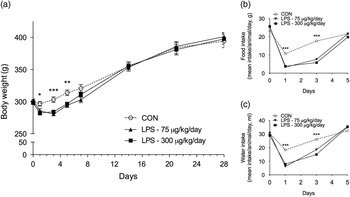
All rats increased their body weight throughout the experimental period (Fig. 1a). However, LPS affected body weight in the beginning of the experiment, illustrated by an interaction of treatment×time on body weight, F(14,189)=4.21, p<0.0005. LPS-treated rats had a significant lower body weight at day 1: F(2,27)=5.17, p=0.013, day 3: F(2,27)=12.40, p<0.0005 and day 5: F(2,27)=9.11, p=0.001. From day 7 and throughout the experimental period, no difference in body weight was detected between groups.
Body weight gain throughout the experimental period (a), and with food and water intake presented during the first 5 days (b and c). Lipopolysaccharide (LPS) decreased body weight during the first 5 days, but from day 7 and onwards there was no difference in body weight between groups. Similarly, LPS decreased water and food intake the first 3 days, then consumption increased. Values are presented as mean±SEM of 6–10 rats/group.

The LPS-induced decrease in body weight on the first 5 days was accompanied by a decrease in both food and water consumption (Figs 1b and c) illustrated by an interaction of treatment×time on food intake, F(8,68)=49.08, p<0.0001 and water intake, F(8,68)=28.71, p<0.0001. Food intake was decreased both on day 1, F(2,27)=23.25, p<0.0001, and on day 3, F(2,17)=154.43, p<0.0001, and water intake was decreased on day 1, F(2,17)=83.33, p<0.0001, and day 3, F(2,17)=55.32, p<0.0001. However on day 5, there was no difference between groups in food intake, F(2,27)=2.63, p=0.101, and water intake, F(2,17)=1.77, p=0.201.
Behaviour in the open field and FST
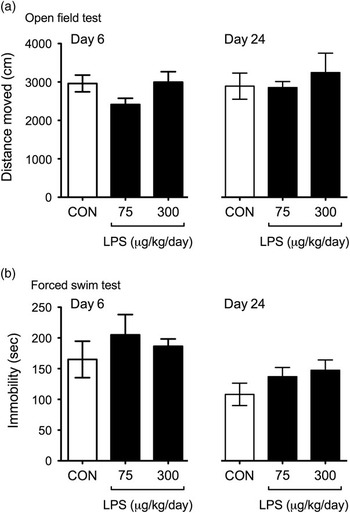
LPS infusion did not affect activity level in the open field after 6 days, F(2,17)=2.217, p=0.141 or after 24 days, F(2,27)=0.354, p=0.705 (Fig. 2a). Furthermore, LPS did not affect the behaviour in the FST after 6 days, F(2,17)=0.560, p=0.581, or after 24 days, F(2,27)=2.993, p=0.067 (Fig. 2b).
Activity level as evaluated in the open field test (a) and depressive-like behaviour as evaluated in the forced swim test (b). Distance moved in the open field was not altered by lipopolysaccharide (LPS) administration for 6 or 24 days. Immobility was not changed by LPS administration for 6 or 24 days. Values are presented as mean±SEM of 6–10 rats/group.

Glucose and insulin values
LPS infusion for 4 weeks did not cause changes in plasma glucose, F(2,26)=1.029, p=0.372, or insulin F(2,26)=0.564, p=0.576, during the OGTT (data not shown).
Endotoxin levels
The endotoxin level in serum was similar between groups after 1 week (H=1.245, 2 df, p=0.056; CON, 0.71±0.28 EU/ml; LPS 75, 0.85±0.12 EU/ml; LPS 300, 0.88±0.18 EU/ml). Following 4 weeks of LPS infusion there were significant increases in LPS levels in LPS 75 and LPS 300 rats (2.5-fold and 7.8-fold, respectively) compared with CON rats (H=6.441, 2 df, p=0.033; CON, 0.42±0.14 EU/ml; LPS 75, 1.08±0.22 EU/ml; LPS 300, 3.74±1.37 EU/ml) (data not shown).
Organ weight
There were no differences in liver weight between groups (calculated as percentage of body weight) after 1 week, F(2,18)=3.11, p=0.072, or after 4 weeks, F(2,27)=2.49, p=0.102 (data not shown). Furthermore, there was no difference in fat mass between groups (calculated as percentage of body weight) after 1 week, F(2,18)=0.268, p=0.768, or after 4 weeks, F(2,27)=0.759, p=0.478 (data not shown).
Cytokine profile in frontal cortex
A cytokine profile was obtained from the right frontal cortex homogenate of CON rats and LPS rats receiving the ‘high’ dose (300 μg/kg/day) following 1 and 4 weeks of treatment. One week of LPS infusion did not result in any cytokine or chemokine changes between groups (data not shown). Four weeks of LPS administration resulted in elevated levels of CXCL5 (p=0.039), CXCL7 (p=0.033), TIMP-1 (p=0.017) and CNTF (p=0.039) compared with CON rats (data not shown).
Discussion
Slow LPS infusion at low doses triggered immediate sickness behaviour with a decline in body weight and food and water intake, hereby corresponding with the reported effects of intraperitoneal LPS injections and hence supporting osmotic minipumps as an adequate administration strategy. However, sickness behaviour disappeared after a few days as indicated by normalisation of body weight and food and water consumption.
Continuous infusion of LPS for 1 or 4 weeks did not produce any behavioural changes in the FST, indicating that chronic low-dose LPS infusion with osmotic minipumps does not lead to a depression-like phenotype in adult male rats. In parallel with the lack of treatment effect on behaviour, we did not detect any differences in pro-inflammatory cytokines in the brain, such as IL-1β and IFN-γ, which are involved in inflammation-induced behavioural changes related to depression (Reference Dantzer19). In contrast, other studies showed that chronic LPS administration induced depressive-like behaviour (Reference Kubera13,Reference Puntener14). However, several differences in experimental design between these studies and ours, could explain this discrepancy. The administration route between studies differed; we used osmotic minipumps, they used intraperitoneal injections (Reference Kubera13,Reference Puntener14). Osmotic minipumps allow a continuous slow infusion of LPS, whereas daily injections might induce stress because of the daily handling as well as local inflammation due to the needle. Moreover, when the daily volume is administered at once, the effect may be more abrupt and deleterious. Two other important differences in experimental design could explain the contrasting results, namely species and sex differences. Both Kubera et al. (Reference Kubera13) and Puntener et al. (Reference Puntener14) used female mice, whereas our study used male rats. Since immune function differs between both species (Reference Haley20) and sex (Reference Grossman21), this could have a pronounced effect on behaviour. In line with this, Kubera et al. administered repeated LPS injections to both male and female mice and found that only female mice developed a depressive-like phenotype. Another possibility is that the dose and duration of LPS was not adequate to induce a chronic low-grade inflammation. The effects of these differences in experimental design require further investigation.
Another aim of this study was to investigate the effects of chronic LPS infusion on appetite and levels of glucose and insulin. Our results show that LPS infusion in male rats for 4 weeks neither increased body weight nor affected insulin sensitivity. This is in contrast to a previously published study by Cani et al. (Reference Cani15), who found that continuous infusion of LPS through osmotic minipumps in mice (using a similar LPS dose, duration of treatment and LPS serotype), increased body weight and food consumption, with a subsequent insulin resistance, similar to high-fat diet fed mice. However, as previously mentioned, since the immune function differs across species, this could explain the discrepancy.
An important point that should be mentioned is that repeated LPS injections are known to cause tolerance to some of its effects. Kehl et al. (Reference Kehl, Kovacs and Larson22) found that repeated i.p. and s.c. LPS injections resulted in a lower blood LPS level compared with a single LPS injection, indicating that tolerance may develop through increased clearance of LPS from the circulation. This may explain why we did not detect differences in LPS levels between LPS-treated and control animals after 1 week, together with no differences in metabolic markers and behaviour. However, the increased LPS level observed after 4 weeks of infusion indicates that the tolerance mechanism(s) may have become saturated after this period, although metabolic markers and behaviour were still unchanged. Future studies infusing LPS for even longer than 4 weeks, although not possible with osmotic minipumps, are therefore needed to clarify whether long-term LPS infusion can induce a systemic low-grade inflammation.
Conclusion
LPS infusion with osmotic minipumps produced an immediate response of sickness behaviour as when LPS is injected intraperitoneally. However, after 1 week there were no observable behavioural differences between LPS administered rats and controls, as indicated by similar food intake, body weight, activity level and depressive-like behaviour. Similarly, after 4 weeks of LPS treatment there were no metabolic or behavioural changes, indicating that chronic LPS infusion with osmotic minipumps in male rats may not be a suitable preclinical model for studying depression and metabolic dysfunction.
Acknowledgements
This study was supported by Aase og Ejnar Danielsen Fond, Det sundhedsvidenskabelige fakultet – Fonden til forskning af sindslidelser and Fonden til Psykiatriens Fremme. The authors would like to thank Pia Høgh Plougmann, Margit Wagtberg Frederiksen, Anete Dudele and Vibeke Bay for technical assistance.
Disclosure
Gregers Wegener is editor-in-chief of Acta Neuropsychiatrica, but was not involved during the review and decision of this paper.