





In this study, a history of language delays (HLD) refers to children diagnosed with language delays in toddlerhood or later identified with a language disorder by the age of 4 years, involving receptive or expressive language difficulties not attributable to hearing loss, other neurodevelopmental conditions, or environmental factors (Bishop et al., Reference Bishop, Snowling, Thompson and Greenhalgh2017). HLD has been linked to negative outcomes in academic, social, and emotional domains (Poulin-Dubois, Reference Poulin-Dubois, Hunnius and Meyer2020). Explicit mentalising (EM) involves deliberate, reflective reasoning and conscious, controlled processes (Freeman, Reference Freeman2016). It is central to emotion regulation and adjustment (Schwarzer et al., Reference Schwarzer, Nolte, Fonagy and Gingelmaier2021) but may be underdeveloped in children with HLD (Nilsson & de López, Reference Nilsson and de López2016). In preschoolers, mentalization is closely tied to the theory of mind (ToM) (Locati et al., Reference Locati, Federica, Karin, Nick and Laura2025; Pons & Harris, Reference Pons, Harris, LoBue, Pérez-Edgar and Buss2019) and the use of mental-state terms (Li et al., Reference Li, Chen and Zhang2022). Children with HLD exhibit poorer ToM (Crawshaw et al., Reference Crawshaw, Lüke and Ritterfeld2025; Lu & Huang, Reference Lu and Huang2026) and fewer mental-state terms (Lee & Rescorla, Reference Lee and Rescorla2008) than their peers without HLD. Therefore, it is crucial to examine whether preschoolers with HLD show poorer EM, and whether ToM is associated with EM through vocabulary ability. Clarifying these mechanisms may help inform early interventions aimed at strengthening mentalization skills and supporting better emotional regulation and school adjustment among preschoolers with HLD.
Explicit mentalising
EM is one of the key components of mentaliztion. Mentalization refers to the capacity to understand and interpret one’s own and others’ behavior in terms of underlying mental states such as emotions, thoughts, beliefs, intentions, and desires (Fonagy & Allison, Reference Fonagy and Allison2013). Conceptually, it encompasses six distinct facets: self-other, implicit-explicit, and cognitive-affective, suggesting that mentalization is a multifaceted construct grounded in multiple dual-system models (Gagliardini et al., Reference Gagliardini, Gullo, Caverzasi, Boldrini, Blasi and Colli2018). Among these, the implicit-explicit dimension differentiates automatic, intuitive processing of mental states from deliberate and reflective reasoning (Shai & Belsky, Reference Shai and Belsky2011a, Reference Shai and Belsky2011b). Accordingly, EM is characterized by conscious, controlled, and reflective processes (Shai & Belsky, Reference Shai and Belsky2017). Developmentally, EM emerges in early childhood through language and social experiences, and is defined as children’s ability to conceptualize and verbalize emotions and intentions, thereby supporting social adaptation and emotion regulation (Kivity et al., Reference Kivity, Levy, Johnson, Rosenstein and LeBreton2024). Despite its theoretical and developmental significance, few studies have examined EM in preschoolers with HLD.
Moreover, when examining children’s EM, it is important to control for family socio-economic status (SES) and sex. Family SES has been associated with maternal mentalization, with mothers from lower-SES backgrounds experiencing greater difficulties (Brophy-Herb et al., Reference Brophy-Herb, Stansbury, Bocknek and Horodynski2012). SES-related differences are also evident in maternal mental-state talk: families with lower SES tend to use simpler, non-causal language, whereas middle-SES families are more likely to provide causally elaborate explanations that more effectively support children’s EM development (Ebert et al., Reference Ebert, Peterson, Slaughter and Weinert2017). In addition, sex differences have been observed in mentalising performance, with boys generally performing more poorly on mentalising tasks and exhibiting more hypermentalising errors than do girls, underscoring the need to control for sex in studies of EM (Poznyak et al., Reference Poznyak, Morosan, Perroud, Speranza, Badoud and Debbané2019).
Theory of mind
ToM is fundamental to children’s psychological development and refers to their ability to attribute mental states to others and understand the goals and intentions underlying their actions (Baron-Cohen et al., Reference Baron-Cohen, Leslie and Frith1985). This ability enables individuals to infer others’ goals and intentions behind their behavior. Recent studies have distinguished between inferences about thoughts or beliefs (cognitive ToM) and emotional states (affective ToM), showing that these cognitive and affective components are distinguishable and may be differentially related to executive function (Cassetta et al., Reference Cassetta, Pexman and Goghari2018). Although mentalization overlaps with ToM, ToM primarily focuses on cognitive inferences about others’ mental states, whereas mentalization is a broader and more dynamic process that encompasses awareness, reflection, and regulation of both one’s own and others’ mental states (Locati et al., Reference Locati, Federica, Karin, Nick and Laura2025).
Cognitive ToM refers to the ability to understand others’ thoughts, beliefs, intentions, and knowledge, as assessed by false belief tasks that require children to distinguish their own knowledge from that of another person (Cassetta et al., Reference Cassetta, Pexman and Goghari2018; Locati et al., Reference Locati, Federica, Karin, Nick and Laura2025). For example, in unexpected-content tasks, children must recognize that another person may believe that a cookie box contains cookies rather than spaghetti, whereas in unexpected-location tasks, they must understand that another person may think an object is still in its original location despite having been moved. Affective ToM, or emotion understanding encompasses two main components: emotion recognition (identifying emotions through facial, vocal, and bodily cues) and emotion knowledge (reasoning about the causes, consequences, and regulation of emotions) (Castro et al., Reference Castro, Cheng, Halberstadt and Grühn2016; Harris et al., Reference Harris, Rosnay and Pons2005; Pons & Harris, Reference Pons, Harris, LoBue, Pérez-Edgar and Buss2019). The development of this emotional understanding progresses across three hierarchical levels: external (linking emotions to observable events), mental (recognizing internal emotional states and distinguishing appearance from reality), and reflective (understanding complex emotions, regulatory strategies, and moral or social norms) (Pons & Harris, Reference Pons, Harris, LoBue, Pérez-Edgar and Buss2019; Pons et al., Reference Pons, Harris and de Rosnay2004).
Vocabulary abilities as the mediator between the theory of mind and explicit mentalising
Vocabulary forms a critical foundation of EM. The label-feedback hypothesis posits that linguistic labels influence the activation and accessibility of emotional concepts, thereby shaping how individuals perceive and respond to emotions (Lupyan, Reference Lupyan2012). A limited vocabulary related to emotions weakens this function, leading to difficulties in recognizing, understanding, and expressing feelings as well as in regulating socio-emotional behaviors. Vocabulary also provides conceptual scaffolds for labeling, organizing, and reflecting on emotional experiences, further supporting EM (Conti-Ramsden & Durkin, Reference Conti-Ramsden and Durkin2012; Hoemann et al., Reference Hoemann, Xu and Barrett2019).
Although previous studies have examined the links between ToM and EM (Cassetta et al., Reference Cassetta, Pexman and Goghari2018), language and ToM (Ebert et al., Reference Ebert, Peterson, Slaughter and Weinert2017), and language and EM (Luyten et al., Reference Luyten, Mayes, Nijssens and Fonagy2017), few have directly investigated their interrelationships, particularly the pathways linking ToM, vocabulary, and EM. Emotional terms help transform vague affective experiences into structured representations, supporting reasoning and explicit mentalization. Importantly, expressive vocabulary is especially complex as it integrates perspective-taking and the articulation of inner states in social contexts (Forgács, Reference Forgács2024), suggesting that it may play a stronger mediating role than receptive vocabulary in linking ToM and EM.
Present study
This study examined EM in preschoolers with HLD and whether ToM is associated with EM through vocabulary. The objectives were threefold: (1) to test whether children with HLD show poorer EM than their peers without HLD. We hypothesized that children with HLD would demonstrate poorer EM than their peers without HLD; (2) to examine whether different dimensions of vocabulary ability – emotion versus non-emotion and receptive versus expressive – mediate the association between ToM and EM, parallel and serial mediation analyses were conducted, controlling for age and sex. Parallel mediation models tested the unique contribution of each vocabulary dimension, whereas serial mediation models examined a hypothesized developmental sequence from receptive to expressive vocabulary. We hypothesized that expressive emotion vocabulary would be the strongest mediator of the ToM–EM association; and (3) to extend this model by including family SES as an additional covariate to explore its effect on these associations.
Method
Participants
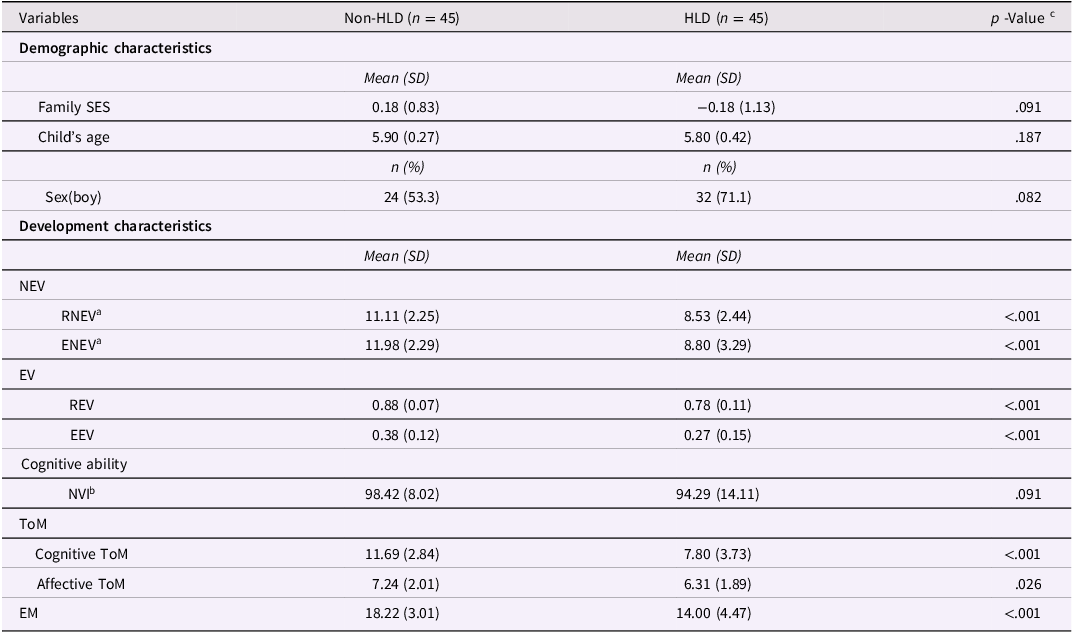
This is a cross-sectional study. Ninety Mandarin-speaking preschoolers, aged 4–6 years, participated in this study, comprising 45 children with HLD and 45 children without HLD. No significant differences were presented between the two groups in the participating children’s cognitive ability, age, sex ratio, or family SES (all ps > .05), as shown in Table 1. Inclusion and exclusion criteria for children with and without HLD are described in the following sections.
Characteristics of this sample (N = 90)

Table 1. Long description
Table 1 presents characteristics of the full sample of 90 children, comparing children without a history of language delay and children with a history of language delay. The groups do not differ significantly in family socioeconomic status, age, sex distribution, or nonverbal cognitive ability. Children with a history of language delay score significantly lower on receptive and expressive non-emotion vocabulary, receptive and expressive emotion vocabulary, cognitive and affective theory of mind, and explicit mentalizing.
Note. RNEV = receptive non-emotion vocabulary; ENEV = expressive non-emotion vocabulary; REV = receptive emotional vocabulary; EEV = expressive emotional vocabulary; NVI = non-verbal index; ToM = theory of mind; EM = explicit mentalizing; Family SES = family socioeconomic status.
aSS: scaled scores from the WPPSI-IV norm.
bCS: composite scores from the WPPSI-IV norm.
cThe p-value for sex was obtained using the chi-square test, while the p-values for the other variables were obtained using one-way ANOVA.
Group without HLD
Participants without HLD were recruited through parenting websites. They demonstrated typical development in the cognitive, language, fine motor, and gross motor domains. None had been diagnosed with neurodevelopmental or neurological conditions or documented hearing impairments.
Group with HLD
Participants with HLD were recruited from various sources, including online parenting communities, child psychiatric clinics, speech-language pathology services, and early intervention centers. For inclusion in the study, children were required to have a formal diagnosis of language delay confirmed during toddlerhood. All diagnoses and evaluations were conducted at the Early Developmental Evaluation Centre, an official institution designated by Taiwan’s Ministry of Health and Welfare to identify developmental disorders in children under the age of seven. Children were excluded from the study if they had known co-occurring neurodevelopmental conditions such as autism spectrum disorder [ASD], neurological disorders (e.g., epilepsy), or sensory impairments (e.g., hearing loss). Furthermore, of the 45 participants in the HLD group, 40 had a diagnosis of developmental language disorder (DLD).
Measures
Family socio-economic status
Family SES, based on the education levels of the father and mother and monthly family income as reported by parents, was calculated using principal component analysis, following the method described by Caro and Cortés (Reference Caro and Cortes2012).
Cognitive ability
Children’s cognitive ability was assessed using the Non-verbal Index (NVI) of the Wechsler Preschool and Primary Scale of Intelligence, Fourth Edition (WPPSI–IV) (Chen, & Chen, Reference Chen and Chen2013).
Theory of mind
In this study, the participants’ ToM was assessed using tasks that measured both cognitive and affective components.
Cognitive theory of mind. Cognitive ToM was evaluated using the verbal task from the ToM subtest of the NEPSY-II battery (Developmental Neuropsychological Assessment, Second Edition) (Korkman et al., Reference Korkman, Kirk and Kemp2012), which demonstrates good internal consistency (0.76–0.84) (Davis & Matthews, Reference Davis and Matthews2010). This subtest assesses various cognitive ToM skills including false belief understanding, recognition of mental states, and figurative language comprehension. The subtest consists of 15 items with the following scoring: one item scores 0–3 points, five items score 0–2 points, and nine items score 1 point each, yielding a total possible score of 0–22.
Affective theory of mind. Affective ToM was assessed using two tasks: the contextual task from the NEPSY-II ToM subtest (Korkman et al., Reference Korkman, Kirk and Kemp2012) and Test of Emotion Comprehension (TEC) (Pons et al., Reference Pons, Harris and de Rosnay2004), which the use of mental-state terms has demonstrated adequate to good internal consistency (0.62–0.77) (Cavioni et al., Reference Cavioni, Grazzani, Ornaghi, Pepe and Pons2020). The NEPSY-II contextual task included six items in which children viewed social scenarios and selected the facial expressions that best reflected the protagonist’s affective state. Each correct response earned one point, with total scores ranging from 0 to 6 points. TEC by Pons et al. (Reference Pons, Harris and de Rosnay2004) comprises nine emotion comprehension components: Recognition, External Cause, Reminder, Desire, Belief, Hiding, Regulation, Mixed, and Moral, with component scores ranging from 0 to 9 points. The Mandarin Chinese version of TEC used in this study was translated by Chou and Huang (Chou & Huang, Reference Chou and Huang2010), with additional material from Lin (Reference Lin2018). Affective ToM total scores were calculated by summing the NEPSY-II contextual task and TEC component scores, resulting in a combined range of 0–15 points. This affective ToM battery and its scoring method have been used in another study (Lu & Huang, Reference Lu and Huang2026).
Explicit mentalising
EM was assessed using materials from the Mandarin Chinese version of TEC (Lin, Reference Lin2018), with 14 additional mentalising sets added in the present study. After the child selected the facial expression that matched the protagonist’s emotional state, an additional follow-up question was asked to assess the child’s ability to explain the reason for the protagonist’s emotions. Specifically, the experimenter pointed to the selected face and asked, “Why does Xiaohua feel this way?” when the child did not verbally label the emotion, or “Why does Xiaohua feel happy/angry/sad/fearful?” when the child provided an emotional label. Responses to the mentalization sets were scored from 0 to 2, with 0 indicating incorrect identification of the emotional state and incorrect explanation, 1 indicating either correct identification or correct explanation of the emotional state, and 2 indicating both correct identification and correct explanation of the emotional state. Total EM scores range from 0 to 28, with higher scores indicating better EM ability. Furthermore, the internal consistency calculated for the analytical sample was 0.70.
Vocabulary ability
Non-emotion vocabulary. Receptive non-emotional vocabulary (RNEV) and expressive non-emotional vocabulary (ENEV) abilities were assessed using the Receptive Vocabulary and Picture Naming subtests of the Chinese version of WPPSI-IV (Chen, & Chen, Reference Chen and Chen2013), which demonstrated high internal consistency for children aged 4–7 years (0.76–0.90 and 0.80–0.89, respectively). These words are examples of non-mental state vocabulary.
Emotion vocabulary. Expressive emotion vocabulary (EEV) and receptive emotion vocabulary (REV) abilities were assessed using an Emotional Lexicon Test (Ornaghi & Grazzani, Reference Ornaghi and Grazzani2013). These words are also mental-state vocabulary. This has demonstrated acceptable to good internal consistency (α = 0.70–0.71) and strong criterion-related validity with the Metacognitive Vocabulary Test (r = .80) and Peabody Picture Vocabulary Test–Revised (Ornaghi et al., Reference Ornaghi, Grazzani, Cherubin, Conte and Piralli2015). With permission from the original author, ELT was translated into Traditional Chinese, in accordance with the guidelines of the International Test Commission (van de Vijver & Hambleton, Reference van de Vijver and Hambleton1996).
EEV was assessed by presenting participants with illustrated story cards and short narratives. Children were asked to label the protagonist’s emotional state using an appropriate emotional word. A score of zero was assigned to incorrect or missing labels. If labeled correctly, the child was asked to explain their response, which was scored from 0 to 2, based on relevance and appropriateness. The total EEV score ranged from 0 to 28 and the proportion of correct responses was used for further analysis.
REV was assessed during a follow-up task using exact scenarios. Participants were asked to choose the most appropriate term from two given emotional words to describe the protagonist’s emotional state. Correct responses were scored as 1 and incorrect responses as 0. The total EEV score ranged from 0 to 14 and the proportion of correct responses was calculated for subsequent analyses.
Procedure
Children and their parents attended the laboratory at scheduled times. After obtaining informed consent, each child was individually assessed in a quiet room using WPPSI-IV, TEC, ToM tasks, and ELT while the parents completed a separate demographic questionnaire. Licensed pediatric clinical psychologists and trained graduate students administered the assessments. The study protocol was reviewed and approved by the Research Ethics Committee of Chung Shan Medical University Hospital and written informed consent was obtained from the parents of all participating children. All methods were performed in accordance with the relevant guidelines and regulations.
Statistical analysis
Statistical analyses were performed using SPSS version 26 (IBM Corp., Armonk, NY, USA). One-way analysis of variance (ANOVA) was conducted to examine developmental characteristics, including cognitive ability, ToM, and vocabulary ability, between participants with and without HLD. To address the first aim, we examined whether the participants with HLD had poorer EM than those without HLD.
For the second aim, parallel mediation analyses were conducted using the SPSS PROCESS macro (Hayes, Reference Hayes2022), controlling for age and sex. Emotional and non-emotional vocabulary abilities were tested as parallel mediators in the relationship between ToM (cognitive and affective) and EM. To reduce the risk of Type I error from conducting two separate mediation analyses using similar vocabulary types (emotion or non-emotion), a Bonferroni correction was applied (α’ = 0.05/2 = 0.025) (Chen et al., Reference Chen, Kuhn and Wiesemann2023). Specifically, parallel mediation analyses (PROCESS Model 4) were used to examine the indirect association of (a) non-emotion receptive and expressive vocabulary (RNEV and ENEV) on cognitive (Model 1a) and affective (Model 1b) ToM, and (b) emotion receptive and expressive vocabulary (REV and EEV) on cognitive (Model 2a) and affective (Model 2b) ToM. To further explore the mediating role of vocabulary ability, serial mediation analyses were conducted using PROCESS Model 6 to assess the sequential effects of RNEV → ENEV (Models 3a and 3b) and REV → EEV (Models 4a and 4b) on the relationship between ToM and EM. Additionally, SES was included as a covariate in the analysis of the third research objective.
Effect sizes for mediation were quantified using the standardized indirect effect, calculated as the product of the standardized path coefficients for paths a and b (ab). As a supplementary index, the mediated proportion was estimated by dividing the indirect effect by the total effect (ab/c), providing an approximation of the relative contribution of the mediator. Indirect effects were tested using bootstrap confidence intervals with default 5,000 resamples implemented in PROCESS. We also conducted a post hoc power analysis for the mediation analyses using R. Power was estimated via Monte Carlo simulation (Zhang, Reference Zhang2014), treating the observed standardized path coefficients as population parameters, and fixing the sample size at N = 90. For each simulated data set, the mediation model was re-estimated, and the indirect effect (ab) was evaluated using percentile bootstrap confidence intervals with 5,000 resamples. Power was defined as the proportion of simulations in which the bootstrap confidence interval for the indirect effect is zero. The effect sizes and power values of each model are presented in Appendix 1.
Results
Developmental characteristics and explicit mentalization in preschoolers with HLD
Table 1 presents the developmental characteristics and EM of participants with and without HLD. One-way ANOVA results showed that participants with HLD scored lower than their peers without HLD on RNEV and ENEV, Fs(1, 88) = 27.20, and 28.31, both p < .001, ηp2s = 0.24 and 0.24 and on REV and EEV, Fs(1, 88) = 29.58 and 13.91, both p < .001, ηp2s = 0.25 and 0.14. Participants with HLD also scored lower in cognitive and affective ToM than those without HLD, Fs (1, 88) = 30.97, p < .001, ηp2 = 0.26, and 0.24 and 5.13, p = .026, ηp2 = 0.05, respectively. Furthermore, participants with HLD performed lower on EM than those without HLD (F(1, 88) = 27.27, p < .001, ηp2 = 0.24).
Vocabulary abilities as mediators in the relationship between theory of mind and explicit mentalization: Parallel and serial mediation analyses
Controlling for age, sex, and family SES, Table 2 shows that both cognitive and affective ToM were positively associated with EM (both p < .001). For non-emotion vocabulary abilities (NEVAs), both RNEV and ENEV were positively correlated with cognitive ToM (both p < .001). In contrast, affective ToM was correlated only with ENEV (p < .01). Regarding emotion vocabulary abilities (EVAs), cognitive ToM was positively associated with both REV and EEV (both p < .001). In contrast, affective ToM was associated only with EEV (p < .0125). In addition, both NEVAs (RNEV and ENEV) and EVAs (REV and EEV) were positively correlated with EM (NEVAs: both p < .001; EVAs: REV, p < .01; EEV, p < .001).
Correlation matrix for study variables (N = 90)
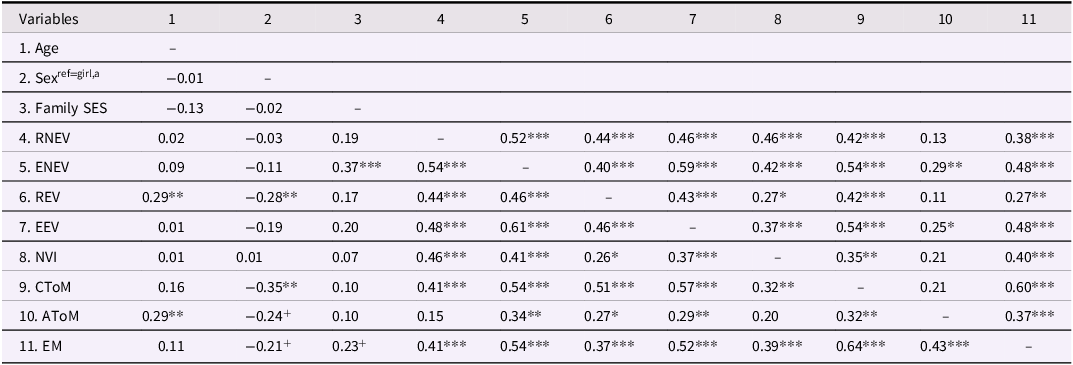
Table 2. Long description
Table 2 presents zero-order correlations and partial correlations among age, sex, family socioeconomic status, receptive and expressive vocabulary, nonverbal cognitive ability, cognitive and affective theory of mind, and explicit mentalizing. The table shows that vocabulary measures are generally positively associated with theory of mind and explicit mentalizing. Cognitive and affective theory of mind are positively associated with explicit mentalizing. The partial correlations control for age, sex, and family socioeconomic status.
Note. The results for partial correlations are shown above the diagonal, with child age, sex, and family SES as covariate variables. The results for the zeroth-order correlation are shown below the diagonal. Family SES = family socioeconomic status; RNEV = receptive non-emotion vocabulary; ENEV = expressive non-emotion vocabulary; REV = receptive emotional vocabulary; EEV = expressive emotional vocabulary; NVI = non-verbal index; CToM = cognitive theory of mind; AToM = affective theory of mind.
aPoint-biserial correlation with females as the reference group. A Bonferroni correction was applied to adjust for multiple testing, setting the significance threshold at p < .025 (*), with additional thresholds at + p < .05, ** p < .01, and ***p < 0.001.
Parallel mediation analyses
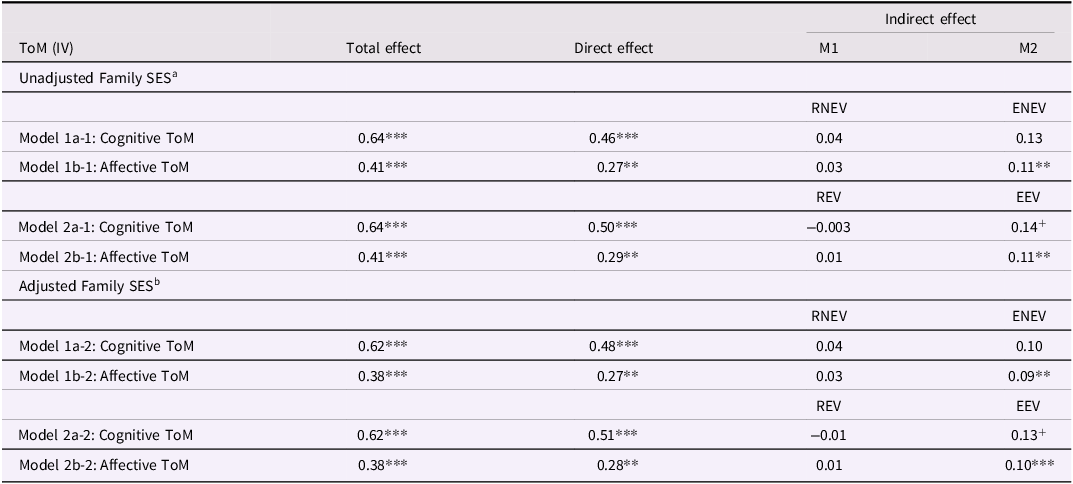
Parallel mediation analyses were conducted to examine the indirect pathways linking cognitive (Models 1a and 2a) and affective (Models 1b and 2b) ToM to EM in preschool children while controlling for age and sex. Models 1a-1 and 1b-1 tested RNEV and ENEV as mediators, whereas Models 2a-1 and 2b-1 tested REV and EEV (Table 3).
Summary of mediation analysis effects with explicit mentalizing as the dependent variable (N = 90)
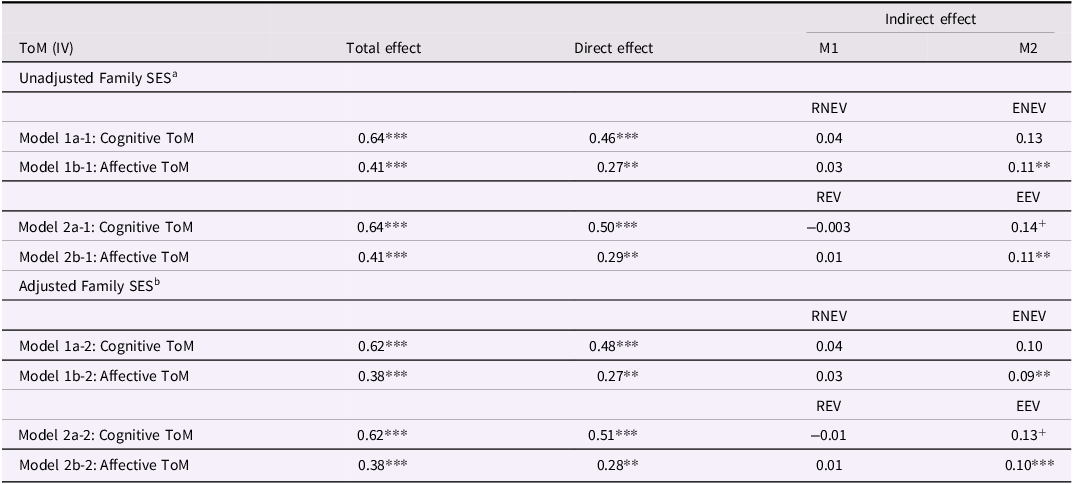
Table 3. Long description
Table 3 summarizes mediation analyses testing whether vocabulary measures mediate associations between theory of mind and explicit mentalizing. Models are shown with and without adjustment for family socioeconomic status. Expressive vocabulary shows significant or marginal indirect effects more consistently than receptive vocabulary. Direct effects of theory of mind on explicit mentalizing remain significant across models, supporting partial mediation.
Note. Total effect = ToMs (IV) → EM (DV) and ToMs (IV) → M1, M2→ EM (DV). Direct effect = ToMs (IV) → EM (DV). Indirect effect = ToMs (IV) → M1, M2 → EM (DV), Family SES = family socioeconomic status; ToM = theory of mind; RNEV = receptive non-emotion vocabulary; ENEV = expressive non-emotion vocabulary; REV = receptive emotion vocabulary; EEV = expressive emotion vocabulary. A Bonferroni correction was applied to adjust for multiple testing, setting the significance threshold at p < .025 (*), with additional thresholds at + p < .05, **p < .01, and ***p < 0.001.
aAge and sex were included as covariates.
bAge, sex, and SES were included as covariates.
For RNEV and ENEV, as shown in Figure 1a (Model 1a-1), ENEV mediated the relationship between cognitive ToM and EM. Cognitive ToM was associated with both RNEV and ENEV (path a1, B = 0.325, 95% CI [0.179, 0.470], p < .001; path a2, B = 0.488, 95% CI [0.325, 0.652], p < .001, respectively). However, only ENEV positively predicted EM (path b2: B = 0.309, 95% CI [0.029, 0.589], p = .031). A significant indirect effect was observed (ab: B = 0.199, 95% CI [0.070, 0.323]). Additionally, cognitive ToM had a direct impact on EM (path c′: B = 0.527, 95% CI [0.291, 0.763], p < .001). Similarly, as illustrated in Figure 1b (Model 1b-1), ENEV mediated the relationship between affective ToM and EM. Affective ToM was associated with ENEV (path a2: B = 0.548, 95% CI [0.197, 0.899], p = .003), and ENEV significantly predicted EM (path b2: B = 0.449, 95% CI [0.165, 0.733], p = .002). The indirect effect was significant (ab: B = 0.311, 95% CI [0.054–0.591]). Additionally, a direct impact of affective ToM on EM was observed (path c′: B = 0.579, 95% CI [0.162, 0.996], p = .007).
Parallel Mediation Models of Cognitive and Affective ToM Predicting EM via Vocabulary. Note. Parallel mediation models (PROCESS Model 4) examining the indirect effects of cognitive ToM (a, c) and affective ToM (b, d) on EM through non-emotion vocabulary (RNEV, ENEV) (a, b) and emotion vocabulary (REV, EEV) (c, d), controlling for child sex and age. Panel (e) depicts the same model as (a) with additional adjustment for family SES. Standardized coefficients (β) are reported. Solid lines indicate significant paths (+ p < .05, *p < .025, **p < .01, ***p < .001); dashed lines indicate nonsignificant paths.

Figure 1. Long description
Figure 1a shows a parallel mediation model in which cognitive theory of mind predicts explicit mentalizing through receptive and expressive non-emotion vocabulary. Cognitive theory of mind is positively associated with both receptive non-emotion vocabulary and expressive non-emotion vocabulary. Expressive non-emotion vocabulary shows a marginal positive association with explicit mentalizing, whereas receptive non-emotion vocabulary does not. The direct association between cognitive theory of mind and explicit mentalizing remains significant after including the mediators. Age and sex are included as covariates.
For REV and EEV, as shown in Figure 1c (Model 1b-1), EEV mediated the relationship between cognitive ToM and EM. Cognitive ToM was associated with both REV and EEV (path a1: B = 0.012, 95% CI [0.007, 0.017], p < .001; path a2: B = 0.023, 95% CI [0.015, 0.030], p < .001, respectively). However, only EEV significantly predicted EM (path b2: B = 7.153, 95% CI [1.178, 13.129], p = .020). The indirect effect was significant (ab: B = 0.159, 95% CI [0.004, 0.320]), and the direct effect of cognitive ToM on EM remained significant (path c′: B = 0.567, 95% CI [0.322, 0.812], p < .001). A similar mediation pattern was observed for affective ToM. As illustrated in Figure 1d (Model 2b-1), EEV mediates the relationship between affective ToM and EM. Affective ToM was associated with EEV (path a2: B = 0.021, 95% CI [0.005, 0.037], p = .012), and EEV, in turn, predicted EM (path b2: B = 11.218, 95% CI [5.345, 17.091], p < .001). The indirect effect was significant (ab: B = 0.267, 95% CI [0.041, 0.566]), and a direct effect of affective ToM on EM was also found (path c′: B = 0.623, 95% CI [0.205, 1.040], p = .004).
Serial mediation analyses
As shown in Figure 2a (Model 3a-1), cognitive ToM was positively associated with RNEV (path a1: B = 0.325, 95% CI [0.179, 0.470], p < .001), which predicted ENEV (path a2: B = 0.339, 95% CI [0.173, 0.506], p < .001), and ENEV was further positively associated with EM (path b2: B = 0.309, 95% CI [0.029, 0.589], p = .031). The indirect effects of cognitive ToM on EM via RNEV and ENEV were significant (B = 0.199, 95% CI [0.068–0.322]). Additionally, cognitive ToM exerted a direct effect on EM (path c′: B = 0.527, 95% CI [0.291, 0.763], p < .001), suggesting a partial serial mediation mechanism. In contrast, the model involving affective ToM revealed a different pattern (Model 3b-1). As illustrated in Figure 1b, affective ToM was not associated with RNEV (path a1: B = 0.218, 95% CI [–0.086, 0.523], p = .158), but was positively associated with ENEV (path a2: B = 0.415, 95% CI [0.111, 0.719], p = .008), which was positively associated with EM (path b2: B = 0.449, 95% CI [0.165, 0.733], p = .002). The indirect effect of affective ToM on EM via ENEV alone was significant (B = 0.186, 95% CI [0.016, 0.442]), whereas the serial pathway through both RNEV and ENEV was not (B = 0.060, 95% CI [–0.024, 0.170]). Additionally, affective ToM had a significant direct effect on EM (path c′: B = 0.579, 95% CI [0.162, 0.996], p = .007), suggesting a partial mediation primarily through ENEV.
Serial Mediation Models of Cognitive and Affective ToM Predicting EM via Receptive Vocabulary then Expressive Vocabulary. Note. Serial mediation models (PROCESS Model 6) examining the indirect effects of cognitive ToM (a, c) and affective ToM (b, d) on EM via sequential mediators. Panels (a) and (b): EM via RNEV (M1) → ENEV (M2). Panels (c) and (d): EM via REV (M1) → EEV (M2). All models control for child sex and age. Panel (e) repeats model (a) with additional adjustment for family SES. Standardized coefficients (β) are reported. Solid lines indicate significant paths (+ p < .05, *p < .025, **p < .01, ***p < .001); dashed lines indicate non-significant paths.

Figure 2. Long description
Figure 2a shows a serial mediation model in which cognitive theory of mind predicts explicit mentalizing through receptive and expressive non-emotion vocabulary. Cognitive theory of mind significantly predicts both vocabulary measures, and receptive non-emotion vocabulary significantly predicts expressive non-emotion vocabulary. Expressive non-emotion vocabulary shows a marginal association with explicit mentalizing. The direct effect remains significant, indicating partial serial mediation. Age and sex are included as covariates.
A similar serial mediation pattern was observed when the REV and EEV were included as mediators. As shown in Figure 2c (Model 4a-1), cognitive ToM was positively associated with REV (path a1: B = 0.012, 95% CI [0.007, 0.017], p < .001), which predicted EEV (path a2: B = 0.018, 95% CI [0.010, 0.026], p < .001). EEV was significantly associated with EM (path b: B = 7.153, 95% CI [1.178, 13.129], p = .020). A significant indirect effect of cognitive ToM on EM via REV and EEV was observed (B = 0.034; 95% CI [0.002, 0.084]), indicating the presence of a serial mediation pathway. Moreover, the direct effect of cognitive ToM on EM remained significant (path c′: B = 0.567, 95% CI [0.322, 0.812], p < .001), suggesting a partial serial mediation mechanism. As shown in Figure 2d (Model 4b-1), affective ToM was associated with a mediation structure that slightly diverged from that of cognitive ToM. It did not significantly predict REV (path a1: B = 0.007, 95% CI [–0.004, 0.018], p = .192), but was significantly associated with EEV (path a2: B = 0.016, 95% CI [0.001, 0.031], p = .032), which showed a positive relationship with EM (path b2: B = 11.218, 95% CI [5.345, 17.091], p < .001). The indirect pathway from affective ToM to EM through EEV alone was significant (B = 0.183, 95% CI [0.029, 0.409]), whereas the full serial path through both REV and EEV was not (B = 0.053, 95% CI [–0.028, 0.181]). Affective ToM also had a significant direct effect on EM (path c′: B = 0.623, 95% CI [0.205, 1.040], p = .004), indicating that the mediation was partial and driven mainly by EEV.
Extended analysis: The role of family socioeconomics status
Family SES was included as a covariate to account for its potential effects on the relationships among ToM, vocabulary ability, and EM. Except for Model 1a-1, SES inclusion did not alter the results of Models 1b-1, 2a-1, or 2b-1 (Table 3). In Model 1a-2, as illustrated in Figure 1e, compared to Model 1a-1, the specific mediating paths showed that cognitive ToM remained associated with ENEV (path a2: B = 0.452, 95% CI [0.299, 0.604], p < .001), but ENEV no longer significantly predicted EM (path b2: B = 0.248, 95% CI [–0.052, 0.547], p = .104). These results suggest that the ENEV → EM path was no longer supported after controlling for family SES.
Family SES was added as a covariate to examine the serial mediating effects of vocabulary ability on the relationship between ToM and EM. Except for Model 3a-1, the inclusion of SES did not alter the results for Models 3b-1, 4a-1, and 4b-1. As shown in Figure 2e (Model 3a-2), the effect of ENEV on EM became non-significant (path b2: B = 0.248, 95% CI [–0.052, 0.547], p = .104), indicating that after controlling for SES, the proposed serial mediation model through ENEV was not supported.
Discussion
To our knowledge, this study is the first to investigate the EM abilities of children with HLD and to distinguish the mediating effects of emotion versus non-emotion vocabulary on the link between ToM and EM. Furthermore, we used parallel and serial mediation analyses to examine the unique contributions and associative pathways of receptive and expressive vocabulary in children’s ToM and EM. Three main findings emerged from this study. First, preschoolers with HLD demonstrated poorer EM and lower levels of cognitive and affective ToM than their peers without HLD. Second, expressive vocabulary (both emotional and non-emotional) significantly mediated the relationship between ToM and EM, whereas receptive vocabulary did not. Finally, after controlling for SES, the non-emotional expressive vocabulary – EM pathway was no longer significant in the cognitive ToM models but remained robust in the affective ToM models. In the present study, preschoolers with HLD demonstrated nonverbal cognitive abilities comparable to those of their peers without HLD. To minimize potential confounding effects, the two groups were matched on SES, restricted to a narrow age range (4–6 years), and balanced by sex, as these factors have been associated with EM development. Notably, the two groups differed only in language ability (i.e., vocabulary in this study), confirming that the key distinction lay within this domain. This design allowed for a more precise examination of ToM and EM differences between preschoolers with and without HLD as well as for exploring the interrelations among ToM, EM, and language. Based on these findings, three main topics warrant further investigation:
First, preschoolers with HLD exhibited poorer cognitive and affective ToM, which is consistent with previous findings in children with language disorders (Nilsson & de López, Reference Nilsson and de López2016). Most participants (88.89%) met the criteria for LD, whereas only five were late talkers (LTs), suggesting that the observed ToM deficits largely reflected the predominance of LD. However, LTs may also show ToM weaknesses, as they often perform below their peers without LT in language ability and can be considered to have milder difficulties within the language endowment spectrum (Ellis Weismer, Reference Ellis Weismer2007). Future research should include larger LT samples to clarify the ToM profiles across children with LTs, LD, and typically developing children.
Furthermore, preschoolers with HLD had poorer EM than their peers without HLD. Several factors may explain weaker EM in HLD: delayed language may hinder emotional concept acquisition and reasoning about mental states (Lee & Rescorla, Reference Lee and Rescorla2008); greater anxiety and withdrawal may reduce social interactions and learning opportunities (Lu et al., Reference Lu, Tsao and Tsai2020, Reference Lu, Tsai and Tsao2022); and caregivers may show less curiosity about children’s mental states (Lu & Huang, Reference Lu and Huang2026), which is associated with fewer mental-state references in daily interactions (Lee & Rescorla, Reference Lee and Rescorla2008).
Second, this study examined the interrelations between language, ToM, and EM. Mediation analyses showed that expressive vocabulary, both emotional and non-emotional, mediated the links between ToM (cognitive and affective) and EM, whereas receptive vocabulary did not. According to the label-feedback hypothesis (Lupyan, Reference Lupyan2012), linguistic labels modulate the accessibility of emotional concepts, enabling children to label and narrate their internal states. By providing such conceptual scaffolds, expressive vocabulary bridges ToM and EM, supporting perspective-taking and emotional inference (Forgács, Reference Forgács2024), and highlighting its pivotal role in preschoolers’ socio-emotional development.
Serial mediation analyses revealed that cognitive ToM is associated with EM through a stepwise pathway from receptive to expressive vocabulary, whereas affective ToM is mediated only by expressive vocabulary. This suggests that cognitive ToM engages in both receptive and expressive skills to reason about beliefs and intentions, whereas affective ToM relies directly on expressive vocabulary to verbalize emotions. Thus, expressive vocabulary serves as a key linguistic bridge that enables children to label, organize, and communicate their internal states, thereby linking mentalization to emotional development (Hoemann et al., Reference Hoemann, Xu and Barrett2019).
Interestingly, after controlling for SES, the non-emotional expressive vocabulary – EM pathway in the cognitive ToM models was no longer significant. In contrast, this pattern was not observed in affective ToM models. This suggests that non-mental state vocabulary may be more closely tied to SES, while cognitive ToM relies on higher-order reasoning shaped by linguistic and cognitive stimulation (Brophy-Herb et al., Reference Brophy-Herb, Stansbury, Bocknek and Horodynski2012; Ebert et al., Reference Ebert, Peterson, Slaughter and Weinert2017), and affective ToM is more rooted in socio-emotional interactions (Castro et al., Reference Castro, Cheng, Halberstadt and Grühn2016). Future studies should explore the impact of SES and vocabulary type on EM. Overall, the pronounced effect of expressive vocabulary may stem from a “task effect”. Given that the current EM task inherently relied on verbal output, these results could capture general oral proficiency rather than a specific socio-cognitive mechanism. Consequently, the mediating role of emotionally expressive vocabulary between ToM and EM warrants further replication. Future studies should also utilize nonverbal assessments to evaluate EM in children.
In addition to its indirect association with language, ToM is directly associated with EM. Cognitive ToM supports EM by linking emotions to underlying beliefs, intentions, and desires (Baron-Cohen et al., Reference Baron-Cohen, Leslie and Frith1985; Schwarzer et al., Reference Schwarzer, Nolte, Fonagy and Gingelmaier2021), whereas affective ToM contributes to EM through emotion recognition and knowledge (Castro et al., Reference Castro, Cheng, Halberstadt and Grühn2016; Pons et al., Reference Pons, Harris and de Rosnay2004). These findings suggest that EM development is grounded in both the cognitive and affective aspects of ToM. In other words, EM builds on children’s ability not only to reason about mental states in general but also to specifically interpret others’ emotions. For preschoolers, EM emerges based on ToM processes, with language serving as a means of externalizing these representations.
Given that ToM, vocabulary, and EM were conceptualized as continuous variables in the current study, the groups with and without HLD were pooled to explore transdiagnostic associations within the ToM-vocabulary EM pathways. However, it is crucial to ensure that the observed relationships are not merely spurious artifacts driven by baseline mean differences between the two groups. Therefore, to rigorously evaluate the robustness of these findings and further elucidate potential group-specific mechanisms, supplementary covariate and subgroup analyses were conducted (see Appendix 2, Tables and Figures). While models adjusted for group membership generally supported the central mediating role of expressive vocabularies found in the pooled sample, subgroup analyses revealed that the ToM-vocabulary-EM pathways are highly group-dependent. Specifically, the mediation pathways were not significant in the group without HLD, with the relationships primarily restricted to direct effects. In stark contrast, within the group with HLD, EEV emerged as a robust full mediator, linking both cognitive and affective ToM to EM across both parallel and serial frameworks. Notably, while general expressive vocabulary (ENEV) showed inconsistent mediation across subgroups, its mediating role remained uniquely robust and specific to the group with HLD. This critical divergence indicates that the significant mediation effects observed in the combined data were primarily driven by the population with HLD. Overall, these findings indicate a unique, potentially compensatory developmental mechanism in children with HLD, suggesting that their ability to successfully translate internal mentalising capacities into explicit mentalization relies profoundly on the acquisition and utilization of EEV.
Finally, deficits in EM are not unique to HLD but are also central to other neurodevelopmental disorders such as impaired social interaction in ASD (Bottema-Beutel et al., Reference Bottema-Beutel, Kim and Crowley2018; Kimhi, Reference Kimhi2014), and executive dysfunction may hinder ToM development in ADHD (Capuozzo et al., Reference Capuozzo, Rizzato, Grossi and Strappini2024). Our findings suggest that, while ToM primarily drives EM, language crucially supports the representation and consolidation of emotional concepts. To advance both theory and clinical practice, future research must adopt a more nuanced perspective on the cognitive and linguistic precursors of mentalization through three main avenues. First, cross-clinical comparisons are required to determine whether language-based interventions yield shared or distinct compensatory effects across populations. Second, because EM can manifest nonverbally (Jensen et al., Reference Jensen, Høgenhaug, Kjølbye and Bloch2021), the poorer EM performance observed in preschoolers might reflect heavy verbal task demands rather than a fundamental capacity deficit. Incorporating non-verbal assessments is essential to disentangle true capacity from performance. Finally, as lexical and syntactic development are often confounded in language-impaired populations, the observed vocabulary effects may be partially driven by syntactic skills, particularly sentential complements (Durrleman, Reference Durrleman2020). Therefore, comprehensive language profiling is required to clarify the independent contributions of vocabulary and syntax to ToM and EM in children.
This study has several limitations. First, although family SES was controlled, the children were mainly from urban/high-SES families, which limits the generalizability to rural/low-SES contexts in which language environments (Brophy-Herb et al., Reference Brophy-Herb, Stansbury, Bocknek and Horodynski2012) and parental mentalization (Ebert et al., Reference Ebert, Peterson, Slaughter and Weinert2017) may differ. Therefore, future studies should compare socio-emotional development across diverse family settings. Second, our EM measure focused on reasoning about others’ thoughts and emotions, capturing early but not later emerging aspects such as self-reflection and the integration of emotions into the self-concept (McLaren & Sharp, Reference McLaren, Sharp, Williams and Muir2020). Future work should include assessments of the “self” dimension, such as self-narratives or emotional regulation tasks in older children. Third, we only assessed receptive and expressive vocabulary, whereas language is a multidimensional concept. Other components such as syntactic skills (Durrleman, Reference Durrleman2020) may also play unique roles in socio-emotional development. Therefore, a comprehensive language assessment is required to clarify these contributions. Additionally, because detailed language profiles were not evaluated during data collection, future research should incorporate comprehensive language assessments. This will enable a deeper examination of how specific language impairment profiles (such as receptive, expressive, or combined receptive-expressive deficits) may be associated with the relationship between ToM and EM.
Conclusion
Preschoolers with HLD exhibited poorer EM performance. EM develops from children’s ability not only to reason about mental states in general but also to interpret others’ emotions. For preschoolers, EM is grounded in both the cognitive and affective components of ToM, with language, particularly expressive vocabulary, serving to externalize and consolidate these representations. Therefore, clinical interventions should strengthen reasoning skills and enhance children’s capacity to understand and verbalize their thoughts and emotions. To achieve this, practitioners can use validated interventions that promote explicit mentalization through language. For instance, conversational training and emotion-focused dialogic reading explicitly encourage children to use expressive vocabulary to discuss and reason about mental states, effectively bridging the gap between implicit ToM and EM performance (Ornaghi et al., Reference Ornaghi, Grazzani, Cherubin, Conte and Piralli2015). Furthermore, comprehensive evidence-based programs such as the Preschool PATHS curriculum (Domitrovich et al., Reference Domitrovich, Cortes and Greenberg2007) systematically teach emotion vocabulary, providing children with the linguistic tools required to consciously identify, externalize, and regulate complex cognitive and affective representations.
Supplementary material
The supplementary material for this article can be found at https://doi.org/10.1017/S0954579426101692.
Data availability statement
Due to ethical and privacy considerations, the data are not publicly available but may be shared upon reasonable request from the corresponding author.
Acknowledgments
We thank all participating family and the research team for their involvement, as well as Chung Shan Medical University for institutional support. We also thank the National Science and Technology Council and Chang Gung University for funding the research and publication processes.
Funding statement
This work was supported by grants awarded to H.-H. Lu from the National Science and Technology Council, Taiwan (NSTC 108-2410-H-040-010-MY3; NSTC 111-2410-H-182-036-MY4), and Chang Gung University, Taiwan (Grant No. UMRPD1Q0151 [UMRPD1Q0151B]).
Competing interests
The authors report no competing interests.
Author contributions
The study was conceived and designed by H.-H. Lu, who also coordinated data collection, supervised the research process, performed statistical analyses, secured funding, and led manuscript writing and revision. C.-Y. Shih supported data analysis and produced all graphical and tabular outputs.
Ethical standards
This research was approved by the Chung Shan Medical University Hospital Research Ethics Committee, Taiwan (CS2-19046). All participants’ parents provided informed consent before they and their children took part in the study. All methods were performed in accordance with the relevant guidelines and regulations.
Pre-registration statement
This study was not pre-registered because it was designed as an exploratory investigation. The analyses were conducted to generate and refine hypotheses regarding cognitive control and emotional face processing in young children with autism spectrum disorder using an existing data set. As specific hypotheses, contrasts, and analytic strategies were developed iteratively based on theoretical considerations and prior empirical findings, pre-registration was not feasible. All analyses are fully reported to enhance transparency and to clearly distinguish exploratory findings from confirmatory research. Future studies will test the hypotheses generated here using pre-registered, confirmatory designs.
AI statement
Artificial intelligence–assisted tools were used exclusively to improve language clarity and readability in accordance with journal standards. The tools were not used to generate data, perform analyses, interpret results, or make scientific judgments. The authors reviewed and approved all AI-assisted edits and assume full responsibility for the accuracy, originality, and integrity of the manuscript.


 Open access

