INTRODUCTION
Agricultural development in West Africa has led to an expansion of cultivated areas without adequate soil conservation. Also, due to the effects of poor agricultural practices, a rapid deterioration of the physical, chemical and biological soil fertility was observed (Bationo et al., Reference Bationo, Kihara, Vanlauwe, Waswa and Kimetu2007; Mafongoya et al., Reference Mafongoya, Bationo, Kihara and Waswa2006; Pieri, Reference Pieri1989; Powlson et al., Reference Powlson, Whitmore and Goulding2011). Besides, rainfall aggressiveness associated with soil characteristics and anthropogenic factors have accelerated runoff, the main factor of water erosion. It becomes therefore urgent to develop appropriate techniques for effective management of water and nutrients to ensure sustainable agricultural production. In such situation, the establishment of soil and water conservation measures is needed to reduce runoff and improve water supply for crops. However, maximizing the use of rain water is only slightly beneficial for crops production if the soil nutrient deficiency is not corrected simultaneously (Zougmoré, Reference Zougmoré2003). In the same regard, Yaméogo et al. (Reference Yaméogo, Somé, Mette Lykke, Hien and Nacro2013) showed that the addition of organic matter in micro-basin of zaï or zaï + stone bunds improved sorghum yield, the chemical properties and the porosity of soil. Organic substrates are indeed a major natural source of nutrients and play a key role in the recovery of soil organic matter, especially in low-input farming systems (Ouédraogo et al., Reference Ouédraogo, Mando and Brussaard2004). Their decomposition is influenced by various parameters such as the biochemical nature of the organic matter, abiotic environmental conditions (temperature, pH, humidity, ventilation) and soil organisms (Diop et al., Reference Diop, Ndiaye and Ba2013; Ouédraogo et al., Reference Ouédraogo, Mando and Brussaard2004; Sileshi and Mafongoya, Reference Sileshi and Mafongoya2006). Soil organisms are responsible for the biochemical processes of decomposition. Macrofauna, including termites and earthworms, plays a key role in the fragmentation of the organic matter and nutrient cycling (Lavelle et al., Reference Lavelle, Decaëns, Aubert, Barot, Blouin, Bureau, Margerie, Mora and Rossi2006; Schon et al., Reference Schon, Mackay, Hedley and Minor2012). Several studies have also shown the impact of soil macrofauna activity on the improvement of soil physical properties like porosity (Bachelier, Reference Bachelier1978; Hallaire et al., Reference Hallaire, Lamandé and Heddadj2004; Lavelle et al., Reference Lavelle, Decaëns, Aubert, Barot, Blouin, Bureau, Margerie, Mora and Rossi2006), and hence infiltration. It is nonetheless important to note that the use of pesticides to fight against crop pests and diseases reduces the abundance and diversity of soil macrofauna (Rashmi et al., Reference Rashmi, Kumar and Mallikarjuna2009). In a context of climate change, where the rational management of water and nutrients is a priority to ensure sustainable agricultural production, effective management of macrofauna could be an opportunity to increase agricultural production through water supply for crops and to restore degraded lands. The objective of this study was to assess the impact of the interaction between soil macrofauna and the methods of soil fertility management on runoff.
MATERIALS AND METHODS
Site description
The research was carried out at Gomtoaga (12°08″02″ N, 1°24'54″ W) which is located in the north-sudanian zone of Burkina. The rainy season stretches from June to September with an average rainfall of 749 mm for the last ten years (from 2003–2012 included). The main characteristic of the rainfall was its irregularity in time and space. The soil is Lixisol (WRB, 2006) with an average slope of 1.5%. The textural class is sandy loam in the 0–20 cm layer (590 g kg−1 sand, 320 g kg−1 silt and 90 g kg−1 clay), with an average bulk density of 1.78 Mg m−3and pH of 6.06. The topsoil (0–20 cm) had low organic matter content (8.4 g kg−1) and low nitrogen content (0.4 g kg−1).
Experimental design
A split plot design with three replications was laid out. The main treatment was the use of insecticides, to establish plots with macrofauna and plots without macrofauna. In 2008, Dursban (with chloropyrifos as active ingredient applied at the rate of 240 g a.i. ha−1) and Endocoton (with endosulfan as active ingredient applied at the rate of 250 g a.i. ha−1) were applied two times (just before the set-up of the experiment and 35 days after sowing). The third insecticide application was carried out 80 days after sowing; Callifan 50 EC (with endosulfan as active ingredient applied at the rate of 250 g a.i. ha−1) and Dursban (with chloropyrifos as active ingredient applied at the rate of 240 g a.i. ha−1) were used. In 2009, Dursban (with chloropyrifos as active ingredient applied at the rate of 240 g a.i. ha−1) and Caïman Super (with endosulfan as active ingredient applied at the rate of 250 g a.i. ha−1) were applied two times (just before the set-up of the experiment and 33 days after sowing). This time, the third insecticide application was done after a period of 89 days after sowing and Rocky 386 EC (with endosulfan as active ingredient applied at the rate of 250 g a.i. ha−1 and alphacypermethrine), and Dursban (with chloropyrifos as active ingredient applied at the rate of 240 g a.i. ha−1) were used. The main plots were 29 m × 23 m and separated by 10 m.
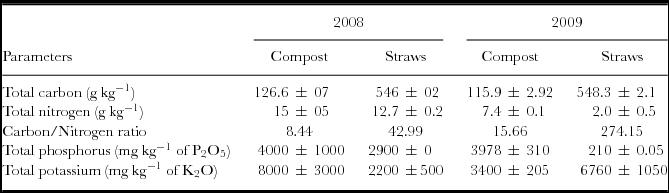
Sub-treatments consisted of urea, compost, compost + urea, sorghum straw + urea, control and absolute control (plot without stone bunds). The size of subplots was 10 m × 5 m. The blocks were separated by an alley of 5 m and the subplot by an alley of 3 m. All organic materials were applied at the same time before sorghum sowing at the rate of 4 t DM ha−1 and urea at the rate of 30 KgN ha−1. The compost was produced using litter and maize straw by aerobic composting technique for 3 months. It is a high-quality organic matter (low C/N ratio). Sorghum straw, a poor quality organic matter (high C/N) from the previous crop year is kept for use during the next crop year. Table 1 shows the chemical properties of the organic resources that were applied. All plots were prepared downslope by stone bunds and were then plowed. The plots were sown with sorghum (Sorghum bicolor L. Moench) variety SARIASO 14 at a density of 31,250 seedlings ha−1. During the growing period, the field was weeded twice using hoes. The crop was harvested 110 days after sowing.
Chemicals characteristics of sorghum straws and compost.

Soil macrofauna sampling
Soil macrofauna was sampled according to the standard method used by the Tropical Soil Biology and Fertility Institute (TSBF) (Anderson and Ingram, Reference Anderson and Ingram1993), in two consecutive years. Soil monoliths (25 cm × 25 cm × 30 cm) were dug out and soil macrofauna were hand-sorted. Three monoliths per treatment were sampled at 50% flowering of the sorghum (74 and 79 days after sowing respectively in 2008 and 2009). This period was favourable to the TSBF method application. Invertebrates and larvae were preserved in 70% alcohol, with earthworms. Macrofauna species were identified (Bachelier, Reference Bachelier1978; Bland and Jaques, Reference Bland and Jaques1947; Villiers, Reference Villiers1979) and their numbers counted.
Rainfall and runoff data collection
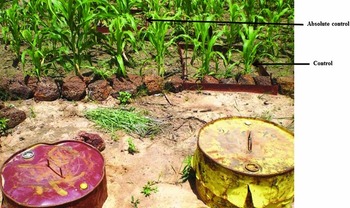
A simple manual rain gauge was installed on the site to record rainfall amount. Data were collected for two consecutive years (2008 and 2009). Runoff was measured during the sorghum-growing period (from sorghum planting to its harvest) for each rain event that generated overland flow. In 2008, 27 rainfall events that generated overland flow were recorded and in 2009, 17 rainfall events were recorded. In each plot, a simplified runoff plot described by Montoroi (Reference Montoroi1991) was installed to collect and store runoff water. This equipment consisted of a runoff plot (1.04 m2) with a drainage system, which drained the water into a container located outside the plot. A second plot runoff was placed without stone bunds in the control plots and served as absolute control (Figure 1). The water collected in the container was quantified. This dimension of runoff plot (1.04 m2) makes available a homogeneous zone to effectively measure methods of fertility management and soil macrofauna impact on runoff.
Simplified runoff plot with control and absolute control.

Yield evaluation
The evaluation of the grain and straws yield of sorghum was done on a useful plot of 31.28 m2 delimited inside each elementary plot.
Data analysis
The quantity of runoff (mm) was determined by considering that 1 mm of rainfall corresponded to 1 L of water m−2. This value was used for the calculation of the runoff rate. The runoff rate was calculated as the ratio between the amount of cumulative runoff (mm) in a treatment and the total amount of rainfall for the rains that generated runoff.
The runoff rate and sorghum yield were statistically analysed using Genstat 9.2 (General Statistics), including ANOVA in split-plot design and Newman–Keuls test for significant differences between treatments at p < 0.05.
For soil macrofauna, density (mean number of individuals m−2) and species richness (alpha diversity) were calculated.
RESULTS
Effect of pesticide application and soil fertility management on soil macrofauna composition and abundance
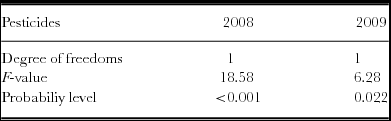
In 2008, results showed that a total of 2598 individuals m−2 were recorded on untreated plots compared to a total of 123 individuals m−2 collected from plots treated with pesticides. Pesticide treatments have eliminated 95% of the soil macrofauna. The analysis of variance showed very highly significant differences (p < 0.001) between treated and untreated plots (Table 2). Pesticide-free plots can then be considered as plots with soil macrofauna while plots treated with pesticides can be considered as plots without soil macrofauna.
Analysis of variance of pesticides effect on soil macrofauna density.

In 2009, a total of 3185 individuals m−2 were recorded on pesticide-free plots compared to a total of 32 individuals m−2 recorded on plots treated with pesticides. Pesticide treatments then eliminated 99% of the soil macrofauna. The analysis of variance revealed significant differences (p = 0.022) between plots treated with and without pesticides (Table 2). Again, pesticide-free plots can be considered as plots with soil macrofauna while plots treated with pesticides can be considered as plots without soil macrofauna.
The results showed that there was a clear dominance of the class of insects which accounted for 92% and 98% of identified individuals respectively in 2008 and 2009. The most represented families are Termitidae (49.23% to 78.63% of individuals), and Formicidae (7.97% to 47.75 % of individuals).
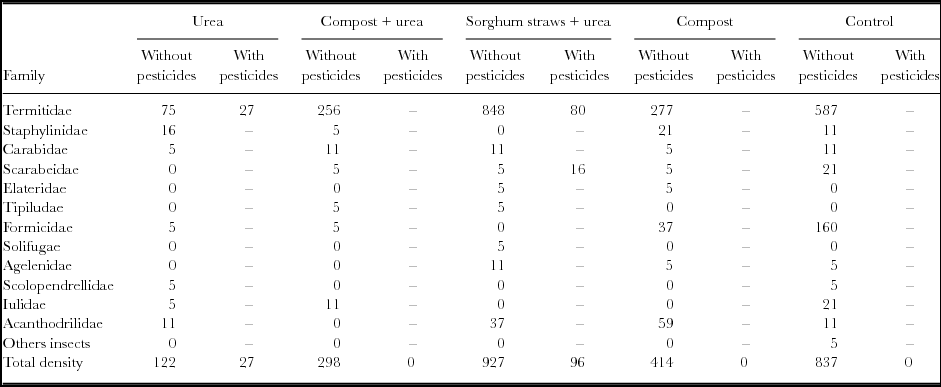
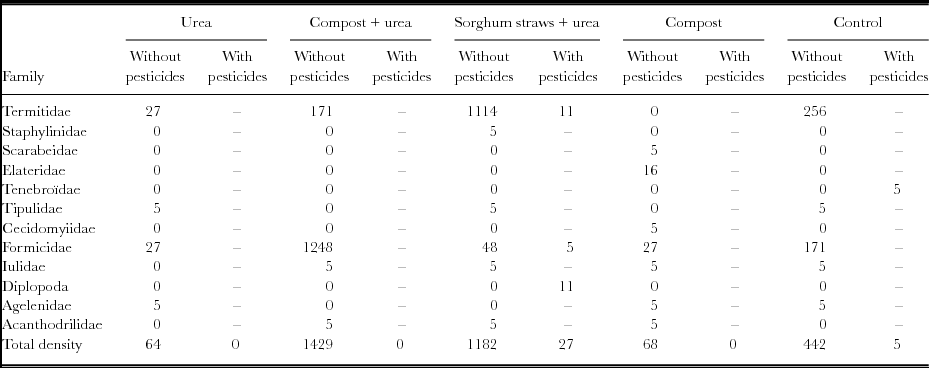
The results showed that the abundance of soil macrofauna significantly varied over the two years, according to soil fertilization option on pesticide-free plots. Soil macrofauna was mainly encountered on plots subject to sorghum straws + urea treatment with a density between 927 and 1182 individuals m−2. The lowest densities were most often observed in the urea treatment (Tables 3, 4).
Effect of pesticides application and soil fertility management on soil macrofauna diversity and abundance (individuals m− 2) in 2008.

Effect of pesticides application and soil fertility management on soil macrofauna diversity and abundance (individuals m− 2) in 2009.

Termites are more abundant on treatment based on sorghum straws + urea, with a density between 848 and 1114 individuals m−2. The termite population was dominated by fungus-growing termites (Microtermes, Odontotermes). As for earthworms, they were more abundant on compost treatment with a density of 5 to 59 individuals m−2 (Tables 2, 3).
Effect of macrofauna on runoff
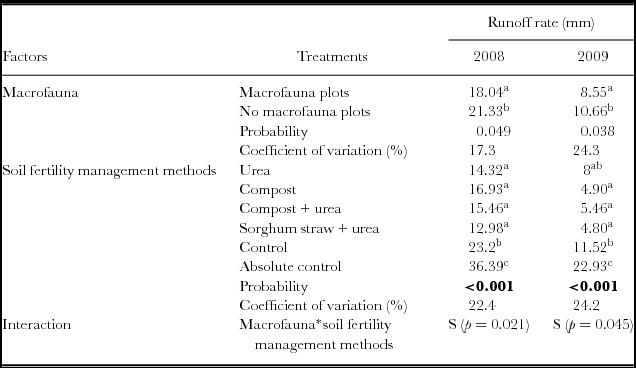
During the sorghum production, the rainfall causing runoff was 512.25 mm in 2008 over 27 rainfall events that generated overland flow and 505.4 mm in 2009 over 17 rainfall events that generated overland flow. The results (Table 5) show that runoff was greater in the absence of soil macrofauna. Indeed, in 2008, the runoff rate was 18.04% on plots with soil macrofauna, which is less than treatments without soil macrofauna (21.33%). In 2009, on plots with soil macrofauna, the runoff rate was 8.55% compared to 10.66% in the absence of soil macrofauna. The removal of macrofauna by application of insecticides significantly increased runoff up to 18.24% and 24.68%, respectively in 2008 and 2009. The difference in runoff rate was due to the frequency of rainfall events. Indeed, in 2008, 27 rainfall events that generated runoff were recorded compared to 17 events in 2009. This result can be explained by the fact that the antecedent soil moisture affects runoff (Penna et al., Reference Penna, Tromp-van Meerveld, Gobbi, Borga and Dalla Fontana2011; Zhao et al., Reference Zhao, Yu, Li, Wang, Liu and Mu2014). ANOVA showed that soil macrofauna had a significant influence on runoff.
Effect of soil macrofauna and soil fertility management methods on runoff (%).

S: Significant; means followed by same letter for each factor are not significantly different at 5%.
Management of soil fertility and runoff
The results of the impact of soil fertility management methods on runoff (Table 5) showed that in 2008, the lowest rate of runoff was obtained with sorghum straw + urea (12.93%). This method of soil fertilization is respectively followed by the other methods i.e. urea (14.32%), compost + urea (15.46%) and compost (16.93%). No significant difference was revealed between these soil fertility management methods; but they differ from the control (stone bunds alone) and absolute control. The high rate of runoff was obtained on the absolute control (36.39%) and it was significantly different from control (23.32%). An exclusive establishment of soil and water conservation measure reduces runoff from 36.25%. When stone are associated with organic and/or mineral fertilizer, there is improvement on the reduction of runoff. This reduction is as follows: 64.33% for sorghum straw+ urea, 60.65% for urea, 57.52% for compost + urea and 53.48% for compost compared to absolute control. The rates of recorded runoff in 2009 are relatively low (Table 5). The lowest runoff was obtained with sorghum straw + urea (4.80%). It was followed by compost (4.90%), compost + urea (5.46%) and urea (8%). No significant difference was revealed between these soil fertility management methods. Except for urea, other soil fertility management methods were different from those of the control (11.52%). The highest rate of runoff was obtained on the absolute control (22.93%), which differs significantly from all the other soil fertility management methods and control. The control (stone bunds alone) reduced runoff by 49.76% compared to absolute control. The fertilizer input associated with stone bunds increased the rate of runoff reduction. Indeed, compared to the absolute control, the reduction of the rate of runoff thanks to the different soil fertility management methods are as follows: 79.07% (sorghum straw + urea), 78.63% (compost), 76.19 % (compost + urea) and 65.11% (urea).
Effect of the interaction between the macrofauna and soil fertility management on runoff
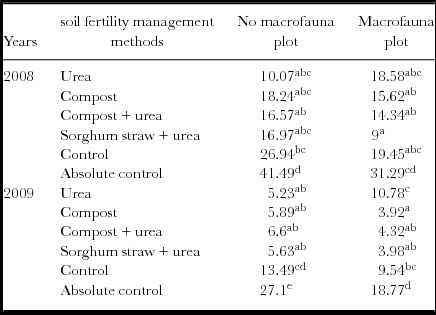
The analysis of variance revealed a significant interaction between soil fertility management methods and macrofauna on runoff during the two-year study (Table 6). In 2008, except for urea treatment, all other soil fertility management methods have recorded low runoff in the presence of soil macrofauna compared to the same treatment without soil macrofauna (Table 6). The lowest runoff was obtained with sorghum straw + urea treatment in the presence of soil macrofauna (9%). The absolute contribution of macrofauna in reducing runoff is 24.58%. In 2009, runoff rates were lower on all treatments in the presence of soil macrofauna, except for urea (Table 6). The compost had the lowest rate of runoff in the presence of soil macrofauna. The absolute contribution of macrofauna in reducing runoff is 30.74%.
Effect of the interaction between macrofauna and soil fertility management methods on runoff rate (%).

Means followed by same letter for each year are not significantly different at 5%.
Effect of the interaction between the macrofauna and the management of soil fertility on sorghum yield
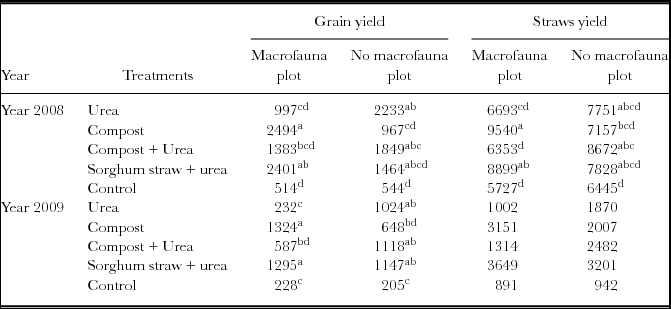
The highest sorghum yield was recorded in 2008, on compost treatment in the presence of soil macrofauna with 2494 kg ha−1 (Table 7). This treatment differs significantly from the compost treatment in the absence of soil macrofauna. The treatment based on sorghum straws + urea and compost + urea did not differ significantly. In the presence of soil macrofauna, the use of compost alone gave a significantly higher yield compared to its combination with urea or urea alone. Indeed, a respective decrease of 80% and 150% in sorghum grain yield was obtained by combining urea and compost, or by using exclusively urea. The low yield was recorded in control (514 kg ha−1). In the absence of macrofauna, sorghum yield varied from 544 kg ha−1 in the control plot, to 2233 kg ha−1 in the urea based treatment.
Effect of the interaction between macrofauna and soil fertility management methods on sorghum yield (kg ha−1).

By contrast, in the absence of soil macrofauna, the opposite was observed. Thus, the highest production was observed on the urea treatment (2233 kg ha−1). This treatment is followed by the compost + urea combination (1849 kg ha−1). Both treatments were statistically similar to compost treatment in the presence of soil macrofauna. The same trend was observed regarding the straw yield.
In the presence of soil macrofauna, the combination of sorghum straws (high C/N ratio) with urea, gave better grain and straw yields compared to the compost + urea combination (low C/N ratio). However, the opposite effect was observed in the absence of soil macrofauna.
In 2009, the results showed the same trends as those of 2008 (Table 7). The high yield was observed with in the presence of soil macrofauna (1324 kg ha−1) and the low yield on control in the absence of soil macrofauna with an average of 205 kg ha−1.
DISCUSSION
Effect of pesticides and soil fertility management on soil macrofauna composition and abundance
The results showed that the use of pesticides removed up of 95% to 99% of soil macrofauna. These results corroborate those of Rashmi et al. (Reference Rashmi, Kumar and Mallikarjuna2009) who showed that pesticides reduce the diversity soil organisms. So, plots treated with pesticides are assimilated to plots without macrofauna. Based on the type of treatment, the results showed that the density of macrofauna varied. They are in accordance with the results of Ouédraogo et al. (Reference Ouédraogo, Mando and Brussaard2004), Sileshi and Mafongoya (Reference Sileshi and Mafongoya2007) and Zida et al. (Reference Zida, Ouédraogo, Mando and Stroosnijder2011) who showed that the quality and quantity of organic matter are factors controlling macrofauna. The use of organic matter resulted in an increase in the macrofauna population, and the use of urea alone induced the opposite effect. The most obvious explanation is that plant residues represent a good energy source for detritivores, especially termites, although a moderation of soil microenvironments may also be a factor. These results corroborate those of Ayuke et al. (Reference Ayuke, Brussaard, Vanlauwe, Six, Lelei, Kibunja and Pulleman2011) that showed that application of farm yard manure in combination with fertilizer, significantly enhanced earthworm diversity and biomass as well as aggregate stability. Termites are the most important group and are especially abundant on treatments with sorghum straws. The results corroborated those of Ouédraogo et al. (Reference Ouédraogo, Mando and Brussaard2004) and Diop et al. (Reference Diop, Ndiaye and Ba2013) who showed that termites responded according to the nature of the organic matter provided, the largest numbers being associated with high cellulose content. Zida et al. (Reference Zida, Ouédraogo, Mando and Stroosnijder2011) also showed that termite numbers were increased more by amendment with straw than with compost or urea. Compost treatment produced the highest densities of earthworms, confirming the observations of Bachelier (Reference Bachelier1978) that they prefer soft litter compost or manure. In the same way, Lapied et al. (Reference Lapied, Nahmani and Rousseau2009) showed that the density of earthworms was higher on plots that received compost, compared to plots treated with urea. Sileshi and Mafongoya (Reference Sileshi and Mafongoya2007) showed that earthworms and beetles were abundant under legumes that produced high quantities of biomass with a low lignin + polyphenol to nitrogen ratios.
Effect of macrofauna and soil fertility management methods on runoff
The results showed that the presence of soil macrofauna reduced runoff. These results corroborate several studies (Larsen et al., Reference Larsen, Liu, Zou, Murphy and Stallard2012). The study of Larsen et al. (Reference Larsen, Liu, Zou, Murphy and Stallard2012) showed that the removal of earthworms doubled the rate of runoff. The runoff reduction by macrofauna is due, on the one hand, to biogenic structures produced by the macrofauna that increases soil roughness and constitutes an obstacle to water flow and, on the other hand to the of drilling pores and galleries. Indeed, Jouquet et al. (Reference Jouquet, Podwojewski, Bottinelli, Mathieu, Ricoy, Orange, Tran and Valentin2008 and Reference Jouquet, Janeau, Pisano, Sy, Orange, Minh and Valentin2012) showed through water runoff simulation that earthworm casting activity enhances water infiltration. Hallaire et al. (Reference Hallaire, Lamandé and Heddadj2004) also showed that the activity of macrofauna led to the formation of fine aggregates with high porosity. Blouin et al. (Reference Blouin, Hodson, Delgado, Baker, Brussaard, Butt, Dai, Dendooven, Peres, Tondoh, Cluzeau and Brun2013) reports that the effects of earthworms increased porosity. It improves infiltration and thereby reduces runoff.
The control plot (stone bunds alone) reduced runoff, compared to absolute control and this corroborates the results of Zougmoré (Reference Zougmoré2003), which showed that the establishment of stone bunds was very favourable to the reduction of runoff. Organic amendments were more effective than urea in reducing runoff. These results also corroborate those of Shuster et al. (Reference Shuster, McDonald, McCartney, Parmelee, Studer and Stinner2002). These authors showed that the runoff was higher with an inorganic nitrogen source (NH4NO3) compared to an organic nitrogen source. Combining stone bunds with the application of sorghum straws and urea resulted in a greatest reduction of runoff in the presence of macrofauna. Ouédraogo et al. (Reference Ouédraogo, Mando and Brussaard2004) showed that termite density was high in the presence of poor organic amendment. Soil macrofauna especially termites activity, improves the physical properties of soil and water infiltration (Bachelier, Reference Bachelier1978; Hallaire et al., Reference Hallaire, Lamandé and Heddadj2004; Lavelle et al., Reference Lavelle, Decaëns, Aubert, Barot, Blouin, Bureau, Margerie, Mora and Rossi2006; Pieri, Reference Pieri1989). Besides, biogenic structures produced by macrofauna are obstacles to runoff.
The use of urea was effective in fighting against runoff in plots without soil macrofauna. In the presence of macrofauna, urea increased runoff up to 84.51% and 106.12% in 2008 and 2009 respectively. In fact, without organic substrate input, macrofauna and micro-organisms stimulated by the urea provoke a rapid mineralization of soil organic matter (Blouin et al., Reference Blouin, Hodson, Delgado, Baker, Brussaard, Butt, Dai, Dendooven, Peres, Tondoh, Cluzeau and Brun2013). The decrease of soil organic matter can lead to structural degradation. The result is a reduction in roughness and porosity of the soil, and thus favoring runoff.
Effect of macrofauna and soil fertility management methods on sorghum productivity
The results revealed a low level of productivity of sorghum during the two years in the control and treatment with exclusive use of urea. These results can be explained by the low level of initial soil fertility. Indeed, several studies in West Africa have criminated this factor as one of the major causes of low agricultural productivity (Cattan et al., Reference Cattan, Letourmy, Zagré, Minougou and Compaoré2001; Koulibaly et al., Reference Koulibaly, Traoré, Dakuo, Zombré and Bondé2010; Ouattara et al., Reference Ouattara, Ouattara, Serpentié, Mando, Sédogo and Bationo2006). The exclusive use of urea or the practice of extensive farming without fertilizers lead to the degradation of chemical, physical and biological properties of soil. Therefore, a negative interaction between the macrofauna and the exclusive use of urea was observed on sorghum production. By increasing the mineralization of organic matter (Ouédraogo et al., Reference Ouédraogo, Brussaard and Stroosnijder2007), urea not only reduces the amount of energy available for macrofauna, but also causes nutrient losses (leaching the caused by over-mineralization), negatively impacting the production of sorghum.
Positive interaction on the productivity of sorghum was obtained between macrofauna and compost, and between macrofauna and a combination of urea and sorghum straws. These results are in agreement with the observations of Lavelle et al. (Reference Lavelle, Decaëns, Aubert, Barot, Blouin, Bureau, Margerie, Mora and Rossi2006), which indicate that the presence of macrofauna leads to increased agricultural production through its role of improvement of the chemical, physical and biological soil. Ouédraogo et al. (Reference Ouédraogo, Nacro, Ouédraogo, Youl and Sedogo2014) has showed that the combined use of sorghum straws and urea in the presence of soil macrofauna improved the availability of phosphorus in the soil. By contrast, a negative interaction was obtained between macrofauna and mix compost with urea on the productivity of sorghum. The combined use of good quality organic matter with urea led to a drop in productivity of sorghum. These results corroborate those obtained by Mando et al. (Reference Mando, Bonzi, Wopereis, Lompo and Stroosnijder2005). The addition of urea in the presence of macrofauna accelerates compost mineralization rate (Menard, Reference Menard2005; Ouédraogo et al., Reference Ouédraogo, Brussaard and Stroosnijder2007). The decline in yields of sorghum with the combined use of compost and urea may be explained by poor synchronization between the mineralization of organic matter and crop requirements.
By contrast, a positive effect of the combination of the organic matter and urea was observed on treatment based on straws + urea, corroborating the results obtained by Bababe (Reference Bababe, Renard, Neef, Becker and Von Oppen1998), Mando et al. (Reference Mando, Bonzi, Wopereis, Lompo and Stroosnijder2005) and Niang (Reference Niang2006). The studies of Ouédraogo et al. (Reference Ouédraogo, Mando and Stroosnijder2006) also showed that the combination of poor quality organic matter (C/N ratio) and urea increased the efficiency of the use of water and nutrients by sorghum. Straw burying stimulates root development (Bababe, Reference Bababe, Renard, Neef, Becker and Von Oppen1998), thus increasing the volume of soil explored by the roots. The yields were always higher when organic (compost) or organo-mineral (straws + urea) fertilizations were used in the presence of soil macrofauna. This clearly shows that the presence of macrofauna is necessary for the rapid decomposition of organic matter (Ouédraogo et al., Reference Ouédraogo, Mando and Brussaard2004) and therefore, for the provision of nutrients to crops. According to Marhan (Reference Marhan2004), digestion of the litter by earthworms increases biomass and the number of fungi. This is probably what explains increased grain yield in the presence of macrofauna, although the organic source (straws) is known for its low mineralization potential.
CONCLUSION
Soil macrofauna is an essential link in the food chain and plays a key role in the decomposition of organic matter. The results showed that soil macrofauna has a significant influence on runoff. The removal of macrofauna caused by the application of insecticides actually increased runoff up to 18.24% and 24.68%, respectively in 2008 and 2009. Burying sorghum straws associated with urea was very effective in fighting against runoff in the presence of soil macrofauna. Moreover, the results showed that the single use of urea increases runoff in the presence of macrofauna. The results suggested that the combined use of sorghum straws and urea with stone bunds was the best soil fertility management in order to fight against runoff. This treatment gave a good sorghum yield in the presence of soil macrofauna during the two years. So, it is important for farmers to use less pesticide. Especially, they must use approved pesticides and natural pesticides in order to preserve the soil macrofauna that contributes effectively to runoff reduction and crop yield improvement.
Acknowledgements
This study was financially supported by the International Foundation for Science (IFS), the contribution of Albert Schweitzer Ecological Center in Burkina Faso, and a grant from the Government of Burkina Faso.