1 The history of proper noun modifiersFootnote 2
In her research on the relation between determiner genitives and noun modifiers, Rosenbach (Reference Rosenbach2007, Reference Rosenbach2010) includes a seminal case study of proper nouns as a special subtype of noun modifiers. Illustrating the pattern are combinations such as the Bush administration or the Barcelona newspapers (Reference Rosenbach2007: 162). The general argument is that determiner genitives and noun modifiers present a case of constructional gradience.Footnote 3 That is, their defining features include certain overlapping syntactic and semantic properties (cf. syntactic gradience in the sense of Denison Reference Denison and Brinton2001; Aarts Reference Aarts2007). This synchronic analysis is complemented by a diachronic hypothesis stating that the two constructions encroach on each other over time, i.e. acquire more overlapping properties. Rosenbach's more specific hypothesis is that this encroaching is semantic and happens along a cline of animacy (see figure 1), with the determiner genitive becoming used with less animate types of nouns and the noun modifier with more animate ones.
Rosenbach's diachronic claim

Rosenbach finds supporting evidence for this diachronic hypothesis in a corpus analysis of proper noun modifiers (PNMs) in the British English news section of the ARCHER corpus.Footnote 4 In this analysis, she tracks PNMs classified according to animacy type, distinguishing ‘human’, ‘collective’, ‘temporal’, ‘locative’ and ‘other’, from 1650 to 1999. She finds that locative PNMs are attested in the very first 50-year period (1650–99) and temporal and collective ones from 1700–49, but human PNMs from 1900–49 only. This confirms her claim of diachronic expansion of the PNM construction in accordance with the animacy cline. PNMs denoting a location are the most frequent type in all periods, though from 1900–49 the proportion of collective and human PNMs increases. Though it provides important first insights into the diachrony of PNM construction, the corpus study is constrained in several ways. Because Rosenbach's main point of interest is the gradience between PNM and determiner genitive, she excludes certain sets of PNMs that are not in the envelope of variation, notably fixed expressions, e.g. Sunday morning, and onomastic NPs that constitute a proper name as a whole, e.g. York Minster, Hampton Court.Footnote 5 Both of these are classed as ‘lexicalisations’. Secondly, Rosenbach limits her investigation to the news section of ARCHER because this is a genre in which PNMs are particularly prolific in Present-day English. Finally, while there are comments on certain earlier phenomena, the empirical analysis does not go further back than 1650, the earliest data point in the ARCHER corpus. The study hence suggests that pre-1650, PNMs, if they are present at all, are restricted to locative ones. Our aim in this article is to empirically investigate the full history of PNMs with a different purpose, tracing the origin and development of this construction. We expect PNMs to be much older and a wider range of types to be present in older data. We believe that the focus on animacy, which has been shown to play a key role in the expansion of the determiner genitive (Rosenbach et al. Reference Rosenbach, Stein, Vezzosi, Bermúdez-Otero, Denison, Hogg and Cully2000; Rosenbach Reference Rosenbach2002, Reference Rosenbach2007), and possible variation with the determiner genitive in Rosenbach's study, detracted from the distinctiveness of the PNM construction and its development. Our overall interest, as historical linguists, is what the development of this particular construction can teach us about grammatical change and the development of new constructions, and how best to study them.
We therefore substantially extend the data looked at by Rosenbach in multiple ways. Firstly, we look at data prior to 1650, going as far back as the Old English period, in which we find examples of PNMs and their likely precursors. Our data are not restricted to a particular genre. We use various multi-genre corpora to cover the full history of the construction. For Old English, we use the 1.5 million words York–Toronto–Helsinki Parsed Corpus of Old English Prose (YCOE; Taylor et al. Reference Taylor, Warner, Pintzuk and Beths2003). For Middle and early Modern English, we primarily rely on corpora from the Penn family, the Penn Parsed Corpora for Middle English (PPCME2, 1150–1500, 1.2 million words; Kroch & Taylor Reference Kroch and Taylor2000) and Early Modern English (PPCEME, 1500–1710, 1.7 million words; Kroch et al. Reference Kroch, Santorini and Delfs2004). The choice of these particular corpora is motivated by the necessity of having reliable part-of-speech tagging in order to identify sequences of proper noun + common noun. The trade-off from using these corpora is that the numbers of tokens, though plenty for identifying trends across time (section 3), are small when it comes to making more detailed observations (e.g. sections 2.3 and 2.4). For this reason, we collect additional examples for Middle English from the non-tagged Innsbruck Middle English Prose Corpus (Sampler) (IMEPCS, about 6.8 million words; Markus Reference Markus1992–7). For the Late Modern and Present-day English periods we use the much larger Corpus of Historical American English (COHA, 1810–2009, 400 million words; Davies Reference Davies2010–), with random samples taken from the 1850s and 2000s subperiods. These data serve to confirm the validity of Rosenbach's findings based on the British news section of ARCHER and to provide comparable data sets in the context of this study. Because the collection of the samples differs for the different periods and corpora, we provide a more detailed discussion of the sample collection for each of the periods at the start of the relevant sections.
Secondly, we include various types of data excluded by Rosenbach. Certain names, which Rosenbach excludes as lexicalised, appear to be particularly relevant for the development of the PNM construction as they go far back in time, e.g. the name York Minster goes back to the Middle Ages at least. We also include data in which the status of the proper noun (PN) as modifier is more controversial. The first type consists of examples such as Sunday morning, Monday evening, in which one could question whether the PN Xday is a modifier or whether the more precise time expressed by the second noun evening, morning is a specifier. In actual corpus examples, this decision is often impossible to make, which is why we are including all such examples. The second type consists of examples such as Reading town, Jordan river, in which the second noun provides a hyperonymic classification of the PN. Here one option is to exclude them as cases of apposition. However, the presence of examples such as Thames river and Thames mouth shows that the two nouns are not necessarily equivalent, which is why we retain them.Footnote 6
Thirdly, in the analysis, we do not only code for animacy types. We include two other factors which emerged as relevant from the historical data: (i) we annotate the head nouns (HN) for three semantic types, ‘place’, ‘time’ and ‘other’; (ii) we mark whether the whole NP is a proper name or not, distinguishing onomastic vs non-onomastic NPs. We explain how we operationalise this factor in section 3. We also added further types of PNMs beyond the types distinguished by Rosenbach when relevant for our understanding of the development of PNMs.
The discussion in this article divides into two main parts answering two different questions: what is the origin of the PNM construction (section 2)? And how do(es) the source construction(s) develop into the Present-day English (PDE) PNM construction described by Rosenbach and others (section 3)? Rather than presenting a chronological discussion, we start with the findings of the quantitative and qualitative analysis of the Middle and Early Modern English data (henceforth ME and EMoE), which show straightforward precursors to the PNMs discussed by Rosenbach (section 2.1). These data are taken as a starting point for the qualitative exploration of a sample from Old English (OE) (section 2.2) and micro-analyses of collective PNMs and human PNMs (sections 2.3 and 2.4 respectively). In section 3, we provide a quantitative investigation of the development from ME to PDE. We conclude the article by discussing the wider significance of this study in section 4. We discuss what this study teaches us about the emergence of grammatical patterns and what the implications are for historical linguists setting out to study them.
2 The origin of proper noun modifiers
In this section, we trace the PNM construction further back in time, in order to find its historical sources. We start from the situation in ME and EMoE (section 2.1), which has also been partly covered by Rosenbach, then to move back in time to OE (section 2.2). We start each section with a discussion of the data collection process.
2.1 Proper noun modifiers in Middle and Early Modern English
To analyse PNM usage in ME and EMoE, we primarily look at data sets from the PPCME2 and PPCEME. The structure searched for was any element tagged as proper noun directly followed by an element tagged as common or as proper noun. The tag sequence proper noun + proper noun appeared to be used in cases where both elements together functioned as a proper name, e.g. Fleet street, Yorke shire, Easter day, Advent Sunday and was therefore not taken as a judgement call on the second noun in its own right (e.g. street as such is a common noun). For ME, additional data were collected from IMEPCS, by querying for combinations of any two forms tagged in PPCME2 as proper noun and noun respectively. Since recall is inevitably compromised by this method,Footnote 7 the additional data are used for qualitative analysis only.
Within the data sets obtained from the Penn corpora, all examples in which one of the elements was tagged wrongly and was in fact not a (proper) noun were excluded in a first step. In a second step, we sorted out one further set of examples in which the relation between PN and HN is arguably different from a modifier–head relation. These are examples of the kind William bishop of Hely, Etheldredus duke of Mercia, Aurilambros kyng and John Baptist, in which the PN denotes a person and the second element provides a title. We judged the relation between PN and HN to be one of apposition rather than modification. In contrast to potential cases of apposition with other types of PNs, there is no evidence of variation of the kind Thames river vs Thames mouth affecting the second noun. In addition, the second element here can function as a noun phrase (NP) in its own right, sometimes with its own internal modification, e.g. in William bishop of Hely and Cambises sone unto Cirus ‘Cambyses son of Cyrus’, made more specific by the addition of postmodification. In this way, the original data sets were narrowed down to 162 ME and 378 EMoE examples that can be said to contain a PN modifying an HN.Footnote 8
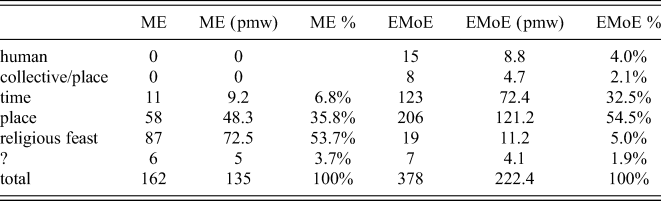
The PNMs in the data sets were then arranged into animacy types, which we labelled ‘human’, ‘collective’, ‘time’, ‘place’ and ‘other’ (see table 1). For 13 examples, it was not possible to pin down the referent of the PN; these are marked as ‘?’. We decided to add one new type, ‘religious feast’, applying to PNs such as Easter, Christmas, All Hallows, Ascension. Within the limitations of Rosenbach's animacy types, these PNs could arguably be grouped under ‘time’ as they denote an event taking place at a particular point in the year or under ‘other’. We separated them out because the temporal aspect is (only) part of their semantic structure and because the group is so prominent in the early data. In eight cases, it was not clear whether the PNM referred to a collective or a place, e.g. Cambridge as reference to the university or the city (see section 2.3), and we marked them as vague (collective/place) in table 1.
PNMs in PPCME2 and PPCEME according to animacy/semantic type

Several observations about PNMs pre-1710 can be made prima facie, bearing in mind that Rosenbach's data contained only locative examples in the 1650–99 period, while two other types, temporal and collective PNMs, were attested in the next period (1700–49). We see a wider range of semantic types, with all animacy types distinguished by Rosenbach except for ‘other’ – unless religious feasts are considered to fall under this type – already attested before 1710 and PNMs denoting places, times and religious feasts attested also in ME (pre-1500). We will look in more detail at the two types that are first instantiated in the EMoE data, i.e. collective and human PNMs (sections 2.3 and 2.4). But as the other PNM types were already common in ME, it follows that if we want to come closer to the origin of these PNMs, we have to go further back in time, widening the investigation to Old English, which is what we will do first.
2.2 Proper noun modifiers in Old English
The data collection from the YCOE is more complex in that Old English still had relatively systematic and distinctive case marking on nouns, including proper nouns, and the YCOE includes case marking in the part-of-speech tags. We extracted separate samples for the different possible case markings on the PN resulting in four sample sets: proper noun tagged as nominative, accusative or dative all followed by a noun (in any case) as well as a set in which a proper noun not tagged for case was followed by a noun. We are stricto sensu not interested in those examples in which the PN has genitive case marking as this construction was retained in later English, but data for proper noun marked as genitive followed by any noun were extracted for reference (see below).
The data sets in which the PN was marked for nominative, accusative and dative case contained a total of 2,039 usable hits, in which the elements were correctly tagged and PN and following noun formed a single NP. The overwhelming majority of these, all but six examples, displayed the same semantic pattern: human (first) name + title, as in Cnut kyning ‘king’, Eadwold preost ‘priest’, Leofric eorl ‘earl’, Sigulf ealdormann ‘alderman’, Osmund biscop of Searbyrig ‘bishop’. In three examples, the second element is a nickname, e.g. Turcytel Myranheafod ‘mareshead’ or Æþelwerde Stameran ‘stammerer’ (in the dative). As with the ME and EMoE data, these examples of apposition are excluded from the discussion. The remaining six examples (all in the accusative) all come from different manuscripts of the Anglo-Saxon Chronicle in the YCOE. They include three different NPs: eall Angelcyn scypu ‘all ships of the Angle nation’ (ChronC and ChronD) / eall Angelcynn scipu (ChronE), ealle Engle þeode ‘all the Angle nation’ (ChronD) and Raculf Menster ‘Reculver Minster’ (ChronC) / Reculf Mynster (ChronA). These examples are retained for further analysis.
The data set in which the PN was not tagged for case proved more interesting though not without complications. After an initial clean-up, this set comprised 393 examples. Upon closer inspection, some of these examples appeared not marked for case at all, whereas others had an ambiguous ending. Compare, for instance, Italia lande and Italian lande ‘Italy country’, in which the head noun lande was tagged as dative and the PN not tagged for case. Italia appears to be the unmarked form and the -an ending could be either dative or genitive. In other cases such as Gallia cyning, the final -a could be part of the unmarked stem, ‘king of Gallia’ or it could be a genitive plural ending of Gallie ‘king of the Gauls’. There were a small number of examples in which the PN is a saint's name ending in -s, e.g. Sanctus Paulus mynstre ‘St Paul's minster’, Sanctus Nicolaus portice ‘St Nicolas’ portico’, possibly illustrating the -s-less determiner genitive. When looking at the reference sample in which the PN is marked as genitive, we do find a larger number of similar examples included there, e.g. Maximianus dagum ‘(in) the days of Maximianus’, Moyses boc ‘Moses’ book’, etc. In fact, the reference sample also contains examples of the ambiguous types described above, ending in -a or -an or other ambiguous final letters. For this reason, we decided to exclude all potentially ambiguous examples from a more detailed analysis. This includes all PNs ending in a final letter/final letters that correspond to a genitive ending (-a, -an, -e, -ena, -es).
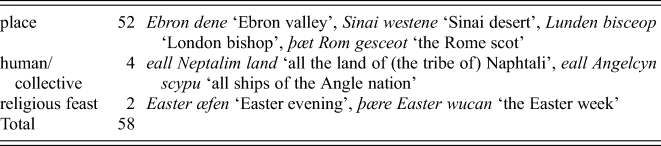
We are left with a set of examples where there is no confusion and the PN is undoubtedly not morphologically marked for genitive case: Moab lande ‘land of Moab’, Sinai munte ‘mount Sinai’, Ponto cyning ‘king of Ponto’, Elig muynstre ‘Ely minister’. To these 53 examples we added 5 of the 6 examples marked as accusative case. Following the procedure just explained, we excluded ealle Engle þeode, where the PN ends in -e and could be a genitive ending. This resulted in sample of 58 cases which we can safely assume illustrate the PN + HN structure we are interested in. With the obvious caveat that this is not necessarily a representative sample of PNMs in the YCOE, the data are valuable as evidence of attestation for individual types of PNMs. Table 2 gives an overview of the semantic types of PNMs in the sample, with diverse examples for illustration.Footnote 9
PNMs in the YCOE sample according to semantic type
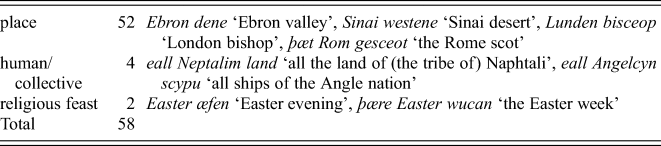
Our limited data set provides evidence of three semantic types of PNMs. Two types correspond to types for ME, PNs denoting places and religious feasts, which supports our hypothesis that PNMs are in fact a much older phenomenon than suggested in earlier studies. The third type is marked as human/collective. These are singular PNs that refer to a ‘group of humans’, e.g. a tribe, a nation, an ethnic group. As ‘collectives of human entities’, they are ambiguous between two of the animacy types.
A closer look at individual examples sheds light on the possible sources for these PNMs. We already noted that there is ambiguity as to whether PNs are marked for genitive case or not. In this unambiguously unmarked set, many examples express a core relation usually conveyed with a genitive, e.g. possession in Naphtali's land Footnote 10 or the Angle nation's ships. In fact, for many of the examples, there are equivalent examples, with a different PN but the same HN, in which the PN is marked as genitive in YCOE, e.g.
(1) Lunden bisecop and Hagusteald biscop vs Hagestaldes biscop and Hrofeceastre bisceop
(2) Iericho feldum vs Moabes feldum
(3) Bethleem birig vs Romes burh
We propose that the problems with applying genitive marking or recognising genitive endings on PNs is one factor leading to PNMs. This is in particular the case for foreign names which do not straightforwardly fit in with the Old English noun declensions (see also Altenberg (Reference Altenberg1982) on the -s-less genitive with foreign names in section 2.4).
Not all examples fit in with this categorisation, though, e.g. Easter æfen ‘Easter evening’ and Rom gesceot ‘Rom scot’ or ‘Rome penny’, which is a tax payable to the papal see in Rome (see OED, s.v. Rom-scot). We have no reason to assume that these examples alternate with genitive marked ones; instead they are listed as compounds in dictionaries such as Bosworth & Toller's (Reference Bosworth and Toller1898) Anglo-Saxon Dictionary and the OED.Footnote 11 Bosworth & Toller, for example, list a number of compound nouns with Easter as first part, e.g. Easteræfen ‘Easter evening’, Easterdæg ‘Easter day’, Easterfæsten ‘Easter feast’, Eastermonaþ ‘Easter month’, etc. We therefore suggest that a second source for PNMs was OE compounds. The religious feast examples all belong to this type. In the case of PNs denoting places or nations/ethnic groups, it seems that unmarked genitival modifiers are the most frequent source, but there are also cases that suggest a compound source. It should be noted that the delimitation of compounds and syntactic groups is as much a problem for OE as it is for PDE. Kastovsky (Reference Kastovsky and Hogg1992: 362–63) notes that spelling is not a reliable indicator of compound versus phrasal status in OE. The presence of inflectional endings on the first noun can be taken as evidence of phrasal status; however, this does not work for genitive markings as these could occur in so-called genitive compounds, e.g. dægeseage ‘daisy, lit. day's eye’, Sunnandæg ‘Sunday, lit. sun's day’. We found the variants Rome byrig, Romeburg, Romes burh and Romesbyrig in the YCOE. The ambiguous morphosyntactic status of proper noun + noun combinations as compounds or phrases, which is a matter of debate for PDE as well (e.g. Breban Reference Breban2018), may have facilitated the convergence of the two OE sources for PNMs.
Looking at the data from the YCOE, we conclude that PNMs are an ‘old’ feature of the English language that have their origins in two source patterns: PNs unmarked for genitive case and compounds with a PN as first element. The emergence of PNMs is thus connected to larger changes affecting the English language system, most importantly the breakdown of the system of nominal inflections, exacerbated by the form of foreign (place) PNs which do not straightforwardly fit in with inflectional paradigms. The possibility to spell compounds as single or separate word forms presented a second reason for the occurrence of ‘PN N combinations’, which constitute the structural template of the PNM pattern.
2.3 The first collective PNMs
Though there are no unambiguous examples of collective PNMs, such as Rosenbach's FBI in the FBI director, our earlier data include examples that could possibly be analysed as collective PNMs. The YCOE data contain two examples of tribes of ethnic groups, eall Neptalim land ‘all the land of (the tribe of) Naphtali’, eall Angelcyn scypu ‘all ships of the Angle nation’.
Another likely predecessor to collective PNMs is attested both in the PPCEME and even earlier, in the additional IMEPCS data. These are combinations referring to the institutions of Parliament (Parlement Howse, Parlement mater, parlement robes) and Church (Churche werk, church landes, Church discipline). Both Parliament and Church are also common nouns, and tagging in PPCEME is not consistent nor is it always possibly to determine common/proper noun status for individual examples. We therefore chose to err on the side of caution and did not include examples with Parliament or Church in the figures in table 1. Nevertheless, they are an indication that certain collective PNMs may have been present well before 1700. In the case of Church, the OED provides examples of what it refers to as ‘attributive compound’ uses dating back as far as the OE period, Chirche pament ‘Church payment’ (1455), chirch steuene ‘Church teaching’ (c.1275), eallum cyricgerihtum ‘all Church dues’ (OE, Wulfstan's Institutes of Polity) and cyricwædan ‘Church garments’ (OE, Laws of Æðelred II).Footnote 12 These would be further examples of PNMs that go back to what could have been compound forms in OE.
Finally, there are examples found in PPCEME and included in table 1, such as a Westminster matter (1548) ‘a matter for the Court of Justice which sat at Westminster Hall’, an Al Sowl Colledge man (1582), Cambridge letters (1630) ‘letters while sender was in Cambridge / at Cambridge university’, or a Newgate bird (1633) referring to Newgate prison. In all these cases the PN is a physical place/building as well as an institution located there. In most examples the PN is shortened, e.g. Newgate (prison) and/or the place it refers to metonymically stands for the institution, e.g. Westminster meaning ‘the Court of Justice’ or Cambridge meaning ‘Cambridge University’. As such the early examples are superficially the same as the established examples with place PNMs, and we could hypothesise that this vagueness formed a bridge to examples such as FBI director in which the institution is the only possible referent for the PN and the PN is unambiguously collective.
2.4 Human PNMs in ME and EMoE: -s-less determiner genitives or modifiers?
The figures in table 1 show the first examples of human PNMs to be attested significantly earlier than Rosenbach's ARCHER data suggest (after 1900). The situation is complicated, however, by the occurrence of -s-less determiner genitives at the time (Altenberg Reference Altenberg1982: 45–51; Rosenbach Reference Rosenbach2002: 205–9), making the evidence harder to interpret. The aim of this section is to assess the evidence: are there any genuine examples of human PNMs in our data set?
In his study of the genitive in the seventeenth century, Altenberg (Reference Altenberg1982: 45–51) describes the phonetical and morphological conditions in which what he refers to as the ‘zero genitive’ occurs. Relevant to this discussion, these include human (foreign) PNs ending in -s, e.g. Moses face, Doctour Caius wife, mr Roberts letter, and HNs starting with -s.Footnote 13 There were a number of examples that we considered -s-less determiner genitives in PPCEME and excluded as instances of PNMs in table 1. They are ser Antony Knevett servand (1553/9), master Dolman howsse (1553/9), my Cosine Ison wife (1599/1601), my Cossine Gates house (1599/1601), doctor Bolds dawgther (1582), ye Ld Clare breast (1689/92). Note that not all of these are conditioned phonetically because the PN ends in -s or the HN starts with -s (e.g. servant), but in all cases the relation between PN and HN involves core genitival relations such as alienable and inalienable possession and kinship. In all examples the possessor PN is a complex phrase.Footnote 14
Rosenbach (Reference Rosenbach2007: 181, see also Rosenbach Reference Rosenbach2019) points out a different, special set of examples with potential human PNMs, which consist of a saint's name and an HN denoting a place or a day, e.g. Saint Paules Church, saynt Marke day. They occur alongside examples of the same type in which the PN is a determiner genitive marked with -s, e.g. Seynt Margaretes Day. Rosenbach analyses the examples without -s as lexicalisations of determiner genitives, which as part of the lexicalisation process have lost the genitival -s marking. She concludes that they are not a productive new pattern of PNMs. In this case too, we find similar examples in our PPCEME data set: seynt laurence church (1526), Bartilmewe fayre ‘Bartholomew feast day’ (1535), S. Laurence chirch (1535/43), sant Margatt parryche (1553/9), sant Margett chyrche (1553/9), sant Austyn parryche (1553/9), sant Thomas of Cantebere day (1553/9) and St. James church (1688/89). Cases where the PN ends in -s, e.g. seynt laurence church and St. James church, can be subsumed under -s-less genitives. However, in line with Rosenbach, we note that these examples overall constitute a recurrent type. They have a long pedigree, being particularly common in the IMEPCS data, e.g. in seynt Michell mount or our lady-chyrch, where many of the saints’ names found also have attested marked genitive forms, as in saynt Mychels mounte, at oure Ladyes fete, Seynt Mathewys day. The alternation between -s-marked genitival forms and what is (given the definite article) decidedly a modifier use of the same PN is illustrated in a single passage from the same text in (5):
(5) And on Seynt Kateryns even, in semblable wyse, the seide Maire and Shiref and their brethren [haue vsid] to walke to Seynt Kateryns Chapell within Temple church, there to hire theire evensong; and from evesong to walke vnto the Kateryn halle, theire to be worshipfully receiued of the wardeyns and brethren of the same; and in the halle there to have theire fires, and their drynkyngs, with Spysid Cakebrede, and sondry wynes; the cuppes merelly filled aboute the hous. (IMEPCS)
Examples such as (5) show that these examples cannot simply be subsumed under the determiner genitive in the same way that examples such as ser Antony Knevett servand and master Dolman howsse can, as also argued by Rosenbach.
We, however, disagree with Rosenbach's claim that they are only a restricted and unproductive variant of particular onomastic genitives naming places and feast days. We argue this perception is a result of her narrow definition of PNMs and propose that the examples fit in with the other types of PNMs in our ME data. The recurrent subtype referring to holidays, e.g. Bartilmewe fayre, echoes the prominent pattern with religious feast PNs in ME, which, as we discuss in section 3, all combine with an HN referring to a particular time, e.g. Ester day, the Chrystysmasse weke, Whitsone Eue, Alle Halwyn tyde ‘All-Hallows’ tide’, þe halirode day ‘Holy Cross day’, etc. In the EMoE data, we see a diversification of the HNs combining with religious feast PNs to include places (Whitsonday farm) and miscellaneous others (my Chrismas dynner, ye Michas pay ‘Michaelmas pay’). There is some evidence from EMoE that the saints’ name pattern was not restricted to HNs denoting day or place: for (Saint) Catherine, the OED lists Catherine wheel (first attestation a Katharine wheele (1584)), Catherine pear (a Katherine Pear (1641)) and Catherine plum.Footnote 15 The similarities with one of the main patterns for ME mean the saints’ name pattern cannot be dismissed as an isolated lexical phenomenon.
Finally, there are examples in our PPCEME set where a determiner genitive reading is ruled out altogether: i.e. a Abraham man / these Abrahom men (1567/8), a King Harry face (1582), the Spracklinge Coat (1624/5), the Sprakling Armes (1624/5), the Sprackling armes (1625/7), ye Ashmole peare (1689/92). The phrase Abraham man, used twice in the same text once with a and once with these, has its own separate entry in the OED, where it is defined as ‘a beggar claiming to have been released on licence from the Hospital of St Mary of Bethlehem in London or a similar institution’.Footnote 16 Its origin is not known. King Harry face used with the indefinite article in our example refers to a type of coin. There are several other combinations in which the first name of a king/queen premodifies a common noun denoting a coin in the OED, e.g. the Marie ryall (1565), old harry soveraignes (1615), an old Harry groat (1633).Footnote 17 These examples show that it was at the very least not impossible to use a (title +) first name PN as modifier well before 1900. In the seventeenth century, finally, we find examples with a PN consisting of a last name only, Sprackling and Ashmole.Footnote 18 These are the first instances similar to examples like the Bush administration and the Weaver car (‘car belonging to the Weaver family’) given as prototypical examples of human PNMs in PDE.Footnote 19
All in all, the evidence places the first occurrences of human PNMs at least in the sixteenth century, and maybe as early as ME, albeit in certain collocational niches. A possible explanation for the large time difference between our and Rosenbach's first examples might be related to different genre-restrictions. Many of the human PN examples are found in texts belonging to the private sphere: e.g. a king Harry face in the diary of Richard Madox, Bartilmewe fayre in a letter from Margaret Roper to her father Thomas More, ye Ashmole peare and the examples with Sprackling in the correspondence of the Hatton and Oxinden families respectively.Footnote 20 This might signal that this specific type of PNM is part of an informal register. Rosenbach restricted her analysis to news texts, in which PNMs feature prominently in PDE, in line with findings that noun modifiers are part of a compressed written style. We agree with Rosenbach that many examples have an onomastic character (naming a day, a place, a coin, a variety of fruit). However, rather than taking this as an indication of a particular lexical status, we will argue in section 3 that it is an integral part of the proper noun modifier construction.
3 The emergence of the Present-day English PNM construction
In the previous section, we traced back the PNM construction before Late Modern English (LMoE) and identified two possible sources of PNMs in Old English. In this section, we discuss how these first possible instances of PNMs relate to and developed into the construction as described for PDE by Rosenbach (Reference Rosenbach2007, Reference Rosenbach2010) and Breban (Reference Breban2018) and several articles in Breban & Kolkmann (Reference Breban and Kolkmann2019).
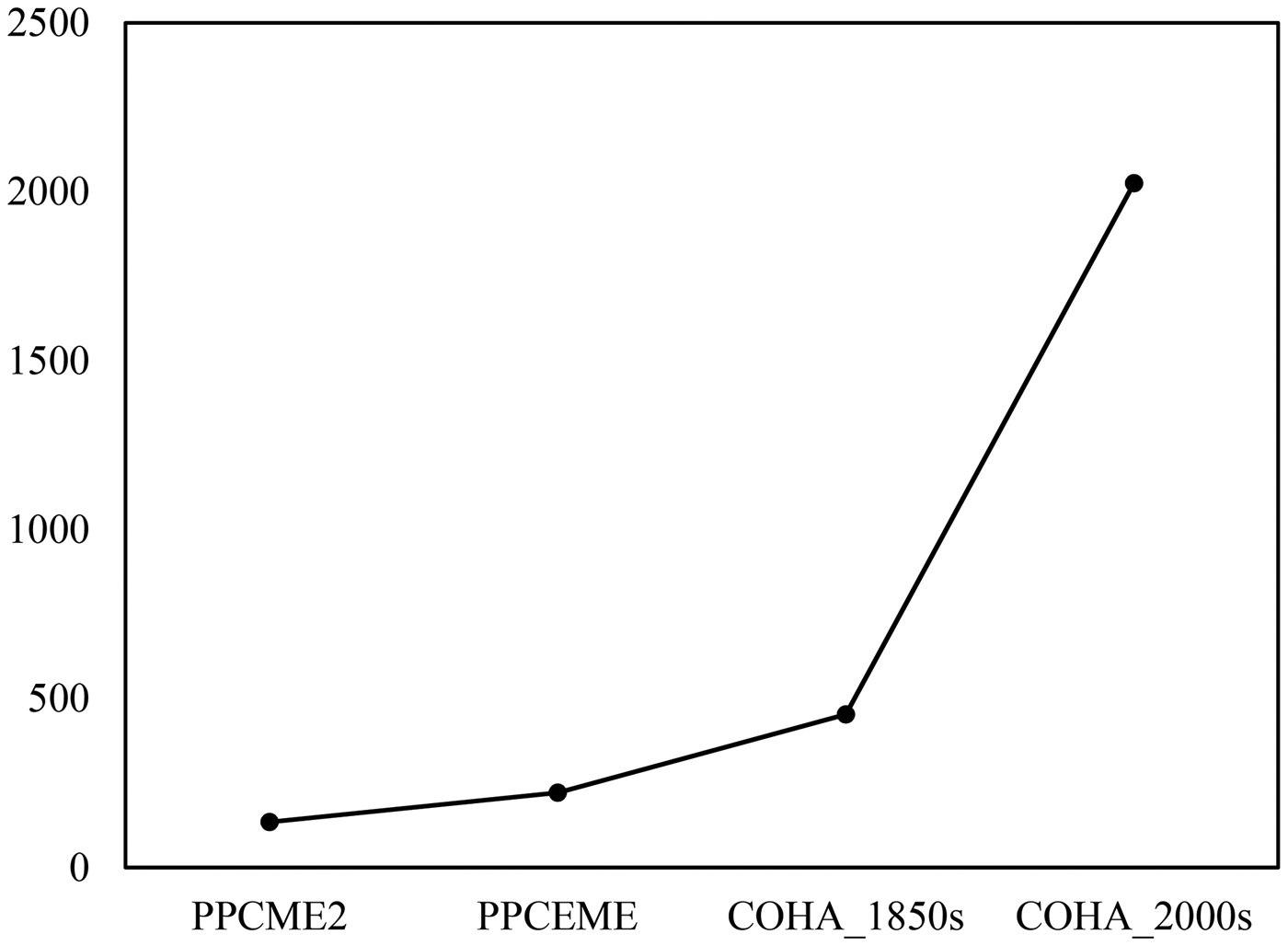
To capture the post-1710 stages in the development of the PNM construction, the Corpus of Historical American English (COHA) was queried for any proper nouns preceding a common noun. Specifically, two random 500-hit samples were drawn from COHA, one from the 1850s subsection, and one from the 2000s subsection. After the removal of false positives, 308 examples remained for the 1850s and 325 for the 2000s. These were analysed following the same procedures as for the older data. Knowing these raw figures, as well as the respective corpus sizes and sampling rates, normalised frequencies for the PNM construction can be estimated. Figure 2 shows the results, revealing an exponential increase in the construction's frequency from LMoE to PDE, much in line with the findings of Rosenbach (Reference Rosenbach2007, Reference Rosenbach2010) for the British news section of ARCHER.
Normalised frequency (per million words) for the PNM construction from ME to PDE, based on PPCEME2, PPCEME and COHA

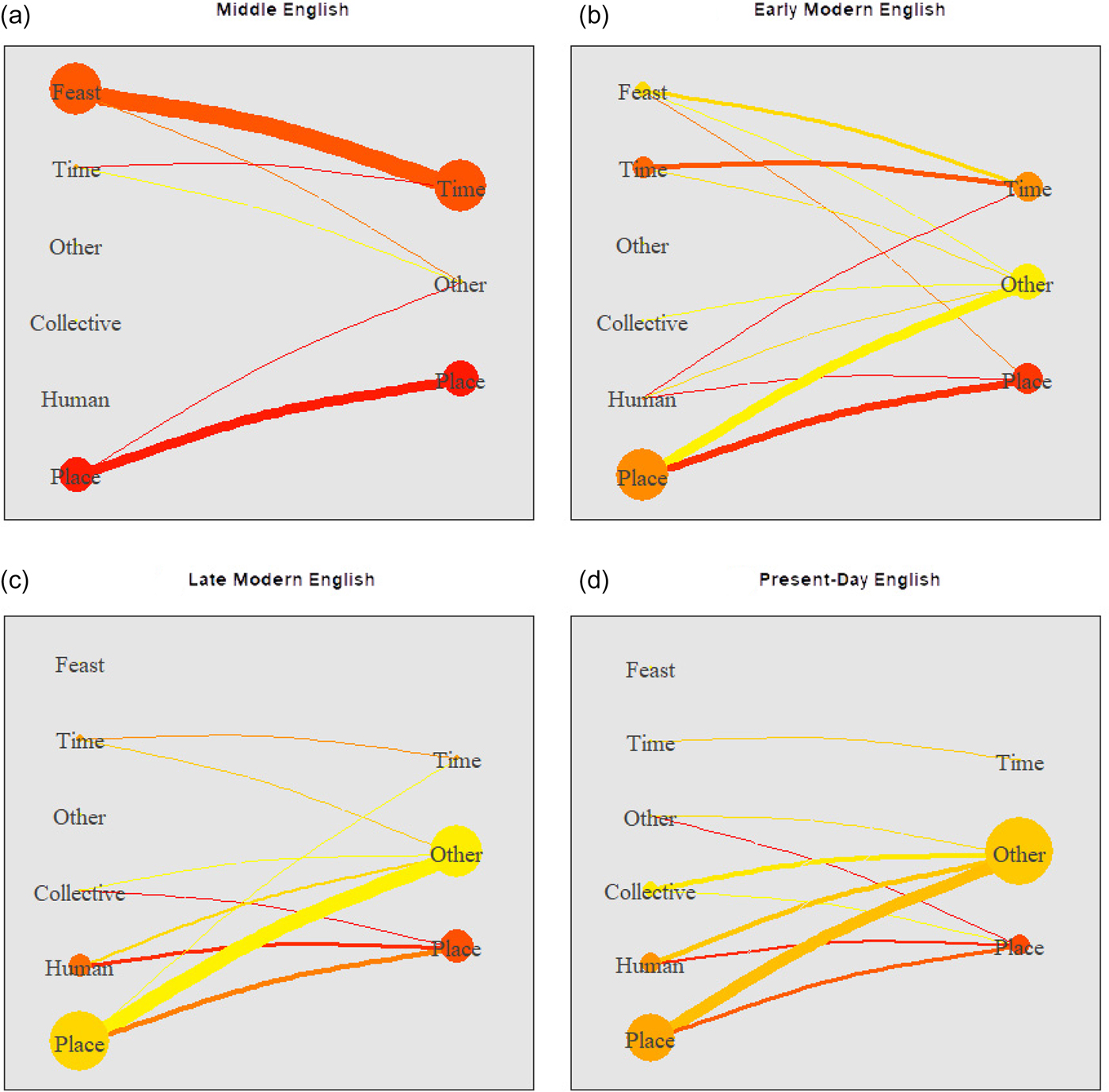
Our aim is to arrive at a comprehensive picture of the development of the PDE PNM construction. The discussion so far has shown that animacy is neither the only nor the main factor determining the types of PNMs found or their emergence. Based on the detailed investigation of the historical data, we include three variables in the analysis proposed here. These are semantic type of PNM, semantic type of HN and the onomastic or non-onomastic status of the NP as a whole (is it a name in its own right or not?). The three aspects of PNMs under study are jointly visualised in figure 3, which in four panels shows the changing distribution of the PNM construction over different types of PNMs, HNs and NP types. The four panels represent (a) ME (based on the data from PPCME2), (b) EMoE (based on the data from PPCEME), (c) LMoE (based on the 1850s sample from COHA) and (d) PDE (based on the 2000s sample from COHA). On the left-hand side of each panel, the semantic types of PNMs are listed (Feast, Time, Other, Collective, Human and Place). On the right-hand side, three semantic types of HNs are distinguished (Time, Other and Place). The size of the data points indicates the relative frequency of each type. The connecting lines indicate attested combinations; the wider the line, the higher the relative frequency of the combination. The colours represent the referential status of the entire NP with red shading indicating the share of onomastic NPs (behaving like a name in their own right) as opposed to yellow for non-onomastic NPs [please note: the printed version has dark grey for red and light grey for yellow]. NPs were analysed as onomastic if they lacked an explicit determiner (e.g. Forbes Magazine or Kansas City), unless they were plural or had a mass HN, in which case the absence of a determiner can just signal indefiniteness (e.g. Alaska king crab with a hearty butter sauce).Footnote 21 This method of annotating is conservative in assigning onomastic status, since proper names can sometimes have a determiner (e.g. the Chicago Symphony Orchestra, the Hudson River). As such, any red colouring signifies a strong tendency for the type or combination to be associated with onomastic as opposed to non-onomastic NPs.Footnote 22 It needs to be emphasised that both size and colour reflect relative frequency in this type of visualisation; if a type or combination is substantially less frequent than (an)other type or combination it is backgrounded irrespective of its absolute frequency. As such these visualisations draw out the most central features and patterns of the PNM construction over time and abstract away from detail. This contrasts with the micro-analytical approach of the qualitative analyses in sections 2.2–2.4 which foreground special, infrequent patterns. We include qualitative observations in the following discussion where relevant.
The changing distribution of PNMs over modifier types (left), head types (right), and onomastic (red) vs non-onomastic (yellow) NPs [please note: the printed version has dark grey for red and light grey for yellow]
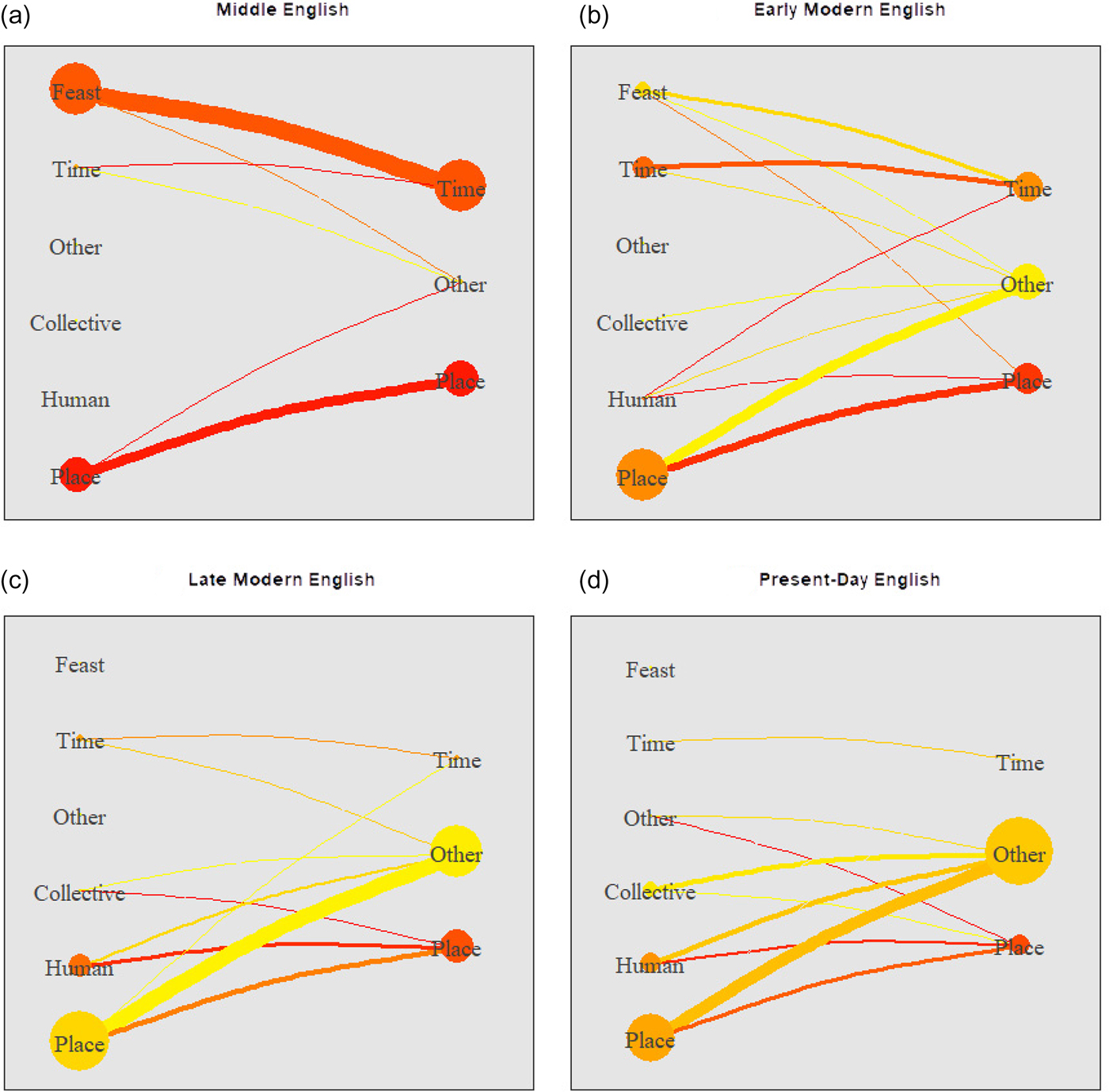
We start our discussion by contrasting panels (a) representing ME and (d) representing PDE. The PDE panel in figure 3 (panel (d)) largely matches the description of PNMs in PDE given in the literature. Various types of PNs are attested with place PNs being the most common. The majority of HNs they combine with are ‘other’ HNs, i.e. not time or place HNs. The main distributional pattern consists of a place, human or collective PNM and an HN that does not refer to time or place. This pattern is yellow to orange indicating that this combination results in both non-onomastic and onomastic NPs. This pattern can be identified with the highly productive PNM construction evidenced in NPs such as an Edinburgh newspaper, the Guggenheim museum, most New England preachers, the Tudor style, a Disney spokeswoman, a former Bill Clinton student, etc. In the remainder we use the shorthand ‘PDE PMN construction’. In addition, two less prominent patterns show up: there are place, human and other PNMs that combine with mainly place HNs to create new proper names, typically place names, e.g. Boston district, Hudson river, George Washington square. There is a marginal and restricted pattern in which time PNs combine with time HNs, e.g. Monday morning, Christmas day. Note though that this association between time PNs and time HNs is probably less exclusive than the PDE panel of figure 3 suggests. Combinations such as Sunday dinner or Christmas present (with ‘other’ HN) obviously occur. They are just very infrequent relative to the other combination types attested in our sample.
The ME panel of figure 3 (panel (a)) is strikingly different. There are two main patterns standing out. At the bottom of the plot, we have place PNs that combine with place HNs to make place names. The data points and line are bright red indicating that the resulting NPs behave almost exclusively like proper names. Examples include Dorset schyre, Flete Strete, Lyndefare cherche ‘Lindisfarne church’. The other main pattern, at the top of the plot, consists of combinations of PNs referring to religious feasts or, less frequently, time with HNs typically denoting time, e.g. Ascension Euen, Candylmas daye, mydwynter tyde. Here, too, the pattern mainly associates with onomastic uses. Assuming that the high degree of distributional segregation between these two patterns justifies treating them as separate constructions, at least for ME, we will refer to these patterns as the ‘place name’ and ‘time point’ constructions.Footnote 23 It can be noted that the two constructions approximately correspond to the two sources for PNMs suggested above for OE. More precisely, time point constructions are related to those examples identified as OE compounds, while onomastic place constructions appear to mainly (but not exclusively) derive from morphologically unmarked genitives (section 2.2). This, too, indicates that they were likely to have been separate constructions at some point. These two main constructions show a correspondence to the two peripheral patterns in the PDE panel.
In addition to these two main constructions, there are some instances of place, time and feast PNMs combining with ‘other’ HNs, e.g. Astyr seruyce ‘Easter service’, Rome scot, May buttre. Here, the combinations with time and feast PNMs show a stronger tendency towards non-onomastic use. There are more examples of place PNs with ‘other’ HNs, including some in non-onomastic NPs, in the IMEPCS data, e.g. the London carrier, Paston men or a Normandy byll, but they are rare in comparison with place names.Footnote 24 The subsequent panels show that it is this small area of overlap with non-prototypical uses of both constructions that gains in relative frequency and expands over time to become the core of the PDE PNM construction.
The EMoE and LMoE panels of figure 3 (panels (b) and (c)) clearly show this development from the ME to the PDE distributions. The development comes with the following changes: place and especially time HNs become relatively less frequent, whereas ‘other’ HNs come to dominate PNM usage. Gains in frequency of PNMs overall are particularly associated with the pattern with ‘other’ HNs. PNs become more diverse in this pattern, which echoes the findings of Rosenbach. However, PNMs denoting humans gain in frequency before those denoting collectives do. In EMoE and LMoE the pattern with ‘other’ HNs is found in non-onomastic NPs. However, our data suggest that the pattern becomes more onomastic, making it in this respect more like the ME constructions. There might be a connection with Breban et al.’s (Reference Breban, Kolkmann and Payne2019) finding that native speakers associate the PDE PNM construction with a ‘naming’ relation between PN and HN. Both findings, though pertaining to different aspects of the PDE PNM construction, point to a connection between the construction and the communicative function of naming. Given that this connection is strongly present in the precursor constructions, this could be seen as persistence (Hopper Reference Hopper, Traugott and Heine1991) of the original function in later stages of grammatical development. The ME time point construction is first affected by the diminishing frequency of PNs denoting religious feasts. The remaining time PN + time HN pattern then becomes increasingly isolated and less prominent. The ME place name construction remains well attested and undergoes some blurring of its distributional boundaries as its PNs become more diverse. It is only in the PDE panel that its share decreases.
Finally, it should be remarked that the expansion of the PDE PNM construction as seen in figure 3 generalises over loss at the micro-level. The PPCEME sample contains examples with names of foreign countries, such as the Turke Ambasset (1517), the Portugall Bishop (1605), the morroccoe imbassador (1635/39), a pair of China shoes (1685) and the Japan tongue (1685). In PDE ethnic adjectives Turkish, Portuguese, etc. would be used here instead. A quick search in the OED shows first attestations of the adjectival forms in the sixteenth or seventeenth century (Turkish 1545, Portuguese 1552, Chinese 1577, Japanese 1588, Moroccan 1685). As the adjectival forms are largely restricted to names for certain countries and a few cities, e.g. Parisian, in English, the loss is not picked up in figure 3.Footnote 25
4 Concluding discussion: proper noun modifiers and the emergence of grammatical patterns
The descriptive aim of this article was to extend the diachronic description of the PNM construction beyond the first observations made by Rosenbach (Reference Rosenbach2007, Reference Rosenbach2010). Rosenbach only looked at data from the seventeenth century onward, which fitted in with her larger aim of studying the changing variation of determiner genitives and noun modifiers. She projected back from PDE in terms of methodological choices to do with in/exclusion of examples, the selection of a particular genre, and a hypothesis based on her work on English genitive constructions. Taking a much more inclusive approach towards data selection, we uncovered a more extensive and complex diachronic development. Our analysis led to the identification of two main source constructions in the OE period: the morphologically unmarked genitive modifier and lexical compounds. The first construction was shown to typically occur with (foreign) place PNs, whereas the second construction could occur with any type of PNs (place/human/feast/time/collective). We argued that these two precursor constructions developed largely independently into the place name and time point construction that dominated ME usage of PNMs. The PNM construction as described for PDE gradually emerged starting from overlap between these two constructions, in particular in combinations with non-time and non-place HNs. As far as we can tell from the ME and EMoE evidence, human PNMs had an early collocational link to the time point construction through various saints’ holidays (e.g. Our Lady Day). Collective PNMs may have developed from the place construction through metonymically used place names (e.g. Cambridge letters). These innovations increasingly blurred the boundaries between the two ME constructions, and as the area of overlap between them became more prominent, a more unified pattern emerged. The findings are reminiscent of the spread of English complement constructions, which likewise tend to originate from disparate minor patterns (De Smet Reference De Smet2013). Our findings challenge the idea that the historical diversification in the types of available PNMs can be reduced to a gradual extension along the animacy hierarchy, but at the same time also confirm and accommodate several of Rosenbach's observations in a single story. Lexicalised saints’ names are argued to be part of a productive pattern. Increased frequency of the PNM construction as a whole, as well as of certain types of PN, is the main change from LMoE to PDE. The onomastic character noted for the PNM construction in PDE reflects its source constructions. History explains synchrony rather than vice versa.
Our findings concerning the possible precursors and subsequent emergence of the PNM construction have wider implications for the understanding and study of grammatical change. Firstly, they provide further evidence for the ubiquity of multiple sources constructions (De Smet et al. Reference De Smet, Ghesquière and Van de Velde2015). Multiple source constructions question a simplistic linear development ‘drawing straight lines between a construction and a single historical ancestor’ and can be envisaged as the ‘blending of clearly distinct lineages’ (Van de Velde et al. Reference Van de Velde, De Smet and Ghesquière2015: 1). This is well established for phonological and lexical semantic changes but is not recognised as much with regard to changes in morphology and syntax. Secondly, our findings underscore Joseph's (Reference Joseph2015) argument that in addition to multiple sources, there is also a multiplicity of factors involved in individual cases of change. Changes are caused by ‘multiple pressures on some part of a language system’ (Joseph Reference Joseph2015: 207). For our case study, we have discussed the break-down and loss of the nominal inflectional system, the difficulty of incorporating foreign names with ‘exotic’ word forms into the inflectional system, and the ambiguous morphosyntactic status of compounds in historical and present stages of English. Changes to noun phrase modification in written texts in Late Modern English have been shown to influence the increase in usage in this period (Rosenbach Reference Rosenbach2007; Biber & Gray Reference Biber and Gray2011, Reference Biber and Gray2016). Thirdly, our findings support views of grammatical change as the gradual emergence of constructions (e.g. Hopper Reference Hopper, Aske, Beery, Michaelis and Filip1987; De Smet Reference De Smet2013). Our case study shows the gradual adding to and gradual distributional crystallisation of the PNM construction. The emergence of a new grammatical pattern happens gradually within the language system in place exploiting ambiguities. We hence agree with the discussion in Traugott & Trousdale (Reference Traugott and Trousdale2010b: 23) that change is only radical if we look at the ‘macro-effects’, represented quite strikingly by juxtaposing the ME and PDE panels in figure 3. The overall picture that emerges from our case study is that grammatical patterns develop out of multiple sources, influenced by a multiplicity of factors, against the background of the language system. New patterns emerge gradually and exploit existing ambiguities. The complexities of these and other developments warn against imposing generalisations based on (synchronic) theorising on historical processes (Anderson Reference Anderson2016; Cristofaro Reference Cristofaro and Enfield2017). The study of such changes requires a data-driven methodology that casts the net wide in terms of data selection and combines frequency analysis with qualitative micro-level analysis to arrive at a comprehensive understanding.