Katherine Bartrum, a twenty-three-year-old woman from Somerset, had been living in India for less than a year with her husband Robert, an assistant surgeon, when the Indian Rebellion began in May of 1857.Footnote 1 In June, Bartrum and her infant son joined other British women and children in leaving the military station at Gonda for the Residency buildings in Lucknow. She remained there during what became known as the siege of Lucknow. In the following months, she suffered the death of her husband in combat and nursed her son through cholera. When the siege ended in November 1857, Bartrum traveled with other British survivors to Calcutta, where her son Bobbie died days before she set sail alone for England. For Bartrum and many other British participants in the Great Rebellion, the deaths of family members, particularly children, revealed not only the violence at the heart of the imperial project but also the ultimate instability of British domestic life and identity within the imperial context. During the worst moments of the conflict, the frequency of child death and the inability to mourn these deaths according to British, Christian rituals suggested a collapse of the domestic sphere as an idealized place of protection and training for elite British children being raised to become the next generation of imperial rulers.
Like many other Britons in India, Katherine Bartrum sought, and sometimes struggled, to experience the deaths of her husband and son according to British, middle-class understandings of death. In the relative safety of Calcutta following her escape from Lucknow, Bartrum recorded her attempts to mourn her son’s death according to British practices in her memoir, letters, and an 1858 published account. With the aid of her companion Emmie Polehampton, the “Florence Nightingale of Lucknow” and widow of the Lucknow chaplain, Bartrum reconstructed the elaborate rituals of the Christian “good death.”Footnote 2 Polehampton’s own firstborn infant had died just months before the rebellion began, and she orchestrated Bartrum’s mourning in ways that mirrored her own, creating community and support through the child’s last moments. Polehampton had been among the first to recognize the severity of Bobbie’s illness as the women made plans to travel from Calcutta to England.Footnote 3 When Bobbie died just over one week later, it was Polehampton who came in the middle of the night and directed Bartrum to lay her struggling child on her lap. Bartrum recalled, “he was gasping for breath, when I turned away my head, for I could not see my child die. She [Polehampton] said, ‘Look, how bright his eyes are growing!’ and ‘now his eyes grew bright and brighter still, too bright for ours to look upon’ … and so ‘the Lord called the child.’”Footnote 4 Polehampton, who months before had begged her husband to let her keep her dead child’s body close to her for just a few hours longer, washed and dressed the infant and laid his body next to his mother on her bed. In the morning, the two women arranged roses and orange blossoms around the child and, at midday, they had a photographer take his picture—just as Polehampton and her husband had done for their own infant.Footnote 5 The postmortem daguerreotype was tinted “to take off the pallor of the effect,” and it showed Bobbie “as if he were smiling in sleep.”Footnote 6 The child was now, according to his mother, “no longer babe but angel.”Footnote 7 That evening, the doctor came to fasten down the coffin lid, and the two ladies rode in the mourning coach along with the coffin to the burial ground, where they were joined by other survivors from Lucknow for the funeral and placement of the inscribed tombstone.Footnote 8
The next day, Katherine Bartrum set sail for England, recalling in the final passages of her personal and later published memoirs how, on leaving Calcutta, she “bade farewell to the land, where all I loved best, had found a resting place.”Footnote 9 By ending her memoir with this statement, Bartrum connected the deaths of her child and husband with leaving India and linked her ultimate personal loss with the larger imperial upheaval.Footnote 10 Even before Bobbie’s death, she had written to her father, “I long to bid farewell to India, the only spot in it which possesses any interest for me is the grave of my Husband,” a site that, to her great consternation, was neither known nor marked.Footnote 11 Upon her son’s death, she declared, “I am stripped of all, I am empty & desolate, all is gone now.”Footnote 12
For Britons in India, mourning rituals held multiple meanings. The practices surrounding grief and death served as means of identifying and connecting the British and European community abroad as well as recognizing Christian salvation. In his classic work, The Hour of Our Death (1981), Philippe Ariès identifies the late eighteenth century as a period of transition for Western death and mourning practices marked by the rise of the “beautiful death,” in which death brought suffering yet also offered peace and happiness to the dying and reunion with departed loved ones.Footnote 13 Burial in overcrowded, unsanitary urban churchyards declined as cemeteries reconfigured into peaceful sites for walking and reflection moved from the center of towns to the outskirts, and individually marked grave sites increasingly replaced anonymous or mass graves. The new cemeteries, modeled after Paris’s Père Lachaise, which opened in 1804, resembled garden settings where, according to George Mosse, “death supposedly lost its sting as it became part of an enchanting landscape.”Footnote 14 The deathbed also emerged as an appropriate setting primarily for the immediate family, not the larger public. More recently, scholars such as Pat Jalland and Drew Gilpin Faust have elaborated on the nineteenth-century ideal of the Christian good death during which, writes Faust, “the deceased had been conscious of his fate, had demonstrated willingness to accept it, had shown signs of belief in God and in his own salvation, and had left messages and instructive exhortations for those who should have been at his side.”Footnote 15 While young children and infants were unable to articulate such overt statements of salvation, descriptions of child death in this tradition often note a change in the child’s eyes, a turning toward God, as in the case of Bartrum’s son, which must be witnessed and acknowledged by the present adults, as well as a final look of peace or contented sleep.
Child death amidst the Indian Rebellion of 1857, however, was a different matter. The conditions in the midst of war often made such manifestations of the good death impossible. This article traces change over time in British representations of child death during the Indian Rebellion, drawing on a variety of different “texts”: letters, diaries, memoirs, published accounts, and press reviews, along with visual sources such as cartoons, historical illustrations and paintings, public memorials, and even a fifty-three-foot painted memorial scroll documenting the main sites of the conflict. Private letters were often later published and personal memoirs reviewed by the press alongside published works. Together these sources reveal the blurred boundaries between private and public, individual and collective memory, personal and collective grief. The varied source base and ability to track one source, a letter or diary, for example, through several manifestations—the original entry, the published form, and then reviews—illuminates how individual expressions of grief became reshaped in the public discourse and collective memory of 1857.
During the initial months of the conflict and in the earliest published British accounts, the deaths of children became war stories—embellished and often symbolic—for the British public, and what under normal circumstances would have been inappropriate material for public discourse served as a powerful, emotive rallying point for British militarism. The diaries and memoirs written during the siege of Lucknow and published and circulated among British readers in 1858 and the following years, however, portrayed child death as more complicated. The focus shifted from vengeance to grief, and it became clear that survivors could not always mourn children’s deaths in a manner that reinforced British values and Christian traditions. The inability to grieve and commemorate the good deaths of children compromised the domestic ideals justifying British imperialism. When proper burial and mourning rituals for children could not be carried out, the British sense of national community began to fray, and doubts about the cost of empire emerged. Images and narratives of the violent deaths of children were so destabilizing that they had to be suppressed. Ultimately, the deaths of children were either represented as good deaths or erased from the public memory of the rebellion, leaving unrecognized the traces of unmoored, hopeless grief recorded during the fighting. Later British memorials built during the mid-1860s and following decades typically represented the deaths of British women, a much more stable symbol than children, obscuring the accounts of child death that had initially been so prevalent. This process demonstrates the ways in which the experience of grief was a form of remembering those who died as well as the ties that bound the dead to the living, a process that, as Judith Butler has argued elsewhere, potentially “furnishes a sense of political community.”Footnote 16 The elements of grief for dead children that served national purposes entered into the collective memory of the rebellion, while those that did not were forgotten or left unarticulated without language for expression.
Militaristic Representations of Child Death
During the first months of the rebellion, the deaths of British children were typically represented to the British public in the same way as the deaths of British women; both representations reinforced understandings of the conflict as a mutiny against legitimate authority in need of immediate suppression. The rebellion ended with the brutal subjugation of Indians by the British forces and the transfer of power from the East India Company to the British Crown in 1858. Noting the overwhelming focus on the deaths of British women as a call for vengeance, many scholars stress that the conflict marked a major shift in British models of empire as the metropole turned away from the liberal imperial utopian rhetoric promoted by T. B. Macaulay and others in the early nineteenth century and openly espoused violence as the means to uphold racial hierarchies.Footnote 17 British forces responded to the uprising with a wholesale attack on Indian communities, burning entire villages and staging public hangings that were photographed and displayed back in Britain.Footnote 18 Before his death, Bartrum’s husband, Robert, described how Indian prisoners were routinely shot or hanged. “At first I loathed the idea,” he wrote to his mother in England, “but now I have become so callous to it, that I feel a pleasure in seeing those creatures revenged upon.”Footnote 19 In the following decades, the British colonial government retreated from highly symbolic forms of religious and cultural intervention that might prompt widespread resistance. Even as the British strengthened ties with the Indian elite, government and private initiatives constructed even greater racial distinctions between Indian and British populations through census reports, health reform, anthropological projects, public exhibitions, museum displays, and intensified segregation within urban spaces.Footnote 20
Perhaps no aspect of the conflict was more important in shaping British responses than narratives about British women being attacked by Indian men. At the Cawnpore (hereafter Kanpur) massacres of 27 June and 15 July 1857, forces under Nana Sahib of Bithur opened fire on the formerly besieged Europeans who were promised safe passage to Allahabad, and then Nana Sahib ordered the approximately two hundred surviving European women and children retained as hostages at the Bibighar or “House of the Ladies” to be killed, leaving their bodies in a well. Appealing to the ideal of virtuous British womanhood, the British public and government used accounts of the Kanpur massacres to justify the violent retaliation of the British army against rebel forces and Indian communities. For many Britons, British womanhood came to symbolize the values associated with the British “civilizing mission”: Christianity, chivalry, and self-sacrifice, as well as a belief in racial superiority.Footnote 21 The British public understood attacks on British women and children as attacks on British domesticity and imperial authority, and
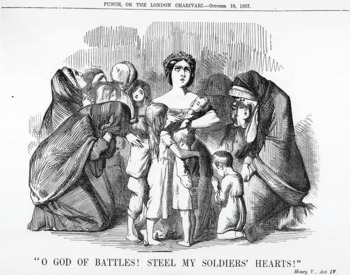
Queen Victoria shown mourning children killed in the Indian Rebellion and calling for vengeance. Punch, 10 October 1857, 151. Courtesy of Vassar College Library.

in the years following the rebellion, ruling the home continued to serve as a model for ruling the empire.Footnote 22
Britons fighting in India and those remaining in Britain circulated gruesome reports of Indians killing British women and children to rally military support against an enemy portrayed as brutal and uncivilized. “Cawnpore! Cawnpore!” became a common battle cry as British-led forces charged against rebel soldiers, and some of the earliest published images of the rebellion to reach Britain focused on child death to present the conflict as an attack on the British home and family.Footnote 23 In October 1857 at the height of the crisis, Punch printed a cartoon showing Queen Victoria holding a dead infant, the child’s eyes peacefully closed, surrounded by grieving women in mourning attire and barefoot children kneeling in prayer, thereby bringing the issue of child death and the rebellion directly to the British domestic public (fig. 1). The caption from Henry V, “O God of Battles! Steel My Soldiers’ Hearts!” defended British soldiers’ brutality against Indians in the name of protecting children. The cartoon thus linked child death in the imperial context to Britain’s history, culture, and national interests represented in this case by the monarch herself as mother.
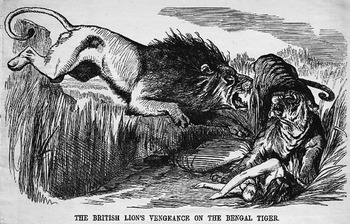
Such depictions of child death drew sharp, antagonistic distinctions between Britons and Indians. In the November 1857 cartoon “Too ‘Civil’ By Half,” Punch critiqued Governor General Canning’s supposed leniency toward rebel soldiers, represented in this case by the sneering sepoy shown holding a sword covered with the blood of two small, dead British children as he cowered under the ready bayonet of a British soldier (fig. 2). Canning sought to distinguish between Indians who participated in the rebellion and those who did not in meting out punishments, but the reference to the death of British children in this image served to reinforce understandings of the conflict as battle of all Indians against all Britons. Most popular of all was John Tenniel’s response to the Kanpur Massacre published in Punch (22 August 1857), “The British Lion’s Vengeance on the Bengal Tiger” (fig. 3). By depicting the British lion as leaping in attack toward the Bengal tiger preparing to devour a naked European woman and child, Tenniel conflated fears of murder and rape and asserted that British military actions were in response to an attack on British women and children. This image was widely reproduced, displayed in British parlors, and even referenced as a recruiting tool to sway young men to enlist for India.Footnote 24
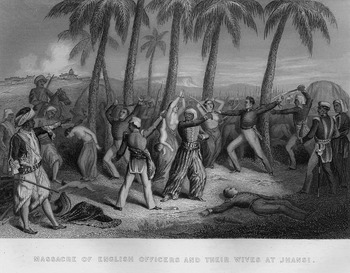
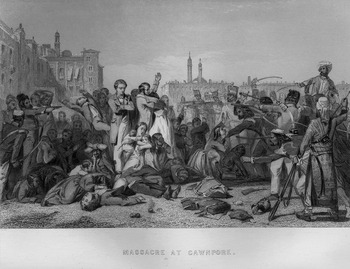
As was the case with the Punch cartoons, illustrations in one of the first histories of the rebellion, Charles Ball’s History of the Indian Mutiny (1858), used the deaths of British children along with those of women to promote a sense of British victimization, Christian righteousness, and racial superiority.Footnote 25 Ball’s steel engravings created exaggerated racial distinctions between white Britons and dark rebel soldiers.Footnote 26 Brutal portrayals of Indians killing naked white women and children, such as the “Massacre of English Officers and Their Wives at Jhansi,” which shows an Indian soldier holding an upside-down, naked British child soon to be killed by another’s sword (fig. 4), literally foregrounded child death, thus constructing a narrative of the rebellion that seemed to justify British retaliation. The unclothed male child on the left lies in nearly exactly the same position as the fallen British soldier on the right. The conflation of child and adult soldier suggests that Britain’s domestic interests were aligned with its military power and that Britain’s future imperial supremacy was also at stake. Other historical illustrations in Ball’s text memorialized British families in India as heroic and, in many cases, solemnly secure in their Christian faith. The “Massacre at Cawnpore” (fig. 5), for example, contrasted the chaos and violence of the rebel soldiers with the illuminated British family grouped below the church steeple: the mother who holds her two young
Punch’s reference to child death as a means to justify indiscriminate British military force against Indians. Punch, 7 November 1857, 191. Courtesy of Vassar College Library.

John Tenniel, “The British Lion’s Vengeance on the Bengal Tiger,” Punch, 22 August 1857, 76–77.

children until the end, the father who stands resigned to his fate with his head in prayer.
Thus, during the rebellion and in the immediate aftermath, public mourning for British children who died served much the same purpose as mourning for British women. Dead children became a rallying point for British military mobilization and symbols of British innocence, Christian sacrifice, racial difference, and moral superiority. The tortured child’s body was the ultimate sign of uncivilized warfare and British martyrdom, creating the boundaries of community by drawing on a standard set of visual formats reaching back at least to Foxe’s Book of Martyrs (1563).Footnote 27 In one of the most extreme examples of such uses of British childhood, Harriet Tytler, wife of Captain Robert Tytler and the only elite British woman present during the battle to reclaim Delhi, demonstrated that children, like women, could readily embody the values of British imperialism. She famously named her child born during the siege “Stanley Delhi-Force” (having rejected the name “Battlefield Tytler” as too extreme) and claimed that on his birth the soldiers declared, “We shall have victory now that this baby has come to avenge the deaths of the murdered children.”Footnote 28 Such references to child death presented the imperial conflict as an attack on the British domestic sphere, but the overwhelming message was one of vengeance rather than grief or loss for the dead.
“Massacre of English Officers and Their Wives at Jhansi,” in Charles Ball, The History of the Indian Mutiny: Giving A Detailed Account of the Sepoy Insurrection in India; and a Concise History of the Great Military Events Which Have Tended to Consolidate British Empire in Hindostan (London, 1858), 1: facing 272. Courtesy of Vassar College Library.

The Siege of Lucknow and Domestic Collapse
The presence of a significant group of British women at Lucknow, who, unlike the women of Kanpur, survived to write about their experiences, served to complicate such uses of the domestic as a symbol for the values of British imperialism. Over the course of six months, from June through November 1857, between two and three thousand British, European, and Indian soldiers and civilians and their family members were besieged in the buildings surrounding the Lucknow Residency, an area covering thirty-three acres.Footnote 29 On 25 September 1857, General James
“Massacre at Cawnpore,” in Charles Ball, The History of the Indian Mutiny (London, 1858), 1: facing 342. Courtesy of Vassar College Library.

Outram’s troops joined General Henry Havelock’s forces from Kanpur to lead an unsuccessful relief of Lucknow, adding approximately one thousand reinforcements and new supplies to the Residency compound. It was not until 17 November that Sir Colin Campbell led the successful relief of Lucknow and arranged for the travel of the Residency survivors to Calcutta by way of the Secundrabagh (a garden palace where only days before Campbell’s troops had killed nearly two thousand Indian soldiers), Kanpur, and Allahabad. From Calcutta, many, like Katherine Bartrum and Emmie Polehampton, departed for England. It was during the evacuation of the Residency survivors from Lucknow to Calcutta that the lasting narratives focused on the chivalrous relief of Lucknow, the overwhelmingly violent suppression of Indian rebels, and the heroism of British women took hold.Footnote 30
Yet even as the Lucknow survivors’ journey to Calcutta reinforced the emphasis on the Kanpur massacre and the heroic relief of Lucknow, survivors’ accounts detailing the conditions of the siege and its aftermath presented a view of British domesticity and civilization as internally fractured, weakened, and at times even questioned. Certainly most of the public reports of the siege focused on the relief, which provided the first material for the British press and was even the subject of the melodramatic playwright Dion Boucicault’s Jessie Brown, or, The Relief of Lucknow: A Drama, in Three Acts, written in 1858. Yet soon these accounts were joined by the outpouring of published memoirs, letters, and diaries written by survivors of the siege. In 1858 alone, the year of Charles Ball’s History of the Indian Mutiny, survivors published over ten accounts of the Lucknow siege, and others circulated their memoirs and letters privately with the press in some cases reviewing these writings as well.Footnote 31
Many memoirs were accounts written by women of the upper classes, such as Bartrum, Polehampton, and others connected to key officials within the Residency buildings. Georgina Harris had settled in Lucknow where her husband served as the head army chaplain only a few weeks before the rebellion began. The preface to her diary, likely the first published narrative of the siege written by a woman, noted that, “As no lady’s diary has hitherto been given to the public, the friends of the writer have thought that it might interest others, beyond the family circle, to communicate additional information on a subject in which the British nation feels so deep an interest.”Footnote 32 Lady Julia Inglis, wife of the Lucknow brigadier, wrote one of the other better-known reports of the siege by a woman. She first circulated her private papers in 1858, when they were reviewed alongside published works, and later published The Siege of Lucknow: A Diary in 1892, when it would be praised by The Times for bringing world attention to the conditions of the siege along with the more familiar details of the relief.Footnote 33 Reviewers also took note of Bartrum’s account, published in the immediate aftermath of events as A Widow’s Reminiscence of the Siege of Lucknow (1858), as well as Polehampton’s letters and diary, published as A Memoir, Letters, and Diary (1858) along with the writings of her husband, Henry Polehampton, the Lucknow chaplain who died during the siege.Footnote 34 One of the most widely reviewed reports written by a woman was Day by Day at Lucknow: A Journal of the Siege (1858), written by Adelaide Case, widow of Colonel William Case, who died in the battle of Chinhat.Footnote 35
British press reviews of women’s accounts of the Lucknow siege alternatively valorized these women for their domestic strength or mocked them for domestic frivolity in the midst of war, but in all cases presented a vision of the British private domestic sphere as fundamentally able to withstand political upheaval. Reviewers routinely commented on the “womanly” and “feminine” perspectives of female authors, most of whom were gentlewomen.Footnote 36 Often such references served to bring attention to women’s skills of caring for the living, nursing the sick, and preparing the dead within the Residency. Reviewers marveled at how women during the rebellion continued to mark the days of domestic importance—“birth-days, wedding-days, death-days, and household anniversaries.”Footnote 37 Reinterpreting women’s Lucknow accounts for the larger British public, reviewers suggested that this continuation of domestic routines helped participants survive the destruction of war. One writer for The Critic, for example, positively remarked how Adelaide Case opened a passage with a description of a wartime “horror”—an amputation conducted without chloroform—and ended this short section of her diary with a vision “proper to her [role] as a woman and a mother” of “peaceful, hopeful expectation”: the marking of a child’s fourth birthday.Footnote 38 By the late nineteenth century, elite women survivors of Lucknow were widely recognized for their distinctly feminine contribution to upholding British imperial values. One reviewer of Inglis’s diary wrote for The Academy in 1892, “Many versions of the heroic defense of Lucknow have been given to the world since then—versions military and versions domestic—so that all mankind may be said to have enjoyed the opportunity of studying the audacity of the men, the patience of the women, the whole grand display of virtues which, in excusable pride, we call ‘British.’”Footnote 39
In addition to praising women for their domestic virtues, however, the British press sometimes also ridiculed women writers for their domestic frivolity associated with children, displacing onto these women larger concerns about the sustainability of British customs and traditions within the empire during a time of conflict. Some reviewers expressed disdain for female survivors who retreated into domestic activities and a feminine perspective as a means to create moments free from, or, oblivious to, the ravages of war. Directly after quoting Harris’s shock and fear following the massacre at Delhi, the reviewer for The Athenaeum wrote, “Still, in the intervals, the lady ascends to the roof of a lofty building to appreciate the scenery around Lucknow, or enters into family merriment to play with a child.” The reviewer went on to detail in patronizing tones Harris’s earnest concern for the fate of her dog “poor Bustle,” and then contrasted Harris’s experience of the initial uprising at Lucknow with the trifling style of her own text: “In the midst of this half-melancholy, half-lightsome prattle, comes the roar of cannon, with slaughter and alarm, and the words burn on the paper, ‘Oh, mother! Mother! How dreadful it is! We have just heard there is a rising in the city.’”Footnote 40 Using the cries of a child to relay the violence of the situation, the reviewer accentuated Harris’s supposed lack of understanding and her reliance on domestic comforts in the midst of war.
In the most explicit critique of the Lucknow women’s domestic perspectives, The Rambler began its review of Case’s Day by Day at Lucknow by noting, “This journal is interesting from its very dullness. The mere notification of the succession of facts by one who has no power of describing them, still less of reasoning upon them, gives an idea of that weary time which a less wearisome style could not give.”Footnote 41 Ignoring Case’s descriptions of mine explosions, shelling, and the death of her husband, The Rambler presented Case’s memoir as “the aptest symbol of the vacant suffering which the ladies” experienced during the siege by focusing almost entirely on Case’s distress on having to leave behind her crockery and other personal belongings when officers ordered the evacuation of the Residency. The reviewer silenced Case’s pain and reduced her suffering, and that of the other female survivors, to a domestic farce in which “They found moving as great a dislocation of comfort as if they had been comfortable where they were.”Footnote 42 Thus, the domestic could be used to represent the resilience of British imperial values, but it also became a means through which to express doubts related to the project of replicating British culture and traditions within the empire by deflecting concerns onto unreasonable women. Nonetheless, reviewers asserted that the feminized British domestic realm, whether praised as a source of national strength or mocked as ridiculous, could withstand even the most hostile imperial settings.
The Lucknow accounts written during the siege were themselves quite different. Survivors expressed deep distress over how the siege overturned British domestic life, provoked tensions within the British community, prevented the fulfillment of British cultural practices, and even raised serious doubts about British policies in India.Footnote 43 The strains of the siege heightened British nationalism but also revealed internal divisions within the British community as class tensions surfaced over sleeping arrangements, food distribution, and accusations of profiteering within the Residency compound.Footnote 44 Reviewers may have stressed British women’s continuation of their domestic roles, but the British women writing about the siege were clear that they were entering a military setting that made traditional domestic relations and spaces impossible. Maria Germon recalled, “when we drove up to the Residency everything looked so warlike—guns pointed in all directions, barricades and European troops everywhere—such a scene of bustle and confusion.”Footnote 45 Soon women’s diaries documented a preoccupation with the more immediate dangers of war, such as battle plans, constant shelling, nursing the wounded, and the organization of women’s night watches.Footnote 46
From the very first days of the siege, British civilians encamped in the Residency emphasized the lack of proper domestic spaces—especially the overcrowding and comingling of children and adults, servants and employers—to describe the disruptions of war. It was “a perfect barrack,” “just like a rabbit warren,” wrote Germon. “At last Miss Nepean offered me a corner in one room—but the perfect babel it was with the number of children and the heat being fearful up to then and no punkah going, it was enough to drive one wild.” Germon stressed how far the Residency was from the ideal middle-class home by focusing on the lack of servants to operate the punkah, or ceiling fan, the lack of privacy, and the constant proximity to children. That evening “two Padres tried to have prayers but we could scarcely hear anything from the babel of tongues and the sound of the screames of so many children—it was perfect misery.”Footnote 47 “The noise of the children in this house is something dreadful,” wrote Case, “and there is not one hole or corner where one can enjoy an instant’s privacy.”Footnote 48 In his memoir of the siege, L. E. Ruutz Rees similarly recalled, “All privacy was destroyed, and the houses within the Residency compound resembled small barrack rooms rather than the apartments of respectable families.”Footnote 49
Furthermore, the siege disrupted imperial hierarchies among British women and Indian servants primarily established and maintained in domestic settings. As more and more Indian civilians fled the Residency, British women identified the lack of deference they received from remaining Indian servants and their own new roles as “the maid-of-all-work,” washerwoman, cook, or nurse as the most immediate outcomes of political rebellion.Footnote 50 During the siege, elite British women dedicated themselves to physical labors previously foreign to their class status without losing sight of how the rebellion challenged imperial hierarchies maintained within the home. In a letter to her father written during the evacuation, Bartrum surmised, “India is no place for Englishwomen now & never will be as it has been, the natives have lost their fear & therefore their respect for Europeans.”Footnote 51
The siege context at Lucknow prompted internal domestic conflicts among Britons and frequent speculation about suicide and self-annihilation of the besieged community through violence. A dispute supposedly started by two wives arguing about the placement of a curtain ended with the Sergeant Major of the 7th Cavalry shooting and killing the riding master of the same regiment.Footnote 52 Several suicides caused great distress along with theological debates about whether suicide would be appropriate if the rebels captured the Residency.Footnote 53 Some women even began to carry laudanum and prussic acid with them for this purpose, and Julia Inglis remarked how she and her husband, the brigadier in charge of the garrison after Sir Henry Lawrence died, discussed how to make arrangements for women and children as well as the sick and wounded in the case of a successful attack. She wrote, “At one time he talked of blowing us up at the last minute, but I have since heard this would have been impracticable. It was strange how calmly we talked on these subjects.”Footnote 54
The Mourning of Child Death during the Siege of Lucknow
The death of children during the months of siege, however, was by far the most pervasive and devastating of such disorders to British domesticity. The press reports and reviewers’ retelling of survivors’ accounts from Lucknow tended to focus on select instances of child death that might be described with pathos, but the original survivors’ accounts stressed the overwhelming yet commonplace experience of child death along with great distress over the inability to mark these deaths according to British practice.
The exact number of women and children who died during the Lucknow siege is difficult to determine. While nearly half of the besieged population consisted of native Indian troops and Indian noncombatants—a fact often omitted from the British public memory of Lucknow—the available records of civilian deaths are usually limited to Britons of the middle and upper classes. One British painted memorial scroll created to commemorate the major events and sites of the rebellion includes a painting of the Lucknow churchyard with a caption stating that in addition to the uncounted soldiers’ wives and children who died, seven out of the sixty-eight British ladies present died along with twenty-three of their sixty-six children.Footnote 55 As an appendix to his account of the siege, L. E. Ruutz Rees included a more complete list of the families of British officers and nonmilitary men present at Lucknow. According to his estimate, which still does not take into account the families of British soldiers or Indians, eighteen out of 232 women and fifty-eight out of 271 children died during the siege and evacuation. In addition, approximately fifty boys from the Martinière College took shelter in the Residency, of whom “a few” died or were wounded.Footnote 56 Since these populations had access to superior accommodations, food supplies, and medical attention, it is reasonable to assume that child death rates among the families of European enlisted soldiers, Indian troops, and servants would have been significantly higher. What is striking in all the available estimates is that children died at much higher rates than women.
The context of these child deaths caused a breakdown of British mourning practices specifically used in the colonial context to preserve British values. Child death, always a tragedy, became even more difficult within the siege setting. It became impossible to interpret and memorialize child deaths according the ideal of the Christian good death recalled in Bartrum’s description of her son’s final moments. Like adults, children during the rebellion often died alone, without forewarning, awareness, any marked connection to God, or communal commemoration. Overwhelmed by the sheer number of deaths and unable to follow conventional mourning patterns for children and other family members, survivors of the siege suffered from “suppressed grief”—illness resulting from grief put off by the immediate demands of survival or left unarticulated and unseen. Indeed, Adelaide Case’s doctor used the term “suppressed grief” to describe her illness following her husband’s death, and many women experiencing child death demonstrated similar characteristics. Inglis noted that Case’s health improved once she arrived in Calcutta after the siege ended, stressing how important it had been for Case to secure proper mourning dress including a widow’s cap.Footnote 57 During the months of the siege, British survivors expressed remorse and guilt over their inability to prevent or properly mourn the deaths of family members. Most of all, child death seemed to show that Britons were powerless to protect their own, that they were unable to maintain their cultural practices in a foreign land, and, for some, that the sacrifice for Britain’s imperial mission was too great.
Fulfilling typical mourning patterns was difficult in part because most of the children who died during the siege experienced deaths that could not conform to nineteenth-century domesticated ideals of childhood or death. Living in makeshift, overcrowded barracks, parents regretted that children lacked the domestic and religious supports to ease their final moments. The means of child death—typically by shell fire or disease—were often sudden and violent. In the early weeks of the siege, Bartrum first realized the full violence of the conflict when she witnessed a child shot as she held her own infant in her arms. She recalled in her diary, “I was dreadfully shocked this morning as I was standing at the window, watching a little girl playing in the court-yard, a round shot [cannonball] struck her in the head, & dashed out her brains. I had never seen anyone killed before, & it was a horrid shock, so much so, that I fell down in a faint on the floor. I can never think of that poor little girl without a shudder.”Footnote 58 Bartrum was surely familiar with other violent deaths by this point, but in describing the death of this girl she underscored how the act disrupted her middle-class vision of playful childhood nourished in safe domestic spaces—gardens and courtyards. Bartrum framed her shock not only in terms of a reaction to witnessing horrific bloodshed but also to the disordering of domestic and public, child and adult, play and warfare.
For Britons like Bartrum, childhood, domesticity, and Britishness were intimately linked. By the mid-nineteenth century, childhood served as one of the key sites where British identity at home and abroad was taught, debated, and evaluated. Middle-class Britons increasingly situated the child as the source of adult accomplishments and values, reinterpreted childhood as a distinct time of innocence best suited for education rather than work, and pursued a wide array of protective reforms exemplified by the child labor laws of the 1830s and 1840s.Footnote 59 It was within the idealized bourgeois home (as well as in institutionally recreated “homes” for working-class children whose own domestic settings state and philanthropic reformers deemed lacking) that children learned about religion, came to understand their class status through interactions with servants, developed a sense of their gender roles, and ideally began to realize what it meant to be British. Reformers recognized the political significance of child socialization in the imperial context as well, hailing institutions such as the Free Church of Scotland orphanage in Calcutta as “a well-cultured garden” in the midst of “moral waste.”Footnote 60 And yet, actual child-rearing practices among the British in India often challenged such cultural distinctions, highlighting instead existing forms of cultural plurality, hybridity, and contestation. Many British children in India, for example, primarily spoke Indian languages rather than English, interacted more often with Indian servants than with their European parents, were themselves the offspring of racially mixed unions or otherwise came to be understood as racially distinct from the adult British population.Footnote 61
If the British ideal of childhood was already highly contested in the imperial context, the horrific courtyard death described by Bartrum and others of this kind completely overturned the modern notion of protected, innocent childhood. As the siege continued, such deaths became a more common occurrence. In language often much starker than Bartrum’s, diarists recorded how “One child was killed and another wounded by the bursting of a shell,”Footnote 62 how “a boy … was killed by a chance ball,”Footnote 63 and how “poor Mrs. Eldridge’s idiot daughter had her leg taken off by a round shot, and died in great agony.”Footnote 64 In a rare reference to the death of an Indian child, Colina Brydon noted that “Gungoo,” her servant, “lost her youngest but one girl. She had been wounded in the foot but had recovered. Internal worms killed her.”Footnote 65 Many injuries were caused by the Residency members’ own shells, not those of rebel soldiers. On an evening in September, Case wrote that “one of our own shells burst, and pieces came back into the ladies’ square, killing one child and wounding another, and also wounding two poor sweepers.”Footnote 66 Similarly, Inglis wrote that she and her baby barely missed being hit by “a fragment from one of our own shells, which often recoiled and fell inside our entrenchments.”Footnote 67 As in most wars, these cases of injury and death from friendly fire did not feature prominently in the British public memory of the Indian Rebellion.
Along with shelling, many children suffered from general malnutrition as women and men struggled with the most basic of domestic duties: providing food for children. By July, scurvy was a serious problem in the compound. Captain Birch noted that it was a common illness, reporting, “scurvy took the form of loose teeth, swollen heads, and boils, and gained the name of ‘garrison disease.’”Footnote 68 Infants and children of all but the wealthiest suffered from a lack of fresh milk. Bartrum declared that milk “is more precious than gold” for the care of her infant, and she was lucky to receive daily supplies from other ladies.Footnote 69 Other women of the Residency were not as fortunate. Case wrote, “A great many children are suffering dreadfully from want of proper nourishment; it is so very difficult to procure milk.” She went on to detail how a widow who had already suffered the deaths of three children came to Julia Inglis to request goat milk for her dying baby. The infant had been born on the first day of the attack during which the woman’s husband was killed, resulting in her inability to nurse from “grief and fretting.”Footnote 70 Inglis, who had managed to bring several milk goats with her into the Residency, refused the request, claiming, “It went to my heart to refuse her; but at this time I had only just enough for my own children, and baby could not have lived without it.”Footnote 71 Inglis hoped the woman would understand her decision to let another child die so that hers might have milk, but Case remarked that the woman’s request for “nourishment for her child,” a need shared by many, “made an impression on me I shall not easily forget.”Footnote 72 Those women who could nurse their own infants were notably thankful, for the inability to nurse as a result of malnutrition or stress was a recognized condition within the compound.Footnote 73 Another mother was sewing when she witnessed the decapitation of her ten-year-old daughter by a round shot that crashed through the wall. The woman was subsequently incapable of nursing her infant, who eventually starved.Footnote 74
As more and more Indian servants left the Residency complex, infants also experienced the loss of wet nurses. When Mrs. Clark gave birth prematurely, she was unable to nurse, and Bartrum and the other ladies who assisted her through delivery could find no one in the Residency to serve as a wet nurse. The mother soon died, followed by her baby girl three days later.Footnote 75 Describing another case, Georgina Harris, wife of the head chaplain, wrote, “All the children are very bad; the want of fresh air and exercise, and the loss of their accustomed food, have made them all ill. Little Herbert D.[ashwood]’s wet-nurse is in such a bad humour, and always threatening to run away, and declaring her milk is gone, so we have been trying to wean the poor child.”Footnote 76 Like many other infants in the Residency, Herbert was fed arrowroot and sago mixed with small amounts of milk or water as substitutes—a concoction that the child disliked and may have caused him to experience diarrhea that then developed into dysentery.Footnote 77 Nearly two weeks after the infant was weaned, and days before his death, Harris lamented, “I fear little Herbert cannot recover: he seems to be sinking. It makes one’s heart ache to look at his little suffering face. He is so weak he scarcely ever cries, and when he does, it is such a little feeble wail it is pitiable to hear.”Footnote 78
Given these conditions, children were particularly susceptible to infectious diseases resulting in multiple and sudden child deaths that further disrupted customary mourning rituals. In mid-August, a period of widespread disease in the Residency complex, Colina Brydon regretted that “So many little children are suffering and sinking.”Footnote 79 Dr. Gilbert Hadow wrote, “You saw the little things drooping and dying from day to day,” stressing “This was the saddest part of all.”Footnote 80 A typical diary entry from this time recorded that “Mrs. Hersham’s and Mrs. Kendal’s babies died. It is sad the number of children who are dying: they get diarrhoea, for which there seems no cure.”Footnote 81 Smallpox and cholera, a notably quick and violent illness, were the most deadly diseases to infect Residency members. Cholera first appeared in mid-June, and by June 25 there were at least one hundred cases and forty deaths from the disease though there was never a full-blown epidemic.Footnote 82
As child death became more common, diary entries recording such deaths were notable for their plain wording. Julia Inglis wrote, “A child of Mrs. Radcliffe’s died to-day from cholera after a few hours’ illness,” and, on the following day, “One of Mrs. Martin’s children died to-day, and another one was not expected to live.”Footnote 83 In contrast to the usually elaborate descriptions of child death and the rituals that accompanied children’s last moments in middle-class Victorian culture, most diarists began to mark deaths in the form of lists with little or no additional commentary: “Poor Mrs. Watson and Mrs. Soppitt each lost their only child of cholera during the day,”Footnote 84 “Mrs. Strangway’s eldest child died of cholera,”Footnote 85 “Mrs. B[oileau]’s baby died in the early morning,”Footnote 86 “Mrs. Dashwood’s baby died last night.”Footnote 87 While technically serving as records of the conditions and time of death, such diary entries also demonstrate how the process of mourning was interrupted and changed by the siege. The blunt, listlike records of deaths suggest both the frequency of child death and a form of “suppressed grief,” highlighting the extreme difficulty of survivors to write about and bear witness to these deaths in familiar ways.
Even as individuals did their best to come together to offer support through the mourning process, customary communal rituals became increasingly difficult to maintain. When the baby of a woman sharing her living quarters with Bartrum died, Bartrum described how she “helped the poor mother wash it & dress it, & prepare it for its last resting place.”Footnote 88 However, in another case, a mother’s inability to witness her child at the exact moment of death caused great anguish. Harris wrote, “Poor little Ina Boileau died in the night; she was so very ill all yesterday, we knew she could not live; her poor mother, who had been watching her all night, had fallen asleep quite exhausted, and when she awoke she found the poor child quite cold in her arms; her cry of anguish awoke us all; poor creature! she is distracted, and reproaches herself with having gone to sleep; but of course she could not help it, and she would not allow any one else to watch with her.”Footnote 89 This was no Christian good death affirming community and peaceful childhood; exhausted and without the presence of others to support her, the mother witnessed neither the child’s end of suffering nor her acceptance by God.
After death, the mourning practices associated with burial presented further challenges and distress. Britons had long used burial to symbolize differences between Christians and Hindus, who typically practiced cremation. In order to limit the spread of infectious diseases in the extremely overcrowded Residency buildings, the bodies of the dead were promptly removed from relatives. Grieving parents had little opportunity to hold and sit with the bodies of dead children, which were taken to the makeshift hospital or “dead-house” to be buried that night.Footnote 90 Generally unable to secure coffins—much less gravestones—for their offspring, parents searched the Residency buildings for suitable boxes in which to place children’s bodies.Footnote 91 Even small boxes were difficult to obtain, and it became the general rule for dead children as well as adults to be sewn into any available material—their bedding, a tablecloth, or sacks—before burial.Footnote 92 When the Cowper baby died, Inglis described how “the nurse sewed it up in some cloth, and Mr. Cowper carried it to the dead-house—a sad office for a father, but we could hardly grieve for the little one who had been born in such troublous times.”Footnote 93
From the “dead-house,” bodies of the dead could not be put to rest in a peaceful cemetery, ideally a place for future visits and memorialization. In order to avoid sniper fire, burials took place during the night in the churchyard, which had not previously been used as a cemetery, but soon became “filled with heaps of the corpses” from the garrison.Footnote 94 Since the beginning of the siege, it had been difficult to find servants willing to dig graves—work that was restricted by caste as well as onerous and dangerous because the churchyard was an easy target. Eventually, it became the general practice to bury all individuals who died each day in a common grave site rather than in separate graves.Footnote 95 By August, the smell of the churchyard was so noxious “owing to the shallowness of the graves” that even James Harris, the head chaplain, did not accompany the dead to their grave site, but rather read the funeral service “over the dead in the hospital porch,” a difficult decision made only after considering his role as the sole surviving chaplain and placing his “duties to the living before the dead.”Footnote 96 After the brigadier ordered that graves be dug at a greater depth, Harris attempted a return to his graveside duties, but he immediately became ill and “vomited about two hours incessantly.”Footnote 97
The nighttime burials (a time of burial associated with suicides in the nineteenth century) made survivors keenly aware of the limitations on rituals aimed at reaffirming connections among Europeans. Mourners bemoaned the lack of participation by Europeans in the funeral service. In July, Case wrote of “some little child which had just died. We saw it carried past in the dark to its last resting place. We saw no Europeans with it, poor little thing!”Footnote 98 Lamenting the fate of children buried without a proper service, Case later recorded in early September that “five babies had been buried during the night.”Footnote 99 Before and after the rebellion, British cemeteries in India served as sites testifying to British imperial power—sacred, usually segregated spaces in which Britons memorialized their dead and maintained a connection with them through frequent visitation.Footnote 100 The siege, however, seemed to reveal the futility of such efforts, if only for a brief moment, as Europeans could not even join together as a community to mark the burial of their dead. Only Emmie Polehampton insisted on fulfilling conventional mourning practices and her role as a chaplain’s wife when her husband died by securing a gravestone for him and regularly visiting his grave site against orders.Footnote 101 For the vast majority of Lucknow survivors, the Residency cemetery came to symbolize the isolation of Britons in a foreign land as well as their inability to care for their own. After her daughter Ina died without witnesses, Mrs. Boileau continued to struggle with the stark contrast between the realities of wartime death and her expectations. A sergeant managed to make her a small coffin in which she personally arranged her daughter’s body. But the final burial provided no solace, and the cemetery proved unable to absorb the sting of death within its walls or offer hope of resurrection and eternal peace. Boileau wrote, “At twelve o’clock she [Ina] was carried away to that wretched mournful churchyard. … Oh, God Almighty comfort me.”Footnote 102 By January 1858, less than two months after the evacuation, there were reports that the British burial ground at Lucknow had been desecrated, the church razed and replaced with a bazaar.Footnote 103
Child Death and the Public Memorials of 1857
As Indrani Sen has demonstrated, grief over the death of a child could potentially reveal deep connections among Indians and Europeans. After experiencing the death of her son in the early 1800s, the evangelical children’s author Mary Martha Sherwood recalled the shared grief she experienced with her child’s ayah, whom Sherwood had seen “unfeignedly weeping for her boy.” Sherwood wrote, “There are moments of intense feeling, in which all distinction of nations, colours, and castes disappears, and in their place there only remains between two human beings one abiding sense of common nature. … The scene of that weeping woman has power … to cause my tears to flow afresh.”Footnote 104 It was unlikely, as Sherwood suggested, that grief erased the hierarchical relationship of employer and servant, yet the women’s shared mourning connected, rather than polarized, Indians and Europeans.
However, after the relief of Lucknow, the British public and press immediately set about making visible only those forms of grief that fit national purposes by reestablishing conventional mourning patterns that unified Britons and by reinforcing accounts that minimized the frequency and violence of child death.Footnote 105 One of the very first priorities for relief workers along with securing food and basic provisions was to distribute proper mourning attire to women survivors as they traveled from Lucknow to Calcutta.Footnote 106 The widow’s black dress or mourning cap instantly identified her as someone who had sacrificed for Britain, while providing established outlets for expressing grief. As the British press represented survivors’ accounts to the public, reviewers generally omitted or downplayed the regular instances of child death without hope or purpose and instead gave greater attention to the rare cases in which survivors described the death of a child during the siege in the conventional terms of a Christian good death, thereby reaffirming British communal and Christian values. “Anywhere else it would be profanity to enter into these mysteries of family sorrow,” wrote a reviewer for The Athenaeum when reflecting on the death of a child, “but every throb of the English heart at Lucknow belongs to history.”Footnote 107 These testimonies of child death no longer belonged to individual families but rather became public. However, the account that entered history was a glorified version of death, in this case of the infant Herbert Dashwood, who died soon after he was weaned from the Indian wet nurse who had nourished him. Omitting this essential context, multiple reviewers quoted the unusually detailed description of Herbert’s death from Harris’s diary, reassuring the British public that the dead child “looked so sweet and happy; the painful look of suffering quite gone, and a lovely smile on his dear little baby face.”Footnote 108 Reviewers said nothing of Herbert’s dependence on his Indian wet nurse and remained silent on the many examples of child death during the siege that did not conform to this model of the good death.
The controversy over Joseph Noel Paton’s painting In Memoriam confirmed that the public increasingly had little tolerance even for highly stylized narratives of child death during the rebellion.Footnote 109 Paton’s original version of the painting exhibited at the Royal Academy in May 1858 displayed British women, children, and an Indian ayah at Kanpur waiting in a cellar as Indian sepoys descended the steps with bayonets in hand. The central British woman painted in the classical tradition holds a Bible. According to reviewers for The Times, her manner conveyed “Christian resignation” and “Christian fearlessness even in the very shadow of death”—values reinforced by the sleeping, peaceful young child at her knees.Footnote 110 However, another reviewer saw “Terror, anguish, despair on every face,” concluding, “The subject is too revolting for further description. … The picture is one which ought not to have been hung.”Footnote 111 Responding to the public outcry over the painting, Paton eventually shifted the setting from Kanpur to Lucknow, and painted over the advancing sepoys with a group of Highland soldiers leading the relief, thereby turning a scene of death into one of rescue.
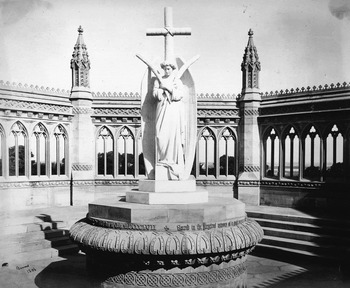
In the years following 1858, the initial construction and subsequent meanings associated with public memorials of the rebellion revealed a deep anxiety about the place of child death in the public memory of this war. In contrast to survivors’ accounts and the images of children’s dead bodies splayed across the pages of Punch during the height of the conflict, later memorials tended to erase child death, focusing instead primarily on the deaths of British women. In the most notable example, the memorial at the well of Kanpur where European women and children had been killed (fig. 6), the deaths of children were too painful to represent in any embodied visual form. An initial architectural plan for the memorial “proposed a sculpture consisting of dead children lying at the feet of an English woman leaning against a cross pierced with a sword.”Footnote 112 But Viceroy and Lady Canning, who commissioned the memorial paid for by the residents of Kanpur, rejected this proposal as too horrific. The final version completed in 1865 displayed an “Angel of the Resurrection” above the well and became widely known as “the Ladies’ Monument.”Footnote 113 Even though nearly twice as many children as women had been killed at Kanpur, in the long term their deaths could not be represented in their own right, but were rather used to reinforce messages of British women’s self-sacrifice and resilience. According to Stephen Heathorn, the Kanpur monuments, a main attraction for Britons in India, became “significant symbolic sites of memory for the raj as a whole.” The regulation of the site reinforced racial exclusion by forbidding all Indians from visiting the memorial well, and in this context the angel statue signified the ideals of British rule: “sacrifice, duty, fortitude and above all, the ultimate triumph over those who had threatened properly constituted
Photograph by Samuel Bourne, ca. 1864, in the Memorial Volume of Photographs, Newscuttings, Letters and Souvenirs, Relating to Charlotte Elizabeth Canning (1817–61), wife of Earl Canning (1812–62), Governor-General of India, 1856–62, British Library, India Office Select Materials, (C) British Library Board MSS Eur. D661, 29. The handwritten caption notes: “Marble figure ‘Angel of the Resurrection’ Sculptured by ‘Marochetti’ From designs drawn by Lady Canning. It stands over ‘the Well’ at Cawnpore which contained a great company of Christian people massacred in the Great Mutiny of 1857.”

authority and order.”Footnote 114 Standing in for the nation, the silenced women of Kanpur, not children, served to represent an empire founded on the civilizing mission.
At Lucknow as well, memorials to 1857 reinforced narratives of British fortitude and heroism. When Julia Inglis made her diary available to the larger public in the 1890s, one reviewer wrote, “The charming undulating grounds shown to visitors of to-day as ‘The Residency’ at Lucknow can afford but little notion of the space wherein more than a thousand Europeans, male and female, cooped up with a crowd of servants and sepoys, defended their lives for fifteen weeks.”Footnote 115 After noting the discrepancy between the existing memorials and the experience of the siege, however, the reviewer went on to reinforce the message of British bravery and heroism, making only one brief mention of the “innocent children” and no mention of their circumstances or deaths. Lucknow, like Kanpur and Delhi, became a major site for Britons following “mutiny tours.”Footnote 116 Photographers were obliged to photograph the ruins of the Residency buildings, vigilantly preserved by the Archaeological Survey of India, and tourists routinely purchased copies for their memorial scrapbooks.Footnote 117 The dominant narratives of the Lucknow siege that emerged highlighted the valor of the military men and the service of women such as Emmie Polehampton, recognized as a “ministering angel” for her aid to the suffering, but had little if anything to say about the children who died.Footnote 118
Unsurprisingly, the memorials to 1857 created a history and memory of the rebellion that served to reinforce the foundations of the British imperial project. Erasing the magnitude, violence, and hopelessness of child death in wartime was an essential feature of this history. Whereas the deaths of British women served to strengthen British ideals of a beneficent empire based on the civilizing mission, the deaths of British children ultimately raised questions about the sustainability of British rule in India. Rather than signifying a transfer of female domestic values to the imperial context, the deaths of children from starvation, malnutrition, disease, and shell fire underscored a collapse of the British domestic ideal. Beyond the obvious destruction of a new generation of Britons in India, child death revealed the difficulty of maintaining British cultural traditions and hierarchies in the imperial context. Typically cared for by Indian servants and, during the siege, put to rest by Indians rather than Europeans, in their deaths just as in their lives British children complicated understandings of a unified British community pitted against Indian rebels. Ultimately, however, as the Lucknow survivors’ accounts reached the British public, any doubts about the stability of the British domestic sphere within the empire were either displaced onto “unreasoning” women writers like Adelaide Case, presented as more concerned with crockery than victory, or forgotten altogether.
The result was that the shifting expressions of grief for children as well as adults who died during the conflict were shaped by the political context. Without access to communal British mourning rituals, including the witnessing of a child’s death and salvation, the preparation of the body, the funeral and burial service, and the marking of the grave for future visitation, survivors struggled to articulate and perform their grief. They pointed to their inability to mourn for children who died during war as a means to highlight the incongruity between an idealized childhood in safe, “British” domestic spaces and extreme wartime violence. These accounts suggested, in fact, that children should never have been present in such circumstances. The immediate reclamation of British mourning rituals beginning with the distribution of mourning attire as survivors made their way from Lucknow to Calcutta and the retelling of child wartime casualties as beautiful deaths surely allowed many survivors to express their grief more openly, providing them with comfort and solace. However, such nationalistic expressions of grief also left much unspoken and unremembered: the trauma of violent child death, the struggle for resources divided unequally among the besieged population, the awareness that Indian as well as British children were dying and that Britons were dependent on Indians for survival, and the utter loss of oneself that can come with grief for another—in sum, the collapse of an idealized British domestic sphere as a foundation of empire. The forms of national grief and memory that eventually dominated public accounts reaffirmed the ties that bound all Britons along with the distinct subject positions that had been eroded during the conflict: military men and domestic women, British colonizers and Indian subjects, nurturing adults and innocent, protected children.