INTRODUCTION
The nematode family Microlaimidae Micoletzky, Reference Micoletzky1922 mainly inhabits marine environments, from intertidal to deep-sea sediments. Much attention has been paid to the family due to its relatively high diversity and wide occurrence (e.g. Muthumbi & Vincx, Reference Muthumbi and Vincx1999; Kovalyev & Tchesunov, Reference Kovalyev and Tchesunov2005; Tchesunov, Reference Tchesunov and Schmidt-Rhaesa2014). Until now, 13 valid genera are included in Microlaimidae (Armenteros et al., Reference Armenteros, Vincx and Decraemer2010; Tchesunov, Reference Tchesunov and Schmidt-Rhaesa2014). Microlaimidae is clearly characterized by two outstretched ovaries and two opposed testes or only a single anterior testis (Tchesunov, Reference Tchesunov and Schmidt-Rhaesa2014). Jensen (Reference Jensen1978), Lorenzen (Reference Lorenzen1994) and Kovalyev & Tchesunov (Reference Kovalyev and Tchesunov2005) have made comprehensive revisions on the family Microlaimidae. Lorenzen (Reference Lorenzen1994) suggested the presence of a 12-fold vestibulum in stoma, teeth in the stegostom and in particular the outstretched ovaries as synapomorphies (= holapomorphies) of Microlaimidae. However, there are still contradictions in species of the type genus Microlaimus De Man, Reference De Man1880, for instance, both M. pecticauda Murphy, Reference Murphy1966 and M. spirifer Warwick, Reference Warwick1970 possess two reflexed rather than outstretched ovaries.
During an investigation of the nematode diversity in intertidal sediments from the East China Sea, we discovered a new species, which represents a new species of the family Microlaimidae: Spirobolbolaimus undulatus sp. nov. Based on the description and comparison with related genera and families, we emend the diagnosis of the genus Spirobolbolaimus and transfer Microlaimus pecticauda and M. spirifer to the genus Molgolaimus Ditlevsen, Reference Ditlevsen1921: Molgolaimus pecticauda (Murphy, Reference Murphy1966) comb. nov. and M. spirifer (Warwick, Reference Warwick1970) comb. nov.
MATERIALS AND METHODS
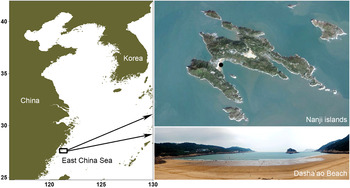
Sediment samples were collected from the Dasha'ao sand beach (27°27.76′N 121°3.48′E) in the Nanji Islands National Marine Natural Reserve in the East China Sea (Figure 1) in May 2014. Samples were fixed with formalin (5% final concentration) in filtered seawater. The fixed samples were stained with 0.1% Rose Bengal for 12 h and subsequently rinsed on a 500 µm sieve to remove large particles and on a 31 µm sieve to retain meiofauna. Nematodes retained on the 500 µm sieve were checked under a stereoscopic microscope and retrieved from the sieve. Meiofauna were extracted from the remaining sediments using Ludox HS 40 by centrifugation and sorted to higher taxa under a stereoscopic microscope. Nematodes were transferred into 9:1 (v/v) solution of 50% alcohol-glycerol in a cavity block to slowly evaporate to pure glycerol, and then mounted into permanent slides.
Sampling site (dot) in the Dasha'ao sand beach of the Nanji Islands in the East China Sea.

Species description was made from glycerol mounts (Platt & Warwick, Reference Platt, Warwick, Kermack and Barnes1983) using differential interference contrast (DIC) microscope (Nikon E80i). Line drawings were made with the aid of a drawing device. Type specimens have been deposited in the Marine Biological Museum of Chinese Academy of Sciences, Qingdao, China. All measurements are in μm, and all curved structures are measured along the arc. The terminology used for describing the arrangement of morphological features follows Coomans (Reference Coomans1979).
Abbreviations used in the paper are as follows: L = body length; abd = anal body diameter; mbd = maximum body diameter; a = L/mbd; b = L/pharynx length; c = L/tail length; c′ = tail length/abd; V = distance from anterior end to vulva; and V% = V × 100/L.
RESULTS
SYSTEMATICS
Order DESMODORIDA De Coninck, Reference De Coninck and Grassé1965
Suborder DESMODORINA De Coninck, Reference De Coninck and Grassé1965
Superfamily MICROLAIMOIDEA Micoletzky, Reference Micoletzky1922
Family MICROLAIMIDAE Micoletzky, Reference Micoletzky1922
Genus Spirobolbolaimus Soetaert & Vincx, Reference Soetaert and Vincx1988
EMENDED DIAGNOSIS (Based on Soetaert & Vincx, Reference Soetaert and Vincx1988 and the following description)
Microlaimidae. Cuticle more or less annulated. Anterior sensilla in three crowns with four cephalic setae shorter than six outer labial setae. Amphid fovea multispiral and ventrally wound, sclerotized. Postamphideal setae in six or eight longitudinal rows. Pharynx with anterior and posterior bulbs. Two opposed testes. Gubernaculum apophysis and/or precloacal supplements may be present.
TYPE SPECIES
Spirobolbolaimus bathyalis Soetaert & Vincx, Reference Soetaert and Vincx1988
Spirobolbolaimus undulatus sp. nov. (Figures 2–4; Table 1)
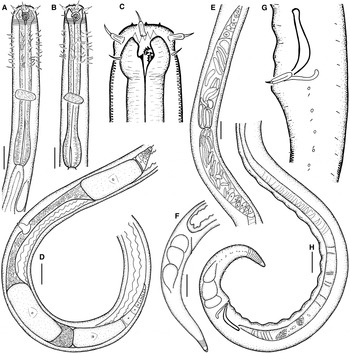
Spirobolbolaimus undulatus sp. nov., male and female: (A, C) male head, showing the six inner labial papillae, six jointed outer labial setae, four cephalic setae shorter and thinner than outer labial setae, eight longitudinal rows of postamphideal setae, multispiral amphid fovea, anterior and posterior pharynx bulbs and sclerotized buccal cavity with one dorsal, two subventral and eight small teeth; (B) female head, showing the same structure as that of male; (D) female reproductive system, showing the opposed outstretched ovaries, big eggs and large spermatheca filled with sperms; (E) male reproductive system, showing the opposed outstretched testes and elongate sperms; (F) female tail, showing the conical tail and three caudal glands; (G) male cloacal region, showing the spicules with gubernaculum apophysis and the rows of short somatic setae; (H) male posterior region, showing the undulate precloacal supplements. Scale bars: 30 µm.

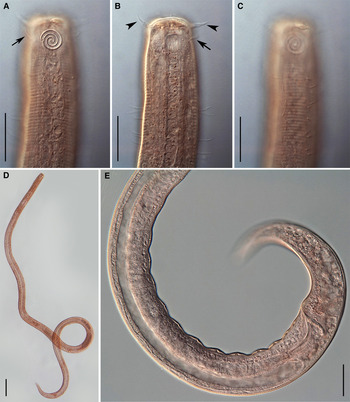
Spirobolbolaimus undulatus sp. nov., male and female: (A–C) male head, showing the distinct multispiral amphid fovea, jointed outer labial setae (arrowheads), short and thin cephalic setae (arrows) and longitudinal rows of postamphideal setae; (D) overall view of female, showing the slender body shape; (E) posterior region of male, showing the undulate precloacal supplements and the spicules with gubernaculum. Scale bars: A–C, E, 30 µm; D, 100 µm.

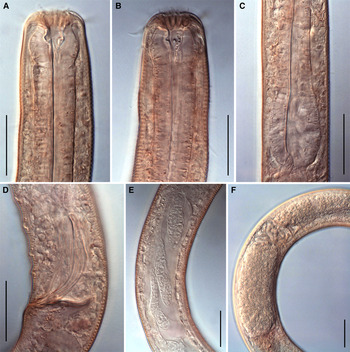
Spirobolbolaimus undulatus sp. nov., male and female: (A–C) male head, showing the anterior and posterior pharynx bulbs and strongly sclerotized buccal cavity with one dorsal, two subventral and eight small teeth; (D) cloacal region of male, showing the spicules with gubernaculum apophysis and undulate precloacal supplements; (E) testis with elongate sperms; (F) ovary and spermatheca filled with sperms and a big egg. Scale bars: 30 µm.

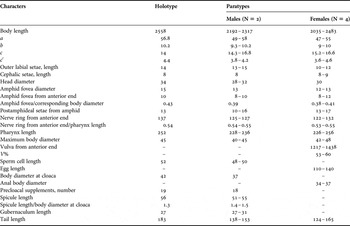
Measurements of Spirobolbolaimus undulatus sp. nov.

DIAGNOSIS
Body length 2–2.6 mm. Six inner labial papillae about 2 µm long; six outer labial setae thick and jointed, 10–15 µm long; and four slender cephalic setae 8–9 µm long. Buccal cavity strongly sclerotized with three main teeth and eight additional small teeth. Multispiral amphid fovea distinctly sclerotized, ventrally wound, composed of three turns about 13 µm across, occupying 39–43% of corresponding body diameter. Postamphideal setae in eight longitudinal rows. Spicules sclerotized with dorso-anteriad gubernaculum apophysis. 18–19 precloacal supplements in a series of mid-ventral hillocks with pores on tops.
TYPE MATERIAL
Holotype: One male on slide NJ-20140513-103. Paratypes: two males on slides NJ-20140513-30 and -32, and four females on slides NJ-20140513-29, -30, -45 and -85. All type slides have been deposited in the Marine Biological Museum of Chinese Academy of Sciences, Qingdao.
TYPE LOCALITY AND HABITAT
Intertidal sandy sediment in the Dasha'ao sand beach of the Nanji Islands in the East China Sea (27°27.76′N 121°3.48′E). Interstitial water temperature was 22°C and salinity 28 psu during sampling in May 2014. The sediment was classified as coarse sand, with the median particle diameter about 612 µm. Sediment organic matter content was about 2.5%.
ETYMOLOGY
The Latin adjective undulatus (undulate) refers to a main feature of the species, viz. the many precloacal supplements in an undulate pattern.
MEASUREMENTS
See Table 1.
DESCRIPTION
Body length 2–2.6 mm, slender and cylindrical, tapering posteriorly (Figure 3D). Cuticle with faint striation, except area of head and tail tip, about 2 µm wide between striations. Head blunt, slightly set-off. Anterior sensilla in three distinct crowns: six inner labial papillae about 2 µm long, six outer labial setae much thicker and jointed and 10–15 µm long, and four slender cephalic setae about 8–9 µm long (Figures 2C & 3A, B). 12 folded vestibula. Buccal cavity strongly sclerotized, with a slightly larger dorsal tooth, a pair of subventral teeth located at the same level and eight additional small lateral teeth in two rows (Figures 2C & 4A, B). Multispiral amphid fovea strongly sclerotized, ventrally wound, composed of three turns about 13 µm across, occupying 39–43% of corresponding body diameter (Figures 2A, B & 3A). Amphid fovea located at the same level as cephalic setae, with anterior border 0.3 head diameter behind anterior end and posterior part surrounded by cuticular striations (Figures 2A, B & 3A). Eight longitudinal rows each composed of 6–9 cervical setae, each 8–10 µm long, starting 13–17 µm behind the amphid fovea (Figures 2A, B & 3B, C). Pharynx with anterior bulb and enlarged posterior bulb, with a sclerotized lumen wall (Figures 2A–C & 4A, C). Nerve ring located at about 55% of pharyngeal length. Cardia 12–15 µm long. Intestine with large globular cells. Three caudal glands, emptying together. Somatic setae about 3 µm long, composed of two subventral and two subdorsal rows, a lateral row of setae also present at tail region. Cuticle pores at lateral field (Figure 2H). Tail conical without terminal setae.
Male diorchic, two opposed testes (Figure 2E). Anterior testis longer than posterior one due to greater development of its seminal vesicle, sperms in anterior testis larger than those in posterior one. Sperm cells large and elongate, banana-shaped, 48–52 µm long (Figure 4E). Spicules sclerotized with a capitulum. Gubernaculum apophysis curved and dorso-anteriad (Figures 2G & 4D). 18–19 precloacal supplements in a series of mid-ventral hillocks with pores on tops, forming a undulate pattern; the posterior 10–12 supplements rather distinct and the anterior rest supplements becoming less prominent upwards (Figures 2H & 3E).
Female didelphic, two outstretched ovaries (Figure 2D). Large spermatheca between ovary and uterus, filled with slim sperms. One large egg in uteri (Figures 2D & 4G). Eggs large, 100–140 µm long.
DISCUSSION
Spirobolbolaimus undulatus as a new species
Spirobolbolaimus undulatus sp. nov. is a member of the family Microlaimidae characterized by two outstretched ovaries and two opposed testes (Tchesunov, Reference Tchesunov and Schmidt-Rhaesa2014). Spirobolbolaimus undulatus is assigned to the genus Spirobolbolaimus based on the possession of the multispiral amphid fovea, outer labial setae longer than cephalic setae, longitudinal rows of postamphideal setae and the anterior and posterior pharynx bulbs. Within Microlaimidae, the new species is also similar to the genus Pseudomicrolaimus Sergeeva, Reference Sergeeva1976, which has a buccal cavity with three main teeth and numerous small teeth. However, the new species differs clearly from members of Pseudomicrolaimus by its multispiral amphid fovea (vs unispiral or circular) and longitudinal rows of postamphideal setae (vs absent).
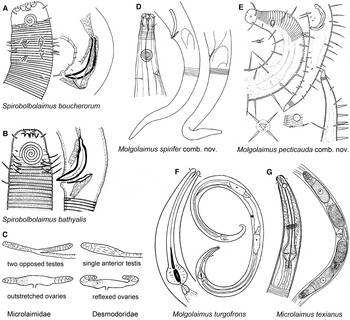
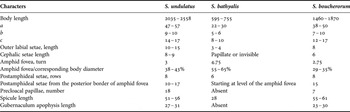
The genus Spirobolbolaimus contains two known species: S. bathyalis Soetaert & Vincx, Reference Soetaert and Vincx1988 and S. boucherorum Gourbault & Vincx, Reference Gourbault and Vincx1990 (Figure 5A, B). The new species differs distinctly from the type speceis Spirobolbolaimus bathyalis by having 8–9 µm long cephalic setae (vs less than 1 µm papillae), three main teeth and eight additional small teeth (vs only three main teeth and a pair of tooth-like projections), eight rows (vs six rows) of postamphideal setae, the presence (vs absence) of prominent gubernaculum apophysis and many precloacal supplements. The new species is most similar to Spirobolbolaimus boucherorum, but differs in the jointed outer labial setae (vs with smooth outline), three main teeth with eight additional small teeth (vs only three main teeth), and many distinct precloacal supplements (vs seven tiny papillate ones; Table 2).
Representatives of Spirobolbolaimus, Molgolaimus and Microlaimus: (A) Spirobolbolaimus boucherorum has four cephalic setae, eight rows of postamphideal setae, gubernaculum apophysis and precloacal supplements (from Gourbault & Vincx, Reference Gourbault and Vincx1990); (B) Spirobolbolaimus bathyalis has only papillate cephalic sensilla and six rows of postamphideal setae, and lacks gubernaculum apophysis and precloacal supplements (from Soetaert & Vincx, Reference Soetaert and Vincx1988); (C) Characters of reproductive system separating the families Microlaimidae (outstretched ovaries; two opposed testes or rarely a single testis) and Desmodoridae (reflexed ovaries and a single testis) (from Jensen, Reference Jensen1978); (D, E) Both Microlaimus spirifer Warwick, Reference Warwick1970 (from Warwick, Reference Warwick1970) and Microlaimus pecticauda Murphy, Reference Murphy1966 (from Murphy, Reference Murphy1966) have reflexed ovaries and are thus transferred to the Desmodoridae genus Molgolaimus: Molgolaimus spirifer (Warwick, Reference Warwick1970) comb. nov. and Molgolaimus pecticauda (Murphy, Reference Murphy1966) comb. nov.; (F) Molgolaimus turgofrons Jensen, Reference Jensen1978, a representative of Desmodoridae, has reflexed ovaries (from Jensen, Reference Jensen1978); (G) Microlaimus texianus Chitwood, 1951, a representative of Microlaimidae, has outstretched ovaries (from Muthumbi & Vincx, Reference Muthumbi and Vincx1999).

Comparison of species of Spirobolbolaimus.

Transfer of Microlaimus pecticauda and M. spirifer to Molgolaimus
The family Microlaimidae as well as its type genus Microlaimus is characterized by two outstretched ovaries (Figure 5G) and two opposed testes or only anterior testis (Tchesunov, Reference Tchesunov and Schmidt-Rhaesa2014). However, there are two exceptions in Microlaimus, in which both M. pecticauda and M. spirifer have two reflexed ovaries (Figure 5D, E). Jensen (Reference Jensen1978) transferred species of Microlaimus with two reflexed ovaries and one testis to the genera Aponema Jensen, Reference Jensen1978, Molgolaimus Ditlevsen, Reference Ditlevsen1921 and Prodesmodora Micoletzky, Reference Micoletzky1923, and erected a new family Molgolaimidae Jensen, Reference Jensen1978 for the three genera. Without considering the taxonomic significance of the reflexed ovaries in the two species, Jensen (Reference Jensen1978) transferred Microlaimus pecticauda and M. spirifer to the Microlaimidae genus Calomicrolaimus Lorenzen, Reference Lorenzen1976. Kovalyev & Tchesunov (Reference Kovalyev and Tchesunov2005) suggested Calomicrolaimus as a junior synonym of Microlaimus on the basis of their high similarity in main features. However, Tchesunov (Reference Tchesunov and Schmidt-Rhaesa2014) recognized Calomicrolaimus as a valid genus, but still retained Microlaimus pecticauda and M. spirifer in the genus Microlaimus.
In his comprehensive phylogenic analysis of free-living nematodes, Lorenzen (Reference Lorenzen1994) disagreed with Jensen's (Reference Jensen1978) establishment of the family Molgolaimidae and downgraded the family as a subfamily Molgolaiminae in Desmodoridae Filipjev, Reference Filipjev1922. Lorenzen (Reference Lorenzen1994) suggested that within free-living nematodes both the existence of two gonads and the pattern of reflexed ovaries are plesiomorphic, while the existence of a single gonad and the pattern of outstretched ovaries are apomorphic. Lorenzen (Reference Lorenzen1994) clearly stated the outstretched ovaries as a synapomorphy of the family Microlaimidae. Likewise, in a more recent revision on Microlaimidae, Kovalyev & Tchesunov (Reference Kovalyev and Tchesunov2005) emphasized the significance of the outstretched ovaries in the family Microlaimidae. Nonetheless, neither Lorenzen (Reference Lorenzen1994) nor Kovalyev & Tchesunov (Reference Kovalyev and Tchesunov2005) paid attention to the pattern of reflexed ovaries in Microlaimus pecticauda and M. spirifer.
On account of the reflexed ovaries and other important features, both Microlaimus pecticauda and M. spirifer match well with the family Desmodoridae rather than Microlaimidae (Figure 5C–E). However, all members of the family Desmodoridae possess a single anterior testis, which was indicated by Lorenzen (Reference Lorenzen1994) as a synapomorphy of the family. Leduc & Verschelde (Reference Leduc and Verschelde2013) proposed a monospecific genus Onepunema with two reflexed ovaries and two testes and assigned it to the family Desmodoridae. However, the two features match neither the diagnosis of the family Desmodoridae nor that of Microlaimidae. Armenteros et al. (Reference Armenteros, Ruiz-Abierno and Decraemer2014) treated Onepunema as a taxon incertae sedis within the family Desmodoridae. The testis structure is still not known for both Microlaimus pecticauda and M. spirifer. If the two species have one testis, the assignment of the two species to Desmodoridae is assured. Alternatively, if they have two testes, like the genus Onepunema, the two species may represent undescribed genera or even family. Nonetheless, we transfer the two species to the family Desmodoridae at the present state of knowledge.
Within Desmodoridae, Microlaimus pecticauda and Microlaimus spirifer match the generic diagnosis of Molgolaimus in the lack of head capsule and the posteriorly located amphid fovea (Figure 5D–F). Thus, we transfer Microlaimus pecticauda and Microlaimus spirifer to Molgolaimus: Molgolaimus pecticauda (Murphy, Reference Murphy1966) comb. nov. and M. spirifer (Warwick, Reference Warwick1970) comb. nov. Molgolaimus pecticauda differs distinctly from all other species of the genus by its amphid with protruded corpus gelatum and long somatic setae. Molgolaimus spirifer has a multispiral amphid fovea, differing from all other species of Molgolaimus which have circular or unispiral amphid fovea. Superficially, members of Molgolaimus as well as Molgolaiminae look very similar to those of Microlaimidae, but differ distinctly by the reflexed ovaries (Tchesunov, Reference Tchesunov and Schmidt-Rhaesa2014).
ACKNOWLEDGEMENTS
We thank Mr Wandong Chen and the Chief Engineer Mr Houcai Cai of Nanji Islands National Marine Natural Reserve for their assistance in sample collection. We wish to extend thanks to two anonymous reviewers for constructive suggestions and comments. Special thanks are due to Prof. Yong Huang of Liaocheng University in China for his friendship and help in our journey in nematode taxonomy.
FINANCIAL SUPPORT
This work is supported by the National Programme on Global Change and Air-Sea Interaction (Grant No: GASI-01-02-02-02) and the Programme on Survey and Protection Evaluation on Marine Biological Resources and Habitats of the Nanji Islands National Marine Natural Reserve of the State Oceanic Administration of China (2010).