FOCUS POINTS
• Tic disorders (TD) affect approximately 30% of obsessive-compulsive disorder (OCD) patients.
• Compared to OCD individuals without TD, the comorbid group (OCD + TD) shows male preponderance, more sensory phenomena, and higher severity of some symptom dimensions, as well as a different pattern of psychiatric comorbidities.
• Tic related-OCD may constitute a particular subgroup of this heterogeneous condition, with specific phenotypical features.
Introduction
Obsessive-compulsive disorder (OCD) is a chronic and disabling psychiatric disorderReference Koran, Thienemann and Davenport1, Reference Niederauer, Braga and Souza2 with a lifetime prevalence of 2–2.5% in the general population.Reference Weissman, Bland and Canino3–Reference Fontenelle, Mendlowicz and Versiani5
OCD is currently viewed as a highly heterogeneous psychiatric disorder, with different clinical phenotypes, which probably reflect different subtypes. Evidence from phenomenological, family, genetic, neuroimaging, and treatment studies have suggested that tic-related OCD could be described as a putative OCD subtype, possibly involving differential pathophysiological mechanisms.Reference Miguel, Leckman and Rauch6–Reference de Mathis, Diniz and Torres8 For instance, previous studies have shown that approximately 30% of OCD patients also present with Tourette syndrome (TS) or other tic disorders (TD).Reference Rosario-Campos, Leckman and Curi9 Other studies have consistently reported particular characteristics in OCD patients with co-occurring TD, such as an earlier age of symptom onset; a predominance of males; higher frequency and severity of specific symptom dimensions; higher comorbidity with mood, anxiety, and attention deficit and hyperactivity disorders; trichotillomania; body dysmorphic disorder; and a higher prevalence of sensory phenomena (disturbing sensations, perceptions, feelings, or urges) preceding their repetitive behaviors, when compared to OCD patients without TD.Reference Miguel, do Rosário-Campos and Shavitt10, Reference de Mathis, do Rosario and Diniz11
The objective of the present study was to compare OCD associated with TD (i.e., TS and chronic tic disorders—OCD + TD) to OCD without TD (OCD – TD) regarding demographic data, several clinical measures such as the presence and severity of obsessive-compulsive symptom (OCS) dimensions, sensory phenomena, and Axis I psychiatric comorbidity in a large sample of OCD patients. Our main hypotheses were that OCD patients with TD would be more likely than those without TD to present the following: an age and gender distribution resembling the early onset OCD group, sensory phenomena, more severe symptoms of the aggression and symmetry dimensions, and a pattern of comorbid disorders previously described in other countries.Reference Miguel, do Rosário-Campos and Shavitt10, Reference de Mathis, do Rosario and Diniz11
Methods
This is a cross-sectional study that includes data on 813 consecutive OCD outpatients from the Brazilian OCD Research Consortium (C-TOC)Reference Miguel, Ferrão and Rosário12; the data were obtained from seven different Brazilian sites between August 2003 and August 2008. Patients with schizophrenia, organic mental disorders, or any other clinical condition that would interfere with the quality of the data collected were excluded. The study was approved by all the university hospital ethics committees involved in the study, and all participants signed a written informed consent. Interviewers were clinical psychologists or psychiatrists with expertise in OCD and were properly trained to apply the complete research protocol.
The following instruments of assessment were applied: the Structured Clinical Interview for DSM-IV Axis I Disorders (SCID-I),Reference First, Spitzer and Gibbon13 the Yale-Brown Obsessive-Compulsive Scale (Y-BOCS),Reference Goodman, Price and Rasmussen14 the Dimensional Yale-Brown Obsessive-Compulsive Scale (DY-BOCS),Reference Rosario-Campos, Miguel and Quatrano15 the Yale Global Tic Severity Scale (YGTSS),Reference Leckman, Riddle and Hardin16 the USP Sensory Phenomena Scale (USP-SPS),Reference Rosario, Prado and Borcato17 the Beck Depression Inventory,Reference Beck, Ward and Mendelson18 and the Beck Anxiety Inventory.Reference Beck, Epstein, Brown and Steer19 Additional questionnaires investigating other clinical aspects and medical conditionsReference Miguel, Ferrão and Rosário12 were also included in the protocol. Detailed information about the C-TOC, as well as training and reliability among interviewers, can be found elsewhere.Reference Miguel, Ferrão and Rosário12
Demographic and clinical features of the two study groups (OCD + TD and OCD – TD) were compared using the Pearson's chi-square test for categorical data, with Yates correction when necessary. Continuous variables were investigated by nonparametric tests (Mann–Whitney), as appropriate. All tests were two-tailed, with p values lower than .05 being considered significant. Statistical analyses were conducted using the SPSS version 16.0 software (SPSS Inc., Chicago, IL) and R: A Language and Environment for Statistical Computing, version 2.9.1.
Results
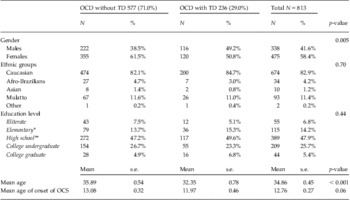
Social and demographic data are shown in Table 1. A total of 813 patients were recruited, 338 (41.6%) of which were males and 674 (83%) Caucasians. The sample mean current age was 34.9 years old (SE 0.45) and the mean age at of OCS onset was 12.8 years old (SE 0.27). Sensory phenomena were reported by 585 individuals, which is 72% of the total sample. The general prevalence of TD (including TS and other chronic TD) in the sample was 29.0% (n = 236), with 8.9% (n = 72) presenting TS, 17.3% (n = 141) presenting chronic motor tic disorder, and 2.8% (n = 23) presenting chronic vocal tic disorder. The mean tic severity score, according to the YGTSS, was 27.2 (SE 1.4) in the OCD + TD group.
Demographic data of the OCD sample (N = 813) and mean age of obsessive-compulsive symptoms onset, according to the presence or absence of co-occurring tic disorders

TD, tic disorders = Tourette syndrome + motor/vocal chronic tic disorders.
OCD = obsessive-compulsive disorder.
s.e. = standard error.
*Up to 8 years of formal education.
*9–12 years of formal education.
Among subjects without TD, only 38.5% were males, compared with 49.2% in the OCD + TD group (p = 0.005). There were no differences between the two study groups regarding ethnicity and educational level. The mean age of OCS onset of was 13.1 years old in the OCD – TD group and 12.0 among the OCD + TD group—a difference that did not reach statistical significance. Current mean age was significantly lower (32.3 years) among patients in the OCD + TD group compared to patients with OCD – TD (35.9 years).
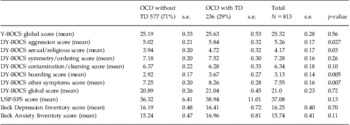
Current severity of OCS, measured with the Y-BOCS and the DY-BOCS global scores, did not differ between the groups (Table 2). The severity of the following symptom dimensions was higher in the OCD + TD group: “aggressive” (p = 0.027), “sexual/religious” (p = 0.03), “hoarding” (p = 0.005), and “others” (p = 0.007). This group also showed a higher rate of sensory phenomena (80.1% vs. 68.6%, p = 0.001), but the difference in severity (USP-SPS score) was not significant. The depressive and anxiety symptom scores (Beck inventories) also did not differ between the two study groups (Table 2).
Current severity of obsessive-compulsive, sensory phenomena, and depressive and anxious symptoms in OCD patients with and without tic disorders

Y-BOCS = Yale-Brown Obsessive-Compulsive Scale; DY-BOCS = Dimensional Yale-Brown Obsessive-Compulsive Scale; USP-SPS = University of São Paulo Sensory Phenomena Score.
TD, tic disorders = Tourette syndrome + motor/vocal chronic tic disorders.
OCD = obsessive-compulsive disorder.
s.e. = standard error.
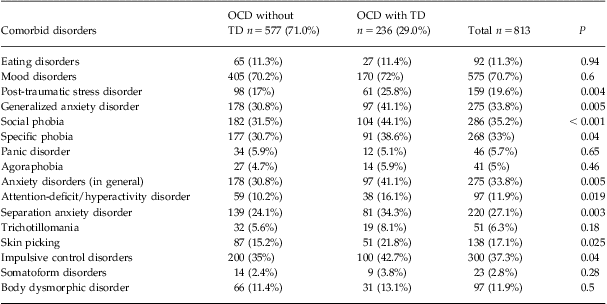
Data on Axis I comorbidity are shown in Table 3. The OCD + TD group showed increased rates of anxiety disorders in general (p = 0.005), social phobia (p < 0.001), specific phobia (p = 0.04), generalized anxiety disorder (p = 0.005), and posttraumatic stress disorder (PTSD) (p = 0.004). The presence of separation anxiety disorder was also associated with OCD + TD (p = 0.003). Attention-deficit/hyperactivity disorder (ADHD) (p = 0.019), skin picking (p = 0.025), and impulse control disorders in general (p = 0.04) were also more frequent in the OCD + TD group when compared to the OCD – TD group. The prevalence of other lifetime Axis I disorders did not differ between groups (Table 3).
Lifetime comorbid Axis I disorders in OCD patients with and without tic disorders
Discussion
To our knowledge, this is the largest systematic study that has compared clinical characteristics of OCD patients with and without comorbid TD. This comprehensive, multicenter study used structured assessment instruments applied by OCD experts. It is innovative in its use of specific and standardized instruments to assess the occurrence and severity of obsessive-compulsive symptom dimensions (DY-BOCS) and sensory phenomena (USP-SPS). As expected, the general prevalence of TS and chronic motor/vocal tics in the whole OCD sample was 8.9% and 20.1%, respectively, which is a finding that resembled early reports.Reference de Mathis, do Rosario and Diniz11 Moreover, consistent with previous studies, one-third of the subjects with TD presented a TS diagnosis.Reference de Mathis, Diniz and Shavitt20
Regarding the age at onset of OCS, the OCD + TD group tended to present earlier onset, as observed in several previous studies.Reference de Mathis, do Rosario and Diniz11, Reference de Mathis, Diniz and Shavitt20–Reference Jaisoorya, Reddy, Srinath and Thennarasu25 As expected, the proportion of males was greater in the OCD + TD group.Reference de Mathis, do Rosario and Diniz11, Reference de Mathis, Diniz and Shavitt20, Reference Ferrão, Miguel and Stein26
Regarding the overall clinical severity scores, obsessive-compulsive, depressive, and anxiety symptoms were similar in both groups. This is an intriguing finding that goes against the traditional view that OCD patients with TS have more severe psychopathology that can lead to a worse treatment response.Reference McDougle, Goodman and Leckman27, Reference McDougle, Goodman and Leckman28 However, there were significant differences in the severity of specific symptom dimensions (“aggression,” “sexual/religion,” and “hoarding”), which were more severe in the OCD + TD group, giving support to previous findings.Reference de Mathis, do Rosario and Diniz11, Reference Leckman, Bloch and King29 These same dimensions have been reported as more frequent in the early onset OCD group,Reference de Mathis, do Rosario and Diniz11, Reference Hasler, LaSalle-Ricci and Ronquillo30, Reference Leckman and Bloch31 and “hoarding” has also been considered as a special OCD subtype, with specific features including a more chronic course and worse treatment response.Reference Bloch, Landeros-Weisenberger and Rosario32 Since OCD has been considered a developmental disorder,Reference Leckman, Bloch and King29 it is possible that early insults in the cortico-striatal circuits may impact several others neural circuits, leading to the manifestation of diverse clinical pictures.
“Sensory phenomena” is a broad term that is used to define uncomfortable or disturbing sensations, perceptions, feelings, or urges that either precede or accompany repetitive behaviors such as compulsions or tics.Reference Rosario, Prado and Borcato17, Reference Miguel, Baer and Coffey21, Reference Rosario-Campos, Leckman and Mercadante22 OCD patients might feel driven to repeat the compulsions until they experience a sense of relief from these uncomfortable sensations. Examples include sensations in the skin, “just-right” perceptions, and feelings of incompleteness.Reference Rosario, Prado and Borcato17 Sensory phenomena have been strongly associated with tic-related OCD, and they may have a particular role in behavioral treatments in this group of patients.Reference Bloch33 The so called “tic-like” compulsions, which were previously associated with TD comorbidity in OCD,Reference Miguel, Coffey and Baer34 may be related to these sensory phenomena, as these patients present repetitive behaviors motivated by uncomfortable physical or emotional feelings, but not by specific cognitions or fears.
Some Axis I disorders co-occurred more frequently in the OCD + TD group, especially anxiety disorders (separation anxiety, specific and social phobias, generalized anxiety disorder, and PTSD), as well as ADHD, impulse control disorders, and other repetitive behaviors, such as skin picking.
Previous studiesReference Cath, Spinhoven and van Woerkom35 have reported that impulsivity and some repetitive behaviors are more frequent in OCD + TD and in TD patients, when compared to OCD patients without TD and other clinical controls. In fact, the involuntary nature of the majority of tics makes them resemble impulsions more than compulsions, but tics can also be considered semivoluntary, in the sense that they can be postponed most of the time or be performed in response to urges or sensory phenomena. This may also be the case of certain compulsions and nonfunctional repetitive behaviors, such as hair pulling and skin picking, which are performed with a very specific “grooming” purpose.Reference Ferrão, Miguel and Stein26, Reference Potenza, Koran and Pallanti36 Thus, it has been proposed that TD, OCD, and these repetitive nonfunctional behaviors belong to an impulsive-compulsive spectrum of disorders,Reference Hollander, Kim and Khanna37, Reference Geller38 which implicates the need for the development of specific pharmacological and behavioral therapies tailored to each one of these phenotypes. The OCD + TD group presented with a higher rate of ADHD—a condition associated with impulsivity and motor disinhibition, which has been frequently described in both TD and early-onset OCD.Reference Geller38, Reference Walitza, Zellmann and Irblich39 Nevertheless, several other conditions characterized by impulsivity are not related to the OCD spectrum. Moreover, the prevalence of trichotillomania was not significantly different between groups in this study. This was an unexpected finding, but may be due to the small number of subjects with this specific comorbidity (type II error).
The higher frequency of anxiety disorders, especially social phobia and generalized anxiety disorder, has been reported in previous studies that have assessed TD and OCD + TD.Reference de Mathis, do Rosario and Diniz11, Reference Miguel, Baer and Coffey21, Reference Diniz, Rosario-Campos and Hounie24, Reference Ferrão, Miguel and Stein26, Reference Petter, Richter and Sandor40, Reference Coffey, Miguel and Biederman41 The association between the tic-related OCD group and PTSD is a new finding, since previous studies reported no significant association of traumatic experiences or PTSD with OCD + TD.Reference Ferrão, Miguel and Stein26, Reference Grabe, Ruhrmann and Spitzer42 Psychological trauma may play an etiological role not only in PTSD and tic disorders, but also in OCD,Reference de Silva and Marks43, Reference Fontenelle, Cocchi and Harrison44 and these conditions may share the same moderator agents. Moreover, the high prevalence of impulsivity and ADHD in this population might also have increased the chance of exposure to traumatic situations.
The main limitations of our study include possible recall bias in the retrospective information that was collected using a cross-sectional design and uncertainty about the extent of the external validity of this information, considering that all participants were attending tertiary health services.
Conclusion
Our findings, which originated from a large sample of Brazilian outpatients, support the pattern that, compared to OCD without TD, OCD plus TD is a particular subgroup with some specific clinical features, such as male preponderance, more sensory phenomena, and higher severity of some symptom dimensions, as well as a different pattern of psychiatric comorbidities. Nevertheless, its neurobiological underpinnings remain to be fully disentangled. Future prospective studies to assess pre-morbid, “at risk” subjects for developing OCD and TD should correlate genetic, neuroimaging, and neuropsychological findings with different OCS dimensions in order to clarify their roles in the final phenotypical expressions. Further studies are also warranted to investigate possible implications of TD comorbidity for treatment approaches and response.
Disclosures
Pedro de Alvarenga, Maria Alice de Mathis, Anna Cláudia Dominguez Alves, Maria Conceição do Rosário, Victor Fossaluza, Ana Gabriela Hounie, Euripedes Constantino Miguel, and Albina Rodrigues Torres do not have anything to disclose.
Maria Conceição do Rosário has been a speaker for the companies Novartis and Shire in the past year.