Clostridium difficile is now the most common organism to cause healthcare-associated infection in the United States and C. difficile infection (CDI) is regarded as one of the serious, expensive, and potentially avoidable consequences of hospitalization.Reference Magill, Edwards and Bamberg1, Reference McDonald, Owings and Jernigan2 The emergence of the virulent NAP1/B1/027 strain and the concern over resistance to traditional antibiotic regimens have elevated C. difficile prevention to a high priority on a national level.Reference Dubberke, Gerding and Classen3 Despite the national attention, the incidence of CDI continues to grow and the financial and human costs of CDI continue to mount.Reference Dubberke, Butler and Yokoe4–Reference Zimlichman, Henderson and Tamir6 The US government’s decision to withhold Medicare reimbursement for hospitals due to CDI in 2017 underscores the gravity of the problem and the severe financial penalties it is willing to levy to address this problem.Reference Lipp, Nero and Callahan7, 8
Epidemiological data suggest that surgical patients have twice the burden of healthcare-associated infection (HAI) when compared to their medical counterparts and that the burden of CDI is increasing among surgical patients.Reference Sax, Uçkay and Balmelli9 This is concerning given the fact that surgical care comprises approximately 40%–50% of all hospital stays and healthcare dollars.Reference Birkmeyer, Gust, Dimick, Birkmeyer and Skinner10 However, prior studies devoted to the investigation of CDI and its impact on the surgical patient population are limited by the use of administrative data, failure to capture cases diagnosed after discharge, or reports from single centers. Surgical patients, although usually younger and healthier than their medical counterparts, frequently receive prophylactic antibiotics and have long inpatient hospital exposure. Large-scale, multicenter studies that focus on the burden of surgical patients gauge the effects of CDI and aim to address the current epidemiological challenges of the disease.
In this context, we designed a prospective, population-based study of hospital-acquired, postoperative CDI within the context of a statewide surgical quality collaborative. Our research questions were: (1) Which surgical procedures are associated with the highest risk for CDI? (2) Which patient characteristics are associated with CDI risk? (3) Is perioperative antibiotic use independently associated with CDI? Finally, we assessed the burden of CDI on resource utilization at the hospital level (extended length of stay, 30-day emergency department presentations, hospital readmission, and reoperation). With new reimbursement legislation and penalties on the horizon, the results from this study can help inform clinicians and administrators about timely and practical strategies to target certain surgical patient populations at high risk for CDI.
METHODS
Data Sources
The Michigan Surgical Quality Collaborative (MSQC) is a 52-hospital consortium representing diverse practice settings throughout the state. MSQC data abstraction and data quality assurance details have been described elsewhere.Reference Campbell, Englesbe and Kubus11, Reference Hendren, Fritze and Banerjee12 In brief, specially trained data abstractors prospectively collect patient characteristics, intraoperative processes of care, and 30-day postoperative outcomes for patients undergoing specified surgical operations utilizing a sampling algorithm that minimizes selection bias. Regular data audits ensure registry data validity. Data collection for MSQC is exempt from institutional review board (IRB) review at participating hospitals, and the current study was reviewed and deemed “non-regulated” by the University of Michigan’s IRB.
Patient Population
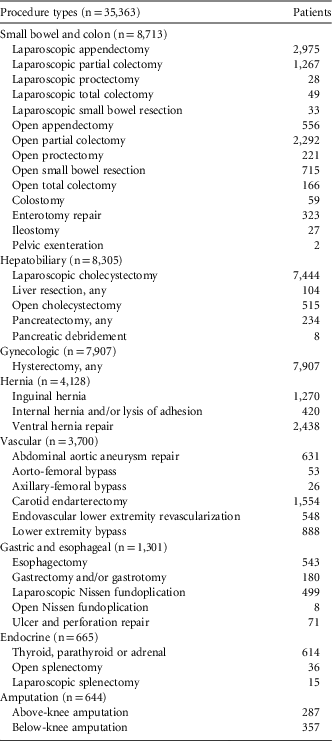
Patients aged 18 years and older undergoing selected general, vascular, or gynecologic operations from July 2012 to September 2013 at any of 52 MSQC community or academic hospitals were included in this study. Forty different procedure types were identified based on Current Procedural Terminology (CPT) codes and grouped into 8 clinically relevant categories (Table 1) to limit degrees of freedom.
Distribution of Patients Across 8 Different Categories

Independent Variables
Registry-based clinical and demographic data analyzed included age, sex, race, American Society of Anesthesiologists (ASA) class, functional status, and body mass index (BMI). Comorbidities included preoperative cardiac, pulmonary, gastrointestinal, renal, neurological, hematological, infectious, and endocrine diagnoses. Patients were categorized as having no comorbidities, 1 comorbid condition, or ≥2 comorbidities. Hypoalbuminemia was defined as a preoperative albumin blood level ≤3.5 g/dL. Patients who did not have an albumin level were categorized in a separate category within this variable.
Antibiotic prophylaxis processes were categorized into the following mutually exclusive 3 categories: patients who received intravenous antibiotics within 1 hour of incision for prophylaxis; patients who were exempt from receiving prophylactic preoperative antibiotics due to use of therapeutic antibiotic therapy for a preexisting infection; and patients who did not receive prophylactic antibiotics.
Main Exposure Variable and Outcome Measures
The development of hospital-acquired postoperative CDI was the main outcome measure in this study. The MSQC piloted the abstraction of CDI as an outcome for colectomy surgery between 2008 and 2012, and then began prospectively measuring this outcome for all eligible cases in 2012. This is the first study using this unique data source. CDI was defined as a laboratory-confirmed positive toxin assay by polymerase chain reaction (PCR), enzyme-linked immunosorbent assay (ELISA), or stool culture up to 30 days postoperatively. Postdischarge complications, including CDI, were identified using a 30-day follow-up procedure that included some combination of medical record review, a patient letter, and/or a patient phone call. Patients who had a positive result within 72 hours of admission were excluded to reduce inclusion of community-acquired CDI cases.Reference McDonald, Coignard, Dubberke, Song, Horan and Kutty13 CDI was also analyzed as an exposure variable to assess its impact on the following resource utilization metrics, which were the secondary outcome measures in this study: (1) extended length of stay (LOS), defined as LOS which extended beyond the 75th percentile; (2) any emergency department (ED) presentation within 30 days of index operation; (3) any 30-day hospital readmission; and (4) any reoperation within 30 days, regardless of indication.
Statistical Analyses
Patients’ clinical and demographic variables were analyzed using χ2 tests for categorical and 2-sided t tests for continuous variables, with significance set at P<.05.
Multivariable logistic regression was used to identify risk factors for CDI. To account for clustering within the 52 included hospitals, robust standard errors were calculated. The model was evaluated for discrimination using the C statistic. The C statistic evaluates model discrimination and represents the area under the receiver-operator-characteristic curve. A value of 0.5 indicates that the model is equivalent to chance, while a value of 1.0 indicates perfect discrimination. To assess the association of CDI with resource utilization measures, 4 multiple logistic regression models with robust standard errors were constructed with CDI as an exposure variable, along with other independent variables.
Post Hoc Analysis
To assess the robustness of the results given the low event rate, post hoc power calculations were performed, and the sample size was deemed adequate to answer the research questions. For example, in assessing the association between prophylactic antibiotics and postoperative CDI, the study had a statistical power of 96%.
All statistical analyses were conducted using STATA special edition (version 13, StataCorp, College Station, TX).
RESULTS
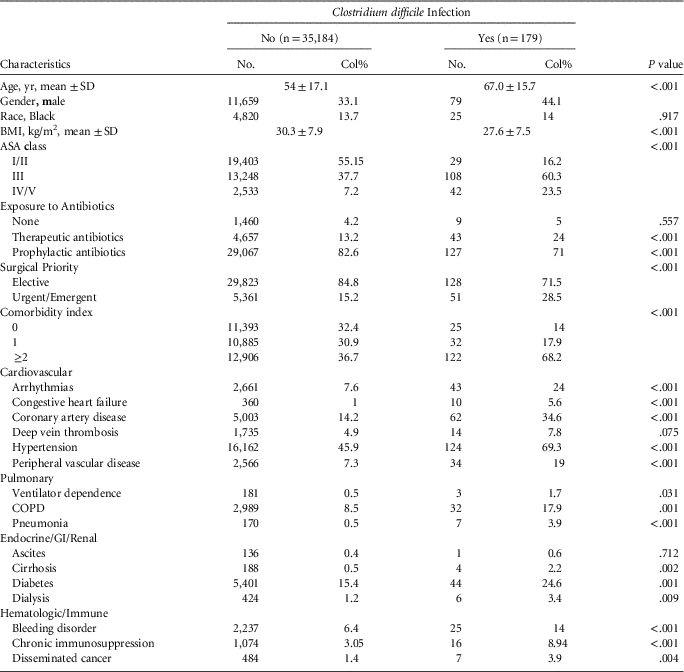
For the 15-month study period, electronic medical records of 35,363 patients undergoing surgery at 52 MSQC community and academic hospitals were studied. Of these patients, 179 (0.51%) developed a hospital-acquired postoperative CDI. On univariate analyses, patients developing CDI were older, had lower BMIs, higher ASA scores, more comorbid conditions, and were more likely to have undergone urgent or emergent surgery (Table 2). Patients developing CDIs were also more likely to have been exposed to preoperative therapeutic antibiotics for other indications.
Clinical and Demographic Characteristics
NOTE. % may not add to 100% due to rounding.
SD, standard deviation; BMI, body mass index; ASA, American Society of Anesthesiologists; COPD, chronic obstructive pulmonary disease; GI, gastroinestinal.
Postoperative CDI incidence rates varied significantly among the 8 procedure groups (Fig. 1). Lower-extremity amputations had the highest incidence of CDI at 2.6%, followed by bowel resection and/or repair operations at 0.9%. Endocrine and gynecologic operations had the lowest incidence rates (0 and 0.1%, respectively).
Incidence of Clostridium difficile infection (CDI) varies across different surgical procedure types. The horizontal line represents the overall population mean (0.51%).
Using multivariable analysis, increasing age (aOR, 1.03; 95% confidence interval [CI], 1.01–1.04), hypoalbuminemia (aOR, 1.76; 95% CI, 1.12–2.77), preoperative sepsis (aOR, 1.65; 95% CI, 1.09–2.51), and chronic immunosuppression (aOR, 1.56; 95% CI, 1.01–2.41) were independently associated with CDI, but not prophylactic antibiotics, ASA class, surgical priority, comorbidity index, or weight loss. Obese patients were less likely to develop CDI (aOR, 0.62; 95% CI, 0.42–0.93). In addition, 3 procedure groups had higher adjusted odds of postoperative CDI: lower-extremity amputations (aOR, 3.5; 95% CI, 1.59–7.9), gastric or esophageal operations (aOR, 2.14; 95% CI, 1.05–4.35), and bowel resection or repair (aOR, 2.01; 95% CI, 1.06–3.8).
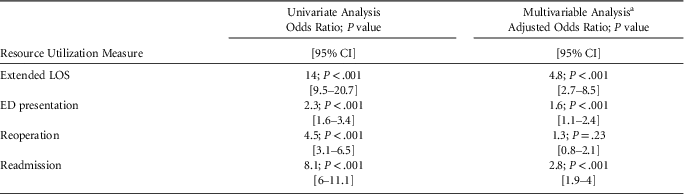
When examining the resource utilization metrics as the outcome, significant associations with CDI were evident (Table 3). Postoperative CDI was independently associated with increased length of stay (mean, 13.7 d vs 4.5 d), higher risk-adjusted ED presentation rates (18.9% vs 9.1%) and risk-adjusted readmission rates (38.9% vs 7.2%) within 30 days of operation (all P<.001).
Impact of Clostridium difficile Infection (CDI) on Resource Utilization Measures
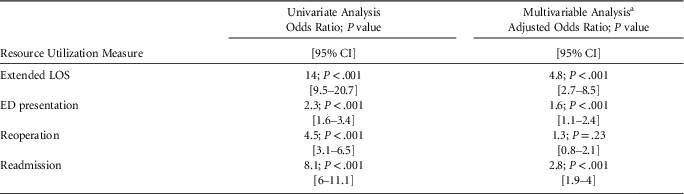
CI, confidence interval; ED, emergency department; LOS, length of stay.
a After adjusting for age, sex, race, body mass index (BMI), American Society of Anesthesiologists (ASA) class, prophylactic antibiotics, surgical priority, preoperative sepsis, procedure type, hypoalbuminemia, weight loss, any complication (excluding CDI), and other comorbidities. All statistical models have a C statistic >.7.
DISCUSSION
This study of 35,363 surgical patients at 52 different hospitals in the state of Michigan showed (1) that the incidence of postoperative CDI, although uncommon overall, was greater in lower-extremity amputations, gastric or esophageal operations, and bowel resection or repair; (2) that the use of intravenous prophylactic antibiotics was not associated with CDI, and (3) that CDI was significantly associated with organizational resource utilization metrics, as risk adjusted readmission rates and LOS were more than double in patients with CDI.
The overall incidence rate of CDI of 0.51% is comparable to other published incidence rates.Reference Lesperance, Causey, Spencer and Steele14–Reference Zerey, Paton, Lincourt, Gersin, Kercher and Heniford17 However, the recent time frame, diverse surgical population, and prospective data collection with 30-day follow-up are unique to this report. During the year the data were collected (2012–2013), the majority of Michigan hospitals had adopted PCR diagnostic testing methodology, which is more sensitive and specific and therefore has fewer false-positive results. Furthermore, our study reflects the contemporary nature of the CDI epidemic in this cohort of surgical patients, most likely involving a substantial number of cases caused by epidemic strains of C. difficile, including the NAP1/BI/027 strains. Nonetheless, direct comparison of CDI rates to other surgical populations and reports is difficult because the incidence and consequence of CDI are not uniformly defined, reported, nor calculated, especially among administrative databases.Reference Lesperance, Causey, Spencer and Steele14, Reference Zerey, Paton, Lincourt, Gersin, Kercher and Heniford17
The present study demonstrates that CDI incidence rates vary significantly between procedures. Similar to the work by Zerey et al,Reference Zerey, Paton, Lincourt, Gersin, Kercher and Heniford17 patients undergoing gastric, small bowel, or colonic resection were at greater risk for CDI. The highest incidence, however, was in patients undergoing a lower-extremity amputation, (2.6%; aOR, 3.5). These patients tend to be in and out of the hospital very frequently before ultimately undergoing an amputation or to have frequent courses of therapeutic antibiotics, thereby increasing their likelihood of developing this infection. On the other hand, the low incidence of CDI among patients who underwent endocrine operations or hysterectomy is not surprising, given that most of them have a short and limited exposure to the healthcare setting. Although the majority (95%) of patients developing CDI had some form of exposure to antibiotics, prophylactic antibiotics per se were not associated with CDI in this study, confirming the findings from a prior study limited to colectomy patients.Reference Krapohl, Morris and Cai18 While there was a trend for patients who were receiving therapeutic antibiotics for other indications to develop CDI, this trend did not reach statistical significance in the multivariable analysis. It is important to note, however, that patients undergoing higher-risk surgical operations are also more likely to be exposed to preoperative antibiotics depending on their indication (eg, colectomy for diverticulitis), thereby contributing to the overall risk.
From a human and financial perspective, CDI is a costly infection. The financial costs of a CDI episode for a hospital are estimated to be approximately $10,000.Reference McGlone, Bailey and Zimmer5, Reference Zimlichman, Henderson and Tamir6 The human cost, is more difficult to quantify but no less important. Together these costs create a preventable burden that could be a rich target for quality improvement and patient care outcomes. Our data confirm that CDI has significant downstream strains on resource utilization. The readmission rate was more than double compared with those patients without CDI. This is not surprising given the deconditioning, dehydration and overall fatigue that accompany CDI in patients already debilitated by recent surgery. With the continued rise in CDI and stricter financial penalties in 2017, there is a strong business case for making an investment in strategy and resources for CDI prevention.Reference Dubberke, Butler and Yokoe4
Because surgical patients already carry twice the burden of HAI than their medical counterparts, administrators may want to consider pathogen-directed or vertical interventions to target specific surgical patients undergoing high-risk procedures. Pathogen-directed and vertical interventions are designed to prevent transmission of specific pathogens causing the infection; they are developed to combat the unique epidemiological characteristics of the organism. In contrast, the non-pathogen–directed, or horizontal, intervention approach attempts to reduce the rates of all infections from all pathogens simultaneously.Reference Wenzel and Edmond19 An example of a pathogen-directed approach is the success of the rapid screening and decolonizing of nasal carriers of Staphylococcus aureus upon admission to reduce surgical site infections.Reference Bode, Kluytmans and Wertheim20 Proponents of the non-pathogen–directed approaches report similar success rates using horizontal interventions with similar success rates at a significant cost savings.Reference Wenzel, Bearman and Edmond21 Although effective horizontal successes have been reported in relation to CDI, the severe financial penalties for CDI may drive the more aggressive and focused preventative intervention strategies that pathogen-directed interventions deliver (ie, preemptive isolation, private rooms, etc.).Reference Abbett, Yokoe and Lipsitz22
This study has several inherent limitations. Primary among them are the shortfalls in the definition and interpretation of CDIs. Our CDI diagnosis included only the results of confirmed laboratory diagnosis of C. difficile toxin assay or culture. It did not detect those patients who may have had received empiric treatment, which may have led to underestimation of CDI in this cohort. Additionally, this study did not account for those patients who were colonized with C. difficile (tested positive) but did not exhibit symptoms (not infected). The overall influence of these patients that are colonized but not infected are believed to be minimal because they would not qualify for testing without the requisite diarrhea episodes. In addition, because diagnostic detection techniques were different at each of the 52 locations, underestimation or overestimation of CDI could confound the results. However, the data collection occurred during 2012, and it is likely that most hospitals had updated their diagnostic testing to the more specific and sensitive PCR methodology. On the other hand, we captured all patients who had a positive result within 30 days of their index operation, which is unique to this report; time lapse during follow-up represents one of the major limitations of other studies using discharge data. Finally, we excluded patients who had a positive result within 72 hours, thereby truly capturing the incidence of a hospital-acquired infection.
In conclusion, the present study shows (1) that postoperative CDI rates vary between procedures with up to a 5-fold increased risk in lower-extremity amputations, (2) that the use of intravenous prophylactic antibiotics was not significantly associated with CDI, and (3) that CDI was significantly associated with resource utilization metrics, as risk adjusted readmission rates and LOS were more than double in patients with CDIs. With new reimbursement legislation and penalties on the horizon, the results from this study can help inform clinicians and administrators regarding timely and practical implications to target surgical patient populations at high risk for CDI and downstream resource utilization.
Acknowledgment
Financial support. This work was supported by the Agency for Healthcare Research and Quality [T32 HS000053-22 to ZMA]; the National Cancer Institute at the National Institute of Health [1K07 CA163665-22 to SH]; and the National Institute of Allergy and Infectious Diseases [5U19AI090871 to DMA].
Conflict of interest. None to disclose.