For decades, political parties worldwide have been affected by an unrelenting crisis, heralded by declining membership and waning levels of trust among citizens (Scarrow et al. Reference Scarrow, Webb and Poguntke2017; Van Haute and Gauja 2015). Parties have reacted by promoting several strategies, such as intra-party democracy (Cross and Katz Reference Cross and Katz2013; Sandri et al. Reference Sandri, Seddone and Venturino2015) and inclusive procedures that allow members – and sometimes all voters – to have a say in intra-party decision making. A growing number of parties outside the US utilize primary elections to select candidates for public office (Cross et al. Reference Cross, Kenig and Pruysers2016; Hazan and Rahat Reference Hazan and Rahat2010). In some cases, such as Iceland and Israel, this practice first involved legislative candidates (Barnea and Rahat Reference Barnea and Rahat2007; Indridason and Kristinsson Reference Indridason and Kristinsson2013). Primaries have also been employed to select chief executive aspirants, both in semi-presidential and parliamentary systems (De Luca and Venturino Reference De Luca and Venturino2017; Evans and Ivaldi Reference Evans and Ivaldi2018; Mény Reference Mény2017). In addition, primaries have been used to choose party leaders in several European countries (Cross and Blais Reference Cross and Blais2012; Cross and Pilet Reference Cross and Pilet2015).
Primaries and intra-party democracy are said to improve political parties’ public image by promoting democracy and transparency, as they provide new tools to activate participation among party members and sympathizers (Sandri et al. Reference Sandri, Seddone and Venturino2015). However, scholars have also raised questions about their negative impact on party organization, especially regarding the strengthening of party leadership, the weakening of party cohesion and the discontent of party members (Hazan and Rahat Reference Hazan and Rahat2010; Ignazi Reference Ignazi2020). Other downsides include poor electoral performances, especially in cases of high levels of divisiveness (Atkeson Reference Atkeson1998; Kenney and Rice Reference Kenney and Rice1987). More precisely, a high level of competitiveness – implying a narrow difference between candidates’ performance – is said to harm the winner's prospects in general elections. Indeed, contested primaries could intensify the conflicts within the party and lead the loser's supporters to desert the party itself in general elections (Herrnson and Gimpel Reference Herrnson and Gimpel1995; Piereson and Smith Reference Piereson and Smith1975). Nonetheless, research results appear mixed on this aspect, suggesting that the relationship between divisiveness and electoral outcomes could be spurious or less obvious (Henderson et al. Reference Henderson, Hillygus and Tompson2010; Lazarus Reference Lazarus and Boatright2018). In particular, the negativity of the primary election campaign exacerbates intra-party conflict, inflaming the loser's discontent about the primary result and incentivizing defection in general elections. Most of the literature in this field analyses US primaries, which provides opportunity for longitudinal studies. Notably, the impact of divisiveness on party electoral prospects was investigated mainly by means of aggregate data (e.g. Atkeson Reference Atkeson1998; Bernstein Reference Bernstein1977; Kenney and Rice Reference Kenney and Rice1987), while studies relying on individual data are less common when addressing primary election participation patterns (e.g. Abramowitz Reference Abramowitz1989; Atkeson Reference Atkeson1999; Hirano et al. Reference Hirano, Snyder and Ansolabehere2010). However, although primaries are quite common in Western democracies, contributions on non-US cases addressing post-primary voting dynamics are still marginal, and studies based on individual data are even more rare. The study by William Cross and Scott Pruysers (Reference Cross and Pruysers2019) represents a notable exception in this sense, as it focuses on the satisfaction with democracy of party members who supported candidates defeated in primary elections.
This article aims to contribute to this strand of literature by investigating primaries’ effects at the individual level. Relying on survey data from four open primaries organized by the Italian Partito Democratico (PD – Democratic Party) to select its leader, the article investigates the determinants for inclinations towards loyalty or defection in general elections. Specifically, this study addresses a classic problem from the American research tradition and introduces some additional aspects that may contribute to explain party electoral prospects after the primary outcome. Indeed, in Western Europe, where contemporary political parties have inherited their political culture and organization from pre-existing mass parties, different factors may drive voters’ attitudes after primary elections. We consider four factors potentially affecting selectors’ loyal or disloyal voting intentions in general elections: (1) whether they have supported a winning or losing candidate at the primary election; (2) their ideological distance from the party; (3) partisan involvement; and (4) their evaluation of the selected leader. Our findings suggest that, aside from primaries’ divisiveness, the selectors’ attitudes in general elections are mainly driven by partisan involvement. This represents the most important determinant for loyalty, even more than leader evaluation. Overall, the potential disgruntlement of selectors who have backed defeated candidates yields puzzling results. The article is organized as follows: the next section details the theoretical framework and hypotheses, then we examine the case study. The fourth section presents methods and variables, followed by the results, and the final discussion outlines the main findings.
Understanding the impact of intra-party democracy
Primaries and divisiveness: a long-standing debate
Primary elections are often blamed for undermining party organization (Hazan and Rahat Reference Hazan and Rahat2010). In this respect, Richard Katz and Peter Mair (Reference Katz and Mair1994) argued that the involvement of party members and sympathizers may entail a lessened control of the parties’ midlevel elites over leaders and candidates. Indeed, being selected through direct methods, the latter develop a tight relationship with those ordinary people from whom they derive their nomination. Moreover, inclusive recruitment procedures could frustrate highly active party members, as in the end they share similar rights (and powers) with those less involved in party activities (Ignazi Reference Ignazi2020). Another strand of literature, especially from the US, devotes special attention to the impact of primary elections on the results of general elections. As argued by Andrew Hacker (Reference Hacker1965), highly competitive primaries won by a razor-thin margin end with many selectors disgruntled over the defeat of their preferred candidate. As a consequence, these disappointed selectors may be hesitant to support the nominee in general elections, especially in cases of negative primary campaigns (Djupe and Peterson Reference Djupe and Peterson2002; Peterson and Djupe Reference Peterson and Djupe2005). Although parsimonious and elegant, this theory is not substantiated by definitive evidence, and moreover, most of the research is based exclusively on US case studies. Robert Bernstein (Reference Bernstein1977), for example, unequivocally shows that a nomination gained after a competitive primary weakens the likelihood that the candidate will be elected. Similarly, according to James Piereson and Terry Smith (Reference Piereson and Smith1975) and Jeffrey Lazarus (Reference Lazarus2005), the divisiveness of primaries is confirmed to be an important determinant of the general election's result, but once control variables are added to the basic model, it turns out to be irrelevant. Other studies simply deny the existence of any actual relationship between divisiveness and electoral performance (Hogan Reference Hogan2003; Ware Reference Ware1979; Wichowsky and Niebler Reference Wichowsky and Niebler2010). Furthermore, in some cases, divisiveness is even said to boost the electoral fortunes of the nominee (Carey and Polga-Hecimovich Reference Carey and Polga-Hecimovich2006). Ultimately, we still lack empirical evidence confirming that (supposedly) disgruntled primary voters are likely to desert the involved parties and candidates in the following general election.
All these studies are commonly based on the use of aggregate data, and divisiveness is unproblematically measured by means of primary results (Atkeson Reference Atkeson1998; Kenney and Rice Reference Kenney and Rice1987).Footnote 1 In this perspective, selectors voting for a losing candidate are assumed to be disgruntled and therefore prone to desert the candidate fielded by their own party at the general election. This point seems to be elusive. In fact, the disgruntled selectors with the status of losers in a primary election may share a potential desire to exit their preferred party, but the transformation of this desire to an actual behaviour is far from obvious. In any case, selectors’ political reasoning between a primary and a general election is a missing link that cannot be inspected through aggregate data.
Spelling out the hypotheses
The problem of what happens after a primary election is usually approached by considering selectors’ propensity to be loyal to the nominee (e.g. Atkeson Reference Atkeson1993; Cross and Pruysers Reference Cross and Pruysers2019; Southwell Reference Southwell1986, Reference Southwell1994, Reference Southwell2010). These studies agree that those supporting the primaries’ winner are supposed to be happy with their candidate in the general election; therefore, they are expected to vote for him or her again. Conversely, selectors who voted for a defeated candidate and now lack their preferred alternative are forced to reorient their preferences strategically. As a consequence, selectors who supported a non-viable primary candidate have two choices. They may accept the nominee fielded by their own party and loyally support him or her; alternatively they may opt for a disloyal strategy, such as supporting a candidate fielded by a competing party or abstaining, even if this implies harm to their usual party.
Accordingly, our first hypothesis recalls the aforementioned studies on divisiveness:
Hypothesis 1: Having supported the winner in primary elections implies a higher likelihood of a loyal vote in general elections.
This hypothesis acknowledges conventional wisdom, which says that primaries’ divisiveness and the related disgruntlement are significant factors in defining voters’ attitudes towards the party in general elections. However, besides the outcome of the selection, other factors may intervene in determining voting choices after primaries. American literature has identified the strength of partisanship and ideology as crucial factors. The relationship with the party may affect the likelihood of deserting the nominee, regardless of whether the preferred candidate was defeated during the primary race. Alienation from the party could be temporary (Johnson and Gibson Reference Johnson and Gibson1974), and party identification may soften the tendency to defect. In this respect, Emmett Buell (Reference Buell1986) found similar results in his study about primaries’ divisiveness and activists’ participation in presidential campaigns. In addition, other scholars suggest that ideology should be considered as a relevant factor when investigating voters’ behaviour and candidates’ performance both in primary and in general elections (Brady et al. Reference Brady, Han and Pope2007; Canes-Wrone et al. Reference Canes-Wrone, Brady and Cogan2002). More recently, Michael Henderson et al. (Reference Henderson, Hillygus and Tompson2010) have confirmed that proximity on policy positions and ideology may moderate the propensity to desert the preferred party in a general election, even in the case of divisive and contested primary elections. All these studies contend that when voters are ideologically close to their party, the potential disgruntlement is moderated, weakening the propensity to exit. Further literature on the US case underlined that partisanship may be a crucial factor for explaining voting behaviour after primary elections. For example, Priscilla Southwell (Reference Southwell1994) examined the 1988 presidential election in the US and clarified that average independent selectors supporting losing candidates were less likely to vote for the nominee than were selectors showing a higher degree of partisanship. Her findings confirm the results of previous studies, such as the one on Kentucky activists by Penny Miller and colleagues (1988). According to their analyses, indeed, even where there are setbacks for the candidate supported in primary elections, highly involved primary participants were less likely to defect in general elections.
In line with this literature, we argue that ideology may play a role in determining incentives for loyal or disloyal attitudes after primary elections, and we posit the following hypothesis:
Hypothesis 2: A greater ideological congruence of the selectors with the party promoting the primary election implies a higher likelihood of a loyal vote in general elections.
Connected with partisanship, there is a further dimension that should be taken into account when investigating voting behaviour in a general election after a primary election. In open primaries, both party members and sympathizers are allowed to cast their ballot; in other words, despite their different engagement, activism or partisanship, they share the same power. This unusual balance entails some consequences. For example, Luca Bernardi et al. (Reference Bernardi, Sandri and Seddone2017), relying on a survey administered among the members of the Italian PD, clarifies that inclusive selection methods, involving sporadically independent selectors, may frustrate the more involved and active party members, whose voice is diluted within a larger selectorate. There is more: indeed, whether or not someone has party membership implies different attitudes towards primaries, as demonstrated by Caroline Close and Camille Kelbel (Reference Close and Kelbel2019). The linkage with party organization in terms of affiliation and activism may entail different attitudes towards primaries and different preferences about their degree of inclusiveness. As a consequence, the defeat of the candidate supported during the primary race could be received differently. While deserting the vote would have high costs for party members, for sympathizers external to the party organization, defection in general elections is easier. And in the case of independents, who are often mobilized to participate for personalized incentives, defection could be the preferred option. The kind of relationship with the party may imply different incentives when facing the setback of the candidate supported in primaries; therefore, our third hypothesis states:
Hypothesis 3: Even in a case of failure of the candidate backed in primaries, party members will be more likely to support the party loyally than will sympathizers and independents.
Finally, understanding voters’ attitudes after a primary election requires considering the issue of personalization of politics (Stewart Reference Stewart, Cross, Katz and Pruysers2018). A great number of studies have shown the growing importance of party leaders at general elections (Aarts et al. Reference Aarts, Blais and Schmitt2011; Costa Lobo and Curtice Reference Lobo M and Curtice2014; Garzia Reference Garzia2013; Rahat and Kenig Reference Rahat and Kenig2018). Among many other factors, this is due to the unfreezing of traditional cleavages, to the fading away of long-term drivers for voting such as ideology and job position, and to the mediatization of politics (Garzia Reference Garzia2011; Mughan Reference Mughan2009). According to this strand of literature, leader evaluations are critical drivers of voter behaviour and, in the last analysis, of election results as well. Although some researchers maintain a sceptical view (King Reference King2002), in general these trends seem to pave the way for the so-called ‘presidentialization’ (Poguntke and Webb Reference Poguntke and Webb2007) or ‘personalization’ (Karvonen Reference Karvonen2010; Rahat and Kenig Reference Rahat and Kenig2018) of contemporary parliamentary democracies and political parties’ organizations as well (Webb et al. Reference Webb, Poguntke, Kolodny and Helms2012). Voters’ assessment of leaders and candidates is a relevant factor, and we maintain that this issue is crucial for assessing the selectors’ attitudes towards candidates at general elections. Moreover, it should be noted that in primary elections the personal differences between candidates may emerge as a prominent dimension, whereas the differences in terms of ideology and policy are probably less noticeable (Norrander Reference Norrander1996). More precisely, two things may happen. First, the supporter of a defeated candidate could be unenthusiastic about the winner of the primaries; therefore, they will have a higher propensity to desert the party during the following general election. Alternatively, the disgruntlement could be mitigated by a positive evaluation of the nominee, even though another candidate was supported in the primaries.
In general, we argue that voting attitudes after a primary competition should be affected by the nominee's evaluation. Therefore, the fourth hypothesis reads as follows:
Hypothesis 4: A greater approval of the nominee by the selectors implies a higher likelihood of a loyal vote in general elections.
Case study, data and methods
Case study
In this article, we investigate the case of the open primaries promoted by the Italian PD to select the party leader. Open primaries – those that allow the participation of party members and sympathizers – are indeed a distinctive trait of the PD's organization (Pasquino and Valbruzzi Reference Pasquino and Valbruzzi2016, Reference Pasquino and Valbruzzi2017). They are recognized by the party statute as the main procedure for selecting candidates for electoral offices, as well as for appointing party officials.
The inclusiveness of the open primaries promoted by the PD envisages a fairly heterogeneous selectorate composed of formally enrolled party members, rather than enrolled sympathizers who usually vote for the party at general elections, or independents neither enrolled nor voting. The presence of different types of selectors makes the PD's primaries an ideal case study for controlling the effects of a dissimilar relationship with the party on the selectors’ voting attitudes after the primary election (H2 and H3). In addition, in primaries for the party leadership, the personal dimension may become more relevant for orienting the selectors’ attitudes, and the leader effect is assumed to be even stronger than in general elections. Focusing on the PD's primaries for the party leader thus allows us to test more precisely the impact of personalization on voters’ attitudes (H4).
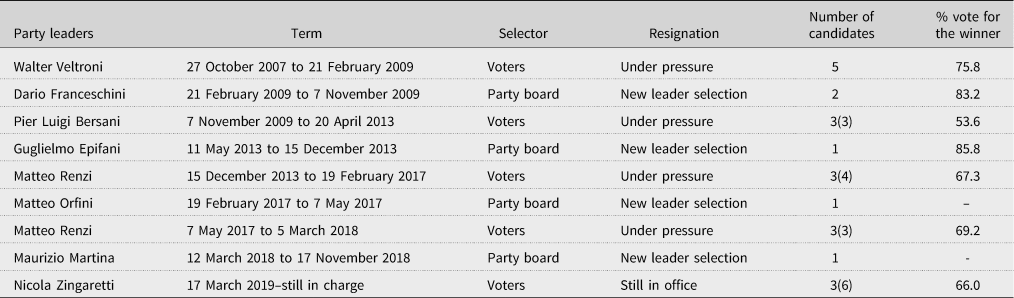
The selection of the PD's leader follows a multistage process (Hazan and Rahat Reference Hazan and Rahat2010: 36–37) involving three consecutive selectorates: members first, then voters, and finally the National Assembly.Footnote 2 As shown in Table 1, since its inception in 2007 the PD has featured eight different leaders alternating for nine terms, and none has been able to complete the four-year tenure.Footnote 3 Among them, Dario Franceschini and Guglielmo Epifani were elected by the National Assembly for a limited time after the resignation under pressure of the incumbent leader. Matteo Orfini was appointed as acting leader (‘reggente’). Maurizio Martina was appointed as acting leader for a few months after the resignation of the previous party leader, and then his role was ratified through a formal election by the National Assembly. Therefore, up to now only Walter Veltroni, Pier Luigi Bersani, Matteo Renzi (for two terms) and Nicola Zingaretti have been selected according to the standard procedure reported above (Fasano and Natale Reference Fasano and Natale2017; Pasquino and Venturino Reference Pasquino and Venturino2010, Reference Pasquino and Venturino2014; Rombi and Serricchio Reference Rombi and Serricchio2019; Sandri and Seddone Reference Sandri and Seddone2015).
The Leaders of the PD, 2007–19

Source: Our adaptation from Cospal (Comparative Study of Party Leader).
Note: Number of candidates for the first stage of the leader selection reported in parentheses.
The last two columns of Table 1 provide some descriptions of the leader selections. It should be noted that the first selection – won by Veltroni – was disputed under provisional rules before the approval of the first party statute in 2008. This caveat sheds light on the number of candidates, which exceeds the usual format of the later selections operated through open primaries. The dimension of the National Assembly and the electoral districts was also significantly different, an arrangement which was agreed on in 2009 (Venturino Reference Venturino, Sandri and Seddone2015). More importantly, the last column details one of the simplest measures of competition, the percentage of votes gained by the winner. In general, as often happens when large selectorates are preferred (Kenig Reference Kenig2009), the selection of the PD's leaders has not been competitive. Nevertheless, in all cases, a substantial share of selectors have been ‘losers’ inasmuch as they voted for a defeated candidate. Referring to primaries, percentages of losers span from 24.2% in 2007 to 46.4% in 2009.
Data and methods
Apart from American primaries (e.g. Buell Reference Buell1986; Johnson and Gibson Reference Johnson and Gibson1974; Miller et al. Reference Miller, Jewell and Sigelman1988; Southwell Reference Southwell1986, Reference Southwell1994, Reference Southwell2010), there are very few survey data about open primary selectors.Footnote 4 As mentioned above, the primary effect on general elections is usually investigated by means of aggregate data. This is at least in part due to the difficulties related to individual-level data collection in the primary election. Nevertheless, when the aim is to tackle the selectors’ attitudes after the primaries, relying on survey data appears to be a more efficient approach. Survey studies are useful tools, but in the case under examination they pose complicated methodological problems. Indeed, given that primary election voters are often a small percentage of the general electorate, identifying them via conventional survey methods poses severe difficulties, and obtaining a reasonable sample size of respondents may be particularly expensive. In order to solve these problems, literature from the US suggests that exit polls are a reliable tool for investigating selectors’ attitudes and opinions (Geer Reference Geer1988; Hirano et al. Reference Hirano, Snyder and Ansolabehere2010; Levy Reference Levy1983), since all the respondents are without question actual primary voters as they are interviewed immediately after having cast their ballots. Furthermore, as underlined by Alan Abramowitz (Reference Abramowitz1989), the exit poll procedure offers several advantages for investigating voting behaviour in primary elections. Indeed, telephone or web survey techniques require that selectors be interviewed either before the primary – when they may not have reached a final decision – or a while after the primary, when their attitudes may have been modified by exposure to information about the results of the primary (Atkeson Reference Atkeson1999). Conversely, exit polls allow candidate preferences and other attitudes to be registered, avoiding any possible contamination coming from information about the outcome. This issue is particularly relevant when addressing selectors’ opinions about candidates’ nomination prospects and electability.
In our case, given that we have to approach open selections, this methodological choice is even more appropriate. The PD, as underlined above, adopts the highest level of inclusiveness. As well as all Italian voters,Footnote 5 foreign citizens and Italian young people of 16 and 17 years are allowed to participate. As a result, the primary selectorate is larger than the electorate of the general elections. Since no mandatory pre-registration is required, there is no way to have a precise identification of the cohort analysed. Waiting for selectors outside the polling station is thus the only practical way to collect reliable information on their attitudes, opinions and voting choices.
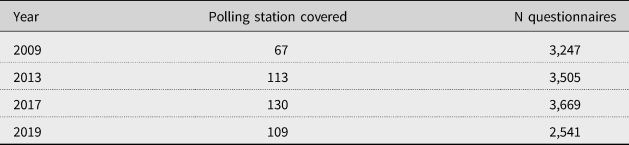
This study relies on four exit polls organized during the PD open leadership selections held in 2009, 2013, 2017 and 2019. To get adequate coverage, the number of interviews to be administered at the national level was set at 3,500. However, in 2019 due to the declining turnout in primary elections, the quota was decreased to 2,500 interviews. The total number of questionnaires was then distributed throughout the 20 Italian regions according to two different criteria: the resident population and the number of votes obtained by the party in the parliamentary election preceding each leader selection. After that, the assigned share of questionnaires was distributed within each region, distinguishing between major cities (capoluoghi di provincia) and small towns.
Polling stations to be covered were chosen according to a convenience criterion. The interviewers – trained students who did not receive any payment for their service – received information from local party officials about the best polling stations in terms of the likely level of turnout and heterogeneity of voters (Table 2). Results of the exit polls have usually been close to the real outcome of the leadership selection, seemingly warranting data reliability.Footnote 6
Details on Exit-Poll Data Collection

Variables
Our hypotheses have been tested through a logit model examining each leadership race separately. We have opted for this strategy rather than a pooled analysis in order to better address the different competitive patterns. In all cases, the dependent variable is a dummy reporting the selectors’ vote intention in the next parliamentary election (‘Vote intention in general elections’).Footnote 7 This variable scores 1 when selectors declare they are sure to support the PD, no matter the result of the primary race, while it scores 0 if they report they are still undecided or they have no intention of supporting the party.Footnote 8
To test the hypotheses presented above, we rely on a set of independent variables. We consider the selectors’ primary vote through a dichotomous variable (‘Vote in leadership selection’), scoring 1 when they have supported the selected party leader (‘Vote for the winner’) and 0 where they have supported a defeated candidate (‘Vote for one of the losing candidates’). Then we include a variable estimating the ideological distance (‘Ideological distance’) between selectors and party. The individual ideological placement has been measured for each selector on a 1–10 scale, where 1 means extreme left and 10 extreme right. Unfortunately, given the lack of a question referring specifically to the ideological placement of the PD, we had to compute this measure as the average placement of all selectors. The ideological distance between each selector and the party was thus calculated as the difference in absolute value between the self-placement of the selector and the party (invariant) placement, as follows:
 $$ideological\;distance = \left\vert {ideo_{ind}-\left({\displaystyle{{\mathop \sum \nolimits_{ideo_{ind} = 1}^n ideo_{ind}} \over n}} \right)} \right\vert , \;$$
where ideo ind represents the ideological self-placement of the respondent.
The third independent variable refers to the selectors’ involvement with the party (‘Relationship with the party’). As emphasized above, literature on US primaries addressed this dimension by relying on data referring to selectors’ activism (e.g. involvement in election campaign, canvassing for a candidate, etc.). Unfortunately, information on selectors’ activism is not available to us. Given that participation was allowed for both party members and sympathizers, as well as independents, a univocal measure was difficult to identify. While party membership may imply participation in activities promoted by the party on a routine basis, sympathizers are less likely to attend that kind of meeting since their involvement in partisan activities is occasional, limited to the electoral context or cognitive mobilization. The latter applies in pretty much the same way for independents. Therefore, we operationalized the selectors’ linkage with the party organization, distinguishing between party members, party voters and independents. This choice is also supported by studies focusing on a non-US case that shows quite clearly that attitudes towards primaries depend on the type of relationship with the party, namely, having a formal enrolment or not (see Close and Kelbel Reference Close and Kelbel2019; Close et al. Reference Close, Kelbel and Van Haute2017). Accordingly, a new variable was computed from two items tapping the formal enrolment and the vote in the last parliamentary election.Footnote 9 Combining both variables, originally measured in dichotomous form, we distinguished between ‘independents’, selectors who are not party members and did not previously vote for the PD (= 0); ‘sympathizers’, selectors who voted PD in the last parliamentary election but who are not formally enrolled (= 1); and ‘members’, all selectors who are formally enrolled (= 2). It should be noted that by crossing the two variables in dichotomous form we obtain four theoretical cases.Footnote 10 Indeed, beyond the three cases defined above, there are selectors who are enrolled, but did not vote PD in the last parliamentary election. Of course, party members may have good reasons for voting against their own party (Polk and Kölln Reference Polk and Kölln2018). However, in the cases under examination we are dealing with PD members who also attend the primaries promoted by the PD; therefore, we consider their earlier defection as a random occurrence, and in the last analysis we collapse them together with all other (non-defectionist) party members.Footnote 11
Finally, models include a measure of the selectors’ evaluation of the new leader (‘Evaluation of the new party leader’); precisely, this variable accounts for a comparative evaluation of the winner. It has been calculated as the difference between the evaluation provided for the candidate supported in primary elections and the evaluation of the new party leader selected via open procedure. Both measures have been assessed using a 1–10 scale. As a result, negative values indicate that selectors face an unwelcomed leader; thus, they have a stronger incentive for deserting their own party. Conversely, when the variable scores 0 or any positive value, it means that selectors share a positive evaluation of the new elected leader, meaning they have no incentive to vote against the PD in the following parliamentary election. Finally, we include age, gender and education as a set of variables controlling for the sociodemographic dimension.Footnote 12
Results
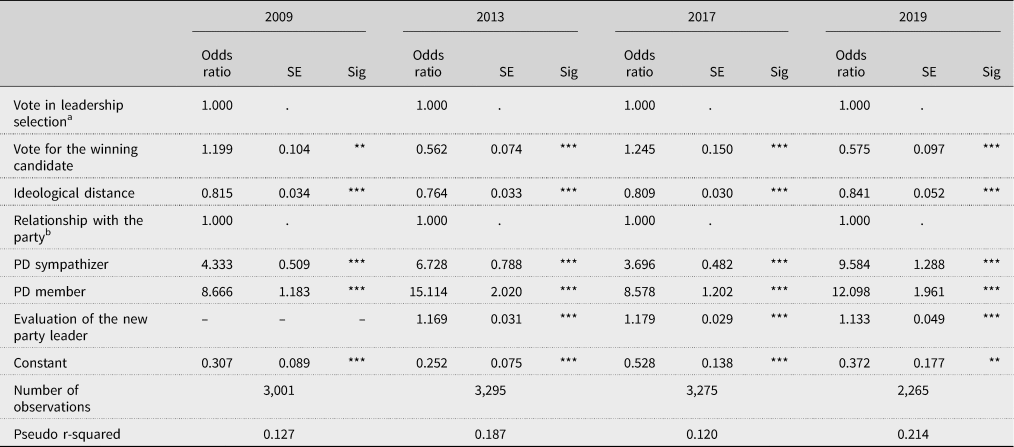
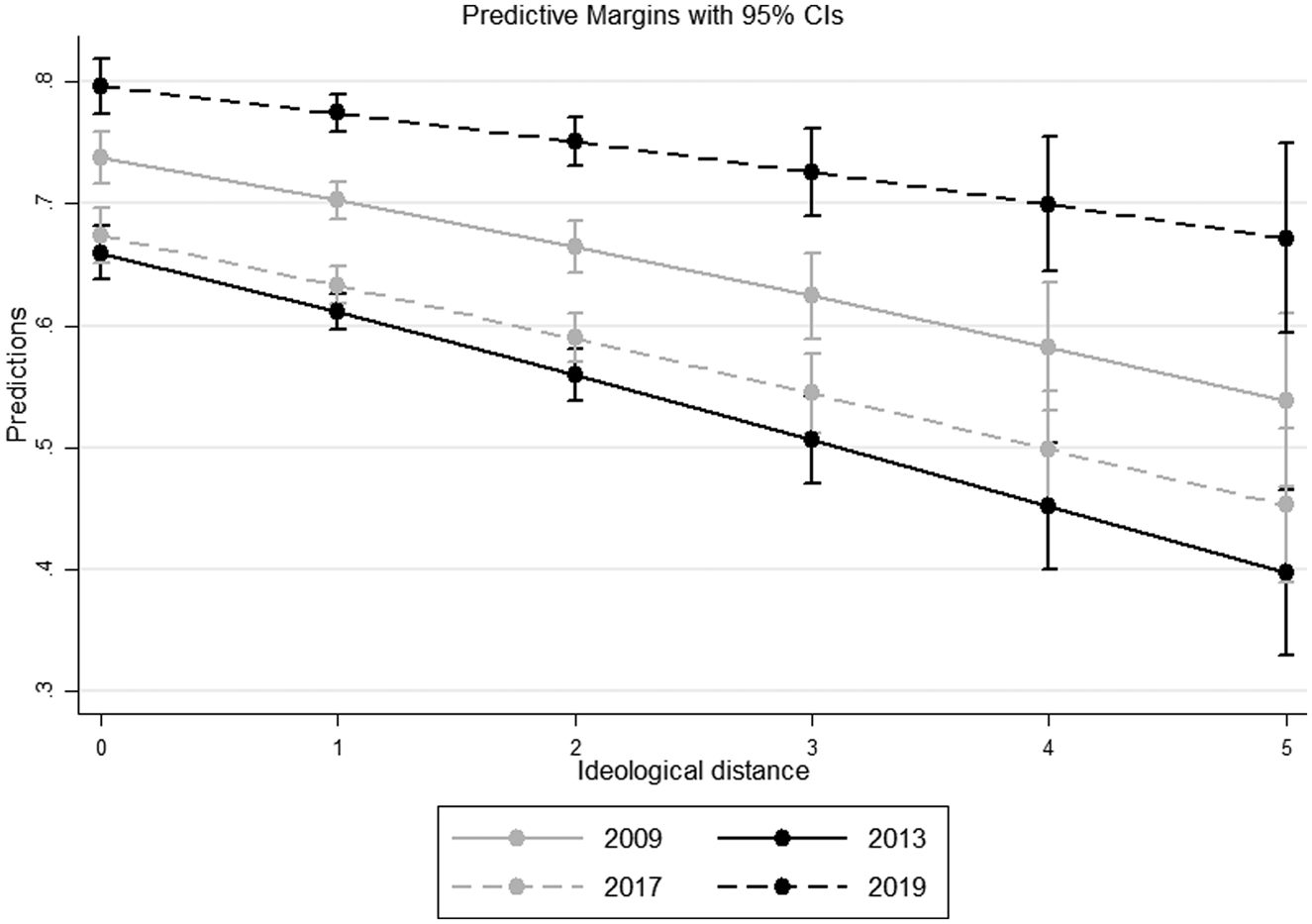
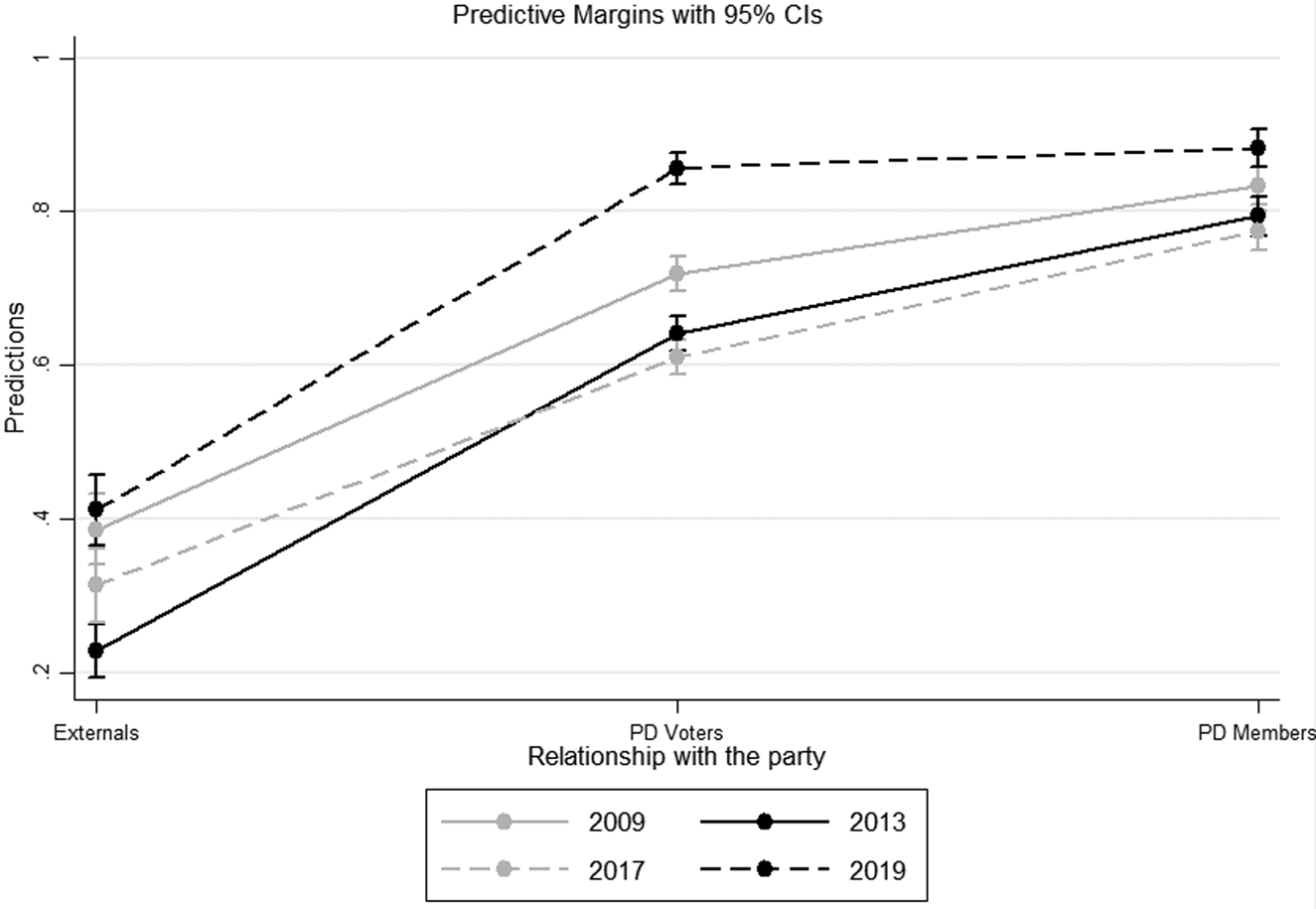
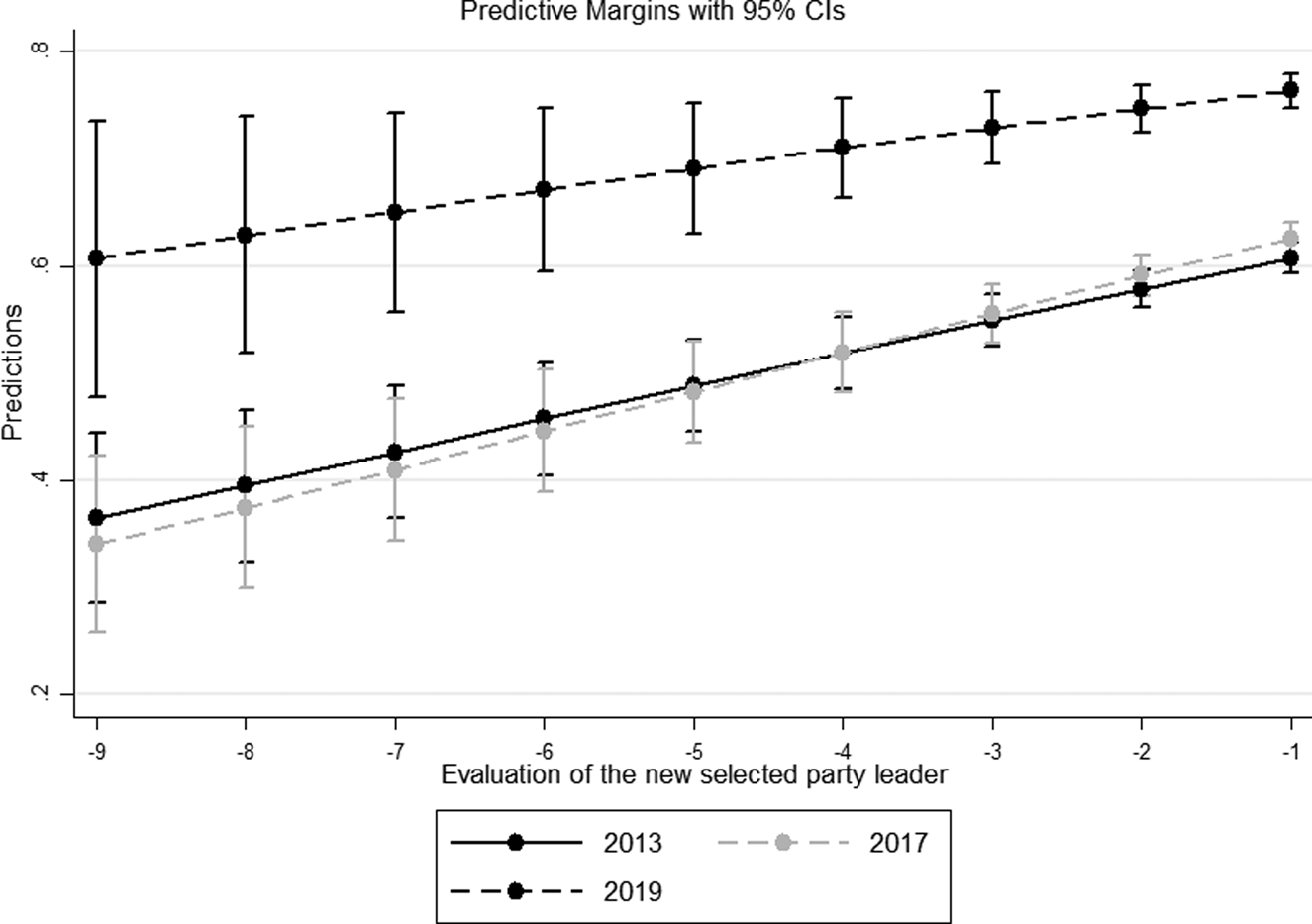
Table 3 illustrates the results from four multivariate logit analyses detailing the dynamics of loyalty and disloyalty for each race. For better readability of the results, we also provide plots for the predicted probabilities for each of the independent variables included in the models (see Figures 1, 2, 3 and 4).Footnote 13 In general, our analyses reveal consistent dynamics underpinning the selectors’ strategies in view of the general elections for all the selections. Only one exception identified disgruntlement generated by the defeat of a preferred candidate. First of all, in 2009 and 2017, supporting the winning candidate predictably implied a higher likelihood of a loyalist vote in the following parliamentary election. However, coefficients for 2013 and 2019 tell precisely the opposite story. In these cases, selectors supporting the winner were less likely to support the party in a general election when their candidate failed in the primaries. For all the leadership races included in our study, odds ratios are significant, suggesting that disgruntlement may be a factor affecting the selectors’ attitudes after primary elections. In summary, these figures are inconsistent in the four races and they do not entirely support our first hypothesis (H1). Meanwhile, the good fit of the three models suggests that, beyond disgruntlement, other factors may drive selectors in general elections. Indeed, moving to the other variables considered, we observe that other factors emerge as more relevant in driving selectors’ attitudes. In particular, we observe that ideological positioning noticeably affects voter intention in subsequent parliamentary elections. Regression coefficients related to ideological distance are always negative; therefore, they support our expectations about H2. When the ideological distance between selector and party increases, the likelihood of a loyal vote declines if the supported candidate fails. However, it should be noted that the variance of this variable is quite limited, and that selectors participating in the PD's primaries in general are ideologically quite close to the party.
Covariates of Selectors’ Vote Intention for the Next Parliamentary Election, binary logit model

Notes: *** p < 0.01, ** p < 0.05, * p < 0.1 Reference categories: a = vote for one of the losing candidates; b = independent. Control variables for age, gender and education included, figures not reported here. The full models are reported in Table 8a in the online Appendix.
Predicted Probabilities – Vote in Leadership Selection (Hypothesis 1)

Predicted Probabilities – Ideological Distance (Hypothesis 2)

Predicted Probabilities – Relationship with the Party (Hypothesis 3)

Predicted Probabilities – Evaluation of the New Selected Leader (Hypothesis 4)

For all the four leadership races investigated, the degree of party involvement determines a higher propensity to loyal attitude in general elections, even in cases of setbacks for the candidate supported in primaries. Indeed, compared with independent selectors, the PD's sympathizers are consistently more likely to support the party after the primaries, while loyalty to the PD in general elections is by far the highest for selectors formally registered as party members. This pattern is replicated for all the leadership races, fully supporting H3. Finally, a positive evaluation of the new elected party leader – a variable tested only for 2013, 2017 and 2019 – increases the chances of a vote for the PD. This aspect is particularly important for recovering the thwarted voters supporting a losing primary candidate, and it backs up H4.
Discussion and conclusion
The starting point of this article is one of the most classic questions about the selection of candidates and leaders: Do primaries damage the winner's electoral prospects? While this issue has been extensively researched with reference to American politics, it continues to be relatively unexplored in other political systems. Therefore, our examination of the primaries promoted by the Italian PD, based on survey data, could be considered innovative. Furthermore, as studies on the consequences of primaries’ divisiveness usually exploit aggregate data, the present analysis could also contribute to improving methods of research on this issue.
In reference to the primaries’ divisiveness, we found that supporting a winning or a losing candidate in the primaries does not promote any clear reaction among selectors. In 2009 this distinction fits the conventional wisdom: winners are predominantly loyal, compared with the prevalently disloyal disgruntled losers. A similar pattern is found in 2017, when those supporting the winning candidate are again likely to vote for the PD. However, our findings suggest the opposite for the 2013 and 2019 leadership races. In these cases, indeed, supporters of the newly elected leaders were less likely to vote for the PD than were their party mates supporting the defeated candidates. These counterintuitive findings may be explained by looking at the contexts in more depth. In 2013, despite being atypical, the distribution of the selectors’ attitudes makes sense. Renzi was then 38 years old, lacked any parliamentary experience, and his previous political career had been with the Christian Democrats rather than the post-Communists (Bordignon Reference Bordignon2014). As a consequence of this political and generational renewal, Renzi's supporters in the 2013 primary election were newly involved voters with a weak party socialization, quite ready to defect if their candidate failed. In other words, the 2013 leadership race was perceived as a turning point for the party. At stake was the future of the PD. In this sense, Renzi embodied the idea of a new party able to surmount the traditional ideological legacy and target the moderate electorate. In 2019, again, the selection of the new party leader represented a decisive turn for the PD. Zingaretti, in this case, accounted for a return to the basics after two terms of Renzi's divisive leadership. Those endorsing the winner were firmly and compactly sustaining the need to restore the old ideological and organizational tradition. If the aim was to cancel the experience of the former leader, the failure of their preferred candidate was a sufficient reason to desert the party. Our findings suggest that when the leadership change implies a deep cultural shift, the outcome becomes critical for those supporting the front-runner, whose expectations – in case of failure – lead to exit from the party. However, from an empirical point of view, our first hypothesis is not fully supported by the analyses.
The meagre explanatory power of the selectors’ attitudes generated by the primaries’ results has paved the way for the research of alternative accounts. By so doing, we have first discovered that disloyal attitudes are contrasted by ideology, measured as a distance between party and selectors on a left–right continuum: when a selector is ideologically closer to the PD, the likelihood of a loyal vote in the following parliamentary election increases. Successively, we have considered the selectors’ involvement with the PD. In this case, selectors are more likely to support the PD in the next parliamentary elections when they are routine party voters and, above all, when they are enrolled members. Conversely, independents are, ceteris paribus, more prone to desert the party. Finally, we found that when a selector assesses the newly selected leader positively, the propensity to be loyal increases even if an alternative primary candidate was supported. In general, our findings suggest that voters’ political reasoning in a multistage election is mainly affected by partisan involvement, leader evaluation and ideological positioning. Conversely, the disgruntlement prompted by supporting a defeated primary candidate is unrelated to selectors’ voting intentions.
On one hand, the empirical analyses presented above prove that the multifaceted relationships between party, leader and (different types of) selectors may contribute to the fortunes of the party in the general elections in a so-far unpredicted way. On the other hand, while this article sheds some light on primaries outside the US, some possible limitations should be considered carefully. First, while candidate recruitment is immediately related to general elections, the leader selections examined here maintain a less direct link. This may be due to time disconnection. For instance, the selectors voting in the December 2013 primaries entered the following parliamentary election only in March 2018. Moreover, although the PD statute imposes the party leader as the only candidate for the role of prime minister, the 2018 election clearly shows that the enforcement of this rule is far from sure (Garzia and Venturino Reference Garzia and Venturino2018). Second, because of untenable research costs, we have relied on convenience, non-random samples of polling stations and non-professional interviewers to implement the exit polls. These minor issues may diminish data quality. Yet, the results contribute to enlarging knowledge about post-primary selectors’ attitudes and offer an original overview of primaries in a non-American context.
The main independent variables we have made use of were meant to tap two aspects. Ideology and whether selectors were party members, sympathizers or independents are dimensions related to party organization and relationships between party and participating citizens; conversely, the selectors’ status of winner/loser and their evaluation of the elected party leader relate to the primaries’ electoral process. Available literature on the US primaries for candidate selection has mainly focused on the latter. This approach may be explained by the very nature of the US parties, usually reported to be mere electoral machines lacking a strong organization, and by the early practice of candidate-centred politics that has arisen in the US (Wattenberg Reference Wattenberg1991). We have analysed whether, when primaries are practised in a non-American milieu, other variables may become relevant. After this recognition, a couple of recurrent characteristics of many European parties – a discernible ideological standing and an extended membership – have demonstrated that they contrast selectors’ attitudes towards exit as a consequence of the primaries’ results.
Supplementary material
To view the supplementary material for this article, please go to https://doi.org/10.1017/gov.2020.24
Acknowledgements
We thank the anonymous referees for their useful suggestions. We also thank the Candidate & Leader Selection – a standing group of the Società Italiana di Scienza Politica – that coordinated the data collections that made this study possible.